Article

Study on Instantaneous Leak Diffusion Characteristics of Heavy Gas Under Wind Speed Control and Modification of Cloud Cluster Radius Prediction Model


College of Energy Environment and Safety Engineering, China Jiliang University, Hangzhou 310018, China
*
Authors to whom correspondence should be addressed.
Symmetry 2026, 18(3), 401; https://doi.org/10.3390/sym18030401
Submission received: 14 January 2026 / Revised: 10 February 2026 / Accepted: 21 February 2026 / Published: 25 February 2026
(This article belongs to the Section Physics)

Abstract

The diffusion process of heavy gas during instantaneous leakage is significantly influenced by wind speed. Accurately characterizing the coupling relationship between wind speed and heavy gas diffusion is crucial for accident risk assessment and emergency response. Based on the Thorney Island 008 test, this study employs computational fluid dynamics (CFD) numerical simulation to construct a gas leakage diffusion model. Through grid independence verification and comparison with measured data, the optimal simulation scheme is determined. Design five wind speed conditions of 0.5 m/s, 1 m/s, 3 m/s, 6 m/s, and 10 m/s to investigate the division of heavy gas dispersion phases, the cloud radius modification model, and the spatiotemporal distribution characteristics of downwind concentrations. The study clearly identifies that heavy gas leakage dispersion can be divided into three stages: gravity diffusion, density stratification, and passive diffusion. By introducing a dimensionless wind speed correction term to improve the cloud plume radius prediction model, the validation results show that the calculated values from the modified model align with the trend observed in CFD simulations. Under all wind speed conditions, the maximum relative error remains within 10%. Downwind gas concentration distribution characteristics reveal that in the near-source areas (25 m, 100 m), higher wind speeds correlate with higher peak gas concentrations and shorter peak arrival times. Conversely, in the mid- and far-field zones (200–500 m), lower wind speeds are associated with higher peak gas concentrations and longer peak arrival times. The cloud radius modification model proposed in this study enables the prediction of heavy gas cloud radii under varying wind speeds within specific conditions. The revealed characteristics of the diffusion phase and the spatiotemporal distribution patterns of gas concentrations provide scientific basis for risk zoning and emergency response planning in heavy gas leakage incidents.

1. Introduction

The use and transportation of heavy gases are widespread in the production and storage processes of the chemical and energy industries. Because their density is much greater than that of air, instantaneous releases of heavy gases rapidly generate high-concentration clouds that spread into surrounding areas and develop complex spatial patterns. These clouds tend to accumulate in low-lying terrain, where areas without early warning or emergency preparedness are especially susceptible to severe consequences [1,2,3]. Compared with leaks of solids or lighter gases, heavy-gas releases pose substantially greater risks to the environment and to humans, animals, and plants. For instance, in the 1984 Mexico City LPG tank accident, a vapor cloud leaked and, under low wind speed conditions, spread along the terrain into residential areas 1.5 km away, ultimately triggering a catastrophic explosion that caused 542 fatalities [4]. These cases underscore the extreme sensitivity of heavy gas dispersion to wind speed conditions and the critical importance of quantifying wind effects for predicting accident consequences.
Ambient wind speed as a key meteorological parameter, not only alters the transport path of vapor clouds through advection but also significantly influences plume rise height, ground-level concentration distribution, and the extent of hazardous zones through its interaction with gravitational settling of heavy gases [5]. Yang [6] found that wind speed significantly affects the hazard range of H2S, with terrain factors and initial mass flow rate also impacting ventilation. Zhao [7] used numerical simulations to investigate the effects of different ambient wind speeds and release heights on chlorine dispersion in obstacle-laden environments, and found that under calm or 3.6 m/s winds, chlorine concentrations in the leeward area tended to saturate, with higher saturation under calm conditions, while at 10 m/s, concentrations increased firstly and then decreased. Qian [8] discovered that wind significantly affects hydrogen leakage and diffusion. Compared to conditions where wind aligns with the leak direction, opposing winds can enlarge the flammable gas cloud. Higher wind velocities confine the cloud to a smaller area yet promote the formation of a recirculation zone near obstacles. As wind speed increases, this zone shifts downward along the obstacle, leading to more pronounced hydrogen accumulation nearby. Zhu [9] investigated LNG dispersion in a wind field model using Fluent simulations, and found that due to gravity, LNG vapor initially formed high-concentration clouds near the ground, while wind speed and turbulence affected the downwind dispersion distance. Wang [10] considered seven hydrogen release scenarios under different wind directions and speeds, and found that with increasing wind speed, the horizontal distribution of hydrogen clouds changed markedly, while the maximum dispersion height at the lower explosive limit decreased, and the vertical distribution at the explosive limit first declined and then increased. Labovesky [11] determined the time series of meteorological conditions such as wind speed, wind direction, and source strength based on experimental measurements, using these as inflow boundary conditions. Furthermore, periodic boundary conditions were applied on both side boundaries to more accurately simulate the airflow within the computational domain and achieve the desired atmospheric stability. Zhou Z [12] analyzed the variation in HF leak dispersion concentrations over large-scale complex terrain under wind speeds of 0.2–5.4 m/s, temperatures of 293–313 K, and varying wind directions and humidity conditions. Results indicate that increased wind speed expands the hazardous zone for high-frequency gases across large-scale complex terrain. Elevated terrain features effectively block gas diffusion, promoting dilution of toxic gases downwind. When ambient temperature rises from 297.15 K to 315.15 K, the lethal injury area increases by 7% and the severe injury area by 5%. Higher environmental humidity reduces the hazardous zone. Tang [13] introduced the Richardson number to describe the relationship between buoyancy and inertial forces, discovering that the buoyant stratification pattern was divided into three regimes. At regime I (Ri > 2.0 or Fr < 0.66), the buoyant stratification was stable and with a clear interface between the upper buoyant flow layer and the lower air layer. At regime II (1.4 < Ri < 2.0 or 0.66 < Fr < 0.8), the buoyant stratification was basically stable, but some vortexes existed at the interface. At regime III (Ri < 1.4 or Fr > 0.8), a strong mixing existed between the upper buoyant flow and the lower air flow, that the buoyant flow stratification became unstable. Although some studies have quantified the influence of wind speed parameters on gas leak dispersion, existing research still lacks a systematic understanding of the linear relationship between wind speed and heavy gas leak dispersion. Particularly in instantaneous leak scenarios, the regulatory mechanism by which wind speed modulates changes in heavy gas plume size remains incompletely elucidated. To achieve accurate simulation of heavy-gas dispersion, computational fluid dynamics has been widely applied [14]. Based on the Reynolds-averaged Navier–Stokes equations, CFD models solve the conservation of mass, momentum, and energy, while incorporating complex geometries and physicochemical phenomena. Despite their computational cost, CFD simulations demonstrate significant advantages for studying heavy-gas leaks and dispersion in complex environments [15,16,17,18].
Based on this, this study aims to utilize CFD numerical simulations to delineate the heavy gas dispersion phase, refine the cloud radius prediction model, and elucidate the regulatory patterns of wind speed on downwind concentration distribution, thereby providing theoretical support for related accident risk assessments.

2. Mathematical Models and Numerical Simulation Methods

2.1. CFD Computational Fluid Dynamics Model

Computational Fluid Dynamics relies on the Navier–Stokes equations, which are discretized numerically to resolve fluid motion. The method transforms continuous physical fields into discrete point variables and establishes algebraic relations among them, thereby enabling the approximate solution of field variables. This numerical framework provides an effective means of simplifying the analysis of complex physical phenomena. In the case of gas leakage, atmospheric dispersion involves a three-dimensional, transient flow coupled with heat and mass transfer. By solving the fundamental governing equations including continuity, momentum, and energy conservation the spatial distribution and temporal evolution of physical quantities within the flow field can be quantitatively characterized [19].
(1) Fluid mechanics governing equations
Gas diffusion follows fluid flow, governed by the continuity equation, momentum equation, and energy equation.
u x + v y + w z = 0
ρ u i t + x j ρ u i u j = p x i + x j μ u i x j + ρ ρ a g i
ρ T t + x j ρ u i T = x j k c p T x j + S T
where μ is the dynamic viscosity of the fluid, g is the gravitational acceleration, P is the absolute pressure, ρ a is the density of air, cp is the specific heat capacity, T is the temperature, k is the thermal conductivity coefficient of the fluid, and ST is referred to as the viscous dissipation term.
(2) Turbulence models
Gas leakage and diffusion in the atmosphere is a non-steady turbulent flow pattern. The characteristic of turbulent motion is that during the motion, fluid particles exhibit continuous and random mixing phenomena, and physical quantities such as velocity and pressure show random pulsations in both space and time. At present, no single turbulence model can accurately simulate all types of turbulent flow, and typically, a specific model is more appropriate for simulating particular turbulent phenomena. Therefore, incorporating an appropriate turbulence model into computational fluid dynamics (CFD) simulations is critical. Tauseef [20] pointed out the critical importance of the effect of turbulence. This group compared the predicted concentration profiles resulting from various CFD turbulent models with actual findings (Trial 20 of the Thorney Island series of tests) [21], concluding that the realizable K-ε model was the best. Therefore, the k-ε model is more suitable for the study of heavy gas leakage and diffusion problems.
The mathematical formulation of the k-ε model is provided as follows:
ρ k t + ρ k u i x i = x i μ + μ σ k k x j + G k ρ ε
ρ ε t + ρ u i ε x i = x j μ + μ σ ε ε x j + ρ C 1 E ε ρ C 2
Here, k denotes turbulent kinetic energy, T refers to time, ui denotes velocity components, xi represents spatial coordinates, μ is the dynamic viscosity, σ k is the turbulent compressibility coefficient, Ε denotes the turbulent dissipation rate, C1 and C2 are the model constants, and σ ε are the turbulent compressibility coefficients.

2.2. Geometric Model Development and Mesh Independent Verification

2.2.1. Geometric Model Development

The Thorney Island full-scale experiments systematically investigated the dispersion dynamics of heavy gas clouds, offering essential datasets for assessing the consequences of industrial leakage accidents [22]. In particular, Trial 008 employed a precisely engineered release system and high-resolution monitoring techniques to capture the transient evolution of heavy gas dispersion, with experimental parameters summarized in Table 1. Building on Trial 008, the present study develops a three-dimensional transient CFD model using FLUENT to reproduce and analyze the dispersion process.
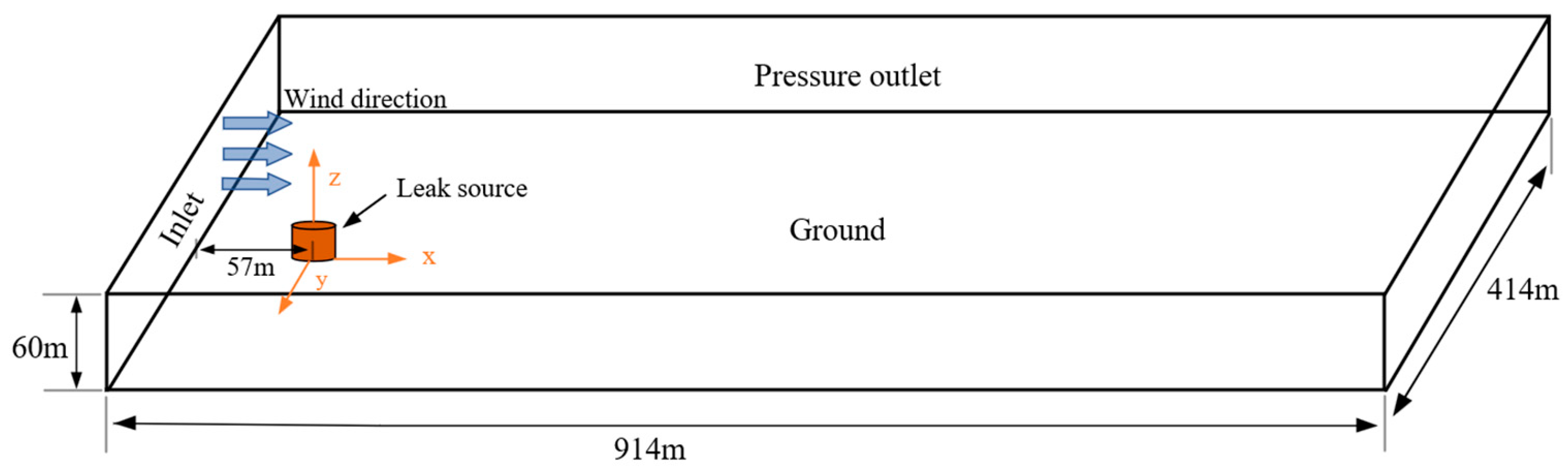
In open-atmosphere dispersion simulations, the size of the computational domain must strike a balance between numerical efficiency and physical fidelity. Oversized domains substantially increase grid numbers and computational cost, whereas undersized domains may induce outlet backflow, violate mass conservation, and introduce concentration biases due to insufficient flow development. In this study, domain configuration is determined with reference to the Thorney Island Test 008 field conditions. The x-axis is aligned with the prevailing wind direction, the y-axis defined as lateral, and the z-axis vertical. The computational domain is defined using the characteristic length ratio method: Along the flow direction (x-axis), the total length is 914 m, with the velocity inlet boundary at x = −57 m and the pressure outlet boundary at x = 857 m. Across the lateral direction (y-axis), the total width is 414 m, spanning from y = −207 m to y = +207 m. The total vertical (z-axis) height is 60 m, with the ground boundary at z = 0 m and the top surface at z = 60 m. The center of the leakage source model is located at coordinates (0, 0, 7), 57 m along the x-direction from the inlet boundary. The numerical calculation model is shown in Figure 1.

2.2.2. Boundary Conditions and Initial Settings

In CFD simulations, appropriate boundary conditions must be specified for the computational domain, as they strongly affect the accuracy of the results. To minimize modeling errors, boundary parameters should be configured to closely reflect real atmospheric conditions.
(1) Inlet boundary
The inlet was defined as a velocity boundary. Turbulence intensity is 5%, and turbulence length scale is 1 m [23]. Owing to surface friction, wind speed diminishes near the ground, and the vertical wind profile within a neutral atmospheric boundary layer is generally represented by either the power-law or logarithmic law [24]. In this study, the inlet wind velocity was prescribed using the power-law function.
u z = u 0 × z z 0 λ
where Uz is the wind speed at the inlet boundary at height z (m/s); U0 is wind speed at height Z0 = 10 m, λ is wind shear exponent, the value is 0.2.
(2) Outlet boundary
The outlet boundary was defined as a pressure outlet, with the static pressure specified as ambient pressure (gauge pressure p = 0). Turbulence parameters were treated using zero-gradient extrapolation. The intensity of the backflow turbulence is 5%, and the viscosity ratio of the backflow turbulence is 10%.
(3) Leak source
The leakage source was modeled as a gas mixture consisting of 58% Freon-12 and 42% N2 by mass fraction.

2.2.3. Mesh Generation and Independence Verification

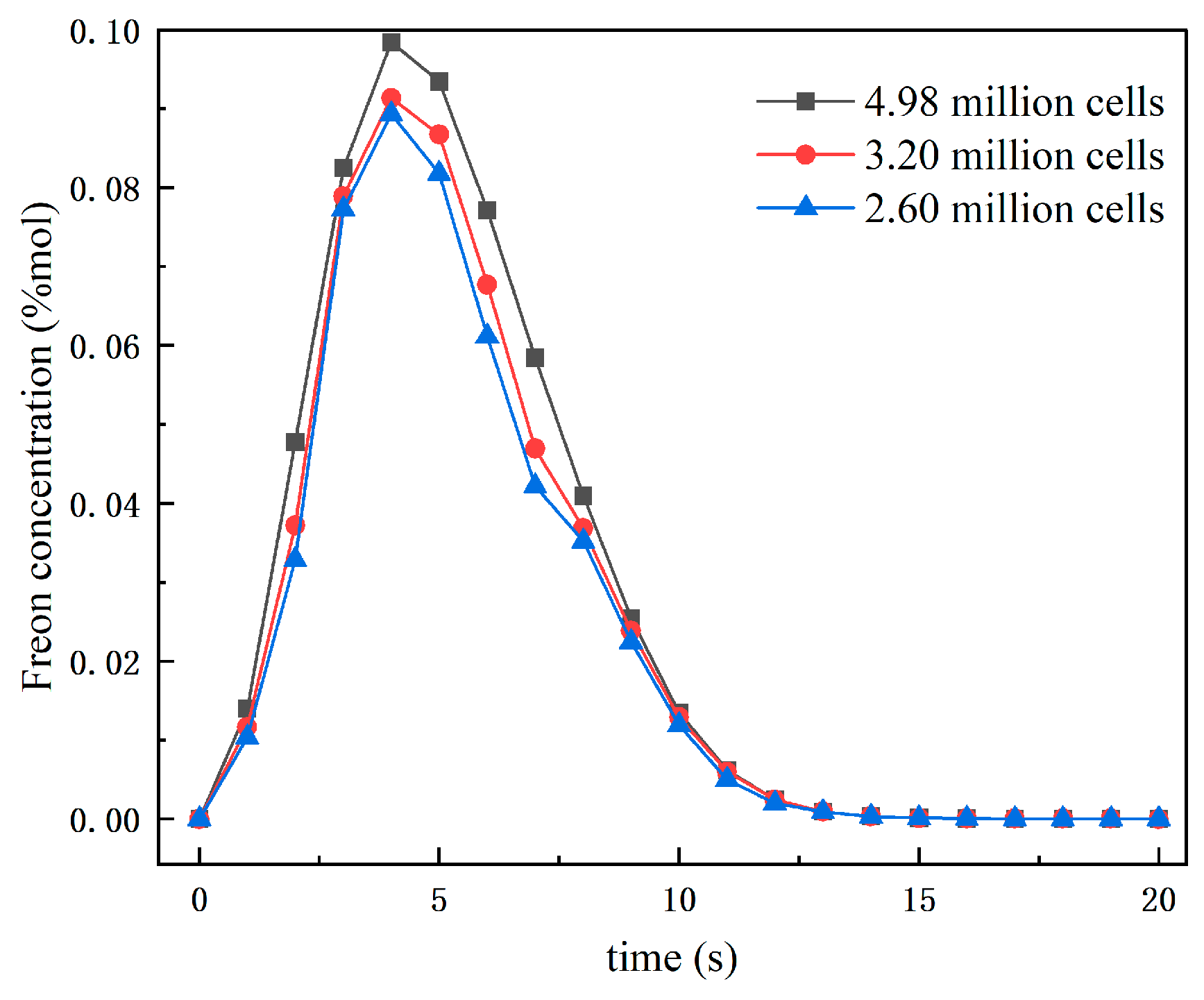
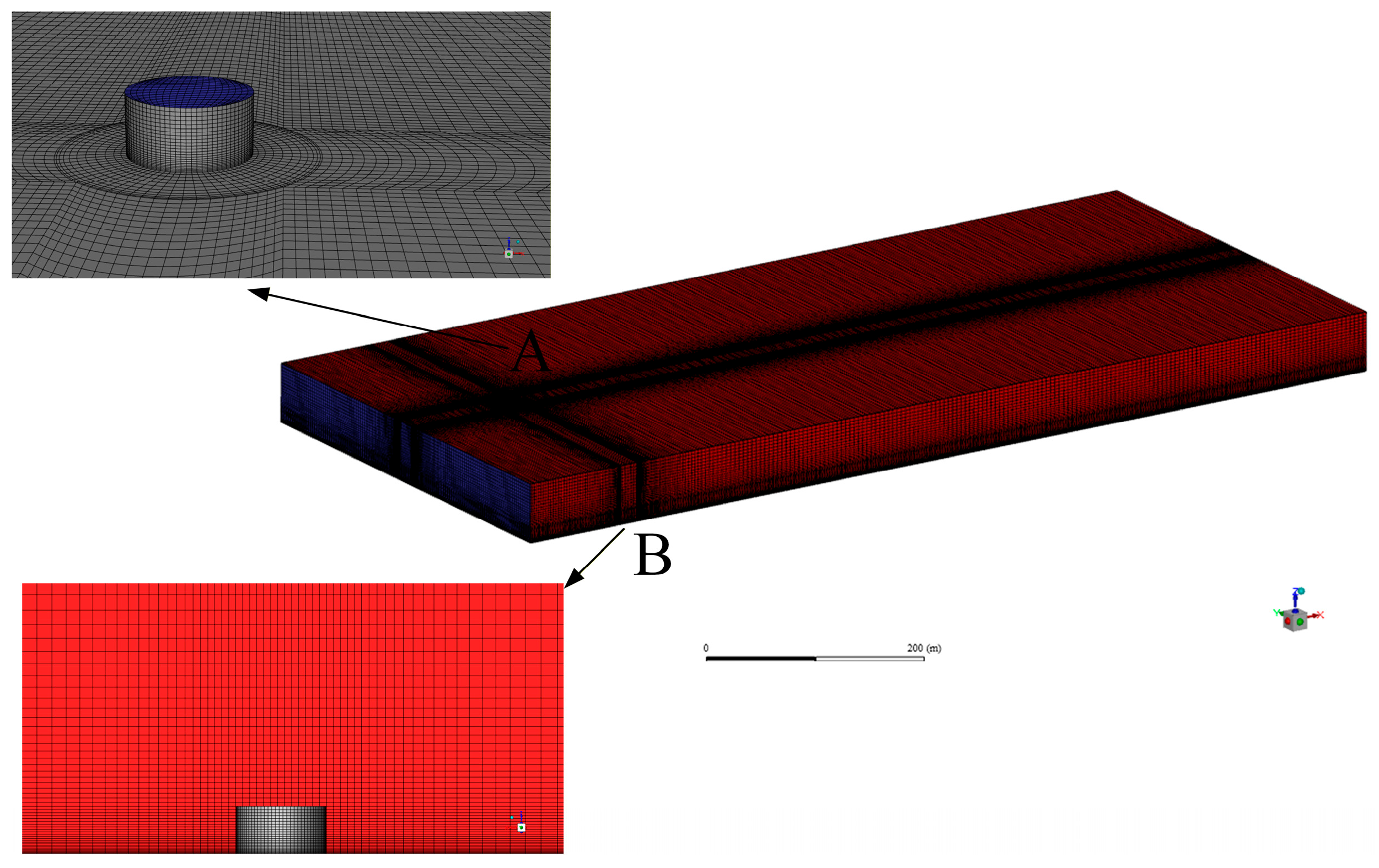
The quality of the computational mesh significantly affects both efficiency and accuracy. To ensure that the results were independent of mesh resolution while maintaining computational efficiency, three grid levels were generated for mesh independence verification (Table 2). Figure 2 illustrates the mesh sensitivity curves of Freon concentration at the monitoring point (x = 20 m downwind, z = 1.6 m) during 0–20 s. Based on the local mesh sensitivity criterion, the relative deviation of concentration (ΔC) for the medium- and coarse-resolution meshes was less than 3% at t = 4 s, which is within the mesh independence threshold of ΔC < 5% defined by ASME V&V 20-2009 [25]. This indicates that both flow field characteristics and concentration distributions achieved mesh-independent solutions. The medium-resolution mesh was therefore selected as the optimal scheme, The mesh structure and refined regions are shown in Figure 3. A gradient-based adaptive sizing function was employed to ensure smooth mesh transitions. Local refinement was applied in regions with steep physical gradients, including the near-source zone and the atmospheric boundary layer, with a minimum cell size of 0.005 m and a growth rate limited to 1.05, as shown in area A in Figure 3. In contrast, the far-field region was progressively coarsened with a maximum cell size of 5 m, as shown in area B in Figure 3. This approach preserved the resolution of the leakage plume while reducing the total cell count by approximately 40%. The final mesh satisfied the orthogonality requirement (Orthogonality > 0.75).

2.3. Reliability Verification and Case Design of the Model

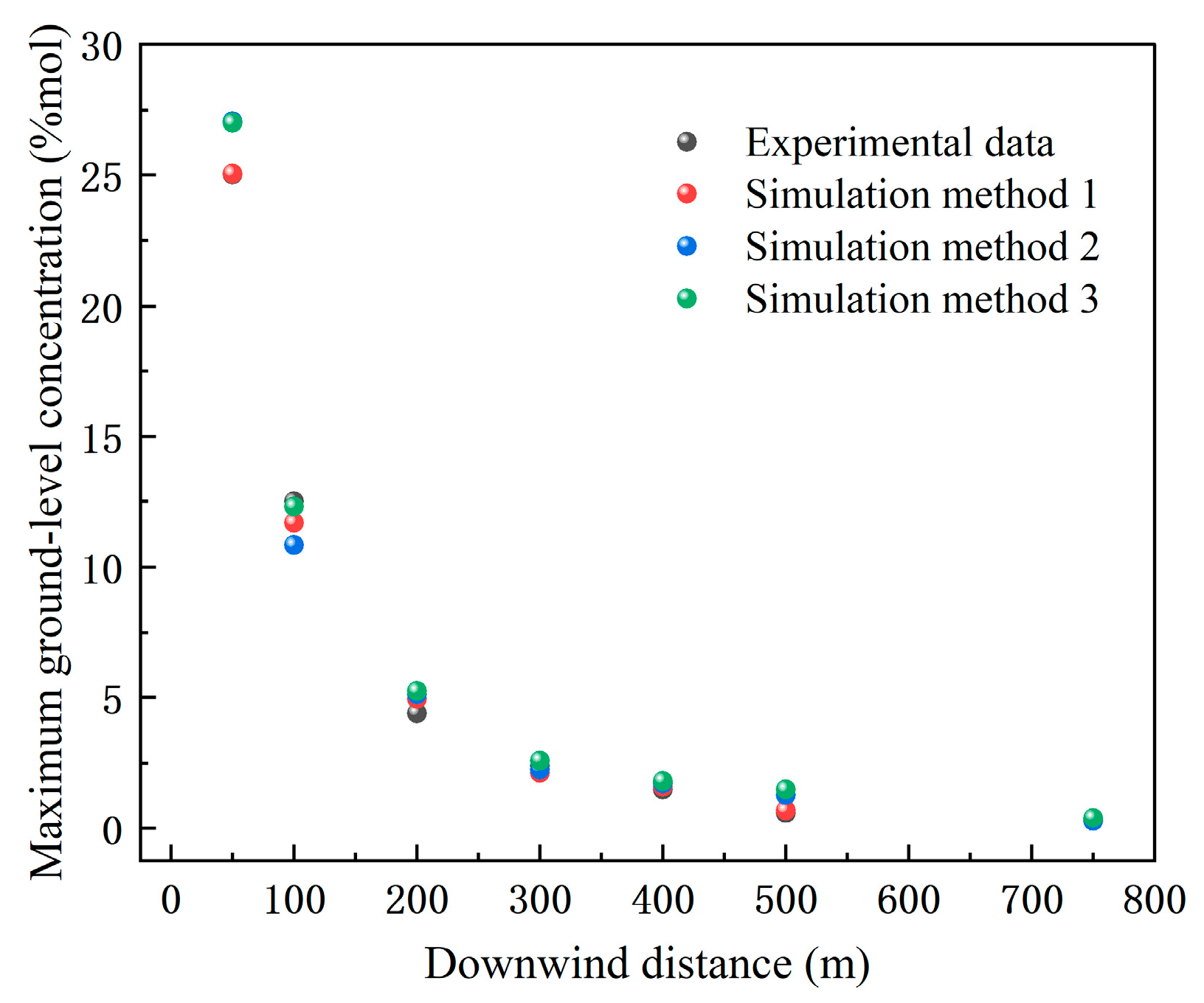
The temporal and spatial variations of Freon concentration were monitored along the downwind axis at distances of 50 m, 100 m, 200 m, 300 m, 400 m, 500 m, and 750 m from the leakage source, corresponding to a ground-level height of 0.4 m. The maximum ground-level concentrations at each monitoring point are presented in Figure 4 and Table 3. This study employed three mainstream k-ε turbulence models for comparative analysis, where simulation methods 1, 2, and 3 represent the Realizable k-ε model, Standard k-ε model, and RNG k-ε model, respectively. By comparing the simulation results with the measured concentration field data, the accuracy and applicability of the model were assessed, thereby validating the effectiveness of the simulation.
Based on the error data presented in Table 3 and Table 4, the predictive performance of the three simulation methods was quantitatively compared. Among them, simulation method 1, adopted in this study, demonstrated a distinct advantage in predicting the maximum ground-level concentrations at fixed downwind positions of the heavy gas plume. In terms of overall deviation characteristics, simulation method 1 exhibited only a slight positive bias, with predictions averaging 2.05% higher than the experimental values. This deviation was substantially lower than the 17.62% and 33.06% observed for simulation methods 2 and 3, respectively. Such a small positive bias holds significant practical value in the field of safety engineering: the moderate overestimation of maximum ground-level concentrations results in a conservative outward extension of hazard zone boundaries relative to the actual dispersion range, thereby providing an effective safety margin. This redundancy introduces an additional safety factor into hazard zoning outcomes, greatly reducing the likelihood of risk misjudgment due to underestimation and offering more reliable technical support for safety management and decision-making in industrial settings.
In terms of mean deviation, the predictions of simulation method 1 differed from the experimental values by 8.44%, remaining well within the 10% error threshold generally accepted in industrial applications. This performance was markedly superior to that of simulation method 2 (17.43%) and simulation method 3 (18.51%). Simulation method 1 is suitable for studying the diffusion of heavy gas during transient leaks.
This study categorizes wind speeds according to the wind speed classification standards specified in the “Guidelines for quantitative risk assessment in chemical enterprises” [26], dividing them into low wind speeds (0.5 m/s, 1 m/s), medium wind speeds (3 m/s), and high wind speeds (6 m/s, 10 m/s). The wind profile exponent is 0.2, with a temperature of 25 °C and relative humidity of 55%. The details of the five simulation scenarios are summarized in Table 5.

3. Results and Discussion

3.1. Classification of Heavy Gas Diffusion Stages

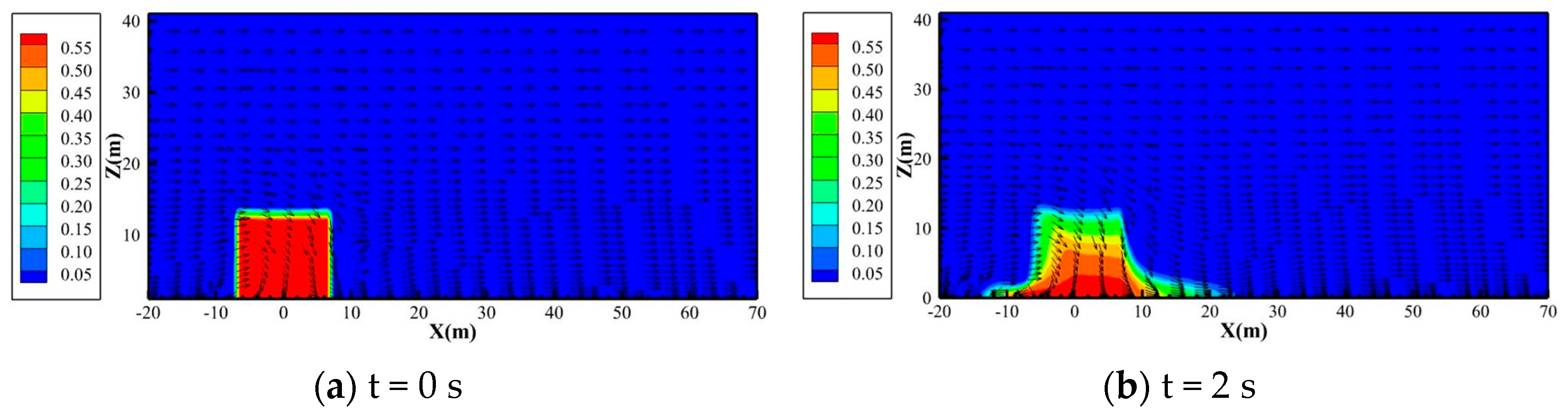
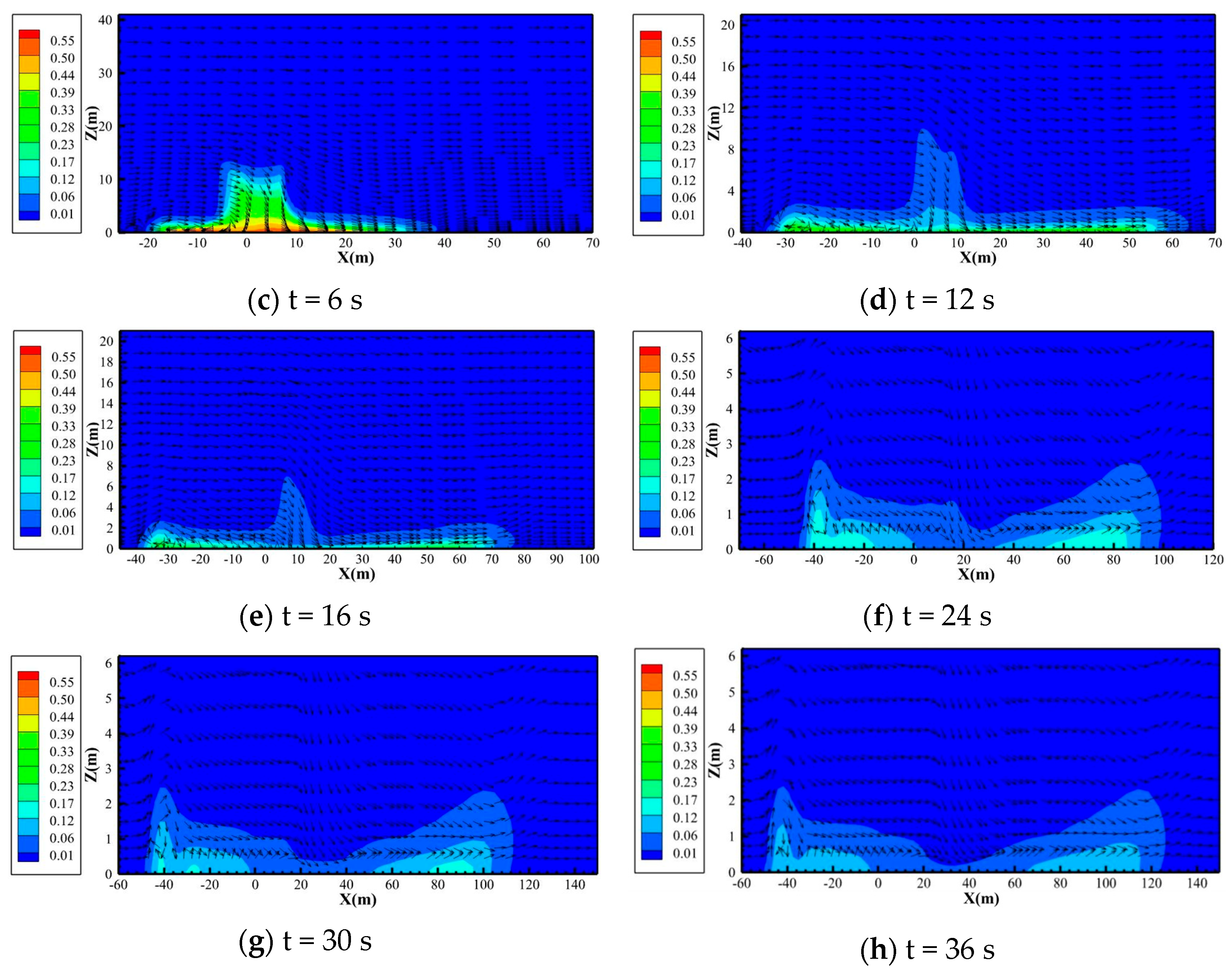
The dispersion of heavy gas after release is a dynamic process, with its governing mechanisms undergoing significant transitions as cloud concentration and density evolve. In the gravity-dominated stage, the dense gas cloud undergoes pronounced settling and radial spreading under the influence of gravity, with cloud motion primarily controlled by gravitational forces. As entrainment and dilution by ambient air progress, cloud density decreases and gravitational effects weaken, leading the dispersion process to gradually shift toward dominance by wind momentum and atmospheric turbulence. Once the cloud density approaches that of air, its behavior resembles that of a neutrally buoyant plume, entering the passive dispersion stage fully governed by turbulence. Accordingly, the dispersion process of heavy gas can be divided into three stages: the gravity-dominated stage, the density stratification stage, and the passive diffusion stage [27]. Figure 5 illustrates the spatial distribution of gas volume concentration in the XZ plane at different time intervals, the direction of the arrows in the figure represents the direction of the gas velocity vector.
(1) The gravity-dominated stage
As shown in Figure 5a, during the initial stable stage prior to the release, the gaseous material remained confined within the container, and the internal concentration field exhibited a uniform distribution. When an instantaneous release occurred, the significant density difference between the gas and the ambient air induced a gravitational settling effect, resulting in a sharp decrease in cloud height and an expansion of its radial extent, thereby forming a non-stationary dispersion flow field. As illustrated in Figure 5b, at 2 s after the release, the gas rapidly dispersed outward under the combined influence of gravitational forces and concentration gradients. With increasing time, at 6 s after the release (Figure 5c), the cloud underwent further vertical settling and continuous radial expansion. The high-concentration region decreased markedly and was confined to a thin layer near the ground, whereas the low-concentration region expanded progressively. At this stage, the outer boundary of the cloud with a volume concentration of 0.05 extended 35 m downwind from the source and 20 m upwind against the source. The flow field vector distribution revealed a pronounced reverse velocity component near the ground boundary, along with a vortex formed in the interaction zone between the incoming wind and the cloud. This phenomenon was mainly attributed to the coupling of atmospheric turbulence with the entrainment effect induced by vertical cloud settling, which together governed the flow evolution at this stage.
(2) The density stratification stage
As shown in Figure 5d,e, at 12 s after the release, the outer boundary of the cloud with a volume concentration of 0.05 extended 65 m downwind and 35 m upwind from the source. At 16 s, the boundary further extended to 78 m downwind and 39 m upwind. It was evident that the variation in the cloud dispersion range along the upwind and downwind directions was relatively small. This occurred because, as the dispersion progressed, the gravitational potential energy was gradually released, leading to a significant reduction in the vertical settling velocity of the gas. Meanwhile, the heavy gas intruded into the surrounding atmosphere and was diluted through air entrainment, which decreased the density of the gas–air mixture and caused it to approach that of the ambient air. Consequently, the cloud lost its gravitational settling force, and the dispersion process gradually shifted from being dominated by gravity to being governed primarily by atmospheric turbulence. This stage corresponded to the density stratification stage of heavy gas dispersion.
(3) The passive diffusion stage
As the cloud continued to disperse, Figure 5f–h show that at 24 s, 30 s, and 36 s after the release, the contour with a volume fraction of 0.05 extended downwind to 100 m, 112 m, and 123 m from the source, and upwind to 45 m, 50 m, and 52 m, respectively. It was evident that the cloud spread slowly in the upwind direction while primarily expanding downwind. Under the influence of atmospheric turbulence and inertial forces, the terminal concentration of the cloud decreased further, and the cloud gradually dispersed upward into the atmosphere. At this stage, the dispersion of the cloud is governed predominantly by atmospheric turbulence, marking the passive diffusion stage of heavy gas.

3.2. Modification and Validation of the Cloud Cluster Radius Prediction Model

In the consequence assessment and emergency response to toxic or flammable gas leaks, accurately predicting the dispersion range and size evolution of the cloud plume is critical. Traditional plume dispersion models are primarily based on Gaussian models, shallow-layer models, or computational fluid dynamics numerical simulations, which demonstrate reasonable reliability when describing passive dispersion under uniform and stable meteorological conditions. However, the actual atmospheric environment is complex and variable, with environmental wind speed being one of the key dynamic factors influencing the diffusion state, rate, and ultimate coverage of cloud clusters. Many existing simplified models often exhibit significant deviations under strong wind conditions, making it difficult to accurately reflect the combined effects of wind speed on cloud stretching, dilution, and transport.
This study introduces a dimensionless wind speed correction term to existing cloud cluster radius prediction models. This correction term physically characterizes the relative strength between environmental dynamics and the cloud cluster’s own diffusion dynamics. To validate the applicability and accuracy of this modified model under variable wind conditions, this study uses the Thorney Island 008 field test as a benchmark. Numerical simulations of gas dispersion processes at different wind speeds were conducted using CFD software Fluent. Cloud cluster radius data were extracted and compared with model calculations to complete the validation of the modified model.

3.2.1. Theoretical Basis for Model Modification

Based on the classical box model and characteristic diffusion theory [28], this study proposes a modified cloud radius prediction model addressing the influence of ambient wind speed on cloud dispersion. The model is established under the following assumptions [29]:
(1) During the initial leakage of hazardous gases, the cloud exhibits a perfect cylindrical shape;
(2) At the initial moment, the concentration and temperature within the cloud are uniformly distributed;
(3) Changes in internal temperature during diffusion are disregarded, neglecting heat transfer, thermal convection, and thermal radiation;
(4) The leaked gas is an ideal gas, adhering to the ideal gas equation of state;
(5) The atmospheric diffusion coefficient is isotropic in the horizontal direction;
(6) Wind speed and direction remain constant throughout the diffusion process;
(7) The ground surface does not absorb the leaked gas;
(8) No chemical reactions or similar processes occur throughout the entire process.
Assuming the cloud mass has a radius of R and a height of H, and considering the static pressure head of the cloud mass to be equal to the aerodynamic drag of the air, the rate of change in the cloud mass’s radial dimension is as follows [30,31,32]:
d R d t = a 1 b 1 / 2 / R
Among them: b = g V Δ / π , g is the gravitational acceleration, V is the cloud mass volume, ∆ is the density difference between cloud mass and air.
Under isothermal flow or diffusion conditions where the gas has the same molar specific heat as air and ground heating is negligible, b can be considered a constant [31], with a value equal to b0.
b 0 = g V 0 Δ 0 / π
Among them: Δ 0 = ρ 0 ρ a / ρ a , Δ 0 is the initial density difference between cloud mass and air, ρ 0 is the initial density of cloud, ρ a is the air density.
Integrating Equation (7) yields:
R 2 = R 0 2 + 2 a 1 b 0 1 / 2 t
In the original model, a 1 is a constant, whose physical essence is to represent the settling coefficient of the cloud driven mainly by its own gravity under wind-free conditions. The cloud is also assumed to be an isotropic circle, with a uniform radius taken as its characteristic scale. However, in real atmospheric leak scenarios, ambient wind exerts two main effects on the cloud: first, advective transport along the wind direction, which determines the trajectory of the cloud center; and second, mechanical stretching and enhanced mixing induced by wind shear. These effects significantly alter the morphological structure of the cloud—especially downwind, where the cloud becomes elongated due to stretching, no longer maintaining a circular shape, and instead more closely resembling an ellipse. At this point, if the uniform-radius assumption from the original model is retained, it cannot adequately describe the stretching and expansion of the cloud along the downwind direction. It is therefore necessary to revise the equivalent radius of the cloud to the characteristic semi-major axis Rn (i.e., half of the cloud’s major axis along the downwind direction). Based on this, the present study proposes that the gravitational settling coefficient a 1 should be extended as a function of the ambient wind speed, and further formulated in a dimensionless form, so as to simultaneously account for both gravitational settling and wind-driven mixing effects, thereby providing a more realistic description of cloud dispersion behavior in actual wind fields.
Through dimensional analysis, the characteristic velocity of gravitational diffusion within the cloud mass itself is selected as the normalized reference, modifying the coefficient as follows:
a 1 u = u u c h a r 1 / 2
The characteristic velocity u c h a r is defined by the characteristic size of the cloud cluster L = V 0 1 / 3 and the characteristic diffusion time of the cloud cluster τ = L / g Δ 0 1 / 2 , namely:
u c h a r = L τ
Substituting Equation (10) into Equation (9) yields the improved model for predicting the characteristic semi-major axis of cloud clusters:
R n 2 = R 0 2 + 2 u u c h a r 1 / 2 b 0 1 / 2 t
Namely:
R n = R 0 2 + 2 u u c h a r 1 / 2 b 0 1 / 2 t 1 / 2
Rn is the characteristic semi-major axis, u is the ambient wind speed, R0 is the initial cloud cluster radius, and t is the time.
This model retains the original model’s concise analytical form while physically coupling the external wind field with the gravity-driven diffusion process within the cloud cluster through the introduction of the u / u c h a r 1 / 2 . When wind speeds are significantly lower than the characteristic velocity, this correction term approaches zero, and the model degenerates into diffusion behavior in a nearly stationary atmosphere. As wind speeds increase, the correction term grows, reflecting the enhancing effect of wind shear on gravitational settling and longitudinal expansion.

3.2.2. Validation of the Modified Model: Comparative Analysis Between Model Predictions and Numerical Simulation Results

To validate the reliability and applicability of the improved predictive model for the characteristic semi-major axis of the cloud, this study constructed instantaneous heavy-gas leakage and dispersion scenarios under five wind speed conditions (0.5 m/s, 1 m/s, 3 m/s, 6 m/s, and 10 m/s) based on the Thorney Island Trial 008 experiment. The evolution of cloud cluster characteristic semi-major axes over time, derived from numerical simulations under various operating conditions, is compared with the calculated values from the modified model. The applicability of the modified model is validated from two dimensions: consistency in trend evolution and reasonableness of numerical deviations. In subsequent descriptions, Rn will denote the characteristic semi-major axis of the cloud.
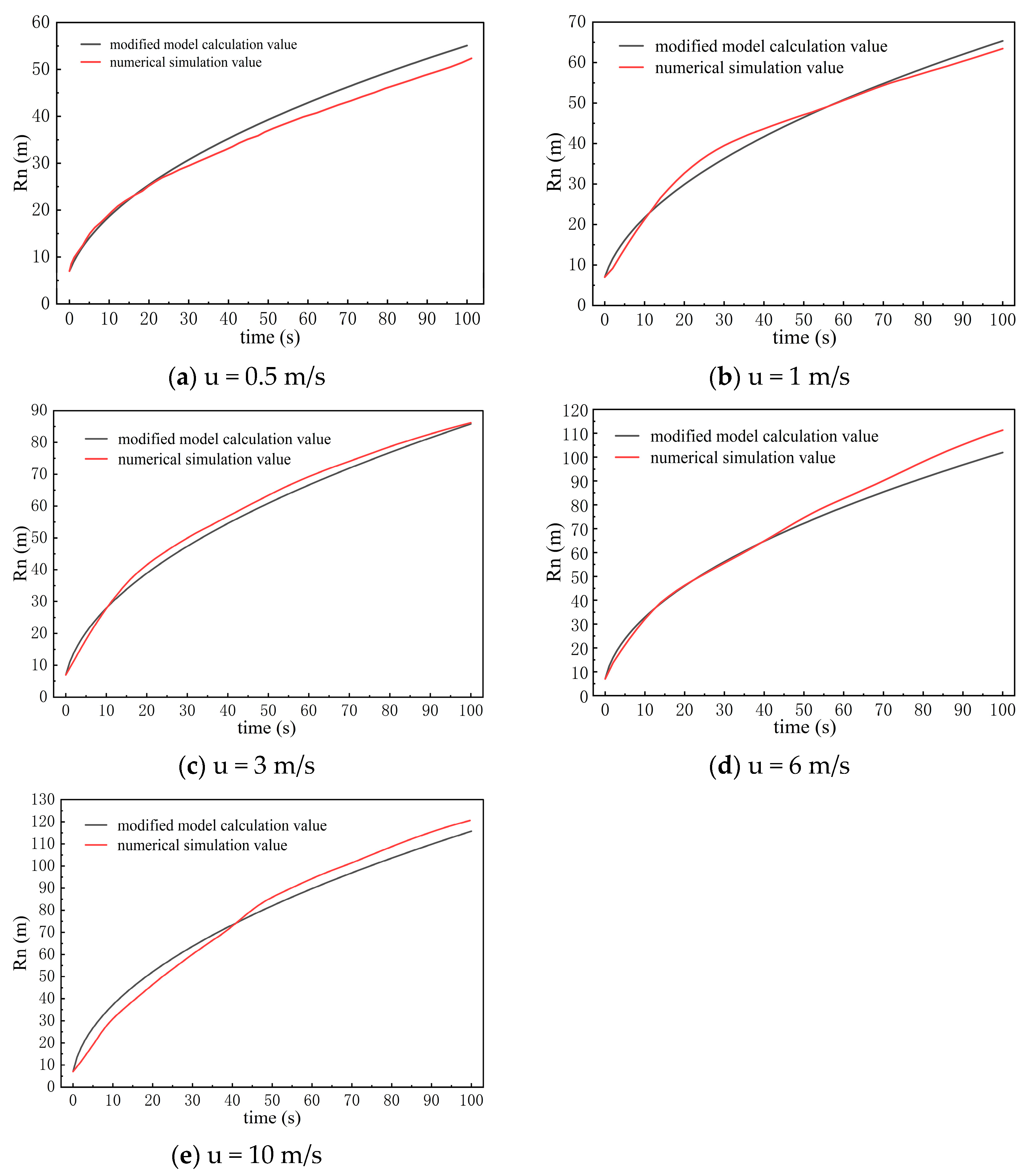
Figure 6a–e respectively present the temporal evolution of the numerical simulation values and the modified model calculations for Rn under the five wind speed conditions, while Table 6 summarizes the maximum deviations between the numerical simulation results and the modified model calculations for each scenario. From the perspective of the overall variation pattern of Rn, the trends of the two sets of results are highly consistent. Moreover, the maximum relative error within 100 s under each condition remains within 10%, meeting the accuracy requirements for engineering applications.
Under low wind speed conditions (0.5 m/s and 1 m/s), the growth of Rn exhibits a characteristic pattern of “rapid initial increase followed by a gradual slowdown in growth rate.” Influenced by gravity and inertia during the early stage of leakage, Rn increases rapidly. As the cloud diffuses to a certain extent, the growth rate of Rn gradually decreases due to the weakened transport effect of the ambient wind speed. The calculated curves from the modified model and the simulation curves show fully synchronized variation rhythms. During the rapid growth phase from 0 to 30 s, the two sets of values almost coincide, with only minor deviations appearing in the later stage. Corresponding to the data in Table 6, under the 0.5 m/s condition, the maximum deviation occurs at 70 s with a relative error of 6.36%. For the 1 m/s condition, the maximum deviation appears at 28 s with a relative error of 9.46%, which is the highest among all conditions. This deviation stems from the weakening of buoyancy effects during the diffusion phase under low wind speeds and the intensification of air mixing processes, leading to discrepancies between model calculations and numerical simulations. Nevertheless, the error remains within an acceptable range.
Under the medium wind speed condition (3 m/s), the transport effect of ambient wind speed on cloud clusters intensifies, with the growth rate of Rn significantly increasing compared to the low wind speed condition, and the duration of the growth phase extending. The trend of the modified model’s calculated values closely matches the simulated values, showing no significant deviation throughout the process. As shown in Table 6, the maximum deviation under this condition occurred at 58 s, with the numerical simulation value at 68.18 m and the model calculation value at 65.50 m. The relative error was only 4.09%, the lowest among all conditions. This phenomenon indicates that the modified model adequately accounts for the promoting effect of wind speed on heavy gas diffusion.
Under high wind speed conditions (6 m/s, 10 m/s), ambient wind speed becomes the dominant factor governing cloud cluster dispersion. The growth rate of Rn reaches its maximum, and the overall curve becomes steeper. Numerical simulation results show that Rn increases rapidly within a short timeframe, exhibiting a stabilizing trend during the late dispersion phase (100 s). The modified model’s calculated curve fully reproduces this variation pattern. During the rapid growth phase from 0 to 50 s, the model’s predicted values closely match the numerical simulation results. Data in Table 6 indicates that the maximum deviation for both operating conditions occurs at the 100 s: the relative error of 9.21% for the 6 m/s condition and 4.21% for the 10 m/s condition. The deviation arises because the cloud mass becomes sufficiently diluted during the late diffusion stage, losing its heavy-gas characteristics and transitioning to neutral gas diffusion. The model’s simplified treatment of the late diffusion process causes numerical discrepancies, though the deviation remains within reasonable limits. This demonstrates that the modified model exhibits good adaptability to diffusion processes under high wind speeds, accurately reflecting the quantitative relationship between wind speed and Rn.
Analysis of trends and deviations across five wind speed operating conditions reveals that the evolution curve of Rn calculated by the modified model perfectly aligns with the numerical simulation curve. Numerical deviations under all operating conditions meet engineering application accuracy requirements, fully validating the reliability and practicality of the modified model.

3.3. Spatiotemporal Distribution Characteristics of Downwind Gas Concentration Under Different Wind Speeds

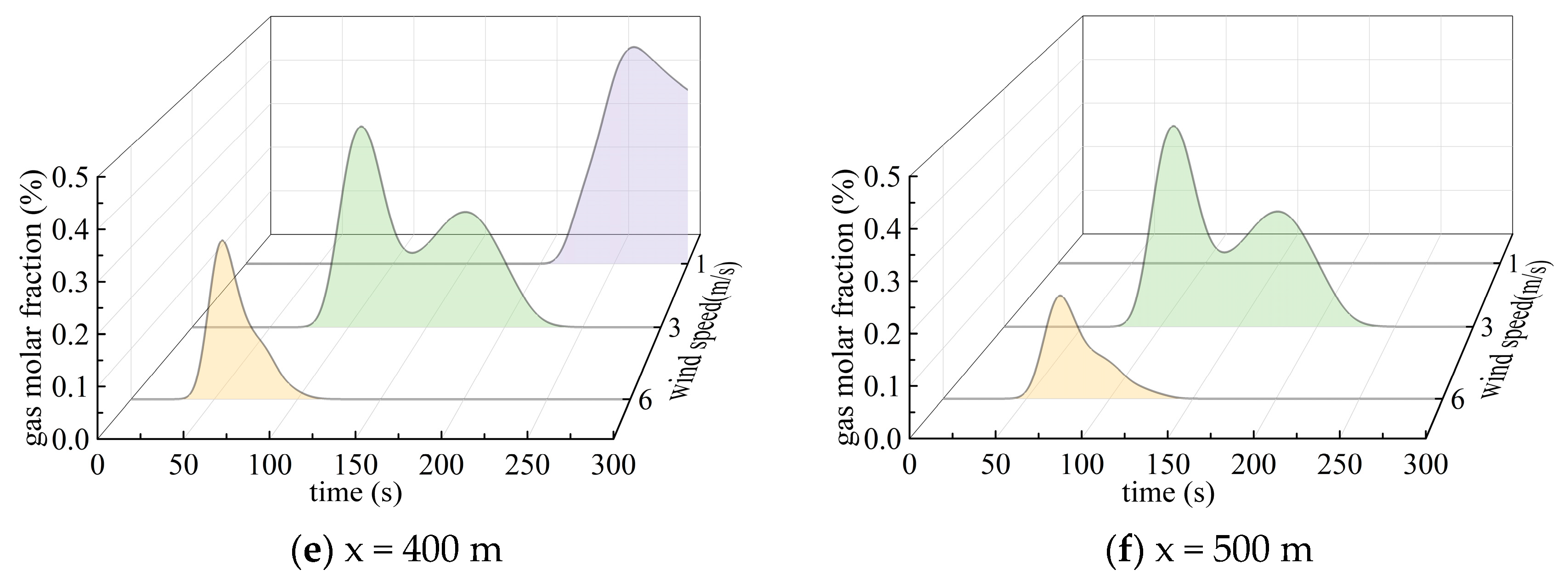
To elucidate the regulatory mechanism of wind speed on the spatiotemporal distribution of downwind concentration following an instantaneous heavy-gas leakage, this study analyzes gas concentration data from six representative downwind locations at distances of 25 m, 100 m, 200 m, 300 m, 400 m, and 500 m. The analysis focuses on three aspects: differences in concentration responses between near-source and mid-to-far fields, the influence of wind speed on secondary peak formation, and the variation patterns of high-concentration retention duration. This provides a theoretical basis for risk assessment and emergency response in heavy gas leakage incidents.
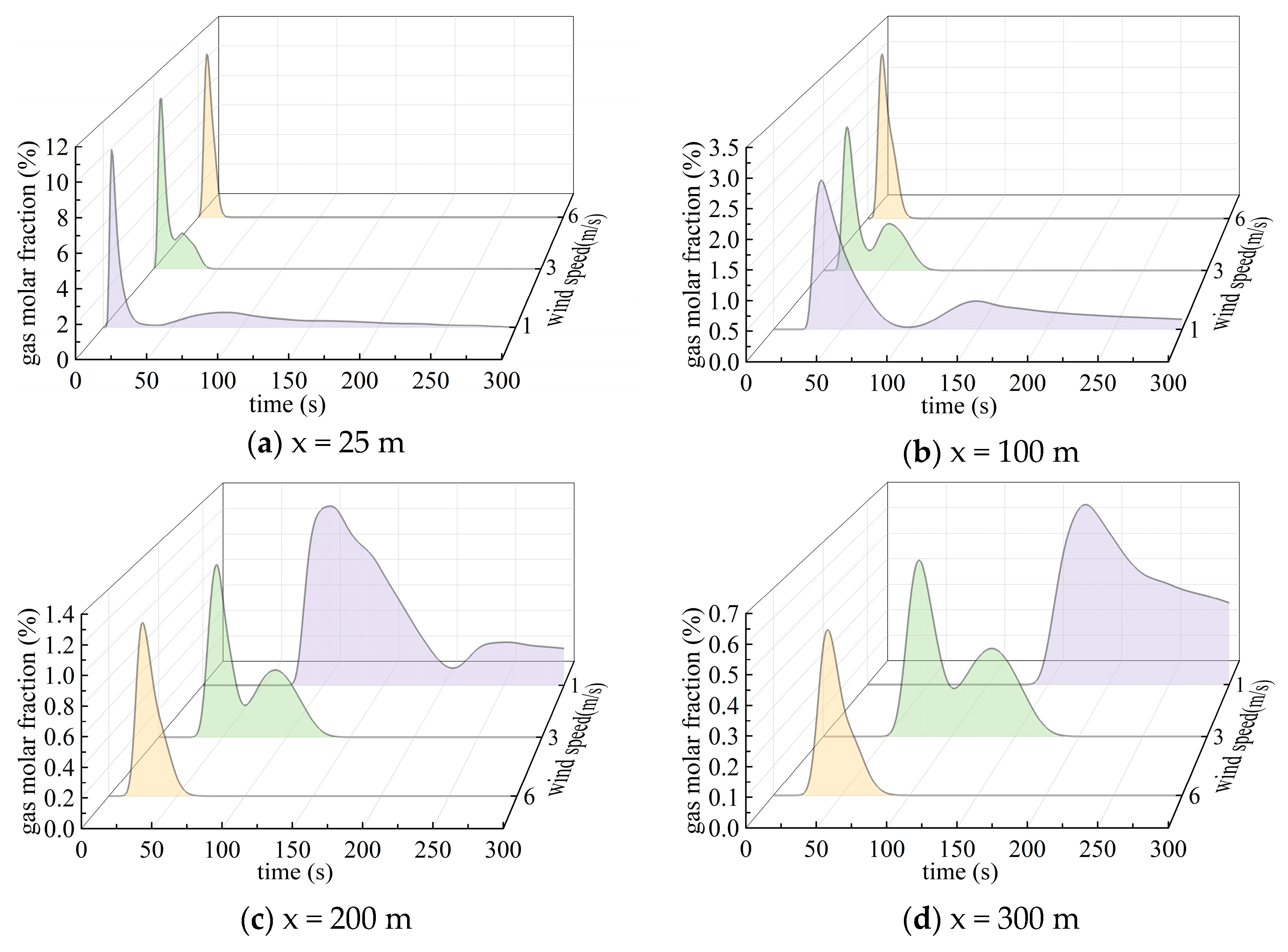
As shown in Figure 7, the concentration variation curves at different downwind distances reveal that the response patterns of concentration changes in the near-source field (25 m, 100 m) and the mid-to-far field (200 m–500 m) to wind speed are completely opposite. In the near-source zone (Figure 7a,b), higher wind speeds result in higher concentration peaks and shorter peak arrival times. Under high wind speed conditions, the strong entrainment effect of airflow rapidly disperses leaked heavy gases outward while accelerating momentum exchange between the heavy gases and ambient air. This causes large quantities of heavy gases to accumulate near the source area within a short timeframe, thereby elevating concentration peaks. Simultaneously, high wind speeds significantly shorten the residence time of heavy gases in the vicinity of the source, causing the peak concentration to occur noticeably earlier. The entire concentration curve exhibits a “sharp rise and sharp fall” pattern. Conversely, under low wind speed conditions, the diffusion momentum of heavy gas is weaker. It accumulates slowly and in smaller quantities near the source area, resulting in a lower peak concentration and a significantly delayed peak arrival time. Moreover, the duration of the high-concentration state is relatively longer. In the mid- and long-range zones (Figure 7c–f), lower wind speeds correlate with higher peak concentrations and longer peak arrival times. Under low wind conditions, the migration speed of heavy gas plumes is slow. During transport to mid- and far-field areas, the mixing and dilution effects with ambient air are weak, allowing the plume to reach the target region at higher concentrations, thus resulting in higher peak concentrations. The slow migration speed also significantly delays the arrival time of the peak concentration, correspondingly prolonging the duration of the high-concentration state. Under high wind speed conditions, heavy gas plumes migrate rapidly. During long-distance transport, the gas undergoes more thorough mixing and dilution with ambient air. By the time it reaches mid- and long-range areas, its concentration has significantly decreased. Peak concentrations are substantially lower than under low wind speed conditions, and peak arrival times occur earlier. Notably, under the low wind speed condition of 1 m/s, the gas concentration at 500 m (Figure 7f) consistently remains at 0. The core reason for this peculiar phenomenon lies in the insufficient migration capacity of the heavy gas plume due to excessively low wind speeds. Within the simulation timeframe, the migration distance of the heavy gas plume has not yet extended to 500 m, preventing the formation of an effective concentration at this node. This result also confirms the decisive role of wind speed in determining the migration range of heavy gases. When wind speeds fall below a critical threshold, the dispersion range of heavy gases is significantly restricted, allowing distant areas to remain free from heavy gas contamination.
During the dynamic evolution of the gas concentration curve, the occurrence of a secondary peak is closely related to the wind-speed-dominated transport mechanism described above. Its essence lies in the external manifestation of the synchronization in the transport of sub-clouds formed after the breakup of the main cloud. Except under the 6 m/s wind speed condition, secondary peaks appear in all other scenarios. Under low and moderate wind speeds, the heavy-gas cloud breaks up into sub-clouds due to turbulent effects. Differences in the transport speeds of these sub-clouds cause them to arrive at the monitoring point at different times, forming the first peak and a secondary peak. Additionally, part of the heavy gas is lifted by ground reflection and may overlap with subsequent cloud portions, further contributing to the secondary peak formation. In contrast, under the high wind speed of 6 m/s, strong convective action synchronously transports the broken sub-clouds downstream, leaving no time lag in their arrival. Moreover, intense dilution rapidly reduces the concentration of the sub-clouds, which explains the absence of a secondary peak under this condition.
The secondary peak phenomenon in concentration is accompanied by a differentiated characteristic in the duration of high-concentration persistence. Its variation pattern resembles the regional concentration response pattern, manifesting as shorter persistence times with higher wind speeds. This duration refers to the time interval during which the concentration remains above a certain percentage of the peak value, determined by the residence time of the heavy gas plume at the monitoring site. At high wind speeds, heavy gases migrate rapidly, resulting in brief dwell times at monitoring points. Concentration curves exhibit a “sharp peak” morphology, with short high-concentration retention periods and a narrow emergency response window. Conversely, at low wind speeds, heavy gases migrate slowly, leading to gradual concentration fluctuations. High-concentration retention periods significantly increase, forming a “broad peak” curve morphology. This characteristic indicates that at low wind speeds, the duration of high-concentration risks in mid- and long-range areas is prolonged. Consequently, more resources must be allocated for extended emergency monitoring and protective measures to prevent safety incidents arising from prolonged exposure to risks.
In summary, the spatiotemporal distribution of downwind gas concentrations under different wind speeds presents significant differential characteristics. The concentration responses to wind speed follow opposite trends in the near-source region versus the intermediate- and far-field regions. The formation of secondary peaks depends on the synchrony of cloud mass fragmentation and migration, while the duration of high-concentration retention shortens as wind speed increases. These three factors are interrelated, collectively forming the complete spatiotemporal evolution pattern of heavy gas dispersion regulated by wind speed. This provides scientific support for heavy gas leakage risk zoning and emergency response planning.

4. Conclusions

This study addressed the issue of heavy gas transient leakage diffusion. The diffusion stages of heavy gas were first delineated, after which the cloud cluster radius prediction model was refined and validated through CFD numerical simulations. The spatiotemporal distribution characteristics of downwind gas concentrations under varying wind speed conditions were also analyzed. The main conclusions are as follows:
(1) The heavy gas diffusion process can be divided into three stages: gravitational diffusion, density stratification, and passive diffusion. During the gravitational diffusion stage, the cloud mass undergoes rapid subsidence dominated by gravity and spreads outward. In the density stratification stage, gravitational influence weakens, and the cloud mass transitions from gravity-dominated behavior to a regime governed by the coupling of gravity and atmospheric turbulence. During the passive diffusion stage, the cloud mass approaches atmospheric density, and the diffusion process is entirely controlled by atmospheric turbulence.
(2) The cloud cluster characteristic semi-major axis prediction model incorporating a dimensionless wind speed correction term effectively couples the interaction between the environmental wind field and gravity-driven diffusion of cloud clusters. The modified model demonstrates good adaptability under low, medium, and high wind speed conditions. The variation trends of the model predictions align well with numerical simulation values, with a maximum relative error of 9.46% and a minimum of 4.09%. This provides theoretical support for rapid prediction of the diffusion range of heavy gas cloud clusters.
(3) Wind speed exerts a significant modulating effect on the spatiotemporal distribution of downwind concentration. The response of gas concentration to wind speed follows opposite trends in the near field versus the intermediate and far fields. In the near field, higher wind speeds lead to higher concentration peaks and earlier arrival times of these peaks. In contrast, in the intermediate and far fields, lower wind speeds result in higher concentration peaks and later arrival times. Additionally, except for the case with a wind speed of 6 m/s, secondary peaks appear in the concentration curves under all other conditions. At high wind speeds, the concentration curves exhibit a “sharp peak” profile, whereas at low wind speeds, they display a “broad peak” profile. This characteristic can provide a basis for determining the duration of emergency monitoring.
The semi-major axis modification model for clouds proposed in this study allows for predicting the characteristic semi-major axis of heavy gas clouds under multiple wind speed conditions, within the prescribed assumptions. The identified three-stage characteristics of heavy gas diffusion and the spatiotemporal distribution patterns of downwind concentration can provide theoretical and data support for risk zoning and emergency response planning in chemical industry accidents involving heavy gas leakage. It should be noted that this study was conducted based on an idealized flat terrain, without considering complex environmental factors such as actual topographic variations or building obstructions, thus differing from real industrial scenarios. Future research could further explore these aspects by incorporating complex terrain models to refine the theoretical and methodological framework for heavy gas diffusion prediction.

Author Contributions

Conceptualization, H.W.; methodology, H.L.; software, X.L.; validation, J.Y.; formal analysis, J.H.; investigation, J.Y.; resources, X.L.; data curation, J.W.; writing—original draft preparation, J.Y.; writing—review and editing, H.L.; visualization, R.C.; supervision, H.W.; project administration, H.W.; funding acquisition, H.W. All authors have read and agreed to the published version of the manuscript.

Funding

This research was supported by the National Key R&D Program of China under Grant No. 2023YFC3008803.

Data Availability Statement

The raw data supporting the conclusions of this article will be made available by the authors on request.

Conflicts of Interest

The authors declare no conflict of interest. The funders had no role in the design of the study; in the collection, analyses, or interpretation of data; in the writing of the manuscript; or in the decision to publish the results.

References

  1. Wang, S.; Wang, J.; Sun, B.; Wang, W. Analysis on research status of diffusion process and consequence assessment of chlorine leakage. Environ. Prot. Chem. Ind. 2016, 36, 332–337. [Google Scholar] [CrossRef]
  2. Wang, X.; Liao, K.; Zhang, Z. Flow field analysis of combustible gas leakage in gasoline storage tank based on FLACS. Beijing Univ. Chem. Technol. 2022, 49, 31–38. [Google Scholar] [CrossRef]
  3. Li, J.; Li, D.; Du, X.; Jin, Z.; Xin, X. Study on the scope of impact of consequences of leakage of hydrogen blended with natural gas pipeline. J. Loss Prev. Process Ind. 2026, 99, 105810. [Google Scholar] [CrossRef]
  4. Pietersen, C.M. Analysis of the LPG-disaster in mexico city. Dep. Ind. Saf. 1988, 20, 85–107. [Google Scholar] [CrossRef]
  5. Hanna, S.R.; Hansen, O.R.; Ichard, M.; Strimaitis, D. CFD model simulation of dispersion from chlorine railcar releases in industrial and urban areas. Atmos. Environ. 2009, 43, 262–270. [Google Scholar] [CrossRef]
  6. Yang, D.; Chen, G.; Fu, J.; Zhu, Y.; Dai, Z.; Wu, L.; Liu, J. The mitigation performance of ventilation on the accident consequences of H2S-containing natural gas release. Process Saf. Environ. Protect. 2021, 148, 1327–1336. [Google Scholar] [CrossRef]
  7. Pei, Z.; Zude, L.I.U. Impacts of Wind Speed and Leakage Height on Chlorine Leakage Diffusion. Procedia Eng. 2014, 84, 672–681. [Google Scholar] [CrossRef]
  8. Qian, J.Y.; Li, X.J.; Gao, Z.X.; Jin, Z.J. A numerical study of hydrogen leakage and diffusion in a hydrogen refueling station. Int. J. Hydrog. Energy 2020, 45, 14428–14439. [Google Scholar] [CrossRef]
  9. Zhu, G.; Guo, X.; Yi, Y.; Tan, W.; Ji, C. Experiment and simulation research of evolution process for LNG leakage and diffusion. J. Loss Prev. Process Ind. 2020, 64, 104041. [Google Scholar] [CrossRef]
  10. Wang, Y.; Zhao, L.; Lv, X.; He, T. Numerical simulation and risk mitigation strategies for hydrogen leakage at vehicle hydrogenation stations. Int. J. Hydrog. Energy 2025, 111, 735–750. [Google Scholar] [CrossRef]
  11. Labovský, J.; Jelemenský, Ľ. CFD simulations of ammonia dispersion using “dynamic” boundary conditions. Process Saf. Environ. Protect. 2010, 88, 243–252. [Google Scholar] [CrossRef]
  12. Zhou, Z.Q.; Cheng, X.C.; Zhang, N.; Bai, Z.M.; Fang, Z.; Liu, Y.Z.; Wang, C.L.; Zhao, W.W. Numerical simulation of HF gas leakage dispersion patterns in large-scale complex terrain under catastrophe scenarios. Process Saf. Environ. Protect. 2025, 201, 19. [Google Scholar] [CrossRef]
  13. Tang, F.; Li, L.J.; Dong, M.S.; Wang, Q.; Mei, F.Z.; Hu, L.H. Characterization of buoyant flow stratification behaviors by Richardson (Froude) number in a tunnel fire with complex combination of longitudinal ventilation and ceiling extraction. Appl. Therm. Eng. 2017, 110, 1021–1028. [Google Scholar] [CrossRef]
  14. Joshi, P.; Bikkina, P.; Wang, Q.S. Consequence analysis of accidental release of supercritical carbon dioxide from high pressure pipelines. Int. J. Greenh. Gas Control 2016, 55, 166–176. [Google Scholar] [CrossRef]
  15. Tan, W.; Wang, K.; Li, C.; Liu, L.; Wang, Y.; Zhu, G. Experimental and numerical study on the dispersion of heavy gases in urban environments. Process Saf. Environ. Protect. 2018, 116, 640–653. [Google Scholar] [CrossRef]
  16. Shen, Z.; Lang, J.; Li, M.; Mao, S.; Xuan, B. Impact of leakage location and downwind storage tank on the gas dispersion in a typical chemical tank storage area. J. Loss Prev. Process Ind. 2023, 83, 105093. [Google Scholar] [CrossRef]
  17. Liu, C.L.; An, J.Y.; Xie, C.X.; Wu, H.W.; Zhang, Z.J. Numerical simulation-based pinhole leakage characteristics and hazard boundaries of buried natural gas risers. Process Saf. Environ. Protect. 2024, 184, 462–476. [Google Scholar] [CrossRef]
  18. Wu, L.; Qiao, L.; Fan, J.; Wen, J.; Zhang, Y.; Jar, B. Investigation on leakage characteristics and consequences of hydrogen-blended gas pipelines based on CFD with the full multicomponent diffusion model. Renew. Energy 2025, 252, 123502. [Google Scholar] [CrossRef]
  19. Efthimiou, G.C.; Andronopoulos, S.; Tavares, R.; Bartzis, J.G. CFD-RANS prediction of the dispersion of a hazardous airborne material released during a real accident in an industrial environment. J. Loss Prev. Process Ind. 2017, 46, 23–36. [Google Scholar] [CrossRef]
  20. Tauseef, S.M.; Rashtchian, D.; Abbasi, S.A. CFD-based simulation of dense gas dispersion in presence of obstacles. J. Loss Prev. Process Ind. 2011, 24, 371–376. [Google Scholar] [CrossRef]
  21. Britter, R.E. The spread of a negatively buoyant plume in a calm environment. Atmos. Environ. 1979, 13, 1241–1247. [Google Scholar] [CrossRef]
  22. Davies, M.E.; Singh, S. The phase II trials: A data set on the effect of obstructions. J. Hazard. Mater. 1985, 11, 301–323. [Google Scholar] [CrossRef]
  23. Richards, P.J.; Hoxey, R.P. Appropriate boundary conditions for computational wind engineering models using the k-ε turbulence model. J. Wind Eng. Ind. Aerodyn. 1993, 46, 145–153. [Google Scholar] [CrossRef]
  24. Kisa, M.; Jelemensky, L. CFD dispersion modelling for emergency preparadnes. J. Loss Prev. Process Ind. 2009, 22, 97–104. [Google Scholar] [CrossRef]
  25. ASME V&V 20-2009; Standard for Verification and Validation in Computational Fluid Dynamics and Heat Transfer. The American Society of Mechanical Engineers: New York, NY, USA, 2009.
  26. AQ/T 3046-2013; Guidelines for Quantitative Risk Assessment in Chemical Enterprises. State Administration of Work Safety: Beijing, China, 2013.
  27. Crowl, D.A.; Louvar, J.F. Chemical process safety: Fundamentals with applications. J. Loss Prev. Process Ind. 2002, 15, 565–566. [Google Scholar]
  28. Pan, X.; Jiang, J. Numerical simulation study on instantaneous leakage and diffusion of heavy gas clouds. J. Nanjing Tech Univ. 2003, 31, 35–39. [Google Scholar]
  29. Jiang, J.; Pan, X. New model for heavy gas releasing dispersion analysis. J. Nanjing Tech Univ. 2002, 24, 41–46. [Google Scholar]
  30. Mohan, M.; Panwar, T.S.; Singh, M.P. Development of dense gas dispersion model for emergency preparedness. Atmos. Environ. 1995, 29, 2075–2087. [Google Scholar] [CrossRef]
  31. Matthias, C.S. Dispersion of a dense cylindrical cloud in a turbulent atmosphere. J. Hazard. Mater. 1992, 30, 117–150. [Google Scholar] [CrossRef]
  32. Matthias, C.S. Dispersion of a dense cylindrical cloud in calm air. J. Hazard. Mater. 1990, 24, 39–65. [Google Scholar] [CrossRef]
Figure 1. CFD computational domain.
Symmetry 18 00401 g001
Figure 2. Mesh sensitivity curve diagram.
Symmetry 18 00401 g002
Figure 3. Detailed view of 3.2 million cells.
Symmetry 18 00401 g003
Figure 4. Variation of maximum ground-level concentration with downwind distance.
Symmetry 18 00401 g004
Figure 5. The gas concentration contours on the XZ-plane (Y = 0 m) at different times.
Symmetry 18 00401 g005aSymmetry 18 00401 g005b
Figure 6. Comparison of modified model calculation values and numerical simulation values for Rn under different wind speeds.
Symmetry 18 00401 g006
Figure 7. Gas concentration variation at different downwind locations under various wind speeds.
Symmetry 18 00401 g007aSymmetry 18 00401 g007b
Table 1. Thorney island 008 experimental parameters.
Leaked substanceFreon 12 and nitrogen mixtureLeakage substance temperature18.6 °C
Leak source shapeCylinder with D = 14 m, H = 14 mReleased volume2000 m3
Initial pressure101,325 PaInitial relative density1.63
Ambient temperature18.6 °CWind speed at 10 m height1.9 m/s
Ground roughness0.005 mAtmospheric stabilityB
Relative humidity55%Leak patternTransient leakage
Table 2. Mesh schemes.
Mesh SchemesNumber of Cells (Million)C-Min (Molf)C-Max (Molf)
Coarse2.6000.08931
Medium3.2000.09134
Fine4.9800.09843
Table 3. Maximum downwind ground-level concentration values from the Thorney Island trial 008.
Downwind Distance (m)Experimental Data (Xp)Simulation Method 1 (X01)Simulation Method 2 (X02)Simulation Method 3 (X03)
502525.0427.0627.00
10012.511.6810.8312.30
2004.44.955.125.24
3002.42.142.262.60
4001.51.601.731.82
5000.590.701.281.49
7500.320.300.280.40
Table 4. Error between predicted maximum downwind ground-level concentrations and field experimental values.
Simulation MethodAbsolute ErrorRelative ErrorAbsolute ErrorRelative Error
X P X 0 ¯ X P X 0 X 0 ¯ X P X 0 ¯ X P X 0 X P ¯
simulation method 1−0.042.05%0.278.44%
simulation method 20.2617.62%0.7917.43%
simulation method 30.5933.06%0.6518.51%
Table 5. Numerical simulation operating conditions.
ConditionWind Speed (m/s)Wind Profile IndexTemperature (°C)Humidity (%)
10.50.22555
210.22555
330.22555
460.22555
5100.22555
Table 6. Maximum deviation between modified model calculation values and numerical simulation values for Rn under different wind speeds.
Wind Speed (m/s)Maximum Deviation Timepoint (s)Numerical Simulation Value (m)Model Prediction Value (m)Relative Error (%)
0.57043.3146.256.36
12838.4135.099.46
35868.1865.504.09
6100111.32101.939.21
10100120.63115.764.21
Disclaimer/Publisher’s Note: The statements, opinions and data contained in all publications are solely those of the individual author(s) and contributor(s) and not of MDPI and/or the editor(s). MDPI and/or the editor(s) disclaim responsibility for any injury to people or property resulting from any ideas, methods, instructions or products referred to in the content.