


Abstract
Stereo foundation models provide strong cross-domain generalization but remain computationally expensive for real-time and resource-constrained deployment. We propose BRD-Stereo, a bilateral reliability distillation framework that transfers foundation-model stereo knowledge to a lightweight BANet-style student. BRD-Stereo treats reciprocal left–right correspondence after geometric warping as an exchange symmetry and uses localized symmetry violations from occlusion or mismatching to reduce teacher reliability. BRD-Stereo models the spatial reliability of teacher supervision and aligns different forms of teacher knowledge with the student’s detail/smooth aggregation structure. The detail branch receives boundary- and gradient-aware supervision, while the smooth branch is guided by low-frequency disparity consistency and local plane regularization. Reliability cues from left–right consistency, image disparity edge agreement, local regularity, occlusion-aware validity, and available teacher confidence weight the pseudo-label objectives. Sliced score distribution distillation transfers a locally softened disparity target around the teacher prediction without requiring full teacher cost volume supervision. Experiments on Scene Flow, KITTI, ETH3D, and Middlebury show consistent gains over plain pseudo-label distillation, with the largest improvements concentrated in boundary, occlusion, weak-texture, and large-disparity regions while preserving BANet-scale inference efficiency.
1. Introduction
Dense metric depth perception is a fundamental capability for autonomous driving, mobile robotics, augmented reality, and embodied intelligence. Among different depth estimation paradigms, stereo matching provides a physically grounded solution by estimating pixel-wise disparities from rectified image pairs and recovering depth through triangulation. In the past decade, deep stereo networks have improved benchmark accuracy through learned feature representations, cost volumes, and increasingly sophisticated aggregation or iterative refinement modules [1,2,3,4,5,6], particularly under domain-specific training and fine-tuning protocols.
Rectified stereo also provides a natural connection to symmetry. Swapping the reference and target views produces paired correspondence problems. For a scene point visible in both cameras, the left-to-right and right-to-left matches are reciprocal after the appropriate coordinate warp, which defines a left–right exchange symmetry of the correspondence relation. Occlusion, ambiguous texture, non-Lambertian appearance, and prediction error produce localized violations of this reciprocity. BRD-Stereo measures these symmetry violations through bidirectional teacher consistency and uses them to regulate knowledge transfer.
Practical stereo perception must simultaneously satisfy accuracy, cross-domain robustness, and inference efficiency. These requirements are especially important for autonomous and robotic platforms operating under fixed compute and latency budgets. Accuracy-oriented stereo networks typically rely on high-resolution 3D/4D cost volumes, heavy aggregation networks, transformer-based global reasoning, or recurrent refinement modules. Although these designs are effective for benchmark performance, their computational and memory costs make them difficult to deploy on mobile, robotic, or latency-constrained platforms. In contrast, lightweight stereo networks improve efficiency by using reduced-resolution cost volumes, compact 2D aggregation modules, sparse disparity search, or simplified refinement pipelines [7,8,9,10,11,12]. However, such efficiency-oriented designs often suffer from degraded robustness when transferred to unseen domains, especially in challenging regions such as occlusions, weakly textured surfaces, repetitive patterns, reflective areas, thin structures, and disparity discontinuities. This accuracy–efficiency–generalization tension has become a central obstacle for deploying stereo matching as an off-the-shelf depth perception module.
Recent stereo foundation models improve cross-domain generalization. By exploiting large-scale training data, monocular depth priors, and high-capacity architectures, these models achieve competitive zero-shot results across diverse real-world scenes [13,14,15,16]. Their computational cost, however, remains prohibitive for real-time applications.
Efficient zero-shot stereo methods combine distillation, compact architecture design, architecture search, pruning, and large-scale pseudo-label training [17,18]. Fast-FoundationStereo accelerates the teacher pipeline by compressing FoundationStereo’s hybrid feature backbone and optimizing the remaining stereo modules, whereas Lite Any Stereo combines efficient architecture design with staged synthetic-to-real training. BRD-Stereo complements these approaches by coupling pixel-wise teacher reliability with the region specialization of a bilateral student.
This issue is acute for lightweight stereo matching. Stereo foundation teachers produce spatially non-uniform pseudo-label errors in occluded areas, reflective surfaces, repetitive textures, transparent objects, low-texture regions, or near object boundaries. Uniform disparity regression or distribution matching transfers these teacher errors directly to the student. Moreover, different regions require different types of stereo reasoning. High-frequency regions such as boundaries and thin structures require detail-preserving supervision, while low-frequency or textureless regions require smoothness, planar consistency, and long-range contextual cues. A single global distillation objective cannot explicitly account for these heterogeneous requirements.
Motivated by this observation, we propose BRD-Stereo, a bilateral reliability distillation framework for learning a lightweight zero-shot stereo matcher from a stereo foundation model. Instead of blindly copying teacher disparities, BRD-Stereo explicitly estimates the spatial reliability of teacher supervision and aligns different forms of teacher knowledge with the bilateral structure of a lightweight student. We instantiate the student with a BANet-style architecture, where a detail branch focuses on high-frequency disparity discontinuities and fine structures, while a smooth branch models low-texture, locally planar, and low-frequency regions. This architecture provides a natural carrier for region-aware distillation: reliable boundary and gradient cues from the teacher are assigned to the detail branch, whereas reliable low-frequency and plane-consistency cues are assigned to the smooth branch.
BRD-Stereo builds on BANet’s bilateral detail/smooth decomposition. Its architectural contribution is a student that supports reliability-aware foundation-model distillation. Relative to BANet, BRD-BANet replaces image-feature scale-aware spatial attention with a score–volume router supervised by teacher-derived detail/smooth targets, augments the smooth pathway with lightweight context reasoning, and replaces direct attention-weighted branch summation with learned residual fusion of the two aggregated score volumes and the original matching evidence. Pixel-wise teacher reliability and branch-specific objectives couple these student-side changes to the distillation process.
The main contributions of this paper are summarized as follows:
- We propose BRD-Stereo, a bilateral reliability distillation framework for lightweight zero-shot stereo matching. Unlike stereo compression methods that primarily distill a global backbone representation or use dense pseudo-disparities as uniform supervision, BRD-Stereo explicitly couples teacher reliability with the spatial structure of the student.
- We introduce a reliability-aware pseudo-labeling mechanism that integrates consistency, confidence, edge agreement, local regularity, and occlusion cues to prevent the student from blindly imitating unreliable teacher predictions.
- We adapt BANet into a distillation-compatible BRD-BANet student. The original bilateral aggregation principle is retained, while the routing, smooth-context modeling, and branch fusion are modified so that teacher-derived detail/smooth knowledge can supervise the corresponding student pathways.
- We design branch-aware distillation losses that transfer boundary/gradient knowledge to detail regions, low-frequency/plane knowledge to smooth regions, and local score distribution information around the teacher disparity. Together with comparisons against standard feature-level distillation, these experiments isolate the benefit of reliability-aware, architecture-aligned transfer.
2. Related Work
2.1. Deep Learning-Based Stereo Matching Algorithms
Stereo matching has gradually evolved from hand-crafted matching costs and local/global optimization to end-to-end trainable networks. Early deep stereo methods learned patch-level similarity or directly regressed disparity from image pairs. Later methods established a more general pipeline consisting of feature extraction, cost volume construction, cost aggregation, and disparity regression or refinement.
A dominant line of deep stereo matching methods constructs high-dimensional cost volumes and learns aggregation networks. GC-Net introduced an end-to-end 3D convolutional framework for cost volume regularization [1]. PSMNet incorporated spatial pyramid pooling and stacked hourglass networks to exploit global context [2]. GwcNet proposed group-wise correlation to improve representation efficiency [3], while GA-Net, ACVNet, PCWNet, and related methods improved either cost representation or cost aggregation [4,19,20]. Explicit correspondence modeling across disparity hypotheses improves accuracy but incurs substantial computation and memory overhead when paired with high-dimensional volumes and heavy 3D aggregation.
Another important line formulates stereo matching as an iterative optimization problem. RAFT-Stereo adapts recurrent all-pairs field transforms to rectified stereo and progressively updates disparity predictions [5]. IGEV-Stereo introduces a geometry encoding volume that combines geometry, context, and local matching information to guide iterative refinement [6]. IGEV++ further extends this idea with multi-range geometry encoding for large disparities and ill-posed regions [21]. Compared with purely aggregation-based methods, iterative methods can avoid directly processing a full high-resolution 4D cost volume at every stage and often show strong generalization. Nevertheless, recurrent updates, indexing operations, and high-capacity context networks still impose non-negligible inference costs.
Recently, zero-shot and foundation-model-based stereo matching has received increasing attention. Methods such as FoundationStereo, Stereo Anywhere, MonSter, DEFOM-Stereo, and related approaches introduce monocular depth priors, vision foundation model features, large-scale synthetic data, or hybrid monocular-stereo reasoning to improve cross-domain robustness [13,14,15,16]. These methods advance generalizable stereo matching and can perform well across diverse real-world scenes without target-domain fine-tuning. However, their strong generalization usually comes from large backbones, complex cost filtering modules, long-range attention, or iterative refinement. Our work instead distills the cross-domain knowledge of such a teacher into a lightweight student, with explicit reliability modeling.
Photometric degradation is another important source of difficulty for stereo systems. Huang et al. proposed a dual-view low-light enhancement network that combines illumination estimation, cross-view correlation, and multi-scale detail transfer [22]. Their restoration setting shows how adverse illumination disrupts stereo correspondence and motivates joint binocular modeling. BRD-Stereo addresses the related disparity-estimation problem by suppressing spatially unreliable teacher supervision in difficult regions.
2.2. Lightweight and Efficient Stereo Matching Algorithms
Real-time and resource-efficient stereo matching is essential for autonomous driving, robotic navigation, drones, and embedded 3D perception. Existing efficient stereo networks mainly reduce computational complexity through compact cost volume representation, lightweight cost aggregation, and streamlined disparity refinement.
One common strategy is to reduce the spatial or disparity resolution of cost volumes. StereoNet and BGNet construct low-resolution cost volumes to accelerate inference and recover full-resolution disparities through refinement or guided upsampling [7,23]. DeepPruner and Fast-ACVNet reduce the disparity search space by selecting informative candidate disparities or sparse high-resolution matches [8,24]. These methods lower computational cost, but aggressive downsampling or sparse search discards fine details and increases errors around disparity discontinuities and thin structures.
Another strategy replaces expensive 3D convolutions with more efficient operators. AANet uses adaptive 2D aggregation to approximate cost aggregation and alleviate edge fattening [9]. HITNet avoids explicitly constructing a dense 3D cost volume and performs hierarchical iterative tile refinement with slanted plane hypotheses [10]. MobileStereoNet explores mobile-friendly stereo architectures using lightweight 2D and 3D variants [11]. Although these methods improve efficiency, deformable aggregation, iterative warping, and recurrent refinement remain costly on mobile hardware.
BANet provides a particularly relevant solution by introducing bilateral aggregation for mobile stereo matching [12]. It observes that stereo images contain both high-frequency detailed regions and low-frequency smooth or textureless regions. Instead of aggregating all regions uniformly, BANet separates the cost volume into detailed and smooth volumes using a spatial attention map, performs branch-specific aggregation, and fuses the two outputs. However, BANet is primarily designed from the architectural perspective and does not explicitly exploit large-scale foundation-model knowledge or teacher reliability. Recent efficient zero-shot methods further attempt to bridge efficiency and cross-domain generalization. GGEV incorporates monocular depth features as structural priors [25]; Fast-FoundationStereo accelerates FoundationStereo through distillation, architecture search, and pruning [17]; and Lite Any Stereo demonstrates that a compact stereo model can achieve strong zero-shot performance with a carefully designed architecture and million-scale training strategy [18]. Our method is complementary: it studies how a BANet-style bilateral student can use foundation-model supervision in a spatially selective and architecture-aware manner.
2.3. Efficient Knowledge Distillation
Knowledge distillation transfers the behavior of a large teacher model to a smaller student model [26]. It has become a widely used model compression technique because it allows compact models to learn richer supervision than sparse ground truth alone. Existing distillation methods transfer different forms of knowledge, including response distributions, intermediate features, relations, attention maps, and uncertainty cues [27,28]. For dense prediction, distillation can further exploit pixel-wise predictions, spatial probability distributions, feature maps, and task-specific structures.
Recent studies adapt distillation to task-specific uncertainty, degradation, and generation dynamics. Lu et al. use degradation modeling and multi-teacher aggregation for continuous adverse-weather removal [29], while SCott controls stochastic solver behavior when transferring a diffusion teacher to a faster sampler [30]. These methods exemplify structure- and condition-aware transfer. In dense stereo, BRD-Stereo estimates the spatial reliability of a foundation teacher and assigns complementary supervision to the student’s bilateral branches.
In stereo matching, knowledge distillation is attractive because accurate real-world dense disparities are expensive to obtain. A large teacher can generate dense pseudo-disparities for unlabeled stereo pairs, enabling scalable supervision for lightweight students. Recent foundation-stereo acceleration methods also use distillation to transfer knowledge from high-capacity teacher models to efficient students [17,18]. Fast-FoundationStereo uses distillation to compress FoundationStereo’s hybrid feature backbone and combines it with architecture search and structured pruning for acceleration [17]. Lite Any Stereo instead emphasizes a compact architecture and a multi-stage training recipe that includes self-distillation and real-world FoundationStereo pseudo-label supervision [18]. These approaches establish that distillation and pseudo-label training can provide efficient zero-shot stereo generalization, but their primary design axis is global representation compression, architecture efficiency, or scalable data transfer. BRD-Stereo addresses a different question: which teacher pixels should be trusted, and which form of knowledge should be delivered to each structural pathway of a bilateral student.
2.4. Positioning of BRD-Stereo
Table 1 compares the design priorities of representative efficient zero-shot stereo methods. Fast-FoundationStereo distills the hybrid backbone into a compact feature extractor and reduces the remaining computation through architecture search and pruning. Lite Any Stereo combines efficient architecture design with self-distillation and large-scale real-world pseudo-label training. BRD-Stereo starts from a lightweight bilateral student and organizes transferred knowledge through pixel-wise reliability gating, teacher-guided detail/smooth routing targets, branch-specific geometric supervision, and local score distribution transfer.
Table 1.
Methodological positioning relative to representative efficient zero-shot stereo approaches. “Explicit” denotes a mechanism directly modeled by the method.
3. Methods
3.1. Overview
We propose BRD-Stereo, a bilateral reliability distillation framework that transfers the cross-domain robustness of a stereo foundation model to a lightweight BANet-style student. Given a rectified stereo pair , the objective is to estimate a dense left-view disparity map . The framework consists of a frozen teacher model and a lightweight bilateral student . The teacher provides pseudo-disparities and reliability cues, while the student performs lightweight disparity estimation.
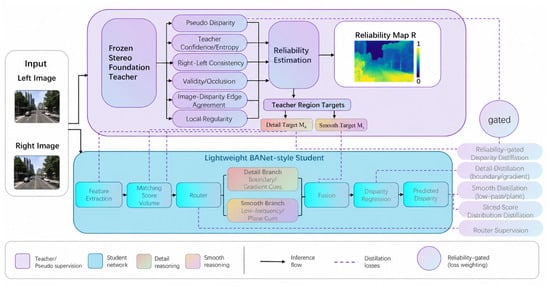
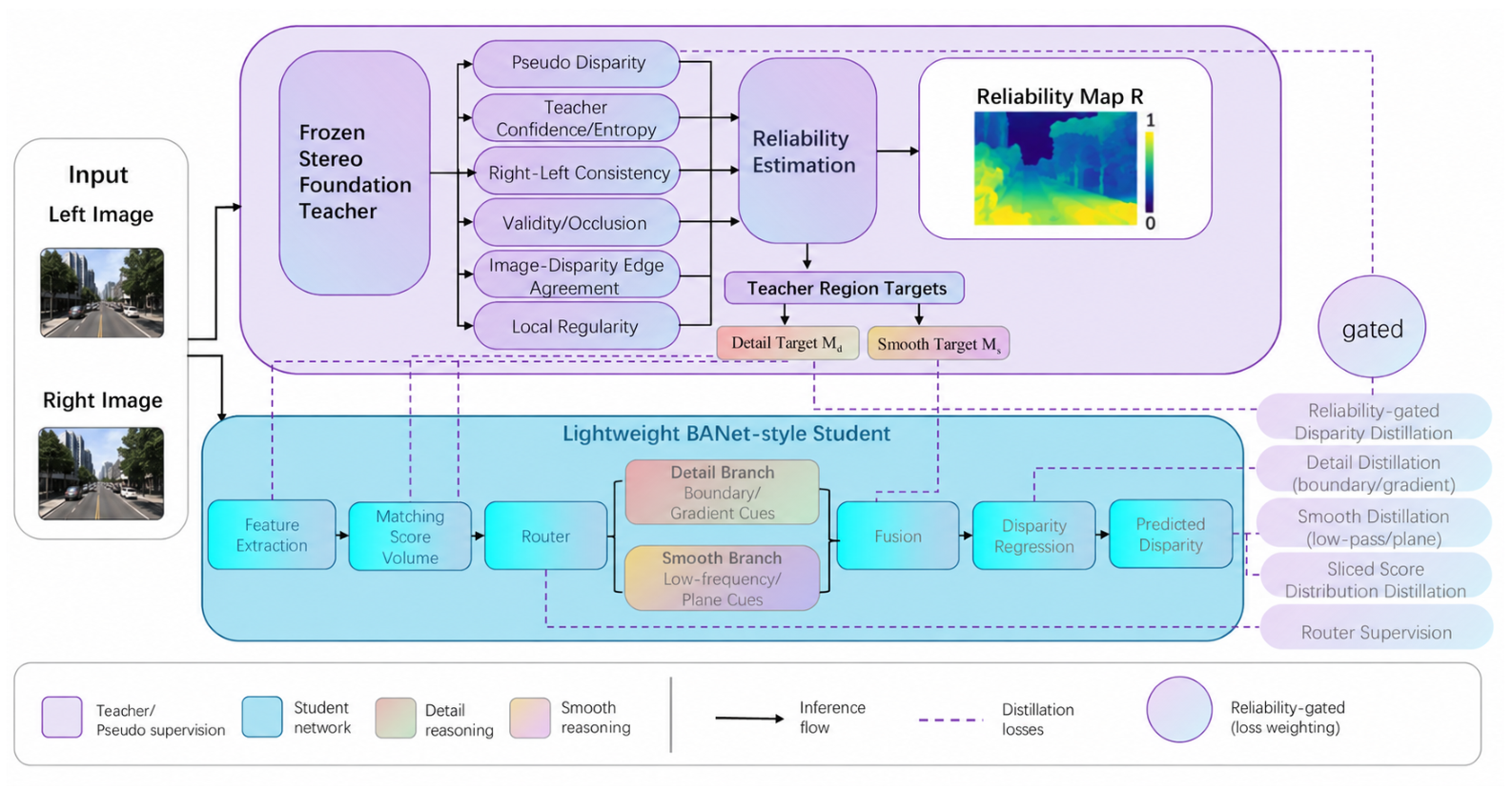
The key motivation is that teacher supervision is spatially non-uniform. Stereo foundation models produce spatially concentrated errors in occluded regions, reflective surfaces, repetitive textures, weak-texture areas, and near disparity discontinuities. Directly regressing all teacher disparities with a uniform pseudo-label loss transfers these errors to the student. Moreover, high-frequency regions require boundary-preserving detail aggregation, whereas low-frequency regions require smooth, planar, and context-aware reasoning. BRD-Stereo addresses these issues by using reliability-aware and branch-aligned distillation. Reliable boundary cues are transferred to the detail branch, reliable low-frequency cues are transferred to the smooth branch, and all pseudo-label losses are gated by a teacher reliability map. The complete teacher–student training framework is illustrated in Figure 1.
Figure 1.
Overview of BRD-Stereo. The frozen FoundationStereo teacher generates pseudo-disparity and complementary reliability cues. Reliability estimation produces a pixel-wise reliability map and teacher-derived detail/smooth targets. The lightweight BANet-style student performs bilateral aggregation, while reliability-gated disparity, detail, smooth, score distribution, and router supervision are used only during training. Solid arrows denote inference flow and dashed lines denote distillation losses.
3.2. Lightweight Bilateral Student
BRD-BANet retains BANet-2D’s decomposition of matching evidence into detail-oriented and smooth-oriented pathways with separate lightweight 2D aggregation branches [12]. BRD modifies this backbone for knowledge transfer: a score–volume router receives teacher-derived region supervision, an efficient context block strengthens smooth pathway reasoning in weak-texture and low-frequency regions, and a learned fusion head combines both branch outputs with the original matching evidence. These changes make the bilateral pathways directly addressable by the reliability-aware distillation objectives. Table 2 summarizes the architectural differences between BANet-2D and BRD-BANet.
Table 2.
Technical boundary between BANet-2D and the BRD-BANet student.
3.2.1. Feature Extraction and Matching Score Volume
The student follows an efficient stereo pipeline with feature extraction, matching score volume construction, bilateral aggregation, and disparity regression. A shared lightweight feature extractor extracts multi-scale features from the left and right images:
where denotes the feature scales. Cost volume construction and bilateral aggregation operate at resolution.
Let denote the left and right features at resolution, where and . We construct a matching score volume , where . For each disparity hypothesis , the matching score is computed by correlation:
where larger values of indicate stronger stereo matching evidence.
3.2.2. Bilateral Detail/Smooth Aggregation
A lightweight router predicts a two-channel soft routing map:
where is a lightweight score–volume router and denote the detail and smooth routing probabilities. The score volume is decomposed into detail and smooth components:
where ⊙ denotes spatial broadcasting along the disparity dimension. The detail branch focuses on high-frequency structures:
and the smooth branch focuses on weak-texture and locally planar regions:
To improve long-range reasoning with limited cost, the smooth branch includes an efficient context block. The two aggregated score volumes are fused as:
where is a lightweight fusion head. The low-resolution disparity is regressed using the score distribution:
The full-resolution disparity is obtained by learned upsampling:
where the factor 4 restores the disparity scale.
FoundationStereo inference, reliability estimation, teacher-derived detail/smooth targets, and all BRD loss computations are discarded after training. The deployed student retains the lightweight router , branch-specific aggregation/context operations and , and fusion head as components of its forward path. These student-side routing and branch refinement modules account for the increase from the 39.8G improved BANet core to the 42.0G full model.
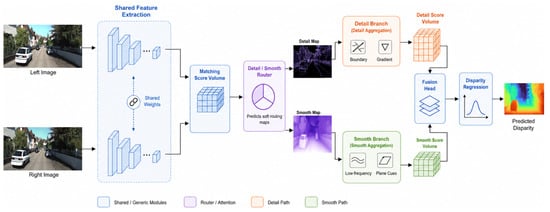
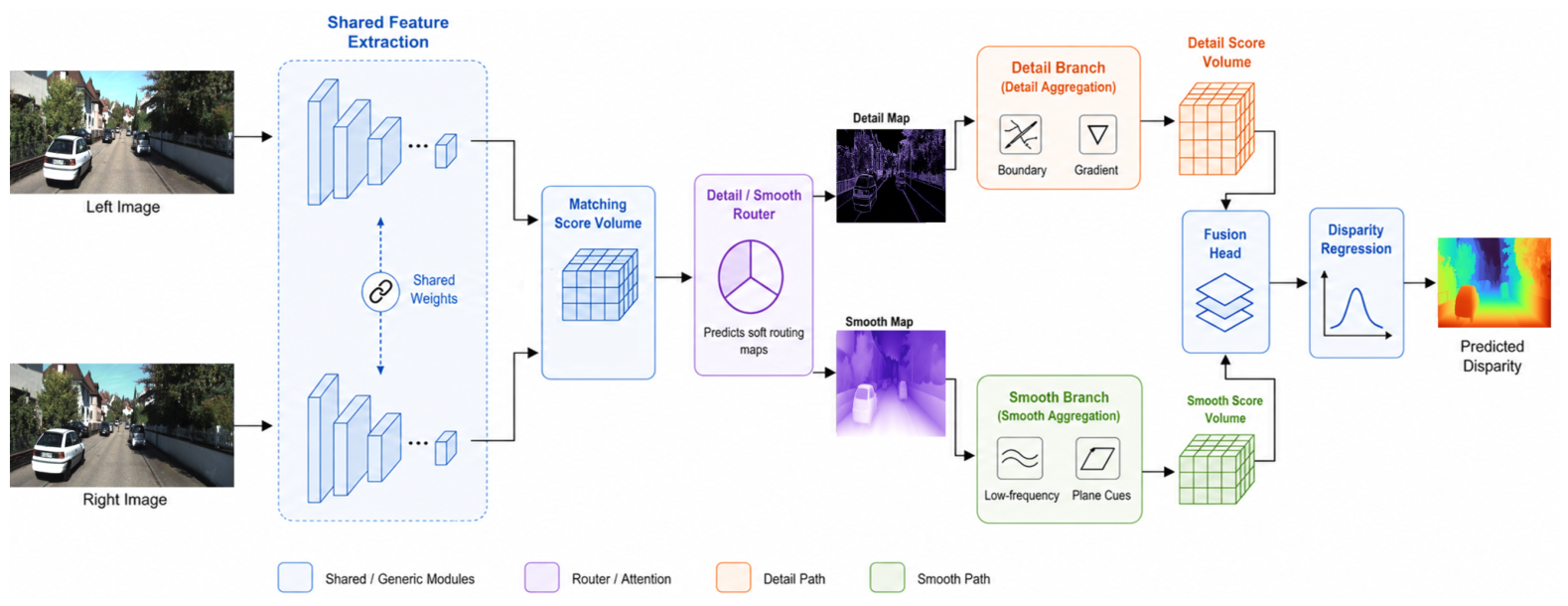
Figure 2 summarizes the resulting student inference path and its bilateral detail/smooth specialization.
Figure 2.
Lightweight bilateral student architecture. Shared stereo features form a compact matching score volume, and the detail/smooth router predicts soft spatial routing maps. The detail and smooth pathways aggregate complementary matching evidence before fusion and disparity regression. Boundary/gradient and low-frequency/plane annotations denote the branch specialization encouraged by BRD training; they do not add teacher-side computation to the inference path.
3.3. Foundation Teacher and Pseudo-Label Generation
A pretrained stereo foundation model is used as the frozen teacher. Given an unlabeled stereo pair, the teacher predicts a full-resolution left-view disparity:
We obtain the right-view teacher disparity by swapping the stereo inputs:
A teacher confidence distribution, when exposed by the teacher interface, is denoted as . The FoundationStereo experiments derive reliability primarily from bidirectional geometry and image disparity cues. For consistency with the student score volume, we define the downsampled teacher disparity:
where denotes resizing to resolution. Full-resolution losses are computed using and , while score-level losses are computed using and .
3.4. Teacher Reliability Estimation
Teacher predictions are not equally reliable across all pixels. We estimate a reliability map and its downsampled version for score-level supervision.
For a left-view pixel , the left–right consistency error is:
where warps the right disparity to the left view. The consistency reliability is:
If the teacher provides a probability distribution , the confidence reliability is computed from normalized entropy:
For experiments without an exposed teacher probability distribution, the confidence factor is neutral: .
We also use image disparity edge agreement as a soft reliability cue. Let
A strong teacher disparity edge without supporting image structure is treated as less reliable:
where denotes the positive part. Local teacher regularity is measured by disparity variance in a local window :
A binary validity mask is generated from disparity range, image boundary, occlusion heuristic, and invalid warping locations. The final reliability map is:
All reliability terms are clipped to for numerical stability.
3.5. Bilateral Region Targets
To align teacher supervision with the bilateral student, we derive teacher-guided region targets. A detail score is computed from image gradients and teacher disparity gradients:
where denotes percentile normalization. The soft detail target is:
where is the sigmoid function. The smooth target is defined as:
The downsampled targets and supervise the router:
3.6. Reliability-Aware Bilateral Distillation
The basic teacher disparity loss is defined at full resolution:
where is the smooth- penalty and denotes stop-gradient. To prevent boundary blurring, we introduce detail-region gradient distillation:
For low-frequency regions, we impose low-pass consistency:
where denotes a Gaussian low-pass filter. We further encourage local plane consistency. For each pixel , we fit a local affine disparity plane to the teacher disparity within :
The student is encouraged to follow the same local plane tendency:
The smooth-region distillation loss is:
Full cost volume distillation is memory-consuming for a lightweight student. We distill only a local slice around the teacher disparity at resolution. For each pixel , the candidate set is:
The student distribution restricted to this set is:
FoundationStereo supplies a point disparity rather than a calibrated per-pixel posterior or predictive variance. Score-level distillation therefore uses a surrogate local soft target centered at :
The fixed bandwidth replaces a hard one-hot disparity target with graded preferences in a local neighborhood of the teacher estimate. It is shared across pixels and does not represent epistemic or aleatoric uncertainty. Spatial variation in teacher trust is modeled separately by , which combines left–right consistency, confidence, edge agreement, local regularity, and occlusion-aware validity. Equation (33) therefore transfers local score distribution structure, while controls the strength of that supervision at each pixel.
The sliced score distribution loss is:
3.7. Overall Objective and Training Strategy
For labeled stereo pairs with ground-truth disparity and valid mask , the supervised loss is:
The BRD loss for pseudo-labeled data is:
For a mini-batch containing labeled samples and pseudo-labeled samples , the final training objective is:
Algorithm 1 summarizes the three-stage training pipeline. First, the student is trained on synthetic labeled stereo data using . Second, the frozen teacher generates pseudo-labels for unlabeled stereo pairs, and the student is trained with supervised losses and reliability-aware bilateral distillation losses. Third, hard but reliable regions are mined for fine-tuning, including disparity boundaries, occlusions, weak-texture regions, large-disparity areas, and pixels with high teacher–student discrepancy but high teacher reliability.
| Algorithm 1: Training pipeline of BRD-Stereo. |
|
3.8. Experimental Protocol
3.8.1. Datasets
We evaluate BRD-Stereo under both in-domain and cross-domain settings. For supervised pretraining and reproduction, we use the Scene Flow dataset [31], which provides dense synthetic ground-truth disparities and is widely adopted for training deep stereo networks. Scene Flow is used to verify the basic stereo matching capability of the student and to compare the reproduced BANet baseline with our improved lightweight backbone.
DrivingStereo [32] provides the unlabeled real-world images used for teacher pseudo-label distillation. KITTI 2012 [33], KITTI 2015 [34], ETH3D [35], and Middlebury [36] are used only for zero-shot evaluation. KITTI contains outdoor driving scenes; ETH3D contains grayscale indoor and outdoor pairs that test low-texture and appearance shifts; and Middlebury contains high-resolution indoor pairs with fine structures, large disparities, and complex boundaries. These four target benchmarks do not contribute images or annotations to training, model selection, hyperparameter search, or fine-tuning.
Table 3 summarizes the sample counts and data roles. Scene Flow contributes 35,454 labeled training pairs for supervised pretraining, and its 4370-pair test split supports in-domain reproduction reporting. The 174,437-pair official DrivingStereo training split is treated as unlabeled: its released disparity/depth annotations are not accessed, and FoundationStereo generates pseudo-disparities and BRD reliability targets once. Cross-domain evaluation uses the ground-truth-available splits of 194 KITTI 2012 pairs, 200 KITTI 2015 pairs, 27 ETH3D low-resolution two-view pairs, and 15 Middlebury MiddEval3 half-resolution pairs. Although the benchmark websites call these “training” splits, they remain held out from model development in this protocol.
Table 3.
Data-use protocol and sample counts. “Selection” indicates target-domain checkpoint selection, hyperparameter choice, or early stopping.
Model parameters are learned from labeled Scene Flow and pseudo-labeled DrivingStereo. A pre-specified schedule and one globally fixed BRD configuration determine the final checkpoint. KITTI, ETH3D, and Middlebury supply neither optimization signals nor checkpoint and hyperparameter selection criteria. The post-hoc sensitivity study in Section 4.8 evaluates the fixed configuration and its perturbations without selecting benchmark-specific settings.
3.8.2. Metrics and Compared Methods
We report standard stereo matching metrics. End-Point Error (EPE) measures the average absolute disparity error over valid pixels. D1 denotes the percentage of pixels whose disparity error is larger than 3 pixels and larger than 5% of the ground-truth disparity. Bad-X denotes the percentage of pixels whose disparity error is larger than X pixels. We report Bad-1.0 on ETH3D and Bad-2.0 on Middlebury.
To evaluate reliability-aware bilateral distillation more directly, we report region-specific metrics. Boundary EPE is computed on pixels near image or disparity boundaries. Occlusion D1 is computed on left–right inconsistent or invalid regions. Weak-texture EPE is computed on low-gradient image regions. Large-disparity EPE is computed on pixels with large disparity values. For efficiency, we report parameters, MACs, and inference latency on an NVIDIA GeForce RTX 4090 (NVIDIA Corporation, Santa Clara, CA, USA).
We compare BRD-BANet with BANet-style internal baselines, representative efficient stereo methods, and foundation-model references. Internal baselines include original BANet-2D, reproduced BANet-2D, improved BANet without distillation, improved BANet with plain FoundationStereo pseudo-label distillation, and improved BANet with reliability-gated pseudo-label distillation. External references include MobileStereoNet-2D and RT-MonSter++ [37] for qualitative comparison, Lite Any Stereo for efficient zero-shot comparison, and Fast-FoundationStereo and FoundationStereo for efficiency or teacher-scale reference.
The comparison includes three established feature-level distillation strategies: FitNet-style intermediate feature regression [27], Attention Transfer (AT) [38], and ReviewKD [39]. All three baselines use the same frozen FoundationStereo teacher, Stage-1 student initialization, unlabeled DrivingStereo pairs, and optimization schedule as plain teacher distillation.
3.8.3. Implementation Details
The student uses a BANet-2D-scale architecture with maximum disparity 192 for KITTI-style evaluation. Stage 1 pretrains the student on 35,454 labeled Scene Flow pairs using disparity regression. For Stage 2, a frozen FoundationStereo teacher generates pseudo-disparities, validity masks, reliability maps, and detail/smooth masks for the 174,437 DrivingStereo training pairs, while their released annotations remain unused. Stage 3 refines reliable hard regions within the same Scene Flow–DrivingStereo pipeline. The pre-specified schedule determines the final checkpoint independently of KITTI, ETH3D, and Middlebury metrics.
The same reliability parameters and loss-balancing coefficients apply to every target benchmark and to the sensitivity study in Section 4.8. Spatial distillation terms are normalized by accumulated reliability or region weights, and every reliability factor is bounded to . These normalizations reduce objective-scale variation with the number of valid or selected pixels, leaving the balancing coefficients to control the relative contributions of complementary supervision terms.
The architecture-only improved BANet retains BANet-2D’s lightweight feature extractor and bilateral detail/smooth aggregation, replaces image-feature spatial routing with score–volume routing, adds a lightweight context block to the smooth pathway, and fuses the detail score volume, smooth score volume, and original matching evidence through learned residual fusion. This configuration contains 5.72 M parameters and requires 39.8 G MACs; the complete BRD-BANet contains 5.84 M parameters and requires 42.0 G MACs.
Table 4 summarizes the fixed optimization and reliability settings. Student optimization uses AdamW with initial learning rate , weight decay , and cosine decay to after a 2000-iteration linear warm-up. Training uses FP16 mixed precision, random crops, four stereo pairs per step, and four-step gradient accumulation for an effective batch size of 16. Stages 1–3 run for 100,000, 80,000, and 20,000 iterations, respectively. On one NVIDIA RTX 4090, they require approximately 3.8, 4.7, and 1.2 h (9.7 h total), excluding the one-time offline FoundationStereo pseudo-label generation.
Table 4.
Fixed BRD optimization and reliability configuration shared across KITTI 2012/2015, ETH3D, and Middlebury.
The reliability temperatures , , and control soft exponential decay. The validity mask rejects left–right inconsistencies above 3 pixels together with out-of-range disparities, image boundary violations, and invalid warps. Stage 3 selects pixels with and teacher–student disparity differences above 1.5 pixels. These thresholds, loss weights, and optimization settings remain fixed across all target benchmarks.
The generic knowledge-distillation controls match spatially corresponding representations from three backbone stages. FitNet-style regression maps each student feature through a training-only projection, resizes it when needed, and applies an loss to the aligned dense teacher feature. Attention Transfer matches channel-collapsed, -normalized spatial attention maps, and ReviewKD uses cross-stage review/fusion over the same feature levels. These training-only modules are discarded after distillation and do not change inference MACs or latency. Each method augments the same teacher disparity objective with coefficients fixed independently of target-benchmark results.
Zero-shot evaluation preserves each benchmark’s provided spatial resolution. ETH3D uses the native sizes of the low-resolution two-view split, and Middlebury uses the official MiddEval3 half-resolution images without further downsampling. Each stereo pair is padded to before inference and unpadded before metric computation. ETH3D and Middlebury use neither tiled inference nor disparity rescaling.
4. Results
4.1. Reproduction and Backbone Validation
We first verify the reproduced BANet baseline and the improved lightweight backbone. Table 5 shows the results on Scene Flow and KITTI. The reproduced BANet-2D obtains 0.58 EPE and 2.55% Bad-3.0 on Scene Flow, and 1.84%/1.88% on KITTI 2012 3-all and KITTI 2015 D1-all, respectively. Relative to the reported BANet-2D results, the reproduced model differs by 0.01 EPE and 0.06 percentage points in Scene Flow Bad-3.0, and by 0.05 percentage points on both KITTI metrics.
Table 5.
Reproduction and backbone validation. Lower is better for all accuracy metrics.
Compared with the reproduced BANet-2D, the improved BANet backbone reduces Scene Flow EPE from 0.58 to 0.55 and Scene Flow Bad-3.0 from 2.55% to 2.38%. On KITTI, it reduces KITTI 2012 3-all from 1.84% to 1.75% and KITTI 2015 D1-all from 1.88% to 1.79%. The improved backbone increases MACs from 36.5 G to 39.8 G and latency from 4.1 ms to 4.5 ms while reducing all four accuracy errors.
The 39.8 G architecture is the shared BANet core for the subsequent BRD configurations. Complete BRD-BANet adds the score–volume router and branch-specific context/fusion refinements to the student inference graph. Teacher inference, reliability estimation, pseudo-label targets, and distillation losses remain training-only components.
4.2. Zero-Shot Cross-Domain Evaluation
Table 6 reports zero-shot cross-domain results on KITTI 2012, KITTI 2015, ETH3D, and Middlebury.
Table 6.
Zero-shot cross-domain evaluation on KITTI, ETH3D, and Middlebury. Lower is better for all metrics. Bold denotes the best internal BRD/BANet variant; external references are listed for context.
The architecture-only improved BANet is evaluated after Scene Flow pretraining and before DrivingStereo pseudo-label distillation. Relative to reproduced BANet-2D, it reduces KITTI 2012 D1 from 3.90% to 3.81%, KITTI 2015 D1 from 4.71% to 4.62%, ETH3D Bad-1.0 from 5.92% to 5.74%, and Middlebury Bad-2.0 from 10.05% to 9.89%. This comparison measures the independent contribution of the modified student backbone.
On the same improved backbone, plain FoundationStereo disparity distillation reduces the four error rates to 3.72%, 4.53%, 5.55%, and 9.72%, adding gains of 0.09, 0.09, 0.19, and 0.17 percentage points. Reliability-gated reaches 4.30%, 4.92%, and 9.18% on KITTI 2015, ETH3D, and Middlebury, while Full BRD-BANet reaches 4.02%, 4.28%, and 8.35%. The progression separates the smaller backbone contribution from the larger gain produced by reliability-aware, branch-aligned transfer.
The full BRD-BANet achieves the best performance among all internal variants. Compared with plain teacher L1 distillation, the full BRD-BANet reduces KITTI 2012 D1 from 3.72% to 3.18%, KITTI 2015 D1 from 4.53% to 4.02%, ETH3D Bad-1.0 from 5.55% to 4.28%, and Middlebury Bad-2.0 from 9.72% to 8.35%. The corresponding relative improvements are 14.5%, 11.3%, 22.9%, and 14.1%, respectively. These consistent gains demonstrate that reliability-aware filtering and bilateral branch-aligned distillation provide complementary benefits beyond plain teacher supervision.
FitNet-style dense feature regression improves plain teacher from 4.53% to 4.39% on KITTI 2015 D1, from 5.55% to 5.18% on ETH3D Bad-1.0, and from 9.72% to 9.42% on Middlebury Bad-2.0. Attention Transfer reaches 4.34%, 5.02%, and 9.26%, while ReviewKD is the strongest generic feature baseline at 4.24%, 4.79%, and 8.98%. Full BRD improves on ReviewKD by 0.22, 0.51, and 0.63 percentage points on these metrics, supporting an additional benefit from reliability filtering and detail/smooth-aligned supervision.
Section 4.9 reports deployment complexity separately for the improved BANet core and the complete BRD-BANet inference graph.
4.3. Region-Specific Analysis
The central goal of BRD-Stereo is to improve challenging regions where lightweight stereo matchers and naive teacher imitation are likely to fail. Table 7 reports region-specific results on the KITTI 2015 validation subset. Compared with improved BANet without distillation, plain teacher L1 reduces Boundary EPE from 1.62 to 1.42, Occlusion D1 from 11.8% to 9.7%, Weak-texture EPE from 1.25 to 1.05, and Large-disparity EPE from 1.46 to 1.28. Reliability-gated distillation further improves these metrics by suppressing unreliable teacher supervision.
Table 7.
Region-specific evaluation on the KITTI 2015 validation subset. Lower is better.
The full BRD-BANet achieves the best region-specific performance. It reduces Boundary EPE to 1.18, Occlusion D1 to 7.3%, Weak-texture EPE to 0.86, and Large-disparity EPE to 1.12. Compared with plain teacher L1, the relative improvements are 16.9%, 24.7%, 18.1%, and 12.5%, respectively. These results directly support the motivation of BRD-Stereo: detail-oriented distillation improves boundary and occlusion regions, while smooth-region distillation improves weak-texture and large-disparity regions.
4.4. Qualitative Results
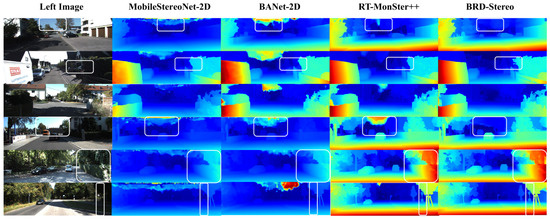
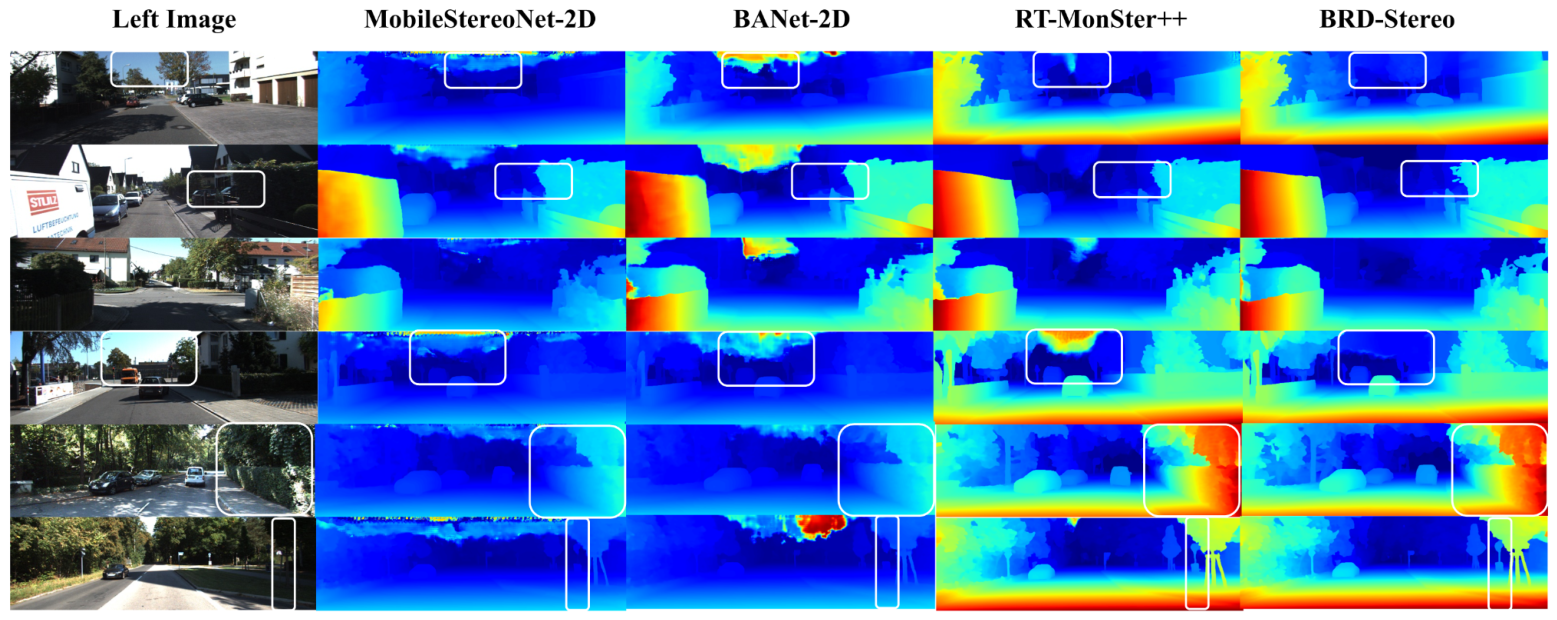
Figure 3 shows qualitative results for BRD-Stereo, MobileStereoNet-2D, BANet-2D, and RT-MonSter++ on challenging real-world pairs. The white boxes highlight regions containing thin structures, depth discontinuities, occlusions, and locally ambiguous appearance. BRD-Stereo produces cleaner object contours and more spatially coherent disparities in these regions while retaining smooth surfaces. The qualitative behavior is consistent with the region-specific improvements reported in Table 7.
Figure 3.
Qualitative comparison with lightweight and real-time stereo methods. From left to right: input left image, MobileStereoNet-2D, BANet-2D, RT-MonSter++, and BRD-Stereo. White boxes mark challenging regions used for close visual inspection, including object boundaries, thin structures, occlusions, and weakly textured surfaces.
4.5. Reliability Analysis
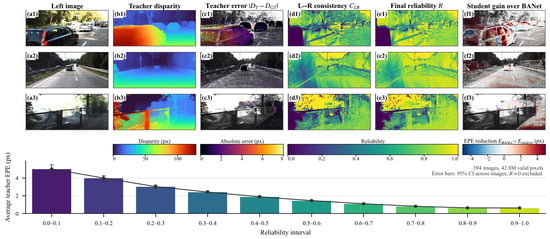
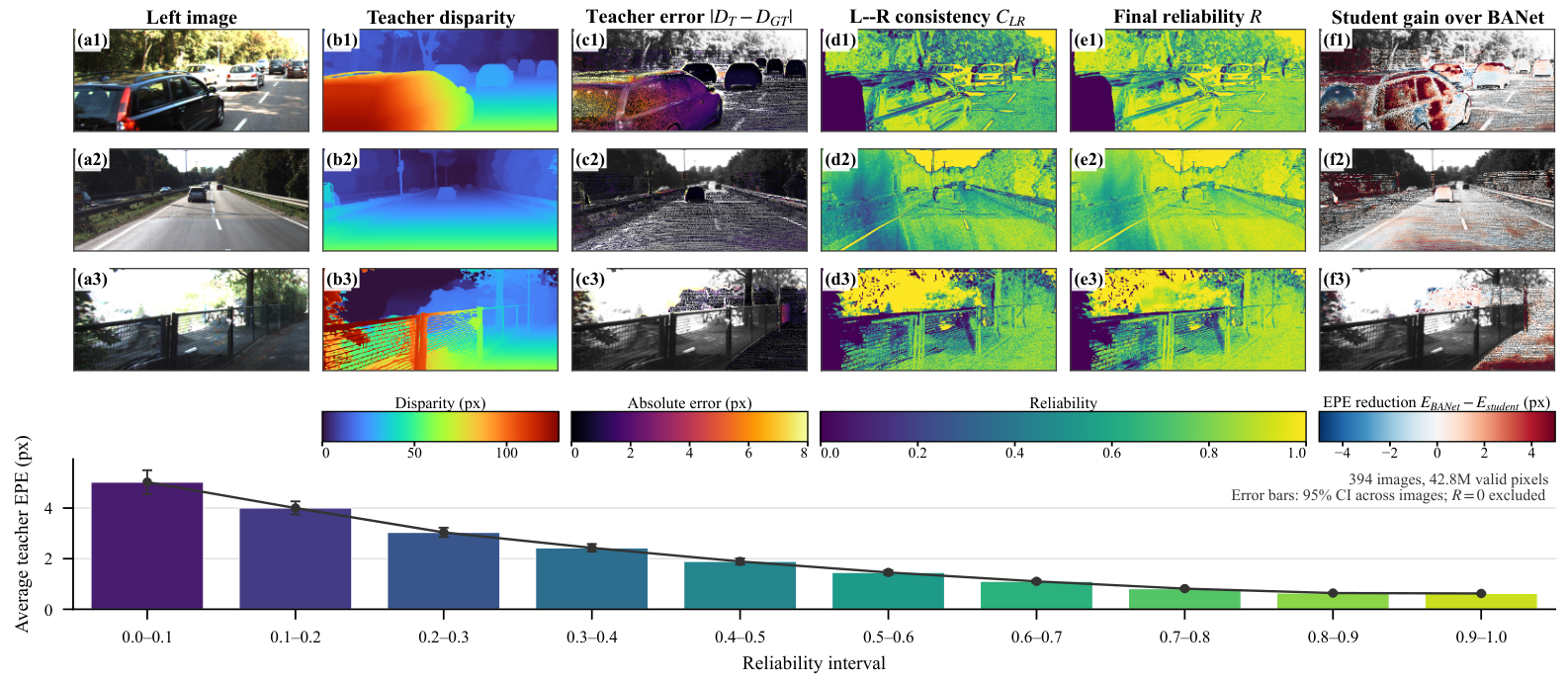
Pseudo-label quality varies across image regions. Figure 4 evaluates the reliability estimator by juxtaposing teacher disparity, teacher absolute error, left–right consistency, the final reliability map, and the student’s EPE reduction over BANet. Low-reliability responses concentrate around large teacher errors, occlusions, reflective or ambiguous boundaries, and difficult fine structures. Across 394 images and 42.8 million valid pixels, average teacher EPE decreases as the reliability interval increases; the error bars report 95% confidence intervals across images. This monotonic relationship is consistent with the reliability-gated gains in Table 6 and Table 8.
Figure 4.
Reliability analysis. The three image rows are indexed by suffixes 1, 2, and 3, respectively; panels (a1–f1), (a2–f2), and (a3–f3) share the same column meanings. The top rows visualize the left image, FoundationStereo teacher disparity, teacher absolute error , left–right consistency , final reliability R, and student EPE reduction over BANet. The bottom plot groups valid pixels by reliability and reports average teacher EPE with 95% confidence intervals across images. Higher reliability consistently corresponds to lower teacher error, supporting reliability-gated pseudo-label distillation.
Table 8.
Ablation study of BRD-Stereo. Lower is better.
4.6. Bilateral Routing Analysis
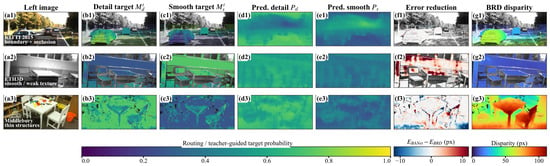
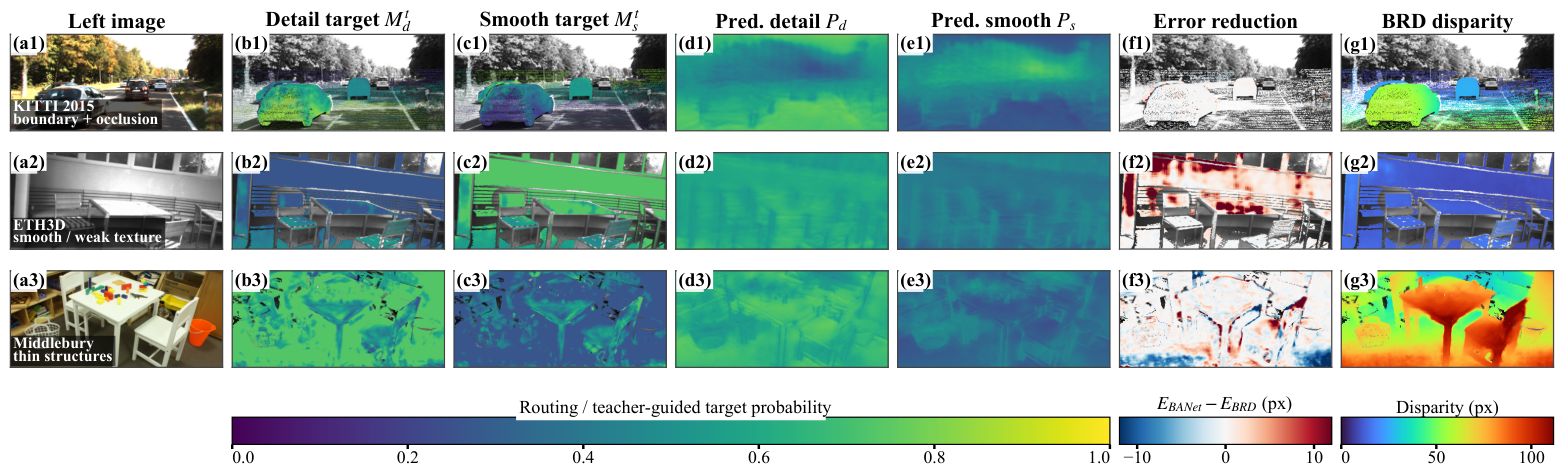
Figure 5 visualizes the behavior of the bilateral router on KITTI 2015, ETH3D, and Middlebury. For this diagnostic, the student is trained only on Scene Flow and evaluated without target-domain fine-tuning. Teacher-guided detail and smooth targets are computed for analysis, while and are the student’s predicted routing maps. The detail pathway responds more strongly around object contours, disparity discontinuities, and thin structures, whereas the smooth pathway emphasizes locally coherent surfaces and weak-texture regions. The error-reduction maps, defined as , show that these complementary routing patterns coincide with local improvements over the BANet baseline. This visualization provides mechanism-level evidence for the region-specific gains in Table 7 and for the branch-wise ablations in Table 8.
Figure 5.
Bilateral routing analysis using the Scene Flow-only student. Rows show selected KITTI 2015, ETH3D, and Middlebury scenes, indexed by suffixes 1, 2, and 3, respectively. Panels (a1–g1), (a2–g2), and (a3–g3) share the same column meanings. Columns visualize the left image, teacher-guided detail target , smooth target , predicted detail routing , predicted smooth routing , error reduction , and BRD disparity. The complementary routing maps emphasize boundary/detail and smooth/weak-texture regions, respectively, and align with localized error reduction.
4.7. Ablation Study
We conduct ablation studies to verify the contribution of each component. All variants use the same improved BANet backbone and the same training data. The results are shown in Table 8. Removing the reliability mask degrades KITTI 2015 D1 from 4.02% to 4.39%, ETH3D Bad-1.0 from 4.28% to 5.30%, Middlebury Bad-2.0 from 8.35% to 9.15%, and Boundary EPE from 1.18 to 1.30. This result shows that spatially uniform teacher supervision propagates teacher errors to the student.
Removing the detail branch loss increases Boundary EPE from 1.18 to 1.36, showing the contribution of boundary-aware gradient distillation to high-frequency structure preservation. Removing the smooth branch loss mainly degrades ETH3D and Middlebury performance, showing that low-frequency and plane-consistency distillation improves weak-texture and high-resolution scenes. Removing router pretraining degrades all metrics, demonstrating the contribution of teacher-guided region assignment to bilateral aggregation.
The disparity-only BRD variant performs worse than the full model, showing the complementary value of sliced score distribution supervision. Its fixed-bandwidth Gaussian target represents local score shape, while the separate reliability weight represents spatial teacher trust.
4.8. Hyperparameter Robustness
The sensitivity analysis tests whether cross-domain performance depends on a narrow hyperparameter choice. Every configuration starts from the same Stage-1 Scene Flow-pretrained student, unlabeled DrivingStereo data, and optimization schedule, then runs unchanged on KITTI 2012, KITTI 2015, ETH3D, and Middlebury. Target-domain images and annotations do not guide configuration selection or fine-tuning.
Parameters are perturbed by functional group: reliability decay temperatures are scaled jointly, auxiliary BRD loss weights and detail-target softness are varied, and the local score-slice radius is changed. This design measures stability without independently optimizing each scalar.
Table 9 shows limited variation across the tested parameter groups. Scaling the reliability temperatures by 25% changes KITTI 2015 D1 by at most 0.06 percentage points and ETH3D Bad-1.0 by at most 0.11 points. Scaling the auxiliary BRD loss weights by 50% changes KITTI 2015 D1 by at most 0.09 points, ETH3D Bad-1.0 by 0.18 points, and Middlebury Bad-2.0 by 0.23 points. A score-slice radius of four is marginally better on KITTI 2015, whereas the default remains better on ETH3D and Middlebury. One shared configuration is therefore retained across all reported evaluations.
Table 9.
Hyperparameter sensitivity under the fixed Scene Flow → DrivingStereo training protocol. Every configuration is evaluated zero-shot on all four target benchmarks without dataset-specific tuning. Lower is better.
4.9. Efficiency Analysis
Table 10 reports deployment efficiency, and Table 11 decomposes the additional computation. The improved BANet core uses 5.72 M parameters, 39.8 G MACs, and 4.5ms. Complete BRD-BANet uses 5.84 M parameters, 42.0 G MACs, and 4.9 ms, adding 0.12 M parameters, 2.2 G MACs, and 0.4 ms through the score–volume router and branch-specific context/fusion modules retained in the student graph.
Table 10.
Efficiency comparison. Latency is measured on RTX 4090.
Table 11.
Deployment complexity decomposition of BRD-BANet. The data clarify the deployment-time cost added to the improved BANet core.
FoundationStereo inference, bidirectional consistency, reliability estimation, pseudo-label generation, teacher-derived region targets, local plane fitting, and all distillation losses are removed at deployment. Relative to reproduced BANet-2D, the final student increases MACs by 15.1% (36.5 G to 42.0 G) and latency by 19.5% (4.1 ms to 4.9 ms).
5. Discussion
BRD-Stereo occupies a complementary design point between high-capacity zero-shot foundation models and lightweight deployment architectures. FoundationStereo obtains cross-domain robustness through million-scale synthetic training, foundation-model priors, and long-range context reasoning [13]; Fast-FoundationStereo accelerates this family through backbone distillation, architecture search, pruning, and large-scale pseudo-label curation [17]; and Lite Any Stereo combines a compact architecture with staged million-scale training [18]. Given a compact bilateral student and a frozen stereo teacher, BRD-Stereo studies where teacher supervision is reliable and how complementary cues should be assigned to specialized student pathways. This reliability–structure coupling can be combined with future efficient backbones or larger pseudo-labeled corpora.
FitNet-style regression transfers intermediate activations, Attention Transfer aligns spatial attention responses, and ReviewKD performs cross-stage feature review [27,38,39]. Under the same teacher, initialization, DrivingStereo data, and optimization schedule, these baselines improve on plain disparity regression. Full BRD-BANet further improves on ReviewKD by 0.22 percentage points on KITTI 2015 D1, 0.51 points on ETH3D Bad-1.0, and 0.63 points on Middlebury Bad-2.0. Together with the reliability error analysis, region-specific results, and branch ablations, this margin supports the value of filtering unreliable regions and routing boundary/detail, smooth/planar, and local score distribution cues to matching student components.
BANet supplies the bilateral aggregation backbone that separates detailed and smooth matching evidence [12]. BRD-BANet modifies routing, smooth-context reasoning, and fusion so that teacher-derived region targets can supervise the two pathways directly. Relative to reproduced BANet-2D, Full BRD-BANet reduces KITTI 2015 D1 from 4.71% to 4.02%, ETH3D Bad-1.0 from 5.92% to 4.28%, and Middlebury Bad-2.0 from 10.05% to 8.35%. Detail supervision contributes most near boundaries and occlusions, while smooth-region supervision contributes more on weak-texture and high-resolution scenes. The resulting contribution is a teacher-addressable bilateral student whose internal specialization is coupled to reliability-aware distillation.
The architecture-only row in Table 6 separates these effects. Relative to BANet-2D, the improved backbone reduces KITTI 2015 D1 by 0.09 points, ETH3D Bad-1.0 by 0.18 points, and Middlebury Bad-2.0 by 0.16 points. Plain teacher disparity distillation adds reductions of 0.09, 0.19, and 0.17 points, while the complete BRD objective produces the largest gains. Architectural refinement contributes independently, with reliability-aware bilateral distillation accounting for the dominant improvement under domain shift.
Teacher-side computation is removed after training. Under the stated RTX 4090 protocol, the final student contains 5.84 M parameters, requires 42.0 G MACs, and runs at 4.9 ms. Its deployment overhead is limited to the student-side routing, context, and fusion modules quantified in Table 11.
6. Limitations and Future Directions
BRD-Stereo requires a high-capacity frozen FoundationStereo teacher during training. Offline pseudo-label generation adds computation and storage, and teacher biases can reach the student when they escape the reliability estimator. The deployed BRD-BANet is also heavier than the reproduced BANet-2D because its score–volume router, smooth branch context block, and residual fusion head remain in the inference graph.
The reliability estimator combines left–right consistency, teacher confidence, edge agreement, local regularity, and occlusion-aware validity through a fixed rule. This manually specified combination may be suboptimal for transparent, reflective, repetitive, or strongly non-Lambertian regions. The Gaussian target in Equation (33) also uses a fixed bandwidth and transfers local score distribution structure rather than calibrated predictive uncertainty. Learning the reliability function from teacher error statistics, adapting the score-target bandwidth, and incorporating calibrated teacher posteriors are promising extensions.
The evidence covers one foundation teacher, one BANet-derived student family, and the DrivingStereo pseudo-label corpus. Transfer to other teachers, compact backbones, and larger unlabeled corpora remains to be evaluated. Severe weather, nighttime imagery, transparent or reflective materials, and other strongly shifted domains would further characterize the failure envelope. Hardware-aware simplification of the router and branch refinement modules may reduce deployment overhead while retaining region-specific gains.
7. Conclusions
We introduced BRD-Stereo, a bilateral reliability distillation framework that transfers a stereo foundation teacher to a lightweight BANet-style matcher. Spatial reliability filters teacher supervision, and complementary cues are assigned to the student’s detail and smooth aggregation branches. Across Scene Flow, KITTI, ETH3D, and Middlebury, BRD-Stereo improves global and region-specific accuracy over plain pseudo-label distillation. The final student contains 5.84 M parameters and runs at 4.9 ms on RTX 4090. Reliability error analysis shows that higher reliability corresponds to lower teacher error, while routing visualizations show complementary detail and smooth specialization under Scene Flow-only training. These results support reliability-aware, architecture-aligned transfer from stereo foundation models to compact students.
Author Contributions
Conceptualization, Y.Z.; methodology, Y.Z.; software, Y.Z., B.Y.; validation, Y.Z.; formal analysis, Y.Z.; investigation, Y.Z.; data curation, Y.Z.; writing–original draft preparation, Y.Z.; writing–review and editing, Y.Z., B.Y.; visualization, Y.Z.; Funding acquisition, B.Y. All authors have read and agreed to the published version of the manuscript.
Funding
This research was funded by Natural Science Basic Research Program of Shaanxi, grant number 2025JC-YBMS-787.
Data Availability Statement
The datasets analyzed in this study are publicly available from the Scene Flow, KITTI, ETH3D, Middlebury, and DrivingStereo benchmark resources cited in the manuscript. No new dataset was created in this study.
Conflicts of Interest
The author declares no conflicts of interest.
References
- Kendall, A.; Martirosyan, H.; Dasgupta, S.; Henry, P.; Kennedy, R.; Bachrach, A.; Bry, A. End-to-end learning of geometry and context for deep stereo regression. In Proceedings of the 2017 IEEE International Conference on Computer Vision (ICCV); IEEE: Piscataway, NJ, USA, 2017; pp. 66–75. [Google Scholar] [CrossRef] [Scilit]
- Chang, J.-R.; Chen, Y.-S. Pyramid stereo matching network. In Proceedings of the 2018 IEEE/CVF Conference on Computer Vision and Pattern Recognition; IEEE: Piscataway, NJ, USA, 2018; pp. 5410–5418. [Google Scholar] [CrossRef] [Scilit]
- Guo, X.; Yang, K.; Yang, W.; Wang, X.; Li, H. Group-wise correlation stereo network. In Proceedings of the 2019 IEEE/CVF Conference on Computer Vision and Pattern Recognition (CVPR); IEEE: Piscataway, NJ, USA, 2019; pp. 3273–3282. [Google Scholar]
- Zhang, F.; Prisacariu, V.; Yang, R.; Torr, P.H.S. GA-Net: Guided aggregation net for end-to-end stereo matching. In Proceedings of the 2019 IEEE/CVF Conference on Computer Vision and Pattern Recognition (CVPR); IEEE: Piscataway, NJ, USA, 2019; pp. 185–194. [Google Scholar] [CrossRef] [Scilit]
- Lipson, L.; Teed, Z.; Deng, J. RAFT-Stereo: Multilevel recurrent field transforms for stereo matching. In Proceedings of the 2021 International Conference on 3D Vision (3DV); IEEE: Piscataway, NJ, USA, 2021; pp. 218–227. [Google Scholar]
- Xu, G.; Wang, X.; Ding, X.; Yang, X. Iterative geometry encoding volume for stereo matching. In Proceedings of the 2023 IEEE/CVF Conference on Computer Vision and Pattern Recognition (CVPR); IEEE: Piscataway, NJ, USA, 2023; pp. 21919–21928. [Google Scholar]
- Khamis, S.; Fanello, S.; Rhemann, C.; Kowdle, A.; Valentin, J.; Izadi, S. StereoNet: Guided hierarchical refinement for real-time edge-aware depth prediction. In Proceedings of the Computer Vision–ECCV 2018: 15th European Conference; Springer: Berlin/Heidelberg, Germany, 2018; pp. 596–613. [Google Scholar]
- Duggal, S.; Wang, S.; Ma, W.-C.; Hu, R.; Urtasun, R. DeepPruner: Learning efficient stereo matching via differentiable patchmatch. In Proceedings of the 2019 IEEE/CVF International Conference on Computer Vision (ICCV); IEEE: Piscataway, NJ, USA, 2019; pp. 4384–4393. [Google Scholar]
- Xu, H.; Zhang, J. AANet: Adaptive aggregation network for efficient stereo matching. In Proceedings of the 2020 IEEE/CVF Conference on Computer Vision and Pattern Recognition (CVPR); IEEE: Piscataway, NJ, USA, 2020; pp. 1959–1968. [Google Scholar]
- Tankovich, V.; Hane, C.; Zhang, Y.; Kowdle, A.; Fanello, S.; Bouaziz, S. HITNet: Hierarchical iterative tile refinement network for real-time stereo matching. In Proceedings of the 2021 IEEE/CVF Conference on Computer Vision and Pattern Recognition (CVPR); IEEE: Piscataway, NJ, USA, 2021; pp. 14362–14372. [Google Scholar]
- Shamsafar, F.; Woerz, S.; Rahim, R.; Zell, A. MobileStereoNet: Towards lightweight deep networks for stereo matching. In Proceedings of the 2022 IEEE/CVF Winter Conference on Applications of Computer Vision (WACV); IEEE: Piscataway, NJ, USA, 2022; pp. 2417–2426. [Google Scholar]
- Xu, G.; Liu, J.; Wang, X.; Cheng, J.; Deng, Y.; Zang, J.; Chen, Y.; Yang, X. BANet: Bilateral aggregation network for mobile stereo matching. In Proceedings of the IEEE/CVF International Conference on Computer Vision; IEEE: Piscataway, NJ, USA, 2025. [Google Scholar]
- Wen, B.; Trepte, M.; Aribido, J.; Kautz, J.; Gallo, O.; Birchfield, S. FoundationStereo: Zero-shot stereo matching. In Proceedings of the IEEE/CVF Conference on Computer Vision and Pattern Recognition; IEEE: Piscataway, NJ, USA, 2025; pp. 5249–5260. [Google Scholar]
- Cheng, J.; Liu, L.; Xu, G.; Wang, X.; Zhang, Z.; Deng, Y.; Zang, J.; Chen, Y.; Cai, Z.; Yang, X. MonSter: Marry monodepth to stereo unleashes power. In Proceedings of the IEEE/CVF Conference on Computer Vision and Pattern Recognition (CVPR); IEEE: Piscataway, NJ, USA, 2025; pp. 6273–6282. [Google Scholar]
- Bartolomei, L.; Tosi, F.; Poggi, M.; Mattoccia, S. Stereo Anywhere: Robust zero-shot deep stereo matching even where either stereo or mono fail. In Proceedings of the IEEE/CVF Conference on Computer Vision and Pattern Recognition; IEEE: Piscataway, NJ, USA, 2025; pp. 1013–1027. [Google Scholar]
- Jiang, H.; Lou, Z.; Ding, L.; Xu, R.; Tan, M.; Jiang, W.; Huang, R. DEFOM-Stereo: Depth foundation model based stereo matching. In Proceedings of the IEEE/CVF Conference on Computer Vision and Pattern Recognition; IEEE: Piscataway, NJ, USA, 2025; pp. 21857–21867. [Google Scholar]
- Wen, B.; Dewan, S.; Birchfield, S. Fast-FoundationStereo: Real-time zero-shot stereo matching. In Proceedings of the IEEE/CVF Conference on Computer Vision and Pattern Recognition; IEEE: Piscataway, NJ, USA, 2026; pp. 7513–7524. [Google Scholar]
- Jing, J.; Luo, W.; Mao, Y.; Mikolajczyk, K. Lite Any Stereo: Efficient zero-shot stereo matching. In Proceedings of the IEEE/CVF Conference on Computer Vision and Pattern Recognition; IEEE: Piscataway, NJ, USA, 2026; pp. 21725–21735. [Google Scholar]
- Xu, G.; Cheng, J.; Guo, P.; Yang, X. Attention concatenation volume for accurate and efficient stereo matching. In Proceedings of the 2022 IEEE/CVF Conference on Computer Vision and Pattern Recognition (CVPR); IEEE: Piscataway, NJ, USA, 2022; pp. 12981–12990. [Google Scholar]
- Shen, Z.; Dai, Y.; Song, X.; Rao, Z.; Zhou, D.; Zhang, L. PCW-Net: Pyramid combination and warping cost volume for stereo matching. In Proceedings of the Computer Vision–ECCV 2022; Springer: Cham, Switzerland, 2022; pp. 280–297. [Google Scholar]
- Xu, G.; Wang, X.; Zhang, Z.; Cheng, J.; Liao, C.; Yang, X. IGEV++: Iterative multi-range geometry encoding volumes for stereo matching. IEEE Trans. Pattern Anal. Mach. Intell. 2025, 47, 7108–7122. [Google Scholar] [CrossRef] [Scilit]
- Huang, J.; Fu, X.; Xiao, Z.; Zhao, F.; Xiong, Z. Low-light stereo image enhancement. IEEE Trans. Multimed. 2023, 25, 2978–2992. [Google Scholar] [CrossRef] [Scilit]
- Xu, B.; Xu, Y.; Yang, X.; Jia, W.; Guo, Y. Bilateral grid learning for stereo matching networks. In Proceedings of the 2021 IEEE/CVF Conference on Computer Vision and Pattern Recognition (CVPR); IEEE: Piscataway, NJ, USA, 2021; pp. 12497–12506. [Google Scholar]
- Xu, G.; Wang, Y.; Cheng, J.; Tang, J.; Yang, X. Accurate and efficient stereo matching via attention concatenation volume. IEEE Trans. Pattern Anal. Mach. Intell. 2024, 46, 2461–2474. [Google Scholar] [CrossRef] [Scilit]
- Liu, J.; Xu, G.; Wang, X.; Zhang, C.; Yang, X. Generalized geometry encoding volume for real-time stereo matching. Proc. AAAI Conf. Artif. Intell. 2026, 40, 7179–7185. [Google Scholar] [CrossRef] [Scilit]
- Hinton, G.; Vinyals, O.; Dean, J. Distilling the knowledge in a neural network. arXiv 2015, arXiv:1503.02531. [Google Scholar]
- Romero, A.; Ballas, N.; Kahou, S.E.; Chassang, A.; Gatta, C.; Bengio, Y. FitNets: Hints for thin deep nets. In Proceedings of the International Conference on Learning Representations, San Diego, CA, USA, 7–9 May 2015. [Google Scholar]
- Gou, J.; Yu, B.; Maybank, S.J.; Tao, D. Knowledge distillation: A survey. Int. J. Comput. Vis. 2021, 129, 1789–1819. [Google Scholar] [CrossRef] [Scilit]
- Lu, X.; Xiao, J.; Zhu, Y.; Fu, X. Continuous adverse weather removal via degradation-aware distillation. In Proceedings of the IEEE/CVF Conference on Computer Vision and Pattern Recognition (CVPR); IEEE: Piscataway, NJ, USA, 2025; pp. 28113–28123. [Google Scholar] [CrossRef] [Scilit]
- Liu, H.; Xie, Q.; Ye, T.; Deng, Z.; Chen, C.; Tang, S.; Fu, X.; Lu, H.; Zha, Z.-J. SCott: Accelerating diffusion models with stochastic consistency distillation. Proc. AAAI Conf. Artif. Intell. 2025, 39, 5451–5459. [Google Scholar] [CrossRef] [Scilit]
- Mayer, N.; Ilg, E.; Hausser, P.; Fischer, P.; Cremers, D.; Dosovitskiy, A.; Brox, T. A large dataset to train convolutional networks for disparity, optical flow, and scene flow estimation. In Proceedings of the IEEE Conference on Computer Vision and Pattern Recognition (CVPR); IEEE: Piscataway, NJ, USA, 2016; pp. 4040–4048. [Google Scholar]
- Yang, G.; Song, X.; Huang, C.; Deng, Z.; Shi, J.; Zhou, B. DrivingStereo: A large-scale dataset for stereo matching in autonomous driving scenarios. In Proceedings of the IEEE/CVF Conference on Computer Vision and Pattern Recognition (CVPR); IEEE: Piscataway, NJ, USA, 2019; pp. 899–908. [Google Scholar] [CrossRef] [Scilit]
- Geiger, A.; Lenz, P.; Urtasun, R. Are we ready for autonomous driving? The KITTI vision benchmark suite. In Proceedings of the IEEE Conference on Computer Vision and Pattern Recognition; IEEE: Piscataway, NJ, USA, 2012; pp. 3354–3361. [Google Scholar]
- Menze, M.; Geiger, A. Object scene flow for autonomous vehicles. In Proceedings of the IEEE Conference on Computer Vision and Pattern Recognition (CVPR); IEEE: Piscataway, NJ, USA, 2015; pp. 3061–3070. [Google Scholar]
- Schops, T.; Schonberger, J.L.; Galliani, S.; Sattler, T.; Schindler, K.; Pollefeys, M.; Geiger, A. A multi-view stereo benchmark with high-resolution images and multi-camera videos. In Proceedings of the IEEE Conference on Computer Vision and Pattern Recognition; IEEE: Piscataway, NJ, USA, 2017; pp. 2538–2547. [Google Scholar] [CrossRef] [Scilit]
- Scharstein, D.; Hirschmuller, H.; Kitajima, Y.; Krathwohl, G.; Nesic, N.; Wang, X.; Westling, P. High-resolution stereo datasets with subpixel-accurate ground truth. In Proceedings of the German Conference on Pattern Recognition; Springer: Cham, Switzerland, 2014; pp. 31–42. [Google Scholar] [CrossRef] [Scilit]
- Cheng, J.; Liao, W.; Cai, Z.; Liu, L.; Xu, G.; Wang, X.; Wang, Y.; Yuan, Z.; Deng, Y.; Zang, J.; et al. MonSter++: Unified Stereo Matching, Multi-View Stereo, and Real-Time Stereo with Monodepth Priors. arXiv 2025, arXiv:2501.08643. [Google Scholar] [CrossRef] [Scilit]
- Zagoruyko, S.; Komodakis, N. Paying more attention to attention: Improving the performance of convolutional neural networks via attention transfer. In Proceedings of the International Conference on Learning Representations, Toulon, France, 24–26 April 2017. [Google Scholar]
- Chen, P.; Liu, S.; Zhao, H.; Jia, J. Distilling knowledge via knowledge review. In Proceedings of the IEEE/CVF Conference on Computer Vision and Pattern Recognition; IEEE: Piscataway, NJ, USA, 2021; pp. 5008–5017. [Google Scholar] [CrossRef] [Scilit]

Disclaimer/Publisher’s Note: The statements, opinions and data contained in all publications are solely those of the individual author(s) and contributor(s) and not of MDPI and/or the editor(s). MDPI and/or the editor(s) disclaim responsibility for any injury to people or property resulting from any ideas, methods, instructions or products referred to in the content. |
© 2026 by the authors. Licensee MDPI, Basel, Switzerland. This article is an open access article distributed under the terms and conditions of the Creative Commons Attribution (CC BY) license.