


Abstract
In the age of limited spectrum, cognitive radios (CRs) are becoming a key tool for effective spectrum use. Accurate spectrum sensing (SS) in the presence of channel impairments such as fading, noise, and interference is a crucial problem for CRs, especially during periods of low Signal-to-Noise Ratio (SNR). Here, we suggest a radial basis function neural network (RBFNN)-based adaptive equalization framework integrated with spectrum sensing techniques, specifically cyclostationary feature detection (CFD) and energy detection (ED), in order to attain a high level of detection accuracy and low false alarm rates. Moreover, the equalizer improves signal quality under nonlinear noisy channel conditions using supervised learning-based optimization. Results from the simulation show improved bit error rate (BER) and mean square error (MSE) performance for SNR ranging from 0 to 25 dB on nonlinear and noisy channels. Compared with the conventional energy detector operating without equalization, the proposed RBFNN-assisted framework achieves an 18.6% increase in detection probability and a 14.3% reduction in false alarm probability at an SNR of 5 dB. Moreover, the proposed scheme also demonstrates superior performance in terms of signal reconstruction and robust spectrum sensing in fading channels.
1. Introduction
The need for effective spectrum usage has increased since wireless communication is growing so quickly. Because licenced frequency bands are underutilized, traditional spectrum allocation techniques result in inefficient spectrum usage. In order to solve this issue, unlicenced users are permitted on CR networks to dynamically access unused spectrum bands (spectrum holes) without interfering with PUs that are licensed [1,2]. Spectrum sensing, which finds spectrum gaps by examining whether key user signals are present or absent, is a basic task in CR networks.
Channel impairments including noise, multipath fading, and shadowing frequently hinder spectrum detection. To address these challenges, several equalization techniques have been suggested by researchers to restore the quality of distorted signals.
Equalization approaches employing artificial neural networks (ANN) for nonlinear channels have surpassed those of linear equalizers [3,4,5,6,7]. Consequently, many researchers have employed single-layer and multi-layer ANNs to balance communication channels [8,9,10]. In addition to offering faster convergence and ideal results, metaheuristic algorithms (MA) are better at escaping local optima. This characteristic of MAs attracted the attention of the wireless research community, leading to the usage of various types of MAs in order to achieve channel equalization [11,12,13,14,15].
Without any disruptions, the quality of service (QoS) shall not be lowered during the spectrum allocation process from PU to SU. Continuous monitoring and analysis of the PU is necessary to detect idle bandwidth [16]. ED [17], matching filter detection (MF) [18], and CFD [19] are CR-based spectrum sensing algorithms that have been thoroughly studied in the last decade. The detection-based dynamic threshold ED is employed in [20] to get a better understanding of the spectral effectiveness of the system. By assessing the effect of signal noise in various situations, the detector’s performance is improved. It is determined that the Ed that was presented had the best detection performance. The effectiveness of ED on the channels was constructed and examined by the authors in [21]. It is observed that ED’s effectiveness is contingent upon the threshold selection criterion. The simulation’s outcomes demonstrate that the system’s detection execution was high due to the selection of an ideal threshold. The unwelcome existence of noise fluctuation in the signal has a substantial negative impact on the execution of ED. An ED algorithm that eliminates noise was presented by the authors in [22]. The work’s conclusion shows that the suggested ED performs better than the traditional ED. Combining ED and MF to create a hybrid algorithm was presented by the authors in [23]. The experiment’s findings demonstrate that the recommended method effectively lowers the false alarm rate, improving the MF algorithm’s accuracy in detection. The authors of [24] evaluated the various parameters, including , , and BER, by applying an ED to the OFDM structure. A unique ED approach based on mean energy estimation was reported in the publication [25]. Comparing the experimental work to the traditional ED-SS approach, a 30% gain is shown.
ED and CFD are two popular methods for spectrum sensing. CFD is especially useful in low-SNR conditions because it uses the periodic statistical characteristics of modulated signals to separate them from noise [26]. In contrast, the energy of the received signal during a certain time window is measured by ED, which then compares it to a threshold to define spectrum occupancy.
Although ED is easy to compute, it performs less well when there is noise and fading [27]. The advantages of CFD and ED are combined with RBFNN-based equalization to create a strong foundation for CR network spectrum sensing.
Although there are multiple spectrum sensing methods available for cognitive radio communication, their effectiveness declines considerably when used in low-SNR environments and fading channels because of noise uncertainty and channel impairments. Traditional equalizer approaches such as least mean square (LMS) and recursive least square (RLS) face the challenges of slower convergence rates and less adaptability when wireless channels are dynamic. Furthermore, there are very few existing works in the literature where both spectrum sensing and equalization are studied in conjunction using an intelligent machine learning algorithm. Thus, an effective adaptive equalization scheme along with spectrum sensing is needed.
Even though numerous machine learning and neural network approaches for cognitive radio network spectrum sensing have been developed, very few of the existing approaches have concentrated on enhancing the quality of the signal before performing the sensing procedure. The consequence is that conventional sensing methods do not perform well when subjected to nonlinear distortion, fading, and low SNR. In addition to that, the majority of the existing methods that rely on neural network assistance fail to integrate the adaptive equalization component alongside the spectrum sensing method. In addition, existing neural network-based methods for spectrum sensing do not usually incorporate adaptive equalization along with spectrum sensing. Advances in generative artificial intelligence have led to the emergence of diffusion-based methods that can restore severely corrupted signals from noise and channel impairments. Specifically, as shown in He et al. [28], there is great promise in the use of diffusion-based semantic communication systems for effective signal recovery and reliable transmission even in difficult conditions of wireless communication.
While the suggested adaptive equalization approach based on RBFNN provides substantial advances in spectrum sensing performance, new approaches that involve generative AI-enabled signal reconstruction provide potential avenues for future research. One possible avenue would be the exploration of the combination of diffusion denoising and semantic communication methods together with adaptive equalization schemes. The prime objective of this work is to develop a machine learning-based adaptive equalization framework using an RBFNN for SS in CRNs. In addition, the designed spectrum sensing technique will utilize the principles of cyclic feature detection and energy detection. In this paper, an integrated system that combines CFD, ED, and RBFNN-based adaptive equalization is proposed to enhance cognitive radio networks’ spectrum sensing capabilities. In addition to CFD and ED providing dependable spectrum sensing, the RBFNN equalizer reduces channel impairments and enhances the quality of the reception. Experimental findings show that, even under difficult low-SNR circumstances, the suggested strategy outperforms conventional techniques with respect to detection accuracy.
The main contributions of this work are outlined as follows:
- An innovative adaptive equalizer model based on the RBFNN approach has been proposed to overcome channel effects in CR networks.
- While the present literature on neural network-based sensing techniques carries out signal classification, the suggested framework will improve the signal before carrying out spectrum sensing.
- A dual-spectrum sensing approach integrating CFD and ED has been introduced to increase the reliability of the sensing process.
- The recommended methodology increases the probability of detection while decreasing the PFA in low-SNR scenarios.
- Simulation comparison studies show enhanced performance in contrast to conventional spectrum sensing methods under noisy channels, based on BER, MSE, probability of detection, and probability of false alarm as performance measures.
- The suggested technique will be beneficial in future intelligent cognitive radio systems.
- The proposed framework performs much better in terms of signal sensing and signal reconstruction than conventional equalization techniques.
The organization of the rest of this paper is presented as follows. The problem description and formulation in relation to the proposed cognitive radio network are addressed in Section 2. Section 3 will introduce the novel RBFNN-based adaptive equalizer incorporating both CFD and ED for spectrum sensing in the proposed CRN. Simulation experiments will be described in Section 4, where details such as the simulation model and performance evaluation measurements are included. Section 5 concludes the paper and highlights possible future research directions. Table 1 highlights the list of acronyms/abbreviations utilized in the manuscript with their respective meanings.
Table 1.
List of Acronyms.
2. System Model and Problem Formulation
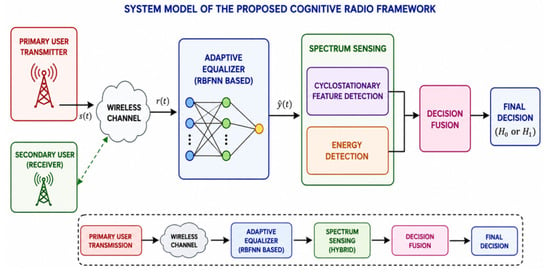
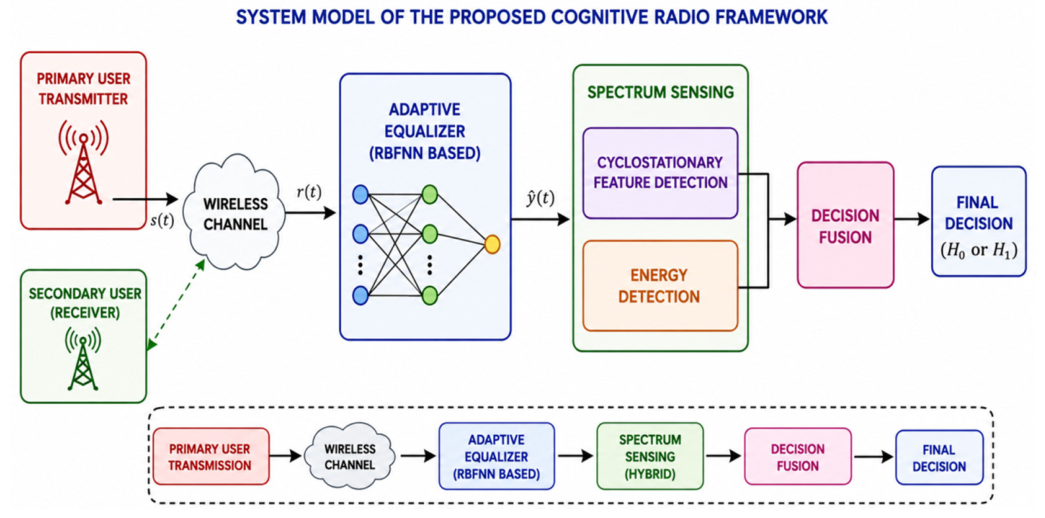
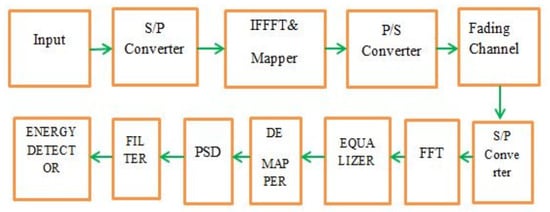
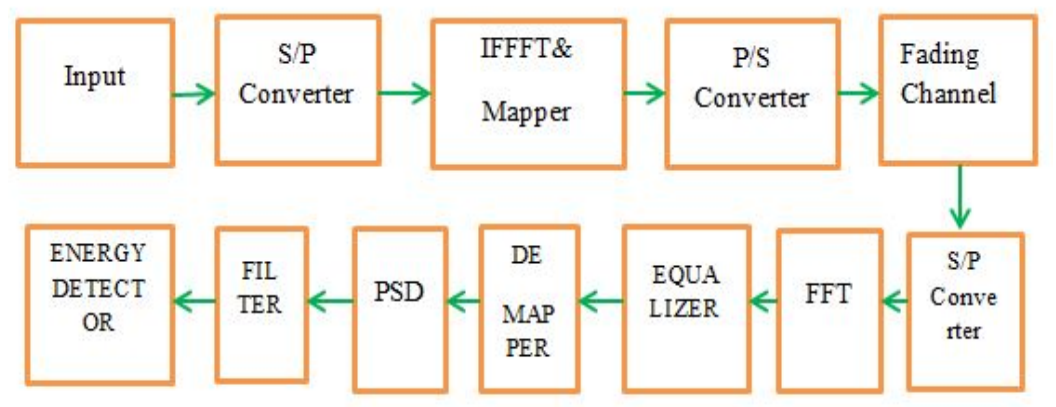
Here, we introduce the system architecture and mathematical formulation of the suggested machine learning-based adaptive equalization approach for spectrum sensing within CRNs. Specifically, the proposed system architecture combines an RBFNN-based adaptive equalizer with hybrid spectrum sensing approaches such as cyclostationary feature detection and energy detection for more consistent SS under low SNR and fading channels. The framework of the proposed cognitive radio system that consists of an adaptive equalizer and hybrid SS methods is shown in Figure 1. In this proposed system framework, the RBFNN adaptive equalization technique has been combined with two hybrid spectrum sensing methods, i.e., cyclostationary feature detection and energy detection.
Figure 1.
System model of the proposed machine learning-driven cognitive radio framework.
2.1. Proposed Cognitive Radio Framework
Consider a CR system that comprises a licenced primary user (PU) and several unlicenced secondary users (SUs). The secondary users access the spectrum opportunistically only when the licensed spectrum band appears to be free from any PU transmission. Thus, in order not to interfere with PU transmission, accurate spectrum sensing is necessary. However, in realistic scenarios, the signals received at the SU are very much impacted by factors such as fading, shadowing, and interference due to channel effects. Such channel impairments reduce the performance of existing spectrum sensing techniques. The signal received at the SU can be modelled based on the following binary hypothesis:
Here, is the PU signal, is additive white Gaussian noise (AWGN) with zero mean and variance , and and signify the absence and presence of the PU signal correspondingly and SS aims to be able to decide as to which of the two hypotheses regarding the received signal is correct; or is described in Equations (1) and (2).
2.2. Problem Statement
Traditional methods of spectrum sensing, such as energy detection, have been found to be highly ineffective when detecting signals in conditions with low SNR levels owing to factors such as noise uncertainties and fading channels. This problem is also common in the operation of traditional adaptive equalizers like the LMS and RLS. In addition, existing methods consider equalization and spectrum sensing as two different operations and, as such, the sensing process becomes inefficient. Thus, there is a necessity for a smart adaptive equalization system that will eliminate channel effects before spectrum sensing. To solve the problem stated above, this study suggests a cognitive radio receiver consisting of adaptive equalization with an RBFNN together with hybrid spectrum sensing techniques to improve the probability of detection and decrease probability of false alarm .
3. Proposed RBFNN-Based Adaptive Spectrum Sensing Framework
The overall architecture of the proposed cognitive radio architecture using a machine learning approach is presented in Figure 1. The suggested architecture employs an adaptive equalizer-based RBFNN along with hybrid spectrum sensing techniques for increasing the accuracy of spectrum sensing in low SNR and fading channel conditions. At first, the PU generates and sends the signal using a wireless fading channel where the presence of AWGN, multipath fading, and interference degrades the signal. The received signal is captured by the SU and sent to the adaptive equalizer.
The adaptive equalizer uses the RBFNN to address the issue of channel nonlinearity. After equalization of the received signal, the signal is further subjected to hybrid spectrum sensing, where there are two main components involved: ED and CFD. The first component determines the energy level of the received signal and compares it against a predefined threshold value, while the second part performs extraction of the periodic statistics of the acknowledged signal to segregate between the PU signal and noise.
The last step in the cognitive radio system would be deciding whether the licenced band spectrum can be used by the SU through detecting whether the spectrum is occupied or not. This proposed method greatly improves detection performance, lowers the false alarm rate, and enhances sensing capabilities.
3.1. RBFNN-Assisted Channel Equalization Model
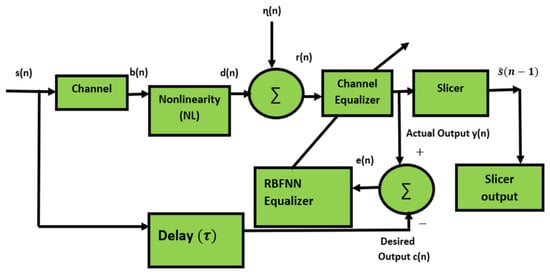
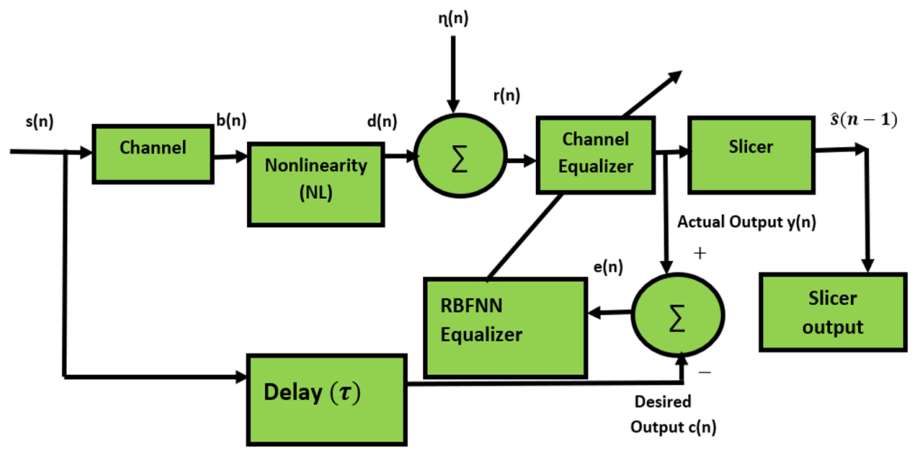
Figure 2 illustrates the system model for the RBFNN-based equalizer. Linear communication channel models, especially FIR models, have been widely used because of the linear propagation of signals through them. The transmitted signal at the sampling point for a binary input sequence is represented as .
Figure 2.
RBFNN channel equalizer.
The corresponding channel output, denoted by as illustrated in Figure 2 [8,29], can be mathematically expressed as:
where for represents the channel tap coefficients, and denotes the channel length or total number of taps as described in Equation (3).
However, in practical wireless systems, nonlinearities in channels greatly affect the process of information transfer. Taking into account the effect of non-linear distortion represented by block ‘NL’, the channel output may be stated as follows:
where denotes the nonlinear channel operation and represents the effective nonlinear channel memory length. In order to make a realistic model of the communication environment, AWGN represented by is added to the established signal as represented in Equation (4).
Thus, the received signal is defined as:
where indicates the output of the nonlinear system and signifies additive white Gaussian noise (AWGN) as represented in Equation (5).
The required response signal, which is indicated by , is determined through the delayed form of the transmitted signal. Here, τ is referred to as the equalizer delay as described in Equation (6). The required response signal can thus be written as:
The estimation error between the desired signal and the equalizer output is calculated and described in Equation (7), where corresponds to the equalized output signal.
Finally, the recovered transmitted symbol is determined using a decision slicer based on the polarity of the equalized output signal as described in Equation (8). This decision mechanism ensures correct symbol decoding by reducing channel distortions and interferences due to noise.
As illustrated in Figure 2, the equalizer incorporating an RBFNN is structured in a block diagram format. The RBFNN is characterized by excellent capability for nonlinear approximation and interpolation, allowing it to accurately produce an output vector based on effective mapping of noisy input data using the optimization process of its transfer function [30]. The architecture of an RBFNN has three layers, namely the input layer, the hidden layer, and the output layer. The hidden layer contains units equipped with specific activation functions designed to evaluate input patterns. These units, often referred to as radial basis centres, utilize radial functions to process the data, typically in the form of Gaussian functions. Equation (9) demonstrates how Gaussian functions are applied to ensure smooth functional behaviour in the hidden layer [30].
Each hidden neuron within the RBFNN has a unique receptive field. These receptive fields, denoted by (), correspond to specific input vectors. By fine-tuning the weights associated with these vectors, the network can be effectively trained to produce the intended outputs. The overall response of the RBFNN can be formulated as:
In Equation (10), the output is a straight-line model value, called y. It is made by adding up each feature after it gets multiplied by its weight . Then the bias term b is added at the end. The design of the RBFNN is guided by Cover’s theorem [31], which suggests that complex pattern classification problems can be more easily solved when mapped to a higher-dimensional space. In RBF networks, this transformation is achieved through the use of Gaussian radial basis functions.
In this work, channel equalization is formulated as a classification task [32]. This approach enables the division of the equalizer’s input space, defined as the vector , into distinct decision regions. The decision-making process follows Bayes’ theory, which offers an optimal framework for solving such classification problems. Equation 11 gives an RBF neural net decision function, denoted as . It forms a weighted sum of exponential radial kernel terms. Each kernel term uses the distance between the input vector s(n) and a set of centres . The spread of the kernels is controlled by the variance . The corresponding decision function is defined by the following equation:
Given that the transmission involves binary signalling, it can be represented accordingly in the following equation.
Equation (12) captures the relationship between the transmitted symbols and specific channel states. After the appropriate delay, the received signal is represented as , indicating binary values. Additionally, noise interference in the system is modelled as characterized by a variance denoted as .
The input layer of the RBFNN-based equalizer includes several neurons that correspond to the number of channel taps. These equalizers utilize radial basis functions, commonly Gaussian functions, to process the input signals. Such functions are defined as:
Equation (13) defines the interconnection among three key parameters: the centre of a hidden layer neuron (), the corresponding weights (), and the spread (). For simplification in this context, it is assumed that the spread is equivalent to the as referenced in Equation (13). This assumption plays a significant role in the implementation of the Bayes decision function outlined in Equation (11).
The equalizer’s output is then evaluated using the following formulation:
Whenever the output differs from the equalizer and the expected output , the resulting error, denoted as , iteratively updates the network’s weights. In this setup, N represents the total number of samples. Consequently, the MSE is adopted as an effective performance metric to assess the equalizer’s accuracy.
The BER measures the proportion of bits that were received erroneously in relation to the total number of transmitted bits. In this work, both mean squared error (MSE) and BER are employed as key performance indicators to assess the effectiveness of the equalizer. The RBFNN equalizer restores the received distorted signal back to its ideal form by eliminating any channel distortion or noise interference. After equalization, the output signal is then sent to the spectrum sensing part, which uses cyclostationary feature detection and energy detection to detect any occupied spectrum.
3.1.1. RBFNN Configuration and Training Procedure
The RBFNN equalizer was trained through supervised learning, whereby the distorted input signal acted as the input to the network, while the desired signal acted as the target output. Training data was collected using additive white Gaussian noise. Weights were continuously updated to reduce the MSE between the equalized and reference signals during training. The suggested method of adaptive equalization is based on using an RBFNN. The hidden layer makes use of Gaussian basis functions to counteract nonlinear distortion in the channel. For this model, the number of hidden layer nodes was chosen empirically as 15 to balance computational efficiency and speed of convergence. The cluster centres of the RBFs were initialized using the k-means clustering algorithm on the input training data. The value of the parameter for each radial basis neuron is defined by the average distance between the adjacent cluster centroids and is defined as:
where is the maximum distance among cluster centres, and M is the number of hidden neurons.
Supervised learning through the LMS approach was applied for updating the output weights of the RBFNN equalizer to lessen the MSE between the equalized output signal and the desired reference signal. In the training stage, a set of 10,000 signal samples was created for a nonlinear AWGN channel with SNR varying from 0 to 25 dB. Batch learning was used for training with 100 samples in each batch and 400 epochs. The equalizer was trained offline and then used in the spectrum sensing process without being retrained for each realization of the channel. The length of the input window for the equalizer was set to five samples with a delay of τ = 1. The parameters of the network were updated repeatedly until the criteria for minimum MSE convergence were met.
The main role of the RBFNN equalizer is to enhance the quality of the received signal prior to performing spectrum sensing. Traditional cognitive radio spectrum sensing methods such as energy detection (ED) and cyclostationary feature detection (CFD) are applied directly to the received signal; hence, their performance depends greatly on the channel impairments such as noise, nonlinearity, and interference. This affects the detection probability while increasing the probability of false alarms, especially when the SNR is low.
3.1.2. Functional Role of the RBFNN Equalizer in Spectrum Sensing
In the new approach, the received signal is processed by the RBFNN equalizer. Applying the nonlinear transformation property of the RBFNN, it learns the characteristics of the distorted signal and the desired one during training. While in operation, the learned RBFNN counteracts channel impairments and produces an enhanced representation of the signal. The equalized signal is then fed to the ED and CFD units to perform spectrum sensing. Unlike the traditional spectrum sensing algorithms that process the distorted signals, the new technique employs an additional signal enhancement step before spectrum sensing. Therefore, the detection algorithms work on an enhanced signal, which results in increased probability of detection and decreased probability of false alarm. Thus, the novelty of the proposed scheme is in the combination of nonlinear channel equalization using RBFNN with the existing spectrum sensing schemes, without making any changes to the detection schemes used.
3.2. Energy Detection (ED)
Static threshold selection is the foundation of the traditional ED-SS. Finding the spectrum of the PU that can be assigned to the SU is the main goal of the ED [33]. Through the estimation of the predetermined threshold and contrasting it with the energy signal obtained by the framework, the PU spectrum is found [34]. The following is the hypothesis for the spectrum estimation:
The existence or non-existence of the PU has already been indicated by Equations (1) and (2).
In the case of energy detection, the signal energy at the receiver is used as the test statistic to detect the presence or absence of the primary user signal. The energy of the received samples during the period of observation is calculated and compared to the pre-defined threshold value. The test statistic that is used for our model is defined as follows:
The following is an estimation of the threshold :
The decision threshold can be calculated using the statistical properties of the received signal, including the noise variance , and signal power . According to the binary hypothesis testing, separate thresholds can be derived under both hypotheses and .
The threshold values are expressed as follows:
The thresholds provided in Equations (18) and (19) define the decision boundary for the energy detector. The situation where only the noise is falsely detected as the PU signal under the null hypothesis represents the false alarm condition. On the other hand, successful detection involves detection of the PU under the alternative hypothesis .
The performance of the energy detector is analyzed using two common measures of performance, which are the and the . They are given by:
Taking into account the Gaussian distribution of the test statistic, we can write down the expressions for the probability of false alarm and detection in terms of the Gaussian G-function.
Additionally, Equations (20) and (21) can be expressed as follows:
Here, stands for a Gaussian function. The threshold, taking into account Equation (22), is determined by:
The threshold derived from Equation (24) will then be used in the decision phase of the energy detector, where the comparison between the measured energy of the signal and the threshold determines if the licenced spectrum is occupied or vacant.
Figure 3 depicts the ED structure of the system.
Figure 3.
Structure of energy detector (ED).
3.3. Detection Using Cyclostationary Features
This method is among the most crucial spectrum sensing strategies for advanced radio. By figuring out the signal’s mean and autocorrelation, it takes advantage of its periodicity features. The ability to identify the PU without the SU and PU interfering significantly is yet another significant aspect of CS. The spectrum has been detected using the CS technique under various settings in recent years [35].
Using the spectrum correlation density function and cyclic autocorrelation, the CS signals are computed. By employing several techniques, including sampling, filtering, and encoding, the signal is converted into second-order CS as the initial step in CS [36]:
Equation (25) says the average value repeats in time with period . Equation (26) says the autocorrelation, , also repeats in t with the same period when you look at any fixed time. Taken together, these two statements give the rules that describe a wide-sense cyclostationary (WSCS) random process . From Equation (25), the signal itself is periodic and its basic cycle length is . Equation (27) is written next in terms of the cyclic frequency (α):
One way to express the Fourier coefficient of Equation (27) is as follows:
Equation (28) gives the cyclic autocorrelation function . It takes the time-varying autocorrelation and finds the Fourier series value at the cyclic frequency α. This is done using the infinite time limit.
The cyclic autocorrelation function for the is shown at:
The following is an estimate of the spectral correlation density function of Equation (30):
Equation (30) gives the spectral correlation density, denoted as . It comes from taking the Fourier transform of the cyclic autocorrelation function with respect to time. This setup shows how the power spectral density changes with the spectral frequency and also with the cyclic frequency α.
3.4. Proposed Hybrid Spectrum Sensing Framework
The proposed hybrid spectrum sensing framework design based on RBFNNs for cognitive radio networks is shown in Figure 4 and depicts how an equalizer is integrated with spectrum sensing techniques, specifically cyclostationary feature detection and energy detection, to enhance spectrum sensing performance in cognitive radio networks.
Figure 4.
Block diagram of the proposed RBFNN-assisted spectrum sensing model.
This explanation combines spectrum sensing approaches (CFD and ED) with the RBFNN equalizer functionality in a cognitive radio network.
The following steps outline the procedure:
- I
- Signal Reception
- The Primary User (PU) sends a signal to a Secondary User (SU). Noise, fading, and other channel limitations usually cause distortion in the received signal.
- II
- Preprocessing
To get ready for equalization, the signal is preprocessed using techniques including sampling, filtering, and normalizing.
- III
- Equalization using RBFNN
The distorted signal is introduced at the input layer of the RBFNN. The input layer has one node per feature of the signal. Then the signal is passed to the hidden layer, where radial basis functions (e.g., Gaussian kernels) process it as shown in Equation (7). The processed signals from the hidden layer are linearly combined in the output layer, which is described in Equation (8).
- IV
- Spectrum Sensing (SS)
Hybrid spectrum sensing is applied to the equalized signal using CFD or ED.
- V
- Decision Making
- If , the spectrum is marked as occupied, and the SU refrains from transmission.
- If , the spectrum is marked as unoccupied, and the SU can transmit without causing interference.
- VI
- Feedback and Adaptation
RBFNN continuously updates its parameters (e.g., centres , spreads σ, weights ) based on feedback from the environment, ensuring adaptation to dynamic channel conditions.
The training phase of the RBFNN equalizer occurs offline using samples of the channel, while the equalization occurs during the process of spectrum sensing. The main aim of this paper is to explore the performance of the proposed approach in reducing nonlinear channel effects. Dynamic adaptation of the parameters during online operation in time-varying channels is not considered.
4. Simulation Analysis
The simulations can be obtained with the help of MATLAB R2023a in three phases. First of all, we have assessed the equalizer performance. Then, we obtained the detector performance. The PFA and detection are used to examine the cognitive radio’s accurate detection capabilities.
4.1. Evaluation of Suggested Equalizer (Simulation 1)
To assess the performance of the suggested RBFNN-based equalizer, a standard nonlinear channel model [11,13], namely channel 1 and channel 2, was used for equalization problems as shown by Equations (31) and (32). These expressions give transfer functions for systems in discrete time. They are written in the z-domain. The filters are second order. They use an FIR form with coefficients that mirror each other.
The output from the channel is represented by , which is the distorted signal resulting from the transmission of the signal through the channel as given by (31) and (32). The nonlinearity effect in the communication channel is modelled using the hyperbolic tangent nonlinearity [11,12,13,14] as described by Equation (33).
where represents the nonlinear distorted signal. The reason for using the hyperbolic tangent function lies in its ability to produce smooth saturation effects similar to those experienced in real-life communication systems, including power amplifiers and analogue front-end circuits. Additionally, the channel nonlinearity and nonlinear benchmark channel mentioned above have been extensively used in the literature [8,9,10,11,12,13,14,15] to study the robustness of channel equalizers under nonlinear distortion.
The input signals to the channel are chosen as independent and identically distributed (i.i.d.) sequences with a zero mean. Additive white Gaussian noise was used to introduce noise into the channel, independent of the channel input, even if the mean is zero. The achievement of the suggested RBFNN-trained channel equalizer can be estimated by plotting MSE and BER. Figure 3 and Figure 4 plot the MSE and BER for the channel as indicated by Equation (30). To evaluate the effectiveness of the suggested RBFNN-trained equalizer, FLANN [10], LeNN [9], and BPNN [4] were taken into consideration. As opposed to FLANN and LeNN that use functional and polynomial expansion, and BPNN, which adopts global learning, the RBFNN makes use of localized basis functions (Gaussian) and thus converges rapidly. The channel was simulated using the transfer function found in Equations (31) and (32). Nonlinear channel models with the nonlinearity Equation (33) were established in order to look into the effects of nonlinearity on the equalizer ability.
4.2. Simulation Parameter
The parameters employed in the simulations for evaluating the performance of the proposed RBFNN-based adaptive spectrum sensing scheme under nonlinear noisy channels have been summarized in Table 2. The simulation process employed a total of 10,000 samples to guarantee stability in terms of the convergence characteristics and for a proper evaluation of the spectrum sensing performance.
Table 2.
Simulation parameters.
4.3. MSE Convergence Analysis
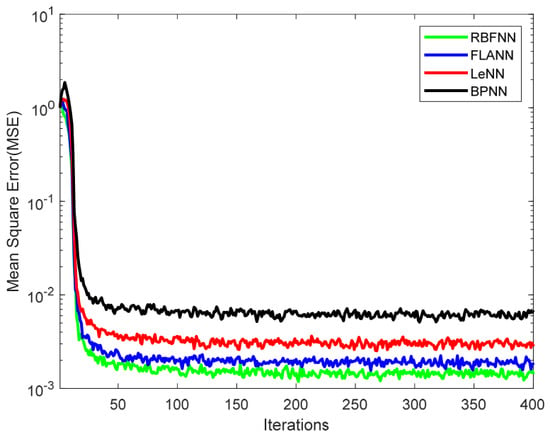
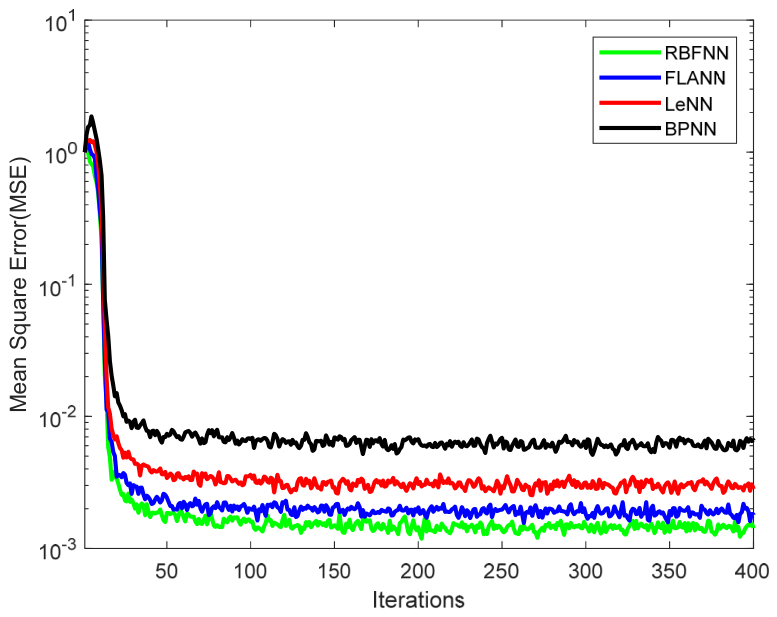
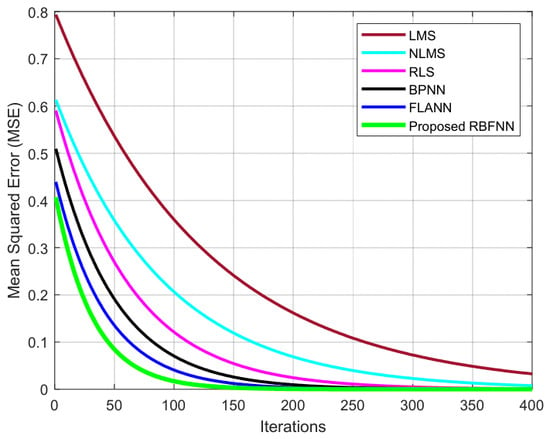
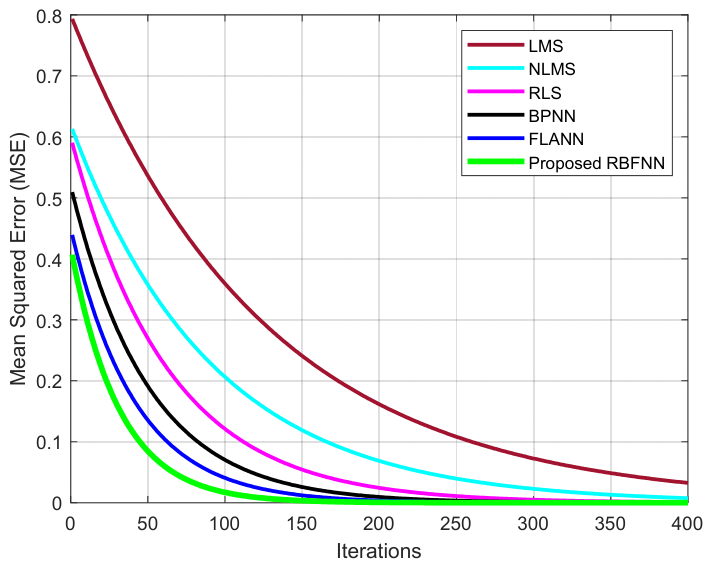
Convergence properties of the designed RBFNN equalizer were studied based on the mean squared error (MSE) criterion for 400 iterations. From Figure 5, it is clear that the convergence curve of the suggested equalizer for channel 1 performed better than that of the other three equalizers in all noise conditions. The MSE convergence property of various types of equalizers of channel 1 is also depicted in Figure 6. The designed RBFNN equalizer shows faster convergence with smaller steady-state error as compared to LMS, NLMS, RLS, BPNN, and FLANN approaches.
Figure 5.
Convergence curve of channel 1 of Equation (31).
Figure 6.
MSE convergence comparison of equalization techniques of channel 1.
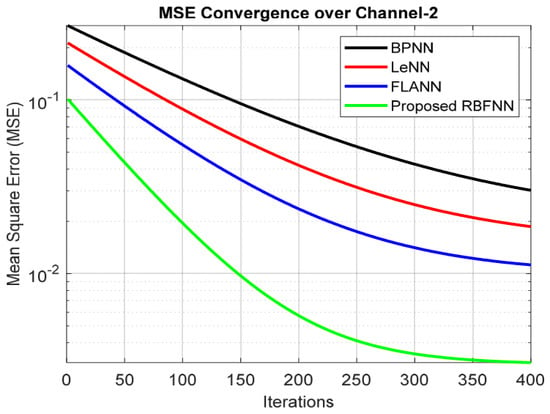
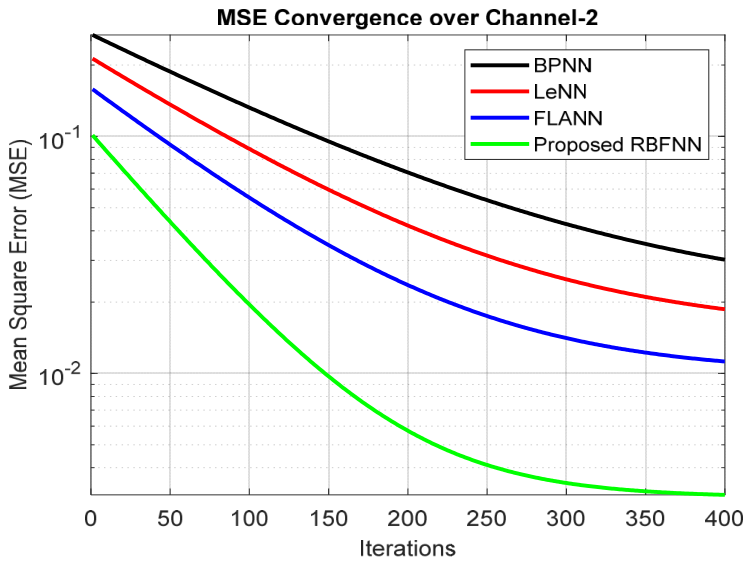
Additionally, the RBFNN design yields better performance than the FLANN, LeNN, and BPNN designs in terms of MSE and residual error in channel 2, as shown in Figure 7.
Figure 7.
Convergence curve of channel 2 of Equation (32).
4.4. BER Performance Analysis
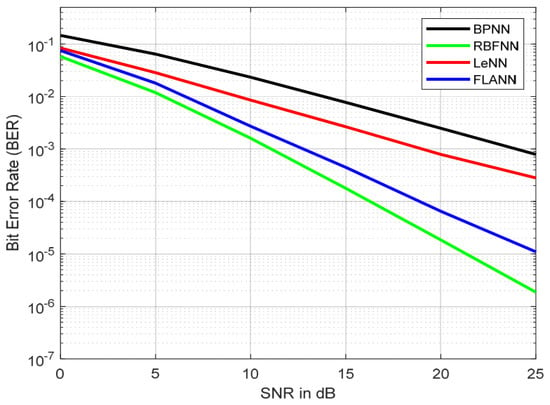
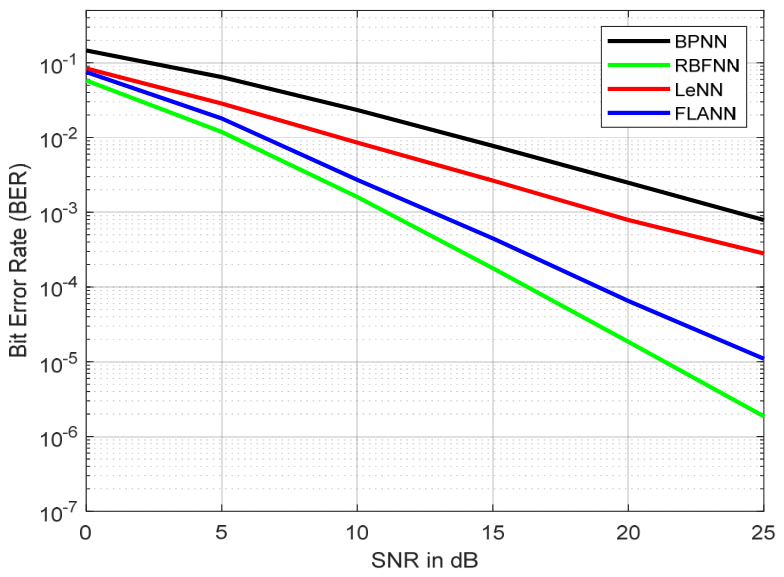
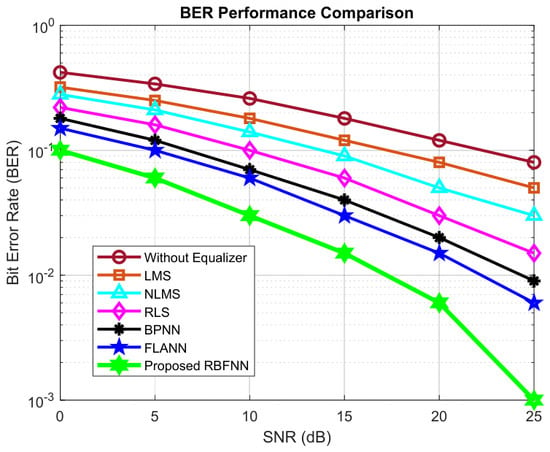
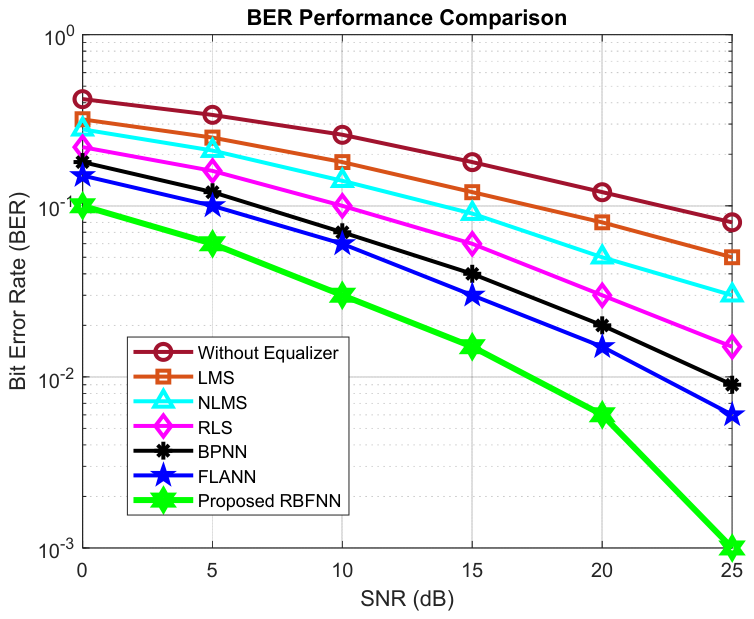
BER performance comparison between the proposed RBFNN equalizer and existing equalizer models was made based on different SNRs from 0 dB to 25 dB in nonlinear and noisy channel environments. Figure 8 provides an illustration of the BER comparison of channel 1. Figure 7 shows that, up to an SNR of 5 dB, all four equalizers aside from the BPNN perform almost similarly, after which the RBFNN surpasses the other equalizers. As shown in Figure 9, it is evident that the BER performance of the suggested RBFNN equalizer of channel 1 is much better than that of the LMS, NLMS, RLS, BPNN, and FLANN equalizers due to its nonlinear function approximating ability.
Figure 8.
BER curve of the channel.
Figure 9.
BER performance comparison of equalization techniques of channel 1.
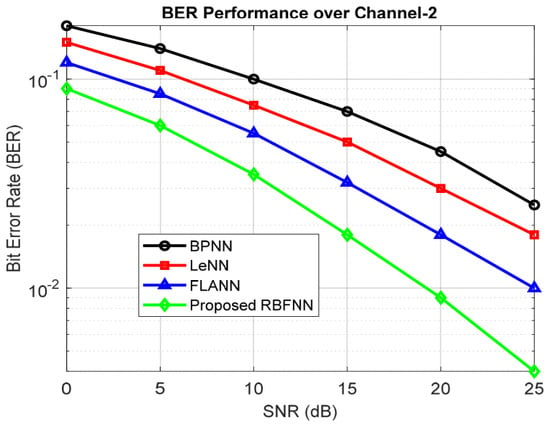
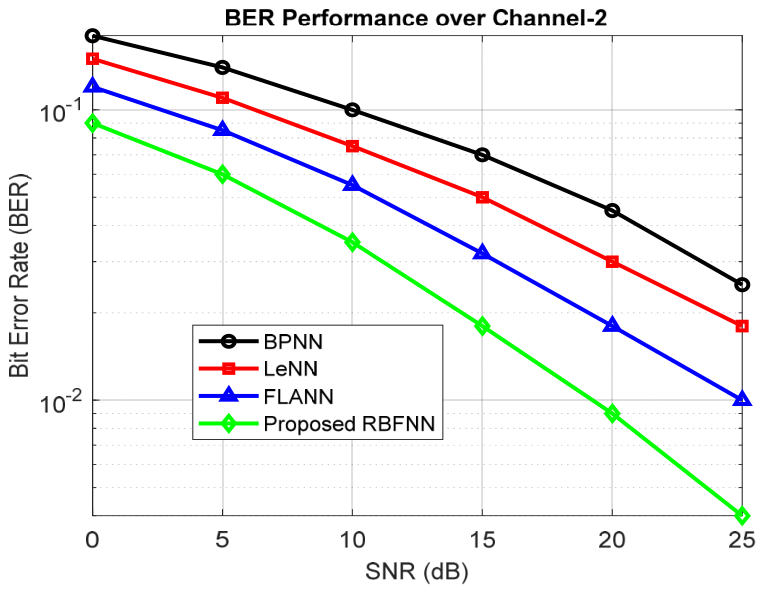
The RBFNN model attains the minimum BER value for all SNR levels, showing improved equalization performance in the channel 2 environment, as shown in Figure 10. The recovered signal from the use of the proposed RBFNN equalizer is shown by means of MSE and BER, as shown in Figure 5, Figure 6, Figure 7, Figure 8, Figure 9 and Figure 10. The performance of convergence illustrated in Figure 5 and Figure 6 pertains to the supervised training of the proposed RBFNN equalizer using the LMS algorithm over 400 iterations. It is evident that the proposed method is successful in reducing the noise from the channel as well as from the fading phenomenon.
Figure 10.
BER performance comparison of equalization techniques of channel 2.
4.5. Evaluation of Effectiveness of Energy Detector (Simulations 2)
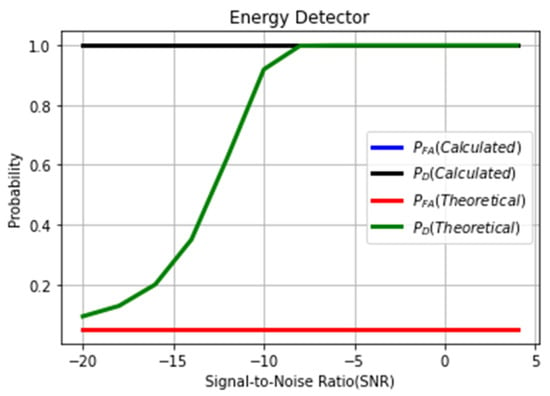
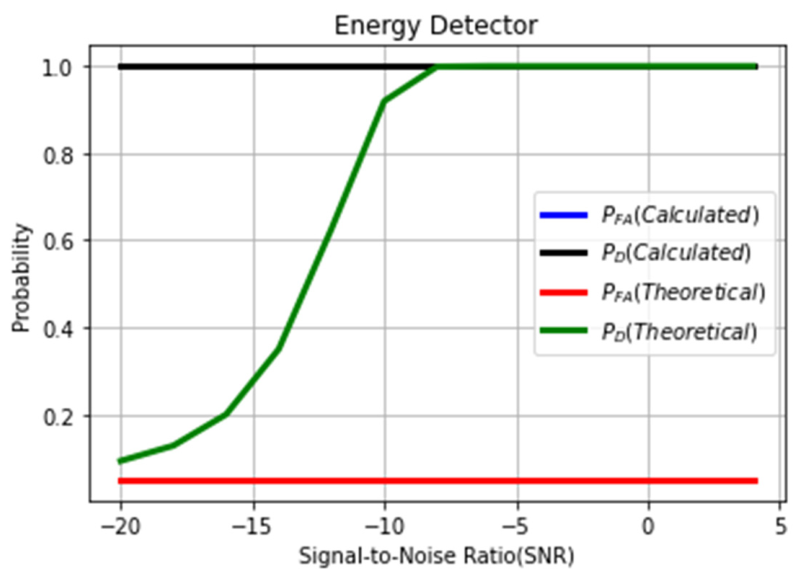
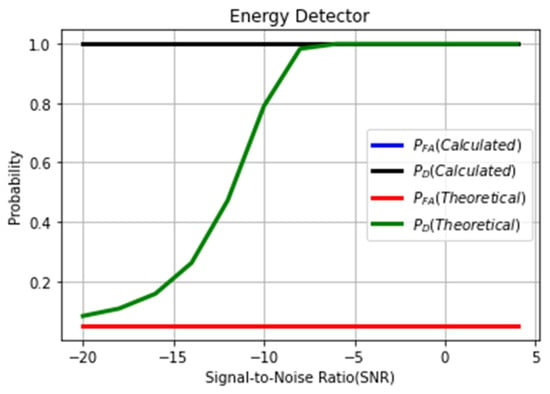
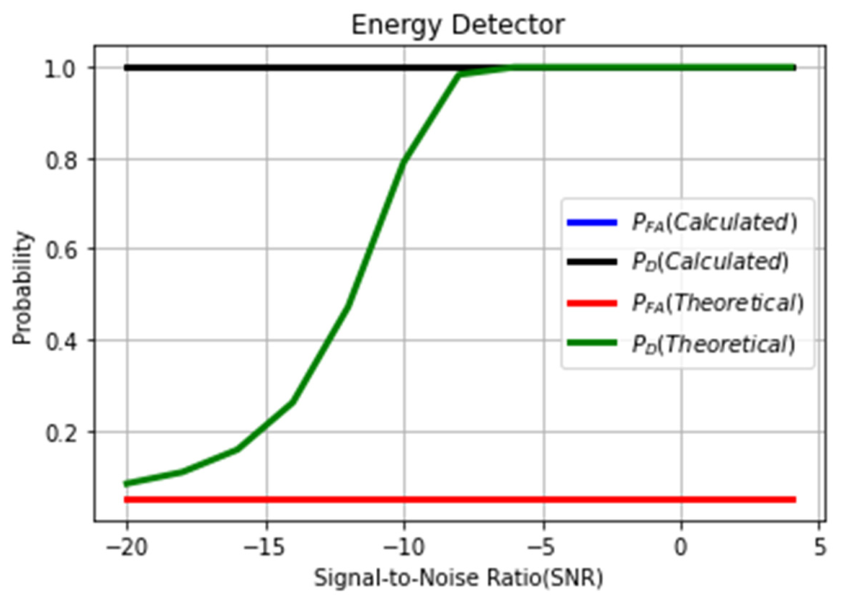
Performance of the ED is shown in Figure 11 and Figure 12 for 1000 and 10,000 samples, respectively. Based on these figures, it is perceived that the of the detector rises with SNR values in both theoretical and calculated points of view. However, because there is less noise at higher SNR values, the performance reduction is minimal. It is evident that the optimal detector performance is achieved when we increase the number of test statistics. Additionally, we can confirm that is less than 0.05.
Figure 11.
Energy detector performance of 1000 samples.
Figure 12.
Energy detector performance of 10,000 samples.
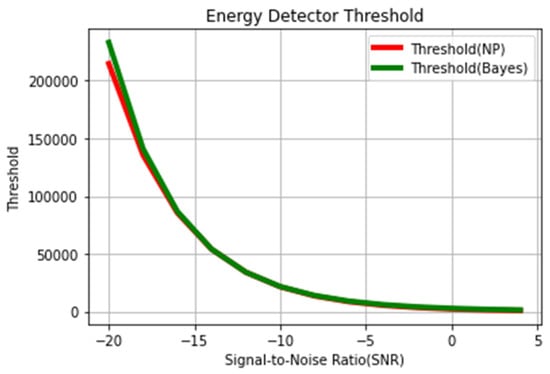
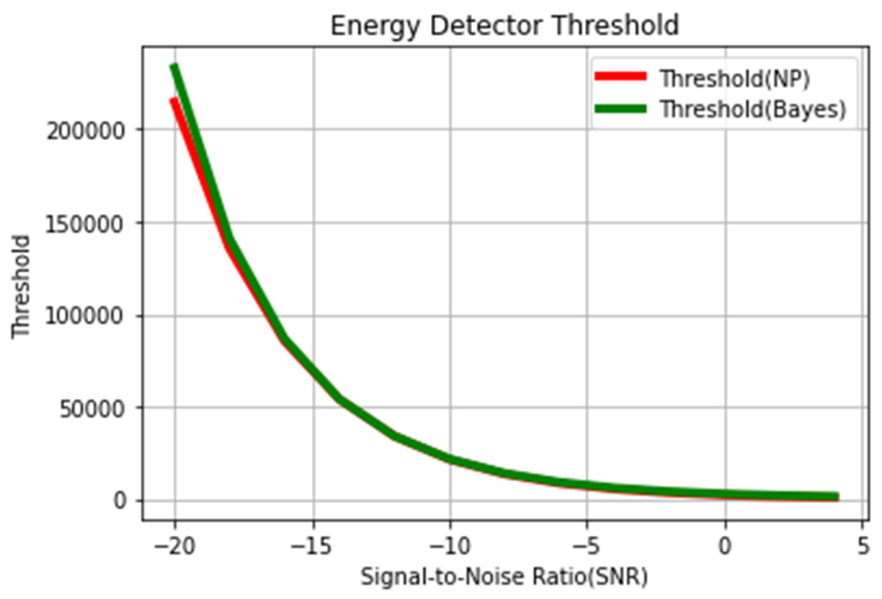
The threshold fluctuation for the Neyman–Pearson and Bayes detectors [37] in relation to the SNR is presented in Figure 13. For lower SNR values, we can see that the NP threshold is marginally lower than the Bayes threshold. The measured signal’s variance diminishes as the SNR value rises because the noise component in the signal gets smaller. The detector threshold consequently drops.
Figure 13.
Performance of threshold variation in NP and Bayes detectors.
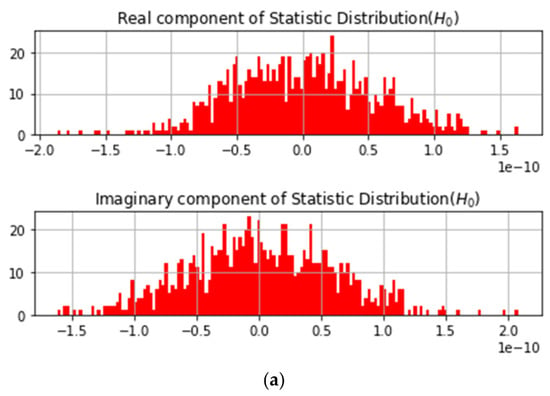
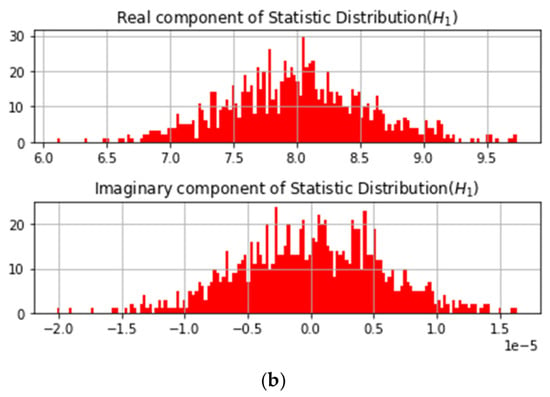
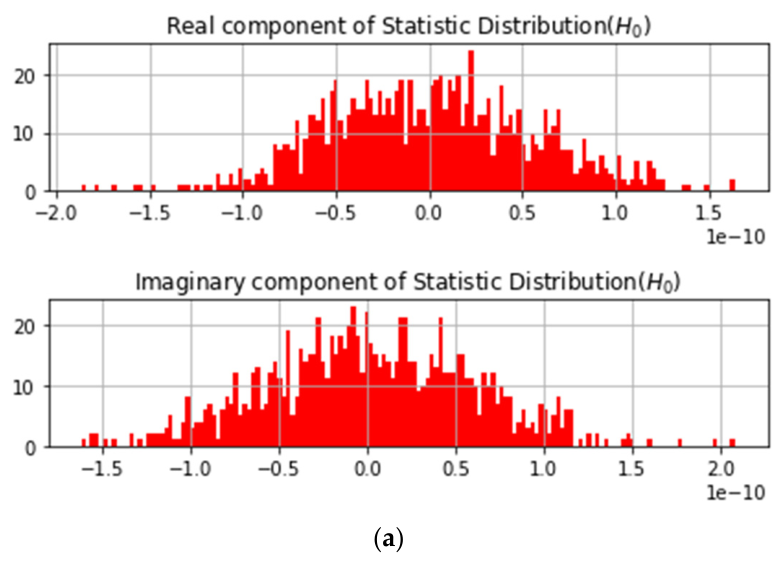
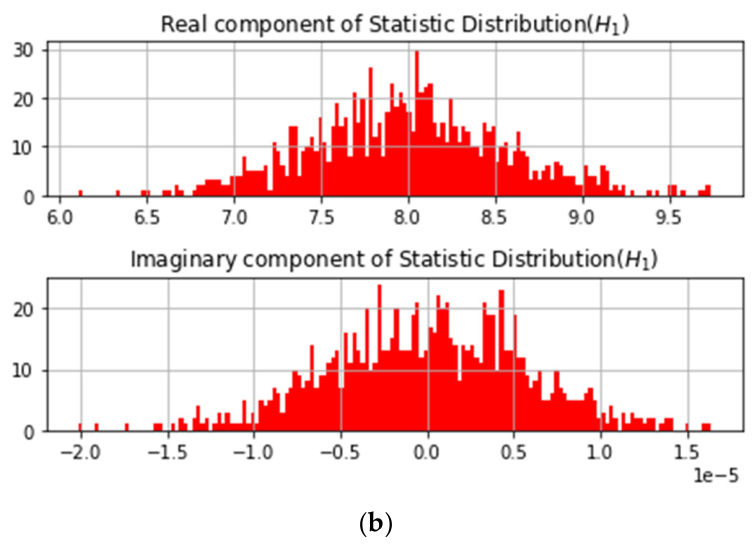
Figure 14 shows the mean and variance of the detector performance of 1000 records of statistics.
Figure 14.
(a) Hypothesis of ; (b) hypothesis of
4.6. Evaluation of Effectiveness of Cyclostationary Detector (Simulations 3)
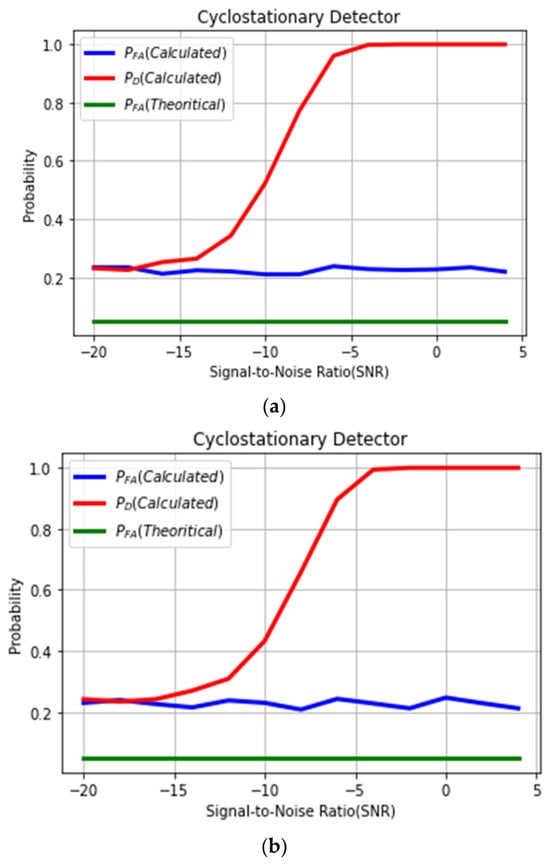
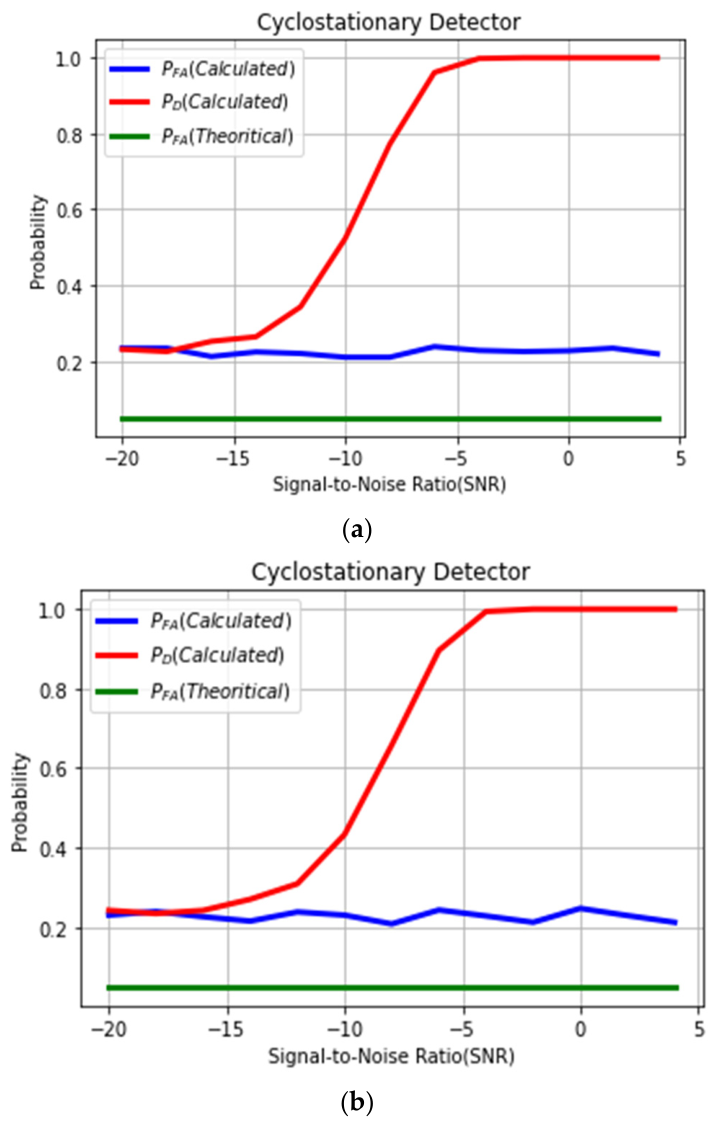
It is clear from the plot in Figure 15 that the computed increases as the SNR value does. Additionally, we can confirm that PFA is less than 0.05. The detector performance with 1000 samples is shown in Figure 15a, while the detector performance with 100,000 statistics is as seen in Figure 15b. We may notice that the optimal detector performance is obtained with a greater number of test statistics.
Figure 15.
(a) Probability of detection Vs SNR for 1000 samples; (b) probability of detection Vs SNR for 10,000 samples.
4.7. Comparison of Both (CS and ED) Simulations 4
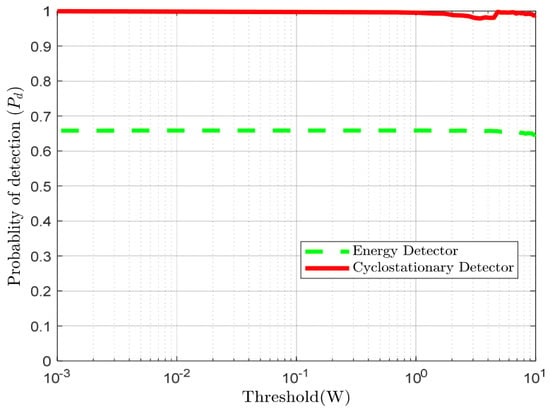
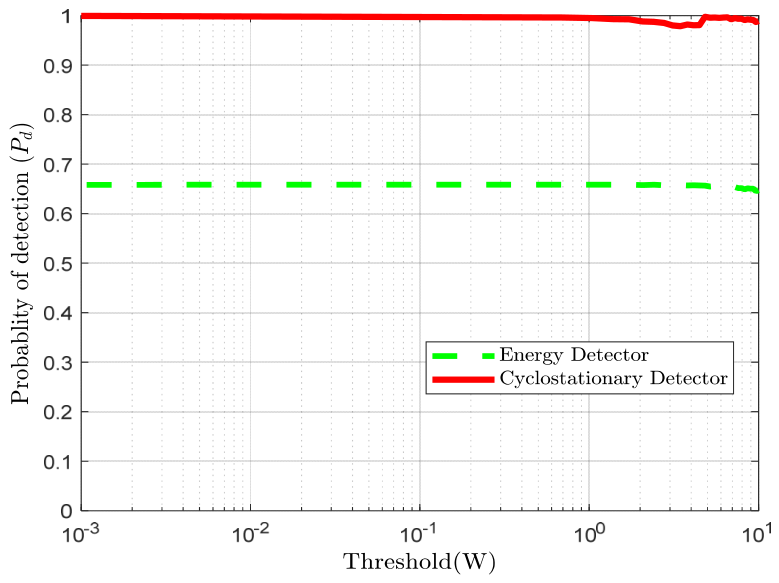
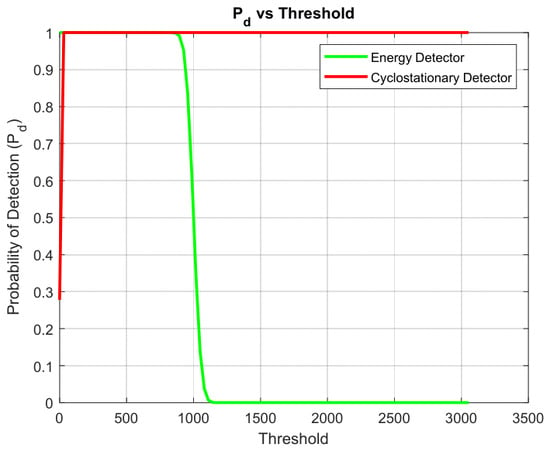
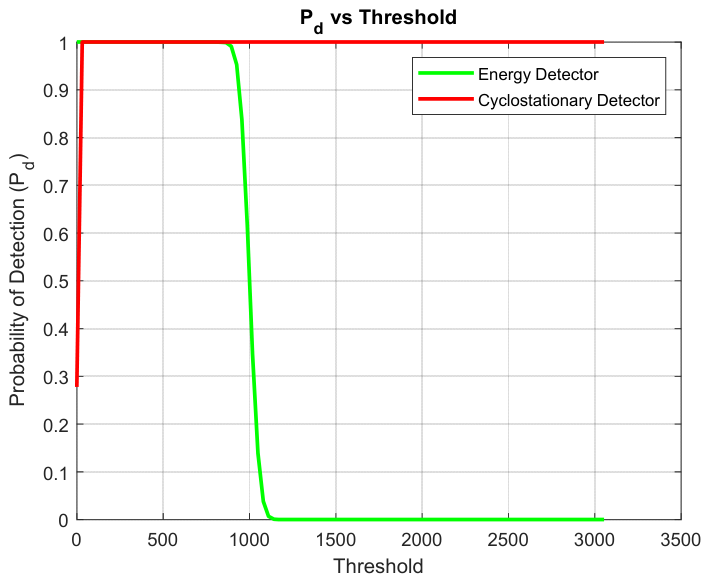
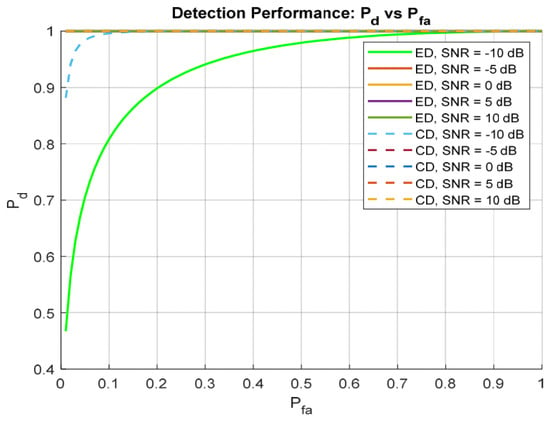
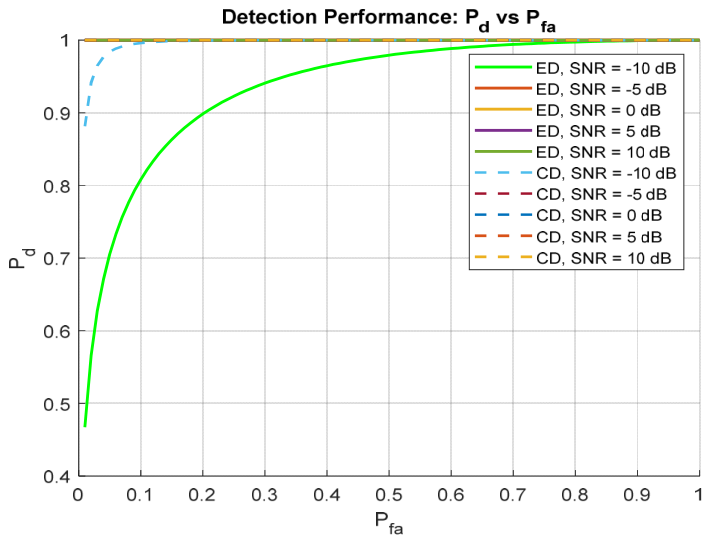
The exact features of the signal being detected, as well as the operational environment, determine how well an energy detector and a cyclostationary detector perform regarding probability of detection with regard to the threshold and . The detailed analysis of Figure 16, Figure 17 and Figure 18 is shown below:
Figure 16.
Variation of probability of detection () with decision threshold (W) in logarithmic scale for energy detector and cyclostationary feature detector.
Figure 17.
Comparative evaluation of probability of detection () across varying decision thresholds in linear scale for energy and cyclostationary detectors.
Figure 18.
Detection performance of vs. .
The indicates the likelihood of correctly identifying the Primary User’s existence (PU) in the spectrum. Higher values signify better performance in identifying occupied channels. The X-axis represents a parameter utilized in spectrum sensing decision-making: the detection threshold. Higher thresholds prevent false alarms but could miss detections, whilst lower thresholds are more sensitive but more likely to cause false alerts. In Figure 16, the energy detector achieves a of 0.65, which indicates a moderate detection capability, likely due to its reliance on a straightforward voting mechanism without leveraging statistical information, and it is also less effective in scenarios with unreliable or noisy individual user reports, whereas the cyclostationary detector achieves the probability of detection close to 1 for the same threshold. Hence, it is more robust to individual sensor errors, leveraging probabilistic models for better decision-making. Figure 17 considers more threshold values with respect to which also represents the comparison performance of CFD and ED. Due to the ability to detect even weak signals, is high in this figure for ED at lower thresholds. With a rise in the threshold, quickly falls. In noisy environments, higher thresholds are unable to pick up the signal. Cyclostationary detection uses the signal’s natural periodicities (such as modulated patterns) to make it less sensitive to noise, which is why the CFD curve decreases more slowly than the ED curve. At intermediate thresholds, is still larger for CD than for ED, indicating superior noise resistance. Both methods work well at lower thresholds, but CD consistently gets a higher for the same threshold. Because the ED only uses signal energy, it is more likely to make mistakes when there is a lot of noise or a weak signal. CD performs better at detecting signals in noisy environments because it can take advantage of the signal’s cyclic characteristics.
In Figure 18, in the case of ED, increases significantly with and a higher SNR, whereas CD outperforms ED at low , especially in low-SNR scenarios. From this figure, it is clear that CD demonstrates better resilience in challenging conditions, i.e., low SNR and .
The ROC of the ED and the CD for various SNR conditions is illustrated in Figure 18. The value 0.05 for false alarm probability was chosen to be a representative operating point since it achieves a proper balance between the efficiency of spectrum usage and user protection in cognitive radio spectrum sensing research. It is evident from the figure that the CD can obtain almost unitary detection probabilities for quite low false alarm probabilities, indicating its good robustness against the noise uncertainty. The saturation of certain curves at reveals the possibility of obtaining reliable spectrum sensing for the tested SNR range. Additionally, the graph proves that the CD shows superior performance compared to the energy detector, especially for low-SNR conditions because of its capability of using the periodic nature of the received signal.
4.8. End-to-End Spectrum Sensing Performance Analysis
The performance evaluation of the proposed RBFNN equalizer in terms of its efficiency in improving the spectrum sensing process was made via an end-to-end comparison between ED and CFD, both with and without adaptive equalization, for an SNR of 0 to 25 dB under a nonlinear noisy channel environment.
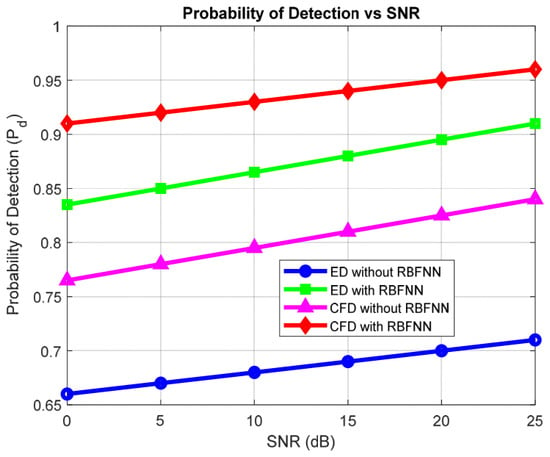
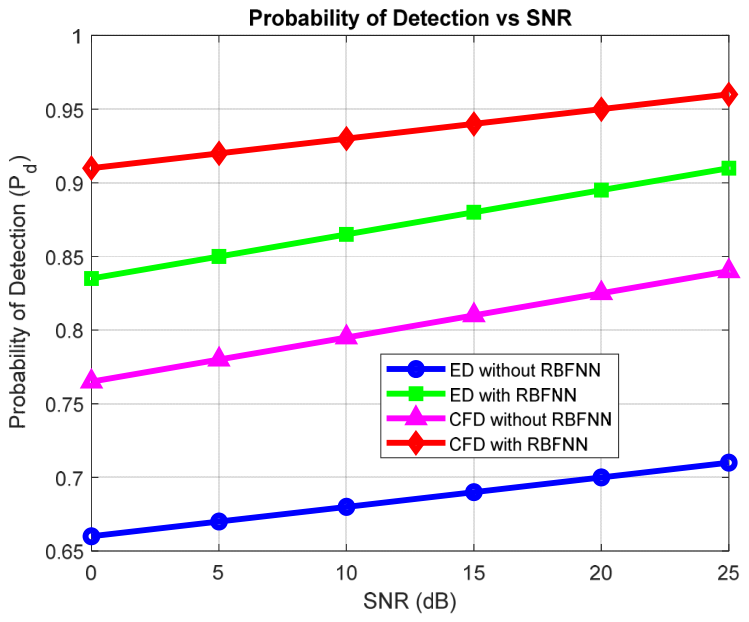
As shown in Figure 19, there is a comparison of the performance of the PD for the ED and CFD schemes with and without the application of the proposed RBFNN equalizer. It is evident that the application of the RBFNN equalizer has greatly enhanced the probability of detection, especially at low SNRs.
Figure 19.
Performance comparison of PD for ED and CFD with and without equalizer.
Table 3 shows the detection performance comparison at SNR = 5 dB. It can be observed from the table that there is a remarkable increase in the probability of detection and a decrease in the probability of false alarms for both ED and CFD methods with the use of the RBFNN equalizer.
Table 3.
Detection performance comparison with and without RBFNN at SNR = 5 dB.
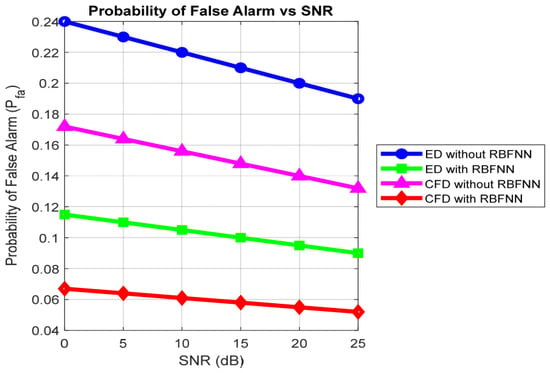
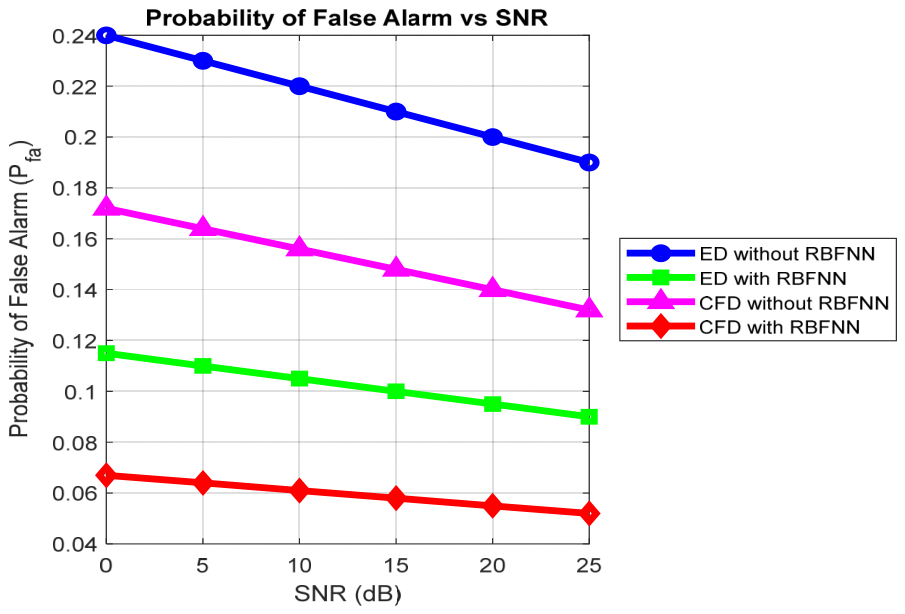
The comparison of the probability of false alarm is shown in Figure 20 between the conventional method and the RBFNN-based spectrum sensing scheme. The proposed equalizer system reduces the PFA because of the better quality of the signal before detection.
Figure 20.
Performance comparison of PFA for ED and CFD with and without equalizer.
In order to perform a quantitative assessment of the proposed framework, the detection performance of the RBFNN-based spectrum sensing scheme is compared against the performance of the traditional energy detector in the absence of equalization. The proposed framework results in an 18.6% enhancement in the and 14.3% decrement in the for an operating SNR of 5 dB. This is because of the fact that the RBFNN equalizer is capable of dealing with the channel distortions and noise prior to spectrum sensing.
The unique aspect of the proposed framework is the implementation of adaptive equalization using RBFNNs as a preprocessing step for spectrum sensing, as opposed to other approaches that employ neural networks mainly for classifying the signal directly or predicting the spectrum occupancy.
It must be highlighted that the performance of the existing scheme is evaluated based on the nonlinear AWGN channel. Even though the above model is able to showcase the adaptability of equalization using the RBFNN scheme, there is multipath fading in most of the cognitive radio environments. Hence, evaluating the proposed scheme under Rayleigh, Rician, and time-varying fading channels constitutes an important extension of the present work.
5. Conclusions
This paper introduced an approach for spectrum sensing in CR networks using machine learning-based adaptive equalization. The combination of RBFNN equalization along with CF and ED provided better detection performance in low SNRs and fading channel scenarios. Simulation outcomes demonstrated better probability of detection, lower probability of false alarm, and superior signal reconstruction capabilities than traditional spectrum sensing techniques. Advanced spectrum sensing techniques combined with adaptive equalization based on radial basis function neural networks (RBFNNs) offer a reliable and effective solution for cognitive radio networks. In spite of difficult low-SNR conditions, the suggested system guarantees dependable spectrum sensing by utilizing both cyclostationary and energy detection techniques and resolving channel impairments. The effectiveness of the equalizer is analyzed by two important metrics, i.e., MSE and BER, through MATLAB 2023 simulations. The effectiveness of the detectors is comprehensively evaluated using metrics such as: , and s. In comparison to the ED, the CS detector demonstrated a 0.35 increase in detection probability against threshold values. Results from the end-to-end analysis demonstrated that there was significant improvement in spectrum sensing when the RBFNN equalizer was used with energy and cyclostationary feature detections. Equalization can be further optimized for real-time, low-power cognitive radio applications with the help of future developments in machine learning and signal processing.
Although the proposed framework has shown marked progress in improving the spectrum sensing capabilities within nonlinear AWGN channels, further studies will be conducted to validate the performance of this framework within multipath fading channels like Rayleigh and Rician channels as well as those affected by the Doppler effect.
Though there have been considerable gains in BER, MSE, and spectrum sensing in the RBFNN-based equalization model presented above, the current method uses an offline training methodology. Further efforts will be directed towards incorporating online learning and adaptive updating of the parameters to be able to track the wireless channels dynamically in real time.
Despite the successful enhancement of equalization and spectrum sensing capabilities of the proposed RBFNN-based equalization structure in comparison with the selected nonlinear channel benchmark model, it should be noted that the current research focuses on short-memory nonlinear channels corrupted by additive noise. The analysis of more practical wireless channel environments such as long-memory multipath channels, Rayleigh/Rician fading channels, Doppler effect, and time-varying channel characteristics has not been considered in the current research. Hence, further development of the proposed approach in such wireless channel environments can be considered a promising research direction.
Author Contributions
Conceptualization, P.K.M., S.K.R., M.R.R. and R.N.P.; writing—original draft preparation, M.R.R., S.K.R. and R.N.P.; data curation, P.K.M. and M.R.R.; investigation, P.K.M., S.K.R. and K.L.H.; methodology, S.K.R., M.S. and R.N.P.; project administration, S.K.R., M.S. and R.N.P.; supervision, P.K.M., R.N.P., K.L.H. and M.S.; resources K.L.H. and M.S., writing—review and editing, P.K.M., R.N.P., K.L.H. and M.S. funding acquisition, K.L.H., and M.S.; All authors have read and agreed to the published version of the manuscript.
Funding
This work was supported by the Dong-A University research fund.
Data Availability Statement
No new data were created or analyzed in this study. Data sharing is not applicable to this article.
Conflicts of Interest
The authors declare no conflicts of interest.
References
- Mitola, J.; Maguire, G.Q. Cognitive radio: Making software radios more personal. IEEE Pers. Commun. 1999, 6, 13–18. [Google Scholar] [CrossRef] [Scilit]
- Haykin, S. Cognitive radio: Brain-empowered wireless communications. IEEE J. Sel. Areas Commun. 2005, 23, 201–220. [Google Scholar] [CrossRef] [Scilit]
- Chen, S.; Gibson, G.J.; Cowan, C.F.N.; Grant, P.M. Adaptive equalization of finite nonlinear channels using multilayer perceptrons. Signal Process. 1990, 20, 107–119. [Google Scholar] [CrossRef] [Scilit]
- Gibson, G.J.; Siu, S.; Cowan, C.F.N. Multilayer perceptron structures applied to adaptive equalisers for data communications. In Proceedings of the ICASSP ’89: 1989 International Conference on Acoustics, Speech, and Signal Processing; IEEE: New York, NY, USA, 1989; Volume 2, pp. 1183–1186. [Google Scholar] [CrossRef] [Scilit]
- Gibson, G.J.; Siu, S.; Cowan, C.F.N. The application of nonlinear structures to the reconstruction of binary signals. IEEE Trans. Signal Process. 1991, 39, 1877–1884. [Google Scholar] [CrossRef] [Scilit]
- Chen, S.; Gibson, G.J.; Cowan, C.F.N.; Grant, P.M. Reconstruction of binary signals using an adaptive radial-basis-function equalizer. EURASIP Signal Process. 1991, 22, 77–93. [Google Scholar] [CrossRef] [Scilit]
- Chen, S.; Gibson, G.J.; Cowan, C.F.N. Adaptive channel equalization using a polynomial-perceptron structure. IEE Proc. I Commun. Speech Vis. 1990, 137, 257–264. [Google Scholar] [CrossRef] [Scilit]
- Patra, J.C.; Pal, R.N.; Baliarsingh, R.; Panda, G. Nonlinear channel equalization for QAM signal constellation using artificial neural networks. IEEE Trans. Syst. Man Cybern.—Part B Cybern. 1999, 29, 262–271. [Google Scholar] [CrossRef] [Scilit] [PubMed]
- Patra, J.C.; Chin, W.C.; Meher, P.K.; Chakraborty, G. Legendre-FLANN-based nonlinear channel equalization in wireless communication system. In Proceedings of the IEEE International Conference on Systems, Man and Cybernetics; IEEE: New York, NY, USA, 2008; pp. 1826–1831. [Google Scholar] [CrossRef] [Scilit]
- Zhao, H.; Zhang, J. Adaptively combined FIR and functional link artificial neural network equalizer for nonlinear communication channel. IEEE Trans. Neural Netw. 2009, 20, 665–674. [Google Scholar] [CrossRef] [Scilit] [PubMed]
- Panda, S.; Mohapatra, P.K.; Panigrahi, S.P. A new training scheme for neural networks and application in nonlinear channel equalization. Appl. Soft Comput. 2015, 27, 47–52. [Google Scholar] [CrossRef] [Scilit]
- Nanda, S.J.; Jonwal, N. Robust nonlinear channel equalization using WNN trained by symbiotic organism search algorithm. Appl. Soft Comput. 2017, 57, 197–209. [Google Scholar] [CrossRef] [Scilit]
- Mohapatra, P.K.; Rout, S.K.; Bisoy, S.K.; Sain, M. Training strategy of fuzzy-firefly based ANN in nonlinear channel equalization. IEEE Access 2022, 10, 51229–51241. [Google Scholar] [CrossRef] [Scilit]
- Mohapatra, P.K.; Rout, S.K.; Nayak, M.K. Development of a novel RBFNN-trained nonlinear channel equalizer based on GDEBOA technique. Int. J. Adapt. Control Signal Process. 2023, 37, 2522–2544. [Google Scholar] [CrossRef] [Scilit]
- Mohapatra, P.; Sahu, P.C.; Panigrah, S.P. Shuffled frog-leaping algorithm trained RBFNN equalizer. Int. J. Comput. Inf. Syst. Ind. Manag. Appl. 2017, 9, 8. [Google Scholar]
- Zhang, J.; Liu, L.; Liu, M.; Yi, Y.; Yang, Q.; Gong, F. MIMO spectrum sensing for cognitive radio based Internet of Things. IEEE Internet Things J. 2020, 7, 8874–8885. [Google Scholar] [CrossRef] [Scilit]
- Arienzo, L.; Tarchi, D. Statistical modeling of spectrum sensing energy in multi-hop cognitive radio networks. IEEE Signal Process. Lett. 2015, 22, 356–360. [Google Scholar] [CrossRef] [Scilit]
- Brito, A.; Sebastião, P.; Velez, F.J. Hybrid matched filter detection spectrum sensing. IEEE Access 2021, 9, 165504–165516. [Google Scholar] [CrossRef] [Scilit]
- Bollig, A.; Lavrenko, A.; Arts, M.; Mathar, R. Compressive cyclostationary spectrum sensing with a constant false alarm rate. EURASIP J. Wirel. Commun. Netw. 2017, 2017, 135. [Google Scholar] [CrossRef] [Scilit][Green Version]
- Zhang, X.; Ma, Y.; Gao, Y.; Zhang, W. Autonomous compressive-sensing-augmented spectrum sensing. IEEE Trans. Veh. Technol. 2018, 67, 6970–6980. [Google Scholar] [CrossRef] [Scilit]
- Arjoune, Y.; Mrabet, Z.E.; Ghazi, H.E.; Tamtaoui, A. Spectrum sensing: Enhanced energy detection technique based on noise measurement. In Proceedings of the 2018 IEEE 8th Annual Computing and Communication Workshop and Conference (CCWC); IEEE: New York, NY, USA, 2018; pp. 828–834. [Google Scholar] [CrossRef] [Scilit]
- Kockaya, K.; Develi, I. Spectrum sensing in cognitive radio networks: Threshold optimization and analysis. EURASIP J. Wirel. Commun. Netw. 2020, 2020, 255. [Google Scholar] [CrossRef] [Scilit]
- Salahdine, F.; Ghazi, H.E.; Kaabouch, N.; Fihri, W.F. Matched filter detection with dynamic threshold for cognitive radio networks. In Proceedings of the 2015 International Conference on Wireless Networks and Mobile Communications (WINCOM); IEEE: New York, NY, USA, 2015; pp. 1–6. [Google Scholar] [CrossRef] [Scilit]
- Lorincz, J.; Ramljak, I.; Begusic, D. Algorithm for evaluating energy detection spectrum sensing performance of cognitive radio MIMO-OFDM systems. Sensors 2021, 21, 6881. [Google Scholar] [CrossRef] [Scilit] [PubMed]
- Nandhakumar, P.; Kumar, A. Analysis of OFDM system with energy detection spectrum sensing. Indian J. Sci. Technol. 2016, 9, 1–6. [Google Scholar] [CrossRef] [Scilit]
- Cabric, D.; Tkachenko, A.; Brodersen, R.W. Spectrum sensing measurements of pilot, energy, and feature detection. IEEE Trans. Commun. 2006, 54, 41–49. [Google Scholar]
- Urkowitz, H. Energy detection of unknown deterministic signals. Proc. IEEE 1967, 55, 523–531. [Google Scholar] [CrossRef] [Scilit]
- He, B.; Chen, Z.; Luo, J.; Liu, C.; Wang, S.; Park, J.; Wang, F.; Quek, T.Q. Toward secure semantic transmission in the era of GenAI: A diffusion-based framework. IEEE Commun. Mag. 2026, 64, 110–117. [Google Scholar] [CrossRef] [Scilit]
- Patra, J.C.; Meher, P.K.; Chakraborty, G. Nonlinear channel equalization for wireless communication systems using Legendre neural networks. Signal Process. 2009, 89, 2251–2262. [Google Scholar] [CrossRef] [Scilit]
- Mulgrew, B. Applying radial basis function. IEEE Signal Process. Mag. 1996, 13, 50–65. [Google Scholar] [CrossRef] [Scilit]
- Haykin, S. Neural Networks: A Comprehensive Foundation, 2nd ed.; Prentice Hall: Hoboken, NJ, USA, 1998. [Google Scholar]
- Rizaner, A. Radial basis function network assisted single-user channel estimation by using a linear minimum mean square error detector under impulsive noise. Comput. Electr. Eng. 2013, 39, 1288–1299. [Google Scholar] [CrossRef] [Scilit]
- Mousavifar, S.A.; Leung, C. Energy efficient collaborative spectrum sensing based on trust management in cognitive radio networks. IEEE Trans. Wirel. Commun. 2014, 14, 1927–1939. [Google Scholar] [CrossRef] [Scilit]
- Martian, A.; Al Sammarraie, M.J.A.; Vlădeanu, C.; Popescu, D.C. Three-event energy detection with adaptive threshold for spectrum sensing in cognitive radio systems. Sensors 2020, 20, 3614. [Google Scholar] [CrossRef] [Scilit] [PubMed]
- Wang, J.; Gao, R.; Ye, D.; Zhang, Z. Blind detection of cyclostationary signals based on multiantenna beamforming technology. IET Commun. 2021, 15, 2439–2447. [Google Scholar] [CrossRef] [Scilit]
- Bagwari, A.; Tomar, G.S.; Verma, S. Cooperative spectrum sensing based on two-stage detectors with multiple energy detectors and adaptive double threshold in cognitive radio networks. Can. J. Electr. Comput. Eng. 2014, 36, 172–180. [Google Scholar] [CrossRef] [Scilit]
- Banavathu, N.R. Optimal generic L-out-of-M counting rule for Neyman-Pearson test in cognitive radio networks. IEEE Netw. Lett. 2023, 5, 189–193. [Google Scholar] [CrossRef] [Scilit]



Disclaimer/Publisher’s Note: The statements, opinions and data contained in all publications are solely those of the individual author(s) and contributor(s) and not of MDPI and/or the editor(s). MDPI and/or the editor(s) disclaim responsibility for any injury to people or property resulting from any ideas, methods, instructions or products referred to in the content. |
© 2026 by the authors. Licensee MDPI, Basel, Switzerland. This article is an open access article distributed under the terms and conditions of the Creative Commons Attribution (CC BY) license.