


Abstract
The BESIII Collaboration has collected large data samples from collisions at center-of-mass energies ranging from 1.84 to 4.95 GeV, which include the world’s largest charmonium sample, consisting of 10 billion and 3 billion events. These high-statistics datasets enable BESIII to carry out a wide range of studies in hyperon physics. In this article, we review the major achievements of the BESIII Collaboration in this field, which can be broadly categorized into four areas: hyperon polarization and violation, rare hyperon decays, hyperon pair production, and hyperon–nucleon interactions.
1. Introduction
The Big Bang implies the production of equal amounts of matter and antimatter, which should have led to their complete annihilation in the early Universe [1]. However, observations indicate that the present Universe is overwhelmingly composed of matter, with little evidence of antimatter. This discrepancy has puzzled the scientific community for more than half a century and remains a subject of intensive research. One of the long-standing explanations is baryogenesis [2], in which the matter abundance is generated dynamically. A crucial requirement for its realization is the violation of charge-conjugation and parity () symmetry. Therefore, exploring violation has become one of the key objectives of modern collider experiments. To date, the clear existence of violation has been established in weak interactions involving kaon, charm, and beauty meson decays [3,4,5,6]. There is also experimental evidence for violation in neutrino oscillations [7]. The observed violation in meson decays is well-interpreted by the Cabibbo–Kobayashi–Maskawa (CKM) mechanism [8,9]. However, the matter–antimatter asymmetry generated by the CKM mechanism is far too small to account for astronomical observations, posing a serious challenge to the Standard Model (SM) and indicating the possible existence of additional sources of violation [1]. This has driven the expansion of violation research into broader domains. Very recently, LHCb reported the first observation of violation in baryons [10], opening a new avenue in the search for physics beyond the SM. The development of angular distribution analysis based on the helicity formalism has provided a new approach to exploring violation in hyperons. The data samples of 10 billion and 3 billion events collected by BESIII in collisions at center-of-mass (c.m.) energies () of 3.097 and 3.686 GeV, respectively, are well-suited for hyperon tests, and both states exhibit sizable branching fractions to hyperon–antihyperon pairs. Moreover, annihilation offers an experimental environment with a relatively low background and enables the production of quantum-entangled hyperon pairs. These features create highly favorable conditions for studying hyperon violation at BESIII [11]. Furthermore, angular distribution analysis not only enables the exploration of violation but also provides a novel approach for accurately extracting hyperon form factors. Since the first experimental determination of the proton form factors in the 1950s [12], form factors have remained a fundamental property of baryons and have been extensively studied to this day. The angular distribution analysis allows the extraction of the modulus ratio of the form factors, thereby extending the study of form factors beyond the relatively stable proton and neutron and providing valuable insights into the internal structure of hyperons. In this respect, BESIII data collected at three energy regions, such as near the hyperon–antihyperon production threshold (2.396–2.900 GeV), around the resonance (3.68–3.71 GeV), and at the resonance (3.773 GeV), are used in the analyses.
Another way to probe physics beyond the SM is through searches for rare decays, including in the hyperon sector. Within and beyond the SM, many theoretical models predict baryon-number-violating (BNV) decays. Experimentally, extensive searches have been carried out, but no evidence for such processes has been observed so far. Among the theories, some predict BNV decays that obey , where denotes the change in the difference between baryon and lepton numbers. As a hyperon factory, BESIII provides an opportunity to explore BNV decays in hyperons, while the presence of an s quark coupled to a u or d quark in hyperons allows the study of possible interference among multiple amplitudes in BNV transitions, an effect that has not been taken into account in existing theoretical calculations due to the ample parameter space. On the other hand, hyperon semileptonic decays provide valuable insight into the interplay between strong and weak interactions. The rule is a fundamental assumption arising from the SU(3) symmetry of the weak hadronic current in the Cabibbo theory of weak interactions, introduced to explain the experimental absence of certain hyperon decay modes. Here, and denote the changes in strangeness and charge between the initial and final state hadrons, respectively. Searching for hyperon semileptonic decays that violate the rule would, therefore, signal the presence of weak currents associated with higher SU(3) multiplets. To ensure sufficient statistics, the full data sample of data collected by BESIII is used in these studies.
At BESIII, substantial data samples have also been collected from the hyperon pair production threshold up to the energy region of the states [13], ranging from 1.84 to 4.95 GeV, providing valuable opportunities to study hyperon pair production in annihilation, to further explore the nature of charmonium(-like) states, and to test the nonperturbative theory of quantum chromodynamics. Experimental observations of the vector charmonium(-like) states exceed the predictions of potential models. This difference provide a significant opportunity to probe exotic configurations of quarks and gluons [14]. A variety of theoretical interpretations, including hybrid, multiquark, and molecular configurations [15,16,17,18,19,20], have been proposed to explain charmonium(-like) states. Nevertheless, no definitive conclusion has been reached, and the underlying nature of these states remains unresolved. This situation highlights our incomplete understanding of strong interaction dynamics in the nonperturbative regime. Further progress therefore relies on more precise experimental measurements. In this context, investigations of hyperon decays of charmonium(-like) states are particularly attractive, owing to their simple final state topologies and comparatively well-understood decay mechanisms. Additionally, the discovery of charmonium(-like) states in annihilation into charmonium and light hadrons highlights the importance of studying hyperon final states, where information is still limited [21].
In addition, scattering experiments play a central role in probing the fundamental forces and internal structure of matter. Over the years, various types of particle beams have been produced and applied in scattering experiments, driving numerous scientific breakthroughs. However, for other neutral particles that are experimentally difficult to control, as well as long-lived hyperons and their antiparticles, experimental measurements remain scarce, even though they possess considerable physical potential. As a result, precise modeling of hyperon–nucleon and hyperon–hyperon interactions remains difficult, despite the availability of strong constraints and well-established descriptions for nucleon–nucleon interactions [22,23]. The properties of hyperons in dense matter have therefore drawn significant attention, owing to their close relevance to hypernuclei and to the role of hyperons in neutron stars [24]. In neutron stars, the possible presence of hyperons decreases the Fermi pressure of the system in the equation of state (EoS), thereby reducing the maximum mass that a neutron star can sustain. EoS calculations that include hyperons often predict a maximum mass lower than the observed values—a discrepancy known as the “hyperon puzzle” [25,26,27], which further motivates the exploration of hyperon–nucleon interactions. Based on the abundant hyperon data produced in decays, BESIII has pioneered a series of hyperon–nucleon scattering studies using the nucleons in the beam-pipe material as targets.
In this article, we review recent results from the BESIII experiment related to hyperon polarization and violation, rare hyperon decays, hyperon production cross sections, and studies of hyperon–nucleon scattering.
2. The BESIII Detector
The BESIII detector [28] has recorded data from symmetric electron–positron collisions provided by the BEPCII storage ring [29], covering c.m. energies from 1.84 to 4.95 GeV. At , it achieved a peak luminosity of . BESIII has accumulated a large data sample in this energy region [30,31,32].
The cylindrical core of the Beijing Spectrometer III (BESIII) detector covers 93% of the solid angle and consists of a helium-based multi-wire drift chamber (MDC), a time-of-flight (TOF) detector, and a CsI(Tl) electromagnetic calorimeter (EMC). These detecting components are housed within a superconducting solenoid magnet that provides a magnetic field of 1.0 Tesla (0.9 Tesla in 2012). The solenoid is supported by an octagonal yoke, which incorporates resistive plate chambers for muon identification interleaved with steel plates. The detection efficiency for charged particles and photons within a solid angle is 93%. At a momentum of 1 GeV, the momentum resolution for charged particles is 0.5%, and for electrons from Bhabha scattering, the resolution is 6%. The EMC achieves an energy resolution of 2.5% (5%) for 1 GeV photons in the barrel (end-cap) region. The plastic scintillator TOF detector has a time resolution of 68 ps in the barrel, while it was originally 110 ps in the end-cap region. The end-cap system was upgraded in 2015 using multi-gap resistive plate chamber technology, improving the time resolution to 60 ps and effectively enhancing data quality [33,34,35].
3. Hyperon Polarization and CP Violation
3.1. Analysis Method
The asymmetry is usually probed by comparing the decay patterns of a particle and its antiparticle. At BESIII, it is studied through angular distribution analysis within the helicity formalism, using decay parameters as observables. The interaction vertex of quantum-entangled spin-1/2 hyperon–antihyperon pairs produced via annihilation can be described by two electromagnetic form factors (EMFFs), and [36,37]:
where M is the hyperon mass, and are the hyperon and antihyperon momenta, respectively, , and is the coupling strength. Based on this, the angular distribution can be characterized by two real parameters: one corresponding to the ratio of the absolute values of the EMFFs, and the other representing their relative phase:
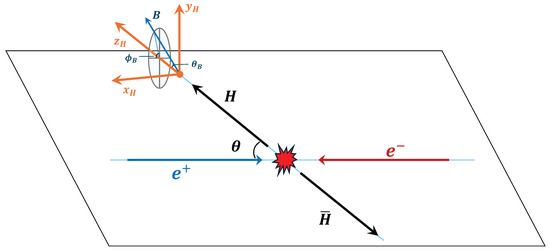
The production via charmonium states follows the same formalism, with the corresponding form factors, and , referred to as psionic form factors [37]. Based on the optical theorem, the form factors in the space-like region are real at the lowest order as a consequence of the Hermiticity of the electromagnetic Hamiltonian, whereas in the time-like region they become complex, giving rise to transverse polarization of the produced hyperons [38,39,40]. In general, by defining the coordinate system as shown in Figure 1, the polarization terms can be expressed as follows [41,42]:
while a projection variable (or ) is often defined experimentally to illustrate the model’s description of data and reveal the polarization signal:
where m represents the bin number in , N is the total number of events in the data sample, is the number of events in the k-th bin, and () denotes the unit vector along the direction of the daughter (antidaughter) particle in the rest frame of the hyperon (antihyperon).
Figure 1.
Orientation axes of the hyperon H and antihyperon helicity frames. B represents the baryon produced by H decay.
Subsequently, the decay amplitude of a spin- hyperon can be wirtten as a combination of S-wave and P-wave contributions,
where and denote the strong and weak phases, respectively. These amplitudes are associated with conservation and violation, and are characterized by the Lee–Yang parameters , , and [43], which satisfy the normalization condition . They are further expressed by defining a parameter . If is conserved, the above hyperon decay parameters should be equal in magnitude but opposite in sign to those of their corresponding antiparticles. This allows us to define observables for violation:
In addition, based on the strong () and weak () phase differences between the S-wave and P-wave, the violation observables can be further expressed as [44,45]
3.2. Charmonium Decay
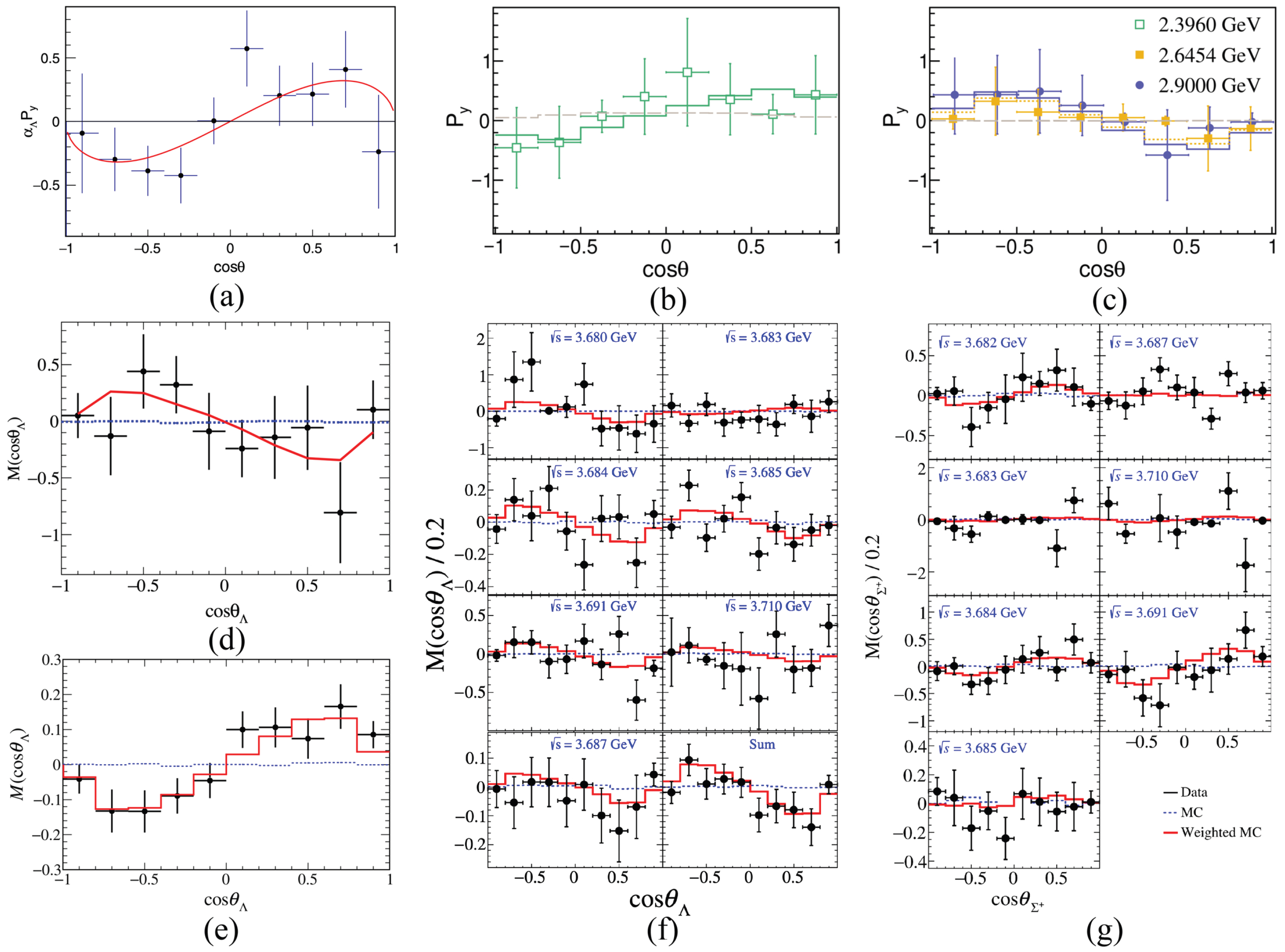
BESIII has recently reported a series of measurements on hyperon spin polarization, aiming to explore possible indications of violation. These measurements are based on the world’s largest and data samples. Due to differences in data-taking periods, some analyses were performed using only partial datasets. The most precise measurement of the decay parameters was performed using the process [46], as shown in Figure 2a. A clear polarization signal was observed, and the measurements of the decay parameters for and for achieved the highest precision to date, with results of and , respectively. The violation observable for the decay was determined to be , which is consistent with zero, indicating no evidence of violation. Meanwhile, the angular distribution parameters and are also determined to be and rad.
The isospin-violating process , together with its charge-conjugation (c.c.), can also be studied through joint angular distribution analysis [47]. The fit results of in each bin are shown in Figure 2a. Unlike hyperon–antihyperon pair production, non-charge-conjugated final states and enable exploration of direct violation by comparing the polarizations extracted from both decay modes. The measurement extracted , rad, and rad. Furthermore, the modulus ratio of the form factors was determined to be , and the violation observable, , is consistent with zero, indicating no significant evidence for direct violation.
For the hyperon pair, based on both the and data samples, BESIII first reconstructed the decays via the dominant channels and , and measured their decay parameters [48,49]. Subsequently, by reconstructing one side of the decay through the neutron channel, the decay parameters of and were measured [50], representing the first test of symmetry in hyperon decays involving a neutron final state. The ratio of the decay asymmetry parameters for the two isospin decay modes serves as a sensitive probe for determining the contribution of transitions and for investigating the rule [51]. As observables, the ratios of the decay asymmetry parameters, and , are found to be smaller than unity by more than , indicating the presence of a transition.
The decay parameters of the radiative decay offer an opportunity to explore parity and strong violation beyond the SM [52]. In this case, the violation observable is defined as . Based on both and data samples, BESIII has also carried out a related study [53]. The aforementioned measurements of the hyperons are summarized in Table 1, with results consistent with conservation. The observed polarization signals are shown in Figure 2b,c.
Table 1.
Fitting results of each decay parameter for and . The first uncertainty is statistical and the second is systematic. The parameters , , and denote the decay asymmetry parameters for the processes , , and , respectively. represents the observable, determined from the corresponding decay parameters.
Figure 2.
Distributions of the polarization observables for [46] (a), [53] (c), and [54] (d); M for [49,50] (b); and for [47] (a), [55] (d), and [56,57] (e), as functions of for each process. The dots with error bars represent the experimental data, the colored solid curves denote the global fit results, the dashed histograms correspond to the phase space (PHSP) Monte Carlo (MC) samples, and the red solid histograms show the PHSP MC weighted according to the global fit.
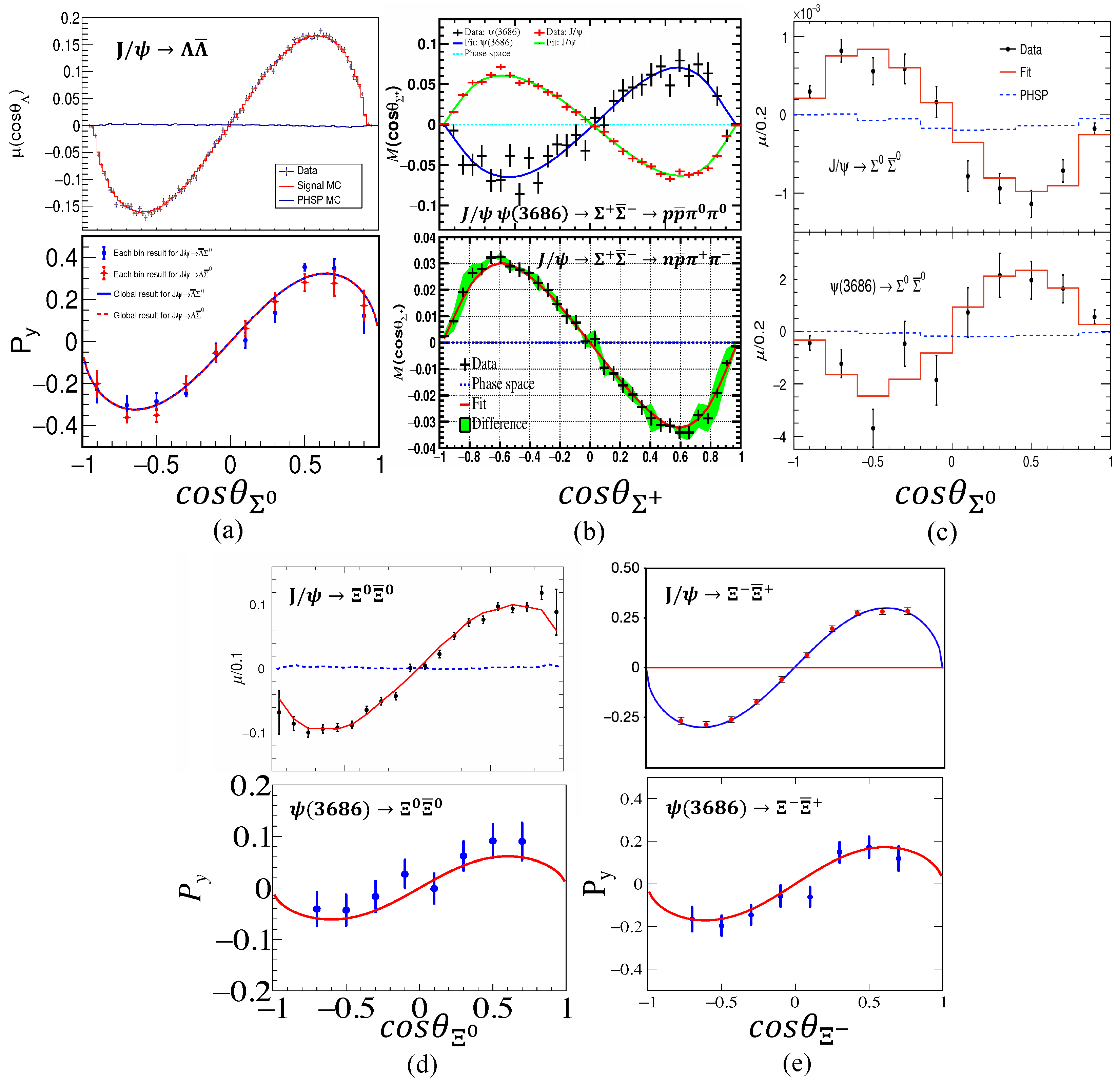
The additional weak decays of the and hyperons allow the extraction of their weak phases and , as well as the strong and weak phase differences between the S-wave and P-wave amplitudes, thereby providing access to more observables [54,55,56,57,58,59]. The corresponding polarization signals are shown in Figure 2d,e, and the results are summarized in Table 2. Notably, the results for the and decays to exhibit a significant difference, which may provide an important probe into the decay dynamics of charmonium decays to hyperon pairs. Similar to the case of , a polarization measurement for single-sided neutron decays has been performed based on the process → and its charge-conjugate channel [60]. The decay parameters () and () of the two decay modes are measured separately. Also, the ratios and , serving as observables for testing the rule, are found to be smaller than the unity by more than . The corresponding observables and are used to test symmetry. Furthermore, by taking the isospin-averaged value of the decays, , a more precise test of symmetry can be achieved. The relevant results are also summarized in Table 2.
Table 2.
Fitting results of each decay parameter for and . The first uncertainty is statistical and the second is systematic. The superscript or subscript denotes or , corresponding to the respective decay mode. () denotes the decay parameter of the dominant decay mode (), while () represents that of the () decay.
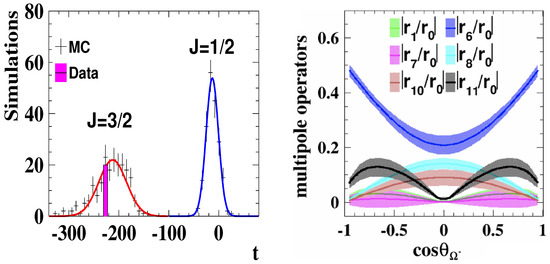
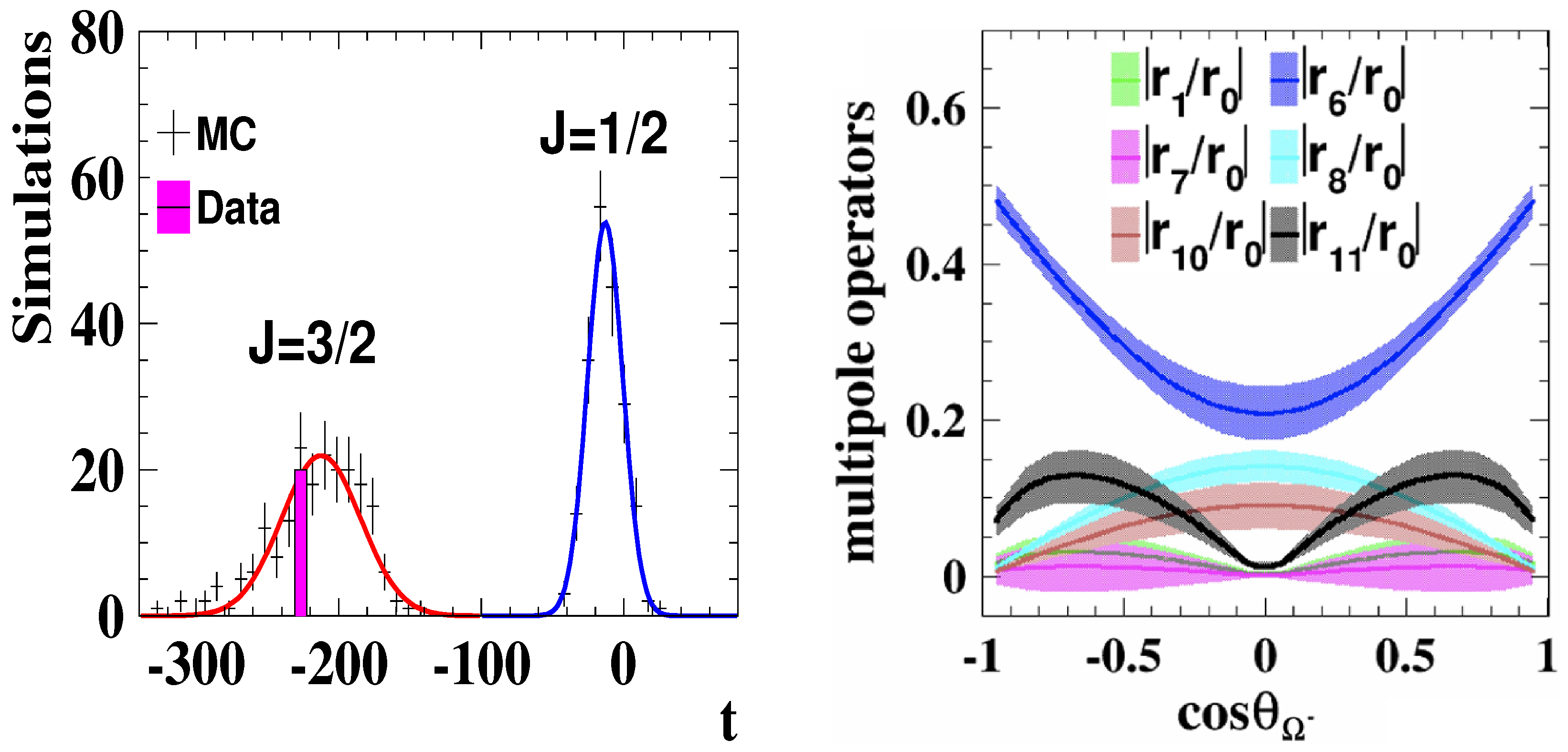
The angular distribution analysis method can also be applied to high-spin hyperons. The discovery of the was a major triumph for the eightfold way model of baryons, and angular distribution analysis provides a means to test the predictions of the eightfold way and the quark model regarding the spin of the . Recently, the BESIII experiment performed a model-independent measurement of the spin using the reaction with the subsequent decays and [61]. The spin is determined to be , with a statistical significance of 14 over the hypothesis, as shown in Figure 3 (left). This represents the first establishment of the spin that is independent of any model-based assumptions since its discovery more than fifty years ago. Additionally, the particles exhibit not only vector polarization, but also quadrupole and octupole polarization contributions [38,62]. Accordingly, the helicity amplitudes and the dependence of the multipolar polarization operators were determined, as listed in Figure 3 (right) and Table 3. Note that, since a single-tag method is adopted for event reconstruction in this analysis, multiple solutions exist [63]. In addition, based on the decays and , the rule can also be tested through the ratio of their branching fractions. A BESIII measurement reports , , and [64]. The ratio of to is determined to be , providing evidence for a deviation from the prediction of the rule.
Figure 3.
Distribution of the test statistic (left), where the curves denote Gaussian fits to the simulated samples and the vertical bar marks the value of t obtained from data. The dependence of the multipolar polarization operators on (right), where the solid lines represent the central values, and the shaded areas represent the range within one standard deviation [61].
Table 3.
Summary of the fitted values of helicity parameters in with the spin-3/2 hypothesis [61]. The first uncertainties are statistical, and the second ones are systematic.
3.3. Annihilation
According to Equation (2), the angular distribution parameter is related to the moduli of the EMFFs. Using the measured angular distribution parameter (denoted as for the non-resonant process), the modulus ratio R of the EMFFs can be directly calculated as [65]
where , and M is the hyperon mass. Variations in the value of R correspond to different production mechanisms of hyperons. To investigate the production mechanisms and internal structure of hyperons under different interactions, BESIII performed angular distribution analyses of and hyperon pairs at energies near the threshold, around the and resonances, covering both purely electromagnetic interactions and mixed electromagnetic–strong interactions.
For the hyperon, a study of the purely electromagnetic process was performed at GeV [66], and the distribution of the polarization observable is shown in Figure 4a. Measurements near the [67] and [68,69] resonances are shown in Figure 4d–f. For the hyperon, studies are currently available only near the threshold [70] and around the [71] resonance. The corresponding polarization signals are shown in Figure 4b,c,g. All of the above measurement results are summarized in Table 4. These studies provide valuable insights into the production mechanisms of and hyperon pairs at different c.m. energies.
Figure 4.
Distributions of the polarization observables for at GeV [66] (a) and at – GeV [70] (b,c), and M for at GeV [68,69] (d,e) and – GeV [67] (f) and at – GeV [71] (g), as functions of for each process. The dots with error bars represent the experimental data, the red curve shows the global fit, the gray and blue dashed histograms correspond to the PHSP MC, and the red polyline and colored solid histograms show the PHSP MC weighted according to the global fit.
Table 4.
The measured parameters of [66,67,69] and [70,71] at each energy point. The first uncertainty is statistical and the second is systematic.
3.4. Electric Dipole Moment
Furthermore, if we introduce four form factors, , , , and , representing the Dirac, Pauli, parity violation, and electric dipole form factors, respectively, the amplitude of the hyperon pair production process can be written as follows [72,73]:
where , , and M follow the same definitions as in Equation (1), Parity conservation implies , while conservation further implies . The form factors and are related to the EMFFs with and , while can be associated with the hyperon electric dipole moment (EDM) [72,73]. Based on this approach, a joint angular distribution can be constructed to explore violation in a novel way, while simultaneously determining the hyperon EDM. Recently, BESIII performed an analysis based on the process, using and as observables to explore both P and violation, while also making a precise measurement of the EDM of [74]. The corresponding results are shown in Table 5. This measurement improves the sensitivity to the EDM by three orders of magnitude compared to previous results, while also introducing a new approach to probing possible sources of violation.
Table 5.
Summary of fitted parameters [74]. The first uncertainty is statistical and the second is systematic.
4. Hyperon Rare Decay
4.1. Radiative Decay
The radiative decays of hyperons offer important insights into the properties of nonleptonic weak interactions [75]. In the limit of unitary symmetry, the parity-violating amplitude in these decays is expected to be small, resulting in a decay asymmetry parameter of [76]. However, experimental measurements show that the values of are large. Several phenomenological models have been proposed to account for these results [77,78,79,80,81,82,83]; nevertheless, none has yet provided a unified description of all weak radiative hyperon decays. To enrich the available experimental information, BESIII has also carried out a series of studies on radiative hyperon decays.
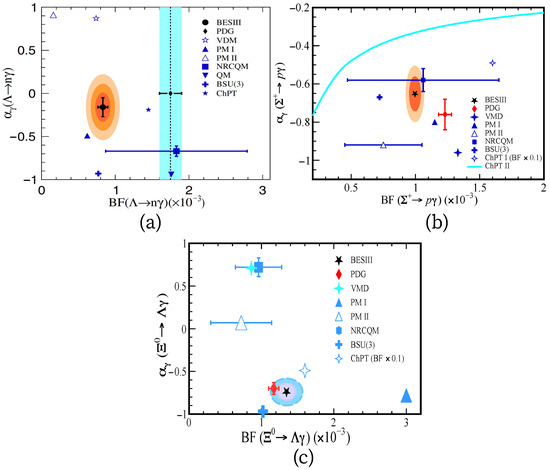
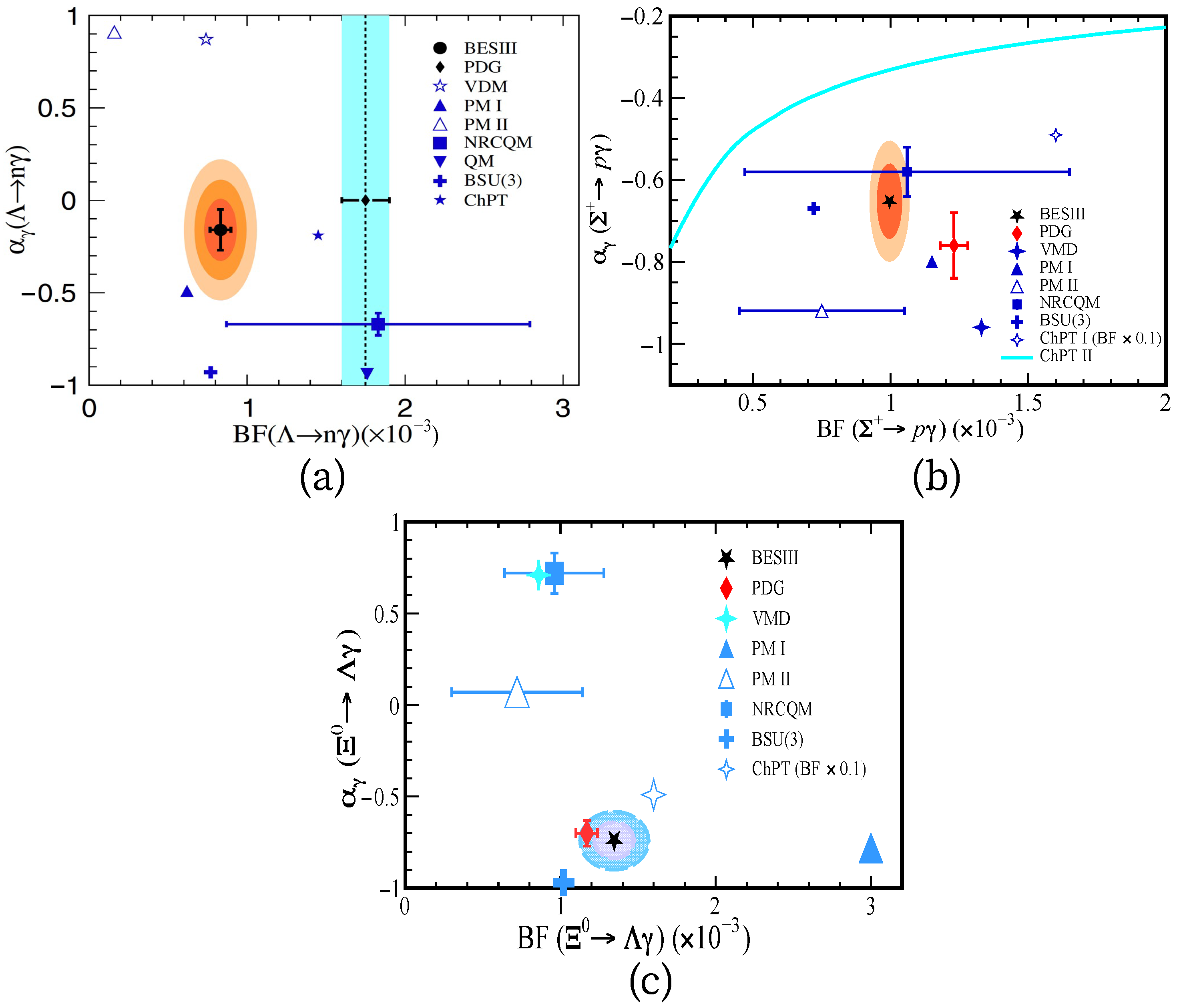
Based on the processes , , and , the branching fractions and decay asymmetry parameters of the decays , , and were measured [84,85,86]. Compared with previous results, the precision of these measurements has been significantly improved, and the decay asymmetry parameter of has been determined for the first time. The measured results are summarized in Table 6. These measurements serve as valuable tests of various phenomenological models. A comparison between the BESIII results, the PDG averages, and the model predictions is presented in Figure 5. In addition, tests were performed in these analyses by constructing observables from the values of hyperons and antihyperons. Within the current statistical precision, the results are consistent with symmetry.
Table 6.
Results of branching fractions and for each radiative decay obtained from both individual and simultaneous fits [84,85,86]. The first uncertainties are statistical and the second uncertainties are systematic.
Figure 5.
Distributions of versus branching fraction for [84] (a), [85] (b), and [86] (c), along with the PDG values [87] and predictions from the vector meson dominance model (VDM) [79], pole model (PM I [77] and PM II [78]), nonrelativistic constituent quark model (NRCQM) [82], broken SU(3) model [BSU(3)] [81], and chiral perturbation theory (ChPT) [80,83].
4.2. Semileptonic Decay
The general approach to determining the absolute branching fractions of rare hyperon decays is to extract the signal yields and detection efficiencies using both the single-tag (ST) and double-tag (DT) methods, and then to obtain the branching fraction as
where () denotes the ST (DT) yield, and () denotes the corresponding ST (DT) detection efficiency. Based on this method, a study using the process was carried out at BESIII to search for the baryon and lepton number violating decays and [88]. Since no evidence for either decay was observed in this analysis, upper limits on their branching fractions at the 90% confidence level (C.L.) were reported to be and .
BESIII has also investigated the semileptonic decays of the [89], [90], and [91] hyperons. The decays and provide an excellent opportunity to test lepton flavor universality (LFU) and thereby to examine the validity of the SM [92]. The ratio of the decay rates of these two processes serves as an observable for testing LFU. However, previous results are still based on fixed-target experiments and therefore suffer from relatively large uncertainties. Using a data sample of 10 billion events and the decay , BESIII has measured the absolute branching fraction of to be , achieving a 30% improvement in precision compared to the world average. Based on the well-measured branching fraction of , the ratio is determined to be , which is consistent with previous results and with LFU [87,93]. Meanwhile, a test is also performed using the asymmetry , which is determined to be , consistent with conservation. In addition, using the same decay sample, the processes and have also been investigated at BESIII. Since no significant signal is observed, upper limits on their branching fractions at 90% C.L. are reported, given by and . These results also provide important experimental constraints for the study of the SU(3) symmetry-breaking mechanism, -violating decays, and other rare or forbidden hyperon decays.
5. Hyperon Pair Production
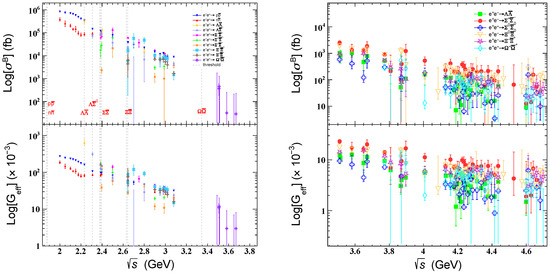
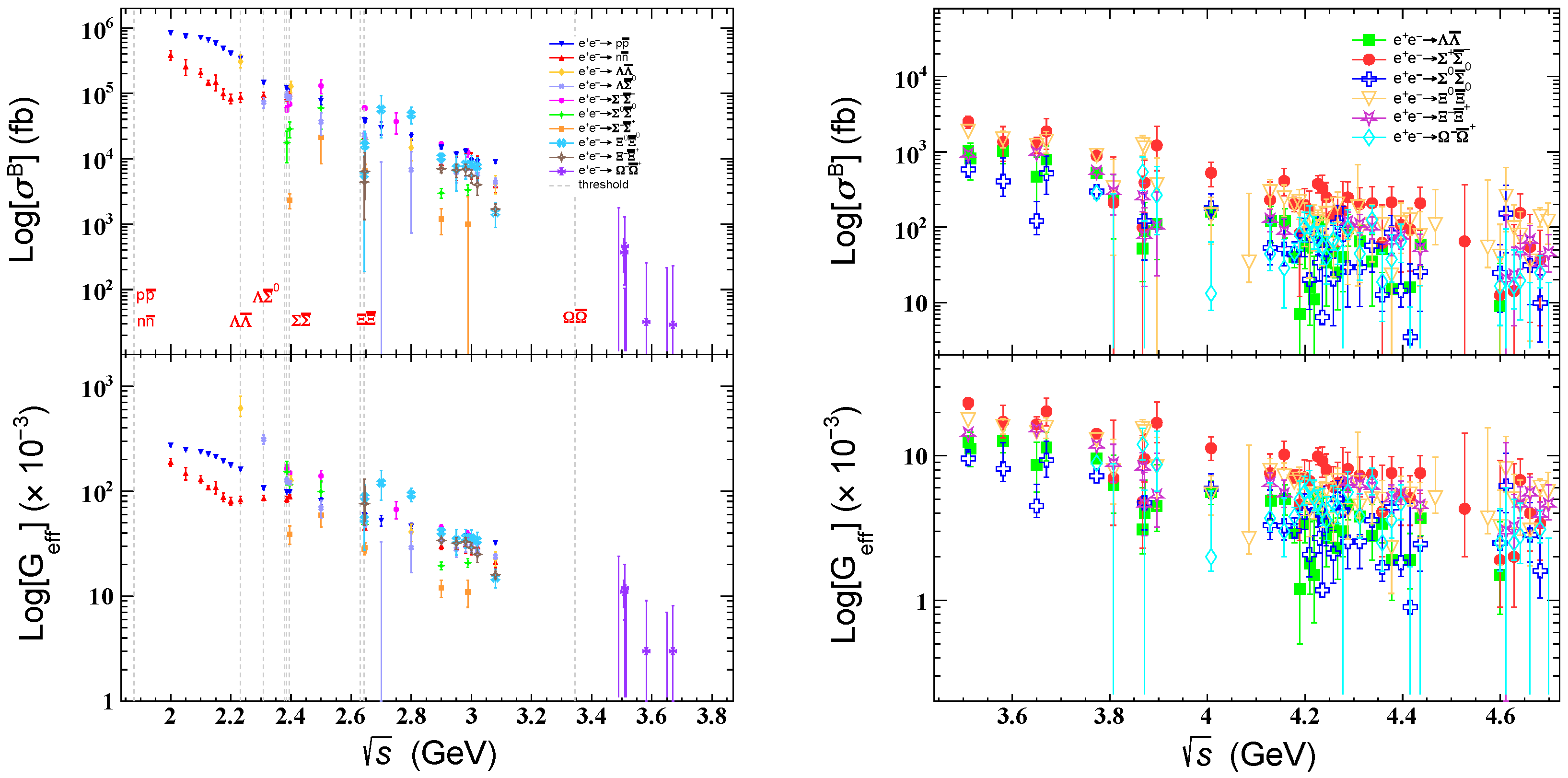
In recent years, measurements of cross sections near production thresholds have provided a sensitive probe for exploring particle interactions, electromagnetic form factors, and possible new resonance states. Numerous experimental studies have been carried out to explore baryon properties, with most analyses based on the interpretation of the Born cross section for baryon–antibaryon pair production. Notably, several of these measurements observed an unusual behavior near the threshold—a significantly nonzero cross section, commonly referred to as threshold enhancement. At BESIII, threshold enhancement has been observed in the measurements of the processes [94,95,96], [97], [98], and [99]. Similar threshold behavior has also been observed in the cross sections of [100,101] and [102,103], although larger data samples are required to draw more definitive conclusions. In addition, measurements of have also been performed [104]. However, since the available energy points are relatively far from the production threshold, no evident threshold enhancement has been observed in this case. In these studies, the Born cross sections and effective form factors of each process were measured using either energy-scan or ISR methods, as shown in Figure 6 (left). In the measurements of the reactions of and , oscillatory behavior of the effective form factors has also been observed, suggesting the presence of intrinsic dynamics that are not yet fully understood.
Figure 6.
The Born cross sections and effective form factors for each baryon pair process near the threshold (left) and in the charmonium energy region (right). The gray dashed lines represent the production threshold of corresponding baryon pairs.
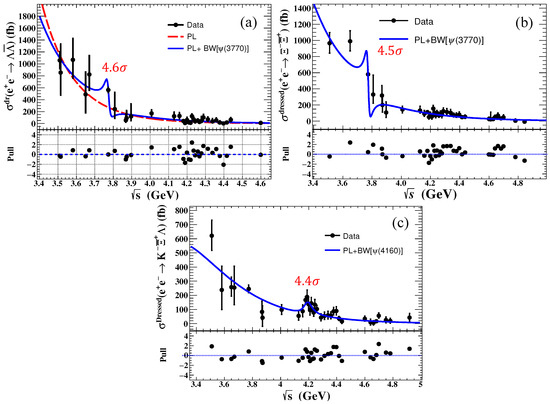
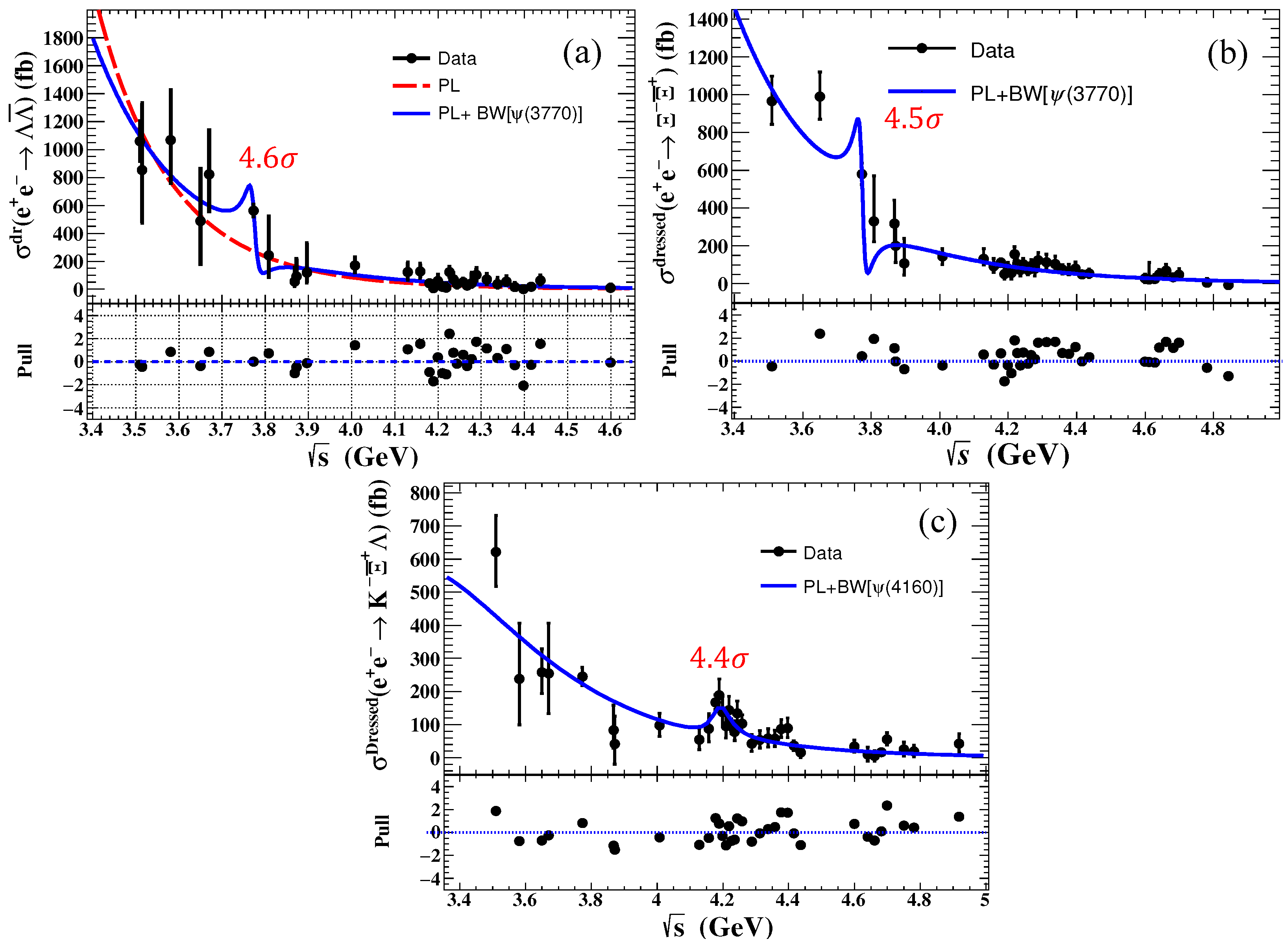
In the charmonium energy region, studying the hadronic decays of charmonium-like states by measuring the Born cross sections of baryonic final states is one of the key approaches to revealing their physical properties. The BESIII experiment performed its first search for the charmonium(-like) states in the process at c.m. energies ranging from 3.5 to 4.6 GeV [105], but found no significant evidence for decaying into . Subsequently, BESIII has conducted a series of studies on hyperon pair production in the processes , , , , and , along with an updated measurement of [106,107,108,109,110,111,112]. The Born cross sections and effective form factors for these processes were measured, as shown in Figure 6 (right). To further investigate the charmonium(-like) states, fits to the dressed cross sections were carried out. Evidence for the decays and was found [106,112], as shown in Figure 7a,b. The branching fractions of these two decays are determined to be or and , respectively. For the other processes, no significant signal of charmonium(-like) states was observed. Only upper limits for the product of the branching fraction and the electronic partial width, , at the 90% C.L., were evaluated. These measurements provide evidence for charmless decays of and can be useful for understanding the coupling of charmonium(-like) states to hyperon pair final states.
Figure 7.
Fits to the dressed cross sections for the [106] (a), [112] (b), and [113] (c) reactions.
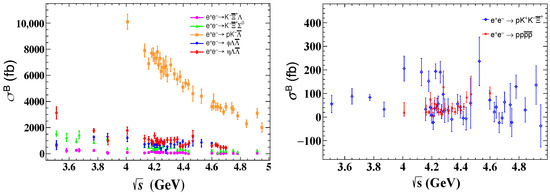
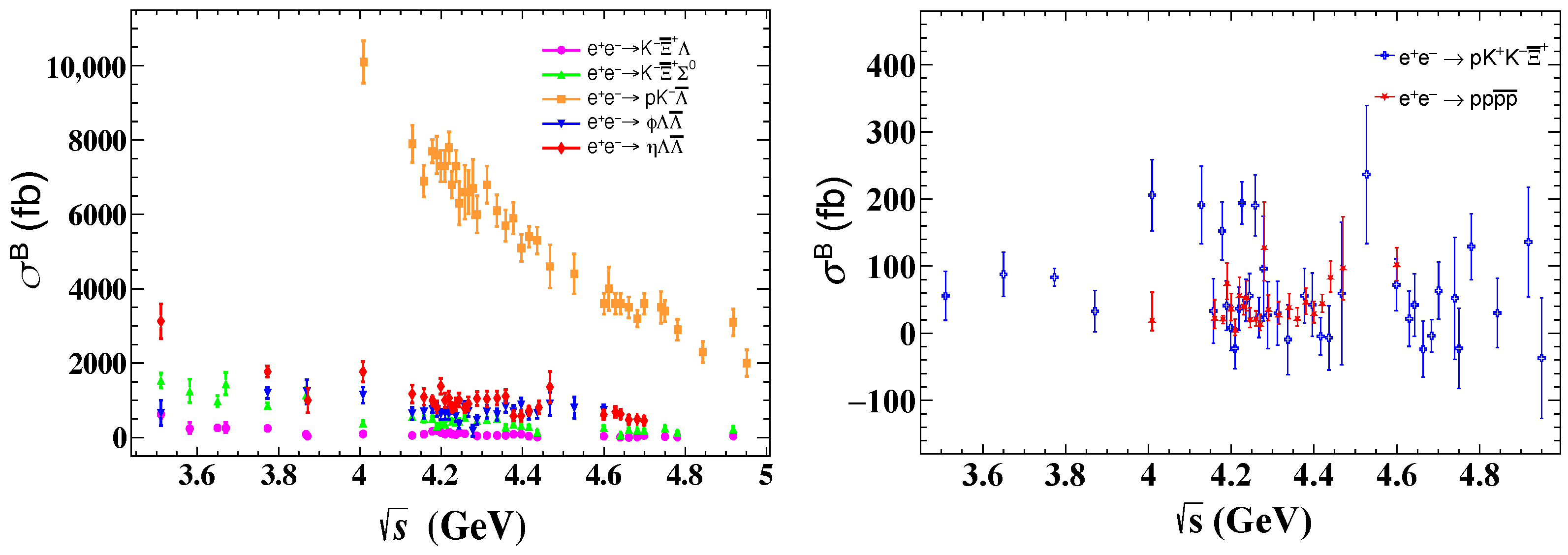
The BESIII experiment has also measured the Born cross sections for three-body decays with hyperon final states [113,114,115,116,117], as shown in Figure 8 (left). For these processes, no significant charmonium(-like) states were observed, except for evidence of the decay , which was observed with a significance of 4.4, including systematic uncertainties, as shown in Figure 7c. The branching fraction is determined to be . Similarly, upper limits on are provided for other assumed resonances. In the processes , , and , clear enhancements can be seen in the invariant mass distributions of and [114,116,117]. Based on fits with Breit–Wigner (BW) functions, the masses and widths of these near-threshold structures were determined, but they do not match any previously known resonances. Future studies with larger data samples and theoretical analyses involving partial wave analysis may help clarify the nature of these observed structures.
Figure 8.
Line shapes of the measured Born cross sections for each three-body (left) and four-body (right) process.
In addition, some studies have focused on the multi-body processes [118], [119,120], and [121], aiming to search for possible deuteron, hexaquark, or di-baryon candidates, as well as to explore charmonium(-like) states. Among these, the measurement results of the Born cross sections for the four-body processes are shown in Figure 8 (right). However, with the current statistics, no definitive conclusions can be drawn regarding the existence of actual resonances or structures in these analyses.
6. Hyperon Nucleon Interaction
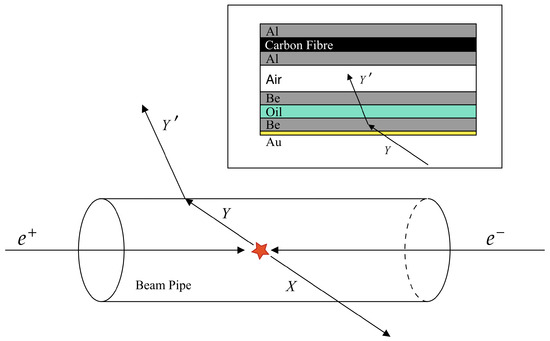
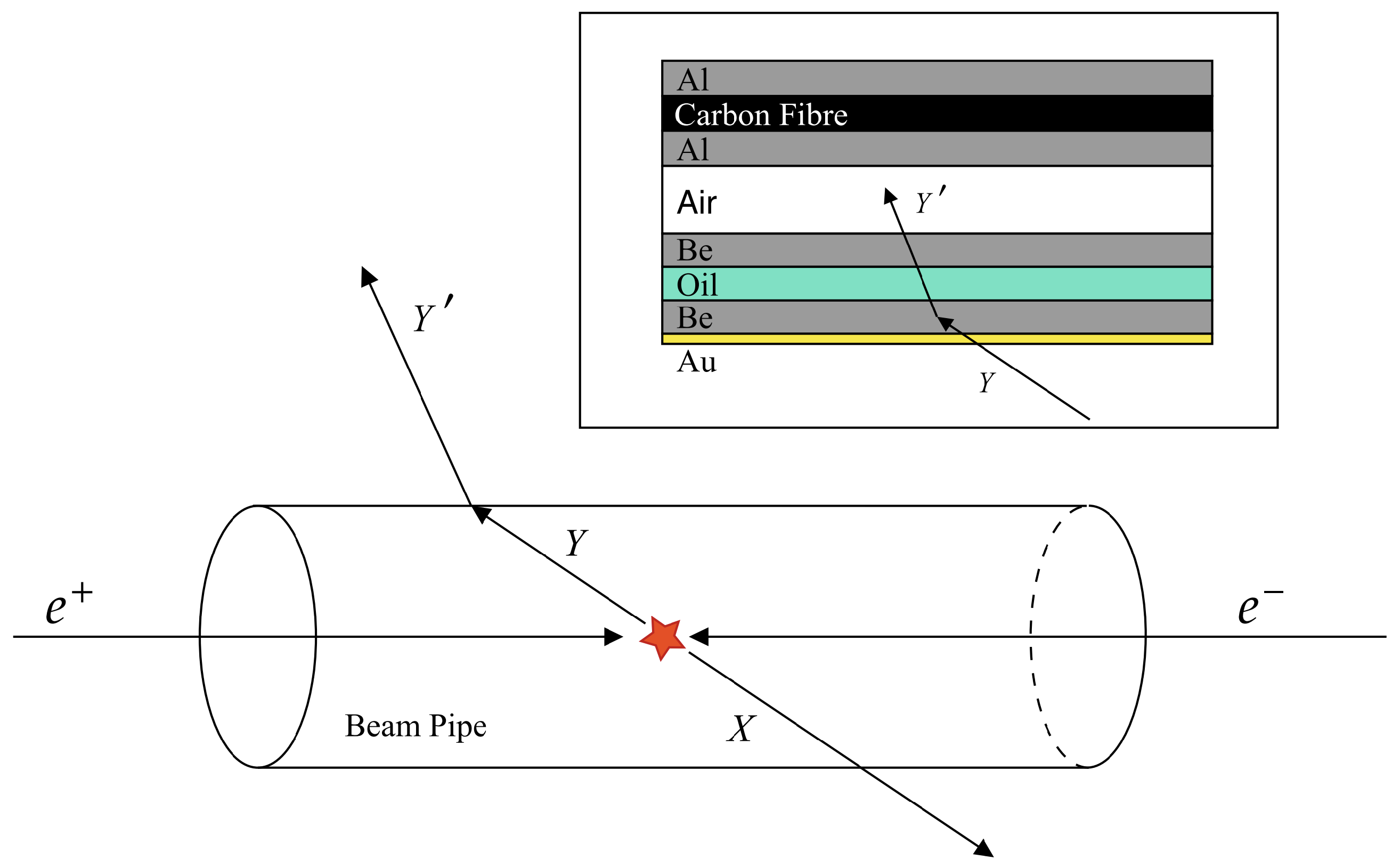
Depending on the charmonium decay modes producing hyperons, and using neutrons in the beam-pipe material as targets, BESIII has pioneered a series of hyperon–nucleon scattering studies. The beam pipe, composed of gold (), beryllium (), and oil (: = 1:2.13), provides a natural and effective target for such studies [122,123]. The hyperon–nucleon scattering process in an electron–positron collider is illustrated in Figure 9 [123]. Hyperon pairs or final states containing hyperons are produced inside the beam pipe and travel along their momentum direction. Some of these hyperons reach the target before decaying and undergo elastic or inelastic scattering with the nuclei in the material. However, due to the complexity of the materials in the beam pipe and the inner wall of the MDC, the BESIII experiment cannot directly extract hyperon–nucleon scattering cross sections as in fixed-target experiments. Therefore, , which is commonly used in fixed-target experiments and is also the primary material of the beam pipe, is chosen as the normalization reference, and the cross sections of all materials are normalized to that on .
Figure 9.
Schematic of the hyperon–nucleus interactions at the collider represented by BESIII [123]. Y and denote the hyperon before and after scattering, respectively, while X represents the accompanying particles produced together with Y.
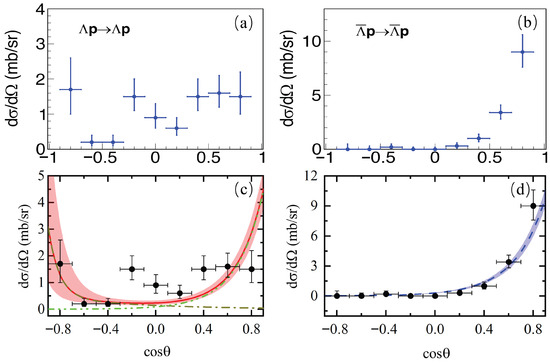
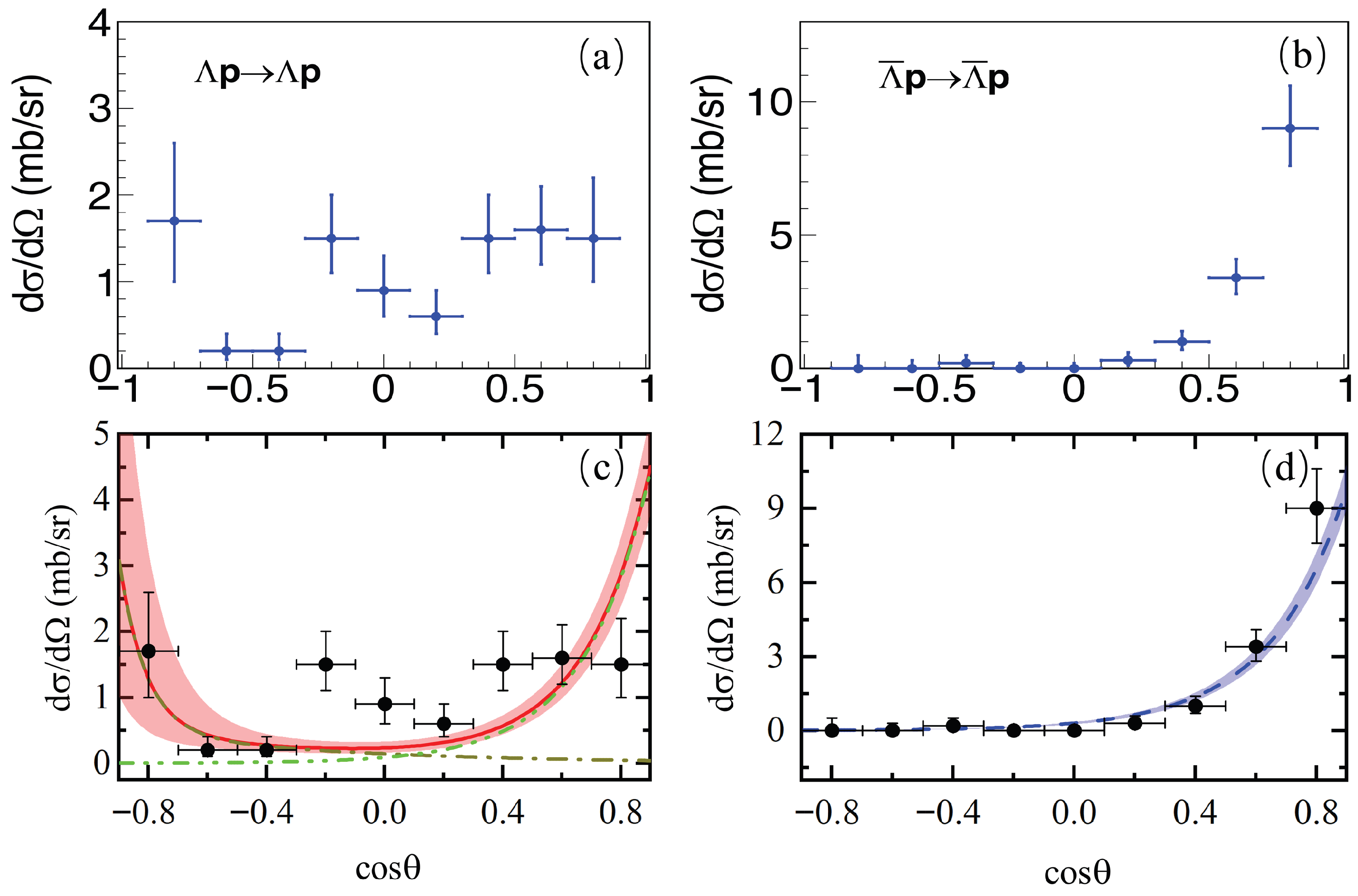
The first study in this series observed the inelastic scattering process with a significance of 7.1, based on hyperons produced in the decay [124]. The reaction cross section of with the target in the beam pipe was measured at a momentum of 0.818 GeV/c. Assuming an effective number of three reaction neutrons in a nucleus, the cross section for the process was determined. The inelastic scattering process was also investigated [125]. The cross section was measured within the momentum range of [1.057, 1.091] GeV/c. The cross section was further determined under the assumption that the signal originates from a surface reaction. The result is consistent with previous experimental measurements. For the hyperon, an elastic scattering study was also performed for the processes and , representing the first investigation of antihyperon–nucleon scattering [126]. Within the angular region and at a / momentum of GeV/c, the cross sections for these two processes were measured. Here, denotes the scattering angle. However, the angular distributions of the cross sections for these two reactions exhibit distinctly different trends, as shown in Figure 10a,b. Theoretical studies attribute the observed difference to reaction dynamics [127]: the process involves contributions from both the t and u channels, while the process allows only the t-channel, leading to the distinct trends observed. Here, the theoretical predictions are in good agreement with the experimental data, as shown in Figure 10c,d. A recent study has measured the inelastic scattering processes and [128]. At a momentum of GeV/c, the reaction cross sections with the nucleus were measured, and assuming an effective number of three reaction neutrons, the single-neutron cross sections were determined to be in good agreement with theoretical predictions. The aforementioned measurements of the scattering cross section are summarized in Table 7.
Figure 10.
Differential cross sections for the reactions (a,c) and (b,d) [126,127]. The dots with error bars represent the experimental data. The solid red curve denotes the complete theoretical model, while the green dash–double-dotted and dark-yellow dash–dotted curves show the individual contributions from the t and u channels, respectively. The t-channel contribution is also displayed by the blue dashed curve.
Table 7.
The measured cross sections of hyperon–nucleon scattering [124,125,126,128]. The first uncertainty is statistical and the second is systematic.
7. Conclusions and Outlook
Having been operating successfully since 2008, the BESIII experiment has collected the world’s largest data samples in the -charm physics region and has conducted a comprehensive program in hyperon physics. In studies of hyperon polarization, the angular distribution analysis method has been widely applied. Numerous polarization signals have been observed, violation observables have reached the level, studies of form factors and radiative decays have provided insights into the interaction mechanisms, and the measurement of the EDM has achieved unprecedented precision. In the field of rare hyperon decay studies, baryon and lepton number violating decays as well as semileptonic decays have been extensively investigated, providing stringent experimental constraints and precision tests of the SM. Extensive cross section measurements have been performed from the hyperon pair production threshold up to the charmonium energy region, including determinations of the relevant form factors for hyperon pair processes. Evidence for the decays and has also been reported. Moreover, an innovative experimental approach has been developed at BESIII to study hyperon–nucleon interactions, which has already been applied to various elastic and inelastic scattering processes. These studies have greatly enriched our understanding of the internal structure and interactions of hyperons. Looking ahead, the BESIII Collaboration is updating its hardware and continuing data collection, with several ongoing exciting analyses; more fascinating results are expected in the near future.
Author Contributions
Conceptualization and methodology, R.Z. and X.W. All authors have read and agreed to the published version of the manuscript.
Funding
This work was supported by the Fundamental Research Funds for the Central Universities Nos. lzujbky-2025-it06, lzujbky-2025-ytA05, lzujbky-2024-jdzx06; the Natural Science Foundation of Gansu Province No. 22JR5RA389, No. 25JRRA799; the ‘111 Center’ under Grant No. B20063; and the National Natural Science Foundation of China under Contract No. 12247101.
Data Availability Statement
No new data were created or analyzed in this study. Data sharing is not applicable to this article.
Conflicts of Interest
The authors declare no conflicts of interest.
Abbreviations
The following abbreviations are used in this manuscript:
| Charge-conjugation and parity | |
| CKM | Cabibbo–Kobayashi–Maskawa |
| BNV | Baryon-number-violating |
| EoS | Equation of state |
| c.m. | Center-of-mass |
| MDC | Multilayer drift chamber |
| TOF | Time-of-flight system |
| EMC | Electromagnetic calorimeter |
| c.c. | Charge-conjugation |
| PHSP | Phase space |
| MC | Monte Carlo |
| VMD | Vector meson dominance model |
| PM | Pole model |
| NRCQM | Nonrelativistic constituent quark model |
| BSU(3) | Broken SU(3) model |
| ChPT | Chiral perturbation theory |
| EDM | Electric dipole moment |
| C.L. | Confidence level |
| DT | Double-tag |
| ST | Single-tag |
| LFU | Lepton flavor universality |
References
- Dine, M.; Kusenko, A. Origin of the matter–antimatter asymmetry. Rev. Mod. Phys. 2003, 76, 1–30. [Google Scholar] [CrossRef] [Scilit]
- Sakharov, A.D. Violation of CP invariance, C asymmetry, and baryon asymmetry of the universe. Sov. Phys. Usp. 1967, 34, 392–393. [Google Scholar] [CrossRef] [Scilit]
- Christenson, J.H.; Cronin, J.W.; Fitch, V.L.; Turlay, R. Evidence for the 2π decay of the meson. Phys. Rev. Lett. 1964, 13, 138–140. [Google Scholar] [CrossRef] [Scilit]
- Aubert, B.; Boutigny, D.; Gaillard, J.M.; Hicheur, A.; Karyotakis, Y.; Lees, J.P.; Robbe, P.; Tisserand, V.; Palano, A.; Chen, G.P.; et al. Observation of CP violation in the B0 meson system. Phys. Rev. Lett. 2001, 87, 091801. [Google Scholar] [CrossRef] [Scilit] [PubMed]
- Abe, K.; Abe, R.; Adachi, I.; Ahn, B.S.; Aihara, H.; Akatsu, M.; Alimonti, G.; Asai, K.; Asai, M.; Asano, Y.; et al. Observation of large CP violation in the neutral B meson system. Phys. Rev. Lett. 2001, 87, 091802. [Google Scholar] [CrossRef] [Scilit] [PubMed]
- Aaij, R.; Beteta, C.A.; Adeva, B.; Adinolfi, M.; Aidala, C.A.; Ajaltouni, Z.; Akar, S.; Albicocco, P.; Albrecht, J.; Alessio, F.; et al. Observation of CP violation in charm decays. Phys. Rev. Lett. 2019, 122, 211803. [Google Scholar] [CrossRef] [Scilit]
- Abe, K.; Akutsu, R.; Ali, A.; Alt, C.; Andreopoulos, C.; Anthony, L.; Antonova, M.; Aoki, S.; Ariga, A.; Arihara, T.; et al. Constraint on the matter–antimatter symmetry-violating phase in neutrino oscillations. Nature 2020, 580, 339–344. [Google Scholar] [CrossRef] [Scilit] [PubMed]
- Cabibbo, N. Unitary Symmetry and Leptonic Decays. Phys. Rev. Lett. 1963, 10, 531–533. [Google Scholar] [CrossRef] [Scilit]
- Kobayashi, M.; Maskawa, T. CP Violation in the Renormalizable Theory of Weak Interaction. Prog. Theor. Phys. 1973, 49, 652–657. [Google Scholar] [CrossRef] [Scilit]
- Aaij, R.; Beteta, C.A.; Adeva, B.; Adinolfi, M.; Aidala, C.A.; Ajaltouni, Z.; Akar, S.; Albicocco, P.; Albrecht, J.; Alessio, F.; et al. Observation of charge–parity symmetry breaking in baryon decays. Nature 2025, 643, 1223–1228. [Google Scholar] [CrossRef] [Scilit]
- Wang, X. Study of hyperon physics at BESIII. Moscow Univ. Phys. Bull. 2024, 79, 105–110. [Google Scholar] [CrossRef] [Scilit]
- Punjabi, V.; Perdrisat, C.F.; Jones, M.K.; Brash, E.J.; Carlson, C.E. The Structure of the Nucleon: Elastic Electromagnetic Form Factors. Eur. Phys. J. A 2015, 51, 79. [Google Scholar] [CrossRef] [Scilit]
- Brambilla, N.; Eidelman, S.; Hanhart, C.; Nefediev, A.; Shen, C.P.; Thomas, C.E.; Vairo, A.; Yuan, C.Z. The XYZ States: Experimental and Theoretical Status and Perspectives. Phys. Rep. 2020, 873, 1–154. [Google Scholar] [CrossRef] [Scilit]
- Wang, X.; Liu, X.; Gao, Y. Colloquium: Hadron Production in Open-charm Meson Pair at e+e− Collider. arXiv 2025, arXiv:2502.15117. [Google Scholar]
- Brambilla, N.; Eidelman, S.; Heltsley, B.; Vogt, R.; Bodwin, G.T.; Eichten, E.; Frawley, A.D.; Meyer, A.B.; Mitchell, R.E.; Papadimitriou, V.; et al. Heavy Quarkonium: Progress, Puzzles, and Opportunities. Eur. Phys. J. C 2011, 71, 1534. [Google Scholar] [CrossRef] [Scilit]
- Briceño, R.A.; Cohen, T.D.; Coito, S.; Dudek, J.J.; Eichten, E.; Fischer, C.S.; Fritsch, M.; Gradl, W.; Jackura, A.; Kornicer, M.; et al. Issues and Opportunities in Exotic Hadrons. Chin. Phys. C 2016, 40, 042001. [Google Scholar] [CrossRef] [Scilit]
- Close, F.E.; Page, P.R. Gluonic charmonium resonances at BaBar and Belle. Phys. Lett. B 2005, 628, 215–222. [Google Scholar] [CrossRef] [Scilit]
- Chen, H.X.; Chen, W.; Liu, X.; Zhu, S.L. The hidden-charm pentaquark and tetraquark states. Phys. Rep. 2016, 639, 1–121. [Google Scholar] [CrossRef] [Scilit]
- Wang, J.Z.; Chen, D.Y.; Liu, X.; Matsuki, T. Constructing J/ψ family with updated data of charmoniumlike Y states. Phys. Rev. D 2019, 99, 114003. [Google Scholar] [CrossRef] [Scilit]
- Qian, R.Q.; Huang, Q.; Liu, X. Predicted and decay modes of the charmoniumlike Y(4230). Phys. Lett. B 2022, 833, 137292. [Google Scholar] [CrossRef] [Scilit]
- Wang, X. Recent Advances in Hadron Production in e+e− Annihilation at BESIII. PoS 2025, QNP2024, 87. [Google Scholar] [CrossRef] [Scilit]
- Vidaña, I. Hyperons: The strange ingredients of the nuclear equation of state. Proc. Roy. Soc. Lond. A 2018, 474, 20180145. [Google Scholar] [CrossRef] [Scilit] [PubMed]
- Hiyama, E.; Nakazawa, K. Structure of S = −2 Hypernuclei and Hyperon–Hyperon Interactions. Ann. Rev. Nucl. Part. Sci. 2018, 68, 131–160. [Google Scholar] [CrossRef] [Scilit]
- Tolos, L.; Fabbietti, L. Strangeness in Nuclei and Neutron Stars. Prog. Part. Nucl. Phys. 2020, 112, 103770. [Google Scholar] [CrossRef] [Scilit]
- Lattimer, J.M.; Prakash, M. Neutron star structure and the equation of state. Astrophys. J. 2001, 550, 426–442. [Google Scholar] [CrossRef] [Scilit]
- Lonardoni, D.; Lovato, A.; Gandolfi, S.; Pederiva, F. Hyperon Puzzle: Hints from Quantum Monte Carlo Calculations. Phys. Rev. Lett. 2015, 114, 092301. [Google Scholar] [CrossRef] [Scilit] [PubMed]
- Abbott, B.P.; Abbott, R.; Abbott, T.D.; Acernese, F.; Ackley, K.; Adams, C.; Adams, T.; Addesso, P.; Adhikari, R.X.; Adya, V.B.; et al. GW170817: Measurements of neutron star radii and equation of state. Phys. Rev. Lett. 2018, 121, 161101. [Google Scholar] [CrossRef] [Scilit]
- Ablikim, M.; Achasov, M.N.; Ai, X.C.; Albayrak, O.; Albrecht, M.; Ambrose, D.J.; Amoroso, A.; An, F.F.; An, Q.; Bai, J.Z.; et al. Design and Construction of the BESIII Detector. Nucl. Instrum. Meth. A 2010, 614, 345–399. [Google Scholar] [CrossRef] [Scilit]
- Yu, C.; Duan, Z.; Gu, S.; Guo, Y.; Huang, X.; Ji, D.; Ji, H.; Jiao, Y.; Liu, Z.; Peng, Y.; et al. BEPCII Performance and Beam Dynamics Studies on Luminosity. In Proceedings of the 7th International Particle Accelerator Conference (IPAC2016), Busan, Republic of Korea, 8–13 May 2016. Paper TUYA01. [Google Scholar] [CrossRef] [Scilit]
- Ablikim, M.; Achasov, M.N.; Ai, X.C.; Albayrak, O.; Albrecht, M.; Ambrose, D.J.; Amoroso, A.; An, F.F.; An, Q.; Bai, J.Z.; et al. Future Physics Programme of BESIII. Chin. Phys. C 2020, 44, 040001. [Google Scholar] [CrossRef] [Scilit]
- Lu, J.; Xiao, Y.; Ji, X. Online monitoring of the center-of-mass energy from real data at BESIII. Radiat. Detect. Technol. Methods 2020, 4, 337–345. [Google Scholar] [CrossRef] [Scilit]
- Zhang, J.W.; Wu, L.H.; Sun, S.S.; Zou, J.H.; Liu, C.X.; Deng, Z.Y.; Ma, Q.M.; Wen, S.P.; Cao, G.F.; Zhang, B.L.; et al. Suppression of top-up injection backgrounds with offline event filter in the BESIII experiment. Radiat. Detect. Technol. Methods 2022, 6, 289–299. [Google Scholar] [CrossRef] [Scilit]
- Li, X.; Sun, Y.J.; Li, C.; Liu, Z.; Heng, Y.K.; Shao, M.; Wang, X.Z.; Wu, Z.; Cao, P.; Chen, M.M.; et al. Study of MRPC technology for BESIII endcap-TOF upgrade. Radiat. Detect. Technol. Methods 2017, 1, 13–20. [Google Scholar] [CrossRef] [Scilit]
- Guo, Y.X.; Sun, S.S.; An, F.F.; Yang, R.X.; Zhou, M.; Wu, Z.; Dai, H.L.; Heng, Y.K.; Li, C.; Deng, Z.Y.; et al. The study of time calibration for upgraded end cap TOF of BESIII. Radiat. Detect. Technol. Methods 2017, 1, 15–23. [Google Scholar] [CrossRef] [Scilit]
- Cao, P.; Chen, H.F.; Chen, M.M.; Dai, H.L.; Heng, Y.K.; Ji, X.L.; Jiang, X.S.; Li, C.; Li, X.; Liu, S.B.; et al. Design and construction of the new BESIII endcap Time-of-Flight system with MRPC Technology. Nucl. Instrum. Meth. A 2020, 953, 163053. [Google Scholar] [CrossRef] [Scilit]
- Fäldt, G. Entanglement in joint decay. Eur. Phys. J. A 2015, 51, 74. [Google Scholar] [CrossRef] [Scilit]
- Fäldt, G.; Kupsc, A. Hadronic structure functions in the e+e− → reaction. Phys. Lett. B 2017, 772, 16–21. [Google Scholar] [CrossRef] [Scilit]
- Dubnickova, A.Z.; Dubnicka, S.; Rekalo, M.P. Investigation of the nucleon electromagnetic structure by polarization effects in e+e− → processes. Nuov. Cim. A 1996, 109, 241–256. [Google Scholar] [CrossRef] [Scilit]
- Tomasi-Gustafsson, E.; Lacroix, F.; Duterte, C.; Gakh, G.I. Nucleon electromagnetic form-factors and polarization observables in space-like and time-like regions. Eur. Phys. J. A 2005, 24, 419–429. [Google Scholar] [CrossRef] [Scilit]
- Denig, A.; Salmè, G. Nucleon Electromagnetic Form Factors in the Timelike Region. Prog. Part. Nucl. Phys. 2013, 68, 113–157. [Google Scholar] [CrossRef] [Scilit]
- Perotti, E.; Fäldt, G.; Kupsc, A.; Leupold, S.; Song, J.J. Polarization observables in e+e− annihilation to a baryon-antibaryon pair. Phys. Rev. D 2019, 99, 056008. [Google Scholar] [CrossRef] [Scilit]
- Ablikim, M.; Achasov, M.N.; Ai, X.C.; Albayrak, O.; Albrecht, M.; Ambrose, D.J.; Amoroso, A.; An, F.F.; An, Q.; Bai, J.Z.; et al. Polarization and entanglement in baryon–antibaryon pair production in electron–positron annihilation. In Proceedings of the 14th International Workshop on Meson Production, Properties and Interaction (MESON 2018), Krakow, Poland, 7–12 June 2018; p. 231. [Google Scholar] [CrossRef] [Scilit]
- Lee, T.D.; Yang, C.N. General Partial Wave Analysis of the Decay of a Hyperon of Spin 1/2. Phys. Rev. 1957, 108, 1645–1647. [Google Scholar] [CrossRef] [Scilit]
- Donoghue, J.F.; He, X.G.; Pakvasa, S. Hyperon Decays and CP Nonconservation. Phys. Rev. D 1986, 34, 833–841. [Google Scholar] [CrossRef] [Scilit] [PubMed]
- Donoghue, J.F.; Pakvasa, S. Signals of CP Nonconservation in Hyperon Decay. Phys. Rev. Lett. 1985, 55, 162–165. [Google Scholar] [CrossRef] [Scilit]
- Ablikim, M.; Achasov, M.N.; Ai, X.C.; Albayrak, O.; Albrecht, M.; Ambrose, D.J.; Amoroso, A.; An, F.F.; An, Q.; Bai, J.Z.; et al. Precise Measurements of Decay Parameters and CP Asymmetry with Entangled Pairs. Phys. Rev. Lett. 2022, 129, 131801. [Google Scholar] [CrossRef] [Scilit] [PubMed]
- Ablikim, M.; Achasov, M.N.; Ai, X.C.; Albayrak, O.; Albrecht, M.; Ambrose, D.J.; Amoroso, A.; An, F.F.; An, Q.; Bai, J.Z.; et al. Extracting the femtometer structure of strange baryons using the vacuum polarization effect. Nat. Commun. 2024, 15, 8812. [Google Scholar] [CrossRef] [Scilit]
- Ablikim, M.; Achasov, M.N.; Ai, X.C.; Albayrak, O.; Albrecht, M.; Ambrose, D.J.; Amoroso, A.; An, F.F.; An, Q.; Bai, J.Z.; et al. Σ+ and polarization in the J/ψ and ψ(3686) decays. Phys. Rev. Lett. 2020, 125, 052004. [Google Scholar] [CrossRef] [Scilit]
- Ablikim, M.; Achasov, M.N.; Ai, X.C.; Albayrak, O.; Albrecht, M.; Ambrose, D.J.; Amoroso, A.; An, F.F.; An, Q.; Bai, J.Z.; et al. Precision CP Symmetry Test and Polarization Analysis in Σ+ Decays. Phys. Rev. Lett. 2025, 135, 141804. [Google Scholar] [CrossRef] [Scilit]
- Ablikim, M.; Achasov, M.N.; Ai, X.C.; Albayrak, O.; Albrecht, M.; Ambrose, D.J.; Amoroso, A.; An, F.F.; An, Q.; Bai, J.Z.; et al. Test of CP Symmetry in Hyperon to Neutron Decays. Phys. Rev. Lett. 2023, 131, 191802. [Google Scholar] [CrossRef] [Scilit] [PubMed]
- Olsen, S.; Pondrom, L.; Handler, R.; Limon, P.; Smith, J.A.; Overseth, O.E. Asymmetry parameter for Λ0 → nπ0. Phys. Rev. Lett. 1970, 24, 843–847. [Google Scholar] [CrossRef] [Scilit]
- Nair, S.S.; Perotti, E.; Leupold, S. Constraining P and CP violation in the main decay of the neutral Sigma hyperon. Phys. Lett. B 2019, 788, 535–540. [Google Scholar] [CrossRef] [Scilit]
- Ablikim, M.; Achasov, M.N.; Ai, X.C.; Albayrak, O.; Albrecht, M.; Ambrose, D.J.; Amoroso, A.; An, F.F.; An, Q.; Bai, J.Z.; et al. Strong and Weak CP Tests in Sequential Decays of Polarized Σ0 Hyperons. Phys. Rev. Lett. 2024, 133, 101902. [Google Scholar] [CrossRef] [Scilit]
- Ablikim, M.; Achasov, M.N.; Ai, X.C.; Albayrak, O.; Albrecht, M.; Ambrose, D.J.; Amoroso, A.; An, F.F.; An, Q.; Bai, J.Z.; et al. Tests of CP symmetry in entangled pairs. Phys. Rev. D 2023, 108, L031106. [Google Scholar] [CrossRef] [Scilit]
- Ablikim, M.; Achasov, M.N.; Ai, X.C.; Albayrak, O.; Albrecht, M.; Ambrose, D.J.; Amoroso, A.; An, F.F.; An, Q.; Bai, J.Z.; et al. Evidence of Transverse Polarization of Ξ0 Hyperon in ψ(3686) → . arXiv 2025, arXiv:2510.19571. [Google Scholar]
- Ablikim, M.; Achasov, M.N.; Ai, X.C.; Albayrak, O.; Albrecht, M.; Ambrose, D.J.; Amoroso, A.; An, F.F.; An, Q.; Bai, J.Z.; et al. Probing CP symmetry and weak phases with entangled double-strange baryons. Nature 2022, 606, 64–69. [Google Scholar] [CrossRef] [Scilit]
- Ablikim, M.; Achasov, M.N.; Ai, X.C.; Albayrak, O.; Albrecht, M.; Ambrose, D.J.; Amoroso, A.; An, F.F.; An, Q.; Bai, J.Z.; et al. Observation of Ξ− hyperon transverse polarization in ψ(3686) → . Phys. Rev. D 2022, 106, L091101. [Google Scholar] [CrossRef] [Scilit]
- Liu, H.; Zhang, J.; Wang, X. CP Asymmetry in the Ξ Hyperon Sector. Symmetry 2023, 15, 214. [Google Scholar] [CrossRef] [Scilit]
- Ablikim, M.; Achasov, M.N.; Ai, X.C.; Albayrak, O.; Albrecht, M.; Ambrose, D.J.; Amoroso, A.; An, F.F.; An, Q.; Bai, J.Z.; et al. First simultaneous measurement of Ξ0 and asymmetry parameters in ψ(3686) decay. Phys. Rev. D 2023, 108, L011101. [Google Scholar] [CrossRef] [Scilit]
- Ablikim, M.; Achasov, M.N.; Ai, X.C.; Albayrak, O.; Albrecht, M.; Ambrose, D.J.; Amoroso, A.; An, F.F.; An, Q.; Bai, J.Z.; et al. Investigation of the ΔI = 1/2 Rule and Test of CP Symmetry through the Measurement of Decay Asymmetry Parameters in Ξ− Decays. Phys. Rev. Lett. 2024, 132, 101801. [Google Scholar] [CrossRef] [Scilit] [PubMed]
- Ablikim, M.; Achasov, M.N.; Ai, X.C.; Albayrak, O.; Albrecht, M.; Ambrose, D.J.; Amoroso, A.; An, F.F.; An, Q.; Bai, J.Z.; et al. Model-Independent Determination of the Spin of the Ω− and Its Polarization Alignment in ψ(3686) → . Phys. Rev. Lett. 2021, 126, 092002. [Google Scholar] [CrossRef] [Scilit] [PubMed]
- Doncel, M.G.; Michel, L.; Minnaert, P. Rigorous spin tests from usual strong decays. Nucl. Phys. B 1972, 38, 477–528. [Google Scholar] [CrossRef] [Scilit]
- Zhang, Z.; Song, J.J.; Zhou, Y.J. Refined Analysis of Polarization in Electron–Positron Annihilation Process. Phys. Rev. D 2024, 109, 036005. [Google Scholar] [CrossRef] [Scilit]
- Ablikim, M.; Achasov, M.N.; Ai, X.C.; Albayrak, O.; Albrecht, M.; Ambrose, D.J.; Amoroso, A.; An, F.F.; An, Q.; Bai, J.Z.; et al. Measurements of the absolute branching fractions of Ω− decays and test of the ΔI = 1/2 rule. Phys. Rev. D 2023, 108, L091101. [Google Scholar] [CrossRef] [Scilit]
- Wang, X.; Huang, G. Electromagnetic Form Factor of Doubly-Strange Hyperon. Symmetry 2022, 14, 65. [Google Scholar] [CrossRef] [Scilit]
- Ablikim, M.; Achasov, M.N.; Ai, X.C.; Albayrak, O.; Albrecht, M.; Ambrose, D.J.; Amoroso, A.; An, F.F.; An, Q.; Bai, J.Z.; et al. Complete Measurement of the Λ Electromagnetic Form Factors. Phys. Rev. Lett. 2019, 123, 122003. [Google Scholar] [CrossRef] [Scilit]
- Ablikim, M.; Achasov, M.N.; Ai, X.C.; Albayrak, O.; Albrecht, M.; Ambrose, D.J.; Amoroso, A.; An, F.F.; An, Q.; Bai, J.Z.; et al. Measurement of Λ baryon polarization in e+e− → at GeV. Phys. Rev. D 2022, 105, L011101. [Google Scholar] [CrossRef] [Scilit]
- Ablikim, M.; Achasov, M.N.; Ai, X.C.; Albayrak, O.; Albrecht, M.; Ambrose, D.J.; Amoroso, A.; An, F.F.; An, Q.; Bai, J.Z.; et al. Measurement of Λ transverse polarization in e+e− collisions at 3.68–3.71 GeV. J. High Energy Phys. (JHEP) 2023, 2023, 81. [Google Scholar] [CrossRef] [Scilit]
- Ablikim, M.; Achasov, M.N.; Ai, X.C.; Albayrak, O.; Albrecht, M.; Ambrose, D.J.; Amoroso, A.; An, F.F.; An, Q.; Bai, J.Z.; et al. Observation of Transverse Polarization and Determination of Electromagnetic Form Factor of Λ Hyperon at GeV. Phys. Rev. D 2025, 112, L051102. [Google Scholar] [CrossRef] [Scilit]
- Ablikim, M.; Achasov, M.N.; Ai, X.C.; Albayrak, O.; Albrecht, M.; Ambrose, D.J.; Amoroso, A.; An, F.F.; An, Q.; Bai, J.Z.; et al. Determination of the Σ+ Timelike Electromagnetic Form Factors. Phys. Rev. Lett. 2024, 132, 081904. [Google Scholar] [CrossRef] [Scilit]
- Ablikim, M.; Achasov, M.N.; Ai, X.C.; Albayrak, O.; Albrecht, M.; Ambrose, D.J.; Amoroso, A.; An, F.F.; An, Q.; Bai, J.Z.; et al. Measurement of Σ+ transverse polarization in e+e− collisions at 3.68–3.71 GeV. J. High Energy Phys. (JHEP) 2024, 2024, 186. [Google Scholar] [CrossRef] [Scilit]
- He, X.G.; Ma, J.P. Testing of P and CP symmetries with e+e− → J/ψ → . Phys. Lett. B 2023, 839, 137834. [Google Scholar] [CrossRef] [Scilit]
- Fu, J.; Li, H.-B.; Wang, J.-P.; Yu, F.-S.; Zhang, J. Probing hyperon electric dipole moments with a full angular analysis. Phys. Rev. D 2023, 108, 009000. [Google Scholar] [CrossRef] [Scilit]
- Ablikim, M.; Achasov, M.N.; Ai, X.C.; Albayrak, O.; Albrecht, M.; Ambrose, D.J.; Amoroso, A.; An, F.F.; An, Q.; Bai, J.Z.; et al. Precise Measurement of the Λ Electric Dipole Moment through the Entangled Strange Baryon-Antibaryon System. arXiv 2025, arXiv:2506.19180. [Google Scholar] [CrossRef] [Scilit]
- Behrends, R.E. Photon Decay of Hyperons. Phys. Rev. 1958, 111, 1691–1697. [Google Scholar] [CrossRef] [Scilit]
- Hara, Y. Nonleptonic Decays of Baryons and the Eightfold Way. Phys. Rev. Lett. 1964, 12, 378–379. [Google Scholar] [CrossRef] [Scilit]
- Gavela, M.B.; Le Yaouanc, A.; Oliver, L.; Pene, O.; Raynal, J.C.; Pham, T.N. Parity Violating Radiative Weak Decays and the Quark Model. Phys. Lett. B 1981, 101, 417–422. [Google Scholar] [CrossRef] [Scilit]
- Nardulli, G. A Pole Model Calculation of Weak Radiative Hyperon Decays. Phys. Lett. B 1987, 190, 187–191. [Google Scholar] [CrossRef] [Scilit]
- Zenczykowski, P. Reanalysis of weak radiative hyperon decays in combined symmetry/vector dominance approach. Phys. Rev. D 1991, 44, 1485–1490. [Google Scholar] [CrossRef] [Scilit]
- Borasoy, B.; Holstein, B.R. Resonances in radiative hyperon decays. Phys. Rev. D 1999, 59, 054019. [Google Scholar] [CrossRef] [Scilit]
- Zenczykowski, P. Joint description of weak radiative and nonleptonic hyperon decays in broken SU(3). Phys. Rev. D 2006, 73, 076005. [Google Scholar] [CrossRef] [Scilit]
- Niu, P.Y.; Richard, J.M.; Wang, Q.; Zhao, Q. Hyperon Weak Radiative Decay. Chin. Phys. C 2021, 45, 013101. [Google Scholar] [CrossRef] [Scilit]
- Shi, R.X.; Li, S.Y.; Lu, J.X.; Geng, L.S. Weak radiative hyperon decays in covariant baryon chiral perturbation theory. Sci. Bull. 2022, 67, 2298–2304. [Google Scholar] [CrossRef] [Scilit]
- Ablikim, M.; Achasov, M.N.; Ai, X.C.; Albayrak, O.; Albrecht, M.; Ambrose, D.J.; Amoroso, A.; An, F.F.; An, Q.; Bai, J.Z.; et al. Measurement of the absolute branching fraction and decay asymmetry of Λ → nγ. Phys. Rev. Lett. 2022, 129, 212002. [Google Scholar] [CrossRef] [Scilit]
- Ablikim, M.; Achasov, M.N.; Ai, X.C.; Albayrak, O.; Albrecht, M.; Ambrose, D.J.; Amoroso, A.; An, F.F.; An, Q.; Bai, J.Z.; et al. Precision measurement of the decay Σ+ → pγ in the process J/ψ → . Phys. Rev. Lett. 2023, 130, 211901. [Google Scholar] [CrossRef] [Scilit]
- Ablikim, M.; Achasov, M.N.; Ai, X.C.; Albayrak, O.; Albrecht, M.; Ambrose, D.J.; Amoroso, A.; An, F.F.; An, Q.; Bai, J.Z.; et al. Measurement of the decay Ξ0 → Λγ with entangled pairs. Sci. Bull. 2025, 70, 454–459. [Google Scholar] [CrossRef] [Scilit]
- Navas, S.; Amsler, C.; Gutsche, T.; Hanhart, C.; Hernández-Rey, J.J.; Lourenço, C.; Masoni, A.; Mikhasenko, M.; Mitchell, R.E.; Patrignani, C.; et al. Review of particle physics. Phys. Rev. D 2024, 110, 030001. [Google Scholar] [CrossRef] [Scilit]
- Ablikim, M.; Achasov, M.N.; Ai, X.C.; Albayrak, O.; Albrecht, M.; Ambrose, D.J.; Amoroso, A.; An, F.F.; An, Q.; Bai, J.Z.; et al. Search for baryon and lepton number violating decays of Ξ0 hyperons. Phys. Rev. D 2023, 108, 012006. [Google Scholar] [CrossRef] [Scilit]
- Ablikim, M.; Achasov, M.N.; Ai, X.C.; Albayrak, O.; Albrecht, M.; Ambrose, D.J.; Amoroso, A.; An, F.F.; An, Q.; Bai, J.Z.; et al. First Measurement of the Absolute Branching Fraction of Λ → pμ−. Phys. Rev. Lett. 2021, 127, 121802. [Google Scholar] [CrossRef] [Scilit]
- Ablikim, M.; Achasov, M.N.; Ai, X.C.; Albayrak, O.; Albrecht, M.; Ambrose, D.J.; Amoroso, A.; An, F.F.; An, Q.; Bai, J.Z.; et al. Search for the hyperon semileptonic decay Ξ− → Ξ0e−. Phys. Rev. D 2021, 104, 072007. [Google Scholar] [CrossRef] [Scilit]
- Ablikim, M.; Achasov, M.N.; Ai, X.C.; Albayrak, O.; Albrecht, M.; Ambrose, D.J.; Amoroso, A.; An, F.F.; An, Q.; Bai, J.Z.; et al. Search for hyperon ΔS = ΔQ violating decay Ξ0 → Σ−e+νe. Phys. Rev. D 2023, 107, 012002. [Google Scholar] [CrossRef] [Scilit]
- Bifani, S.; Descotes-Genon, S.; Romero Vidal, A.; Schune, M.H. Review of Lepton Universality tests in B decays. J. Phys. G 2019, 46, 023001. [Google Scholar] [CrossRef] [Scilit]
- Chang, H.M.; González-Alonso, M.; Martin Camalich, J. Nonstandard Semileptonic Hyperon Decays. Phys. Rev. Lett. 2015, 114, 161802. [Google Scholar] [CrossRef] [Scilit]
- Ablikim, M.; Achasov, M.N.; Ai, X.C.; Albayrak, O.; Albrecht, M.; Ambrose, D.J.; Amoroso, A.; An, F.F.; An, Q.; Bai, J.Z.; et al. Measurement of the proton form factor by studying e+e− → . Phys. Rev. D 2015, 91, 112004. [Google Scholar] [CrossRef] [Scilit]
- Ablikim, M.; Achasov, M.N.; Ai, X.C.; Albayrak, O.; Albrecht, M.; Ambrose, D.J.; Amoroso, A.; An, F.F.; An, Q.; Bai, J.Z.; et al. Study of the process e+e− → via initial state radiation at BESIII. Phys. Rev. D 2019, 99, 092002. [Google Scholar] [CrossRef] [Scilit]
- Ablikim, M.; Achasov, M.N.; Ai, X.C.; Albayrak, O.; Albrecht, M.; Ambrose, D.J.; Amoroso, A.; An, F.F.; An, Q.; Bai, J.Z.; et al. Measurement of proton electromagnetic form factors in e+e− → in the energy region 2.00–3.08 GeV. Phys. Rev. Lett. 2020, 124, 042001. [Google Scholar] [CrossRef] [Scilit]
- Ablikim, M.; Achasov, M.N.; Ai, X.C.; Albayrak, O.; Albrecht, M.; Ambrose, D.J.; Amoroso, A.; An, F.F.; An, Q.; Bai, J.Z.; et al. Oscillating features in the electromagnetic structure of the neutron. Nat. Phys. 2021, 17, 1200. [Google Scholar] [CrossRef] [Scilit]
- Ablikim, M.; Achasov, M.N.; Ai, X.C.; Albayrak, O.; Albrecht, M.; Ambrose, D.J.; Amoroso, A.; An, F.F.; An, Q.; Bai, J.Z.; et al. Observation of a cross-section enhancement near mass threshold in e+e− → . Phys. Rev. D 2018, 97, 032013. [Google Scholar] [CrossRef] [Scilit]
- Ablikim, M.; Achasov, M.N.; Ai, X.C.; Albayrak, O.; Albrecht, M.; Ambrose, D.J.; Amoroso, A.; An, F.F.; An, Q.; Bai, J.Z.; et al. Measurement of the e+e− → + c.c. cross sections at from 2.3094 to 3.0800 GeV. Phys. Rev. D 2024, 109, 012002. [Google Scholar] [CrossRef] [Scilit]
- Ablikim, M.; Achasov, M.N.; Ai, X.C.; Albayrak, O.; Albrecht, M.; Ambrose, D.J.; Amoroso, A.; An, F.F.; An, Q.; Bai, J.Z.; et al. Measurements of Σ+ and Σ− time-like electromagnetic form factors for center-of-mass energies from 2.3864 to 3.0200 GeV. Phys. Lett. B 2021, 814, 136110. [Google Scholar] [CrossRef] [Scilit]
- Ablikim, M.; Achasov, M.N.; Ai, X.C.; Albayrak, O.; Albrecht, M.; Ambrose, D.J.; Amoroso, A.; An, F.F.; An, Q.; Bai, J.Z.; et al. Measurement of the e+e− → cross sections at center-of-mass energies from 2.3864 to 3.0200 GeV. Phys. Lett. B 2022, 831, 137187. [Google Scholar] [CrossRef] [Scilit]
- Ablikim, M.; Achasov, M.N.; Ai, X.C.; Albayrak, O.; Albrecht, M.; Ambrose, D.J.; Amoroso, A.; An, F.F.; An, Q.; Bai, J.Z.; et al. Measurement of cross section for e+e− → near threshold at BESIII. Phys. Rev. D 2021, 103, 012005. [Google Scholar] [CrossRef] [Scilit]
- Ablikim, M.; Achasov, M.N.; Ai, X.C.; Albayrak, O.; Albrecht, M.; Ambrose, D.J.; Amoroso, A.; An, F.F.; An, Q.; Bai, J.Z.; et al. Measurement of cross section for e+e− → near threshold. Phys. Lett. B 2021, 820, 136557. [Google Scholar] [CrossRef] [Scilit]
- Ablikim, M.; Achasov, M.N.; Ai, X.C.; Albayrak, O.; Albrecht, M.; Ambrose, D.J.; Amoroso, A.; An, F.F.; An, Q.; Bai, J.Z.; et al. Study of e+e− → at center-of-mass energies from 3.49 to 3.67 GeV. Phys. Rev. D 2023, 107, 052003. [Google Scholar] [CrossRef] [Scilit]
- Ablikim, M.; Achasov, M.N.; Ai, X.C.; Albayrak, O.; Albrecht, M.; Ambrose, D.J.; Amoroso, A.; An, F.F.; An, Q.; Bai, J.Z.; et al. Measurement of the cross section for e+e− → and observation of an excited Ξ baryon. Phys. Rev. Lett. 2020, 124, 032002. [Google Scholar] [CrossRef] [Scilit]
- Ablikim, M.; Achasov, M.N.; Ai, X.C.; Albayrak, O.; Albrecht, M.; Ambrose, D.J.; Amoroso, A.; An, F.F.; An, Q.; Bai, J.Z.; et al. Measurement of the cross section for e+e− → and evidence of the decay ψ(3770) → . Phys. Rev. D 2021, 104, L091104. [Google Scholar] [CrossRef] [Scilit]
- Ablikim, M.; Achasov, M.N.; Ai, X.C.; Albayrak, O.; Albrecht, M.; Ambrose, D.J.; Amoroso, A.; An, F.F.; An, Q.; Bai, J.Z.; et al. Measurement of Born cross section of e+e− → at center-of-mass energies between 3.510 and 4.951 GeV. J. High Energy Phys. (JHEP) 2024, 2024, 22. [Google Scholar] [CrossRef] [Scilit]
- Ablikim, M.; Achasov, M.N.; Ai, X.C.; Albayrak, O.; Albrecht, M.; Ambrose, D.J.; Amoroso, A.; An, F.F.; An, Q.; Bai, J.Z.; et al. Measurement of Born cross section of e+e− → at 3.50–4.95 GeV. Phys. Rev. D 2025, 111, L051502. [Google Scholar] [CrossRef] [Scilit]
- Ablikim, M.; Achasov, M.N.; Ai, X.C.; Albayrak, O.; Albrecht, M.; Ambrose, D.J.; Amoroso, A.; An, F.F.; An, Q.; Bai, J.Z.; et al. Measurement of Born cross sections of e+e− → and search for charmonium(-like) states at 3.51–4.95 GeV. J. High Energy Phys. (JHEP) 2024, 2024, 62. [Google Scholar] [CrossRef] [Scilit]
- Ablikim, M.; Achasov, M.N.; Ai, X.C.; Albayrak, O.; Albrecht, M.; Ambrose, D.J.; Amoroso, A.; An, F.F.; An, Q.; Bai, J.Z.; et al. Measurement of Born cross sections and effective form factors of e+e− → from 3.7 to 4.7 GeV. arXiv 2025, arXiv:2508.01359. [Google Scholar]
- Zhang, R.; Wang, X. Search for charmonium(-like) states decaying into the final states. arXiv 2025, arXiv:2508.03454. [Google Scholar]
- Ablikim, M.; Achasov, M.N.; Ai, X.C.; Albayrak, O.; Albrecht, M.; Ambrose, D.J.; Amoroso, A.; An, F.F.; An, Q.; Bai, J.Z.; et al. Measurement of the cross section of e+e− → at center-of-mass energies between 3.510 and 4.843 GeV. J. High Energy Phys. (JHEP) 2023, 2023, 228. [Google Scholar] [CrossRef] [Scilit]
- Ablikim, M.; Achasov, M.N.; Ai, X.C.; Albayrak, O.; Albrecht, M.; Ambrose, D.J.; Amoroso, A.; An, F.F.; An, Q.; Bai, J.Z.; et al. Measurement of the cross sections of e+e− → K−Λ/Σ0 at center-of-mass energies between 3.510 and 4.914 GeV. J. High Energy Phys. (JHEP) 2024, 2024, 258. [Google Scholar] [CrossRef] [Scilit]
- Ablikim, M.; Achasov, M.N.; Ai, X.C.; Albayrak, O.; Albrecht, M.; Ambrose, D.J.; Amoroso, A.; An, F.F.; An, Q.; Bai, J.Z.; et al. Observation of a near-threshold enhancement in the mass spectrum from e+e− → ϕ at from 3.51 to 4.60 GeV. Phys. Rev. D 2021, 104, 052006. [Google Scholar] [CrossRef] [Scilit]
- Ablikim, M.; Achasov, M.N.; Ai, X.C.; Albayrak, O.; Albrecht, M.; Ambrose, D.J.; Amoroso, A.; An, F.F.; An, Q.; Bai, J.Z.; et al. Measurement of e+e− → pK− + c.c. cross sections between 4.009 GeV and 4.951 GeV. J. High Energy Phys. (JHEP) 2023, 2023, 27. [Google Scholar] [CrossRef] [Scilit]
- Ablikim, M.; Achasov, M.N.; Ai, X.C.; Albayrak, O.; Albrecht, M.; Ambrose, D.J.; Amoroso, A.; An, F.F.; An, Q.; Bai, J.Z.; et al. Measurement of e+e− → η from 3.5106 to 4.6988 GeV and study of mass threshold enhancement. Phys. Rev. D 2023, 107, 112001. [Google Scholar] [CrossRef] [Scilit]
- Ablikim, M.; Achasov, M.N.; Ai, X.C.; Albayrak, O.; Albrecht, M.; Ambrose, D.J.; Amoroso, A.; An, F.F.; An, Q.; Bai, J.Z.; et al. Determination of spin-parity quantum numbers for the narrow structure near the p threshold in e+e− → pK− + c.c. Phys. Rev. Lett. 2023, 131, 151901. [Google Scholar] [CrossRef] [Scilit] [PubMed]
- Ablikim, M.; Achasov, M.N.; Ai, X.C.; Albayrak, O.; Albrecht, M.; Ambrose, D.J.; Amoroso, A.; An, F.F.; An, Q.; Bai, J.Z.; et al. Study of e+e− → 2() at center-of-mass energies between 4.0 and 4.6 GeV. Phys. Rev. D 2021, 103, 052003. [Google Scholar] [CrossRef] [Scilit]
- Ablikim, M.; Achasov, M.N.; Ai, X.C.; Albayrak, O.; Albrecht, M.; Ambrose, D.J.; Amoroso, A.; An, F.F.; An, Q.; Bai, J.Z.; et al. Observation of e+e− → π− + c.c. Chin. Phys. C 2023, 47, 043001. [Google Scholar] [CrossRef] [Scilit]
- Ablikim, M.; Achasov, M.N.; Ai, X.C.; Albayrak, O.; Albrecht, M.; Ambrose, D.J.; Amoroso, A.; An, F.F.; An, Q.; Bai, J.Z.; et al. Search for the production of deuterons and antideuterons in e+e− annihilation at center-of-mass energies between 4.13 and 4.70 GeV. Phys. Rev. D 2024, 109, 092013. [Google Scholar] [CrossRef] [Scilit]
- Ablikim, M.; Achasov, M.N.; Ai, X.C.; Albayrak, O.; Albrecht, M.; Ambrose, D.J.; Amoroso, A.; An, F.F.; An, Q.; Bai, J.Z.; et al. Measurement of the Born cross section for e+e− → pK−K− at 3.5–4.9 GeV. J. High Energy Phys. (JHEP) 2025, 2025, 111. [Google Scholar] [CrossRef] [Scilit]
- Yuan, C.Z.; Karliner, M. Cornucopia of antineutrons and hyperons from a super J/ψ factory for next-generation nuclear and particle physics high-precision experiments. Phys. Rev. Lett. 2021, 127, 012003. [Google Scholar] [CrossRef] [Scilit]
- Dai, J.; Li, H.B.; Miao, H.; Zhang, J. Prospects to study hyperon-nucleon interactions at BESIII. Chin. Phys. C 2024, 48, 073003. [Google Scholar] [CrossRef] [Scilit]
- Ablikim, M.; Achasov, M.N.; Ai, X.C.; Albayrak, O.; Albrecht, M.; Ambrose, D.J.; Amoroso, A.; An, F.F.; An, Q.; Bai, J.Z.; et al. First study of reaction Ξ0n → Ξ−p using Ξ0-nucleus scattering at an electron-positron collider. Phys. Rev. Lett. 2023, 130, 251902. [Google Scholar] [CrossRef] [Scilit]
- Ablikim, M.; Achasov, M.N.; Ai, X.C.; Albayrak, O.; Albrecht, M.; Ambrose, D.J.; Amoroso, A.; An, F.F.; An, Q.; Bai, J.Z.; et al. First measurement of ΛN inelastic scattering with Λ from e+e− → J/ψ → . Phys. Rev. C 2024, 109, L052201. [Google Scholar] [CrossRef] [Scilit]
- Ablikim, M.; Achasov, M.N.; Ai, X.C.; Albayrak, O.; Albrecht, M.; Ambrose, D.J.; Amoroso, A.; An, F.F.; An, Q.; Bai, J.Z.; et al. First study of antihyperon-nucleon scattering p → p and measurement of Λp → Λp cross section. Phys. Rev. Lett. 2024, 132, 231902. [Google Scholar] [CrossRef] [Scilit] [PubMed]
- Wang, X.Y.; Gao, Y.; Liu, X. Understanding of the BESIII measurement of (anti)hyperon-nucleon scattering. Phys. Lett. B 2025, 862, 139321. [Google Scholar] [CrossRef] [Scilit]
- Ablikim, M.; Achasov, M.N.; Ai, X.C.; Albayrak, O.; Albrecht, M.; Ambrose, D.J.; Amoroso, A.; An, F.F.; An, Q.; Bai, J.Z.; et al. First measurement of Σ+n → Λp and Σ+n → Σ0p cross-sections via Σ+-nucleus scattering at an electron-positron collider. arXiv 2025, arXiv:2505.19907. [Google Scholar]

Disclaimer/Publisher’s Note: The statements, opinions and data contained in all publications are solely those of the individual author(s) and contributor(s) and not of MDPI and/or the editor(s). MDPI and/or the editor(s) disclaim responsibility for any injury to people or property resulting from any ideas, methods, instructions or products referred to in the content. |
© 2026 by the authors. Licensee MDPI, Basel, Switzerland. This article is an open access article distributed under the terms and conditions of the Creative Commons Attribution (CC BY) license.