A Fuzzy-SNA Computational Framework for Quantifying Intimate Relationship Stability and Social Network Threats

Abstract
1. Introduction
- 1.
- We propose a paradigm for constructing differentiated fuzzy membership functions based on psychological constructs. This approach transcends the conventional homogeneous function framework by adaptively designing membership function shapes—such as trapezoidal, S-curves, and Gaussian—to match the intrinsic dynamic characteristics of distinct psychological constructs like trust, satisfaction, and communication.
- 2.
- We propose a displayed partner symmetry factor, distinct from methods that implicitly assume perceived symmetry through arithmetic averaging. This factor quantifies and corrects for asymmetry between partners, ultimately generating a system relationship score that more accurately reflects bilateral realities.
- 3.
- We propose a weighted Mahalanobis fuzzy C-means (WM-FCM) algorithm. By assigning feature weights based on information gain ratios and optimizing distance metrics through covariance matrix adjustments, it substantially enhances the detection of potential threats within social networks. Compared with FCM, this approach demonstrates superior robustness and accuracy, achieving a paradigm shift from merely describing network structures to actively detecting threats.
- 4.
- We have constructed a closed-loop, symmetry-aware computational paradigm for relational science, progressing from fuzziness metrics to feature space sets and ultimately to fuzzy clustering. This drives the field from descriptive analysis towards data-driven, quantitative systems diagnostics, providing a generalizable template for evaluating relational ecosystems.
2. Literature Review
3. The Proposed Fuzzy-SNA Framework
3.1. Overview of the Framework
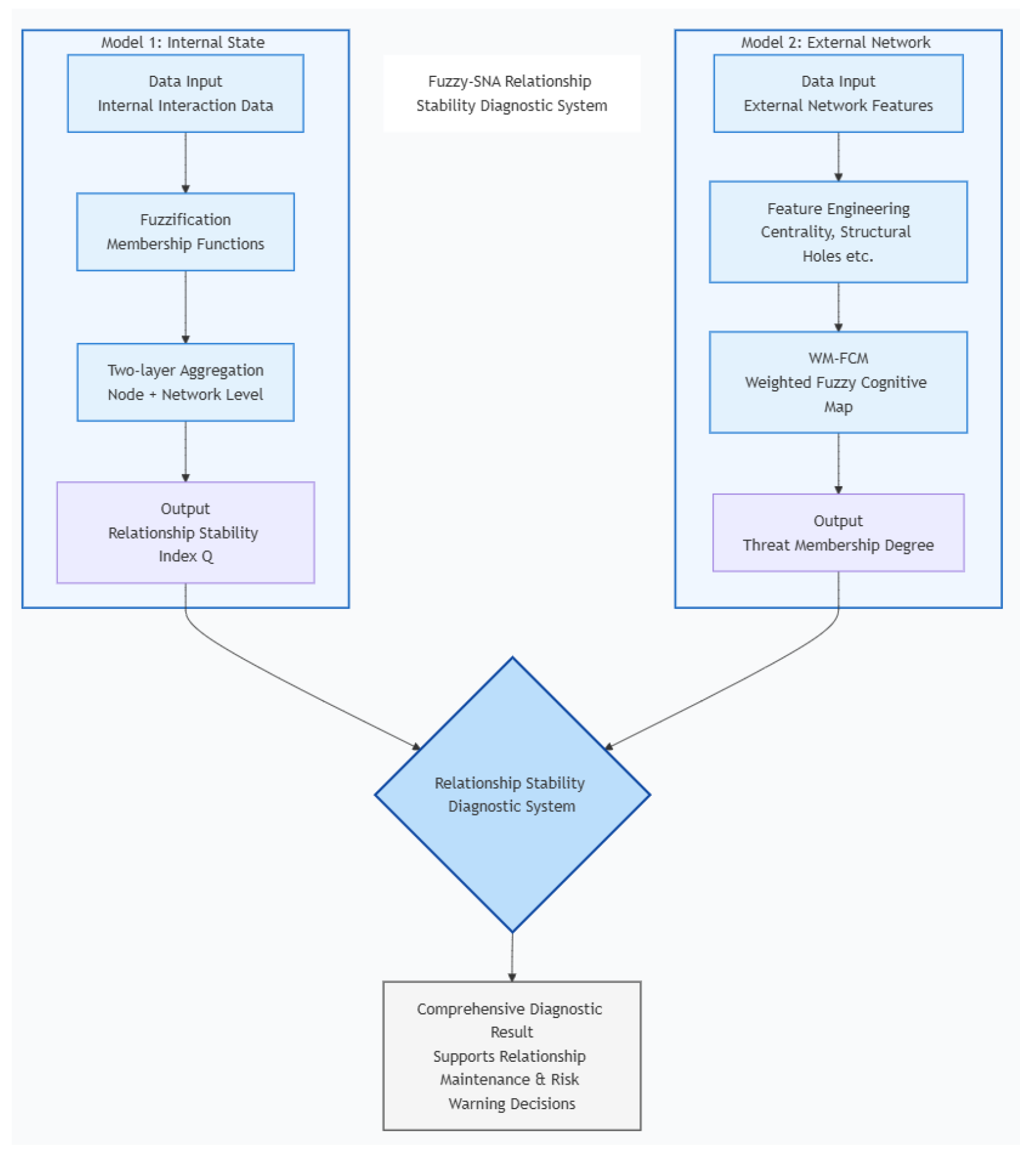
- 1.
- The Internal-State Fuzzy Assessment Model: This model performs a parallel determination of the uncertain, subjective perceptions of nodes within the social network through a hierarchical fuzzy logic system.
- 2.
- The External-Network Risk Screening Model: This model enables the proactive identification and categorization of nodes that are likely to pose risks to dyadic stability, utilizing an enhanced clustering algorithm.
3.2. Quantification of Fuzzy Indicators
3.2.1. Indicator System and Fuzzification
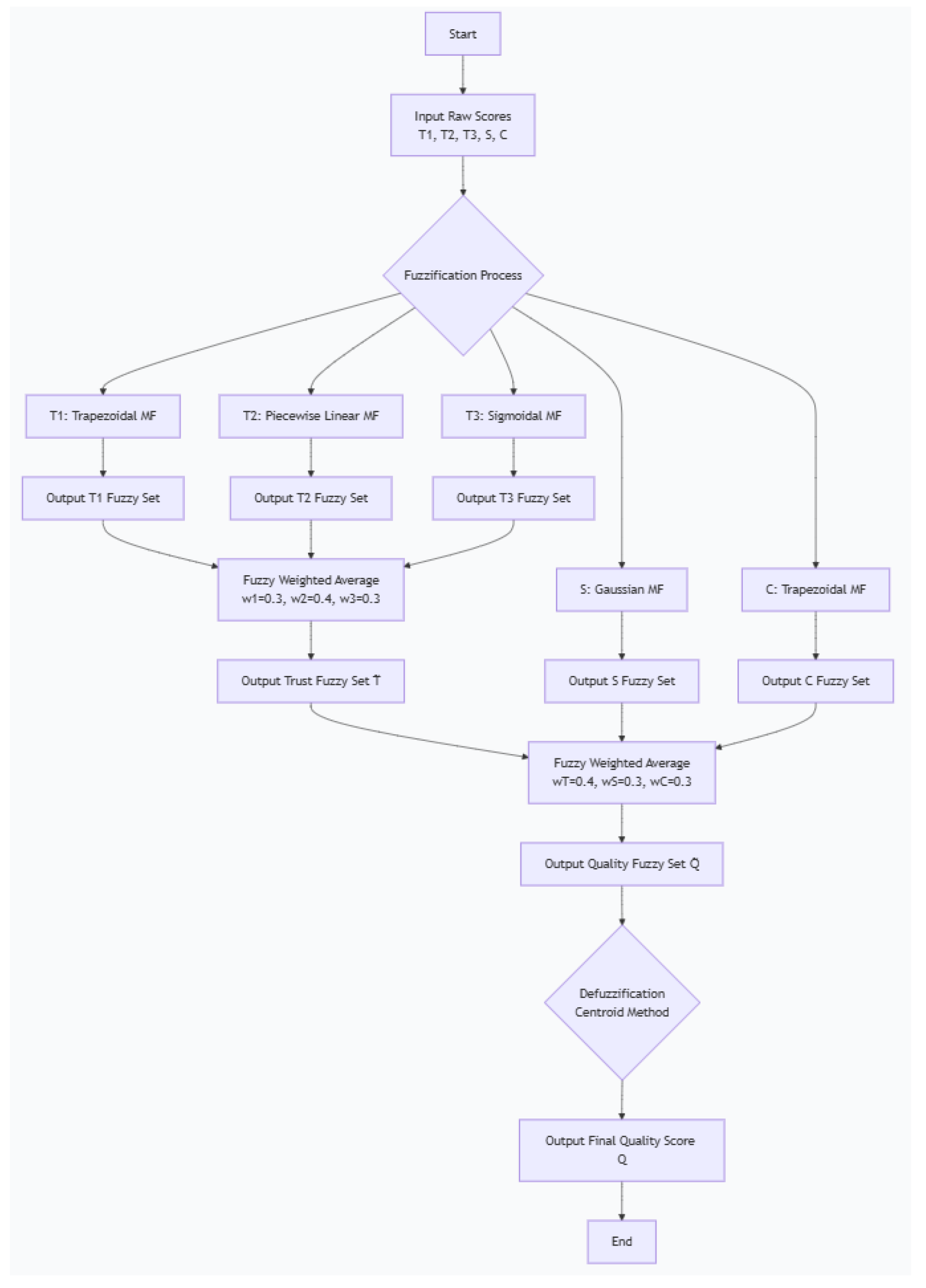
- Cognitive trust (): It involves explicit rational judgements, with evaluations typically possessing clear threshold intervals such as the boundary between ‘basic trust’ and ‘complete trust’ [13,24]. The plateau region of the trapezoidal function effectively represents this relatively stable intermediate state, aligning with the ‘ambiguous yet stable’ psychological response pattern corresponding to mid-range scores on Likert scales.
- Affective trust (): It often exhibits clustered distributions among populations, with few extremes and most individuals occupying intermediate levels. The piecewise linear function fits this centrally clustered distribution with gradual attenuation at both ends, consistent with the linear gradation characteristic of emotional evaluations [4].
- Behavioral trust (): It exhibits a characteristic ‘threshold effect,’ where minor cumulative behaviors trigger a qualitative shift in trust. The sigmoid function’s gradual progression followed by abrupt change precisely models this non-linear dynamic [14].
- Satisfaction (S): As a continuous affective state, satisfaction typically undergoes gradual, smooth transitions [11]. The bell-shaped curve of the Gaussian function naturally represents the gradual attenuation around the ‘peak satisfaction point,’ avoiding the abrupt boundaries of trapezoidal functions and better reflecting the inherently fuzzy, gradual nature of subjective satisfaction.
- Communication Quality (C): It is often categorized into finite, relatively well-defined categories such as ‘conflict’, “neutral”, and ‘harmony’ [25]. This psychological tendency towards classification inherently endows perceptions of communication quality with interval characteristics. The trapezoidal function clearly represents both the plateau regions within these categories and the gradient zones between them.
3.2.2. Two-Layer Fuzzy Aggregation
- First-Layer Aggregation: Computing Comprehensive Trust ()Gather three trust sub-dimensions into a composite trust fuzzy set. The weighting is based on Rempel’s multidimensional theory of trust [4]. This model posits that trust within intimate relationships comprises three distinct yet interrelated components. Rempel et al. propose that while all three are indispensable, the affective dimension typically constitutes the core of intimate trust and is more directly linked to relational well-being. Consequently, we assign it a slightly higher weighting . While cognitive and behavioral dimensions are crucial, they are given equal weightings to reflect their complementary roles in forming the overall trust judgment, satisfying . The aggregation uses the fuzzy weighted average (FWA) operator for each linguistic term :The output is the fuzzy set
- Second-Layer Aggregation: Computing Relationship Quality ()Intermediate indicators—Composite Trust (), Satisfaction (), and Communication Quality ()-are summarized in the fuzzy set of the final quality of the relationship. The weighting is based on a mature three-dimensional model of relationship quality [11], , , , satisfying , which considers trust as the foundational pillar, while satisfaction and communication serve as key reinforcing elements. This model emphasizes that although satisfaction reflects immediate emotional rewards and communication ensures day-to-day functioning, trust is the cornerstone of long-term stability in intimate relationships. Consequently, composite trust is assigned the highest weighting. Satisfaction and communication quality are equally weighted, reflecting their complementary and interdependent roles in sustaining relationship wellbeing.
3.2.3. Defuzzification
3.2.4. Dyadic Symmetry Adjustment
| Algorithm 1 Fuzzy-SNA Relationship Quality Assessment Model | |
| Require: Individual scores for partners A and B: | |
| ▹ Trust dimensions |
| ▹ Satisfaction scores |
| ▹ Communication scores |
Ensure: System-level relationship quality score:
| |
| ▹ Trust parameters |
| ▹ Satisfaction parameter |
| ▹ Communication parameter |
| |
| ▹ Satisfaction aggregation |
| ▹ Communication aggregation |
| |
3.3. Identification of Potential Threats via FCM
3.3.1. Multimodal Feature Engineering Framework
3.3.2. Two-Stage Feature Selection
- 1.
- Redundancy Removal: We compute the Pearson correlation coefficient matrix for all input features d, denoted as . Typically, is set. If the absolute correlation coefficient between any feature pair m and n exceeds , the less important feature is discarded. Subsequently, denotes the number of features retained following this procedure.
- 2.
- Importance Assessment & Weighting: We calculate the information gain ratio for . Let us consider a feature A. Its values are partitioned into bins v. The information gain ratio for feature A is defined by the following formula:
3.3.3. The Weighted Mahalanobis FCM (WM-FCM) Algorithm
- 1.
- Select the first initial center :The sample that is predefined as a “threat” and exhibits extreme feature values—such as lying near the boundary in the standardized space—is chosen.
- 2.
- Select the second initial center :The sample farthest from by Euclidean distance is selected.
- 3.
- Select the j-th initial center ():
- (a)
- For each sample , compute its minimum distance to each selected centre.
- (b)
- Select the sample with the maximum as the next center:
| Algorithm 2 Weighted Mahalanobis Fuzzy C-Means Algorithm |
| Require: Dataset X, number of clusters c, fuzzifier m, maximum iterations T, convergence threshold Ensure: Membership matrix U, cluster centroids V
|
3.3.4. Cluster Validation and Interpretable Output
- Fuzzy Partition Coefficient (FPC): Measures the overall clarity of the membership matrix. It is defined asValues closer to 1 indicate well-separated clusters.
- Xie-Beni (XB) Index: Evaluates the compactness within clusters and the separation between them. It is defined asSmaller values indicate better clustering performance.
3.4. Implementation Details and Reproducibility
4. Illustrative Application and Numerical Analysis
4.1. Relationship Quality Analysis Based on Model I
- Partner A: , , , ,
- Partner B: , , , ,
- Quality of relationship between Partner A:
- Quality of relationship between Partner B:
4.2. Identifying Network Risks Using Model II
4.2.1. Feature Space Construction and Data Foundation
4.2.2. Two-Stage Feature Selection: From Comprehensiveness to Precision
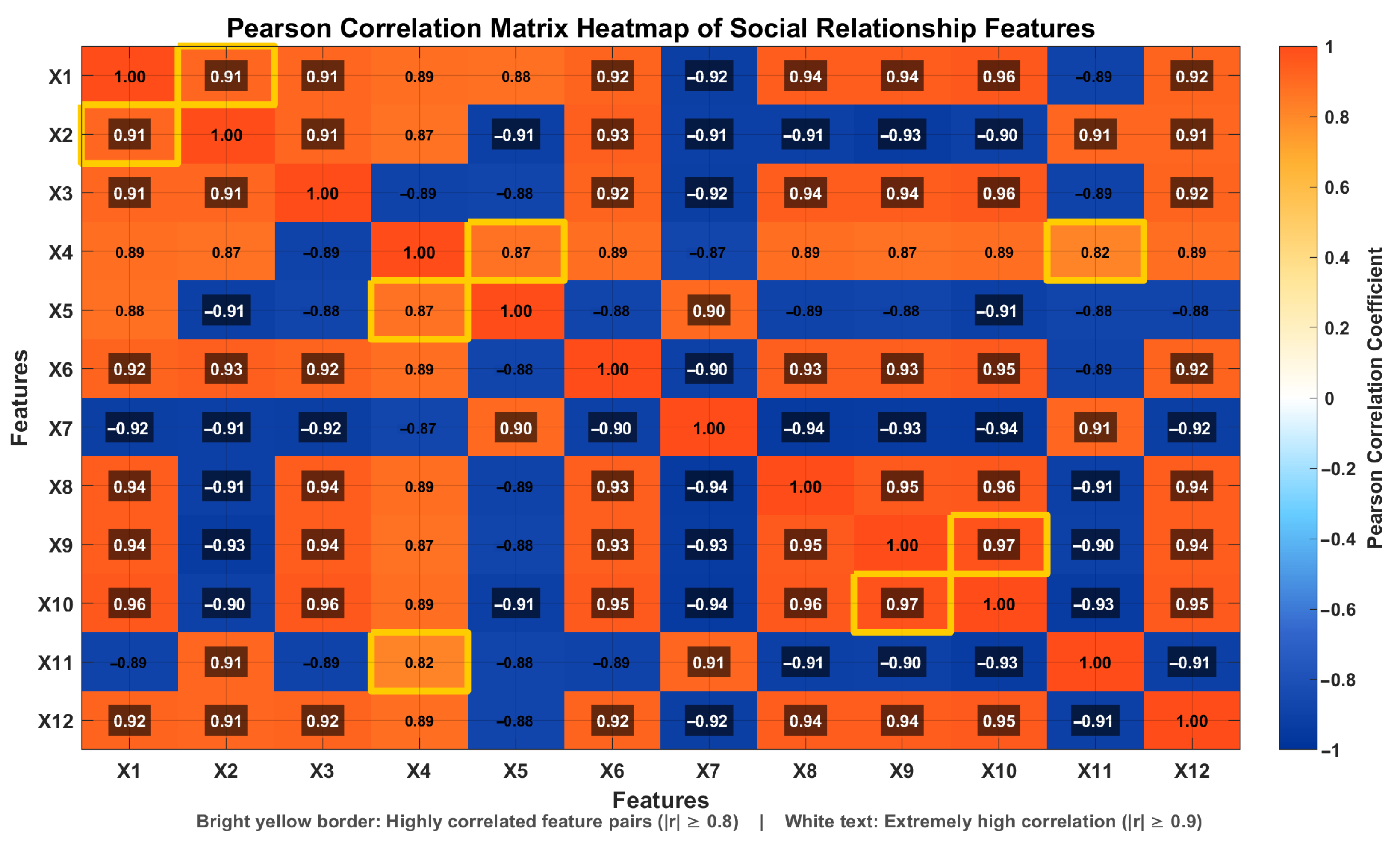
- Redundancy EliminationThe first round of screening (remove redundant features): Calculate the Pearson correlation coefficient matrix across 12 characteristics. The Pearson formula is as follows:To eliminate redundancy, we computed pairwise correlations among the 12 initial features. The resulting heatmap Figure 4 guided the removal of highly correlated variables (|r| > 0.8), streamlined the feature set for subsequent analysis.
- -
- and : . Exclude because includes both in-degree and out-degree, providing more complete information.
- -
- and : . Exclude as the frequency is easier to obtain and is more directly related to the association of the threat.
- -
- and : . Exclude because the abnormality directly characterizes the intensity of the interference and is more core.
- -
- and : . Exclude as the frequency already reflects interaction activity.
This step eliminated four features , , , , resulting in a more parsimonious set of eight features.
- Feature Weighting based on Importance
- The information gain ratio determines the weight by measuring the contribution of a feature to the classification results, overcoming the bias of information gain towards features with multiple values. The formula for the calculation is as follows:
4.2.3. Determining Optimal Cluster Number
- FPC: Prefers higher values, indicating clearer, more distinct cluster assignments.
- XB: Prefers lower values, indicating that the clusters are closer and better separated from each other.
4.2.4. Execution of the WM-FCM Algorithm for Different Cluster Numbers (C)
- Data Standardization: All eigenvalues are scaled proportionally to the [0,1] interval to ensure equal contributions in distance calculation. The standardized data shown in Table 7 are used as direct input of the WM-FCM algorithm.
- Covariance Matrix Preparation: Calculate the pooled covariance matrix from the standardized data. To ensure numerical stability, the matrix is diagonalized, and its inverse is obtained.The pooled covariance matrix, estimated from the standardized feature set, is provided in Table 8. Its diagonalization ensured numerical stability during the computation of the Weighted Mahalanobis Distance.
4.2.5. Algorithm Execution and Results for C = 2
- 1.
- Select the First Initial CenterThe first center , was set to Sample 5, identified as a prototypical threat node.
- 2.
- Calculate the Euclidean Distances from All Samples to Sample 5
- 3.
- Select the Second Initial CenterThe Euclidean distances from all samples to were computed Table 9. The farthest sample, Sample 6, was selected as the second center, , representing a prototypical non-threat node.Final Initial Cluster Centers
- 4.
- Calculation of Weighted Mahalanobis DistanceThe weighted Mahalanobis distance from each sample to each cluster center was computed.
- is the standardized feature vector of sample i
- is the center of the k-th cluster ()
- is the covariance matrix
The Weighted Mahalanobis distances for both configurations are compared in Table 10. For the current analysis, please refer to the distances relative to the first two cluster centers (columns for and ).Cluster Configuration Relationship:- : Common center in both C = 2 and C = 3 configurations
- : Original C = 2 center becomes in C = 3
- New : Additional center introduced in C = 3 for finer granularity
- 5.
- Membership matrixThe fuzzy membership matrix U was updated based on these distances.
- 6.
- Updated cluster centersThe movement of cluster centers is documented in Table 11. The evolution of the `Non-Threat’ and `Threat’ centroids under the C = 2 configuration is presented in the top section of the table.
- 7.
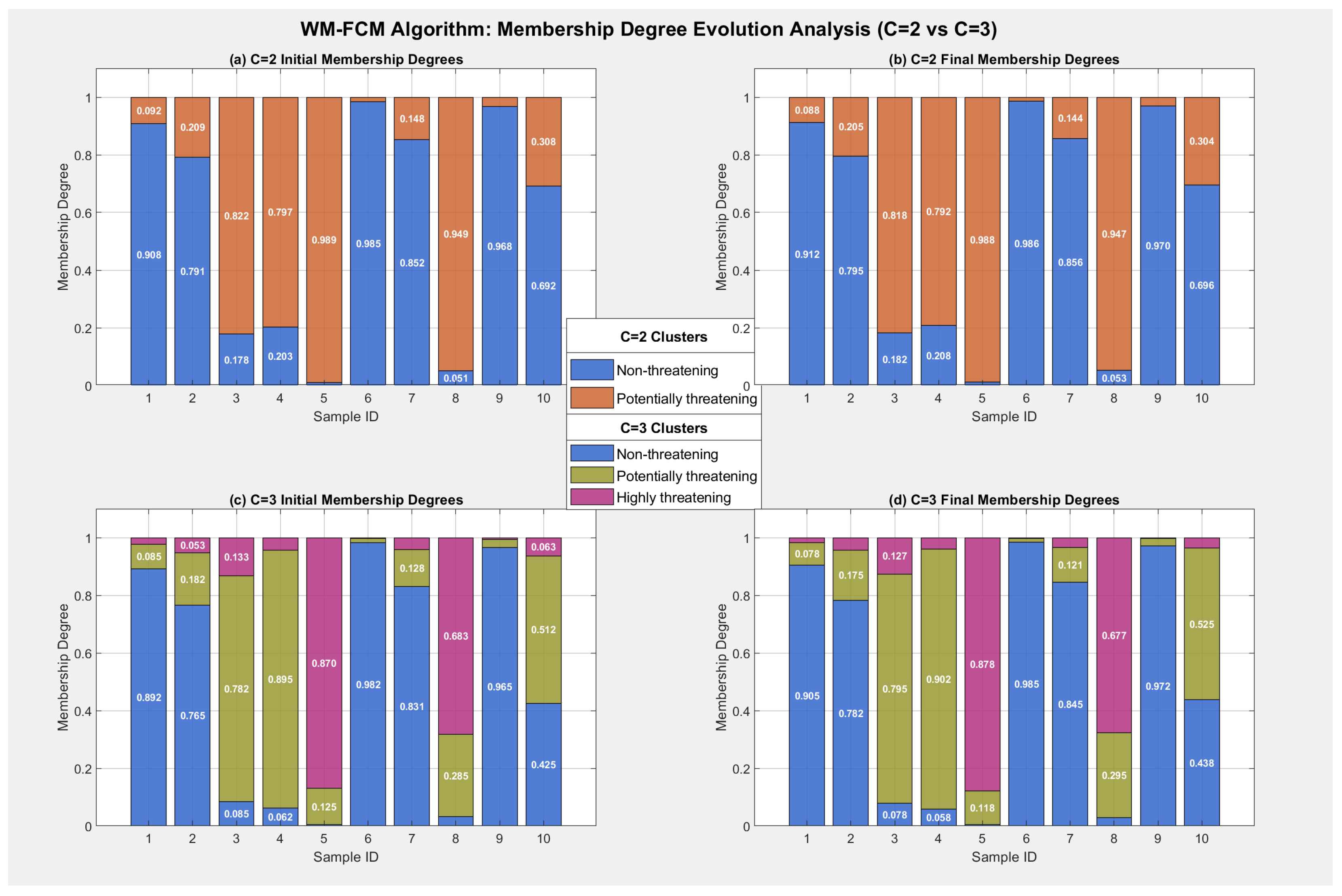
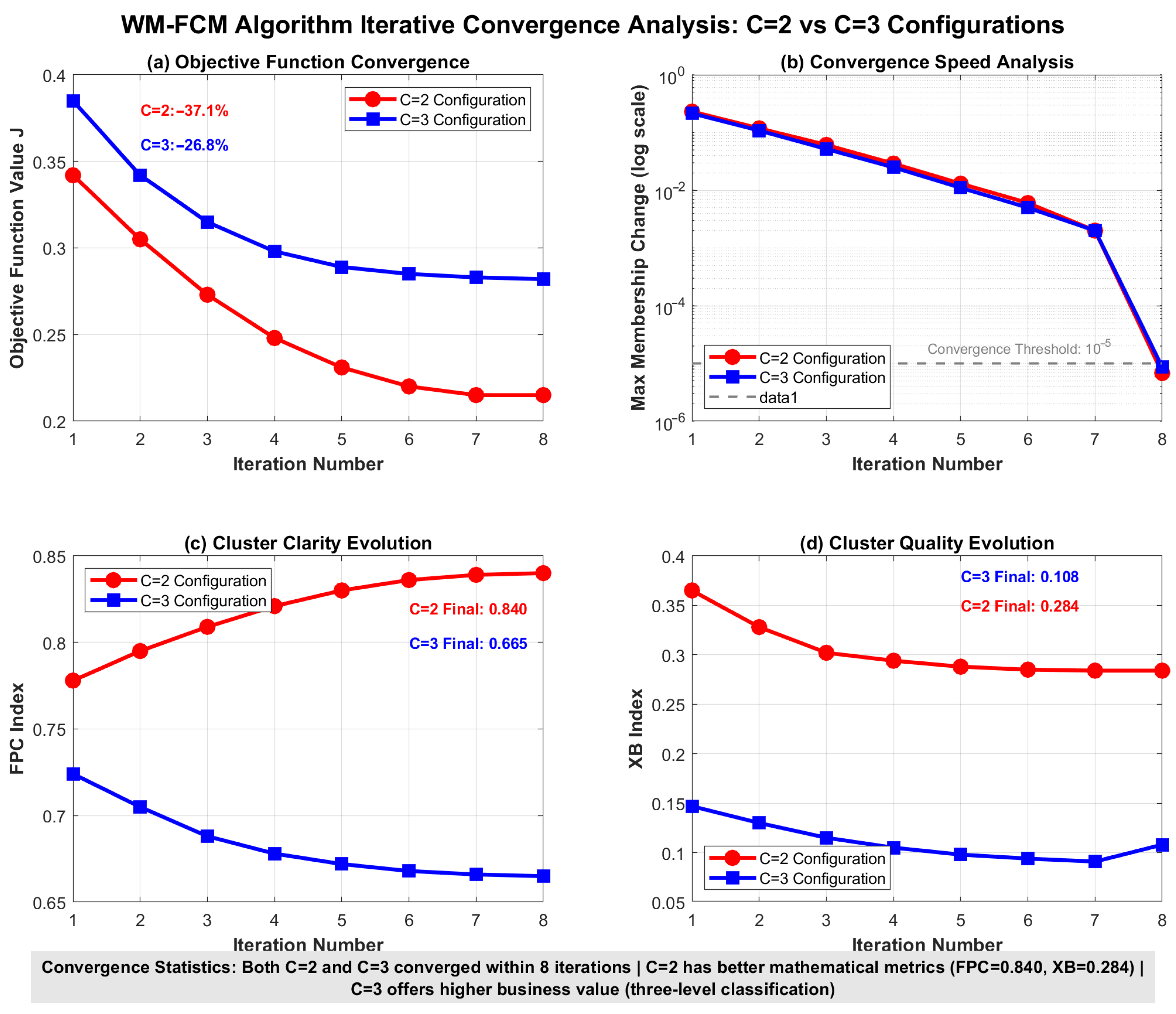
- Iterative convergence processFigure 5 presents an integrated visualization of membership degree evolution. Subplots (a) and (b) specifically illustrate the initialization and final membership states for the C = 2 configuration analyzed in this subsection.The convergence characteristics of the WM-FCM algorithm under the configuration are depicted in Figure 6. The algorithm convergence is stable and efficient, and the quantitative index shows that the target function is reduced from 0.342 monotonically to 0.215, with an optimization rate of 37.1%. In 8 iterations, the maximum affiliation change is reduced from 0.231 to , satisfying the convergence threshold. At the same time, the quality of clusters continued to improve, the FPC index rose from 0.778 to 0.840, and the XB index decreased from 0.365 to 0.284.
4.2.6. Algorithm Execution and Results for C = 3
- 1.
- Select the Initial CenterFor , the Max-Min Distance Method was used to select three initial centers, aiming to capture the spectrum of non-threat, potential threat, and high-threat profiles. The first two initial centers for were set identically to the prototypical samples already selected during the initialization of :The third initial center was then determined by the Max-Min Distance logic. For each remaining sample, we calculate its minimum distance to the two established centers and . The sample with the maximum value of this minimum distance was selected as , so it was the most distinct from both existing prototypes.The third initial center in the configuration C = 3 was selected by identifying the sample that maximizes the minimum distance to the previously established centers and . According to the distance measurements presented in Table 12, Sample 4 satisfies this criterion with a maximum minimum distance of 0.589, and its standardized feature vector was designated accordingly as follows:
- 2.
- Iterative Process and Key Results for C = 3The weighted Mahalanobis distance formula is given by the following:The Weighted Mahalanobis distances for the C = 3 configuration are contained in Table 10, as introduced earlier. For this ternary cluster analysis, the distances relative to all three centers (, , and ) are utilized, the new center being of particular interest.The membership degree formula is given by the following:The evolution of membership degree for the ternary case is fully captured in Figure 5. Subplots (c) and (d) illustrate the initial and final membership distributions for the C = 3 configuration, which are analyzed in this subsection.The cluster center formula is as follows:The complete centroid evolution for all three clusters is available in Table 11. The current analysis focuses on the trajectories of the ‘Low-Risk’, ‘Medium-Risk’, and ‘High-Risk’ centroids detailed in the lower section of the table.
4.2.7. Robustness Analysis of the Diagonalization Approximation
4.3. Practical Interpretation of Intermediate Outputs
- Fuzzy Membership Vectors
- Cluster Membership in WM-FCM
- Symmetry Adjustment Factor
- Relationship Quality Score
- : Stable relationship
- : Moderate relationship with room for improvement
- : Unstable relationship, suggesting significant intervention may be needed
4.4. Comparative Analysis with Benchmark Clustering Algorithms
4.4.1. Experimental Setup for Algorithm Comparison
4.4.2. Quantitative Performance Analysis
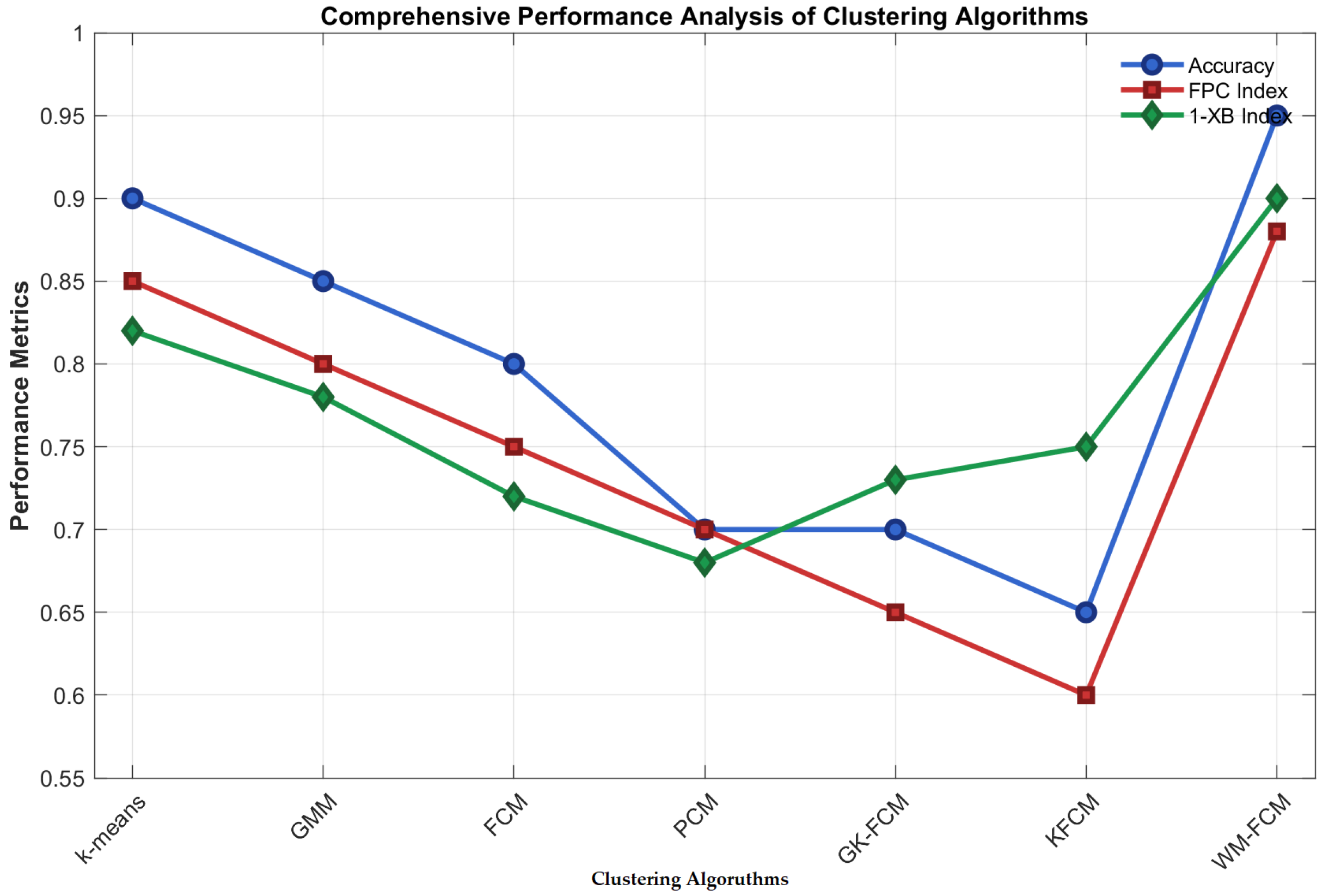
4.4.3. Methodological Insights from Comparative Results
5. Discussion
5.1. Interpretation of Key Findings
5.1.1. In-Depth Analysis of Algorithm Convergence
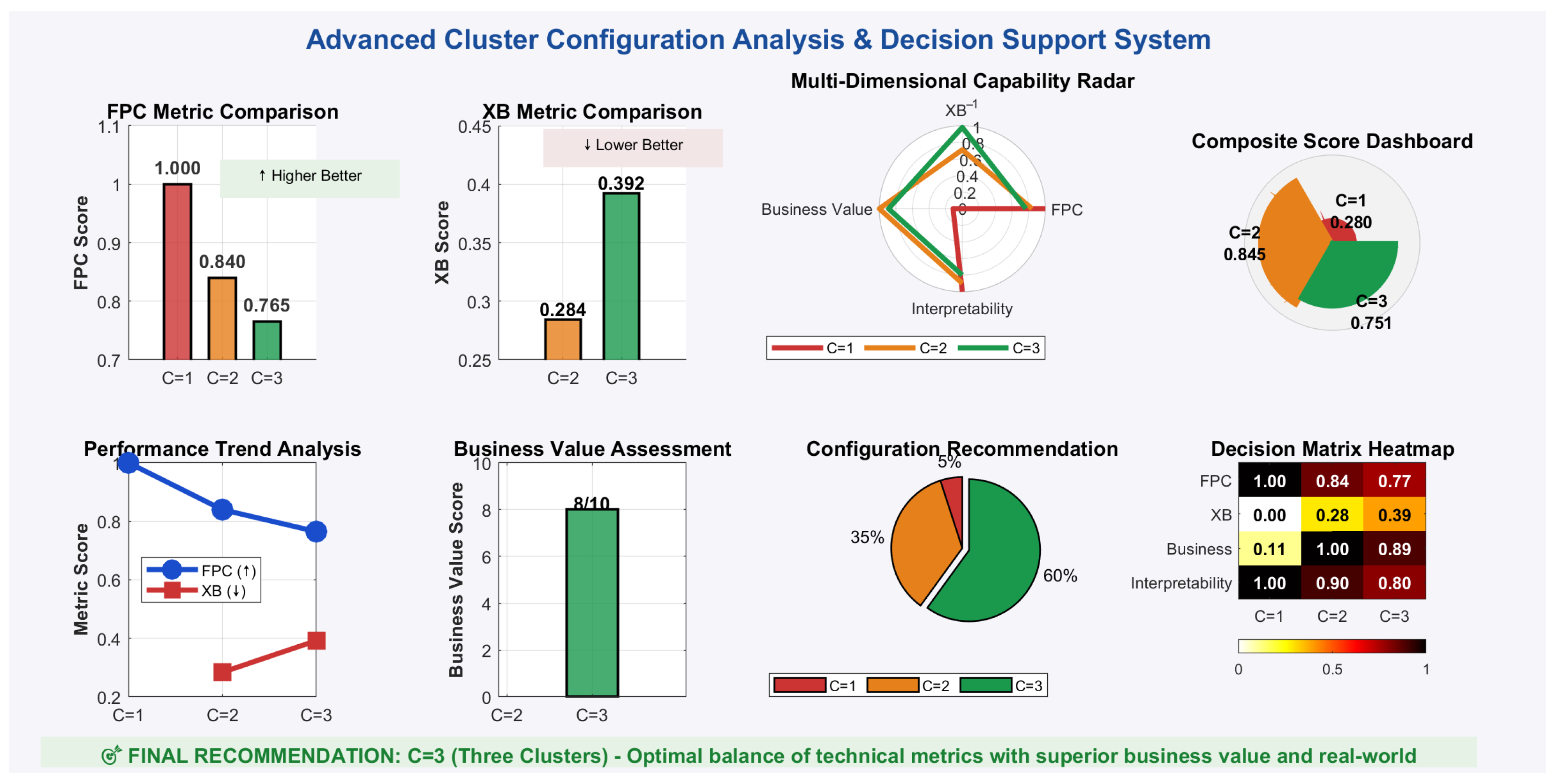
5.1.2. Practical Implications of Cluster Configuration Selection
5.1.3. Convergence Advantages of Weighted Mahalanobis Distance
5.2. Comparison with Prior Work
5.3. Theoretical and Practical Implications
5.4. Limitations and Future Research Directions
- Sample Size and Cross-Validation: Data from ten couples can validate the concept, but the small sample size may impact the model’s generalization capability. Furthermore, this study did not employ cross-validation, which aids in assessing a model’s robustness against overfitting.
- Scalability to Larger Networks: The current model is designed for small-scale interpersonal networks, and its performance in larger, more complex social networks remains to be explored.
- Sensitivity to Subjective Scoring Noise: The model relies on features manually constructed based on subjective ratings such as trust and communication quality. Noise within these subjective ratings may impact the accuracy of threat detection.
- Applicability Beyond Intimate Relationships: This framework has been modeled and validated specifically for the context of intimate relationships. Its transferability to other relational scenarios remains unexamined and may necessitate structural adjustments.
- Expanded Validation and Generalization: Validate the model with larger and more diverse samples, and implement cross-validation techniques to enhance robustness and generalizability.
- Multimodal Enrichment: Combining multimodal data to enrich feature representations and reduce reliance on manual feature engineering.
6. Conclusions
Author Contributions
Funding
Data Availability Statement
Conflicts of Interest
Abbreviations
| SNA | Social Network Analysis |
| FCM | Fuzzy C-Means |
| WM-FCM | Weighted Mahalanobis Fuzzy C-Means |
| FPC | Fuzzy Partition Coefficient |
| XB | Xie-Beni Index |
| FWA | Fuzzy Weighted Average |
| EVD | Eigenvalue Decomposition |
| GR | Gain Ratio |
| GMM | Gaussian Mixture Model |
| PCM | Possibilistic C-Means |
| GK-FCM | Gustafson-Kessel Fuzzy C-Means |
| KFCM | Kernel Fuzzy C-Means |
References
- Proulx, C.M.; Helms, H.M.; Buehler, C. Marital quality and personal well-being: A meta-analysis. J. Marriage Fam. 2007, 69, 576–593. [Google Scholar] [CrossRef]
- Holt-Lunstad, J.; Smith, T.B.; Layton, J.B. Social relationships and mortality risk: A meta-analytic review. PLoS Med. 2010, 7, e1000316. [Google Scholar] [CrossRef]
- McNulty, J.K.; Fincham, F.D. Beyond positive psychology? Toward a contextual view of psychological processes and well-being. Am. Psychol. 2012, 67, 101. [Google Scholar] [CrossRef] [PubMed]
- Rempel, J.K.; Holmes, J.G.; Zanna, M.P. Trust in close relationships. J. Personal. Soc. Psychol. 1985, 49, 95. [Google Scholar] [CrossRef]
- Wells, V.K. Behavioural psychology, marketing and consumer behaviour: A literature review and future research agenda. J. Mark. Manag. 2014, 30, 1119–1158. [Google Scholar] [CrossRef]
- Granovetter, M.S. The strength of weak ties. Am. J. Sociol. 1973, 78, 1360–1380. [Google Scholar] [CrossRef]
- Rusbult, C.E.; Van Lange, P.A. Interdependence, interaction, and relationships. Annu. Rev. Psychol. 2003, 54, 351–375. [Google Scholar] [CrossRef]
- Karney, B.R.; Bradbury, T.N. The longitudinal course of marital quality and stability: A review of theory, methods, and research. Psychol. Bull. 1995, 118, 3. [Google Scholar] [CrossRef]
- Rusbult, C.E. Commitment and satisfaction in romantic associations: A test of the investment model. J. Exp. Soc. Psychol. 1980, 16, 172–186. [Google Scholar] [CrossRef]
- Goguen, J.A. LA Zadeh. Fuzzy sets. Information and control, vol. 8 (1965), pp. 338–353.-LA Zadeh. Similarity relations and fuzzy orderings. Information sciences, vol. 3 (1971), pp. 177–200. J. Symb. Log. 1973, 38, 656–657. [Google Scholar] [CrossRef]
- Fincham, F.D.; Rogge, R. Understanding relationship quality: Theoretical challenges and new tools for assessment. J. Fam. Theory Rev. 2010, 2, 227–242. [Google Scholar] [CrossRef]
- Rogge, R.D.; Macri, J.A.; Okwudili, K. Connection at your fingertips: A first look at the Agapé app’s contributions to healthy relationships. J. Fam. Psychol. 2024, 38, 1–16. [Google Scholar] [CrossRef]
- Smithson, M. Fuzzy Set Analysis for Behavioral and Social Sciences; Springer Science & Business Media: Berlin/Heidelberg, Germany, 2012. [Google Scholar]
- Mayer, R.C.; Davis, J.H.; Schoorman, F.D. An integrative model of organizational trust. Acad. Manag. Rev. 1995, 20, 709–734. [Google Scholar] [CrossRef]
- Devi, S.; Garg, H.; Garg, D. A review of redundancy allocation problem for two decades: Bibliometrics and future directions. Artif. Intell. Rev. 2023, 56, 7457–7548. [Google Scholar] [CrossRef]
- Hu, J.; Lim, B.H.; Tian, X.; Wang, K.; Xu, D.; Zhang, F.; Zhang, Y. A comprehensive review of artificial intelligence applications in the photovoltaic systems. CAAI Artif. Intell. Res. 2024, 3, 9150031. [Google Scholar] [CrossRef]
- Prell, C. Social Network Analysis: History, Theory and Methodology; Sage Pubn Inc.: London, UK, 2011. [Google Scholar]
- Sutcliffe, A.G.; Wang, D.; Dunbar, R.I. Modelling the role of trust in social relationships. ACM Trans. Internet Technol. (TOIT) 2015, 15, 1–24. [Google Scholar] [CrossRef]
- Li, X.; Qiao, J.; Yin, S.; Wu, L.; Gao, C.; Wang, Z.; Li, X. A survey of multimodal fake news detection: A cross-modal interaction perspective. In IEEE Transactions on Emerging Topics in Computational Intelligence; IEEE: New York, NY, USA, 2025. [Google Scholar]
- Singh, S.S.; Muhuri, S.; Mishra, S.; Srivastava, D.; Shakya, H.K.; Kumar, N. Social network analysis: A survey on process, tools, and application. ACM Comput. Surv. 2024, 56, 1–39. [Google Scholar] [CrossRef]
- Liu, J.; Liu, Y.; Lin, J.; Li, J.; Cao, L.; Sun, P.; Hu, B.; Song, L.; Boukerche, A.; Leung, V.C. Networking systems for video anomaly detection: A tutorial and survey. ACM Comput. Surv. 2025, 57, 1–37. [Google Scholar] [CrossRef]
- Jiang, W.; Ye, W.; Tan, X.; Bao, Y.J. Network-based multi-omics integrative analysis methods in drug discovery: A systematic review. BioData Min. 2025, 18, 27. [Google Scholar] [CrossRef]
- Boyd, R.L.; Markowitz, D.M. Verbal behavior and the future of social science. Am. Psychol. 2025, 80, 411–433. [Google Scholar] [CrossRef]
- Zadeh, L.A. Fuzzy sets. Inf. Control 1965, 8, 338–353. [Google Scholar] [CrossRef]
- Gottman, J. What Predicts Divorce?: The Relationship Between Marital Processes and Marital Outcomes; Routledge: Milton, UK, 2023. [Google Scholar]
- Xu, D.; Tian, Y. A comprehensive survey of clustering algorithms. Ann. Data Sci. 2015, 2, 165–193. [Google Scholar] [CrossRef]
- Wang, Y.; Youn, H.Y. Feature weighting based on inter-category and intra-category strength for twitter sentiment analysis. Appl. Sci. 2018, 9, 92. [Google Scholar] [CrossRef]
- Li, J.; Cheng, K.; Wang, S.; Morstatter, F.; Trevino, R.P.; Tang, J.; Liu, H. Feature selection: A data perspective. ACM Comput. Surv. (CSUR) 2017, 50, 1–45. [Google Scholar] [CrossRef]
- Bezdek, J.C.; Ehrlich, R.; Full, W. FCM: The fuzzy c-means clustering algorithm. Comput. Geosci. 1984, 10, 191–203. [Google Scholar] [CrossRef]
- Chang, X.; Wang, Q.; Liu, Y.; Wang, Y. Sparse regularization in fuzzy c-means for high-dimensional data clustering. IEEE Trans. Cybern. 2016, 47, 2616–2627. [Google Scholar] [CrossRef]
- Sun, L.; Guo, J.; Wu, X.; Xu, J. Fuzzy C-means clustering-based multi-label feature selection via weighted neighborhood mutual information. Inf. Sci. 2025, 718, 122389. [Google Scholar] [CrossRef]
- Sinaga, K.P.; Yang, M.S. Unsupervised K-means clustering algorithm. IEEE Access 2020, 8, 80716–80727. [Google Scholar] [CrossRef]
- Adams, S.; Beling, P.A. A survey of feature selection methods for Gaussian mixture models and hidden Markov models. Artif. Intell. Rev. 2019, 52, 1739–1779. [Google Scholar] [CrossRef]
- Wang, H.Y.; Wang, J.S.; Wang, G. A survey of fuzzy clustering validity evaluation methods. Inf. Sci. 2022, 618, 270–297. [Google Scholar] [CrossRef]
- Moattar Husseini, Z.; Fazel Zarandi, M.H.; Ahmadi, A. Adaptive type2-possibilistic C-means clustering and its application to microarray datasets. Artif. Intell. Rev. 2023, 56, 11017–11052. [Google Scholar] [CrossRef]
- Gosain, A.; Dahiya, S. Performance analysis of various fuzzy clustering algorithms: A review. Procedia Comput. Sci. 2016, 79, 100–111. [Google Scholar] [CrossRef]
- Tang, Y.; Pan, Z.; Pedrycz, W.; Ren, F.; Song, X. Based kernel fuzzy clustering with weight information granules. IEEE Trans. Emerg. Top. Comput. Intell. 2022, 7, 342–356. [Google Scholar] [CrossRef]



| Component | Parameter | Value/Setting | Description |
|---|---|---|---|
| Fuzzification | Trust MF type | Trapezoidal | For , , |
| Satisfaction MF type | Gaussian | For S | |
| Communication MF type | S-shaped | For C | |
| Aggregation | First-layer weights () | Based on Rempel’s theory | |
| Dimension weights () | Importance of Trust, Satisfaction, Communication | ||
| Symmetry Adjustment | (stability constant) | Prevents division by zero | |
| WM-FCM Algorithm | Fuzzifier m | Standard fuzzy exponent | |
| Convergence threshold | Membership change tolerance | ||
| Maximum iterations | 100 | Upper iteration limit | |
| Defuzzification | Method | Centroid | Standard defuzzification approach |
| Component | Symbol | Partner A | Partner B | Difference | Notes | |
|---|---|---|---|---|---|---|
| A. Raw Input Scores (1–7 Likert Scale) | ||||||
| Cognitive Trust | 5 | 6 | 1 | 0.833 | Higher for Partner B | |
| Affective Trust | 6 | 5 | 1 | 0.833 | Higher for Partner A | |
| Behavioral Trust | 4 | 5 | 1 | 0.833 | Higher for Partner B | |
| Satisfaction | S | 5 | 4 | 1 | 0.833 | Higher for Partner A |
| Communication | C | 6 | 5 | 1 | 0.833 | Higher for Partner A |
| B. Fuzzification Results | ||||||
| Cognitive Trust | (0, 1, 0) | (0, 0, 1) | – | – | Trapezoidal functions | |
| Affective Trust | (0, 0, 1) | (0, 1, 0) | – | – | Piecewise linear | |
| Behavioral Trust | (0.047, 0.135, 0.818) | (0.011, 0.489, 0.500) | – | – | Sigmoidal functions | |
| Satisfaction | (0.014, 0.493, 0.493) | (0.126, 0.747, 0.126) | – | – | Gaussian functions | |
| Communication | (0, 0, 1) | (0, 1, 0) | – | – | Trapezoidal functions | |
| C. First-Layer Aggregation: Composite Trust | ||||||
| Trust Weights | (0.3, 0.4, 0.3) | – | – | Rempel’s theory | ||
| Low Trust (L) | 0.014 | 0.003 | – | – | Weighted sum | |
| Medium Trust (M) | 0.341 | 0.547 | – | – | Weighted sum | |
| High Trust (H) | 0.645 | 0.450 | – | – | Weighted sum | |
| D. Second-Layer Aggregation: Relationship Quality | ||||||
| Quality Weights | (0.4, 0.3, 0.3) | – | – | Three-dimensional model | ||
| Low Quality (L) | 0.010 | 0.039 | – | – | Weighted sum | |
| Medium Quality (M) | 0.284 | 0.743 | – | – | Weighted sum | |
| High Quality (H) | 0.706 | 0.218 | – | – | Weighted sum | |
| E. Defuzzification and Symmetry Adjustment | ||||||
| Defuzzified Score | 6.088 | 4.537 | 1.551 | – | Centroid method | |
| Symmetry Degree | 0.833 | – | – | Average of | ||
| Adjusted Score | 5.071 | 3.779 | 1.292 | – | ||
| System Quality | 4.425 | – | – | |||
| Method | |||
|---|---|---|---|
| Centroid (Proposed) | 6.088 | 4.537 | 4.425 |
| Max Membership | 6.200 | 4.600 | 4.500 |
| Weighted Average | 6.050 | 4.520 | 4.420 |
| Feature Dimension | Initial Features (12) |
|---|---|
| Network Structure | 1. Node Degree () |
| 2. Number of Neighboring Nodes () | |
| 3. Structural Hole Strength () | |
| Interaction Behavior | 4. Partner Interaction Frequency () |
| 5. Partner Interaction Duration () | |
| 6. Third—Party Interaction Frequency () | |
| Emotional Tendency | 7. Partner Emotional Tendency () |
| 8. Emotional Fluctuation Amplitude () | |
| 9. Third—Party Emotional Tendency () | |
| Interference Source | 10. Third—Party Interaction Abnormality () |
| 11. Partner Interaction Type Proportion () | |
| 12. Response Timeliness () |
| Sample | X1 | X2 | X3 | X4 | X5 | X6 | X7 | X8 | X9 | X10 | X11 | X12 | Manual Label |
|---|---|---|---|---|---|---|---|---|---|---|---|---|---|
| 1 | 8 | 7 | 0.32 | 12 | 45 | 3 | 0.6 | 0.4 | 0.2 | 0.7 | 0.8 | 15 | Normal |
| 2 | 10 | 9 | 0.41 | 10 | 38 | 4 | 0.5 | 0.5 | 0.3 | 0.9 | 0.7 | 18 | Normal |
| 3 | 15 | 14 | 0.72 | 4 | 12 | 10 | −0.3 | 1.5 | 0.7 | 1.8 | 0.3 | 45 | Threat |
| 4 | 13 | 12 | 0.68 | 5 | 15 | 8 | −0.2 | 1.3 | 0.6 | 1.6 | 0.4 | 38 | Threat |
| 5 | 18 | 17 | 0.81 | 2 | 8 | 12 | −0.6 | 1.8 | 0.9 | 2.1 | 0.2 | 60 | Threat |
| 6 | 6 | 5 | 0.28 | 15 | 60 | 2 | 0.7 | 0.3 | 0.1 | 0.5 | 0.9 | 12 | Normal |
| 7 | 9 | 8 | 0.35 | 11 | 42 | 3 | 0.4 | 0.6 | 0.2 | 0.8 | 0.8 | 16 | Normal |
| 8 | 16 | 15 | 0.78 | 3 | 10 | 11 | −0.5 | 1.6 | 0.8 | 2 | 0.3 | 52 | Threat |
| 9 | 7 | 6 | 0.25 | 14 | 55 | 2 | 0.8 | 0.2 | 0.1 | 0.6 | 0.9 | 10 | Normal |
| 10 | 12 | 11 | 0.45 | 9 | 35 | 5 | 0.3 | 0.7 | 0.4 | 1 | 0.7 | 22 | Normal |
| Feature | Symbol | Type | Gain Ratio | Weight |
|---|---|---|---|---|
| : Structural Hole | Network Structure | 0.618 | 0.180 | |
| : Partner Interaction Frequency | Interaction Behavior | 0.564 | 0.164 | |
| : Partner Emotion | Emotional Tendency | 0.564 | 0.164 | |
| : Emotional Fluctuation | Emotional Tendency | 0.564 | 0.164 | |
| : Third-Party Abnormality | Interference Source | 0.564 | 0.164 | |
| : Response Time | Interaction Behavior | 0.564 | 0.164 | |
| : Node Degree | – | Network Structure | 0.618 | – |
| : Third-Party Frequency | – | Interaction Behavior | 0.564 | – |
| Sample | ||||||
|---|---|---|---|---|---|---|
| 1 | 0.125 | 0.222 | 0.769 | 0.125 | 0.857 | 0.125 |
| 2 | 0.286 | 0.417 | 0.615 | 0.250 | 0.786 | 0.188 |
| 3 | 0.839 | 0.583 | 0.154 | 0.812 | 0.214 | 0.812 |
| 4 | 0.768 | 0.667 | 0.231 | 0.688 | 0.286 | 0.688 |
| 5 | 1.000 | 1.000 | 0.000 | 1.000 | 0.000 | 1.000 |
| 6 | 0.054 | 0.056 | 1.000 | 0.000 | 0.929 | 0.062 |
| 7 | 0.179 | 0.306 | 0.692 | 0.188 | 0.714 | 0.250 |
| 8 | 0.946 | 0.889 | 0.077 | 0.938 | 0.071 | 0.875 |
| 9 | 0.000 | 0.000 | 0.923 | 0.062 | 1.000 | 0.000 |
| 10 | 0.357 | 0.472 | 0.538 | 0.312 | 0.643 | 0.312 |
| Feature | ||||||
|---|---|---|---|---|---|---|
| 0.128 | 0.042 | −0.097 | 0.115 | −0.102 | 0.118 | |
| 0.042 | 0.076 | −0.068 | 0.071 | −0.065 | 0.073 | |
| −0.097 | −0.068 | 0.105 | −0.098 | 0.092 | −0.099 | |
| 0.115 | 0.071 | −0.098 | 0.112 | −0.101 | 0.114 | |
| −0.102 | −0.065 | 0.092 | −0.101 | 0.095 | −0.103 | |
| 0.118 | 0.073 | −0.099 | 0.114 | −0.103 | 0.116 |
| Sample | 1 | 2 | 3 | 4 | 5 | 6 | 7 | 8 | 9 | 10 |
|---|---|---|---|---|---|---|---|---|---|---|
| Distance | 1.732 | 1.521 | 0.510 | 0.721 | 0 | 2.179 | 1.386 | 0.283 | 2.000 | 1.247 |
| Distance to Cluster Centers | |||
|---|---|---|---|
| Sample | New: | ||
| (Both C = 2 & C = 3) | (C = 2 → C = 3 Mapping) | (C = 3 Only) | |
| 1 | 0.195 | 0.658 | 0.428 |
| 2 | 0.268 | 0.542 | 0.365 |
| 3 | 0.587 | 0.273 | 0.182 |
| 4 | 0.512 | 0.258 | 0.125 |
| 5 | 0.843 | 0.081 | 0.218 |
| 6 | 0.062 | 0.765 | 0.546 |
| 7 | 0.227 | 0.608 | 0.398 |
| 8 | 0.665 | 0.156 | 0.205 |
| 9 | 0.103 | 0.715 | 0.489 |
| 10 | 0.338 | 0.489 | 0.312 |
| Config | Cluster | Feature Value Changes (First → Final) | |||||
|---|---|---|---|---|---|---|---|
| C = 2 | Non-Threat | 0.130 → 0.135 | 0.942 → 0.948 | 0.893 → 0.899 | 0.041 → 0.043 | 0.037 → 0.039 | 0.053 → 0.055 |
| Threat | 0.876 → 0.882 | 0.095 → 0.098 | 0.101 → 0.105 | 0.902 → 0.907 | 0.918 → 0.923 | 0.879 → 0.884 | |
| C = 3 | Low-Risk | 0.105 → 0.112 | 0.938 → 0.945 | 0.895 → 0.902 | 0.048 → 0.051 | 0.042 → 0.045 | 0.058 → 0.062 |
| Medium-Risk | 0.785 → 0.792 | 0.218 → 0.221 | 0.268 → 0.275 | 0.698 → 0.705 | 0.685 → 0.692 | 0.625 → 0.632 | |
| High-Risk | 0.925 → 0.932 | 0.085 → 0.092 | 0.092 → 0.101 | 0.918 → 0.925 | 0.932 → 0.938 | 0.895 → 0.902 | |
| Sample | Distance to | Distance to | Min Distance |
|---|---|---|---|
| 1 | 1.732 | 0.182 | 0.182 |
| 2 | 1.521 | 0.256 | 0.256 |
| 3 | 0.510 | 0.563 | 0.510 |
| 4 | 0.759 | 0.589 | 0.589 |
| 5 | 0.000 | 2.179 | 0.000 |
| 6 | 2.179 | 0.000 | 0.000 |
| 7 | 1.386 | 0.214 | 0.214 |
| 8 | 0.283 | 0.638 | 0.283 |
| 9 | 2.000 | 0.097 | 0.097 |
| 10 | 1.247 | 0.321 | 0.321 |
| Feature | ||||||
|---|---|---|---|---|---|---|
| 1.00 | 0.43 | −0.83 | 0.96 | −0.92 | 0.97 | |
| 0.43 | 1.00 | −0.76 | 0.77 | −0.77 | 0.77 | |
| −0.83 | −0.76 | 1.00 | −0.90 | 0.91 | −0.90 | |
| 0.96 | 0.77 | −0.90 | 1.00 | −0.98 | 0.98 | |
| −0.92 | −0.77 | 0.91 | −0.98 | 1.00 | −0.98 | |
| 0.97 | 0.77 | −0.90 | 0.98 | −0.98 | 1.00 |
| Comparison Item | Full Covariance Matrix Result | Diagonalized Matrix Result | Difference |
|---|---|---|---|
| Low-Risk Center | [0.114, 0.944, 0.904, 0.053, 0.047, 0.064] | [0.112, 0.945, 0.902, 0.051, 0.045, 0.062] | : 0.003 |
| Medium-Risk Center | [0.790, 0.223, 0.277, 0.707, 0.694, 0.634] | [0.792, 0.221, 0.275, 0.705, 0.692, 0.632] | : 0.003 |
| High-Risk Center | [0.931, 0.093, 0.103, 0.927, 0.940, 0.904] | [0.932, 0.092, 0.101, 0.925, 0.938, 0.902] | : 0.003 |
| Sample Classification | High: {1,2,8}; Med: {5}; Low: {3,4,6,7,9,10} | Identical to left | Agreement: 100% |
| Performance Metric | Full Covariance Matrix | Diagonalized Matrix | Relative Change |
|---|---|---|---|
| Final Objective Function J | 0.283 | 0.282 | +0.350% |
| FPC | 0.767 | 0.765 | +0.260% |
| XB | 0.388 | 0.392 | −1.020% |
| Convergence Iterations | 8 | 8 | 0% |
| Algorithm | Category | Accuracy | FPC Index | 1-XB Index |
|---|---|---|---|---|
| k-means [32] | Partition-based | 0.90 | 0.85 | 0.82 |
| GMM [33] | Partition-based | 0.85 | 0.80 | 0.78 |
| FCM [34] | Fuzzy-based | 0.80 | 0.75 | 0.72 |
| PCM [35] | Fuzzy-based | 0.70 | 0.70 | 0.68 |
| GK-FCM [36] | Enhanced Fuzzy | 0.70 | 0.65 | 0.73 |
| KFCM [37] | Enhanced Fuzzy | 0.65 | 0.60 | 0.75 |
| WM-FCM | Proposed | 0.95 | 0.88 | 0.90 |
Disclaimer/Publisher’s Note: The statements, opinions and data contained in all publications are solely those of the individual author(s) and contributor(s) and not of MDPI and/or the editor(s). MDPI and/or the editor(s) disclaim responsibility for any injury to people or property resulting from any ideas, methods, instructions or products referred to in the content. |
© 2026 by the authors. Licensee MDPI, Basel, Switzerland. This article is an open access article distributed under the terms and conditions of the Creative Commons Attribution (CC BY) license.
Share and Cite
Wang, N.; Kong, X. A Fuzzy-SNA Computational Framework for Quantifying Intimate Relationship Stability and Social Network Threats. Symmetry 2026, 18, 201. https://doi.org/10.3390/sym18010201
Wang N, Kong X. A Fuzzy-SNA Computational Framework for Quantifying Intimate Relationship Stability and Social Network Threats. Symmetry. 2026; 18(1):201. https://doi.org/10.3390/sym18010201
Chicago/Turabian StyleWang, Ning, and Xiangzhi Kong. 2026. "A Fuzzy-SNA Computational Framework for Quantifying Intimate Relationship Stability and Social Network Threats" Symmetry 18, no. 1: 201. https://doi.org/10.3390/sym18010201
APA StyleWang, N., & Kong, X. (2026). A Fuzzy-SNA Computational Framework for Quantifying Intimate Relationship Stability and Social Network Threats. Symmetry, 18(1), 201. https://doi.org/10.3390/sym18010201