


Abstract
Let G be a connected graph. The Steiner k-Wiener index of graph G is defined as , where represents the minimum size of a connected subgraph of G that connects S. Using some graph operations, we obtain the minimum value and the second minimum value of the Steiner k-Wiener index for cacti with order n and t cycles, and we characterize the corresponding extremal graphs by exploiting structural symmetries.
MSC:
05C09; 05C35
1. Introduction
In this paper, all graphs are undirected, finite, simple, and connected. The terminology and concepts used herein are based on the reference [1]. Let G be a simple connected graph, where and are its vertex set and edge set, respectively. For , denotes the degree of u in G, which is the number of edges incident to u. A vertex of degree 1 is called a pendant vertex, and an edge incident to a pendant vertex is called a pendant edge. For , represents the distance between u and v, specifically the length of the shortest path connecting u and v. Let be the graph that arises from G by deleting the edge . Similarly, is a graph that arises from G by adding an edge , where . Let .
The Wiener index was introduced by the chemist Wiener in 1947 during his study of paraffin boiling points [2], and the Wiener index of a graph G is defined as the sum of distances between all pairs of vertices in G, expressed as
For more details on the Wiener index, we refer to [3,4,5,6,7,8,9].
In 1994, Chartrand et al. [10] put forward the notion of Steiner distance. For a subset , the Steiner distance is defined as the minimum size of a connected subgraph of G connecting S. In particular, if , then . In 2014, Li et al. [11] formulated the Steiner k-Wiener index, which generalizes the Wiener index by incorporating the definition of Wiener index and Steiner distance. For a positive integer k, , the Steiner k-Wiener index of a graph G is defined as
If , the Steiner 2-Wiener index coincides with the Wiener index. Subsequently, some studies on the Steiner k-Wiener index were reported. In 2020, Li et al. [12] calculated the Steiner Szeged index and the Steiner k-Wiener index of cycles and wheels. In 2021, Lai et al. [13] determined upper and lower bounds of the Steiner -Wiener index among all unicyclic graphs. Based on this, in 2022, Fan et al. [14] determined upper and lower bounds of the Steiner k-Wiener index among all unicyclic graphs. For results on the Steiner k-Wiener index, one can refer to [15,16,17]. And other topological indices have begun to receive extensive attention, such as the Trinajstić index [18].
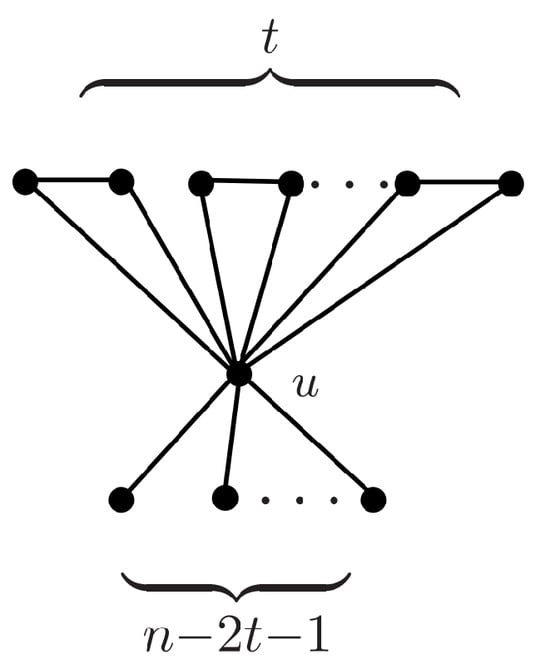
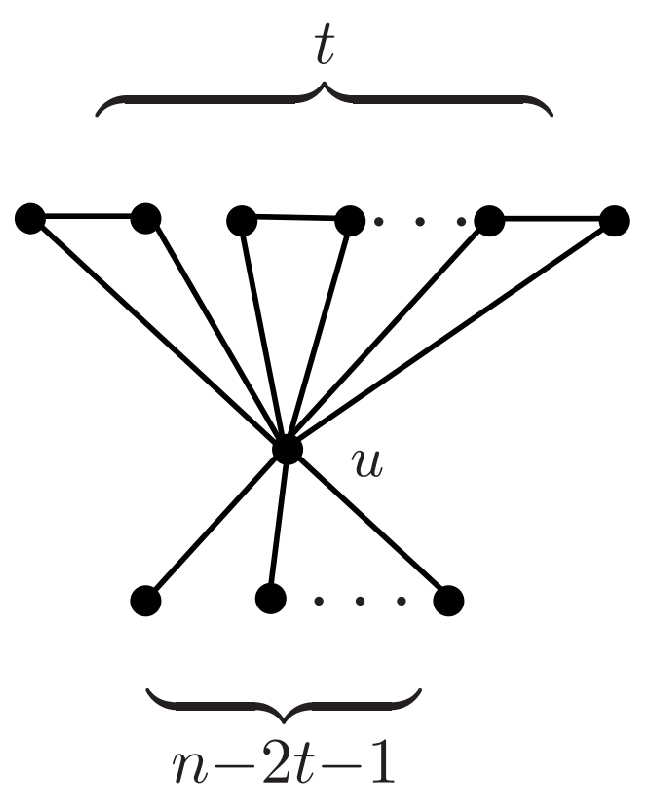
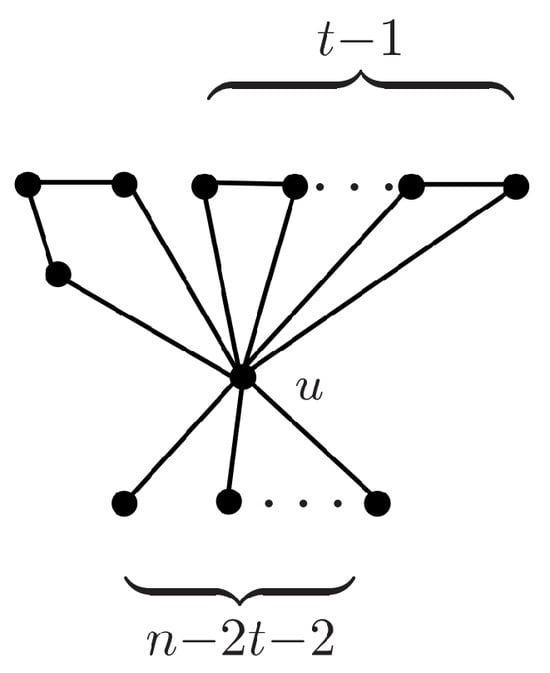
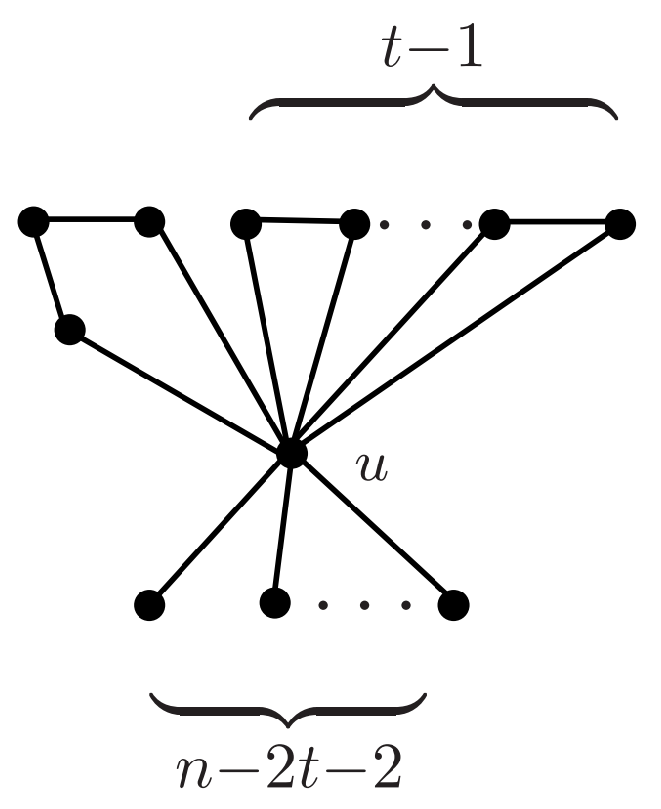
A connected graph whose every block is either an edge or a cycle is called a cactus graph, or simply a cactus. Denote by the set of all cacti with n vertices and t cycles, where . Clearly, represents the set of all trees of order n, and represents the set of all unicyclic graphs of order n. A cycle is called an end-block if it contains exactly one vertex whose degree is not equal to 2. A bundle is a cactus in which all cycles share exactly one common vertex. Let be a bundle consisting of t cycles of lengths , where pendant edges are attached to the unique common vertex of all cycles. If , define (see Figure 1).
Figure 1.
Graph .
Cacti hold significant importance in graph theory and network analysis, as they are widely employed to describe and analyze closed structures and cyclic relationships in various real-world systems. Consequently, investigating the Steiner k-Wiener index of cacti is of great value. In 2007, Liu et al. [8] gave the minimum Wiener index among graphs in . In 2021, Deng et al. [9] determined the extremal graphs with second smallest Wiener index among cacti with order n and t cycles. However, the lower bound on the Steiner k-Wiener index of n-vertex cacti with exactly t cycles remains unknown for . Therefore, in this paper, using graph transformation methods and the symmetric structure of the graph, we obtain the minimum and second minimum Steiner k-Wiener indices for cacti with order n and t cycles, and we characterize the corresponding extremal graphs.
Theorem 1.
Let , .
(a) If , then
with equality if and only if .
(b) If , then
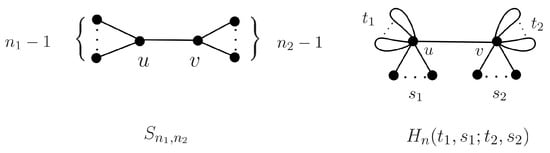
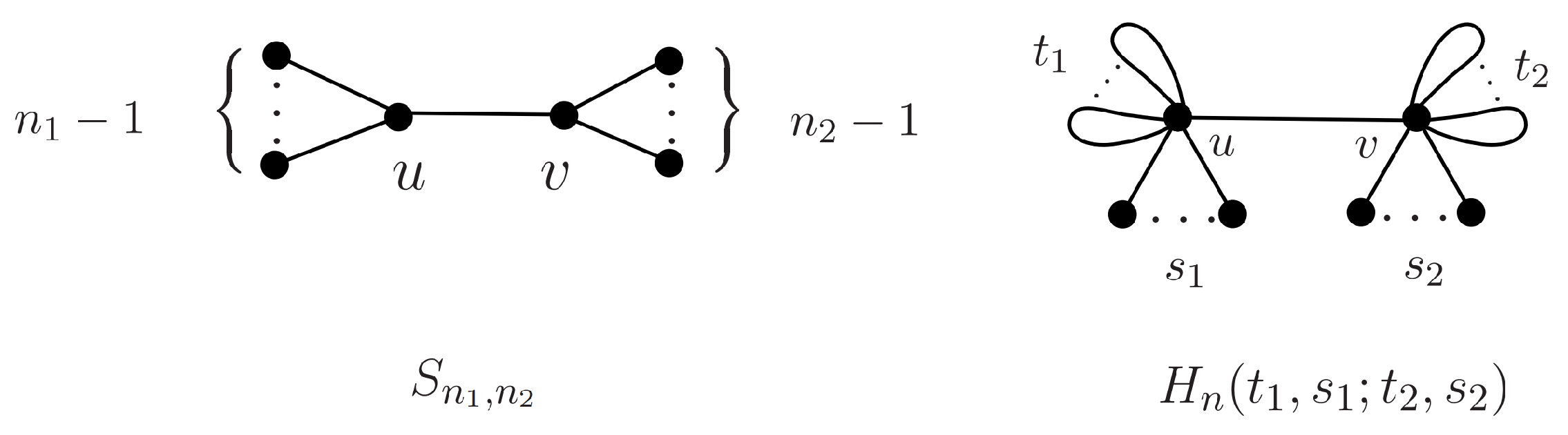
The double star (assume ) is defined as a tree in which the end u of an edge is connected to pendant edges, and the other end v is connected to pendant edges(see Figure 2). Clearly, .
Figure 2.
Graphs and .
The graph is defined as a graph in which one end u of an edge is connected to cycles and pendant edges, and the other end v is connected to cycles and pendant edges(see Figure 2). Here, , and .
Theorem 2.
Let , .
(a) If and , then
if , then
with equality if and only if ;
Figure 3.
Graph .
(b) If , then
if and , , with equality if and only if ;
if and , , with equality if and only if ;
if and ,, with equality if and only if .
2. Preliminaries
To establish the main results, we present some crucial lemmas.
Lemma 1.
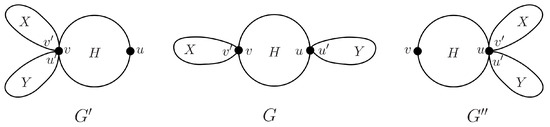
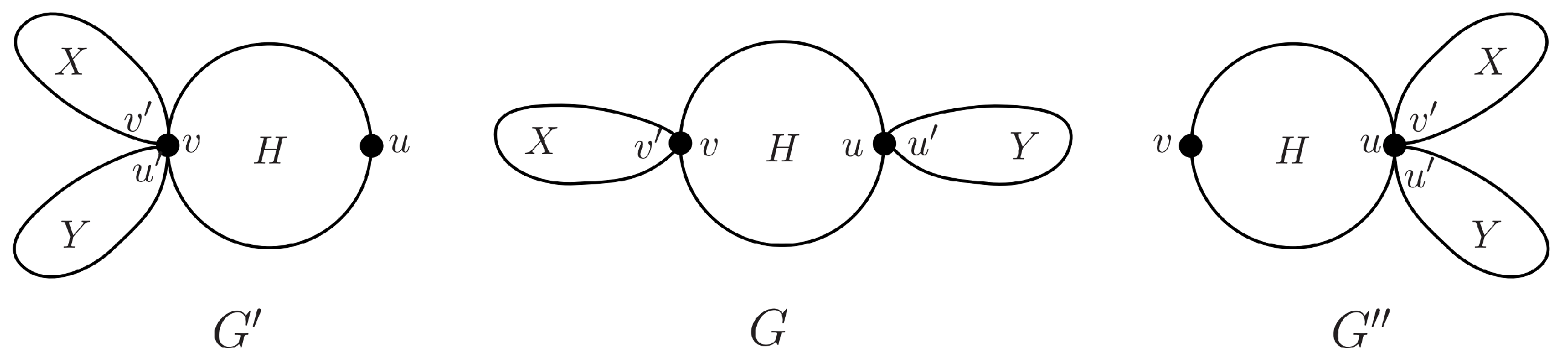
Let H, X, and Y be three pairwise disjoint connected graphs. Suppose that , , and . Let G be the graph obtained from by identifying v with and u with . Let be the graph obtained from by identifying v, , and , and let be the graph obtained from by identifying u, , and (see Figure 4). If , then
Figure 4.
The transformation used in Lemma 1.
Proof.
Let . Now we will examine the change in Steiner distance from G to .
• If or or , then .
• If , , and , then .
• If , , and , then , where .
• If , , and , then .
• If , , and , then .
Thus, we have
Similarly, we also have
If , then ; if , then . □
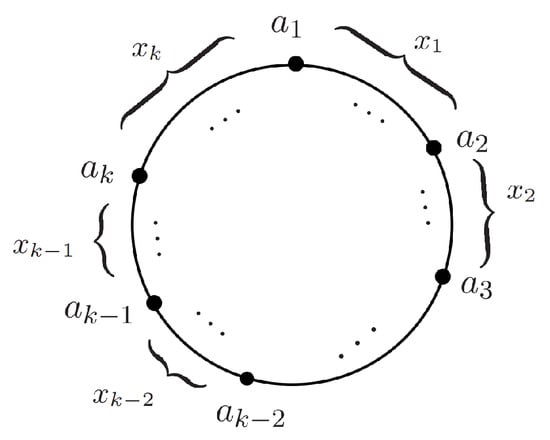
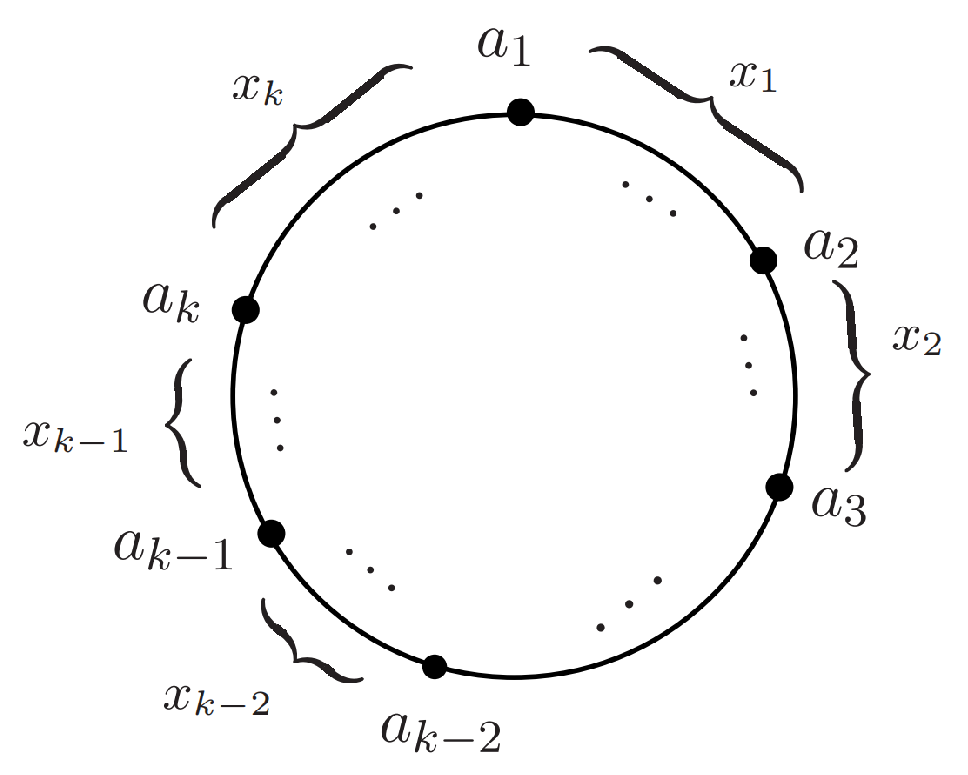
Let be a cycle of order n, with vertex set . For each k-subset , let , where the vertices are selected in a clockwise sequence from . We can associate this subset with a corresponding vector , where is the length of the path from to in the clockwise direction for , and is the length of the path from to in the clockwise direction. Obviously, . Thus, (see Figure 5). For example, consider the cycle and the subset ; it is obvious that and .
Figure 5.
Graph .
Lemma 2.
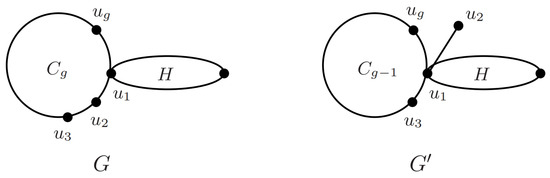
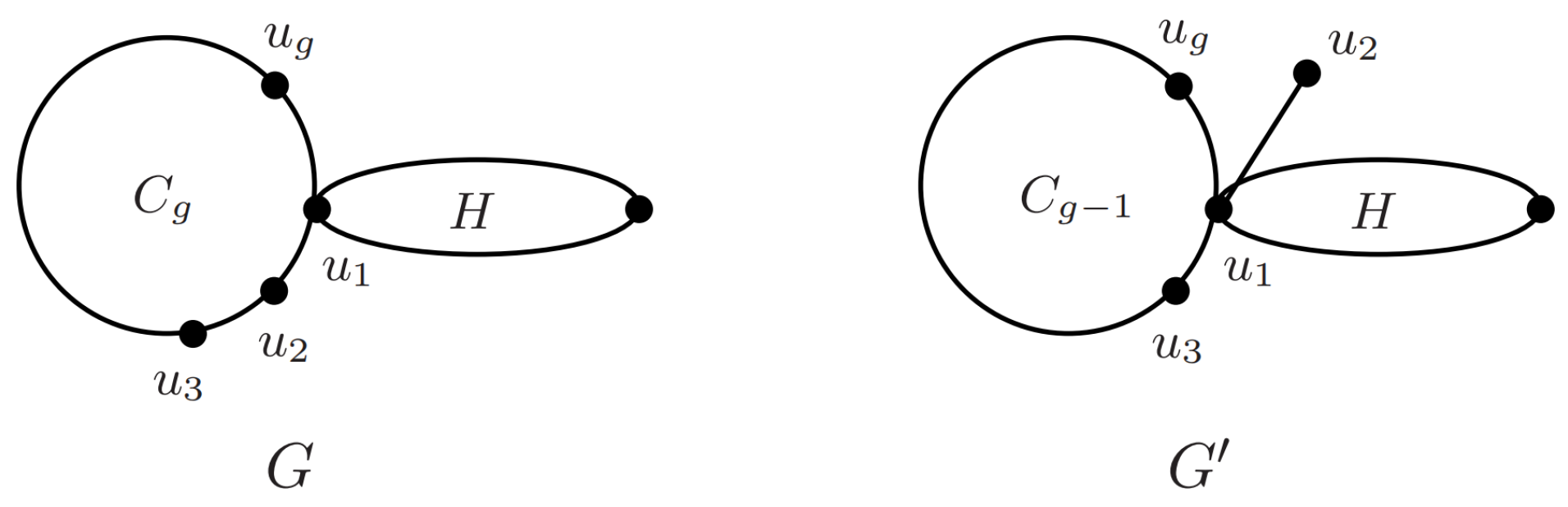
Let G be a graph of order n, which is obtained from a connected graph H and a cycle () by identifying the vertex with a vertex u of the graph H (see Figure 6). Let .
Figure 6.
The transformation used in Lemma 2.
(a) If , then ;
(b) If , then .
Proof.
Let , where and .
(a) For any subset with , where , the following cases arise:
Case 1. .
Subcase 1.1. If , it is clear that .
Subcase 1.2. If , let , where . Then , . Let the corresponding vector of in G be ; thus, the corresponding vector of in is .
• If in G, where for , then in . In this case, we obtain ; thus, .
• If in G, where for all , then in . In this case, we obtain , ; thus, .
Subcase 1.3. If and , let , where and . Then, we have and . Let , where ; then, , . Let the corresponding vector of in G be ; thus, the corresponding vector of in is . It is noted that for , and .
• If in G, then in . In this case, we obtain , ; thus, .
Case 2. .
Subcase 2.1. If , obviously, .
Subcase 2.2. If , let , where . Then, , . Let the corresponding vector of in G be ; thus, its corresponding vector in is .
• If in G, where for , then in . In this case, we obtain , ; thus, .
• If in G, where for all , then in . In this case, we obtain , ; thus, .
• If in G and there exists for such that , then in . In this case, we obtain , ; thus, .
Subcase 2.3. If and , let with , where . Then, and . Let , where ; then, , . Let the vector corresponding to in G be ; thus, its corresponding vector in is .
• If in G, where for all , then in . In this case, we obtain and ; thus, .
• If in G, where for , then in . In this case, we obtain , ; thus, .
In all cases outlined above, except for Subcases 1.2, 2.2, and 2.3, we have . Define as the set of all k-subsets S in Subcase 1.2, where . Similarly, let be the set of all k-subsets S in Subcases 2.2 and 2.3, where . To prove , now we need to demonstrate that .
If , then , implying ; now we consider . Define , where for . Each k-subset S in satisfies ; let for . Obviously, .
For each , where , let
By rotating each element in in a counterclockwise manner by i units on the cycle, we can obtain
Let the vector corresponding to be ; thus, the vector for is , where . Since , and following from Subcase 1.2, we have for all in G, and in .
When , it follows that satisfies in G, where for , and in . And because , then . According to Subcase 2.2, this implies , and hence . Define . If and , by the definition of and , then . Let , , assuming . Hence, we can get
If , it would follow that , implying , which is contradictory with for all in G; then, . Therefore, we know that .
Now we consider case . Clearly, , where . When , since , then ; consider the k-subset , where . Obviously, and ; then, the corresponding vector of is . Because , in G, and in , then according to Subcase 2.3, we can get , so .
When , since , then ; consider the situation of the parity of . If is odd, there exists a k-subset . Evidently, , and the corresponding vector of is , where . Because , in G, and in , then according to Subcase 2.2, we can get , so ; if is even, there exists a k-subset . Evidently, , and the corresponding vector of is , where . Because , in G, and in , then according to Subcase 2.2, we can get , so .
Thus, . Hence, we conclude that .
(b) For any subset with , it is evident that . Let . If , then . Similarly, if , then . Thus, we conclude that . □
Lemma 3.
Let G be a connected graph with order n, then
where p is the number of cut vertices in G.
Proof.
For any subset with , it is obvious that .
Let , , where . If , then , and its contribution to is ; if , then , and its contribution to is . Thus, we can get . □
3. Minimum Values
In this section, we attain the graph with the minimum Steiner k-Wiener index in .
Proof of Theorem 1.
According to Lemma 3, (b) is obviously true; now we prove (a). We first prove two Claims.
Claim 1.
Let with the minimum Steiner k-Wiener index; then, .
Assume that . Let and H be a component of G containing both u and v, such that and . Let and , where . Let
Apparently, , and by Lemma 1, either or , a contradiction. Therefore, .
Let u be the unique cut vertex of G. By Claim 1 and Lemma 2, we can get . Now we need to prove that is the unique graph with the minimum Steiner k-Wiener index.
Claim 2.
If , then .
For convenience, let , . And let the cycle in ; then, . Therefore, for any subset with , there are the following cases: (1) ; (2) , ,; (3) , , ; (4) , , ; (5) , , .
For , in case (2), ; in case (5), ; for all other cases, . Therefore, it follows that
Since , then .
For , in case (5), ; for all other cases, . Therefore, it follows that
Since , then .
By Claim 2, we know that is the unique graph with the minimum Steiner k-Wiener index. Now we compute the Steiner k-Wiener index of . For any subset with , if , then , and there are such subsets, contributing to . If , then , and there are such subsets, contributing to . Thus, we obtain
□
4. Second Minimum Values
In this section, we determine the graph with the smallest Steiner k-Wiener index in . If , there are three possibilities:
(1) G contains a cycle that is not a triangle.
(2) G contains a cut edge that is not a pendant edge.
(3) G contains a cycle that is not an end-block.
Lemma 4.
Let , where . If G contains a cycle that is not triangle, then
with equality if and only if .
Proof.
We first prove that for , then .
Let , , and let in ; then, . For any subset with , the following cases are considered: (1) ; (2) , , , ; (3) , , , ; (4) , , , ; (5) , , , ; (6) , , , ; (7) , , , ; (8) , , , ; (9) , , , .
For , it is clear that case (9) does not exist. In cases (2), (4), and (5), ; in case (8), ; in all other cases, . Since case (8) contains only one subset, it follows that .
For , in cases (2), (4), and (5), ; in case (9), ; in all other cases, . Since case (9) contains only one subset, it follows that .
For , in cases (2), (4), and (5), ; in all other cases, . It follows that . According to the above cases, we claim that for .
If G contains no cycle of length 4, then by Lemmas 1 and 2, we know that .
If G contains a cycle of length 4, then by Lemmas 1, 2 and Claim 2 in Theorem 1, we know that , with equality if and only if .
Now we compute the Steiner k-Wiener index of . Based on Claim 2 in Theorem 1, we know that
□
Lemma 5.
Let , where . If G contains a cut edge that is not a pendant edge, and , then
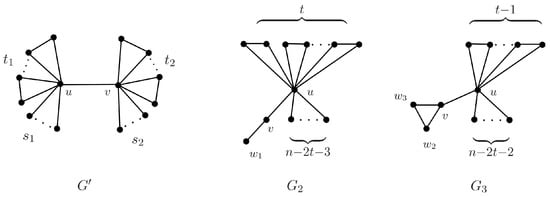
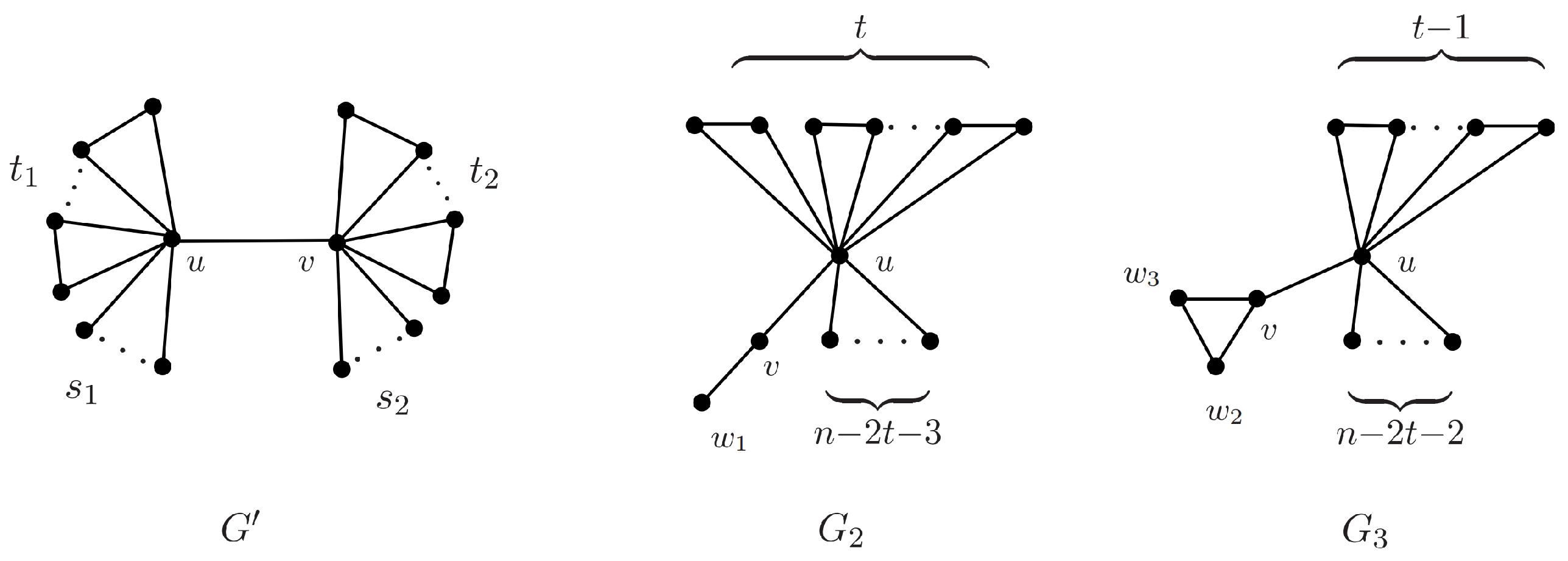
with equality if and only if (see Figure 7).
Figure 7.
, , and used in Lemma 5.
Proof.
Let be the graph in which all cut edges except for are pendant edges, and all cycles are end-blocks and triangles (see Figure 7). By Lemmas 1 and 2, it is clear that . Suppose that vertex u is attached with triangles and pendant edges, and vertex v is attached with triangles and pendant edges in , where and .
Let be the graph obtained by moving the triangles and pendant edges from vertex v to vertex u in graph , and be the graph obtained by moving the triangles and pendant edges from vertex v to vertex u in graph (see Figure 7). According to Lemma 1, it is evident that , with equality if and only if or . Next, we calculate the Steiner k-Wiener indices for and .
For any set with , several cases are as follows: (1) ; (2) , ; (3) , . In case (3), ; for other cases, . Therefore, we can derive
Thus, .
For any set with , there are the following cases: (1) , ; (2) , , ; (3) , , ; (4) , , ; (5) , , ; (6) , , ; (7) , , .
For , in cases (2), (4), and (6), ; in case (7), ; for other cases, . Therefore, we can derive
For , in cases (2), (4), and (6), ; for other cases, . Therefore, we can derive
Thus, we can get
If , since , then ; if , since , then . □
Lemma 6.
Let , where . If G contains a cycle that is not an end-block, and , then
Proof.
If G contains a cycle that is not a triangle, since G has a cycle that is not an end-block, it follows from Lemma 4 that .
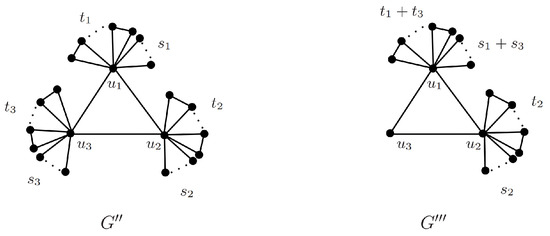
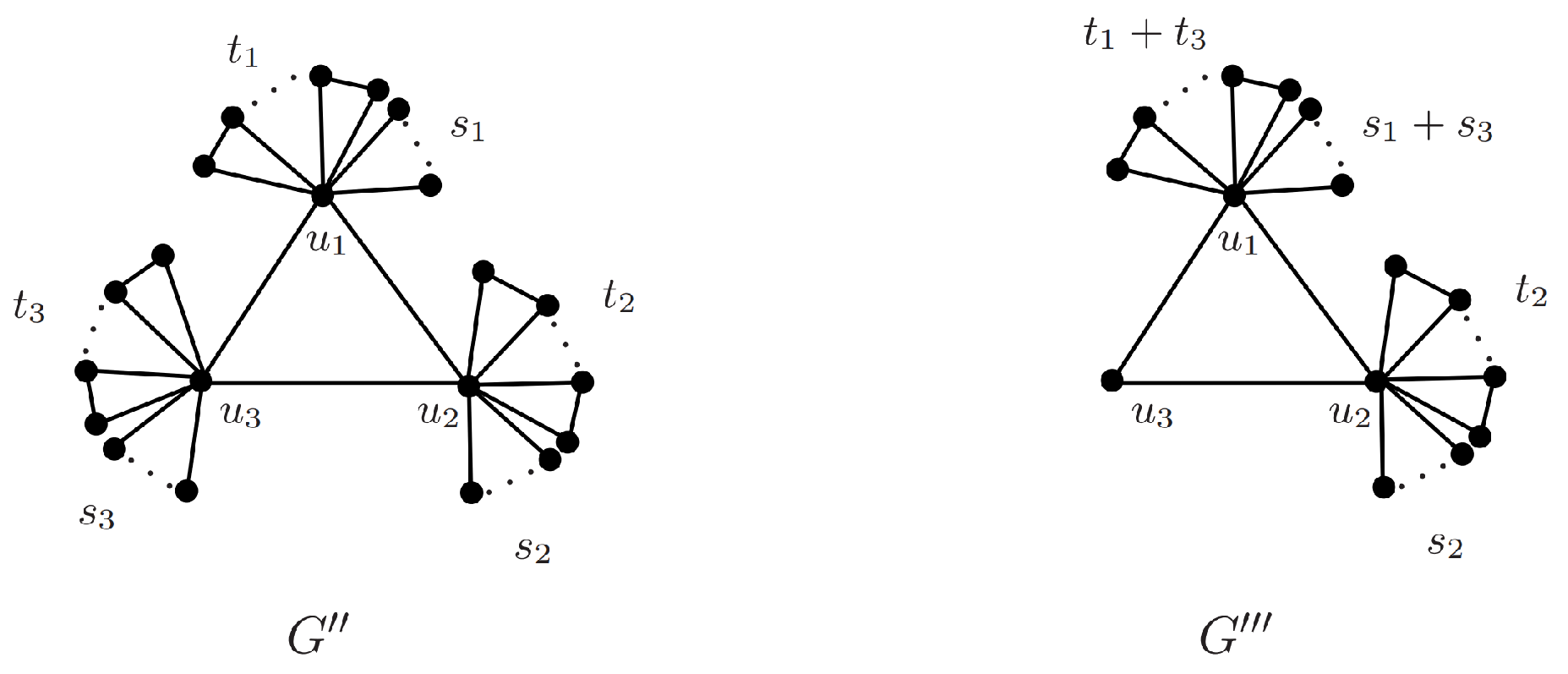
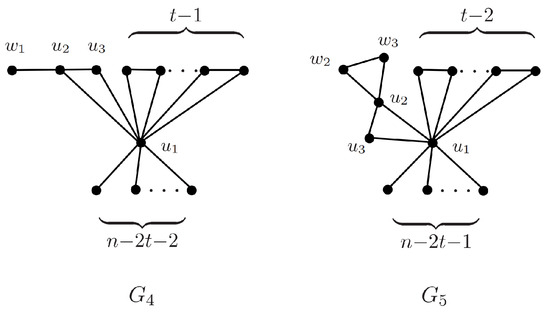
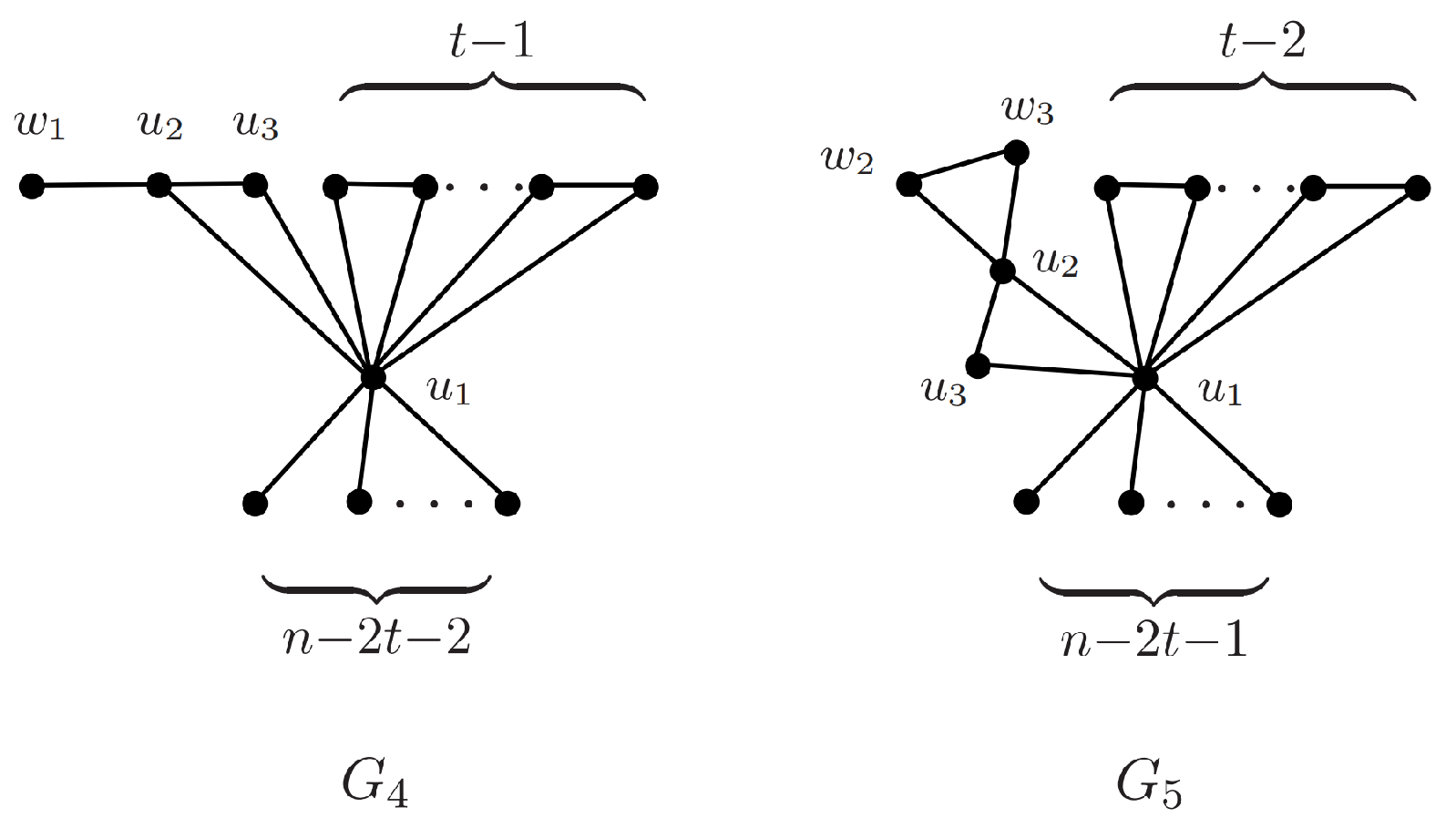
If all cycles in G are triangles, by Lemmas 1 and 2, we know that . Here, has exactly one triangle that is not an end-block, and the remaining cycles are triangles and end-blocks. Moreover, all cut edges in are pendant edges (see Figure 8). Let be the non-end-block triangle in . Suppose that is attached with triangles and pendant edges, where . Clearly, and . By moving the triangles and pendant edges from vertex to vertex in , we obtain the graph (see Figure 8). According to Lemma 1, we have , with equality if and only if .
Figure 8.
and used in Lemma 6.
Now, let be the graph obtained by moving the triangles and pendant edges from to in , and be the graph obtained by moving the triangles and pendant edges from to in (see Figure 9). By Lemma 1, we can conclude . Next we calculate the Steiner k-Wiener indices of and , respectively.
Figure 9.
and used in Lemma 6.
For any set with , there are the following cases: (1) ; (2) , , ; (3) , , ; (4) , , ; (5) , , .
For , in cases (2) and (3), ; in case (5), ; for other cases, . Accordingly, we can get
For , in cases (2) and (3), ; for other cases, . Accordingly, we can get
Thus, we know that
If , because , then ; if , because , then .
For any set with , there are the following cases: (1) , ; (2) , , , ; (3) , , , ; (4) , , , ; (5) , , , ; (6) , , , ; (7) , , , ; (8) , , , ; (9) , , , ; (10) , , , ; (11) , , , ; (12) , , , ; (13) , , , .
For , it is clear that case (13) does not exist. In cases (2), (3), (6), (7), and (10), ; in cases (5), (9), and (12), ; for other cases, . Accordingly, we can get
For , in cases (2), (3), (6), (7), (10), and (11), ; in case (13), ; for other cases, . Accordingly, we can get
For , in cases (2), (3), (6), (7), (10), and (11), ; for other cases, . Accordingly, we can get
Thus, we know that
If , since , then ; if , then ; if , since , then . In summary, it can be concluded that □
Proof of Theorem 2.
By Lemma 3, (b) is straightforward. We now turn to the proof of (a).
When , since the cases described in Lemma 4 and Lemma 6 do not arise, the conclusion follows directly from Lemma 5; when , if , since , we have . If , since , we have . Thus, . By Lemmas 4 to 6, we derive , with equality if and only if . □
5. Conclusions
In this paper, we first determine the minimum Steiner k-Wiener index of cacti and the corresponding extremal graphs by employing edge-contraction and cycle-contraction transformations. Next, we divide cacti except the extremal graph attaining the minimum value into three types and derive the minimum Steiner k-Wiener index for each type; by comparing these minimum values, we establish the second-minimum Steiner k-Wiener index of cacti together and the corresponding extremal graphs. Based on the cacti, we can consider studying the largest Steiner k-Wiener index among all cacti with order n and t cycles.
Author Contributions
Writing—original draft, C.X.; Writing—review and editing, M.L. All authors have read and agreed to the published version of the manuscript.
Funding
This work was supported by National Natural Science Foundation of China (No. 11961040).
Data Availability Statement
No new data were created or analyzed in this study. Data sharing is not applicable to this article.
Conflicts of Interest
The authors declare no conflicts of interest.
References
- Bondy, J.A.; Murty, U.S.R. Graph Theory; Springer: Berlin/Heidelberg, Germany, 2008. [Google Scholar]
- Wiener, H. Structural determination of paraffin boiling points. J. Am. Chem. Soc. 1947, 69, 17–20. [Google Scholar] [CrossRef] [Scilit] [PubMed]
- Entringer, R.C.; Jackson, D.E.; Snyder, D.A. Distance in graphs. Czechoslov. Math. J. 1976, 26, 283–296. [Google Scholar] [CrossRef] [Scilit]
- Dobrynin, A.A.; Entringer, R.; Gutman, I. Wiener index of trees: Theory and applications. Acta Appl. Math. 2001, 66, 211–249. [Google Scholar] [CrossRef] [Scilit]
- Dankelmann, P. On the Wiener index of orientations of graphs. Discret. Appl. Math. 2023, 336, 125–131. [Google Scholar] [CrossRef] [Scilit]
- Ramane, H.S.; Revankar, D.S.; Ganagi, A.B. On the Wiener index of a graph. J. Indones. Math. Soc. 2012, 57–66. [Google Scholar] [CrossRef] [Scilit]
- Spiro, S. The Wiener index of signed graphs. Appl. Math. Comput. 2022, 416, 126755. [Google Scholar] [CrossRef] [Scilit]
- Liu, H.; Lu, M. A unified approach to extremal cacti for different indices. MATCH Commun. Math. Comput. Chem. 2007, 58, 183–194. [Google Scholar]
- Deng, H.; Keerthi Vasan, G.C.; Balachandran, S. The second-minimum Wiener index of cacti with given cycles. Asian-Eur. J. Math. 2021, 14, 2150039. [Google Scholar] [CrossRef] [Scilit]
- Chartrand, G.; Oellermann, O.R.; Tian, S.L.; Zou, H.B. Steiner distance in graphs. Časopis Pro Pěstování Mat. 1989, 114, 399–410. [Google Scholar] [CrossRef] [Scilit]
- Li, X.; Mao, Y.; Gutman, I. The Steiner Wiener index of a graph. Discuss. Math. Graph Theory 2016, 36, 455–465. [Google Scholar] [CrossRef] [Scilit]
- Li, X.; Zhang, M. Results on two kinds of Steiner distance-based indices for some classes of graphs. MATCH Commun. Math. Comput. Chem. 2020, 84, 567–578. [Google Scholar]
- Lai, J.; Liu, M. The Steiner (n − 1)-Wiener index of unicyclic graphs. J. Lanzhou Jiaotong Univ. 2021, 40, 141–143+155. [Google Scholar]
- Fan, Y.; Zhao, B. On the extremal Steiner Wiener index of unicyclic graphs. MATCH Commun. Math. Comput. Chem. 2022, 88, 205–218. [Google Scholar] [CrossRef] [Scilit]
- Rasila, V.A.; Vijayakumar, A. Bounds on the Steiner-Wiener index of graphs. Discret. Math. Algorithms Appl. 2022, 14, 2250017. [Google Scholar] [CrossRef] [Scilit]
- Wang, X.; Geng, X.Y. The Steiner Wiener index of bicyclic graphs. IAENG Int. J. Appl. Math. 2025, 55, 1716–1721. [Google Scholar]
- Wang, H.; Zhang, A. Extremal problems on Steiner k-distances. Discret. Appl. Math. 2025, 365, 13–26. [Google Scholar] [CrossRef] [Scilit]
- Tang, L.D. Extremal bounds on peripherality measures. Discret. Math. Lett. 2023, 12, 201–208. [Google Scholar] [CrossRef] [Scilit]
Disclaimer/Publisher’s Note: The statements, opinions and data contained in all publications are solely those of the individual author(s) and contributor(s) and not of MDPI and/or the editor(s). MDPI and/or the editor(s) disclaim responsibility for any injury to people or property resulting from any ideas, methods, instructions or products referred to in the content. |
© 2025 by the authors. Licensee MDPI, Basel, Switzerland. This article is an open access article distributed under the terms and conditions of the Creative Commons Attribution (CC BY) license (https://creativecommons.org/licenses/by/4.0/).