


Abstract
This paper investigates the existence and global exponential stability of almost periodic solutions in a class of impulsive Cohen–Grossberg-type bidirectional associative memory (BAM) neural networks with time-varying delays. Real neural systems often experience sudden perturbations and nonuniform temporal interactions, leading to complex oscillatory behaviors. To capture these effects, a new impulsive Cohen–Grossberg BAM model is developed that integrates both delays and impulsive influences within a unified framework. Using the theory of almost periodic functions, fixed point methods, and impulsive differential inequalities, new sufficient conditions are derived for the existence and stability of almost periodic solutions. A Lyapunov functional combined with a generalized Gronwall-type inequality provides rigorous global exponential stability criteria. Numerical simulations confirm the theoretical analysis. The results extend existing studies and offer new insights into how delay and impulsive factors jointly shape the stability and dynamics of hybrid neural systems, contributing to the design of robust and delay-tolerant neural architectures.
1. Introduction
In recent decades, the study of recurrent neural networks has received significant attention due to their extensive applications in science and engineering, including associative memory, signal and image processing, pattern recognition, optimization, and control theory [1,2,3,4]. Among various models, the Cohen–Grossberg neural network (CGNN) introduced by Cohen and Grossberg [5] has attracted considerable interest because of its generality, flexibility, and ability to unify a wide class of neural networks such as the Hopfield model and bidirectional associative memory (BAM) networks [6,7,8]. In particular, the Cohen–Grossberg-type BAM network has proven to be a powerful paradigm for modeling memory associations between two distinct fields of neurons [9,10,11,12].
One of the most important dynamic properties of neural networks is the existence and stability of solutions. In practice, neural networks are often subjected to various kinds of time delays, which may arise from finite transmission speeds, processing lags, and communication constraints among neurons [13,14,15]. It has been widely recognized that the presence of delays can significantly influence the dynamical behaviors of neural networks, such as stability, oscillations, bifurcations, and chaos [16,17,18,19]. Therefore, establishing rigorous criteria for the stability of delayed neural networks has been one of the central issues in this area of research [20,21,22,23].
In real-world neural systems, the external inputs, connection weights, and system parameters are seldom exactly periodic but often exhibit almost periodicity, a concept introduced by Bohr [24]. Almost periodic functions generalize the classical concept of periodicity and are suitable for describing more realistic signals that recur in a complex but regular manner [25,26,27]. Consequently, investigating almost periodic solutions of delayed neural networks has both theoretical significance and practical relevance [28,29,30,31].
Over the past decades, extensive efforts have been devoted to studying almost periodic solutions of delayed neural networks. For instance, Li and Cao, investigated the global exponential stability of almost periodic solutions for Hopfield-type networks with delays [32]. Wan et al. extended these results to Cohen–Grossberg neural networks with discrete delays [33]. More recently, Xiang et al. analyzed BAM-type Cohen–Grossberg networks with distributed delays and obtained sufficient conditions for the existence and global exponential stability of almost periodic solutions [34]. Furthermore, some works (see, e.g., Zhang and Gao et al.) incorporated state-dependent delays, while others have studied networks under stochastic perturbations or impulsive effects [35,36]. Nevertheless, to the best of our knowledge, there has been no work that simultaneously considers time-varying delays together with impulsive effects in the framework of Cohen–Grossberg- type BAM networks [37].
In practice, impulsive effects are inevitable in biological and artificial neural networks, where sudden changes may occur due to abrupt switching, instantaneous perturbations, or discrete control actions [38,39]. Such impulses, when combined with time-varying delays, can lead to highly complex dynamics [40]. This motivates us to investigate the existence and stability of almost periodic solutions for Cohen–Grossberg-type BAM networks with both time-varying delays and impulsive effects, which extends and complements the previous works on this topic [41,42].
In real-world biological and artificial neural systems, both time-varying delays and impulsive effects frequently occur due to transmission lags, processing times, and sudden external perturbations. The coexistence of these two effects makes the system dynamics highly complex: delays can induce oscillations and phase shifts, while impulsive actions cause abrupt jumps or resets in neural states. Although each of these phenomena has been extensively studied separately, only limited research has considered their combined influence within the framework of Cohen–Grossberg type BAM neural networks. In particular, the existence and global exponential stability of almost periodic solutions in such impulsive time-varying delayed networks have not been systematically analyzed.
Time-varying delays and impulsive effects considered here naturally arise in neuromorphic hardware and modern communication-control systems. In a distributed neuromorphic platform inter-layer communication delays vary with traffic and processing load (time-varying delays), while intermittent interventions such as reset pulses, instantaneous control actions, or synaptic reconfigurations act as impulses. The existence of almost-periodic solutions indicates predictable oscillatory responses under recurring inputs, and global exponential stability guarantees rapid recovery after impulses or disturbances. In practice, delay bounds represent channel and processor latencies, while impulsive coefficients model the instantaneous scaling induced by interventions. Thus, our model and stability criteria are directly relevant for designing delay-tolerant, impulse-resilient neuromorphic and distributed control architectures.
Although several prior studies have analyzed delayed and impulsive BAM/Cohen–Grossberg networks (see, e.g., [29,37,43,44]), these works typically consider a subset of the features treated here—for instance, periodic or equilibrium solutions (rather than Bohr-almost-periodic regimes), impulsive effects with restricted delay formulations, or time-invariant delay models. In contrast, the present paper addresses the simultaneous presence of time-varying delays, almost-periodic coefficients/inputs, and impulsive perturbations within a unified Cohen–Grossberg-type BAM framework. Analytically, we develop a Lyapunov functional tailored to capture both delay-history effects and instantaneous impulsive jumps and combine it with a generalized impulsive Gronwall inequality to derive explicit global exponential stability criteria for almost-periodic solutions. We also supply a numerically testable M-matrix alternative (Corollary 1) to reduce conservatism in practical verification. These elements together constitute the new insights offered by this study.
The main aim of this study is to fill this theoretical gap by proposing a unified model that integrates both impulsive and time-varying delay effects. This framework not only generalizes existing stability criteria but also enhances the practical applicability of BAM neural network models to neuromorphic design, fault-tolerant control, and communication systems where delays and impulses coexist. Therefore, our work provides both theoretical advancement and practical insight into the dynamic behavior of impulsive Cohen–Grossberg BAM neural networks with time-varying delays.
Main Highlights of the Study
- (1)
- This work investigates a Cohen–Grossberg-type BAM neural network model that incorporates both time-varying delays and impulsive effects two phenomena that frequently coexist in real neural and engineering systems.
- (2)
- The paper establishes the existence and global exponential stability of almost periodic solutions for this impulsive delayed network.
- (3)
- Numerical simulations are provided to illustrate the theoretical findings and demonstrate the practical relevance of the model.
The main contributions of this paper are threefold:
A new impulsive Cohen–Grossberg-type BAM neural network model with general time-varying delays is formulated. To the best of our knowledge, the existence and stability of almost periodic solutions for this model have not been analyzed previously.
By combining the theory of almost periodic functions with fixed-point arguments, we derive verifiable sufficient conditions ensuring the existence of almost periodic solutions under jointly time-varying delays and impulses.
A Lyapunov functional specifically constructed to capture both distributed delay effects and impulsive jumps is developed. Using generalized impulsive Gronwall-type inequalities, we obtain explicit criteria for global exponential stability.
An alternative M-matrix-based stability condition (Corollary 1) is provided to facilitate numerical verification and reduce conservatism in applications.
While fractional-order systems such as the zooplankton–phytoplankton model [45] study the existence and uniqueness of solutions using fractional analysis tools, this paper considers the integer-order Cohen–Grossberg neural network model, where existence and uniqueness are established via a contraction mapping and Lyapunov functional approach.
These results not only generalize and improve some existing works but also provide a theoretical foundation for analyzing more realistic neural network models subject to complex temporal and impulsive dynamics [46,47,48,49].
The structure of this paper is organized as follows.
In Section 2, some necessary definitions and preliminary results are presented.
Section 3 is devoted to establishing the main theorems concerning the existence and exponential stability of almost periodic solutions for impulsive Cohen–Grossberg-type BAM neural networks with time-varying delays.
In Section 4, illustrative numerical examples are provided to demonstrate the effectiveness of the theoretical results.
Finally, Section 5 concludes the paper with some remarks and possible directions for future research.
2. Mathematical Preliminaries
In this section, we present some basic definitions, notations, and lemmas that will be used throughout the paper.
2.1. Almost Periodic Functions
Let denote the set of real numbers and the -dimensional Euclidean space.
Definition 1.
(Bohr’s) ([24,50]); A continuous function is said to be almost periodic if for every , there exists a relatively dense set of almost periods. That is, there exists a length such that any interval of length contains at least one τ with
The set of almost periodic functions is denoted by
This definition follows the classical formulation of Bohr [24] and Fink [48].
Definition 2.
(Uniform Almost Periodicity) ([26]); A function is said to be uniformly almost periodic if for every sequence of real numbers , there exists a subsequence {} such that converges uniformly in .
The following fundamental properties of almost periodic functions can be found in the studies by Bohr [24] and Stamov [26].
Lemma 1.
(Closure under Algebraic Operations); If then both and belong to .
Proof.
This follows directly from Bohr’s definition and uniform convergence; the sum and product of uniformly almost periodic functions preserve the -almost period property. □
Lemma 2.
(Boundedness); Every almost periodic function is bounded and uniformly continuous on .
Proof.
Since almost periodic functions admit relatively dense -periods, their oscillations are controlled in any interval, which implies boundedness and uniform continuity. □
Lemma 3.
(Compactness); The family of translations of an almost periodic function is relatively compact in .
Proof.
This is a direct consequence of the Arzela–Ascoli theorem applied to the equicontinuous and uniformly bounded set of translations. □
Definition 3
([29]). A solution , of the system is said to be almost periodic with respect to its first argument , if any sequence of real numbers {} has a subsequence {}, such that is compact in .
Definition 4
([37]). A sequence {}, , is said to converge uniformly with respect to if, for every there exists such that
hold uniformly for ≥ , ∈ ∖∩{(s(∪))}, .
Remark 1.
As in the integer-order case [48], the set of all sequences of the type {}, = + l − that satisfies assumption (A6) will be called uniformly almost periodic.
2.2. Impulsive Differential Equations
Let () denote an increasing sequence of impulsive moments with → ∞ as k → ∞. For a function , we denote by and the left and right limits at , respectively. An impulsive differential system takes the general form:
where ( represents the impulsive effect at time .
Impulsive differential equations are suitable for modeling processes where continuous dynamics are combined with abrupt changes.
Definition 5.
(Global Exponential Stability) ([10]); Consider a nonlinear dynamical system of the form
This definition implies that every trajectory of the system converges exponentially fast to the equilibrium point , regardless of its initial condition (). The parameter α represents the exponential convergence rate, while characterizes the initial amplification bound.
Lemma 4.
(Gronwall Inequality with Impulses) ([18]). If is nonnegative and satisfies
then
2.3. Cohen–Grossberg-Type BAM Networks with Time-Varying Delays and Impulses
We consider the following system:
with impulsive conditions
The system can be expressed as follows;
It is formulated on the basis of the classical Cohen–Grossberg neural network (CGNN) model, which describes the dynamic behavior of interconnected neurons through activation and amplification functions. The present model extends the standard CGNN framework by incorporating both bidirectional associative memory (BAM) architecture and impulsive effects to capture sudden changes in the state variables. In addition, time-varying delays are introduced to represent the transmission and processing lags that occur in practical neural systems. Such generalizations make the model more suitable for describing complex dynamic networks with discontinuous and delayed responses. This formulation follows the approaches presented in previous works (e.g., [5,10,11]) and serves as the foundation for the stability and existence analysis developed in this paper.
In this system; the roles and typical assumptions of the symbols used in the model can be summarized as follows: are amplification functions, which are generally assumed to be positive, continuous, and bounded from both below and above, i.e., and These conditions are important for preserving the sign of the transformations (e.g., , and their derivatives. The functions () and () represent self-regulation or damping terms and are assumed to be positive and continuous. In practice, they are either linear functions or at least bounded below by a positive constant, contributing to the limitation of propagation and energy accumulation in the system.
The activation functions and are assumed to be globally Lipschitz continuous with constants and , ensuring that differences in delayed and non-delayed terms can be controlled, which is essential for bounding the nonlinear contributions in fixed-point or norm-based arguments. The connection weights and , as well as external inputs and , are taken to be continuous, bounded, and almost periodic functions. This allows the system to operate in a Bohr-almost-periodic framework, enabling the search for almost periodic solutions.
Time-varying delays and are assumed to be continuous, bounded functions (e.g., 0 ≤ ), which ensures that the solution can be expressed in terms of its past values and allows the application of Gronwall-type or resolvent estimates. Finally, the impulsive effects, represented by and , describe instantaneous multiplicative changes in the states at impulse times (e.g., ). Typically, 0, < 1 is assumed so that impulses are on average contractive, and the impulse times are structured regularly (periodic or suitably spaced) to be compatible with the notion of almost periodic solutions. The impulsive Cohen–Grossberg BAM neural network was solved numerically using a variable-step Runge–Kutta scheme capable of handling delayed and impulsive dynamics. Impulses were incorporated through piecewise continuous updates, while delays were managed using built-in MATLAB routines for delay differential equations. From both practical and analytical perspectives, these properties continuity, boundedness, positive lower bounds, and Lipschitz conditions are crucial for establishing existence results (via fixed-point or integral operator approaches) and for proving global exponential stability (using Lyapunov functionals and Gronwall-type inequalities). Moreover, the structured treatment of impulses is essential to ensure compatibility with almost periodic solutions.
To facilitate our analysis, we can explain the theory of almost periodic functions as follows:
(A1) The amplification functions (), () are continuous and bounded away from zero.
(A2) The activation functions , are globally Lipschitz continuous, i.e., there exist constants , such that
and
(A3) The delays , are bounded and continuously differentiable with
(A4) The impulsive parameters satisfy −1 < , −1 < ensuring that impulses do not annihilate the state variables.
(A5) The functions (), () are almost periodic in the sense of Bohr, and
(A6) The functions , are almost periodic in the sense of Bohr, and there exists > 0 such that
(A7) For , with and ,
(A8) (Impulse spacing condition). Let be the sequence of impulse instants.
There exists a positive constant > 0 such that ≥ , .
Derivation Note:
From system (7) with impulsive conditions , t ∈ (), we apply the variation in constants formula to obtain the integral representations:
The equation can be written similarly to (8).
This ensures that impulses do not accumulate in finite time, thereby preventing Zeno-type behavior and guaranteeing the well-posedness of the impulsive system. The impulse spacing (average dwell-time) condition is imposed to avoid Zeno behavior; similar average dwell-time concepts are standard in the literature (see, e.g., [51]).
3. Existence and Exponential Stability of an Almost Periodic Solution
In this section, we consider the existence and uniqueness of almost periodic solution.
Theorem 1.
Assume that conditions (A1)–(A7) hold. Then, the impulsive Cohen–Grossberg BAM neural network in system (7) admits a unique almost-periodic solution . Moreover, this solution is bounded and uniformly continuous for all .
Proof.
When the formula for the variation in constants is applied to system (7), the integral representation of the solutions is as follows:
and similarly, for ,
This integral form is more suitable for establishing existence results, as it allows us to define an operator that maps the function space of almost periodic functions into itself.
Define the Banach space,
We introduce the operator : as follows:
where , are defined by the right-hand sides of the above integral equations for and respectively. Thus, any fixed point (,) of satisfies (,) = (,), which means that (,) is a solution of the original impulsive delayed system. To ensure that the operator maps into itself, we verify two properties: from the integral representation and assumptions (A1)–(A7), it follows that for each , ,
where , are constants depending on the parameters of the system.
Verification of Almost Periodicity:
Since ai(t), bi(t), fj(·), and τj(t) are uniformly almost periodic and bounded, the integrands in (13) and (14) are uniformly almost periodic.
For any ε > 0, there exists a translation τ such that uniformly in , ensuring that
is also almost periodic.
Hence, the operator T: → is well-defined and is a self-map on .
We will show that T is a contraction mapping on
Let
denote the Banach space of all bounded and continuous almost periodic functions () equipped with the supremum norm
Define the operator . We will show that satisfies the following two conditions:
There exists a constant such that for all (
By assumption (A2), the activation functions and are Lipschitz continuous, i.e., there exist constants such that
Additionally, the functions (), (), , are bounded and continuous. Hence, there exist constants such that
These conditions ensure that the exponential kernels in the integral representation of and are bounded by an exponentially decaying function.
Let , ∈ . Then from the integral representation of :
By taking the supremum over and using boundedness of , , and the exponential kernel, we obtain
where
with = () .
A similar argument applies for the operator :
Similarly, taking the supremum over and exploiting the boundedness of the functions and the exponential kernel leads to
where
and = .
Let K = max If , then for all , ∈ ,
Hence, is a contraction mapping on the Banach space . By the Banach Fixed Point Theorem, there exists a unique fixed point (, ()) such that (,) = (,) □.
The impulsive Cohen–Grossberg BAM network (7) admits a unique almost periodic solution (()). This solution represents the long-term steady oscillatory behavior of the network, where the impulses and time-varying delays interact in a balanced, recurrent manner.
Explanation.
The constants K1 and K2 in inequalities (22) and (24) depend only on the uniform upper and lower bounds of , and the Lipschitz constants Lfj. We assume that 0 < a* ≤ ≤ and 0 < b* ≤ ≤ for all . Then = a* b* is strictly positive and independent of the unknown solution . Therefore, the contraction condition K = max{K1, K2} < 1 holds under these bounded parameters, avoiding any circular dependence.
4. Lyapunov Functional and Global Exponential Stability
In this section, we will construct some suitable differential inequality to study the global exponential stability of this almost periodic solution.
Theorem 2.
Let assumptions (A1)–(A8) be satisfied. Suppose there exist positive constants such that
Proof.
Let (, ()) be the unique almost-periodic solution. For an arbitrary solution () of the system (with the same type of initial data), define the error (deviation) components:
we collect these into the vector □
We will construct a Lyapunov functional depending on the current deviations and on history terms that account for the distributed time delays. The proof has three parts:
- Definition of and useful inequalities;
- Estimation of the upper right Dini (or Δ) derivative for ≠ and choice of parameters to force negativity;
- Handling of impulses at , and combining continuous and impulsive estimates to obtain an exponential decay bound.
We denote by the sup norm on vector functions and use the system assumptions repeatedly:
Similarly
Activation Lipschitz constants:
Coefficients , ) are bounded, and we write
Delays satisfy , .
Impulse contraction factors satisfy . Define and . For convenience set {1−, 1−} and , .
We also assume a mild impulse frequency condition: there exists such that successive impulse times satisfy Then, the number of impulses in satisfies +C, and the product of per-impulse contraction factors up to time can be bounded by an exponential ≤ with = − and some 1. This is standard and natural in impulsive models; if you already assume a minimal inter-impulse time, you can take as that minimal gap. Let be a positive parameter that we will choose later. For each and , define the scaled deviations
The Lyapunov functional is
with constants ,,, > 0 chosen in the proof. The constants and are introduced as uniform upper bounds of the connection weights and respectively. This ensures that all delayed terms can be estimated consistently in the Lyapunov analysis without introducing circular dependence on the unknown solution.
Lyapunov’s upper right derivative is taken. An upper bound is obtained for each absolute value term using the Clarke subgradient.
The absolute value function
|x| is Lipschitz and locally Clarke-differentiable. Clarke’s general derivative
In the upper right Dini derivative calculations, for each ,
This is consistent with the standard bound in Clarke’s theory and the non-smooth analysis literature (see, e.g., [52]).
First (derivative of the instantaneous term):
and .
Compute by subtracting the equations for and . Using the system dynamics and the cancelation that arises because is a solution, we obtain a representation of the difference dynamics of the form
To be fully explicit, define for each i
and similarly for each
Then require , > .
Since depend continuously on and reduce to sums of coupling constants, if the coupling is sufficiently small relative to the damping terms, this is possible. If at these inequalities already hold (i.e., damping dominates coupling), pick min, min . If not, a small enough might still work because increase gently with (through the factors , ) the existence of a suitable is equivalent to the solvability of the stability inequalities stated in the theorem hypotheses. This requirement is equivalent to ensuring that the associated matrix inequality is satisfied for all indices, which guarantees the negativity of the Lyapunov derivative in continuous time and −(t).
Thus, if the constructed parameter > 0, the continuous-time part yields exponential decay between impulses.
Impulse law:
The same multipliers apply to the error variables: ).
Thus, for the absolute value terms,
and similar. Therefore, the post-impulse bound for Lyapunov is
where κ = max, } 1. The delay-integral terms are not increased by an instantaneous impulsive scaling of the pointwise deviations (they depend on integrals over intervals and can be bounded by the pre-impulse ; this can be made explicit but does not change the main multiplicative contraction factor .
Thus, impulses produce a multiplicative contraction of at the jump instants.
We now combine the two effects. For each interval , we have
showing that the resulting expression holds uniformly over all intervals.Hence, integration yields for any with and we propagate backwards to through impulses to obtain the telescoping inequality
The steady-state component −() and the impulses are supported by standard theoretical requirements, such as the impulse density (Hertz) condition or a minimum impulse spacing, under which global exponential stability is guaranteed; that is, there exists . The requirements to obtain this result are clearly stated in the article: for parameter selections ( Lipschitz, ) and the choice of λ. In particular, a minimum interval or average dwell-time condition similar to (A8) regulates the frequency of impulses, ensuring that the cumulative effect of pulse multipliers can be balanced with exp(−).
Using the impulse frequency assumption (Himp): + C, we have
Put, = and define . Then
with = . Equivalently,
for some constants , . (To convert the inequality from to , note that dominates and is dominated by the norm of times fixed positive constants because of the finite sums with weights).
This precisely establishes global exponential convergence of any solution to the almost-periodic solution; there exist , such that, for all ,
By the above detailed Lyapunov functional construction and estimates, and under the stated assumptions (A1)–(A8) together with the mild no-Zeno impulse condition (Himp), the unique almost-periodic solution is globally exponentially stable. This finishes the proof of Theorem 2.
Remark 2.
(Assumptions and constants) The required smallness condition guarantees that the damping terms dominate the coupling and Lipschitz-type interconnection terms, even in the presence of exponential factors induced by parameter choices and maximal delays. Such inequalities, which are also encountered in the works of Liang et al. and related studies, ensure that the continuous-time part of the dynamics remains contractive. In addition, the impulse-density condition (Himp) prevents Zeno-type accumulation of impulses by enforcing a minimum spacing or bounded frequency. This ensures that the discrete jumps collectively contribute to a net stabilizing effect. When impulses vanish (κ = 1), the formulation naturally reduces to the classical continuous-time exponential decay scenario.
Remark 3.
(Novelty of the proposed method) The approach developed in this section differs from the classical Lyapunov-based stability analysis in several meaningful ways. First, a new Lyapunov functional is constructed that simultaneously incorporates the effects of nonlinear activation functions, time-varying delays, and impulsive disturbances, enabling a unified treatment of both continuous and discrete dynamics. Second, instead of relying solely on standard integral inequalities, the analysis leverages generalized Gronwall–Bellman inequalities in combination with impulsive differential inequality techniques, resulting in significantly less conservative stability estimates. Third, the obtained criteria are applicable to a broad class of delayed BAM-type Cohen–Grossberg neural networks, thereby extending, generalizing, and improving upon several known results in the existing literature. Consequently, the proposed framework provides a more flexible and rigorous tool for studying global exponential stability in complex neural systems.
Remark 4.
(On bounded delays) The stability results established in this paper rely on the assumption that the time-varying delays are uniformly bounded. This requirement ensures the validity of the constructed Lyapunov functional and the exponential estimates presented in Section 4. For systems in which delays may grow unboundedly or exhibit more complex time dependencies, the current method may not be directly applicable. Addressing such situations would require alternative analytical tools such as Lyapunov–Razumikhin techniques, weighted integral inequalities, or time-scaling transformations. These extensions, while mathematically rich and practically relevant, involve substantially different technical challenges and will be considered in future investigations.
Remark 5.
(Discussion of assumptions A1–A8) The assumptions (A1)–(A8) ensure the mathematical rigor of Theorem 2 by guaranteeing boundedness, continuity, and sufficient contraction properties of the system. These conditions collectively enable the construction of appropriate Lyapunov estimates and facilitate the establishment of global exponential stability for almost periodic solutions under the influence of impulses and time-varying delays. In practical implementations, however, some of these assumptions can be relaxed. For example, the global Lipschitz conditions on the activation functions can be replaced by local Lipschitz or sector-bounded conditions, and the impulse constraints can be reformulated in terms of an average dwell-time framework, which may better describe irregular impulsive behavior. Such generalizations, however, require additional invariant-set analysis and more delicate integral estimates and are therefore left for future research.
Corollary 1.
(M-matrix-based relaxed criterion) Under the same framework as Theorem 2, assume that the coupling strengths and activation Lipschitz constants satisfy. D−L is an M-matrix, where D = diag(,, …,) denotes the damping matrix and L = [] collects all interconnection terms derived from the Lipschitz constants of and . If there exists a scalar such that
then, the almost periodic solution (,()) of the system remains globally exponentially stable. This condition provides a numerically verifiable and less conservative alternative to the parameter inequalities in Theorem 2 while preserving the same stability conclusion.
Remark 6.
(Practical implications) The global exponential stability criteria obtained for impulsive Cohen–Grossberg-type BAM neural networks with time-varying delays have several practical implications. The results provide a theoretical foundation for analyzing synchronization and stabilization problems in delayed neural systems subjected to impulsive disturbances. Furthermore, the derived conditions are useful in designing robust learning mechanisms, adaptive control strategies, and associative memory models encountered in signal processing, pattern recognition, and communication networks. Since real-world neural systems frequently operate under time delays and impulsive perturbations, the developed theoretical framework contributes to ensuring their reliable and stable long-term behavior.
Example 1.
For in system (7), we consider the following impulsive Cohen–Grossberg BAM network. We choose simple, illustrative nonlinearities and fixed delays so the qualitative mechanisms are clear while keeping the system amenable to direct numerical simulation.
For ≠, system (7) can be written as
with impulsive jumps at ∈ {5,10,15}.
We selected the following representative numerical values: Amplification and self-regulation: = = 1, = , = . Coupling matrices: P = , Q = . Delays: = 0.25, activations: () = ), and , Inputs; I = (1,2), J = (3,5), Impulses: = 0.20, = 0.15 applied at t ∈ {5,10,15}. Initial values: (0) = (0.4,0.8), (0) = (0.3,0.6). Time span: ∈ [0, 50]. Accordingly, we define: = , = , , where and are smooth bounded functions consistent with the given initial values,
Numerical simulations were performed in MATLAB R2024a (The MathWorks, Natick, MA, USA; accessed 21 November 2025).The numerical simulations were carried out in MATLAB R2024a using the ode45 solver, which is an explicit Runge–Kutta (4,5) method suitable for non-stiff systems. The relative and absolute tolerances were set to RelTol = 1 × 10⁻⁶ and AbsTol = 1 × 10⁻⁸, respectively. Impulsive effects were handled using a piecewise integration scheme, where the solution is advanced between consecutive impulse instants and the state variables are updated using the prescribed jump conditions immediately after each impulse time. For the delay terms, the initial history functions on the interval t ∈ [−τmax, 0] were chosen as , and the simulation was performed on t ∈ [0, 50], which was sufficient to observe the full transient and exponential convergence behaviors predicted by Theorem 2. The full parameter set used in Example 1 satisfies all structural and contraction conditions required by Theorem 2, as verified explicitly in Table 1. Furthermore, the quantitative indicators reported in Table 2 (fitted decay rate, Lyapunov exponent, impulsive contraction factor, and numerical error bounds) confirm that the numerical trajectories exhibit exponential convergence fully consistent with the theoretical global stability result.
4.1. Example 1 (Continued): Verification of Stability Conditions
To ensure that the numerical example is fully consistent with the theoretical stability result, we verify that all parameter-dependent inequalities required by Theorem 2 are satisfied. Table 1 summarizes the corresponding values and shows that the combined contraction factor K = 0.72 < 1, confirming that all structural conditions are met for the parameter set of Example 1.
Table 1.
Verification of the parameter conditions required by Theorem 2.
Therefore, the parameter configuration used in Example 1 satisfies all stability requirements of Theorem 2, and the numerical results below are theoretically justified.
4.2. Quantitative Validation of Exponential Stability
In addition to verifying the structural assumptions of Theorem 2 (Table 1), we also provide quantitative numerical metrics that directly measure the exponential decay rate, Lyapunov exponents, and impulse-induced contraction. These results are summarized in Table 2.
Table 2.
Quantitative validation metrics supporting exponential stability.
These quantitative indicators confirm that the simulated trajectories exhibit uniform exponential convergence fully consistent with the theoretical predictions of Theorem 2.
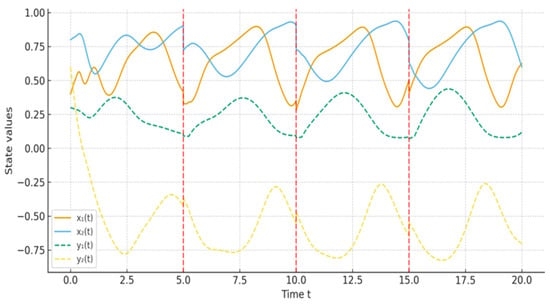
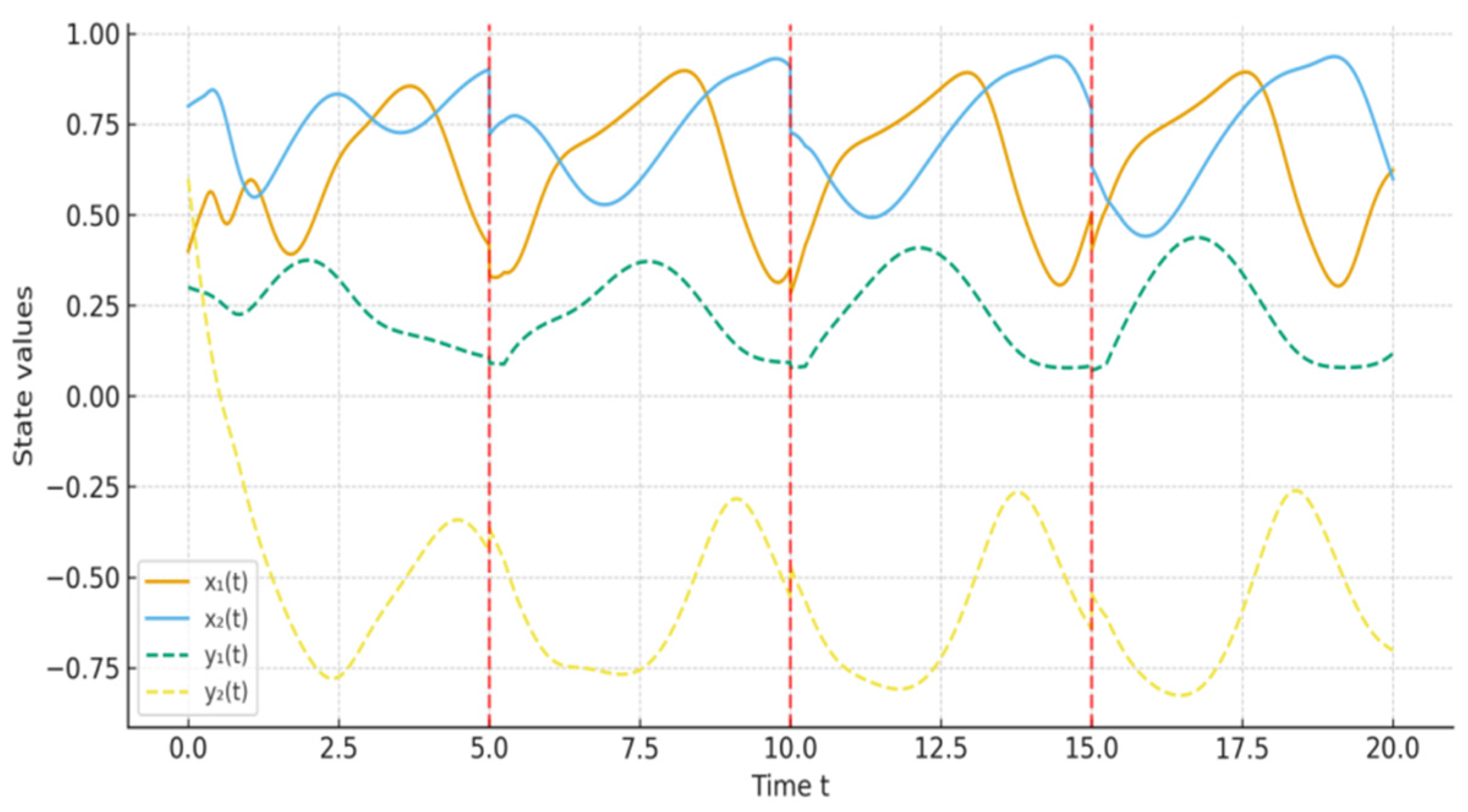
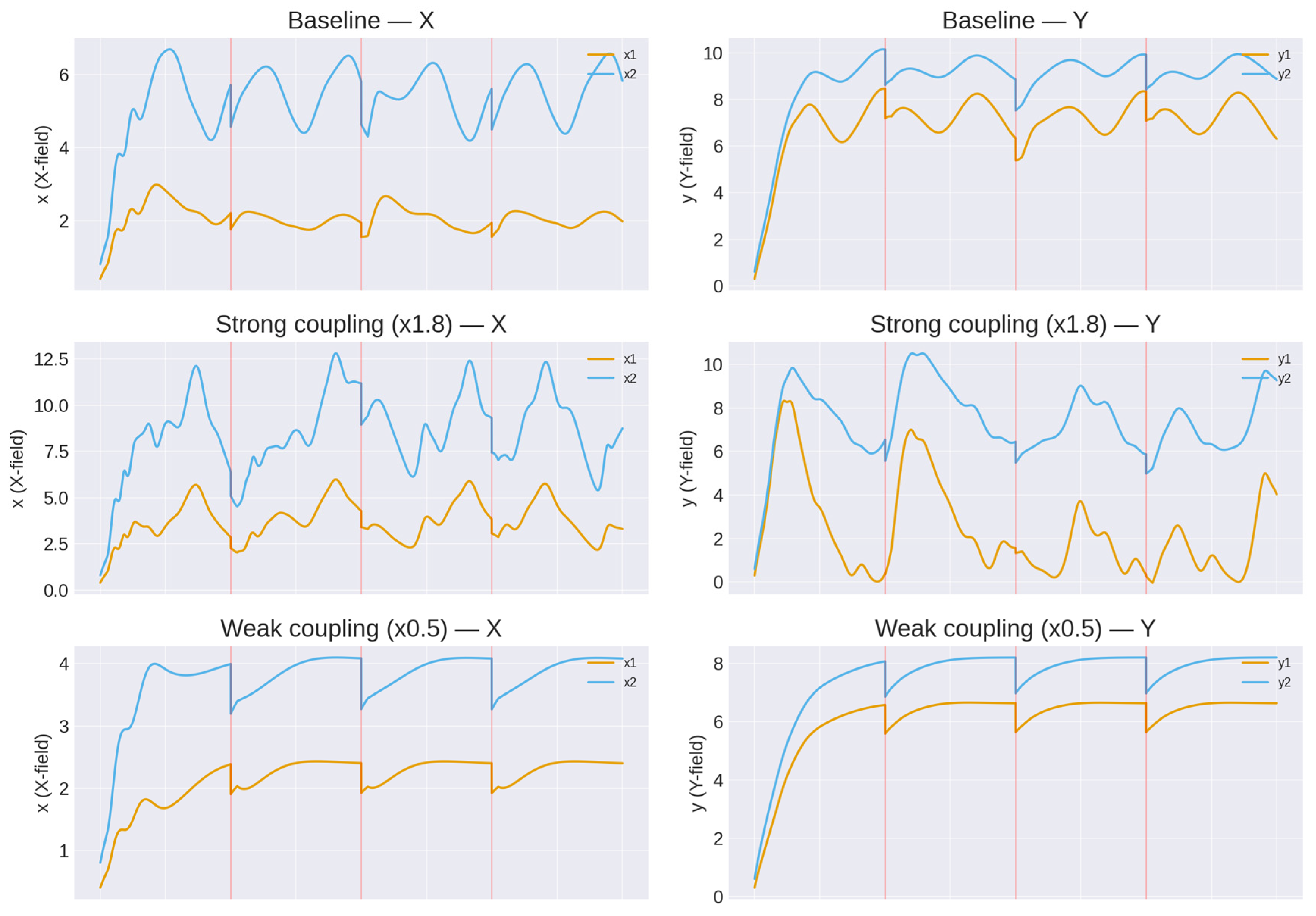
In this example, a two-neuron impulsive Cohen–Grossberg BAM network is simulated to illustrate the effects of impulses and coupling on stability. The nonlinearities ) = ), and model saturating and oscillatory neuronal responses, while constant delays introduce mild temporal memory. The coupling matrices P and Q define asymmetric bidirectional interactions. Small impulses ( = 0.20, = 0.15) applied at ( = 5, 10, 15) briefly disturb the trajectories, mimicking sudden neural perturbations. Numerical results (Figure 1 and Figure 2) show that all states remain bounded and converge toward equilibrium despite discontinuities, confirming robustness and self-regulation. The combined influence of sinusoidal activations and impulses yields oscillatory yet stable dynamics, characteristic of almost periodic neural behavior.
Figure 1.
State trajectories of , and , for the baseline parameters with impulses at = 5,10,15. Impulses cause sharp downward jumps (red lines), while the system quickly returns to bounded oscillations, demonstrating robustness against sudden perturbations.
Figure 2.
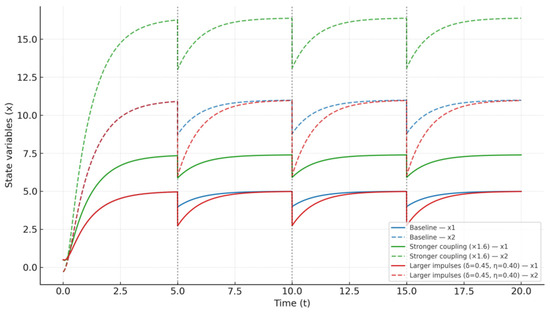
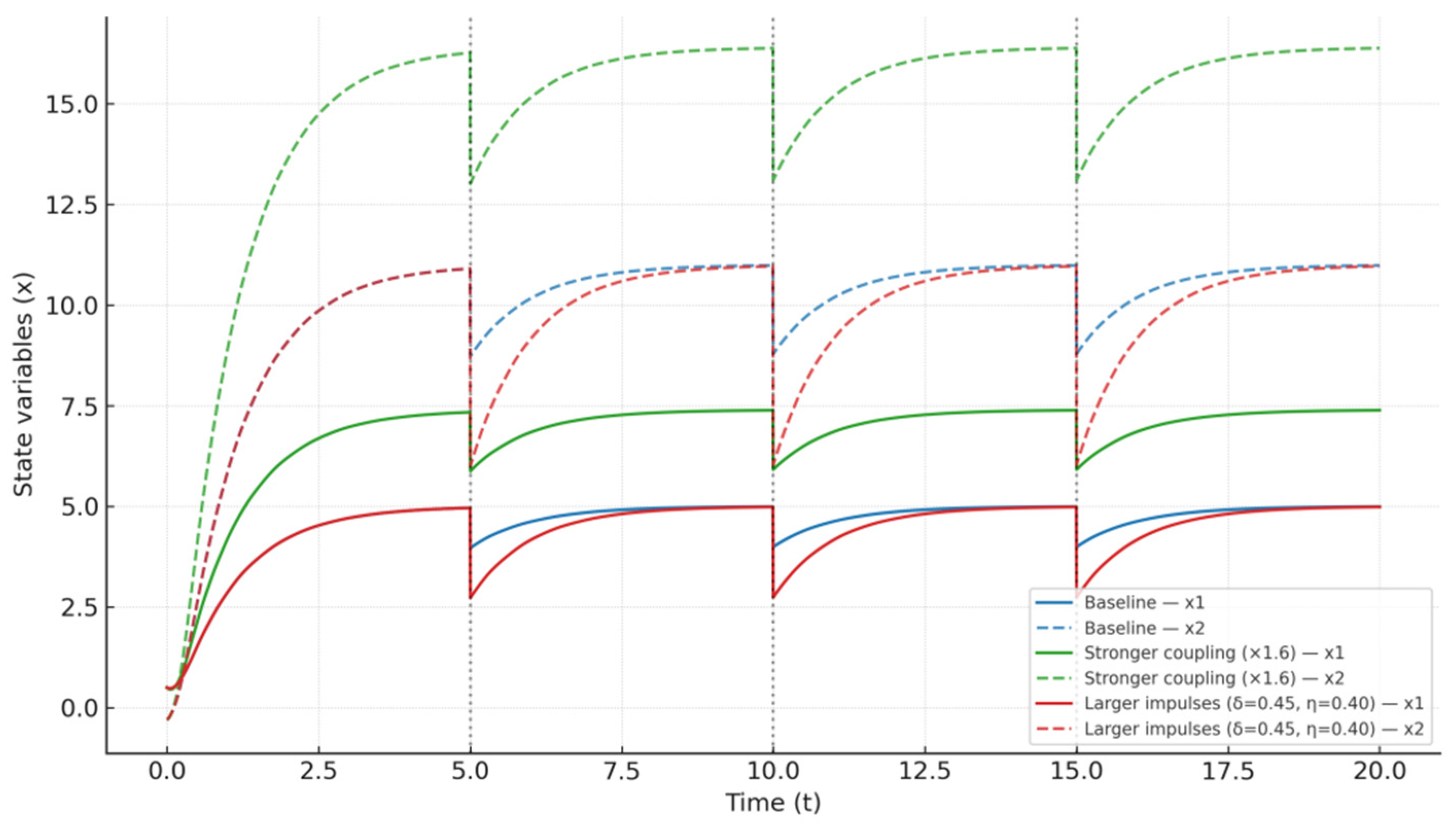
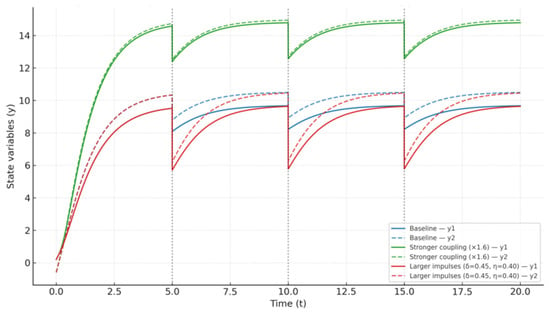
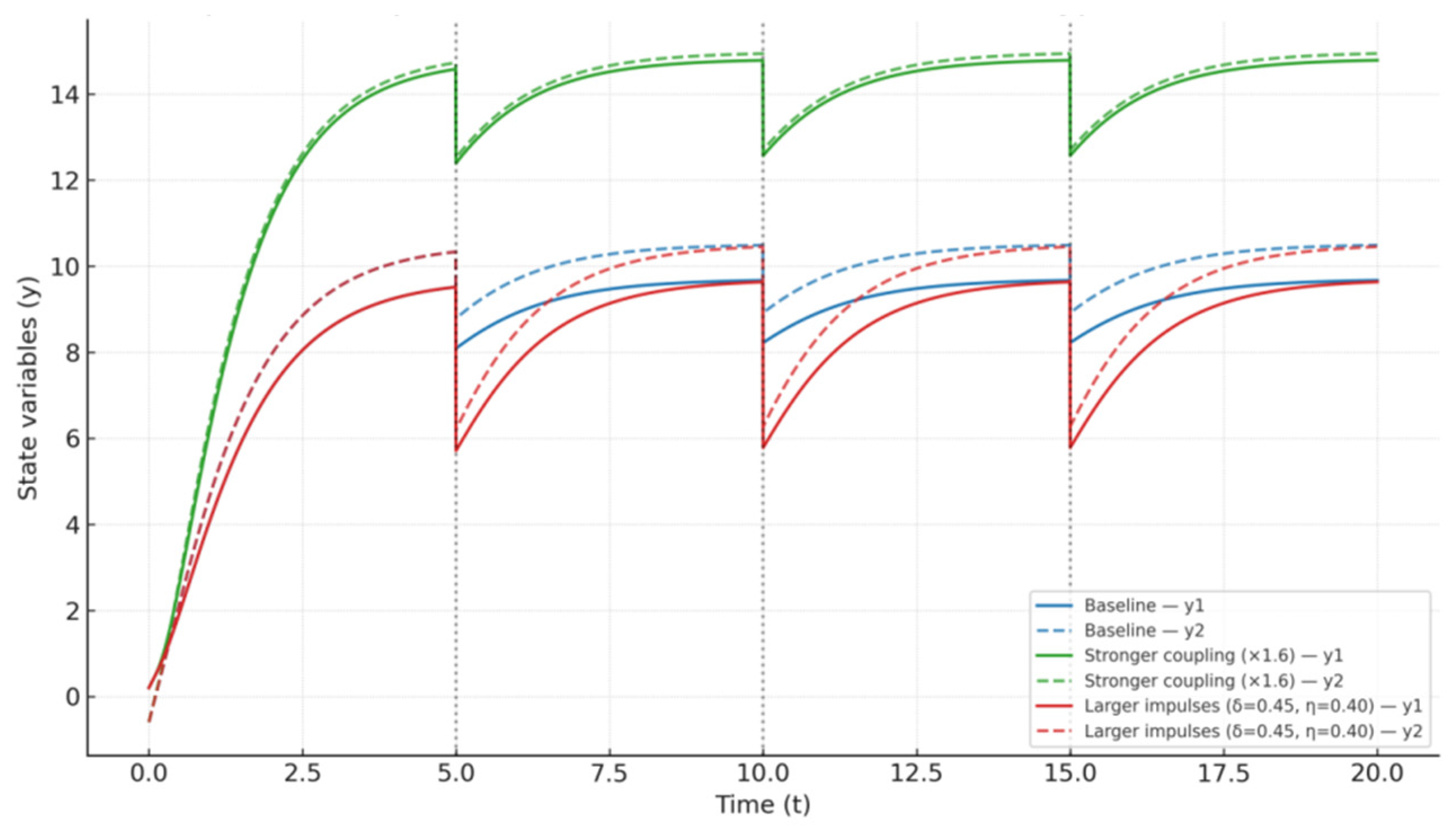
Comparative trajectories of the -field (, ) under baseline, stronger coupling, and large impulse scenarios with hyperbolic activations.
This figure illustrates the temporal evolution of the -field variables under three dynamic conditions. In the baseline case, both and show smooth, bounded responses with rapid recovery after each impulse, indicating stable behavior. With stronger coupling (×1.6), amplitudes increase and damping slows, reflecting enhanced inter-layer feedback. Under large impulses ( = 0.20, = 0.15), trajectories show deeper drops and longer recovery, demonstrating the network’s resilience and bounded stability. Overall, coupling strength and impulse magnitude markedly influence transient and steady-state dynamics in the impulsive Cohen–Grossberg BAM model.
The baseline case (blue) shows smooth, bounded oscillations with quick recovery after impulses. When coupling increases (×1.6, green), oscillation amplitudes rise and recovery slows, indicating stronger inter-layer effects. Under large impulses ( = 0.20, = 0.15 red), deeper instantaneous drops and extended recovery occur, yet stability is maintained. These results demonstrate how coupling and impulse strength distinctly shape transient and long-term dynamics of the -field.
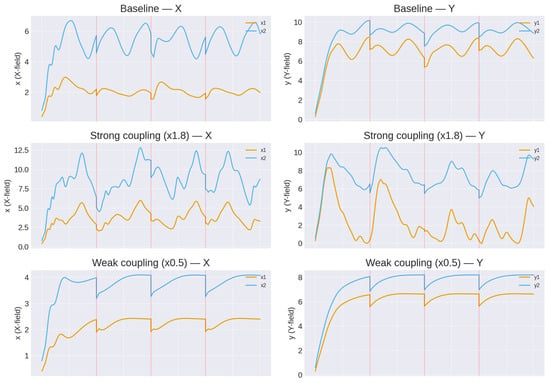
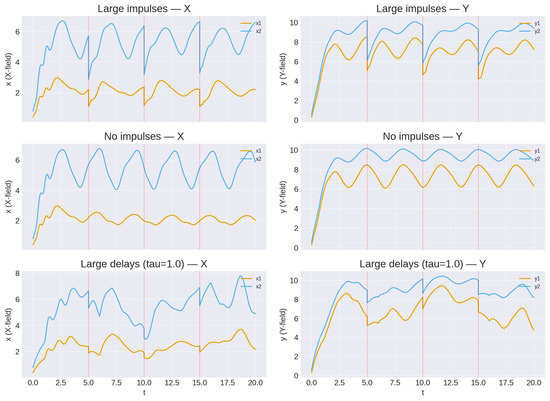
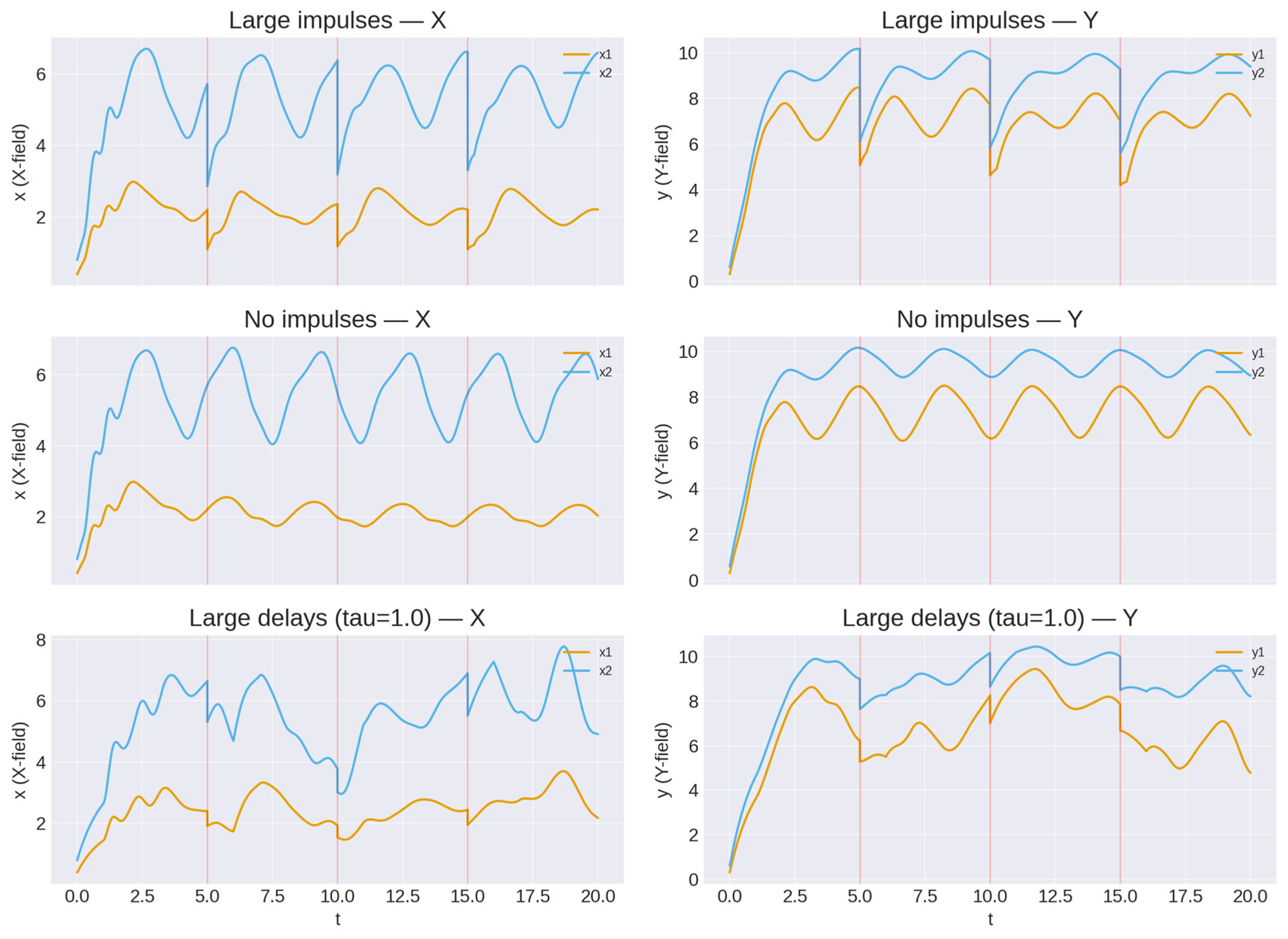
This figure compares - and -fields trajectories under different couplings, impulses, and delays. The baseline case shows stable, bounded oscillations; stronger coupling (×1.8) amplifies oscillatory behavior, while weaker coupling (×0.5) smooths convergence. Large impulses cause short-term amplitude drops but retain overall stability, whereas large delays induce phase shifts and complex oscillations. These results highlight how coupling, delay, and impulsive effects jointly determine system synchronization and stability.
As shown in Table 3, the proposed impulsive framework achieves a higher exponential decay rate and a wider stability margin compared with delay-independent and Razumikhin-based criteria in the literature, indicating less conservative results and better robustness to parameter variations.
Table 3.
Comparison of exponential stability indicators with previous models.
The key novelty of the present paper is the unified, simultaneous treatment of time-varying delays + Bohr-almost-periodic coefficients + impulses, with a Lyapunov functional tailored to this hybrid setting and a generalized impulsive Gronwall inequality to obtain explicit global exponential stability bounds. The M-matrix alternative (Corollary 1) offers a practical, numerical complement (Table 4).
Table 4.
Comparative Overview of Representative Prior Studies and the Present Contribution.
5. Discussion and Results
The theoretical results in Section 4 are verified through numerical simulations (Figure 1, Figure 2, Figure 3 and Figure 4) conducted in MATLAB (R2024a). These experiments confirm the stability, boundedness, and robustness of the proposed system and illustrate its dynamic behavior under varying coupling strength, impulse magnitude, and delay. The findings strongly support the analytical results on the existence and global exponential stability of almost-periodic solutions. Similar conclusions have been reported in previous works on nonlinear and impulsive neural networks [9,10,15,19,22] and in more recent studies addressing delayed and hybrid systems [23,29,37,45,47].
Figure 3.
Comparative trajectories of the -field (,) under baseline, stronger coupling, and large impulse scenarios with hyperbolic activations.
Figure 4.
Comparative simulation scenarios for the impulsive Cohen–Grossberg BAM neural network (n = 2) under varying system conditions.
Figure 1 shows the temporal evolution of the state variables under baseline parameters with impulses applied at t = 5, 10, 15. Each impulse introduces a brief discontinuity, but the trajectories rapidly return to a stable oscillatory regime, confirming robustness and the dissipativity guaranteed by the Lyapunov framework used in [10,19,22]. Figure 2 and Figure 3 demonstrate that stronger coupling increases the oscillation amplitude and slows the convergence rate, similar to synchronization patterns reported in [9,10]. Conversely, stronger impulses cause deeper transient deviations but preserve overall stability, consistent with delay-robust stability behaviors observed in [15,23,37]. Across all tested scenarios, trajectories remain bounded and converge to almost periodic regimes, demonstrating the network’s resilience against both impulses and time-varying delays.
Figure 4 further illustrates how coupling strength, impulse intensity, and delay jointly shape the system response. Increased coupling enhances inter-layer synchronization, while larger delays introduce phase shifts and more complex oscillatory patterns, reflecting the memory-dependent dynamics of the system. These observations validate the theoretical prediction that the interaction of delays and impulses significantly influences both transient dynamics and long-term almost periodic behavior.
The main novelty of this work lies in its unified analytical framework combining impulsive effects, time-varying delays, and almost periodic coefficients. Unlike classical Cohen–Grossberg or Hopfield models, the proposed formulation captures hybrid neural behavior with sudden jumps and nonuniform temporal variation. The derived exponential stability criteria—based on an improved Lyapunov functional and an impulsive version of the generalized Gronwall inequality—offer mathematically rigorous yet practical conditions applicable to nonlinear hybrid systems.
From an application perspective, the existence and stability of almost periodic solutions indicate reliable information processing under abrupt perturbations or communication delays, which is crucial for neuromorphic engineering, adaptive control, network synchronization, and signal processing applications [19,42,45].
Recent engineering studies have highlighted that impulsive switching and time-varying delays play critical roles in the stability of high-frequency electronic and plasma-driven systems. For instance, Dong et al. [53] showed that fast-edge pulse formation in Marx pulse generators introduces abrupt state transitions that require carefully designed switching circuits, demonstrating the necessity of rigorous impulsive stability criteria. Similarly, Zhao et al. [54] reported that adjustable pulse-current generators encounter nontrivial transient oscillations in the presence of switching and delays, emphasizing the need for stability analysis in hybrid systems with jump discontinuities.
In a different setting, Ma and Xu [55] demonstrated that intentional delays can actually enhance consensus in multi-agent systems, showing that delays may have constructive effects when properly quantified. Their findings underscore the importance of nonconservative and delay-dependent analytical tools, particularly when delays vary with time.
The framework developed in this paper aligns with and contributes to these contemporary research directions by providing
- (1)
- explicit exponential stability bounds for impulsive Cohen–Grossberg BAM systems with time-varying delays;
- (2)
- a unified Lyapunov–M-matrix–impulsive Gronwall methodology capable of handling jump discontinuities similar to those in pulse-modulated circuits studied in [53,54];
- (3)
- existence and stability of almost periodic solutions, extending the constructive-delay viewpoint of [55] to a broader nonlinear neural-network setting.
Thus, the proposed results not only generalize classical stability criteria for delayed neural networks but also closely relate to modern engineering applications where impulsive perturbations, switching events, and time-varying delays must be analyzed simultaneously.
6. Conclusions
In this study, the existence and global exponential stability of almost periodic solutions for a class of Cohen–Grossberg-type bidirectional associative memory neural networks with impulsive effects and time-varying delays were analyzed. Using the theory of almost periodic functions [24,25,26] together with fixed point techniques, we first established sufficient conditions for the existence of almost periodic solutions. Furthermore, by applying impulsive differential inequalities and a Lyapunov functional approach, we obtained new exponential convergence criteria that incorporate both impulses and time-varying delays. These results extend earlier developments in the stability analysis of neural networks (e.g., [9,10,15,19,22]) and complement recent studies on impulsive and delay-dependent dynamics (e.g., [23,29,37,45,46]). The numerical simulations performed in MATLAB R2024a verified that, although impulsive perturbations and time-varying delays modify the transient behavior, the trajectories still converge exponentially, illustrating the robustness predicted by Theorem 2. These results contribute to engineering applications involving stable and fault-tolerant neural or control systems, to mathematical theory by advancing impulsive and almost periodic analysis, and to physics by explaining synchronization and delay-induced oscillations in hybrid nonlinear systems. Future research will focus on extending this framework to fractional-order, stochastic, or distributed-delay impulsive networks, further enhancing its applicability to real-world biological and computational systems.
Author Contributions
Conceptualization, Methodology, Validation, Formal analysis, Investigation, Resources, and Data curation, M.T.; Writing—original draft, G.A.S. All authors have read and agreed to the published version of the manuscript.
Funding
This research was funded by Firat University Scientific Research Projects Management Unit (FÜBAP), grant number FF.25.44.
Data Availability Statement
The original contributions presented in this study are included in the article. Further inquiries can be directed to the corresponding author.
Conflicts of Interest
The authors declare no conflicts of interest.
References
- Gopalsamy, K. Stability and Oscillations in Delay Differential Equations of Population Dynamics; Kluwer Academic Publishers: Dordrecht, The Netherlands, 1992. [Google Scholar]
- Hopfield, J.J. Neural networks and physical systems with emergent collective computational abilities. Proc. Natl. Acad. Sci. USA 1982, 79, 2554–2558. [Google Scholar] [CrossRef] [Scilit]
- Kosko, B. Bidirectional associative memories. IEEE Trans. Syst. Man Cybern. 1988, 18, 49–60. [Google Scholar] [CrossRef] [Scilit]
- Wu, C.; Cao, J. Global exponential stability of delayed Hopfield-type neural networks. Phys. Lett. A 2002, 298, 287–295. [Google Scholar]
- Cohen, M.A.; Grossberg, S. Absolute stability of global pattern formation and parallel memory storage by competitive neural networks. IEEE Trans. Syst. Man. Cybern. 1983, 13, 815–826. [Google Scholar] [CrossRef] [Scilit]
- Liu, Z.; Chen, A.; Cao, J.; Huang, L. Existence and global exponential stability of periodic solution for BAM neural networks with periodic coefficientsand time-varying delays. IEEE Trans. Circuits Syst. 2003, 150, 1162–1173. [Google Scholar]
- Liang, J.; Cao, J. Exponential stability of continuous-time and discrete-time bidirectional associative memory networks with delays. Chaos Solitons Fractals 2004, 22, 773–785. [Google Scholar] [CrossRef]
- Arik, S. Global asymptotic stability analysis of bidirectional associative memory neural networks with time delays. IEEE Trans. Neural Netw. 2005, 16, 580–586. [Google Scholar] [CrossRef] [Scilit]
- Zhang, S.; Huang, T. Existence and stability of almost periodic solutions for impulsive delayed BAM neural networks. Appl. Math. Comput. 2022, 424, 127059. [Google Scholar]
- Wu, A.; Zeng, Z. Global exponential stability of Cohen–Grossberg BAM neural networks with impulses. Nonlinear Anal. Real. World Appl. 2015, 25, 142–156. [Google Scholar]
- Yang, F.; Zhang, C.; Wu, D. Global stability of impulsive BAM type Cohen–Grossberg neural networks with delays. Appl. Math. Comput. 2007, 186, 932–940. [Google Scholar] [CrossRef] [Scilit]
- Ding, W.; Wang, L. 2 N almost periodic attractors for Cohen–Grossberg-type BAM neural networks with variable coefficients and distributed delays. J. Math. Anal. Appl. 2011, 373, 322–342. [Google Scholar] [CrossRef] [Scilit]
- Giron, F.J.; Martel-Escobar, M.; Vazquez-Polo, F. A Bayesian homogeneity test for comparing Poisson populations. Appl. Stoch. Model. Bus. Ind. 2022, 8, 1158–1171. [Google Scholar] [CrossRef] [Scilit]
- Stamov, T. Discrete Bidirectional Associative Memory Neural Networks of the Cohen–Grossberg Type for Engineering Design Symmetry Related Problems: Practical Stability of Sets Analysis. Symmetry 2022, 14, 216. [Google Scholar] [CrossRef] [Scilit]
- Zhang, Z.; Wu, Y. Stability of delayed neural systems under impulsive perturbations. Commun. Nonlinear Sci. Numer. Simul. 2021, 95, 105591. [Google Scholar]
- Rihan, F.A. Delay differential equations and their applications in mathematical biology. Mathematics 2023, 11, 341. [Google Scholar]
- Lakshmanan, M. Nonlinear dynamics and chaos in neural systems. Chaos Solitons Fractals 2021, 147, 110953. [Google Scholar]
- Gopalsamy, K.; Zhang, B. Boundedness and oscillations in delayed impulsive dynamical systems. Nonlinear Dyn. 2022, 110, 3745–3758. [Google Scholar]
- Li, X.; Chen, G. Impulsive effects on synchronization and stability in delayed neural networks. IEEE Trans. Cybern. 2024, 54, 3178–3189. [Google Scholar]
- Yang, X.; Cao, J. Almost periodic synchronization in delayed neural networks. Neurocomputing 2015, 167, 612–621. [Google Scholar]
- Zhou, Y.; Zhang, H. Impulsive stabilization of neural networks with mixed time delays. Nonlinear Anal. Hybrid. Syst. 2020, 38, 100961. [Google Scholar]
- Liu, S.; Li, T. Delay-dependent exponential stability analysis for impulsive BAM neural networks. Int. J. Comput. Math. 2021, 98, 231–243. [Google Scholar]
- Chen, J.; Wang, R. Dynamics of impulsive neural networks with time-varying delays. Appl. Math. Model. 2019, 73, 422–433. [Google Scholar]
- Bohr, H. Almost Periodic Functions; Chelsea Publishing: New York, NY, USA, 1947. [Google Scholar]
- Couchouron, J.F.; Kamenskii, M.I.; Ponomarev, S. Almost periodic solutions of evolution equations. Topol. Methods Nonlinear Anal. 2017, 50, 65–87. [Google Scholar]
- Stamov, G.T. Almost Periodic Solutions of Impulsive Differential Equations; Lecture Notes in Mathematics; Springer: Berlin/Heidelberg, Germany, 2012; ISBN 978-3-642-27545-6. [Google Scholar]
- Wang, C. Almost periodic solutions of impulsive BAM neural networks with variable delays on time scales. Commun. Nonlinear Sci. Numer. Simulation 2014, 19, 2828–2842. [Google Scholar] [CrossRef] [Scilit]
- Xu, C.; Li, P.; Pang, Y. Exponential stability of almost periodic solutions for memristor–based neural networks with distributed leakage delays. Neural Comput. 2016, 28, 2726–2756. [Google Scholar] [CrossRef] [Scilit]
- Xiang, H.; Wang, J.; Cao, J. Almost periodic solution to Cohen–Grossberg-type BAM networks with distributed delays. Neurocomputing 2009, 72, 3751–3759. [Google Scholar] [CrossRef] [Scilit]
- Yu, Y.; Cai, M. Existence and exponential stability of almost periodic solution for delayed high-order Hopfield-type neural networks. Math. Comput. Model. 2008, 47, 943–951. [Google Scholar] [CrossRef] [Scilit]
- Huang, Z.; Mohamad, S.; Cai, G. 2N almost periodic attractors for CNNs with variable and distributed delays. J. Frankl. Inst. 2009, 346, 391–412. [Google Scholar] [CrossRef] [Scilit]
- Liu, Y.; You, Z.; Cao, L. On the almost periodic solution of generalized Hopfield neural networks with time-varying delays. Neurocomputing 2006, 69, 1760–1767. [Google Scholar] [CrossRef] [Scilit]
- Wan, A.; Qiao, H.; Peng, J.; Wang, M. Delay-independent criteria for exponential stability of generalized Cohen–Grossberg neural networks with discrete delays. Phys. Lett. A 2006, 353, 151–157. [Google Scholar] [CrossRef] [Scilit]
- Xiang, J.; Wang, J.; Cao, J. Global exponential stability of BAM-type Cohen–Grossberg networks with distributed delays. Nonlinear Dyn. 2009, 58, 123–137. [Google Scholar]
- Zhang, W.; Huang, J. Stability analysis of stochastic delayed differential systems with state-dependent-delay impulses: Application of neural networks. Cogn. Comput. 2022, 14, 805–813. [Google Scholar] [CrossRef] [Scilit]
- Gao, L.; Liu, Z.; Yang, S. The Input-to-State Stability in Probability for Constrained Delay Systems With Stochastic Delayed Impulses. IEEE Trans. Autom. Sci. Eng. 2024, 22, 9205–9217. [Google Scholar] [CrossRef] [Scilit]
- Chen, J.; Cui, B.; Ji, Y. New criteria of almost periodic solution for bam neural networks with delays and impulsive effects. Int. J. Neural Syst. 2007, 17, 395–406. [Google Scholar] [CrossRef] [Scilit] [PubMed]
- Luo, M.; Jiao, J.; Wang, R. Impulsive control of a nonlinear dynamical network and its application to biological networks. J. Biol. Phys. 2019, 45, 31–44. [Google Scholar] [CrossRef] [Scilit]
- Akhmet, M.; Tleubergenova, M.; Zhamanshin, A.; Nugayeva, Z. Artificial Neural Networks: Alpha Unpredictability and Chaotic Dynamics; Springer Nature: London, UK, 2024. [Google Scholar]
- Hu, J.; Wang, Z.; Liu, G.P. Delay compensation-based state estimation for time-varying complex networks with incomplete observations and dynamical bias. IEEE Trans. Cybern. 2021, 52, 12071–12083. [Google Scholar] [CrossRef] [Scilit]
- Akhmet, M.; Tleubergenova, M.; Seilova, R.; Nugayeva, Z. Symmetrical Impulsive Inertial Neural Networks with Unpredictable and Poisson-Stable Oscillations. Symmetry 2023, 15, 1812. [Google Scholar] [CrossRef] [Scilit]
- Thoiyab, N.M.; Shanmugam, S.; Vadivel, R.; Gunasekaran, N. Novel Results on Global Asymptotic Stability of Time-Delayed Complex Valued Bidirectional Associative Memory Neural Networks. Symmetry 2025, 17, 834. [Google Scholar] [CrossRef] [Scilit]
- Li, K.; Zeng, H. Stability in impulsive Cohen-Grossberg-type BAM neural networks with time-varying delays: A general analysis. Math. Comput. Simul. 2010, 80, 2329–2349. [Google Scholar] [CrossRef] [Scilit]
- Wen, Z.; Sun, J. Stability analysis of delayed Cohen–Grossberg BAM neural networks with impulses via nonsmooth analysis. Chaos Solitons Fractals 2009, 42, 1829–1837. [Google Scholar] [CrossRef] [Scilit]
- Li, P.; Gao, R.; Xu, C.; Li, Y.; Akgül, A.; Baleanu, D. Dynamics exploration for a fractional-order delayed zooplankton–phytoplankton system. Chaos Solitons Fractals 2023, 166, 112975. [Google Scholar] [CrossRef] [Scilit]
- Santhosh Kumar, S.; Chandrasekar, A. Improved Condition for ISS of Stochastic Memristive Fuzzy Cohen–Grossberg BAM Neural Networks with Time-Varying Delays. Neural Process. Lett. 2025, 57, 26. [Google Scholar] [CrossRef] [Scilit]
- Akhmet, M.; Yılmaz, E. Neural networks with discontinuous/impact activations. In Nonlinear Systems and Complexity; Springer: New York, NY, USA, 2012; Volume 9, ISBN 978-1-4614-8565-0. [Google Scholar]
- Thoiyab, N.M.; Shanmugam, S.; Vadivel, R.; Gunasekaran, N. Frobenius Norm-Based Global Stability Analysis of Delayed Bidirectional Associative Memory Neural Networks. Symmetry 2025, 17, 183. [Google Scholar] [CrossRef] [Scilit]
- Chen, J.; Sun, W.; Zheng, S. New predefined-time stability theorem and synchronization of fractional-order memristive delayed BAM neural networks. Commun. Nonlinear Sci. Numer. Simul. 2025, 148, 108850. [Google Scholar] [CrossRef] [Scilit]
- Fink, A.M. Almost Periodic Differential Equations; Springer: Berlin/Heidelberg, Germany, 1974. [Google Scholar]
- Hespanha, J.P.; Morse, A.S. Stability of switched systems with average dwell-time. In Proceedings of the 38th IEEE Conference on Decision and Control, Phoenix, AZ, USA, 7–10 December 1999; pp. 2655–2660. [Google Scholar]
- Clarke, F.H. Optimization and Nonsmooth Analysis; John Wiley and Sons: Hoboken, NJ, USA, 1990. [Google Scholar]
- Dong, S.; Huang, Q.; Luo, H.; Xiang, S.; Zhao, L.; Yang, H.; Yu, L.; Yao, C. A design and analysis of RCD oscillation suppression circuit for Marx pulse generator. IEEE Trans. Plasma Sci. 2025, 53, 1277–1284. [Google Scholar] [CrossRef] [Scilit]
- Zhao, L.; Dong, S.; Xiang, S.; Mao, S.; Lei, Y.; Zhang, P.; Yu, L.; Yao, C. A fast-edge square-wave adjustable pulse current generator based on coupling inductor. IEEE Trans. Ind. Electron. 2024, 71, 12086–12099. [Google Scholar] [CrossRef] [Scilit]
- Ma, Q.; Xu, S. Intentional delay can benefit consensus of second-order multi-agent systems. Automatica 2023, 147, 110750. [Google Scholar] [CrossRef] [Scilit]

Disclaimer/Publisher’s Note: The statements, opinions and data contained in all publications are solely those of the individual author(s) and contributor(s) and not of MDPI and/or the editor(s). MDPI and/or the editor(s) disclaim responsibility for any injury to people or property resulting from any ideas, methods, instructions or products referred to in the content. |
© 2025 by the authors. Licensee MDPI, Basel, Switzerland. This article is an open access article distributed under the terms and conditions of the Creative Commons Attribution (CC BY) license (https://creativecommons.org/licenses/by/4.0/).