


Abstract
Light mesons serve as a cornerstone in probing symmetry realizations and dynamical breaking mechanisms in the non-perturbative regime of the strong interaction. Among them, a notable case is the , a state observed in the invariant mass spectrum. It was initially identified as the , but subsequent studies by the FOCUS and BESIII collaborations have unambiguously established it as a distinct new state. FOCUS further showed that interference models cannot reproduce a -like mass value in its high-statistics data. The absence of the in both and theoretical spectroscopy renders its internal structure an open and compelling question. This work reviews observations of the , discusses its possible interpretations, and outlines future prospects for its study, particularly regarding the BESIII experiment.
1. Introduction
Hadrons, such as mesons and baryons, are observable manifestations of strong interactions, with their properties deeply rooted in the symmetries of quantum chromodynamics (QCD). Light mesons, in particular, are pivotal in probing the non-perturbative regime of QCD, where phenomena like chiral symmetry breaking and confinement dominate. Their spectrum and decay patterns provide critical insights into how the underlying symmetries are realized or broken. Consequently, light mesons provide an ideal testing ground for the study of strong interactions in the non-perturbative regime.
Many light mesons, such as the , , and states and their excitations, are well established and understood both experimentally and theoretically [1]. Nevertheless, some states remain poorly understood. The [1] is one such state that requires further investigation, even though more than forty years have passed since its first observation [2].
In this paper, we review experimental results for the . Section 2 and Section 3 present the early ambiguities regarding whether it was a new state or the photoproduction mode of the [1], as well as high-statistics results that helped to distinguish it from the . Section 4 compares the mass and width across different observations and compares the with other nearby vector states. In Section 6, we discuss possible interpretations of the and prospects for future studies, particularly in the BESIII experiment [3].
2. The in the Early Stages
The first results for the were reported in the invariant mass spectrum in the 1980s, although the data were limited by statistics [2,4,5]. As a result, it was difficult to distinguish the from the , which predominantly decays into but has a mass close to that of the .
The was first reported as a bump centered at 1.75 GeV/ in the mass spectrum from the photoproduction reaction by Aston D., et al. in 1981 [2]. A fit that included interference between the resonance and a non-resonant contribution that accounted for the , , and tails yielded a mass of GeV/ and a width of GeV [2] (see Figure 4 of [2]).
Given the large statistical uncertainties, these values were consistent with those of the , which may explain why the structure was initially regarded as the photoproduction mode of the , a state more commonly observed in collisions [1]. Notably, an alternative fit without the interference between the Breit–Wigner resonance and non-resonant process was also described in Ref. [2], yielding a mass of MeV/ and a width of MeV. This already suggested that the structure might be a new state distinct from the .
The evident state in Ref. [2] was also reported in subsequent photoproduction experiments [4,5]. Figure 1 shows the acceptance-corrected mass distribution by the Omega Photon Collaboration [4], where the peak is visible. A fit using a Breit–Wigner component and a non-interfering background component yielded a mass of GeV/ and a width of GeV for the signal [4].
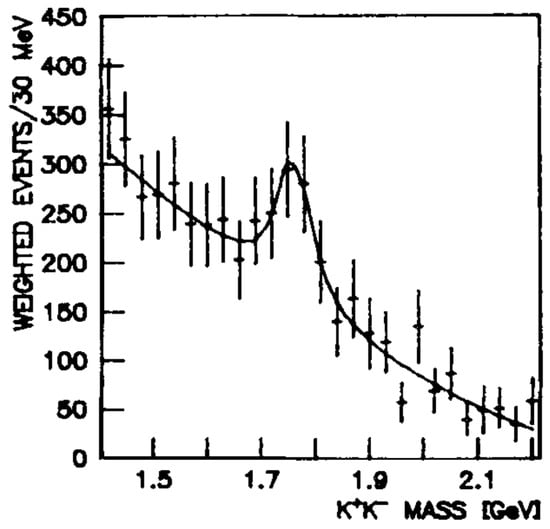
Figure 1.
Acceptance-corrected mass distribution from Ref. [4].
The mass distribution by Busenitz J. et al. in 1989 [5] also shows a similar structure, around 1.75 GeV/, as shown in Figure 2. A fit without interference gave a mass of GeV/ and a width of GeV. Although Ref. [5] noted that the observation was consistent with Ref. [2], the low statistics and large uncertainties meant that the Particle Data Group (PDG) at the time still classified these signals as the ‘photoproduction of the ’.
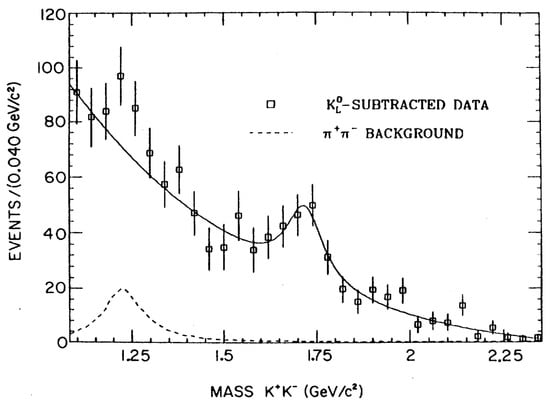
Figure 2.
mass distribution from Ref. [5].
3. The in High-Statistics Data
3.1. The FOCUS Results
The FOCUS collaboration was the first to report the with high statistics (significance well above ) in the mass spectrum from a photoproduction process [6]. A distinct peak corresponding to the is visible in Figure 3a of Ref. [6].
The mass and width reported by FOCUS are MeV/c2 and MeV, respectively, with very small uncertainties. These values differ significantly from those of the [1]. Furthermore, FOCUS searched for the in the mass spectrum—the dominant decay mode of the —and found no signal [6]. Based on the clear differences in resonance parameters and decay modes, the FOCUS collaboration concluded that the is a new state distinct from the .
3.2. The at BESIII
A key result came from the BESIII collaboration, which reported the first simultaneous observation of both the and the in the same mass distribution, with each having significance exceeding [7]. This observation unambiguously confirms that the two are distinct states. Through a partial wave analysis (PWA; an introduction can be found in Ref. [8]), BESIII not only determined the mass and width of the but also established its spin parity as , the same as that of the . Figure 3 shows the fit projection of the mass spectrum, where the is represented by the pink dashed line and the by the red dash-dotted line [7]. Interestingly, the does not appear as a peak; instead, a significant dip around 1.7 GeV/ is observed due to the interference between the and the . The mass and width of the from this analysis are MeV/ and MeV, respectively [7].
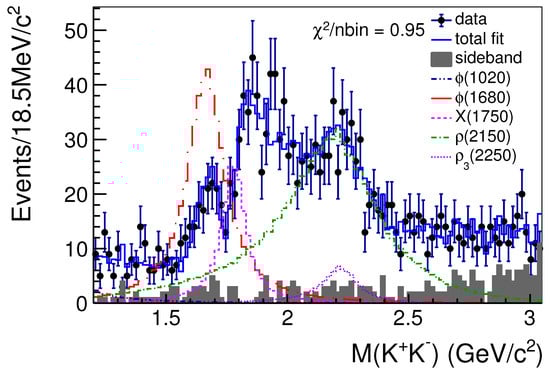
Figure 3.
mass distribution of from Ref. [7]. The is represented by the pink dashed line and the by the red dash-dotted line.
4. Comparison of Observations and Other Nearby Vector States
For ease of comparison, Table 1 summarizes measurements of the from different experiments alongside other nearby vector states. Figure 4 displays the masses and widths of these observations and states.

Table 1.
Masses and widths of the and other nearby vector states.
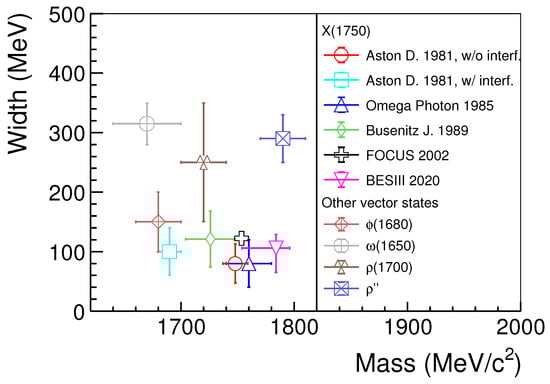
Figure 4.
Comparison of the mass and width of the [2,4,5,6,7] and other nearby vector states [1,9]. Uncertainties for points from FOCUS 2002 [6], BESIII 2020 [7], and for [9] are the quadrature sum of statistical uncertainty and systematic uncertainty; for other points, only statistical uncertainties are shown.
It is evident that the mass and width of the differ from those of the , even in the early results with large statistical uncertainties. The only exception arises from an interference fit in Ref. [2], which modeled interference between the signal resonance and a non-resonant contribution accounting for the , , and tails. In this specific model, the extracted mass and width of the appear closer to those of the . Given the significant role of interference, the FOCUS collaboration investigated fit models incorporating interference between the resonance and a continuum, as well as between the resonance and a second, lower-mass resonance. Crucially, in all scenarios tested by FOCUS, the mass of the consistently exceeded 1747 MeV/ [6]. This investigation suggests that the -like parameters obtained in the interference model of Ref. [2] result not only from the interference effects but also from the limited statistics of the data.
5. Other Related Experiments
As a state, the can be produced directly in collisions. Consequently, it could potentially be observed in the cross-section for , provided that the production rate and dataset are sufficiently large.
The BaBar collaboration studied the process using the initial state radiation method and found that the data were well described without any additional contribution from the [10]. Similarly, recent results from the SND [11] and CMD-3 collaborations [12], obtained via the energy scan method, also show no essential contribution from the .
The absence of the in data may indicate a small production rate, which could be related to its specific quark content.
6. Discussion and Perspectives
6.1. Possible Theoretical Interpretations
The has been observed in the mass spectrum across multiple experiments [2,4,5,6,7]. This makes it a natural candidate for a strangeonium state ().
Strangeonium spectroscopy was first systematically studied in Ref. [13] within the framework of the relativistic quark model with QCD in Ref. [14], which successfully predicted the but did not anticipate the : the predicted states are , , unobserved , and unobserved . More recent theoretical studies on strangeonia and their decay properties [15,16] obtained similar results for the strangeonia and did not predict a strangeonium with a mass of around 1750 MeV/. Consequently, the is incompatible with the current spectrum of conventional strangeonium states.
Alternatively, the could be an excited state of the or mesons, with sufficient mass to decay into . The nearest known state in this sector is the , with a mass of MeV/ and a width of MeV [1]. Recent theoretical studies on excitations obtained a state corresponding to the [17,18,19], but they do not predict a state with a mass similar to the . The mainly decays into and final states [1], which is different from the . Thus, the significant differences in both the decay patterns and resonance parameters (mass and width) strongly prohibit the identification of the as the , despite the fact that this possibility cannot be entirely excluded due to the sizeable experimental uncertainties regarding the ’s properties.
Given the difficulties in accommodating the within the conventional quark model, exotic interpretations such as tetraquark states and hybrid states become compelling. However, theoretical studies on light hybrid states [20,21] and light tetraquark states [22,23] show a large difference between the and these hybrid and tetraquark states: hybrid states have a mass greater than 2.3 GeV/ [20,21], and tetraquark states have a mass greater than 1.9 GeV/ [22,23]. Therefore, while its conventional nature is challenged, the also does not readily fit into the predicted spectra of light exotics, calling for further theoretical scrutiny of its internal structure.
6.2. Future Experimental Prospects
The absence of the in the predictions from both and quarkonia spectroscopy underscores the need for further theoretical and experimental efforts.
Most observations of the come from photoproduction experiments. Recently, the exclusive photoproduction of vector mesons in the mass region around GeV/ has been reported by the ALICE and LHCb collaborations in ultraperipheral heavy-ion collisions (UPCs) [9,24]. Notably, LHCb observed the photoproduction of a state with a mass of MeV/ and a width of MeV in the final state [9].
The observed by LHCb in as well as the could also decay into . Given the unclear quark content of the , a possible connection to these -like states warrants consideration. Although current measurements of their masses and widths suggest that they are distinct, the sizeable uncertainties preclude a definitive conclusion. Further comparative studies of the and the -like states, such as precise measurements of their masses and widths, and a direct search for in , could help to clarify whether they are distinct states.
The future Electron–Ion Collider (EIC) will provide another opportunity to study the photoproduction of the with high precision. Recent simulation studies [25] demonstrate that vector mesons in this mass range can be efficiently reconstructed in collisions. A dedicated search for the in both and final states, accompanied by the measurement of their relative branching fractions, would provide direct insight into its quark content.
On the other hand, charmonium decays such as those of and , produced in collisions, provide a clean environment for the study of the . The BESIII experiment [3] has collected the world’s largest dataset of and decays, offering excellent opportunities to investigate the properties of the and clarify its nature. BESIII has observed the in using a portion of its data [7]. Further studies of processes like and , , and could help to determine the isospin and quark content of the .
Author Contributions
Conceptualization, J.Z.; methodology, J.Z. and H.W.; validation, H.W., J.Z. and Z.H.; writing—original draft preparation, J.Z.; writing—review and editing, H.W. and Z.H.; funding acquisition, Z.H. All authors have read and agreed to the published version of the manuscript.
Funding
This research was partially funded by the Tsinghua University Initiative Scientific Research Program; the Natural Science Foundation of China, Grants No. 11975011 and No. 12061141002; and the Ministry of Science and Technology of China, Grant No. 2024YFA1610501.
Data Availability Statement
No new data were created or analyzed in this study.
Acknowledgments
Conflicts of Interest
The authors declare no conflicts of interest.
References
- Navas, S.; Amsler, C.; Gutsche, T.; Hanhart, C.; Hernández-Rey, J.; Lourenço, C.; Masoni, A.; Mikhasenko, M.; Mitchell, R.E.; Patrignani, C.; et al. Review of Particle Physics. Phys. Rev. D 2024, 110, 030001. [Google Scholar] [CrossRef]
- Aston, D.; Atkinson, M.; Bailey, R.; Ball, A.H.; Bouquet, B.; Brookes, G.R.; Bröring, J.; Bussey, P.J.; Clarke, D.; Clegg, A.B.; et al. Evidence for a High Mass Enhancement in K+K− Photoproduction. Phys. Lett. B 1981, 104, 231–234. [Google Scholar] [CrossRef]
- Ablikim, M.; An, Z.H.; Bai, J.Z.; Berger, N.; Bian, J.M.; Cai, X.; Cao, G.F.; Cao, X.X.; Chang, J.F.; Chen, C.; et al. Design and Construction of the BESIII Detector. Nucl. Instrum. Meth. A 2010, 614, 345–399. [Google Scholar] [CrossRef]
- Atkinson, M.; Axon, T.J.; Barberis, D.; Brodbeck, T.J.; Brookes, G.R.; Bunn, J.J.; Bussey, P.J.; Clegg, A.B.; Dainton, J.B.; Davenport, M.; et al. Photoproduction of ϕ Mesons by Linearly Polarized Photons of Energy 20 GeV to 40 GeV and Further Evidence for a Photoproduced High Mass KK Enhancement. Z. Phys. C 1985, 27, 233. [Google Scholar] [CrossRef]
- Busenitz, J.; Olszewski, C.; Callahan, P.; Gladding, G.; Wattenberg, A.; Binkley, M.; Butler, J.; Cumalat, J.; Gaines, I.; Gormley, M.; et al. High-energy Photoproduction of π+π−π0, K+K−, and States. Phys. Rev. D 1989, 40, 1–21. [Google Scholar] [CrossRef]
- Link, J.M.; Reyes, M.; Yager, P.M.; Anjos, J.C.; Bediaga, I.; Göbel, C.; Magnin, J.; Massafferri, A.; de Miranda, J.M.; Pepe, I.M.; et al. Observation of a 1750MeV/c2 Enhancement in the Diffractive Photoproduction of K+K−. Phys. Lett. B 2002, 545, 50–56. [Google Scholar] [CrossRef]
- Ablikim, M.; Achasov, M.N.; Adlarson, P.; Ahmed, S.; Albrecht, M.; Alekseev, M.; Amoroso, A.; An, F.F.; An, Q.; Bai, Y.; et al. Partial wave analysis of ψ(3686) → K+K−η. Phys. Rev. D 2020, 101, 032008. [Google Scholar] [CrossRef]
- Peters, K.J. A Primer on partial wave analysis. Int. J. Mod. Phys. A 2006, 21, 5618–5624. [Google Scholar] [CrossRef]
- Aaij, R.; Abdelmotteleb, A.S.W.; Beteta, C.A.; Abudinén, F.; Ackernley, T.; Adefisoye, A.A.; Adeva, B.; Adinolfi, M.; Adlarson, P.; Agapopoulou, C.; et al. Coherent photoproduction of ρ0, ω and excited vector mesons in ultraperipheral PbPb collisions. arXiv 2025, arXiv:2506.06250. [Google Scholar] [CrossRef]
- Lees, J.P.; Poireau, V.; Tisserand, V.; Grauges, E.; Palano, A.; Eigen, G.; Stugu, B.; Brown, D.N.; Kerth, L.T.; Kolomensky, Y.G.; et al. Precision measurement of the e+e− → K+K−(γ) cross section with the initial-state radiation method at BaBar. Phys. Rev. D 2013, 88, 032013. [Google Scholar] [CrossRef]
- Achasov, M.N.; Aulchenko, V.M.; Barnyakov, A.Y.; Barnyakov, M.Y.; Beloborodov, K.I.; Berdyugin, A.V.; Berkaev, D.E.; Bogdanchikov, A.G.; Botov, A.A.; Buzykaev, A.R.; et al. Measurement of the e+e− → K+K− cross section in the energy range . Phys. Rev. D 2016, 94, 112006. [Google Scholar] [CrossRef]
- Ivanov, V.L. Measurement of the Cross Section for the Process e+e− → K+K− with the CMD-3 Detector. Phys. Atom. Nucl. 2020, 83, 731–737. [Google Scholar] [CrossRef]
- Barnes, T.; Black, N.; Page, P.R. Strong decays of strange quarkonia. Phys. Rev. D 2003, 68, 054014. [Google Scholar] [CrossRef]
- Godfrey, S.; Isgur, N. Mesons in a Relativized Quark Model with Chromodynamics. Phys. Rev. D 1985, 32, 189–231. [Google Scholar] [CrossRef] [PubMed]
- Li, Q.; Gui, L.C.; Liu, M.S.; Lü, Q.F.; Zhong, X.H. Mass spectrum and strong decays of strangeonium in a constituent quark model. Chin. Phys. C 2021, 45, 023116. [Google Scholar] [CrossRef]
- de Quadros, J.N.; da Silva, D.T.; da Silva, M.L.L.; Hadjimichef, D. Strong decays of strange quarkonia in a corrected 3P0 model. Phys. Rev. C 2020, 101, 025203. [Google Scholar] [CrossRef]
- Yu, G.L.; Wang, Z.G.; Wang, X.W.; Wang, H.J. The ground states and the first radially excited states of D-wave vector ρ and ϕ mesons. Int. J. Mod. Phys. A 2021, 36, 2150197. [Google Scholar] [CrossRef]
- Feng, J.C.; Kang, X.W.; Lü, Q.F.; Zhang, F.S. Possible assignment of excited light 3S1 vector mesons. Phys. Rev. D 2021, 104, 054027. [Google Scholar] [CrossRef]
- Tan, W.H.; Liu, W.Y.; Xi, H.Z.; Chen, H.X. QCD sum rule study of excited light meson operators. Phys. Rev. D 2025, 112, 054040. [Google Scholar] [CrossRef]
- Guo, F.K.; Shen, P.N.; Wang, Z.G.; Liang, W.H.; Kisslinger, L.S. Light vector hybrid states via QCD sum rules. arXiv 2007, arXiv:hep-ph/0703062. [Google Scholar] [CrossRef]
- Barsbay, B.; Azizi, K.; Sundu, H. Light quarkonium hybrid mesons. Phys. Rev. D 2024, 109, 094034. [Google Scholar] [CrossRef]
- Xin, Q.; Wang, Z.G. Fully-light vector tetraquark states with explicit P-wave via QCD sum rules. Chin. Phys. C 2024, 48, 033104. [Google Scholar] [CrossRef]
- Lodha, C.; Rai, A.K. Investigation of Mass and Decay Characteristics of the All-light Tetraquark. Few Body Syst. 2024, 65, 99. [Google Scholar] [CrossRef]
- Ragoni, S. Overview of the Latest ALICE UPC and Photonuclear Results. Acta Phys. Polon. Supp. 2025, 18, 1-A47. [Google Scholar] [CrossRef]
- Devi, N.; Kim, M.; Klein, S.R.; Seger, J. Photoproduction and detection of ρ′ → π+π−π+π− decays in ultra-peripheral collisions and at an electron-ion collider. arXiv 2025, arXiv:2505.00916. [Google Scholar] [CrossRef]
Disclaimer/Publisher’s Note: The statements, opinions and data contained in all publications are solely those of the individual author(s) and contributor(s) and not of MDPI and/or the editor(s). MDPI and/or the editor(s) disclaim responsibility for any injury to people or property resulting from any ideas, methods, instructions or products referred to in the content. |
© 2025 by the authors. Licensee MDPI, Basel, Switzerland. This article is an open access article distributed under the terms and conditions of the Creative Commons Attribution (CC BY) license (https://creativecommons.org/licenses/by/4.0/).