


Abstract
This paper analyzes the dynamic behavior of a fishery model described by differential algebraic equations. Two patches, namely free fishing area and protected area, are included in the model. The migration of fish is symmetrical, i.e., the fish can migrate between the two patches. It is observed that a singularity-induced bifurcation occurs when the economic benefit of harvesting changes. When the economic benefit is positive, a state feedback controller is added to stabilize the system. Some examples and numerical simulations are presented to verify the theoretical results. In addition, harvesting of prey populations is used as a control measure to obtain the maximum economic benefits and ecological sustainability. The optimal solution is derived by using Pontryagin’s maximum principle. Through extensive numerical simulations, it is shown that the optimal solution is capable of achieving ecosystem sustainability.
1. Introduction
Fisheries are an important part of the national economy and provide important contributions to economic growth and employment. How to manage fisheries is a very complex issue. Therefore, new management approaches or options must be considered to prevent damage and to ensure that the marine ecosystems and their unique features are protected and restored. There are many models that consider protected areas [1,2,3,4,5]. It seems more realistic to consider fishery management in the presence of a predator that competes with humans for commercially viable prey. In this regard, marine reserves are often considered the main tool for relieving stress on marine resources and ecosystems. Therefore, it is very meaningful to analyze how to use protected areas as management tools for wild harvest fisheries.
Ami et al. [6,7] explored the impacts of the creation of marine protected areas (MPAs) from economic and biological perspectives. The authors examined a bio-economic model of a single-species fishery with a MPA in [8,9]. Ref. [7] concluded that protected patches are resource conservation populations, although they cannot prevent extinction in all cases, whereas Ref. [8] deduced the stable and unstable conditions of the system. T K Kar studied the prey–predator system in two patches of environments: one for prey and predators (patch 1), and the other for prey refuges (patch 2), in [1]. The prey refuge (patch 2) is a prey sanctuary where fishing is not allowed, while the unprotected area is an open fishing area. The existence of possible steady states and their local and global stability are discussed. The authors of [10] proposed and studied a Holling II functional response predator model with two patches, where one is a free fishing zone and the other is a protected area, which improved the model in [8] and proposed that the price of fish is related to the harvest.
F Mansal et al. [11] proposed a mathematical model for fisheries with variable market prices; they proved that a generalized market price equation (MPE) can be derived and must be solved to compute a non-trivial equilibrium for the model. Y Lv [12] studied a prey–predator model for harvesting fishery resources in protected areas and, unlike the previous model, predators were also harvested. It was proposed that the presence of harvesting affects the presence of equilibrium. Further, the stability criterion of the model was analyzed from both local and global perspectives. M I Batista [13] proposed the assessment of catches, landings and fishing effort as useful tools for MPA management. In addition, A Moussaoui [14] gave a bioeconomic model for saturated catch and variable price fisheries. P Paul et al. [15] studied the effects of low, medium and high protected area sizes on maximum sustainable yield and population levels in prey–predator systems under different possible scenarios. Researchers also studied the interactions between lobster fisheries and marine protected areas in central New Zealand [16]. Y Pei [17] presented a model based on a fishery management system with a selective harvesting policy. Different from [12], Y Pei divided predators into protected areas and open areas, and predators could move freely in the protected areas and open areas.
F Mansal [18] proposed a fractional fishery model for protected areas with fractional order derivatives of time; the main objective of that paper was to investigate the dynamics of predators and prey in fishery models when fractional order derivatives are used. The fractional derivative model overcomes the serious disadvantage of the classical integer order differential model theory and the experimental results, and can obtain good results with a few parameters. It has been applied in many fields, such as the dynamic analysis of the fractional prey–predator and harvest interaction of M Javidi [19], the dynamic analysis of fractional nutrient–plankton systems [20], and the study of fractional models for electric vehicle supercapacitors [21].
Optimal control theory is also often discussed in fisheries, and the most common method is Pontryagin’s maximum principle. For example, Ref. [8] discusses the optimal equilibrium point harvesting policy for a bio-economic model of a single-species fishery with a marine protected area. It was concluded that sustainable characteristics of fisheries can be implemented to maintain ecological balance and maximize net economic income from fisheries [10]. T K Ang used a non-linear Michaelis–Menten fishing model to discuss the dynamics and optimal harvest of a prey–predator fishery model [22]. For more examples of optimal control theory, one could refer to works [23,24,25].
Differential algebraic equations (DAEs) are widely used in linear (or non-linear) circuits, dynamic systems, chemical engineering, power engineering, and other fields, and their theory plays an important role in the mathematical models of many scientific and engineering problems. For example, K Chakraborty [26] considered a simple prey–predator model with a prey stage structure, and they verified the existence of singularity-induced bifurcation (SIB) phenomenon by using DAEs under internal equilibrium conditions of the system where the economic benefit is zero, and they designed an optimal control apparatus to eliminate the singularity-induced bifurcation and impulsive behavior of the system under consideration of positive economic benefits. The authors then constructed bifurcation and control for a bioeconomic model of a prey–predator system with time delays in two patches, one with a protected area and the other with an open area, and in the open area where no predator is considered [27].
Here, we consider a simple harvested prey–predator model to verify the existence of the SIB phenomenon under internal equilibrium conditions of a system with zero economic efficiency, and design state feedback controllers to overcome the SIB problem. The control problem is posed, and the corresponding optimality system describing the (continuous) optimal control solution is described. We find a representation of the optimal control, and present numerical results for scenarios with different illustrative parameter sets. Numerical results provide more realistic features of the system. In this paper, an iterative method for the Runge–Kutta fourth-order optimal control scheme is used for the solution.
The paper is organized as follows. In Section 2, the basic model is established. In Section 3, qualitative analysis is presented. The existence of singularity-induced bifurcation is proved, and an optimal controller is designed to eliminate the singularity-induced bifurcation in the system considering the positive economic benefits. The optimal harvest strategy is discussed in Section 4, and the corresponding numerical simulations are carried out in Section 5. Discussions and conclusions are presented in the last section.
2. Model Formulation
In this section, we consider a model of the interaction between fish populations in an open area and fish populations in a protected marine area. Suppose that and z are the densities of the unprotected prey, protected prey, and predator populations at time t, respectively. It is assumed that all of these populations grow in a homogeneous environment. It is generally believed that when the number of predators increases indefinitely, the amount of food eaten by predators also increases indefinitely. However, we know that, in the real world, most animals have a digestive saturation factor. Thus, the following differential equations with a type Holling II functional response function represents the classical fishery model (see [12,18,27] for further details):
where is the Holling type II functional response [10]. In [10,28], the authors consider the situation where prey are also caught by predators in protected areas; inspired by this, the fishery model described by Equation (1) is generalized as follows:
where and denote the intrinsic growth rate of prey species within unreserved and reserved patches, respectively; and are the carrying capacity of prey in unreserved and reserved areas, respectively; and denote the migration rates between two patches, and they have the nature of symmetry; are the maximum uptake rates, and denote the ratio of biomass conversion rates (); is the catchability coefficient of prey population; are the semi-saturation constants for the Holling type II function response; is the effort to harvest prey in the unreserved area; and is the mortality rate of the predator.
The functional form of the harvest is often described using the phrase catch per unit effort (CPUE) hypothesis [29] to describe the assumption that catch per unit effort is proportional to population level. Thus, the harvest function is defined as . Let us extend our model by considering the following algebraic equation:
where is the fixed fishing cost per unit of effort, is the fixed price per unit of biomass of fish in the unreserved area, and is the total economic rent received by the fishery. Thus, we obtain the following differential algebraic system:
with initial value
3. Qualitative Analysis of System (4)
In this subsection, the occurrence of singularity-induced bifurcation and the effect of economic profit on the dynamics of the system will be investigated. From an ecological management point of view, it is sufficient to consider the internal equilibrium of System (4).
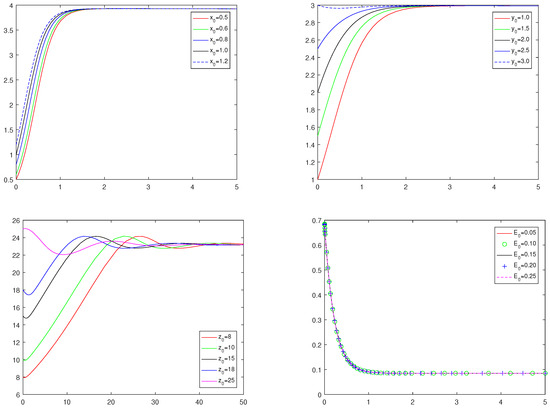
Let us now investigate the dynamic behavior of System (4). We obtain the existence of internal equilibrium by numerical simulation (Figure 1). The local stability of the internal equilibria can be studied using the phenomenon of singularity-induced bifurcation (SIB). From System (4), we have the following matrix:
where represents the matrix of partial derivatives of the components of with respect to X [26].
In order to test the existence of the SIB phenomenon, we take the total economic rent as a bifurcation parameter. Thus, we have the following theorem.
Theorem 1.
The differential-algebraic System (4) has a singularity-induced bifurcation at the internal equilibrium . When the bifurcation parameter increases through zero, the stability of the internal equilibrium point changes from stable to unstable(see Appendix A).
According to the above theorem, when the harvest economic benefit is positive, the equilibrium of System (4) becomes unstable. From the economic viewpoint, it is clear that the fishing agencies are interested in positive economic rents from the fisheries. Therefore, in order to stabilize the System (4) at the equilibrium , it is possible to design a system with a state feedback controller of the form , where represents the net feedback gain [26]. After introducing the above state feedback controller, we expand System (4) to the following new system [26]:
Thus, we have the following theorem:
Theorem 2.
System (5) is stable at the internal equilibrium if the following conditions are satisfied (see Appendix B):
(1) ;
(2) ;
(3) ,
(4) ,
where
Therefore, it is possible to design a suitable control function to eliminate singularity-induced bifurcations. Similarly, the economic benefits of fishery managers can be achieved by using appropriately designed feedback controllers.
4. Optimal Control Problem
In the commercial exploitation of renewable resources, the fundamental issue from an economic point of view is to determine the optimal trade-off between present and future harvests. This section focuses on the profitable aspects of fisheries. It is assumed that price is a function that decreases as biomass increases. Therefore, in order to maximize the total discounted net income from the fishery, the optimal control problem can be formulated as follows:
where is the constant fishing cost per unit of effort, is the constant price per unit of biomass of the harvested stock, A is an economic constant, and is the instantaneous annual discount rate.
The problem (6), depending on Equation (4) and the control constraints , can be solved by applying Pontryagin’s maximum principle. The existence of optimal control is obtained by combining the convexity of the objective function with respect to ; the linearity of the differential equations in the control and the compactness of the range values of the state variables. Suppose that is an optimal control; the corresponding states are , and . We are seeking to derive the optimal control that makes .
The Hamiltonian function for this problem is
where represent the adjoint variables.
Using Pontryagin’s maximum principle [23,30,31], the adjoint equations and the transversal conditions for the optimization system can be obtained as follows:
with the transversal conditions
By solving the optimality condition,
we will obtain the formula of the optimal control as follows:
Thus, we obtain the following result.
Theorem 3.
There exists an optimal control , and the corresponding solutions , , and , that maximize . And, there exists adjoint variables , and , satisfying Equation (8) with the transversality condition Moreover, the optimal control is given by .
5. Examples and Numerical Simulations
5.1. Examples of System (4)
In this subsection, some examples and numerical simulations will be given to verify the theoretical results obtained in Section 3. To perform the simulation experiments, we use the software MATLAB 7.0.
Example 1.
Fix the following parameter values: , , , , , , , , , , , , , , , . Different values of ( ) are taken from [27].
Table 1.
Interior equilibrium and eigenvalues of System (4) for different net revenues.
Remark 1.
It is worth noting that the eigenvalues of System (4) are and when , whereas the eigenvalues of System (4) are and when . Thus, it is clear from Table 1 that when is increased through zero, the signs of the two eigenvalues of the characteristic polynomial of System (4) remain unchanged, but the sign of the third eigenvalue of System (4) changes from negative to positive. As a result, the stability of System (4) at the internal equilibrium point changes from stable to unstable.
Example 2.
Fix the following parameter values: , , , , , , , , , , , , , , , . Different values of ( ) are taken from [27].
Table 2.
Interior equilibrium and eigenvalues of System (5) for different net revenues.
Remark 2.
In order to stabilize the equilibrium of System (4) in the presence of positive economic benefit equal to 2.01, we can consider a state feedback controller of the form . The value of the net feedback gain can be calculated using Theorem 2. Thus, we have calculated for System (4). Let us take the value of net feedback gain to be . It is clear that all the eigenvalues are negative when is increased through zero, i.e., in case of positive economic profit, at the internal equilibrium at which the stability of System (4) can be restored. Therefore, singularity-induced bifurcation can be eliminated from System (4) at the equilibrium when net economic profit increases through zero and taken to be positive.
5.2. Examples and Numerical Simulations for Optimal Control Problem
Example 3.
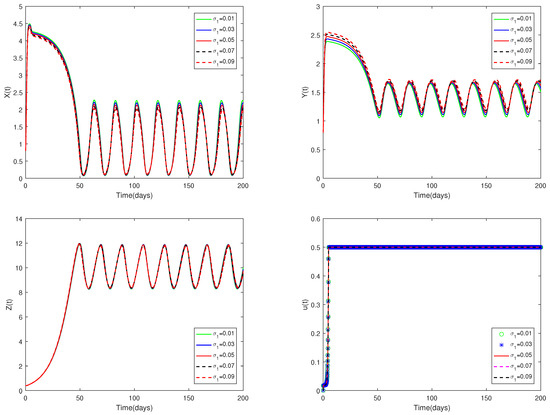
Fix the following parameter values: , , , , , , , , , , , , , , , , , . Fix the initial value as , and different values of ( ) are taken [26,27].
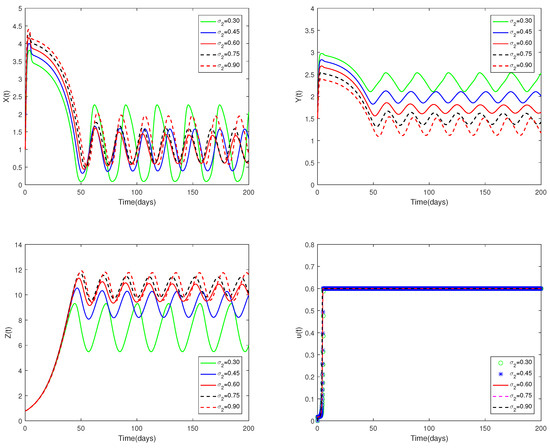
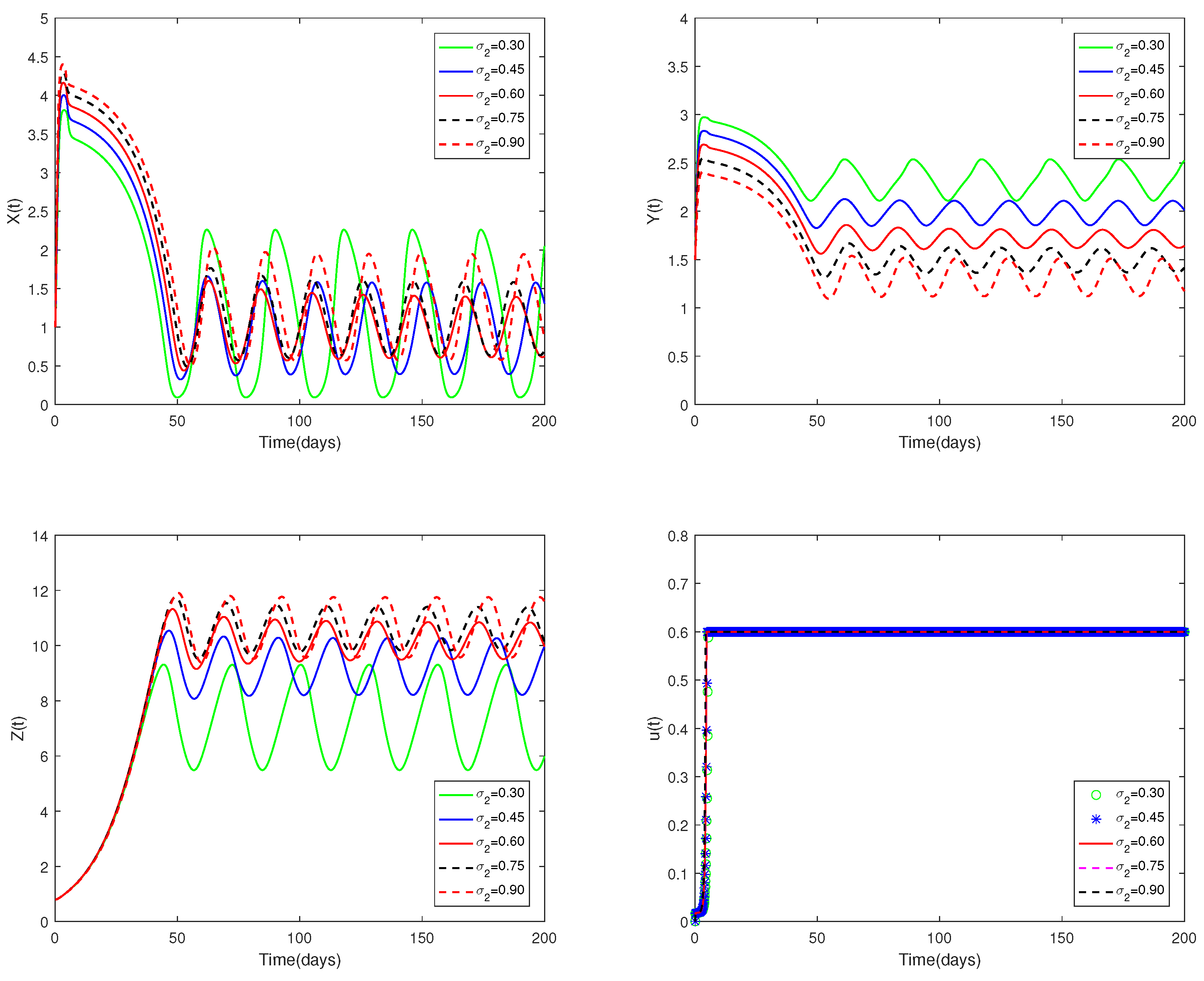
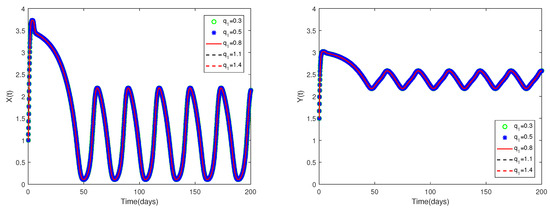
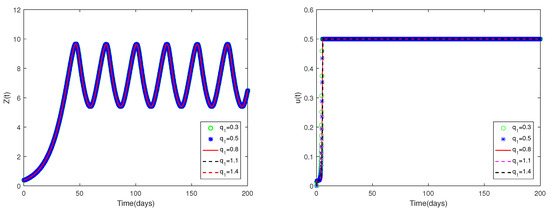
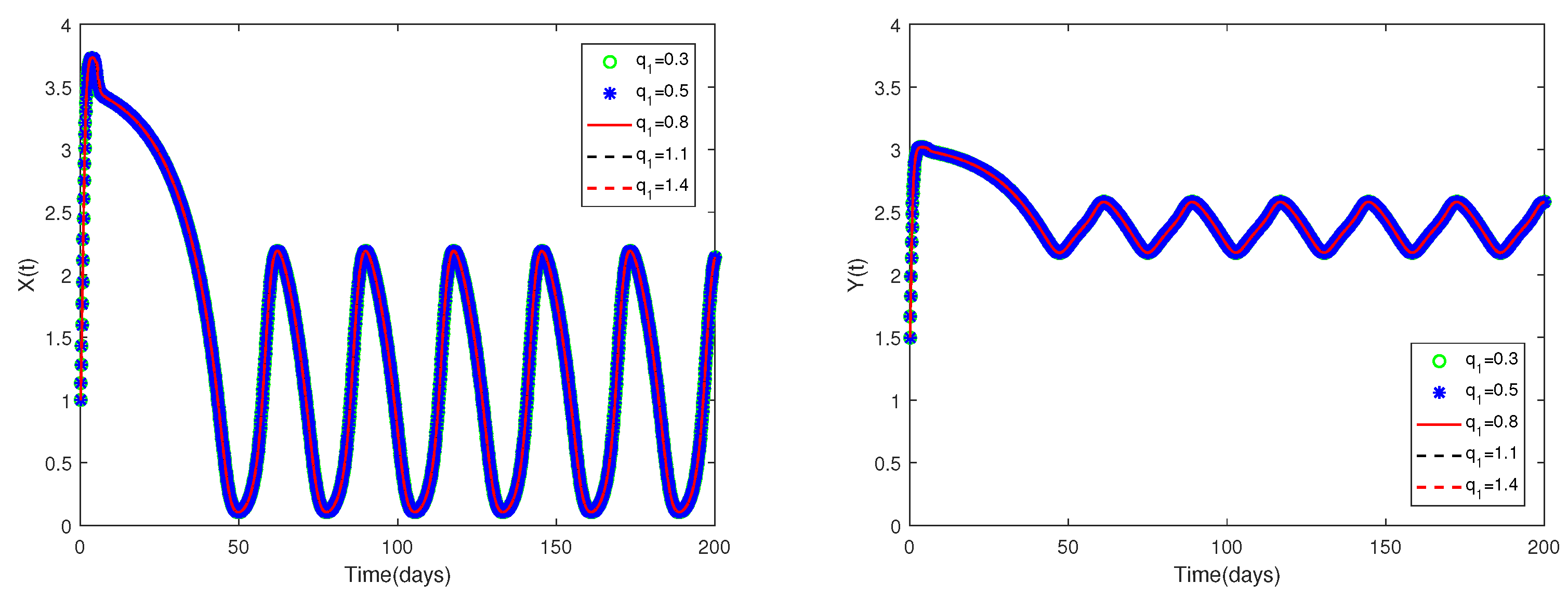
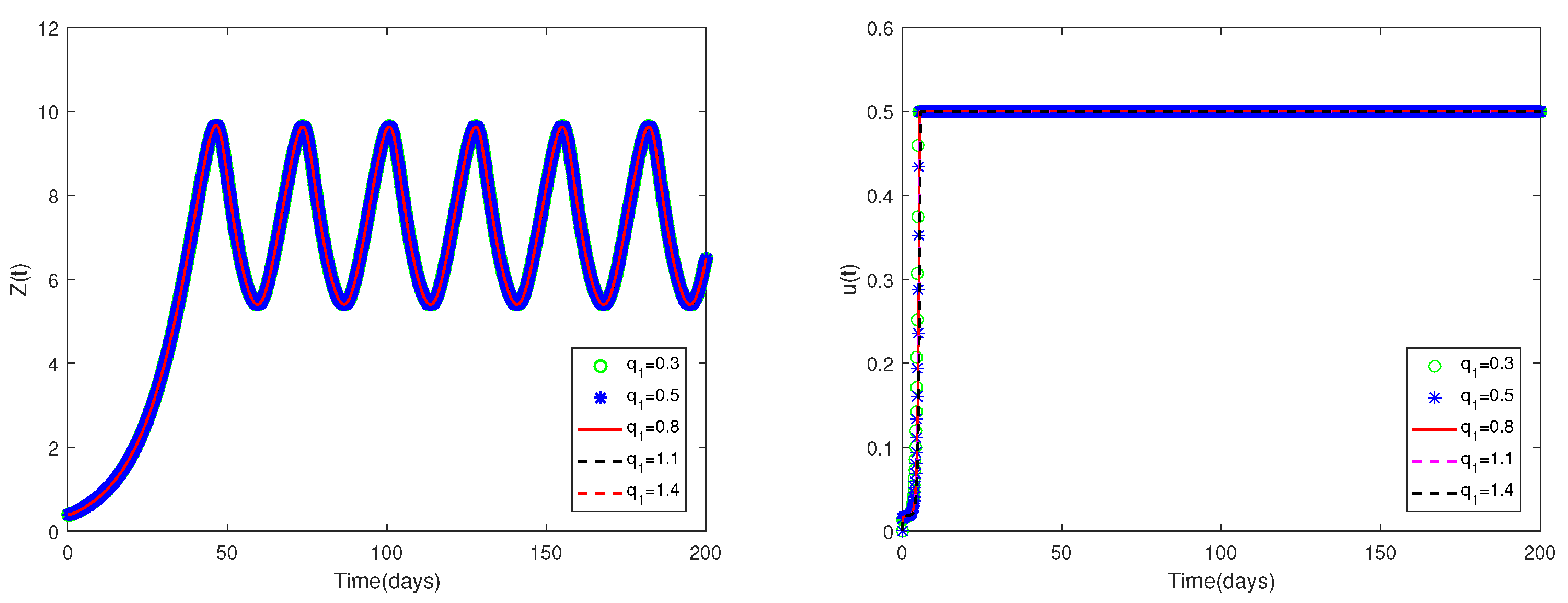
Figure 2 illustrates that when the value of is relatively small, which means the number of prey migrations from the open area to the reserve area is small when the number of prey in both areas increases sharply in a short time, then gradually decreases, and the final number changes in periodic form. Predators increase first, and then change in periodic form. The harvest rapidly increases to 0.5 in a short period of time, and then maintains this value until it decreases to zero on about the 50th day. Because the values of are very close, the curves are almost overlapping.
Figure 2.
Time series of optimal control problem for different values of . Here, the values of are relatively small [26,27].
Example 4.
Fix the following parameter values: , , , , , , , , , , , , , , , , , . Fix the initial value as , and different values of ( ) are taken from [26,27].
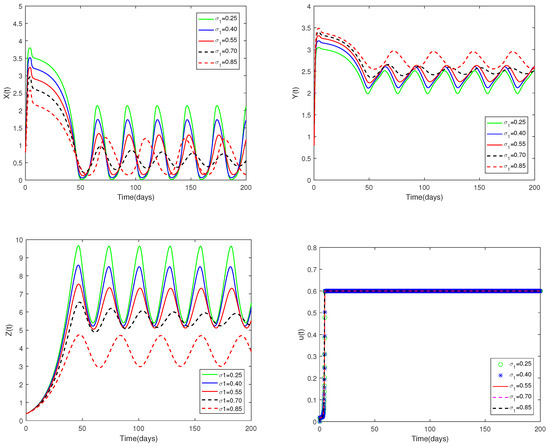
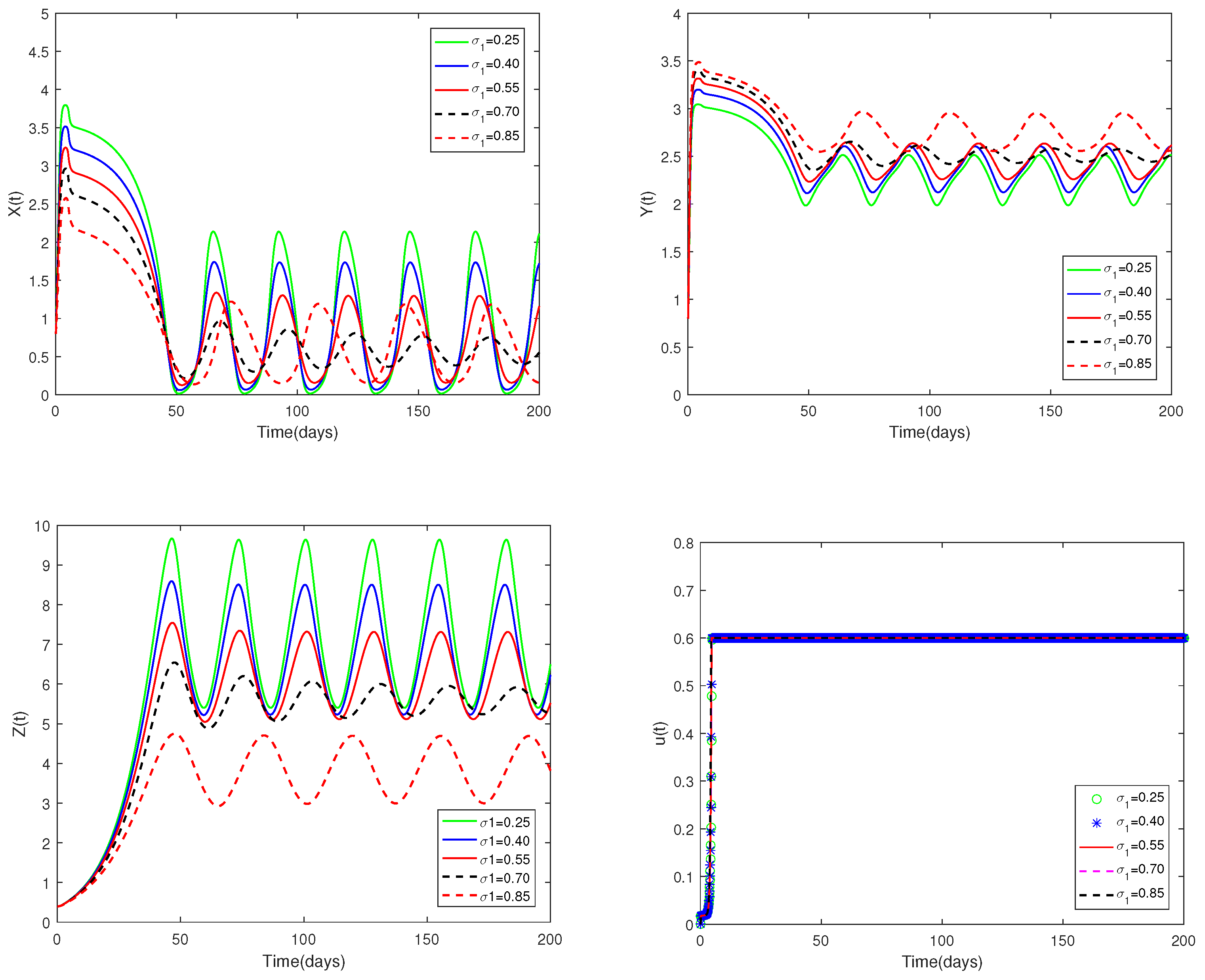
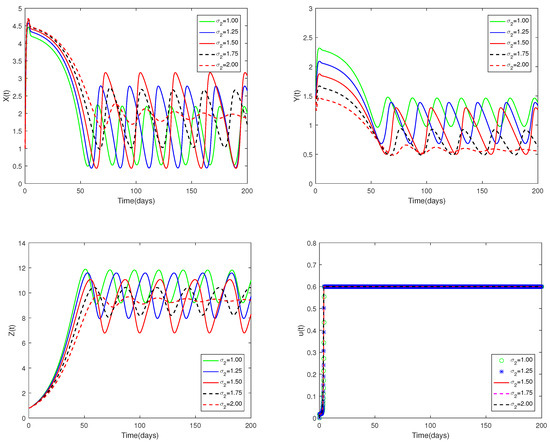
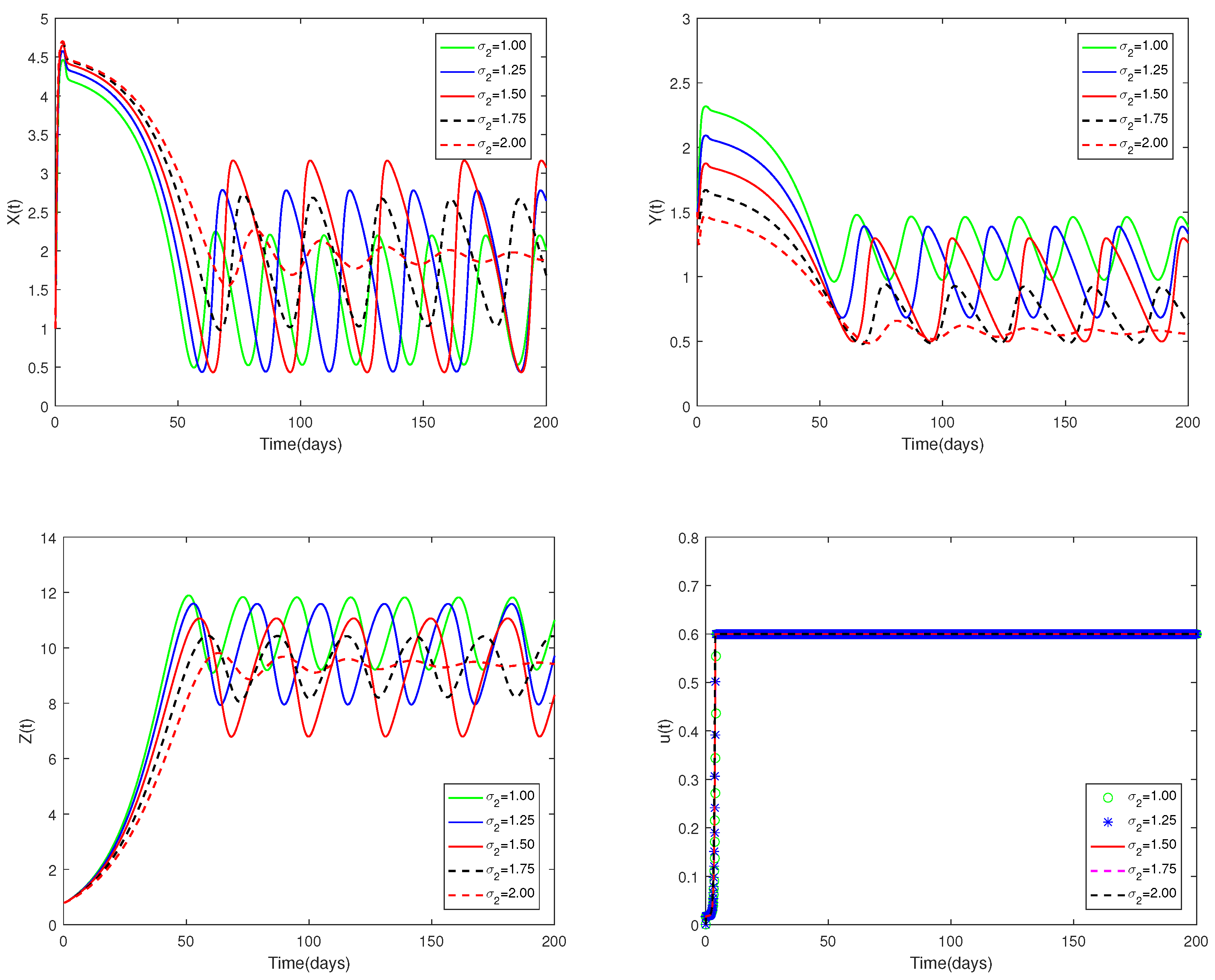
Figure 3 shows that if the value of is appropriately increased, the curves of prey and predator will change significantly. A larger value of leads to more prey in the reserve area, less prey in the open area, and less predators in each area. The harvest remains unchanged after increasing to about 0.5 on the fifth day.
Figure 3.
Time series of optimal control problem for different values of . Here, the values of are relatively large [26,27].
Remark 3.
Figure 2 and Figure 3 show that when the parameter is relatively small, the solution of the optimal control problem is insensitive to it. An appropriate increase in the migration rate from the protected area to the open area will promote the development of fisheries, and will not destroy the ecological balance.
Example 5.
Fix the following parameter values: , , , , , , , , , , , , , , , , , . Fix the initial value as , and different values of ( ) are taken from [26,27].
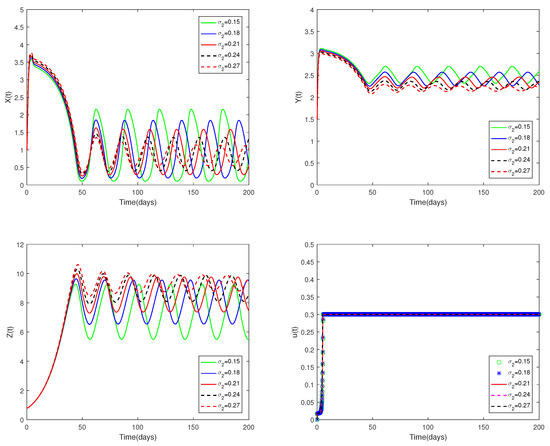
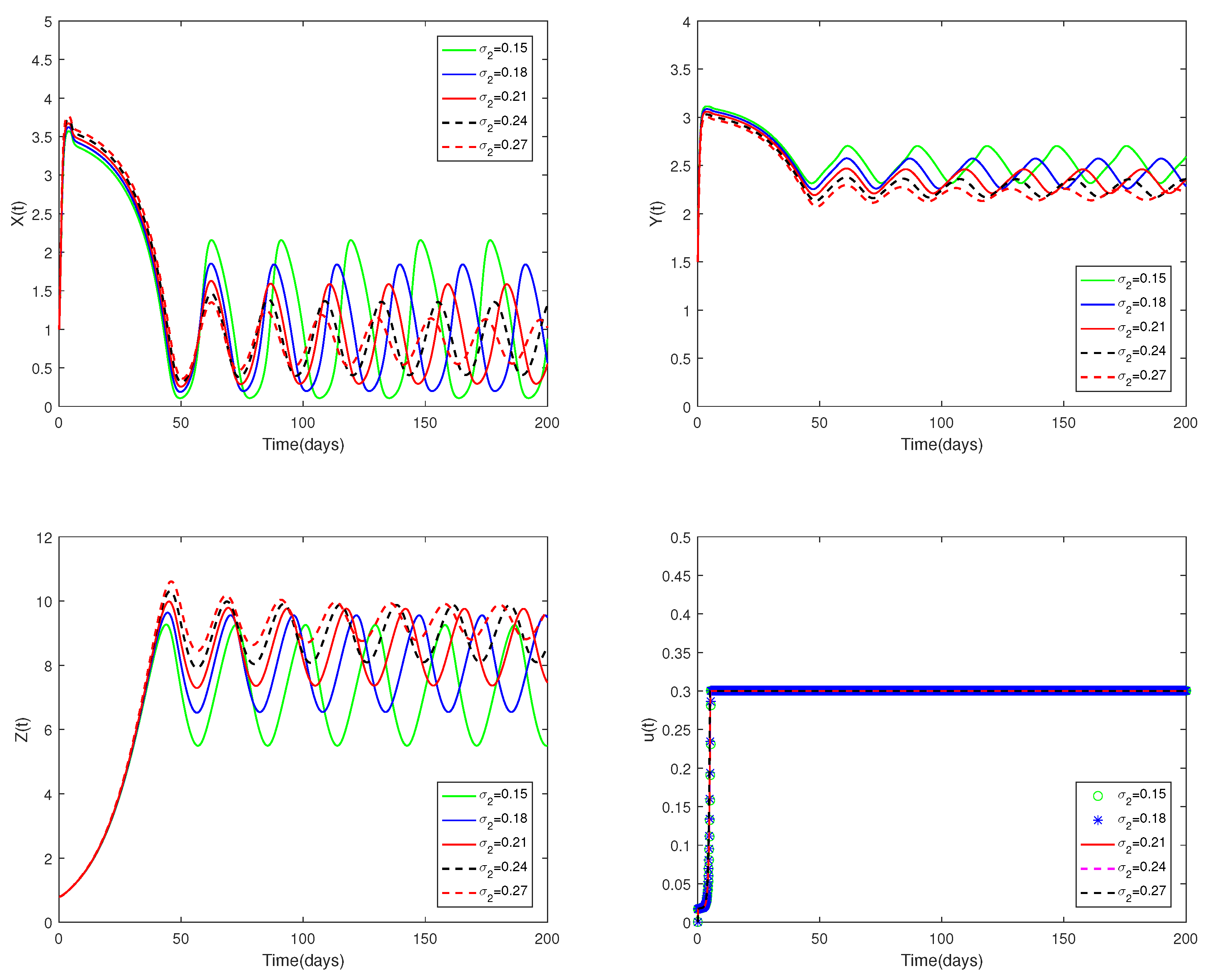
Figure 4 illustrates that when the value of is relatively small, the number of prey migration from the protected area to the open area is small when the number of prey in both areas increases sharply in a short time, then decreases, followed by periodic oscillation. The harvest remains unchanged after increasing to about 0.3.
Figure 4.
Time series of optimal control problem for different values of . Here, the values of are relatively small [26,27].
Example 6.
Fix the following parameter values: , , , , , , , , , , , , , , , , , . Fix the initial value as , and different values of ( ) are taken from [26,27].
From Figure 5, we will find that by increasing the value of , the numbers of prey and predators are significantly changed, especially the number of prey in the reserve area. As gradually increases, the number of prey in the reserved area becomes smaller. The harvest rapidly increases to about 0.6, and then remains unchanged.
Figure 5.
Time series of optimal control problem for different values of . Here, the values of are moderate [26,27].
Example 7.
Fix the following parameter values: , , , , , , , , , , , , , , , , , . Fix the initial value as , and different values of ( ) are taken from [26,27].
Figure 6 shows that when the value of is large enough, the number of prey migrations from the reserve area to the open area increases, which leads to a significant increase in the open area. The harvest rapidly increases to about 0.6 and then remains unchanged.
Figure 6.
Time series of optimal control problem for different values of . Here, the values of are large enough [26,27].
Remark 4.
Example 8.
Fix the following parameter values: , , , , , , , , , , , , , , , , , . Fix the initial value as , and different values of ( ) are taken from [26,27].
Figure 7 shows that the solution of the optimal control problem is insensitive to parameter .
Figure 7.
Time series of optimal control problems for different values of [26,27].
6. Conclusions
Here, we investigate the dynamics of the fishery model with reserved area as a regulatory mechanism. Two prey–predator models with protected areas and open areas are established. For the first model, no control is taken. The occurrence of singularity-induced bifurcation is studied, and the impact of economic profits on the system dynamics is also considered. For the second model, the optimal solution is obtained by using Pontryagin’s maximum principle.
The qualitative analysis and the numerical simulation results of system (4) are as follows:
♡ From Figure 1, we can conclude that for any positive initial value, System (4) always has an internal equilibrium point.
♡ For any internal equilibrium of System (4), it changes from stable to unstable when the economic rent increases through zero.
♡ From the perspective of fisheries, it has practical significance only if the economic component is positive. In order to stabilize the internal equilibrium of System (4), we can design a state feedback controller.
♡ The numerical simulation results show that the designed state feedback controller can restore the stability of internal equilibrium of System (4) when the economic benefit is positive.
The qualitative and numerical simulation results of the optimal control problem are as follows:
♡ By using Pontryagin’s maximum principle, we can derive the optimal control and the corresponding solution that maximizes .
♡Figure 2, Figure 3, Figure 4, Figure 5 and Figure 6 illustrate that appropriate high migration rates from protected areas (open areas) to open areas (protected areas) will promote fisheries development while not destroying sustainable ecological development.
♡ Figure 7 shows that when the catch coefficient changes, the number of prey and predators and the harvest amount remains unchanged. In other words, the catch coefficient does not affect the fishery development or the sustainable ecological development.
The whole study of this paper is mainly based on a deterministic framework. On the other hand, this would be more realistic if it were possible to incorporate ecological fluctuations and other factors into model, such as noise.
Author Contributions
Conceptualization, W.G.; methodology, R.S.; software, X.J.; validation, R.S.; formal analysis, X.J.; investigation, X.J. and R.S.; writing—original draft, X.J.; writing—reviewing and editing, W.G. and R.S.; visualization, X.J.; supervision, R.S. All authors have read and agreed to the published version of the manuscript.
Funding
This research was funded by Philosophy and Social Sciences Research Project for Higher Education Institutions in Shanxi Province (grant number 2023W061).
Institutional Review Board Statement
Not applicable.
Informed Consent Statement
Not applicable.
Data Availability Statement
The data presented in this study are available in the manuscript.
Acknowledgments
We would like to thank the anonymous reviewers for their helpful comments and suggestions, which greatly improved the quality of this paper. We would like to express our heartfelt thanks to Philosophy and Social Sciences Research Project for Higher Education Institutions in Shanxi Province for supporting this research.
Conflicts of Interest
The authors declare that they have no known competing financial interests or personal relationships that could have appeared to influence the work reported in this paper.
Appendix A
Proof of Theorem 1.
Obviously, has a single zero eigenvalue. Define
(i) By the existence of , it follows that where is the sum of the elements of the main diagonal matrix of the matrix at the internal equilibrium , and represents the adjoint matrix of matrix [25].
(ii) It can be proven that
where
(iii) It can also be shown that
From (i)–(iii), it can be observed that all the conditions for singularity-induced bifurcation are satisfied, and hence the differential algebraic System (4) has a singularity-induced bifurcation at the internal equilibrium for .
Again, similarly to [26], we take the following notations:
Therefore, the existence of an internal equilibrium implies . Hence, it can be concluded that when the increases through zero, one of the eigenvalues of System (4) along the real axis moves from the (set of all complex numbers with negative real part) to (set of all complex numbers with positive real part) [25]. Thus, the stability of System (4) is affected by this behavior, i.e., the stability of System (4) at the internal equilibrium point changes from stable to unstable.
The proof is complete. □
Appendix B
Proof of Theorem 2.
For System (5), we can obtain the Jacobian matrix at internal equilibrium as
The corresponding characteristic equation is
where
According to the Routh–Hurwitz criterion, the System (5) is stable at the internal equilibrium if the net feedback gain satisfies condition: , where is given by Theorem 2.
The proof is complete. □
References
- Kar, T.K.; Misra, S. Influence of prey reserve in a prey-predator fishery. Nonlinear Anal. 2006, 65, 1725–1735. [Google Scholar]
- Kar, T.; Pahar, U. A model for prey-predator fishery with marine reserve. J. Fish. Aquat. Sci. 2007, 2, 195–205. [Google Scholar] [CrossRef] [Scilit]
- Zhang, R.; Sun, J.; Yang, H. Analysis of a prey-predator fishery model with prey reserve. Appl. Math. Sci. 2007, 1, 2481–2492. [Google Scholar]
- Ghosh, M. Modeling prey-predator type fishery with reserve area. Int. J. Biomath. 2010, 3, 351–365. [Google Scholar] [CrossRef] [Scilit]
- Khamis, S.; Tchuenche, J.; Heiliö, M. Dynamics of fisheries with prey reserve and harvesting. Int. J. Comput. Math. 2011, 88, 1776–1802. [Google Scholar] [CrossRef] [Scilit]
- Ami, D.; Cartigny, P.; Rapaport, A. Can marine protected areas enhance both economic and biological situations? Comptes Rendus Biol. 2005, 328, 357–366. [Google Scholar] [CrossRef] [Scilit]
- Coppa, S.; Pronti, A.; Massaro, G.; Brundu, R.; Camedda, A.; Palazzo, L.; Nobile, G.; Pagliarino, E.; de Lucia, G.A. Fishery management in a marine protected area with compliance gaps: Socio-economic and biological insights as a first step on the path of sustainability. J. Environ. Manag. 2021, 280, 111754. [Google Scholar] [CrossRef] [Scilit]
- Kar, T.K.; Matsuda, H. A bioeconomic model of a single-species fishery with a marine reserve. J. Environ. Manag. 2008, 86, 171–180. [Google Scholar] [CrossRef] [Scilit]
- Biswas, M.H.A.; Hossain, M.R.; Mondal, M.K. Mathematical modeling applied to sustainable management of marine resources. Procedia Eng. 2017, 194, 337–344. [Google Scholar] [CrossRef] [Scilit]
- Chakraborty, K.; Kar, T.K. Economic perspective of marine reserves in fisheries: A bioeconomic model. Math. Biosci. 2012, 240, 212–222. [Google Scholar] [CrossRef] [Scilit] [PubMed]
- Nguyen-Huu, F.M.T.; Balde, P.A.M. A mathematical model of a fishery with variable market price: Sustainable fishery/over-exploitation. Acta Biotheor. 2014, 62, 305–323. [Google Scholar]
- Lv, Y.; Yuan, R.; Pei, Y. A prey-predator model with harvesting for fishery resource with reserve area. Appl. Math. Model. 2013, 37, 3048–3062. [Google Scholar] [CrossRef] [Scilit]
- Batista, M.I.; e Costa, B.H.; Gonçalves, L.; Henriques, M.; Erzini, K.; Caselle, J.E.; Gonçalves, E.J.; Cabral, H.N. Assessment of catches, landings and fishing effort as useful tools for MPA management. Fish Res. 2015, 172, 197–208. [Google Scholar] [CrossRef] [Scilit]
- Moussaoui, A.; Auger, P. A bioeconomic model of a fishery with saturated catch and variable price: Stabilizing effect of marine reserves on fishery dynamics. Ecol. Complex. 2021, 45, 100906. [Google Scholar] [CrossRef] [Scilit]
- Paul, P.; Kar, T.K.; Ghorai, A. Impact of marine reserve on maximum sustainable yield in a traditional prey-predator system. Commun. Nonlinear Sci. Numer. Simul. 2018, 54, 34–49. [Google Scholar] [CrossRef] [Scilit]
- Rojas-Nazar, U.A.; Eddy, T.D.; Bell, J.J.; Gardner, J.P.A. Lobster fishery and marine reserve interactions in central New Zealand. Mar. Policy 2019, 105, 67–79. [Google Scholar] [CrossRef] [Scilit]
- Pei, Y.; Chen, M.; Liang, X.; Li, C. Model-based on fishery management systems with selective harvest policies. Math. Comput. Simul. 2019, 156, 377–395. [Google Scholar] [CrossRef] [Scilit]
- Mansal, F.; Sene, N. Analysis of fractional fishery model with reserve area in the context of time-fractional order derivative. Chaos Solitons Fractals 2020, 140, 110200. [Google Scholar] [CrossRef] [Scilit]
- Javidi, M.; Nyamoradi, N. Dynamic analysis of a fractional order prey-predator interaction with harvesting. Appl. Math. Model. 2013, 37, 8946–8956. [Google Scholar] [CrossRef] [Scilit]
- Dehingia, K.; Boulaaras, S.; Gogoi, S. On the dynamics of a nutrient-plankton system with Caputo and Caputo-Fabrizio fractional operators. J. Comput. Sci. 2024, 76, 102232. [Google Scholar] [CrossRef] [Scilit]
- Zhang, Q.; Wei, K. A comparative study of fractional-order models for supercapacitors in electric vehicles. Int. J. Electrochem. Sci. 2024, 19, 100441. [Google Scholar] [CrossRef] [Scilit]
- Ang, T.K.; Safuan, H.M. Dynamical behaviors and optimal harvesting of an intraguild prey-predator fishery model with Michaelis-Menten type predator harvesting. Biosystems 2021, 202, 104357. [Google Scholar] [CrossRef] [Scilit]
- Chu, C.; Liu, W.; Lv, G.; Moussaoui, A.; Auger, P. Optimal harvest for predator-prey fishery models with variable price and marine protected area. Commun. Nonlinear Sci. Numer. Simul. 2024, 134, 107992. [Google Scholar] [CrossRef] [Scilit]
- Zevika, M.; Triska, A.; Kusdiantara, R.; Syukriyah, Y.; Fairusya, N.; Guswenrivo, I. Dynamic analysis and optimal control strategies of a predator-prey mathematical model for the pest eradication in oil palm plantation. Chaos Solitons Fractals 2024, 183, 114902. [Google Scholar] [CrossRef] [Scilit]
- Miao, L.; Zhu, L. Parameter identification of a reaction-diffusion predator-prey system based on optimal control theory. Appl. Math. Model. 2024, 133, 1–19. [Google Scholar] [CrossRef] [Scilit]
- Chakraborty, K.; Chakraborty, M.; Kar, T.K. Optimal control of harvest and bifurcation of a prey-predator model with stage structure. Appl. Math. Comput. 2011, 217, 8778–8792. [Google Scholar] [CrossRef] [Scilit]
- Chakraborty, K.; Chakraborty, M.; Kar, T.K. Bifurcation and control of a bioeconomic model of a prey-predator system with a time delay. Nonlinear Anal. 2011, 5, 613–625. [Google Scholar] [CrossRef] [Scilit]
- Ghosh, B.; Pal, D.; Kar, T.K.; Valverde, J.C. Biological conservation through marine protected areas in the presence of alternative stable states. Math. Biosci. 2017, 286, 49–57. [Google Scholar] [CrossRef] [Scilit]
- Clark, W. Mathematical Bioeconomics: The Optimal Management of Renewable Resources; Wiley Series; Wiley: New York, NY, USA, 1990. [Google Scholar]
- Venkatasubramanian, V.; Schattler, H.; Zaborszky, J. Local bifurcations and feasibility regions in differential-algebraic systems. IEEE Trans. Autom. Control 1995, 40, 1992–2013. [Google Scholar] [CrossRef] [Scilit]
- Kamien, M.I.; Schwartz, N.L. Dynamic Optimization: The Calculus of Variations and Optimal Control in Economics and Management; Elsevier: New York, NY, USA, 1991. [Google Scholar]

Disclaimer/Publisher’s Note: The statements, opinions and data contained in all publications are solely those of the individual author(s) and contributor(s) and not of MDPI and/or the editor(s). MDPI and/or the editor(s) disclaim responsibility for any injury to people or property resulting from any ideas, methods, instructions or products referred to in the content. |
© 2024 by the authors. Licensee MDPI, Basel, Switzerland. This article is an open access article distributed under the terms and conditions of the Creative Commons Attribution (CC BY) license (https://creativecommons.org/licenses/by/4.0/).