


Abstract
This review paper investigates the relationship between symmetries of knots and links in the three-dimensional sphere, with a focus on cyclic symmetries, and their associated polynomial invariants. It examines the behavior of these polynomials in the case where the knot is set-wise fixed by the action of finite cyclic group on the 3-sphere. The study highlights how these invariants can obstruct the existence of such symmetries, providing valuable insights into the topological properties of these knots. The paper reviews established results on polynomial criteria for periodicity and their extensions to freely periodic links. It also explores generalizations to study the symmetries of virtual knots and spatial graphs.
1. Introduction
Knots and links are fundamental concepts in low-dimensional topology. A knot is a closed loop embedded in the three-dimensional sphere , akin to a piece of string with its ends joined together, which cannot be untangled without cutting the loop. Knots are studied up to continuous deformations, known as isotopies, where the loop can be stretched or twisted but not broken. An n-component link consists of n such knots that may be intertwined or interlinked, with each knot remaining a distinct closed loop. Knot theory, the study of knots and links, focuses on classifying and distinguishing these objects using various mathematical invariants.
Knots and links are represented by diagrams, which are planar projections that capture their structure through over and under crossings at intersections. However, these diagrams are not unique, as different projections can represent the same knot or link. To address this, knot diagrams are considered up to a set of local transformations known as Reidemeister moves. These moves, consisting of three basic local operations—twisting a loop, moving a strand over or under another, and sliding strands past one another—allow one to modify a diagram without changing the underlying topological structure of the knot or link. By applying a finite sequence of Reidemeister moves, one can transform any two diagrams of the same knot or link into each other, confirming their equivalence. Therefore, knots and links are classified by their diagrams, considered up to equivalence under Reidemeister moves. For an introduction to the fundamentals and basics of knot theory, readers may refer to [1].
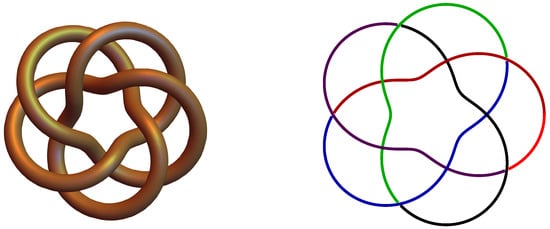
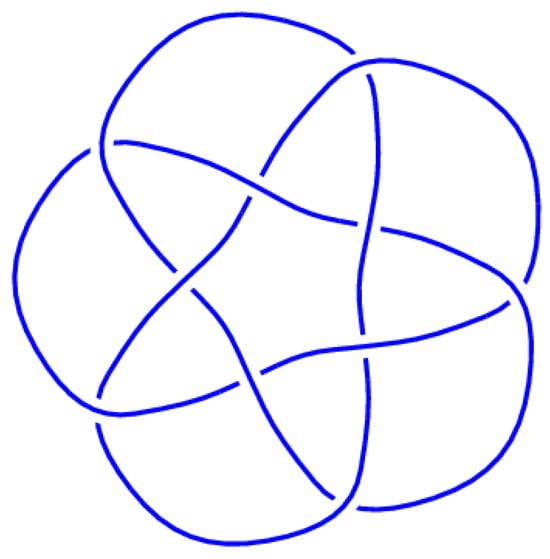
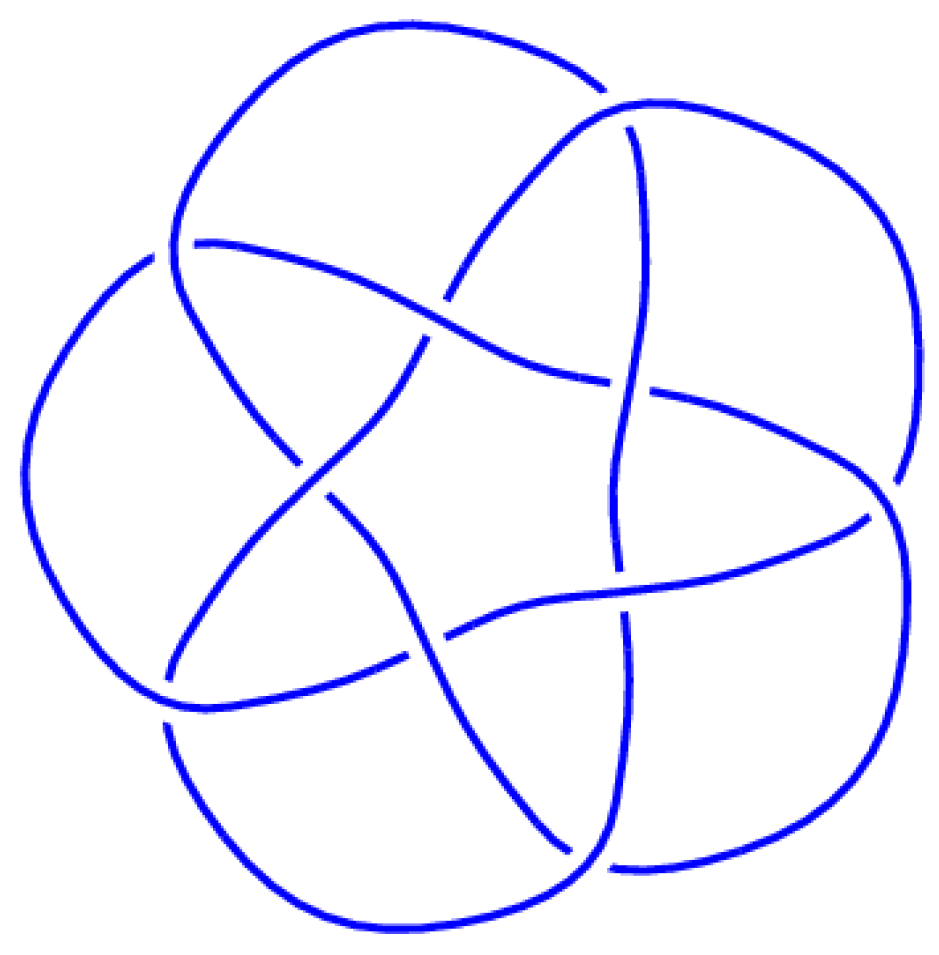
In this review paper, we focus on knots and links in which admit cyclic symmetries. In other words, those which are invariant by an action of the finite cyclic group on . We distinguish two cases depending on whether the set of fixed points is empty (free action) or is an unknotted circle (semi-free action). A link is said to be p-periodic (with an integer) if it is set-wise invariant under a rotation by an angle of and satisfies , where is the axis of rotation. If L is periodic, its quotient (or factor) link is denoted by . A link L is called freely p-periodic if it is set-wise invariant under a free action of the finite cyclic group of order p on . It is well known that a periodic link can be represented by a planar diagram that exhibits its rotational symmetry, see Figure 1. Similarly, freely periodic links can also be represented by planar diagrams that capture the link’s symmetry, though in a less direct manner [2].
Figure 1.
A 5-periodic link and its 5-periodic link diagram.
We are particularly focused on exploring the symmetries of knots and links through the study of polynomial invariants, such as the Alexander, Jones, and HOMFLYPT polynomials. These invariants are essential tools in knot theory, providing a means to distinguish knots and links. By examining how these polynomials behave in the presence of symmetries, especially rotational symmetries like p-periodicity, we gain insight into the topological properties of knots and links. Our study investigates the relationship between these polynomial invariants and the symmetries of p-periodic and freely p-periodic links, with the aim of finding obstructions to link symmetry in terms of these knot invariants. For an elementary introduction to the study of symmetries of knots and links we refer the reader to ([3], Chapter 10) and ([4], Chapter 8).
The structure of this paper is as follows: In Section 2, we review definitions and fundamental properties of periodic and freely periodic links. Section 3 provides an overview of the knot invariants that will be utilized throughout the paper. In Section 4, we review the existing literature on periodicity criteria derived from polynomial knot invariants. Section 5 extends the discussion to similar results for freely periodic links. Finally, we explore generalizations to the study of symmetries of virtual knots and spatial graphs.
2. Periodic and Freely Periodic Links
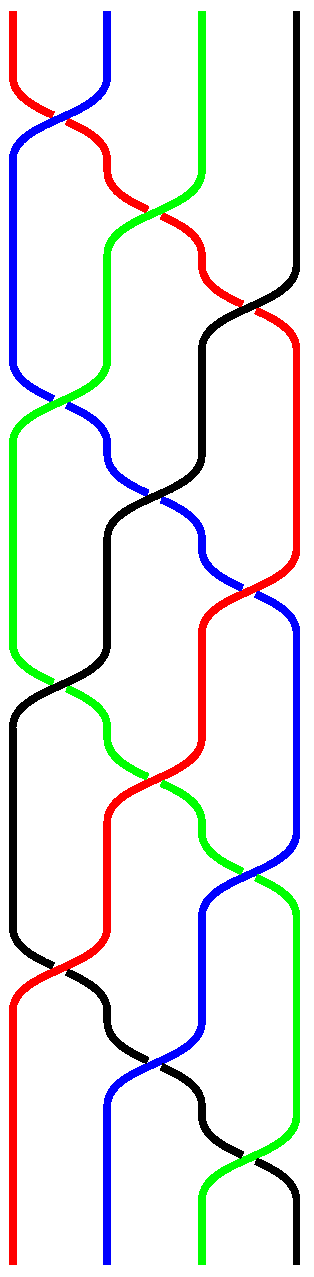
For , let denotes the group of braids on n strands with the standard elementary braids , see Figure 2. It is well known that this group is generated by modulo the following defining relations:
Figure 2.
The generators of braid group : and .
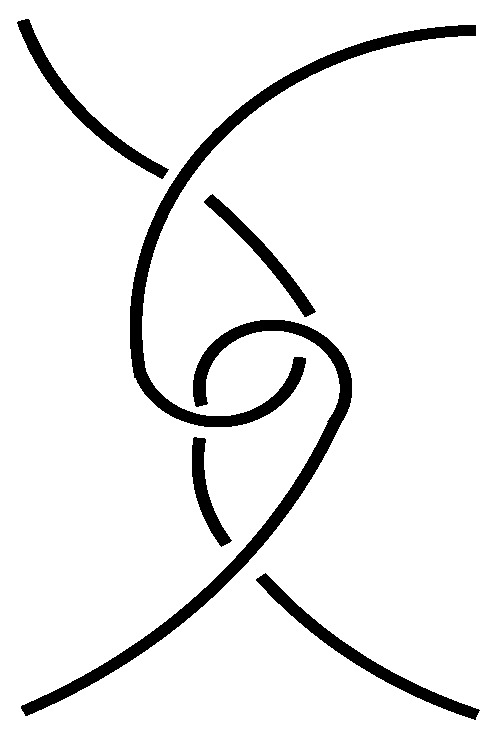
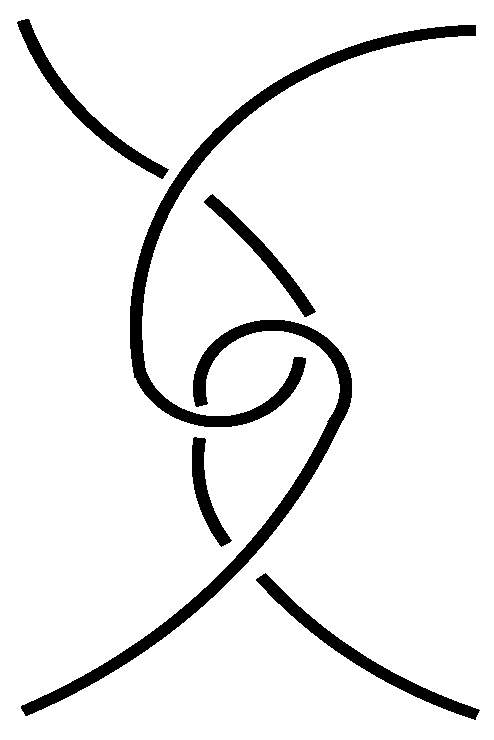
Obviously, the braid group is not abelian for . Its centre is generated by the braid ; see Figure 3. The notion of tangles is a natural generalization of braids. An n-tangle represents a portion of a knot or link diagram confined within a certain region, such as a disk, or a three-dimensional ball. Formally, an n-tangle is defined as a proper embedding of n disjoint arcs (and possibly some number of closed loops) into such that the endpoints of these arcs lie on the boundary and consist of the points and the points . The embedding is considered up to ambient isotopy. This means that two embeddings are equivalent if one can be continuously deformed into the other within , without cutting or intersecting the arcs and while keeping the boundary fixed. The multiplication of tangles is defined by concatenation; placing one tangle above the other. A 2-tangle is displayed in Figure 4. More on tangles and braids can be found in [1] for instance.
Figure 3.
The braid generates the centre of the group .
Figure 4.
A 2-tangle.
Now we shall define the types of link symmetries that we will study in the present paper. Let
and for any integers p and q with , consider the map from to itself defined by
It is worth mentioning here that if , then is a rotation through an angle of about a circle . If we consider as the one-point compactification of , then we can think of the restriction of to as a rotation about the z-axis. For simplicity we shall use the notation instead . Obviously this map defines a semi-free action of the cyclic group of order p, , on whose quotient space is homeomorphic to . In what follows, an auto-diffeomorphism h of is said to be of order if p is the smallest integer such that is the identity map.
Definition 1.
Let be an integer. A link L of is said to be p-periodic if and only if there exists an orientation-preserving auto-diffeomorphism h of such that:
- 1.
- h is of order p,
- 2.
- the set γ of fixed points by h is homeomorphic to a circle and ,
If L is periodic then we denote its quotient link by and by the linking number of K and γ.
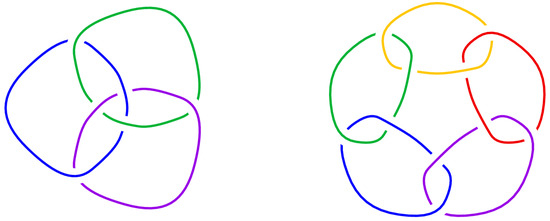
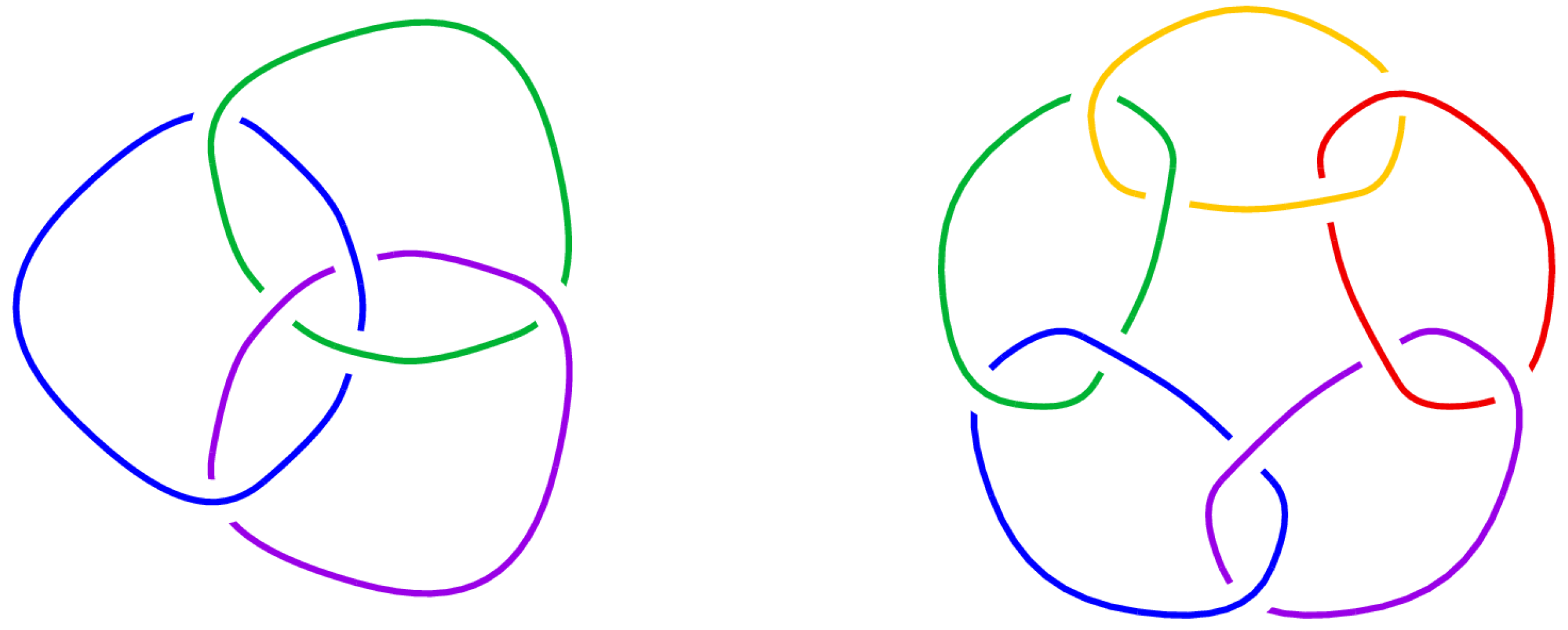
As a consequence of the positive solution of the Smith Conjecture [5], such a diffeomorphism h is conjugate to the map . Therefore, without loss of generality we can think of h as a rotation of around an axis . Consequently, a p-periodic link can be represented by a planar diagram in which is invariant by a rotation through an angle of about the origin, see Figure 5. Using this diagrammatic description one can easily see that the torus link is p-periodic whenever p divides n or m. Some important results on knot periodicity have been obtained using topological methods. In particular, Edmonds [6] proved that a p-periodic knot admits an equivariant Seifert surface of minimal genus. Flapan proved that if a knot has infinitely many periods then it is trivial [7]. More recently, Costa and Quach Hongler [8] proved that if K is a prime alternating knot that is p-periodic with , then K has a p-periodic alternating projection. Consequently, the only possible periods of a prime alternating knot K are the divisors of the crossing number of K.
Figure 5.
A 3-periodic link diagram (left) and a 5-periodic link diagram (right).
If the integers p and q are relatively prime, then the action of defined by on is free; it has no fixed points. The quotient space of under this action is the lens space .
Definition 2.
Let be an integer. A link L of is said to be freely p-periodic if and only if there exists an orientation-preserving auto-diffeomorphism h of such that:
- 1.
- h is of order p,
- 2.
- For all , has no fixed points.
Definition 3.
Let be two relatively prime positive integers with . A link L of is called a -lens link if it is invariant by .
It has been conjectured that any free action of on is conjugate to an orthogonal action [9]. In other words, any auto-diffeomorphism h of of order p which has no fixed points is conjugate to for some . This conjecture has been proved for , see [10]. A representation of lens links by planar diagrams that exhibit the symmetry has been given in [2].
Theorem 1.
Let p and q be two relatively prime positive integers and L be a link of . Then L is a -lens link if and only if there exists an m-tangle T with such that:
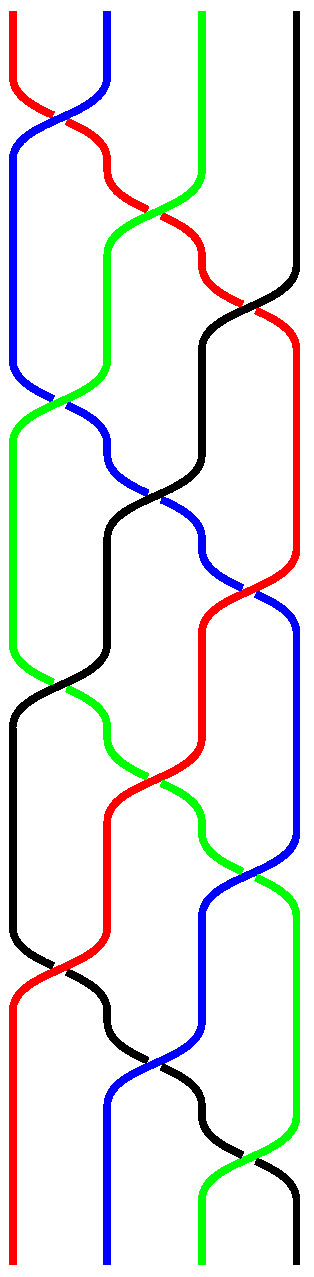
With the help of Theorem 1, one can easily construct examples of freely periodic knots and links. For instance the torus link is a -lens link, hence freely p-periodic, whenever p divides . Figure 6 displays a -lens knot and its lens diagram which can be seen as the closure of the tangle , where .
Figure 6.
A -lens knots and its diagram.
3. Knot Invariants
In this section, we will provide a brief overview of the definitions and fundamental properties of polynomial invariants of knots and links, which will be utilized in the subsequent sections to examine knot periodicity. For a more in-depth discussion of these invariants and their properties, we refer the reader to [11].
3.1. Polynomial Invariants
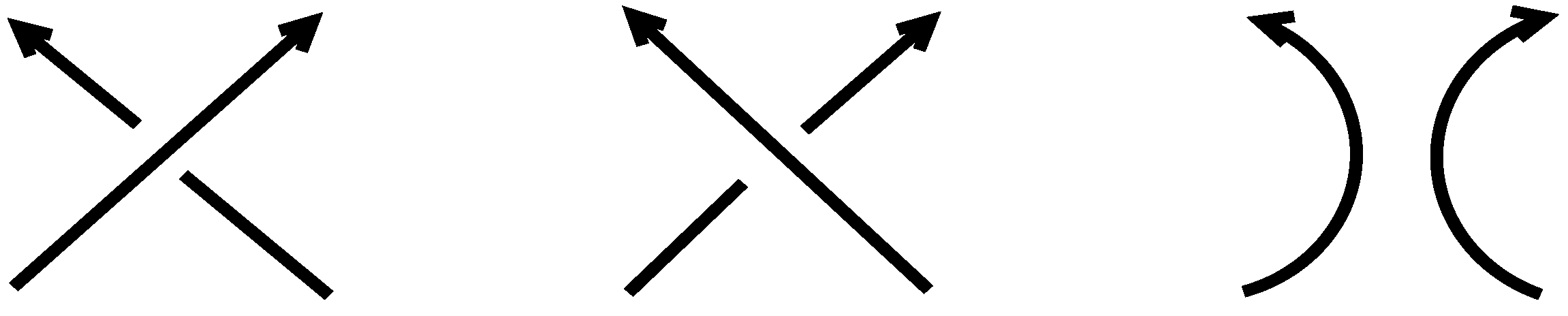
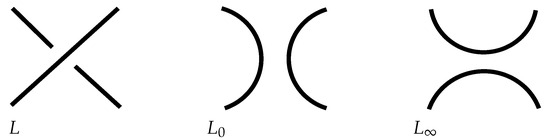
The Alexander polynomial, introduced by J. W. Alexander in 1928, is a fundamental topological invariant associated with oriented links [12]. It provides essential information about the link’s topology and can be computed using a simple recursive process known as the Conway skein relations. Specifically, the polynomial is defined as follows:
- ,
- ,
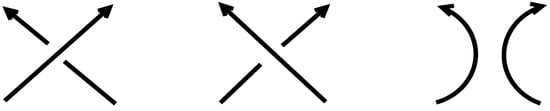
where U denotes the trivial knot and , and are three oriented links that are identical except in a small localized region. In this region, the diagrams differ as shown in Figure 7, with the links representing specific crossing changes.
Figure 7.
The oriented links , and , respectively.
In 1984, Vaughan F. Jones introduced a groundbreaking invariant of ambient isotopy for oriented links, now known as the Jones polynomial and denoted hereafter as . This invariant takes values in the ring and is defined recursively using a skein relation. The Jones polynomial provides a powerful tool for distinguishing between different knots and links, offering greater sensitivity than earlier invariants. It can be computed through the following recursive process [13]:
- ,
- ,
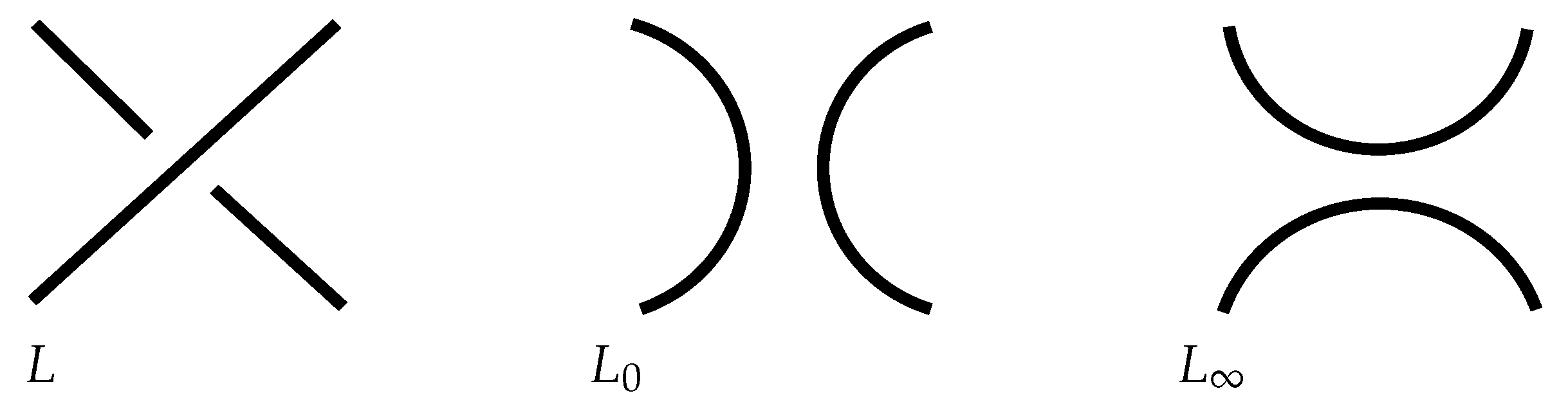
An alternative definition of the Jones polynomial is given by Kauffman using the bracket polynomial [14]. The Kauffman bracket polynomial is an invariant of regular isotopy of links, introduced by Kauffman shortly after the discovery of the Jones polynomial. This invariant, which takes values in , can be defined recursively by the following skein relations:
where ◯ stands for the trivial knot and L, and are three links which are identical except in a three-ball where they are like in Figure 8.
Figure 8.
The links L, and respectively.
Given a link L and D a diagram of L. The Jones polynomial of L is obtained from the bracket polynomial through the formula: , where is the writhe of D and is the bracket polynomial of D with orientation ignored.
The HOMFLY polynomial, also known as the HOMFLYPT polynomial, is a two-variable knot invariant that generalizes both the Alexander and Jones polynomials. It was introduced in 1986 by Hoste, Ocneanu, Millett, Freyd, Lickorish and Yetter [15] and Przytycki and Traczyk [16]. This polynomial, denoted hereafter , is an invariant of oriented links which satisfies the following relations:
- ,
The HOMFLYPT polynomial reduces to the Alexander polynomial when and and to the Jones polynomial when and .
Another two-variable polynomial invariant of links has been introduced by Kauffman [17]. This invariant which specializes to the Jones polynomial is defined as follows. First consider the invariant of regular isotopy of nonoriented link diagrams defined through the following relations:
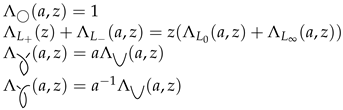 where , , and are four links which are identical except in a small ball where they are as displayed in Figure 9.
Figure 9.
, , and , respectively.
Let D be an oriented link diagram of a link L. Then, the two-variable Kauffman polynomial of L is defined by , where is obtained by forgetting the orientation of D. The polynomial is an invariant of ambient isotopy of links which specializes to the Jones polynomial through the relation .
3.2. Categorification
In his seminal work [18] Khovanov introduced a bi-graded link homology theory whose graded Euler characteristic corresponds to the Jones polynomial. Let L be an l-component oriented link, and let denote its reduced Khovanov homology. The Jones polynomial of L can be expressed as:
Following Khovanov’s work on the categorification of the Jones polynomial, a categorification of the Alexander polynomial was developed independently by Ozsváth and Szabó [19], and by Rasmussen [20]. They defined a bi-graded link homology theory, , known as link Floer homology. This theory provides an alternative perspective on the Alexander polynomial. Specifically, for any l-component link L, the graded Euler characteristic of is, up to a multiplicative factor, the Alexander polynomial of L. More precisely, we have:
It is also worth noting that a similar categorification has been established for the HOMFLYPT polynomial. In its one-variable specialization , defined in [21], this polynomial arises as the graded Euler characteristic of the Khovanov-Rozansky homology of the link [22].
4. Invariants of Periodic Links
In this section, we will review the literature on various criteria introduced to study the periodicity of knots and links through the use of polynomial invariants.
4.1. The Alexander Polynomial
The first general result introducing restrictions on the possible periods of a given knot in is due to Trotter [23] using group-theoretic arguments. Indeed, in 1961 Trotter proved that if a knot K is p-periodic, the commutator subgroup of the fundamental group of the knot is free, and the Alexander polynomial has no repeated roots, then the splitting field of contains the roots of unity. A decade later, Murasugi [24] introduced new criteria for knot periodicity and gave several examples of knots where these criteria are used as obstructions to periodicity. In particular, Murasugi proved the following theorem:
Theorem 2
([24]). Let p be a prime, and K a -periodic knot in , then satisfies the following condition
for some knot polynomial and a positive integer k relatively prime to p.
The theorem above was readily used to prove that the only periods of the torus knot are the divisors of n and m. It is worth noting that this result regarding the periods of torus knots can also be derived using the topological arguments developed in [25].
Murasugi’s congruence, presented in Theorem 2, is based essentially on relating the Alexander polynomials of the periodic knot K and its factor knot . This result has been generalized in various related studies. In particular, Burde [26,27] extended this congruence to periodic knots in homology spheres. Hillman provided homological proofs of the results of Murasugi and Burde [28,29] and extended them to the Alexander module of knots [30,31]. Sakuma [32] generalized Murasugi’s condition to the multi-variable Alexander polynomial of periodic links. Davis and Livingston suggested alternative proofs of Murasugi’s congruence in [33] and examined the sufficiency of the condition in [34]. Miyazawa proved similar results for the Conway polynomial [35]. Other research work related to Murasugi’s results on the Alexander polynomial and related invariants of periodic knots can be found in [36,37,38,39,40].
4.2. The Jones Polynomial
In [41], Murasugi proved that the Jones polynomial of a periodic link satisfies a congruence relation involving the polynomials of the periodic link and its factor link. This finding, which is similar to the results obtained in the case of the Alexander polynomial, can be stated as follows:
Theorem 3
([41]). Let p be a prime, and L a -periodic link. Then
where .
As noted by Murasugi, the condition in Theorem 3 above has more theoretical than practical value as it is difficult to apply to study knot periodicity in general. Traczyk, used the Kauffman bracket to prove another necessary condition for the Jones polynomial of periodic links [42]. More refined and precise versions of Murasugi’s and Traczyk’s results have been introduced in [43,44]. In particular, Yokota proved the following:
Theorem 4
([44]). Let p be an odd prime and K a p-periodic knot. We have:
- (i)
- if , then
- (ii)
- if , thenand
The work of Murasugi and Traczyk on the Jones polynomial of periodic links was extended by Przytycki to the HOMFLYPT polynomial [45]. Similar results have been obtained by the author for the -quantum invariant of links [46]. Przytycki and Sikora further generalized this result to the -quantum invariants of links [47]. Additionally, Chen and Le [48] demonstrated that Murasugi’s congruence holds for quantum invariants of periodic links associated with any complex simple Lie algebra and any irreducible representation thereof. Other related research work can be found in [49].
4.3. The HOMFLYPT Polynomial
Murasugi’s congruence [24] has been a significant result in the study of periodic knots, providing a deep connection between knot periodicity and the behavior of knot polynomials. This result has been foundational in the study of knot symmetries and is so natural that it extends beyond the Alexander polynomial to all knot invariants derived from quantum groups. These quantum invariants inherit similar congruence properties, reinforcing the idea that periodicity fundamentally influences the structure of knot invariants. However, despite its broad applicability, Murasugi’s congruence has limitations. It is not easily used as an obstruction criterion to rule out periodicity, meaning that while it provides necessary conditions for periodicity, it often lacks the strength to definitively exclude certain knots from being periodic. This limitation has led to ongoing efforts in knot theory to develop more refined tools that can complement Murasugi’s congruence in detecting and obstructing knot periodicity. These tools will be discussed in the following paragraphs.
Recall first that the HOMFLYPT polynomial takes values in the ring . More specifically, for an n-component link K, it can be expressed as
where if n is odd, and if n is even. In the special case when K is a knot, this reduces to
where the coefficients lie in . Traczyk [50,51] established a powerful criterion for detecting knot periodicity using the polynomial .
Theorem 5
([50]). Let p be an odd prime and K be a p-periodic knot with , then where whenever modulo p.
The advantage of Traczyck’s periodicity criterion is that it is simple and very practical when compared to other periodicity criteria. Let us illustrate this by the following example.
Example 1.
According to [52], the HOMFLYPT polynomial of the knot is given by:
Hence the polynomial with coefficients reduced modulo 5 is:
which clearly does no satisfy the condition given by Theorem 5 above. Thus, the knot is not 5-periodic.
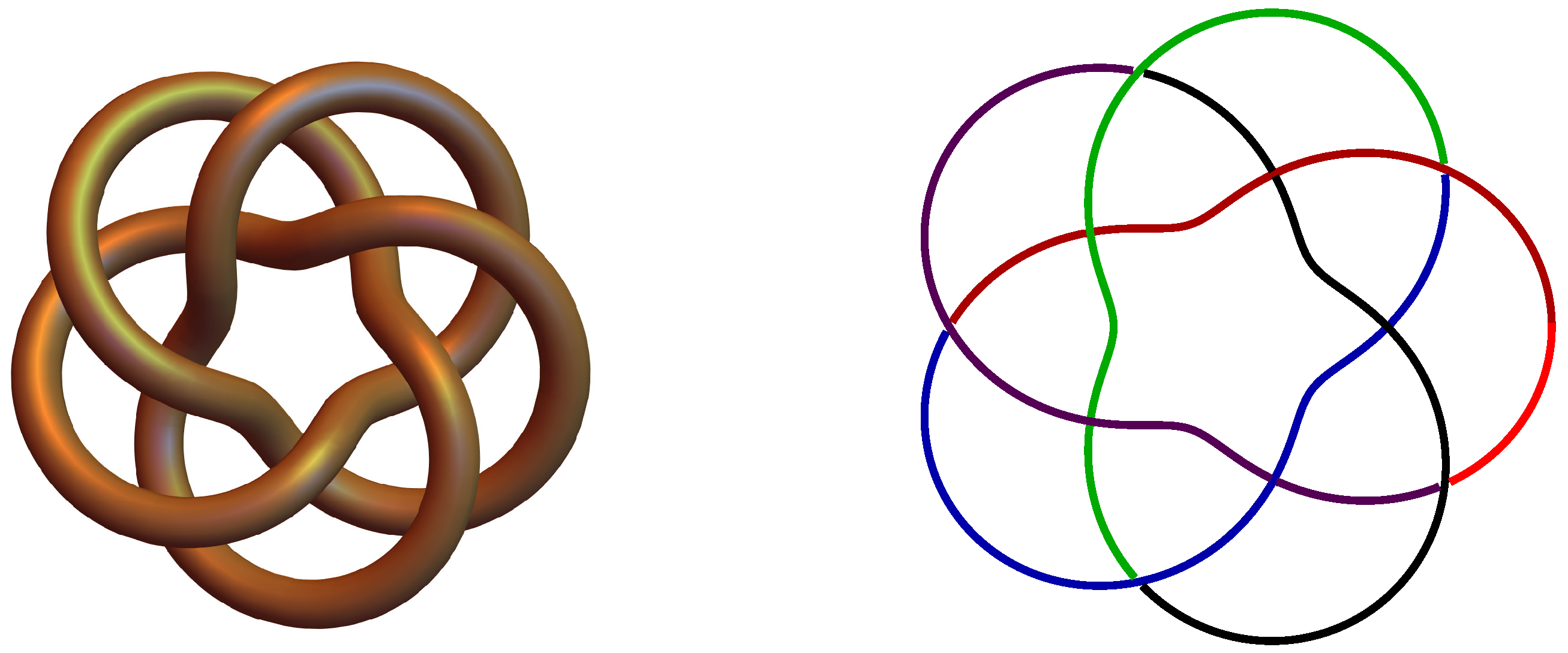
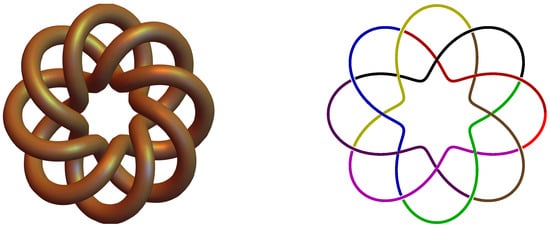
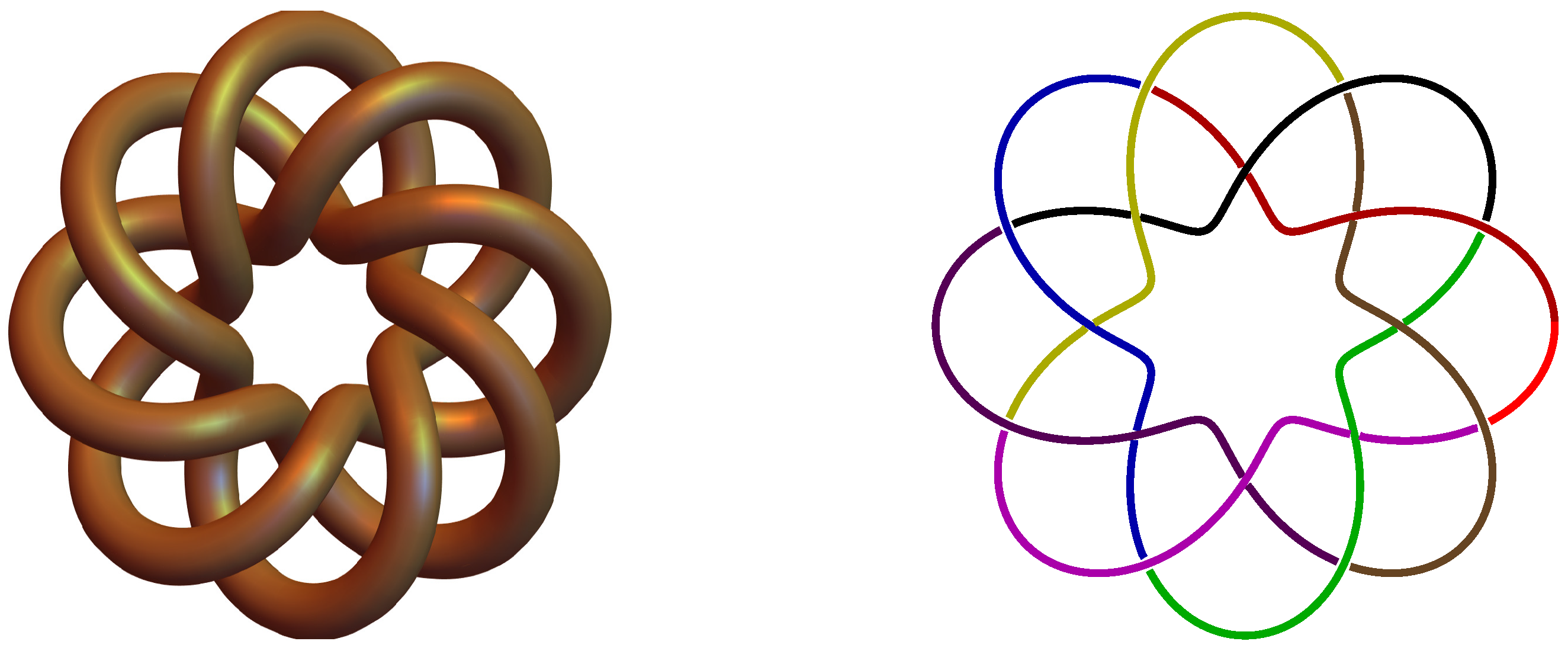
Indeed, Traczyck applied his result to study the 5-periodicity of the 165 prime knots with 10 crossings. Out of these, the torus knot and the -weaving knot are obviously 5-periodic, see Figure 10. The criterion rules out 149 of the remaining 163 knots. For the last 14 knots, the criterion can be applied on appropriate satellites to rule out the 5-periodicity.
Figure 10.
The weaving knot 10123.
Yokota [53], proved that the regularity of the polynomial given in Theorem 5 extends to first polynomials as well. More precisely, Yokota proved the following:
Theorem 6
([53]). Let p be a prime and K be a p-periodic knot. Then for all , we have:
for some integers .
It is noteworthy that both Traczyk and Yokota established their results by using equivariant crossing changes to reduce the periodic knot diagram to a diagram of a torus knot, while maintaining some control over the knot polynomial modulo p. They then examined Jones’s formula for the HOMFLYPT polynomial of torus knots [54]. On the other hand, Przytycki [55] provided an elementary proof of Theorems 5 and 6 using Jaeger decomposition product of the HOMFLYPT polynomial [56].
We conclude this discussion with the following two natural questions.
Question 1.
Both Theorem 5 and Theorem 6 apply to periodic knots but not to periodic links with more than one component. Are there obstruction criteria of the same type which are valid for periodic links?
Question 2.
Is it possible to obtain explicit formulas for the coefficients in Theorem 6?
4.4. The Two-Variable Kauffman Polynomial
Inspired by the effective periodicity criteria derived from the HOMFLYPT polynomial, Yokota investigated the behaviour of the two-variable Kauffman polynomial of periodic knots [57] and proved similar obstruction to knot periodicity. It is well known that if K is a knot then where is a polynomial on with integral coefficients.
Theorem 7
([57]). Let p be an odd prime and K a p-periodic knot. Then,
Furthermore, for , we have
where , for , are integers.
In a later paper, Yokota [58] proposed another criterion for knot periodicity that combines results about both the HOMFLYPT and Kauffman polynomials. More recently, new periodicity criteria involving the HOMFLYPT and Kauffman polynomials have been discussed in [59].
4.5. Link Homology
As discussed in Section 3, the Alexander and Jones polynomials can be viewed as the graded Euler characteristics of the link Floer homology and the Khovanov homology, respectively. A natural question that arises in this context is whether the regularity of these polynomials for periodic links, as described in Theorems 2 and 3, extends to necessary conditions on the level of the homology. This question has been addressed in several recent papers.
Given a periodic link L with γ the axis of the rotation. Hendricks [60] constructed equivariant Heegaard diagrams for periodic knots, establishing a relationship between the link Floer homology of and that of the quotient link . Hendricks also provided an alternative proof of Murasugi’s result on the Alexander polynomial of periodic knots. Additional results on the link Floer homology of periodic knots can be found in [61,62].
The study of Khovanov homology of periodic links has been initiated by the author, who proposed constructing an equivariant homology for symmetric links [63]. Politarczyk further developed this concept in [64,65], notably constructing an equivariant version of the Jones polynomial and refining the periodicity criteria introduced in [41,45]. Further obstructions to knot periodicity via Khovanov homology are discussed in [66,67,68].
4.6. Other Invariants
Przytycki discussed the use of the Vassiliev invariants to study knot periodicity [69]. Naik [70] used the Casson–Gordon invariants and homology groups of cyclic branched covers of to establish necessary conditions for a knot to be periodic. Hillman, Livingston and Naik [71] proved a version of Theorem 2 for the twisted Alexander polynomial of periodic knots.
5. Invariants of Freely Periodic Links
Polynomial invariants of freely periodic links have been explored in several research papers, though the results achieved using these invariants are not as strong as those obtained for rotational symmetry, as discussed in the previous section. This is partly due to the fact that the quotient of under a free action of a finite group is a lens space, rather than itself as it is the case of semi-free actions. Hartley [72] investigated the Alexander polynomial of freely periodic knots and uncovered an interesting relationship between freely periodic and periodic knots. Specifically, Hartley’s work shows that if K is a freely p-periodic knot in , then there exists a p-periodic knot in a homology sphere M with the same Alexander polynomial as K. He used this result to improve a previous finding by Kinoshita [73]. We now present the results obtained in terms of the Jones [74] and HOMFLYPT polynomials [75]. Murasugi’s results on Jones polynomial of periodic knots stated in Theorem 3 extends to lens knots as follows:
Theorem 8
([74]). Let K be a -lens knot, where p is an odd prime and is an integer. Then there exists an m-tangle T, such that:
where I is the ideal of generated by p and .
Notice that setting in Theorem 8 gives a version of the congruence in Theorem 3. The behaviour of the HOMFLYPT polynomial of freely periodic links has been studied in [75] where a necessary condition for a knot to be a lens knot has been obtained in terms of the polynomial . This result, which can be seen as an extension of Theorem 5, is given in the following theorem:
Theorem 9
([75]). Let p be an odd prime and . If K is a -lens knot then
where is the -module generated by the polynomials modulo p, for .
It is worth mentioning here that for small values of p we can easily examine the generators of to obtain precise congruence relations satisfied by the coefficients of the polynomial . For instance:
- If K is freely 3-periodic then where modulo 3 whenever i is not a multiple of 3.
- If K is a -lens knot, thenwith: and modulo 5, for all k.
Remark 1.
Let us illustrate the condition given in Theorem 9 above with the following example. The knot is freely 3-periodic as it is the closure of , where T is the 2-tangle in Figure 4. Its HOMFLYPT polynomial is given by:
Clearly, the polynomial with coefficients reduced modulo 3 satisfies the condition in Theorem 9. On the other hand, for the knot , we have:
Thus,
which does not satisfy the necessary condition given by Theorem 9 to be freely 3-periodic. Indeed, this necessary condition rules out the free 3-periodicity of 72 out of the 84 prime knots with at most 9 crossings.
The arguments used to prove Theorem 9 are similar to the ones developed by Traczyk in [50], so they are essentially based on using equivariant crossing changes to reduce the lens diagram of the knot to a torus knot. Similar results on the polynomial of lens knots can be found in [76]. We conclude this section by the following two questions.
Question 3.
The free-periodicity obstruction criterion in Theorem 9 is valid only for . Does an analogous necessary condition hold for other values of q?
Question 4.
Unlike the case of periodic knots, where necessary conditions have been derived in terms of the first polynomials , the study of free periodicity has been limited to the first two coefficients and . Can these results be extended to for ?
6. Generalizations
6.1. Periodic Virtual Knots
Virtual knots, introduced by Kauffman [77] in 1999, expand classical knot theory by incorporating virtual crossings, which represent abstract interactions in knot diagrams rather than actual over/under crossings. This extension enables the study of knots on thickened surfaces of higher genus, offering a more versatile topological setting than traditional 3-dimensional knots. Virtual knots are governed by a set of generalized Reidemeister moves, which include both classical and virtual moves, providing a consistent framework for determining virtual knot equivalence. This broader approach has led to the development of new invariants and tools for distinguishing virtual knots, such as virtual analogues of the Alexander polynomial, Jones polynomial, Kauffman bracket, and other knot invariants. A natural question that has been addressed by many scholars is how do these invariants reflect symmetries of virtual knots.
A virtual knot K is said to be p-periodic if it admits a virtual knot diagram in which is invariant under a rotation about the origin by a angle of . Boden, Nicas and White [78] studied the Alexander polynomial of periodic virtual knots and proved that it satisfies a condition similar to the one presented in Theorem 2. Other obstructions for virtual link periodicity can be found in [79,80,81,82,83,84,85].
6.2. Periodic Spatial Graphs
Spatial graphs extend the concept of knots and links by considering embeddings of graphs, rather than just circles, in . Specifically, a spatial graph consists of vertices and edges embedded in , allowing for the exploration of more intricate structures such as branching points and multiple connected components, beyond the simple closed loops seen in knot theory. Like knots and links, spatial graphs can be studied through their crossings, entanglements, and various topological invariants. Spatial graphs are typically represented by their regular projections onto the plane, and the classification of spatial graphs up to isotopy is equivalent to studying their projections under a set of local moves, known as generalized Reidemeister moves [3]. The Yamada polynomial, introduced in [86], is a topological invariant of spatial graphs, defined recursively using skein-type relations. It serves as an extension of the Kauffman bracket to spatial graphs. A spatial graph is called p-periodic if it admits a projection in that is invariant under a rotation by an angle of about the origin. Inspired by the results on the Jones polynomial of periodic knots, obstructions to the periodicity of spatial graphs have been introduced, with results expressed in terms of the Yamada polynomial, see [76,87,88].
7. Conclusions and Discussion
Knot polynomials, such as the Alexander, Jones, and HOMFLYPT polynomials, have been used to establish useful criteria for studying knot periodicity. These polynomials have been instrumental in formulating necessary conditions that serve as obstructions to determining whether a knot is periodic. In particular, the HOMFLYPT polynomial has proven highly efficient in detecting and obstructing both knot periodicity and free-periodicity. Some of these obstruction criteria have even been generalized to virtual knots and spatial graphs. However, despite these successes, there are notable limitations.
The first major issue in the literature is that polynomial invariants used to study knot periodicity provide necessary rather than sufficient conditions. These polynomials serve mainly as obstructions to periodicity, indicating when a knot cannot be periodic, but they do not definitively prove when a knot is periodic. For example, reductions in polynomials can show that a knot does not have a certain periodic structure, but they fail to guarantee periodicity when the conditions are satisfied. While the work of Davis and Livingston [34] on the Alexander polynomial represents an exception, discussing sufficient conditions for periodicity, no such sufficient condition has been discovered for other polynomial invariants such as the Jones or HOMFLYPT polynomials. This gap significantly limits the utility of polynomial invariants in providing a comprehensive understanding of knot periodicity.
The second critical issue is that the techniques developed to study periodicity using the HOMFLYPT and Jones polynomials rely heavily on combinatorial and diagrammatic methods. These methods are particularly useful for periodic links, where symmetries can be captured through a diagrammatic description of the knot or link in question. However, these methods have inherent limitations. They cannot easily be extended to study other types of symmetries, such as dihedral symmetry, because such symmetries lack a clear diagrammatic representation. Without a systematic diagrammatic description for more complex symmetries, the tools developed for studying periodic links become ineffective. This severely limits the scope of current research, as many knot symmetries fall outside the reach of these combinatorial techniques. We conclude this paper by highlighting several problems on the topic that remain to be addressed:
Problem 1.
The HOMFLYPT polynomial has proven to be a powerful tool in identifying obstructions to knot periodicity. However, it is not yet clear whether these obstructions extend to the triply-graded homology of links, whose Euler characteristic corresponds to the HOMFLYPT polynomial [22]. Can these deeper homological structures also provide new insights or obstructions?
Problem 2.
While knot polynomials have been used to study cyclic symmetries, it remains an open question whether they can detect more complex, non-cyclic symmetries, such as dihedral symmetries. Investigating this could not only lead to obstructions for such symmetries but also help uncover the elusive topological significance of these knot invariants.
Problem 3.
In Section 4 and Section 5, most of the obstructions to periodicity are expressed in terms of congruence conditions modulo certain ideals. Although useful, this approach imposes limitations on the broader applicability of these criteria. Deriving explicit formulas for these invariants would not only improve our understanding of knot periodicity but also enhance the ability to study quantum invariants of symmetric 3-manifolds, offering a more comprehensive toolkit for addressing these complex topological questions.
Funding
This research was funded by United Arab Emirates University, UPAR grant #G00004167.
Data Availability Statement
Data are contained within the article.
Conflicts of Interest
The author declares no conflicts of interest.
References
- Murasugi, K. Knot Theory and Its Applications; Translated from the 1993 Japanese Original by Bohdan Kupita; Birkhäuser: Boston, MA, USA, 1996. [Google Scholar]
- Chbili, N. Le polynôme de HOMFLY des nœuds librement périodiques. Comptes Rendus Acad. Sci. Ser. I-Math. 1997, 325, 411–414. [Google Scholar] [CrossRef] [Scilit]
- Kawauchi, A. Survey on Knot Theory; Springer Science & Business Media: Berlin/Heidelberg, Germany, 1996. [Google Scholar]
- Livingston, C. Knot Theory; Mathematical Association of America: Washington, DC, USA, 1993. [Google Scholar]
- Bass, H.; Morgan, J.W. The Smith Conjecture; Academic Press: New York, NY, USA, 1994; Volume 112. [Google Scholar]
- Edmonds, A.L. Least area Seifert surfaces and periodic knots. Topol. Appl. 1984, 18, 109–113. [Google Scholar] [CrossRef] [Scilit]
- Flapan, E. Infinitely periodic knots. Canad. J. Math. 1985, 37, 17–28. [Google Scholar] [CrossRef] [Scilit]
- Gonzáles, A.F.C.; Hongler, C.V.Q. Periodic projections of alternating knots. Topol. Appl. 2021, 300, 107753. [Google Scholar]
- Rubinstein, J.H. An algorithm to recognize the 3-sphere. In Proceedings of the International Congress of Mathematicians, Zürich, Switzerland, 3–11 August 1994; pp. 601–611. [Google Scholar]
- Rubinstein, J.H. Free actions of some finite groups on S3: I. Math. Ann. 1979, 240, 165–176. [Google Scholar] [CrossRef] [Scilit]
- Lickorish, W.B.R. An Introduction to Knot Theory; Springer: New York, NY, USA, 1997. [Google Scholar]
- Alexander, J.W. Topological invariants of knots and links. Trans. Am. Math. Soc. 1928, 30, 275–306. [Google Scholar] [CrossRef]
- Jones, V.F.R. Polynomial invariant for knots via von Neumann algebras. Bull. Am. Math. Soc. 1985, 12, 103–111. [Google Scholar] [CrossRef] [Scilit]
- Kauffman, L. State models and the Jones polynomial. Topology 1987, 26, 395–407. [Google Scholar] [CrossRef] [Scilit]
- Freyd, P.; Yetter, D.; Hoste, J.; Lickorish, W.B.R.; Millet, K.; Ocneanu, A. A new polynomial invariant of knots and links. Bull. Am. Math. Soc. 1985, 12, 239–246. [Google Scholar] [CrossRef] [Scilit]
- Przytycki, J.; Traczyck, P. Invariants of links of Conway type. Kobe J. Math. 1987, 4, 115–139. [Google Scholar]
- Kauffman, L. An invariant of regular isotopy. Trans. Am. Math. Soc. 1990, 318, 417–471. [Google Scholar] [CrossRef]
- Khovanov, M. A categorification of the Jones polynomial. Duke Math. J. 2000, 101, 359–426. [Google Scholar] [CrossRef] [Scilit]
- Ozsváth, P.; Szabó, Z. Holomorphic disks and knot invariants. Adv. Math. 2004, 186, 58–116. [Google Scholar] [CrossRef] [Scilit]
- Rasmussen, J. Floer Homology and Knot Complements. Ph.D. Thesis, Harvard University, Cambridge, MA, USA, 2003. [Google Scholar]
- Murakami, H.; Ohtsuki, T.; Yamada, S. Homfly polynomial via an invariant of colored plane graphs. Enseign. Math. 1998, 44, 325–360. [Google Scholar]
- Khovanov, M.; Rozansky, L. Matrix factorizations and link homology. Fundam. Math. 2008, 199, 1–91. [Google Scholar] [CrossRef] [Scilit]
- Trotter, H.F. Periodic automorphisms of groups and knots. Duke Math. J. 1961, 28, 553–557. [Google Scholar] [CrossRef] [Scilit]
- Murasugi, K. On periodic knots. Comment. Math. Helv. 1971, 46, 162–174. [Google Scholar] [CrossRef] [Scilit]
- Conner, P.E. Transformation groups on a K(π, 1) II. Mich. Math. J. 1959, 6, 413–417. [Google Scholar] [CrossRef] [Scilit]
- Burde, G. Über periodische Knoten. Arch. Math. 1978, 30, 487–492. [Google Scholar] [CrossRef] [Scilit]
- Burde, G.; Zieschang, H.; Heusener, M. Knots; De Gruyter: Berlin, Germany, 2013. [Google Scholar]
- Hillman, J.A. New proofs of two theorems on periodic knots. Arch. Math. 1981, 37, 457–461. [Google Scholar] [CrossRef] [Scilit]
- Hillman, J.A. On the Alexander polynomial of a cyclically periodic knot. Proc. Am. Math. Soc. 1983, 89, 155–156. [Google Scholar] [CrossRef]
- Hillman, J.A. Symmetries of knots and links and invariants of abelian coverings I. Kobe Math. J. 1986, 2, 7–27. [Google Scholar]
- Hillman, J.A. Symmetries of knots and links, and invariants of abelian coverings II. Kobe Math. J. 1987, 3, 149–165. [Google Scholar]
- Sakuma, M. On the polynomials of periodic links. Math. Ann. 1981, 257, 487–494. [Google Scholar] [CrossRef] [Scilit]
- Davis, J.F.; Livingston, C. Periodic knots, Smith theory, and Murasugi’s congruence. Enseign. Math. 1991, 37, 1–9. [Google Scholar]
- Davis, J.F.; Livingston, C. Alexander polynomials of periodic knots. Topology 1991, 30, 551–564. [Google Scholar] [CrossRef] [Scilit]
- Miyazawa, Y. Conway polynomials of periodic links. Osaka J. Math. 1994, 31, 147–163. [Google Scholar]
- Murasugi, K. On symmetry of knots. Tsukuba J. Math. 1980, 4, 331–347. [Google Scholar] [CrossRef] [Scilit]
- Lüdicke, U. Zyklische knoten. Arch. Math. 1979, 32, 588–599. [Google Scholar] [CrossRef] [Scilit]
- Bae, Y.; Lee, I.S. On the Alexander polynomial of periodic links. J. Knot Theory Ramif. 2011, 20, 749–761. [Google Scholar] [CrossRef] [Scilit]
- Hillman, J.A. On the splitting field of the Alexander polynomial of a periodic knot. Bull. Austral. Math. Soc. 1995, 52, 313–315. [Google Scholar] [CrossRef] [Scilit]
- Turaev, V.G. Reidemeister torsion in knot theory. Russ. Math. Surv. 1986, 41, 119. [Google Scholar] [CrossRef] [Scilit]
- Murasugi, K. The Jones polynomials of periodic links. Pacific J. Math. 1988, 131, 319–329. [Google Scholar] [CrossRef] [Scilit]
- Traczyk, P. 10101 has no period 7: A criterion for periodicity of links. Proc. Am. Math. Soc. 1990, 108, 845–846. [Google Scholar]
- Bae, Y.; Kim, Y.K.; Park, C.Y. Jones polynomials of periodic knots. Bull. Austral. Math. Soc. 1998, 58, 261–270. [Google Scholar] [CrossRef] [Scilit]
- Yokota, Y. The Jones Polynomial of Periodic Knots. Proc. Am. Math. Soc. 1991, 113, 889–894. [Google Scholar] [CrossRef]
- Przytycki, J.H. On Murasugi’s and Traczyk’s criteria for periodic links. Math. Ann. 1989, 283, 465–478. [Google Scholar] [CrossRef] [Scilit]
- Chbili, N. The quantum Su(3) invariants of links and Murasugi’s congruence. Topol. Appl. 2002, 122, 479–485. [Google Scholar] [CrossRef] [Scilit]
- Przytycki, J.H.; Sikora, A.S. SUn-quantum invariants for periodic links. In Diagrammatic Morphisms and Applications (San Francisco, CA, 2000); American Mathematical Society: Providence, RI, USA, 2000; Volume 318, pp. 199–205. [Google Scholar]
- Chen, Q.; Lê, T.T.Q. Quantum invariants of periodic links and periodic 3-manifolds. Fund. Math. 2004, 184, 55–71. [Google Scholar] [CrossRef] [Scilit]
- Kim, J.; Kim, K.T. Quantum invariant congruence for periodic links. J. Knot Theory Ramif. 2023, 32, 2350020. [Google Scholar] [CrossRef] [Scilit]
- Traczyk, P. Periodic knots and the skein polynomial. Invent. Math. 1991, 106, 73–84. [Google Scholar] [CrossRef] [Scilit]
- Traczyk, P. A criterion for knots of period 3. Topol. Appl. 1990, 36, 275–281. [Google Scholar] [CrossRef] [Scilit]
- Livingston, C.; Moore, A.H. KnotInfo: Table of Knot Invariants. Available online: https://knotinfo.math.indiana.edu (accessed on 15 October 2024).
- Yokota, Y. The skein polynomial of periodic knots. Math. Ann. 1991, 291, 281–291. [Google Scholar] [CrossRef] [Scilit]
- Jones, V.F.R. Hecke algebra representations of braid groups and link polynomials. Ann. Math. 1987, 126, 335–388. [Google Scholar] [CrossRef] [Scilit]
- Przytycki, J.H. An elementary proof of the Traczyk-Yokota criteria for periodic knots. Proc. Am. Math. Soc. 1995, 123, 1607–1611. [Google Scholar] [CrossRef] [Scilit]
- Jaeger, F. Composition products and models for the Homfly polynomial. L’Enseign. Math. 1989, 35, 323–361. [Google Scholar]
- Yokota, Y. The Kauffman polynomial of periodic knots. Topology 1993, 32, 309–324. [Google Scholar] [CrossRef] [Scilit]
- Yokota, Y. Polynomial invariants of periodic knots. J. Knot Theory Ramif. 1996, 5, 553–567. [Google Scholar] [CrossRef] [Scilit]
- Markiewicz, M.; Politarczyk, W. A new polynomial criterion for periodic knots. J. Knot Theory Ramif. 2022, 31, 2250064. [Google Scholar] [CrossRef] [Scilit]
- Hendricks, K. Localization of the link Floer homology of doubly-periodic knots. J. Symplect. Geom. 2015, 13, 545–608. [Google Scholar] [CrossRef] [Scilit]
- Boyle, K. Rank inequalities on knot Floer homology of periodic knots. Bull. Lond. Math. Soc. 2022, 54, 668–681. [Google Scholar] [CrossRef] [Scilit]
- Jabuka, S.; Naik, S. Periodic knots and Heegaard Floer correction terms. J. Eur. Math. Soc. 2016, 18, 1651–1674. [Google Scholar] [CrossRef] [Scilit]
- Chbili, N. Equivalent Khovanov homology associated with symmetric links. Kobe J. Math. 2010, 27, 73–89. [Google Scholar]
- Politarczyk, W. Equivariant Jones polynomials of periodic links. Knot Theory Ramif. 2017, 26, 1741007. [Google Scholar] [CrossRef] [Scilit]
- Politarczyk, W. Equivariant Khovanov homology of periodic links. Mich. Math. J. 2019, 68, 859–889. [Google Scholar] [CrossRef] [Scilit]
- Borodzik, M.; Politarczyk, W. Khovanov homology and periodic links. Indiana Univ. Math. J. 2021, 70, 235–267. [Google Scholar] [CrossRef] [Scilit]
- Borodzik, M.; Politarczyk, W.; Silvero, M. Khovanov homotopy type, periodic links and localizations. Math. Ann. 2021, 380, 1233–1309. [Google Scholar] [CrossRef] [Scilit]
- Zhang, M. A rank inequality for the annular Khovanov homology of 2-periodic links. Algebr. Geom. Topol. 2018, 18, 1147–1194. [Google Scholar] [CrossRef] [Scilit]
- Przytycki, J.H. Vassiliev-Gusarov skein modules of 3-manifolds and criteria for periodicity of knots. In Low-Dimensional Topology (Knoxville, TN, 1992); Conference Proceedings and Lecture Notes in Geometry and Topology III; International Press: Cambridge, MA, USA, 1992; pp. 143–162. [Google Scholar]
- Naik, S. New invariants of periodic knots. Math. Proc. Camb. Philos. Soc. 1997, 122, 281–290. [Google Scholar] [CrossRef] [Scilit]
- Hillman, J.A.; Livingston, C.; Naik, S. Twisted Alexander polynomials of periodic knots. Algebr. Geom. Topol. 2006, 6, 145–169. [Google Scholar] [CrossRef] [Scilit]
- Hartley, R.I. Knots with free period. Canad. J. Math. 1981, 33, 91–102. [Google Scholar] [CrossRef] [Scilit]
- Kinoshita, S. On knots and periodic transformations. Osaka Math. J. 1958, 10, 43–52. [Google Scholar]
- Chbili, N. The Jones polynomials of freely periodic knots. J. Knot Theory Ramif. 2000, 9, 885–891. [Google Scholar] [CrossRef] [Scilit]
- Chbili, N. The skein polynomial of freely periodic knots. Topol. Appl. 2002, 121, 535–542. [Google Scholar] [CrossRef] [Scilit]
- Chbili, N. Skein algebras of the solid torus and symmetric spatial graphs. Fund. Math. 2006, 190, 1–10. [Google Scholar] [CrossRef] [Scilit]
- Kauffman, L.H. Virtual knot theory. Eur. J. Comb. 1999, 20, 663–690. [Google Scholar] [CrossRef] [Scilit]
- Boden, H.U.; Nicas, A.J.; White, L. Alexander invariants of periodic virtual knots. Diss. Math. 2018, 530, 59. [Google Scholar] [CrossRef] [Scilit]
- Im, Y.H.; Lee, S.Y. On the index and arrow polynomials of periodic virtual links. J. Knot Theory Ramif. 2012, 21, 1250058. [Google Scholar] [CrossRef] [Scilit]
- Jeong, M.J.; Park, C.Y. Periodic virtual links and the binary bracket polynomial. J. Knot Theory Ramif. 2012, 21, 1250002. [Google Scholar] [CrossRef] [Scilit]
- Kim, J.; Kim, K.T. Some congruence of the generalized Alexander invariant for periodic virtual links. J. Knot Theory Ramif. 2022, 31, 2250099. [Google Scholar] [CrossRef] [Scilit]
- Kim, J.; Kim, K.T.; Shin, M.H. The generalized Alexander polynomial of periodic virtual links. J. Knot Theory Ramif. 2019, 28, 1950042. [Google Scholar] [CrossRef] [Scilit]
- Kim, J.; Lee, S.Y.; Seo, M. The Miyazawa polynomial of periodic virtual links. Osaka J. Math. 2009, 46, 769–781. [Google Scholar]
- Kim, J.; Lee, S.Y.; Seo, M. On the VA-polynomial of periodic virtual knots. J. Knot Theory Ramif. 2013, 22, 1350016. [Google Scholar] [CrossRef] [Scilit]
- Kim, J.; Lee, S.Y.; Seo, M. On the virtual Alexander polynomial of periodic virtual knots. J. Knot Theory Ramif. 2014, 23, 1460011. [Google Scholar] [CrossRef] [Scilit]
- Yamada, S. An invariant of spatial graphs. J. Graph Theory 1989, 13, 537–551. [Google Scholar] [CrossRef] [Scilit]
- Chbili, N. Graph skein modules and symmetries of spatial graphs. J. Knot Theory Ramif. 2012, 21, 1250090. [Google Scholar] [CrossRef] [Scilit]
- Marui, Y. The Yamada polynomial of spatial graphs with Zn-symmetry. Kobe J. Math. 2001, 18, 23–49. [Google Scholar]




Disclaimer/Publisher’s Note: The statements, opinions and data contained in all publications are solely those of the individual author(s) and contributor(s) and not of MDPI and/or the editor(s). MDPI and/or the editor(s) disclaim responsibility for any injury to people or property resulting from any ideas, methods, instructions or products referred to in the content. |
© 2024 by the author. Licensee MDPI, Basel, Switzerland. This article is an open access article distributed under the terms and conditions of the Creative Commons Attribution (CC BY) license (https://creativecommons.org/licenses/by/4.0/).