


Abstract
The association between the instantaneous invariants of a one-parameter Lorentzian spatial movement and the spacelike lines with certain trajectories is considered in this study. To be more precise, we present a theoretical formulation of a Lorentzian inflection line congruence, which is the spatial symmetrical of the inflection circle of planar kinematics. Finally, we establish novel Lorentzian explanations for the Disteli and Euler–Savary formulae. Our results add to a better understanding of the interaction between axodes and Lorentzian spatial movements, with potential implications in fields such as robotics and mechanical engineering.
MSC:
53A04; 53A05; 53A17
1. Introduction
Differential line geometry is the study of line families in three-dimensional space. The ambient space may or may not be Euclidean. Motivating differential line geometry is its extensive use in robot kinematics and mechanism design, as a result of its direct relationship to spatial movement (kinematics). In spatial movements, however, it is necessary to examine the intrinsic properties of the line trajectory in view of the ruled surfaces. In addition, the instantaneous screw axis of a movable body is widely known to trace a set of two ruled surfaces known as the stationary axode and the movable axode, with as their ruling (creating) in the stationary space and the movable space, respectively. The axodes roll and slide with regard to one another during the movement, ensuring that tangential contact between the axodes is maintained along the entire length of the two matting rulings (one in each axode), which determine the at any given moment. A specific movement is thought to give rise to a distinct family of axodes, and the opposite is also true. If the axodes of any movement are defined, then the movement can be recreated without identifying the mechanism’s physical components, their configuration, private dimensions, or the relationship between them. In the operations of synthesis, the investigation has revealed that axodes are the middle of the physical mechanism and the actual movement of their constituents [1,2,3,4]. One of the best effective techniques for analyzing the movement of line space appears to reveal a relationship between this space and dual numbers. W. Clifford first discussed dual numbers after him. E. Study used it as a tool for understanding differential line geometry and kinematics. He gave special attention to the representation of straight lines by dual unit vectors and demonstrated their well-known mapping (E. Study map). The line families of the three-dimensional Euclidean space are acted upon by the points on the dual unit sphere of the three-dimensional dual space [5,6,7,8,9,10,11,12,13]. In the three-dimensional Minkowski space , the Lorentzian metric can have either a positive, negative, or zero Lorentzian causal character, whereas the metric in the three-dimensional Euclidean space are always positive definite. Consequently, the kinematic and geometric clarifications can be made more relevant in (see [14,15,16,17]). Some papers provide us with additional inspiration for our work (see [18,19,20,21,22,23,24,25,26,27,28,29,30,31,32,33,34,35]).
In this work, we employ the dual vector calculus established by E. Study in their investigations of geometry. The curvature functions of a spacelike line are constructed from the axodes’ invariants. Similar to the kinematic theory of planar and spherical movement, the well-known inflection circle is determined on the Lorentzian dual unit sphere. Using E. Study’s map, a Lorentzian line congruence is then introduced and its spatial equivalent is examined. The acquired expressions degenerate into a quadratic form that provides a clear understanding of the geometric properties of the Lorentzian inflection line congruence. Moreover, the invariants of the axodes are used to derive new Lorentzian proofs of the Euler–Savary and Disteli formulae.
2. Preliminaries
An overview of the dual numbers theory and dual Lorentzian vectors is provided in this Section [1,2,3,4,5,36,37,38]. The formula: is known as the dual number such that and , where and are real numbers. This is actually very similar to the concept of a complex number, the main distinction being that in a complex number . Then, the set
together with the Lorentzian metric
is named Lorentzian 3-space . A dual vector is a spacelike dual if or = , a timelike dual if , and a lightlike or null dual if and . If the norm of is specified by
As a result, the vector is known as a spacelike (timelike) dual unit vector if (). Then,
The six components and of and are known as the normed Plücker coordinates. For any two dual vectors and of , the vector product is specified by
where , , is the canonical dual basis of . The hyperbolic and Lorentzian (de Sitter space) dual unit spheres, respectively, are:
and
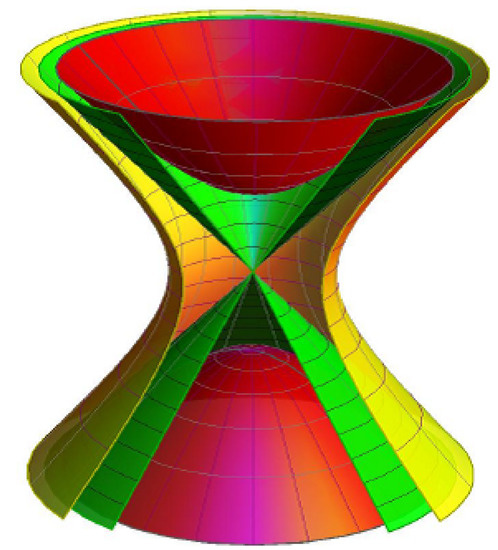
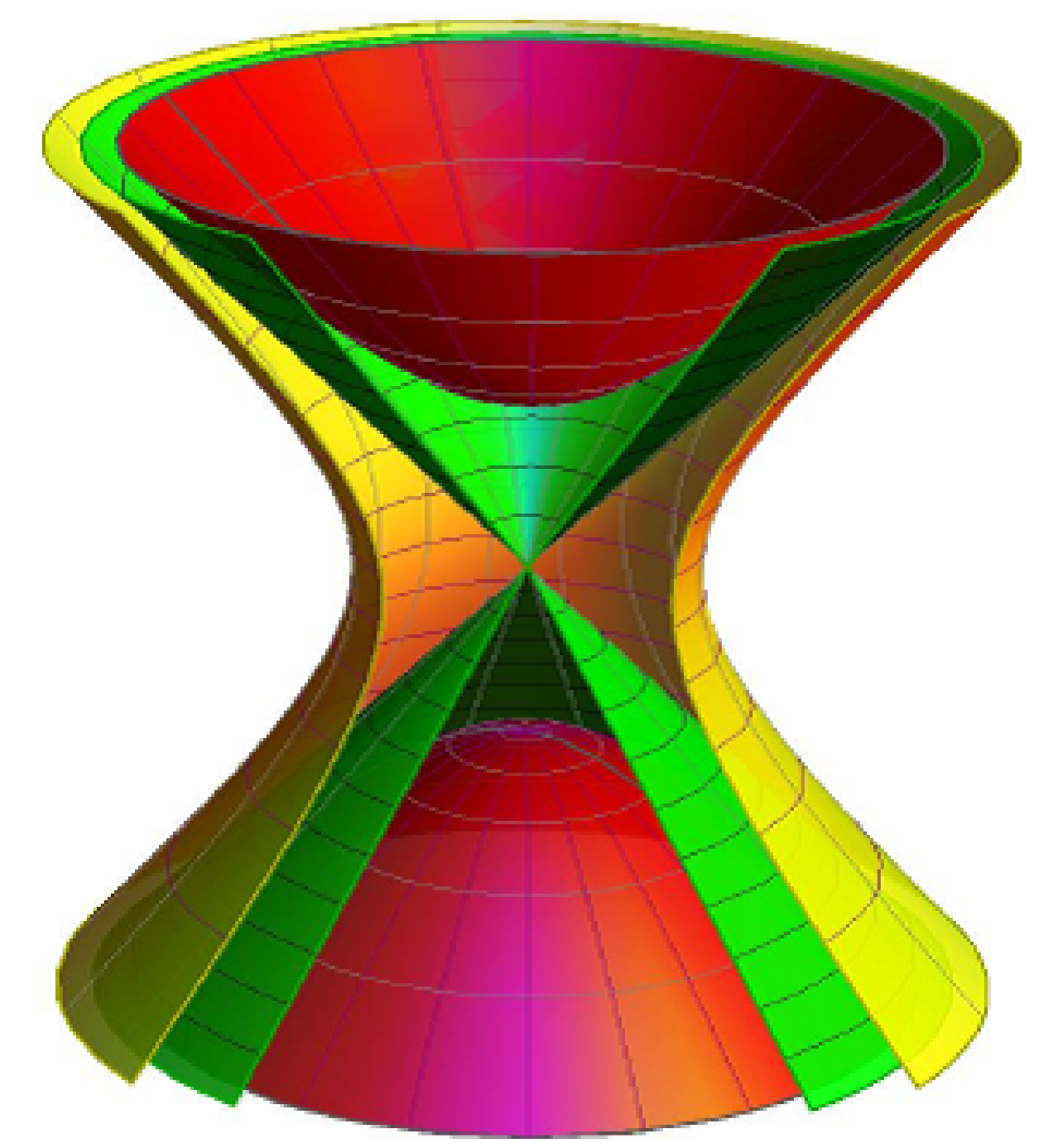
respectively. Then we can state the E. Study map as the ring-shaped hyperboloid image of spacelike lines, the common asymptotic cone image of null-lines, and the oval shaped hyperboloid image of timelike lines (see Figure 1).
Figure 1.
The dual hyperbolic and dual Lorentzian unit spheres.
Via the E. Study map, a timelike ruled surface in Minkowski 3-space is represented by a regular curve . Similarly, a regular curve shows a spacelike or timelike ruled surface in . are specified with the rulings of the surface and we will not distinguish between ruled surfaces and their explaining dual curves from now on.
Definition 1.
For any two (non-null) dual vectors and in , we have [15,16,17]:
- (a)
- If and are two dual spacelike vectors, then
- •
- There exists a single dual number ; , and such that ; if and span a dual spacelike plane. This number corresponds to the dual angle between and .
- •
- There exists a single dual number such that , where or via or , respectively, if and span a dual timelike plane. This number corresponds to the central dual angle between and .
- (b)
- If and are two dual timelike vectors, then there exists a single dual number such that , where or via and have the same time-direction or different time-direction, respectively. This dual number is named the Lorentzian timelike dual angle between and .
- (c)
- If is dual spacelike, and is dual timelike, then there exists a single dual number 0 such that , where or via or . This number is called the Lorentzian timelike dual angle between and .
One-Parameter Lorentzian Dual Spherical Movements
Assume that and are two Lorentzian dual unit spheres with as a mutual center in . Suppose ;(timelike)}, and ;(timelike), ,} are two orthonormal dual frames of and , respectively. When setting stationary, the elements of are functions of a real parameter (say the time). Therefore, moves against This movement is known as a one-parameter Lorentzian dual spherical movement and it is denoted by . Via the E. Study map, if and are matching the Lorentzian line spaces (movable) and (stationary), respectively, then demonstrates the one-parameter Lorentzian spatial movement in .
By the 1st order instantaneous features of , consider a Lorentzian dual unit sphere heading by ;(timelike),, as follows: is the instantaneous screw axis for the movement , and as the mutual spacelike central normal of two separated screw axes. represents a third spacelike dual unit vector. The set , located as such, will be named induce Blaschke frame. It is fully specified by the 1st order ownerships of the movement.
According to the E. Study map, we have two timelike ruled surfaces created by the . One is in the stationary Lorentzian space and another in the movable Lorentzian space . The first timelike ruled surface is named stationary axode , whereas the second one is named movable axode . These two axodes have all the times, a mutual tangent along the , and they slide on each other. The origin is the mutual central point established by the of the movement between the movable axode in and stationary axode in . Then,
The dual arc length ( of the axodes is . Since contains only 1st order derivatives of , it is a 1st order property of , especially with its dual speed. Put to symbolize , since they are equal to each other. The mutual distribution parameter of is
Proposition 1.
Through the movement , the movable timelike axode osculates with the stationary timelike axode on the timelike in the 1st order at any instant t (compared with [6,7,8]).
From now on, we will frequently omit the explicit from our computations. If dash is the derivative with respect to , then therefore the Blaschke formulae are
where
are the dual geodesic curvatures of the axodes , and is the Darboux vector. The tangent vector of the striction curve (s) is
The functions , , and are referred as the curvature (construction) functions of the timelike axodes. Under the hypothesis that , the timelike Disteli-axis (evolute or curvature axis) is
Let be the radius of curvature among and . Then,
where
Thus, we attain
Equation (10) is a new Lorentzian dual version of the well-known Euler–Savary formula (compared with [1,2,3,4,5,6,7,8]). This version furnishes a correlation for the two timelike axodes in the movement . From the real and dual parts of Equation (10), respectively, we obtain:
and
Now, assuming that the induce Blaschke frame is stationary in , then,
where
is the induce Darboux vector. is the induce dual geodesic curvature, where and are the rotational angular speed and translational angular speed of the movement . Likewise, they are both kinematic invariants, correspondingly.
Consequently, it is possible to state the following corollary:
Proposition 2.
Through the movement , the pitch of the movement is
In our treatise, we shall set to leave out the pure translational movements. Furthermore, zero divisors are eliminated. As a result, we only consider non-torsional movements, and the timelike axodes are non-developable ruled surfaces ().
3. Spacelike Lines with Special Trajectories
Through the movement , in general, any stationary spacelike line related with the movable timelike axode will produce a spacelike or timelike ruled surface, () in .On the assumption that it is a timelike ruled surface, this ruled surface is known as a spacelike line trajectory in kinematics. Given that all kinematic–geometric properties may therefore be determined using the invariants of the timelike axodes of the movement . Therefore, we investigate a spacelike dual unit vector such that its coordinates are
where
The velocity and the acceleration vectors of , respectively, are:
and
Then,
In order to examine (), the Blaschke frame is specified as:
where
Here, , , and are orthogonal intersected lines at a point on known as the striction (or central) point. The locus of is the striction curve on . From Equation (18), the dual arc length of is
Thus,
where
is the dual spherical curvature of . The tangent direction of is:
which will be a spacelike (timelike) curve if (. , , and are the construction functions of the (). Via the assumption that , the timelike Disteli-axis is:
Put as the radius of curvature through and . Then,
where
Furthermore, we have
where is the dual curvature and is the dual torsion, respectively.
3.1. Plucker Coordinates of a Lorentzian Line Congruence
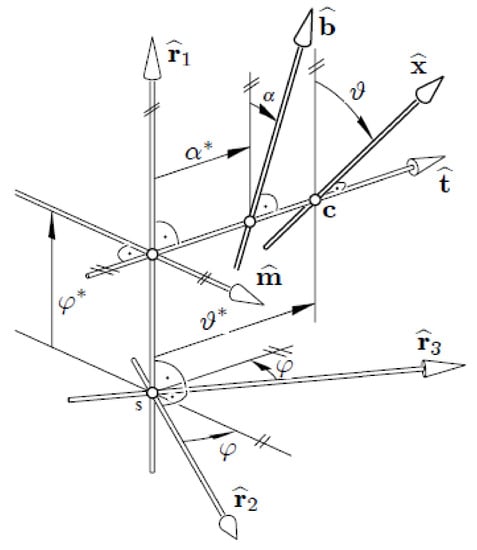
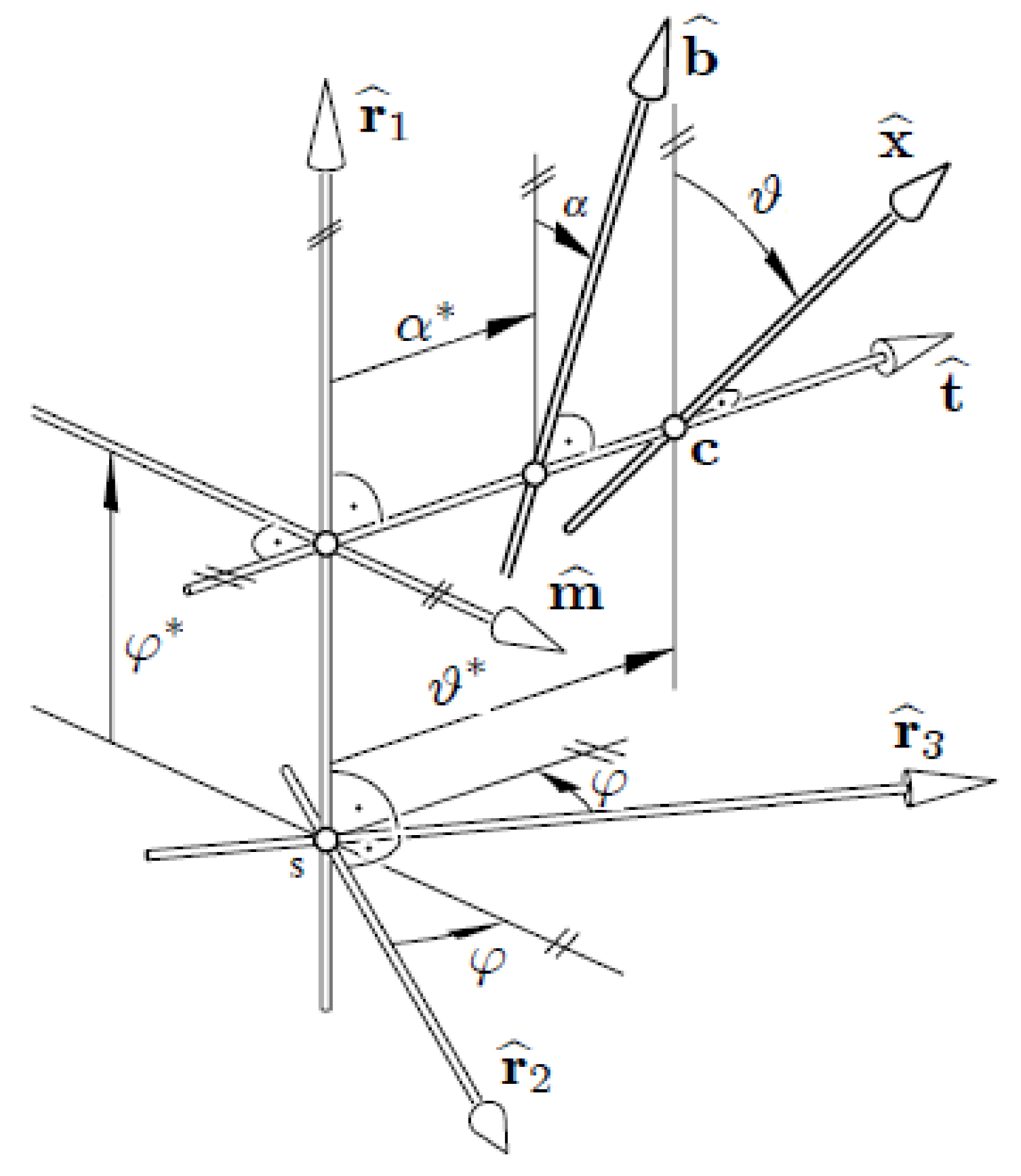
Here, we offer a procedure for locating a Lorentzian line congruence from the Plucker coordinates. Therefore, from Equation (18), we have that . Thus, all higher derivatives can be gained in terms of . The dual coordinates of () can be situated in , as follows: we choose relative to the set {; , , } by its intercept distance , sustained on the and the angle , sustained with respect to . We set the dual angles , and , which recognize the positions of and along (Figure 2). The signs are specified by the following: (), and () are in the right-hand Lorentzian screw rule with the thumb pointing along ; the sense of is such that , and are positioned with the thumb in the direction of the . Because is a spacelike dual unit vector, we have:
where . Furthermore, we attain
Figure 2.
and its Disteli-axis .
It is noticeable that the striction point is the origin of the induce Blaschke frame; that is, —see Figure 2.
Considering the real and dual parts of in Equation (31), we obtain:
Let be a point on . Since a, we obtain the linear equation system in (i = 1, 2, 3, and are the coordinates of a):
The following skew symmetric matrix of coefficients of unknowns is
and hence it has a rank of 2 with (p is an integer). The rank of the augmented matrix
is also 2. There are therefore infinite solutions to this system, as shown by
Since can be chosen arbitrarily, we can set . Therefore, Equation (35) becomes
In this case, we have
which is the base or director surface of the Lorentzian line congruence. By Equations (33) and (37), the Lorentzian line congruence is
The constants h, , and can control the shape of . If we let and as the movement parameter, then is a timelike ruled surface in -space. Hence, from Equations (37) and (38) and according to the shapes of its striction curves, the timelike ruled surface can be categorized into four types:
- (1)
- Timelike Archimedes with its striction curve is a timelike circular helix; for , , , , and (Figure 3).Figure 3. Timelike Archimedes.
- (2)
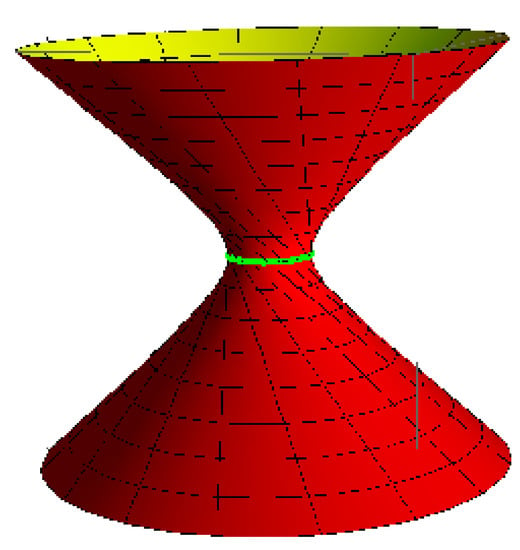
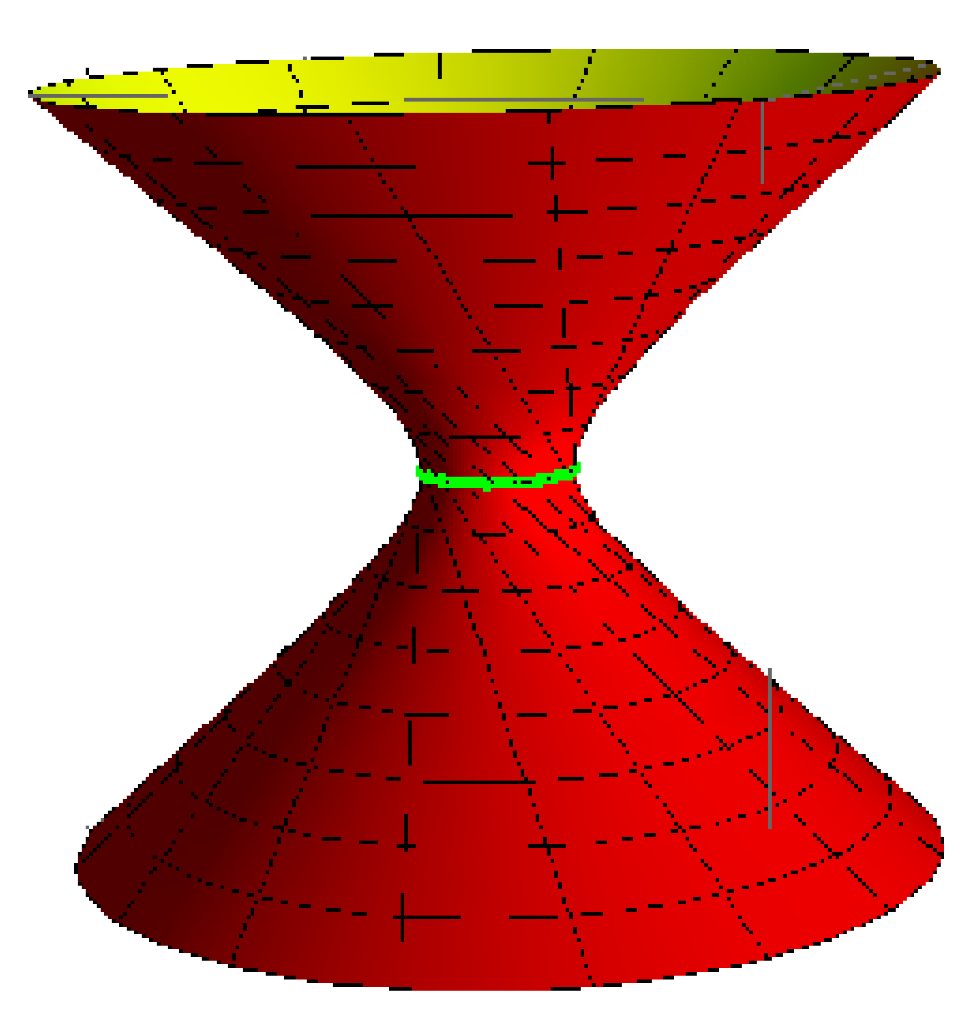
- Lorentzian unit sphere with its striction curve is a spacelike circle; for , , , and (Figure 4).Figure 4. Lorentzian unit sphere.
- (3)
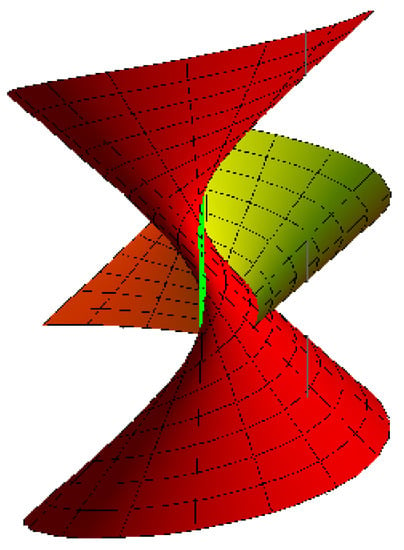
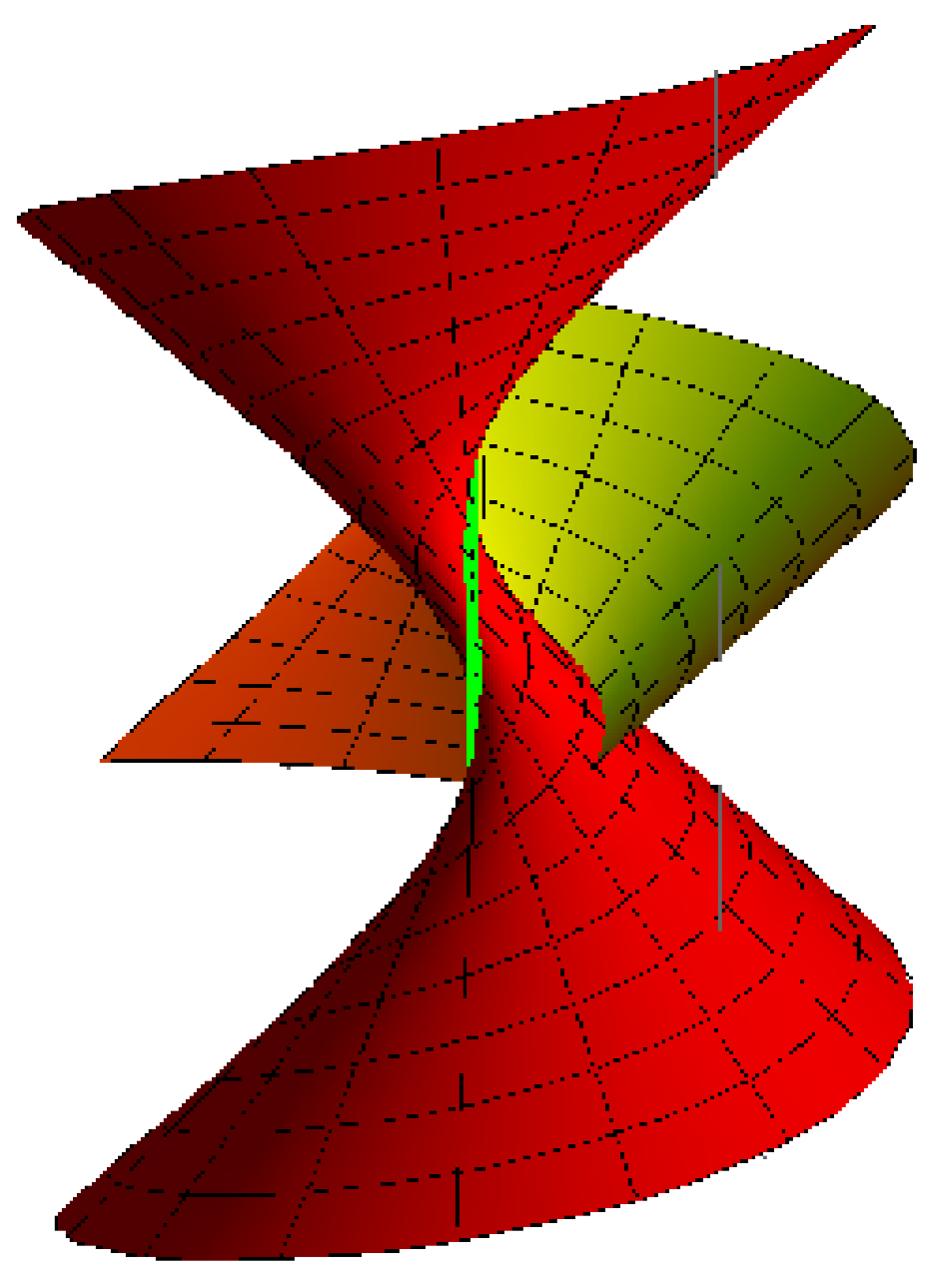
- Timelike helicoid with its striction curve is a timelike line; for , , , , and (Figure 5).Figure 5. Timelike helicoid.
- (4)
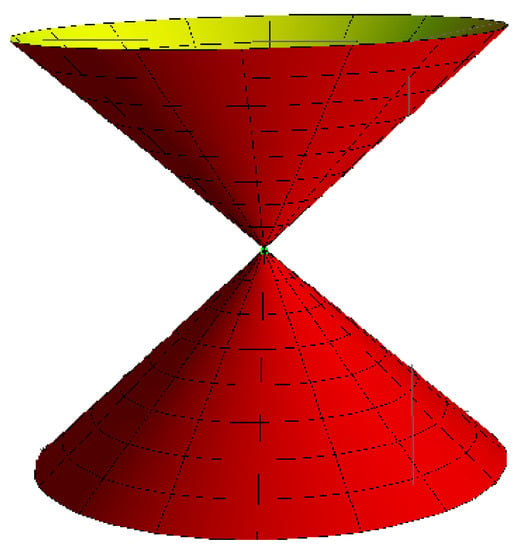
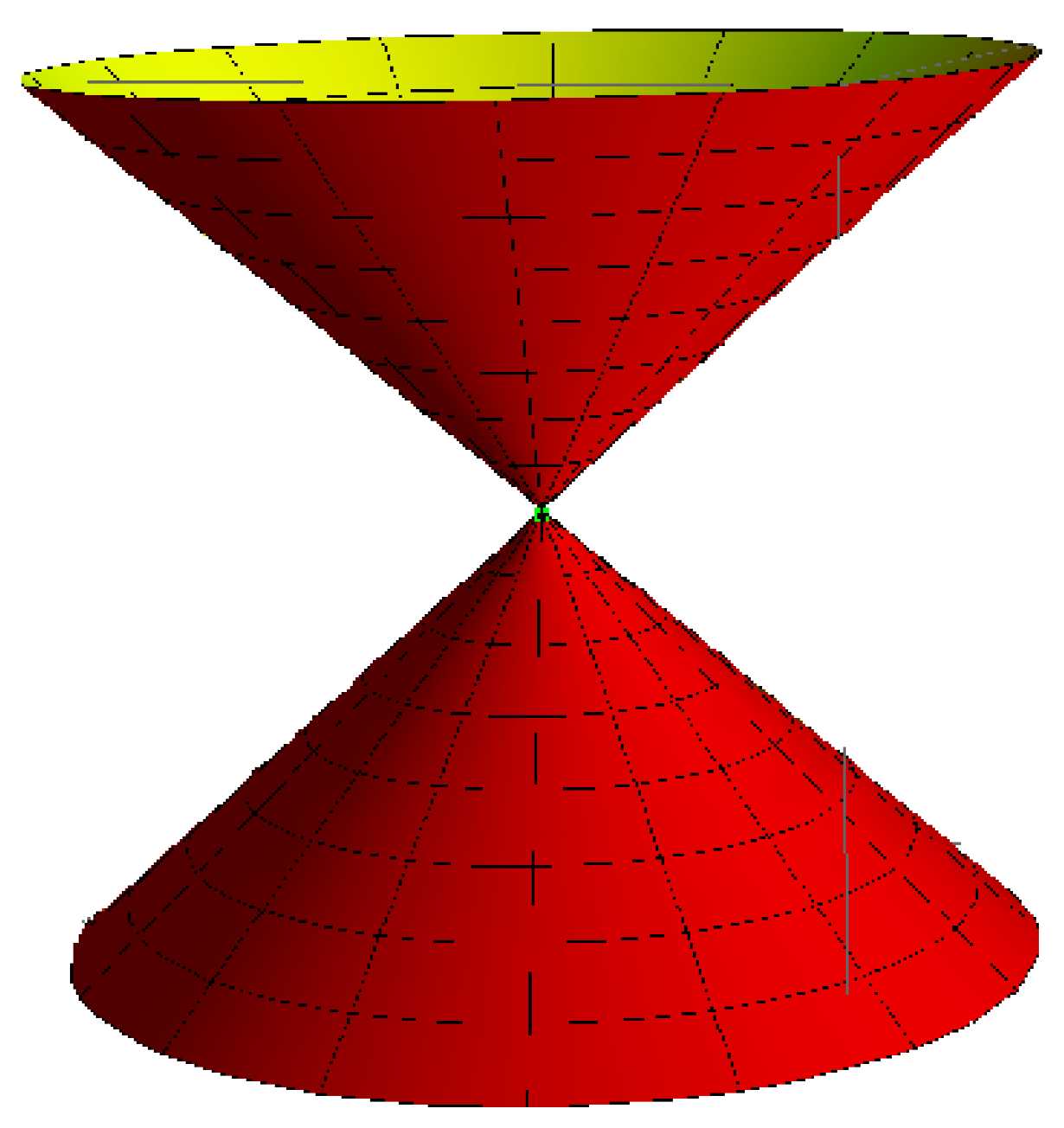
- Timelike cone with its striction curve is a fixed point; for , , , and (Figure 6).Figure 6. Timelike cone.
3.2. Lorentzian Inflection Line Congruence
We now define Lorentzian inflection line congruence, which is the spatial synonymous of the inflection circle in planar kinematic [1,2,3]. Then, from Equation (30), we have:
Therefore, the spatial synonymous of the inflection circle in planar kinematic is located by (i) the Lorentzian line complex characterized by the inflection cone c: , and (ii) the Lorentzian line complex characterized by the attached plane of lines : . All the set of spacelike lines of the movable space and also in the plane satisfy : , initiating the Lorentzian inflection line congruence. Therefore, the Lorentzian inflection line congruence composed of a set of planes : , each of which is related with a direction of the inflection cone c: .
Hence, we have attained the following theorem:
Theorem 1.
Through the movement , consider a set of correlating spacelike lines of the movable timelike axode, such that each one of these lines has the analog of an inflection circle. Then, this set of spacelike lines forms a Lorentzian inflection line congruence which consists of common lines of the two Lorentzian line complexes c: , and π:
However, from Equation (30), we can also see that
Now, the lines , , and specify the Blaschke frame and they are intersected at the striction point of the timelike ruled surface . From Equations (25) and (40) it could be assumed that the striction curve of will have a tangent orthogonal to its creator, that is, . In this case, () is a timelike binormal ruled surface with timelike striction curve. However, if we substitute into Equation (23), we obtain . The curve that satisfies this differential equation is a spacelike great dual circle on . For example, a spacelike great dual circle can be given as . The tangent vector can be gained as . Thus, has the form . Let be a point on , then
which yields that:
A relationship such as , defines timelike ruled surface. Thus, we take , h indicating the pitch of , and by eliminating , and t, we obtain:
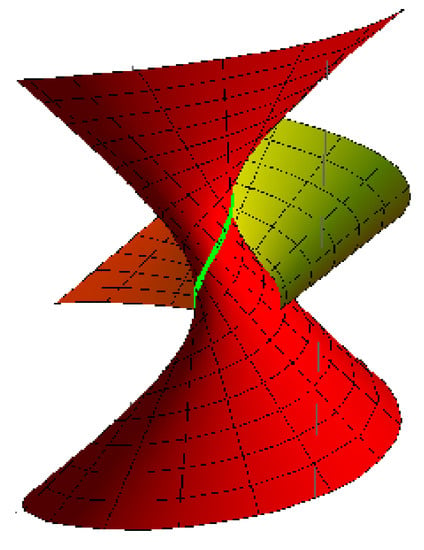
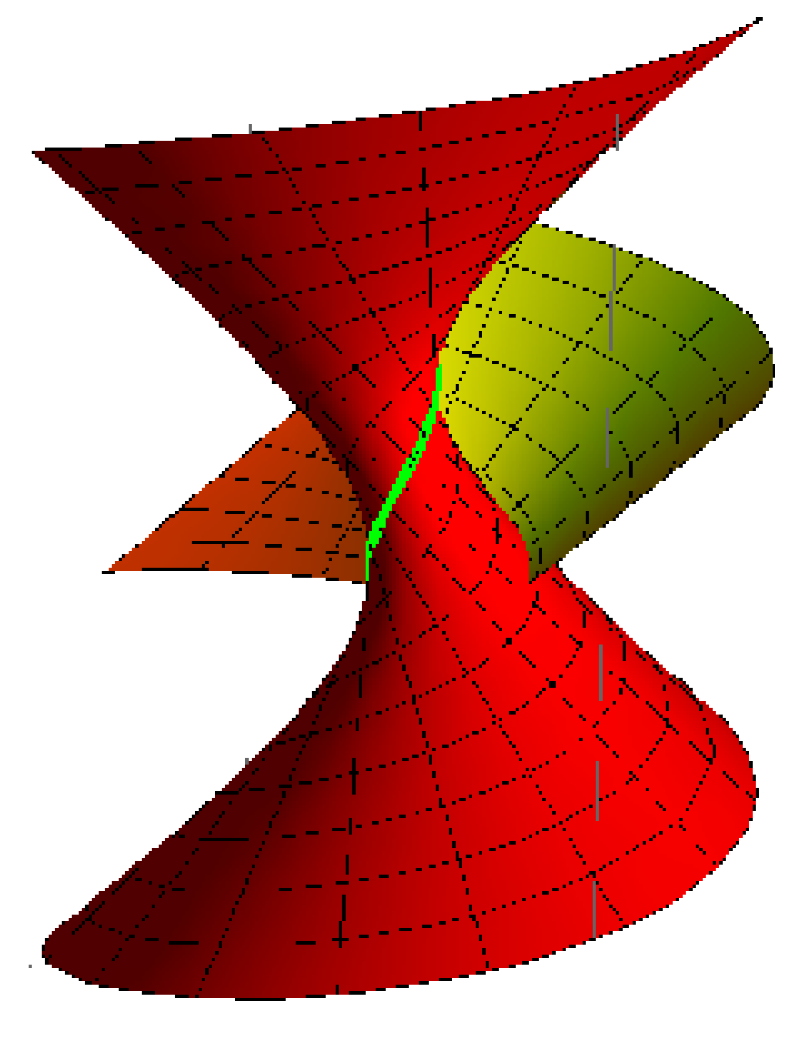
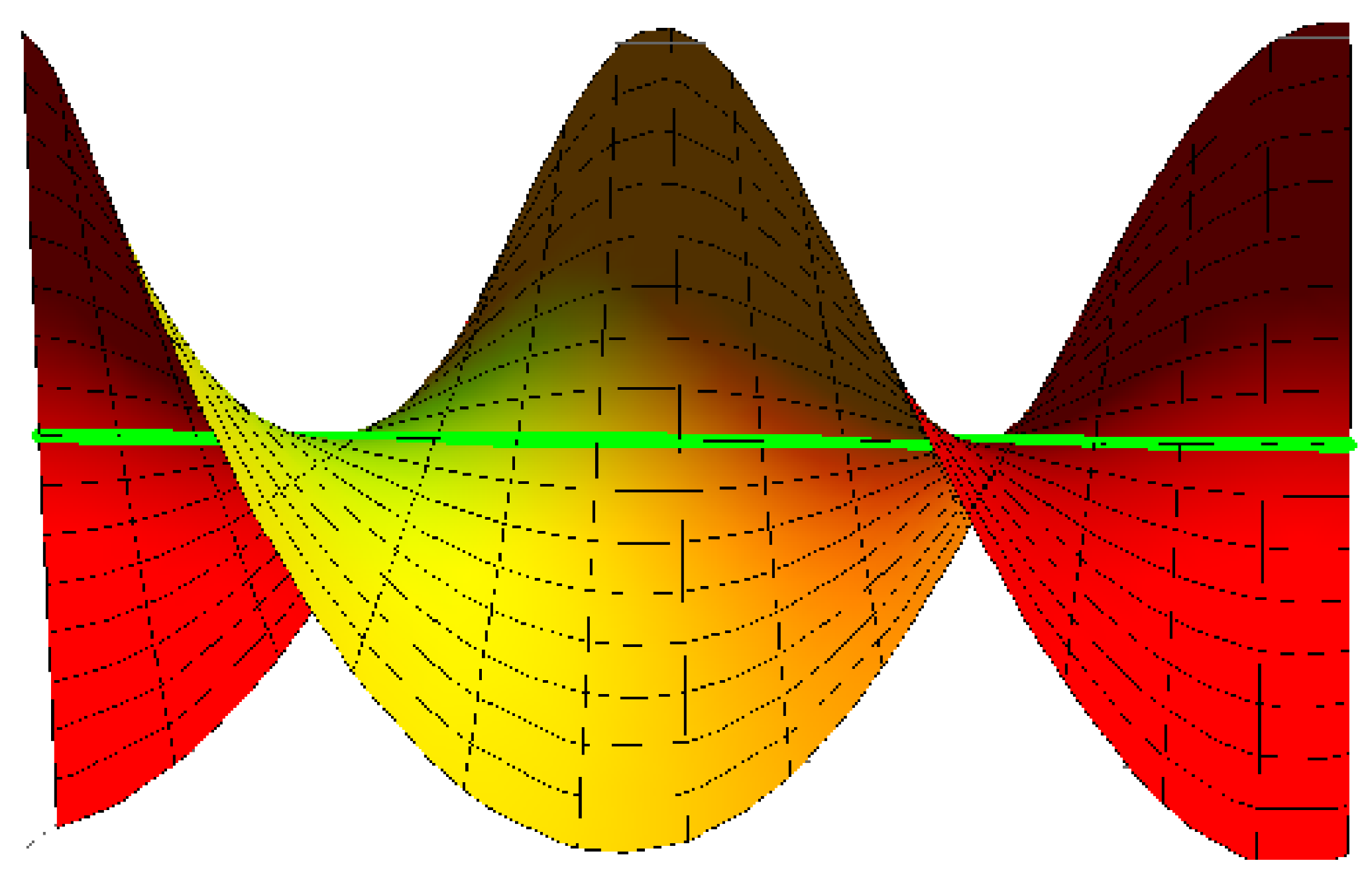
This is a one-parameter family of timelike helicoidal surface of the 1st kind. If we let ,, and , then a member of such family can be gained (Figure 7).
Figure 7.
A timelike helicoid of 1st kind.
Theorem 2.
In the Minkowski 3-space , any timelike helicoidal surface of 1st kind with timelike striction curve be included in Lorentzian inflection line congruence
Analysis of the Lorentzian Inflection Line Congruence
In order to analyze the lines of the Lorentzian inflection line congruence , from Equations (29), (31) and (40) we have
Equation (43) consists of the inflection trajectories in Lorentzian spherical kinematics (Compared with [1,2,3]). The real part of Equation (43) defines the Lorentzian inflection cone for the real Lorentzian spherical part of the movement and is given by:
The intersection of this Lorentzian inflection cone with a real Lorentzian unit sphere fastened at the apex of the Lorentzian cone explains a spacelike spherical curve. There is a Lorentzian plane for each line, correlating with all orientations of a line of the Lorentzian inflection cone, provided by the dual part of Equation (43):
Solving Equation (44) with respect to , we attain:
Equation (47) is linear in the position coordinates and of the oriented line . Therefore, for a one-parameter Lorentzian spatial movement , the spacelike lines in a given stationary direction in -space lie on a Lorentzian plane. In Figure 3, it is shown that the angle identifies the spacelike line ; hence, Equation (47) realizes two spacelike lines and in the Lorentzian plane specified by and the (, and are identical to the inflection circle in planar kinematics). If the distance on the spacelike central normal from the is accepted as the independent parameter, then Equation (47) becomes:
We see that (or will alter its place if the parameter takes various values, but constant. Meanwhile, the place of the Lorentzian plane is altered if the parameter of (or has several value, but constant. As a consequence, the set of all spacelike lines , and realized by Equation (48) is the Lorentzian inflection line congruence for all values of .
We can also examine the Lorentzian inflection line congruence as follows: if we choose the plus sign, then by substituting Equation (46) into the real part of Equation (31), we find:
where , and . If we set , consider Equations (38), (46) and (49), then
is the Lorentzian inflection line congruence. This congruence is composed of the timelike ruled surfaces , , , constant, and , = constant. Thus, according to Equations (49) and (50) we have the following:
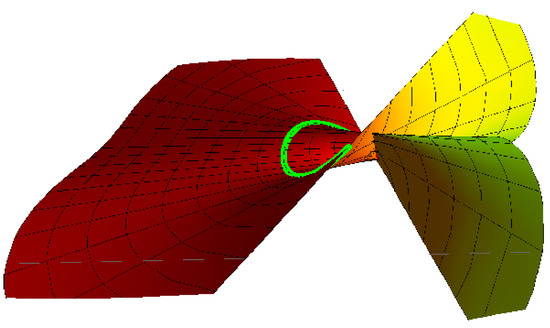
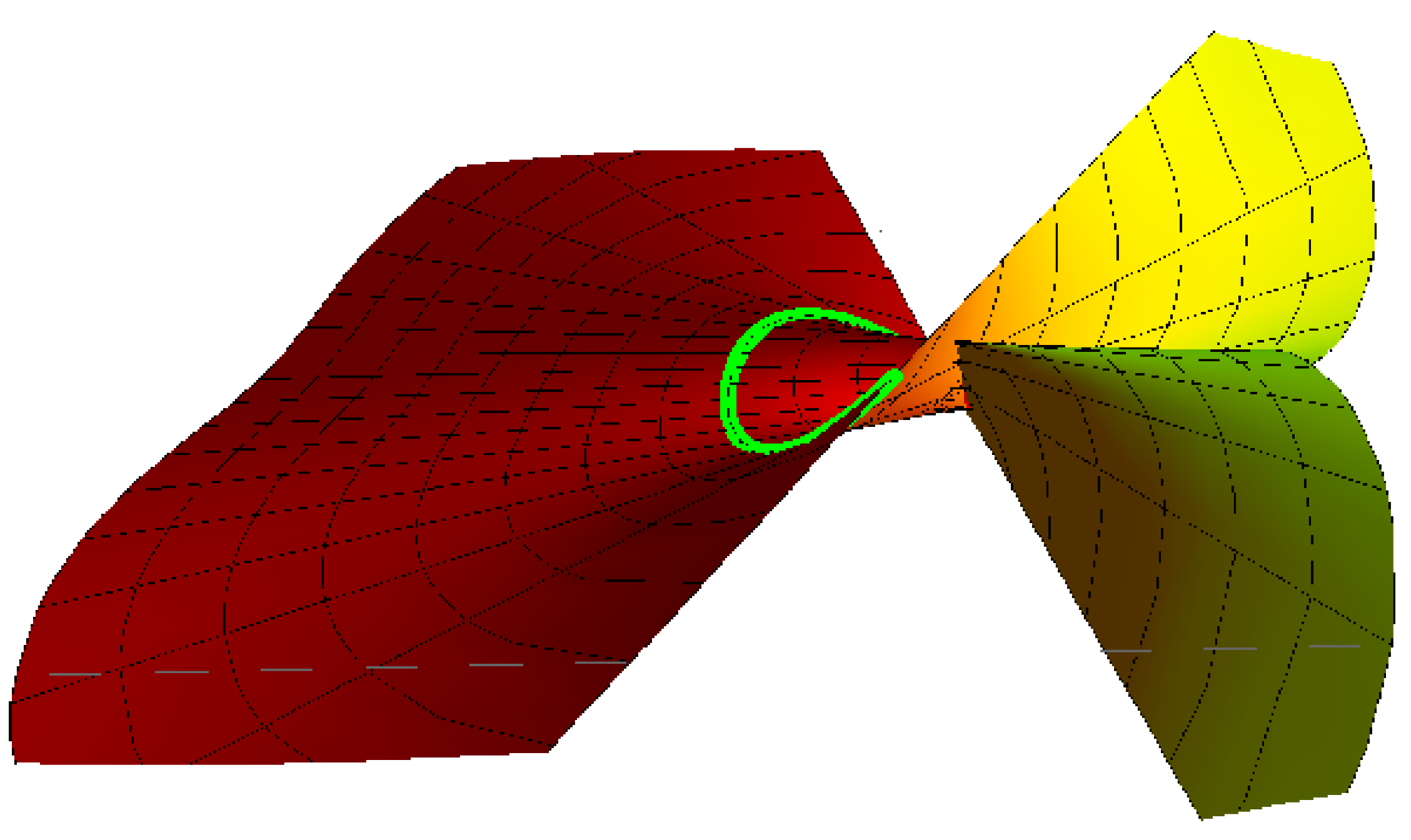
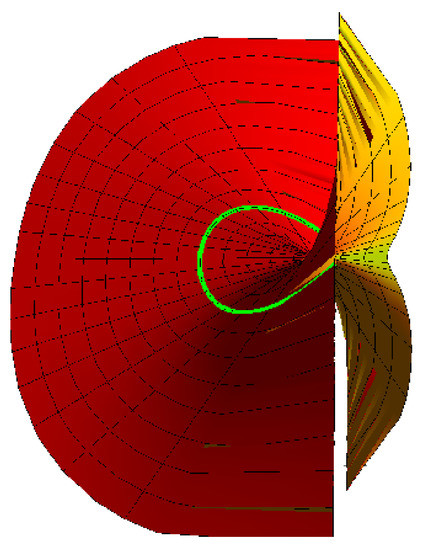
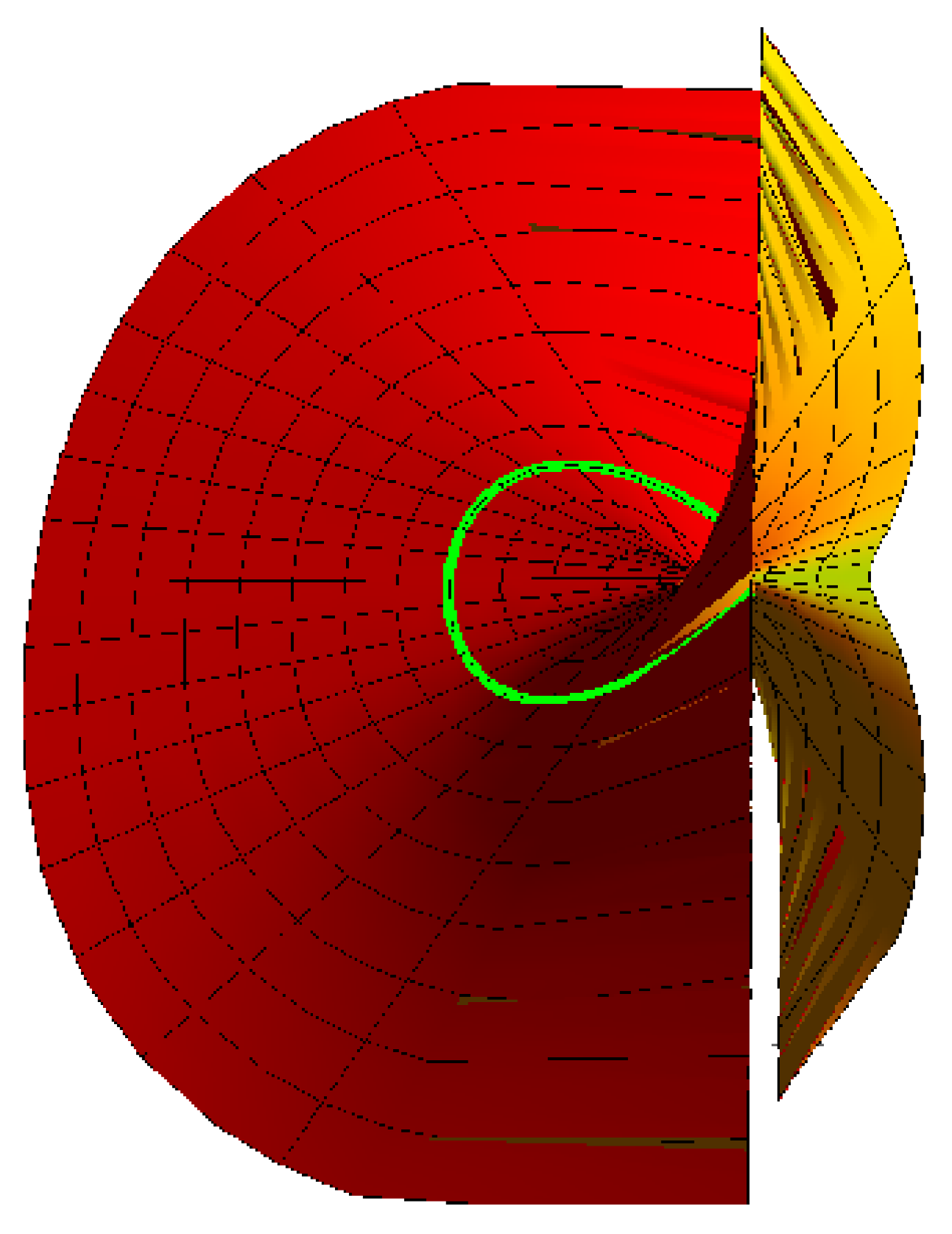
(1) Spacelike inflection spherical curve with timelike inflection ruled surface: for , , , , and (Figure 8 and Figure 9).
Figure 8.
Inflection spacelike spherical curve (for , and ).
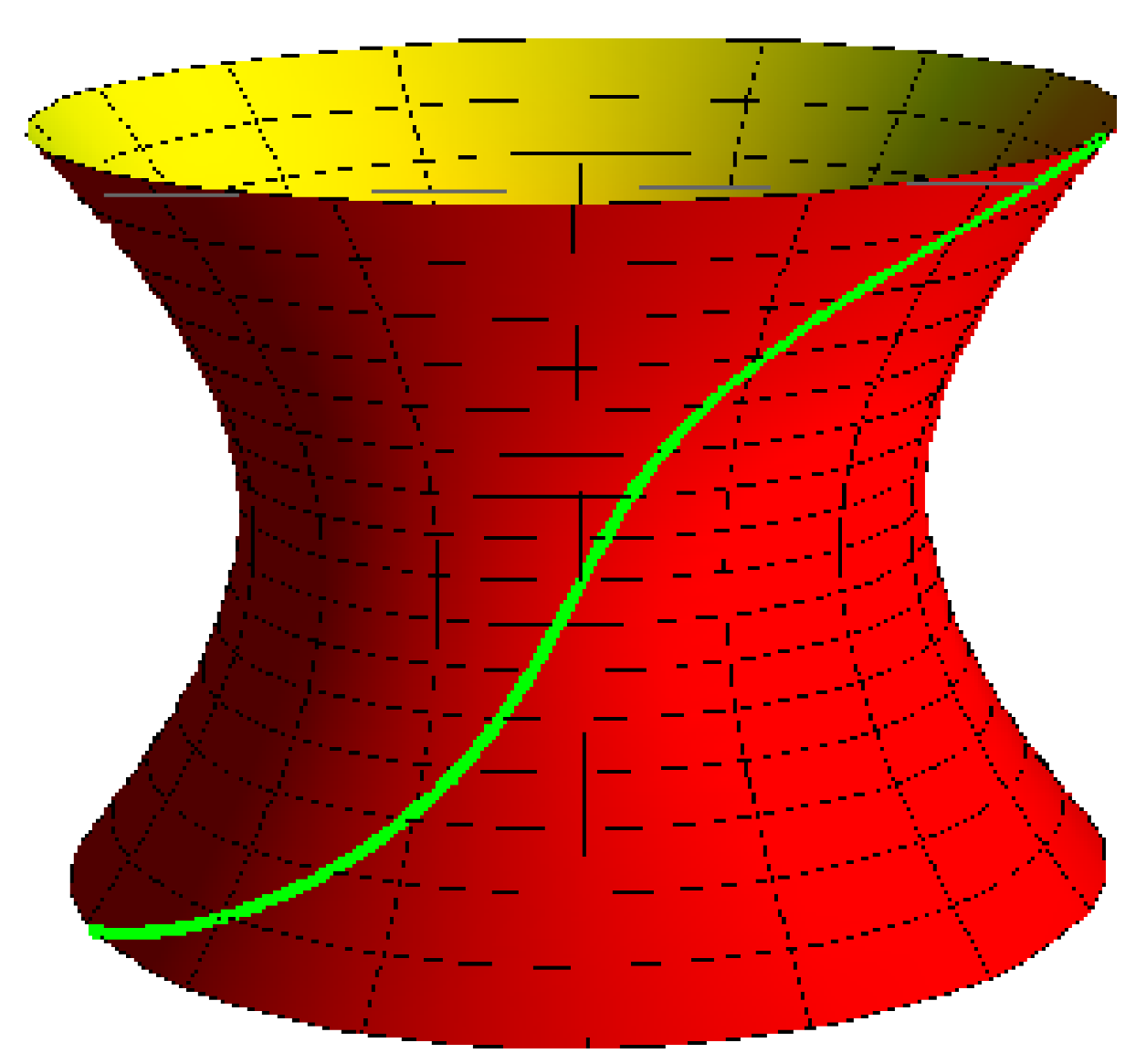
Figure 9.
Timelike inflection ruled surface (for , and ).
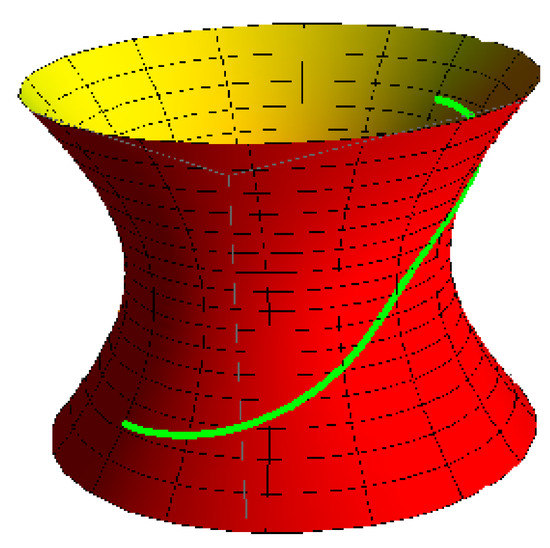
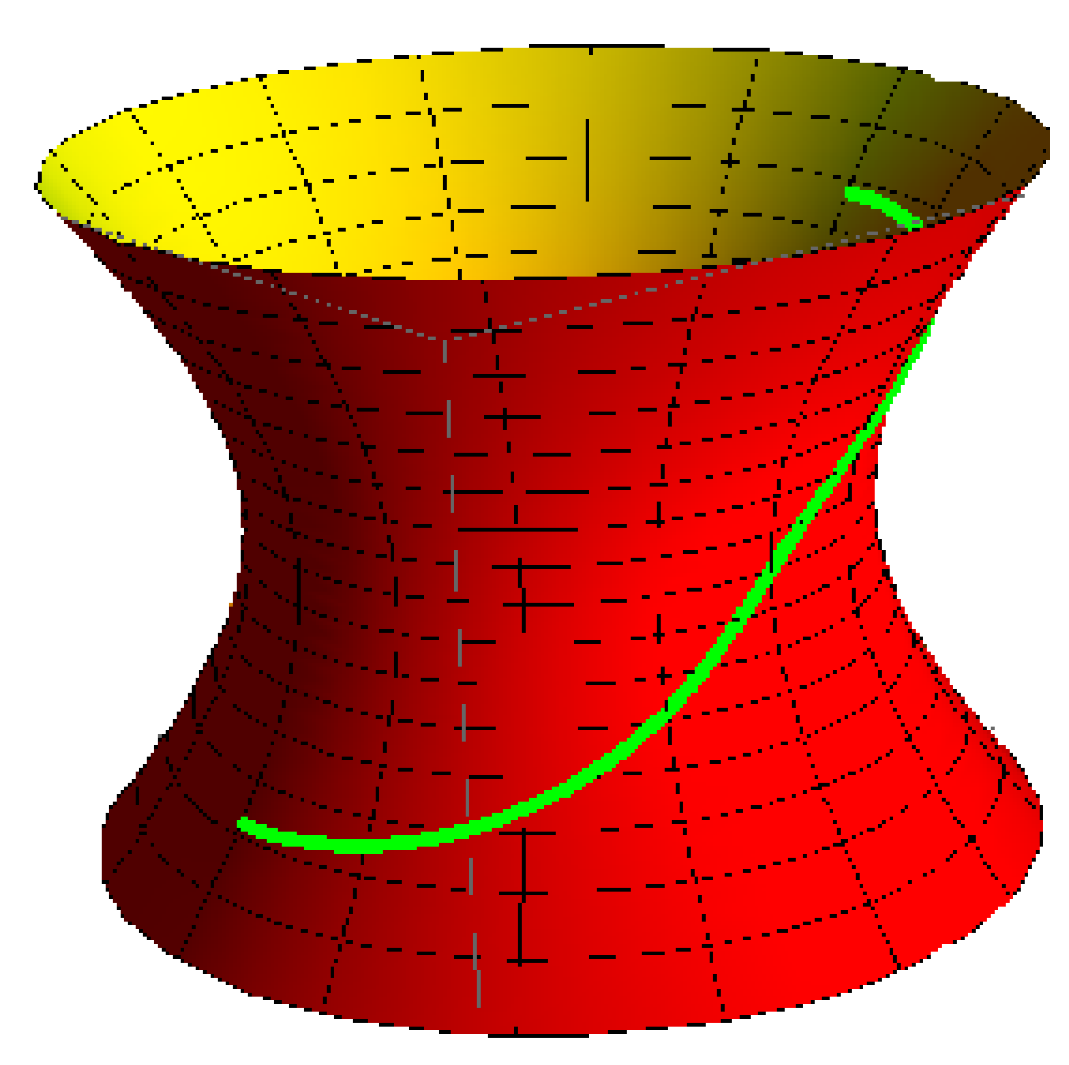
(2) Spacelike inflection spherical curve with timelike inflection ruled surface: for , , , , and (Figure 10 and Figure 11).
Figure 10.
Inflection spacelike spherical curve (for , , , , and ).
Figure 11.
Timelike inflection ruled surface (for , , , , and ).
3.3. Euler–Savary Equation and Disteli Formulae
Disteli succeeded in discovering a curvature axis for the creating line of a ruled surface in 1914 [9], bringing the well-known planar Euler–Savary explanation to spatial kinematics. Calculating the dual spherical curvature of yields the Lorentzian Disteli equations as follows. The dual spherical radius of curvature can be written by (see Figure 2):
Then, we have the identity
After some algebraic manipulations, it can be reduced to:
Equation (53) is a dual spherically Euler–Savary Equation (compare with [1,2,3]). Via the real and the dual parts, respectively, we have:
and
Equations (54) and (55) are new Disteli formulae in the one-parameter spatial movement; the first one gives the relationship through the places of the stationary line in the movable space and the Disteli-axis . The second one distinguishes the distance from the line to the Disteli-axis . At the end of this section, we can rederive the dual Euler–Savary Formula (10). Substituting , , and , and into Equation (53), we gain, subsequent to simplifications, that
as claimed.
4. Conclusions
Based on E. Study’s map, the instantaneous invariants of relative motion through two Lorentzian dual unit spheres are utilized to derive formulae for the velocity and acceleration of point trajectories (spacelike dual curve). The instantaneous invariants are related to the curvature and torsion expressions of this spacelike curve. The well-known inflection circle of spherical and planar kinematics is calculated in dual space. E. Study’s map is then utilized to thoroughly study a Lorentzian inflection line congruence and its spatial equivalent. Finally, the axode invariants are used to provide new proofs of the Euler–Savary equation and the Disteli formulae.
The use of line geometry for investigating spatial kinematics in Minkowski 3-space could be utilized to investigate specific problems and create novel applications. We shall be interested in the creation of timelike ruled surfaces as tooth margins for gears with skew axes in the future, as shown in [34,35].
Author Contributions
Conceptualization, A.A.A. and R.A.A.-B.; methodology, R.A.A.-B.; validation, A.A.A. and R.A.A.-B.; formal analysis, A.A.A. and R.A.A.-B.; investigation, R.A.A.-B.; resources, A.A.A. and R.A.A.-B.; data curation, A.A.A. and R.A.A.-B.; writing—original draft preparation, R.A.A.-B.; writing—review and editing, A.A.A.; visualization, R.A.A.-B.; supervision, R.A.A.-B.; project administration, A.A.A.; funding acquisition, A.A.A. All authors have read and agreed to the published version of the manuscript.
Funding
This research was funded by Princess Nourah bint Abdulrahman University Researchers Supporting Project number (PNURSP2023R337).
Data Availability Statement
Our manuscript has no associate data.
Acknowledgments
The authors would like to acknowledge the Princess Nourah bint Abdulrahman University Researchers Supporting Project number (PNURSP2023R337), Princess Nourah bint Abdulrahman University, Riyadh, Saudi Arabia.
Conflicts of Interest
The authors declare that there is no conflict of interest regarding the publication of this paper.
References
- Bottema, O.; Roth, B. Theoretical Kinematics; North-Holland Press: New York, NY, USA, 1979. [Google Scholar]
- Karger, A.; Novak, J. Space Kinematics and Lie Groups; Gordon and Breach Science Publishers: New York, NY, USA, 1985. [Google Scholar]
- Schaaf, A.; Ravani, B. Geometric continuity of ruled surfaces. Comput. Aided Geom. Des. 1998, 15, 289–310. [Google Scholar] [CrossRef] [Scilit]
- Pottman, H.; Wallner, J. Computational Line Geometry; Springer: Berlin/Heidelberg, Germany, 2001. [Google Scholar]
- Abdel-Baky, R.A.; Al-Solamy, F.R. A new geometrical approach to one-parameter spatial motion. J. Eng. Math. 2008, 60, 149–172. [Google Scholar] [CrossRef] [Scilit]
- Abdel-Baky, R.A.; Al-Ghefari, R.A. On the one-parameter dual spherical motions. Comp. Aided Geom. Des. 2011, 28, 23–37. [Google Scholar] [CrossRef] [Scilit]
- Özcan, B.; Senyurt, S. On some characterizations of ruled surface of a closed timelike curve in dual Lorentzian space. Adv. Appl. Clifford Algebr. 2012, 22, 939–953. [Google Scholar]
- Al-Ghefari, R.A.; Abdel-Baky, R.A. Kinematic geometry of a line trajectory in spatial motion. J. Mech. Sci. Technol. 2015, 29, 3597–3608. [Google Scholar] [CrossRef] [Scilit]
- Abdel-Baky, R.A. On the curvature theory of a line trajectory in spatial kinematics. Commun. Korean Math. Soc. 2019, 34, 333–349. [Google Scholar]
- Aslan, M.C.; Sekerci, G.A. Dual curves associated with the Bonnet ruled surfaces. Int. J. Geom. Methods Mod. Phys. 2020, 17, 2050204. [Google Scholar] [CrossRef] [Scilit]
- Alluhaibi, N. Ruled surfaces with constant Disteli-axis. AIMS Math. 2020, 5, 7678–7694. [Google Scholar] [CrossRef] [Scilit]
- Abdel-Baky, R.A.; Tas, F. W-Line congruences. Commun. Fac. Sci. Univ. Ank. Ser. A1 Math. Stat. 2020, 69, 450–460. [Google Scholar] [CrossRef] [Scilit]
- Abdel-Baky, R.A.; Naghi, M.F. A study on a line congruence as surface in the space of lines. AIMS Math. 2021, 6, 11109–11123. [Google Scholar] [CrossRef] [Scilit]
- Gungor, M.A.; Ersoy, S.; Tosun, S. Dual Lorentzian spherical movements and dual Euler–Savary formula. Eur. J. Mech. A/Solids 2009, 28, 820–826. [Google Scholar] [CrossRef] [Scilit]
- Alluhaibi, N.; Abdel-Baky, R.A. On the one-parameter Lorentzian spatial movements. Int. J. Geom. Methods Mod. Phys. 2019, 16, 1950197. [Google Scholar] [CrossRef] [Scilit]
- Alluhaibi, N.A.; Abdel-Baky, R.A. On the kinematic-geometry of one-parameter Lorentzian spatial movement. Int. J. Adv. Manuf. Technol. 2022, 121, 7721–7731. [Google Scholar] [CrossRef] [Scilit]
- Li, Y.; Alluhaibi, N.; Abdel-Baky, R.A. One-parameter Lorentzian dual spherical movements and invariants of the axodes. Symmetry 2022, 14, 1930. [Google Scholar] [CrossRef] [Scilit]
- Li, Y.; Tuncer, O.O. On (contra)pedals and (anti)orthotomics of frontals in de Sitter 2-space. Math. Meth. Appl. Sci. 2023, 1, 1–15. [Google Scholar] [CrossRef] [Scilit]
- Li, Y.; Erdogdu, M.; Yavuz, A. Differential Geometric Approach of Betchow-Da Rios Soliton Equation. Hacet. J. Math. Stat. 2022, 1, 1–12. [Google Scholar] [CrossRef] [Scilit]
- Li, Y.; Abolarinwa, A.; Alkhaldi, A.; Ali, A. Some Inequalities of Hardy Type Related to Witten-Laplace Operator on Smooth Metric Measure Space. Mathematics 2022, 10, 4580. [Google Scholar] [CrossRef] [Scilit]
- Li, Y.; Aldossary, M.T.; Abdel-Baky, R.A. Spacelike Circular Surfaces in Minkowski 3-Space. Symmetry 2023, 15, 173. [Google Scholar] [CrossRef] [Scilit]
- Li, Y.; Chen, Z.; Nazra, S.H.; Abdel-Baky, R.A. Singularities for Timelike Developable Surfaces in Minkowski 3-Space. Symmetry 2023, 15, 277. [Google Scholar] [CrossRef] [Scilit]
- Li, Y.; Alkhaldi, A.; Ali, A.; Abdel-Baky, R.A.; Saad, M.K. Investigation of ruled surfaces and their singularities according to Balschke frame in Euclidean 3-space. AIMS Math. 2023, 8, 13875–13888. [Google Scholar] [CrossRef] [Scilit]
- Qian, Y.; Yu, D. Rates of approximation by neural network interpolation operators. Appl. Math. Comput. 2022, 41, 126781. [Google Scholar] [CrossRef] [Scilit]
- Li, Y.; Eren, K.; Ayvaci, K.H.; Ersoy, S. The developable surfaces with pointwisev1-type Gauss map of Frenet type framed base curves in Euclidean 3-space. AIMS Math. 2023, 8, 2226–2239. [Google Scholar] [CrossRef] [Scilit]
- Li, Y.; Abdel-Salam, A.A.; Saad, M.K. Primitivoids of curves in Minkowski plane. AIMS Math. 2023, 8, 2386–2406. [Google Scholar] [CrossRef] [Scilit]
- Wang, G.S.; Guan, L.M. Neural network Interpolation operators of multivariate function. J. Comput. Anal. Math. 2023, 431, 115266. [Google Scholar] [CrossRef] [Scilit]
- Li, Y.; Liu, S.; Wang, Z. Tangent developable and Darboux developables of framed curves. Topol. Appl. 2021, 301, 107526. [Google Scholar] [CrossRef] [Scilit]
- Yang, Z.C.; Li, Y.; Erdogdub, M.; Zhu, Y.S. Evolving evolutoids and pedaloids from viewpoints of envelope and singularity theory in Minkowski plane. J. Geom. Phys. 2022, 104513, 1–23. [Google Scholar] [CrossRef] [Scilit]
- Li, Y.; Wang, Z. Lightlike tangent developables in de Sitter 3-space. J. Geom. Phys. 2021, 164, 1–11. [Google Scholar] [CrossRef] [Scilit]
- Li, Y.; Wang, Z.; Zhao, T. Geometric Algebra of Singular Ruled Surfaces. Adv. Appl. Clifford Algebr. 2021, 31, 1–19. [Google Scholar] [CrossRef] [Scilit]
- Li, Y.; Abolarinwa, A.; Azami, S.; Ali, A. Yamabe constant evolution and monotonicity along the conformal Ricci flow. AIMS Math. 2022, 7, 12077–12090. [Google Scholar] [CrossRef] [Scilit]
- Li, Y.; Ganguly, D. Kenmotsu Metric as Conformalη-Ricci Soliton. Mediterr. J. Math. 2023, 20, 193. [Google Scholar] [CrossRef] [Scilit]
- Zhang, X.; Zhang, J.; Pang, B.; Zhao, X. An accurate prediction method of cutting forces in 5-axis flank milling of sculptured surface. Int.J. Mach. Tools Manuf. 2016, 104, 26–36. [Google Scholar] [CrossRef] [Scilit]
- Calleja, A.; Bo, P.; Gonzalez, H.; Barton, M.; Norberto, L.; de Lacalle, L. Highly accurate 5-axis flank CNC machining with conical tools. Int. J. Adv. Manuf. Technol. 2018, 97, 1605–1615. [Google Scholar] [CrossRef] [Scilit]
- Walfare, J. Curves and Surfaces in Minkowski Space. Ph.D. Thesis, K.U. Leuven, Faculty of Science, Leuven, Belgium, 1995. [Google Scholar]
- López, R. Differential geometry of curves and surfaces in Lorentz-Minkowski space. Int. Electron. J. Geom. 2014, 7, 44–107. [Google Scholar] [CrossRef] [Scilit]
- O’Neil, B. Semi-Riemannian Geometry Geometry, with Applications to Relativity; Academic Press: New York, NY, USA, 1983. [Google Scholar]
Disclaimer/Publisher’s Note: The statements, opinions and data contained in all publications are solely those of the individual author(s) and contributor(s) and not of MDPI and/or the editor(s). MDPI and/or the editor(s) disclaim responsibility for any injury to people or property resulting from any ideas, methods, instructions or products referred to in the content. |
© 2023 by the authors. Licensee MDPI, Basel, Switzerland. This article is an open access article distributed under the terms and conditions of the Creative Commons Attribution (CC BY) license (https://creativecommons.org/licenses/by/4.0/).