


Abstract
With the deep study in this work, we introduce the concept of filters of a bitonic algebra A. We study some fundamental structures of such determined filters. We also focus on features of filters with respect to homomorphisms. With the help of the idea of upper sets, we investigate basic ideas of filters in a bitonic algebra, and we also state some important theorems related to them. We obtain some relations between filters of bitonic algebras and upper sets. We obtain an equivalent condition of the filters with the help of the notion of upper sets.
1. Introduction
Filter theory has an important role in the study of algebraical structures, computer science and associated logics that are in some cases studied by Rasiowa in [1]. Filters, in general, provide accurate keys to locate elements that are large enough to perform some measures which are beneficial in general topology, firstly studied by Cartan in [2], in logic, studied by Tarski, Moisil and others, many of whose results are found in Birkhoff’s Lattice Theory in [3]. Relying on several theory-based investigators who dealt with filters, such as Xiaohong, Xiangyu and Xuejiao, the connection and ranked notion of many filter concepts were studied in a systematic manner, and the structure they used is especially essential in their studies given in [4]. Lately, many researchers have focused on filters of various algebraic structures. In [5], the concept of filters of bounded implicative BCK-algebra was studied by Deeba, and he described connections between such filters and congruences. The notion of BCC-algebras was given by Komori in [6,7]. Later, in [8,9] a dual form of the ordinary definition was used by Dudek to define the notion of BCC-algebras. The concept of bitonic algebras in the manner of a generalization of dual BCC algebras was introduced by Yon and Özbal and analysed in [10]. They introduced the concept of derivation on bitonic algebras and deeply studied the properties of the derivations of this algebra. Additionally, symmetric bi-derivations were conducted in bitonic algebras by Ebadi and Sattari, and they studied properties of symmetric bi-derivations of bitonic algebras in [11].
In this study, we focus on the concept of filters on bitonic algebras. We give examples for these structures and investigate their basic properties. We analyse properties of filters by using the idea of upper sets and state some important theorems. We also obtain several characterization of filters in this creating as unions of upper sets in bitonic algebras. We try to give a suitable condition of the filters with the help of the notion of upper sets.
2. Preliminaries
In this section of the study, we will state some important concepts and notions of bitonic algebras that will be used through the whole of the paper to be able to deeply study filters of bitonic algebras.
Definition 1
([10]). A bitonic algebra is an algebraic system , where A is a set, and 1 is an element in A and a binary operation ∗ on A, satisfying the following axioms:
- (B1)
- œ,
- (B2)
- œ=œ,
- (B3)
- œ∗ and œ implies œ=
- (B4)
- œ∗ gives with ∗
for every œ,.
Lemma 1
([10]). Let be a bitonic algebra. Then,
- (1)
- œ∗œ;
- (2)
- œ∗ implies œ∗;
- (3)
- œœ
for every œ,.
Let be a bitonic algebra. If we define a binary relation “≤” on A by
for any œ,, then ≤ is a partial order on A by (B3) and Lemma 1. Hence is a poset, and 1 is the greatest element in A by (B1).
Lemma 2.
[10]. Let be a bitonic algebra. Then
- (1)
- œ≤b̧ implies œ ≤ with œ
- (2)
- œ≤b̧∗œ
for every œ,b̧,.
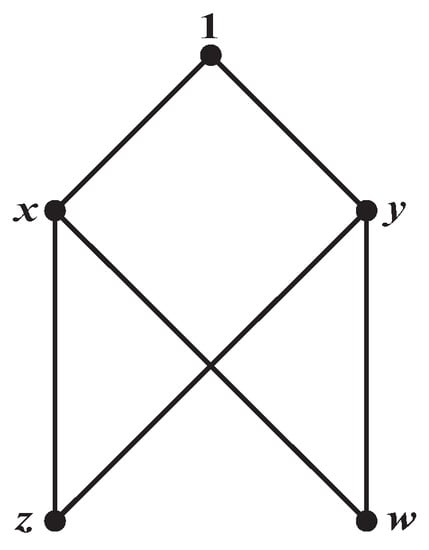
Example 1
([10]). Consider the set . If we define a binary operation ∗ on N by the following table
| 1 | x | y | z | w | |
| 1 | 1 | x | y | z | w |
| x | 1 | 1 | y | z | w |
| y | 1 | x | 1 | z | w |
| z | 1 | 1 | 1 | 1 | x |
| w | 1 | 1 | 1 | z | 1 |
Then, is a bitonic algebra with a Hasse diagram in Figure 1.
Figure 1.
The bitonic algebra N with the Hasse diagram in Example 1.
Theorem 1
([10]). Let be a bitonic algebra. Then the following are equivalent:
- (1)
- œ
- (2)
- œ∗œ∗
for every œ,.
Let be a bitonic algebra. We will define a binary operation “∨” on A by œ∨œ∗∗
for every œ,.
Lemma 3
([10]). Let be a bitonic algebra. Then for the binary operation ∨ on A, we have
- (1)
- (2)
- œ≤ implies œ∨
- (3)
- œ and œ
for every œ,.
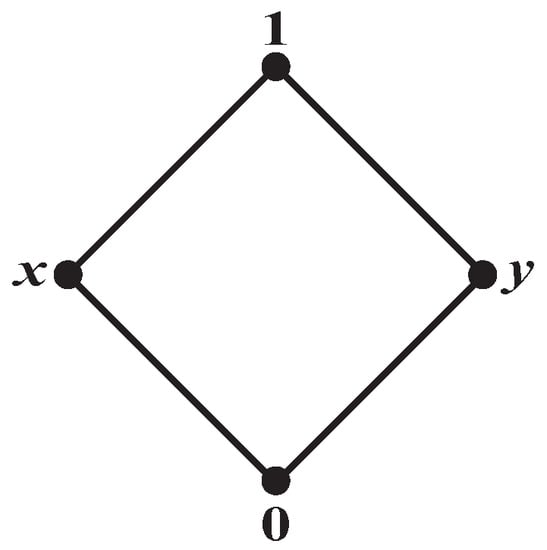
Example 2
([10]). Let be a set. If we define a binary operation ∗ on B by the following table
| 1 | x | y | 0 | |
| 1 | 1 | x | y | 0 |
| x | 1 | 1 | y | y |
| y | 1 | x | 1 | 0 |
| 0 | 1 | 1 | 1 | 1 |
Then is a bitonic algebra with the Hasse diagram in Figure 2.
Figure 2.
The bitonic algebra B with the Hasse diagram in Example 2.
Example 3.
Let be a set. If we define a binary operation ∗ on C by the following table
| 1 | a | b | |
| 1 | 1 | a | b |
| a | 1 | 1 | b |
| b | 1 | a | 1 |
then is a bitonic algebra.
Let A be a bitonic algebra. A nonempty subset S of A is called a bitonic subalgebra of A if for every , and a nonempty subset F of A is called a filter of A if it satisfies
- (F1)
- ;
- (F2)
- a̧ with a̧∗b̧ gives b̧ for any a̧,b̧.
3. Filters of Bitonic Algebras
In this section of the study, we will focus on the concept of filters of bitonic algebras. We will consider their characteristic properties and basic concepts. With the help of another set, we focus on another way to define a filter of a bitonic algebra.
Proposition 1.
Let F be a filter of a bitonic algebra A. If a̧≤b̧ and a̧ for any b̧, then b̧.
Proof.
Let F be a filter of a bitonic algebra A and assume that a̧≤b̧ and a̧ for any b̧. Then, we have a̧∗b̧ =1 and since F is a filter we have b̧. □
Theorem 2.
Every filter F of a bitonic algebra A is a subalgebra of A.
Proof.
Let F be a filter of a bitonic algebra A. Because of the fact that F is a filter, it can be said that so F is nonempty.
Let be in F. By Lemma 1, we can state that with as F is a filter. Hence, F is a subalgebra. □
Proposition 2.
Let A be a bitonic algebra and be a family of filters of A. Then is a filter of A.
Proof.
Let be the family of filters of a bitonic algebra A. Since is a filter of A for all .
Let and . Thus, for every it is clear that and . Since is a filter of A for every , we gather for the whole , . That is .
Hence, is a filter.
□
For a bitonic algebra A, the union of its filters could not be a filter of A. In Example 2, and are filters of B, but is not a filter of B, because and but .
Proposition 3.
Let A be a bitonic algebra with a chain of filters of A with . Then is a filter of A.
Proof.
Let A be a bitonic algebra and a chain of filters of A with . since for all .
If with then there exists with such that and . Indeed, we have two possible cases: one is and the second is . When is so, is with . Since is a filter of A we have .
Similarly, if , then and give us , since it is a filter of A. Then, . Therefore, is a filter.
□
Theorem 3.
as the family of all filters of a bitonic algebra A creates a complete lattice.
Proof.
Let be a family of all filters of a bitonic algebra A. It is clear and .
Let be any elements where with . Thus, for all , and there is an index j̧ where . As a result, .
Let be the family of the whole filters of a bitonic algebra A, which is contained in the intersection . If we define as the intersection of all filter containing , hence, if we choose and then is a complete lattice.
□
A bitonic algebra is said to be commutative if for all we have
Lemma 4
([10]). An algebra of the (2,0)-type is a commutative bitonic algebra if and only if satisfies the following properties for all
- ()
- ;
- ()
- ;
- ()
- implies and ;
- ()
- .
Theorem 4
([10]). Let be a commutative bitonic algebra. Then it is a join-semilattice in which is the least upper bound of .
Definition 2.
Let and be bitonic algebras. As a function is said to be a homomorphism of bitonic algebras if and only if for all .
If is a homomorphism of bitonic algebras then we have
For any homomorphism , the set , denoted by , is said to be the kernel of .
Proposition 4.
Let and be bitonic algebras and be a homomorphism. Then
- (1)
- If G is a filter of B then is filter of A;
- (2)
- If F is a filter of A and ϱ is surjective is a filter of B;
- (3)
- is a filter of A.
Proof.
Let and be bitonic algebras.
- (1)
- Let G be a filter of B. We have since .Let , for any . In that case and . Because of the reason that is a homomorphism we haveand we have that G is a filter; therefore . Hence, . This means that is a filter of A.
- (2)
- Let F be a filter of A and be surjective. Obviously, . Now consider and for . Then, there are elements such that and . There exists such that since is surjective and . Now, consider . where and F is a filter of A are obtained, and therefore meaning . Consequently, is a filter of B.
- (3)
- Since , . Let and for any . So, and , and we getsince is a homomorphism of bitonic algebras and by Definition 1 (B2). Hence . Hence, is filter of A.
□
Definition 3.
Let A be a bitonic algebra. Then we will define the upper set of æ and ç by
for each æ,ç.
Remark 1.
Let A be a bitonic algebra and . Then since , so . Since by Lemma 1(3), , and since we have .
Theorem 5.
Let be a bitonic algebra. If there exists the smallest element , then for all .
Proof.
Assume that there is the element such that for all . Let . Then, and ; hence and . Therefore, . □
Proposition 5.
Let A be a bitonic algebra and . Then
- (1)
- ;
- (2)
- ;
- (3)
- and ;
- (4)
- If then .
Proof.
- (1)
- Let A be a bitonic algebra and . Then, with the help of the definition of a bitonic algebra, it can be obtained asTherefore, .
- (2)
- Let for a bitonic algebra A. Since with Lemma 1 (1) we can state .
- (3)
- Let . Since for a bitonic algebra A we can state ; that is . Additionally, since with the help of being bitonic algebras we can state .
- (4)
- Assume that for . Let . ThenConsider . By Theorem 1 we haveThus, . Hence .
□
Proposition 6.
Let A be a bitonic algebra with the property that for all æ,ç,c̠, æ∗çç∗c̠æ∗c̠). Then, æ,çç,æ) for any æ,ç.
Proof.
Let A be a bitonic algebra with the property for the whole æ,ç,c̠, æ∗çç∗c̠æ∗c̠). Thus, by Theorem 1 it can be stated as
æ,çæççæç,æ)
Therefore, æ,çç,æ). □
Definition 4.
Let be a bitonic algebra. If for the whole , it is labeled as self-distributive.
Example 4.
Let be the bitonic algebra given in Example 1. Since but , it is not a self-distributive algebra.
Let be a set. Then, ∗ on A is defined as a binary whose table is given as:
| 1 | x | |
| 1 | 1 | x |
| x | 1 | 1 |
In that situation, we get a self-distributive bitonic algebra .
Corollary 1.
Let be a self-distributive bitonic algebra. Then the upper set is a filter of A for any .
Theorem 6.
If F is a filter of a bitonic algebra A then for all .
Proof.
Let and . In that case, . F is a filter and , and . Hence, .
□
Theorem 7.
Let A be a self-distributive bitonic algebra and F be a non-empty subset of A. If for all , then F is a filter of A.
Proof.
Let . In that case, by hypothesis with ; additionally we have . Thus, is a filter since , . Hence, F is a filter. □
Theorem 8.
If F is a filter of a self-distributive bitonic algebra A then
Proof.
Let F be a filter of a bitonic algebra A and . Since , it can be said that . Hence, . Now, let . In that case, exists such that . Thus, by Theorem 6, we have . Hence . Therefore, .
□
Corollary 2.
If F is a filter of a self-distributive bitonic algebra A then .
Proposition 7.
Let A be a self-distributive bitonic algebra and . Then, if and only if .
Proof.
Let A be a self-distributive bitonic algebra, and . Suppose that . Then, we have . With the help of being a bitonic algebra we get
Hence . Thus, . Let for . Since A is a self-distributive bitonic algebra we have
That is, . Hence . Therefore, .
Conversely, assume . Then, .
□
Proposition 8.
Let A be a bitonic algebra and , then .
Proof.
Let A be a bitonic algebra and such that . Then consider . Since , we have . Therefore, . □
Proposition 9.
Let A be a self-distributive bitonic algebra and , then .
Proof.
Let A be a self-distributive bitonic algebra with . Suppose . In that case, consider . Since A is self-distributive with , we have . Thus, Now, assume that . Then, comes from directly Proposition 8. □
Proposition 10.
Let A be a bitonic algebra and . Then
- (1)
- If , then and ;
- (2)
- If and then .
Proof.
- (1)
- Let and . In that case, . Since by Lemma 2(1). Hence , and .Additionally, consider with . Thus, since and by Lemma 2(1). Hence, , and .
- (2)
- Let and . Then by (1), with .
□
Proposition 11.
Let A be a bitonic algebra and . Then, .
Proof.
Let A be a bitonic algebra and . Consider . By Lemma 1 (3), and the definition of a bitonic algebra, we have . Hence, we get . Additionally, since by Lemma 2(2), . Hence, . □
Theorem 9.
Let be a self-distributive bitonic algebra. Then the upper set is a filter of A for any .
Proof.
Let be a self-distributive bitonic algebra. Since for any , it can be stated as . Now, let with for any . Consider . Using our assumptions we have
Hence, we get . Therefore, . Thus, is a filter of A. □
4. Conclusions
Filters in algebras are considered substructures that play a significant role in our understanding of algebras. Filters are used in general topology to characterize such important concepts as continuity, initial and final structures, and compactness. A filter is a special subset of a partially ordered set and they occur in order and lattice theory with respect to a congruence on these structures. This set is another useful tool to study algebraical properties of the given algebra and also another way to state characteristics of the given algebra different than the usual way.
Thus, in this meticulous work, filters of bitonic algebras are considered to discuss their important properties by giving important theorems, lemmas and propositions that are tools to check for the properties of the given algebra. It is aimed to continue to study filter theory. Additionally, the notion of upper sets of bitonic algebras is generalized to provide an equivalent condition of the filters using this concept. To be able to achieve this, we investigate several properties of upper sets in bitonic algebras, introduce more extended upper sets of bitonic algebras, and obtain some relations with filters of bitonic algebras by again listing some important theorems, lemmas and properties as a tool relating them to the structure of filters in commutative bitonic algebras. In the next studies, these certain results will be used to list the filters of bitonic algebras by using appropriate algorithms and also will be added in the studies of derivations of bitonic algebras to be able to give algebraical properties of the concept.
Funding
This research received no external funding.
Conflicts of Interest
The author declares no conflict of interest.
References
- Rasiowa, H. An Algebraic Approach to Non-Classical Logics; North Holland: Amsterdam, The Netherlands, 1974. [Google Scholar]
- Cartan, H. Théorie des filtres. Comptes Rendus Hebd. Séances L’académie Sci. 1937, 205, 595–598. [Google Scholar]
- Birkhoff, G. Lattice Theory; American Mathematical Society: Providence, RI, USA, 1967; Volume XXV. [Google Scholar]
- Zhang, X.; Ma, X.; Wang, X. Filters in Strong BI-Algebras and Residuated Pseudo-SBI-Algebras. Mathematics 2020, 8, 9. [Google Scholar] [CrossRef] [Scilit]
- Deeba, E.Y. Filter theory of BCK-algebra. Math. Jpn. 1980, 25, 631–639. [Google Scholar]
- Komori, Y. The variety generated by BCC-algebras is finitely based. Reports Fac. Sci. Shizuoka Univ. 1983, 17, 13–16. [Google Scholar]
- Komori, Y. The class of BCC-algebras is not a variety. Math. Jpn. 1984, 29, 391–394. [Google Scholar]
- Dudek, W.A. On BCC-algebras. Log. Anal. 1990, 129–130, 103–111. [Google Scholar]
- Dudek, W.A. On proper BCC-algebras. Bull. Inst. Math. Acad. Sin. 1992, 20, 137–150. [Google Scholar]
- Yon, Y.H.; Özbal Ayar, Ş. On derivations and generalized derivations of bitonic algebras. Appl. Anal. Discret. Math. 2018, 12, 110–125. [Google Scholar] [CrossRef] [Scilit]
- Ebadi, D.; Sattari, M.H. Symmetric Bi-Derivations on Bitonic Systems. Turk. J. Comput. Math. Educ. 2021, 12, 5025–5032. [Google Scholar]
Publisher’s Note: MDPI stays neutral with regard to jurisdictional claims in published maps and institutional affiliations. |
© 2022 by the author. Licensee MDPI, Basel, Switzerland. This article is an open access article distributed under the terms and conditions of the Creative Commons Attribution (CC BY) license (https://creativecommons.org/licenses/by/4.0/).