


Abstract
Against the backdrop of China’s “dual carbon” goals and urban green transition, improving urban land use efficiency is essential for shifting land development from extensive expansion to intensive and low-carbon use. Using the Low-Carbon City Pilot Program as a quasi-natural experiment, this study examines panel data from 285 prefecture-level cities in China from 2007 to 2023. We apply a multi-period difference-in-differences model, a threshold regression model, and a spatial Durbin model to assess the program’s impact on urban land use efficiency. The results show that the pilot program significantly improves urban land use efficiency, and the effect persists over time. This finding remains robust across a series of robustness checks. Heterogeneity analysis shows that the efficiency gains are stronger in cities with lower air pollution control pressure, higher industrial pollution control pressure, and lower fiscal pressure. Further threshold analysis shows that digital connectivity is a key condition for strengthening the policy effect. The spatial analysis suggests that the policy effect shows some spatial association. However, the decomposed indirect and total effects are not robust, so the spatial results should be interpreted with caution. This study provides empirical evidence on how low-carbon city pilots affect urban land governance and land use efficiency. Its conclusions, however, remain subject to limitations related to efficiency measurement, policy identification, and the availability of city-level data.
1. Introduction
Urban land use provides an important lens for understanding low-carbon transition, territorial governance, and sustainable urban development. As urbanization continues worldwide, many countries face similar challenges, including construction land expansion, inefficient land use, shrinking ecological space, and rising transport and energy demand. Urban land is not merely an economic input. It is also a socio-spatial resource shaped by planning systems, infrastructure networks, local government objectives, and the behavior of multiple actors. Improving urban land use efficiency therefore means more than producing higher output with less land. It also requires better spatial allocation of land under environmental constraints, planning regulations, and public-interest considerations.
China’s urbanization offers a useful setting for examining the links among low-carbon policy, land governance, and local government behavior. For many years, some Chinese cities relied on land conveyance, industrial attraction, and spatial expansion to support economic growth. This land-driven model accelerated urbanization, but it also produced land misallocation, inefficient construction land expansion, ecological encroachment, and rising carbon pressure. Under China’s “dual carbon” goals and the “Beautiful China” initiative, urban land development must shift from scale expansion to intensive and low-carbon use. In China’s governance system, national urban pilot programs usually follow central strategic goals, are organized by agencies such as the National Development and Reform Commission, and are implemented by local governments through planning, industrial policy, and environmental governance. Low-carbon city pilots are therefore not only environmental policy tools. They are also institutional experiments that reshape local governance and urban spatial development.
Improving urban land use efficiency is not a purely technical or economic issue. It involves local government incentives, environmental regulation, and factor allocation mechanisms [1,2,3,4]. Since 2010, China has implemented the Low-Carbon City Pilot Program in three batches. The program aims to explore local pathways for low-carbon development, optimize energy structures, promote industrial upgrading, and create replicable models of green development [5,6,7,8]. It also provides a quasi-natural experiment for testing whether environmental regulation can support both carbon reduction and economic development. A key question is whether the program can change local government incentives and redirect land allocation away from short-term growth targets toward long-term low-carbon transition and ecological well-being. This question has important implications for ecological governance and land market reform.
The related literature can be divided into two main strands. The first strand examines the measurement and determinants of urban land use efficiency. In terms of measurement, existing studies have moved from single-factor efficiency to total-factor efficiency [2]. Many studies also use data envelopment analysis with undesired outputs to better capture the environmental dimension of land use efficiency. In terms of determinants, scholars have examined technological progress, industrial agglomeration, regional integration, and the digital economy. These studies show that market integration and technological innovation can improve land resource allocation [4,9]. The second strand evaluates the effects of the Low-Carbon City Pilot Program. Existing studies show that the program reduces carbon emissions and air pollution [10,11], improves urban green total factor productivity and manufacturing upgrading [12], and reduces land use by firms with high energy consumption, high pollution, and high emissions in industrial land [13]. Other studies also find heterogeneous effects across pilot batches and city types [5].
Despite these contributions, three gaps remain. First, studies on low-carbon city pilots mainly focus on emission reduction, green innovation, or macroeconomic growth. They pay less attention to how these pilots become embedded in urban planning, land supply, industrial access, and spatial governance. Second, studies on land use efficiency often emphasize measurement and determinants, but they rarely explain how low-carbon policy reshapes urban land systems from the perspective of land governance and policy experimentation. Third, existing DID studies have examined the relationship between low-carbon city pilots and urban green land use efficiency, but they leave room for further analysis of policy persistence, conditional effects, and spatial association. In particular, spatial correlation, spatial interaction terms, and robust spatial spillover effects need to be clearly distinguished.
International studies on urban policy experimentation provide useful insights for the Chinese case. Many countries have used eco-city projects, green growth zones, low-emission areas, and climate-oriented planning tools to embed environmental goals into land redevelopment, industrial location, and infrastructure investment [14,15]. These experiences show that environmental pilot programs can reshape land allocation through planning and regulatory instruments. China’s Low-Carbon City Pilot Program follows a similar logic but operates within a distinctive institutional setting characterized by developmental local governments and public land ownership. Therefore, it offers a useful case for examining how environmental policy experiments affect urban land governance.
Against this background, this study treats the Low-Carbon City Pilot Program as a quasi-natural experiment. Using panel data from 285 prefecture-level cities in China from 2007 to 2023, we apply a multi-period difference-in-differences model, a threshold regression model, and a spatial Durbin model to examine the program’s impact on urban land use efficiency. This study contributes to the literature in three ways. First, it develops an urban land governance perspective that links low-carbon city pilots, land use efficiency, and spatial governance within one analytical framework. This perspective highlights that land use efficiency depends not only on input-output performance, but also on planning institutions, local government incentives, and industrial access rules. Second, it uses a long city-level panel to examine the persistence, heterogeneity, and digital-connectivity threshold of the policy effect. Third, it distinguishes spatial association from robust spatial spillover effects. This distinction avoids interpreting a significant spatial interaction term as direct evidence of a robust indirect effect, and it allows a more cautious discussion of regional policy transmission.
The remainder of this paper is organized as follows. Section 2 presents the institutional background, theoretical mechanisms, and research hypotheses. Section 3 describes the research design, variable construction, and data sources. Section 4 reports the baseline regression, dynamic effects, and robustness checks. Section 5 examines mechanism-related evidence, heterogeneity, threshold effects, and spatial association. Section 6 discusses the main findings and concludes with policy implications and research limitations.
2. Theoretical Analysis and Hypotheses
Urban land use efficiency reflects how effectively production factors are allocated in urban space. Its evolution depends not only on market forces but also on government intervention and institutional arrangements. Urban land is not merely an economic input. It is a socio-spatial construct shaped by planning systems, land markets, infrastructure networks, local development objectives, and diverse actors [16,17]. Under a growth-oriented development model, local governments often attract investment through low-cost land supply and preferential land policies. This approach can shift resources toward high-pollution and low-efficiency sectors, thereby constraining improvements in land use efficiency. Low-carbon city pilot programs are comprehensive policy experiments through which China promotes green and low-carbon transformation at the urban scale. Their goals include carbon reduction, environmental improvement, industrial restructuring, and governance transformation. From an urban land governance perspective, these programs affect land use efficiency through more than changes in firms’ production costs. They also embed low-carbon objectives into land supply, industrial access, project approval, and spatial planning. In doing so, they reshape urban land development and the spatial allocation of industry.
2.1. Low-Carbon City Pilot Programs and Urban Land Resource Allocation Efficiency
Low-carbon city pilot programs affect urban land allocation by tightening environmental regulation and institutional constraints. These policies change firms’ production costs and investment decisions, but their effects go beyond firm behavior. They also reshape the relationship between government intervention and market allocation, and they help correct factor misallocation.
Under the traditional “land-for-investment” model, local governments compete for investment by offering low-cost land and preferential land policies. This model can promote short-term economic expansion. However, it also distorts land price signals, directs resources toward high-pollution and low-efficiency sectors, and creates spatial lock-in [18,19]. Low-carbon city pilot programs impose stronger environmental constraints and institutional rules. These constraints limit the selective allocation of land by local governments and encourage land supply to follow efficiency-oriented principles. As a result, they can reduce spatial misallocation caused by excessive government intervention.
From the perspective of factor allocation, urban land use efficiency improves when capital, labor, technology, and land move toward more productive uses. Without strict environmental constraints, high-pollution industries may occupy large amounts of land because they face lower institutional costs. Low-carbon city pilot programs raise pollution costs and environmental entry barriers. This changes firms’ relative returns and increases the pressure on inefficient firms to exit or upgrade. At the same time, policy support can help green and high-value-added industries expand, thereby reallocating land toward more productive sectors [20]. Low-carbon policies may also strengthen market expectations and institutional stability. This reduces uncertainty in cross-sector factor mobility and helps shift land use from scale expansion toward efficiency improvement. Therefore, we propose the following hypothesis:
H1.
Low-carbon city pilot programs significantly improve urban land use efficiency.
2.2. Mechanisms Through Which Low-Carbon City Pilots Improve Land Use Efficiency
First, low-carbon city pilot programs may promote urban land use efficiency through green innovation. By strengthening low-carbon development targets, environmental access standards, and green transition incentives, these programs can change the innovation incentives of local governments and market actors. On the one hand, they raise the compliance costs of high-pollution and energy-intensive production, which increases firms’ incentives to adopt green technologies [21]. Firms may therefore invest more in energy saving, emission reduction, cleaner production, and pollution control. On the other hand, the pilot programs send policy signals and provide institutional support for green technologies, green industries, and low-carbon projects. These signals can guide innovation resources toward energy conservation, environmental protection, clean energy, green manufacturing, and pollution control. From a land use perspective, green innovation can improve production processes, reduce energy consumption, lower emissions, and raise output per unit of land. It can therefore shift urban land use from high-consumption and high-emission patterns toward cleaner and higher-value uses. In this sense, green innovation can affect both the output and environmental dimensions of land use efficiency. It can increase economic output per unit of land while reducing undesired environmental outputs.
Second, low-carbon city pilot programs may improve land use efficiency by optimizing government resource allocation. These programs affect not only firms but also the behavior of local governments. Under a growth-oriented evaluation system, local governments often pursue short-term growth through large-scale and low-cost land supply. This creates a path dependence on “development through land” . Low-carbon pilot programs introduce green and low-carbon targets into local development goals. They encourage local governments to shift from a narrow focus on growth to a broader focus on development quality and sustainability. In land conveyance and project approval, local governments must pay greater attention to environmental performance and long-term efficiency. This may reduce land supply for inefficient and high-pollution projects. At the same time, fiscal resources may shift toward green innovation, technological upgrading, and public services [22]. Although this fiscal adjustment does not directly change land use patterns, it can improve the local technological base, human capital, and institutional environment. These changes may increase output efficiency per unit of land. This institutional channel suggests that government resource allocation is important for improving urban land use efficiency.
Third, low-carbon city pilot programs may affect land use efficiency through openness upgrading. In an open economy, cross-border flows of capital, technology, and industry can reshape urban land use. As green-oriented policy experiments, low-carbon pilot programs may change how cities participate in global production networks through signaling and screening mechanisms. Through the signaling mechanism, pilot status sends a signal that a city is committed to green transition and sustainable development. This may increase the city’s attractiveness to green capital, clean technologies, and high-end industries [23,24]. Through the screening mechanism, stricter environmental standards raise the entry costs of highly polluting and energy-intensive foreign investment projects. This can encourage local governments to move from quantity-oriented investment attraction to quality-oriented investment selection. As a result, foreign capital may flow more toward technology-intensive, cleaner, and higher-value-added sectors [25,26]. High-quality FDI can improve land use efficiency directly through higher-value production. It can also generate indirect gains through technology spillovers, management learning, and industrial chain linkages [27,28]. Therefore, openness upgrading may serve as an external channel through which low-carbon city pilot programs affect urban land use efficiency.
Based on the above discussion, we propose the following hypothesis:
H2.
Low-carbon city pilot programs may improve urban land use efficiency through three mechanism-related channels: green innovation, government resource allocation, and openness upgrading.
2.3. Nonlinear Mechanism: Threshold Effect
The effects of low-carbon city pilot programs may vary with local development conditions. One important condition is digital connectivity. As part of urban infrastructure, digital connectivity can reduce information asymmetry and transaction costs. It can also improve the mobility and matching of production factors [29]. When digital connectivity is high, policy signals can reach firms more quickly and clearly. This helps firms adjust production, adopt green technologies, and reallocate resources with lower friction. It also strengthens the ability of local governments to monitor environmental performance, coordinate policy implementation, and provide public services. By contrast, weak digital connectivity may slow information flows, reduce factor-matching efficiency, and weaken governance coordination. In such cities, low-carbon policy constraints may be less likely to translate into industrial upgrading and land reallocation.
Digital connectivity therefore shapes the extent to which low-carbon city pilot programs affect urban land use efficiency. Once digital connectivity passes a certain threshold, the policy effect may become stronger. Based on this logic, we propose the following hypothesis:
H3.
Digital connectivity has a threshold effect on the relationship between low-carbon city pilot programs and urban land use efficiency. The positive effect of the pilot programs is stronger in cities with higher levels of digital connectivity.
2.4. Spatial Linkages and Regional Transmission
As regional integration deepens, cities become connected through industrial linkages, factor flows, and institutional interactions. The effects of low-carbon city pilot programs may therefore extend beyond pilot cities and become spatially associated with neighboring or economically linked cities. On the one hand, stricter environmental standards and industrial entry rules may encourage the relocation of high-pollution activities while supporting the regional diffusion of green industries. These changes can affect land use structures in nearby cities. On the other hand, pilot policies may influence neighboring governments through demonstration effects and competitive pressure. Local governments may learn from pilot practices, adjust their own policy tools, or compete for green investment. In addition, the movement of capital, labor, and technology across cities can further transmit the effects of low-carbon policies through regional markets [13,30].
These processes suggest that the spatial consequences of low-carbon city pilot programs may not follow a single direction. They may include positive diffusion, industrial relocation, policy learning, and regional competition. The observed spatial pattern may also depend on how inter-city linkages are measured. Based on this logic, we propose the following hypothesis:
H4.
The impact of low-carbon city pilot programs on urban land use efficiency may show spatial association, but its direction and strength depend on inter-city linkages, spatial weight specifications, and local governance conditions.
3. Empirical Design
3.1. Model Specification
To identify the causal effect of the low-carbon city pilot program on urban land use efficiency, this study treats the program as a quasi-natural experiment and employs a multi-period difference-in-differences (DID) model. Because the low-carbon city pilot program was implemented in multiple batches, a multi-period DID framework provides an appropriate strategy for identifying policy effects. However, when treatment is staggered and treatment effects are potentially heterogeneous, traditional two-way fixed-effects event-study estimators may suffer from bias because already-treated units can serve as controls for later-treated units. Accordingly, the dynamic effects discussed below should be interpreted in light of the heterogeneous-treatment-effects framework proposed by [31,32]. The baseline specification is as follows:
where represents the land use efficiency of city in year , is the policy variable, is the control variable, is the city fixed effect, and is the year fixed effect, used to control for unobserved individual heterogeneity and time shocks; represents the random disturbance term. Given that the low-carbon city pilot policies were implemented in batches (2010, 2012, and 2017), this study adopts a multi-period DID design, assigning a value of 1 to pilot cities in each batch after policy implementation and 0 otherwise, thereby fully leveraging the temporal differences in policy implementation to enhance the identification power of the estimates. The parameter is the core coefficient of interest in this study, reflecting the average treatment effect of the low-carbon city pilot policy on urban land use efficiency. If , it indicates that the low-carbon policy helps improve urban land use efficiency.
3.2. Variable Descriptions
3.2.1. Dependent Variable
Urban land use efficiency (eff). Urban land use efficiency measures a city’s ability to generate higher output under given land input, or to use land more efficiently under given output constraints. This study constructs the indicator system from both input and output dimensions. The input indicators include land, labor, capital, and energy. The output indicators include both desired and undesired outputs. Specifically, the desired output is measured by industrial output per unit of land, while the undesired output is measured by carbon emissions. Because urban land use generates economic output but also entails environmental costs, this study uses a Super-SBM model with undesired outputs to estimate urban land use efficiency for China’s prefecture-level cities from 2007 to 2023.
To improve transparency and reproducibility, Appendix A reports the full indicator system, the Super-SBM model specification, variable definitions, and data sources.
3.2.2. Key Explanatory Variables
Low-Carbon City Pilot Program (did). This study uses the Low-Carbon City Pilot Program, launched in batches by the National Development and Reform Commission (NDRC), as a quasi-natural experiment. We construct a policy dummy variable, , to identify the treatment status of each city-year observation. Because the program was implemented in different batches, the treatment year varies across pilot cities. The variable equals 1 if city had been included in the pilot program by year , and 0 otherwise. This variable captures the effect of the pilot policy on urban land use efficiency.
3.2.3. Control Variables
To reduce omitted variable bias, this study controls for city-level characteristics that may affect urban land use efficiency. These variables cover industrial structure, economic growth, fiscal conditions, human capital, information infrastructure, and population size. Industrial structure (third) is measured by the share of tertiary industry value added in GDP. Economic growth (rgdp) is measured by the regional GDP growth rate. Fiscal pressure (Finan) is measured by the ratio of the fiscal deficit to fiscal revenue. Human capital (Human) is measured by the number of college students per 10,000 people. Information infrastructure (Info) is measured by mobile phone penetration, defined as the ratio of mobile phone users to the permanent resident population. Population size (Chang) is measured by the logarithm of the permanent resident population. These variables capture differences in economic structure, development stage, fiscal capacity, factor endowments, and urban scale. They are also commonly used in studies of urban land use efficiency. To reduce the influence of extreme values, all continuous control variables are winsorized at the 1st and 99th percentiles. The detailed definitions, measurement methods, and data sources are reported in Appendix A.
3.3. Descriptive Statistics and Analysis of Key Findings
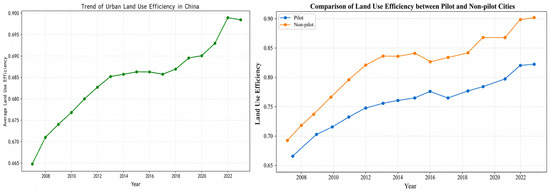
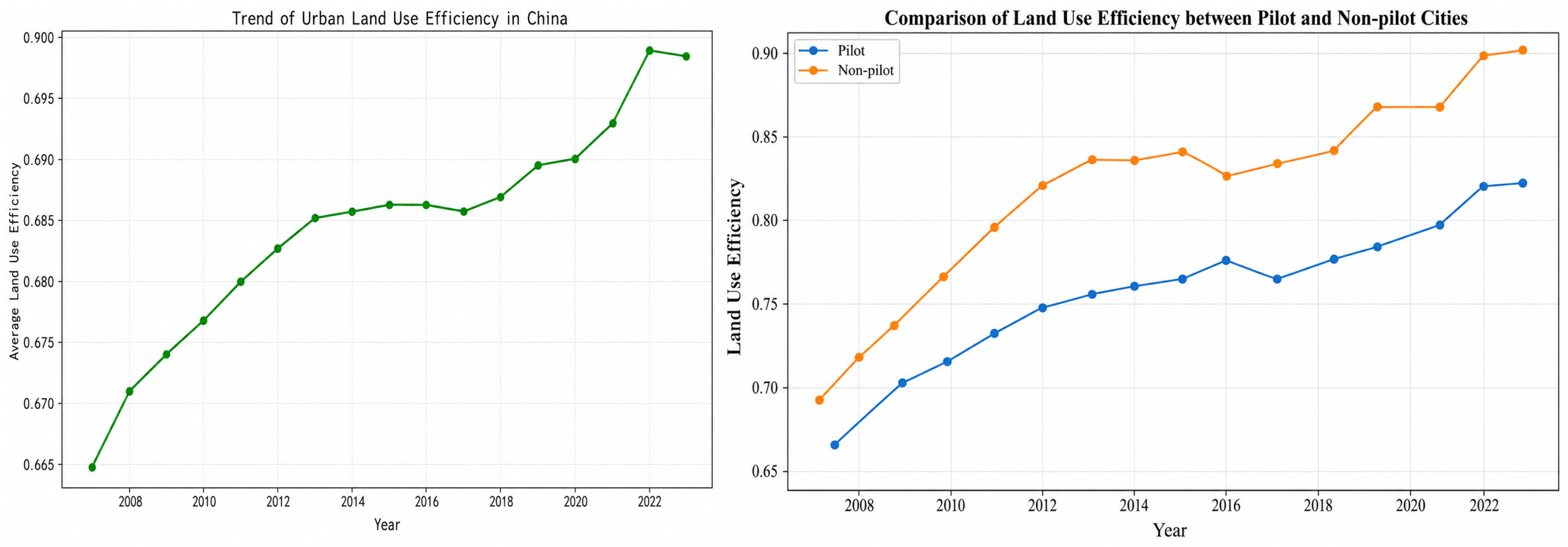
Table 1 reports the descriptive statistics for the main variables. Figure 1 shows several preliminary patterns. First, urban land use efficiency increased steadily during the sample period. Low-carbon pilot cities also had higher efficiency levels than non-pilot cities, and the gap widened after policy implementation. This pattern provides initial evidence that the Low-Carbon City Pilot Program may have improved land use efficiency. Second, the distribution of land use efficiency shifted to the right over time, and the median value increased gradually. This suggests a general improvement in urban land use efficiency across the sample. Third, low-carbon pilot cities were mainly concentrated in eastern coastal and central China, showing clear regional clustering. This spatial pattern suggests the need to examine regional heterogeneity and spatial association in the following analysis.
Table 1.
Descriptive Statistics.
Figure 1.
Time Series of Urban Land Use Efficiency.
4. Analysis of Results
4.1. Baseline Regression
Table 2 reports the baseline estimates for the effect of the Low-Carbon City Pilot Program on urban land use efficiency. The models gradually add control variables and stricter fixed effects. Across all specifications, the estimated coefficient of the pilot variable remains between 0.005 and 0.006 and is statistically significant. This result indicates that the pilot program has a stable positive association with urban land use efficiency. Compared with non-pilot cities, pilot cities experienced an average increase of about 0.5–0.6 percentage points in land use efficiency, supporting Hypothesis 1.
Table 2.
Baseline Regression.
The economic magnitude is modest but meaningful. Urban land use efficiency is a composite measure based on land, labor, capital, energy inputs, desired output, and undesired output. It usually changes gradually rather than sharply. The estimated effect therefore suggests that the pilot program promoted a steady improvement in land use efficiency rather than an immediate structural shift. A possible explanation is that the program tightened environmental regulation, raised industrial access standards, and changed local government incentives. These changes may have increased the adjustment pressure on high-pollution and energy-intensive firms, while encouraging green and higher-value-added industries. As a result, land resources were more likely to move toward cleaner and more productive uses.
4.2. Parallel Trends Test
Construct a dummy variable using the relative policy implementation period (−5, 5) (omitting as the base period), and estimate:
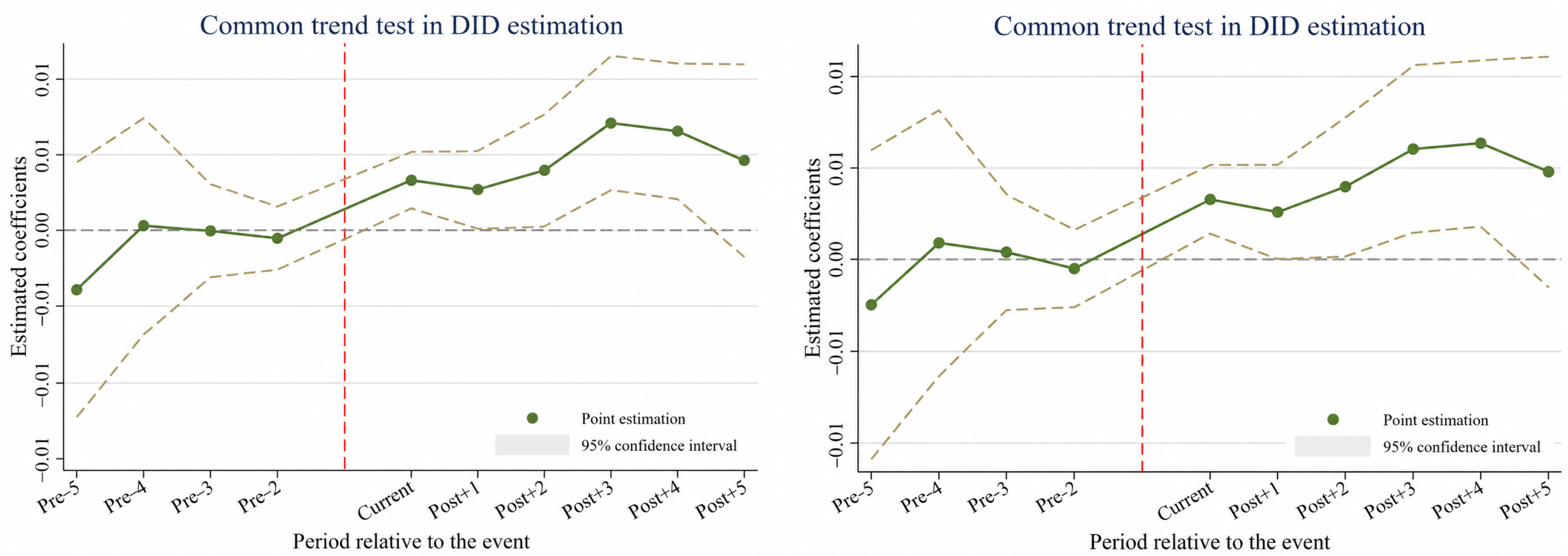
If close to zero and statistically insignificant for , the parallel trends assumption is supported. Post-policy coefficients capture the dynamic path of the treatment effect. Using the year before policy implementation as the reference period, we construct relative-time dummy variables and estimate the model with city and year fixed effects.
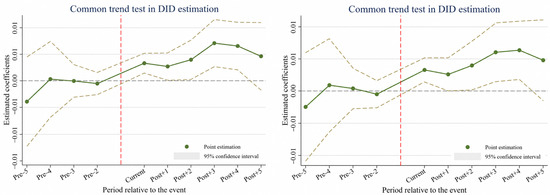
Table 3 and Figure 2 report the event-study results under the traditional two-way fixed effects framework. The pre-policy coefficients are small and statistically insignificant, which suggests that pilot and non-pilot cities followed similar trends in urban land use efficiency before the policy. This supports the parallel trends assumption. After policy implementation, the coefficients generally become positive. This pattern is consistent with the baseline results and suggests that the policy effect persisted over time.
Table 3.
Parallel Trends Test.
Figure 2.
Parallel trends test. Note: The left figure shows the results without control variables, and the right figure shows the results with control variables.
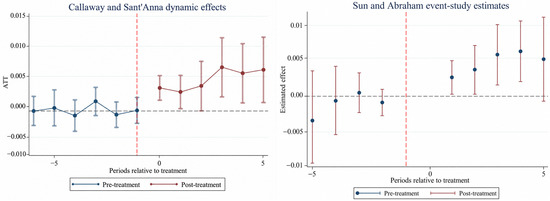
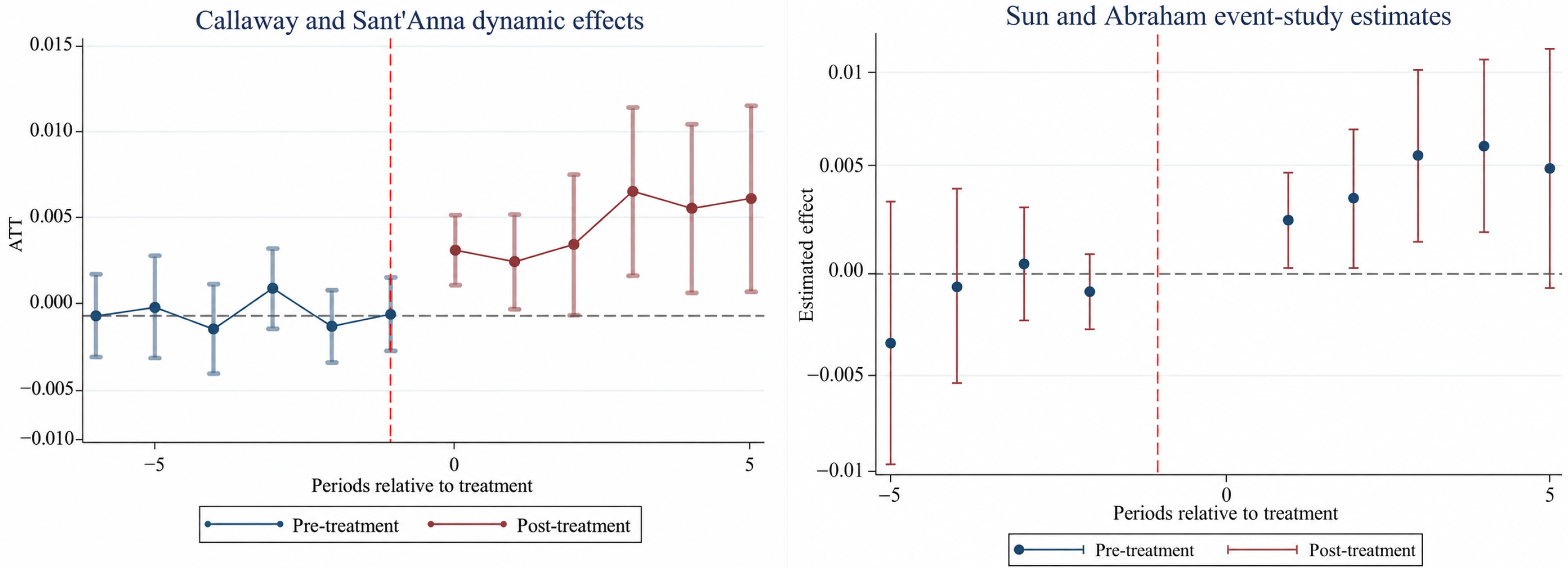
Because the Low-Carbon City Pilot Program was implemented in batches, the traditional TWFE event-study design may be biased when treatment effects differ across cohorts. To address this concern, we conduct two supplementary tests. First, we use the group-time average treatment effect estimator proposed by [31]. Second, we use the interaction-weighted event-study estimator proposed by [32]. Figure 3 reports the corresponding dynamic estimates.
Figure 3.
Test of Dynamic Policy Effects. Note: The left figure shows the dynamic estimation results using the group-time average treatment effect method by , while the right figure shows the dynamic estimation results using the interaction-weighted event study method by .
The results in Figure 3 show that, after accounting for staggered treatment timing and heterogeneous treatment effects, the pre-policy estimates still fluctuate around zero and show no clear pre-trend. This further supports the parallel trends assumption. The post-policy estimates generally shift in a positive direction, although the confidence intervals are wider than those in the traditional TWFE event study. These results suggest that the positive effect of the pilot program is not driven solely by the conventional TWFE specification.
4.3. Placebo Test
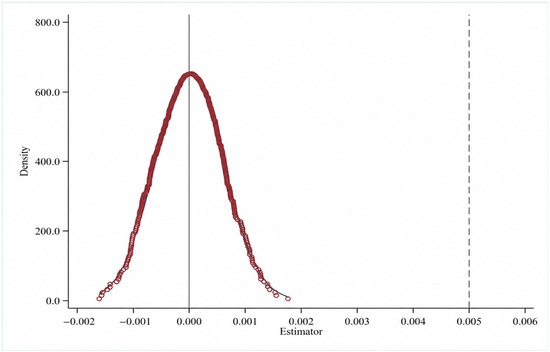
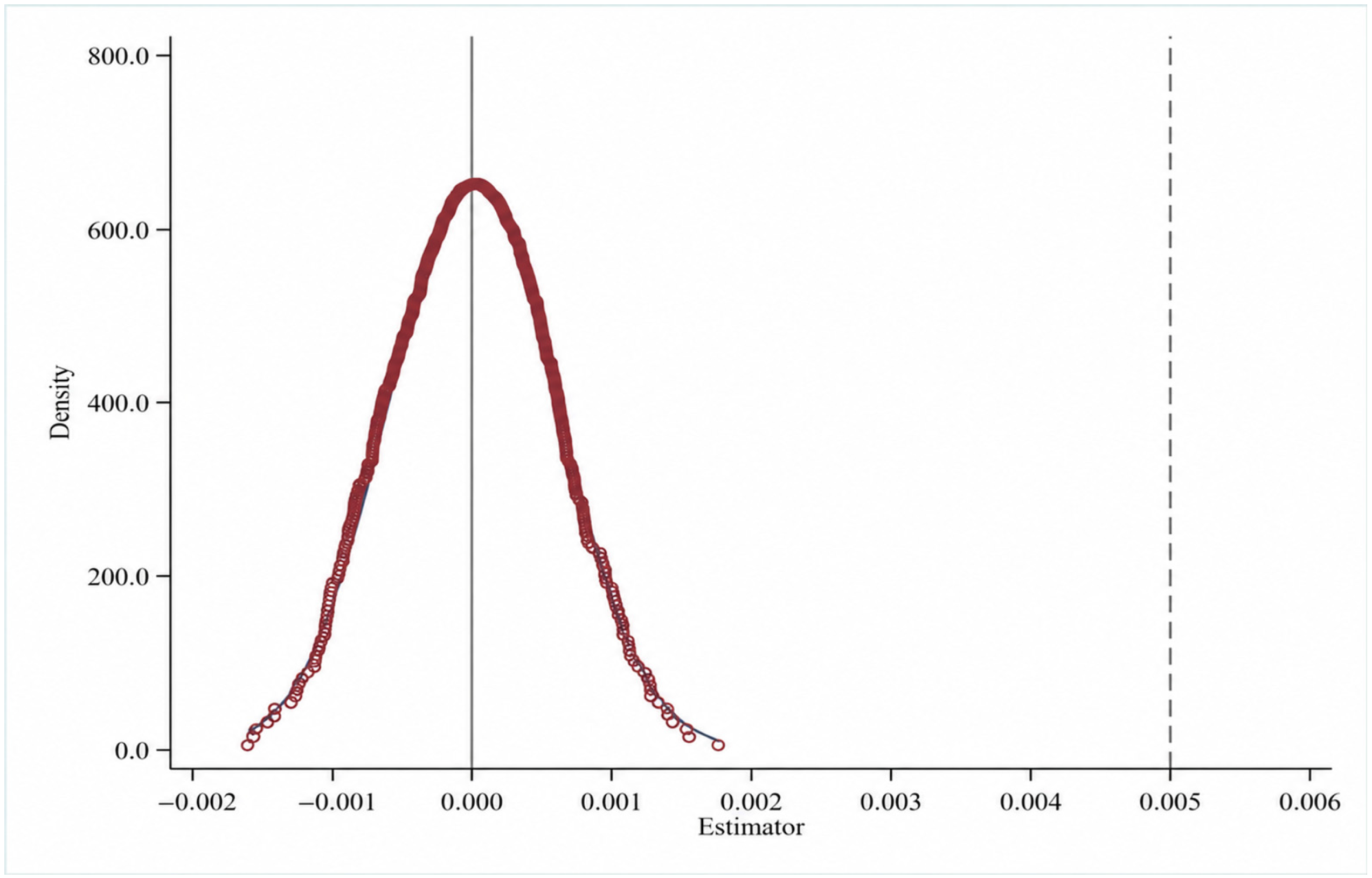
To further assess whether the baseline results are driven by omitted variables or unobserved factors, we conduct a placebo test to examine the validity of the identification strategy. Specifically, we randomly assign a placebo treatment group of “pilot cities” and repeat the regression multiple times through permutation. This procedure generates the distribution of the estimated policy coefficients under random assignment, which we then compare with the actual estimate. Figure 4 presents the placebo test results. The horizontal axis reports the estimated coefficients of the placebo policy variable, while the vertical axis shows their kernel density. The distribution is centered near zero and remains clearly separated from the baseline estimate, indicating that, in the absence of a true policy shock, the model does not systematically generate spurious effects.
Figure 4.
Placebo Test.
4.4. Robustness Tests
To assess the reliability of the baseline results, we conduct several robustness tests. These tests address model specification, potential interference from related policies, and the influence of special regional samples. Table 4 reports the results.
Table 4.
Robustness Tests.
Column (1) uses two-way clustered standard errors to account for possible correlation across both cities and years. The estimated effect remains positive and consistent with the baseline result. Column (2) uses one-period lagged control variables to reduce concerns that contemporaneous controls may respond to the policy. The coefficient of the pilot variable remains 0.005 and is significant at the 5% level. This result suggests that the baseline finding is not driven by the timing of the control variables.
Column (3) controls for the New Energy Demonstration City Pilot policy. This policy promotes new energy development, energy substitution, green infrastructure, and low-carbon industries. Because its objectives overlap with those of the Low-Carbon City Pilot Program, it may also affect urban land use efficiency through energy restructuring, green technology adoption, and industrial upgrading. After controlling for this related green policy, the coefficient of the Low-Carbon City Pilot Program remains positive. This indicates that the baseline result is not simply driven by overlapping green policy shocks. Column (4) excludes the policy implementation year to reduce the influence of transitional shocks or statistical adjustments in the initial policy year. The results remain consistent with the baseline estimates.
Columns (5) and (6) further test whether the results are driven by special regional samples. Column (5) excludes the four municipalities directly under the central government: Beijing, Tianjin, Shanghai, and Chongqing. These cities differ from other prefecture-level cities in administrative status, fiscal capacity, land markets, and policy enforcement. Column (6) excludes eight western provinces and autonomous regions: Sichuan, Guizhou, Yunnan, Tibet, Shaanxi, Gansu, Qinghai, and Ningxia. These regions have distinctive resource endowments, industrial structures, land development patterns, and ecological constraints. In both tests, the estimated coefficient remains positive and close to the baseline estimate. Overall, the robustness checks support the stability of the main finding: low-carbon city pilot programs improve urban land use efficiency.
4.5. Evidence on Mechanisms
To explore the possible channels through which the Low-Carbon City Pilot Program affects urban land use efficiency, we examine three mechanism-related outcomes: green innovation, government resource allocation, and openness upgrading. This section does not conduct a formal mediation test. Such tests may be biased in a two-way fixed effects framework. Following [27], we instead examine whether the pilot program affects the proposed mechanism variables. These results provide supportive evidence for the potential channels, but they do not prove a complete causal mediation chain.
Table 5 reports the results. Columns (1) and (2) use green patent applications and green patent grants as dependent variables. The coefficients of the pilot variable are positive and statistically significant in both columns. This suggests that the pilot program is associated with stronger green innovation activity. From a land use perspective, green innovation may reduce the environmental cost of economic activity per unit of land by improving cleaner production, energy efficiency, and pollution control technologies. It may also support industrial upgrading toward technology-intensive and low-pollution sectors. These changes can raise comprehensive output efficiency per unit of land.
Table 5.
Evidence Related to Mechanisms.
Column (3) uses the share of science expenditure in general fiscal expenditure as the dependent variable. The coefficient is positive and significant at the 10% level. This result suggests that the pilot program may encourage local governments to adjust fiscal resources toward science, technology, and capacity building for green transition. A higher share of science expenditure can improve a city’s technological foundation and governance capacity, which may support higher land use efficiency [28]. This finding is consistent with the proposed government resource allocation channel.
Column (4) uses the ratio of FDI to GDP as the dependent variable. The coefficient is positive and significant at the 10% level. This result suggests that the pilot program may improve a city’s ability to attract external capital related to clean technologies, green industries, and higher-value-added activities. At the same time, stricter environmental standards may raise the entry costs of highly polluting and low-end projects. Changes in external capital inflows may then contribute to land resource allocation through technology spillovers, management learning, industrial upgrading, and factor reallocation. Thus, the results provide supportive evidence for the openness upgrading channel.
4.6. Heterogeneity Analysis
The effects of low-carbon city pilot programs may differ across cities. As discussed above, the policy effect depends not only on whether environmental constraints change land development and industrial access, but also on whether local governments have the capacity to support industrial restructuring, technological upgrading, and resource reallocation. We therefore examine heterogeneity along three dimensions that are closely related to policy transmission: air pollution control pressure, industrial pollution control pressure, and fiscal pressure. Air pollution control pressure captures a city’s environmental quality constraints and pollution control burden. Industrial pollution control pressure reflects the adjustment space in pollution-intensive sectors. Fiscal pressure measures the resource constraints faced by local governments in implementing low-carbon policies and transforming land governance. Table 6 reports the results.
Table 6.
Heterogeneity Analysis.
4.6.1. Heterogeneity by Air Pollution Control Pressure
We classify cities into high- and low-air-pollution-pressure groups according to whether a city’s annual average PM2.5 concentration is above or below the national average in the same year. Columns (1) and (2) show that the policy effect is stronger in cities with lower air pollution control pressure, while the effect is not significant in cities with higher pressure. The between-group test also confirms a significant difference.
This result suggests that cities with lower air pollution pressure tend to have a stronger environmental governance foundation and a lighter pollution control burden. In these cities, low-carbon pilot policies may shift more easily from short-term pollution control to land use optimization, industrial upgrading, and resource allocation improvement. In cities with higher air pollution pressure, local governments may need to devote more resources to short-term pollution reduction and compliance with environmental standards. This can limit the role of low-carbon policies in improving land use efficiency. The heterogeneity by air pollution pressure therefore reflects the importance of the existing environmental governance foundation.
4.6.2. Heterogeneity by Industrial Pollution Control Pressure
We further classify cities into high- and low-industrial-pollution-pressure groups based on industrial pollution intensity. Columns (3) and (4) show that the pilot program has a stronger positive effect in cities with higher industrial pollution control pressure. The effect is weaker in cities with lower industrial pollution pressure.
This finding does not mean that more severe pollution always leads to better policy outcomes. Rather, it suggests that cities with higher industrial pollution intensity may have greater room for land reallocation. In these cities, low-carbon pilot programs can raise environmental entry standards, phase out high-pollution and low-efficiency production capacity, promote technological upgrading, and support industrial restructuring. These changes can release land from inefficient uses and redirect it toward cleaner and more productive activities. By contrast, cities with lower industrial pollution pressure may already have a more favorable industrial structure and a stronger pollution control foundation. Their marginal gains from the pilot program may therefore be smaller. This heterogeneity mainly reflects differences in the scope for industrial restructuring.
4.6.3. Heterogeneity by Fiscal Governance Pressure
Finally, we divide cities into high- and low-fiscal-pressure groups using the ratio of the fiscal deficit to fiscal revenue. Columns (5) and (6) show that the pilot program significantly improves land use efficiency in cities with lower fiscal pressure. The effect is not significant in cities with higher fiscal pressure. The between-group test also shows a significant difference.
This result indicates that the Low-Carbon City Pilot Program is not only an environmental policy. It also requires fiscal resources, governance capacity, and institutional enforcement. Cities with lower fiscal pressure usually have greater flexibility in policy implementation and stronger capacity for public resource allocation. They can implement low-carbon requirements more effectively in land supply, industrial access, environmental regulation, and green infrastructure investment. In contrast, cities with higher fiscal pressure may rely more heavily on land conveyance and investment expansion to ease fiscal constraints. Growth pressure and fiscal stress may then weaken the implementation of low-carbon policies. The heterogeneity by fiscal pressure therefore shows that the policy effect depends partly on local government resource capacity.
5. Analysis of Spatial Spillover Effects
The baseline regression and heterogeneity analysis show that the Low-Carbon City Pilot Program improves urban land use efficiency. However, these results mainly capture the average policy effect. In practice, the effect may vary across cities because cities differ in environmental governance, digital infrastructure, and development conditions. The policy effect may therefore be nonlinear. In addition, cities are connected through factor flows, industrial linkages, and policy interactions. The influence of the pilot program may thus extend beyond local boundaries and show spatial association.
To examine these issues, this section proceeds in two steps. First, we use a threshold model to test whether digital connectivity conditions the effect of the pilot program on urban land use efficiency. Second, we use spatial econometric models to examine whether the policy effect is spatially associated across cities. This design allows us to assess both the nonlinear and spatial dimensions of the policy effect, while avoiding the assumption that the program has a uniform impact across all cities.
To capture the nonlinear effect of the low-carbon city pilot program on land resource allocation efficiency and provide more precise evidence for policy design, this paper follows [33] and estimates the following threshold regression model:
Here, I(·) denotes an indicator function that equals 1 when the condition in parentheses is satisfied and 0 otherwise. is the threshold variable, and is the threshold value to be estimated. When the threshold variable lies below or above the critical value, the policy effect is captured by and , respectively. This paper uses informatization—measured by the proportion of mobile phone users in the population (Info)—to characterize the local development foundation. The significance of the threshold effect is tested using the bootstrap method.
5.1. Threshold Effect of Informatization
5.1.1. Threshold Identification and Estimation
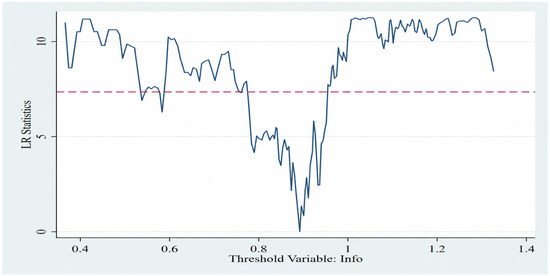
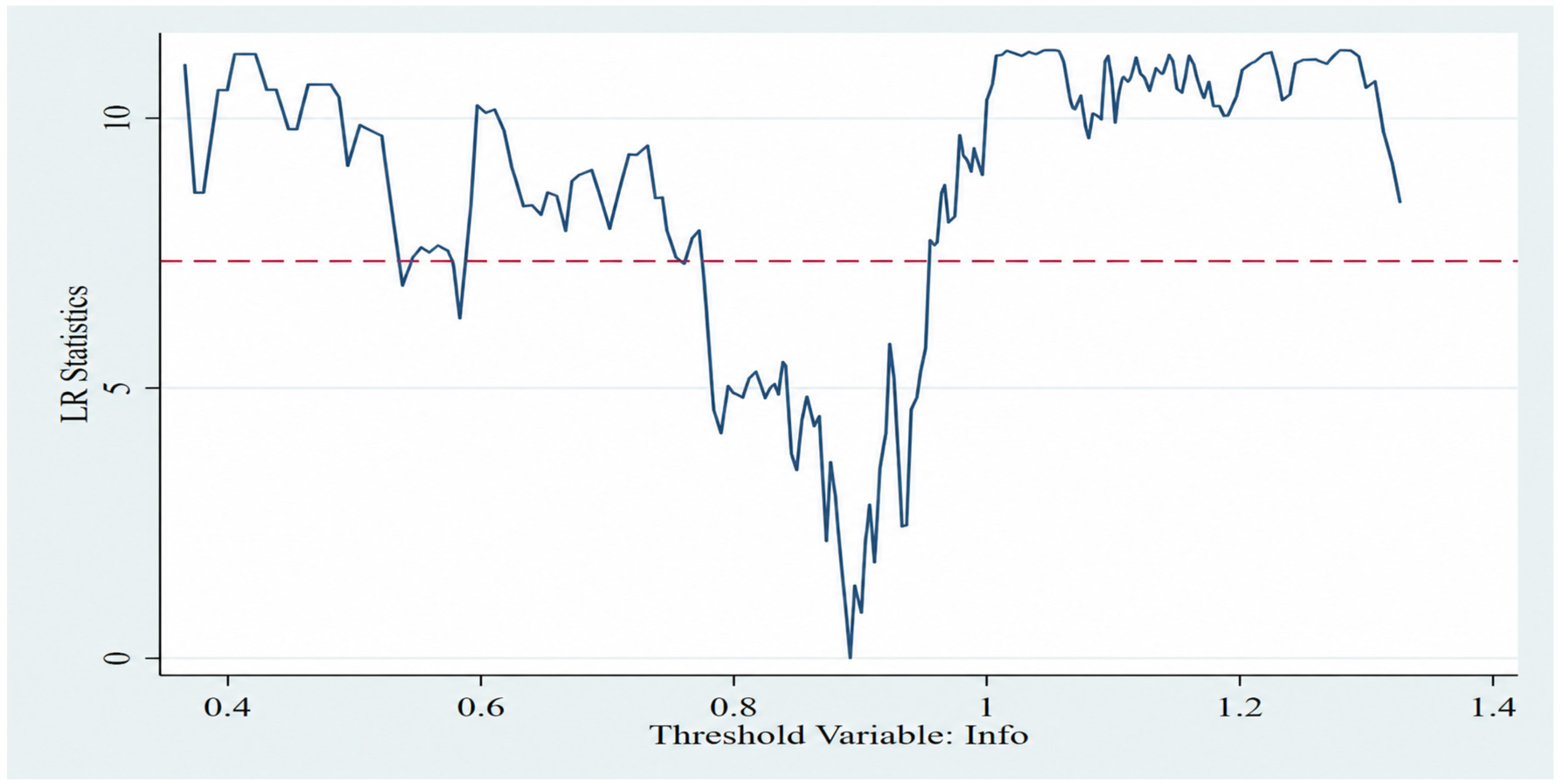
To examine whether the effect of the Low-Carbon City Pilot Program is nonlinear, we estimate a threshold regression model. We use digital connectivity (Info) as the threshold variable and test whether it conditions the effect of the program at different development stages. Figure 5 shows a significant single-threshold effect. The estimated threshold value is 0.8917, with a 95% confidence interval of [0.8293, 0.8953]. The LR statistic reaches its minimum near this value and remains below the critical value, which supports the single-threshold specification.
Figure 5.
Threshold Estimates for Information Technology Levels and the LR Likelihood Ratio Function.
Table 7 reports the threshold regression results. When digital connectivity is below the threshold (Info ≤ 0.8917), the coefficient of the pilot program is 0.0061 and is significant at the 1% level. When digital connectivity is above the threshold (Info > 0.8917), the coefficient rises to 0.0109 and remains significant at the 1% level. These results indicate that digital connectivity strengthens the effect of the pilot program on urban land use efficiency.
Table 7.
Estimation Results of the Threshold Model for Information Technology Levels.
This threshold effect has a clear economic interpretation. Higher digital connectivity can reduce information asymmetry and transaction costs. It can also improve factor mobility and resource matching across regions. These conditions help amplify the resource allocation effect of low-carbon policies. In addition, digital infrastructure supports industrial digitalization and smarter production processes, which can improve resource use efficiency and strengthen the role of technological progress. Digital connectivity may also improve policy implementation. Cities with stronger digital infrastructure can monitor environmental performance more effectively, enforce regulations more efficiently, and transmit policy information more quickly. Firms can then adjust production and investment decisions in a more timely manner. These mechanisms explain why the policy effect becomes stronger once digital connectivity crosses the threshold.
5.1.2. Spatial Correlation Analysis
Before estimating the spatial econometric model, we first examine whether urban land use efficiency and related variables show spatial dependence. For this purpose, we calculate the annual global Moran’s I statistics for urban land use efficiency (eff) and digital connectivity (Info) using the inverse-distance spatial weight matrix. We also use local Moran scatter plots to describe their spatial distribution.
Table 8 reports the global Moran’s I statistics for 2007–2023. Urban land use efficiency shows significant positive spatial autocorrelation in every year. Its Moran’s I value is positive and significant at the 1% level throughout the sample period. It increases from 0.047 in 2007 to 0.102 in 2019, and then declines slightly while remaining relatively high. This pattern indicates clear spatial clustering. High-efficiency cities tend to be located near other high-efficiency cities, while low-efficiency cities also tend to cluster together.
Table 8.
Global Moran’s I Statistics for Each Year.
The spatial pattern of digital connectivity is weaker in the early years. Its Moran’s I is insignificant before 2011, but becomes significantly positive thereafter. It reaches about 0.100 around 2016 and remains significant despite later fluctuations. This suggests that, as information infrastructure improves, digital connectivity across cities also begins to show spatial linkage and diffusion.
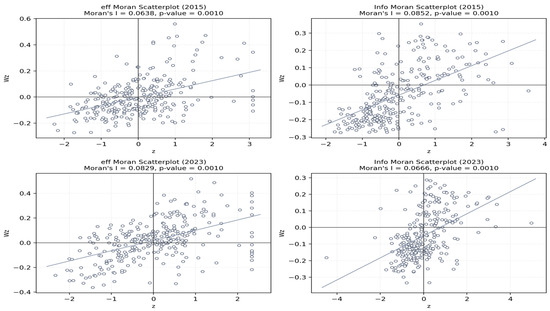
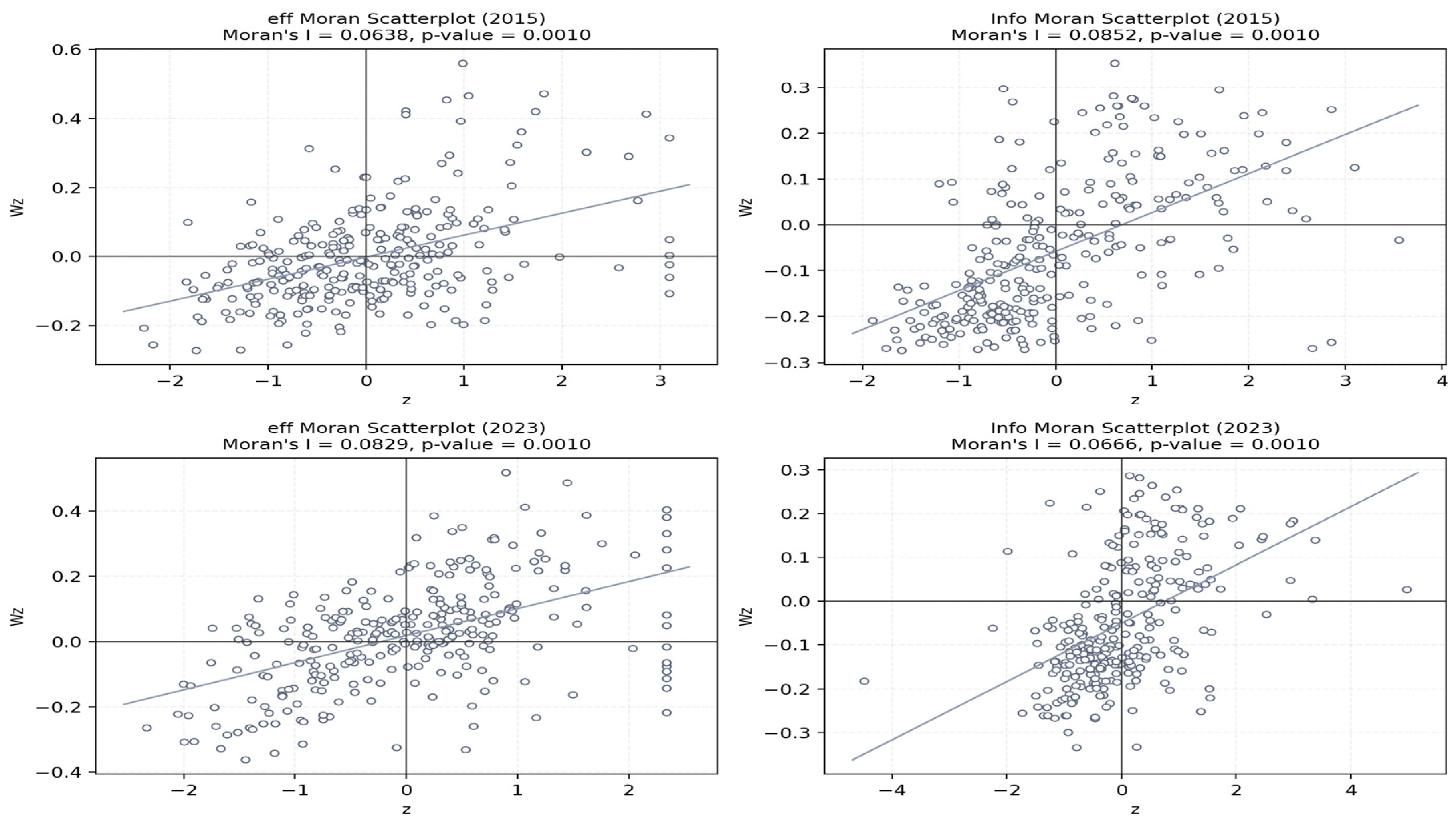
Figure 6 presents the local Moran scatter plots for 2015 and 2023. For both urban land use efficiency and digital connectivity, most cities are located in the first quadrant (high-high) and the third quadrant (low-low). The fitted lines also have positive slopes. These results further confirm positive spatial autocorrelation. The high-high clusters indicate that high-efficiency or highly connected cities tend to be adjacent to similar cities. The low-low clusters show the spatial concentration of cities with relatively weaker performance.
Figure 6.
Local Moran scatterplots of land allocation efficiency and informatization levels (2015, 2023).
5.2. Spatial Spillover Effects of the Low-Carbon City Pilot Policy
Building on the threshold analysis, this study further employs the Spatial Durbin Model (SDM) to estimate the spatial spillover effects of the low-carbon city pilot program. The model is specified as follows:
Here, denotes the spatial weight matrix, is the spatial lag coefficient capturing the spatial dependence of the dependent variable, and captures the spatial spillover effect of the policy. Table 9 reports the estimation results under different spatial weight matrices, including the geographic distance matrix (Wg), the economic distance matrix (We), the inverse geographic distance matrix (Wa), and the economic–geographic nested matrix (Wn). Different spatial weight matrices capture different types of inter-city linkages and therefore carry different economic meanings. The geographic distance matrix reflects physical proximity and captures the possibility that policy effects diffuse across nearby cities. The economic distance matrix captures linkages among cities with similar levels of economic development. It is useful for identifying policy learning, industrial competition, and resource allocation interactions among cities at comparable development stages. The inverse-distance matrix emphasizes distance decay, meaning that closer cities have stronger spatial connections. The economic-geographic nested matrix combines geographic proximity with economic similarity and captures inter-city linkages shaped by both spatial and economic ties.
Table 9.
Regression Results of the Spatial Durbin Double Difference Model.
The spatial transmission of low-carbon city pilot policies is unlikely to follow a single geographic diffusion process. It may be shaped by industrial relocation, policy learning, technology diffusion, local government competition, and differences in regional governance capacity. For this reason, the estimated spatial effects may differ across weight matrices. The formulas and standardization procedures for the spatial weight matrices are reported in Appendix B.
Table 9 reports the estimates based on alternative spatial weight matrices. A significant spatial interaction term indicates spatial association under a given matrix, but it does not necessarily imply a robust indirect effect. In the spatial Durbin model, direct, indirect, and total effects must be assessed through effect decomposition. We therefore distinguish three levels of evidence when interpreting the spatial results: spatial dependence in land use efficiency, the significance of the spatial interaction term, and the robustness of decomposed spillover effects.
First, the spatial lag coefficient is positive and significant under the geographic distance matrix and the inverse-distance matrix. This suggests that urban land use efficiency is spatially dependent. In other words, a city’s land use efficiency is related not only to its own characteristics but also to the land use efficiency of nearby cities. This finding is consistent with Moran’s I results reported above.
Second, the spatial interaction term varies across matrices. Under the geographic distance matrix, its coefficient is 0.220 and significant at the 1% level. This result suggests that the policy effect is spatially associated among geographically proximate cities. However, this should not be interpreted as definitive evidence of a robust positive spillover effect. Under the economic distance matrix, the spatial interaction term is positive but statistically insignificant. This difference indicates that the spatial pattern of the policy effect is sensitive to how inter-city linkages are defined. Geographic proximity, economic similarity, industrial linkages, and local governance capacity may all shape regional policy transmission.
The effect decomposition provides a more cautious picture. Across different spatial weight matrices, the direct effect of the Low-Carbon City Pilot Program is generally positive, but its significance is not stable. The indirect and total effects are also not robustly significant. This contrast between the spatial interaction term and the decomposed effects highlights the complexity of spatial policy effects. It also shows why the significance of should not be treated as equivalent to a robust spillover effect.
Several mechanisms may explain the lack of robust indirect effects. First, low-carbon city pilot programs may generate both positive and negative regional effects. Green technologies, governance practices, and industrial upgrading may diffuse through policy learning and regional cooperation. At the same time, stricter environmental constraints may push some high-pollution activities toward surrounding areas or places with weaker regulation, offsetting part of the positive effect. Second, regional transmission depends on absorptive capacity. Cities differ in digital connectivity, industrial structure, fiscal capacity, and governance capability, which may lead to different responses to policy signals and green technology diffusion. Third, spatial transmission may take time. The movement from policy diffusion to land use efficiency improvement often requires industrial restructuring, project renewal, and planning implementation. As a result, indirect effects may be difficult to detect in the short run.
6. Conclusions, Policy Implications, and Research Limitations
6.1. Conclusions
Using panel data from 285 prefecture-level cities in China from 2007 to 2023, this study treats the Low-Carbon City Pilot Program as a quasi-natural experiment. We apply multi-period difference-in-differences models, threshold models, and spatial Durbin models to examine the program’s impact on urban land use efficiency and the conditions under which this impact emerges. The main conclusions are as follows.
First, the Low-Carbon City Pilot Program significantly improves urban land use efficiency. The baseline results show that pilot cities experienced higher land use efficiency than non-pilot cities after policy implementation. This finding remains valid after the parallel trends test, placebo test, and a series of robustness checks. By strengthening environmental constraints and institutional guidance, the program has partly changed the traditional development model based on land expansion and low-cost land supply. It has also promoted a shift from extensive land expansion toward more intensive and efficient land use.
Second, the policy effect is heterogeneous across cities. The effect is stronger in cities with lower air pollution control pressure, higher industrial pollution control pressure, and lower fiscal pressure. This suggests that the program does not work uniformly across all cities. Its effectiveness depends on environmental governance foundations, the structure of industrial pollution, and local fiscal capacity.
Third, digital connectivity is an important condition for the policy effect. The threshold model shows that, once digital connectivity crosses a certain threshold, the effect of the program on urban land use efficiency becomes stronger. This indicates that information infrastructure and digital governance capacity can improve policy signal transmission, environmental monitoring, and factor matching. These conditions help low-carbon policies translate more effectively into improved land use efficiency.
Fourth, the spatial results require cautious interpretation. The spatial econometric results show that urban land use efficiency is spatially correlated, and the policy effect also shows some spatial association. However, the effect decomposition results show that the direct effect is not always significant. The indirect and total effects are also not robust across alternative spatial weight matrices. Therefore, this study does not interpret the significance of the spatial interaction term as evidence of a robust positive spatial spillover effect. Instead, it treats the result as evidence that the policy effect has certain spatial association characteristics.
6.2. Policy Implications
Based on the findings above, this study offers the following policy implications.
First, policymakers should deepen the Low-Carbon City Pilot Program and strengthen efficiency-oriented land allocation. The baseline results show that the program improves urban land use efficiency. This suggests that low-carbon policies do more than improve environmental governance. They may also change local governments’ land supply decisions, industrial access standards, and project selection criteria, thereby shifting land use from extensive expansion toward intensive and low-carbon development. Future policy design should embed low-carbon requirements more firmly into territorial spatial planning, land supply, industrial access, and project approval. This can guide land resources toward low-carbon industries, higher-value-added activities, and green infrastructure.
Second, cities should improve digital infrastructure to strengthen the effect of low-carbon policies. The threshold results show that digital connectivity is an important condition for policy effectiveness. Investment in digital infrastructure and smart city systems can improve information flows, environmental monitoring, and resource matching. These improvements can help low-carbon policies translate more effectively into land use efficiency gains.
Third, low-carbon governance should be tailored to local conditions. The heterogeneity results show that the policy effect varies with air pollution pressure, industrial pollution pressure, and fiscal pressure. Cities with lower air pollution pressure can place greater emphasis on structural upgrading and green transition. Cities with higher industrial pollution pressure can use low-carbon policies to promote technological upgrading, phase out inefficient capacity, and support industrial restructuring. Cities with lower fiscal pressure can make greater use of their implementation capacity to advance low-carbon transition. Differentiated policy design can improve the effectiveness and adaptability of low-carbon city pilots.
Fourth, regional coordination should be improved, but it should be based on a cautious interpretation of the spatial results. The spatial analysis suggests some spatial association, but the decomposed indirect and total effects are not robust. Therefore, policy design should not assume that experience from pilot cities will automatically diffuse to neighboring cities. Instead, coordination mechanisms should reflect differences in geographic proximity, industrial linkages, economic development, and governance capacity. Cross-regional planning coordination, environmental standards for industrial relocation, green technology sharing, and joint environmental supervision can reduce uncertainty in regional policy transmission. These measures can also help prevent the relocation of high-pollution activities and improve the conditions for regional gains in land use efficiency.
Fifth, long-term institutional coordination is needed to align low-carbon transition with resource allocation reform. Low-carbon city pilot programs are not only environmental policy tools. They also reshape how land, capital, technology, and industrial projects are allocated. Future policy design should strengthen coordination among environmental policy, industrial policy, and land policy. Such coordination can support a more stable institutional framework for green development and efficient resource allocation.
6.3. Research Limitations and Future Directions
This study has several limitations. Although it examines the effect of the Low-Carbon City Pilot Program using multi-period difference-in-differences models, threshold models, and spatial Durbin models, the findings remain subject to limitations in efficiency measurement, policy identification, and city-level data availability.
First, the measurement of urban land use efficiency depends on the input-output indicator system and the Super-SBM model specification. This study includes land, labor, capital, and energy inputs, as well as desired and undesired outputs. However, different indicator choices, data definitions, and model specifications may affect the estimated efficiency scores. Future research could combine remote sensing data, parcel-level data, and more detailed land use categories to improve measurement precision.
Second, unobserved city-level factors may still affect the estimates. Local governance capacity, planning enforcement, land marketization, industrial policy preferences, and environmental regulatory capacity may influence both policy implementation and changes in land use efficiency. Although this study uses fixed effects and control variables to reduce omitted variable bias, it cannot fully rule out all potential confounding factors. Future research could use land transfer data, firm-level emissions data, and planning documents to identify the mechanisms through which low-carbon policies affect land use efficiency in greater detail.
Third, the spatial results are sensitive to the specification of the spatial weight matrix. This study uses several spatial weight matrices to examine spatial association in the policy effect. However, the indirect and total effects are not robust across all matrices. Therefore, the spatial findings should be interpreted with caution. Future research could construct spatial weight matrices based on transport networks, industrial chain linkages, firm investment networks, or pollution transmission pathways. Such approaches may better identify the spatial transmission mechanisms of low-carbon policies.
Author Contributions
W.W. contributed to the manuscript framework, methodology, software, and writing. C.Z. (Chenghao Zhao) contributed to manuscript research guidance and review. C.Z. (Chunmin Zhang) contributed to the manuscript language revision and manuscript review. C.Z. (Chenghao Zhao) contributed to the literature review and writing. W.W. contributed to the manuscript language revision. All authors have read and agreed to the published version of the manuscript.
Funding
This work was supported by the National Social Science Fund of China (Grant numbers 24SGC089).
Institutional Review Board Statement
This manuscript does not contain any research conducted by any of the authors on human participants or animals.
Data Availability Statement
The data used to support the findings of this study are available from the corresponding author upon request.
Conflicts of Interest
The authors declare that there are no competing interests.
Appendix A. Definitions and Measurement of the Main Variables
Appendix A.1. Urban Land Use Efficiency
This study measures urban land use efficiency with prefecture-level city data on land resource allocation efficiency for 2007–2023. Land resource allocation efficiency refers to the ability to maximize output under a given level of land input, or to make full use of land under a given output constraint. Following the existing literature, this study builds an evaluation system for urban land use efficiency from both the input and output sides and applies a Super-SBM model with undesirable outputs.
Assume that there are decision-making units (DMUs). Each DMU uses inputs to produce desirable outputs and undesirable outputs. For the -th DMU, the efficiency score is obtained from the following Super-SBM model:
where denotes input redundancy, denotes the shortfall in desirable output, denotes undesirable output redundancy, and is the intensity vector. A higher efficiency score indicates that a city can generate more desirable output and less undesirable output with fewer inputs. In this study, this score is used to measure urban land use efficiency.
Table A1.
Input–Output Indicator System for Urban Land Use Efficiency.
This indicator system includes land, labor, capital, and energy as input variables. Industrial output per unit of land is used as the desirable output, while carbon emissions are treated as the undesirable output. The indicator therefore captures the overall efficiency of urban land use under green and low-carbon constraints.
Appendix A.2. Variable Definitions and Data Sources
The data used in this study consist of three parts: urban land use efficiency data, Low-Carbon City Pilot Program data, and city-level control variables. The dependent variable, urban land use efficiency (eff), is obtained from a prefecture-level city dataset on land resource allocation efficiency. This indicator is estimated using a Super-SBM model with undesirable outputs and covers the period from 2007 to 2023.
The core explanatory variable, the Low-Carbon City Pilot Program (DID), is identified from the official lists of low-carbon provinces and low-carbon cities released by the National Development and Reform Commission. The Commission launched three batches of pilot programs in 2010, 2012, and 2017. The first batch covered five provinces and eight cities, the second covered one province and 28 cities, and the third covered 41 cities and four counties or districts. Based on these pilot lists and the launch year of each batch, this study identifies pilot cities and their entry years. DID equals 1 for a city after it enters the pilot program and 0 otherwise.
The control variables are mainly drawn from the China City Statistical Yearbook and corresponding city-level statistical materials. Population size, fiscal pressure, industrial structure, economic growth, human capital, and digital connectivity are calculated from the relevant indicators in these sources. To reduce the influence of extreme values, this study winsorizes all continuous control variables at the 1st and 99th percentiles. It also checks the definitions, data consistency, and abnormal values of the main variables.
Table A2.
Detailed Definitions of Variables.
Appendix B. Construction of Spatial Weight Matrices
This study constructs four types of spatial weight matrices and standardizes them before estimation.
First, we construct the geographic-distance weight matrix. Let denote the geographic distance between city and city , calculated from their longitude and latitude coordinates. The geographic-distance weight matrix is defined as:
Second, we construct the economic-distance weight matrix. Let and denote the average per capita GDP of city and city during the sample period. The economic-distance weight matrix is defined as:
Third, we construct the inverse geographic-distance weight matrix. This matrix gives greater weight to nearby cities and allows spatial linkages to decline more rapidly as geographic distance increases. It is defined as:
Fourth, we construct the economic-geographic nested weight matrix. This matrix incorporates both geographic proximity and economic similarity. It is defined as:
For all spatial weight matrices, the diagonal elements are set to zero, that is, . Each matrix is row-standardized before estimation. Because different matrices capture different forms of inter-city linkage, the estimated spatial associations may vary across specifications. This study therefore compares results across multiple matrices rather than relying on a single spatial structure.
References
- Liu, J.; Hou, X.; Wang, Z.; Shen, Y. Study the effect of industrial structure optimization on urban land-use efficiency in China. Land Use Policy 2021, 105, 105390. [Google Scholar] [CrossRef] [Scilit]
- Liao, X.; Fang, C.; Shu, T.; Ren, Y. Spatiotemporal impacts of urban structure upon urban land-use efficiency: Evidence from 280 cities in China. Habitat Int. 2023, 131, 102727. [Google Scholar] [CrossRef] [Scilit]
- Wang, Z.; Fu, H.; Liu, H.; Liao, C. Urban development sustainability, industrial structure adjustment, and land use efficiency in China. Sustain. Cities Soc. 2023, 89, 104338. [Google Scholar] [CrossRef] [Scilit]
- Yu, B.; Zhou, X. Urban administrative hierarchy and urban land use efficiency: Evidence from Chinese cities. Int. Rev. Econ. Financ. 2023, 88, 178–195. [Google Scholar] [CrossRef] [Scilit]
- Pan, A.; Zhang, W.; Shi, X.; Dai, L. Climate policy and low-carbon innovation: Evidence from low-carbon city pilots in China. Energy Econ. 2022, 112, 106129. [Google Scholar] [CrossRef] [Scilit]
- Zhang, H.; Di Maria, C.; Ghezelayagh, B.; Shan, Y. Climate policy in emerging economies: Evidence from China’s Low-Carbon City Pilot. J. Environ. Econ. Manag. 2024, 124, 102943. [Google Scholar] [CrossRef] [Scilit]
- Liu, K.; Huang, T.; Xia, Z.; Xia, X.; Wu, R. The impact assessment of low-carbon city pilot policy on urban green innovation: A batch-time heterogeneity perspective. Appl. Energy 2025, 377, 124489. [Google Scholar] [CrossRef] [Scilit]
- Yuan, G.; Liu, J.; Wang, Y. Low-carbon city pilot policies, government attention, and green total factor productivity. Financ. Res. Lett. 2025, 77, 107043. [Google Scholar] [CrossRef] [Scilit]
- Xu, W.; Guo, J.; Zhou, J. Impact of digital governance on the green utilization efficiency of urban land. Land Use Policy 2025, 153, 107539. [Google Scholar] [CrossRef] [Scilit]
- Song, H.; Sun, Y.; Chen, D. Evaluating the effectiveness of government air pollution control: An empirical study from China’s “Low-Carbon City” initiative. Manag. World 2019, 35, 95–108. (In Chinese) [Google Scholar]
- Zhang, H. Can low-carbon city pilot policies reduce carbon emissions? Evidence from a quasi-natural experiment. Econ. Manag. 2020, 42, 25–41. (In Chinese) [Google Scholar]
- Zhang, G.; Li, H.; Chu, C. Low-carbon city pilot policies and high-quality development of manufacturing: “Empowerment” or “hindrance”? Urban Environ. Stud. 2025, 4, 92–108. (In Chinese) [Google Scholar]
- Cao, Y.; Wu, Y.; Li, Z.; Wang, Q. Climate policy and carbon leakage: Evidence from the low-carbon city pilot program in China. Environ. Impact Assess. Rev. 2025, 110, 107730. [Google Scholar] [CrossRef] [Scilit]
- Sabel, C.F.; Zeitlin, J. Experimentalist Governance. In The Oxford Handbook of Governance; Levi-Faur, D., Ed.; Oxford University Press: Oxford, UK, 2012; pp. 169–183. [Google Scholar]
- Bulkeley, H.; Castán Broto, V. Government by experiment? Global cities and the governing of climate change. Trans. Inst. Br. Geogr. 2013, 38, 361–375. [Google Scholar] [CrossRef] [Scilit]
- Healey, P. Urban Complexity and Spatial Strategies: Towards a Relational Planning for Our Times; Routledge: London, UK, 2007. [Google Scholar]
- Haila, A. Urban Land Rent: Singapore as a Property State; Wiley-Blackwell: Chichester, UK, 2016. [Google Scholar]
- Liu, S.; Wang, Z.; Zhang, W. The exhaustion of the “land-driven development” model: An empirical study based on a threshold regression model. Manag. World 2020, 36, 80–92. (In Chinese) [Google Scholar]
- Wu, F. Planning for Growth: Urban and Regional Planning in China; Routledge: New York, NY, USA, 2015. [Google Scholar]
- Porter, M.E.; van der Linde, C. Toward a new conception of the environment-competitiveness relationship. J. Econ. Perspect. 1995, 9, 97–118. [Google Scholar] [CrossRef] [Scilit]
- Copeland, B.R.; Taylor, M.S. Trade, growth, and the environment. J. Econ. Lit. 2004, 42, 7–71. [Google Scholar] [CrossRef]
- Yu, Y.; Zhang, S.; Du, Y. Local economic growth targets and the technological complexity of manufacturing exports. World Econ. 2019, 42, 120–144. (In Chinese) [Google Scholar]
- Brenner, N.; Theodore, N. (Eds.) Spaces of Neoliberalism: Urban Restructuring in North America and Western Europe; Blackwell: Malden, MA, USA, 2002; ISBN 9781405101059. [Google Scholar]
- Bulkeley, H.; Betsill, M.M. Cities and Climate Change: Urban Sustainability and Global Environmental Governance; Routledge: London, UK, 2005; ISBN 9780415359160. [Google Scholar]
- Cole, M.A.; Elliott, R.J.R.; Zhang, L. Foreign direct investment and the environment. Annu. Rev. Environ. Resour. 2017, 42, 465–487. [Google Scholar] [CrossRef] [Scilit]
- Popp, D. Environmental policy and innovation: A decade of research. Int. Rev. Environ. Resour. Econ. 2019, 13, 265–337. [Google Scholar] [CrossRef] [Scilit]
- Sassen, S. The Global City: New York, London, Tokyo, 2nd ed.; Princeton University Press: Princeton, NJ, USA, 2001. [Google Scholar]
- McCann, E.; Ward, K. (Eds.) Mobile Urbanism: Cities and Policymaking in the Global Age; University of Minnesota Press: Minneapolis, MN, USA, 2011. [Google Scholar]
- Castells, M. The Rise of the Network Society, 2nd ed.; Wiley-Blackwell: Chichester, UK, 2010. [Google Scholar]
- Brenner, N. New State Spaces: Urban Governance and the Rescaling of Statehood; Oxford University Press: Oxford, UK, 2004. [Google Scholar]
- Sun, L.; Abraham, S. Estimating dynamic treatment effects in event studies with heterogeneous treatment effects. J. Econom. 2021, 225, 175–199. [Google Scholar] [CrossRef] [Scilit]
- Callaway, B.; Sant’Anna, P.H.C. Difference-in-differences with multiple time periods. J. Econom. 2021, 225, 200–230. [Google Scholar] [CrossRef] [Scilit]
- Hansen, B.E. Threshold effects in non-dynamic panels: Estimation, testing, and inference. J. Econom. 1999, 93, 345–368. [Google Scholar] [CrossRef] [Scilit]

Disclaimer/Publisher’s Note: The statements, opinions and data contained in all publications are solely those of the individual author(s) and contributor(s) and not of MDPI and/or the editor(s). MDPI and/or the editor(s) disclaim responsibility for any injury to people or property resulting from any ideas, methods, instructions or products referred to in the content. |
© 2026 by the authors. Licensee MDPI, Basel, Switzerland. This article is an open access article distributed under the terms and conditions of the Creative Commons Attribution (CC BY) license.