


Abstract
The underutilisation or overutilisation of various interdependent and interacting factors poses a challenge to sustainable development and requires the development of an appropriate methodology to evaluate the sustainability of tourism development projects in rural Land (TDPRL). However, most previous evaluations of TDPRL sustainability are macro-oriented and ignore the entire project life cycle. This study focuses on the resilience characteristics of TDPRL and proposes a “sustainable resilience model” based on physical-mechanical theory, which analyses various factors influencing TDPRL resilience based on the three dimensions of tractive force, driving force, and internal dynamic, and constructs a qualitative evaluation index system through stakeholder meetings. Then the analytic network process (ANP) is used to assess the resilience of TDPRL quantitatively. The rationality of the evaluation index system is validated through an empirical analysis of three rural tourism projects in Zhengzhou, Henan Province. We found that the resilience of TDPRL depends first on the project fundamentals, which include population, industry, location, and infrastructure. Second, local elites are crucial to rural tourism revitalization. Third, the project team should have sufficient capacity to provide tourists with satisfactory products and services, ensuring the project’s sustainable operation, and meeting the core demands of stakeholders. This study provides a novel tool for the decision-making and improvement of rural tourist project development and land use planning over the project life cycle.
1. Introduction
Cases of rural tourism in practice can be traced back to the late 19th century in Europe and the USA and are full of romanticism [1]. The concept of sustainable development was gradually applied to rural tourism following Gro Harlem Brundtland’s at the United Nations General Assembly in 1987 “Our Common Future”. Rural tourism is considered to be an important complement to sustainable economic, ecological, social and cultural development. Studies have shown that rural tourism increases farmers’ incomes and employment opportunities [2], reduces the deterioration of rural conditions [3], and is an effective strategy for communities to achieve better living conditions [4]. In India, rural tourism is considered to go some way towards eliminating the negative impact of mass tourism on developing countries [3]. In China, rural tourism is considered an important mechanism for rural revitalisation and economic diversification [5], and an effective tool for alleviating urban-rural conflicts [6]. In rural South Africa, the development of cultural or rural-based tourism projects is often seen as the only economic option [7]. There seems to be a consensus that tourism development must take into account economic growth as a tool for improving quality of life and employment, especially in rural areas [8,9].
However, rural tourism has not always brought well-being to human communities. It has also brought additional challenges, thus questioning whether it can be sustainable. VisitScotland noted in 1994 that there are currently no successful case applications of sustainable tourism development, and even in some places the best strategy for the local population and future generations may not be tourism at all [10]. The contribution of tourism to the rural economy is often overstated, and large numbers of rural visitors do not necessarily generate correspondingly high levels of per capita expenditure [7]. Sharply, R. warns that although rural tourism provides supplementary income to rural communities, overall income levels from rural tourism have not increased as a result [11]. The problem of underutilisation and underproduction of resources is revealed in rural tourism. In addition, some critics argue that rural tourism has not fundamentally improved the quality of life of local farmers and has created a conflict between tourism culture and local culture [12,13]. The overutilization of rural resources will challenge the local ecological environment, especially in developed areas [14].
TDPRL involves more sensitive and vulnerable stakeholders than urban tourism projects. Whether rural tourism resources are under or overutilized will have an irreversible impact on the sustainability of rural tourism [15]. There is therefore a need to understand, describe and evaluate the sustainability of rural tourism in a more systematic and accurate way, which is made possible by the emergence of resilience theory. Focusing on the resilience characteristics of TDPRL, this study proposes a “sustainable resilience model” based on physical-mechanical theory to facilitate an effective evaluation of TDPRL.
2. Literature Review
The concept of resilience has its origins in materials science [16]. In 1973, Holling provided a systematic explanation of resilience as a determination of the persistence of relationships within systems, and it is also a measure of the ability of these systems to absorb changes in state variables, driving variables and parameters and still maintain them [17]. Resilience is a property of a system that results in the persistence of the system or the likelihood of the system’s extinction [17]. Due to the non-linear, uncertain and unpredictable nature of TDPRL, sustainability or resilience is often used in different scenarios of rural tourism development. Lew [18] argues that although both emphasise the balance between people and nature, there are still differences; sustainability emphasises conservation and mitigation, and resilience emphasises adaptation to change. It has also been argued that resilience and sustainability are essentially the same [19] and that resilience can be used as an alternative integrated indicator of sustainable development [18]. According to Holling, “sustainability” is the ability to create adaptive capacity, and “development” is the process of creating opportunities; “sustainable development” is the process of creating opportunities while promoting adaptive capacity [20]. Based on Holling’s view that sustainable development encompasses more meaning and content, resilience can be used as a systematic and dynamic indicator to measure the sustainability of TDPRL.
Although most studies do not strictly distinguish between sustainability or resilience of rural tourism, it does not affect the theoretical contribution to the sustainability of rural tourism. Since the emergence of COVID-19, studies in different countries have described the impact of the epidemic on rural tourism and its recovery [6,21,22,23]. To varying degrees, these studies have measured the resilience of rural tourism to unexpected or unpredictable shocks in different countries or regions. In the midst of unprecedented “uncertainty”, we should remain cautious and vigilant about rural tourism [24]. But at the same time, we should also be wary of focusing too much on the ability to cope with unexpected changes to the detriment of the project itself. In fact, projects are mostly in the midst of slow fluctuations in environmental change, rather than sudden exogenous environmental change. Lew [25] notes that although most resilience research has focused on rural tourism’s response to major disasters and crises, a new framework with slowly changing variables provides a more holistic view of resilience. The resilience of TDPRL lies not only in returning to its original function after project impacts but also in the ability to renew, reorganise and develop during dynamic change [26]. For less resilient projects, even minor disruptions can lead to significant social consequences due to their vulnerability or loss of kinetic energy [27].
In terms of research scales, Bernard Lane and Kastenholz [1] found that most people tend to address sustainable governance and management of tourism at the macro level—local, regional, national and international—through extensive literature analysis. This may be due to the availability of data, as data at the national level are usually abundant, and data at the regional level are readily available through surveys by regional authorities or research projects [28]; furthermore, even when some data are available, coordination is always difficult to achieve [29]. Decision paths and action plans at the basic level should be thoroughly understood before decisions are made at the macro or meso level, such as national, regional or local. The implementation of rural tourism resilience can only find its most direct expression at the project level, as it is only at the project level that the results of policies and decisions can have a tangible impact at the “grassroots” level [30]. In other words, any large-scale process or action that affects environmental decision-making is ultimately mediated and translated into action by the relevant stakeholders at the micro level [31]. Therefore, the focus of research should shift to resilience at the project level to understand the sustainability of rural tourism.
A limited number of studies have measured or assessed the sustainability of rural tourism from different project phases. Mwesiumo et al. [30] describe the drivers, challenges and critical success factors of rural tourism from the early stages of the project. Arbolino et al. [32] provide a qualitative and quantitative analysis of the sustainable planning of the project through a multi-objective optimisation technique, which provides sustainable tourism investment decisions by providing a framework to support them. Domínguez-Gómez et al. [33] define the various players in a sustainable tourism project in terms of stakeholders and argue that the core of project sustainability lies in balancing stakeholder interests and unbalanced power. Peric [34] argues that in the tourism sector, relationships and cooperation among stakeholders are essential for long-term sustainability. Mai et al. [35] apply a system dynamics approach to planning and forecasting scenarios for Katba Island in Vietnam. Niavis et al. [29] optimise support for policy interventions in project selection by developing a framework for measuring project sustainability, pointing out that the existing literature focuses on addressing the last four stages of a project’s life cycle, and emphasise that the success of a project requires the adoption of appropriate strategies, actions and decisions throughout the life cycle. However, it is important to note that although Niavis et al. emphasise the entire life cycle of a project, it is still based on a traditional project management perspective, focusing only on the four phases of project initiation, planning, implementation and end, neglecting the core operational phase of rural tourism projects, which is precisely the key reason for the failure of many project cases.
Whether this complexity arises from the random correlation of a large number of interacting factors or from a small number of control processes [20], it is important to address the correlation and interaction of various influencing factors in the development of rural tourism projects. Although it is possible to identify factors that influence TDPRL resilience, such as economic, social, ecological and cultural influences, it is not easy to analyse these factors for analytical or practical purposes [36]. This view is similar to others that emphasise the interweaving and overlaying of different influences from different knowledge domains [37]. The construction of TDPRL resilience indicators needs to be based on a more robust approach that recognises the interrelationship between top-down and bottom-up dimensions. Park et al. [38] argue that these dimensions are different from the general dimensions in previous studies, as they must be based on more practical, more direct policy relevance and measurability. When multidimensional span indicators are available, measurements with integration effects should be considered. Without such measurement criteria and procedures, it is impossible to provide any constructive input into selection decisions and dynamic improvements in TDPRL. However, resorting to traditional assessment techniques that rely only on value for money (e.g., cost-benefit analysis) is difficult and often unsuccessful [39]. Given the resilience characteristics of TDPRL, not only is there a need for prudent and continuous control of cost-benefit analysis throughout the life cycle, but assumptions and interpretations of resilience should also be linked to qualitative data on social processes and stakeholder perceptions [40]. It is therefore necessary to develop quantitative and/or qualitative indicators and to set a baseline for resilience assessment through a multi-criteria decision-making approach (MCDA) [29]. The application of MCDA can generally be divided into four categories. The first category is the AHP hierarchy and priority map methods, which use information about the relative size of numbers to calculate weights. The second category is the entropy method, which uses information about the entropy of the data, i.e., the amount of information, to calculate weights. The third category includes CRITIC, independence weights and information weights, which mainly use the volatility of the data or the correlation between the data to calculate the weights. The fourth category is factor analysis and principal component analysis, which uses the principle of information concentration of the data and uses variance interpretation ratio to calculate weights. Of these, AHP is one of the most widely used MCDA methods. It is supported by a large amount of software with different data management and representation capabilities and is highly compatible with the practicalities of project evaluation. ANP is an improved version of AHP that takes into account not only the treatment of various qualitative and quantitative data—the use of qualitative and quantitative information is fundamental in sustainability assessment [41]—but also the network hierarchy in which different levels and factors are interrelated and interact with each other. The weighting of indicators is often inevitably linear, but among the many methods that consider priority weighting, ANP has more advantages in dealing with the non-linear characteristics of factors, such as correlations and interactions between factors.
Based on the above discussion, the measurement of rural tourism sustainability can be characterised in terms of resilience, but the emphasis in understanding its resilience should shift to the project level, emphasising the capacity that the project itself should not have to collapse due to over-utilisation or lose sustainability due to underutilisation in an environment of slowly fluctuating change. The measurement of TDPRL resilience should be based on a whole life cycle perspective. In addition, the different levels that influence resilience and the network-level relationships between the different factors should be considered. In view of this, and inspired by physical-mechanical theory, this study proposes a “sustainable resilience model”, which analyses various factors influencing TDPRL resilience based on the three dimensions of tractive force, driving force, and internal dynamic, and constructs a qualitative evaluation index system through stakeholder meetings. The ANP is then used to assess the resilience of TDPRL quantitatively. The rationality of the evaluation index system is validated through an empirical analysis of three rural tourism projects in Zhengzhou, Henan Province.
3. Methodology
The study of force is a very old topic in both the East and the West. The ancient Chinese literature The Mohist Canons mentioned that force makes the object rise to move. Also, the western concept of force occurred before the physical science. Aristotle thought that force was fired from one object to another. In 1687, in his book Mathematical Principles of Natural Philosophy, Newton formally clarified gravity and the three laws of motion, which opened a new door for human rational understanding of “force”. According to Newton’s law of motion, the force is the physical quantity that characterizes the object interaction, and there is no isolated force between the universe. It is manifested in the object interaction, which reflects the interaction relationship between the load and the carrier. It is based on the interaction of force and reaction perspective. A rural tourism development project can be regarded as a dynamic system object, its development changes affected by economic, social and ecological factors [42]. These factors are action force and reaction force. The sustainable development of rural tourism development projects can be explained as the result of the combined force and reaction force.
3.1. Theoretical Model
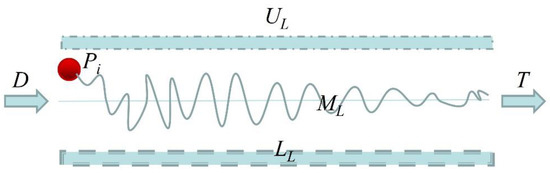
The sustainable resilience theoretical model is shown in Figure 1. The ball is regarded as a rural tourism project, and the environment around the whole development life cycle of is regarded as a track interval with upper and lower boundaries. The movements of follow a certain trajectory in this interval. Whenever ’s trajectory escapes from the interval, it is regarded as unsustainable. The ball is mainly affected by three types of resultant force: the tractive force in front of the ball, the driving force behind the ball, and the sum of various forces inside the ball called the internal dynamic . The upper limit of the orbit interval is denoted as , the lower limit is denoted as , and the orbit centerline is denoted as ; if the trajectory is close to , it means that the resources provided to the project are not fully utilized, and the underutilized resources may be attracted by other spheres (projects) outside the boundary, resulting in the upper wall thickness damage; if the trajectory of is close to , it indicates that the project is overusing the resources available in its environment, and the lower wall thickness of the track would be destroyed; the trajectory of moving in order along the middle line is the ideal state. As described above, a normally developed rural tourism project, in the early stage of project development, oscillates up and down the track interval. After entering the operation period, the amplitude continues to decrease and gradually converges to the midline to move forward. However, when the unsustainable project deviates from the midline, the shock escapes from the upper and lower limits of the interval, and finally, the project is forced to stop.
Figure 1.
Sustainable resilience theoretical model.
The combined effect of the three types of forces on the ball is called sustainable resilience F, which is estimated as follows:
where is the evaluation weight of the resultant force index, is the value of the resultant force index, and the assignment of will be determined by ANP, which we will discuss in the Section 3.3.
3.2. Evaluation Indicators
The sustainable resilience of rural tourism projects takes villages as the carrier (not limited to space), culture (not limited to tradition) as the connotation, and urban residents as the customer group. The tourism projects provide rural life experience and produce sustainable economic, social, environmental and cultural benefits under the condition of limited resources through project activities of various stakeholders. When analysing and constructing our evaluation index system, we should stand at a certain future point and look back at the present as far as possible. We should make systematic analysis and response based on the following issues such as where people are, where industries are, how infrastructure construction and basic public services are allocated, what lifestyles are, and how living environments are. If the project cannot respond to these major forward-looking issues, rural revitalization is likely to turn “good things” into “bad things”. Based on the sustainable resilience model, the setting method of the evaluation index mainly adopts the combination of historical literature and policy document-related index screening, project case field research interview, and inviting stakeholders to discuss multiple rounds of meetings. The discussion on the construction of the evaluation index system began in April 2021 and ended in January 2022. The discussions took place in a centralised format on four occasions, in April, July, October and January 2021 and 2022 respectively. The lead researcher for this paper participated and led the discussions throughout. The eleven stakeholders invited were from a variety of backgrounds. They mainly included two local villagers’ representatives (the head of the village committee and a representative of the villagers’ elite), three government officials (from the local tourism department, agricultural committee and street office respectively), three representatives of tourism investment companies, three expert advisors (two Chinese professors from Huazhong Agricultural University and Henan Agricultural University and another retired tourism bureau director from Zhumadian, Henan), one travel agency representative (from Ctrip), two representatives of operating companies, and one travel enthusiast (a well-known travel writer in China). Each discussion was recorded in the form of a live diary, allowing for the existence of disagreements, and was confirmed by the participants’ joint signatures. The subsequent discussions were based on the results of the previous discussions and revisions. The discussions culminated in an agreement at the fourth meeting and resulted in the evaluation indicators shown in Table 1.
Table 1.
Evaluation index system of sustainable resilience.
3.3. Indicators Weighting
There are many qualitative and quantitative evaluation methods for the weighting of evaluation indicators. Among them, T.L.Satty (1996) proposed the ANP theory that has the ability to deal with the network dependence and mutual feedback of different index elements in the index system. ANP theory has strong operability and more practical applications and the specific theoretical basis and application methods can be referred to [44,45,46].
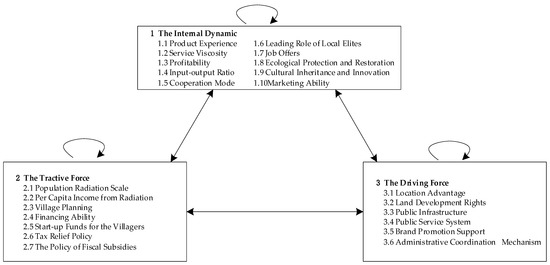
In the evaluation index system shown in Table 1, different index elements affect and depend on each other. For example, the two indicators and not only have one direct impact on the cluster but also affect and depend on each other. The project with high “Product Experience” can improve the customer “Service Viscosity”, and the change of these two indicators also has a positive correlation with the “Financing Ability” under the cluster “The Tractive Force”. On the basis of pairwise comparison, the ANP network structure [47] is constructed. As shown in Figure 2. This paper applies ANP and the corresponding software Super Decision (developed by Rozann W.Satty and William Adams) to the index weighting.
Figure 2.
Network structure for TDPRL resilience.
3.3.1. Judgment Matrix
First, the indicator as the parent node, through the expert group to determine whether the remaining indicators other than will have an impact on . If the impact exists, the indicator is labeled as a child node of ; then, and all other indicators are used as parent nodes to judge, and the relationship matrix that can reflect the mutual influence and dependence relationship is established respectively.
The 1~9 scale method proposed by Satty is used to quantify the pairwise comparison matrix. The subjective score value in the judgment matrix is scored by experts with more experience in such problems to generate a judgment matrix.
3.3.2. Calculating Limit Relative Sort Vectors by Supermatrix
The supermatrix is composed of different submatrices. The submatrix is obtained by the pairwise comparison judgment matrix established in Section 4.1, the relative weight ranking vector is obtained and the consistency test is performed [44,45]. Each submatrix reflects the relationship between the two decision levels. The data in the supermatrix consist of the eigenvectors of the pairwise comparison matrix of the interaction index factors. Each element in the matrix is normalized, but the matrix is not normalized.
Therefore, weighting the elements of the supermatrix yields a weighted supermatrix: , where (), is the element layer judgment matrix is the sub-matrix block in the supermatrix [45,46]. The calculation of weighted supermatrix is carried out by Super Decision software.
Perform evolutions on the weighted supermatrix to calculate the limit relative ordering vector, . When , the results are consistent, thus form a long-term stable matrix. At this time, the nonzero values of each row of the supermatrix are the same [45,46]. The value of the corresponding row of the original matrix is the stable weight of each evaluation index relative to the target.
3.4. Overview of Projects
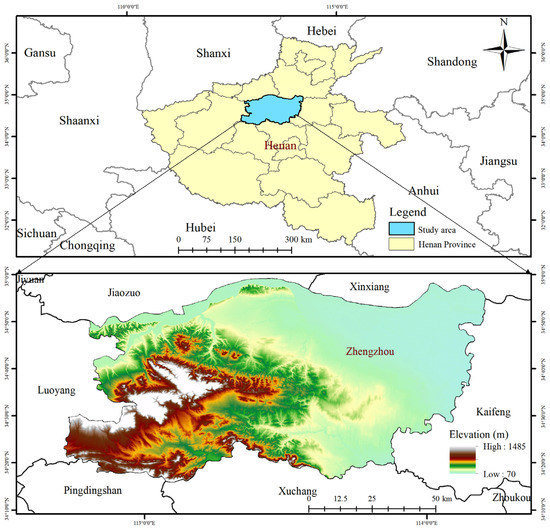
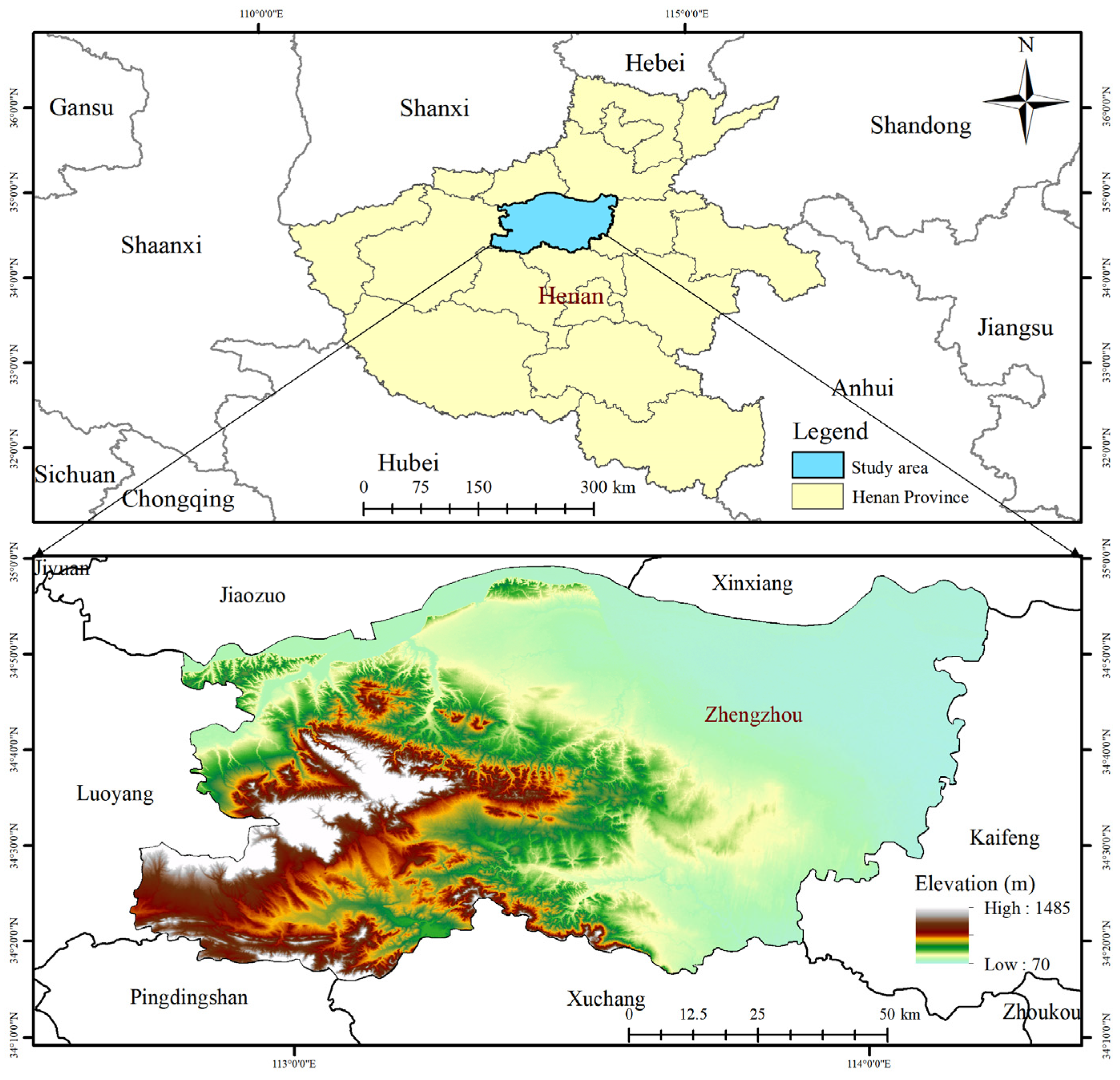
To validate the effectiveness of the constructed sustainable resilience evaluation index system, the expert group selected three TDPRLs located in Zhengzhou, Henan Province (as shown in Figure 3) as empirical evidence. One of the TDPRLs is located in Huiji District and the other two in Xinzheng City. Huiji District is the central urban area of Zhengzhou near the Yellow River, with an area of about 233 km2 and a population of about 560,000. Huiji has a long history of fishing and a farming culture. Xinzheng is located in the northern part of Zhengzhou, with an area of about 885 square kilometres and a population of about 650,000. Xinzheng has a long history and culture; it was known as “Youxiong” in ancient times and Emperor Xuan Yuan of China had his capital here.
Figure 3.
Location of case project.
Of these three projects, the “Yellow River Fishing Village Project (A1)” is a new start-up project located in Huiji District; the “Dahan Kiln Project (A2)” and the “Huangdi Qianguo Project (A3)” are ongoing operational projects located in Xinzheng City. These three projects cover a population of approximately 96.4 million people within a 3-h drive, with a corresponding annual per capita disposable income of approximately RMB 24,800. One of the strengths of these projects is the size of the population. In addition to the validity of the indicator system, the experts have attempted to validate the findings to provide operational improvement support for A2 and A3 and directional guidance for early planning for A1.
4. Results
4.1. Indicators Weighting
Based on the methodology described in Section 3.3.1, a matrix of indicator relationships was constructed in accordance with the expert group’s comments, as shown in Table 2. A value of “1” in the table indicates that an indicator has an influence on another indicator, and a value of “0” indicates that the indicator has no influence on another indicator [48]. For example, the corresponding value of “11” for S06 on the vertical axis and S05 on the horizontal axis indicates that S06 has an effect on S05 and S05 has an effect on S06. Similarly, the corresponding value of S03 on the vertical axis and S01 on the horizontal axis is “01”, indicating that S03 has an effect on S01, but S01 has no effect on S03.
Table 2.
Indicator Relation Matrix.
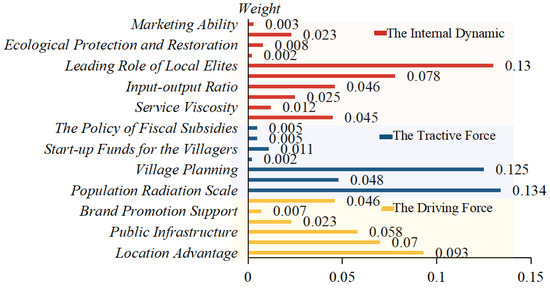
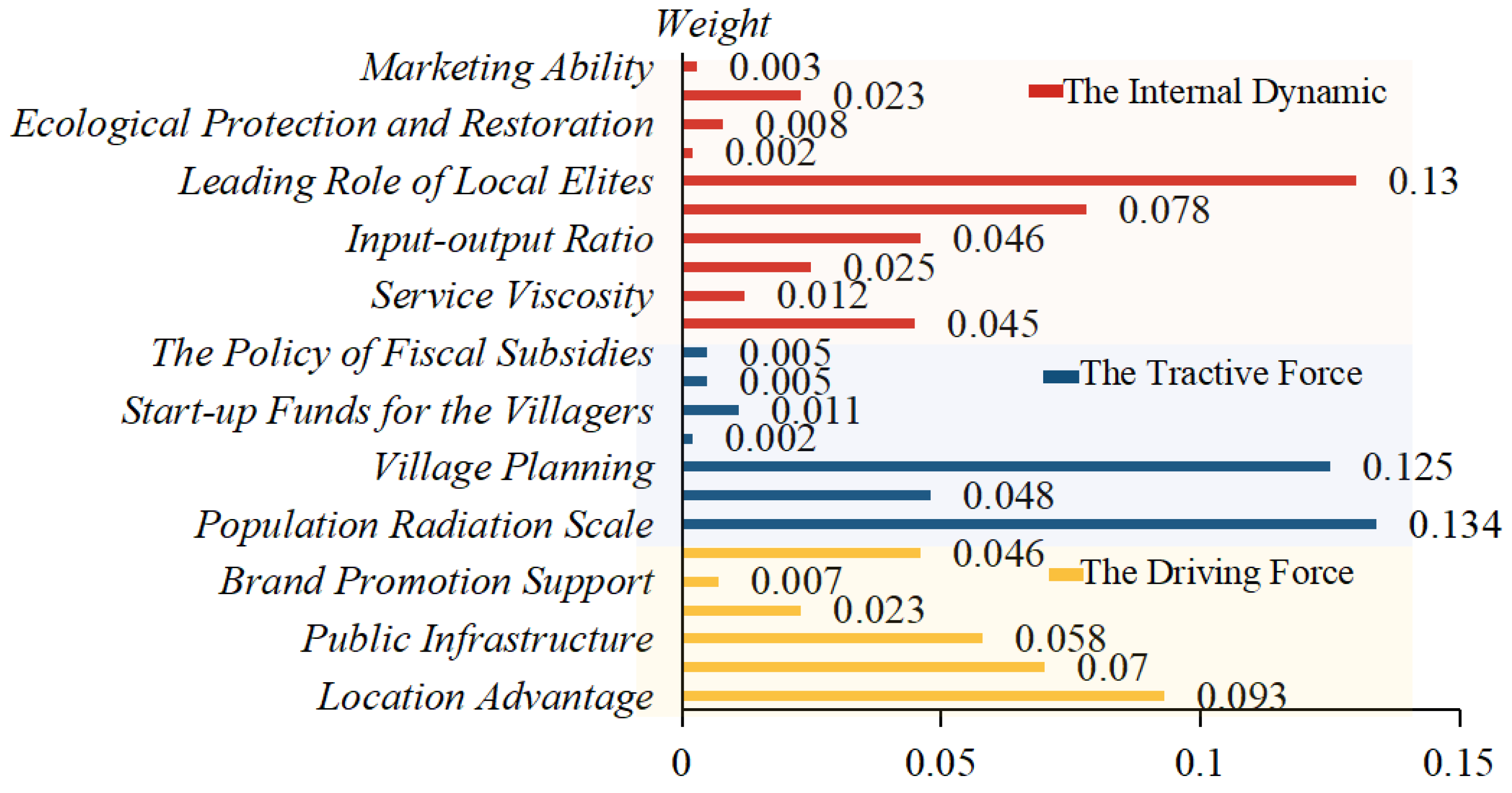
Using the 1–9 scale method proposed by Satty (1996), the expert group quantified every two comparison matrices to produce a total of 21 judgment matrices. The index weights calculated by the Super Decision software are shown in Figure 4.
Figure 4.
The weight of the indicators.
The study organized experts to conduct an in-depth analysis of the ranking results in Figure 4, which are reported below:
- (1)
- Ranked in the forefront, “Population Radiation Scale”, “Village Planning”, “Location Advantage”, “Cooperation Mode”, “Land Development Rights”, “Public Infrastructure” and “Per Capita Income from Radiation” fully reflect the project fundamentals are the decisive role of in the sustainable development of TDPRL. In the feasibility study stage of the TDPRL project, it is necessary to judge whether population, industry, location, infrastructure, and so on can form the basic support of the project.
- (2)
- The indicator of “Leading Role of Local Elites” ranks second, which shows that experts from various disciplines such as academia, government, enterprises, and rural collective organizations all believe that local elites play an important role in rural revitalization. The study believes that the core role of local elites is to unite neighbors and integrate interests with morality.
- (3)
- TDPRL’s qualities such as “Input-output Ratio”, “Product Experience”, “Profitability”, “Cultural Inheritance and Innovation” and “Service Viscosity” are critical to the success of the project. This requires the project team to have sufficient capacity throughout the project life cycle to provide visitors with satisfactory products and services. This also requires continuing operations while ensuring the safety of cash flows and meeting the core demands of all stakeholders.
- (4)
- In addition, the essence of business is the creation of customer value, and obtaining profits; if we only infer from general business theory, the ranking of “profitability” indicators may be more advanced, but the scoring results are not. After in-depth discussion, it was found that there were too many index factors affecting “profitability”. It is a more comprehensive index, and other indicators will share a part of the weight.
4.2. Evaluation of Tourism Development Projects
Considering the confidentiality of business data and the elimination of the influence of data dimension, the expert group first standardized the basic information of the three projects, and the standardized information matrix is shown in columns 3–5 of Table 3. According to (1), the comprehensive evaluation results of the three projects are estimated in the last row of Table 3.
Table 3.
Results of sustainable resilience of tourism development projects.
Note:
- As the project is still in the start-up phase, some of its indicator data are based on projections from the programming phase.
- Theoretically, any one of these indicators could act as a “one-vote” veto, which would deviate the trajectory of the project from the track. Therefore, we assumed that the projects included in the evaluation have avoided this possibility in the project initiation stage.
Comparing and , two differences make the sustainable resilience value of better than that of :
The first difference is the indicator of “Leading Role of Local Elites”. The whole process of , from project start-up to project operation, is led by Zhao, a villager who returns home to start a business. Nonetheless, the project promotion of is mainly based on tourism enterprises. Compared with , fewer villagers in participate in the decision-making and collective working processes. The second difference is the indicators of “Cooperation Mode”. is mainly invested by villagers, and the proportion of social capital is less than 20%. Every month, shareholders receive proportional dividends as a pre-determined cooperation agreement. is largely invested by tourism enterprises (80%); the government buys shares in the form of town collective economic organizations (20%) and does not participate in substantive business activities.
The third difference is the “input-output ratio” index. Project covers an area of about 26 hectares, with an investment of about 40 million yuan. The initial capital of the villagers ‘ original shares was only 4 million yuan, mainly for the overall design of the project and the traffic construction of the site; the remaining 36 million was invested by the introduced social capital, and the participation form of social capital is the integration of investment, amusement facilities construction and operation. The annual operating income is about 30 million yuan. Project , by contrast, covers an area of about 11 hectares, with a total investment of about 1.2 billion yuan. The tourism enterprises invest 600 million, the government invests 100 million, and financing loans and arrears cover 500 million. The project operation is entrusted to professional companies, with an annual operating income of about 60 million yuan. However, the operation of has shown a strong development trend, although has begun to fall into a dilemma. The current cash flow income cannot even cover the operating loan interest and operating costs except for the 100 million project funds owed during the construction period. The fourth is that the form of products is relatively simple. Visitors generally reflect that although the performance program is excellent, the play time is too short.
The comparison of the results of and has implications for :
A1 originally planned to heavily invest in performing arts projects such as “Leap the Yellow River” and “Dining Show”. The total investment is expected to be about 1.4 billion yuan. It is planned to adopt the government platform company as the main body in the construction stage and the professional operation enterprise as the main body in the operation stage. The village collective and villagers participate in the way of land rent investment. The old houses of the original villagers are planned to be completely demolished and rebuilt. Recommended by the expert group, the final district government collective decision to change the original “heavy investment” to the “light investment heavy operation” model, a follow-up study will continue to track the development of .
Suggestions for the operational improvement of :
According to the sustainable resilience model, the core of improving sustainable resilience is to increase the forces that push running forward, to increase the upper and lower wall thickness of the track interval, and to ensure that the direction of various resultant forces is consistent. In terms of the tractive force, although it is not feasible to improve the fundamentals of the project, tax breaks and financial subsidies can be sought from the government, and banks can be coordinated to extend the repayment of loan principal and interest to support operating cash flow security.
In terms of the internal dynamic, the main focus is on improving the product experience, fully tapping the Emperor culture and folk customs elements in the project location, and iteratively upgrading the product based on the integration of “humanity”, “divinity” and “crowd” to enhance the interactive experience of tourists; to formulate attractive profit-sharing sales policies on marketing investment promotion means, expand sales network, increase project image and sustainable profitability; at the same time to upgrade the mode of cooperation, timely introduction of new shareholders, not only ease the pressure on debt, but also share resources; in addition, fully interact with residents, the introduction of the characteristics of the village crafts, labor, security, and other services to enhance the stickiness of rural life.
In terms of the driving force, the main point is to strengthen the project administrative coordination mechanism, change the state that the government platform company does not contribute at all in the operation stage, and use the government public resources to provide brand promotion support and improve the level of public services. Finally, tourism enterprises also need to coordinate various stakeholders to ensure that the direction of force is consistent, reduce friction in the implication of projects, and make the tourism development return to the middle line of the track interval.
5. Discussion
5.1. Implication of the Case Validation
Through the analysis of three rural tourism projects in Zhengzhou, Henan Province, the empirical findings of this study case, especially some lessons learned, should offer ample warning and can support policy formulation or decision making by rural tourism project participants or stakeholders at any stage of the project life cycle.
Firstly, not all villages are suitable for tourism projects. When making investment decisions or policy recommendations, stakeholders need to take full account of the village’s endowments and conduct investment visits in advance. The fundamentals of the project, i.e., the corresponding population, industry, location and infrastructure, are the core factors that need to be examined first, which also requires a relatively macro or meso perspective from the investment decision maker. Therefore, when making policy or project decisions, government authorities or local communities should take a step-by-step approach to the introduction of the rural tourism industry and highlight priorities. Before the aforementioned fundamentals are formed, it is important to first take advantage of the opportunity of rural revitalisation to form fundamental support according to one’s own endowment, and then develop tourism projects in the right time. Otherwise, the disorderly development of rural tourism projects will lead to the improper allocation of resources for rural revitalisation (especially through tangible means), which will eventually bring inestimable consequences to the villages.
Secondly, the main role of villagers in TDPRL is crucial. Although many studies have also emphasised the role of local residents ‘ participation [49,50,51] and the importance of project leaders [29], there is no clear statement on how to ensure the main role of villagers. Whether farmers can obtain more decent income through TDPRL, so as to further enhance their material, emotional, and spiritual lives, which need to be further strengthened in both rural leaders and cooperation modes. Among them, the core role of village leaders provides an important impetus for the advancement of the whole project. Unfortunately, however, not all villages have such leaders. The rural leaders in the new era should not only have certain economic strength and mind, but also have enough prestige, political influence and feelings of serving the village. In the long run, an effective institutional environment and mechanisms are needed to strengthen the training of new village leaders. For the cooperation mode, it is necessary to clarify the responsibilities and rights that villagers should bear in TDPRL in the form of contract agreement in the project investment decision-making stage. The right part is not only the guarantee of the material income of villagers from the incentive policy, but also the guarantee of their decision-making participation ability.
Generally, although the ultimate significance of developing rural tourism projects should not only lie in the profitability of the project itself, but also in the impact on society and the environment, the business model and profitability are the general core elements of the project. Otherwise, even if the project is supported by the rural revitalisation strategy, the consequences would be unthinkable if the project was not running smoothly and the cash flow could not be supported.
Finally, the application of TDPRL resilience should also follow the principle of fairness. Our analysis of resilience evaluation indicators fully considers this point. For example, the indicators involve rural infrastructure and public services, and also include social equity issues such as villagers ‘ decision-making participation and employment. This will help to respond to the concerns of the existing literature on rural tourism projects in terms of large differences in urban and rural public services, lack of substantial improvement in the quality of villagers’ life, and major conflicts on the environment and culture.
5.2. Significance of Sustainable Resilience Model
TDPRL and its environment can be regarded as a dynamic and open system. By analysing the relationship and interaction between internal and external factors in the whole life cycle of the project, this study proposes an resilience model and combines ANP measurement. To our knowledge, the findings provide valuable insights, which are further elaborated below.
The study further expands on resilience enhancement in response to slow fluctuations. Resilience and sustainability are often confused and applied to the understanding and evaluation of rural tourism, but research should not be mired in too much debate, but should give priority to the scenario of its application [52]. This study argues that the resilience of rural tourism is a more comprehensive measure of its sustainable development. A large number of existing studies on the resilience or sustainability of rural tourism focus on the response to exogenous shocks. These studies seem to subconsciously believe that projects are sustainable when there is no exogenous shock. In fact, compared with these sudden exogenous change shocks, most of the time, the project faces a slowly fluctuating changing environment due to the interaction and joint action of various factors. Even if it is not impacted by exogenous mutations, when the cumulative effect of slowly fluctuating factors reaches a certain level, it can lead to the failure of the project at a certain point in the whole life cycle. Overshoot or lack of kinetic energy leads to the collapse of the project. Of course, after superimposing the forces of exogenous shocks, fragile projects are more likely to collapse faster.
This study further enriches the life cycle understanding and evaluation application of rural tourism at the project level. The collection of project individuals makes the concept of rural tourism substantive. The implementation of rural tourism resilience is not only truly expressed at the project level, but also the uneven interests and powers of relevant stakeholders are most directly gamed, collided and balanced at the project level. Therefore, the study of rural tourism resilience at the micro level can help us better understand the rural tourism industry and formulate relevant policies at the meso and macro levels. The additional contribution compared to previous research is that we are no longer limited to the perspective of traditional project management, or even only in a certain stage of traditional project management. Based on the perspective of the whole life cycle, we can pay more attention to the relevant influencing factors of the operation and management of rural tourism projects, and believe that the vitality of rural tourism projects lies in their operation. The models and conclusions proposed in this study can be used not only for investment decision makers (not limited to government authorities, local communities or business owners, etc.) to select or make decisions on rural tourism projects in the investment decision-making stage, but also for systematic diagnosis and management improvement of project resilience in the implementation or operation stage.
In addition, the analysis of the measurement model of resilience in this study can also be extended to other open and flexible systems, such as the improvement of resilience in shrinking cities or the improvement of resilience in rural areas.
This study still has the following limitations. it should be noted that the direction and results of the combined effects of the three forces are often very complex in reality. The nature of our system cannot accept extremely destructive experiments, making it difficult to accurately measure the results. The application of statistics in our empirical case evaluation represents a relative trend rather than an accurate result. Secondly, TDPRL resilience is a relatively dynamic elastic scale, and its evaluation index should be updated with time. This paper also does not deeply discuss the strengthening of the upper and lower boundaries of the track interval, and also needs to improve the project empirical case sample to correct the evaluation index system.
6. Conclusions
This study aims to find a more effective method to fully consider the resilience characteristics of rural tourism projects and measure the comprehensive results of resilience from the entire life cycle of the project. In response to this problem, we established a resilience measurement model of rural tourism projects based on the interaction force and reaction principle of influencing factors, and combined the ANP method to investigate the network hierarchy of related factors, which provides a novel tool for the decision-making and improvement of rural tourist project development and land use planning over the project life cycle. The main conclusions of this paper are as follows.
- (1)
- The dynamic system is divided into three dimensions. We assume that the sustainable development of the project is mainly affected by three forces, namely tractive force, driving force, and internal dynamic. The size and direction of these three forces will have a direct impact on the effective use or overuse of their factors, and thus change the trajectory of the sustainable development of the project. According to the change of the project development track, it is proposed that the project operation track of sustainable development (i.e., high resilience) should move forward within the relatively vague upper and lower track boundaries and converge to the middle line.
- (2)
- A multi-factor comprehensive evaluation index system was proposed. We combined our framework with the existing theoretical research, policy documents on rural tourism, interviews with multiple TDPRLs, and expert group meetings composed of stakeholders. Our TDPRL sustainable resilience evaluation index was qualitatively interpreted and constructed.
- (3)
- The empirical analysis verified the rationality and accuracy of the model. Through the expert group’s relationship comparison and importance scoring of the evaluation indicators, the ANP method was used to assign weights to the indicators, and a total of 23 evaluation indicators in three categories with weight assignment were formed. Through the analysis of three rural tourism projects in Zhengzhou, Henan Province, the rationality and accuracy of the model were verified.
Author Contributions
Conceptualization, Y.S. and X.C.; Methodology, Y.S. and J.Z.; Writing—original draft, Y.S.; Writing—review & editing, J.Z., X.C. and G.Z.; Supervision, G.Z. All authors have read and agreed to the published version of the manuscript.
Funding
The Hubei Provincial Department of Education Project of Philosophy and Social Sciences (CN): 21G015.
Institutional Review Board Statement
Not applicable.
Informed Consent Statement
Not applicable.
Data Availability Statement
All data generated or analyzed during this study are included in this published article.
Conflicts of Interest
The authors declare no conflict of interest.
References
- Lane, B.; Kastenholz, E. Rural Tourism: The Evolution of Practice and Research Approaches—Towards a New Generation Concept? J. Sustain. Tour. 2015, 23, 1133–1156. [Google Scholar] [CrossRef] [Scilit]
- Lane, B.; Weston, R.; Davies, N.J.; Kastenholz, E.; Joana, L.; Janusz, M. Industrial Heritage and Agri/Rural Tourism in Europe: A Review of Their Development. In Socio-Economic Systems and Future Policy Issues; 2013; Available online: http://www.europarl.europa.eu/studies (accessed on 24 November 2022).
- Kumar, S.; Valeri, M.; Shekhar, S. Understanding the Relationship among Factors Influencing Rural Tourism: A Hierarchical Approach. J. Organ. Chang. Manag. 2022, 35, 385–407. [Google Scholar] [CrossRef] [Scilit]
- Ahmad, F.A.; Ammar, A.G.; Salamiah, A.J.; Khairun, N.A. Sustainable Tourism Development: A Study on Community Resilience for Rural Tourism in Malaysia. Procedia Soc. Behav. Sci. 2015, 168, 116–122. [Google Scholar]
- Sun, J.X.; Wang, S.J. Construction of Sustainable Development Evaluation System of Rural Tourism Destination Based on Rural Revitalization Strategy. Geogr. Res. 2022, 41, 289–306. [Google Scholar]
- Marques, C.P.; Guedes, A.; Bento, R. Rural Tourism Recovery between Two COVID-19 Waves: The Case of Portugal. Curr. Issues Tour. 2022, 25, 857–863. [Google Scholar] [CrossRef] [Scilit]
- Briedenhann, J.; Wickens, E. Rural Tourism—Meeting the Challenges of the New South Africa. Int. J. Tour. Res. 2004, 6, 189–203. [Google Scholar] [CrossRef] [Scilit]
- Mary, C.; Desmond, A.G. Integrated Rural Tourism: Concepts and Practice. Ann. Tour. Res. 2008, 35, 316–337. [Google Scholar]
- Brian, G.; Roz, W.; Ray, Y. Re-Conceptualising Rural Resources as Countryside Capital: The Case of Rural Tourism. J. Rural Stud. 2006, 22, 117–128. [Google Scholar]
- Buckley, R. Book Review: Sustainable Tourism: A Geographical Perspective. J. Travel Res. 2000, 39, 238–240. [Google Scholar] [CrossRef] [Scilit]
- Sharpley, R. Rural Tourism and the Challenge of Tourism Diversification: The Case of Cyprus. Tour. Manag. 2002, 23, 233–244. [Google Scholar] [CrossRef] [Scilit]
- Luciana, Y.X.; Pedro, R.J.; Alexander, T.L. Agenda 21: Planning for the Future, Changing Today. Environ. Sci. Policy 2019, 101, 7–15. [Google Scholar]
- Hall, C.M. Policy Learning and Policy Failure in Sustainable Tourism Governance: From First- and Second-Order to Third-Order Change? J. Sustain. Tour. 2011, 19, 649–671. [Google Scholar] [CrossRef] [Scilit]
- Rosalina, P.D.; Dupre, K.; Wang, Y. Rural Tourism: A Systematic Literature Review on Definitions and Challenges. J. Hosp. Tour. Manag. 2021, 47, 134–149. [Google Scholar] [CrossRef] [Scilit]
- He, H.; Shen, L.; Wong, S.W.; Cheng, G.; Shu, T. A “load-carrier” perspective approach for assessing tourism resource carrying capacity. Tour. Manag. 2023, 94, 104651. [Google Scholar] [CrossRef] [Scilit]
- Tredgold, T.X. XXXVII. On the Transverse Strength and Resilience of Timber. Philos. Mag. 1818, 51, 214–216. [Google Scholar] [CrossRef] [Scilit]
- Holling, C.S. Resilience and Stability of Ecological Systems (1973). In Resilience and Stability of Ecological Systems (1973); Yale University Press: New Haven, CT, USA, 2013; pp. 245–260. [Google Scholar]
- Lew, A.A.; Ng, P.T.; Ni, C.; Wu, T. Community Sustainability and Resilience: Similarities, Differences and Indicators. Tour. Geogr. 2016, 18, 18–27. [Google Scholar] [CrossRef] [Scilit]
- Adger, W.N. Building Resilience to Promote Sustainability. IHDP Update 2003, 2, 1–3. [Google Scholar]
- Holling, C.S. Understanding the Complexity of Economic, Ecological, and Social Systems. Ecosystems 2001, 4, 390–405. [Google Scholar] [CrossRef] [Scilit]
- Era, J.S.B.; Rosario, J.M.D. Examining Tourism Resilience Practices as basis for a Post-COVID-19 Recovery in the Philippines. ASEAN J. Hosp. Tour. 2020, 18, 1–12. [Google Scholar] [CrossRef] [Scilit]
- Yang, E.; Smith, J.W. The Spatial and Temporal Resilience of the Tourism and Outdoor Recreation Industries in the United States throughout the COVID-19 Pandemic. Tour. Manag. 2023, 95, 104661. [Google Scholar] [CrossRef] [Scilit]
- Sari, N.M.; Nugroho, I.; Julitasari, E.N.; Hanafie, R. The Resilience of Rural Tourism and Adjustment Measures for Surviving The COVID-19 Pandemic: Evidence from Bromo Tengger Semeru National Park, Indonesia. For. Soc. 2022, 6, 67–83. [Google Scholar] [CrossRef] [Scilit]
- Cheer, J.; Lew, A. Understanding Tourism Resilience: Adapting to Social, Political, and Economic Change; Routledge: London, UK, 2017; pp. 3–17. [Google Scholar]
- Lew, A.A. Scale, Change and Resilience in Community Tourism Planning. Tour. Geogr. 2014, 16, 14–22. [Google Scholar] [CrossRef] [Scilit]
- Folke, C. Social-Ecological Resilience and Behavioural Responses. In Individual and Structural Determinants of Environmental Practice; Routledge: London, UK, 2003; p. 17. [Google Scholar]
- Ruiz-Ballesteros, E. Social-Ecological Resilience and Community-Based Tourism. Tour. Manag. 2011, 32, 655–666. [Google Scholar] [CrossRef] [Scilit]
- Zhang, W.; Bai, Y.X. Study on the Regional Differences, Distribution Dynamic Evolution and Spatial Correlation of Rural Revitalization Level in China. Quant. Econ. Tech. Econ. Res. 2022, 2, 84–102. [Google Scholar]
- Niavis, S.; Papatheochari, T.; Koutsopoulou, T.; Coccossis, H.; Psycharis, Y. Considering Regional Challenges When Prioritizing Tourism Policy Interventions: Evidence from a Mediterranean Community of Projects. J. Sustain. Tour. 2022, 30, 663–684. [Google Scholar] [CrossRef] [Scilit]
- Deodat, M.; Jon, H.; Mikhail, S. Navigating the Early Stages of a Large Sustainability-Oriented Rural Tourism Development Project: Lessons from Træna, Norway. Tour. Manag. 2022, 89, 104456. [Google Scholar]
- Wilson, G.A. Community Resilience, Globalization, and Transitional Pathways of Decision-Making. Geoforum 2012, 43, 1218–1231. [Google Scholar] [CrossRef] [Scilit]
- Arbolino, R.; Boffardi, R.; De Simone, L.; Ioppolo, G. Multi-Objective Optimization Technique: A Novel Approach in Tourism Sustainability Planning. J. Environ. Manag. 2021, 285, 112016. [Google Scholar] [CrossRef] [Scilit] [PubMed]
- Domínguez-Gómez, J.A.; González-Gómez, T. Analysing Stakeholders’ Perceptions of Golf-Course-Based Tourism: A Proposal for Developing Sustainable Tourism Projects. Tour. Manag. 2017, 63, 135–143. [Google Scholar] [CrossRef] [Scilit]
- Peri, M.; Jelena, Đ.; Lamot, I. Importance of Stakeholder Management in Tourism Project: Case Study of the Istra Inspirit Project. Faculty of Tourism and Hospitality Management in Opatija. Biennial International Congress. Tourism & Hospitality Industry. University of Rijeka, Faculty of Tourism & Hospitality Management, 2014. p. 273. Available online: https://www.researchgate.net/publication/337111163_IMPORTANCE_OF_STAKEHOLDER_MANAGEMENT_IN_TOURISM_PROJECT_CASE_STUDY_OF_THE_ISTRA_INSPIRIT_PROJECT (accessed on 24 November 2022).
- Mai, T.; Smith, C. Scenario-Based Planning for Tourism Development Using System Dynamic Modelling: A Case Study of Cat Ba Island, Vietnam. Tour. Manag. 2018, 68, 336–354. [Google Scholar] [CrossRef] [Scilit]
- Walker, B.; Gunderson, L.; Kinzig, A.; Folke, C.; Carpenter, S.; Schultz, L. A Handful of Heuristics and Some Propositions for Understanding Resilience in Socio-Ecological Systems. Ecol. Soc. 2006, 11, 709–723. [Google Scholar] [CrossRef] [Scilit]
- Ingold, T.; Kurttila, T. Perceiving the Environment in Finnish Lapland. Body Soc. 2000, 6, 183–196. [Google Scholar] [CrossRef] [Scilit]
- Park, D.-B.; Yoon, Y.-S. Developing Sustainable Rural Tourism Evaluation Indicators. Int. J. Tour. Res. 2011, 13, 401–415. [Google Scholar] [CrossRef] [Scilit]
- Douissa, M.R.; Jabeur, K. A Non-Compensatory Classification Approach for Multi-Criteria ABC Analysis. Soft Comput. 2020, 24, 9525–9556. [Google Scholar] [CrossRef] [Scilit]
- Luthe, T.; Wyss, R. Assessing and Planning Resilience in Tourism. Tour. Manag. 2014, 44, 161–163. [Google Scholar] [CrossRef] [Scilit]
- Cinelli, M.; Coles, S.R.; Kirwan, K. Analysis of the Potentials of Multi Criteria Decision Analysis Methods to Conduct Sustainability Assessment. Ecol. Indic. 2014, 46, 138–148. [Google Scholar] [CrossRef] [Scilit]
- Shen, L.; Shu, T.; Liao, X.; Yang, N.; Ren, Y.; Zhu, M.; Cheng, G.; Wang, J. A New Method to Evaluate Urban Resources Environment Carrying Capacity from the Load-and-Carrier Perspective. Resour. Conserv. Recycl. 2020, 154, 104616. [Google Scholar] [CrossRef] [Scilit]
- Liu, S.Y. Land Issues in Urban-Rural China. J. Peking Univ. Philos. Soc. Sci. 2018, 55, 79–93. [Google Scholar]
- Saaty, T.L. Decision Making—The Analytic Hierarchy and Network Processes (AHP/ANP). J. Syst. Sci. Syst. Eng. 2004, 13, 1–35. [Google Scholar] [CrossRef] [Scilit]
- Wang, L.F. Theory and Algorithm of Analytic Network Process (ANP). Syst. Eng. Theory Pract. 2001, 21, 44–50. [Google Scholar]
- Liu, R.; Yu, J.X.; Sun, H.C.; Tian, P. Introduction and Application of Super Decision Software Based on ANP. Syst. Eng. Theory Pract. 2003, 23, 141–143. [Google Scholar]
- Zha, S.S.; Guo, Y.; Huang, S.H.; Tang, P.Z. A Hybrid MCDM Approach Based on ANP and TOPSIS for Facility Layout Selection. Trans. Nanjing Univ. Aeronaut. Astronaut. 2018, 35, 119–129. [Google Scholar]
- Wudhikarn, R.; Chakpitak, N.; Neubert, G. Improving the Strategic Benchmarking of Intellectual Capital Management in Logistics Service Providers. Sustainability 2020, 12, 10174. [Google Scholar] [CrossRef] [Scilit]
- Xiao, W.; Mills, J.; Guidi, G.; Rodríguez-Gonzálvez, P.; Gonizzi Barsanti, S.; González-Aguilera, D. Geoinformatics for the Conservation and Promotion of Cultural Heritage in Support of the UN Sustainable Development Goals. ISPRS J. Photogramm. Remote Sens. 2018, 142, 389–406. [Google Scholar] [CrossRef] [Scilit]
- Vinerean, S.; Opreana, A.; Tileagă, C.; Popșa, R.E. The Impact of COVID-19 Pandemic on Residents’ Support for Sustainable Tourism Development. Sustainability 2021, 13, 12541. [Google Scholar] [CrossRef] [Scilit]
- Zhang, X.H. Research on Integrated Rural Tourism Based on Stakeholders; Northwest University of Agriculture and Forestry: Yangling, China, 2011. [Google Scholar]
- Fabry, N.; Zeghni, S. Resilience, Tourist Destinations and Governance: An Analytical Framework. Post-Print 2019, hal-02070497. Available online: https://hal.archives-ouvertes.fr/hal-02070497 (accessed on 24 November 2022).

Publisher’s Note: MDPI stays neutral with regard to jurisdictional claims in published maps and institutional affiliations. |
© 2022 by the authors. Licensee MDPI, Basel, Switzerland. This article is an open access article distributed under the terms and conditions of the Creative Commons Attribution (CC BY) license (https://creativecommons.org/licenses/by/4.0/).