


Abstract
Resilient and sustainable industrial site reclamation is a critical challenge in post-disaster recovery, particularly in contexts marked by institutional uncertainty, limited resources, and competing stakeholder priorities. Decisions on industrial relocation and redevelopment are essential for achieving balanced urban growth and efficient land use but are often constrained by conflicting socio-economic, environmental, and governance objectives. This study develops a scalable decision-support framework based on the Fuzzy Analytic Hierarchy Process (FAHP) to evaluate alternative industrial site reclamation strategies under uncertainty. The framework integrates economic, environmental, social and land use criteria within a hierarchical decision structure and employs triangular fuzzy numbers (TFNs) together with Buckley’s geometric mean aggregation to derive priority weights from expert judgements. The framework is demonstrated using the Al-Qaboun industrial area in post-disaster Damascus. Results indicate that relocation to Adra Industrial City represents the preferred reclamation strategy. A sensitivity analysis demonstrates the stability of the prioritisation under alternative weighting scenarios, confirming the robustness of the proposed framework. The framework is transferable because its hierarchical structure can be adapted to different industrial sites by modifying evaluation criteria and stakeholder inputs while retaining the same FAHP methodology. The study provides a transparent decision-support approach for resilient industrial redevelopment and contributes to Sustainable Development Goal 11.
1. Introduction
Post-disaster urban reconstruction presents complex and multidimensional challenges, particularly in cities where large-scale destruction intersects with pre-existing structural deficiencies. In this context, urban planning and sustainable development have become critical priorities in Damascus, the capital of Syria, as the country navigates the long-term consequences of conflict. Among the most pressing yet underexplored issues is the sustainable reclamation of urban industrial sites. Decisions regarding the future of these sites are central not only to optimising land use and addressing regional development imbalances [1,2], but also to creating opportunities for resilient, resource-efficient, and low-carbon urban transformation.
Historically, industrial decentralisation policies in Syria sought to reduce pressure on densely populated urban areas by relocating industrial activities to peripheral zones. However, these policies have frequently been shaped by political and regional considerations, with limited attention to economic efficiency, environmental sustainability, or social equity. As Damascus embarks on a “Building Back Better” (BBB) recovery trajectory, reconstruction efforts must address destruction on a scale that exceeds national recovery capacity and increasingly relies on external support. Evidence from post-disaster recovery contexts demonstrates that integrating sustainability and resilience principles into reconstruction planning can reduce future vulnerabilities while enhancing long-term urban performance [3].
Resilience is a key principle in post-disaster reconstruction and sustainable urban development [4]. In this study, resilience is defined as the capacity of industrial systems and associated urban environments to withstand disruption, adapt to changing environmental and socio-economic conditions, and recover while maintaining essential functions. Rather than restoring pre-disaster conditions alone, resilient industrial reclamation aims to reduce future vulnerabilities while strengthening long-term sustainability. In this context, BBB strengthens resilience by promoting the use of recovery, rehabilitation, and reconstruction phases to integrate disaster risk reduction into economic recovery, environmental restoration, infrastructure redevelopment, and social systems [3].
Industrial site reclamation is widely recognised as a key component of sustainable urban regeneration, particularly in environmentally sensitive and strategically important locations [5]. Effective reclamation requires balancing economic viability, environmental protection, and social wellbeing through integrated planning approaches [6]. In Damascus, the rehabilitation of partially damaged industrial areas offers opportunities not only to restore productive capacity and employment but also to embed low-carbon technologies, circular economy practices, and climate-resilient infrastructure into the reconstruction process.
The scale of destruction resulting from the Syrian conflict and its extensive socio-economic consequences [7] underscore the urgency of adopting structured and sustainable reconstruction strategies [8]. Given the industrial sector’s importance to employment generation and economic productivity, decisions regarding the rehabilitation, relocation, or redevelopment of industrial sites will have long-term implications for both economic recovery and environmental performance. Furthermore, post-conflict urban expansion has increased pressure on land resources and infrastructure systems, reinforcing the need for coordinated and evidence-based planning approaches that support sustainable development objectives [9].
Making such decisions is inherently challenging due to the involvement of multiple stakeholders, competing priorities, and uncertain data environments [10]. Conventional planning approaches often struggle to balance economic, environmental, social, and technical considerations simultaneously, which may result in suboptimal or contested outcomes [11]. Consequently, there is a growing demand for decision-support tools capable of integrating diverse criteria, managing uncertainty, and facilitating transparent evaluation processes. Multi-criteria decision-making (MCDM) methods provide a structured framework for addressing these challenges by enabling the systematic assessment of competing alternatives while incorporating stakeholder preferences and contextual constraints [12]. Also, industrial site reclamation requires the simultaneous consideration of economic, environmental, social, technical and governance objectives. These objectives are frequently characterised by conflicting stakeholder priorities and incomplete information. Consequently, MCDM techniques have become increasingly important for supporting transparent and evidence-based planning decisions.
Among the available MCDM techniques, the Fuzzy Analytic Hierarchy Process (FAHP) has demonstrated particular value in addressing uncertainty and subjective judgement through the use of fuzzy logic and pairwise comparisons [13,14]. The FAHP was selected because it extends the conventional Analytic Hierarchy Process by incorporating fuzzy logic to capture uncertainty associated with linguistic expert judgements. Through pairwise comparisons expressed as triangular fuzzy numbers, FAHP provides a systematic mechanism for deriving reliable priority weights while reducing ambiguity inherent in subjective assessments.
Despite growing applications of FAHP in infrastructure planning and sustainability assessment, relatively limited research has applied the method to industrial site reclamation in post-disaster environments. Existing studies often evaluate isolated economic or environmental factors rather than integrating resilience, stakeholder perspectives, and sustainability considerations within a unified framework. This gap is especially evident in post-conflict cities such as Damascus, where decisions regarding demolition, rehabilitation, or redevelopment are complicated by financial constraints, competing stakeholder interests, and significant uncertainty [2,15,16].
To address this gap, this study develops and applies an integrated decision-support framework for evaluating and prioritising post-disaster industrial site reclamation alternatives in Damascus. The proposed framework is scalable because its hierarchical decision structure can readily be transferred to other industrial redevelopment contexts by adapting the evaluation criteria and stakeholder inputs without modifying the underlying FAHP methodology. This characteristic enhances its applicability across different geographical settings and planning environments.
The principal contributions of this study are threefold. First, it develops a structured FAHP framework for evaluating sustainable industrial site reclamation under uncertainty. Second, it integrates resilience and sustainability considerations into industrial redevelopment decision-making. Third, it provides a practical decision-support tool for policymakers responsible for post-disaster industrial recovery. By bridging decision science, urban planning, and sustainability transitions, the research contributes to the development of evidence-based strategies that support resilient urban recovery and advance Sustainable Development Goal 11 (Sustainable Cities and Communities).
While the proposed framework offers a structured and transferable approach to decision-making, the findings are influenced by the selected case study, the availability of data, and expert-based judgements used in the evaluation process. These limitations should be considered when interpreting the results and assessing their transferability to other post-disaster contexts.
The overarching aim of this research is to develop and apply a robust decision-support framework for optimising resilient and sustainable industrial site reclamation strategies in post-disaster contexts, with a particular emphasis on resilience and low-carbon transition.
In response, this study develops an integrated FAHP multi-criteria decision-making pathway to support resilient and sustainable resilient industrial site reclamation in post-disaster contexts. To achieve this aim, the study pursues the following objectives:
- To assess the current conditions and identify viable reclamation strategies for the Al-Qaboun industrial area, with specific attention to their potential to support low-carbon energy integration and sustainable urban recovery.
- To develop an integrated FAHP-based MCDM framework capable of systematically structuring and evaluating multi-dimensional decision criteria under conditions of uncertainty.
- To evaluate and prioritise alternative reclamation strategies using the proposed FAHP model, complemented by sensitivity analysis to examine the influence of energy-related criteria on the final prioritisation.
2. Selected Muti-Attribute Evaluation Criteria
The identification of evaluation criteria is fundamental to developing a robust decision-support framework for sustainable industrial site reclamation. Because redevelopment decisions influence economic recovery, environmental quality, social well-being, and future land use efficiency, the evaluation framework must incorporate criteria that collectively represent the multidimensional nature of post-disaster reconstruction. Accordingly, the criteria adopted in this study were identified through a comprehensive review of the extant literature on sustainable industrial redevelopment, urban regeneration, industrial location planning, and post-disaster recovery.
In many developing countries, industrial location policies are often employed as strategies to address regional imbalances and mitigate excessive urbanization. Many nations have adopted policies that either prohibit industrial activities within their largest cities or relocate industries away from these urban centres to slow or reverse the growth of primate cities. The effectiveness and rationale behind these policies have been widely debated in the literature [5,17,18,19]. A significant body of evidence suggests that while industrial decentralization may not be economically efficient [18], these policies are nonetheless implemented to satisfy political, regional, and equity objectives, supported by various interest groups [10,17]. Given that industrial decentralization policies are likely to persist, the primary challenge is that they are often formulated without a solid understanding of the sustainability impacts associated with industrial location decisions [10,17]. Consequently, there is an increasing need for structured decision-support methods capable of balancing competing economic, environmental, social, and planning objectives while accounting for uncertainty in expert judgement.
MCDM methods are particularly useful in scenarios characterized by high uncertainty, unknown variables, diverse interests, and conflicting perspectives [20]. According to [21], an MCDM model comprises three fundamental components: (1) a set of decision options that need to be ranked, (2) a set of criteria for evaluating each option, and (3) a set of performance measures, which are the raw scores for each option against each criterion.
MCDM follows several key phases: (a) identifying objectives, (b) developing criteria, (c) generating, evaluating, and selecting alternatives, and (d) implementing and monitoring [15]. Ranking suitable industrial areas is a crucial multi-criteria decision problem that involves socio-economic, technical, and environmental considerations. The MCDM process typically includes (i) defining objectives, (ii) selecting criteria to measure these objectives, (iii) specifying alternatives, (iv) assigning weights to the criteria, and (v) applying an appropriate mathematical algorithm to rank the alternatives. MCDM facilitates the unbiased integration of modern planning objectives for the independent identification and ranking of the most suitable planning solutions [17,18].
MCDM can be effectively used to apply concepts of value and weight to assess sustainability [11,22]. Thus, MCDM can be enhanced to manage the sustainability of industrial site reclamation by addressing multiple project requirements and accommodating conflicting stakeholders’ interests. Table 1 presents a synthesized list of criteria associated with post-disaster industrial site reclamation, which can be valuable in developing MCDM criteria that promote sustainability by shaping decision-makers’ objectives and priorities. These MCDM categories should account for the varying perspectives and resistance to change among different stakeholders, such as the conventional industrial sector, rational government decision-makers, and fragile workforce communities.
Table 1.
MCDM for urban industrial sustainable reclamation.
Modern urban planning theories emphasize the importance of considering all stakeholders with diverse values to avoid political and manipulative decisions [18]. Most applications of decision-making techniques focus on ranking the priority of predefined management options or planning scenarios. Recently, the application of quantitative approaches, such as MCDM techniques, in land suitability assessments has increased, allowing for the handling of diverse data. This study, however, demonstrates how spatial decision-making can be used not only to prioritize options and conduct scenario analysis but also to provide insights into the spatial extent of the alternatives. This approach is particularly valuable in situations where political transitions in urban planning policies grant local decision-makers significant discretion.
Studies by [10,13,14] have shown that multi-criteria analysis methods and AHP can yield effective and applicable results by considering numerous environmental, social, and economic factors in site selection. Within this family of methods, the FAHP is particularly suitable for industrial site reclamation because it enables expert knowledge to be incorporated through fuzzy pairwise comparisons while explicitly accounting for uncertainty associated with linguistic judgements.
Based on the literature review and the characteristics of the Al-Qaboun case study, the evaluation criteria were organised into four primary dimensions: economic (Eco), environmental (Env), social (Soc), and land use (LU). This hierarchical grouping provides the basis for the FAHP analysis and ensures that all relevant sustainability dimensions are systematically represented during the pairwise comparison process.
Table 1 summarises the complete hierarchy of evaluation criteria and sub-criteria adopted in this research. The hierarchical organisation enables each criterion to be compared systematically using the FAHP methodology, thereby supporting transparent and consistent prioritisation based on expert judgement. This structure also enhances the transferability of the framework because the criteria can be adapted to other industrial redevelopment contexts without modifying the underlying FAHP procedure.
3. Application of FAHP
The Analytic Hierarchy Process (AHP), developed by Saaty in 1980, remains a widely used method for decision-making today. The term “analytic” refers to the breakdown of a problem into its fundamental components, while “hierarchy” indicates the organization of these components in relation to the primary goal. The process is conducted in two phases to establish priorities for alternative decision options based on the judgments of decision-makers [19,23].
In regard to research design, the research adopted a sequential mixed-methods design consisting of four stages. First, a comprehensive review of the literature and a field investigation of the Al-Qaboun Industrial Area were undertaken to identify the principal sustainability issues associated with industrial site reclamation. Second, the evaluation criteria and sub-criteria were organised into a hierarchical FAHP structure based on the economic, environmental, social and land use dimensions presented in Table 1. Third, expert judgements were collected through structured pairwise comparison questionnaires using linguistic preference scales represented by triangular fuzzy numbers (TFNs). The stakeholder inputs were collected through a structured expert survey designed to obtain pairwise comparisons of the identified criteria using Saaty’s scale. Finally, the FAHP procedure was applied to aggregate expert opinions, derive criteria weights using Buckley’s geometric mean approach, assess consistency, perform defuzzification and evaluate the robustness of the results through sensitivity analysis. The comparison helps create a hierarchical structure that serves as the foundation for the decision-making process [23,24].
Accurate assessment of sustainability in evaluating industrial locations is crucial for achieving the objectives of sustainable development in the built environment. Industrial cities play a vital role in societal well-being, economic development, and environmental protection [25]. However, the location of these industrial projects, their resource usage (materials and energy), and the generation of waste and emissions significantly impact the sustainability of the built environment. To mitigate these negative effects and ensure responsible resource allocation in industrial site selection, previous studies have considered a wide range of factors, including both objective and subjective aspects, to effectively evaluate industrial location decisions. FAHP is particularly effective when decision criteria are well-defined, allowing their importance to be systematically ranked in relation to one another.
In regard to a consistency assessment, consistency of the pairwise comparison matrices was evaluated using Saaty’s Consistency Ratio (CR). Matrices with CR ≤ 0.10 were accepted. Any matrix exceeding this threshold was reviewed before inclusion in the final analysis [26].
In regard to a sensitivity analysis, the weighting scenarios should be evaluated to examine the robustness of the derived priorities. This research scenarios redistributed the influence of expert groups while preserving the overall decision framework. This approach follows established sensitivity-analysis practice in FAHP-based MCDM studies [27] and was adopted to identify whether changes in stakeholder weighting altered the preferred reclamation strategy. The analysis demonstrated stable prioritisation across the tested scenarios.
The sensitivity analysis is an important validation procedure in multi-criteria decision-making because it assesses the stability of decision outcomes under varying assumptions and provides confidence in the reliability of the proposed framework. The scenarios were designed to represent plausible decision-making perspectives that may arise in practice, including greater emphasis on economic recovery, environmental protection, social considerations, land use planning, and a balanced weighting scenario. These scenarios enable the assessment of whether changes in stakeholder priorities alter the preferred reclamation strategy or merely influence the relative importance of individual criteria.
Rather than representing arbitrary changes, each scenario reflects a realistic planning perspective that decision-makers may adopt during post-disaster industrial redevelopment. The objective was therefore not to optimise a single weighting configuration but to determine whether the proposed FAHP framework consistently supports the same strategic decision under different planning priorities.
4. Materials and Methods
In regard to the expert selection and stakeholder data collection, a purposive sampling strategy was adopted to recruit experts with demonstrable knowledge of industrial development, urban planning, environmental management, infrastructure, post-disaster reconstruction and related disciplines. This was supported by the first author’s professional network within the Damascus Engineering Syndicate and the Damascus City Council. Invitations to participate were distributed to 80 potential participants (via direct electronic invitations, followed by reminder emails) drawn from universities, government agencies, consultancy organisations and industry ensuring representation from relevant public and private sector backgrounds. Eighteen (18) completed questionnaires were returned (resulting in a response rate of 23%) and satisfied the inclusion criteria for analysis. Although the response rate was modest, it is considered acceptable for expert-based FAHP studies because the emphasis is placed on the quality and relevance of specialist knowledge rather than statistical representativeness.
The relatively low participation rate may be partly attributed to the heightened political uncertainty and security concerns prevailing in Syria during the survey period (September 2024), immediately preceding the political transition in December 2024. Confidentiality concerns and the absence of direct incentives may have further limited participation. Nevertheless, the sample is considered adequate for expert-based decision-making studies, where the quality, relevance, and depth of expert knowledge are more important than the number of responses. Moreover, the achieved response rate exceeds the minimum thresh-old recommended by [28] for producing meaningful survey-based findings.
The survey responses were anonymised and used solely for research purposes. The resulting data were used to derive criteria weights through FAHP, applying the Buckley geometric mean method to address uncertainty in expert judgement.
The final respondents had relevant and diverse professional backgrounds across academia, engineering consultancies, urban planning institutions, and environmental management companies. All participants had substantial experience, ensuring informed and reliable inputs for the FAHP analysis. This expert composition ensures methodological robustness and aligns with the requirement for knowledge-intensive decision-making.
The survey instrument was designed to be concise and clear, using a structured pairwise comparison scale to minimise ambiguity and reduce cognitive burden during evaluation. This facilitated consistent and reliable elicitation of expert judgements for criteria weighting.
The sample size and composition are consistent with previous FAHP applications in construction and infrastructure studies [29,30], which demonstrate that reliable results can be achieved with small but highly specialised expert groups. Finally, qualitative insights from the field case study were used to complement the survey data, strengthening contextual interpretation and supporting the analysis within the specific socio-political and environmental conditions of the study area.
4.1. Case Study Description
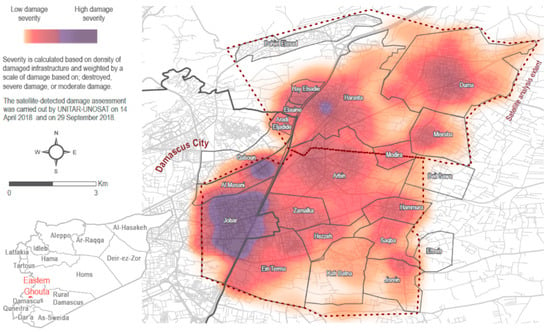
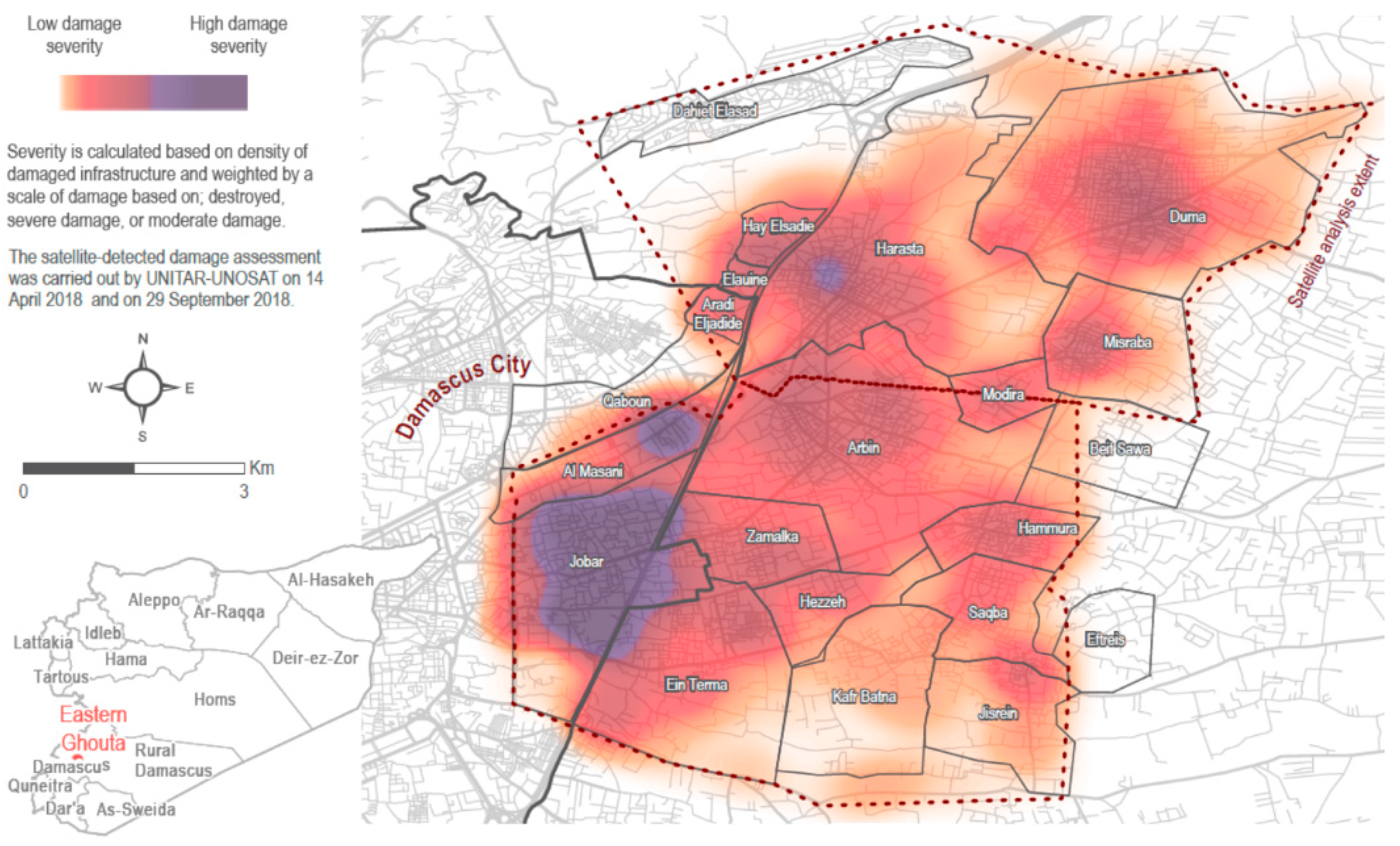
Al-Qaboun industrial area is located at the northern entrance of Damascus, a highly organized zone housing industrial and craft facilities as well as various government building. It spans from Abbasi garages in the west to the administrative borders of Damascus governorate bordering Harasta in the east, and from the international highway (Damascus-Homs) in the north to the Tora River separating Qaboun and Jobar in the south (Figure 1). Most factories and workshops are antiquated with ineffective infrastructure and outdated facilities. These conditions provide inadequate working environments and affect both productivity and product quality. The area contains around 750 establishments employing about 20,000 workers. Notable factories include Al-Khomasia General Company, textile and clothing companies, concierge and agricultural companies, building materials companies and Mechanical Workshops, Rubber and Plastic Products Company, Crash Soft Drinks Factory, Syronics TV Lab, Tariq Al Majdalani Wood Factory, and the main Soap Factory. Despite varying degrees of destruction, the area remains a vital economic hub.
Figure 1.
Al-Qaboun Damascus-North Damage Assessment.
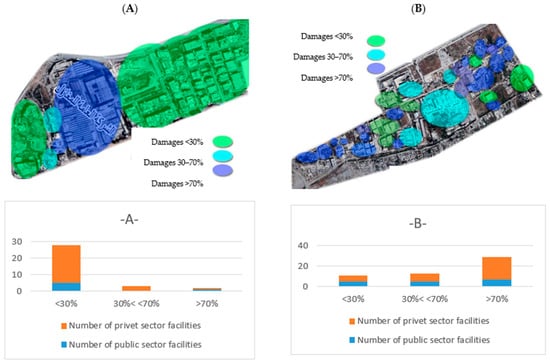
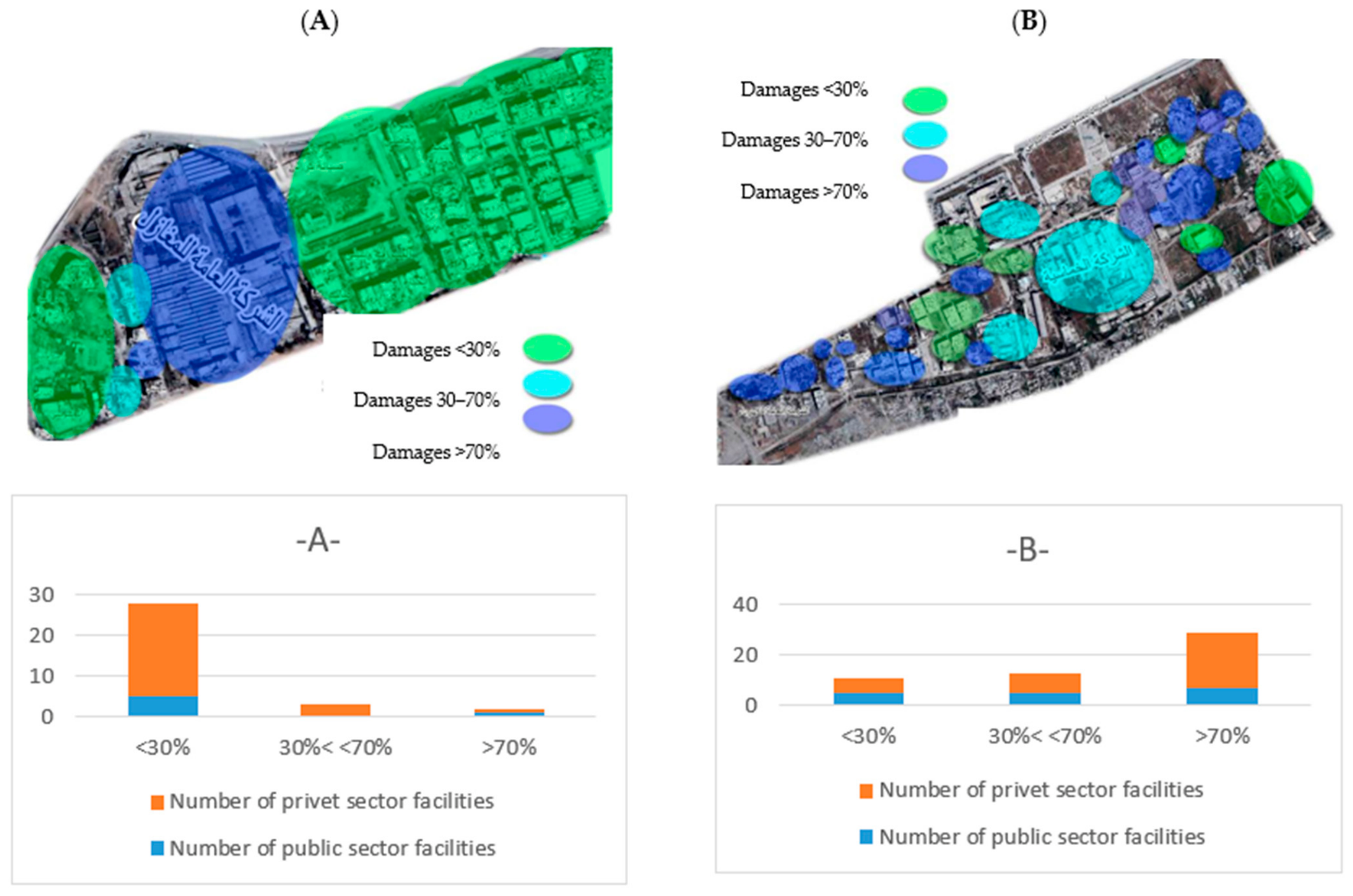
Al-Qaboun industrial area consists of two parts, (A) and (B), as shown in Figure 2. Based on field investigations, the destruction percentages were calculated. Area (A) comprises 46 factories with an overall damage rate of 26.1%. There is a surface tunnel, 2 m deep and 2 m in diameter, connecting the Al-Dogali building with the Jano building (requiring backfilling and treatment). Area (B) comprises 133 factories with an overall 59.4% damage.
Figure 2.
The spatial distribution of damage and the percentage of affected public and private facilities in Al-Qaboun’s two parts, (A,B).
The Syrian Government considered three alternative strategies for the post-conflict reconstruction and redevelopment of the Al-Qaboun industrial area:
- Option A1: Reconstruction in situ. This strategy permits affected industries to rebuild at their existing locations within Al-Qaboun without the provision of additional infrastructure or public services. Although this option requires the least immediate public investment, it offers limited opportunities to enhance urban resilience, modernise infrastructure, or implement the principles of Build Back Better.
- Option A2: Partial relocation and reconstruction. This strategy allows industrial associations and factory owners to choose between rebuilding in Al-Qaboun or relocating to the Adra Industrial City. Highly polluting industries would be relocated exclusively to Adra, while less polluting industries could remain in their original locations. Implementing this option would require substantial investment in infrastructure, including transport networks, water supply, electricity, and utility services at both sites, potentially increasing implementation complexity and costs. Furthermore, industries remaining within the urban area would continue to face exposure to environmental and urban development risks.
- Option A3: Complete industrial relocation. This strategy promotes the relocation of all industrial activities from Al-Qaboun to the Adra Industrial City as part of a comprehensive Build Back Better initiative. Consolidating industrial operations within a purpose-built industrial zone would reduce land-use conflicts, minimise environmental impacts on surrounding residential areas, improve access to modern infrastructure and services, and enhance long-term resilience by relocating industries to a lower-risk and more sustainable location.
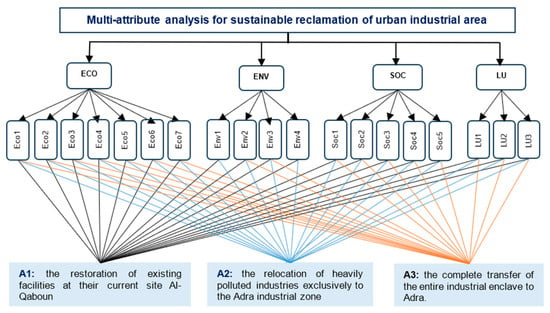
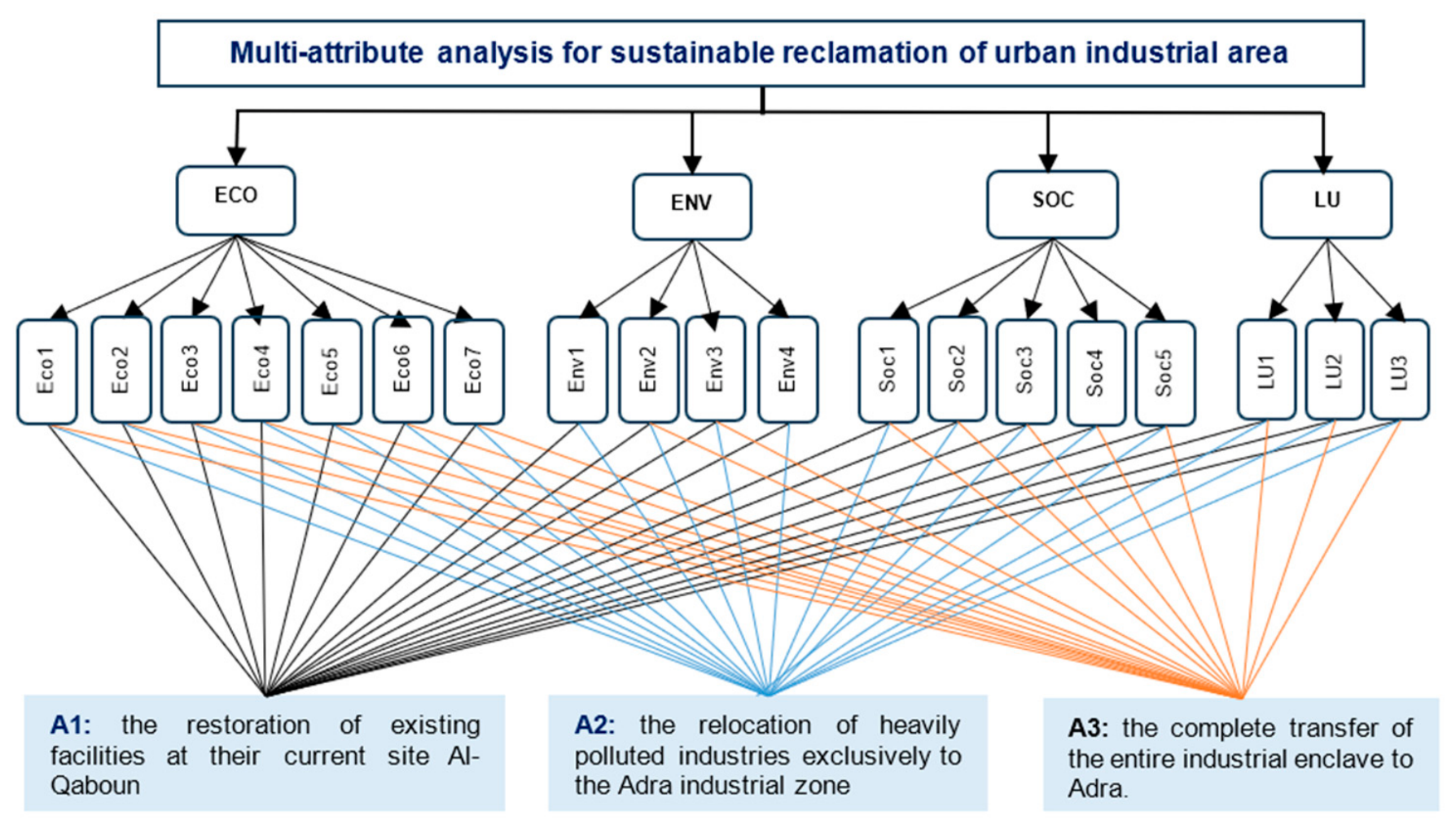
Figure 3 illustrates the hierarchy structure of the categories, sub-criteria, and alternatives. This simplified approach will enable generating a unique solution for the reciprocal comparison matrix.
Figure 3.
Hierarchy structure of the categories, sub-criteria, and alternatives.
4.2. FAHP Technique-Based Empirical Survey
The FAHP method is employed to establish preference weightings for the decision criteria based on subjective perceptions expressed in natural language. The FAHP method is useful for transforming experts’ survey responses into fuzzy weights, which can then be used to calculate composite indices. The survey technique is widely used in risk management and post-disaster assessment research [22,31]. There are three main reasons for selecting this data collection method: (1) It is less intrusive and cost-effective compared to interviews. (2) The questionnaire is easily understandable for most potential respondents; and (3) the analysis of returned responses is straightforward [14,32].
The questionnaire was designed to accommodate the FAHP technique for analysing the sustainable reclamation categories (economic, environmental, social, and land use) of urban industrial sites, as highlighted in Table 1. The questionnaire used for this study comprises five sections. Section 1 gathered information on the background of the invited experts, such as their work positions and years of experience.
Section 2, Section 3, Section 4 and Section 5 of the questionnaire utilised Saaty’s scale of preference [26], ranging from 1 to 9, to rate the relative priorities and importance of two sub-criteria at a time within each criterion (or category) through a pairwise comparison process. The typical question asked was, “How important is criterion A compared to criterion B?” This Saaty scale is an integral part of using the AHP or FAHP technique for pairwise comparisons. Table 2 presents the nine-point linguistic scale used for the pairwise comparison of each category’s sub-criteria and the corresponding triangular fuzzy numbers (TFNs). TFNs provide a more quantitative and alternative way to aggregate the experts’ opinions than using the arithmetic mean method [27,33]. For this purpose, the questionnaire was designed in the form of a checklist with closed-ended questions, and this approach facilitated the scoring process for participants while enforcing a unified way of scoring/weighting the sub-criteria. The pairwise comparison for any given category’s sub-criteria is given by Equations (1) and (2) for each expert as explained by [14].
where n is the number of sub-criteria and is a pairwise comparison matrix for each element () for the Uth expert.
Table 2.
Linguistic scale for quantitative comparison of FAHP.
Experts completed pairwise comparisons using linguistic variables that were subsequently converted into fuzzy numerical values before aggregation. The hierarchical model comprised the overall objective, four primary criteria groups and the associated sub-criteria described in Table 1. Table 2 presents the linguistic scale and TFN values adopted for pairwise comparisons within FAHP, adapted from [14]. The scale enables experts to express the relative importance of criteria and sub-criteria using qualitative linguistic judgments ranging from 1 (“Equal importance”) to 9 (“Extremely important”). Intermediate even-numbered values (2, 4, 6, and 8) represent compromise judgments between adjacent levels of importance. The use of this scale enhances consistency, reduces ambiguity in expert assessments, and supports the incorporation of uncertainty and subjectivity within the FAHP decision-making framework.
Individual pairwise comparison matrices were converted into fuzzy matrices using the TFNs shown in Table 2. The individual judgements were subsequently aggregated using Buckley’s geometric mean method (Equations (1) and (2) to obtain a collective fuzzy comparison matrix. The mathematical formulation of the aggregation procedure, defuzzification process and consistency assessment are illustrated in Equation (3)–(5).
As from previous work [14] a preliminary pilot survey was conducted on a sample of prospective respondents to establish reasonable validity and assess the reliability of the questionnaire. The next step in the research design involved eliciting expert opinions on the relative importance of the sub-criteria within each criterion. To achieve this target, the survey was distributed to professionals currently working in Damascus’ reconstruction planning, engineering, and manufacturing sectors using a purposive sampling technique. The purposive sampling technique was the most appropriate for this study as it required the invited experts to meet predefined criteria [35]. These criteria included (i) being a regulator/policymaker, project manager, contractor, industrial (private, public, or public-private partnership), consultant, designer, or property developer/owner involved in the reclamation of Damascus’ industrial area and (ii) having relevant knowledge of sustainable urban reclamation strategies.
This targeted approach enhances the likelihood of obtaining insights from individuals with pertinent expertise and experience. Although a purposive sampling technique is not representative of the entire population, according to [36,37], it is useful for serving specific research purposes.
4.3. FAHP Algorithms
According to [38], there are several FAHP methods to calculate fuzzy weights. However, this study utilises the [34] geomean () approach, which is considered one of the top methods [38]. This approach is easier to compute and guarantees a unique solution (see Equation (2)). The other two popular methods have major limitations. For more detailed information on applying FAHP, readers are referred to [39].
To derive the fuzzy geometric mean and fuzzy weights of each sub-criterion, the geometric mean technique was utilised, as shown in Equations (3) and (4):
where is the geometric mean of fuzzy comparison value, is the number of sub-criteria, is the fuzzy relative weight matrix of ith sub-criterion as indicated by the TFN, and = (,, ) for the lower, middle, and upper values of the fuzzy weights.
The next phase involved converting the obtained fuzzy geometric mean values to crisp values through a defuzzification process. To achieve this goal, the normalization procedure was applied. The centroid method (Equation (5)) was used for defuzzification, as it provides a crisp value based on the centre of gravity [27]. The final phase of the FAHP analysis involved deriving the global priority weights of the reclamation alternatives by synthesising the local priority weights throughout the hierarchical decision structure. The alternative with the highest overall FAHP priority weight was identified as the preferred strategy for sustainable post-disaster industrial site reclamation.
4.4. Sensitivity Analysis
To further validate the robustness of the FAHP–TOPSIS results, a sensitivity analysis was conducted following the approach recommended in the multi-criteria decision-making literature [27]. This step examines the stability of the ranking outcomes under different weighting conditions and assesses the extent to which variations in expert judgement influence the final selection of the preferred alternative among A1, A2, and A3 (Figure 2).
In this study, five alternative weighting scenarios were developed (Table 3) to test the sensitivity of the model outputs. These scenarios were derived from a separate group of four domain experts who did not participate in the original FAHP survey. Their ranking inputs were used to systematically adjust the weights of the sub-criteria, thereby generating alternative decision environments for comparative analysis. This procedure enables the evaluation of whether the final rankings remain consistent under different plausible preference structures.
Table 3.
Weighting scenarios.
The use of multiple expert-informed scenarios enhances the methodological robustness of the study by reducing reliance on a single consensus matrix and allowing for cross-validation of results. A similar approach was adopted by [27], who utilised multiple expert-defined scenarios to test the stability of industrial location decisions in the Damascus industrial area. In line with this precedent, the present study applies scenario-based sensitivity testing to ensure that the best alternative is derived (Table 3), not only optimal under baseline conditions but also stable across varying decision preferences.
4.5. Research Contributions and Limitations
This study contributes to the growing body of knowledge on post-disaster industrial site reclamation by developing and applying a comprehensive FAHP decision-support framework for evaluating and prioritising redevelopment alternatives under uncertainty. Unlike many previous studies that consider only isolated economic or environmental factors, the proposed framework integrates economic, environmental, social, land use, resilience, and low-carbon transition considerations within a single hierarchical decision structure. By explicitly incorporating stakeholder perspectives into the weighting process, the framework provides a transparent and systematic approach for supporting complex redevelopment decisions in post-disaster environments.
A further contribution lies in the framework’s scalability and transferability. While developed and tested using the Al-Qaboun industrial area in Damascus, the underlying FAHP methodology can be applied across different industrial sites, geographical contexts, and planning environments by adapting the evaluation criteria and stakeholder inputs while preserving the same hierarchical decision structure. Although site-specific criteria and stakeholder priorities may vary, the methodological structure remains consistent, enabling robust, transparent, and comparable decision-making across applications. This flexibility enhances the framework’s applicability to a wide range of post-disaster planning environments. Consequently, the framework offers practical guidance for policymakers, planners, and practitioners involved in sustainable industrial redevelopment and resilient urban recovery.
Despite these contributions, several limitations should be acknowledged. The analysis is based on a single case study and a purposive sample of 18 experts, which may limit the direct generalisability of the findings. Although the respondents possessed substantial professional expertise and represented diverse stakeholder groups, the results remain subject to the uncertainties and potential biases associated with expert judgement. Furthermore, data collection was undertaken during a period of heightened political uncertainty in Syria, which may have influenced participation rates and stakeholder engagement. Finally, the evaluation reflects the availability of data and expert knowledge at the time of the study. Future research could strengthen the framework through the inclusion of additional case studies, larger expert panels, and more extensive spatial, environmental, and economic datasets to further validate its applicability across different post-disaster contexts.
5. Results and Discussion
This section presents and discusses the results obtained from the application of the Fuzzy Analytic Hierarchy Process (FAHP) for evaluating sustainable industrial site reclamation alternatives. The analysis is based entirely on expert pairwise comparisons expressed as triangular fuzzy numbers, from which the relative priority weights of the evaluation criteria, sub-criteria, and reclamation alternatives were derived. The resulting priority weights provide a transparent basis for identifying the most appropriate reclamation strategy under conditions of uncertainty.
5.1. Survey Results
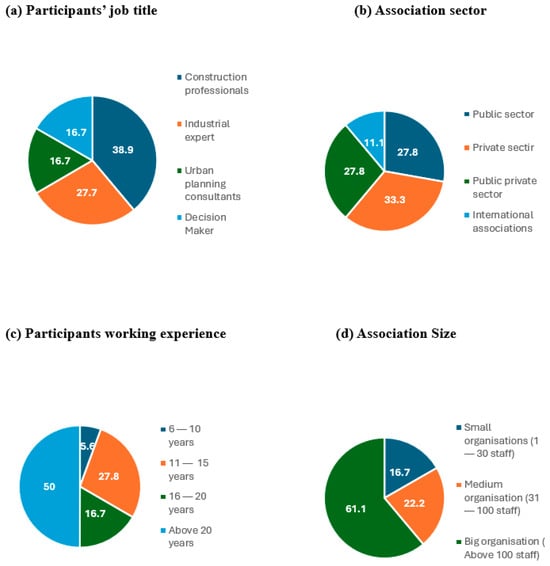
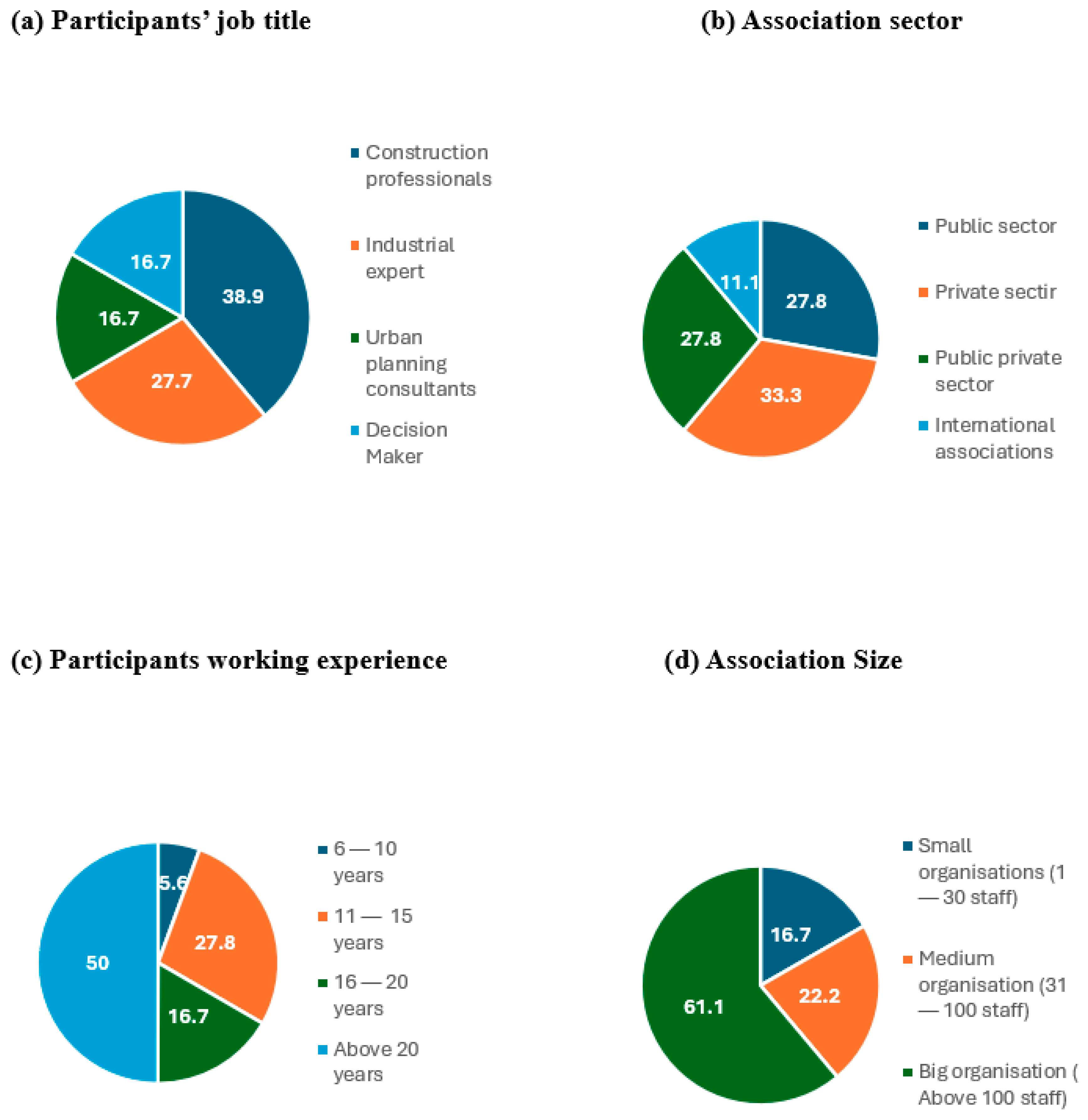
In step 1, a team of 18 respondents belonging to a range of diverse organizations, including the private sector (six experts, 33%), both public-private partnerships (PPPs) and the public sector (five experts, 28%), and two experts from international institutions based in Syria, was gathered. The limited representation of international experts might be due to the current sanctions’ regime, which prevents international investments. Nevertheless, the results are considered representative since the public and private sectors, along with PPPs, remain the largest stakeholders in decision-making for industrial site reclamation.
Regarding experience, half of the experts’ group have more than 20 years of working experience in the industry, while another 45% (eight experts) have more than 11 years of working experience. Additionally, 11 experts work in large organizations with at least 100 employees, and 4 experts work in medium-sized organizations with at least 31 employees. Moreover, 39% of the experts are construction professionals, 28% (five experts) are industrial experts, and the others are either urban planning consultants or decision-makers (17%, three experts each). Other influential stakeholders outside the scope of this study include suppliers, end-users, and neighbouring communities.
Figure 4c indicates that 50% of the respondents have more than 20 years of experience, reflecting the phenomenon of immigration among young professionals during the conflict. Moreover, most institutions operating in the reconstruction and reclamation of industrial cities are large organizations, with 61% of the respondents working for such entities, as depicted in Figure 4d.
Figure 4.
Participants’ characteristics.
Paired comparisons were made by AHP technique to determine the extent of impact of the site selection criteria on the most sustainable location. The weighting scores of each criterion based on the AHP matrix are given in Table 4.
Table 4.
Expert consensus on the pairwise comparison.
In step 2, Table 1, presenting the identified categories, sub-criteria, and alternatives, was created, while their hierarchical structure was illustrated in Figure 3.
In step 3, the evaluation step, several surveys were conducted, which involved an 18-member expert group undertaking the pairwise comparison individually, and a consensus matrix was derived. That is, applying the FAHP algorithms, especially Equations (1) and (2), to the survey responses resulted in the expert consensus pairwise matrices (Table 4) for two of the categories (economic and environmental) and for the overall goal which is resilient and sustainable industrial site reclamation.
The result was the development of the final weights for the categories and their sub-criteria (Table 4). This involves first multiplying the first value of the TFN scale of each column with one another to the root of 1/n (Equation (3)).
For instance, for all the columns in the first row, Eco1′ of Table 4, the geomean () gives as shown in Table 4 for the economic category:
Secondly, it involves using Equations (4) and (5) to derive the final weights, as shown in Table 5.
Table 5.
Geomean, and the sum of .
In step 4, a four-member expert group was invited to evaluate the alternatives (A1–A3) using a linguistic scale, and the final weights of the alternatives were obtained using Equations (3)–(5), as shown in Table 6. The same procedure is applied for all pairwise comparisons.
Table 6.
Final weights for the categories and alternatives.
In step 5, the aggregate weight () for each alternative was calculated as follows (for A1):
In regard to the rank being based on weightings, via the pairwise comparison among the sub-criteria within each category, the team of 18-experts assigned the highest weighting () to the “funding” criterion while the “suppliers” criterion () received the lowest weighting relative to other criteria in the economic category (see Table 6). For the social category, both “public health safety and security” and the demand for “creating jobs” received the highest rating ), followed by creating “equal opportunities”) for the marginalised communities where the industrial sites are currently located. Moreover, “environmental standards” and “pollution” have the highest rating, while the global “climate change” consideration has the lowest rating under the environmental category (Table 6). In the land use category, improving “neighbourhood plans” had the highest weighting assigned by the experts, followed by concerns regarding “policies of ownership”.
In regard to the alternatives ranking, given the final aggregate weightings (Table 6), the higher values were assigned to A3, A1, and A2 in descending order. Consequently, the alternative proposal (A3) with should be considered the most appropriate strategy for this case study. Therefore, the recommended approach is to relocate and transfer the entire Al-Qaboun industrial enclave to the Adra industrial zone outside the borders of Damascus. This ideal area border recommended as a sustainable location is located on a land with a low degree of slope and soil permeability and poor agricultural value. There is not any large-scale settlement around the ideal area, only a small-scale rural settlement. Since these rural settlements are separated by 1 km distances during suitability analyses, it is considered that the proposed ideal area for the industrial site will not pose a serious problem to these settlements. The fact that the ideal area is not located near any urban development site direction eliminates the risk of being situated within an urban settlement in years to come.
Furthermore, to achieve stakeholder satisfaction, it is suggested to place greater emphasis on maximising safety and security, minimizing the negative impact on neighbouring communities, minimizing expenses, minimizing harmful environmental impacts, and maximising the well-being of the workforce involved in the construction process and within the industrial area (e.g., engineers, workers).
5.2. Sensitivity Analysis Results
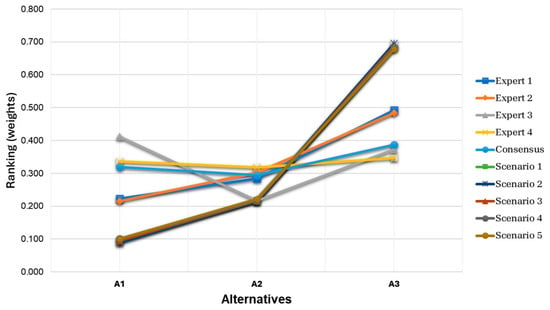
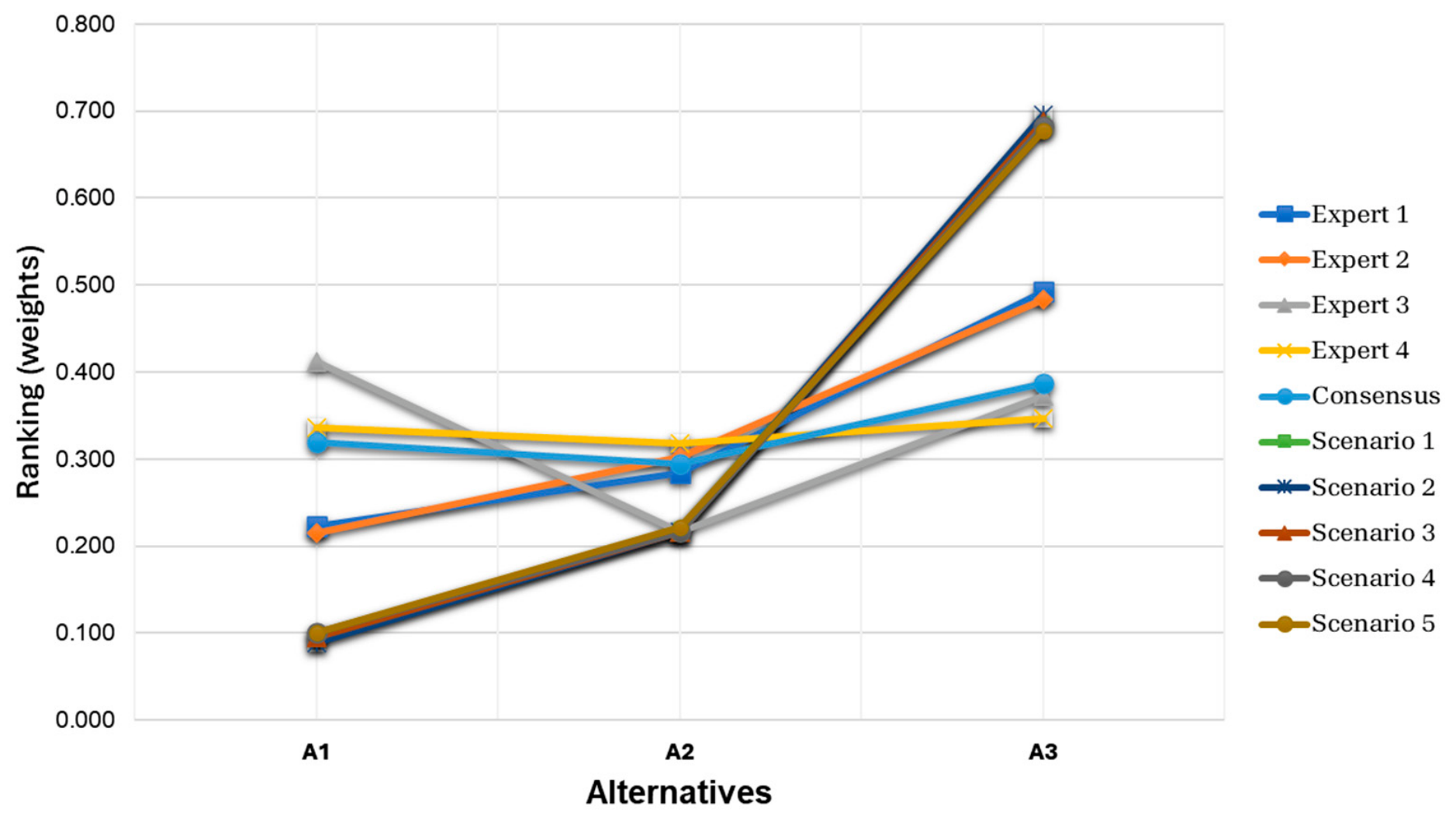
As stated earlier in Section 4.4, five distinct scenarios were considered, taking as inputs each expert’s preferences along with different weighting scenarios (Table 6). For each scenario, a joint decision matrix was obtained. Initially, the FAHP algorithms are applied to each expert’s preferences; then, the weighting scenarios are implemented. The results are presented in Figure 5.
Figure 5.
Ranking of alternatives (via FAHP) with respect to experts’ preferences and weighting scenarios.
As shown in Figure 5, the joint decision matrices obtained from the five different weighting scenarios all point to the same conclusion that was reached through the earlier consensus process (detailed in Table 6): option A3 is favoured as the best alternative. Additionally, the rank of alternatives is consistent across the consensus result and all weighting scenarios for three out of the four individual experts. The exception is Expert 3, whose personal preference ranked option A1 ) higher than option A3 . The aggregate weightings corresponding to the scenarios and expert inputs are represented in Figure 5.
The validity of the FAHP technique was determined by the Consistency Ratio generated as a result of the analysis. The ratio was expected to be below 0.1 (10%) [26]. Since the Consistency Ratio was 0.09 in this study, it was considered scientifically valid.
5.3. Research Implications
The findings demonstrate that FAHP provides a transparent and robust framework for evaluating industrial site reclamation alternatives under uncertainty. By incorporating expert judgement through triangular fuzzy numbers, the framework captures ambiguity inherent in complex post-disaster planning decisions while deriving consistent priority weights for the evaluation criteria and alternatives.
The prioritisation results indicate that the preferred reclamation alternative achieved the highest global FAHP priority weight after synthesising the local priorities throughout the hierarchical decision structure. This outcome reflects the combined influence of economic, environmental, social and land use considerations rather than any single criterion, demonstrating the value of integrated sustainability assessment. The sensitivity analysis showed that the preferred alternative remained stable under the five weighting scenarios, indicating that the decision framework is robust to reasonable changes in stakeholder priorities. Where variations in criterion weights altered the relative importance of individual factors, the overall preferred alternative remained unchanged, providing additional confidence in the reliability of the FAHP results.
Although the proposed framework was developed for the Al-Qaboun Industrial Area, the hierarchical structure can be adapted to other industrial redevelopment projects by modifying the evaluation criteria and stakeholder inputs while retaining the same FAHP methodology. This scalability enhances the practical usefulness of the framework for post-disaster industrial planning and sustainable urban regeneration.
The study is subject to several limitations. The analysis relied on expert judgement, which may introduce subjective bias despite the use of fuzzy logic to reduce uncertainty. In addition, the panel of eighteen experts, although consistent with many FAHP studies, may not capture the full diversity of stakeholder perspectives. Future research should incorporate larger and more diverse expert panels and validate the framework across additional case studies.
6. Conclusions
This study presents a novel FAHP-based MCDM framework for evaluating and prioritising sustainable industrial site reclamation strategies in post-disaster urban environments. The principal contribution lies in integrating economic, environmental, social, and land-use criteria within a unified fuzzy decision framework that explicitly addresses uncertainty in expert judgement. By combining these interdependent sustainability dimensions into a transparent, systematic, and reproducible methodology, the proposed framework provides a robust decision-support tool for complex reclamation challenges characterised by competing objectives and limited information.
The framework was applied to the war-affected Al-Qaboun industrial zone in Damascus to evaluate three reclamation scenarios. The results identified the complete relocation of industrial activities to the Adra Industrial Zone (Alternative A3) as the most sustainable and resilient option, owing to its lower development risk, greater long-term industrial potential, reduced urban encroachment, and improved environmental and socio-economic performance. Sensitivity analysis confirmed the stability of the ranking under varying weighting scenarios, demonstrating the robustness and reliability of the proposed methodology.
Beyond the case study, the key strength of the proposed FAHP framework is its scalability and transferability. Its modular architecture enables adaptation to a wide range of industrial redevelopment, brownfield regeneration, and post-disaster recovery projects through the incorporation of context-specific sustainability indicators and stakeholder priorities. The framework can also be extended to integrate emerging planning dimensions, including climate resilience, circular economy principles, life-cycle sustainability assessment, carbon mitigation, infrastructure resilience, resource efficiency, and digital planning technologies. This flexibility makes it a comprehensive decision-support platform for sustainable industrial development across diverse geographical and socio-economic contexts.
The proposed framework offers significant practical value for policymakers, urban planners, infrastructure authorities, and development agencies by improving the transparency, consistency, and defensibility of industrial reclamation decisions. It facilitates stakeholder engagement, supports evidence-based policy development, and promotes resilient “Build Back Better” strategies that balance economic growth with environmental stewardship and social well-being.
Future research should validate the framework across different industrial sectors and post-disaster settings to further establish its generalisability. Integrating Geographic Information Systems (GIS), Building Information Modelling (BIM), remote sensing, digital twins, and artificial intelligence with the proposed FAHP framework would enable dynamic spatial analysis and real-time decision support, while incorporating life-cycle assessment, behavioural modelling, and uncertainty analysis would further enhance its analytical capability.
Overall, this research advances the application of fuzzy MCDM in sustainable industrial site reclamation by delivering a scientifically rigorous, scalable, and transferable framework for resilient urban regeneration. Although demonstrated through a post-conflict industrial redevelopment case, the methodology is broadly applicable to industrial relocation, brownfield regeneration, infrastructure recovery, and sustainable urban transformation. By providing a transparent and adaptable decision-support framework, this research contributes to more resilient, sustainable, and evidence-based planning for industrial redevelopment in an increasingly uncertain world.
Author Contributions
Conceptualization, L.A.K.; methodology, L.A.K., T.O.O. and T.O.; software, L.A.K., T.O.O. and T.O.; validation, L.A.K. and T.O.O.; formal analysis, L.A.K. and T.O.O.; investigation, L.A.K., T.O.; resources, L.A.K.; data curation, T.O.O.; writing—original draft preparation, L.A.K.; writing—review and editing, all authors; visualization, L.A.K. and T.O.O. and T.O.; project administration, L.A.K. and I.S.; funding acquisition, N.M.E.-B. and I.S. All authors have read and agreed to the published version of the manuscript.
Funding
This research received no external funding.
Data Availability Statement
Data are contained within the article.
Acknowledgments
The authors express their gratitude to the School of Computing, Engineering & the Built Environment (SCEBE) at Edinburgh Napier University for providing the support and resources necessary for the completion of this research.
Conflicts of Interest
The authors declare no conflict of interest.
References
- Khaddour, L. Comparative analysis of residential building envelopes newly implementing the building insulation code in Damascus. Int. J. Environ. Sci. Technol. 2024, 21, 1509–1536. [Google Scholar]
- Khaddour, L.; Osunsanmi, T.; Olawumi, T.; Bradly, L. Multi-Attribute Analysis for Sustainable Reclamation of Urban Industrial Sites: Case from Damascus Post-Conflict. In Proceedings of the IOP Conference Series: Earth and Environmental Science; IOP Publishing: Bristol, UK, 2024; p. 012087. [Google Scholar]
- Mannakkara, S.; Wilkinson, S.; Potangaroa, R. Resilient Post Disaster Recovery Through Building Back Better; Routledge: Oxfordshire, UK, 2018. [Google Scholar]
- Khaddour, L.; Elhassnaoui, I. Building Back Circular: Post-Disaster Recovery for Climate Resilience Innovation. In Design Innovation for Climate-Resilient Cities and Communities; Springer: Berlin/Heidelberg, Germany, 2026. [Google Scholar]
- Khaddour, L.A.; Yeboah, S.K.; Dodoo, J.K. Ecological and Carbon Footprints of Cities Encyclopedia of Sustainable Technologies. In Encyclopedia of Sustainable Technologies, 2nd ed.; Elsevier: Amsterdam, The Netherlands, 2023. [Google Scholar] [CrossRef] [Scilit]
- Brooks, C. A model for redeveloping complex, highly contaminated sites—The Industri-plex Site in Woburn, Massachusetts. WIT Trans. Ecol. Environ. 2006, 94, 10. [Google Scholar]
- CIA. Syria—The World Factbook; Central Intelligence Agency: Langley, VA, USA, 2017; Volume 1, pp. 1–22. [Google Scholar]
- WBG. Syria’s Post-Conflict Reconstruction Costs Estimated at $216 Billion. Available online: https://www.worldbank.org/en/news/press-release/2025/10/21/syria-s-post-conflict-reconstruction-costs-estimated-at-216-billion (accessed on 20 September 2025).
- Fang, J.; Zhou, W.; Xiong, L. Multi-criteria decision making approach for supplier selection and order allocation in a digital supply chain resilience. Ann. Oper. Res. 2024, 14, 1–37. [Google Scholar] [CrossRef] [Scilit]
- Lu, W.; Zhang, L.; Liu, Y. Evaluation of Urban Complex Utilization Based on AHP and MCDM Analysis: A Case Study of China. Buildings 2024, 14, 2179. [Google Scholar] [CrossRef] [Scilit]
- Wang, A.; Zheng, W.; Tan, Z.; Han, M.; Chan, E.H. Synergies and trade-offs in achieving sustainable targets of urban renewal: A decision-making support framework. Environ. Plan. B Urban Anal. City Sci. 2025, 52, 490–508. [Google Scholar] [CrossRef] [Scilit]
- Taherdoost, H.; Madanchian, M. Multi-criteria decision making (MCDM) methods and concepts. Encyclopedia 2023, 3, 77–87. [Google Scholar] [CrossRef] [Scilit]
- Mahmoud, S.; Zayed, T.; Fahmy, M. Development of sustainability assessment tool for existing buildings. Sustain. Cities Soc. 2019, 44, 99–119. [Google Scholar] [CrossRef] [Scilit]
- Olawumi, T.O.; Chan, D.W. Identifying and prioritizing the benefits of integrating BIM and sustainability practices in construction projects: A Delphi survey of international experts. Sustain. Cities Soc. 2018, 40, 16–27. [Google Scholar] [CrossRef] [Scilit]
- Khaddour, L.A.; Deng, W. Multi-criteria sustainability risk management for post-war residential re-construction: The case of Damascus. J. Hous. Built Environ. 2023, 38, 1939–1982. [Google Scholar] [CrossRef] [Scilit]
- Rikalovic, A.; Cosic, I.; Labati, R.D.; Piuri, V. A comprehensive method for industrial site selection: The macro-location analysis. IEEE Syst. J. 2015, 11, 2971–2980. [Google Scholar] [CrossRef] [Scilit]
- Hosseini, S.A.; De la Fuente, A.; Pons, O. Multicriteria decision-making method for sustainable site location of post-disaster temporary housing in urban areas. J. Constr. Eng. Manag. 2016, 142, 04016036. [Google Scholar] [CrossRef] [Scilit]
- Mosadeghi, R.; Warnken, J.; Tomlinson, R.; Mirfenderesk, H. Comparison of Fuzzy-AHP and AHP in a spatial multi-criteria decision making model for urban land-use planning. Comput. Environ. Urban Syst. 2015, 49, 54–65. [Google Scholar] [CrossRef] [Scilit]
- Taibi, A.; Atmani, B. Combining fuzzy AHP with GIS and decision rules for industrial site selection. Int. J. Interact. Multimed. Artif. Intell. 2017, 4, 60–69. [Google Scholar] [CrossRef] [Scilit]
- Halog, A.; Manik, Y. Advancing integrated systems modelling framework for life cycle sustainability assessment. Sustainability 2011, 3, 469–499. [Google Scholar] [CrossRef] [Scilit]
- Pacheco-Torgal, F.; Labrincha, J. The future of construction materials research and the seventh UN Millennium Development Goal: A few insights. Constr. Build. Mater. 2013, 40, 729–737. [Google Scholar] [CrossRef] [Scilit]
- Si, J.; Marjanovic-Halburd, L.; Nasiri, F.; Bell, S. Assessment of building-integrated green technologies: A review and case study on applications of Multi-Criteria Decision Making (MCDM) method. Sustain. Cities Soc. 2016, 27, 106–115. [Google Scholar] [CrossRef] [Scilit]
- Saaty, T.L. Decision making with the analytic hierarchy process. Int. J. Serv. Sci. 2008, 1, 83–98. [Google Scholar] [CrossRef] [Scilit]
- Achillas, C.; Moussiopoulos, N.; Karagiannidis, A.; Banias, G.; Perkoulidis, G. The use of multi-criteria decision analysis to tackle waste management problems: A literature review. Waste Manag. Res. 2013, 31, 115–129. [Google Scholar] [CrossRef] [Scilit] [PubMed]
- Olawumi, T.O.; Chan, D.W. Application of generalized Choquet fuzzy integral method in the sustainability rating of green buildings based on the BSAM scheme. Sustain. Cities Soc. 2020, 61, 102147. [Google Scholar] [CrossRef] [Scilit]
- Moisa, M.B.; Karuppannan, S.; Wong, Y.J.; Khaddour, L.A. Urban agriculture land suitability assessment using AHP and geospatial analysis in Gondar Zuria, Ethiopia. DYSONA–Appl. Sci. 2025, 6, 322–333. [Google Scholar] [CrossRef] [Scilit]
- Kahraman, C.; Suder, A.; Cebi, S. Fuzzy multi-criteria and multi-experts evaluation of government investments in higher education: The case of Turkey. Technol. Econ. Dev. Econ. 2013, 19, 549–569. [Google Scholar] [CrossRef] [Scilit]
- Malhotra, M.K.; Grover, V. An assessment of survey research in POM: From constructs to theory. J. Oper. Manag. 1998, 16, 407–425. [Google Scholar] [CrossRef] [Scilit]
- Anjomshoae, A.; Hassan, A.; Wong, K.Y. An integrated AHP-based scheme for performance measurement in humanitarian supply chains. Int. J. Product. Perform. Manag. 2019, 68, 938–957. [Google Scholar] [CrossRef] [Scilit]
- Beltrão, L.M.; Carvalho, M.T. Prioritizing construction risks using fuzzy AHP in Brazilian public enterprises. J. Constr. Eng. Manag. 2019, 145, 05018018. [Google Scholar] [CrossRef] [Scilit]
- Ismael, D.; Shealy, T. Sustainable construction risk perceptions in the Kuwaiti construction industry. Sustainability 2018, 10, 1854. [Google Scholar] [CrossRef] [Scilit]
- Khaddour, L.A. Life-cycle sustainability risk management a multi-stakeholder approach: The case of Damascus post-war residential projects. Environ. Dev. Sustain. 2022, 24, 12756–12786. [Google Scholar]
- Sivakumar, R.; Kannan, D.; Murugesan, P. Green vendor evaluation and selection using AHP and Taguchi loss functions in production outsourcing in mining industry. Resour. Policy 2015, 46, 64–75. [Google Scholar] [CrossRef] [Scilit]
- Buckley, J.J. Fuzzy hierarchical analysis. Fuzzy Sets Syst. 1985, 17, 233–247. [Google Scholar] [CrossRef] [Scilit]
- Campbell, S.; Greenwood, M.; Prior, S.; Shearer, T.; Walkem, K.; Young, S.; Bywaters, D.; Walker, K. Purposive sampling: Complex or simple? Research case examples. J. Res. Nurs. 2020, 25, 652–661. [Google Scholar] [CrossRef] [Scilit] [PubMed]
- Etikan, I.; Bala, K. Sampling and sampling methods. Biom. Biostat. Int. J. 2017, 5, 00149. [Google Scholar] [CrossRef] [Scilit]
- Olawumi, T.O.; Chan, D.W.; Saka, A.B.; Ekundayo, D.; Odeh, A.O. Are there any gains in green-tech adoption? Unearthing the beneficial outcomes of smart-sustainable practices in Nigeria and Hong Kong built environment. J. Clean. Prod. 2023, 410, 137280. [Google Scholar] [CrossRef] [Scilit]
- Al Fozaie, M.T.; Wahid, H. A guide to integrating expert opinion and fuzzy AHP when generating weights for composite indices. Adv. Fuzzy Syst. 2022, 2022, 3396862. [Google Scholar] [CrossRef] [Scilit]
- Hsieh, T.-Y.; Lu, S.-T.; Tzeng, G.-H. Fuzzy MCDM approach for planning and design tenders selection in public office buildings. Int. J. Proj. Manag. 2004, 22, 573–584. [Google Scholar] [CrossRef] [Scilit]

Disclaimer/Publisher’s Note: The statements, opinions and data contained in all publications are solely those of the individual author(s) and contributor(s) and not of MDPI and/or the editor(s). MDPI and/or the editor(s) disclaim responsibility for any injury to people or property resulting from any ideas, methods, instructions or products referred to in the content. |
© 2026 by the authors. Licensee MDPI, Basel, Switzerland. This article is an open access article distributed under the terms and conditions of the Creative Commons Attribution (CC BY) license.