


Abstract
With growing interest in health and leisure, walking tourism has emerged as a significant segment of the tourism market. Coastal trails have gained prominence as attractive tourist attractions offering unique experiences that combine coastal and forest environments. Understanding the experiences of tourists using these trails is essential to their sustainability and the revitalization of nearby regions and tourist destinations. However, the sustainable management of coastal trails and the understanding of the perceptions and evaluations of tourists using them remain limited. Therefore, this study aims to analyze walking tourism experiences on coastal trails using online review data to identify tourists’ perceptions and evaluations. Three representative coastal trails in South Korea were selected as the study sites, and 21,289 reviews (including course information, titles, review content, and posting dates) were collected from Durunubi, a walking tourism application operated by the Korea Tourism Organization. The research methodology employed text mining and sentiment analysis in Python 3.12.13 and spatial analysis using GeoDa 1.22.0.20 and QGIS 3.40.11. This study explores the emotional geography of walking tourism experiences along Korean coastal trails by integrating the analysis of online review data using text mining, sentiment analysis, and spatial analysis. The analysis revealed that positive sentiments were associated with natural landscapes, while negative sentiments were associated with trail management. These emotional experiences exhibit distinct spatial clustering patterns. This finding has important implications for establishing sustainable trail management strategies.
1. Introduction
With a recent increase in interest in health and leisure, walking tourism has emerged as a significant segment of the tourism market. Walking tourism is inextricably linked to trails, an essential element of natural and cultural experiences, and one of the fastest-growing outdoor activities globally [1,2]. This is because they are affordable for numerous people and offer benefits to their physical and emotional well-being [3]. Furthermore, trails are recognized as important spaces that help walking tourists relieve stress and provide restorative experiences [4].
The United Nations World Tourism Organization (UNWTO) has emphasized that trail-related tourism (TRT), which is associated with walking tourism, is an effective method of regional development, providing social and economic benefits to local businesses and communities [5]. Trail and walking tourism that utilizes them contribute to the local tourism industry, leading to significant investment in trail-related infrastructure, facilities, and services [6,7]. Walking tourism can be developed anywhere as a sustainable tourism product that requires relatively little investment, and when properly managed, can provide social and economic benefits to residents and communities [8]. Trail development occurs across diverse environments, including urban, rural, and coastal areas [9], but coastal trails are recognized as an important trail type offering unique landscapes and experiences [10,11].
For effective tourism promotion, planning, and management, it is essential to have information about when and where tourists visit, as well as which elements of the destination they value most [12]. Traditional survey methods are time-consuming and resource-intensive, and they have limitations in capturing users’ spontaneous perceptions [13]. Consequently, recent research has increasingly utilized user-generated content (UGC), such as social media, to monitor large-scale tourism patterns and analyze tourist preferences and sentiments [14]. Text mining and sentiment analysis are effective in extracting meaningful information from vast text datasets and quantifying tourists’ attitudes and emotions [15]. These techniques provide a continuous, meaningful way to monitor trail users’ experiences and satisfaction levels. Furthermore, Spatial Analysis, when combined with geographic location information, helps identify the spatiotemporal patterns and hotspots of tourism activities [16].
Higher levels of trail development are known to correlate with greater visitor satisfaction [17,18]. Therefore, for the successful development and management of walking tourism destinations and coastal trails, the factors influencing user satisfaction must be analyzed from a multifaceted perspective. While earlier text mining studies mainly identified tourists’ preferences based on word frequency, recent research emphasizes quantifying the intensity and polarity of sentiments derived from tourists’ authentic perceptions and evaluations, and further integrating these data to uncover spatial patterns of tourist experiences [13]. However, despite these advancements, research that thoroughly explores user satisfaction, experience, and the resulting differences in spatial preferences for specific trail types, such as coastal trails, is still limited. Specifically, a critical research gap remains in extending beyond the textual understanding of what tourists feel, to empirically visualizing and verifying where these complex emotions occur within physical geographic contexts [14,19].
Therefore, this study aims to address this gap by analyzing tourists’ perceptions and assessments using review data on walking tourism and coastal trails. This study aims to present a new analytical dimension by integrating sentiment analysis (what is felt) and spatial analysis (where it is felt) through text mining, thereby exploring the complex interactions between tourists’ subjective emotions and spatial contexts. To achieve this, the current study sets forth three main research questions. First, what are the core experiential dimensions and semantic structures of coastal trail tourists as reflected in online review data? Second, how do the intensity and polarity of tourists’ positive and negative sentiments manifest, and what differences exist among different trail destinations? Third, what spatial clustering patterns do these subjective emotional experiences form within the geographical environment of coastal trails? Specifically, the methodological approach of analyzing walking tourists’ review data through the integrated application of text mining, sentiment analysis, and spatial analysis will help derive practical policies and management strategies for the sustainable development of coastal trails and the enhancement of user experience.
2. Literature Review
2.1. Walking Tourism and Coastal Trail
Walking tourism is a distinctive form of slow, experience-based travel in which walking itself becomes the primary mode of engaging with the place and the self [20]. It emphasizes direct bodily immersion, sensory awareness, and emotional reflection through movements in natural and cultural landscapes [21,22]. This form of tourism aligns with global trends that emphasize wellness, sustainability, and authenticity [23], positioning walking as both a physical journey and a psychological or spiritual process of self-discovery [24]. In recent years, walking tourism has been increasingly recognized as a sustainable strategy for regional revitalization [23,25].
Coastal trails have emerged as attractive linear tourism resources that integrate marine and terrestrial environments [4]. They enable tourists to experience the continuity of landscapes while engaging with local communities, promoting environmental awareness and cultural appreciation [26]. In South Korea, national-scale initiatives, such as the Korea Dulle Trail, including the Haeparang, Namparang, and Seohaerang trails, exemplify efforts to connect coastal, rural, and forest environments to a unified walking network [27].
Research on walking and trail tourism has generally focused on four key domains. First, emotional and restorative experiences emphasize walking as a mechanism for stress recovery and affective restoration [28,29]. Second, environmental and aesthetic appreciation, exploring multisensory interaction with scenery, seasons, and natural elements [30,31]. Third, challenge and achievement, where long-distance or mountainous walking promotes flow, vitality, and feelings of accomplishment [32]. Fourth, community and connectivity, emphasizing place attachment, identity, and regional linkages through walking routes [33].
Building upon these theoretical foundations, recent advances in digitalization have transformed how tourists express and share their experiences [34]. This shift has redefined the tourism experience as a data-rich, traceable phenomenon, wherein emotional and spatial patterns can be analyzed through computational methods [35,36]. UGC, particularly online reviews, provides authentic narratives of personal tourism experiences [35,37]. As individuals increasingly document their walking journeys on digital platforms [38], such data reflects genuine emotions, sensory impressions, and other reflections that traditional survey methods may overlook [20]. Consequently, text mining and natural-language processing techniques have been widely applied to uncover latent meanings, collective emotions, and destination images in large-scale textual datasets [36].
However, existing research often treats these texts as aspatial data, focusing on what tourists feel rather than where those feelings take place. This study employs an integrative analytical design that combines text mining to identify the semantic and affective structures embedded in tourist narratives with spatial analysis to visualize and interpret the corresponding emotional geographies. This approach provides a multidimensional understanding of how tourists perceive and evaluate coastal trails through the intersections of language, emotion, and place.
Recent studies have increasingly utilized UGC to investigate walking tourism experiences. For example, previous study analyzed online reviews of the Seoul Trail using sentiment analysis and demonstrated that digital narratives effectively capture visitors’ emotional responses and satisfaction. Their findings highlighted the potential of online reviews as valuable sources for understanding experiential dimensions of walking tourism beyond traditional survey-based approaches [13]. However, the study primarily focused on sentiment characteristics and did not examine how emotions vary across geographic space. This limitation suggests the need for integrating textual analysis with spatial analytical approaches to better understand the geographic dimensions of walking experiences.
2.2. Theoretical Integration and Analytical Framework
Tourism experiences are increasingly understood as emotional spatial phenomena in which feelings emerge through interactions with the environment [39,40]. In walking tourism, such interactions are intensified through the embodied act of movement, where terrain, rhythm, and atmosphere evoke cognitive reflection and affective resonance [41]. Place, therefore, functions not merely as a backdrop but also as an active element that co-produces meaning [42]. Accordingly, this study considers walking as a spatially embedded emotional experience in which movement, perception, and geography intersect.
Textual and spatial data offer complementary means of analyzing the interplay between emotions and places. As authentic forms of UGC, online reviews contain spontaneous narratives that reflect tourists’ emotional expressions and symbolic meanings [37,43]. Text-mining techniques, including topic modeling, co-occurrence mapping, and sentiment analysis, enable the extraction of the affective and semantic structures embedded in these narratives [44]. However, such analyses often treat emotions as aspatial, identifying what tourists feel but not where those feelings occur. Incorporating spatial analysis addresses this limitation by mapping emotional intensity across geographic space. GIS-based tools enable the detection of spatial clusters of positive and negative emotions, revealing how affective experiences align with specific environmental settings [19,45].
Drawing on previous studies employing text mining, sentiment analysis, and GIS-based spatial analysis, this study adopts an integrated analytical framework that combines textual and spatial approaches to investigate the emotional geography of walking tourism. The framework includes two interconnected layers: A textual layer that extracts semantic and affective meanings from online narratives [46,47] and a spatial layer that visualizes these emotional expressions within coastal trail environments using GIS-based analysis [45,48]. Integrating the two layers helps identify spatio-emotional clusters, showing how landscape features like scenery, elevation, and accessibility influence tourists’ feelings and perceptions. This approach advances tourism experience research by highlighting emotion’s situated, expressive nature and viewing walking tourism as a dynamic interaction between language, affect, and the environment.
The analytical framework is informed by three complementary streams of tourism research. First, studies employing frequency analysis and co-occurrence networks have demonstrated the value of identifying dominant themes and semantic structures in tourism-related UGC [49]. Second, sentiment analysis studies have shown that online reviews can effectively capture tourists’ emotional evaluations and experiential meanings [13,50]. Third, GIS-based studies utilizing local spatial autocorrelation techniques have revealed the spatial clustering of tourism phenomena and destination characteristics [16,51]. By integrating these analytical traditions, the present study seeks to identify not only what tourists experience and how they feel, but also where specific emotional experiences are geographically concentrated.
Consequently, limited research has integrated semantic analysis, emotional analysis, and local spatial clustering within a single framework. This study addresses this gap by linking sentiment extracted from online reviews with geographic locations and applying LISA analysis to identify spatial concentrations of positive and negative emotions along coastal trails. Together, these complementary techniques operationalize the framework to examine the emotional geographies of walking tourism, providing a data-driven understanding of how emotions and environments are intertwined through walking experiences. In doing so, it contributes to the literature on the emotional geography of walking tourism.
3. Methodology
3.1. Study Sites
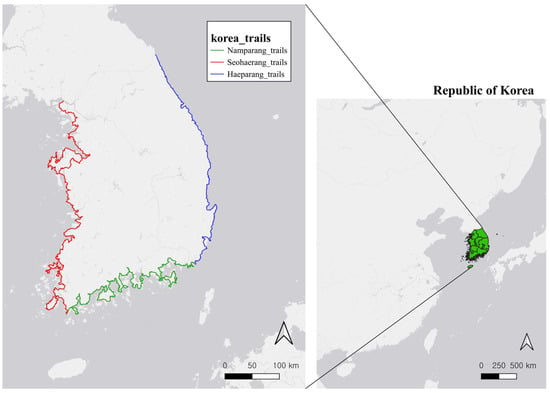
This study site is a national walking trail system developed by the Korea Tourism Organization and local governments to promote sustainable tourism and regional revitalization. Republic of Korea is surrounded by sea on three sides, and approximately 4500 km-long walking trails connect the country’s borders, including the east, west, and south coasts, and the DMZ border region. Collectively known as the Korea Dulle Trail, the coastal trail consisted of three sections. This study focused on Korea’s representative coastal trails: the Haeparang Trail (50 courses, 750 km), Namparang Trail (90 courses, 1470 km), and Seoharang Trail (109 courses, 1800 km) (see Figure 1).
Figure 1.
Coastal trails in Republic of Korea (Source: Authors). Note: The three coastal trails consist of the Haeparang trail (East Coast), Namparang trail (South Coast), and Seohaerang trail (West Coast).
These trails are particularly significant for walking tourism because they integrate natural landscapes, cities, local villages, and cultural heritage resources within a continuous tourism network. Unlike destination-based tourism, the trails encourage slow mobility and prolonged interaction with local environments, making them important spaces for sustainable tourism. The selected trails also constitute one of the most actively utilized walking tourism resources in Korea. A large volume of UGC has accumulated through online review platforms, providing a valuable opportunity to investigate tourists’ perceptions and emotional experiences across extensive geographic areas. Therefore, the study sites provide an appropriate setting for examining the emotional geography of walking tourism through the integration of text mining and spatial analysis.
3.2. Data Collection and Preprocessing
Online reviews were collected from Durunubi (https://www.durunubi.kr/; accessed on 2 October 2025), which is a Korean trail platform. The Korea Tourism Organization provides trail information, route maps, and stamp certification services to walking tourists. In Korea, most trail tourists use this app primarily for navigation or to record their travel through certification [32]. Therefore, reviews from Durunubi are considered highly reliable because they are free of commercial or sponsored content. These reviews include authentic photos and content shared by tourists participating in walking tourism.
Data were collected using the Beautiful Soup library in Python 3.12.13 and compiled into a CSV file. The collection period spanned from October 2021 to September 2025, with 21,289 reviews. The data included title, review content, upload date, and course information. Blank spaces, special characters, emojis, and words with fewer than two characters were removed during preprocessing. Furthermore, because the reviews were written in Korean, the open-source library Mecab-ko from the KoNLPy package 0.6.0 [52] in Python was used for tokenization and morphological analysis. After preprocessing, 20,016 reviews and 18,273 tokenized words were retained for analysis.
3.3. Analytical Framework
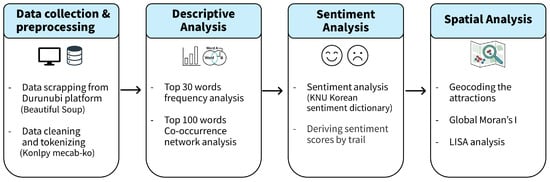
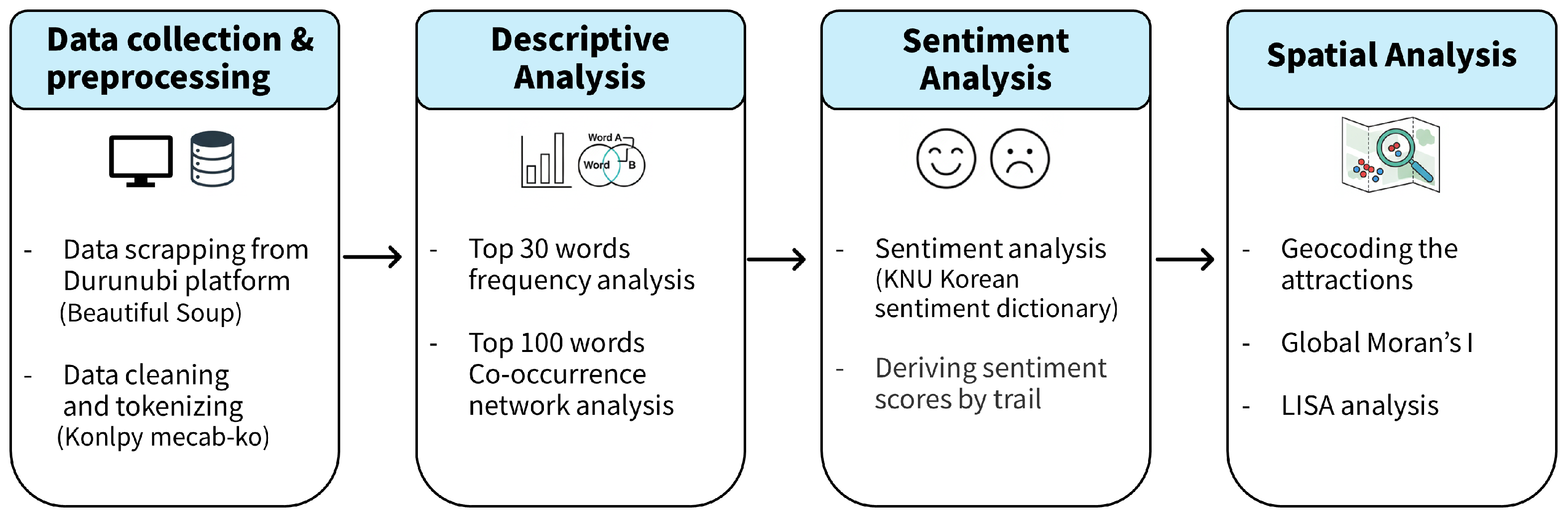
This study employed an integrated analytical workflow consisting of four sequential phases: data collection and preprocessing, descriptive text analysis, sentiment analysis, and spatial analysis (see Figure 2). Based on the following analysis results, we were able to systematically analyze the perceptions and emotional experiences of tourists walking along the coastal trails. All text-mining procedures, including frequency analysis, co-occurrence network analysis, and sentiment analysis, were conducted using Python. Spatial statistical analyses, including Global Moran’s I and LISA, were performed using GeoDa, whereas spatial visualization and map production were carried out using QGIS.
Figure 2.
Analytical framework of the study.
First, to understand the structure of tourists’ walking tourism experiences, we conducted a descriptive analysis using frequency and co-occurrence network analyses. This process involved extracting the most frequently mentioned words, followed by identifying and listing pairs of words with high co-occurrence frequencies in reviews. The co-occurrence network, represented as a graph-based model, consists of nodes that represent words appearing in the text, and edges indicating co-occurrence relationships based on specific adjacency criteria within the documents [53]. This facilitates pattern discovery, as seen in network visualizations, where the node diameter and edge thickness highlight predictive attributes and strong co-occurrence [54]. This step clarified the images and relationships perceived by tourists engaged in walking along a coastal trail.
Second, sentiment analysis was conducted based on the KNU Korean Sentiment Dictionary. This lexicon comprises 12,853 emotion-related words, including 4872 positive, 9828 negative, and 154 neutral words [55]. The dictionary contains idioms, abbreviations, emoticons, and other elements. Each word was assigned an emotional value on a five-point scale: very positive (+2), positive (+1), neutral (0), negative (−1), and very negative (−2) [56]. Additionally, the analysis categorized expressions into positive, negative, and neutral based on word polarity [57], the length of each document was calculated, and the corresponding results were derived. The data were organized by trail for sentiment analysis. These outputs were subsequently aggregated by trail and attraction and served as key variables for the spatial analysis.
Finally, to explore the spatial patterns of tourist attractions as perceived by tourists along the coastal trails, tourist attraction names were extracted from the review corpus based on place names explicitly mentioned in user-generated reviews. To ensure sufficient representation and reduce noise from infrequently mentioned locations, the 70 most frequently mentioned attractions were selected for spatial analysis. The frequency of mentions and average sentiment scores for each attraction derived from the previous analyses were used as analytical variables.
For the spatial analysis, latitude and longitude coordinates were obtained by geocoding the identified attraction names. Prior to the local spatial analysis, Global Moran’s I was calculated to examine the overall spatial autocorrelation of attraction sentiment scores and assess whether the observed spatial pattern differed significantly from a random distribution. A k-nearest-neighbor (KNN) spatial weights matrix was employed to define spatial relationships among attractions. Because the attractions were unevenly distributed across the study area, sensitivity analyses were conducted using alternative neighbor specifications (k = 4, 6, 8) to evaluate the robustness of the results.
To identify significant correlations among tourist attractions, we employed Local Indicators of Spatial Autocorrelation (LISA) analysis. As an exploratory spatial data analysis technique, LISA identifies the locations and types of spatial clusters within a dataset based on the concept of spatial dependency [16,58]. The LISA results can be divided into five categories. High-High (HH) represents spatial clusters of tourist attractions with high sentiment scores, indicating hotspots. High-Low (HL) represents tourist attractions with high sentiment scores adjacent to tourist attractions with low sentiment scores, indicating spatial outliers. Low-High (LH) represents tourist attractions with low sentiment scores adjacent to tourist attractions with high sentiment scores. Low-Low (LL) represents spatial clusters of tourist attractions with low sentiment scores, indicating cold spots. Not Significant indicates no clustering between tourist attractions [59,60].
4. Results
4.1. Seasonality and Frequency of Reviews
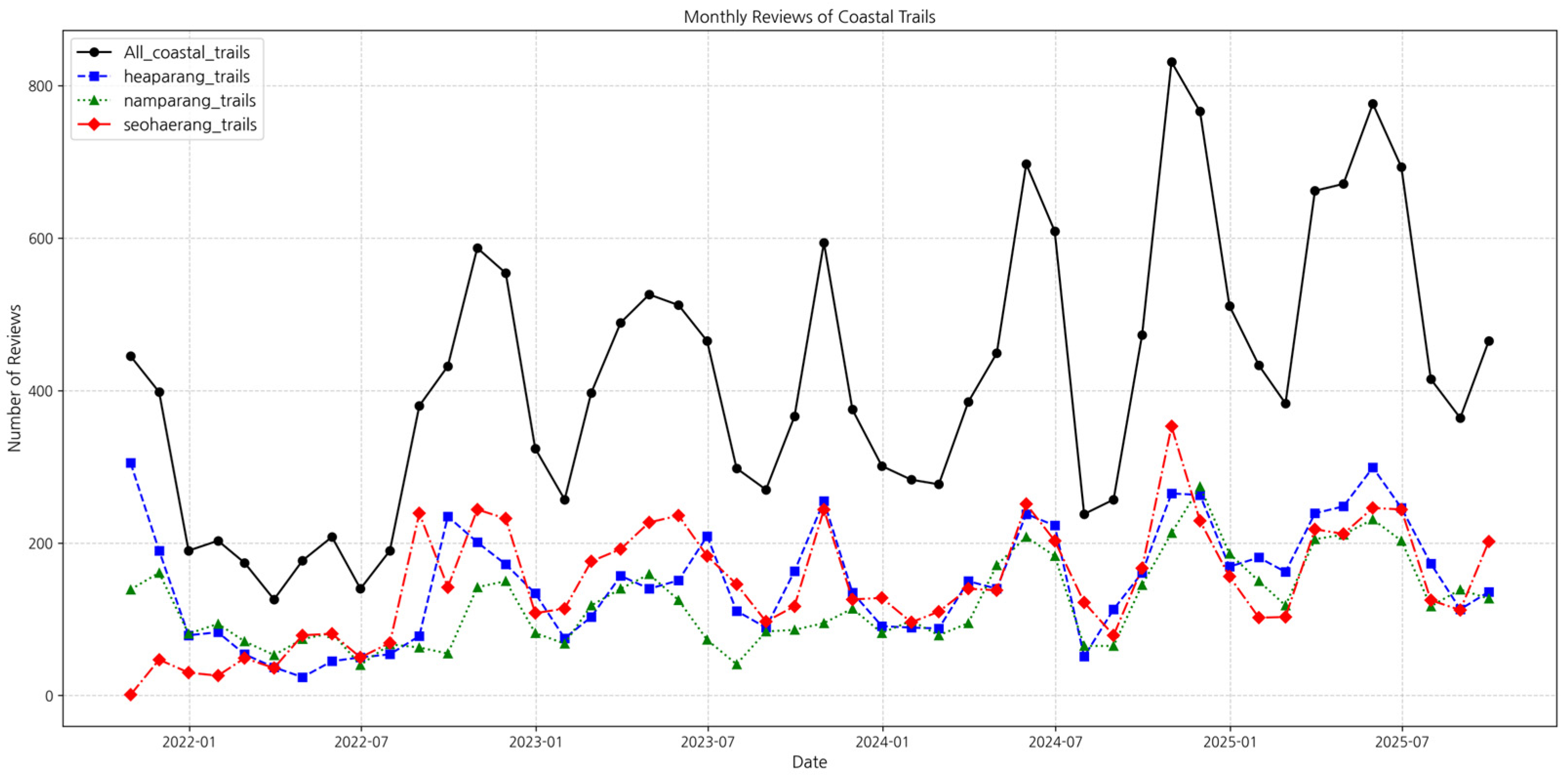
Figure 3 illustrates the monthly distribution of review activity across the three coastal trails between October 2021 and September 2025. A clear seasonal pattern is observed, with review volumes generally increasing during spring (April–June) and autumn (October–December), while declining during summer and winter months. This pattern suggests that coastal walking tourism is strongly influenced by seasonal outdoor recreation preferences and weather conditions. Although the magnitude of review activity differed among the trails, all three exhibited similar seasonal fluctuations, indicating that seasonality is a common characteristic of coastal walking tourism demand. The consistency of seasonal patterns across all three trails suggests that climatic and recreational seasonality exert a stronger influence on visitation behavior than regional differences among coastal trails.
Figure 3.
Monthly changes in the number of reviews (Source: Authors).
A frequency analysis of review data for coastal trails identified keywords that represent tourist experiences. The analysis included nouns, adjectives, and verbs at the morphological level, listing the top 30 most frequent words (see Table 1). The results showed that words related to natural landscapes and spatial elements had the highest occurrence rates. Sea-related terms appeared most prominently, underscoring its role as the central landscape element for coastal trail users. Additional high-frequency words pointed to a mix of coastal and mountainous settings, as well as built environments such as roads and parks, indicating that the trails traverse a varied spatial context.
Table 1.
Keyword frequency of reviews.
Keywords related to mobility and accessibility, such as Bus, Road, and Information, also appeared frequently, suggesting that transportation and route-related elements are commonly mentioned in tourist reviews. In addition, emotional and perceptual keywords such as Happiness, Wind, Tough, and Scenery were identified among the most frequent terms, indicating that tourists often describe both experiential and emotional aspects of walking trails. Facility- and management-related terms, including Signage, Bus Stop, and Terminal, were also observed, reflecting the presence of infrastructure- and service-related topics in tourists’ evaluations.
4.2. Co-Occurrence Network Analysis
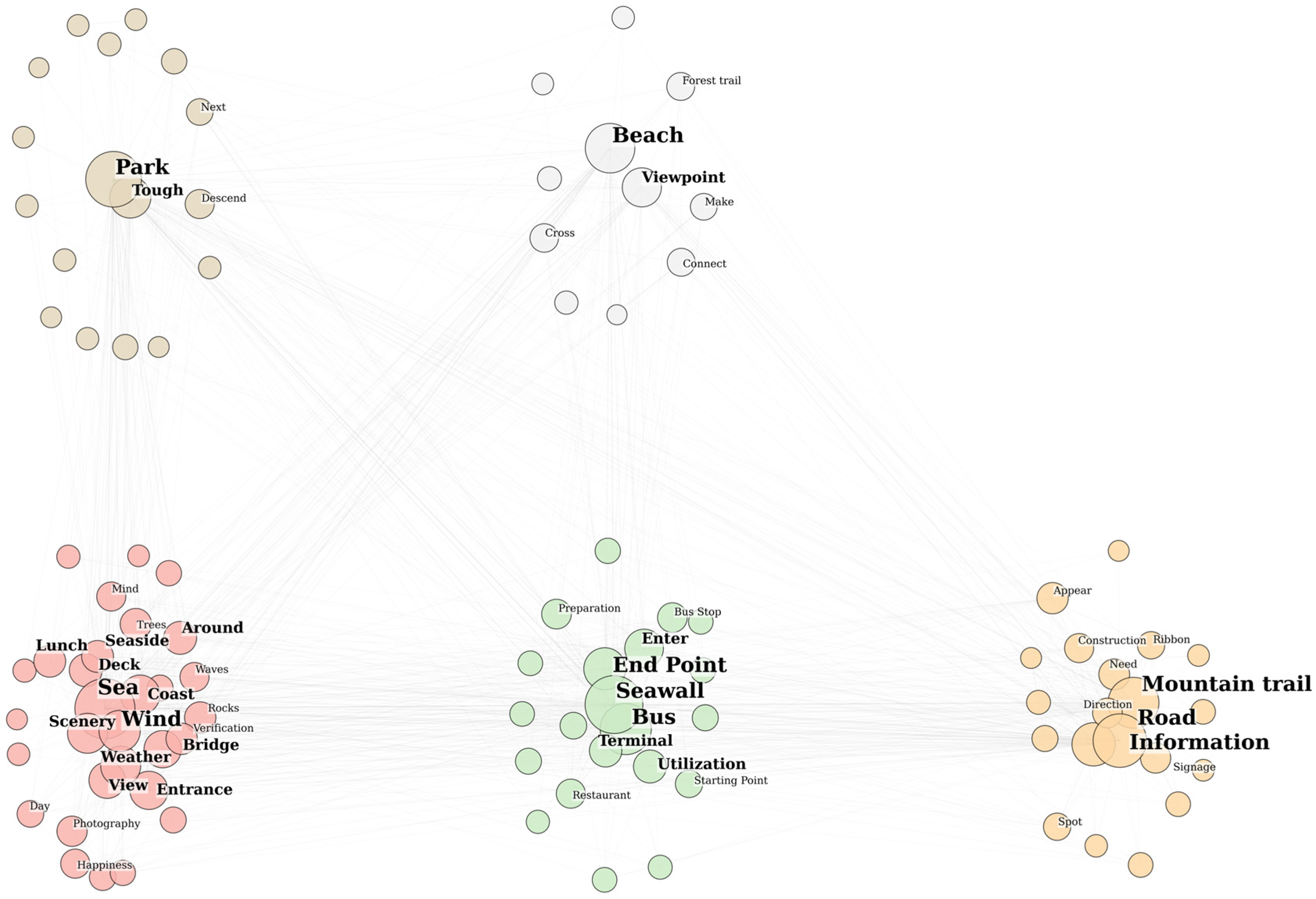
This study conducted a co-occurrence network analysis to identify semantic relationships among keywords extracted from tourist reviews. The initial network consisted of 100 nodes and 3502 edges, with a network density of 0.707, indicating a highly interconnected keyword structure with strong semantic cohesion. Applying a frequency threshold (co-occurrence ≥ 36) to remove weak connections refined the network to 99 nodes and 895 edges. Modularity-based community detection identified five distinct clusters representing semantically coherent thematic groups (see Figure 4).
Figure 4.
Result of co-occurrence network analysis (Source: Authors).
As shown in Figure 4, the network displays five distinct clusters that vary in size and centrality. The node size is proportional to degree centrality, whereas the edge thickness represents the strength of co-occurrence relationships. To improve readability, only the 50 most central keywords are labeled in the visualization, while all keywords were retained in the network analysis. Highly central keywords such as Sea, Bus, Road, Beach, and Park occupy prominent positions within the network and represent core concepts underlying tourists’ perceptions of coastal trails. The keywords, themes, and interpretations of each cluster are summarized in Table 2.
Table 2.
Keyword theme by cluster in co-occurrence networks.
The co-occurrence network revealed a multi-layered thematic structure within tourists’ experiences of coastal walking trails, indicating that several key concepts were interconnected across clusters. The five clusters revealed several recurring dimensions of tourists’ experiences of coastal walking trails. Cluster 1 was characterized by keywords related to natural landscapes and emotional experiences, whereas Cluster 2 primarily reflected mobility and accessibility. Cluster 3 contained keywords associated with route information and trail management, while Cluster 4 represented physically challenging yet restorative walking experiences. Cluster 5 emphasized regional connectivity and destination linkages along the trail network. Overall, the co-occurrence network demonstrates that tourists’ perceptions of coastal trails encompass environmental, functional, and experiential aspects.
4.3. Sentiment Analysis
The sentiment analysis results distinguished the three trails (see Table 3). Documents refer to the number of reviews collected per trail, whereas document length indicates the average number of words per document. Sentiment words were classified into four levels, strongly positive, positive, strongly negative, and negative, by assigning scores of +2, +1, −2, and −1 based on sentiment intensity. In addition, the positive count is the number of words with a positive sentiment and their ratio relative to the total word count. Similarly, negative count is the number of words with negative sentiments and their ratio relative to the total word count. Finally, the sentiment score is the net sentiment score derived by subtracting the sum of the scores for negative words from the sum of the scores for positive words in a review [61,62,63].
Table 3.
Result of sentiment analysis.
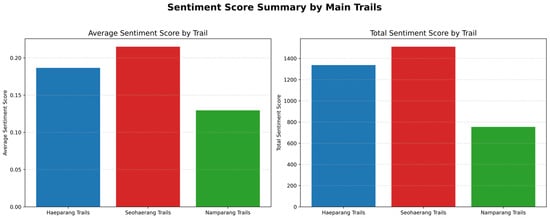
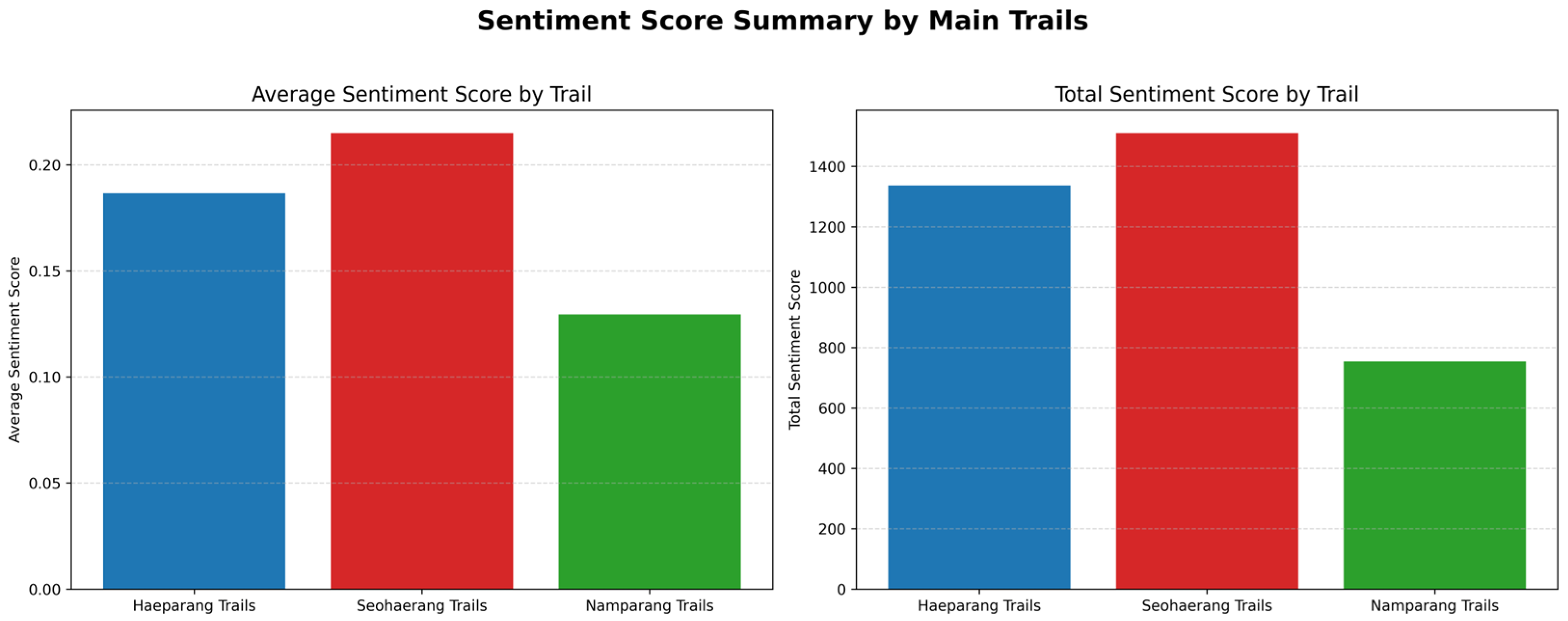
As shown in Table 3, all three coastal trails showed positive sentiments in reviews. Among them, the Seohaerang Trail had the highest percentage of positive words (58.72%) and the highest net sentiment score (1511 points. This was followed by the Haeparang (positive word ratio 55.62%, net sentiment score 1337 points) and Namparang (positive word ratio 54.81%, net sentiment score 754 points) trails. Figure 5 further illustrates these differences. Seohaerang trail showed the highest average and cumulative sentiment scores, whereas Namparang trail recorded the lowest values on both indicators. Haeparang trail occupied an intermediate position between the two.
Figure 5.
Sentiment score of coastal trails (Source: Authors). Note: Average sentiment score refers to the mean sentiment score per review, whereas total sentiment score represents the cumulative sentiment score across all reviews.
The proportions of review texts representing positive, negative, and neutral sentiment polarity values for each coastal trail are presented in Table 4. While differences existed among trails, the proportion of reviews with positive sentiments was generally higher than that of negative reviews. However, neutral polarity values accounted for over half (56.52–65.05%) of the reviews in each trail. This relatively high proportion reflects the presence of non-sentiment-bearing terms and the coexistence of positive and negative expressions within individual reviews.
Table 4.
Proportion of sentiment characteristic.
The qualitative evidence from the sample reviews further illustrates the emotional patterns tourists express. Positive reviews often show a deep sense of happiness, gratitude, and surprise at the beauty of coastal scenery.
Haeparang-trail Course 8 is the Path of Happy Love: The path to the Ulsan Grand Bridge Viewpoint was lined with such a beautiful, lush forest that I can’t even describe how happy I felt the entire way. …… Arriving at Ilsanji, I thought I’d definitely walk the Haeparang Course 8 again someday. Once more, I want to say thank you to Course 8 for giving me such a happy vibe and so much happiness.(anonymous reviewer #1)
By contrast, negative reviews are typically related to inadequate management or infrastructure. This type of review demonstrates that even with positive experiences, practical issues, such as trail accessibility and maintenance, significantly impact tourist satisfaction.
Hakkadari’s Haeparang Trail Course 34 Travel Review: The view of the East Sea from Mukho Lighthouse was spectacular. One regret was that the starting point marker for Course 34 was just by the roadside with no sign, making it easy to miss. Also, be aware that the end of Mangsaeng Beach is under construction, so you can’t follow the ribbon and must take a detour.(anonymous reviewer #2)
Overall, the sentiment analysis revealed that tourists expressed predominantly positive emotions toward coastal walking trails. Positive sentiment was primarily associated with scenic landscapes and enjoyable walking experiences, whereas negative sentiment was more frequently related to route management, accessibility, and infrastructure conditions. These findings demonstrate that both environmental and functional attributes constitute important dimensions of tourists’ evaluations of coastal trail experiences.
4.4. Spatial Analysis
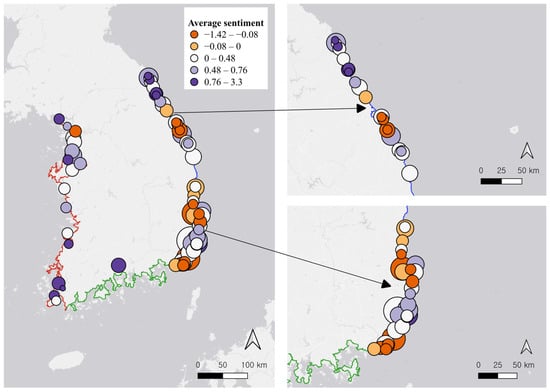
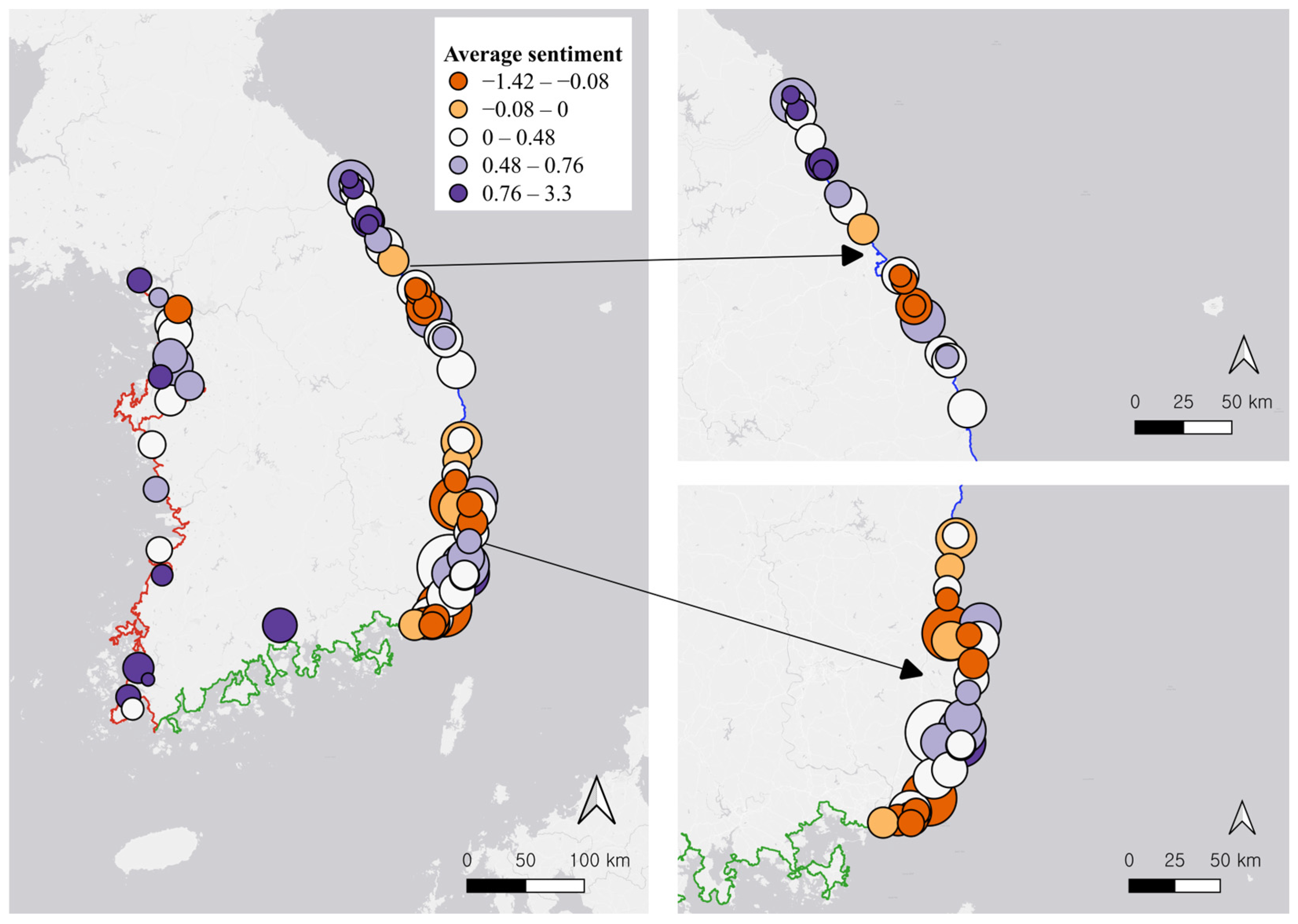
This study conducted spatial analysis to explore the spatial distribution of tourist attractions as perceived by coastal trail tourists. The frequency of the 70 tourist attractions is shown by circle size, and the average sentiment score is shown by color. The colors were visualized such that deep red represented more positive evaluations, deep blue represented more negative evaluations, and lighter colors represented evaluations closer to neutral (0). The analysis revealed a pattern in which the positive and negative evaluations clustered locally. Specifically, the northwestern, southwestern, and northeastern coastal regions generally exhibited clusters of tourist attractions receiving positive evaluations. In contrast, the central-eastern and southeastern coastlines displayed a complex mix of tourist attractions receiving both negative and positive evaluations (see Figure 6).
Figure 6.
Spatial distribution of tourist attractions (Source: Authors). Note: Circle size represents the frequency of tourist attraction mentions, while color indicates the average sentiment score. Darker colors represent stronger sentiment values. Blue line = Haeparang trail; Red line = Seohaerang trail; Green line = Namparang trail.
In some areas, tourist attractions had a high number of reviews but negative sentiment scores, suggesting that these attractions consistently provide tourists with negative experiences. Excellent tourist attractions that simultaneously secured a high number of reviews and positive evaluations also existed. These exploratory findings indicate that tourist satisfaction and dissatisfaction vary spatially along coastal trails. Therefore, a quantitative spatial statistical analysis was conducted to identify statistically significant hot spots (clusters of excellent tourist attractions) and cold spots (clusters requiring improvement).
First, a Global Moran’s I analysis was conducted to determine whether the average sentiment scores of the 70 tourist attractions exhibited a spatially random pattern or clustering tendency. The spatial weight matrix was constructed using the K-Nearest Neighbors (KNN) method. Following sensitivity tests using alternative neighbor specifications (k = 4, 6, 8), k = 6 was selected because it provided a stable spatial connectivity structure while avoiding excessive smoothing of local spatial relationships. The analysis included all 70 tourist attractions. The results showed a Global Moran’s I value of 0.331, indicating positive spatial autocorrelation. The associated p-value (0.001) and z-score (5.7789) confirmed that the pattern was highly significant. Therefore, tourist attraction sentiment scores exhibited a statistically significant clustered spatial pattern rather than a random distribution.
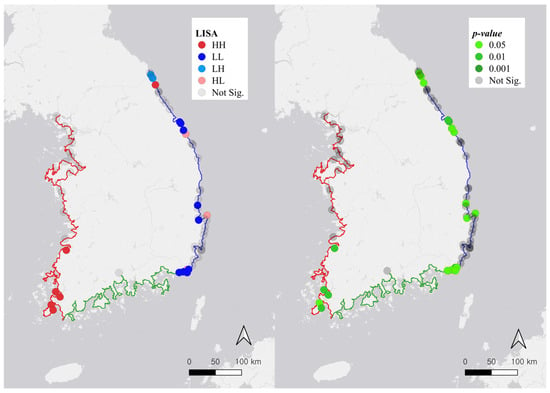
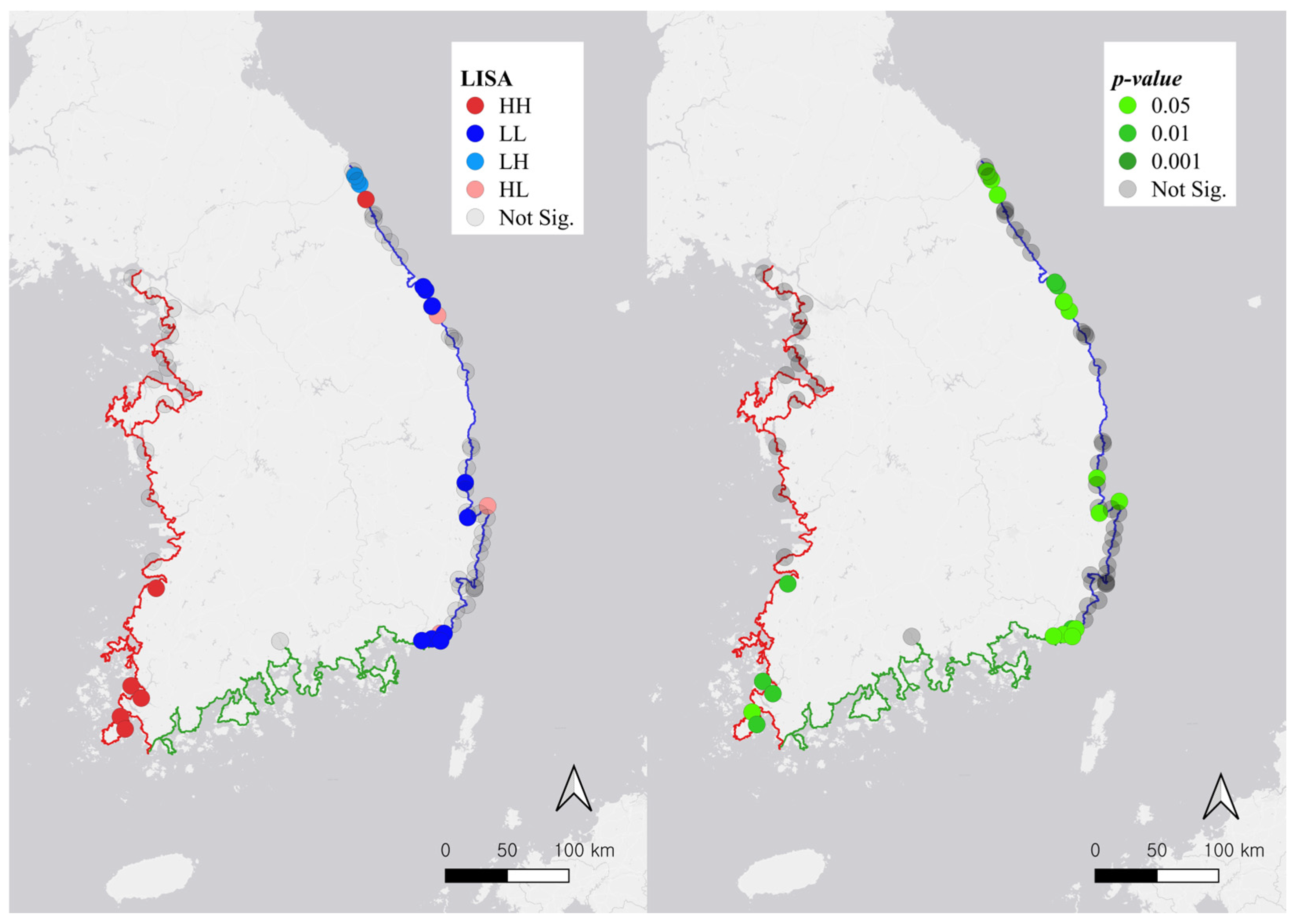
Following the confirmation of spatial autocorrelation, Local Indicators of Spatial Association (LISA) were applied to identify local clusters. Among the 70 tourist attractions, 23 (32.9%) were classified as statistically significant local clusters. Six attractions formed HH (High–High) clusters, indicating concentrations of highly rated attractions surrounded by similarly highly rated neighboring attractions. These clusters were primarily located along the southwestern and northeastern coastal regions. Twelve attractions were classified as LL (Low–Low) clusters, indicating concentrations of relatively low-rated attractions, mainly distributed along the southeastern and eastern coastlines (see Figure 7).
Figure 7.
Result of LISA analysis (Source: Authors). Note: HH = High–High cluster; LL = Low–Low cluster; HL = High–Low outlier; LH = Low–High outlier. Statistical significance was assessed using 999 permutations and a significance level of p < 0.05. Blue line = Haeparang trail; Red line = Seohaerang trail; Green line = Namparang trail.
In addition to the HH and LL clusters, five tourist attractions were identified as spatial outliers. Three attractions were classified as HL (High–Low) clusters, indicating locations with relatively high sentiment scores surrounded by neighboring attractions with lower sentiment scores. Two attractions were classified as LH (Low–High) clusters, indicating locations with relatively low sentiment scores situated within areas characterized by higher surrounding sentiment scores. These results demonstrate that tourist evaluations are not spatially homogeneous and that substantial local variation exists even within broader clusters of positive or negative sentiment.
5. Discussion
This study explored how tourists experience and evaluate Korea’s coastal trails by integrating text mining, sentiment analysis, and spatial analysis of online reviews. The findings suggest that walking tourism is not merely a recreational activity but a multidimensional experience shaped by interactions among natural landscapes, mobility conditions, emotional responses, and spatial contexts. By examining both textual narratives and spatial patterns, this study contributes to a more comprehensive understanding of how tourists perceive and emotionally engage with coastal trail environments.
The five clusters derived from the co-occurrence network analysis captured diverse aspects of walking tourism. The results revealed that tourists’ experiences were organized around themes of natural landscapes, mobility, trail management, emotional restoration, and destination connectivity. In particular, environmental keywords such as Sea, Beach, Coast, Wind, and Scenery occupied central positions within the network, indicating that aesthetic appreciation of coastal environments forms the core of walking tourism experiences. This finding is consistent with previous international studies that describe walking tourism as an embodied encounter with nature that promotes psychological restoration and personal reflection [21,28,32]. Similarly, research on the Kumano Kodo pilgrimage route in Japan highlighted how walking experiences generate emotional attachment through interactions with natural and cultural landscapes [24]. The present study extends these findings by demonstrating that such restorative experiences are also evident across large-scale coastal trails in Korea.
The sentiment analysis revealed that tourists generally expressed positive emotions regarding their coastal trail experiences. Overall, the positive reviews were primarily attributed to natural landscapes and emotional experiences (Cluster 1). In contrast, negative emotions were almost entirely linked to Course information and Trail management (Cluster 3), with core keywords including ‘signage,’ ‘construction,’ and ‘danger.’ An important finding was the relatively high proportion of neutral reviews (61.53%). While this could partly reflect limitations of sentiment lexicons in capturing context-dependent emotional expressions, it may also indicate the functional nature of walking tourism reviews. Unlike reviews of hotels or restaurants, many walking trail reviews contain practical information regarding routes, transportation, facilities, and trail conditions. Consequently, tourists often describe their experiences in factual and informational terms rather than through explicit emotional expressions. Therefore, the large proportion of neutral reviews should not be interpreted as evidence of emotional absence but rather as a characteristic of UGC with walking tourism. This interpretation supports previous studies suggesting that tourism reviews frequently combine experiential and informational functions [35,37].
The predominance of positive emotions observed in this study is consistent with previous research conducted in outdoor and trail-based tourism settings. For example, A study reported that visitors to protected natural areas frequently expressed positive sentiments associated with landscape appreciation and recreational enjoyment [61]. Similarly, A study, analyzing social media content related to tourism in Nepal, found that positive emotional expressions were strongly associated with scenic environments and outdoor experiences [14]. The consistency of these findings across different geographical contexts suggests that emotional benefits derived from walking and nature-based tourism may represent a common characteristic of outdoor recreation experiences.
Finally, spatial analysis revealed that tourists’ emotions exhibited spatial autocorrelation rather than a random distribution. A significant Global Moran’s I index (0.331, p = 0.001) provided statistical justification for the LISA analysis, successfully deriving an emotional geo-map along the linear coastal trail. The presence of outlier clusters (HL and LH) suggests that, even within the same trail, individual tourist attractions can exhibit outstanding or poor effects relative to their surrounding tourism environment. Consequently, spatial analysis deepened our understanding of how tourist perceptions and evaluations of coastal trails are geographically distributed.
From the perspective of emotional geography, emotions are understood as relational, contextual, and spatially embedded rather than fixed individual attributes [45,48]. The spatial clustering identified through Moran’s I and LISA analyses supports this perspective by demonstrating that tourists’ emotional evaluations were not randomly distributed across space. Instead, positive and negative emotional experiences tended to concentrate within particular coastal regions. These findings suggest that emotions emerge through interactions between tourists and specific environmental, infrastructural, and spatial conditions, reinforcing the view that tourism experiences are inherently place-dependent.
5.1. Theoretical Contribution
First, it contributes methodologically by proposing a framework that integrates text mining, sentiment analysis, and spatial analysis to connect the textual and spatial dimensions of the tourist experience. This framework applies emotion to space in the context of coastal trails and walking tourism following prior research [14,15,19,45]. It also presents a methodology for analyzing UGC by spatially analyzing sentiment patterns along tourism routes. This study deepens the spatial understanding of emotional experiences by spatially visualizing and interpreting tourists’ emotional expressions using textual data.
Second, by applying affect scores to the LISA within a linear tourism context, this study revealed tourist satisfaction as a geographically manifested phenomenon influenced by spatial autocorrelation rather than a simple overall destination average. This framework provides a new theoretical perspective for understanding regional tourism performance and disparities by identifying outstanding tourist spots (hot spots) and those requiring improvement (cold spots). Consequently, this study emphasizes that walking tourism on coastal trails is a spatially embedded emotional experience that extends beyond mere physical movement. This reflects the growing tendency to conceptualize tourism spaces not as static and physical, but as emotional and dynamic [39,41].
Finally, this study provides empirical evidence that accessibility, trail management, and environmental quality jointly influence tourists’ perceptions and emotional evaluations. The coexistence of positive emotional expressions related to scenery and restoration alongside negative sentiments associated with route guidance, signage, and maintenance suggests that both experiential and functional attributes are important determinants of walking tourism experiences. This finding broadens existing understandings of coastal trail tourism by highlighting the interconnected roles of emotional, environmental, and managerial factors.
5.2. Practical Implications
First, the results highlight the importance of preserving and enhancing natural landscape resources along coastal trails. Keywords associated with the sea, beaches, scenery, wind, and viewpoints occupied central positions within the co-occurrence network and were strongly associated with positive emotional responses. Trail managers should therefore prioritize landscape conservation and maintain visual quality along walking routes, as these environmental attributes constitute core elements of tourists’ experiences.
Second, accessibility and transportation infrastructure should be considered integral components of coastal walking tourism. The prominence of keywords related to buses, terminals, bus stops, and route endpoints indicates that tourists place substantial importance on convenient access and mobility. Improving public transportation connections and providing clear information regarding access points may enhance the overall visitor experience and encourage greater participation in walking tourism.
Third, the results consistently identified route guidance and trail management as important concerns. Negative evaluations were frequently associated with signage, construction, route deviations, and maintenance issues. Therefore, destination managers should implement continuous monitoring of trail conditions, improve directional signage, and provide real-time information regarding route changes or temporary disruptions. Such measures may reduce visitor inconvenience and improve satisfaction levels.
Fourth, the spatial analysis suggests that management strategies should be differentiated according to local conditions rather than applied uniformly across the entire coastal trail system. Significant spatial clusters of positive and negative sentiment indicate that destination quality varies geographically. Areas identified as High–High clusters may serve as benchmark destinations, whereas Low–Low clusters should be prioritized for infrastructure improvements and targeted management interventions. A place-specific management approach may therefore be more effective than standardized national-level policies.
Finally, this study demonstrates the practical value of UGC as a monitoring tool for tourism management. Online reviews provide continuous and large-scale feedback regarding visitor experiences, emotions, and service quality. Tourism organizations and local governments can utilize such data to identify emerging issues, evaluate visitor satisfaction, and support evidence-based decision-making for coastal trail development and management.
5.3. Limitations and Future Research
First, the data sources were limited to the ‘Durunubi’ platform. Although these data are highly reliable and noncommercial, they may introduce sample bias. This could exclude the perspectives of tourists who do not use this platform or prefer other media. This may not represent the attitudes of tourists, residents, or overseas visitors who record their experiences on other platforms. Future studies should integrate reviews from multiple platforms to capture a broader range of experiences.
Second, by focusing on coastal walking trails, the generalizability of this study to other types of trails (e.g., urban and mountainous) is limited. Research comparing diverse trail environments can clarify the differences in tourist experiences. Finally, this study identified the presence and location of tourist attraction clusters but did not statistically model the reasons for their existence. Future research should integrate other spatial data and clarify the causal relationships among various factors, thereby identifying specific environmental and management factors.
Another limitation relates to the operationalization of emotion. Emotional geography emphasizes the fluid, embodied, and contextual nature of emotions [45], whereas this study quantified emotions using aggregated sentiment scores derived from textual reviews. Although this approach enabled large-scale spatial analysis, it inevitably simplified complex emotional experiences into numerical indicators. Therefore, the emotional maps produced in this study should be interpreted as representations of aggregated emotional expressions rather than direct measures of tourists’ lived emotional experiences. Future studies could incorporate more fine-grained spatiotemporal approaches, such as GPS-based trajectory data, experience sampling, or longitudinal sentiment tracking, to better capture emotional dynamics during walking experiences.
6. Conclusions
This study examined tourists’ emotional experiences and evaluations of Korea’s three major coastal trails, the Haeparang, Namparang, and Seohaerang trail, using online review data. Drawing on the perspective of emotional geography, the study integrated text mining, co-occurrence network analysis, sentiment analysis, and spatial analysis to investigate how tourists perceive and emotionally respond to coastal walking tourism experiences.
The findings revealed that tourists’ experiences of coastal trails are organized around multiple interconnected dimensions. Frequency and co-occurrence network analyses showed that natural landscape elements, including the sea, beaches, scenery, and wind, occupied central positions in tourists’ narratives. At the same time, accessibility, transportation, route information, and trail management emerged as important components of the walking experience. The co-occurrence network further identified five thematic clusters representing natural landscapes and emotional experiences, mobility and accessibility, course information and trail management, challenging and healing experiences, and regional connectivity.
The sentiment analysis demonstrated that all three trails generated predominantly positive emotional responses. Positive sentiments were mainly associated with scenic landscapes, restorative experiences, and enjoyment of walking activities, whereas negative sentiments were more frequently related to infrastructure conditions, route management, and accessibility issues. Among the three trails, the Seohaerang trail exhibited the highest overall sentiment scores, while the Namparang trail recorded comparatively lower emotional evaluations.
The spatial analysis revealed significant spatial clustering of emotional evaluations. Positive sentiment clusters were concentrated in specific coastal regions, whereas negative sentiment clusters appeared in other areas, indicating that tourists’ emotional experiences are spatially differentiated rather than randomly distributed. These findings suggest that environmental quality, accessibility, and management conditions collectively shape tourists’ perceptions of coastal walking destinations.
Overall, this study contributes to identifying the thematic, emotional, and spatial dimensions of tourists’ experiences, the study provides a more comprehensive understanding of how coastal trails are perceived and evaluated. The findings may serve as a useful foundation for future research and evidence-based management strategies aimed at enhancing the quality and sustainability of coastal trails.
Author Contributions
Conceptualization, H.O. and C.J.; methodology, H.O.; software, H.O.; validation, H.O.; formal analysis, H.O.; investigation, H.O.; data curation, H.O. and J.Y.; writing—original draft preparation, H.O. and J.Y.; writing—review and editing, C.J.; visualization, H.O.; supervision, C.J.; project administration, C.J. All authors have read and agreed to the published version of the manuscript.
Funding
This research was a part of the project titled ‘Global Industry-Leading Research and Training Program for Innovative Human Resources in Marine Leisure Tourism (RS-2025-02317535),’ funded by the Ministry of Oceans and Fisheries, Korea.
Data Availability Statement
The data will be made available by the authors on request.
Conflicts of Interest
The authors declare no conflicts of interest.
References
- Davies, N. Who Walks, Where and Why? Practitioners’ Observations and Perspectives on Recreational Walkers at UK Tourist Destinations. Ann. Leis. Res. 2018, 21, 553–574. [Google Scholar] [CrossRef] [Scilit]
- Power, D.; Lambe, B.; Murphy, N. Trends in Recreational Walking Trail Usage in Ireland during the COVID-19 Pandemic: Implications for Practice. J. Outdoor Recreat. Tour. 2023, 41, 100477. [Google Scholar] [CrossRef] [Scilit] [PubMed]
- Maples, J.; Bradley, M.; Giles, S.; Leebrick, R.; Clark, B. Climbing out of Coal Country: The Economic Impact of Rock Climbing in West Virginia’s New River Gorge. J. Appalach. Stud. 2019, 25, 184–201. [Google Scholar] [CrossRef] [Scilit]
- Lukoseviciute, G.; Pereira, L.N.; Panagopoulos, T. Assessing the Income Multiplier of Trail-Related Tourism in a Coastal Area of Portugal. Int. J. Tour. Res. 2022, 24, 107–121. [Google Scholar] [CrossRef] [Scilit]
- World Tourism Organization (UNWTO) (Ed.) Walking Tourism–Promoting Regional Development, Executive Summary; World Tourism Organization (UNWTO): Madrid, Spain, 2019; ISBN 978-92-844-2052-0. [Google Scholar]
- Arellano, A. Tourism in Poor Regions and Social Inclusion: The Porters of the Inca Trail to Machu Picchu. World Leis. J. 2011, 53, 104–118. [Google Scholar] [CrossRef] [Scilit]
- Oh, M.; Kim, S.; Choi, Y. Analyses of Determinants of Hiking Tourism Demands on the Jeju Olle Hiking Trail Using Zero-Truncated Negative Binomial Regression Analysis. Tour. Econ. 2020, 26, 1327–1343. [Google Scholar] [CrossRef] [Scilit]
- Rubino, G.; Gattuso, D.; Stark, J.; Taczanowska, K. Walkability as a Measure of the Attractiveness of Tourist Walking Itineraries. J. Transp. Geogr. 2025, 128, 104354. [Google Scholar] [CrossRef] [Scilit]
- MacLeod, N. The Role of Trails in the Creation of Tourist Space. J. Herit. Tour. 2017, 12, 423–430. [Google Scholar] [CrossRef] [Scilit]
- Freire, S.; Santos, T.; Tenedório, J.A. Recent Urbanization and Land Use/Land Cover Change in Portugal—The Influence of Coastline and Coastal Urban Centers. J. Coast. Res. 2009, II, 1499–1503. [Google Scholar]
- Lukoseviciute, G.; Henriques, C.N.; Pereira, L.N.; Panagopoulos, T. Participatory Development and Management of Eco-Cultural Trails in Sustainable Tourism Destinations. J. Outdoor Recreat. Tour. 2024, 47, 100779. [Google Scholar] [CrossRef] [Scilit]
- Chen, J.; Becken, S.; Stantic, B. Assessing Destination Satisfaction by Social Media: An Innovative Approach Using Importance-Performance Analysis. Ann. Tour. Res. 2022, 93, 103371. [Google Scholar] [CrossRef] [Scilit]
- Lee, S.; Chung, W.J.; Jeong, C. Exploring Sentiment Analysis and Visitor Satisfaction along Urban Liner Trails: A Case of the Seoul Trail, South Korea. Land 2024, 13, 1349. [Google Scholar] [CrossRef] [Scilit]
- Bhatt, P.; Pickering, C.M. Analysing Spatial and Temporal Patterns of Tourism and Tourists’ Satisfaction in Nepal Using Social Media. J. Outdoor Recreat. Tour. 2023, 44, 100647. [Google Scholar] [CrossRef] [Scilit]
- Park, S.B.; Kim, J.; Lee, Y.K.; Ok, C.M. Visualizing Theme Park Visitors’ Emotions Using Social Media Analytics and Geospatial Analytics. Tour. Manag. 2020, 80, 104127. [Google Scholar] [CrossRef] [Scilit]
- Kang, S.; Lee, G.; Kim, J.; Park, D. Identifying the Spatial Structure of the Tourist Attraction System in South Korea Using GIS and Network Analysis: An Application of Anchor-Point Theory. J. Destin. Mark. Manag. 2018, 9, 358–370. [Google Scholar] [CrossRef] [Scilit]
- Donovan, G.H.; Cerveny, L.K.; Gatziolis, D. If You Build It, Will They Come? For. Policy Econ. 2016, 62, 135–140. [Google Scholar] [CrossRef] [Scilit]
- Kelley, H.; Van Rensburg, T.M.; Jeserich, N. Determinants of Demand for Recreational Walking Trails in Ireland. Tour. Manag. 2016, 52, 173–186. [Google Scholar] [CrossRef] [Scilit]
- Huang, Y.; Fei, T.; Kwan, M.-P.; Kang, Y.; Li, J.; Li, Y.; Li, X.; Bian, M. GIS-Based Emotional Computing: A Review of Quantitative Approaches to Measure the Emotion Layer of Human–Environment Relationships. ISPRS Int. J. Geo-Inf. 2020, 9, 551. [Google Scholar] [CrossRef] [Scilit]
- Dihingia, S.; Gjerde, M.; Vale, B. Walking Tourist: Review of Research to Date. J. Urban Plan. Dev. 2022, 148, 04022017. [Google Scholar] [CrossRef] [Scilit]
- Blades, G. Making Meanings of Walking with/in Nature: Embodied Encounters in Environmental Outdoor Education. J. Outdoor Environ. Educ. 2021, 24, 293–318. [Google Scholar] [CrossRef] [Scilit]
- Nordh, H.; Vistad, O.I.; Skår, M.; Wold, L.C.; Magnus Bærum, K. Walking as Urban Outdoor Recreation: Public Health for Everyone. J. Outdoor Recreat. Tour. 2017, 20, 60–66. [Google Scholar] [CrossRef] [Scilit]
- Yeap, P.-F.; Liow, M.L.S. Tourist Walkability and Sustainable Community-Based Tourism: Conceptual Framework and Strategic Model. Int. J. Tour. Cities 2024, 10, 78–104. [Google Scholar] [CrossRef] [Scilit]
- Kato, K.; Progano, R.N. Spiritual (Walking) Tourism as a Foundation for Sustainable Destination Development: Kumano-Kodo Pilgrimage, Wakayama, Japan. Tour. Manag. Perspect. 2017, 24, 243–251. [Google Scholar] [CrossRef] [Scilit]
- Febriani, P.; Muttaqin, I. Walking Tour and Culture: Fostering Cultural Collaboration Through Tourism. Indones. Tour. J. 2025, 2, 25–40. [Google Scholar] [CrossRef] [Scilit]
- Wang, S.; Wang, Y. Trans Canada Trail: A Shared-Use Network of Pathways from Coast to Coast to Coast. J. Outdoor Recreat. Tour. 2022, 39, 100517. [Google Scholar] [CrossRef] [Scilit]
- Ministry of Culture, Sports and Tourism; Korea Tourism Organization. 2024 Walking Tourism Survey Report; Ministry of Culture, Sports and Tourism: Sejong-si, Republic of Korea, 2025. (In Korean) [Google Scholar]
- Harmon, J.; Kyle, G. Connecting to the Trail: Natural Spaces as Places of Healing. Leis. Sci. 2022, 44, 1112–1127. [Google Scholar] [CrossRef] [Scilit]
- Kim, S.-I.; Jeong, C. Influence of Perceived Restorativeness on Recovery Experience and Satisfaction with Walking Tourism: A Multiple-Group Analysis of Daily Hassles and the Types of Walking Tourist Attractions. Land 2025, 14, 266. [Google Scholar] [CrossRef] [Scilit]
- Roostika, R.; Kusumawati, R.A.; Kuntari, T.; Mumpuni, P. “Sensing” the destination: Assessing multisensory experiences in outdoor tourism. Indones. Interdiscip. J. Sharia Econ. (IIJSE) 2025, 8, 5773–5792. [Google Scholar]
- Zhong, L.; Campbell, C.; Buckley, R.; Zhu, D.; Yu, H.; Chauvenet, A.; Cooper, M.-A. Senses, Emotions and Wellbeing in Forest Recreation and Tourism. Tour. Recreat. Res. 2025, 50, 688–700. [Google Scholar] [CrossRef] [Scilit]
- Mau, M.; Klausen, S.H.; Roessler, K.K. Becoming a Person: How Long-Distance Walking Can Lead to Personal Growth—A Cultural and Health-Related Approach. New Ideas Psychol. 2023, 68, 100975. [Google Scholar] [CrossRef] [Scilit]
- Choi, S.; Kim, I. Sustainability of Nature Walking Trails: Predicting Walking Tourists’ Engagement in pro-Environmental Behaviors. Asia Pac. J. Tour. Res. 2021, 26, 748–767. [Google Scholar] [CrossRef] [Scilit]
- Pencarelli, T. The Digital Revolution in the Travel and Tourism Industry. Inf. Technol. Tour. 2020, 22, 455–476. [Google Scholar] [CrossRef] [Scilit]
- Li, S.; Li, Y.; Liu, C.; Fan, N. How Do Different Types of User-Generated Content Attract Travelers? Taking Story and Review on Airbnb as the Example. J. Travel Res. 2024, 63, 371–387. [Google Scholar] [CrossRef] [Scilit]
- Xu, H.; Lv, Y. Mining and Application of Tourism Online Review Text Based on Natural Language Processing and Text Classification Technology. Wirel. Commun. Mob. Comput. 2022, 2022, 9905114. [Google Scholar] [CrossRef] [Scilit]
- Bigne, E.; Fuentes-Medina, M.L.; Morini-Marrero, S. Memorable Tourist Experiences versus Ordinary Tourist Experiences Analysed through User-Generated Content. J. Hosp. Tour. Manag. 2020, 45, 309–318. [Google Scholar] [CrossRef] [Scilit]
- Rodrigues Lucena, T.F.; Fleury Rosa, S.R.; Miosso, C.J.; da Silva Torres, R.; Krueger, T.; Domingues, D.M.G. Walking and Health: An Enactive Affective System. Digit. Creat. 2016, 27, 314–333. [Google Scholar] [CrossRef] [Scilit]
- Germann Molz, J.; Buda, D.-M. Attuning to Affect and Emotion in Tourism Studies. Tour. Geogr. 2022, 24, 187–197. [Google Scholar] [CrossRef] [Scilit]
- Tussyadiah, I.P. Toward a Theoretical Foundation for Experience Design in Tourism. J. Travel Res. 2014, 53, 543–564. [Google Scholar] [CrossRef] [Scilit]
- Haanpää, M.; García-Rosell, J.-C.; Hakkarainen, M. Walking the Concepts: Elaborating on the Non-Representational Sensitivities of Tourism Experience. J. Mark. Manag. 2022, 38, 1832–1850. [Google Scholar] [CrossRef] [Scilit]
- Eggli, F.; Wattanacharoensil, W. Living with Tourism: A Fluid Interplay of Various Actors within the Urban Tourism Space. Tour. Recreat. Res. 2025, 1–19. [Google Scholar] [CrossRef] [Scilit]
- Cheung, M.L.; Leung, W.K.; Cheah, J.-H.; Ting, H. Exploring the Effectiveness of Emotional and Rational User-Generated Contents in Digital Tourism Platforms. J. Vacat. Mark. 2022, 28, 152–170. [Google Scholar] [CrossRef] [Scilit]
- Chen, X.; Xie, H.; Tao, X.; Wang, F.L.; Zhang, D.; Dai, H.-N. A Computational Analysis of Aspect-Based Sentiment Analysis Research through Bibliometric Mapping and Topic Modeling. J. Big Data 2025, 12, 40. [Google Scholar] [CrossRef] [Scilit]
- Davidson, J.; Milligan, C. Embodying Emotion Sensing Space: Introducing Emotional Geographies. Soc. Cult. Geogr. 2004, 5, 523–532. [Google Scholar] [CrossRef] [Scilit]
- Marine-Roig, E.; Anton Clavé, S. A Detailed Method for Destination Image Analysis Using User-Generated Content. Inf. Technol. Tour. 2016, 15, 341–364. [Google Scholar] [CrossRef] [Scilit]
- Santana, B.; Campos, R.; Amorim, E.; Jorge, A.; Silvano, P.; Nunes, S. A Survey on Narrative Extraction from Textual Data. Artif. Intell. Rev. 2023, 56, 8393–8435. [Google Scholar] [CrossRef] [Scilit]
- Bondi, L. Emotional Geographies; Routledge: London, UK, 2016; ISBN 978-1-315-57924-5. [Google Scholar]
- Marine-Roig, E. Destination Image Analytics Through Traveller-Generated Content. Sustainability 2019, 11, 3392. [Google Scholar] [CrossRef] [Scilit]
- George, O.A.; Ramos, C.M.Q. Sentiment Analysis Applied to Tourism: Exploring Tourist-Generated Content in the Case of a Wellness Tourism Destination. Int. J. Spa Wellness 2024, 7, 139–161. [Google Scholar] [CrossRef] [Scilit]
- Anselin, L. Local Indicators of Spatial Association—LISA. Geogr. Anal. 1995, 27, 93–115. [Google Scholar] [CrossRef] [Scilit]
- Park, E.L.; Cho, S.-K. KoNLPy: Korean Natural Language Processing in Python. In Proceedings of the 26th Annual Conference on Human & Cognitive Language Technology; Korean Institute of Information Scientists and Engineers, The Korean Society for Cognitive Science: Seoul, Republic of Korea, 2014; Volume 6, pp. 133–136. [Google Scholar]
- Baronchelli, A.; Ferrer-i-Cancho, R.; Pastor-Satorras, R.; Chater, N.; Christiansen, M.H. Networks in Cognitive Science. Trends Cogn. Sci. 2013, 17, 348–360. [Google Scholar] [CrossRef] [Scilit]
- Urbanowicz, R.; Moore, J. Learning Classifier Systems: The Rise of Genetics-Based Machine Learning in Biomedical Data Mining. In Methods Biomed. Inform. Pragmatic Approach; Academic Press: Cambridge, MA, USA, 2013; pp. 265–311. [Google Scholar] [CrossRef] [Scilit]
- Cho, H. Comparison of Three Korean Sentiment/Emotion Word Dic Tionaries. In Proceedings of the 2023 IEEE International Conference on Big Data and Smart Computing (BigComp), Jeju, Republic of Korea, 13–16 February 2023; pp. 334–335. [Google Scholar]
- Park, S.-M.; Na, C.-W.; Choi, M.-S.; Lee, D.-H.; On, B.-W. KNU Korean Sentiment Lexicon: Bi-LSTM-based Method for Building a Korean Sentiment Lexicon. J. Intell. Inf. Syst. 2018, 24, 219–240. [Google Scholar] [CrossRef]
- Kousta, S.-T.; Vinson, D.P.; Vigliocco, G. Emotion Words, Regardless of Polarity, Have a Processing Advantage over Neutral Words. Cognition 2009, 112, 473–481. [Google Scholar] [CrossRef] [Scilit]
- Kang, S.; Kim, J.; Nicholls, S. National Tourism Policy and Spatial Patterns of Domestic Tourism in South Korea. J. Travel Res. 2014, 53, 791–804. [Google Scholar] [CrossRef] [Scilit]
- Jang, S.; Kim, J.; Von Zedtwitz, M. The Importance of Spatial Agglomeration in Product Innovation: A Microgeography Perspective. J. Bus. Res. 2017, 78, 143–154. [Google Scholar] [CrossRef] [Scilit]
- Jang, S.; Kim, J. Remedying Food Policy Invisibility with Spatial Intersectionality: A Case Study in the Detroit Metropolitan Area. J. Public Policy Mark. 2018, 37, 167–187. [Google Scholar] [CrossRef] [Scilit]
- Hausmann, A.; Toivonen, T.; Fink, C.; Heikinheimo, V.; Kulkarni, R.; Tenkanen, H.; Di Minin, E. Understanding Sentiment of National Park Visitors from Social Media Data. People Nat. 2020, 2, 750–760. [Google Scholar] [CrossRef] [Scilit]
- Joyce, B.; Deng, J. Sentiment Analysis of Tweets for the 2016 US Presidential Election. In Proceedings of the 2017 IEEE MIT Undergraduate Research Technology Conference (URTC), Cambridge, MA, USA, 3–5 November 2017; IEEE: Piscataway, NJ, USA, 2017; pp. 1–4. [Google Scholar]
- Naldi, M. A Review of Sentiment Computation Methods with R Packages. arXiv 2019, arXiv:1901.08319. [Google Scholar] [CrossRef] [Scilit]

Disclaimer/Publisher’s Note: The statements, opinions and data contained in all publications are solely those of the individual author(s) and contributor(s) and not of MDPI and/or the editor(s). MDPI and/or the editor(s) disclaim responsibility for any injury to people or property resulting from any ideas, methods, instructions or products referred to in the content. |
© 2026 by the authors. Licensee MDPI, Basel, Switzerland. This article is an open access article distributed under the terms and conditions of the Creative Commons Attribution (CC BY) license.