


Abstract
Land expropriation policy is related to social stability and sustainable development, and its implementation will have an impact on the relative poverty of residents. Based on the data of the China Family Panel Studies (CFPS) from 2010 to 2022, this paper constructs a staggered difference-in-differences (DID) model to evaluate the impact of land expropriation policy on family relative poverty. It is found that the land expropriation policy can significantly alleviate the relative poverty of families, and PSM-DID and placebo tests also show that the above conclusions are still valid. Further analysis shows that the poverty reduction effect of land expropriation policy exists in gender, family dependency ratio, land value, and urban–rural heterogeneity. The mechanism analysis shows that the land expropriation policy can reduce poverty mainly by increasing the proportion of non-agricultural income, promoting labor migration, and improving social and economic status. The conclusion of this paper provides relevant theoretical support and policy enlightenment for implementing land expropriation policy and fully realizing the goal of rural revitalization.
1. Introduction
Poverty eradication remains a central objective of global sustainable development and is a core target of Sustainable Development Goal 1 (SDG 1). Although extreme poverty has declined substantially worldwide, consolidating these achievements and addressing relative poverty have become increasingly important policy challenges. Recent research in development economics and land policy has shown that land institutions and land governance play a crucial role in shaping income distribution, rural transformation, and long-term welfare outcomes (Deininger, 2003; Besley and Ghatak, 2009; Adamopoulos and Restuccia, 2020) [1,2,3]. Land is not only a productive asset but also a key institutional arrangement that influences resource allocation, social equity, and structural change. Consequently, land reform has long been regarded as an important policy instrument for improving agricultural productivity and reducing rural poverty (Moene, 1992) [4]. In China, where land is publicly owned, land policy reforms have been central to economic restructuring and urban–rural integration. Rapid industrialization and urbanization have intensified land-use pressures and spatial restructuring (Long et al., 2012; Liu, 2018; Zhou et al., 2019; Bu & Liao, 2022; Tian et al., 2024) [5,6,7,8,9].
China provides a distinctive institutional setting for examining the relationship between land governance and poverty reduction. In 2020, China officially eliminated absolute poverty under its national standard. Since then, policy priorities have shifted toward preventing poverty recurrence and addressing relative poverty within the broader framework of rural revitalization. In this context, land expropriation has become an increasingly important policy instrument shaping rural households’ asset allocation, income structure, and welfare trajectories. Under China’s dual urban–rural land system, land expropriation serves as a primary mechanism for facilitating urban expansion, infrastructure development, and industrial upgrading. With rapid urbanization, the scale of land expropriation has expanded substantially. In 2023, 307,700 hectares of land were expropriated nationwide, of which 247,500 hectares (80.46%) consisted of collectively owned agricultural land. This pattern implies that land expropriation directly affects a large number of rural households whose livelihoods depend heavily on farmland. land expropriation primarily operates through the state-led conversion of collectively owned rural land into state-owned land, which not only facilitates urban expansion and industrial development but also reshapes rural households’ asset endowments, income sources, and access to social security, thereby exerting important effects on relative poverty.
Against this background, an important question arises: how does land expropriation affect household poverty outcomes, particularly relative poverty? Moreover, through what mechanisms does land expropriation influence poverty dynamics? Despite the growing literature on land-use change and rural transformation, empirical evidence on the poverty implications of land expropriation remains limited. Addressing this gap is particularly important in the context of China’s transition from absolute poverty alleviation to long-term poverty governance. By examining the poverty effects of land expropriation and exploring their underlying mechanisms and heterogeneous impacts, this study contributes to a deeper understanding of the relationship between land system reform and poverty dynamics. The findings also provide policy insights for improving land governance and strengthening sustainable poverty reduction in rapidly urbanizing regions.
The literature relevant to this study primarily analyzes three aspects. First, research on land transfer yields income effect and poverty reduction effect. Most researchers conclude that land transfer increases farmers’ incomes and helps to relieve poverty (Jin & Deininger, 2009; Jin & Jayne, 2013; Li et al., 2019) [10,11,12]. Peng et al. (2020) [13] further find that for land flow-out farmers, non-agricultural income and land rental income are the primary sources of income growth, while for land flow-in farmers, the increase in cultivated area and agricultural investment serve as the primary sources of income growth. Conversely, some studies argue that land transfer may not enhance farmers’ incomes and could have a significantly negative impact (Zhang et al., 2020) [14]. Others suggest that leasing land has a notable positive effect on income, although renting land does not improve income levels (Zhang et al., 2018) [15]. Liu et al. (2024) [16] find that land transfer can effectively alleviate multidimensional relative poverty, with the alleviation effect from leasing land being more remarkable than that from renting land.
Second, the research on the impact of land expropriation policy has garnered attention. In the process of land expropriation, the formerly collective-operated land is transformed into state-owned land, and then the state sells the operation rights to developers or other users, which may generate or intensify the conflict between residents and local government officials (Guo, 2001) [17] and reduces the trust in government officials (Zhao & Xie, 2022; Sha, 2023) [18,19]. Waeterloos and Rutherford (2004) [20] highlighted that land expropriation had intensified the poverty experienced by farm workers in Zimbabwe. Some researchers study the correlation between land expropriation and farmers’ income. Gu (2022) [21] discovered that households experienced increased income post-expropriation, primarily due to enhanced wage income and significant socio-economic benefits from government compensation. Others are concerned about the possible effect of land expropriation on farmers’ health. Zhao et al. (2022) [22] argued that land expropriation harms Chinese farmers’ health and subjective well-being, especially those disadvantaged farmers. Huang et al. (2024) [23] found that land expropriation can affect rural households’ health and economic status through additional liquidity.
Third, the impact of land-related policies on poverty has been a focal point of research. Land tenure reform is implemented in various regions globally and is widely regarded as an effective method for combating poverty (Lipton, 1988; Fitz, 2018; Varga, 2020) [24,25,26]. Liu and Wang (2019) [27] noted that rural poverty is often directly associated with the endowment, quality, and utilization of land resources. Guo and Liu (2021) [28] emphasized the role of land assetization in poverty alleviation. Moene (1992) [4], Griffin et al. (2002) [29], and Jayne et al. (2003) [30] explored the poverty reduction effect of land redistribution. Keswell and Carter (2014) [31] found that the analysis of land redistribution policies in South Africa substantially impacted the welfare of poor households, with land transfers increasing family income levels by 25%. Besley and Burgess (2000) [32] and Deininger et al. (2009) [33] discussed the effects of land reform in India, particularly regarding leasing reforms and the abolition of intermediary systems, which significantly contributed to reducing rural poverty. Scheidel et al. (2014) [34] analyzed the poverty arising from land scarcity in Cambodia, proposing strategies such as livelihood diversification (seasonal migration, additional labor investment) and institutional innovations (establishing community banking systems and rice banks). Heger et al. (2020) [35] found that improving soil and vegetation quality can effectively alleviate poverty, while land degradation exacerbates it (Barbier & Hochard, 2018) [36]. Zhou et al. (2018) [37] examined the poverty reduction effects of land consolidation projects.
A review of the existing literature on the relationship between land-related policies and poverty reveals that most studies operate within the framework of absolute poverty alleviation effects of land policies. Others explore the social conflicts and impacts on residents’ income and health caused by land expropriation. However, land expropriation has been accelerating nationwide in recent decades and affecting tens of millions of people living in rural and urban areas, and it is challenging to identify the effect and causality of land expropriation on poverty reduction. Currently, the relationship between land expropriation and poverty reduction is contentious. On the one hand, there may be a positive effect since the government provides compensation and resettlement measures for land-lost residents. The monetary compensation can directly increase households’ income and facilitate non-agricultural employment and migration, thereby alleviating poverty. On the other hand, land expropriation may heighten the risk of residents falling into poverty. For many poor rural households, land serves as an essential means of production and livelihood and is one of the primary sources of household income. Land expropriation deprives agricultural and rental income from land and increases the possibility of falling back into poverty. Thus, it is far from reaching a consensus on how land expropriation would affect people’s well-being and poverty reduction.
Compared to existing research, this study contributes as follows. First, this paper expands the related research on land policy reform. Land policy reform is related to the foundation of the country, which is different from the existing studies that focus on the effects of land transfer (Jin & Deininger, 2009) [10], land lease (Zhang et al., 2018) [15]. This paper systematically evaluates the impact of land expropriation, a land policy with administrative leading characteristics, on the relative poverty of residents, and makes up for the shortcomings of related studies. Second, we estimate the causal effect of land expropriation on poverty reduction through a staggered DID framework, and the results remain robust with the PSM-DID method and placebo tests. Thirdly, this paper identifies the mechanism and group differences of land expropriation policy to alleviate relative poverty. Based on the microscopic data of CFPS from 2010 to 2022, this paper constructs a multi-time double difference (DID) model, which breaks through the limitation of relying on cross-sectional or short-term data in the past, and conducts heterogeneity analysis by combining the dimensions of family dependency ratio, gender of head of household, land value, urban and rural areas, and tests that land expropriation affects family relative poverty by increasing the proportion of non-agricultural income, promoting labor transfer and improving social and economic status. This paper provides theoretical support and practical reference for optimizing land expropriation policy, establishing a long-term mechanism to prevent poverty, and promoting the strategy of rural revitalization.
The remainder of this paper is structured as follows. Section 2 elucidates the policy background and research hypotheses. Section 3 introduces the causal identification model employed and provides stylized facts of the data and a statistical description of the main variables. Section 4 analyzes the empirical results, including robustness tests and heterogeneous analyses, and examines the mechanism channels of the policy effect. Section 5 concludes the full text.
2. Policy Background and Research Hypothesis
2.1. Policy Background
According to “Article 10 of the Constitution of China”, the state owns urban land, and land in rural areas and urban suburbs, except for that legally designated as state-owned, is collectively owned. Since the beginning of China’s reform and opening up in 1978, the government implemented the household responsibility system, under which land ownership remained collective while the contractual management rights were transferred to farmers. In 2016, the “Opinions on Improving the Separation of Ownership, Contractual, and Management Rights of Rural Land” clarified that the contractual management rights over land were split into contractual rights and management rights, with farmers retaining the contractual rights. This shift from the “separation of two rights” to the “division of three rights” clarified the property rights of rural land and addressed land fragmentation. Land expropriation refers to the government’s legal expropriation of land for public interest purposes, accompanied by appropriate compensation.
To avoid conceptual ambiguity, it is necessary to clarify the meaning of “land expropriation” in the context of China’s land tenure system. In classical economic and legal literature, expropriation generally refers to the compulsory acquisition of privately owned property by the state (Deininger, 2003; Besley and Ghatak, 2009) [1,2]. However, rural land in China is collectively owned, and farmers hold contractual and management rights rather than full ownership rights. Land expropriation refers to the government’s legal expropriation of land for public interest purposes, accompanied by appropriate compensation. In the Chinese institutional context, this process primarily involves the state-led conversion of collectively owned rural land into state-owned land for non-agricultural use. Although it differs from expropriation under private property regimes, it similarly entails compulsory administrative intervention, the reallocation of land rights, and compensation arrangements, thereby generating comparable economic effects on household assets, income, and welfare. Therefore, this paper adopts the term “land expropriation” as a context-specific concept while explicitly acknowledging its institutional distinctiveness.
The 1953 “Measures for the Expropriation of Land for State Construction” laid out specific requirements for land expropriation. In 1982, the State Council issued the “Regulations on the Expropriation of Land for State Construction,” which increased compensation standards (three to six times the annual output of the land). After the release of the 1986 “Land Administration Law of the People’s Republic of China,” the law underwent several revisions, with the latest revision in 2021 introducing the “Regulations for the Implementation of the Land Administration Law of the People’s Republic of China.” These regulations required the improvement of land expropriation procedures and the enforcement of compensation, stipulating that expropriation compensation and resettlement plans must include the scope of acquisition, the current state of the land, the purpose of expropriation, compensation methods and standards, resettlement targets, resettlement methods, and social security provisions. As urbanization accelerates, the demand for construction land in China continues to rise, leading to the government’s expansion in the scale of land expropriation.
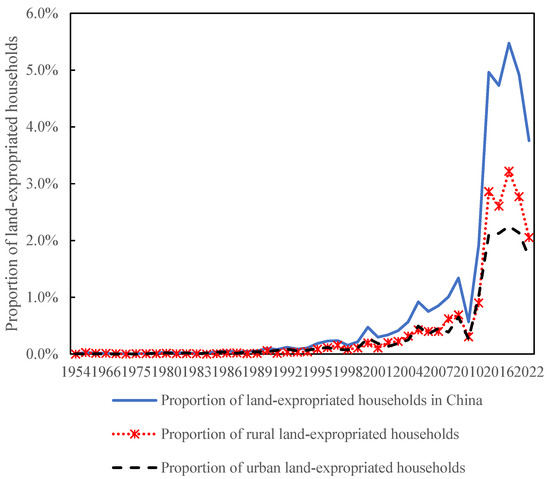
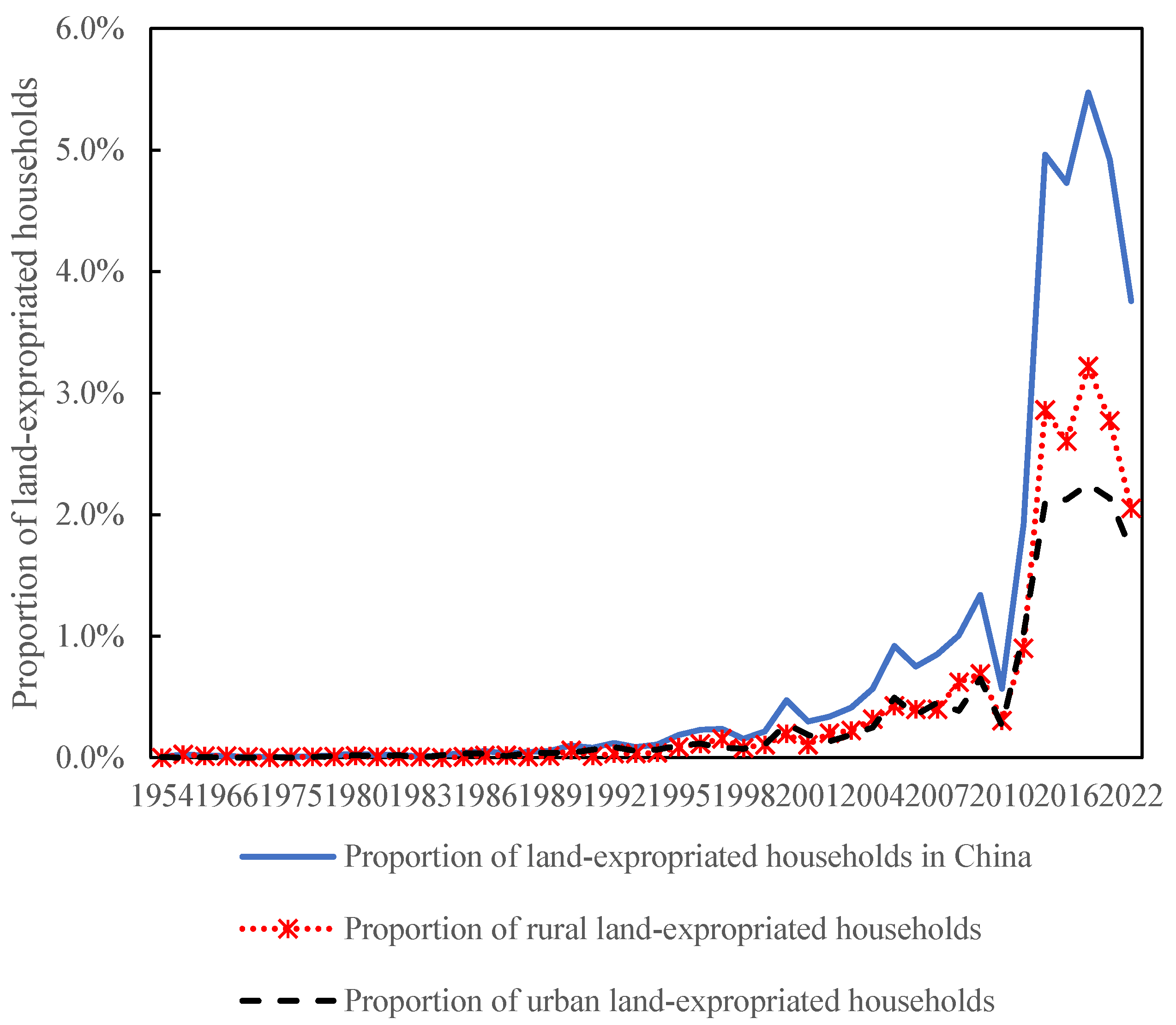
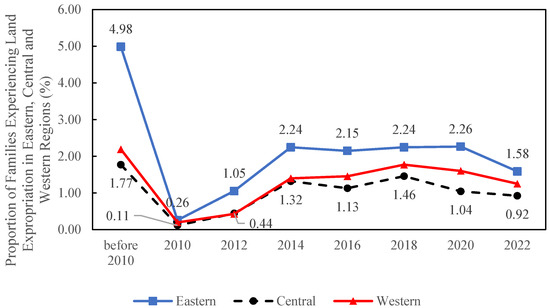
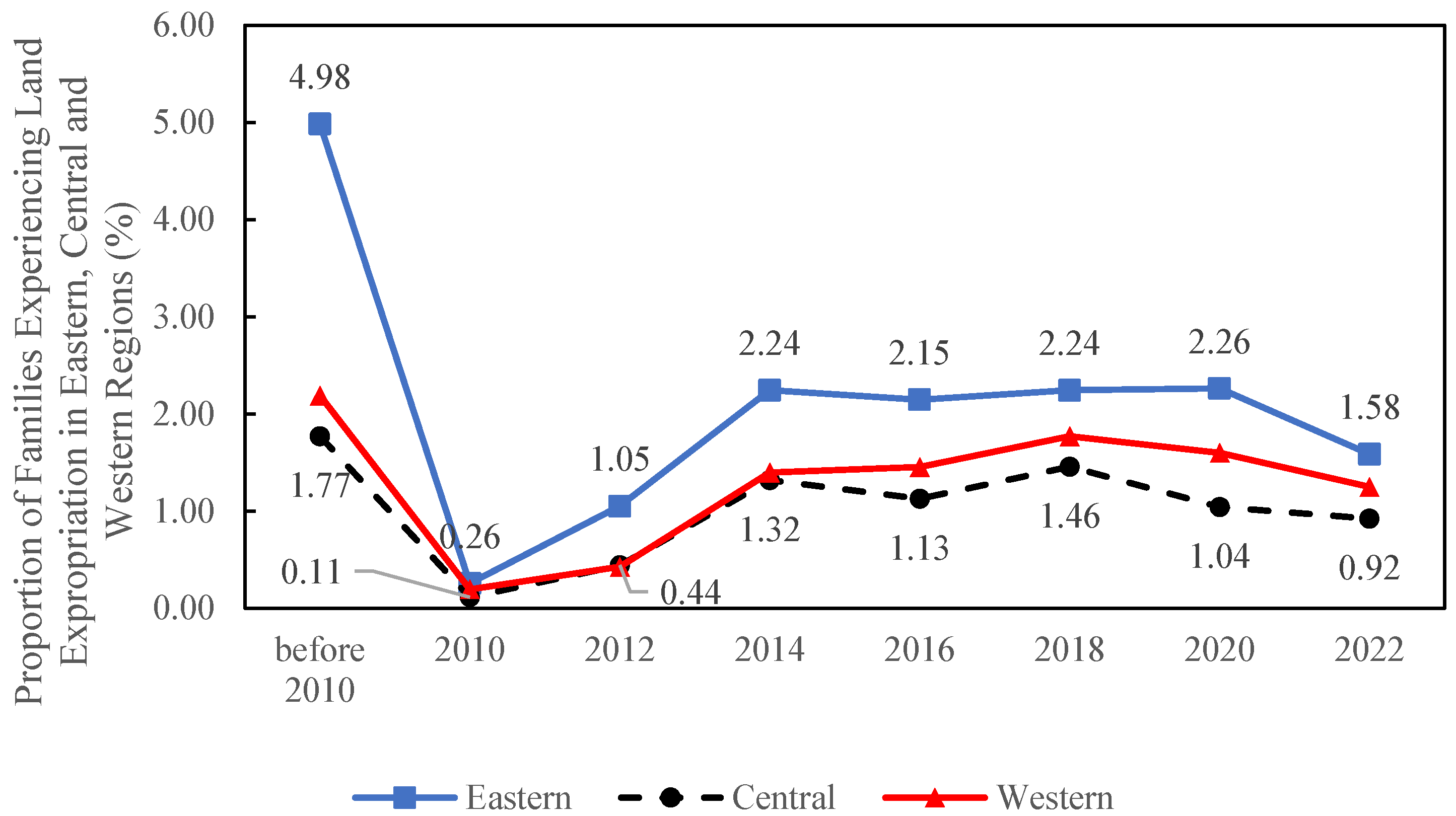
Figure 1 presents the changes in the number of households experiencing land expropriation in China from 1954 to 2022. As shown in Figure 1, before 2000, relatively few households in China experienced land expropriation. However, after 2000, the number of households affected by land expropriation gradually increased, with a particularly sharp rise after 2012. Since 2012, the scale of rural land expropriation has exceeded that of urban areas. In 2022, 3.8% of households in China experienced land expropriation. According to the 2023 China Statistical Yearbook, China’s total population reached 1.41 billion in 2022, meaning that approximately 53.6 million people were affected by land expropriation. Regionally, the scale of land expropriation in the eastern region is relatively the highest, followed by the western region, and the lowest in the central region (as shown in Table 1 and Figure 2).
Figure 1.
Proportion of households experiencing land expropriation in urban and rural China. Data source: The China Family Panel Studies (CFPS) database from 2010 to 2022.
Table 1.
Changes in variables related to land expropriation.
Figure 2.
The proportion of households experiencing land expropriation in different regions.
2.2. Research Hypothesis
Land expropriation policy is a very important land system reform policy. Under the background of rural revitalization, its impact on relative poverty deserves special attention. At present, there is a controversy about the relationship between land expropriation and relative poverty. On the one hand, the government will pay a certain compensation fee for land expropriation, which directly increases the income of residents and provides capital accumulation for residents to engage in non-agricultural work and population migration. At the same time, the government has corresponding resettlement measures and improved public services, which improve the quality of life of residents, and these effects can alleviate the relative poverty of residents. On the other hand, the expropriation of land by the government also increases the risk of residents falling into relative poverty. For residents, land is an important means of production and living, and it is one of the important sources of family income. Expropriation of land makes the land-expropriated residents lose their income sources, such as agricultural income and land rent. Although residents can get some compensation for land expropriation, it is difficult to estimate whether this compensation can balance the future land income. In addition, landless families may also face employment transformation, insufficient social security, and adaptation risks due to land loss, thus creating a new problem of relative poverty. From the above analysis, it can be seen that the government’s expropriation of land can alleviate and aggravate the relative poverty of residents. However, at present, the efficiency of agricultural production is low, the price of agricultural products is not high, and the income of families relying on land for agricultural production is low. Even if the land of families is not expropriated, most families choose to go out to work instead of farming at home, which shows that the value of one-time compensation income from current land expropriation is higher than the value of keeping land for their own farming. Therefore, this paper holds that land expropriation can alleviate the relative poverty of families more than aggravate it.
The impact of land expropriation policy on household poverty can be understood through several vital dimensions. First, government-led land expropriation is accompanied by compensation, which directly increases the household’s income and may alleviate poverty. Second, following land expropriation, landless households often engage in external employment to sustain their income levels. This labor migration from agriculture to the non-agricultural sector may also mitigate poverty through the spillover effects of the non-farm sector. Finally, land expropriation contributes to poverty alleviation by promoting the social and economic status of families. As landless household members transition to the non-agricultural sector, they acquire vocational skills and enhance their economic status, accumulating economic and human capital, further reducing poverty. Based on these observations, this paper proposes the following research hypotheses.
Hypothesis 1.
Land expropriation can alleviate relative poverty.
Hypothesis 2.
Land expropriation reduces poverty by promoting household non-agricultural income, labor migration, and the social and economic status.
3. Methods and Data
3.1. Staggered Difference in Difference (DID) Model
This study employs a staggered Difference-in-Differences (DID) model to investigate the impact of land expropriation policy on household poverty. The dependent variable is whether a household is in a state of poverty, while the policy variable is whether the household has undergone land expropriation. The implementation of land expropriation policy is governed by government authorities, which impose a policy mandate independent of individual household poverty status. Consequently, individual households barely influence the execution of the land expropriation policy. This situation implies no bidirectional causality between the implementation of land expropriation and household poverty status, meeting the preconditions for using DID models in randomized experiments.
In traditional DID models, the policy is applied to different individuals at the same point in time. However, the land expropriation events do not occur simultaneously for all households. For example, some households experienced land expropriation in 2012, while others did so in 2014. This results in households being in different treated and control groups at various time points, such as in the control group at time t and the treated group at time t + 1. Given these multiple time points of policy occurrence, the traditional DID model is not applicable. Therefore, a staggered DID model is employed. This study, framed within a counterfactual approach, treats the experience of land expropriation by households as a quasi-natural experiment and uses the staggered DID model to examine the effects of land expropriation policy on household poverty. The modeling process is as follows.
In the model, represents the poverty status of household in year . includes a set of control variables affecting poverty status, is the constant term, represents provincial-level fixed effects, denotes time fixed effects, and is the random error term. The Difference-in-Differences (DID) variable is defined as . Here, is a binary indicator, where if household has experienced land expropriation (indicating it is in the treated group), and if the household has not experienced land expropriation (indicating it is in the control group). is a binary indicator where if time is after land expropriation, and if time is before land expropriation. The coefficient represents the DID estimator, which measures the average treated effect by capturing the difference in poverty status for households affected by land expropriation before and after the policy implementation.
3.2. Data Source and Variable Description
The data is from a nationally representative survey, the China Family Panel Studies (CFPS) (https://www.isss.pku.edu.cn/cfps/, accessed on 11 March 2026), which includes data from seven survey waves conducted in 2010, 2012, 2014, 2016, 2018, 2020, and 2022. The CFPS collects micro-level data at the individual, household, and community levels, starting from 2010, and is subsequently conducted biennially. The sample covers 31 provinces (including municipalities and autonomous regions) in China, providing high national representativeness. To ensure sample continuity and traceability, the analysis retains only those households tracked across all six waves, resulting in a balanced panel dataset. The data is merged from household and individual samples, excluding missing values. The primary variables for this study are as follows.
Dependent Variable: The dependent variable represents the poverty status of household in year , and is a binary variable. A household is in poverty if its per capita net income falls below the poverty line, in which case . Otherwise, the household is non-poverty and . The poverty line is assessed using strongly relative poverty (50% of the median income) and weakly relative poverty (the measurement results for poverty indicators are detailed in Appendix Table A1).
Core Explanatory Variable: The core explanatory variable is the Difference-in-Differences (DID) variable , which measures the impact of land expropriation policy on poverty. If the coefficient is statistically significant and negative, this indicates that the land expropriation policy has a poverty-reducing effect. Conversely, if is statistically significant and positive, this suggests that the land expropriation policy exacerbates household poverty.
Control Variables: To avoid potential estimation bias due to omitted variables, this study incorporates several control variables, following insights from relevant literature (Liu et al., 2024) [16]. Firstly, household head characteristics variables: gender (Gender), age (Age), years of education (Edu), marital status (Spouse), chronic illness (Ill), health insurance (Med), agricultural employment (Agri), and household size (Size). Secondly, the regional economic development variable. Economic development levels vary across different regions, which in turn leads to differences in poverty conditions. The study uses per capita GDP as an indicator. This variable (PCGDP) is computed by taking the natural logarithm of per capita GDP, adjusted for prices across provinces. Thirdly, the land asset value variable. The value of household land assets may influence the poverty status of displaced residents. This is captured using the land value variable (PCLand), calculated by dividing the reported household land value by the number of household members to obtain per capita land value and then taking the natural logarithm. Additionally, the model controls the time and province dummy variables.
Table 2 provides the descriptive statistics for the variables. The table indicates that households’ average annual per capita income is 20,194 CHY, with a median of 11,049 CHY. On average, 49% of households are engaged in agricultural activities. Non-agricultural income constitutes an average of 87% of total household income, suggesting that most households do not rely predominantly on agricultural income. On average, 13% of household members work out of their hometown, but the median is 0, indicating that more than half of the household members do not seek employment outside the local area. The employment rate among individuals is 75%, with an unemployment rate of 25%. Household members have an average of 7.7 years of education, with a median of 9 years, reflecting an average educational attainment equivalent to primary school. Furthermore, 91% of residents have access to urban and rural resident health insurance, demonstrating broad coverage and significant progress in health care reform.
Table 2.
Descriptive statistics of variables.
To avoid multicollinearity between variables, the correlation coefficient matrix of the variables was calculated before conducting the regression analysis. Table A2 presents the correlation coefficient matrix of the variables. As shown in the table, the correlation coefficients of the variables are all below 0.3, indicating weak correlations between the variables (Appendix Table A2).
4. Results
4.1. Benchmark Regression
Since the dependent variable is binary, this paper employs the Panel Logit model to estimate the aforementioned econometric model. The baseline regression results are presented in Table 3. In odd-numbered columns of Table 3, the estimation results under different poverty standards control only for time-fixed effects and province-fixed effects, while the even-numbered columns control for time, province dummies, and other covariates. After controlling for relevant covariates, the Difference-in-Differences (DID) variables for the three relative poverty measures are all significantly negative at the 5% significance level, with relatively similar coefficient magnitudes. This indicates that the land expropriation policy has a significant poverty-reducing effect.
Table 3.
Benchmark regression.
When the dependent variable is strongly relative poverty (50% of the median income), the difference-in-differences variable Treat × Period is −0.29 and significant at the 1% significance level. This result implies an economic interpretation that households experiencing land expropriation are 25.2% () less likely to fall into strongly relative poverty (50% of the median) compared to households that did not experience land expropriation. When the dependent variable is weakly relative poverty, the Treat × Period variable is −0.306, also significant at the 1% significance level, indicating that households affected by land expropriation are 26.4% () less likely to fall into weakly relative poverty compared to unaffected households. Similar conclusions are drawn under other poverty standards.
Overall, controlling for other variables, households affected by land expropriation are about one-fourth less likely to experience relative poverty than those unaffected by land expropriation. Moreover, factors such as participation in employment, higher levels of education, and higher per capita land value within households significantly alleviate the likelihood of falling into relative poverty. This underscores that poverty reduction efforts must continue to focus on employment, education, and related factors.
4.2. Parallel Trend Test
Using the staggered DID model to evaluate the causal effect, we need to ensure that the time trends of the treated group and the control group are consistent if there were no policy influences. Therefore, this paper makes a parallel trend test on the poverty reduction effect of the land expropriation policy and uses the following model to estimate it:
In this context, indicates that for household i, when the household is in the j-th period before the land expropriation, and , otherwise. Similarly, indicates that for household i, when the household is in the j + th period after the land expropriation, and , otherwise. This paper takes the period of −1 as the reference period before the policy implementation. To avoid multicollinearity, the −1 period is excluded from the regression, while other variables are consistent with Equation (1). Since the CFPS survey is conducted biennially, there is a 2-year interval between periods. The observation period of this study is 2010–2022, with 2012 as the starting year of the policy implementation. This implies that the dummy variables for periods −10, −8, −6, −4, and −2 are used as the reference for the period before the policy. The period 0 represents the time when the land expropriation policy is implemented, and the study analyzes the persistence of the policy’s impact in periods 2, 4, 6, 8, and 10. The specific results are as follows:
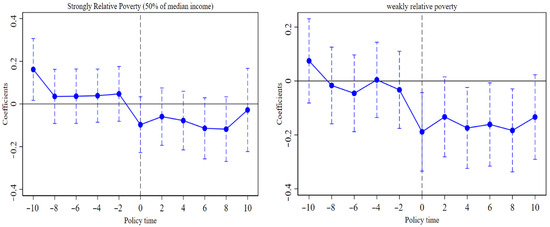
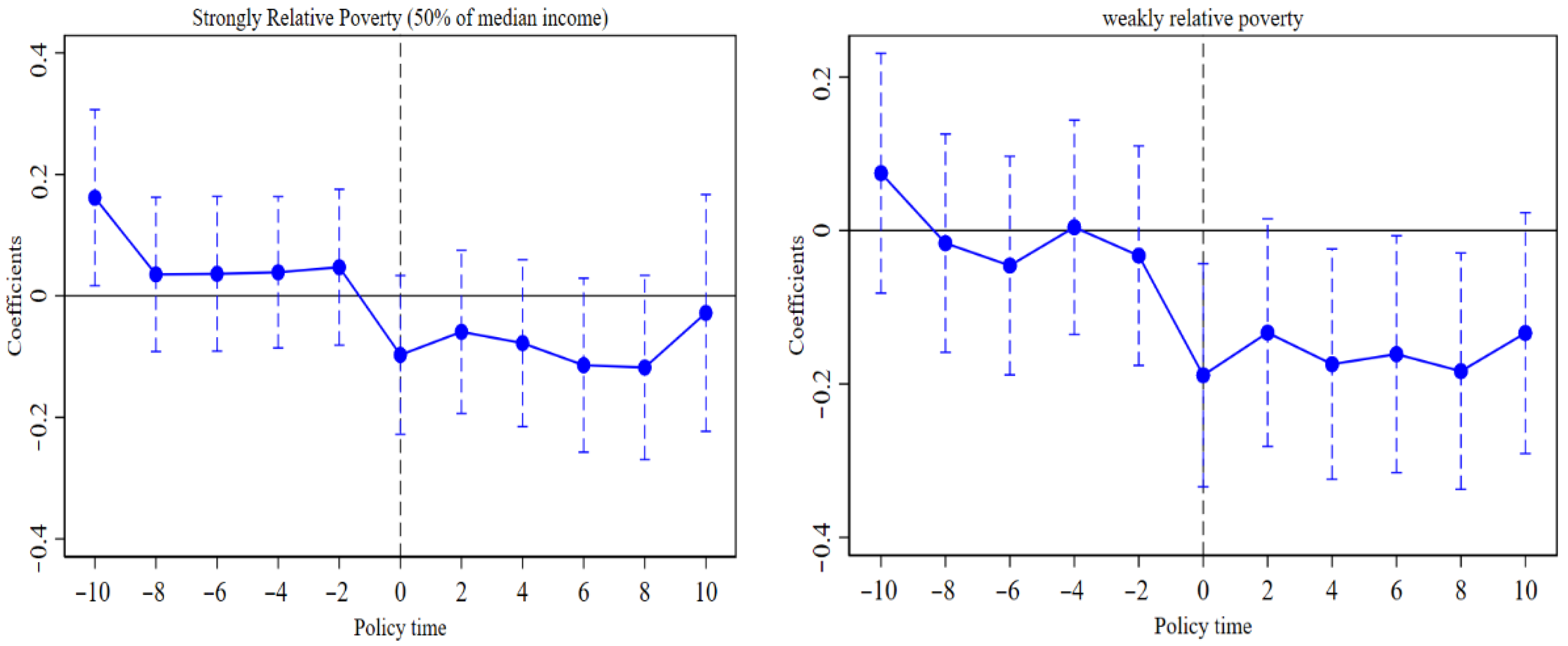
Figure 3 shows the parallel trend test results under two relative poverty standards. It can be seen that before the policy occurs, the coefficient of treatment effect is not significant, and the coefficient is close to 0 (a value of 0 is included in the 95% confidence interval). This shows that before the implementation of the policy, there was no significant difference between the treated group and the control group in terms of strongly relative poverty (50% of the median income) and weakly relative poverty. Thus, the land expropriation policy meets the assumption of parallel trends. When the land expropriation policy was implemented, the coefficient was significantly negative, indicating that the policy had a strong poverty reduction effect in the year when it was implemented, but over time, the poverty reduction effect of the policy weakened.
Figure 3.
Parallel trend test under relative poverty standards.
4.3. Robustness Test
4.3.1. Difference in Difference Propensity Score Matching (PSM-DID)
Firstly, this paper uses the Difference in Difference Propensity Score Matching (PSM-DID) to test the robustness. Two main approaches are used: cross-sectional PSM, where the entire panel data is treated as a cross-section for matching, and year-by-year PSM, following the method of Böckerman and Ilmakunnas (2009) [41]. However, the cross-sectional PSM method may face the issue of “self-matching,” while year-by-year PSM may result in inconsistent matching samples before and after the policy implementation. Despite these limitations, these methods are still widely used. In this paper, cross-sectional PSM and year-by-year PSM approaches are attempted and compared in the analysis, the regression results are shown in Table 4. From the estimates in Table 4, after controlling for relevant covariates, the coefficient of the interaction term Treat × Period remains significantly negative, with a magnitude similar to the results of the baseline regression. These findings suggest that the poverty reduction effects of the land expropriation policy on the two measures of relative poverty.
Table 4.
Regression results of cross-sectional and year-by-year matching.
4.3.2. Placebo Test
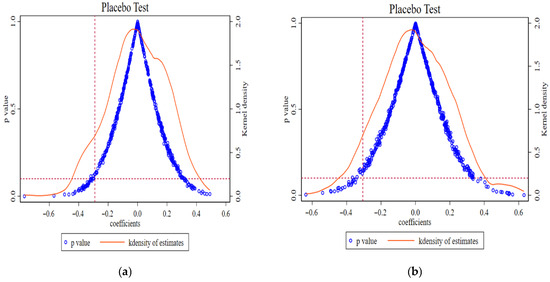
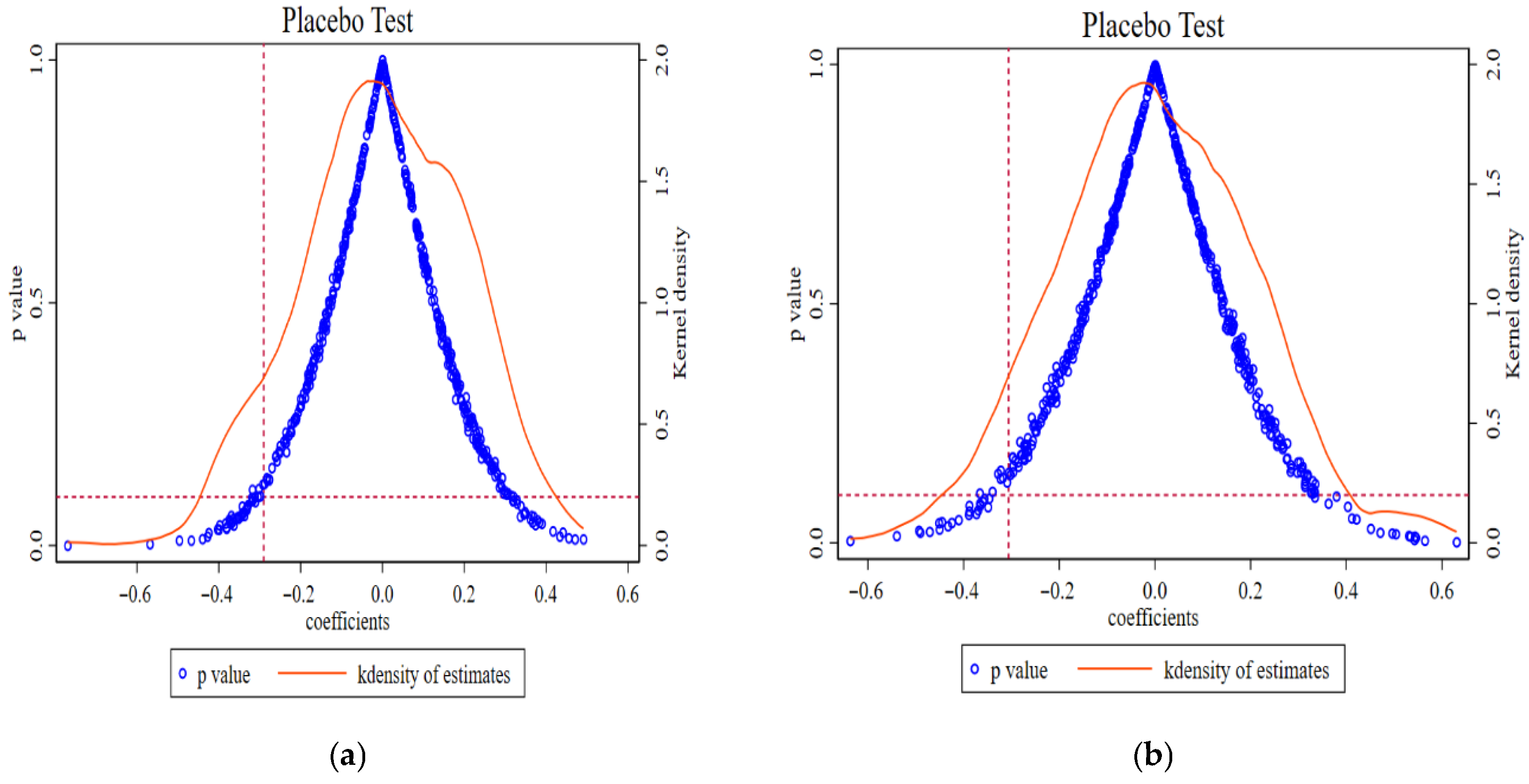
We randomly select samples from the entire dataset with the same number as the original treated group and randomly generate policy implementation times to create a new treated group with randomized individual and policy times. The double-randomized placebo test method is generally the most robust, providing random trials from different perspectives. Taking strong relative poverty (50% of median income) as an example, this random process is repeated 500 times, and 500 groups of dummy variables are obtained. This results in 500 sets of dummy variables, denoted as . Based on this, the baseline regression model is re-estimated, and the kernel density and p-value distributions of the 500 are presented in Figure 4. The results show that the coefficients of the randomized Difference-in-Differences (DID) variables are concentrated around zero, with the majority of p-values exceeding 0.1 (horizontal dashed line in Figure 4a. The actual policy estimate is −0.29 (left vertical dashed line in Figure 4a), which differs significantly from the placebo test results, confirming that the land expropriation policy effect is valid. Weak relative poverty also gets a similar result (see Figure 4b).
Figure 4.
Placebo test for relative poverty. Note: The X-axis represents the 500 randomly generated estimated coefficients: (a) strongly relative Poverty (50% of median income); (b) weakly relative poverty.
4.4. Heterogeneity Analyses
4.4.1. Heterogeneity Between Urban and Rural Regions
There is a significant disparity in economic development between urban and rural regions in China. Table 5 shows that the impact of land expropriation policy on poverty reduction varies between urban and rural regions. The land expropriation policy can significantly reduce the poverty of rural and urban families, but its effect is obviously different between different poverty standards and urban and rural groups. When the poverty standard is strongly relative poverty (50% of median income), the land expropriation policy has a more significant poverty reduction effect in cities and towns. When the poverty standard is weakly relative poverty, its poverty reduction effect is more prominent in rural areas. The above results reflect that land expropriation plays a differentiated poverty reduction mechanism under different income stages and urban and rural economic structures.
Table 5.
Regression results by sub-sample for rural and urban regions.
When families are in strongly relative poverty (50% of median income), urban families generally face higher living costs and stronger rigid expenditure constraints, are highly dependent on monetary income, and lack self-sufficient production and physical buffering capacity. As an exogenous, stable, and large-scale one-off income shock, land expropriation compensation has a higher marginal utility among urban, relatively poor families, which can more effectively alleviate the basic survival pressure and liquidity constraints of urban strongly relative poverty (50% of median income) and show a stronger “bottom-lifting” poverty reduction effect. In contrast, rural families can still rely on subsistence production to buffer part of their expenditures at this stage, so the marginal improvement effect is relatively limited.
When the family is in weakly relative poverty, the challenge faced by the family at this time changes from “whether it can survive” to “whether it can continuously increase income”. Land expropriation can significantly improve the ability of rural families to enter non-agricultural employment, business activities, and capital accumulation by releasing land elements, promoting the non-agricultural transfer of labor force, and providing start-up capital and institutional support, thus forming a more sustainable income growth path. In contrast, the income structure of urban families in weakly relative poverty is more stable, the marginal dependence on land expropriation compensation is lower, and the space for poverty reduction is relatively limited. Therefore, in the weakly relative poverty zone, land expropriation shows a more prominent “developmental poverty reduction effect” in rural families.
4.4.2. Heterogeneity of Family Dependency Ratio
The dependency ratio reflects the family population structure and economic burden, and is an important indicator to measure the vulnerability of family poverty. There are significant differences in labor supply capacity, income level, and resistance to external risks among families with different raising levels, which may lead to different performances of land expropriation policies in poverty alleviation. Based on this, this paper divides the sample into two groups according to the level of family support: high dependency ratio and low dependency ratio, and identifies the impact of land expropriation policy on relative poverty under different family structures. The dependency ratio is calculated according to the proportion of the number of individuals less than 18 years old and over 64 years old in the total family size, and the average value of the whole sample is used as the grouping standard. Families below the average value are defined as “low dependency ratio families,” and those above the average value are “high dependency ratio families”. Subsequently, these two sub-samples were regressed (see Table 6).
Table 6.
Regression results of different family support scores samples.
It is found that the land expropriation policy can significantly reduce poverty in families with a low dependency ratio and a high dependency ratio, but the poverty reduction effect is more prominent in families with high dependency ratio. The possible reason for this result is that families with high dependency ratio usually face the livelihood dilemma of “less labor-heavy burden-weak ability to resist risks”, and their family income is highly dependent on limited labor supply, and the proportion of education, medical care, and pension expenditure is high, which makes them more likely to fall into poverty or return to poverty. The compensation income and resettlement resources brought by land expropriation can significantly improve the cash flow of families with high dependency ratio in a short period of time, alleviate the basic survival pressure, and effectively hedge the sustained economic impact brought by the dependency burden, so the poverty reduction effect on such families is more significant. At the same time, land expropriation is often accompanied by supporting policies such as the expansion of non-agricultural employment opportunities, skills training, and social security convergence. After the land is expropriated, the laborers with high dependency ratio tend to enter the urban and industrial sectors for employment, thus realizing the diversification and stabilization of income sources. In addition, compensation and resettlement assets have improved the structure of family assets, eased the widespread credit constraints of families with high dependency ratio, enabled them to increase their investment in children’s education and production, and further enhanced their long-term income ability. In contrast, a low-dependency family has relatively abundant labor resources and more diversified income sources, and its marginal dependence on land expropriation compensation is lower, and its poverty reduction depends more on a market-oriented income growth mechanism. Therefore, the land expropriation policy has a more prominent poverty reduction effect in families with high dependency ratio, and land expropriation has a differentiated impact on alleviating family livelihood constraints and structural fragility.
4.4.3. Heterogeneity of Land Value
To further examine whether the poverty reduction effect of land expropriation policy varies based on land value, this study classifies households with land values below the average as low land value households and those with land values above the average as high land value households.
Table 7 shows that the land expropriation policy can significantly reduce two kinds of relative poverty, but it is more effective for families with higher land value. The possible reason is that the higher the land value, the higher the compensation paid by the government, which improves the cash income and asset accumulation ability of landless farmers. The high compensation not only alleviates the short-term income gap but also provides families with stronger consumption, education, and medical expenses, thus reducing the risk of long-term poverty. In addition, the land value is often related to the location conditions. In areas with high land value, there are more non-agricultural employment opportunities, and it is easier for farmers to realize industrial transfer and employment transformation after land acquisition. In areas with high land value, the fiscal revenue level is relatively high, and the government can often provide more social security, housing placement, and public services in the process of land acquisition. These factors reduce the risk of land-lost families falling into relative poverty. Therefore, in policy optimization, we should pay special attention to the landless farmers in areas with low land value, and make up for their shortcomings in poverty reduction by increasing financial transfer payments, employment support, and social security.
Table 7.
Regression results by sub-sample based on household land value.
4.4.4. Heterogeneity of Gender of Householders
Gender affects the allocation of family resources and the way of labor force participation. In the process of urban–rural transformation and land system reform in China, female-headed families are often in a more vulnerable socio-economic position. Is there a gender difference in the impact of land expropriation policy on relative poverty? In this paper, according to the gender of the head of household, the results are shown in Table 8. This paper finds that under the standard of strongly relative poverty (median income is 50%), the effect of land expropriation policy on reducing poverty for women is more significant. Under the weakly relative poverty standard, the policy has a stronger poverty reduction effect on men.
Table 8.
Regression results of different gender samples of heads of households.
This difference stems from the systematic differences in family income structure and the gender division of labor mechanism under different poverty standards. Strongly relative poverty groups are mainly in the stage of survival constraint, among which women are more concentrated in the structural weak position of low education, limited labor participation, and insufficient non-agricultural employment opportunities, and their income is highly dependent on redistribution within the family. As an exogenous, stable, and independent income source, land expropriation compensation can significantly improve women’s economic status while alleviating family survival constraints, thus showing an obvious “all-out poverty reduction effect” in deep poverty areas. In contrast, the weakly relative poverty groups have basically gotten rid of the survival constraints, and the core constraints of poverty reduction have shifted to income growth ability and opportunity acquisition. Land expropriation creates conditions for family members, especially men, to enter non-agricultural employment, entrepreneurship, and capital accumulation by releasing the constraints of land elements and providing initial capital. In view of the comparative advantage of men in the labor market, they can more effectively turn the opportunities brought by land expropriation into sustained income growth, so they show a stronger “growth-oriented poverty reduction effect” in the weakly relative poverty zone. To sum up, land expropriation mainly plays the role of alleviating deep poverty for women, while reducing poverty for men by promoting income growth. The gender difference essentially stems from the interaction between poverty level differences and family gender division of labor structure.
The heterogeneous effects of land expropriation can be systematically understood through differences in household resource endowments, compensation conditions, and adjustment capacities. First, the urban–rural heterogeneity reflects structural disparities in labor market access and institutional support. Rural households often face more limited access to stable non-agricultural employment and social security systems, which constrain their ability to transform land compensation into sustainable income gains. Second, households with higher dependency ratios experience a weaker poverty reduction effect, as a larger share of non-working members increases the burden of livelihood transition and limits the capacity for labor reallocation. Third, variation in land value captures differences in compensation levels and asset transformation potential. Households with higher land values typically receive greater compensation, which enhances their ability to smooth consumption, invest in human capital, or engage in non-agricultural activities. Finally, gender heterogeneity may be driven by differences in human capital, labor market attachment, and access to economic opportunities. Households headed by individuals with stronger labor market participation are more likely to benefit from the structural changes induced by land expropriation.
Overall, these findings suggest that the poverty reduction effect of land expropriation is conditional on both household characteristics and the broader institutional environment.
4.5. Mechanism Discussion
This study further explores the mechanisms through which land expropriation policy achieves its poverty reduction effects. The discussion of the theoretical mechanism based on Section 2.2 shows that land expropriation policy can affect household poverty through three channels. First, when the government expropriates a household’s land, it increases the share of non-agricultural income through compensation for the land. Second, land-lost households may migrate labor to non-agricultural sectors, ensuring household income through external employment. Third, during the migration process, family members acquire new occupational skills, improving their socio-economic status.
To shed light on the potential mechanisms underlying the estimated effects, this paper adopts a channel-based approach by examining whether land expropriation systematically affects a set of theoretically relevant intermediate outcomes (Baron & Kenny, 1986; Kenny et al., 1998; Igartua & Hayes, 2021) [42,43,44]. Specifically, building on Equation (1), we estimate the impact of land expropriation on the proportion of non-agricultural income (Noagri), labor migration (Outwork), and household socioeconomic status (ISEI). This strategy allows us to assess whether these variables respond to the policy shock in ways consistent with the observed reduction in relative poverty. While this approach does not aim to establish formal causal mediation effects, it provides suggestive evidence on the potential transmission channels through which land expropriation may influence household welfare. Table 9 presents the parameter estimation results.
Table 9.
The impact of land expropriation policy on mechanism variables.
The Proportion of Non-Agricultural Income. With rapid economic development, households have diversified their sources of income beyond agricultural revenue from land. Noagri is represented by the proportion of non-agricultural income in total household income. The DID variable Treat × Period in column (1) is significantly positive, indicating that, following land expropriation, the government provides corresponding compensations. This suggests that, compared to households not subject to land expropriation, the land expropriation policy promotes an increase in non-agricultural income for the affected households. This finding aligns with the conclusions drawn by Gu (2022) [21] and Huang et al. (2024) [23].
Labor Migration. Household members increase family income by working away from their hometown, with the labor migration variable represented by the proportion of household members engaged in off-farm employment. The interaction term Treat × Period in column (2) is significantly positive, indicating that, compared to households that were not subject to land expropriation, the implementation of land expropriation policy has encouraged affected households to expand alternative employment channels, thereby facilitating the migration of labor to other sectors.
Socio-economic Status. Individuals occupy different economic positions based on their professions, leading to variations in income levels, which in turn affect residents’ poverty. To examine the impact of land expropriation policy on family socio-economic status, we draw upon the studies (Duncan, 1961; Blau & Duncan, 1967; Ganzeboom et al., 1992; Präg & Gugushvili, 2021) [38,39,40,45], utilizing the International Socio-economic Index (ISEI) as a measure of socioeconomic status. The ISEI assesses occupational prestige based on various factors, with higher ISEI values indicating higher socio-economic status. In column (3) of Table 9, the interaction term Treat × Period is significantly positive, indicating that, compared to households not subject to land expropriation, the implementation of land expropriation policy has prompted affected households to transition to occupations with greater economic status, thereby facilitating family social mobility to achieve the effect of poverty reduction.
5. Discussion
5.1. Analysis of Research Results
This section further interprets the empirical findings and situates them within the broader literature. First, our findings that land expropriation reduces relative poverty are consistent with studies emphasizing the role of structural transformation and non-farm employment in improving rural household welfare. By facilitating the reallocation of labor from agriculture to more productive non-agricultural sectors, land expropriation can contribute to income growth and poverty reduction. Second, the identified mechanisms non-agricultural income growth, labor mobility, and improvements in socio-economic status are broadly in line with existing research on rural transformation. However, our study extends this literature by providing micro-level causal evidence using a staggered DID approach, thereby addressing endogeneity concerns common in earlier studies. Third, our findings on heterogeneity add nuance to the existing literature. While some studies suggest that land expropriation may exacerbate inequality or generate welfare losses for certain groups, our results indicate that its poverty-reducing effects are stronger among vulnerable households, such as female-headed households and those with higher dependency ratios. This suggests that, under certain institutional arrangements, land expropriation can have inclusive effects. Finally, it is important to note that targeted poverty alleviation policies were widely implemented in China during the sample period. Due to data limitations, we are unable to directly control for the intensity of such policies at the household level. However, the inclusion of household and year fixed effects helps absorb time-invariant heterogeneity and common policy shocks. Therefore, the estimated results should be interpreted as the net effect of land expropriation within a broader policy environment. The findings of this paper should not be interpreted as a general endorsement of land expropriation policies, as their broader social consequences may involve complex trade-offs beyond poverty outcomes.
5.2. Limitations and Future Research Scope
Despite the contributions of this study, several limitations should be acknowledged. First, although the staggered DID framework helps identify causal effects, potential unobserved time-varying factors may still bias the estimates. Second, this study relies on household-level survey data. While the results suggest a poverty-reducing effect within the observed period, caution is warranted in extrapolating these findings to longer-term outcomes beyond the sample horizon. Third, targeted poverty alleviation policies were widely implemented in China during the sample period. Due to data limitations, we are unable to directly control for the intensity of such policies at the household level. However, the inclusion of household and year fixed effects helps absorb time-invariant heterogeneity and common policy shocks. Therefore, the estimated results should be interpreted as the net effect of land expropriation within a broader policy environment. The findings of this paper should not be interpreted as a general endorsement of land expropriation policies, as their broader social consequences may involve complex trade-offs beyond poverty outcomes.
Future research could extend this study in several directions. For example, incorporating administrative data or long-term panel data would allow for a more comprehensive evaluation of dynamic and long-run effects. In addition, comparative studies across countries with different land tenure systems could provide deeper insights into the role of institutional factors. Finally, further research could explore the interaction between land expropriation policies and other social policies, such as social security and rural revitalization programs.
6. Conclusions
This paper investigates the impact of land expropriation on relative poverty in China and provides policy-relevant insights into land system reform and long-term poverty governance. The Chinese land institutional framework is characterized by collective ownership of rural land and a state-led land conversion system, in which local governments monopolize land expropriation and allocation for urbanization and industrial development. This institutional arrangement fundamentally distinguishes China from market-oriented land systems and shapes the mechanisms through which land expropriation affects household welfare.
Against this institutional backdrop, this study first documents key features of contemporary land expropriation practices in China. Using CFPS data from 2010 to 2022 and a staggered difference-in-differences (DID) model, we identify the causal impact of land expropriation on household relative poverty. The results show that land expropriation significantly reduces both strongly relative poverty (50% of median income) and weakly relative poverty. Households experiencing land expropriation are approximately one-fourth as likely to fall into relative poverty as those that do not. These findings are robust to PSM-DID and placebo tests. Further analysis reveals significant heterogeneity in the poverty reduction effects across gender, dependency ratio, land value, and urban–rural status. For example, the policy exhibits stronger poverty-reducing effects among female-headed households, households with higher dependency ratios, those with higher land values, and those located in urban areas. Mechanism analysis suggests that these effects are primarily driven by increased non-agricultural income, rural labor transfer, and improvements in socio-economic status. These findings highlight the role of land expropriation as a key institutional channel facilitating structural transformation and income mobility in rural China.
From a policy perspective, land expropriation plays a critical role in shaping household welfare, but its effectiveness depends on institutional design. First, improving the compensation mechanism is essential. Compensation standards should account not only for current land use but also for future value appreciation and household livelihood sustainability, ensuring long-term income security. Second, policymakers should adopt differentiated support strategies for vulnerable groups, given the heterogeneous effects across households. Third, promoting rural labor mobility and human capital accumulation remains crucial. Strengthening vocational training for landless farmers can enhance their capacity to integrate into non-agricultural sectors, thereby supporting sustainable income growth.
More broadly, while the findings are grounded in China’s unique institutional context, they offer important implications for other developing and transition economies where land institutions are closely linked to urbanization and structural change. In such contexts, well-designed land policies can serve not only as tools for resource reallocation but also as instruments for poverty reduction and inclusive development.
Author Contributions
Writing—original draft, Writing—review & editing, X.C.; Ideas, review and editing, W.Z.; review and editing, Z.Z.; review, Z.F. All authors have read and agreed to the published version of the manuscript.
Funding
This paper is supported by the National Social Science Foundation of China (NSSFC), “Research on the long-term mechanism of supporting the will and wisdom to solve relative poverty” (Grant No. 20&ZD168), and the National Natural Science Foundation of China (NNSFC),”Intergenerational Transmission, Neighborhood Effect, and Educational Poverty: Based on the Perspective of Social Network Economics” (Grant No. 71973102), Major program of the National Social Science Foundation of China (NSSFC), “Research on the theoretical, empirical and policy system of coordinating and promoting the effective improvement of quality and reasonable growth of quantity in the economy” (Grant No. 24&ZD045), the 77th General Program of China Postdoctoral Science Foundation (2025M773659), the Youth Fund Project of Humanities and Social Sciences Research of the Ministry of Education in 2025 (Grant No. 25YJC790012) Study on the Formation Mechanism and Governance of Returning to Poverty from the Perspective of Rural Revitalization”, General Project of Social Science Fund of Hubei Province in 2025 (later funded project) (Grant No. HBSKJJ20253227), the National Natural Science Foundation of China (NSFC) “Research on the Effects, Mechanisms, and Policies of the Bidirectional Flow of Population and Funds between Urban and Rural Areas on Rural Relative Poverty” (Grant. 72303216), and the 78th General Program of China Postdoctoral Science Foundation (2025M783719), “Study on the Effect Evaluation and Impact Mechanism of Population Mobility on Family Fertility Intention”.
Data Availability Statement
Data are available from the authors upon request.
Acknowledgments
The authors are grateful to the Editor and the anonymous referees for their helpful comments and suggestions.
Conflicts of Interest
The authors declare no conflicts of interest.
Appendix A
Table A1.
Measurement results of absolute and relative poverty in China (2010–2022).
Table A2.
Correlation coefficient matrix of variables.
References
- Deininger, K.W. Land Policies for Growth and Poverty Reduction; World Bank Publications: Washington, DC, USA, 2003; Volume 41181, Available online: http://documents.worldbank.org/curated/en/485171468309336484 (accessed on 11 March 2026).
- Besley, T.; Maitreesh, G. Property rights and economic development. Handb. Dev. Econ. 2010, 5, 4525–4595. [Google Scholar] [CrossRef] [Scilit]
- Adamopoulos, T.; Diego, R. Land reform and productivity: A quantitative analysis with micro data. Am. Econ. J. Macroecon. 2020, 12, 1–39. [Google Scholar] [CrossRef] [Scilit]
- Moene, K.O. Poverty and landownership. Am. Econ. Rev. 1992, 82, 52–64. Available online: http://www.jstor.org/stable/2117602 (accessed on 11 March 2026).
- Long, H.; Li, Y.; Liu, Y.; Woods, M.; Zou, J. Accelerated restructuring in rural China fueled by “increasing vs. decreasing balance” land-use policy for dealing with hollowed villages. Land Use Policy 2012, 29, 11–22. [Google Scholar] [CrossRef] [Scilit]
- Liu, Y. Introduction to land use and rural sustainability in China. Land Use Policy 2018, 74, 1–4. [Google Scholar] [CrossRef] [Scilit]
- Zhou, Y.; Guo, L.; Liu, Y. Land consolidation boosting poverty alleviation in China: Theory and practice. Land Use Policy 2019, 82, 339–348. [Google Scholar] [CrossRef] [Scilit]
- Bu, D.; Liao, Y. Land property rights and rural enterprise growth: Evidence from land titling reform in China. J. Dev. Econ. 2022, 157, 102853. [Google Scholar] [CrossRef] [Scilit]
- Tian, W.; Wang, Z.; Zhang, Q. Land allocation and industrial agglomeration: Evidence from the 2007 reform in China. J. Dev. Econ. 2024, 171, 103351. [Google Scholar] [CrossRef] [Scilit]
- Jin, S.; Deininger, K. Land rental markets in the process of rural structural transformation: Productivity and equity impacts from China. J. Comp. Econ. 2009, 37, 629–646. [Google Scholar] [CrossRef] [Scilit]
- Jin, S.Q.; Jayne, T.S. Land Rental Markets in Kenya: Implications for Efficiency, Equity, Household Income and Poverty. Land Econ. 2013, 89, 246–271. [Google Scholar] [CrossRef] [Scilit]
- Li, R.; Li, Q.; Lv, X.; Zhu, X. The land rental of Chinese rural households and its welfare effects. China Econ. Rev. 2019, 54, 204–217. [Google Scholar] [CrossRef] [Scilit]
- Peng, K.; Yang, C.; Chen, Y. Land transfer in rural China: Incentives, influencing factors and income effects. Appl. Econ. 2020, 52, 5477–5490. [Google Scholar] [CrossRef] [Scilit]
- Zhang, Y.X.; Pradipta, H.; Zhang, X.N.; Qu, M. Analyzing the Deviation between Farmers’ Land Transfer Intention and Behavior in China’s Impoverished Mountainous Area: A Logistic-ISM Model Approach. Land Use Policy 2020, 94, 104534. [Google Scholar] [CrossRef] [Scilit]
- Zhang, L.; Feng, S.Y.; Heerink, N.; Qu, F.T.; Kuyvenhoven, A. How Do Land Rental Markets Affect Household Income? Evidence from Rural Jiangsu, P.R. China. Land Use Policy 2018, 74, 151–165. [Google Scholar] [CrossRef] [Scilit]
- Liu, S.; Xu, H.; Deng, L. Does land transfer help alleviate relative Poverty in China? An analysis based on income and capability perspective. Appl. Econ. 2024, 57, 723–735. [Google Scholar] [CrossRef] [Scilit]
- Guo, X. Land expropriation and rural conflicts in China. China Q. 2001, 166, 422–439. [Google Scholar] [CrossRef] [Scilit]
- Zhao, X.; Xie, Y. The effect of land expropriation on local political trust in China. Land Use Policy 2022, 114, 105966. [Google Scholar] [CrossRef] [Scilit]
- Sha, W. The political impacts of land expropriation in China. J. Dev. Econ. 2023, 160, 102985. [Google Scholar] [CrossRef] [Scilit]
- Waeterloos, E.; Rutherford, B. Land reform in Zimbabwe: Challenges and opportunities for poverty reduction among commercial farm workers. World Dev. 2004, 32, 537–553. [Google Scholar] [CrossRef] [Scilit]
- Gu, G. Rethinking dispossession: The livelihood consequences of land expropriation in contemporary rural China. J. Agrar. Change 2022, 22, 703–721. [Google Scholar] [CrossRef] [Scilit]
- Zhao, X.; Jin, L.; Sun, S.B. Gone with the land”: Effects of land expropriation on health and subjective well-being in rural China. Health Place 2022, 73, 102614. [Google Scholar] [CrossRef] [Scilit]
- Huang, W.; Luo, M.; Ta, Y.; Wang, B. Land Expropriation, Household Behaviors, and Health Outcomes: Evidence from China. J. Dev. Econ. 2024, 171, 103358. [Google Scholar] [CrossRef] [Scilit]
- Lipton, M. Land assets and rural Poverty. In World Bank Staff Working Papers; The World Bank: Washington, DC, USA, 1988; Available online: http://documents.worldbank.org/curated/en/347761468739797460 (accessed on 21 March 2026).
- Fitz, D. Evaluating the impact of market-assisted land reform in Brazil. World Dev. 2018, 103, 255–267. [Google Scholar] [CrossRef] [Scilit]
- Varga, M. Poverty reduction through land transfers? The World Bank’s titling reforms and the making of ‘‘subsistence” agriculture. World Dev. 2020, 135, 105058. [Google Scholar] [CrossRef] [Scilit]
- Liu, Y.; Wang, Y. Rural land engineering and poverty alleviation: Lessons from typical regions in China. J. Geogr. Sci. 2019, 29, 643–657. [Google Scholar] [CrossRef] [Scilit]
- Guo, Y.; Liu, Y. Poverty alleviation through land assetization and its implications for rural revitalization in China. Land Use Policy 2021, 105, 105418. [Google Scholar] [CrossRef] [Scilit]
- Griffin, K.; Khan, A.R.; Ickowitz, A. Poverty the Distribution of Land. J. Agrar. Change 2002, 2, 279–330. [Google Scholar] [CrossRef] [Scilit]
- Jayne, T.S.; Yamano, T.; Weber, M.T.; Tschirley, D.; Benfica, R.; Chapoto, A.; Zulu, B. Smallholder income and land distribution in Africa: Implications for poverty reduction strategies. Food Policy 2003, 28, 253–275. [Google Scholar] [CrossRef] [Scilit]
- Keswell, M.; Carter, M.R. Poverty and land redistribution. J. Dev. Econ. 2014, 110, 250–261. [Google Scholar] [CrossRef] [Scilit]
- Besley, T.; Burgess, R. Land reform, poverty reduction, and growth: Evidence from India. Q. J. Econ. 2000, 115, 389–430. [Google Scholar] [CrossRef] [Scilit]
- Deininger, K.; Jin, S.; Nagarajan, H.K. Land reforms, poverty reduction, and economic growth: Evidence from India. J. Dev. Stud. 2009, 45, 496–521. [Google Scholar] [CrossRef] [Scilit]
- Scheidel, A.; Farrell, K.N.; Ramos-Martin, J.; Giampietro, M.; Mayumi, K. Land poverty and emerging ruralities in Cambodia: Insights from Kampot province. Environ. Dev. Sustain. 2014, 16, 823–840. [Google Scholar] [CrossRef] [Scilit]
- Heger, M.P.; Zens, G.; Bangalore, M. Land and poverty: The role of soil fertility and vegetation quality in poverty reduction. Environ. Dev. Econ. 2020, 25, 315–333. [Google Scholar] [CrossRef] [Scilit]
- Barbier, E.B.; Hochard, J.P. Land degradation and Poverty. Nat. Sustain. 2018, 1, 623–631. [Google Scholar] [CrossRef] [Scilit]
- Zhou, Y.; Guo, Y.; Liu, Y.; Wu, W.; Li, Y. Targeted poverty alleviation and land policy innovation: Some practice and policy implications from China. Land Use Policy 2018, 74, 53–65. [Google Scholar] [CrossRef] [Scilit]
- Duncan, O.D. A Socioeconomic Index for all Occupations. In Occupations and Social Status; Wiley: New York, NY, USA, 1961. [Google Scholar]
- Blau, P.M.; Duncan, O.D. The American Occupational Structure; Wiley: New York, NY, USA, 1967. [Google Scholar]
- Ganzeboom, H.B.G.; De Graaf, P.M.; Treiman, D.J. A Standard International Socio-Economic Index of Occupational Status. Soc. Sci. Res. 1992, 21, 1–56. [Google Scholar] [CrossRef] [Scilit]
- Böckerman, P.; Ilmakunnas, P. Unemployment and self-assessed health: Evidence from panel data. Health Econ. 2009, 18, 161–179. [Google Scholar] [CrossRef] [Scilit]
- Baron, R.M.; Kenny, D.A. The moderator–mediator variable distinction in social psychological research: Conceptual, strategic, and statistical considerations. J. Personal. Soc. Psychol. 1986, 51, 1173. [Google Scholar] [CrossRef]
- Kenny, D.A.; Kashy, D.A.; Bolger, N. Data analysis in social psychology. In The Handbook of Social Psychology, 4th ed.; Gilbert, D.T., Fiske, S.T., Lindzey, G., Eds.; McGraw-Hill: New York, NY, USA, 1998; pp. 233–265. [Google Scholar]
- Igartua, J.J.; Hayes, A.F. Mediation, moderation, and conditional process analysis: Concepts, computations, and some common confusions. Span. J. Psychol. 2021, 24, e49. [Google Scholar] [CrossRef] [Scilit]
- Präg, P.; Gugushvili, A. Subjective social mobility and health in Germany. Eur. Soc. 2021, 23, 464–486. [Google Scholar] [CrossRef] [Scilit]

Disclaimer/Publisher’s Note: The statements, opinions and data contained in all publications are solely those of the individual author(s) and contributor(s) and not of MDPI and/or the editor(s). MDPI and/or the editor(s) disclaim responsibility for any injury to people or property resulting from any ideas, methods, instructions or products referred to in the content. |
© 2026 by the authors. Licensee MDPI, Basel, Switzerland. This article is an open access article distributed under the terms and conditions of the Creative Commons Attribution (CC BY) license.