


Abstract
Improving cultivated land use efficiency is widely regarded as a core issue in ensuring national food security. As one of the key policy instruments supporting agricultural development, agricultural subsidies are considered to play an important role in promoting cultivated land use efficiency. Using micro-survey data from 449 farm households in a typical black soil region of Heilongjiang Province, this study employs the stochastic frontier analysis (SFA) model, the fractional logit model, and the mediation effect model to explore the potential impact of agricultural subsidies on black soil cultivated land use efficiency, as well as the potential mediating pathway at farm scale. The results suggest the following conclusions: (1) Different types of agricultural subsidies appear to have heterogeneous effects on black soil cultivated land use efficiency. Specifically, producer subsidies and total agricultural subsidies appear to exhibit nonlinear relationships with black soil cultivated land use efficiency; however, within the sample range, the overall effects tend to be negative, whereas cultivated land fertility protection subsidies are also associated with lower black soil cultivated land use efficiency. (2) Farm scale appears to serve as a potential mediating pathway linking producer subsidies and total agricultural subsidies to cultivated land use efficiency. (3) Under different conditions of land fragmentation and farm scale, the mediating pathway at farm scale appears to vary. A mediating pathway is observed among highly fragmented landholdings and small-scale farmers, whereas it is not evident among low fragmentation landholdings and large-scale farmers. Based on these findings, this study suggests that the study area may consider optimizing the structure of agricultural subsidies to promote moderate-scale farming and to improve the coordination mechanism between agricultural technical training and regulatory supervision in order to enhance black soil cultivated land use efficiency.
1. Introduction
Cultivated land is widely regarded as a core factor of agricultural production and an important material foundation for ensuring national food security [1,2]. Cultivated land use efficiency refers to the comprehensive level of land utilization achieved through the rational allocation of production factors, such as labor, capital, and technology, under given cultivated land resource conditions. It reflects both the allocation efficiency of cultivated land resources and the production performance realized during the agricultural production process [3]. As a high quality and scarce cultivated land resource, black soil cultivated land is characterized by high soil fertility and strong grain production capacity. It also plays an important strategic role in promoting high quality agricultural development and ecological civilization construction. However, long-term high-intensity cultivation has led to problems such as soil layer thinning, declining organic matter content, and soil structure degradation. At the same time, grain production is still characterized by relatively high inputs of fertilizers and pesticides, reflecting an extensive utilization pattern. Moreover, external shocks, such as geopolitical conflicts and rising global food demand, have further increased the challenges to food security [4,5]. Under this background, exploring pathways to improve the black soil cultivated land use efficiency is considered to be of great practical significance for achieving sustainable agricultural development.
The existing studies have examined the determinants of cultivated land use efficiency from multiple perspectives. These factors include macro-level variables, such as natural conditions, socioeconomic development, and fiscal expenditure, related to agriculture [6,7], as well as micro-level characteristics, including farm scale, farmers’ age, and education level [8,9,10]. Among these factors, agricultural subsidies, as an important policy instrument used by governments to guide farmers’ production behavior [11], have gradually become a focus of academic attention. Some studies have argued that agricultural subsidies can alleviate the farmers’ financial constraints and promote agricultural input investment, thereby improving cultivated land use efficiency [12]. By contrast, other scholars have suggested that agricultural subsidies may weaken production constraints and induce the excessive use of fertilizers, pesticides, and other inputs, which in turn may negatively affect cultivated land use efficiency [13]. A review of the literature indicates that most existing studies have treated agricultural subsidies as one of the key factors affecting cultivated land use efficiency. However, the systematic evaluation of their overall effects and the identification of underlying mechanisms still warrant further investigation.
In addition, farm scale is also an important factor affecting cultivated land use efficiency. Within China’s current agricultural subsidy policy system, most subsidies are often linked to the scale of cultivated land operation. For example, producer subsidies and crop rotation subsidies are generally granted to the actual operators of cultivated land. Previous studies have found that subsidies can encourage farmers to transfer in cultivated land [14]. Under conditions of moderate-scale farming, agricultural production can improve factor allocation efficiency through scale effects. This can increase land productivity and further enhance cultivated land use efficiency [6]. However, other studies have suggested that large-scale operators may increase the use of fertilizers and pesticides in pursuit of profit maximization. This may reduce resource use efficiency and exert a negative impact on cultivated land use efficiency [15,16].
In summary, although previous studies have explored the impact of agricultural subsidies on cultivated land use efficiency, several research gaps appear to remain. First, many studies have not fully incorporated undesirable outputs, such as carbon emissions and non-point source pollution, when measuring cultivated land use efficiency. This may limit the ability to comprehensively capture the environmental constraints associated with cultivated land utilization. Second, the existing literature has not reached a consistent conclusion regarding the effect of agricultural subsidies on cultivated land use efficiency. Third, the research focusing specifically on black soil cultivated land, an important strategic cultivated land resource, remains relatively limited. In particular, studies that systematically examine the impact of agricultural subsidies on the black soil cultivated land use efficiency from the micro-level perspective of farm households appear to be insufficient. Against this background, this study uses survey data from 449 farm households in Hailun City and Huanan County of Heilongjiang Province, which represent a typical black soil region. From the perspective of cultivated land operators, this study measures the black soil cultivated land use efficiency by incorporating undesirable outputs. It further examines the potential mechanisms through which agricultural subsidies and farm scale may affect the farmers’ cultivated land use efficiency. The findings aim to provide both theoretical insights and practical references for optimizing agricultural subsidy policies and for improving the utilization efficiency of black soil cultivated land.
2. Theoretical Analysis and Research Hypotheses
2.1. The Impact of Agricultural Subsidies on Farmers’ Black Soil Cultivated Land Use Efficiency
Agricultural subsidies significantly influence the farmers’ production decision-making behavior [17,18]. This may, in turn, affect the black soil cultivated land use efficiency. Producer subsidies and cultivated land fertility protection subsidies are important components of the current agricultural subsidy system.
Producer subsidies are granted to the actual operators of black soil cultivated land, and therefore provide direct production incentives for farmers. On the one hand, subsidies may alleviate financial constraints. They may encourage farmers to adopt advanced production technologies or increase fixed capital investment, such as purchasing agricultural machinery and utilizing agricultural socialized services [19]. This may improve the black soil cultivated land use efficiency. Meanwhile, increased income may enhance the quality of the farmers’ investments in working capital and may improve factor allocation. On the other hand, driven by the objective of short-term profit maximization [20], subsidies may generate policy dependence among farmers. They may weaken the willingness to adopt new technologies and even to induce excessive input use, which in turn may lead to a decline in marginal efficiency. By comparison, cultivated land fertility protection subsidies aim to improve soil quality and to promote sustainable agricultural development. These subsidies partially compensate for the costs associated with adopting black soil conservation technologies, thereby positively guiding the farmers’ black soil conservation behaviors [21] and potentially promoting the sustainable utilization of black soil cultivated land. However, in practice, cultivated land fertility protection subsidies are usually distributed to the holders of land contract rights, which may not effectively incentivize the actual land operators.
Overall, total agricultural subsidies may increase the farmers’ disposable income and provide financial support for capital and technological investments. This may trigger adjustments in the structure of production factors and encourage farmers to adopt new production technologies, thereby potentially influencing the efficiency of black soil cultivated land use. The impact of total agricultural subsidies on the black soil cultivated land use efficiency essentially reflects the combined effects of different subsidy types at the farm level under real-world constraints. The direction and magnitude of this impact may depend on the structure and relative weight of different subsidy types within the total subsidy.
Based on the above analysis, the following hypotheses are proposed:
H1.
Producer subsidies may have a significant impact on the farmers’ black soil cultivated land use efficiency; the specific direction of this relationship requires empirical verification.
H2.
Cultivated land fertility protection subsidies may have a significant impact on the farmers’ black soil cultivated land use efficiency; the specific direction of this relationship requires empirical verification.
H3.
Total agricultural subsidies may have a significant impact on the farmers’ black soil cultivated land use efficiency; the specific direction of this relationship requires empirical verification.
2.2. The Mediating Role of Farmers’ Farm Scale
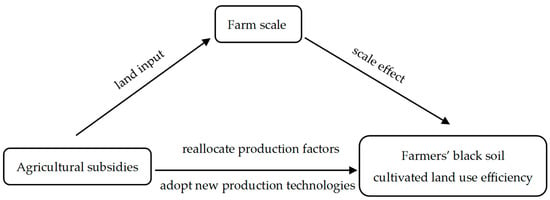
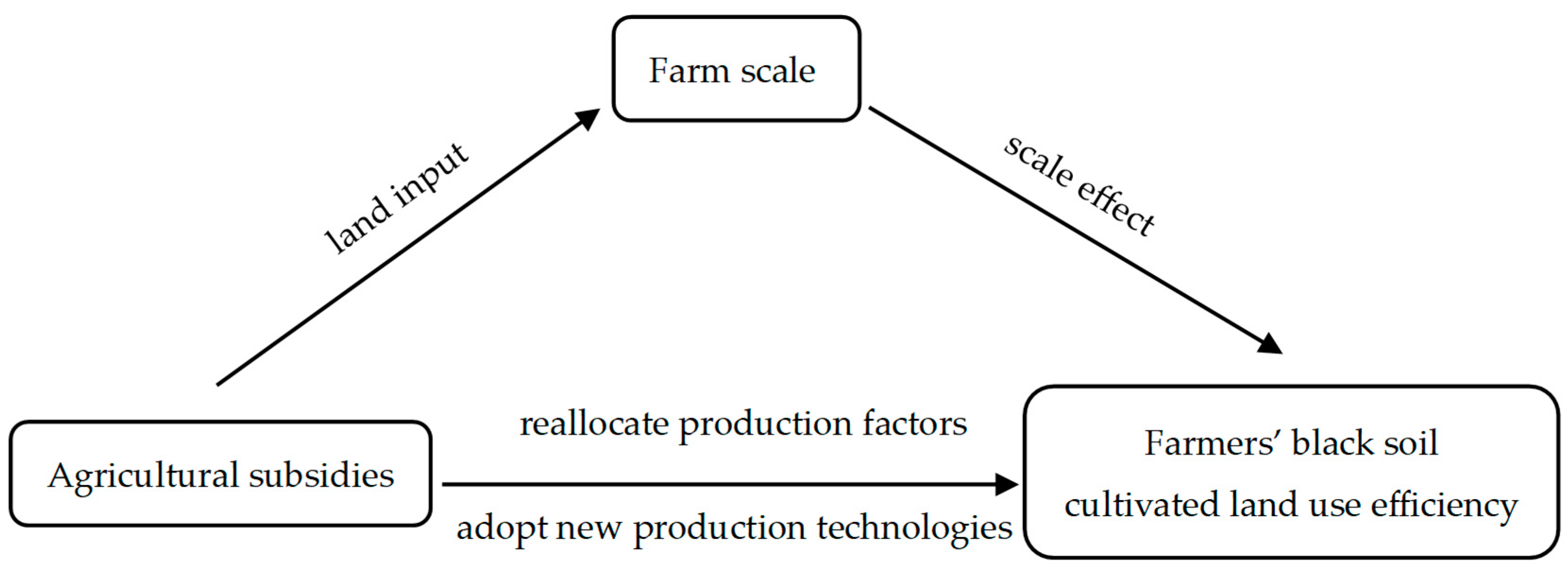
Agricultural subsidies, as transfer payments directly related to agricultural production, can increase the marginal returns to agricultural factor inputs [22], influence the farmers’ risk preferences [23], and encourage land transfer decisions, through which the scale effects may gradually emerge. Farm scale is widely considered to be a key factor affecting cultivated land use efficiency. First, the expansion of farm scale helps optimize the allocation of agricultural production factors [24]. It can overcome the indivisibility of certain production factors, improve factor utilization, and reduce redundant inputs. Second, an appropriate expansion of farm scale can reduce the marginal application cost of new production technologies. It can facilitate the diffusion and adoption of advanced technologies, and thereby improve cultivated land use efficiency [25,26]. Finally, large-scale farming creates the conditions for farmers to outsource agricultural services [27]. By optimizing the allocation of land resources and increasing capital investment, it promotes factor reallocation and enhances resource use efficiency [28,29]. The above mechanism is summarized in Figure 1.
Figure 1.
Theoretical analytical framework.
Different types of subsidies differ in their allocation criteria and target recipients, and therefore may influence farm scale through different mechanisms. Producer subsidies are allocated according to the actual crops planted by farmers and the corresponding planting area, which is closely linked to farm scale. Such subsidies may strengthen the farmers’ expectations of returns from expanding their farm scale, which may increase their willingness to transfer in land. By contrast, farmland fertility protection subsidies are distributed based on contracted land area and are therefore not directly linked to actual farm scale. Moreover, the subsidy standard is relatively low and the amount is limited, resulting in relatively weak marginal incentives for scale expansion. Consequently, the role of farm scale in the relationship between these two types of subsidies and the farmers’ black soil cultivated land use efficiency may differ.
Based on the above analysis, the following hypothesis is proposed:
H4.
Farm scale may serve as a potential mediating pathway linking agricultural subsidies to the farmers’ black soil cultivated land use efficiency, and the mediating pathway may vary across different types of subsidies.
3. Materials and Methods
3.1. Data Sources
The data used in this study were obtained from a household survey conducted by the research team in September 2024 in typical black soil regions, namely the Songnen Plain and the Sanjiang Plain. The survey targeted farming households in Hailun City of Suihua and Huanan County of Jiamusi. According to the Third National Land Survey, the total cultivated land area in the typical black soil region of Northeast China is approximately 19.733 million hm2, of which Heilongjiang Province accounts for approximately 11.067 million hm2 (approximately 56.1%), indicating its relatively important position in this region. The Songnen Plain and the Sanjiang Plain are the major concentration areas of black soil cultivated land in Heilongjiang Province and are highly representative in terms of natural conditions, cultivated land use patterns, and policy implementation contexts. Hailun City, located in the Songnen Plain, has cultivated land accounting for 74% of its total land area. Huanan County, located in the Sanjiang Plain, has cultivated land accounting for approximately 54% of its total land area. Both areas are designated as key counties for implementing black soil cultivated land protection tasks under the Implementation Plan for the Black Soil Protection Project in Heilongjiang Province (2021–2025) (Heizhengban Gui [2021] No. 40) [30], making them suitable study areas for this research. The survey adopted a stratified random sampling method. In each county (city), 3–4 townships were selected, and 3–4 villages were further selected within each township for household surveys. A total of 465 questionnaires were collected. After excluding samples without crop planting activities, 449 valid questionnaires remained, resulting in a validity rate of 96.56%.
3.2. Variable Description
3.2.1. Dependent Variable
Black soil cultivated land use efficiency. During the survey period, grain crops had not yet reached the harvest stage. Therefore, farmers were asked about production conditions in 2023, based on a full production cycle, to calculate the black soil cultivated land use efficiency. Drawing on previous studies [29,31,32], an evaluation indicator system for the black soil cultivated land use efficiency is constructed (see Table 1).
Table 1.
Evaluation Indicators of Black Soil Cultivated Land Use Efficiency.
Input indicators include labor input, current capital input (seeds, pesticides, and fertilizers), and fixed capital input (machinery and irrigation), all measured per unit of sown area. The desirable output is agricultural output value per unit of sown area, while the undesirable outputs include carbon emissions and agricultural non-point source pollution per unit of sown area. The calculation methods follow those of Li et al. [33] and Lai et al. [34].
3.2.2. Core Explanatory Variables
Agricultural subsidies are usually distributed after agricultural production in the current year. Their policy effects mainly influence the farmers’ cultivated land management decisions in the subsequent production cycle. Therefore, this study uses agricultural subsidies received by farmers in 2022 for empirical analysis. Considering the research objectives and the subsidy within the sample, the core explanatory variables include the following three types: producer subsidies, farmland fertility protection subsidies, and total agricultural subsidies.
Producer subsidies are granted to farmers based on the types of crops planted and the actual planting area in a given year. In this study, producer subsidies are measured as the amount of producer subsidies received in 2022 per unit of black soil cultivated land operated by farmers.
Farmland fertility protection subsidies are allocated to contractors based on the area of the cultivated land under contract. In this study, these subsidies are measured as the amount of farmland fertility protection subsidies received in 2022 per unit of black soil cultivated land actually operated by farmers.
To reflect the overall effect of agricultural subsidies, total agricultural subsidies are measured as the total amount of various agricultural subsidies received in 2022 per unit of black soil cultivated land actually operated by farmers.
In this study, agricultural subsidies are measured on a per-unit-area basis to ensure comparability across farm households. A logarithmic transformation is applied to reduce skewness and the influence of extreme values and to improve estimation stability. Given that cultivated land use efficiency is bounded between 0 and 1, while subsidy variables are measured in monetary terms, the log transformation helps reduce scale differences. In addition, a quadratic term of the subsidy variable is further included to capture potential nonlinear effects. This allows the marginal impact of subsidies on efficiency to vary with subsidy levels.
3.2.3. Mediating Variable
The mediating variable for this study is farm scale. Farm scale is measured as the total area of black soil cultivated land operated by the farmers, including both contracted and rented land.
3.2.4. Control Variables
The control variables include individual characteristics, household endowments, and production characteristics. Individual characteristics include years of farming experience and education level of the household head. Household characteristics include the number of agricultural laborers, the labor force ratio, party membership, and participation in agricultural insurance. Production characteristics include participation in agricultural technical training, cultivated land fragmentation, and distance to the nearest township market. In addition, the variable “area affected by natural disasters” is included in the robustness tests to control for exogenous shocks to grain production. The definitions and descriptive statistics of all variables are reported in Table 2.
Table 2.
Variable Definitions and Descriptive Statistics.
3.3. Model Setting
3.3.1. Model for Measuring Black Soil Cultivated Land Use Efficiency
This study employs the stochastic frontier analysis (SFA) method to measure the black soil cultivated land use efficiency. This approach can control for exogenous environmental influences on the production frontier. It also provides relatively robust estimates in the presence of abnormal observations. Therefore, it is well suited to capturing the nonlinear relationship between inputs and outputs in agricultural production [35]. Compared with traditional methods, an SFA distinguishes between random noise and inefficiency. This provides a more accurate measure of production efficiency. It is therefore widely used in agricultural efficiency analysis.
A stochastic frontier analysis generally adopts either the Cobb–Douglas (C–D) production function or the translog production function. Compared with the translog production function, the C–D production function uses fewer variables and reduces multicollinearity. Therefore, the C–D production function is employed to estimate the black soil cultivated land use efficiency.
Following the previous studies, undesirable outputs are treated as inputs and incorporated into the model [36]. This approach helps capture environmental constraints and provides a more comprehensive measure of the black soil cultivated land use efficiency. The model specification is as follows:
In the model, Yi denotes the desirable output of black soil cultivated land use, Li, Wi, and Fi represent labor input, current capital input, and fixed capital input, respectively, Zi denotes the undesirable output of black soil cultivated land use, β0–β4 are the parameters to be estimated, Vi represents the random error term, and Ui denotes the inefficiency term. The black soil cultivated land use efficiency (TEi) can be expressed as follows:
3.3.2. Fractional Logit Model
Since black soil cultivated land use efficiency is bounded between 0 and 1, OLS models may produce predictions outside the feasible range and fail to address boundary issues. By contrast, the fractional logit model is more suitable for proportional dependent variables and more appropriate for the estimation framework of this study. Therefore, this study employs a fractional logit model [37] to examine the impact of agricultural subsidies on the black soil cultivated land use efficiency, as specified below:
In the model, TEi denotes the black soil cultivated land use efficiency, Xi represents agricultural subsidies, Ki denotes the control variables, α0 is the intercept term, α1–α3 are the parameters to be estimated, and e1 is the random disturbance term.
3.3.3. Mediating Effect Model
This study adopts the stepwise regression method [38] to conduct a mediation analysis. It aims to explore the relationship between agricultural subsidies and the black soil cultivated land use efficiency. Specifically, the analysis examines the mediating role of farm scale. It should be noted that nonlinear specifications and squared terms increase the complexity of mediation identification. In addition, given the cross-sectional nature of the data, the mediation results are primarily used to identify the potential associational pathways among the variables, and the findings should be interpreted with caution rather than as strict causal decomposition.
In these models, TEi denotes the black soil cultivated land use efficiency, Xi represents agricultural subsidies, M denotes the mediating variable, namely farm scale, Ki represents the control variables, α0, β0, and δ0 are the intercept terms, α1–α9 are the parameters to be estimated, and e1, e2, and e3 denote the random disturbance terms.
4. Empirical Analysis of the Impact of Agricultural Subsidies on Farmers’ Black Soil Cultivated Land Use Efficiency
To eliminate scale differences across the variables, logarithmic transformations are applied to the core explanatory and mediating variable. For variables containing zero values, one is added before logarithmic transformation. In addition, the variance inflation factor (VIF) is used to test for multicollinearity. The results indicate that all VIF values are below 10, suggesting no serious multicollinearity among the explanatory variables.
4.1. Measurement of Black Soil Cultivated Land Use Efficiency
The estimation results of the Cobb–Douglas (C–D) production function are reported in Table 3. Overall, the model estimation appears to perform well. The estimated value of γ is 0.947. This suggests that 94.7% of the variation in the composite error term is attributed to inefficiency, while 5.3% is due to random disturbances. The average black soil cultivated land use efficiency of the sampled farm households is 0.692, suggesting that there remains considerable room for improvement. From the estimated coefficients, labor input is significantly positive at the 1% level, suggesting that labor remains an important factor in grain production among farm households. Meanwhile, the significance of undesirable outputs suggests that grain output growth is associated with carbon emissions and agricultural non-point source pollution. This implies potential environmental pressures. By contrast, the coefficients of fixed and working capital inputs are not statistically significant, suggesting that their effects on desirable outputs is relatively limited. This finding is consistent with a previous study [39], which reported insignificant effects of seed and fertilizer inputs on rice yields in China. This result may imply that increasing capital inputs alone may not substantially enhance agricultural output under current conditions. Furthermore, the sum of the elasticities of all production factors is less than one, suggesting that grain production at the household level exhibits decreasing returns to scale. This finding implies that agricultural production at the micro level may face the coexistence of declining marginal productivity and potential inefficiencies in resource allocation.
Table 3.
Regression Results of the Stochastic Frontier Production Function.
4.2. Baseline Regression Results and Analysis
Using Stata 17.0, this study conducts empirical estimations based on the fractional logit model. In Models 1–3, producer subsidies, cultivated land fertility protection subsidies, and total agricultural subsidies are used as core explanatory variables, respectively (Table 4).
Table 4.
Regression Results of Agricultural Subsidies on Black Soil Cultivated Land Use Efficiency.
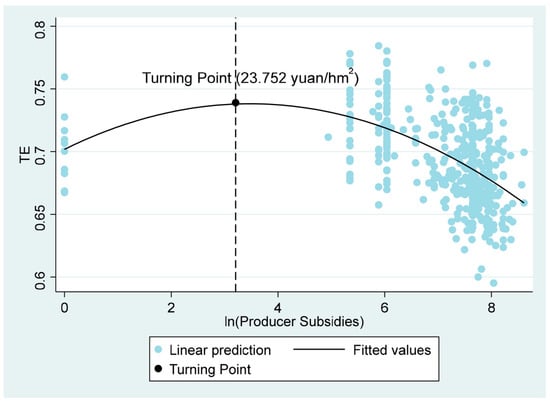
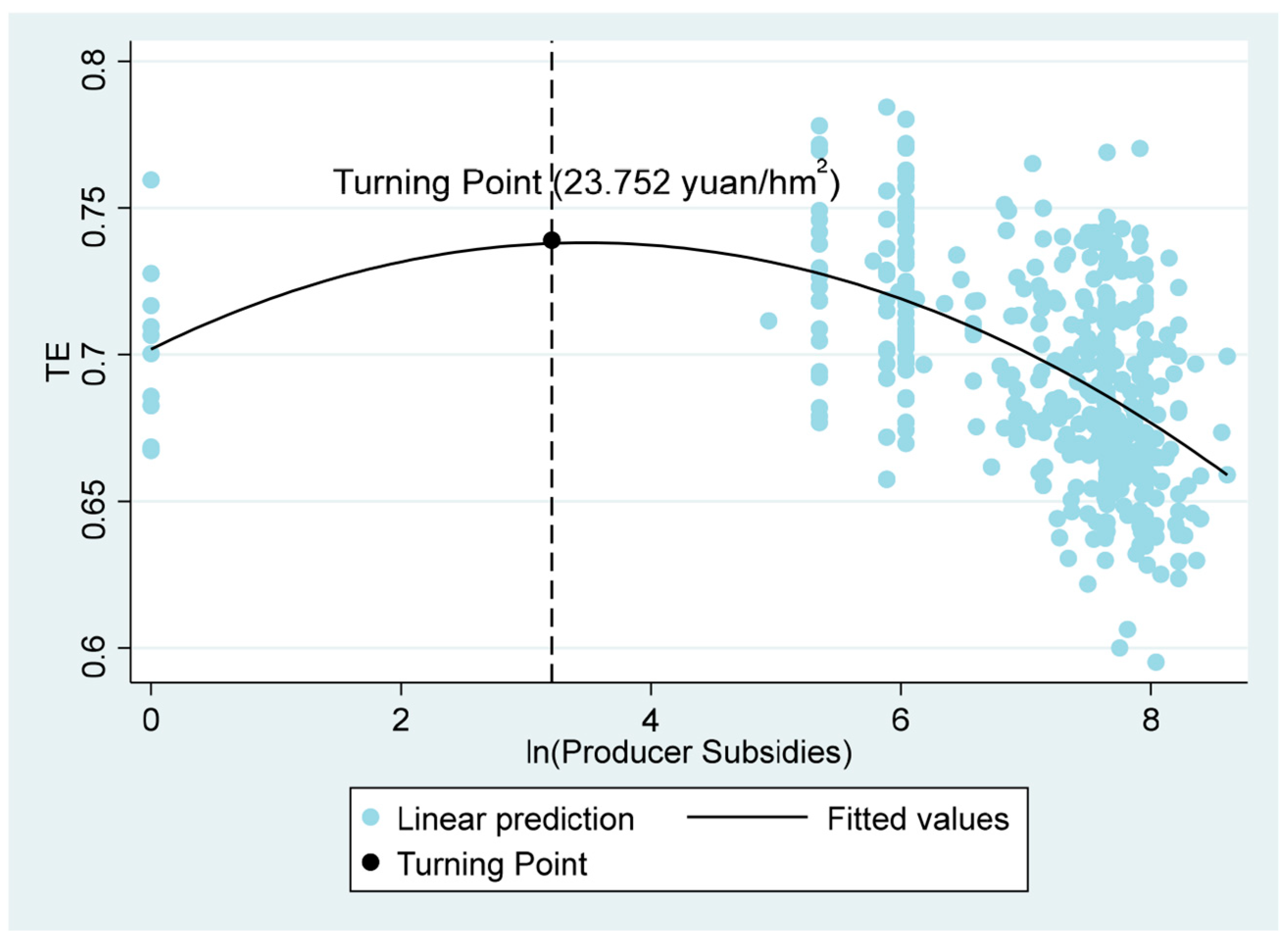
The coefficient of the linear term of producer subsidies is 0.095 (10% level), while the coefficient of the quadratic term is −0.015 (5% level). These results suggest a nonlinear relationship between producer subsidies and the black soil cultivated land use efficiency. This provides preliminary support for H1. However, the estimated turning point is approximately 23.752 yuan/hm2. As shown in Figure 2, the fitted curve illustrates this relationship. The dashed vertical line in Figure 2 indicates the turning point projected onto the x-axis. The horizontal axis represents the logarithm of subsidy levels, and the turning point is reported in original units. Only a very small number of observations lie to the left of this point. This may be related to the relatively stable and behavior-linked nature of producer subsidies. As a result, farmers may respond quickly to incentives and adjust input use at an early stage, which may lead to changes in marginal effects at low subsidy levels. Therefore, within the sample range, the relationship is a predominantly decreasing trend rather than a typically inverted U-shaped pattern. One possible explanation is that, as rational economic agents, farmers may prioritize low-cost strategies, such as chemical fertilizers and pesticides, to maximize short-term returns. However, agricultural production exhibits diminishing marginal returns, and increasing conventional inputs alone may not sustain output growth. Meanwhile, the associated increase in undesirable outputs may be related to a decline in the black soil cultivated land use efficiency. Field survey evidence supports this interpretation to some extent. Although subsidies exist, the high costs of machinery and technology adoption remain constraints for most smallholders. In addition, the high degree of land fragmentation limits economies of scale in mechanized operations. This makes it difficult for farmers to further improve the black soil cultivated land use efficiency.
Figure 2.
Relationship between Producer Subsidies and Black Soil Cultivated Land Use Efficiency.
The coefficient of cultivated land fertility protection subsidies is −0.054 (10% level), indicating a negative association with the black soil cultivated land use efficiency. This result provides empirical support for H2. This may be due to misalignment between subsidy distribution and actual operators. In the sample, 95% of farmers engage in land inflow, while the cultivated land fertility protection subsidy is mainly allocated to the contract rights holders, rather than to the actual land operators. As a result, the subsidy may not reach the actual decision-makers. Moreover, the subsidy level for cultivated land fertility protection is relatively low and accounts for only a small proportion of the total subsidies, making it difficult to generate sufficiently strong incentives for farmers. In addition, the allocation is based on contracted land area rather than conservation practices, such as straw returning or crop rotation and fallow systems. Meanwhile, insufficient policy guidance and publicity from local governments may weaken the farmers’ awareness of the ecological objectives of the subsidy. Consequently, farmers may focus on the ownership and the amount of the subsidies as short-term economic benefits, rather than conservation practices, which may hinder improvements in the black soil cultivated land use efficiency.
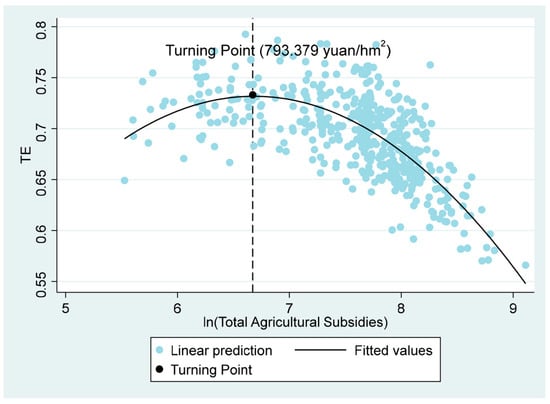
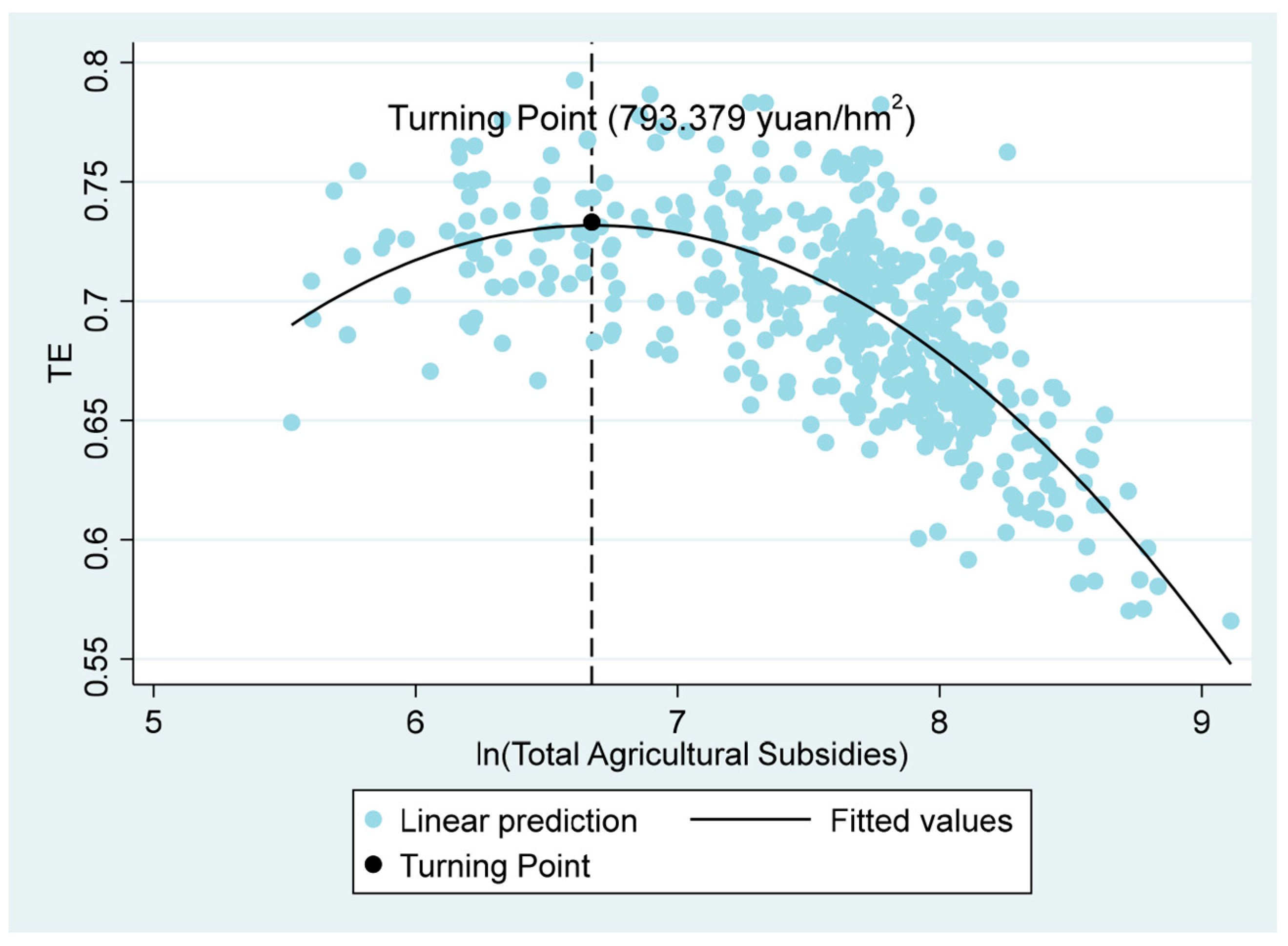
The coefficient of the linear term of the total agricultural subsidies is 1.909, and the coefficient of the quadratic term is −0.143 (5% level), indicating a nonlinear relationship between the total agricultural subsidies and the black soil cultivated land use efficiency, which provides support for H3. The turning point is approximately 793.379 yuan/hm2, lower than the sample mean (2352.031 yuan/hm2), indicating that the majority of observations lie to the right of the turning point. The total agricultural subsidies also include agricultural machinery purchase subsidies and crop rotation subsidies, which may mitigate the negative effects of other subsidy types by improving production conditions and promoting technology adoption. As a result, the marginal effects of the total agricultural subsidies tend to change more gradually, leading to a higher turning point. Figure 3 shows an asymmetric inverted U-shaped pattern, with the logarithm of subsidies on the horizontal axis and the turning point in original units. The dashed vertical line indicates the projected turning point on the x-axis. This suggest that the quadratic specification primarily captures the diminishing marginal effects of the total agricultural subsidies on the black soil cultivated land use efficiency. This pattern reflects the structure of the subsidy system. Within the existing subsidy framework, producer subsidies account for the largest share and constitute the main source of the farmers’ subsidy income. Their primary policy objective is to stabilize the farmers’ grain production incentives and to ensure food security; thus, they are positively associated with improvements in the black soil cultivated land use efficiency when subsidies are low. However, when the total subsidies exceed a threshold, their positive effects may weaken due to policy dependence and inefficient input use. First, some farmers may develop subsidy dependence, making production decisions that prioritize maintaining existing cropping structures and input patterns rather than actively optimizing resource allocation. As conventional factor inputs continue to increase, the ratio between inputs and desirable outputs may decline accordingly. Second, within the current agricultural subsidy system, environmentally oriented subsidies remain limited, and policy support for environmentally friendly inputs—such as organic fertilizers and biological pesticides—remains limited. As a result, undesirable outputs may lack effective policy constraints. Field investigations reveal that, although farmers generally recognize the environmental benefits of organic fertilizers and biological pesticides, their relatively high costs and labor requirements discourage large-scale adoption. Under rational decision-making, farmers often apply such inputs only in small-scale subsistence production, rather than in large-scale field cultivation. Furthermore, although farmers generally express strong support for cultivated land protection, their willingness to adopt specific conservation technologies remain relatively low. For example, regarding straw returning, many farmers report that pest and disease problems tend to intensify after implementation. This may be related to the shortage of skilled machinery operators and poor operational quality, as well as the limited adaptability of certain technologies to local farming conditions, which weakens the incentive effects of subsidy policies. Overall, total agricultural subsidies may not fully promote sustainable production and may be associated with a lower black soil cultivated land use efficiency.
Figure 3.
Relationship between Total Agricultural Subsidies and Black Soil Cultivated Land Use Efficiency.
Among the control variables, the proportion of household labor, party membership within the household, and participation in agricultural technical training all have significantly positive associations with the black soil cultivated land use efficiency. Households with more labor may achieve more refined management and higher efficiency. Party membership may be associated with better access to policy and information, enabling farmers to obtain policy updates and technical extension information in a timely manner, thereby potentially improving the scientific and standardized nature of agricultural production. Participation in agricultural technical training may improve technical skills and the awareness of ecological protection, encouraging the adoption of modern agricultural practices, such as water-saving irrigation and straw returning, which are positively associated with improvements in the black soil cultivated land use efficiency. Finally, the years of farming experience of the household head have a significantly negative association with the black soil cultivated land use efficiency. Farmers who have long engaged in traditional agricultural practices may limit the adoption of new technologies, such as intensive fertilization and deep tillage, while remaining relatively cautious toward new technologies, which may constrain improvements in cultivated land use efficiency.
4.3. Mediation Analysis and Potential Pathways
Based on the mediation effect model constructed in the previous section, this study further examines the potential mediating pathway of farm scale (Table 5). The estimation results show that producer subsidies and total agricultural subsidies are positively associated with farm scale, while cultivated land fertility protection subsidies are negatively associated with farm scale. This result suggests that producer subsidies are allocated based on the operated land area and directed to the actual operators. They may therefore encourage farmers to expand their farm scale. By contrast, cultivated land fertility protection subsidies are primarily allocated to the contract rights holders rather than to the actual operators. Combined with their relatively low level, these subsidies may not effectively reach the actual decision-makers in agricultural production. As a result, they may be associated with a restraining effect on farm scale expansion.
Table 5.
Regression Results of the Mediation Effect Model.
When both the subsidy variables and farm scale are included, the core explanatory variables (producer subsidies and total agricultural subsidies) and the farm scale remains statistically significant. These results provide partial support for H4 and suggest the presence of a potential mediating pathway through farm scale. In addition, the bootstrap method (1000 replications) is used to further test the indirect effects and to construct confidence intervals. The results in Table 6 show that the confidence intervals for both paths do not include zero, providing additional statistical evidence for the presence of indirect effects.
Table 6.
Bootstrap Test Results.
To obtain higher income, farmers are more likely to allocate part of the agricultural subsidies to cultivated land investment, particularly through farm scale expansion. This may facilitate more efficient factor allocation and adoption of socialized agricultural services. As a result, the black soil cultivated land use efficiency may be improved. However, when scale expansion is mainly accompanied by increased use of conventional inputs, such as chemical fertilizers and pesticides, rather than technological progress or green input substitution, its positive effect may be limited. Furthermore, the expansion of farm scale induced by agricultural subsidies is also constrained by the institutional conditions of cultivated land transfer. Field investigations indicate that black soil cultivated land is often transferred through long-term, relationship-based arrangements among acquaintances or relatives. This forms an informal norm that “each household cultivates its own contracted land”. Although some farmers express willingness to expand, they often face constraints in accessing additional land through formal transfer markets. This mechanism reduces the effective supply of transferable black soil cultivated land and constrains scale expansion. Under these conditions, the potential indirect positive effect of subsidies through farm scale may not be fully realized. Therefore, the relationship between agricultural subsidies and the black soil cultivated land use efficiency remains nonlinear and is predominantly negative within the sample range.
4.4. Robustness Tests
4.4.1. Endogeneity Discussion
Considering that the relationship between agricultural subsidies and the black soil cultivated land use efficiency of farm households may be subject to bias due to omitted variables and potential endogeneity, this study employs an instrumental variable approach. Specifically, the average level of agricultural subsidies received by other farmers in the same village (excluding the surveyed household) is used as the instrument [40]. Within a village, subsidy allocation criteria and policy implementation intensity tend to be relatively consistent. In addition, farm households usually share similar farm scale and cropping structures. Therefore, the village-level average subsidy is expected to be correlated with the subsidies received by the sample household. Moreover, the instrumental variable is constructed using a leave-one-out approach, which helps reduce mechanical correlation with the error term. From a theoretical perspective, although the village-level average subsidy reflects broader village-level contextual characteristics, such as infrastructure conditions, policy implementation intensity, and market environments, which may also affect cultivated land use efficiency, it is less likely to directly determine the cultivated land use efficiency of a specific household. Therefore, it provides a plausible but not strict exogeneity assumption. This approach is consistent with the existing studies that use group-level averages (excluding the individual observation) as instrumental variables to capture exogenous variation.
The weak instrumental test results indicate that the first-stage F-statistics are all above 10, exceeding the conventional threshold. This applies to producer subsidies, cultivated land fertility protection subsidies, and total agricultural subsidies (including their quadratic terms). This suggests that weak instrument concerns are unlikely to be severe. The Durbin–Wu–Hausman (DWH) test results show that the p-values are 0.128 (producer subsidies), 0.090 (cultivated land fertility protection subsidies), and 0.005 (total agricultural subsidies), respectively. These results indicate that the producer subsidies are exogenous, while the cultivated land fertility protection subsidies and the total agricultural subsidies reject exogeneity and exhibit endogeneity. Therefore, instrumental variable estimations are conducted only for the cultivated land fertility protection subsidies (Model 10) and the total agricultural subsidies (Model 11), while the producer subsidies are not included in the IV model (Table 7). After addressing the potential endogeneity issue using the instrumental variable approach, the estimated effects remain broadly consistent with the baseline results. Specifically, the cultivated land fertility protection subsidies continue to show a negative association with the black soil cultivated land use efficiency, while the total agricultural subsidies still exhibit a nonlinear relationship. These findings provide supplementary evidence supporting the robustness of the main results.
Table 7.
Endogeneity Test Results.
4.4.2. Test of the Inverted U Relationship
To ensure the robustness of the regression results, the U-test method is employed to further examine the nonlinear relationship between the total agricultural subsidies and the black soil cultivated land use efficiency. The results are reported in Table 8. The value range of the logarithm of the total agricultural subsidies is (5.527, 9.111). The slope at the lower bound is 0.073, which is significantly positive at the 5% level, whereas the slope at the upper bound is –0.155, which is significant at the 1% level. The estimated turning point is 6.672, which falls within the sample interval. These results suggest that the total agricultural subsidies exhibit an inverted U relationship with the black soil cultivated land use efficiency, providing additional support for the baseline findings.
Table 8.
Robustness Test: U-test Results.
A further analysis indicates that the estimated turning point corresponds to approximately 793.379 yuan/hm2 in original units, which is also notably lower than the sample mean, suggesting that most observations lie to the right of the turning point. This is consistent with the earlier finding that the relationship appears to be predominantly decreasing within the sample range.
In addition, the U-test is not conducted for the producer subsidies. This is because the estimated turning point of the producer subsidies is located at a very low level, with only a small number of observations to the left of the turning point. Under such conditions, the U-test may not provide reliable evidence for an inverted U relationship. Therefore, for the producer subsidies, this study focuses on interpreting the nonlinear specification based on the overall trend and sample distribution, rather than formally testing the inverted U shape.
4.4.3. Alternative Variable Transformation
To further test the robustness of the results, producer subsidies, cultivated land fertility protection subsidies, total agricultural subsidies, and farm scale are transformed using the inverse hyperbolic sine (IHS) transformation and are reintroduced into the regression model. The results are reported in Table 9.
Table 9.
Robustness Test: Alternative Variable Transformation.
The results show that the producer subsidies and the total agricultural subsidies continue to exhibit nonlinear relationships with the black soil cultivated land use efficiency, while the cultivated land fertility protection subsidies remain negatively associated with the black soil cultivated land use efficiency. In addition, farm scale continues to be associated with a potential mediating pathway linking the producer subsidies and the total agricultural subsidies to the black soil cultivated land use efficiency. The coefficients are generally consistent with the baseline and pathway analysis results, suggesting that the main findings are robust to alternative variable transformations.
4.4.4. Alternative Estimation Method and Additional Control Variable
To avoid potential bias arising from the choice of estimation method and to further control for possible omitted variables, this study introduces an additional control variable: the area of farmland affected by natural disasters in the previous year. Meanwhile, a beta regression model, which is suitable for dependent variables bounded between 0 and 1, is employed [41]. The results are reported in Table 10. The coefficients of the linear terms of the producer subsidies and the total agricultural subsidies remain positive, while their quadratic terms remain negative and statistically significant, indicating persistent nonlinear relationships between these subsidies and the black soil cultivated land use efficiency. Meanwhile, farm scale remains statistically significant, suggesting a potential mediating pathway. The coefficient of the cultivated land fertility protection subsidies remains negative and statistically significant. Overall, the results are broadly consistent with the baseline findings, suggesting that the conclusions are robust across different model specifications.
Table 10.
Robustness Test: Alternative Estimation Method and Additional Control Variable.
4.5. Heterogeneity Analysis
Differences in the degree of cultivated land fragmentation can lead to variation in farmland resource endowment and mechanization levels. This may, in turn, result in heterogeneity in the potential mediating pathway through farm scale of black soil cultivated land in the relationship between agricultural subsidies and the black soil cultivated land use efficiency. In addition, farm households with different farm scales may differ in factor allocation patterns and technology adoption capacity, which could lead to heterogeneous effects in how agricultural subsidies operate through a potential mediating pathway via farm scale. Therefore, this study examines the heterogeneity of this pathway from two perspectives: the degree of cultivated land fragmentation and farm scales. The results are presented in Table 11.
Table 11.
Heterogeneity Regression Results.
Based on the median value of the average plot size, farm households with an average plot size above the median are classified as the low fragmentation group, while those below the median are classified as the high fragmentation group. For the high fragmentation group, farm scale is associated with a significant potential mediating pathway in the relationship between the producer subsidies, the total agricultural subsidies, and the black soil cultivated land use efficiency. By contrast, this pathway is not statistically significant in the low fragmentation group. A possible explanation is that, when fragmentation is high, the dispersion of plots increases production organization and management costs. Under such conditions, farm households may have stronger incentives to expand farm scale in order to reduce costs and to improve factor allocation efficiency. By contrast, in the low fragmentation group, cultivated land is more contiguous, and production conditions are relatively favorable. In this case, agricultural subsidies are more likely for capital investment, and the potential transmission pathway appears more limited.
Furthermore, based on the median value of farm scale, farm households are divided into small-scale and large-scale farmers. The regression results show that the evidence of the potential mediating pathway is observed for small-scale farmers but not for large-scale farmers. A possible explanation is that, compared with small-scale farmers, large-scale farmers already operate at a relatively high level of farm scale. Therefore, the marginal incentive of agricultural subsidies for further scale expansion may be limited, which weakens the potential mediating role of farm scale.
5. Discussion
As one of the world’s important high quality cultivated land resources, black soil cultivated land plays an irreplaceable role in ensuring stable grain production [42]. Black soil is not only a fundamental resource for grain production but a key ecological resource supporting the sustainable development of regional agriculture [43]. Consequently, its rational utilization has long attracted extensive attention from scholars. In agricultural production, increasing grain output often coexists with constraints related to resources and the environment. Achieving a rational allocation of production inputs while ensuring grain output has therefore become a key issue in promoting sustainable agricultural development [44]. As an important policy instrument for government intervention in agricultural production, agricultural subsidies play a crucial role in stabilizing grain production and guiding the production behavior of farm households. Some studies have shown that China’s agricultural subsidy system has contributed to the continuous expansion of the national grain-sown area, but it may also generate undesirable outputs, such as carbon emissions [45]. Therefore, it is necessary to further explore the potential relationship between agricultural subsidies and black soil cultivated land use efficiency.
Building on the existing literature, this study adopts a micro-level perspective for farm households. It uses black soil cultivated land use efficiency, incorporating carbon emissions and agricultural non-point source pollution, as a comprehensive indicator for evaluating agricultural production performance. It systematically examines the association between agricultural subsidies and the farmers’ black soil cultivated land use efficiency. This helps address the insufficient attention paid to this issue in the previous studies. This indicator comprehensively reflects the coordination among resource inputs, economic outputs, and environmental impacts in the agricultural production process. It helps reveal the possible pathways through which agricultural subsidies may be related to the sustainable utilization of black soil resources. Consequently, the findings provide additional empirical evidence for research on black soil conservation and the sustainable use of cultivated land resources. On this basis, this study further constructs an analytical framework to examine the impact of agricultural subsidies on the black soil cultivated land use efficiency and explores the underlying mechanisms from the perspective of farm scale. The theoretical analysis is mainly grounded in scale effect theory and farm household production behavior theory, focusing on how agricultural subsidies may influence cultivated land use efficiency through the farmers’ decisions regarding factor input allocation, farm scale expansion, and adjustments in production practices. In terms of the empirical analysis, this study uses farm household survey data and applies the stochastic frontier analysis (SFA) model to estimate the black soil cultivated land use efficiency. Subsequently, a fractional logit model is employed to examine the relationship between the agricultural subsidies and the black soil cultivated land use efficiency. It also analyzes the potential mediating role of farm scale in this relationship. Meanwhile, China has continuously improved its agricultural subsidy policies and black soil protection policy system in recent years. It has also actively promoted the conservation and utilization of black soil at the national level. This policy context provides an important institutional background for this study. The results may offer useful references for optimizing the design of agricultural subsidy policies and for promoting the sustainable utilization of black soil resources.
Based on the empirical results and analysis of this study, the following policy implications are proposed.
First, adjust the structure of agricultural subsidies to promote the efficient and sustainable utilization of black soil cultivated land. The results show that producer subsidies and total agricultural subsidies are associated with nonlinear relationships with the efficiency of black soil cultivated land use. This indicates that simply increasing the scale of subsidies cannot continuously improve the black soil cultivated land use efficiency. Under certain conditions, it may also reinforce the farmers’ dependence on conventional inputs, such as chemical fertilizers and pesticides. Therefore, in order to mitigate the inducement effect of subsidies on short-term high-intensity input use, ecological performance could be further emphasized in the design of subsidy policies. Specifically, conservation practices with strong operability—such as straw returning, crop rotation, and reduced fertilizer application—may be considered for incorporation into the eligibility criteria or evaluation indicators for receiving producer subsidies. At the same time, policy communication could be strengthened to clarify the purposes of cultivated land fertility protection subsidies and subsidies for the adoption of black soil conservation technologies. The distribution of subsidies may be more closely linked to the farmers’ fulfillment of cultivated land protection responsibilities and their adoption of conservation tillage technologies. In the long run, green agricultural subsidy policies, such as organic fertilizer subsidies, could be further promoted, and the proportion of green subsidies may be appropriately increased so that more financial resources are directed toward environmentally friendly production technologies and services. In addition, the subsidy distribution mechanism could be further refined by improving the targeting of beneficiaries more precisely, explicitly designating the actual land operators as the primary recipients of subsidies may help enhance policy incentive efficiency.
Second, promote moderate-scale management to release the positive effects of scale. Given that farm scale expansion is found to be positively associated with improvements in factor allocation efficiency under certain conditions, the development of land scale management and service scale management may be promoted simultaneously. In the short term, when rapid expansion of land operating scale is difficult to achieve, subsidies and policy guidance could prioritize encouraging smallholders to purchase agricultural socialized services or participate in production trusteeship arrangements, thereby realizing service-based scale management and potentially improving the allocation efficiency of machinery, technology, and managerial inputs. In the long run, moderate-scale land management may be gradually promoted as institutional conditions gradually improve. On the one hand, farmers could be encouraged to transfer farmland through multiple arrangements, such as contracts, shareholding, and cooperative management. At the village level, land transfer information platforms may be established and contract registration and intermediary services could be further standardized to reduce transaction costs, weaken the closed nature of acquaintance-based networks, and expand the effective supply of transferable land parcels. On the other hand, legal and financial support for moderate-scale operators, such as family farms and agricultural cooperatives, could be strengthened to enhance their stability and long-term operational capacity. Meanwhile, differentiated support policies may be considered for farmers with low land fragmentation and relatively large operating scales, flexible technical guidance and information services could be emphasized for highly fragmented land and smallholder farmers, and scale-oriented production may be facilitated through land transfer, cooperative farming, or agricultural socialized services so as to better leverage the positive role of farm scale in improving the efficiency of black soil cultivated land use.
Third, improve the coordination mechanism between agricultural technical training and regulatory supervision to enhance technological adaptability and implementation effectiveness. Technical pathways that match local production conditions should ideally be selected based on terrain characteristics, soil conditions, and farm scale. Demonstration bases could be established in typical black soil regions, such as Hailun City and Huanan County, to organize training on practices including scientific straw returning, biological pest control, and precision fertilization. In this way, an agricultural technical service system with broad coverage and enhanced support may be gradually developed. This system could help improve the efficiency of the farmers’ labor inputs. It may also reduce the likelihood of implementation failures caused by insufficient technical knowledge or improper operation. As a result, it may enhance the feasibility and stability of technology adoption. To strengthen the effectiveness of institutional constraints in the short term, regulatory frequency and violation costs for destructive practices, such as straw burning and excessive fertilizer application, may be appropriately increased. Compliance records could also be incorporated into subsidy eligibility or subsidy grading evaluations, thereby encouraging a gradual shift from short-term, high-input, high-consumption production patterns toward more sustainable agricultural practices.
Nevertheless, several limitations remain in this study. First, due to heterogeneity in the producer subsidy standards for corn, soybeans, and rice, subsidy amounts per unit of sown area differ across crop planting structures. Because the distribution of crop types in the survey sample is uneven, and some categories contain relatively small sample sizes, this study does not conduct a detailed analysis of crop-structure heterogeneity. Second, the empirical analysis in this study is based on cross-sectional data derived from farm households’ retrospective reporting of past production cycles. Although multiple measures were taken to mitigate recall bias, it may still affect the measurement of certain variables to some extent. In addition, the use of cross-sectional data limits the ability to capture the dynamic effects of agricultural subsidies on farm scale and black soil cultivated land use efficiency.
Future research could extend the analysis to multi-province, mixed-cropping regions and incorporate panel data or longitudinal survey data to further enhance the robustness of the findings. This would also enable a more systematic examination of the short-term and long-term effects of agricultural subsidies.
6. Conclusions
Using survey data from Hailun City and Huanan County in Heilongjiang Province as the sample, this study measures the black soil cultivated land use efficiency and empirically examines the impact of agricultural subsidies on the black soil cultivated land use efficiency of farm households, as well as the underlying mechanisms. In addition, heterogeneity in the mediating role of farm scale in the relationship between agricultural subsidies and black soil cultivated land is further analyzed. The main conclusions are as follows.
First, the overall grain production of micro-level farm households exhibits a trend of decreasing returns to scale, indicating that there remains substantial room for improving the black soil cultivated land use efficiency in the study area.
Second, different types of agricultural subsidies exert significantly different effects on the black soil cultivated land use efficiency. Specifically, producer subsidies and total agricultural subsidies exhibit nonlinear relationships and, combined with the distribution of observations, these relationships are predominantly characterized by decreasing trends within the sample range, whereas cultivated land fertility protection subsidies are negatively associated with the black soil cultivated land use efficiency.
Third, farm scale of black soil cultivated land is associated with a potential mediating pathway linking producer subsidies and total agricultural subsidies to the black soil cultivated land use efficiency.
Finally, the mediating pathway of farm scale exhibits heterogeneity under different levels of cultivated land fragmentation and farm scale. Specifically, the mediating pathway of farm scale is more evident for producer subsidies and total agricultural subsidies in the high fragmentation group and among small-scale farmers, whereas such patterns are not statistically evident in the low fragmentation group or among large-scale farmers.
Author Contributions
Conceptualization, W.L. and S.H.; methodology, W.L.; formal analysis, W.L.; investigation, W.L.; data curation, W.L.; writing—original draft preparation, W.L.; writing—review and editing, S.H. and Z.W.; supervision, S.H.; project administration, S.H.; funding acquisition, S.H. All authors have read and agreed to the published version of the manuscript.
Funding
This research was funded by the General Project of Humanities and Social Sciences Research of the Ministry of Education (Grant No. 24YJA790015) and the National Key Research and Development Program of China (Grant No. 2024YFD1500900).
Institutional Review Board Statement
Ethical review and approval were not required for this study. According to Article 32 of the Administrative Measures for Ethical Review of Life Science and Medical Research Involving Humans in China, studies utilizing human data or biospecimens that do not cause harm to individuals, do not involve sensitive personal information or commercial interests, and employ anonymized data may be exempt from ethical review (https://www.gov.cn/zhengce/zhengceku/2023-02/28/content_5743658.htm, accessed on 20 February 2026). The data used in this study are micro-level survey data collected from farmers. All participants were fully informed of the purpose and content of the survey prior to participation. Participation was entirely voluntary, and informed consent was obtained. The data were collected anonymously, did not involve sensitive personal information, and did not include any procedures that could cause harm to participants. Participants had the right to withdraw at any time. This study adheres to relevant institutional and national ethical guidelines.
Informed Consent Statement
Informed consent was obtained from all participants involved in the study.
Data Availability Statement
The original contributions presented in the study are included in the article, further inquiries can be directed to the corresponding author.
Acknowledgments
The authors would like to thank the farmers who participated in the survey and the local agricultural departments for their support in the data collection process.
Conflicts of Interest
The authors declare no conflicts of interest.
References
- Foley, J.A.; Ramankutty, N.; Brauman, K.A.; Cassidy, E.S.; Gerber, J.S.; Johnston, M.; Mueller, N.D.; O’Connell, C.; Ray, D.K.; West, P.C.; et al. Solutions for a cultivated planet. Nature 2011, 478, 337–342. [Google Scholar] [CrossRef] [Scilit] [PubMed]
- Zhou, Y.; Li, X.; Liu, Y. Rural land system reforms in China: History, issues, measures and prospects. Land Use Policy 2020, 91, 104330. [Google Scholar] [CrossRef] [Scilit]
- Han, H.; Zhang, X. Static and dynamic cultivated land use efficiency in China: A minimum distance to strong efficient frontier approach. J. Clean. Prod. 2020, 246, 119002. [Google Scholar] [CrossRef] [Scilit]
- Mok, W.K.; Tan, Y.X.; Chen, W.N. Technology innovations for food security in Singapore: A case study of future food systems for an increasingly natural resource-scarce world. Trends Food Sci. Technol. 2020, 102, 155–168. [Google Scholar] [CrossRef] [Scilit]
- Kemmerling, B.; Schetter, C.; Wirkus, L. The logics of war and food (in)security. Glob. Food Secur. 2022, 33, 100634. [Google Scholar] [CrossRef] [Scilit]
- Fei, R.; Lin, Z.; Chung, J. How land transfer affects agricultural land use efficiency: Evidence from China’s agricultural sector. Land Use Policy 2021, 104, 105300. [Google Scholar] [CrossRef] [Scilit]
- Ke, N.; Zhang, X.; Lu, X.; Li, Y.; Chen, Y. Regional disparities and influencing factors of eco-efficiency of arable land utilization in China. Land 2022, 11, 257. [Google Scholar] [CrossRef] [Scilit]
- Mutoko, M.C.; Hein, L.; Shisanya, C.A. Farm diversity, resource use efficiency and sustainable land management in the western highlands of Kenya. J. Rural Stud. 2014, 36, 108–120. [Google Scholar] [CrossRef] [Scilit]
- Zhou, X.; Wu, D.; Li, J.F.; Liang, J.; Zhang, D.; Chen, W. Cultivated land use efficiency and its driving factors in the Yellow River Basin, China. Ecol. Indic. 2022, 144, 109411. [Google Scholar] [CrossRef] [Scilit]
- Alem, H.; Jumpah, E.T.; Bavorova, M. Sustainable intensification and land use efficiency among smallholder maize farmers in northern Ghana. Land Use Policy 2026, 165, 108002. [Google Scholar] [CrossRef] [Scilit]
- Chen, J.Y.; Dimitrov, S.; Pun, H. The impact of government subsidy on supply chains’ sustainability innovation. Omega 2019, 86, 42–58. [Google Scholar] [CrossRef] [Scilit]
- Qu, Y.; Lyu, X.; Peng, W.; Xin, Z. How to evaluate the green utilization efficiency of cultivated land in a farming household? A case study of Shandong Province, China. Land 2021, 10, 789. [Google Scholar] [CrossRef] [Scilit]
- Xu, H.Z.; Chen, T. Impact of farmers’ differentiation on farmland-use efficiency: Evidence from household survey data in rural China. Agric. Econ. 2013, 59, 227–234. [Google Scholar] [CrossRef] [Scilit]
- Guo, L.; Li, H.; Cao, X.; Cao, A.; Huang, M. Effect of agricultural subsidies on the use of chemical fertilizer. J. Environ. Manag. 2021, 299, 113621. [Google Scholar] [CrossRef] [Scilit]
- Luo, X.; Ao, X.; Zhang, Z.; Li, Y.; Wang, H. Spatiotemporal variations of cultivated land use efficiency in the Yangtze River Economic Belt based on carbon emission constraints. J. Geogr. Sci. 2020, 30, 535–552. [Google Scholar] [CrossRef] [Scilit]
- Kuang, B.; Lu, X.; Zhou, M.; Chen, D. Provincial cultivated land use efficiency in China: Empirical analysis based on the SBM-DEA model with carbon emissions considered. Technol. Forecast. Soc. Change 2020, 151, 119874. [Google Scholar] [CrossRef] [Scilit]
- Liu, K.C. Influence and mechanism of grain production subsidy policy on farmers’ grain planting decision: Evidence from Jiangxi Province. Chin. Rural Econ. 2010, 2, 12–21. [Google Scholar] [CrossRef]
- Xin, Y.; Xu, Y.; Zheng, Y. A study on green agricultural production decision-making by agricultural cooperatives under government subsidies. Sustainability 2024, 16, 1219. [Google Scholar] [CrossRef] [Scilit]
- Yu, S.J.; Gao, M. The impact of producer subsidies on grain total factor productivity: Taking corn as an example. J. Zhongnan Univ. Econ. Law 2025, 6, 26–36. [Google Scholar] [CrossRef]
- Schultz, T.W. Transforming Traditional Agriculture; Yale University Press: New Haven, CT, USA, 1964. [Google Scholar]
- Liu, S.; Liu, F. Influence of external factors on farmers’ farmland quality protection behavior: Empirical evidence from Henan, Jilin and Inner Mongolia. Rural Econ. 2024, 1, 32–44. [Google Scholar] [CrossRef]
- Tan, Z.X.; Zhou, Z. The association degree of the history track of agricultural subsidies system and the enthusiasm of peasants for growing grain. Reform 2014, 1, 94–102. [Google Scholar]
- Peng, H.; Pang, T. Optimal strategies for a three-level contract-farming supply chain with subsidy. Int. J. Prod. Econ. 2019, 216, 274–286. [Google Scholar] [CrossRef] [Scilit]
- Xu, X.B.; Li, C.; Guo, J.B.; Yu, W.; Yang, J. Land transfer-in scale, land operation scale and carbon emissions from crop planting throughout the life cycle: Evidence from China rural development. Chin. Rural Econ. 2022, 11, 40–58. [Google Scholar] [CrossRef]
- Hu, Y.; Li, B.; Zhang, Z.; Liu, Y.; Wang, J. Farm size and agricultural technology progress: Evidence from China. J. Rural Stud. 2022, 93, 417–429. [Google Scholar] [CrossRef] [Scilit]
- Chen, X. The role of modern agricultural technologies in improving agricultural productivity and land use efficiency. Front. Plant Sci. 2025, 16, 1675657. [Google Scholar] [CrossRef] [Scilit] [PubMed]
- Wang, S.; Bai, X.; Zhang, X.; Reis, S.; Chen, D.; Xu, J. Urbanization can benefit agricultural production with large-scale farming in China. Nat. Food 2021, 2, 183–191. [Google Scholar] [CrossRef] [Scilit]
- Dong, M.; Wu, H.; Li, J.; Xiao, Q.; Li, J. Study on the influence of agricultural socialized services on the production technical efficiency of rice farmers. Chin. J. Agric. Resour. Reg. Plan. 2026. in press. Available online: https://link.cnki.net/urlid/11.3513.S.20251125.1604.014 (accessed on 22 March 2026).
- Yao, W.; Zhu, Y.; Liu, S.; Zhang, Y. Can agricultural socialized services promote agricultural green total factor productivity? From the perspective of production factor allocation. Sustainability 2024, 16, 8425. [Google Scholar] [CrossRef] [Scilit]
- Gui, H. Implementation Plan for the Black Soil Protection Project in Heilongjiang Province (2021–2025); [2021] No. 40; General Office of Heilongjiang Provincial People’s Government: Harbin, China, 2021.
- Yin, G.; Lin, Z.; Jiang, X.; Song, W.; Li, H. Spatiotemporal differentiations of arable land use intensity: A comparative study of two typical grain producing regions in northern and southern China. J. Clean. Prod. 2019, 208, 1159–1170. [Google Scholar] [CrossRef] [Scilit]
- Hu, X.; Lin, X.; Wen, G.; Zhou, Y.; Zhou, H.; Lin, S.; Yue, D. The impact of cultivated land fragmentation on farmers’ ecological efficiency of cultivated land use based on the moderating and mediating effects of the cultivated land management scale. Land 2024, 13, 1628. [Google Scholar] [CrossRef] [Scilit]
- Li, B.; Zhang, J.B.; Li, H.P. Research on spatial-temporal characteristics and affecting factors decomposition of agricultural carbon emission in China. China Popul. Resour. Environ. 2011, 21, 80–86. [Google Scholar] [CrossRef]
- Lai, S.Y.; Du, P.F.; Chen, J.N. Evaluation of non-point source pollution based on unit analysis. J. Tsinghua Univ. Sci. Technol. 2004, 44, 1184–1187. [Google Scholar] [CrossRef]
- Benedetti, I.; Branca, G.; Zucaro, R. Evaluating input use efficiency in agriculture through a stochastic frontier production: An application on a case study in Apulia (Italy). J. Clean. Prod. 2019, 236, 117609. [Google Scholar] [CrossRef] [Scilit]
- Kuang, Y.P.; Zhang, R. Effect of farmland transfer on the ecological efficiency of food production. China Popul. Resour. Environ. 2021, 31, 172–180. [Google Scholar]
- Papke, L.E.; Wooldridge, J.M. Econometric methods for fractional response variables with an application to 401(k) plan participation rates. J. Appl. Econom. 1996, 11, 619–632. [Google Scholar] [CrossRef] [Scilit]
- Baron, R.M.; Kenny, D.A. The moderator–mediator variable distinction in social psychological research: Conceptual, strategic, and statistical considerations. J. Pers. Soc. Psychol. 1986, 51, 1173–1182. [Google Scholar] [CrossRef]
- Yang, W.J.; Li, Q. Analysis of technical efficiency of rice production by Chinese farmers: Based on survey data of 761 households in 11 provinces. J. Agrotech. Econ. 2016, 1, 71–81. [Google Scholar] [CrossRef]
- Ma, T.T.; Guo, G.Z. Subsidy policies, labor mobility and urbanization process: Analysis based on the perspective of population mobility across regions. Reform Econ. Syst. 2025, 3, 88–97. [Google Scholar]
- Ferrari, S.; Cribari-Neto, F. Beta regression for modelling rates and proportions. J. Appl. Stat. 2004, 31, 799–815. [Google Scholar] [CrossRef] [Scilit]
- Teng, Y.; Pang, B.; Guo, X. Study on the quality improvement on black land in northeast China under the environment of sustainable agricultural development. Kybernetes 2021, 52, 809–827. [Google Scholar] [CrossRef] [Scilit]
- Ma, S.; Wang, L.-J.; Jiang, J.; Zhao, Y.-G. Land use/land cover change and soil property variation increased flood risk in the black soil region, China, in the last 40 years. Environ. Impact Assess. Rev. 2024, 104, 107314. [Google Scholar] [CrossRef] [Scilit]
- Yuan, F.; Tang, K.; Shi, Q.; Qiu, W.; Wang, M. Rural women and chemical fertilizer use in rural China. J. Clean. Prod. 2022, 344, 130959. [Google Scholar] [CrossRef] [Scilit]
- Du, X.; Liu, H.; Yuan, Y. On the impacts of agricultural subsidies on agricultural carbon emissions in China: Empirical evidence from microdata of rice production. Environ. Sci. Pollut. Res. 2023, 30, 101151–101167. [Google Scholar] [CrossRef] [Scilit] [PubMed]

Disclaimer/Publisher’s Note: The statements, opinions and data contained in all publications are solely those of the individual author(s) and contributor(s) and not of MDPI and/or the editor(s). MDPI and/or the editor(s) disclaim responsibility for any injury to people or property resulting from any ideas, methods, instructions or products referred to in the content. |
© 2026 by the authors. Licensee MDPI, Basel, Switzerland. This article is an open access article distributed under the terms and conditions of the Creative Commons Attribution (CC BY) license.