


Abstract
Servicification—defined as the services value added embodied in goods—has been studied mainly in manufacturing, but its role in agricultural exports is less understood. We measure servicification in agricultural exports and examine how it is associated with export performance, upstream linkages and upgrading-related proxies. Using trade-in-value-added accounting for 80 countries (1995–2022), we estimate two-way fixed-effects panel models with exporter-clustered standard errors. Higher servicification is associated with both larger and intermediate agricultural value-added exports within countries over time. Decompositions show that these relationships are driven by services produced domestically, which are a location-based measure that may include services supplied by foreign-owned affiliates operating locally. Foreign services value added is not systematically related to outcomes. Servicification is also associated with a smaller agriculture-to-economy value-added gap proxy, and embodied financial and Information and Communication Technology (ICT) services appear complementary. Labour-market results for a smaller subsample are suggestive of stronger links with skill-intensive employment shares at lower GDP per capita levels. Because reverse causality cannot be ruled out, the findings are interpreted as conditional associations that motivate future causal identification.
1. Introduction
Agricultural regions remain important for development, but as economies shift jobs and value away from agriculture, rural areas often lag in outcomes relative to cities [1]. In countries that develop later, this gap is even larger because global pressures make rural change and productivity growth more urgent and more difficult [2]. Building agricultural value chains requires more than increasing farm output. It also requires coordination, standards, and support activities that connect farms to markets and enable the upgrading of reliability and quality [3]. When specialised services and processing options are limited, suppliers struggle to meet the buyers’ requirements and remain in low-value roles rather than moving to higher-value positions [4]. Participation in global value chains can help connect producers to systems that share knowledge and set standards, but also makes service gaps and coordination problems more visible as binding constraints [5]. We refer to these constraints as the “missing middle”: gaps in intermediate services—such as logistics, storage, quality assurance, finance, and certification—that connect producers to markets and underpin scale, compliance, and reliability [2].
We focus on agricultural export performance, where structural reform depends on developing value chains. Trade participation amplifies these benefits through scale, innovation, competition, and productivity gains. However, exporting simultaneously raises demands on coordination and compliance systems, exposing service gaps—the missing middle—even when farm productivity increases. A key motivation for this article is that many of the services that shape the competitiveness of agricultural exports are not observed as stand-alone “service exports”. Instead, they are embodied in exported goods through upstream and midstream functions (e.g., logistics, certification, finance, and information). This situation is termed ‘servicification’—the value-added contribution of services to exported goods—which has been documented in manufacturing but remains understudied in agriculture [6].
Servicification may reflect value-creating coordination and information-intensive activities, but may alternatively signal rising service costs due to regulation, inefficiency, or limited competition. For this reason, it cannot be treated as synonymous with upgrading. In this paper, we treat servicification as a measurable indicator of the services embodied in agricultural exports, and we interpret its empirical associations with export performance and upgrading-related proxies with appropriate caution. Against this background, the paper addresses three questions. First, does servicification in agricultural exports correlate with export performance in value-added terms and with upstream linkages (e.g., intermediate agricultural value-added exports)? Second, is servicification in agriculture primarily cost-reducing, or is it also associated with value-creating roles such as coordination, certification, data, and logistics that can shape the positions of countries in global value chains [7]? Third, where do these enabling services develop—domestically or abroad—and how does domestic-versus-foreign decomposition relate to agricultural export outcomes [8]? Foreign services here refer to services delivered across the border; the domestic component is location-based and may include services produced by foreign-owned affiliates established locally, which cannot be separated with the present data.
To address these questions, we assemble a country–year panel for 80 countries in 1995–2022 and measure the value-added services embodied in agricultural exports using value-added trade accounting. We relate within-country changes in servicification to changes in export outcomes using country and year fixed effects with clustered standard errors and standard macro controls. We also examine intermediate agricultural exports and an agriculture–economy-wide value-added gap proxy, and we consider whether service composition matters by isolating financial and ICT service content and testing for their complementarity. The paper makes three contributions. First, it extends servicification (or “Mode 5” services embodied in goods) from manufacturing to agricultural exports, where service inputs are frequently indirect and under-measured in standard trade statistics [6]. Second, it provides a decomposition of servicification into domestic and foreign service value added, linking this decomposition to export outcomes and upstream links in a long panel setting. Third, it explores whether specific enabling services—particularly financial services and ICT—display complementarity in their association with export performance, and it presents labour-market correlations as an exploratory extension in the subset of countries with labour data.
Because servicification and export performance may co-evolve and be jointly shaped by broader reforms and shocks, we interpret the coefficients as within-country conditional associations rather than causal effects. However, the estimates reveal a strong and economically significant relationship between servicification, export outcomes, and proxies related to upgrading, underscoring servicification as an important dimension of structural change in agricultural trade. Clarifying the direction and mechanisms of these effects is a natural next step, calling for more granular data and quasi-experimental variation in services and trade policies to identify causal impacts.
Although our empirical focus is on servicification and export performance, the framework has direct implications for land use and the spatial organisation of agricultural production, as service ecosystems shape which regions and farming systems can participate in modern value chains. However, as we discuss below, this is a topic for further work.
2. Conceptual Framework and Testable Expectations
Agricultural transformation is uneven across regions. This leaves many rural areas with slower productivity growth and fewer new jobs [9]. At the same time, climate and environmental limits shape what counts as “successful” rural transformation, making it more important to coordinate, manage risks and adapt [10]. These challenges make the organisation of agricultural production and trade even more important. Success depends not only on farm-level productivity, but also on how effectively production is connected to inputs, standards, logistics, and downstream markets. In many developing economies, the main bottlenecks emerge in the middle of the chain, where shortages of specialised firms and supporting skills constrain progress and limit export diversification.
This section provides a conceptual framework linking servicification—the services value added embodied in agricultural exports—to export performance and upgrading-related outcomes. In agriculture, many enabling functions (logistics, storage, certification, finance, information, coordination) enter exports as inputs to goods production and trade rather than as separately recorded service exports, which motivates the use of value-added accounting to make these contributions visible. Importantly, servicification is not mechanically equivalent to upgrading. A higher share of services embodied in exports can reflect the expansion of value-creating coordination and knowledge-intensive functions consistent with upgrading, but it can also reflect higher service costs due to regulatory frictions, limited competition, or inefficiency. For this reason, the framework below is used to derive testable empirical expectations and to guide the interpretation of the results as conditional within-country associations, rather than as causal effects. Table 1 provides a summary of the key mechanisms and empirical implications that are now discussed.
Table 1.
Conceptual perspectives, mechanisms, and empirical proxies.
2.1. Perspective 1: Who Gains from Participating in Value Chains?
How do service-focused links affect who benefits from agricultural exports? Today, agrarian exports depend more on the organisation of the value chain, not on the performance of individual farms [11]. This requires connected activities that span from input to post-harvest services [3]. Research on global value chains shows that these activities are managed through governance structures, often led by major firms that set standards, decide who profits, and shape possible improvements [5]. This is important for agriculture because changes in agro-food systems have increased the importance of post-farm roles and the services that link producers to urban and export markets [12]. However, inclusion is not guaranteed: smallholder participation depends on overcoming coordination costs and quality/scale requirements that often exceed local capacity [13]. From a trade angle, joining agricultural and food GVCs depends on whether countries can develop the supporting skills and services outside the farm that enable compliance, coordination, and timely delivery (OECD, 2020 [4]). Looking at agricultural exports through a value-chain perspective directly links export results to the growth of key intermediate functions that support rural development [11].
Empirical implication. If servicification captures coordination and market-access functions, then higher servicification should be associated with stronger export performance within countries. Because these functions are often locally organised and embedded in domestic supply networks, the association is expected to be stronger for domestic services value added than for services supplied cross-border, although governance structures may affect how gains are distributed along the chain.
2.2. Perspective 2: The Missing Middle and Services Bottlenecks
In many developing countries, agricultural value chains often lack strong middle segments, that is, services such as aggregation, storage, cold-chain handling, quality checks, and coordination. As a result, higher farm output does not always lead to lasting improvements or more diverse exports [2]. This problem has grown as food systems have become more commercial and modern retail has expanded, increasing the need for a steady supply, consistent quality, and timely delivery, all of which require skilled intermediaries [14]. While contracts and vertical coordination can partly fill the gap, studies on contract farming show that unequal bargaining power, enforcement issues, and selection problems can limit broad inclusion when the middle of the chain is weak [15]. Weak governance and logistics bottlenecks—especially in cold-chain infrastructure—further compromise quality and timeliness.
Value chains show their weaknesses during shocks, as poor logistics, storage, and coordination make them less resilient and can turn price or climate shocks into long-term problems with market access [16]. These bottlenecks are often service-intensive rather than “farm” problems, because conventional trade statistics do not capture embodied services in exports [17,18]. Servicification offers a framework to formalise this linkage: by accounting for services embedded in agricultural exports—logistics, certification, finance, information—as part of traded value, we move beyond incomplete conventional trade statistics. This measure captures ’invisible’ service contributions to export competitiveness [6].
Conceptually, this matters because services in GVCs increasingly act as value-creating activities that shape coordination and upgrading, not only as cost-saving inputs [7]. From an empirical perspective, logistics capability is a central candidate channel: where logistics performance is weak, servicification and trade competitiveness tend to be jointly constrained, making the missing middle binding for exports. Consequently, the missing-middle problem is closely linked to policy domains that shape service input, including trade facilitation, transport regulation, finance, and digital connectivity, rather than only farm interventions [19].
Empirical implication. Under the missing-middle framework, higher domestic servicification indicates the depth of locally available intermediaries and enabling services that support scale, compliance, and reliability. Consequently, we test whether increases in servicification correlate with not only total agricultural exports but also intermediate agricultural exports, reflecting stronger upstream links. At the same time, because servicification can also reflect higher service costs, the framework does not impose a one-to-one mapping from servicification to welfare improvements; instead, the empirical results are interpreted as patterns consistent with (or inconsistent with) missing-middle constraints.
2.3. Perspective 3: Servicification and GVC Readiness
Participation in global agricultural value chains extends beyond primary production; services—especially coordination and information systems—link dispersed suppliers to international buyers [20]. In perishable-goods chains, these coordination functions are critical, as trade demands strict phytosanitary and quality standards that require reliable logistics, inspection, certification, and farm-to-market coordination [12]. From a global value-chain perspective, services are not just about cutting costs—they create value, shape how chains are managed, set possible improvement paths, and decide who can meet buyer needs. Because agricultural goods spoil quickly, buyers often have more power, as they can set strict rules and quality standards to avoid losses.
Because many of these inputs are bundled with exported goods rather than traded as stand-alone services, servicification can be understood as services value added embodied in agricultural exports, capturing “invisible” contributions that standard trade data misses [6]. This is important for policy because restrictions and regulations in services—often operating behind the border—can shape GVC participation as strongly as goods-market measures by influencing access to complementary capabilities that make cross-border production fragmentation feasible [18]. Evidence linking servicification to trade competitiveness points especially to logistics performance as a binding constraint, implying that weak service ecosystems can block export growth even when production expands. A concrete example of a behind-the-border reform could be streamlining phytosanitary inspections. By simplifying these processes, countries can reduce delays in the logistics chain, ensuring faster and more reliable export deliveries, which can in turn enhance competitiveness. So, differences in servicification between countries can be read as differences in how ready they are to join agricultural GVC, in line with patterns observed for servicification and GVC integration in other regions [21].
A key methodological distinction in our measurement is between domestic and foreign services value added. Our decomposition is location-based (services produced inside vs. outside the exporting country) rather than ownership-based. This means domestic servicification includes services from foreign-owned affiliates established locally, which we cannot separately identify. We interpret domestic servicification as indicating the depth of the local service ecosystem available to exporters, and acknowledge this limitation for causal mechanism interpretation.
Export earnings vary across countries with similar farm productivity because enabling-service systems differ substantially. Standard trade statistics record goods crossing borders but do not capture the service functions supporting agricultural trade—transport planning, cold-chain management, finance, certification, compliance, data coordination—particularly when bundled with goods or intermediated [17,20]. This measurement gap means export performance depends on both farm productivity and service capacity.
Value-added trade accounting helps reveal these embedded service contributions by breaking down total exports into the value created by different sectors and countries along the production chain. Instead of only asking what product is exported, this method identifies where and by which industries value is created, making it possible to measure the value added from services in agricultural exports and to distinguish between domestic and foreign contributions. This approach is constructive when production is spread out and goods cross borders several times, as it avoids double-counting and gives a clearer picture of the economic value embedded in trade and GVC participation [22,23,24].
3. Data and Empirical Strategy
This section describes data, variables, and specifications for measuring servicification and testing its associations with export outcomes. It also sets out the baseline panel specification and how the estimated relationships should be interpreted. The analysis combines (i) value-added trade accounting measures that decompose agricultural exports into sectoral sources of value added, (ii) standard country-level controls (economic size and development), and (iii) labour-market indicators available for a smaller subsample. Table A1 summarises all variables, sources, units, and coverage. Value-added trade measures are derived from the OECD/TiVA database, which provides annual inter-country input–output tables and value-added decompositions that can be used to trace sectoral value added embodied in exports. TiVA data are standard in value-added trade research but rely on modelled input–output relationships. We treat servicification indicators as macro-level approximations (not firm-level service purchase data).
Our data comprise a balanced panel of 80 countries observed annually from 1995 to 2022 (2240 country–year observations). We selected countries with complete annual data for all core variables. Labour-market outcomes are available for a substantially smaller set of country–year observations. These indicators are based on broad occupational/skill groupings and heterogeneous country coverage; for that reason, labour results are presented as an exploratory extension and interpreted cautiously.
Servicification is captured by the services value-added share embodied in agricultural exports (), decomposed into domestic and foreign components ( and ).
Servicification measures. Let denote the total value added embodied in agricultural exports of country i in year t. Let denote the value added generated by sector s that is embodied in those agricultural exports, and let be the set of service sectors. We define the servicification shares as1:
so that, by construction,
Domestic services value added refers to services produced within the exporting country (location-based), and may therefore include services produced by foreign-owned affiliates established locally. The data do not allow a further split by ownership. This limitation is important for mechanism interpretation and is revisited in the robustness and discussion sections. We also examine financial and ICT services separately and test their complementarity via interaction terms. Export outcomes include the log of total agricultural value-added exports and the log of intermediate agricultural value-added exports, allowing upstream linkages to be distinguished from overall export performance.
These measures follow value-added trade accounting that traces sectoral contributions through input–output structures and addresses double counting in gross exports. The construction aligns with standard GVC “slicing” approaches that interpret exports as bundles of domestic and foreign value added across tasks and sectors. Labour outcomes are constructed as percentage shares of employment in broad occupational and skill categories (high vs. medium). Because these categories are aggregated and the country coverage is partial, labour results are used as suggestive evidence on task/skill reallocation consistent with servicification, not as definitive esti-mates of labour-market impacts.
The empirical strategy uses the panel structure to relate changes in agricultural export outcomes within countries to changes in servicification over time, while controlling for country-specific factors and global shocks. The baseline models use two-way fixed effects for country and year, with standard errors clustered by exporting country. The primary outcome is the log of total agricultural value-added exports. The primary explanatory variable is the total professional services (also called business services or modern services) value-added share of farming exports. Controls include economic size and development (, ) and the importance of agriculture in exports (). To distinguish between domestic and imported service inputs, aggregate servicification is split into domestic and foreign components, and their ratio gives a revealed openness indicator.
Empirical Strategy
We relate within-country changes in agricultural export outcomes to changes in servicification using a two-way fixed-effects panel model:
where denotes an outcome of interest (e.g., or ), is the services value-added share embodied in agricultural exports, is a vector of time-varying controls (e.g., , , and agriculture’s export importance), are country fixed effects, and are year fixed effects. Standard errors are adjusted to allow for correlation within each exporting country, so all observations from the same country share a common error structure: we cluster standard errors at the country level.
Domestic versus foreign services content. To distinguish locally produced from foreign-produced services embodied in exports, we estimate:
where and , so that .
Service composition and complementarity. To explore whether financial and ICT services are complementarily enabling inputs, we estimate:
where (financial and insurance services VA share embodied in agricultural exports) and (ICT services VA share embodied in agricultural exports).
Heterogeneity by development level (extensions). To study how associations vary with development, we interact servicification with (log) GDP per capita:
Interpretation. Given potential joint dynamics and reverse causality between servicification and export outcomes, the coefficients are interpreted as within-country conditional associations rather than causal effects.
4. Results
This section presents the empirical associations between servicification in agricultural exports and (i) export performance in value-added terms, (ii) upstream linkages and an upgrading-related proxy, (iii) the composition of enabling-service inputs, and (iv) labour-market correlates in a smaller subsample. Throughout, the estimates are interpreted as within-country conditional associations (not causal effects), and the robustness and timing checks are used to assess sensitivity to short-run shocks and alternative timing assumptions.
4.1. Baseline Association: Servicification and Total Agricultural Value-Added Exports
Table 2 reports the baseline relationship between servicification—measured as the services value added embodied in agricultural exports—and total agricultural value-added exports. The baseline specification includes country and year fixed effects, standard errors clustered at the exporting-country level, and controls for economic size and the importance of agriculture in exports.
Table 2.
The effects of servicification on agricultural exports.
Column (1) shows a positive and statistically significant association between servicification and total agricultural value-added exports: the coefficient on the total services share is 0.471 ), implying that increases in services embodied in agricultural exports coincide with higher agricultural export performance in value-added terms. Column (2) tests whether servicification’s effect differs between income groups. The impact of servicification remains positive but the interaction term with GDP per capita is negative and significant: as income increases, the servicification effect diminishes. For more details, see the discussion of the marginal effect below.
Column (3) decomposes servicification into domestic and foreign components and points to a sharper mechanism: the domestic services share is positive and significant (0.682, ), whereas the foreign services share is negative and weakly significant at the 10% level (−2.406). This pattern is consistent with the interpretation that what matters for sustained agricultural export performance is the development of domestic service ecosystems—logistics, coordination, compliance, and related “middle” capabilities—rather than reliance on cross-border imported services inputs alone. In value-chain terms, the results fit a view in which servicification reflects upgrading of enabling functions that support participation and competitiveness, and where weak domestic services capacity can remain a binding constraint even when production expands. Across columns, the controls behave as expected: GDP enters positively and strongly, population is negative, and agriculture’s export share is strongly positive, consistent with scale and specialisation effects shaping value-added exports.
4.2. Marginal Effects
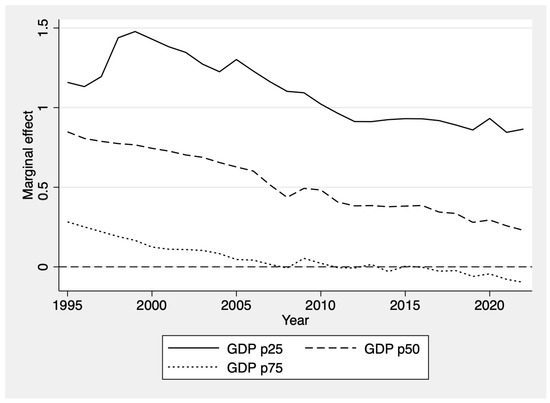
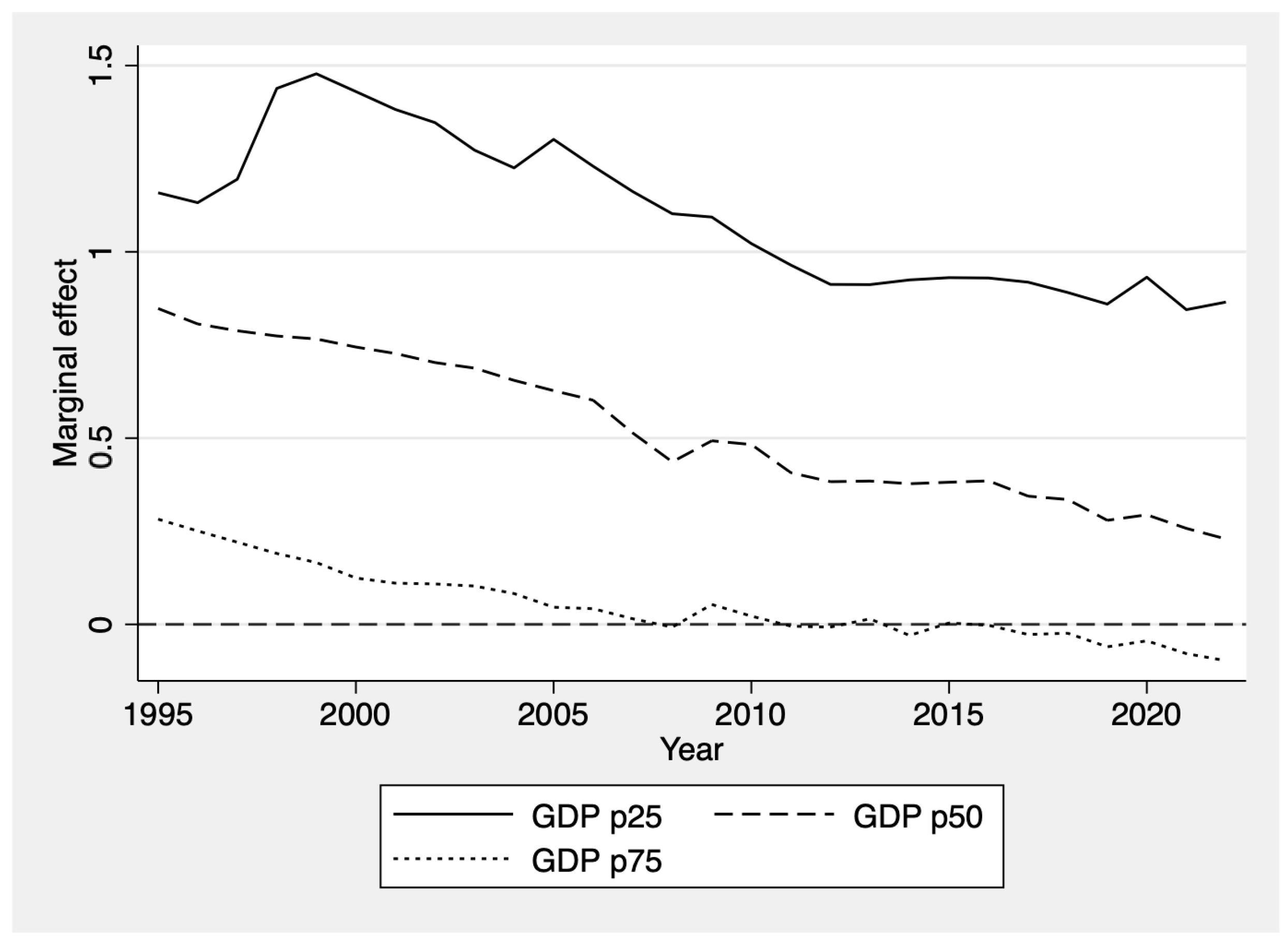
Figure 1 visualizes heterogeneity in the servicification–export relationship by development level. The figure is based on the second column of Table 2 that provides an overall interaction effect of .
Figure 1.
Marginal effects servicification.
The figure evaluates this expression at the 25th, 50th, and 75th percentiles of , calculated between countries within each year of the estimation sample. The key pattern is that the implied marginal effect is largest at the lower end of the income distribution (p25) and smaller at the median and upper quartile, indicating that the servicification–export association is substantially stronger for lower-income countries in the sample. Any movement of the lines over time reflects changes in the distribution of used for evaluation, rather than time-varying coefficients.
4.3. Mechanism-Oriented Outcomes: Intermediate Exports and the Value-Added Gap Proxy
Table 3 examines whether the baseline association is also visible in outcomes that speak more directly to value-chain linkages and upgrading-related patterns, rather than only to total exports. Specifically, we consider (i) intermediate agricultural value-added exports as a proxy for upstream linkages and (ii) an agriculture–economy value-added gap measure as an upgrading-related proxy.
Table 3.
Servicification and intermediate agricultural exports and value added gap.
The intermediate-export results show that servicification is positively associated with intermediate agricultural value-added exports, consistent with services supporting up-stream connectivity (aggregation, storage, coordination, logistics) rather than reflecting only final-market expansion. The upgrading-related proxy shows that servicification is associated with a smaller agriculture–economy value-added gap. Because this gap measure can reflect multiple forces—sectoral productivity shifts, compositional change, and broader macro dynamics—it is interpreted as a proxy pattern consistent with convergence/divergence, not as a direct estimate of “upgrading effects.”
4.4. Service Composition: Finance, ICT, and Complementarity
Table 4 explores whether the composition of service inputs matters by isolating (i) the financial services value-added share and (ii) the ICT services value-added share embodied in agricultural exports, and testing their interaction.
Table 4.
Financial and ICT services in agricultural exports.
First, because financial and ICT service intensities can co-move in development processes, we treat the interaction estimates as informative about complementarity but note that collinearity may inflate standard errors on the main effects when entered jointly. Second, to help interpret magnitudes, we report a simple “economic significance” calculation using a one-standard-deviation change (or a 10 percentage-point increase) in each service share and illustrate the implied association with agricultural value-added exports, holding other variables constant. This makes the interaction effect more interpretable than relying on the raw coefficient alone.
Overall, the estimates suggest that finance and ICT shares are each positively associated with export performance when entered separately, and that their interaction is positive, consistent with a setting in which financial deepening is most strongly associated with export performance when combined with information/coordination capacity (and vice versa). These patterns are consistent with enabling-services interpretations, but they should be read as correlations.
4.5. Labour-Market Correlates in a Subsample
Table 5 report labour-market correlates of servicification for the subsample with occupational and skill-composition data. Because these outcomes use broad categories (high vs. medium skill) and the subsample is smaller and more heterogeneous than the baseline export sample, the labour results are best read as an exploratory complement to Table 1, Table 2 and Table 3 rather than as definitive estimates of labour-market impacts.
Table 5.
Services share and income interactions by development group.
Table 5, top, examines whether servicification is associated with occupational upgrading, using the subsample with occupation data and defining the dependent variables as the percentage shares of high- versus medium-skill occupations. The motivation is that if servicification coincides with the build-up of coordination, compliance, logistics, and information tasks within agricultural value chains, one might also expect changes in the composition of work, particularly where service ecosystems are still developing. Table 5A therefore asks whether the servicification measure relating to export performance is also related to shifts toward higher-skill occupations. The high-skill results point to income-related heterogeneity rather than a uniform pattern. In column (1), the servicification coefficient is positive (consistent with a shift toward higher job-quality occupations) but not statistically significant. In column (2), with an interaction term for GDP per capita, the direct effect of servicification is positive and significant, while the interaction term is negative, indicating that any positive association weakens as incomes rise. For medium-skill occupations (columns 1–3), both direct and interaction effects are imprecisely estimated, so the results do not support strong claims about systematic changes in medium-skill job shares.
Table 5, bottom, relates servicification to worker capabilities, using the subsample with skills data and defining the dependent variables as the percentage shares of high-skill and medium-skill workers. The specification mirrors the earlier tables (country and year fixed effects, clustered standard errors) but shifts the focus from export outcomes to labour-market composition within agricultural value chains. For high-skill shares, column (1) reports a negative but imprecise baseline association. Column (2) allows for income heterogeneity: the main effect of servicification is positive, while its interaction with GDP per capita is negative and statistically significant. This pattern suggests that any positive association between servicification and high-skill shares is concentrated in economies where service ecosystems and complementary capabilities are still emerging, and becomes weaker at higher income levels. For medium-skill shares, column (3) again yields an imprecise baseline estimate. In column (4), the direct effect is positive and significant but is offset as income rises (the interaction term is negative), indicating a stronger positive association in lower-income countries. Taken together, Table 5B is consistent with servicification being associated with shifts away from low-skill work toward medium- and high-skill tasks in lower-income settings, but the evidence is not strong enough to support generalised claims about labour-market upgrading across all countries.
4.6. Summary of Results
Taken together, the empirical results yield five main patterns. First, servicification—measured as the services value added embodied in agricultural exports—is positively associated with agricultural export performance in value-added terms within countries over time. Second, when servicification is decomposed, the association is concentrated in the domestic services component, while the foreign component is smaller and does not display the same positive relationship (noting that the “domestic” component is location-based and may include services produced by foreign-owned affiliates established locally). Third, servicification is also positively associated with intermediate agricultural value-added exports and is negatively associated with the agriculture–economy value-added gap proxy, consistent with servicification coinciding with stronger upstream linkages and convergence-related patterns, though these proxy outcomes are interpreted cautiously. Fourth, service composition matters: financial and ICT service inputs display a positive complementarity pattern, suggesting that these enabling services are most strongly associated with export performance when they deepen together. Fifth, labour-market correlates in a smaller subsample are suggestive of stronger associations with skill-intensive employment shares at lower development levels; given the smaller and more heterogeneous sample and aggregated labour categories, these labour results are treated as an exploratory extension.
5. Conclusions
5.1. Main Findings
This paper extends the servicification concept from manufacturing to agricultural exports, examining how services embodied in exports associate with export performance, value-chain linkages, and structural outcomes across 80 countries (1995–2022). We find five robust within-country patterns.
First, higher servicification is associated with stronger agricultural export performance in value-added terms within countries over time. Second, servicification is also associated with intermediate agricultural value-added exports, consistent with servicification co-moving with deeper upstream connectivity rather than only final-market expansion. Third, domestic services dominate the association; foreign services show no comparable effect (despite the location-based decomposition including foreign affiliates). Fourth, servicification is associated with a smaller agriculture–economy value-added gap proxy; given that this proxy can reflect multiple forces, it is interpreted cautiously as an upgrading-related pattern rather than a direct estimate of upgrading effects. Fifth, service composition matters: the embodied shares of financial services and Information and Communication Technology (ICT) services display a complementarity pattern, suggesting that the association with export performance is strongest when both deepen together.
In a smaller subsample with labour data, servicification is associated with more skill-intensive employment shares primarily at lower levels of GDP per capita. Given the smaller and more heterogeneous sample and the aggregation of skill/occupation categories, these labour results are treated as an exploratory extension rather than definitive evidence of labour-market impacts.
5.2. Interpretation and Policy Relevance
The evidence supports a ’missing middle’ interpretation: enabling services (coordination, certification, logistics, finance, information systems) are tightly linked to export competitiveness and modern agri-food value-chain participation. The domestic-versus-foreign asymmetry implies that importing services cannot fully substitute for developing local service capacity—a critical policy distinction for countries seeking to build domestic value capture and strengthen rural linkages.
The financial-ICT complementarity points to a sequencing insight: financial expansion without accompanying improvements in information/traceability/coordination systems (or vice versa) yields limited gains in settings demanding reliability and rapid response. Rather than prescribing specific policies, this pattern highlights policy domains shaping enabling services: trade facilitation, logistics regulation, border procedures, financial access, and digital connectivity—all potentially important for agricultural exports.
5.3. Limitations
Several limitations qualify interpretation. First, the empirical design is associational. Servicification and export performance may evolve jointly and may be influenced by common reforms, demand shifts, or shocks. We did perform some rudimentary robustness checks, not reported. While 5 year rolling-average and lag specifications support the robustness of the main patterns to short-run fluctuations and alternative timing assumptions, lead/placebo evidence and timing considerations also indicate that reverse causality and joint dynamics are plausible, as stated elsewhere in the paper. With slow-moving variables, lagging and forwarding will provide similar regression results and do not solve the issue of causality, neither using internal instruments and dynamic panel settings. Good instruments are needed to do this, which are difficult to construct in this setting. Consequently, the estimates are interpreted as within-country conditional associations rather than causal effects, indicating that the dynamics systematically go together.
Second, servicification measures from TiVA rely on modelled input–output relationships and may miss informal services or quality differences across countries. Third, our domestic-versus-foreign decomposition is location-based; we cannot disentangle services from foreign-owned affiliates operating locally, limiting mechanism interpretation. We treat local servicification as a proxy for ’available service depth’ rather than domestic ownership.
We do not include institutional controls as separate regressors because institutional variation is largely time-invariant and absorbed by country fixed effects, and because time-varying institutional indices are highly collinear with GDP per capita. While this does not rule out institutional mechanisms, it means institutions are captured as part of country-specific characteristics rather than as explicit covariates, representing a trade-off between collinearity and mechanism transparency. In particular, aspects of the services regulatory environment—such as governance quality, competition, and openness in logistics, finance, and ICT—are partly reflected in the country effects and in the servicification measures themselves, but are not separately identified in the regressions. There is a clear case for future work to examine services-specific institutional development more directly, for example using indicators such as the OECD Services Trade Restrictiveness Index (STRI), yet current STRI coverage and time series are too limited across the 80-country, 1995–2022 panel used here to support a consistent and well-identified extension within this framework.
5.4. Future Research
Future work should prioritise identification strategies that can more credibly distinguish causality from correlation. Promising directions include exploiting quasi-experimental policy reforms affecting logistics and services regulation, staggered rollouts of digital infrastructure and traceability systems, and other sources of plausibly exogenous variation in access to enabling services. Developing and validating stronger instrumental-variable designs is particularly important given the evidence of joint dynamics and potential reverse causality. Progress in measurement would also benefit from linking macro TiVA-based servicification measures to more granular sectoral and firm-level evidence on service procurement, governance arrangements, and ownership structure, and from using more detailed labour classifications and wage/productivity outcomes to clarify distributional implications in agricultural regions. A further priority is to link servicification measures more explicitly to land-use outcomes, spatial patterns of agricultural production, and environmental or resource-use indicators to clarify how evolving service ecosystems affect land-based livelihoods and rural landscapes.
Author Contributions
Conceptualization, C.F. and H.R.; Methodology, H.R.; Formal analysis, H.R.; Investigation, H.R.; Resources, C.F.; Data curation, H.R.; Writing—original draft, H.R.; Writing—review & editing, C.F.; Project administration, C.F. and H.R. All authors have read and agreed to the published version of the manuscript.
Funding
This research received no external funding.
Data Availability Statement
The raw data supporting the conclusions of this article will be made available by the authors on request.
Conflicts of Interest
The authors declare no conflicts of interest.
Appendix A
Table A1.
Data sources and variable definitions.
Countries Included
Angola, United Arab Emirates, Argentina, Australia, Austria, Belgium, Bangladesh, Bulgaria, Belarus, Brazil, Brunei Darussalam, Canada, Switzerland, Chile, China, Côte d’Ivoire, Cameroon, Democratic Republic of the Congo, Colombia, Costa Rica, Cyprus, Czech Republic, Germany, Denmark, Egypt, Spain, Estonia, Finland, France, United Kingdom, Greece, Hong Kong, Croatia, Hungary, Indonesia, India, Ireland, Iceland, Israel, Italy, Jordan, Japan, Kazakhstan, Cambodia, Republic of Korea, Lao People’s Democratic Republic, Lithuania, Luxembourg, Latvia, Morocco, Mexico, Malta, Myanmar, Malaysia, Nigeria, Netherlands, Norway, New Zealand, Pakistan, Peru, Philippines, Poland, Portugal, Romania, Russian Federation, Saudi Arabia, Senegal, Singapore, Sao Tome and Principe, Slovak Republic, Slovenia, Sweden, Thailand, Tunisia, Türkiye, Taiwan, Ukraine, United States, Viet Nam, South Africa.
Note
| 1 | The domestic/foreign split is based on the location where services value added is generated (inside vs. outside the exporting country), not firm ownership; domestic services may therefore include services produced by foreign-owned affiliates operating locally. |
References
- Herrendorf, B.; Rogerson, R.; Valentinyi, A. Growth and structural transformation. In Handbook of Economic Growth; Aghion, P., Durlauf, S.N., Eds.; Elsevier: Amsterdam, The Netherlands, 2014; Volume 2B, pp. 855–941. [Google Scholar]
- Losch, B.; Fréguin-Gresh, S.; White, E.T. Structural Transformation and Rural Change Revisited; World Bank and AFD: Washington, DC, USA, 2012. [Google Scholar]
- Trienekens, J.H. Agricultural value chains in developing countries. Int. Food Agribus. Manag. Rev. 2011, 14, 51–83. [Google Scholar]
- OECD. Global Value Chains in Agriculture and Food; Technical Report 139; OECD Publishing: Paris, France, 2020. [Google Scholar]
- Gereffi, G.; Humphrey, J.; Sturgeon, T. The governance of global value chains. Rev. Int. Political Econ. 2005, 12, 78–104. [Google Scholar] [CrossRef] [Scilit]
- Cernat, L.; Kutlina-Dimitrova, Z. Thinking in a box: A “Mode 5” approach to services trade. J. World Trade 2014, 48, 1109–1126. [Google Scholar] [CrossRef] [Scilit]
- Miroudot, S.; Cadestin, C. Services in Global Value Chains: From Inputs to Value-Creating Activities; OECD Trade Policy Papers 197; OECD: Paris, France, 2017. [Google Scholar]
- Reardon, T.; Echeverria, R.; Berdegué, J.A.; Minten, B.; Liverpool-Tasie, L.; Tschirley, D.; Zilberman, D. Rapid transformation of food systems in developing regions. Agric. Syst. 2019, 172, 47–59. [Google Scholar] [CrossRef] [Scilit]
- Timmer, C.P. A World Without Agriculture; Aei Press: Washington, DC, USA, 2009. [Google Scholar]
- Barbier, E.B. Is green rural transformation possible in developing countries? World Dev. 2020, 131, 104955. [Google Scholar] [CrossRef] [Scilit]
- Kaplinsky, R.; Morris, M. A Handbook for Value Chain Research; IDRC: Ottawa, ON, Canada, 2001. [Google Scholar]
- Barrett, C.B.; Reardon, T.; Swinnen, J.; Zilberman, D. Agri-food value chain revolutions in low- and middle-income countries. J. Econ. Lit. 2022, 60, 1316–1377. [Google Scholar] [CrossRef] [Scilit]
- Reardon, T.; Barrett, C.B.; Berdegué, J.A.; Swinnen, J. Agrifood industry transformation and small farmers in developing countries. World Dev. 2009, 37, 1717–1727. [Google Scholar] [CrossRef] [Scilit]
- Reardon, T.; Timmer, C.P.; Berdegué, J. The rapid rise of supermarkets in developing countries: Induced organizational, institutional, and technological change in agrifood systems. Electron. J. Agric. Dev. Econ. 2004, 1, 168–183. [Google Scholar]
- Bellemare, M.F.; Bloem, J.R. Does contract farming improve welfare? A review. World Dev. 2018, 112, 259–271. [Google Scholar] [CrossRef] [Scilit]
- Vroegindewey, R.; Hodbod, J. Resilience of agricultural value chains in developing country contexts. Sustainability 2018, 10, 916. [Google Scholar] [CrossRef] [Scilit]
- Nordås, H.K. Trade in goods and services: Two sides of the same coin? Econ. Model. 2010, 27, 496–506. [Google Scholar] [CrossRef] [Scilit]
- Francois, J.; Hoekman, B. Services trade and policy. J. Econ. Lit. 2010, 48, 642–692. [Google Scholar] [CrossRef] [Scilit]
- Greenville, J.; Kawasaki, K.; Beaujeu, R. How Policies Shape Global Food and Agriculture Value Chains; OECD Food, Agriculture and Fisheries Papers 100; OECD: Paris, France, 2017. [Google Scholar]
- Low, P. The role of services in global value chains. In Global Value Chains in a Changing World; Elms, D., Low, P., Eds.; WTO: Geneva, Switzerland, 2013; pp. 61–81. [Google Scholar]
- Thangavelu, S.M.; Wang, W.; Oum, S. Servicification in Global Value Chains: The Case of Asian Countries; Technical Report ERIA Discussion Paper Series—DP-2017-12; Economic Research Institute for ASEAN and East Asia (ERIA): Jakarta, Indonesia, 2017. [Google Scholar]
- Johnson, R.C.; Noguera, G. Accounting for intermediates: Production sharing and trade in value added. J. Int. Econ. 2012, 86, 224–236. [Google Scholar] [CrossRef] [Scilit]
- Koopman, R.; Wang, Z.; Wei, S.J. Tracing value-added and double counting in gross exports. Am. Econ. Rev. 2014, 104, 459–494. [Google Scholar] [CrossRef] [Scilit]
- Timmer, M.P.; Los, B.; Stehrer, R.; de Vries, G.J. Slicing up global value chains. J. Econ. Perspect. 2014, 28, 99–118. [Google Scholar] [CrossRef] [Scilit]

Disclaimer/Publisher’s Note: The statements, opinions and data contained in all publications are solely those of the individual author(s) and contributor(s) and not of MDPI and/or the editor(s). MDPI and/or the editor(s) disclaim responsibility for any injury to people or property resulting from any ideas, methods, instructions or products referred to in the content. |
© 2026 by the authors. Licensee MDPI, Basel, Switzerland. This article is an open access article distributed under the terms and conditions of the Creative Commons Attribution (CC BY) license.