1. Introduction
Land trusteeship services are an essential requirement for achieving agricultural modernization. However, in the process of promoting the socialization of land trusteeship services [
1], there is a growing risk of service quality problems. The quality risk of land trusteeship service refers to the uncertainty in the quality of services provided by service organizations to farmers, including mechanization, inputs, agronomic management, harvesting, marketing, and so on. Due to the lagging, unobservable, and unsound supervision system of agricultural machinery operation quality, service organizations often act in an opportunistic manner [
2], in order to maximize operational time savings and reduce fuel consumption and the depreciation cost of machinery. For example, the engine load rate is artificially manipulated, and operations that should have been deep plowing are replaced by shallow plowing. In the machine harvesting operation [
3], the cutting table feeding speed is too fast, and the feeding amount is too large, which is easy to cause mechanical blockage and failure. In addition, under special circumstances such as turning, picking up, falling, and overripe lots, the problem of high leakage loss occurs from time to time [
2], and all these various malpractices together generate quality risk of land trusteeship services, which brings serious damage to farmers. Farmers originally expected to improve agricultural production efficiency through the land trusteeship services [
4], but suffered losses due to the service quality risk, which not only affects the economic returns of farmers, but also brings great challenges to the stable development of agricultural production. Due to the growth characteristics of crops, it is difficult to supervise land trusteeship services. So, did supervision failures lead to the quality risk of land trusteeship services? This is the core question of concern in this paper.
Agricultural family operation does not require agricultural production supervision, so there are few studies on agricultural production supervision behavior [
2]. Existing studies mainly focus on the supervision of bank behavior [
5,
6,
7,
8,
9,
10], enterprise and employee behavior [
11,
12,
13,
14,
15,
16], pollution behavior [
17] and so on. Regarding the supervision of pollution behavior, Zeng et al. used the survey data of farmers to determine the effects of different environmental supervision concepts on the willingness and intensity of farmers to adopt smart pig farming technology [
18]. Bao et al. investigated the effects of governmental supervision on the behavior of farmers in the management of surface pollution [
19]. Yu et al. analyzed the effects of supervision on the behavior of fishermen in the cultivation of new pollutants [
20]. After the emergence of land trusteeship services, farmers and service organizations formed the principal–agent relationship, but the practice and academic circles have paid limited attention to this agency problem. Land trusteeship services refer to market-oriented, specialized, and scaled services covering the entire production chain provided by entities such as professional service companies, farmer cooperatives, rural collective economic organizations, and specialized service providers to agricultural operators, including smallholder farmers and family farmers [
2]. As a new way of agricultural production and management, the land trusteeship services has its favorable aspects, such as promoting the adoption of green technology in agriculture [
21,
22,
23], promoting the increase in food production [
24] and non-farm employment of farmers [
25], increasing the income of farmers [
26,
27,
28]. The benefits are observed when service quality is adequate; if there are failures, performance may decline. There are also unfavorable aspects, such as lowering food yields and increasing the service quality risk [
2]. However, scholars only pay attention to the favorable side, but neglect the problem of land trusteeship services quality risk. In fact, the prevention and control of quality risk is the premise and guarantee of the comprehensive effect of land trusteeship services. Literature closely related to risk prevention and control is a series of studies on agricultural risks, such as risk identification [
29,
30], risk causes [
31,
32], risk hazards [
33,
34], and risk prevention and control [
35,
36]. However, there are few studies related to the quality risk of land trusteeship services [
37]. To summarize, the existing literature does not provide a reasonable and effective answer to the scientific question of supervision failure leading to the quality risk of land trusteeship services.
This paper aims to reveal the effects of supervision failure on the quality risk of land trusteeship services and its underlying mechanisms. According to the above practical problems and theoretical gaps, based on the principal–agent theory, this paper analyzes the formation mechanism of land trusteeship services quality risk from the perspective of supervision, obtains farmers’ data through questionnaire survey, empirically examines the influence of direct and indirect supervision on the land trusteeship services quality risk by using the Heckman model, then carries out robustness and heterogeneity analysis. The research can contribute to enriching agricultural principal–agent theory, strengthening service supervision, and enhancing the quality of land trusteeship services.
This paper has the following innovations. First, from a theoretical perspective, most existing studies analyze land trusteeship services and their quality risks through frameworks such as the division of labor [
1], property rights [
38], economies of scale [
39], transaction costs [
40], and incomplete contracts [
41]. However, little research has yet adopted the principal–agent theory perspective. Land trusteeship services represent a classic principal–agent relationship between farmers and service organizations. To clarify the formation mechanism of quality risk of land trusteeship services, it is essential to approach the issue from the principal–agent theory perspective. Second, existing literature solves the principal–agent problem between service organizations and farmers based on economic incentives. However, in the practice of land trusteeship services, it is difficult to implement incentive mechanisms such as an overproduction share. Farmers are often unwilling to take out additional agricultural surplus to motivate service organizations not to engage in opportunistic behavior, but prefer to choose to supervise the service organization’s behavior. Therefore, this paper explores the cause and prevention of quality risk of land trusteeship services from a supervision viewpoint, which is more realistic and innovative. Third, due to the possible sample self-selection problem, the use of the Ordinary Least Squares model will overestimate the effect of supervision failure on the quality risks of land trusteeship services [
42]. Therefore, this paper uses the Heckman model to correct the estimation bias caused by the sample self-selection problem, so as to make the effect of the supervision mechanism more credible.
The remainder of this paper is structured as follows.
Section 2 presents theoretical analysis and research hypotheses.
Section 3 outlines the empirical research design.
Section 4 reports regression results and analysis.
Section 5 concludes with findings and policy recommendations.
2. Theoretical Analysis
The principal–agent theory is a core theory in economics, specifically referring to the conflict of interests arising when principals struggle to effectively supervise agents’ behavior. This issue stems from information asymmetry and commonly occurs in relationships such as those between business owners and management, or shareholders and managers. To address this problem, economic theory proposes designing incentive, supervision, and constraint mechanisms to align the objectives of principals and agents. The theory is primarily applied in corporate management and public administration. In corporate management, it mainly involves executives supervising employee behavior [
13] and governments supervising corporate conduct [
5,
6,
14]. In public administration, it primarily concerns the government supervising environmental pollution activities [
17,
18]. As the theory applied to this present work, the relationship between farmers and service organizations in land trusteeship services is conceptualized as a principal–agent relationship where farmers are principals and service organizations are agents. Service organizations may exploit information asymmetry to engage in opportunistic behavior. As principals, farmers need to supervise the behavior of service organizations.
Supervision is an important means of addressing the opportunistic behavior of agents in principal–agent relationships [
43,
44], and it is less costly to supervise ex ante than to take remedial measures after getting into trouble [
45]. However, the difficulty of supervision of land trusteeship services is reflected in the characteristics of agricultural production and the failure of the supervision system. First, the characteristics of agricultural production. The effects of agricultural production operations are lagging and unobservable, with one example being the spreading of medicine. The type and amount of medicine used by the service organization is difficult for farmers to observe, and the effect of killing insects can only be seen after a period of time. Second, the failure of the supervision system of land trusteeship services. Whether it is directly supervised by farmers or indirectly supervised by intermediary organizations, it is difficult and ineffective.
The mechanism by which supervision failure impacts the quality risk of land trusteeship services involves reducing service costs and increasing service revenue. On one hand, service providers strive to reduce costs by substituting inferior agricultural inputs for higher-quality ones during pre-production services. During mid-production services, they deliver substandard assistance to minimize machinery wear and tear. On the other hand, service organizations strive to increase service revenue. Given the seasonal nature and time-sensitive windows of agricultural production, during peak farming periods, service organizations accelerate their service pace to serve more farmers, thereby generating higher service revenue. For example, they may increase feed rates during harvesting. However, this also leads to higher harvesting loss rates. Accordingly, this paper puts forward the following hypothesis.
H1: Supervision failure positively affects the quality risk of land trusteeship.
2.1. Failure of Direct Supervision
The failure of direct supervision by farmers leads to quality risk of land trusteeship services. At present, the supervision of land trusteeship services is basically done by farmers, whose supervisory ability is very weak [
2]. If the effect of land trusteeship services can be observed by farmers directly with their eyes, then the service quality risk can be easily avoided. However, the quality of agricultural machinery operations needs to be measured by several months after the seedling density, straw thickness, spike rate, and grain fullness in the mid-production stage. While the performance of these aspects of the crop will also be affected by climate, soil, fertilizer, pesticides, and other factors [
46], which is very difficult to figure out the correspondence. This makes farmers generally feel “uneasy” about the processes that are not operated by them. Possible reasons are as follows.
Firstly, it is difficult for farmers to judge whether a service organization has adopted opportunistic behavior through outward actions when operating agricultural machinery [
37]. Therefore, even if farmers stand by the land to supervise service organizations, the results may not necessarily be good. Secondly, it is difficult for farmers to observe the technical indicators of machinery operation, including engine load rate, fuel consumption rate, operating speed, cutting table feeding speed, etc., and judge whether the service organization has adopted opportunistic behavior [
34]. Most farmers are unfamiliar with the technical specifications of these agricultural machines. Thirdly, it is difficult for farmers to observe and recognize the quality of agricultural machinery operations on the spot, and it is more difficult to observe and recognize the depth of plowing, the density of topsoil coverage, the density of sowing uniformity, harvesting seed spilling, leakage of harvested grains, and loss of clearing [
2,
34,
37]. Accordingly, this paper puts forward the following hypothesis.
H2: Direct supervision failure positively affects the quality risk of land trusteeship.
2.2. Failure of Indirect Supervision
The failure of indirect supervision by intermediaries leads to quality risk of land trusteeship services. In practice, we are exploring the establishment of a supervising force and system for land trusteeship services with intermediary organizations, such as village collectives, so as to directly intervene in the operational behavior of service organizations and reduce the quality risk of land trusteeship services.
However, moral hazards exist in the dual principal–agent relationship between the village collective and village cadres [
47]. On one hand, the village collective is principal, and the village committee is the agent. On the other hand, the village committee is principal, and the village cadres is agent [
48]. This may lead to principal–agent problems, such as in corporate governance, where management and majority shareholders compete for control of the enterprise, and investors choose to “collude” with management and “supervise” the behavior of majority shareholders. In farmers’ professional cooperatives, core members acting as agents may infringe on the interests of small and medium-sized members and the overall value of the cooperative. In land trusteeship services, village cadres and service organizations “conspire” against the interests of farmers. The characteristics of small and dispersed farming households have a great negative impact on the demand for mechanized services, and village cadres face multiple obstacles in organizing farmers to carry out land trusteeship services, mainly in the following aspects:
First, dispersed farmers are not unified in the selection of varieties and farming arrangements [
47], making it difficult for farmers to connect with large-scale land trusteeship services. Second, the differentiation of farmers has led to a clear difference in the demand for land trusteeship services [
37]. Third, the land cannot be centralized, which makes village cadres face many difficulties in organizing farmers [
2]. Village cadres may be less motivated to work in the socialization of land trusteeship services, may be lax in the matching of supply and demand, or in the coordination between farmers and service organizations. This will make the effect of village collective coordination greatly reduced, generate higher commission agency costs, and even change the direction of the role of village collective coordination on the quality risk of land trusteeship services. Ultimately, it cannot play the role of indirect supervision by intermediary organizations, which triggers quality risk of land trusteeship services. Accordingly, this paper puts forward the following hypothesis.
H3: Indirect supervision failure positively affects the quality risk of land trusteeship.
Based on the agricultural production process, quality risks in land trusteeship service can be categorized into pre-production, mid-production, and post-production service quality risks [
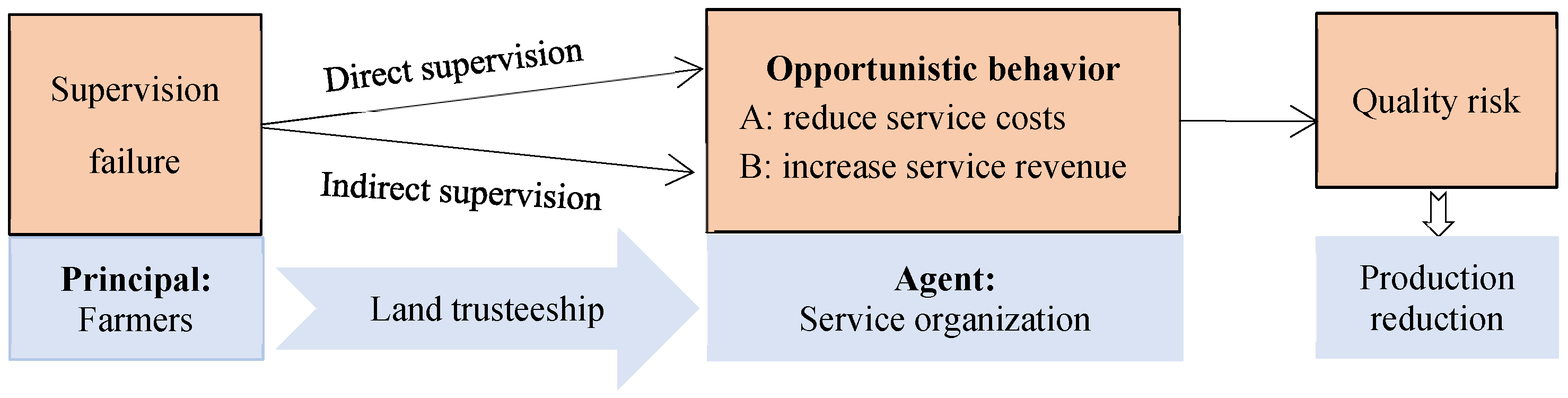
37]. Pre-production service quality risk contains materials supply risk, machinery supply risk, land consolidation risk, seeding breeding risk, and cultivation risk. Among them, the machinery supply risk is inadequate, untimely, or low-quality supply of agricultural machinery. Mid-production service quality risk contains sowing quality risk, fertilizer application risk, crop irrigation risk, pest control risk, weed control risk, and harvesting risk. Among them, harvesting risk is higher rates of fruit damage or loss due to machine harvesting. Post-production service quality risk contains product drying risk, storage risk, processing risk, transportation risk, and sales risk. Among them, the product drying risk is inadequate drying, leading to high moisture content of the product, affecting storage life. Similar to the preceding section, supervision failure positively impacts the pre-production, mid-production, and post-production service quality risks. But the effect varies based on service observability. In the absence of supervision, moral hazard behaviors readily trigger quality losses. Although information asymmetry exists in pre-production stages, certain processes can be partially remedied. In post-production, outputs are already formed. The quality metrics are easily quantifiable and verifiable, leaving minimal room for moral hazard. Based on the above analysis, this paper proposes the following hypothesis. The mechanism of quality risks arising from supervision failure is illustrated in
Figure 1.
H4: Supervision failure positively affects pre-production, mid-production, and post-production service quality risks. The effect varies based on service observability.
3. Empirical Research Design
3.1. Data Sources
As a large agricultural province of China, Shandong Province is very representative and typical in land trusteeship services. It has a significant trend toward large-scale land trusteeship services, with many large-scale farms and cooperatives emerging, which has a strong demand for and in-depth exploration of large-scale application of agricultural machinery and professional services. It is conducive to the study of efficient organization and operation modes of land trusteeship services in the modern agricultural industrial system. In addition, Shandong province has a well-developed agricultural machinery industry, many enterprises with advanced technology, and a complete range of agricultural machinery, which provides a solid industrial foundation and rich practical cases for the study of land trusteeship services.
In order to ensure that the sample can reach a relatively even distribution within the overall scope of Shandong province, so as to accurately reflect the actual situation of land trusteeship services. Twenty counties with a relatively large volume of land trusteeship services were carefully selected from 12 cities in the east, middle, west, and north–south parts of Shandong Province as the sample survey areas. In the sampling process, a stratified random sampling method was first used to select three sample townships in each selected sample county. Then, two administrative villages were selected in each sample township. Finally, in each sample village, farmers are selected in strict accordance with the rules of random sampling, and then questionnaires are distributed to these sample farmers.
The authors implemented the follow-up survey in two waves between 2022 and 2023. Accordingly, the panel data is obtained. The returned questionnaires were critically scrutinized to exclude invalid questionnaires due to problems such as omissions or errors. In view of the objective reality that the current group of farmers is constantly divided, it is very likely that some farmers did not participate in the land trusteeship services when the sample farmers were selected. Therefore, in order to ensure the validity and relevance of the survey data, the research team carried out a careful screening of the sample farmers and excluded the sample farmers who did not adopt the land trusteeship services. A total of 1138 valid questionnaires were obtained from the farmers’ survey in these two years. The distribution of survey samples and questionnaires is shown in
Table 1.
3.2. Selection of Variables
(1) Explained variables. Based on the theoretical analysis, the explained variables selected in this paper are the quality risk of land trusteeship services. To further analyze the impact of supervision failure on the production process, this study selects pre-production, mid-production, and post-production service quality risk as explanatory variables. The questionnaire items for farmers are: How high do you perceive the service quality risk during pre-production, mid-production, and post-production stages of land trusteeship in 2022? And how high in 2023? According to the related study [
2], all of these were characterized by a five-level Likert scale; very low = 1, low = 2, average = 3, high = 4, and very high = 5. Farmers assign subjective scores ranging from 1 to 5 for these variables. First, the Cronbach’s alpha is 0.83, and all correlation coefficients exceed 0.75, indicating that the Likert scale possesses high reliability. The results of the KMO and Bartlett’s tests indicate that the sample data in this study are suitable for factor analysis. The confirmatory factor analysis results indicate that the Likert scale demonstrates good construct validity. Third, the CR values in this paper are all greater than 0.75, and the AVE values are all greater than 0.55. So, the discriminant validity test passed.
(2) Core explanatory variable. This paper selects supervision failure as the core explanatory variable. Supervision failure is the failure degree of farmers to supervise agricultural service organizations. Based on theoretical analysis, supervisory failure can be categorized into direct supervisory failure and indirect supervisory failure. Direct supervision failure refers to the ineffectiveness of farmers’ direct oversight of service organizations. Indirect supervision failure refers to the breakdown of supervision over service organizations through various intermediary bodies, such as village collectives. They are all characterized by a five-level Likert scale; very low = 1, low = 2, average = 3, high = 4, and very high = 5.
(3) Instrumental variable. To address endogeneity issues arising from other unobservable factors, we employ plots as an instrumental variable (IV). Plots is the number of plots owned by the farmer. Under China’s farmland allocation model, the number of plots is an exogenous variable that is not associated with the quality risk of land trusteeship services, which meets the requirement that the instrumental variable be uncorrelated with the dependent variable. Meanwhile, supervision failure is generally positively correlated with the number of plots. The higher the number of plots, the more difficult it is to supervise land trusteeship services, which conforms to the requirement that the instrumental variable is correlated with the endogenous variable.
(4) Control variables. In this paper, gender, age, education level of the household head, and whether or not they are party members are selected as individual-level control variables. Health status, position in the village, number of people working in agriculture, number of people working in the labor force, and participation in cooperatives are selected as household-level control variables. Soil fertility and ease of irrigation are selected as farmland-level control variables [
2]. Among them, the variable of whether the head of the household is a member of the Communist Party of China (CPC) takes the value of 1 if he/she is a member of the CPC, and 0 if not. The health status is the health status of the members of the household. The number of farmers and workers indicates the number of laborers in the household who are working at home in agriculture and those who are working outside the home, respectively. Cooperative participation is a dummy variable for whether the farmer participates in an agricultural cooperative. Soil fertility and irrigation accessibility are characterized by a five-point Likert scale. Area is the identification condition for the Heckman selection equation. The area variable is the total area of cropland contracted by the farmer. The definitions and descriptive statistics of the variables are shown in
Table 2.
3.3. Modeling
(1) Baseline regression model
There may be sample self-selection by farmers in the process of land trusteeship services, and the OLS model is no longer applicable in this study, because it will overestimate the effect of supervision failure. The reason is that farmers’ choices of supervision are not random and may be affected by a variety of unobserved factors that are potentially related to service quality risk. Farmers who choose to supervise may differ systematically from non-supervisors in unobservable ways that also influence perceptions of quality risk.
In order to effectively correct the estimation bias due to the sample self-selection problem, the Heckman model is able to fully take the non-random factors in farmers’ choice of supervision into account by constructing a choice equation and an outcome equation. In the selection equation, variables that may affect farmers’ choice of supervision can be included as a way to predict the probability of farmers’ choice of supervision. Then, based on the estimation results of the selection equation, the inverse Mills ratio is calculated and incorporated into the outcome equation. The outcome equation focuses on the relationship between supervision failure and the quality risk of land trusteeship services, with the inclusion of the inverse Mills ratio. It is able to adjust for the bias due to sample self-selection, thus estimating the true effect of supervision failure on the quality risk of land trusteeship services more precisely. This paper adopts the Heckman model to explore the effect of supervision failure on quality risk, which is divided into two stages: the farmer selection model and the result model construction. The two steps of the Heckman model setting are as follows.
The first stage is the selection equation. The probability of farmers carrying out service quality supervision is estimated using a Probit model, and the selection equation is shown in Equation (1). In the equation,
denotes the probability that farmers carry out quality supervision of services.
is a dummy variable, which takes the value of 1 when farmers supervise the quality of land trusteeship services and 0 when they do not supervise the quality.
is the identification criterion. It influences supervisory decisions but does not directly impact service quality risk.
is the coefficient to be estimated,
is the vector of control variables influencing supervision decision-making.
The second stage is the result equation. The inverse Mills ratio is calculated according to the selection equation, and the quality risk level of land trusteeship services is the explained variable. Supervision failure, inverse Mills ratio, and control variables are the explanatory variables. The expression of the result equation is shown in Equation (2). Where
denotes the quality risk level of land trusteeship services,
denotes the supervision failure variable,
is the coefficient to be estimated,
is the inverse Mills ratio,
is the control variable influencing quality risk, and
is the error term.
(2) Robustness test model
In order to clarify the influence of various types of factors on the results, the Random Forest Model (RF) is utilized to calculate the importance of risk-causing factors for the quality of agricultural service operations. In this paper, the model is used to test the robustness of the results. Empirical analysis using RF can deal with mixed data and nonlinear relationships that exist between multidimensional variables and target values. It can also be used to do clustering, discriminant analysis, regression, and survival analysis.
The basic method of RF for the classification and selection of multidimensional complex data is as follows. First, based on the field research sample set, where the sample capacity is
N, Bootstrap sampling is utilized to extract
S samples from the original training set to generate
S random vector decision trees
θ. Second, independently distributed random vector sequences
θi are utilized to build decision tree models for evaluating the quality risk causative factors {
h(
x,θi),
i = 1,
S,
k}, where
x is the filtered factors affecting the quality risk. Subsequently, through
k rounds of screening, the decision tree model sequence {
h1(
x),
h2(
x),
h3(
x)} is obtained. It is utilized to form a multidimensional quality risk causative factor regression modeling system that determines the final classification result, and the formula is expressed as Equation (3). Where
hi(
x) denotes a single decision tree,
H(
x) is a random forest combined classification model, and
Y is the output target variable.
Calculating the importance of feature variables is the classic use of RF. First, use the out-of-bag data to calculate the out-of-bag error
et of each decision tree, and then randomly change the value of the
j feature variable
Xj to re-calculate the out-of-bag error
, according to which we can get the importance of the feature variables
Importance(
Xj), see Equation (4).
4. Regression Results and Analysis
4.1. Results and Analysis of Baseline Regression
Based on the empirical research design above, this paper uses the Heckman model to explore the impact of supervision failure on the quality risk of land trusteeship services. STATA15 software is used to analyze the sample data, and the estimation results of the OLS regression model and the Heckman model are compared and analyzed. The results are shown in
Table 3.
First, the estimation results of OLS model 1 and Heckman model 2 show that the effects of supervision failure on service quality risk are 0.181 and 0.139, respectively, which are both significant at the 1% level. It can be seen that the OLS model overestimated the main effect of supervision failure by 23%, and the Heckman sample selection model effectively corrected the sample selectivity bias in the quality risk of land trusteeship services.
Second, the area variable is significant at the 1% level, indicating that the selected identification variable is appropriate for the analysis of the Heckman model 2. The selection equation of model 2 shows that the number of workers, cooperative participation, and irrigation convenience variables negatively affect the decision to supervise land trusteeship services. The gender, age, education level, whether party member, whether village cadre, number of farmers, health status, and soil fertility variables positively affect the decision to supervise land trusteeship services. From the result equation of model 2, the significance level of the inverse Mills ratio (IMR) is 5%, indicating that there is a sample self-selection problem. That is to say, there is a correlation between whether or not farmers carry out supervision of land trusteeship services and the risk level. So, it is reasonable to use the Heckman model for parameter estimation. The effect of supervision failure on the quality risk of land trusteeship services is significantly positive at 1% level, indicating that there is a positive effect of supervision failure on the quality risk of land trusteeship services. So, the hypothesis H1 is proved.
Third, in the result equation of model 3, the coefficient for direct supervision is 0.126, significant at the 5% level. This indicates that direct supervision failure positively influences the quality risk of land trusteeship service. So, the hypothesis H2 is proved. In model 4, the coefficient of the indirect supervision variable is 0.108, with a significance level of 5%. This indicates that indirect supervision failure positively influences the quality risk of land trusteeship services. So, the hypothesis H3 is proved. Comparing the two reveals that direct supervision failures exert a stronger impact on service quality risks than indirect supervision failures.
Further analysis shows that the impact of different risk types of supervisory difficulties is not the same. According to the classification of land trusteeship services quality risk in the previous section, service quality risk contains pre-production, mid-production, and post-production service quality risk. This paper uses the same method and control variables as the benchmark regression to obtain the regression results of the three types of quality risk of land trusteeship services, which are shown in
Table 4.
It can be seen that all three IMRs in models 1, 2, and 3 are significant at the 5% level, indicating that there is a sample self-selection problem, i.e., there is a correlation between whether or not farmers conduct supervising and the quality risk level of land trusteeship services. So, the use of the Heckman model for parameter estimation is reasonable. The results of the selection equations were generally consistent with expectations. The result equations of models 1, 2, and 3 all show that the effect of supervision failure on pre-production and mid-production service quality risk is significantly positive at the 5% level, indicating that there is a positive effect of supervision failure on pre-production and mid-production service quality risk. The effect of supervision failure on post-production service quality risk is significantly positive at the 10% level, indicating that there is a positive effect of supervision failure on post-production service quality risk. So, the hypothesis H4 is proved.
In order of magnitude, this effect is mid-production, pre-production, and post-production service quality risk. This may stem from the highly concealed nature of mid-production operations, where decisions directly impact crop growth and cause irreversible damage.
4.2. Robustness Tests
In order to enhance the reliability of the above findings, this paper conducts robustness tests from two aspects. One is an instrumental variable test. The other is the model replacement test, which replaces the benchmark regression model with a model such as machine learning. Furthermore, the results of multicollinearity and heteroscedasticity tests indicate that this model does not exhibit the aforementioned issues. Due to space constraints, these test results are not presented here.
- (1)
Robustness tests for IV
Although the Heckman model has the function of reducing endogeneity, there may still be other factors that lead to endogeneity in the parameter estimates of supervision failure variables. Specifically, the quality risk of land trusteeship services is both horizontally and vertically contagious. That is to say, there may be a reverse causality between land trusteeship service quality, risk, and supervision failure, resulting in a lack of credibility of the estimation results. Based on this, this paper adopts the instrumental variable approach to address the endogeneity bias caused by the reverse causality between the independent and dependent variables. The number of farm plots is selected as an instrumental variable for supervision failure to test the possible endogeneity problem. The results are shown in
Table 5.
Table 5 Model 1 reports the estimation results of the number of plots of land trusteeship services as an instrumental variable. The coefficients and their significance are basically in line with the expectations, so there is no endogeneity problem in the baseline regression results. Meanwhile, the Endogenous Switching Regression (ESR) model is used in this paper to replace the Heckman model, and the Maximum Likelihood Estimation (MLE) replaces the OLS method for parameter estimation. The regression coefficients of instrumental variables and their significance in models 2, 3, and 4 are basically consistent with the benchmark regression model, indicating that the benchmark estimation results are robust.
- (2)
PSM model robustness test
The farmers’ choice of supervision is not a random event, so there may be estimation bias due to sample selection bias problems. In addition, there may also be endogeneity caused by model setting bias. In this paper, we assigned farmers who supervise service quality to the treatment group and selected farmers who do not supervise service quality as the control group. Then, we use the PSM model for robustness testing, with land trusteeship services quality risk as the dependent variable and supervision failure as the independent variable. The matching methods are selected as entropy balance matching, caliper matching (range = 0.05), kernel function matching (bandwidth = 0.06), and K-nearest neighbor matching (k = 4). Among them, entropy balance matching is used to weigh the data of the control group to make it consistent with the covariate moments of the treatment group. The average treatment effects under the four matching rules are shown in
Table 6.
As can be seen from
Table 6, the average treatment effect of supervision failure is significantly positive, indicating that supervision failure has a significant positive effect on the quality risk of land trusteeship services. And compared with the treatment effects without sample matching, the treatment effects of supervision failure are all reduced after sample matching. This indicates that sample matching effectively reduces the endogeneity problem, thus reducing the overestimation of the results.
Further, the matched samples were subjected to regression analysis using the same variables as in the baseline regression. The results of the PSM model robustness test under the four matching rules were obtained, as shown in
Table 7. It can be seen that supervision failure increases the quality risk of land trusteeship services. These results are consistent with the benchmark regression. Synthesizing the above test results, the benchmark regression results are robust.
- (3)
Machine learning model robustness test
In this paper, robustness tests are performed using machine learning methods such as regression trees and random forest models, which are suitable for nonlinear regression to reduce estimation bias due to model setting errors and to reduce endogeneity problems due to omitted variables. In this paper, R 4.2.2 software is used to perform the computation of the Random Forest (RF) model. In addition, in order to carry out the comparison of the fitting effect of machine learning models, this paper still uses the Support Vector Machine (SVM) model, Convolutional Neural Network (CNN) model, and Lasso model for fitting. The results obtained from the estimation of the five models are shown in
Table 8.
The estimation results from the RF model show that the estimation coefficients of supervision failure variables are positive, indicating that supervision failure positively affects the quality risk of land trusteeship services. Based on the importance coefficients of the features, it is evident that the coefficient for supervision is significantly larger than those of other variables. This indicates that supervision failure is a major cause of quality risk of land trusteeship services. In addition, the fitting results of the SVM model, CNN model, and Lasso model all show that the regression coefficients of supervision failure variables are positive, indicating that supervision failure positively affects the quality risk of land trusteeship services.
6. Conclusions, Policy Implications, and Prospects
6.1. Conclusions
The quality risk of land trusteeship services is getting more and more intense. Based on the principal–agent theory, this paper analyzes the mechanism of supervision failure leading to the quality risk of land trusteeship services, chooses Shandong province of China as the research location, and applies the IV-Heckman model based on the collection of farmers’ data to empirically test the impact of supervision failure on the quality risk of land trusteeship services. The study found that:
(1) The significance level of the IMR indicates that there is a sample self-selection problem; that is to say, it is reasonable to use the Heckman model for parameter estimation. The Heckman result equation shows that supervision failure positively affects land trusteeship service quality risks, mid-production service quality risk, pre-production service quality risk, and post-production service quality risk. The effect size is in the order of mid-production, pre-production, and post-production service quality risk.
(2) The estimation results of the OLS model and Heckman model show that supervision failure has a significant positive effect on land trusteeship services quality, with risk being 0.181 and 0.139, respectively. It can be seen that the OLS model overestimated the main effect of supervision failure by 23%. The Heckman model effectively corrected the sample selectivity bias of the quality risk of land trusteeship services.
(3) The results of the heterogeneity analysis showed that, in terms of crop heterogeneity, the impact of supervision failure on the quality risk of different crop types was in the order of cash crops, corn, and wheat. In terms of link heterogeneity, the influence of supervision failure on the quality risk in different links is single-link, multi-link, and full-link, in order of magnitude.
(4) Supervision failure positively affects the four quartiles of the quality risk of land trusteeship services. In order of the influence degree from low to high are 25%, 50%, 75% and 100% quartiles. It can be seen that the higher the quality risk level, the deeper the influence of supervision failure on the quality risk of land trusteeship services.
6.2. Policy Implications
This paper proposes the following policy insights to reduce the quality risk of land trusteeship services.
First, a sound regulatory mechanism for land trusteeship services should be established. Establish a regulatory mechanism that includes multiple channels, such as supervision and inspection, complaints and reports, and regular evaluation, to comprehensively supervise service organizations and practitioners. The supervisory authorities should strengthen their supervision efforts, moderately increase the supervision frequency, and conduct comprehensive inspections of the service quality and operating procedures of service organizations. Given that mid-production services exhibit the highest quality risk, supervisory authorities should prioritize monitoring during this phase.
Second, increase the punishment for land trusteeship services violations. For service organizations and practitioners whose service quality is not satisfactory, the supervisory authorities should deal with them in accordance with the law and increase the penalties. In addition, it is necessary to strengthen publicity and education on the land trusteeship services market, improve farmers’ awareness of risk and identification ability, and reduce losses caused by service quality problems. Given the higher quality risks in cash crop production and single-link service, allocate more supervision resources to these sectors and the service link.
Third, supervision failure due to unobservability issues can be resolved through digital technology, which should be utilized to strengthen service supervision. Establish a digital supervision platform to supervise and evaluate the service process and quality of plowing, sowing, pest control, and harvesting in land trusteeship. Thereby reducing opportunistic behavior among agricultural machinery operators. Through data analysis, service quality problems and abnormalities are detected in a timely manner, providing decision-making support for farmers and regulatory authorities.
The future prospects are as follows. This paper analyzes the formation mechanism of land trusteeship services quality risk only from the principal–agent theory. The quality risk of land trusteeship services originates from the division of labor in agriculture, and the current land trusteeship services have high transaction costs, which need to realize the reciprocity and balance of rights and responsibilities under the separation of agricultural management rights and operation rights, then reduce or avoid the risk as much as possible by improving the contract of land trusteeship services. Therefore, in the future, the quality risk of land trusteeship services can be further explored from the theoretical perspectives of division of labor theory, transaction cost theory, property right theory, and contract theory.