Multiple Scenario-Based Impacts of Urban Expansion on Ecosystem Health in the Three Major Urban Agglomerations of the Yangtze River Economic Belt, China

Abstract
1. Introduction
2. Materials and Methods
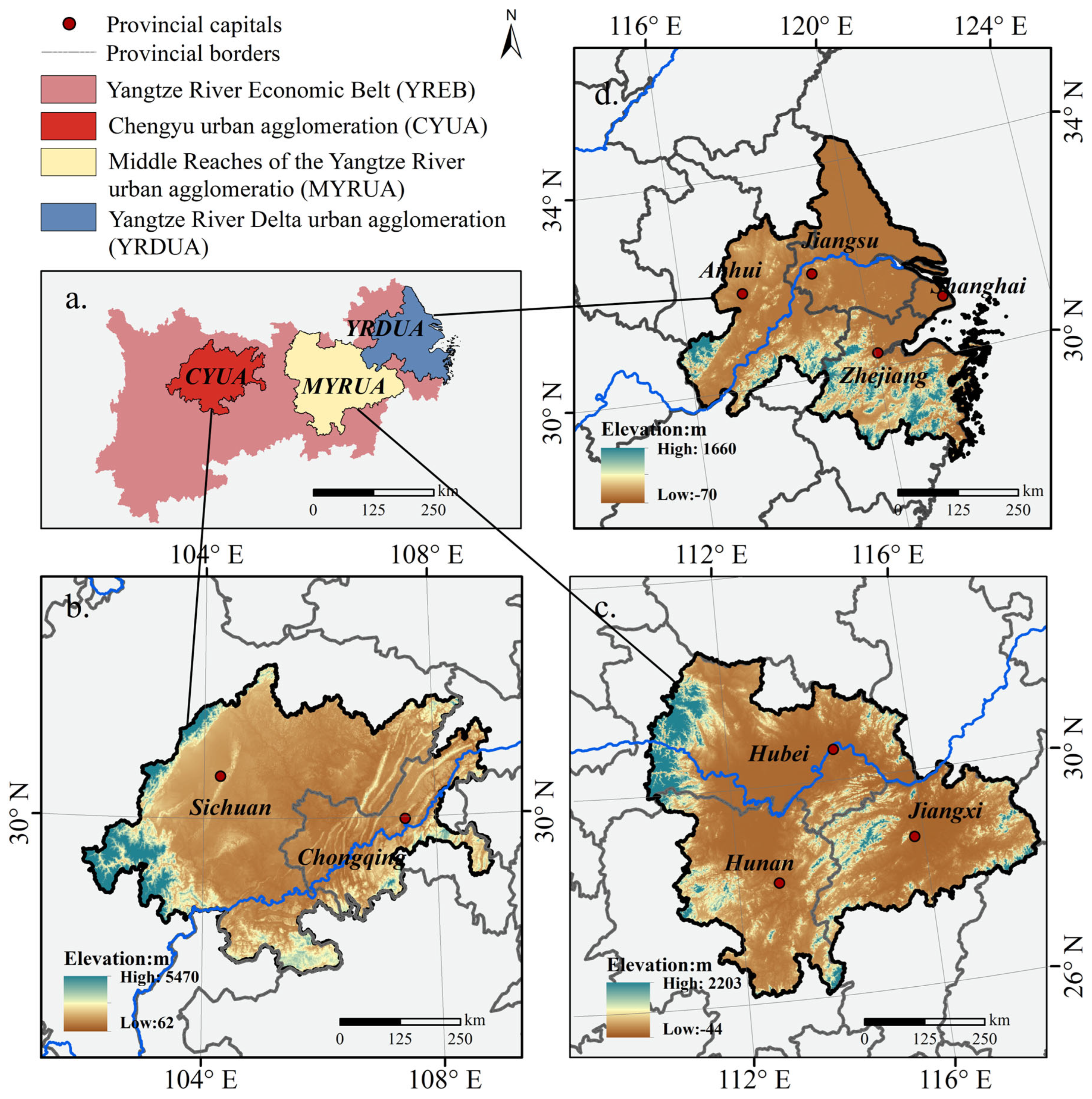
2.1. Study Area
2.2. Data Sources
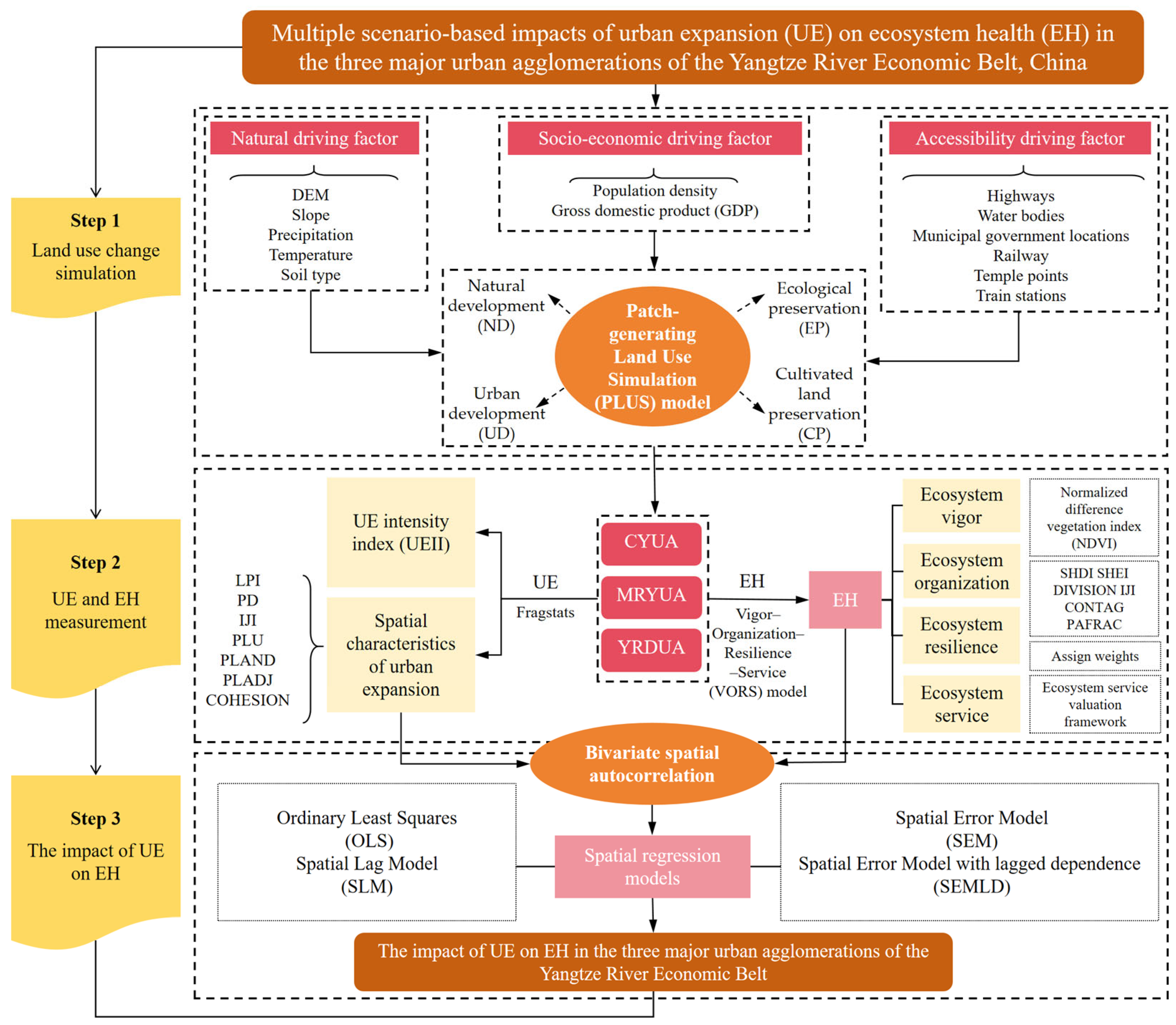
2.3. Method
2.4. Land Use Simulation
2.4.1. Selection of Simulation Driving Factors
2.4.2. PLUS Model Parameter Settings
2.4.3. Model Accuracy Check
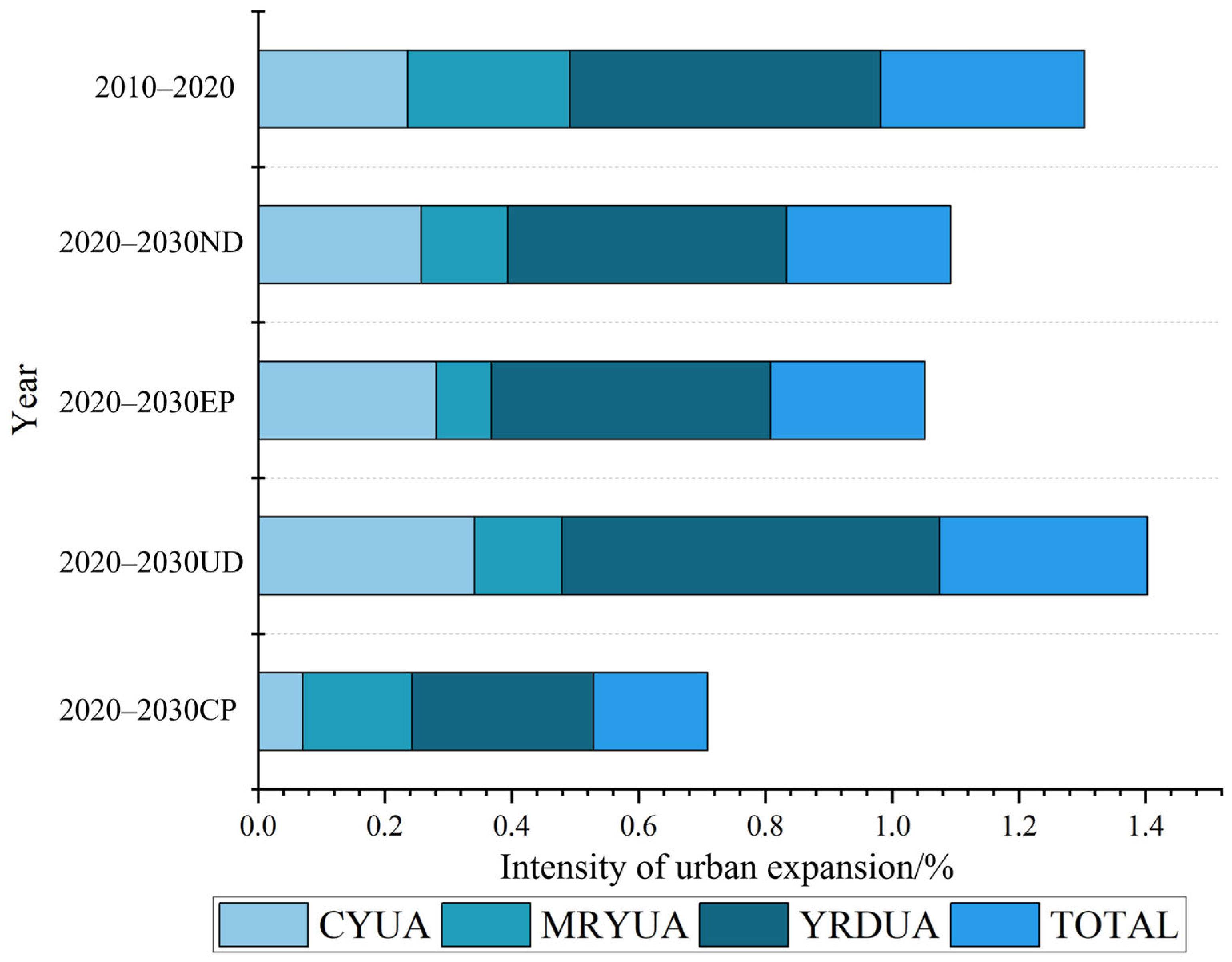
2.5. UE Measurement
2.5.1. UEII Measurement
2.5.2. Spatial Characteristics of UE
2.6. EH Assessment
2.6.1. Ecosystem Vigor Assessment
2.6.2. Ecosystem Organization Assessment
2.6.3. Ecosystem Resilience Assessment
2.6.4. Ecosystem Services Assessment
2.7. Bivariate Spatial Autocorrelation
2.8. Spatial Regression Model
3. Results
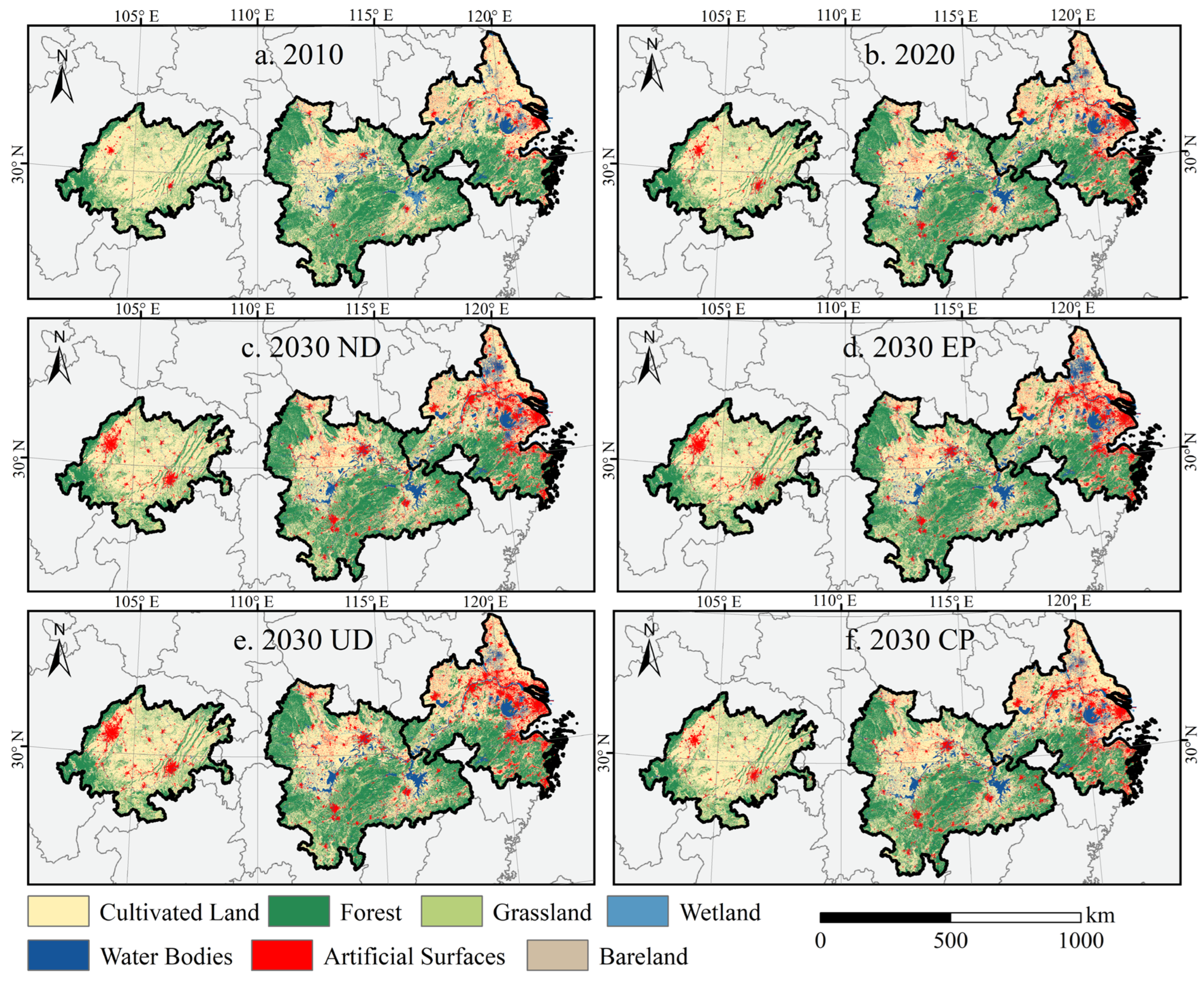
3.1. Multi-Scenario Simulation of Land Use Change
3.2. Landscape Character of UE
3.3. EH Changes in Multiple Scenarios
3.4. Spatial Autocorrelation Between EH and UE
3.5. Impact of UE on EH
4. Discussion
4.1. Agglomeration of Findings
4.2. Policy Implications
4.3. Limitations and Future Direction
5. Conclusions
Supplementary Materials
Author Contributions
Funding
Data Availability Statement
Acknowledgments
Conflicts of Interest
Abbreviations
References
- Wang, J.; Chen, Y.; Liao, W.; He, G.; Tett, S.F.; Yan, Z.; Zhai, P.; Feng, J.; Ma, W.; Huang, C.; et al. Anthropogenic emissions and urbanization increase risk of compound hot extremes in cities. Nat. Clim. Change 2021, 11, 1084–1089. [Google Scholar] [CrossRef] [Scilit]
- Li, G.; Fang, C.; Watson, J.E.; Sun, S.; Qi, W.; Wang, Z.; Liu, J. Mixed effectiveness of global protected areas in resisting habitat loss. Nat. Commun. 2024, 15, 8389. [Google Scholar] [CrossRef] [Scilit] [PubMed]
- Zhou, G.; Eisenhauer, N.; Terrer, C.; Eldridge, D.J.; Duan, H.; Guirado, E.; Berdugo, M.; Zhou, L.; Liu, S.; Zhou, X.; et al. Resistance of ecosystem services to global change weakened by increasing number of environmental stressors. Nat. Geosci. 2024, 17, 882–888. [Google Scholar] [CrossRef] [Scilit]
- Gao, J.; Bukovsky, M.S. Urban land patterns can moderate population exposures to climate extremes over the 21st century. Nat. Commun. 2023, 14, 6536. [Google Scholar] [CrossRef] [Scilit]
- Iqbal, M.; Arshed, N.; Chan, L.F. Exploring the dynamics: Biodiversity impacts of natural resource extraction with moderating influence of FinTech for sustainable practices in resource-rich nations. Resour. Policy 2024, 91, 104933. [Google Scholar] [CrossRef] [Scilit]
- Baccour, S.; Goelema, G.; Kahil, T.; Albiac, J.; van Vliet, M.T.; Zhu, X.; Strokal, M. Water quality management could halve future water scarcity cost-effectively in the Pearl River Basin. Nat. Commun. 2024, 15, 5669. [Google Scholar] [CrossRef] [Scilit] [PubMed]
- Li, G.; Fang, C.; Li, Y.; Wang, Z.; Sun, S.; He, S.; Qi, W.; Bao, C.; Ma, H.; Fan, Y.; et al. Global impacts of future urban expansion on terrestrial vertebrate diversity. Nat. Commun. 2022, 13, 1628. [Google Scholar] [CrossRef] [Scilit]
- Testi, I.; Wang, A.; Paul, S.; Mora, S.; Walker, E.; Nyhan, M.; Duarte, F.; Santi, P.; Ratti, C. Big mobility data reveals hyperlocal air pollution exposure disparities in the Bronx, New York. Nat. Cities 2024, 1, 512–521. [Google Scholar] [CrossRef] [Scilit]
- Chen, W.; Gu, T.; Xiang, J.; Luo, T.; Zeng, J.; Yuan, Y. Ecological restoration zoning of territorial space in China: An ecosystem health perspective. J. Environ. Manag. 2024, 364, 121371. [Google Scholar] [CrossRef] [Scilit]
- Yuan, Y.; Chen, W.; Zeng, J.; Gu, T. Spatiotemporal evolution patterns and driving mechanisms of global ecosystem health. Geogr. Res. 2025, 44, 2626–2642. (In Chinese) [Google Scholar] [CrossRef]
- Ahmad, Y.; Zahra, R.; Ali, C. Transformations in urban gardens: Neoliberal influences and land use conflicts in Shiraz’s Qasr al-Dasht Gardens. Land Use Policy 2024, 146, 107311. [Google Scholar] [CrossRef] [Scilit]
- Barau, A.S.; Maconachie, R.; Ludin, A.N.M.; Abdulhamid, A. Urban morphology dynamics and environmental change in Kano, Nigeria. Land Use Policy 2015, 42, 307–317. [Google Scholar] [CrossRef] [Scilit]
- Qu, Y.; Zhan, L.; Wei, C.; Zhang, Q.; Wang, J. Interactive transition of cultivated land and construction land during China’s urbanization: A coordinated analytical framework of explicit and implicit forms. Land Use Policy 2024, 138, 107049. [Google Scholar] [CrossRef] [Scilit]
- Colsaet, A.; Laurans, Y.; Levrel, H. What drives land take and urban land expansion? A systematic review. Land Use Policy 2018, 79, 339–349. [Google Scholar] [CrossRef] [Scilit]
- Li, G.; Sun, S.; Fang, C. The varying driving forces of urban expansion in China: Insights from a spatial-temporal analysis. Landsc. Urban Plan. 2018, 174, 63–77. [Google Scholar] [CrossRef] [Scilit]
- Liu, P.; Hu, Y.; Jia, W. Land use optimization research based on FLUS model and ecosystem services–setting Jinan City as an example. Urban Clim. 2021, 40, 100984. [Google Scholar] [CrossRef] [Scilit]
- Pan, Z.; He, J.; Liu, D.; Wang, J. Predicting the joint effects of future climate and land use change on ecosystem health in the Middle Reaches of the Yangtze River Economic Belt, China. Appl. Geogr. 2020, 124, 102293. [Google Scholar] [CrossRef] [Scilit]
- Roy, B.; Rahman, M.Z. Spatio-temporal analysis and cellular automata-based simulations of biophysical indicators under the scenario of climate change and urbanization using artificial neural network. Remote Sens. Appl.-Soc. Environ. 2023, 31, 100992. [Google Scholar] [CrossRef] [Scilit]
- Liang, X.; Guan, Q.; Clarke, K.C.; Liu, S.; Wang, B.; Yao, Y. Understanding the drivers of sustainable land expansion using a patch-generating land use simulation (PLUS) model: A case study in Wuhan, China. Comput. Environ. Urban Syst. 2021, 85, 101569. [Google Scholar] [CrossRef] [Scilit]
- Chen, W.; Wang, G.; Gu, T.; Fang, C.; Pan, S.; Zeng, J.; Wu, J. Simulating the impact of urban expansion on ecosystem services in Chinese urban agglomerations: A multi-scenario perspective. Environ. Impact Assess. Rev. 2023, 103, 107275. [Google Scholar] [CrossRef] [Scilit]
- Qiao, W.; Huang, X. The impact of land urbanization on ecosystem health in the Yangtze River Delta urban agglomerations, China. Cities 2022, 130, 103981. [Google Scholar] [CrossRef] [Scilit]
- Luan, C.; Liu, R.; Li, Y.; Zhang, Q. Comparison of various models for multi-scenario simulation of land use/land cover to predict ecosystem service value: A case study of Harbin-Changchun Urban Agglomeration, China. J. Clean. Prod. 2024, 478, 144012. [Google Scholar] [CrossRef] [Scilit]
- Yu, Z.; Yang, G.; Lin, T.; Zhao, B.; Xu, Y.; Yao, X.; Ma, W.; Vejre, H.; Jiang, B. Exposure ecology drives a unified understanding of the nexus of (urban) natural ecosystem, ecological exposure, and health. Ecosyst. Health Sustain. 2024, 10, 0165. [Google Scholar] [CrossRef] [Scilit]
- Yadav, A.; Kansal, M.L.; Singh, A. Ecosystem health assessment based on the VORS framework for the Upper Ganga Riverine Wetland in India. Environ. Sustain. Indic. 2025, 25, 100580. [Google Scholar] [CrossRef] [Scilit]
- Hernández-Blanco, M.; Costanza, R.; Chen, H.; DeGroot, D.; Jarvis, D.; Kubiszewski, I.; Montoya, J.; Sangha, K.; Stoeckl, N.; Turner, K.; et al. Ecosystem health, ecosystem services, and the well-being of humans and the rest of nature. Glob. Change Biol. 2022, 28, 5027–5040. [Google Scholar] [CrossRef] [Scilit] [PubMed]
- Lin, X.; Wang, Z.; Bao, Y. Integrating ecosystem stress into the assessment of ecosystem health in karst areas and exploring its driving factors. Ecol. Indic. 2024, 167, 112662. [Google Scholar] [CrossRef] [Scilit]
- Liu, X.; Han, Y.; Li, Y.; Li, L.; Liu, Y. Evaluation of ecosystem health improvement potential based on “water-based”: Taking the Chahannaoer basin of Inner Mongolia Autonomous Region as an example. Acta Ecol. Sin. 2025, 45, 2868–2876. (In Chinese) [Google Scholar] [CrossRef]
- Ma, J.; Tian, L.; Zhang, Y.; Yang, X.; Li, Y.; Liu, Z.; Zhou, L.; Wang, Z.; Ouyang, W. Global property rights and land use efficiency. Nat. Commun. 2024, 15, 8525. [Google Scholar] [CrossRef] [Scilit]
- Ma, X.; Tan, J. Study on the collaborative integration of ecosystem health and tourism resource development and its zonal management in Nanshan National Park. Acta Ecol. Sin. 2025, 45, 9408–9418. (In Chinese) [Google Scholar] [CrossRef]
- Wang, Y.; Xue, H.; Li, A.; Ma, X.; Sun, A.; Zhang, J. Spatial-temporal differentiation and influencing factors of ecosystem health in Three-River-Source national Park. Ecol. Indic. 2025, 171, 113183. [Google Scholar] [CrossRef] [Scilit]
- Heller, N.E.; McManus Chauvin, K.; Skybrook, D.; Barnosky, A.D. Including stewardship in ecosystem health assessment. Nat. Sustain. 2023, 6, 731–741. [Google Scholar] [CrossRef] [Scilit]
- Gunawan, H.; Setyawati, T.; Atmoko, T.; Subarudi; Kwatrina, R.T.; Yeny, I.; Yuwati, T.W.; Effendy, R.; Abdullah, L.; Mukhlisi; et al. A review of forest fragmentation in Indonesia under the DPSIR framework for biodiversity conservation strategies. Glob. Ecol. Conserv. 2024, 51, e02918. [Google Scholar] [CrossRef] [Scilit]
- Raj, A.; Sharma, L.K. Spatial E-PSR modelling for ecological sensitivity assessment for arid rangeland resilience and management. Ecol. Model. 2023, 478, 110283. [Google Scholar] [CrossRef] [Scilit]
- Costanza, R. Nature: Ecosystems without commodifying them. Nature 2006, 443, 749. [Google Scholar] [CrossRef] [Scilit] [PubMed]
- Wang, P.; Song, Y.; Zhang, J.; Yu, P.; Zhang, Y.; Zhang, X.; Wang, C. Research on factors affecting ecosystem health in Beijng-Tianjin-Hebei region and its multi-scenario simulation based on different spatial scales. Acta Ecol. Sin. 2025, 45, 8986–8999. (In Chinese) [Google Scholar] [CrossRef]
- Das, M.; Das, A.; Mandal, A. Research note: Ecosystem Health (EH) assessment of a rapidly urbanizing metropolitan city region of eastern India–A study on Kolkata Metropolitan Area. Landsc. Urban Plan. 2020, 204, 103938. [Google Scholar] [CrossRef] [Scilit]
- Sahana, M.; Saini, M.; Areendran, G.; Imdad, K.; Sarma, K.; Sajjad, H. Assessing Wetland ecosystem health in Sundarban Biosphere Reserve using pressure-state-response model and geospatial techniques. Remote Sens. Appl.-Soc. Environ. 2022, 26, 100754. [Google Scholar] [CrossRef] [Scilit]
- Kii, M. Projecting future populations of urban agglomerations around the world and through the 21st century. npj Urban Sustain. 2021, 1, 10. [Google Scholar] [CrossRef] [Scilit]
- Gu, T.; Luo, T.; Ying, Z.; Wu, X.; Wang, Z.; Zhang, G.; Yao, Z. Coupled relationships between landscape pattern and ecosystem health in response to urbanization. J. Environ. Manag. 2024, 367, 122076. [Google Scholar] [CrossRef] [Scilit] [PubMed]
- Han, P.; Hu, H.; Zhou, J.; Wang, M.; Zhou, Z. Integrating key ecosystem services to study the spatio-temporal dynamics and determinants of ecosystem health in Wuhan’s central urban area. Ecol. Indic. 2024, 166, 112352. [Google Scholar] [CrossRef] [Scilit]
- Wang, X.; Yao, W.; Luo, Q.; Yun, J. Spatial relationship between ecosystem health and urbanization in coastal mountain city, Qingdao, China. Ecol. Inform. 2024, 79, 102458. [Google Scholar] [CrossRef] [Scilit]
- Gourevitch, J.D.; Alonso-Rodríguez, A.M.; Aristizábal, N.; de Wit, L.A.; Kinnebrew, E.; Littlefield, C.E.; Moore, M.; Nicholson, C.C.; Schwartz, A.J.; Ricketts, T.H. Projected losses of ecosystem services in the US disproportionately affect non-white and lower-income populations. Nat. Commun. 2021, 12, 3511. [Google Scholar] [CrossRef] [Scilit]
- Zhai, M.; Wu, Y.; Gu, Y.; Su, S.; Zang, H.; Ding, W.; Lu, J. Development of an interactive multi-region enviro-economic equilibrium (IMR3E) model for managing inner-and inter-region carbon-emission mitigation. Resour. Conserv. Recycl. 2023, 199, 107214. [Google Scholar] [CrossRef] [Scilit]
- Tu, D.; Cai, Y.; Liu, M. Coupling coordination analysis and spatiotemporal heterogeneity between ecosystem services and new-type urbanization: A case study of the Yangtze River Economic Belt in China. Ecol. Indic. 2023, 154, 110535. [Google Scholar] [CrossRef] [Scilit]
- Scown, M.W.; Dunn, F.E.; Dekker, S.C.; Van Vuuren, D.P.; Karabil, S.; Sutanudjaja, E.H.; Santos, M.J.; Minderhoud, P.S.; Garmestani, A.S.; Middelkoop, H. Global change scenarios in coastal river deltas and their sustainable development implications. Glob. Environ. Change 2023, 82, 102736. [Google Scholar] [CrossRef] [Scilit]
- Zhao, C.; Wu, S.; Yang, L.; Wu, Y.; Xiao, P.; Xu, J.; Liu, Y. Evaluating ecological conservation effectiveness of security patterns under multiple scenarios: A case study of Hubei Province. Ecol. Indic. 2024, 166, 112528. [Google Scholar] [CrossRef] [Scilit]
- Ma, C.; Li, M.; Jiang, P. The multiscale response of global cropland cropping intensity to urban expansion. Agric. Syst. 2024, 221, 104138. [Google Scholar] [CrossRef] [Scilit]
- Schuster-Olbrich, J.P.; Marquet, O.; Miralles-Guasch, C.; Arce, L.F. Spatial patterns and drivers of urban expansion: An exploratory spatial analysis of the Metropolitan Region of Santiago, Chile, from 1997 to 2013. Cities 2024, 153, 105305. [Google Scholar] [CrossRef] [Scilit]
- Jung, M.C.; Wang, T.; Kang, M.; Dyson, K.; Dawwas, E.B.; Alberti, M. Urban landscape affects scaling of transportation carbon emissions across geographic scales. Sust. Cities Soc. 2024, 113, 105656. [Google Scholar] [CrossRef] [Scilit]
- Xing, X.; Shi, W.; Wu, X.; Liu, Y.; Wang, X.; Zhang, Y. Towards a more compact urban form: A spatial-temporal study on the multi-dimensional compactness index of urban form in China. Appl. Geogr. 2024, 171, 103368. [Google Scholar] [CrossRef] [Scilit]
- Chen, W.; Wang, G.; Zeng, J. Impact of urbanization on ecosystem health in Chinese urban agglomerations. Environ. Impact Assess. Rev. 2023, 98, 106964. [Google Scholar] [CrossRef] [Scilit]
- Anríquez, G.; Calabrese, J.; Foster, W.; Keim, K.; Osses, P. Refining the scale of the rural-urban landscape: A policy-relevant application to Chile. Appl. Geogr. 2024, 168, 103318. [Google Scholar] [CrossRef] [Scilit]
- Tian, Y.; Jim, C.Y.; Tao, Y.; Shi, T. Landscape ecological assessment of green space fragmentation in Hong Kong. Urban For. Urban Green. 2011, 10, 79–86. [Google Scholar] [CrossRef] [Scilit]
- Fang, W.; Huang, S.; Huang, Q.; Huang, G.; Wang, H.; Leng, G.; Wang, L.; Li, P.; Ma, L. Bivariate probabilistic quantification of drought impacts on terrestrial vegetation dynamics in mainland China. J. Hydrol. 2019, 577, 123980. [Google Scholar] [CrossRef] [Scilit]
- Chen, W.; Yuan, Y.; Liu, Z.; Zeng, J.; Yang, L.; Zhong, Y.; Gu, T.; Feng, Z. Ecosystem health in the Yangtze and Yellow River basins in China: Regional differences and driving forces. Ecol. Indic. 2024, 166, 112422. [Google Scholar] [CrossRef] [Scilit]
- Mallick, K.; Verfaillie, J.; Wang, T.; Ortiz, A.A.; Szutu, D.; Yi, K.; Kang, Y.; Shortt, R.; Hu, T.; Sulis, M.; et al. Net fluxes of broadband shortwave and photosynthetically active radiation complement NDVI and near infrared reflectance of vegetation to explain gross photosynthesis variability across ecosystems and climate. Remote Sens. Environ. 2024, 307, 114123. [Google Scholar] [CrossRef] [Scilit]
- Yaermaimaiti, A.; Li, X.; Ge, X.; Liu, C. Analysis of landscape pattern and ecological risk change characteristics in Bosten Lake basin based on optimal scale. Ecol. Indic. 2024, 163, 112120. [Google Scholar] [CrossRef] [Scilit]
- Zhang, J.; Wang, J.; Chen, Y.; Huang, S.; Liang, B. Spatiotemporal variation and prediction of NPP in Beijing-Tianjin-Hebei region by coupling PLUS and CASA models. Ecol. Inform. 2024, 81, 102620. [Google Scholar] [CrossRef] [Scilit]
- Peng, Y.; Chen, W.; Pan, S.; Gu, T.; Zeng, J. Identifying the driving forces of global ecosystem services balance, 2000–2020. J. Clean. Prod. 2023, 426, 139019. [Google Scholar] [CrossRef] [Scilit]
- Costanza, R.; De Groot, R.; Sutton, P.; Van der Ploeg, S.; Anderson, S.J.; Kubiszewski, I.; Farber, S.; Turner, R.K. Changes in the global value of ecosystem services. Glob. Environ. Change 2014, 26, 152–158. [Google Scholar] [CrossRef] [Scilit]
- Xie, G.; Zhang, C.; Zhang, L.; Chen, W.; Li, S. Improvement of the evaluation method for ecosystem service value based on per unit area. J. Nat. Resour. 2015, 30, 1243–1254. (In Chinese) [Google Scholar] [CrossRef]
- Dong, Y.H.; Peng, F.L.; Li, H.; Men, Y.Q. Spatial autocorrelation and spatial heterogeneity of underground parking space development in Chinese megacities based on multisource open data. Appl. Geogr. 2023, 153, 102897. [Google Scholar] [CrossRef] [Scilit]
- Legendre, P. Spatial autocorrelation: Trouble or new paradigm? Ecology 1993, 74, 1659–1673. [Google Scholar] [CrossRef] [Scilit]
- Dormann, C.F.; McPherson, J.M.; Araújo, M.B.; Bivand, R.; Bolliger, J.; Carl, G.; Davies, R.G.; Hirzel, A.; Jetz, W.; Kissling, W.D.; et al. Methods to account for spatial autocorrelation in the analysis of species distributional data: A review. Ecography 2007, 30, 609–628. [Google Scholar] [CrossRef] [Scilit]
- Al Kafy, A.; Dey, N.N.; Saha, M.; Altuwaijri, H.A.; Fattah, M.A.; Rahaman, Z.A.; Kalaivani, S.; Bakshi, A.; Rahaman, S.N. Leveraging machine learning algorithms in dynamic modeling of urban expansion, surface heat islands, and carbon storage for sustainable environmental management in coastal ecosystems. J. Environ. Manag. 2024, 370, 122427. [Google Scholar] [CrossRef] [Scilit]
- Wei, G.; He, B.J.; Liu, Y.; Li, R. How does rapid urban construction land expansion affect the spatial inequalities of ecosystem health in China? Evidence from the country, economic regions and urban agglomerations. Environ. Impact Assess. Rev. 2024, 106, 107533. [Google Scholar] [CrossRef] [Scilit]
- Zhang, F.; Xie, A.; Jiang, C.; Chen, J.; An, Y.; Yang, P.; Ma, D. Coupling coordination analysis and spatiotemporal heterogeneity between urban land green use efficiency and ecosystem services in Yangtze River Economic Belt, China. Hum. Soc. Sci. Commun. 2024, 11, 1328. [Google Scholar] [CrossRef] [Scilit]
- Li, Y.; Qin, L.; Wang, Y.; Liu, H.; Zhang, M.; Hao, H. Ecosystem health assessment of the largest lake wetland in the Yellow River basin using an improved vigor-organization-resilience-services model. Ecol. Indic. 2024, 166, 112539. [Google Scholar] [CrossRef] [Scilit]
- Chung, M.G.; Frank, K.A.; Pokhrel, Y.; Dietz, T.; Liu, J. Natural infrastructure in sustaining global urban freshwater ecosystem services. Nat. Sustain. 2021, 4, 1068–1075. [Google Scholar] [CrossRef] [Scilit]
- Eldridge, D.J.; Cui, H.; Ding, J.; Berdugo, M.; Sáez-Sandino, T.; Duran, J.; Gaitan, J.; Blanco-Pastor, J.L.; Rodríguez, A.; Plaza, C.; et al. Urban greenspaces and nearby natural areas support similar levels of soil ecosystem services. npj Urban Sustain. 2024, 4, 15. [Google Scholar] [CrossRef] [Scilit]
- Seidl, A.; Mulungu, K.; Arlaud, M.; van den Heuvel, O.; Riva, M. The effectiveness of national biodiversity investments to protect the wealth of nature. Nat. Ecol. Evol. 2021, 5, 530–539. [Google Scholar] [CrossRef] [Scilit]
- Liu, Y.; Liu, J.; Yin, X.; Ouyang, X.; Ji, C.; Li, S.; Wei, G. Human activities and ecosystem health: A historical analysis of Poyang Lake. Ecol. Indic. 2024, 166, 112446. [Google Scholar] [CrossRef] [Scilit]
- Luo, Q.; Zhou, J.; Zhang, Y.; Yu, B.; Zhu, Z. What is the spatiotemporal relationship between urbanization and ecosystem services? A case from 110 cities in the Yangtze River Economic Belt, China. J. Environ. Manag. 2022, 321, 115709. [Google Scholar] [CrossRef] [Scilit] [PubMed]
- Qu, H.; You, C.; Wang, W.; Guo, L. Spatio-temporal interplay between ecosystem services and urbanization in the Yangtze River Economic Belt: A new perspective for considering the scarcity effect. Land Use Policy 2024, 147, 107358. [Google Scholar] [CrossRef] [Scilit]
- Abdelaal, F.; Guo, B.H. Knowledge, attitude and practice of green building design and assessment: New Zealand case. Build. Environ. 2021, 201, 107960. [Google Scholar] [CrossRef] [Scilit]
- Genc, O.; Kurt, A. Mimicking nature to design eco-industrial parks: Exploring the influence of connectance on industrial network optimization. J. Clean. Prod. 2024, 475, 143704. [Google Scholar] [CrossRef] [Scilit]
- Massaro, E.; Schifanella, R.; Piccardo, M.; Caporaso, L.; Taubenböck, H.; Cescatti, A.; Duveiller, G. Spatially-optimized urban greening for reduction of population exposure to land surface temperature extremes. Nat. Commun. 2023, 14, 2903. [Google Scholar] [CrossRef] [Scilit]
- Searchinger, T.D.; Wirsenius, S.; Beringer, T.; Dumas, P. Assessing the efficiency of changes in land use for mitigating climate change. Nature 2018, 564, 249–253. [Google Scholar] [CrossRef] [Scilit]
- Hou, W.; Zhou, W.; Li, J.; Li, C. Simulation of the potential impact of urban expansion on regional ecological corridors: A case study of Taiyuan, China. Sust. Cities Soc. 2022, 83, 103933. [Google Scholar] [CrossRef] [Scilit]
- Jantz, P.; Goetz, S.; Laporte, N. Carbon stock corridors to mitigate climate change and promote biodiversity in the tropics. Nat. Clim. Change 2014, 4, 138–142. [Google Scholar] [CrossRef] [Scilit]
- Yu, H.; Xiao, H.; Gu, X. Integrating species distribution and piecewise linear regression model to identify functional connectivity thresholds to delimit urban ecological corridors. Comput. Environ. Urban Syst. 2024, 113, 102177. [Google Scholar] [CrossRef] [Scilit]





| Data Type | Name | Year | Resolution | Sources |
|---|---|---|---|---|
| Land use | GlobeLand30 | 2010/2020 | 30 m | National Catalogue Service For Geographic Information (https://www.webmap.cn/commres.do?method=globeIndex, accessed 4 December 2026) |
| Normalized difference vegetation index (NDVI) | MODIS | 2000/2010/2020 | 500 m | MODIS (https://search.earthdata.nasa.gov, accessed 4 December 2026) |
| Natural driving factor | DEM | 2020 | 30 m | ASTER GDEM 30 m (https://search.earthdata.nasa.gov/, accessed 4 December 2026) |
| Slope | 2020 | 30 m | Calculated from DEM | |
| Precipitation | 2020 | 1000 m | Resources and Environmental Science Data Center (https://www.resdc.cn/, accessed 4 December 2026) | |
| Temperature | 2020 | 1000 m | ||
| Soil type | 2017 | 1000 m | ||
| Socio-economic driving factor | Gross domestic product (GDP) | 2020 | 1000 m | |
| Population density | 2020 | 100 m | Worldpop (https://hub.worldpop.org, accessed 4 December 2026) | |
| Accessibility driving factor | Railway | 2021 | Shapefile | National Catalogue Service For Geographic Information (https://www.webmap.cn/, accessed 4 December 2026) |
| Highways (including expressways) | 2021 | Shapefile | ||
| Water bodies | 2021 | Shapefile | ||
| Municipal government locations | 2021 | Shapefile | ||
| Train stations | 2020 | Shapefile | OpenStreetMap (https://www.openstreetmap.org, accessed 4 December 2026) | |
| Temple points | 2020 | Shapefile |
| Scenario | Change Regulation |
|---|---|
| Natural development (ND) | The Markov chain model was applied to predict the natural progression of land use changes from 2010 to 2020, without any imposed constraints. This model allows simulation scenarios to evolve in alignment with the historical patterns of land use transformation. |
| Ecological preservation (EP) | The scenario focuses on limiting the degradation of forest, grasslands, and water bodies to support ecological conservation efforts. Based on the ND scenario, the likelihood of converting forest, grassland, and water bodies into other land types is reduced by 20%. In contrast, the probability of converting cultivated land, bareland, and artificial surfaces into forest, grassland, and water bodies is increased by 10%. |
| Urban development (UD) | This scenario is designed to prioritize the development of artificial surfaces to promote economic growth. Building on the ND scenario, the UD scenario raises the probability of converting cultivated land, forest, grassland, and water bodies into artificial surfaces by 20%. Conversely, it reduces the likelihood of converting artificial surfaces back into other land types by 30%. Moreover, the transformation of artificial surfaces into any other land types is prohibited. |
| Cultivated land preservation (CP) | This scenario emphasizes the protection of cultivated land. According to the ND scenario, the conversion of forest land, grassland, and bareland into cultivated land increases by 30%. Meanwhile, the probability of converting cultivated land into forest, grassland, bareland, or artificial surfaces decreases by 20%. |
| Neighborhood Weights | Cultivated Land | Forest | Grassland | Wetland | Water Bodies | Artificial Surfaces | Bareland |
|---|---|---|---|---|---|---|---|
| ND | 0.7 | 0.4 | 0.2 | 0.1 | 0.2 | 0.9 | 0.1 |
| EP | 0.3 | 1 | 0.9 | 0.5 | 0.5 | 0.4 | 0.1 |
| UD | 0.8 | 0.4 | 0.3 | 0.2 | 0.2 | 1 | 0.1 |
| CP | 1 | 0.3 | 0.1 | 0.1 | 0.2 | 0.7 | 0.1 |
| Ecosystem Services | Cultivated Land | Forest | Grassland | Water and Wetland | Artificial Surface | Bareland | |
|---|---|---|---|---|---|---|---|
| Provision | Food provision | 1.0 | 0.5 | 0.5 | 0.7 | 0.0 | 0.26 |
| Freshwater supply | 0.3 | 0.5 | 0.5 | 1.0 | 0.0 | 0.24 | |
| Regulation | Gas regulation | 0.5 | 0.9 | 0.7 | 0.7 | 0.0 | 0.40 |
| Climate regulation | 0.5 | 0.9 | 0.7 | 0.6 | 0.0 | 0.39 | |
| Hydrological regulation | 0.6 | 0.9 | 0.8 | 0.9 | 0.0 | 0.49 | |
| Soil maintenance | 0.7 | 0.9 | 0.9 | 0.5 | 0.0 | 0.49 | |
| Cultural service | Culture and entertainment | 0.3 | 0.6 | 0.6 | 0.7 | 0.8 | 0.24 |
| Esthetic value | 0.4 | 0.9 | 0.8 | 0.9 | 0.6 | 0.36 | |
| Natural heritage and diversity | 0.5 | 0.9 | 0.7 | 0.8 | 0.4 | 0.53 | |
| Total | 4.8 | 7.0 | 6.2 | 6.8 | 1.8 | 3.4 | |
| Variables | 2010 | 2020 | 2030ND | ||||||
|---|---|---|---|---|---|---|---|---|---|
| CYUA | MRYUA | YRDUA | CYUA | MRYUA | YRDUA | CYUA | MRYUA | YRDUA | |
| Constant | 0.6029 *** | 0.6678 *** | 0.6393 *** | 0.6098 *** | 0.6552 *** | 0.5706 *** | 0.6111 *** | 0.6535 *** | 0.5777 *** |
| LPI | 0.0001 | −0.0006 | 0.0060 ** | −0.0029 | 0.0047 ** | 0.0082 *** | −0.0002 | 0.0045 * | 0.0064 ** |
| PD | −0.0919 *** | −0.0872 *** | −0.0855 *** | −0.0796 *** | −0.0626 *** | 0.0633 ** | −0.0987 *** | −0.0560 *** | 0.0757 *** |
| PLADJ | −0.0006 | −0.0008 *** | −0.0010 *** | −0.0005 * | −0.0005 *** | −0.0001 | −0.0005 | −0.0006 *** | 0.0001 |
| COHESION | −0.0004 | −0.0001 | −0.0001 | −0.0001 | −0.0003 | −0.0002 | −0.0003 * | −0.0002 | 0.0003 |
| IJI | 0.0003 *** | 0.0003 *** | 0.0003 *** | 0.0003 *** | 0.0004 *** | 0.0005 *** | 0.0003 *** | 0.0004 *** | 0.0005 *** |
| PLAND | 0.0016 | 0.0026 | −0.0035 *** | 0.0040 | −0.0026 | −0.0043 *** | 0.0026 | −0.0023 | −0.0063 * |
| PLU | −0.4202 *** | −0.5659 *** | −0.6351 *** | −0.4347 *** | −0.5889 *** | −0.4654 *** | −0.5620 *** | −0.6201 *** | −0.4986 *** |
| Measures of fit | |||||||||
| R2 | 0.6067 | 0.6699 | 0.7713 | 0.6230 | 0.7479 | 0.7537 | 0.6994 | 0.7648 | 0.7934 |
| Log likelihood | 2264.06 | 4185.52 | 2888.22 | 2220.12 | 4353.77 | 2659.98 | 2359.44 | 4360.98 | 2712.06 |
| Akaike info criterion | −4512.12 | −8355.04 | −5760.43 | −4424.24 | −8691.54 | −5303.96 | −4702.87 | −8705.95 | −5408.12 |
| Schwarz criterion | −4466.98 | −8306.07 | −5713.98 | −4379.10 | −8642.56 | −5257.51 | −4657.74 | −8656.98 | −5361.66 |
| Lag coeff. (Lambda) | 0.79 *** | 0.82 *** | 0.82 *** | 0.78 *** | 0.86 *** | 0.81 *** | 0.79 *** | 0.85 *** | 0.82 *** |
| N | 2084 | 3366 | 2458 | 2084 | 3366 | 2458 | 2084 | 3366 | 2458 |
| Variables | 2030EP | 2030UD | 2030CP | ||||||
|---|---|---|---|---|---|---|---|---|---|
| CYUA | MRYUA | YRDUA | CYUA | MRYUA | YRDUA | CYUA | MRYUA | YRDUA | |
| Constant | 0.6231 *** | 0.6573 *** | 0.5856 *** | 0.6180 *** | 0.6555 *** | 0.5832 *** | 0.6019 *** | 0.6409 *** | 0.5626 *** |
| LPI | 0.0003 | 0.0047 * | 0.0062 ** | −0.0010 | 0.0043 * | 0.0049 * | −0.0054 | 0.0029 | 0.0057 * |
| PD | −0.1366 *** | −0.0667 *** | 0.0718 *** | −01226 *** | −0.0648 *** | 0.0693 *** | −0.0541 ** | −0.0258 | 0.0363 |
| PLADJ | −0.0004 | −0.0005 *** | 0.0001 | −0.0003 | −0.0006 *** | −0.0002 | −0.0006 * | −0.0007 *** | −0.0003 |
| COHESION | −0.0011 * | −0.0006 | −0.0003 | −0.0011 * | −0.0004 | 0.0001 | 0.0007 | 0.0005 | 0.0010 ** |
| IJI | 0.0004 *** | 0.0004 *** | 0.0004 *** | 0.0003 *** | 0.0004 *** | 0.0005 *** | 0.0003 *** | 0.0004 *** | 0.0007 *** |
| PLAND | 0.0030 | −0.0020 | −0.0051 * | 0.0043 | −0.0018 | −0.0042 | 0.0056 | −0.0015 | −0.0059 * |
| PLU | −0.5758 *** | −0.6037 *** | −0.5249 *** | −0.5857 *** | −0.6161 *** | −0.5335 *** | −0.4303 *** | −0.6032 *** | −0.4614 *** |
| Measures of fit | |||||||||
| R2 | 0.7124 | 0.7574 | 0.7947 | 0.6798 | 0.7584 | 0.8114 | 0.6686 | 0.7304 | 0.7715 |
| Log likelihood | 2417.86 | 4352.88 | 2738.23 | 2225.71 | 4286.11 | 2741.53 | 2348.69 | 4128.33 | 2698.81 |
| Akaike info criterion | −4819.72 | −8689.76 | −5460.46 | −4435.41 | −8556.22 | −5467.05 | −4681.39 | −8240.66 | −5381.62 |
| Schwarz criterion | −4774.58 | −8640.79 | −5414.00 | −4390.28 | −8507.25 | −5420.59 | −4636.25 | −8191.69 | −5335.17 |
| Lag coeff. (Lambda) | 0.79 *** | 0.85 *** | 0.81 *** | 0.76 *** | 0.84 *** | 0.81 *** | 0.81 *** | 0.84 *** | 0.82 *** |
| N | 2084 | 3366 | 2458 | 2084 | 3366 | 2458 | 2084 | 3366 | 2458 |
Disclaimer/Publisher’s Note: The statements, opinions and data contained in all publications are solely those of the individual author(s) and contributor(s) and not of MDPI and/or the editor(s). MDPI and/or the editor(s) disclaim responsibility for any injury to people or property resulting from any ideas, methods, instructions or products referred to in the content. |
© 2026 by the authors. Licensee MDPI, Basel, Switzerland. This article is an open access article distributed under the terms and conditions of the Creative Commons Attribution (CC BY) license.
Share and Cite
Wu, J.; Zhang, W.; Peng, Y.; Zheng, L.; Wang, J.; Liu, Z. Multiple Scenario-Based Impacts of Urban Expansion on Ecosystem Health in the Three Major Urban Agglomerations of the Yangtze River Economic Belt, China. Land 2026, 15, 330. https://doi.org/10.3390/land15020330
Wu J, Zhang W, Peng Y, Zheng L, Wang J, Liu Z. Multiple Scenario-Based Impacts of Urban Expansion on Ecosystem Health in the Three Major Urban Agglomerations of the Yangtze River Economic Belt, China. Land. 2026; 15(2):330. https://doi.org/10.3390/land15020330
Chicago/Turabian StyleWu, Jiahui, Wanqi Zhang, Yelin Peng, Liang Zheng, Jianpeng Wang, and Zhiling Liu. 2026. "Multiple Scenario-Based Impacts of Urban Expansion on Ecosystem Health in the Three Major Urban Agglomerations of the Yangtze River Economic Belt, China" Land 15, no. 2: 330. https://doi.org/10.3390/land15020330
APA StyleWu, J., Zhang, W., Peng, Y., Zheng, L., Wang, J., & Liu, Z. (2026). Multiple Scenario-Based Impacts of Urban Expansion on Ecosystem Health in the Three Major Urban Agglomerations of the Yangtze River Economic Belt, China. Land, 15(2), 330. https://doi.org/10.3390/land15020330