


Abstract
Land-use change is central to achieving European climate, biodiversity, and sustainable land-use objectives. However, it remains unclear how well existing knowledge on carbon dynamics supports evidence-based land-use governance and policy implementation. This study examines how the scientific literature addresses land-use change in relation to carbon dynamics and greenhouse gas fluxes, using a dataset retrieved with European Union Member State names as geographical search terms. A combined methodological approach was applied, integrating bibliometric mapping with qualitative content analysis. The dataset comprised 716 peer-reviewed publications from the Web of Science Core Collection spanning 1998–2025. Bibliometric analysis identified dominant research themes, geographical patterns and temporal trends, while qualitative analysis assessed the integration of policy and governance dimensions. The qualitative analysis shows how the 22 selected studies address land take and related processes in connection with carbon dynamics, policy, and governance. The retrieved literature focuses heavily on soil organic carbon. At the same time, the selected studies vary in how they connect carbon-related knowledge to land-use governance, spatial planning and decision-support processes. The retrieved dataset shows an uneven distribution of country mentions, while methodological approaches vary across the selected studies. Overall, the reviewed literature provides a strong basis for understanding carbon dynamics associated with land-use change and illustrates different connections to integrated land-use governance and evidence-based decision-making. The identified gaps highlight the need for integrated spatial assessment approaches that combine carbon-related indicators with broader land-use and governance objectives.
1. Introduction
The land use, land-use change and forestry (LULUCF) sector can function as both a carbon sink and as a carbon source, depending on land management practices and land conversion processes [1]. Carbon stock refers to the amount of carbon held in a carbon pool, while carbon sequestration refers to the process of storing carbon in that pool [2]. Agricultural and forest land together cover more than three-quarters of the European Union’s territory, making land use a critical component of climate mitigation, biodiversity conservation and sustainable land management. Over recent decades, growing scientific evidence has highlighted the importance of terrestrial ecosystems in regulating carbon fluxes and mitigating climate change. At the same time, biodiversity loss, land degradation, and soil deterioration continue at an alarming rate, demonstrating the need for integrated approaches to land-use management [3,4].
Both the IPBES [3] and IPCC [4] assessment reports emphasise that land-use change simultaneously affects greenhouse gas emissions, carbon sequestration, biodiversity, and ecosystem services. Consequently, land-use decisions have become increasingly important within European environmental policy. In response, the European Union has established a comprehensive policy framework that integrates climate mitigation, biodiversity conservation, and sustainable land management. The EU Biodiversity Strategy for 2030 identifies restoring degraded ecosystems—including peatlands, wetlands, and grasslands—as a key contribution to achieving climate neutrality [5]. Land take generally refers to the expansion of settlements, industry and infrastructure at the expense of agricultural land, forests, and other natural or semi-natural areas; however, sources define it differently [6]. The EU Soil Strategy for 2030 [7] recognises healthy soils as essential for climate resilience, biodiversity, food security, and the long-term objective of achieving no net land take by 2050. More recently, the Soil Monitoring Law has reinforced these objectives by establishing a harmonised framework for monitoring and restoring soil health across the European Union [8].
Agricultural policy has also evolved towards stronger integration of environmental and climate objectives. The current Common Agricultural Policy (CAP) for the period 2023–2027 requires Member States to prepare CAP Strategic Plans that integrate climate action, biodiversity conservation, sustainable soil management, and land-use objectives into agricultural support measures. The performance-based delivery model further strengthens the need for evidence-based policy implementation and monitoring [9]. This review focuses on the European Union because its Member States share a policy framework linking climate mitigation, biodiversity conservation, and sustainable land management [5,7,9,10]. This common framework makes the EU a relevant context for examining how the scientific literature connects land-use change and carbon dynamics to policy, governance, and planning.
Despite the increasing policy relevance of land use, it remains unclear whether existing scientific research provides an adequate knowledge base to support evidence-based land-use governance and climate policy implementation. Previous studies have examined the relationships between land-use change and greenhouse gas (GHG) emissions and removals using a wide range of datasets, modelling approaches, and spatial analyses. However, research has often focused on individual components of land-use change rather than examining how existing knowledge supports integrated policy implementation and spatial decision-making. Furthermore, research attention appears to be unevenly distributed across land-use processes, geographical regions, and methodological approaches. This raises the question of whether current scientific evidence adequately reflects the information needs arising from evolving European land-use and climate policies.
Previous reviews and bibliometric studies have examined related aspects of land-use change and carbon research. Beillouin et al. [11] mapped evidence from meta-analyses on the effects of land management, land-use change, and climate change on soil organic carbon. Raza et al. [12] compared research attention to organic and inorganic soil carbon, while Jiang et al. [13] examined research trends in grassland soil carbon pools under different land uses. Colsaet et al. [14] systematically reviewed the drivers of land take and urban expansion, including institutional and policy factors. This study complements these contributions by combining a bibliometric mapping of land-use change and carbon dynamics in the EU context with a targeted qualitative analysis of how selected studies on land take, urban sprawl, and soil sealing connect carbon-related knowledge to policy, governance, and planning.
This article systematically examines how the scientific literature addresses land-use change in relation to carbon dynamics in the European Union. It assesses the extent to which current research supports evidence-based land-use governance and climate policy implementation. More specifically, the study addresses three research questions:
- What are the dominant research themes in the scientific literature addressing land-use change and carbon dynamics within the European Union context?
- How are European Union Member State mentions distributed within the retrieved abstracts, and which methodological approaches are used in the selected studies?
- How do the selected studies addressing land take, urban sprawl and soil sealing connect carbon-related knowledge to policy, governance and planning?
This study is based on a comprehensive review of 716 peer-reviewed publications retrieved from the Web of Science Core Collection database, covering 1998–2025. The analysis combines bibliometric mapping using VOSviewer1.6.20 with qualitative content analysis to identify dominant research themes, geographical patterns, methodological approaches, and policy-related knowledge gaps.
2. Materials and Methods
This study adopted a combined methodological approach to examine how scientific research addresses the relationship between land-use change, carbon dynamics and climate policy in the European Union context. The methodology consisted of two complementary parts. First, a bibliometric analysis provided a systematic overview of the research field by identifying dominant research themes, conceptual relationships, geographical distribution, and temporal development (Section 3.1). Second, a qualitative content analysis focused on studies explicitly addressing policy, governance, management, and planning dimensions related to land-use change and carbon dynamics (Section 3.2).
2.1. Bibliometric Analysis
Section 3.1 presents a bibliometric analysis of peer-reviewed publications retrieved from the Web of Science Core Collection database. The analysis aimed to identify the dominant research themes, keyword relationships, the distribution of European Union Member State mentions in abstracts, and temporal publication trends.
The literature search was conducted on 16 April 2026 using the Web of Science publication-year filter (1998–2025). To capture a broad range of studies addressing land-use change and carbon-related processes within the European Union context, the following search strategy was applied:
- Topic: (“land use change” OR “land conversion” OR “land take” OR “urban sprawl” OR “soil sealing”);
- AND Topic: (“carbon” OR “LULUCF”)
- AND Topic: (“Austria” OR “Belgium” OR “Bulgaria” OR “Croatia” OR “Cyprus” OR “Czechia” OR “Czech Republic” OR “Denmark” OR “Estonia” OR “Finland” OR “France” OR “Germany” OR “Greece” OR “Hungary” OR “Ireland” OR “Italy” OR “Latvia” OR “Lithuania” OR “Luxembourg” OR “Malta” OR “Netherlands” OR “Poland” OR “Portugal” OR “Romania” OR “Slovakia” OR “Slovenia” OR “Spain” OR “Sweden”).
During the development of the search strategy, the geographical term “Europe” was also explored. Inspection of retrieved records showed that this term could occur in general references to European policy without indicating a focus on EU Member States. The final geographical search therefore used individual EU Member State names to target publications explicitly mentioning these countries. Both “Czechia” and “Czech Republic” were included to capture alternative country names. This approach may nevertheless omit EU-wide studies and studies identified only by regional or local place names. The geographical search terms identified publications mentioning EU Member States, rather than restricting the dataset to studies conducted exclusively within the EU.
The carbon-related search requirement reflects the review’s focus on the relationship between land-use change and carbon dynamics. The term “carbon” covered a range of carbon-related concepts, while “LULUCF” captured publications referring to the sector and its policy framework.
The initial search yielded 749 publications. The results were filtered to Web of Science documents of the ‘Article’ type, resulting in a final dataset of 716 publications.
To analyse the conceptual structure of the research field, the selected records were exported directly from the Web of Science database as tab-delimited files containing the Full Record and Cited References. Because Web of Science limits each export to 500 records, the dataset was exported in two separate files and subsequently imported into VOSviewer (version 1.6.20).
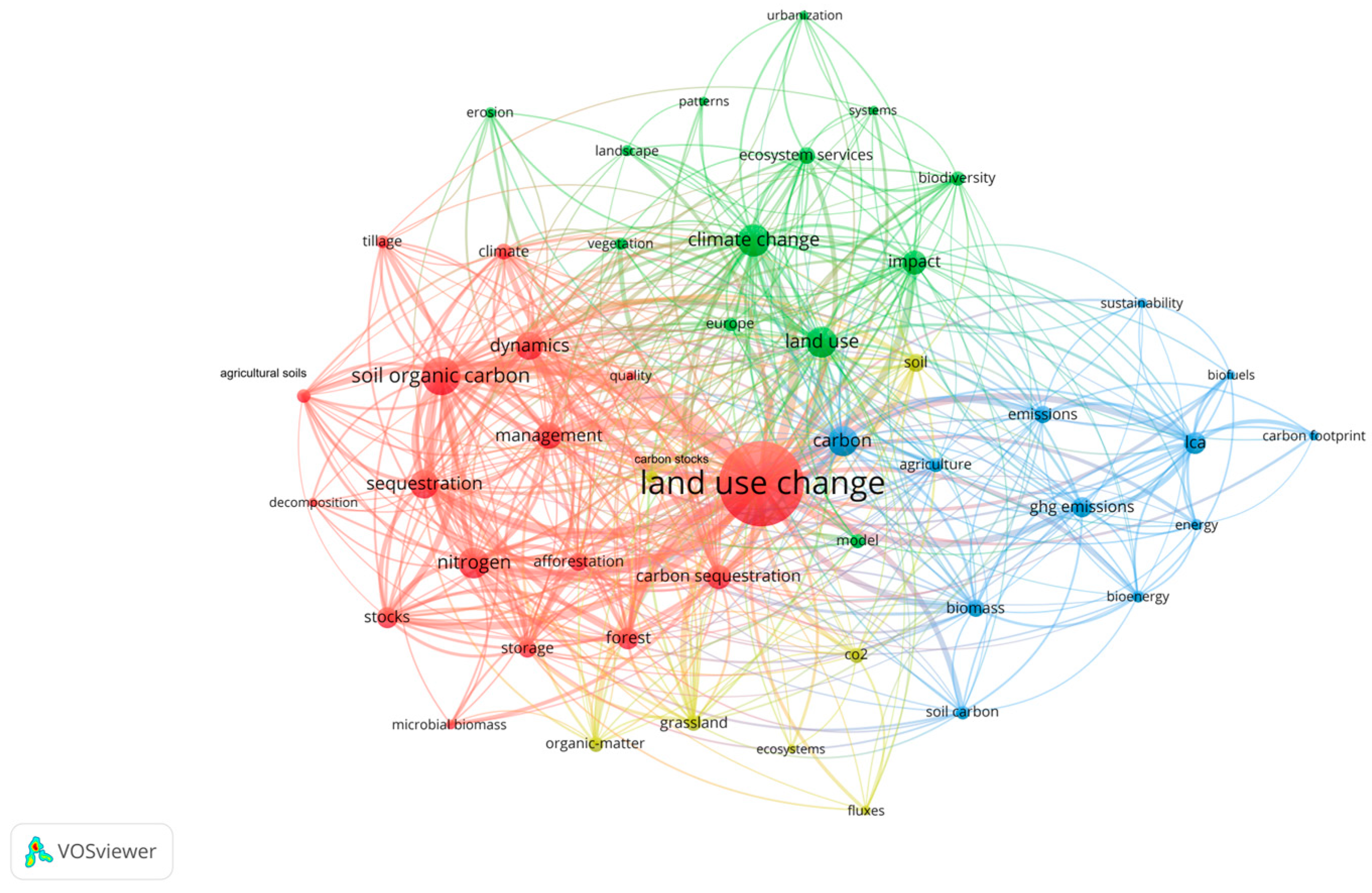
Keyword co-occurrence analysis was used to identify the principal research topics and their interrelationships. All keywords were included in the analyses, and a minimum occurrence threshold of 20 was applied. The keyword co-occurrence analysis used the full-counting method. This yielded 49 keywords that met the inclusion criterion.
To improve consistency, a thesaurus file was created in VOSviewer to harmonise keywords referring to the same concept but differing in spelling, punctuation, or grammatical form (Table 1). This prevented identical concepts from being treated as separate keywords and ensured a more reliable representation of the conceptual structure.
Table 1.
Complete keyword thesaurus used in the VOSviewer analysis.
The resulting keyword network illustrates the field’s conceptual structure and the relationships among its dominant themes. The bibliometric results supported this interpretation and helped identify the most frequently studied research topics and their interconnections.
In addition to keyword analysis, country mentions in the retrieved literature were examined by identifying references to European Union Member States in article abstracts. The abstracts of all 716 publications were exported from the Web of Science database and processed in Microsoft Excel. During data preparation, three missing abstracts were identified. Two abstracts were unavailable in the database, while one abstract was added manually from the publisher’s website. Consequently, the final dataset consisted of 714 abstracts. Each EU Member State was counted once per abstract, regardless of how many times it was mentioned. Abstracts mentioning multiple Member States contributed to the count for each country mentioned. Abstracts without Member State names did not contribute to any country count.
The frequency of country mentions was calculated and visualised using ArcGIS Pro 3.0.3 as a choropleth map. A colour gradient ranging from dark red to light red was applied, with darker shades indicating more frequent mentions of a country. The base map of European Union Member States was obtained from the Eurostat 2024 dataset using the EPSG:3035 coordinate reference system. The map represents the frequency of country mentions in abstracts, rather than verified study locations.
Temporal publication trends were analysed using Microsoft Excel by calculating the annual number of publications over the study period. Annual publication counts were obtained from Web of Science’s ‘Refine by Publication Years’ distribution, which uses the Early Access year when it differs from the final publication year, and the final publication year otherwise. Consequently, an article first published online in 2025 could be included even if its final publication year was 2026. Each publication was counted once in the annual distribution, as presented in Section 3.1.3.
2.2. Qualitative Content Analysis
Section 3.2 presents a qualitative content analysis that complements the bibliometric analysis of 716 publications by examining a narrower set of studies addressing policy, governance, management or planning in relation to land take and carbon dynamics.
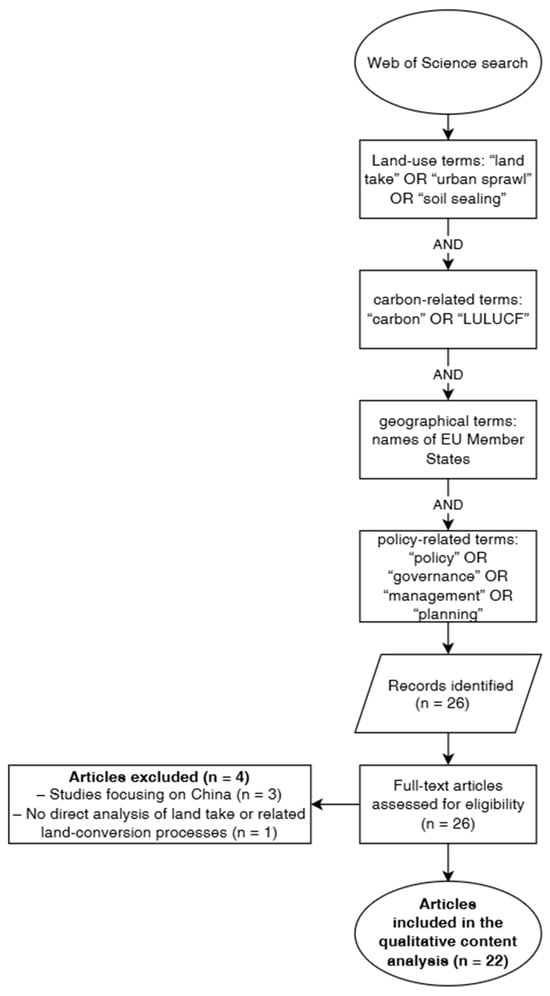
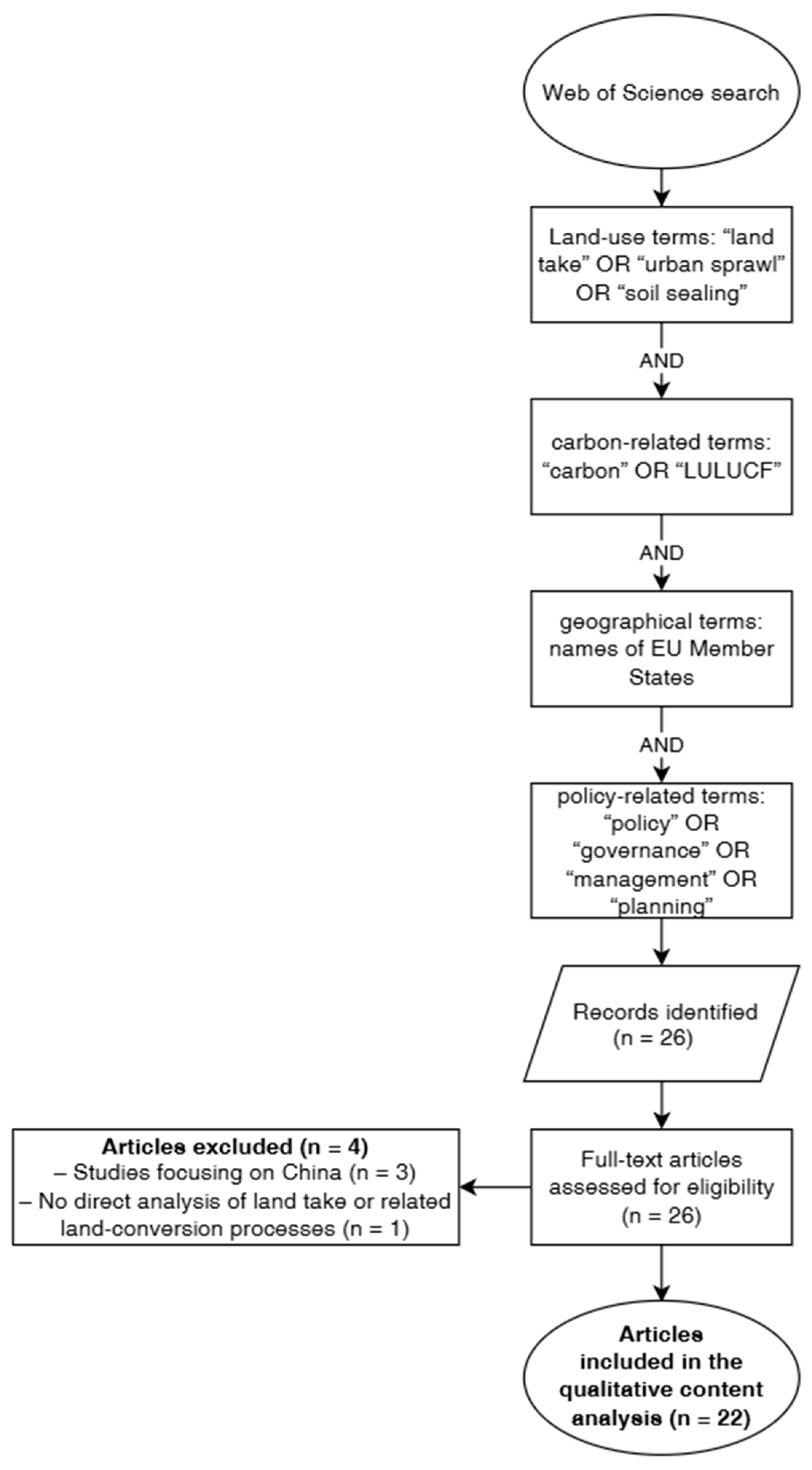
The qualitative sample was identified by refining the bibliometric search strategy in the Web of Science Core Collection. The land-use-related terms were narrowed to “land take”, “urban sprawl”, and “soil sealing”, and an additional search condition was introduced using “policy”, “governance”, “management” or “planning”. The carbon-related terms “carbon” and “LULUCF”, the EU Member State names, the publication period of 1998–2025 and the Article document type remained unchanged. This refined search yielded 26 publications.
After an initial assessment of titles and abstracts, the full texts of all 26 publications were reviewed to determine their eligibility and relevance to the qualitative content analysis. Three studies focusing on China were excluded because they did not meet the geographical eligibility criterion. One study focusing on Ireland was excluded because it examined indirect drivers, including teleworking and transport, without establishing a direct connection to land-use change. The final qualitative dataset therefore consisted of 22 publications, and Figure 1 illustrates the search and selection process.
Figure 1.
Selection process for the qualitative content analysis.
Studies covering both EU and non-EU countries were retained when EU Member States were included in the analysis. The subsequent classification distinguished how directly the selected studies addressed land take and carbon dynamics, as well as how they treated policy and governance. Limited or absent treatment of a dimension was recorded as a finding rather than automatically used as a reason for exclusion.
The selected studies were analysed to examine how they addressed relationships among carbon dynamics, land take, urban development, and policy, governance, or spatial planning. For each publication, information was extracted on its geographical focus, land take representation, land-use concept, carbon-related aspects, policy or governance focus, and methodological approach. Table 2 presents the criteria used for the qualitative classification.
Table 2.
Criteria used for the qualitative classification of the selected studies.
Studies in the limited category could nevertheless provide indicators or methods relevant to planning. This classification describes how the publications treat policy and governance. It does not measure the actual uptake of research findings in policy or planning. Section 3.2 presents the results. The qualitative synthesis also examined whether the studies provided planning-relevant indicators, assessed potential effects of policy instruments, or analysed legal and institutional frameworks.
The first author performed the qualitative classification manually using the criteria described above. The classifications were subsequently checked together with a co-author for consistency.
3. Results
3.1. Bibliometric Mapping of Research Themes and Geographical Focus
3.1.1. Keyword Co-Occurrence Analysis
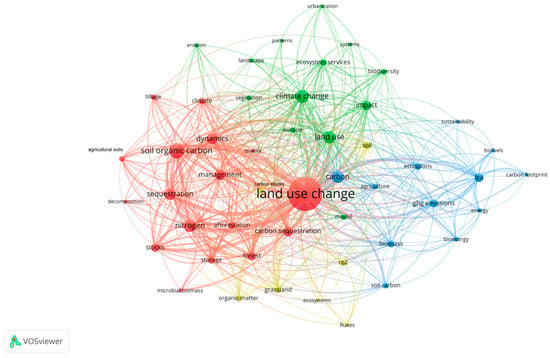
Land-use change was the most frequently occurring keyword, with 391 occurrences and a total link strength of 1395 (Table 3). Soil organic carbon ranked second in both occurrence frequency (136) and total link strength (564). Other frequently occurring keywords included climate change (110), nitrogen (104), and land use (103). The keyword co-occurrence network visualises the relationships among these terms (Figure 2).
Table 3.
Top keywords by occurrence and total link strength.
Figure 2.
Keyword co-occurrence network of articles on land-use change and carbon dynamics retrieved using EU Member State names as geographical search terms (VOSviewer visualisation).
Overall, the keyword network shows that land-use change serves as the central integrating concept in the retrieved literature. It has the highest occurrence frequency and the greatest total link strength, placing it at the network centre. The term is strongly connected with soil organic carbon, carbon sequestration, land use, climate change, and carbon, indicating that the retrieved literature on land-use change strongly focuses on carbon-related processes within terrestrial ecosystems.
3.1.2. Distribution of Country Mentions in Abstracts
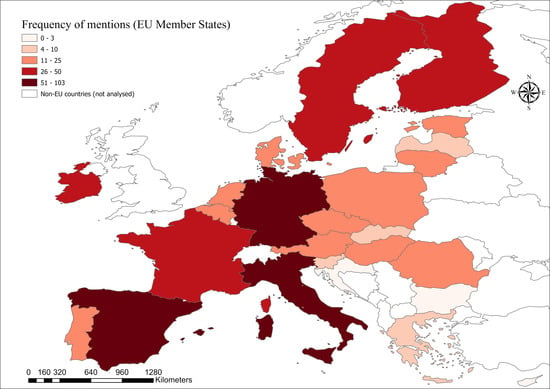
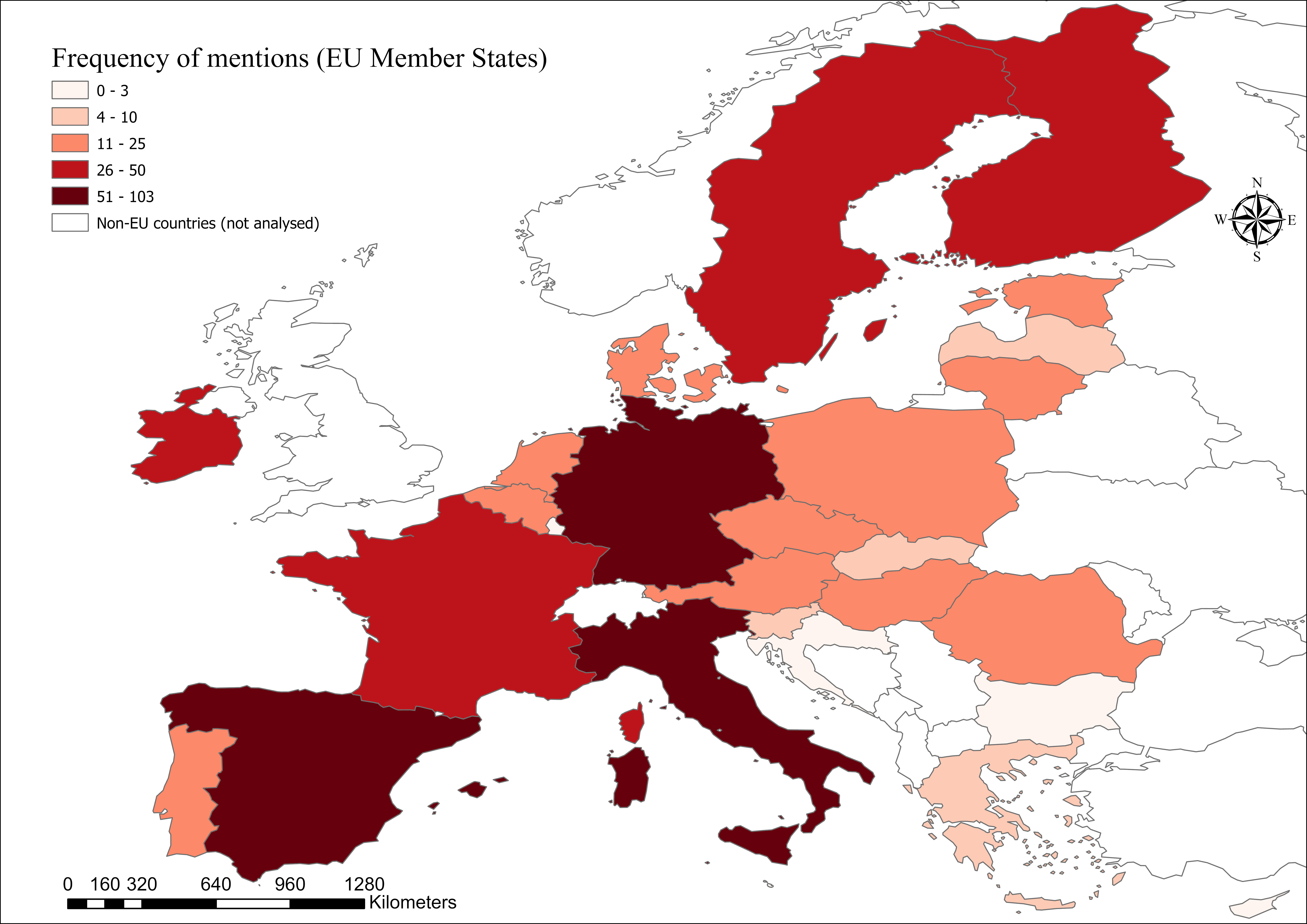
To examine country mentions in the reviewed literature, the frequency of European Union Member State mentions in article abstracts was analysed. This analysis describes country mentions, not verified study locations, countries of publication, or author affiliations (Figure 3).
Figure 3.
Frequency of European Union Member State mentions in the reviewed abstracts. Base map: Eurostat (2024).
The results reveal an uneven distribution of country mentions within the retrieved dataset. Spain (103), Germany (98), and Italy (92) were the most frequently mentioned countries, followed by Finland (48), Ireland (47), Sweden (47), and France (45).
In contrast, several Central and Eastern European Member States were mentioned less frequently. Slovakia (5), Slovenia (4), Bulgaria (3), and Croatia (3) were mentioned only rarely, while Malta was not mentioned in any of the analysed abstracts. Overall, the results indicate that country mentions were concentrated in Southern, Central and parts of Northern Europe, with several smaller and Eastern European Member States mentioned less frequently in this dataset.
3.1.3. Temporal Trends in Land-Use Change and Carbon-Related Research
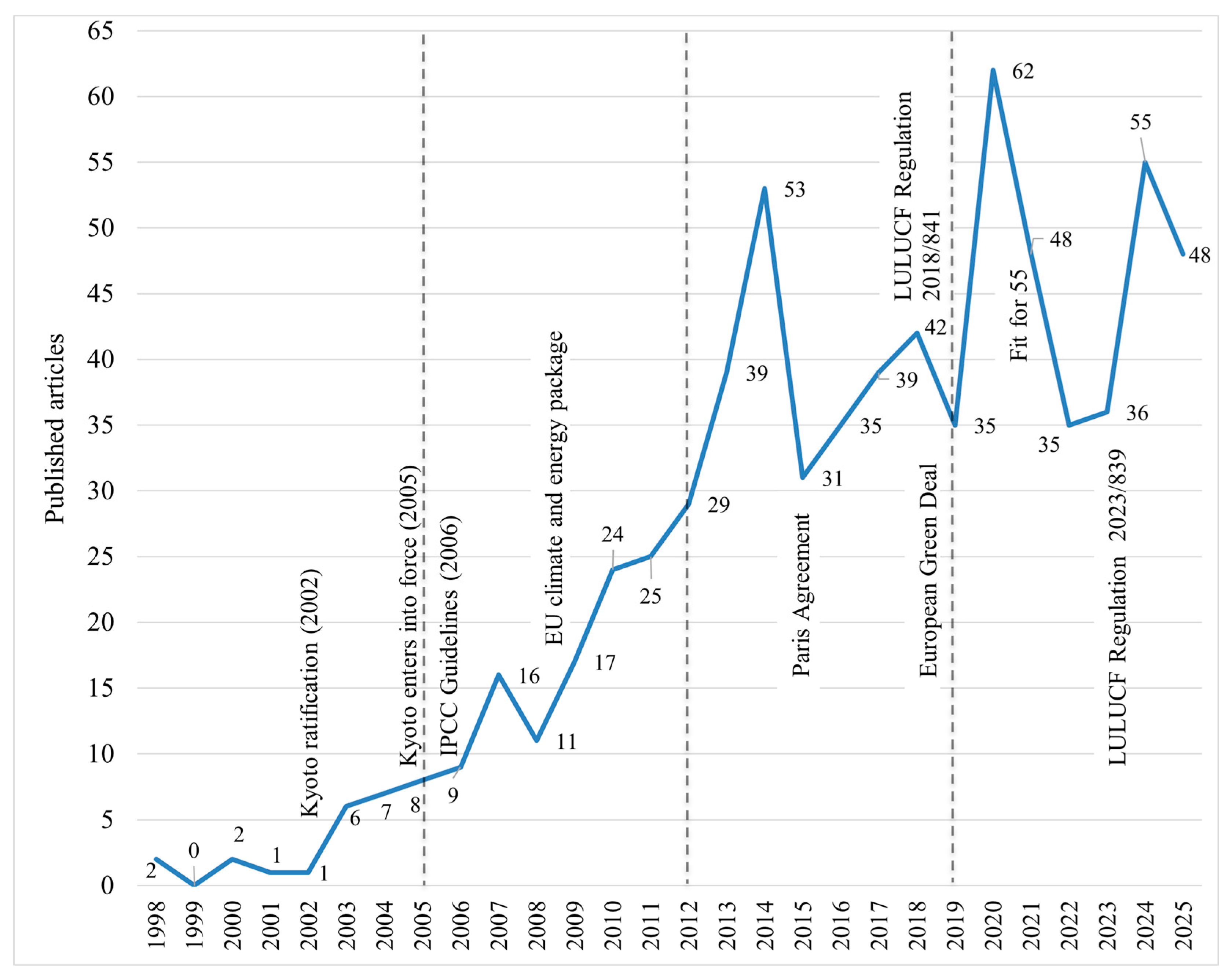
The temporal distribution of publications on land-use change and carbon-related research demonstrates a clear long-term increase in scientific output over the study period (Figure 4). Publication activity remained low and relatively stable until the early 2000s, after which a gradual upward trend became evident. The most pronounced increases occurred during the early 2010s and again around 2019–2020, with publication peaks recorded in 2014 (53 articles) and 2020 (62 articles).
Figure 4.
Annual number of publications on land-use change and carbon-related research retrieved using EU Member State names as geographical search terms (1998–2025), based on Web of Science data. Vertical dashed lines at 2005, 2012 and 2019 separate the four seven-year periods used in the analysis. Selected international and European Union climate policy milestones are labelled separately.
To facilitate interpretation of long-term publication trends, the study period (1998–2025) was divided into four equal-length intervals.
Period 1 (1998–2004). The initial period is characterised by very low publication activity, indicating the early stage of research on land-use change and carbon-related processes. Although a modest increase became visible after 2002, the overall research output remained limited. This period corresponds to preparations for implementing the Kyoto Protocol, including the European Union’s ratification in 2002 [15] and its entry into force in 2005.
Period 2 (2005–2011). Publication activity increased noticeably from 2006 onwards, marking the beginning of a sustained growth phase. This period includes the publication of the 2006 IPCC Guidelines for National Greenhouse Gas Inventories, which establish a harmonised methodological framework for greenhouse gas accounting, including the land use, land-use change and forestry (LULUCF) sector [16]. It also encompasses the adoption of the EU Climate and Energy Package (2008–2009) [17].
Period 3 (2012–2018). Research activity continued to increase, reaching a first publication peak in 2014 with 53 articles. Publication output declined to 31 articles in 2015 but recovered during the following years. This period includes the transition between the first and second commitment periods of the Kyoto Protocol, the adoption of the Doha Amendment [18], and the adoption of the Paris Agreement in 2015 [19].
Period 4 (2019–2025). The final period is characterised by the highest overall publication activity, with a peak of 62 articles recorded in 2020. Although publication output declined in 2021–2022, it remained substantially higher than in previous periods. The latter part of the study period includes several important European climate policy developments, notably the adoption of the European Green Deal in 2019 [20], the Fit for 55 package [21] and the revised LULUCF Regulation (EU) 2023/839 [10]. Overall, the temporal analysis demonstrates a substantial increase in publication activity over the past three decades. The observed shifts in publication output correspond temporally with several major international and European climate policy milestones illustrated in Figure 4. This comparison is descriptive and does not establish whether these policy milestones influenced publication activity or research priorities.
3.2. Qualitative Analysis of Policy and Governance Dimensions
The qualitative analysis included 22 publications addressing policy, governance, management, or planning dimensions related to land take and carbon-related processes (Table 4). The reviewed studies demonstrated considerable diversity in terminology, policy focus and methodological approaches. Of the 22 studies, seven addressed land take directly, whereas fifteen examined related concepts such as soil sealing, urban sprawl, or urban expansion. All frequencies reported below refer to publications within the 22-study qualitative sample.
Carbon-related aspects appeared in several forms. Ten studies addressed carbon storage or carbon stocks [22,23,24,25,26,27,28,29,30,31], five focused on carbon sequestration [23,25,26,31,32] and three analysed soil organic carbon [33,34,35]. Other carbon-related aspects included GHG emissions, carbon footprints and carbon budgets. These categories were not mutually exclusive, as individual publications could address more than one carbon-related aspect. In fifteen studies, carbon-related aspects were assessed directly in the context of land take or related land-use processes, whereas six studies addressed them indirectly. One publication did not include an explicit carbon-related component. Gabriels et al. [36] examined the relationship between soil sealing and flooding without analysing carbon-related processes and were therefore classified as having no explicit carbon component. The study was retained for its analysis of soil sealing and its relevance to land management.
Policy and governance dimensions were addressed explicitly in twelve studies, while ten referred to these aspects only to a limited extent. The explicit policy-oriented studies mainly addressed spatial planning, regional planning, legal frameworks, or land-use management.
The reviewed studies employed a broad range of methodological approaches, and several studies combined multiple methods. Individual publications could fall into multiple methodological categories. Consequently, the category counts may exceed 22. GIS-based spatial analysis was widely used. Scenario modelling was applied in three studies [28,37,38], while InVEST modelling appeared in three studies [24,26,30]. Two publications applied multi-criteria approaches [33,39], of which one explicitly used the Analytic Hierarchy Process (AHP) [33]. Other approaches included ecosystem service assessment, remote sensing, machine learning, life-cycle assessment (LCA), soil surveys, literature review, field sampling, and comparative legal analysis.
The scenario studies examined different combinations of factors affecting land take and environmental outcomes [28,37]. Mascarenhas et al. [28] showed through scenario analysis that dispersed urban development could result in land take even under population decline. In their scenarios, compact development had more favourable outcomes for limiting land take, but its effects on ecosystem service provision varied between services. Haas et al. [37] examined interactions between decarbonization, circular economy strategies and land take in Austria. Their decarbonization-only and weak circular economy scenarios did not meet the circular economy and land take targets set by Austrian policy. Avoiding further expansion of buildings and roads on unbuilt land was a key component of the strong circular economy scenario, which was consistent with all three policy targets considered: carbon neutrality, reduced material consumption and limited annual land take. Together, these scenario studies highlight the importance of considering land take alongside carbon-related and other environmental objectives, as favourable outcomes for one objective do not necessarily imply favourable outcomes for others [28,37].
The studies also connected environmental assessments to different aspects of planning and governance. Calzolari et al. [25] illustrated how maps of soil ecosystem services could inform urban planning and the design of compensation measures by identifying the services potentially lost through soil sealing. Pan et al. [38] modelled the potential effects of restricting urban development in selected areas of the Stockholm region. Their scenario results showed that these restrictions could mitigate the emission effects of urban sprawl, although urban growth management alone could not address all projected increases in emissions. Koumoulidis et al. [40] examined the legislative dimension, identifying challenges in monitoring, enforcement and alignment with EU targets across five national frameworks. Together, these studies addressed distinct aspects of governance: providing information for planning decisions, assessing the potential effects of policy instruments, and examining the frameworks through which land-use objectives are implemented.
Table 4.
Characteristics of selected studies addressing land take, carbon-related processes, and policy or governance dimensions.
4. Discussion
This study examines how land-use change has been addressed in relation to carbon dynamics in a dataset of 716 publications retrieved using EU Member State names as geographical search terms for the period 1998–2025. The bibliometric results show increased publication output and an uneven distribution of themes and country mentions in this dataset. The complementary qualitative analysis of the 22 selected studies provides a more focused perspective on the methods used and how carbon-related knowledge connects to policy, governance, and planning in studies addressing land take, urban sprawl, and soil sealing.
4.1. Research Themes and Geographical Pattern
The bibliometric analysis identified land-use change as the central integrating concept within the retrieved literature, closely linked to soil organic carbon, carbon sequestration, carbon storage, and greenhouse gas emissions. These findings indicate that the retrieved publications primarily focused on understanding carbon dynamics within terrestrial ecosystems and on quantifying changes in carbon stocks associated with different land-use categories. The prominence of carbon-related themes should be interpreted in light of the search requirement for “carbon” or “LULUCF”. This observation aligns with the development of international greenhouse gas accounting frameworks, particularly the LULUCF Regulation and the IPCC Guidelines, which establish reporting requirements and provide methodological guidance for estimating carbon emissions and removals from land use, respectively [1,16]. However, the keyword analysis alone does not establish the extent to which these carbon-related processes are integrated with broader land-use governance, spatial planning, or decision-support perspectives.
The geographical analysis also revealed considerable variation in how often countries were mentioned in the retrieved literature. Italy, Spain, and Germany were mentioned more frequently, while several Central and Eastern European Member States were mentioned less often. Previous research has emphasised the importance of local socio-economic and biophysical context in understanding land system change [44]. Differences in definitions and monitoring approaches between EU countries also complicate the comparison of land take indicators [6]. However, country mentions do not necessarily correspond to study locations, so this distribution should be interpreted as a pattern within the retrieved literature rather than a direct measure of national research activity. The present analysis did not examine the roles of data availability, policy differences, or the geographical concentration of research teams in shaping this pattern.
4.2. Connections to Policy and Governance
The qualitative analysis shows how the 22 selected studies connect land take, carbon-related processes, and governance. Although many of these studies address urban sprawl, soil sealing, or related land conversion processes, they do not always analyse land take as a distinct policy and governance issue. Furthermore, while the selected studies investigate carbon storage, carbon sequestration, and greenhouse gas emissions, the ways these environmental indicators link to broader planning and governance frameworks vary. These links are particularly relevant in light of recent European policy developments, including the European Green Deal, the EU Soil Strategy for 2030, the revised LULUCF Regulation, and the Nature Restoration Regulation, which collectively emphasise the simultaneous consideration of climate, biodiversity, soil protection, and land-use objectives [7,10,20,45].
These studies can inform planning and policy decisions. However, their usefulness for planning does not by itself show whether the proposed measures work in practice. Calzolari et al. [25] acknowledged that their standardised indicators could overestimate or underestimate the potential provision of soil ecosystem services under certain circumstances. Pan et al. [38] assessed the potential effects of development restrictions through scenario modelling. Their results show possible outcomes under the modelled assumptions, rather than observed effects of implemented restrictions. Koumoulidis et al. [40] identified legislative and implementation challenges and called for stakeholder engagement and empirical evaluation to better understand implementation effectiveness. These examples suggest that researchers should consider both methodological limitations and evidence on policy implementation when interpreting findings.
4.3. Methodological Approaches in the Reviewed Studies
The methodological review shows an uneven distribution of methods within the 22 selected studies. GIS-based spatial analysis was widely used, while scenario modelling was also represented in the reviewed literature. Two studies applied multi-criteria approaches [33,39], including one that used AHP [33]. However, multi-factor consideration was not limited to these approaches. Scenario studies by Haas et al. [37], Pan et al. [38], and Mascarenhas et al. [28] also examined interactions between development patterns, policy choices and environmental outcomes. Because contemporary land-use decisions involve multiple environmental, economic, legal, and social objectives, further research could explore how MCDA might complement the scenario-based and spatial approaches used in the selected studies. Similar observations have been made within land system science, where researchers have emphasised the need to link scientific knowledge with land-use planning and governance and to consider interactions and trade-offs between land-use objectives [44,46,47].
The reviewed approaches serve different, potentially complementary purposes. GIS-based assessments locate land-use changes and environmental impacts, but their interpretation depends on the input data, indicators and modelling choices [26,33]. Scenario modelling explores possible outcomes of development and policy choices, with results conditional on the assumptions used [38]. MCDA can combine several criteria to identify areas requiring protection or restrictions on development, but the resulting priorities reflect the selection, scoring and weighting of those criteria [33]. Differences in spatial scale, indicators and assumptions therefore limit direct comparison between studies. Their findings should be interpreted in relation to the specific planning question and assessment framework.
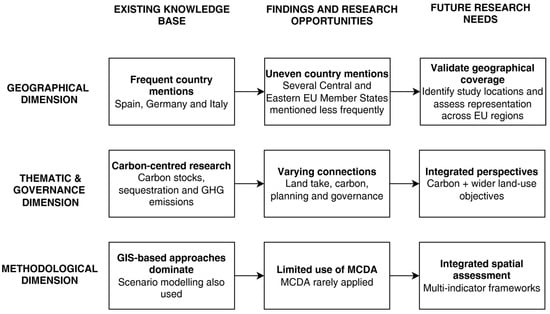
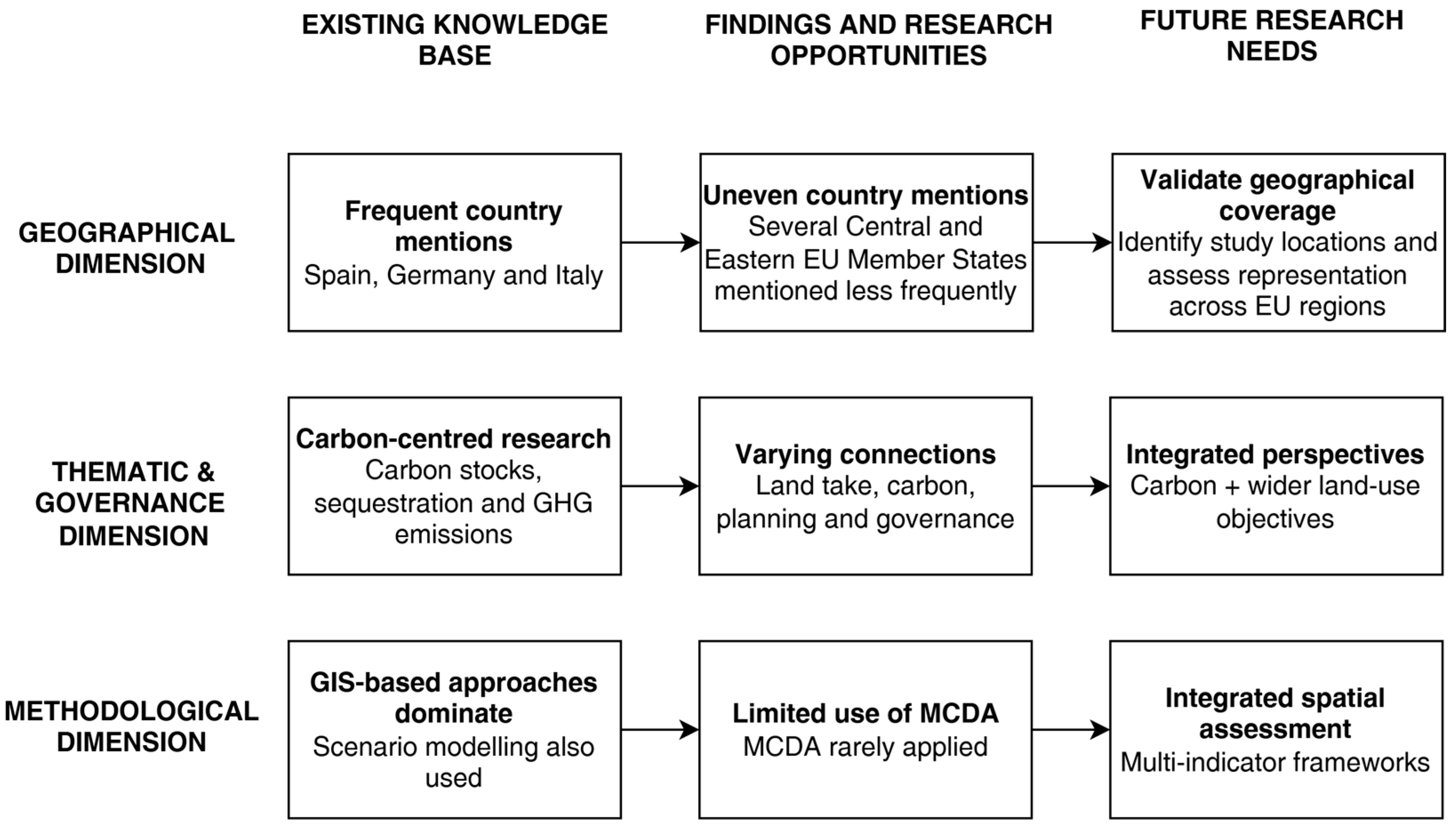
The results also highlight a broader conceptual challenge. The selected studies address different aspects of land-use change, such as carbon storage, soil organic carbon, or urban expansion. At the same time, scenario studies also examine interactions between land-use change, policy choices and environmental outcomes [28,37,38]. Yet current European legislation increasingly requires simultaneous consideration of climate mitigation, biodiversity conservation, soil health, ecosystem services, and land take reduction within the same planning and decision-making processes. Future research could explore methodological approaches that combine multiple spatial indicators within transparent, scientifically justified assessment frameworks rather than evaluating each objective separately. Figure 5 synthesises the main findings, identified knowledge gaps, and resulting research needs.
Figure 5.
Synthesis of the main findings and opportunities for future research.
4.4. Limitations of This Review and Future Research
The present study has several limitations. The bibliometric analysis relied exclusively on the Web of Science Core Collection and therefore did not include publications indexed only in Scopus or other databases. The review covers publications from 1998 to 2025 and therefore does not capture subsequent developments. The grey literature outside the indexed dataset was not included. Keyword co-occurrence analysis identifies thematic patterns and connections but does not directly assess how research findings are applied in policy and planning. The search used English-language search terms, including EU Member State names, without adding their equivalents in national languages, but was not restricted by publication language. Relevant publications may still have been missed if their searchable bibliographic fields did not contain the query terms.
In addition, the search strategy focused specifically on studies addressing carbon-related aspects of land-use change within the European Union context. Consequently, relevant studies discussing land governance or spatial planning without explicit reference to carbon may not have been captured.
The geographical analysis was based on country mentions in abstracts, which may refer to study locations, background information, or comparisons. Conversely, when abstracts mention only regional or local place names, this approach may not identify the corresponding country. The resulting distribution therefore describes country mentions within the retrieved dataset rather than a validated distribution of study locations. Finally, the qualitative analysis focused on the 22 selected studies identified through a targeted search using “land take”, “urban sprawl”, and “soil sealing”, combined with carbon-related, geographical, and policy- and governance-related terms. Its findings therefore relate to this selected literature and should not be generalised to the entire body of EU research on land-use change and climate policy.
Despite these limitations, the study provides an overview of the retrieved literature on land-use change and carbon dynamics in the European Union context, from both bibliometric and policy perspectives. The findings identify opportunities for further methodological development to strengthen the interface between scientific evidence and land-use governance. In particular, future research could explore integrated spatial assessment frameworks that combine carbon dynamics with other policy-relevant indicators, supporting transparent, evidence-based land-use decision-making across multiple governance levels.
5. Conclusions
This study examined how land-use change is addressed in relation to carbon dynamics within a dataset of 716 publications retrieved using EU Member State names as geographical search terms. By combining bibliometric mapping with qualitative content analysis, the study provides an overview of dominant research themes, country mentions, methodological approaches, and the extent to which the selected studies address policy and governance dimensions.
The results demonstrate that the retrieved literature has primarily focused on carbon-related processes, particularly soil organic carbon, carbon storage, carbon sequestration, and greenhouse gas emissions. At the same time, country mentions are uneven across the dataset, with Italy, Spain, and Germany mentioned more frequently and several Central and Eastern European Member States mentioned less often. The qualitative analysis also showed that the 22 selected studies address policy and governance in different ways, including links between land take, spatial planning, governance, and carbon-related processes. Furthermore, only two of the 22 selected studies applied multi-criteria approaches.
These findings highlight opportunities to explore further how carbon-related knowledge can support integrated land-use governance and evidence-based decision-making. As European policies increasingly require simultaneous consideration of climate mitigation, biodiversity conservation, soil protection, and land take reduction, future research could examine how to combine these objectives within coherent spatial assessment approaches.
Future research could therefore further explore integrated spatial assessment frameworks that combine environmental indicators with policy and governance objectives. Such approaches could strengthen the scientific basis for sustainable land-use planning and support more transparent and evidence-based land-use decision-making across governance levels.
Supplementary Materials
The following supporting information can be downloaded at: https://www.mdpi.com/article/10.3390/land15122259/s1, Table S1: Titles, DOIs, and Web of Science accession numbers of the 716 publications; Table S2: Frequency of EU Member State mentions in publication abstracts; Table S3: Annual publication counts (1998–2025); Table S4: Characteristics and qualitative classification of the 22 studies included in the qualitative synthesis.
Author Contributions
Conceptualization, B.T. and E.J.; methodology, B.T. and E.J.; validation, B.T. and E.J.; formal analysis, B.T.; investigation, B.T.; data curation, B.T.; writing—original draft preparation, B.T.; writing—review and editing, B.T. and E.J.; visualisation, B.T.; supervision, E.J.; project administration, E.J.; funding acquisition, E.J. All authors have read and agreed to the published version of the manuscript.
Funding
This research was supported by the Estonian Research Council under personal research grant PSG1207, “Using spatial data to identify land-use conflicts and multipurpose land-use opportunities for promoting sustainable land use”.
Data Availability Statement
The bibliographic records analysed in this study were obtained from the Web of Science Core Collection and are subject to the database provider’s access and licensing conditions. The Supplementary Information File provides identifiers for the 716 publications in the bibliometric dataset, aggregated country-mention frequencies and annual publication counts, and a separate classification table for the 22 studies included in the qualitative analysis.
Acknowledgments
During the preparation of this manuscript, the authors used OpenAI ChatGPT (GPT-5.6 Sol, OpenAI) for language editing and text restructuring. The authors have reviewed and edited the output and take full responsibility for the content of this publication.
Conflicts of Interest
The authors declare no conflicts of interest.
Abbreviations
The following abbreviations are used in this manuscript:
| AHP | Analytic Hierarchy Process |
| CAP | Common Agricultural Policy |
| GHG | Greenhouse gas |
| GIS | Geographic information system |
| InVEST | Integrated Valuation of Ecosystem Services and Tradeoff |
| LCA | Life cycle assessment |
| LULUCF | Land use, land-use change and forestry |
References
- European Parliament and Council. Regulation (EU) 2018/841 of the European Parliament and of the Council of 30 May 2018 on the Inclusion of Greenhouse Gas Emissions and Removals from Land Use, Land Use Change and Forestry in the 2030 Climate and Energy Framework, and Amending Regulation (EU) No 525/2013 and Decision No 529/2013/EU; European Union: Brussels, Belgium, 2018; Volume 156. [Google Scholar]
- Intergovernmental Panel on Climate Change (IPCC). Annex I: Glossary. In Climate Change and Land; Cambridge University Press: Cambridge, UK, 2019; pp. 803–830. ISBN 978-1-009-15798-8. [Google Scholar]
- IPBES. Global Assessment Report on Biodiversity and Ecosystem Services of the Intergovernmental Science-Policy Platform on Biodiversity and Ecosystem Services. Available online: https://www.ipbes.net/node/35274 (accessed on 6 November 2025).
- Intergovernmental Panel on Climate Change (IPCC). IPCC Summary for Policymakers. In Climate Change and Land: An IPCC Special Report on Climate Change, Desertification, Land Degradation, Sustainable Land Management, Food Security, and Greenhouse Gas Fluxes in Terrestrial Ecosystems; Cambridge University Press: Cambridge, UK, 2019. [Google Scholar]
- European Commission. EU Biodiversity Strategy for 2030 Bringing Nature Back into Our Lives; European Commission: Brussels, Belgium, 2020. [Google Scholar]
- Marquard, E.; Bartke, S.; Gifreu i Font, J.; Humer, A.; Jonkman, A.; Jürgenson, E.; Marot, N.; Poelmans, L.; Repe, B.; Rybski, R.; et al. Land Consumption and Land Take: Enhancing Conceptual Clarity for Evaluating Spatial Governance in the EU Context. Sustainability 2020, 12, 8269. [Google Scholar] [CrossRef] [Scilit]
- European Commission. EU Soil Strategy for 2030: Reaping the Benefits of Healthy Soils for People, Food, Nature and Climate; European Commission: Brussels, Belgium, 2021. [Google Scholar]
- European Parliament and Council. Directive (EU) 2025/2360 of the European Parliament and of the Council of 12 November 2025 on Soil Monitoring and Resilience (Soil Monitoring Law); European Union: Brussels, Belgium, 2025. [Google Scholar]
- European Parliament and Council. Regulation (EU) 2021/2115 of the European Parliament and of the Council of 2 December 2021 Establishing Rules on Support for Strategic Plans to Be Drawn up by Member States under the Common Agricultural Policy (CAP Strategic Plans) and Financed by the European Agricultural Guarantee Fund (EAGF) and by the European Agricultural Fund for Rural Development (EAFRD) and Repealing Regulations (EU) No 1305/2013 and (EU) No 1307/2013; European Union: Brussels, Belgium, 2021; Volume 435. [Google Scholar]
- European Parliament and Council. Regulation (EU) 2023/839 of the European Parliament and of the Council of 19 April 2023 Amending Regulation (EU) 2018/841 as Regards the Scope, Simplifying the Reporting and Compliance Rules, and Setting out the Targets of the Member States for 2030, and Regulation (EU) 2018/1999 as Regards Improvement in Monitoring, Reporting, Tracking of Progress and Review; European Union: Brussels, Belgium, 2023. [Google Scholar]
- Beillouin, D.; Cardinael, R.; Berre, D.; Boyer, A.; Corbeels, M.; Fallot, A.; Feder, F.; Demenois, J. A Global Overview of Studies about Land Management, Land-Use Change, and Climate Change Effects on Soil Organic Carbon. Glob. Change Biol. 2022, 28, 1690–1702. [Google Scholar] [CrossRef] [Scilit] [PubMed]
- Raza, S.; Irshad, A.; Margenot, A.; Zamanian, K.; Li, N.; Ullah, S.; Mehmood, K.; Ajmal Khan, M.; Siddique, N.; Zhou, J.; et al. Inorganic Carbon Is Overlooked in Global Soil Carbon Research: A Bibliometric Analysis. Geoderma 2024, 443, 116831. [Google Scholar] [CrossRef] [Scilit] [PubMed]
- Jiang, Z.; Ma, H.; Li, S.; Zheng, C.; Bai, E. Towards Smart Soil Carbon Pool Management of Grassland: A Bibliometric Overview from Past to Future. Ecol. Process. 2025, 14, 54. [Google Scholar] [CrossRef] [Scilit]
- Colsaet, A.; Laurans, Y.; Levrel, H. What Drives Land Take and Urban Land Expansion? A Systematic Review. Land Use Policy 2018, 79, 339–349. [Google Scholar] [CrossRef] [Scilit]
- European Commission. Council Decision of 25 April 2002 Concerning the Approval, on Behalf of the European Community, of the Kyoto Protocol to the United Nations Framework Convention on Climate Change and the Joint Fulfilment of Commitments Thereunder; European Commission: Brussels, Belgium, 2002. [Google Scholar]
- Intergovernmental Panel on Climate Change. 2006 IPCC Guidelines for National Greenhouse Gas Inventories; Institute for Global Environmental Strategies (IGES): Hayama, Japan, 2006; ISBN 4-88788-032-4. [Google Scholar]
- Council of the European Union. Council Adopts Climate-Energy Legislative Package; Council of the European Union: Brussels, Belgium, 2009. [Google Scholar]
- Council of the European Union. Council Decision (EU) 2015/1339 of 13 July 2015 on the Conclusion, on Behalf of the European Union, of the Doha Amendment to the Kyoto Protocol to the United Nations Framework Convention on Climate Change and the Joint Fulfilment of Commitments Thereunder; European Union: Brussels, Belgium, 2015; Volume 207. [Google Scholar]
- United Nations Framework Convention on Climate Change. Adoption of the Paris Agreement; United Nations Framework Convention on Climate Change: Paris, France, 2015. [Google Scholar]
- European Commission. The European Green Deal; European Commission: Brussels, Belgium, 2019. [Google Scholar]
- European Commission. “Fit for 55”: Delivering the EU’s 2030 Climate Target on the Way to Climate Neutrality; European Commission: Brussels, Belgium, 2021. [Google Scholar]
- Salata, S.; Arcidiacono, A.; Corsi, S.; Mazzocchi, C.; Fedalto, A.; Riccobene, D. Farming on the Edge: The 10-Fold Deficit in Lombardy’s Agricultural Land. Land 2025, 14, 2112. [Google Scholar] [CrossRef] [Scilit]
- Ungaro, F.; Tarocco, P.; Aprea, A.; Bazzocchi, S.; Calzolari, C. From Fertile Grounds to Sealed Fields: Assessing and Mapping Soil Ecosystem Services in Forlì’s Urban Landscape (NE Italy). Land 2025, 14, 719. [Google Scholar] [CrossRef] [Scilit]
- Ragosta, M.; Daniele, G.; Imbrenda, V.; Coluzzi, R.; D’Emilio, M.; Lanfredi, M.; Matarazzo, N. Land Transformations in Irpinia (Southern Italy): A Tale on the Socio-Economic Dynamics Acting in a Marginal Area of the Mediterranean Europe. Sustainability 2024, 16, 8724. [Google Scholar] [CrossRef] [Scilit]
- Calzolari, C.; Tarocco, P.; Lombardo, N.; Marchi, N.; Ungaro, F. Assessing Soil Ecosystem Services in Urban and Peri-Urban Areas: From Urban Soils Survey to Providing Support Tool for Urban Planning. Land Use Policy 2020, 99, 105037. [Google Scholar] [CrossRef] [Scilit]
- González-García, A.; Palomo, I.; González, J.A.; López, C.A.; Montes, C. Quantifying Spatial Supply-Demand Mismatches in Ecosystem Services Provides Insights for Land-Use Planning. Land Use Policy 2020, 94, 104493. [Google Scholar] [CrossRef] [Scilit]
- Urbieta, P.; Fernandez, E.; Ramos, L.; Méndez Martínez, G.; Bento, R. A Land-Cover Based Urban Dispersion Indicator Suitable for Highly Dispersed, Discontinuously Artificialized Territories: The Case of Continental Portugal. Land Use Policy 2019, 85, 92–103. [Google Scholar] [CrossRef] [Scilit]
- Mascarenhas, A.; Haase, D.; Ramos, T.B.; Santos, R. Pathways of Demographic and Urban Development and Their Effects on Land Take and Ecosystem Services: The Case of Lisbon Metropolitan Area, Portugal. Land Use Policy 2019, 82, 181–194. [Google Scholar] [CrossRef] [Scilit]
- Szumacher, I.; Pabjanek, P. Temporal Changes in Ecosystem Services in European Cities in the Continental Biogeographical Region in the Period from 1990–2012. Sustainability 2017, 9, 665. [Google Scholar] [CrossRef] [Scilit]
- Sallustio, L.; Quatrini, V.; Geneletti, D.; Corona, P.; Marchetti, M. Assessing Land Take by Urban Development and Its Impact on Carbon Storage: Findings from Two Case Studies in Italy. Environ. Impact Assess. Rev. 2015, 54, 80–90. [Google Scholar] [CrossRef] [Scilit]
- Malucelli, F.; Certini, G.; Scalenghe, R. Soil Is Brown Gold in the Emilia-Romagna Region, Italy. Land Use Policy 2014, 39, 350–357. [Google Scholar] [CrossRef] [Scilit]
- Lagarias, A. Impervious Land Expansion as a Control Parameter for Climate-Resilient Planning on the Mediterranean Coast: Evidence from Greece. Land 2023, 12, 1844. [Google Scholar] [CrossRef] [Scilit]
- Criado, M.; Santos-Francés, F.; Martínez-Graña, A.; Sánchez, Y.; Merchán, L. Multitemporal Analysis of Soil Sealing and Land Use Changes Linked to Urban Expansion of Salamanca (Spain) Using Landsat Images and Soil Carbon Management as a Mitigating Tool for Climate Change. Remote Sens. 2020, 12, 1131. [Google Scholar] [CrossRef] [Scilit]
- Altobelli, F.; Vargas, R.; Corti, G.; Dazzi, C.; Montanarella, L.; Monteleone, A.; Caon, L.; Piazza, M.G.; Calzolari, C.; Munafò, M.; et al. Improving Soil and Water Conservation and Ecosystem Services by Sustainable Soil Management Practices: From a Global to an Italian Soil Partnership. Ital. J. Agron. 2020, 15, 1765. [Google Scholar] [CrossRef] [Scilit]
- Lorenz, K.; Preston, C.M.; Kandeler, E. Soil Organic Matter in Urban Soils: Estimation of Elemental Carbon by Thermal Oxidation and Characterization of Organic Matter by Solid-State 13C Nuclear Magnetic Resonance (NMR) Spectroscopy. Geoderma 2006, 130, 312–323. [Google Scholar] [CrossRef] [Scilit]
- Gabriels, K.; Willems, P.; Orshoven, J.V. A Data-Driven Analysis, and Its Limitations, of the Spatial Flood Archive of Flanders, Belgium to Assess the Impact of Soil Sealing on Flood Volume and Extent. PLoS ONE 2020, 15, e0239583. [Google Scholar] [CrossRef] [Scilit] [PubMed]
- Haas, W.; Baumgart, A.; Eisenmenger, N.; Virág, D.; Kalt, G.; Sommer, M.; Kratena, K.; Meyer, I. How Decarbonization and the Circular Economy Interact: Benefits and Trade-Offs in the Case of the Buildings, Transport, and Electricity Sectors in Austria. J. Ind. Ecol. 2025, 29, 531–545. [Google Scholar] [CrossRef] [Scilit] [PubMed]
- Pan, H.; Page, J.; Zhang, L.; Cong, C.; Ferreira, C.; Jonsson, E.; Näsström, H.; Destouni, G.; Deal, B.; Kalantari, Z. Understanding Interactions between Urban Development Policies and GHG Emissions: A Case Study in Stockholm Region. Ambio 2020, 49, 1313–1327. [Google Scholar] [CrossRef] [Scilit] [PubMed]
- Gareis, P.; Diller, C. Identifying Exurbs: A Multi-Criteria Approach for Germany. Eur. Spat. Res. Policy 2023, 30, 71–89. [Google Scholar] [CrossRef] [Scilit]
- Koumoulidis, D.; Varvaris, I.; Hadjimitsis, D.; Gabriele, M.; Brumana, R.; Gitas, I.; Georgopoulos, N.; Abdollahnejad, A.; Gkounti, E.; Stavrakoudis, D.; et al. Profiling Land Use Planning: Legislative Structures in Five European Nations. Land 2025, 14, 1261. [Google Scholar] [CrossRef] [Scilit]
- Destek, M.A.; Sarkodie, S.A.; Asamoah, E.F. Does Biomass Energy Drive Environmental Sustainability? An SDG Perspective for Top Five Biomass Consuming Countries. Biomass Bioenergy 2021, 149, 106076. [Google Scholar] [CrossRef] [Scilit]
- Saganeiti, L.; Pilogallo, A.; Faruolo, G.; Scorza, F.; Murgante, B. Territorial Fragmentation and Renewable Energy Source Plants: Which Relationship? Sustainability 2020, 12, 1828. [Google Scholar] [CrossRef] [Scilit]
- Ottelin, J.; Heinonen, J.; Junnila, S. New Energy Efficient Housing Has Reduced Carbon Footprints in Outer but Not in Inner Urban Areas. Environ. Sci. Technol. 2015, 49, 9574–9583. [Google Scholar] [CrossRef] [Scilit] [PubMed]
- Verburg, P.H.; Erb, K.-H.; Mertz, O.; Espindola, G. Land System Science: Between Global Challenges and Local Realities. Curr. Opin. Environ. Sustain. 2013, 5, 433–437. [Google Scholar] [CrossRef] [Scilit] [PubMed]
- European Parliament and Council. Regulation (EU) 2024/1991 of the European Parliament and of the Council of 24 June 2024 on Nature Restoration and Amending Regulation (EU) 2022/869 (Text with EEA Relevance); European Union: Brussels, Belgium, 2024. [Google Scholar]
- Turner, B.L., II; Lambin, E.F.; Reenberg, A. The Emergence of Land Change Science for Global Environmental Change and Sustainability. Proc. Natl. Acad. Sci. USA 2007, 104, 20666–20671. [Google Scholar] [CrossRef] [Scilit] [PubMed]
- Meyfroidt, P.; de Bremond, A.; Ryan, C.M.; Archer, E.; Aspinall, R.; Chhabra, A.; Camara, G.; Corbera, E.; DeFries, R.; Díaz, S.; et al. Ten Facts about Land Systems for Sustainability. Proc. Natl. Acad. Sci. USA 2022, 119, e2109217118. [Google Scholar] [CrossRef] [Scilit] [PubMed]

Disclaimer/Publisher’s Note: The statements, opinions and data contained in all publications are solely those of the individual author(s) and contributor(s) and not of MDPI and/or the editor(s). MDPI and/or the editor(s) disclaim responsibility for any injury to people or property resulting from any ideas, methods, instructions or products referred to in the content. |
© 2026 by the authors. Licensee MDPI, Basel, Switzerland. This article is an open access article distributed under the terms and conditions of the Creative Commons Attribution (CC BY) license.