


Abstract
Metropolitan area governance has become a key focus in the academic literature, particularly regarding institutional models, intergovernmental cooperation, and the role of local governments. Yet less is known about whether local governments diagnose metropolitan governance problems in ways that are consistent with the institutional solutions they consider appropriate, especially in countries with weak metropolitan institutionalisation. This study addresses this gap by examining how local governments in ten metropolitan areas of Andalusia, Spain, perceive existing governance challenges and the institutional models required to address them. An extensive quantitative analysis was conducted through a direct survey of local political decision-makers and technical staff. The study links theoretically identified governance dilemmas to perceived local challenges and preferred institutional responses, thereby assessing the coherence between problem diagnosis and proposed solutions. The findings reveal a preference for technical, flexible, and functional arrangements—particularly metropolitan agencies and vertical coordination—over more politically integrated models such as metropolitan governments. The article therefore contributes evidence on the Spanish metropolitan governance anomaly and on the local political-institutional conditions that help explain the persistence of “metropolitan governance without metropolitan government”.
1. Introduction
In recent decades, urban growth rates have accelerated, creating a territorial pattern of urban settlement which, according to the World Bank, will intensify in the coming years. It is therefore projected that, by 2050, more than 70% of the world’s population will be living in cities [1]. Alongside urban growth, production models, new patterns of consumption and lifestyles, and service provision systems have been profoundly transformed. These changes have also significantly influenced the spatial dynamics of cities, manifesting in the phenomenon known as metropolisation, i.e., the most visible territorial outcome of these processes [2,3,4,5,6,7]. A key feature of this phenomenon over the last fifty years is the expansion of urban populations beyond traditional city boundaries. Labour markets, different forms of leisure and consumption, residential and industrial location decisions, and public services are increasingly metropolitan in scale [8,9,10,11,12,13,14]. This has generated an urban development pattern comprising numerous small administrative units within a larger physical agglomeration: the metropolitan area [15,16,17,18,19,20,21,22].
In line with Valenzuela and Salom [18], the turn of the twenty-first century has witnessed the de-concentration of both residential and productive activities owing to various factors: (1) in the economic sphere, industrial activities of a highly technological nature, as well as services to sectors playing a major role in the new expansive cycle of large cities have proliferated; and (2) in the social sphere, consumption patterns have changed, giving rise to an increase in home-to-work mobility in urban-metropolitan environments, materialising not only in real estate developments, which have accelerated residential diffusion processes outside the city centre, but also in tourist urbanisation through the creation of recreational spaces.
These transformations increasingly expose a mismatch between functional metropolitan dynamics and municipal administrative boundaries. Rather than rendering municipal institutions simply “obsolete”, the expansion of mobility, housing, labour-market and service relations beyond municipal jurisdictions creates coordination problems that individual local governments cannot address alone [18,21]. Comparative research on Spain similarly shows a persistent gap between metropolitanisation and the institutional structures designed to govern it [23,24]. Metropolitan areas therefore present new challenges for public authorities, socioeconomic actors and citizens, particularly in relation to intergovernmental coordination, institutional capacity and democratic legitimacy.
In line with the above, Subirats [25] points out that the growing importance of urban and metropolitan realities is giving rise to what has been described as the metropolitan revolution [5] or the need for mayors to intervene more directly in global governance [26]. However, the capacity to represent, govern and channel social participation in these scenarios is not growing in proportion to the rate of change. We are witnessing a combination of rapid urbanisation and the increasing weight of cities, while local competencies are not keeping up and are failing to fulfil their responsibilities and meet needs. Moreover, representation and decision-making mechanisms used to govern large cities are becoming increasingly obsolete in the face of current challenges. The economic, social, and environmental relationships between cities and regions are changing rapidly [27], yet institutional structures are showing considerable inertia in adapting to these new conditions. The question is how institutions can develop common strategies to respond to new demands for joint action. Consequently, future metropolitan realities largely depend on how new forms of governance are envisaged. Given the key role attributed to local governments in the scientific literature, it is essential to understand how local governments approach the challenges of metropolitan governance in view of their development.
The Spanish case requires specific consideration. Spain had approximately 48.1 million inhabitants at the start of 2023 and, if current demographic trends were maintained, the population could reach around 53.7 million by 2039 and 54.6 million by 2074. This increase would be driven by positive international migration, while natural increase is projected to remain negative [28]. At the same time, population and daily mobility are increasingly concentrated in large functional urban areas whose socioeconomic relations extend beyond municipal borders. However, the institutional response has remained fragmented. The national legal framework allows Autonomous Communities to create formal metropolitan entities, but this possibility has been used only to a very limited extent; Catalonia and the Valencian Community are the two regions that have established formal metropolitan entities under this framework, while other large urban areas rely on heterogeneous arrangements such as sectoral agencies, consortia, inter-municipal agreements, regional coordination and strategic planning [23]. This diversity is evident in Madrid, Barcelona, Valencia, Bilbao and Seville, which display different degrees and forms of metropolitan institutionalisation [24]. This persistent gap between functional metropolitanisation and political–institutional consolidation is what the literature has characterised as the Spanish metropolitan governance “anomaly” [7,22,23,24]. It is shaped by municipal fragmentation, strong municipal autonomy, the central role of Autonomous Communities in creating metropolitan structures, and political reluctance to transfer authority to a new metropolitan tier [23,24].
The study had three objectives: first, to identify the major metropolitan governance challenges, especially in relation to a strategic governance approach; second, to determine how local governments can address metropolisation challenges through different institutional responses; and third, to examine how local governments in Andalusia’s ten metropolitan areas connect their diagnosis of metropolitan problems with their preferred governance solutions. Andalusia is particularly relevant because it is Spain’s most populous Autonomous Community, with approximately 8.58 million inhabitants (17.85% of the Spanish population) [29], and more than 70% of its population lives in the ten metropolitan areas considered in this study [30,31]. Two major regional policy instruments—the Urban Agenda of Andalusia [30] and the Territorial Planning Plan of Andalusia [32]—also recognise the strategic role of metropolitan areas in regional development. Although previous research has examined metropolitan institutional models, fragmentation and intergovernmental coordination, there remains limited empirical evidence on how local governments themselves relate perceived metropolitan governance challenges to the institutional arrangements they consider most appropriate, particularly in the Spanish context of weak metropolitan institutionalisation [23,24]. The article addresses this gap by directly linking theoretically derived governance dilemmas, local actors’ perceptions and their stated institutional preferences. This provides the study’s main innovative contribution. The remainder of the article is organised as follows. Section 2 develops the analytical framework and clarifies the relationship between strategic governance, metropolitan dilemmas and institutional models. Section 3 presents the Andalusian case and the survey methodology. Section 4 discusses the empirical results, and Section 5 summarises the main conclusions, policy implications and limitations.
2. Theoretical Framework
This article treats metropolisation primarily as a functional and socio-spatial process through which everyday relations—commuting, housing, employment, services, consumption and infrastructure use—extend beyond municipal administrative boundaries. Its institutional dimension emerges when these functional interdependencies create a need for coordination across jurisdictions. Metropolitan governance is therefore understood here as the set of formal and informal arrangements through which public authorities and other actors coordinate decisions, resources and policies at the metropolitan scale [24,33,34,35]. Within this framework, strategic metropolitan governance does not constitute a sixth institutional model. Rather, it is an approach to governing metropolitan interdependence based on multi-level coordination, horizontal cooperation, integrated policy-making, actor participation, shared knowledge and adaptable institutional arrangements. It is closely connected to the new regionalism, which emphasises flexible horizontal cooperation, and to urban strategic planning, which provides instruments for building shared agendas across fragmented territories [36,37,38,39,40]. The five institutional models discussed below represent alternative organisational forms through which these strategic governance principles may be implemented with different degrees of institutionalisation. The research framework consequently links three analytical levels: metropolitan governance dilemmas, their observable expression as challenges perceived by local governments, and the institutional responses preferred by those governments.
International research has documented the growth of functionally integrated metropolitan areas and the resulting pressure for new forms of coordination across fragmented jurisdictions [34,35,41,42]. These debates concern not only spatial expansion but also the capacity of governance systems to coordinate infrastructure, public services, land use, mobility, environmental policy and democratic representation at a scale that increasingly exceeds municipal boundaries [24,33,35]. The Spanish case is especially relevant because metropolitanisation has advanced without an equivalent consolidation of metropolitan institutions [23,24].
As a result, many cities are expanding rapidly beyond their municipal boundaries and other political-administrative limits. At the same time, neighbouring urban areas are becoming increasingly interconnected, contributing to the emergence of integrated labour markets, shared infrastructure, and common interests. These processes are giving rise to functionally integrated metropolitan areas, where inhabitants are developing a shared sense of urban identity and belonging—a trend that is likely to intensify in the coming years. More broadly, these transformations have profoundly reshaped urban spatial organisation, with metropolisation being among the most visible territorial expressions. Over the last fifty years, urbanisation has relentlessly extended beyond the conventional boundaries of individual cities, resulting in urban regions characterised by a wide range of metropolitan-scale socio-economic activities, including employment, leisure and consumption, residential and industrial location patterns, and the provision of public services. This evolution has produced a fragmented administrative landscape in which numerous municipalities coexist within a spatially integrated urban agglomeration, commonly referred to as a metropolitan area.
As noted by Valenzuela and Salom [18], the early twenty-first century was characterised by the growing decentralisation of residential and productive activities, driven by both economic and social factors. From an economic perspective, the expansion of large cities was accompanied by ever more widespread high-technology industries and services associated with pivotal sectors of the new urban growth cycle. From a social perspective, changing consumption patterns and increasing work commuting have contributed to urban restructuring. These dynamics have driven residential development outward, beyond traditional urban centres, while also promoting forms of tourist urbanisation associated with the creation of new recreational spaces.
These conditions have increasingly exposed the limitations of governance arrangements organised exclusively around municipal jurisdictions. Functional metropolitan relations frequently cross administrative boundaries, creating collective-action and coordination problems that cannot be managed effectively by a single municipality [21,23,24,34]. The key issue is therefore not that municipal institutions have become obsolete, but that their territorial scope is often misaligned with the spatial scale at which major metropolitan processes operate. Political responses to this mismatch differ according to the degree of institutionalisation adopted:
- Metropolitan governments: this involves the creation of government institutions with specific and direct powers over the metropolitan area, endowed with legal autonomy and democratic legitimacy (with direct elections);
- Indirect metropolitan government: a metropolitan government is established as a separate institutional authority for the metropolitan area, with indirect democratic legitimacy via representatives designated by the member municipalities rather than through direct popular elections;
- Metropolitan agencies: an agency is established as a legal entity that provides certain services or develops sectoral public policies in the metropolitan area;
- Vertical coordination: a government whose territorial jurisdiction is larger than the metropolitan area (regional government or provincial institution) provides services or articulates public policies specifically intended for the metropolitan area;
- Voluntary cooperation between municipalities: these arrangements involve collaboration between different municipal governments in the metropolitan area without necessarily having to generate new entities or stable institutional structures. When they do, the organisations are flexible in nature, such as associations or foundations that group the municipalities. This type of arrangement is used to promote collaboration and cooperation to realise specific programmes or projects.
For analytical purposes, these five models can be ordered according to the intensity of metropolitan institutionalisation and political integration they entail. Direct metropolitan government represents the highest level because it creates an autonomous, democratically legitimised metropolitan authority; indirect metropolitan government also establishes a distinct authority but with indirect legitimacy; metropolitan agencies institutionalise cooperation around specific functions; vertical coordination relies on an already existing higher tier of government; and voluntary cooperation involves the lowest level of formalisation. The ordering should not be interpreted as a normative ranking: lower-institutionalisation models may offer greater flexibility, while higher-institutionalisation models may provide stronger metropolitan autonomy, visibility and accountability [24,33,34]. This continuum provides the criterion used later to interpret local governments’ institutional preferences.
The debate on metropolitan governance models has gained momentum in recent years, owing to a visible shift in focus in urban policies [37]. The new urban policy paradigm has been called the model of sustainable and integrated urban development, and the model is characterised by a series of particularly complex components: careful consideration of the different thematic issues that make up urban development; the need to adapt to specific territorial characteristics; the multi-actor composition of urban reality; and the wide variety of resources needed for urban development, etc. [38]. Within this framework, an intense debate has once again arisen over the governance model to adopt for metropolitan areas, highlighting the efficiency of strategy-based solutions. At the same time, urban strategic planning has been reassessed as an appropriate public policy instrument to respond to these demands and, therefore, to contribute to the improvement, advancement and consolidation of metropolitan area governance [7,21,22,33,38,39,43]. The literature identifies several key metropolitan governance dimensions currently under discussion:
- Metropolitan governance as a continuous process [35,41,44,45,46,47,48]: metropolitan governance does not take a unique form. Rather, it is either the product of a historical evolution reflecting shifting forms of governance, or a hybrid form of metropolitan governance integrating different, coexisting governance designs.
- The involvement of municipal authorities in metropolitan governance [35,41,46,49]: numerous case studies have shown that metropolitan governance as an urban policy must be based on the so-called bottom-up model, which requires the effective and decisive involvement of local governments and authorities.
- Metropolitan governance as a multi-level response [35,37,41,49]: the administrative structure of a metropolitan territory is highly diverse and complex. Public administrations operating at different levels of government and exercising different powers within the same metropolitan territory influence and shape that territory in different ways.
- Civil society involvement in metropolitan governance [35,46,47,48]: citizens play an essential role in making metropolitan urban policies effective.
- The geographical scope of metropolitan governance [50],: metropolitan regions embody the so-called ‘real city’—an area where formal jurisdictional borders remain in constant tension with actual urban dynamics, rendering fixed administrative limits conceptually problematic. This represents a major political challenge, since municipal administrative territorial boundaries, formal territorial planning instruments, and inter-municipal service provision areas usually correspond to differentiated territorial demarcations, resulting in substantial territorial segmentation.
- Comprehensive solutions to territorial development as a framework for metropolitan governance [35,37,44,47,48]: the need to go beyond sectoral and thematically isolated interventions to promote territorial development has long been acknowledged. Public policy responses therefore require complex solutions that integrate segmented issues and public policy instruments.
Within this strategic governance approach, local governments play a fundamental role in constructing collective metropolitan responses. To avoid terminological ambiguity, this article uses “dilemmas” to refer to the analytical dimensions identified in the literature, whereas “challenges” refers to their empirical operationalisation in the survey. Local governments’ capacity to contribute to metropolitan governance can therefore be examined through the following dilemmas.
First, a wide variety of actors operate in metropolitan areas, and they differ in territorial scope and nature. Certain metropolitan areas contain a large number of municipalities, while other regional, provincial and/or county administrations also play a role at the metropolitan level, as do other bodies (public and private). This fragmentation poses a significant challenge to metropolitan governance.
Second, as indicated by Subirats [25], public institutions and spheres of government are traditionally built on a hierarchical model with clearly defined competencies. For this reason, metropolitan governance usually suffers from a lack of precisely defined roles and a generally accepted hierarchy. Tomàs [33] points out that metropolitan areas develop policies associated with competences which can be framed both in the field of hard policies (spatial planning, urban planning, transport, environment, etc.) and soft policies (education, health, social services, etc.). However, they tend to focus on the field of hard policies and in particular those relating to spatial planning, transport and the environment [51].
The third dilemma is linked to the metropolitan areas’ institutional capacity. As noted by Farinós [27], territorial governance requires material capital, including financial resources, equipment and other resources, and institutional capital, which includes political, social and intellectual capital.
Regarding material capital, financing largely determines the degree of autonomy of metropolitan areas, both through the volume of resources they manage and the funding source (internal or external). There are basically two sources of funding, and they are usually combined: on the one hand, transfers from municipalities (bottom-up) and/or higher levels of government (top-down); and, on the other, internally generated revenues, such as taxes and fees (water, waste treatment, etc.). This funding model creates a lack of financial autonomy, which represents a major challenge for metropolitan authorities.
In terms of institutional capital, the political capital of metropolitan areas lacks the capacity to intervene effectively in metropolitan spaces. The question of social capital, i.e., the sharing of common norms, cultural values and objectives (the notion of community), remains open. It is less a matter of a metropolitan feeling leading to some form of metropolitan citizenship, and more that of a lack of research on how metropolitan realities shape citizens’ attitudes and behaviours. Intellectual capital encompasses local actors’ understanding of both the territorial system and how it evolves, as well as of the socio-economic processes, their impact, and how institutions operate. Also included is the development of a shared understanding of available knowledge, knowledge transfer, and actors’ learning capacity. In this regard, local governments and, consequently, metropolitan areas have considerable difficulty in generating knowledge about metropolitan processes, as well as in transferring and sharing this understanding [52].
The fourth dilemma is related to representation structures and citizens’ capacity to influence decision-making through the election of their political representatives. Formally, the mayor/president and councillors can be directly or indirectly elected. In addition, since governance is a much broader concept than that of government, certain governance models include representation by members of civil society (unions, chambers of commerce, universities, etc.).
Regardless of the representation model, to govern metropolises effectively today and to understand collective governance capabilities, a different conception of local democracy needs to be built. While representative mechanisms remain essential to ensure the legitimacy of local authorities, new forms of citizen participation and engagement must be developed. Subirats [37] emphasises the need to coordinate the interests of different actors (public, private, and non-profit) in pursuit of scenarios which increase governance capacity and decision-making effectiveness. Similarly, Birch argues that a productive metropolitan governance system embraces state and non-state actors, with well-established collaborative mechanisms for policy design and implementation. Ultimately, a major metropolitan governance predicament is how to create stable representation mechanisms that guarantee that all actors have the opportunity to participate in metropolitan decision-making.
The fifth dilemma is linked to what we could call political resistance. Metropolitan governance systems often have to confront resistance from other government levels, including the national government, regions, provinces, as well as the municipalities themselves. Thus, any existing government level is unlikely to voluntarily transfer power to a metropolitan authority perceiving the latter as a potential rival [45].
Ultimately, metropolitan governance dilemmas extend beyond local authority functions and resource allocation. They encompass the distribution of decision-making power, the openness of governance systems, and the willingness to delegate decision-making power. Table 1 synthesises the dilemmas of metropolitan governance.
Table 1.
Dilemmas of metropolitan governance.
In Spain, municipalities have strengthened their administrative and policy roles since the democratic transition and have become embedded in an increasingly layered system of multi-level governance [53,54]. Yet this strengthening has not been accompanied by a comparable consolidation of metropolitan institutions. Recent comparative research describes a highly fragmented and diverse metropolitan landscape in which Autonomous Communities have rarely used their legal capacity to create formal metropolitan entities and where functional needs are instead addressed through sectoral agencies, consortia, inter-municipal agreements, strategic plans and regional coordination [23]. Tomàs [24] similarly shows that Madrid, Barcelona, Valencia, Bilbao, and Seville display markedly different governance arrangements, degrees of institutionalisation and patterns of intergovernmental cooperation. This institutional diversity, together with the persistent mismatch between functional metropolitan areas and political-administrative structures, underpins what the literature calls the Spanish metropolitan governance anomaly [7,22,23,24].
The Spanish anomaly is therefore not merely an absence of metropolitan government, but the outcome of institutional and political conditions that favour heterogeneous, often sectoral or multi-level solutions. Municipal autonomy, the reluctance of established government levels to transfer authority, and the decisive role assigned to Autonomous Communities in creating metropolitan structures all influence the available governance options [23,24]. This also identifies the actors that may contribute to future change: municipal governments through horizontal cooperation, regional governments through legal recognition, coordination and financing, and sectoral agencies or other metropolitan platforms through functional cooperation. Against this background, analysing the preferences of Andalusian local governments can help explain which forms of institutional change appear acceptable to the actors expected to implement them.
3. Methodology
3.1. A Description of the Metropolitan Reality of Andalusia
Andalusia is a Spanish Autonomous Community. Located in the south of the Iberian Peninsula, it is Spain’s most populous region with about 8,585,000 inhabitants, that is, 17.85% of the total population [28,29,31]. Over 70% of the regional population resides in Andalusia’s ten existing metropolitan areas, and out of 785 municipalities, 193 belong to one of the community’s metropolitan areas. These metropolitan areas are Almeria-El Ejido, Bay of Algeciras, Bay of Cadiz-Jerez, Cordoba, Granada, Huelva, Jaen, Malaga, Marbella and Seville [55] (Figure 1, Table 2).
Figure 1.
Metropolitan areas of Andalusia.
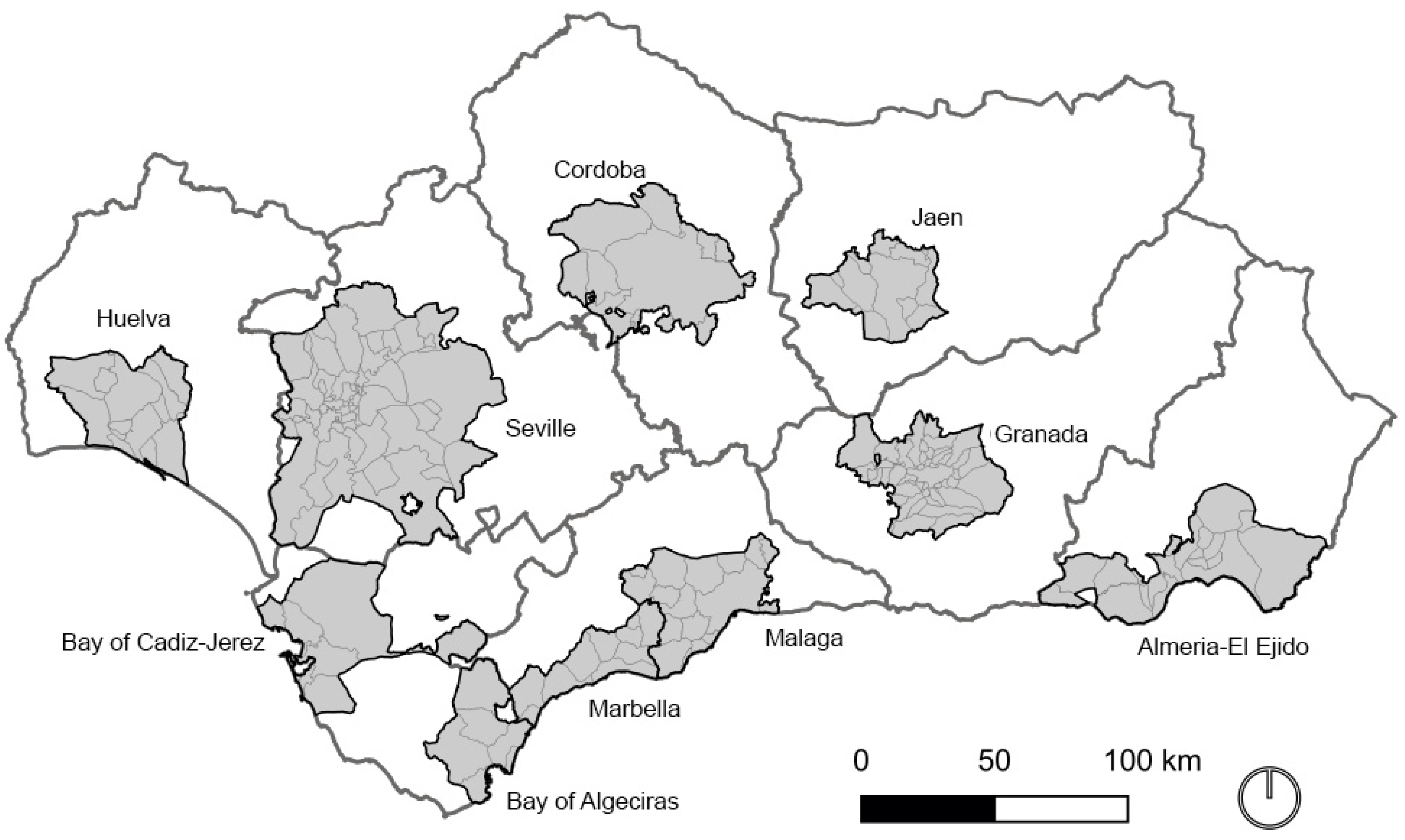
Table 2.
Metropolitan areas of Andalusia and municipalities.
The urban fabric therefore extends beyond traditional administrative boundaries and, in many cases, originates in an urban transformation that has unfolded over the last few decades. As a result, Andalusia has built a complex, diverse and constantly evolving metropolitan system, which is particularly visible in the main urban centres and their areas of influence.
The Andalusian metropolitan system reflects long-term processes of urban expansion, functional integration and suburbanisation documented in regional research [56,57]. Seville, Malaga, Granada, the Bay of Cadiz-Jerez and other urban areas have developed relationships that extend beyond central-city boundaries, especially in mobility, housing, employment, services and land use [56,57]. Rather than assuming that all metropolitan areas follow an identical trajectory, the study treats these areas as territorially differentiated configurations whose functional integration and institutional development vary considerably. These studies identify the Andalusian coastal corridor—and particularly the Costa del Sol and parts of the Mediterranean coast—as an area where tourism-led urbanisation, residential dispersion and inter-municipal functional relations have been especially significant [56,57]. Because the present study does not independently measure urban expansion, these territorial patterns are used here as contextual characteristics derived from the cited regional literature rather than as new empirical findings.
Regional studies also describe a structurally heterogeneous metropolitan system, with differences in demographic growth, urban expansion and functional integration between coastal and inland areas [56,57]. In this text, claims about the relative dynamism of individual areas are therefore limited to patterns explicitly documented in these sources; where comparable indicators are not available, the article avoids presenting qualitative contrasts as independently verified measurements.
A common feature identified in the literature is the redistribution of population and activities between central cities and their surrounding municipalities, although its intensity differs across metropolitan areas [56,57]. This process reinforces the functional interdependence between municipalities and helps explain why mobility, land management, infrastructure, environmental policy and service provision increasingly require coordination at a supra-municipal scale.
As in the rest of the world, governing these spaces in Andalusia remains challenging for a number of reasons: administrative fragmentation, insufficient financial or economic resources, and lack of metropolitan management knowledge. In this context, it is essential to study not only how these areas function, but also the institutional and administrative realities of Andalusian metropolitan municipalities.
3.2. Methodological Characteristics of the Study
To explore the perspectives of key actors involved in the governance of Andalusian metropolitan municipalities, a quantitative study was conducted in 2022 to examine metropolitan governance challenges and potential institutional responses. The objective was to shed light on the institutional and administrative reality of municipalities, based on their political and technical leaders’ perceptions.
A questionnaire inspired by the POLLEADER II (Political Leaders in European Cities. Second Round) survey was developed by a European team of local government specialists (LOGOPOL–Local Government and Politics) within the framework of the European Consortium for Political Research (ECPR). This project utilises a comparative dataset based on a survey conducted in 29 European countries between 2015 and 2016, aimed at analysing the roles of mayors and the transformation of local political representation [53]. In that survey, an identical questionnaire was sent to all mayors of municipalities with more than 10,000 inhabitants, including questions related to social background, political trajectories, and the ambitions of local leaders [58]. It was implemented in Spain between September 2015 and January 2016. Approximately 40% of mayors of Spanish municipalities with more than 10,000 inhabitants participated in the survey, resulting in 303 valid questionnaires based on a universe of 752 municipalities with these population characteristics in 2014 [59]. Although the sample was not strictly random, the number of mayors interviewed and the territorial and gender representation achieved provided adequate conditions for a reliable statistical analysis. A similar survey—POLLEADER I—had previously been conducted between 2003 and 2004 in seventeen countries [60].
In our case study, the units of analysis consisted of the 193 municipalities belonging to Andalusia’s ten metropolitan areas according to the delimitation proposed by Feria [57] and included in the Diagnosis of the Andalusian Urban Agenda [30]. A total of 132 valid questionnaires were obtained, corresponding to a response rate of 68.39%. The estimated sampling error is 4.81% at a 95% confidence level when calculated for the full set of participating municipalities. The analysis reported in this article is descriptive and exploratory: means, percentage distributions and cross-tabulated institutional preferences are used to identify aggregate patterns. No inferential significance tests were applied because the study does not seek to estimate causal effects and because subgroup sizes across metropolitan areas and respondent categories are uneven. This analytical choice is now stated explicitly and is considered when interpreting the scope of the findings. Table 3 provides details of the survey and the sample. The statistical analysis was conducted using jamovi (version 2.4.14.0), while Microsoft Excel (version 16.114.1) was used for data processing and preparation of the visual materials.
Table 3.
Survey and sample details.
Respondents were institutional representatives with direct knowledge of municipal governance and planning. The questionnaire was primarily addressed to mayors. When mayors did not participate directly, another elected representative, a politically responsible municipal official, or a technical officer involved in urban, territorial or metropolitan planning and management responded. Table 4 presents the distribution of responses by respondents’ professional roles and the metropolitan areas to which their municipalities belong. Municipal technical and managerial staff constitute the largest group, with 76 respondents (57.58%), followed by elected representatives and other political officials, with 42 (31.82%), and mayors, with 14 (10.61%). From a territorial perspective, Seville and Granada together account for 68 responses (51.52% of the total). This distribution reflects the composition of the sample and should be taken into account when interpreting the findings, particularly when comparing perceptions across professional groups and metropolitan areas. Table 4 presents the distribution of respondents by professional role and the metropolitan area to which their municipality belongs.
Table 4.
Distribution of survey respondents by professional role and metropolitan area in Andalusia.
The telephone-administered questionnaire comprised two thematic blocks—(1) metropolitan dilemmas, i.e., questions aimed at identifying the main metropolitan challenges and problems faced by municipalities; and (2) public policy responses—exploring locally implemented strategies and measures to address these challenges.
The questionnaire contained 18 questions organised around the two thematic blocks described above and combined multiple-response items, Likert-type scales and binary yes/no questions. The full instrument covered: identification and characteristics of metropolitan problems; coordination and distribution of competences; financial and organisational capacity; metropolitan knowledge and information-sharing; metropolitan belonging and civil-society involvement; political willingness and intergovernmental relations; existing cooperation practices; and preferences regarding alternative institutional responses. The present article deliberately analyses two questions because they operationalise the relationship at the centre of the research design: (1) the priority assigned to metropolitan governance challenges and (2) the institutional formula considered most appropriate for addressing each challenge. The remaining questions provide broader contextual information but do not form part of the specific challenge-solution comparison developed here.
Regarding perceptions, participants were asked to indicate the level of priority of a number of challenges affecting their respective metropolitan areas. This was done on a scale from 1 to 5, where 1 was “low priority” and 5, “high priority”. The challenges raised in this section included: (1) lack of coordination between the different public and private actors and their competencies or functions in the metropolitan area; (2) limited powers to intervene in the metropolitan area; (3) insufficient economic resources for metropolitan management; (4) citizens’ weak feelings of metropolitan belonging; (5) little knowledge about metropolitan realities, including the territory, socioeconomic processes, and the impact of policies; (6) difficulties in disseminating and sharing knowledge about the metropolitan area; and lastly, (7) political will to cede power to metropolitan areas and civil society mobilisation in metropolitan matters.
The second key question focused on the institutional responses to metropolitan governance challenges in Andalusia. To explore possible solutions to the challenges identified, participants were asked to indicate which institutional models they considered most appropriate to improve metropolitan governance in their area. The options proposed in this second question included: (1) directly elected metropolitan government, where citizens elect their representatives at a metropolitan government level; (2) indirectly elected metropolitan government, based on the representation of municipalities in a metropolitan structure; (3) sectoral metropolitan agency, focused on the management of specific strategic areas such as transport, the environment or urban planning; (4) vertical coordination by an existing government level, promoting the integration of metropolitan governance within previous governmental structures; and (5) voluntary cooperation between actors, based on agreements between municipalities without the need for formal metropolitan government structures.
These questions established a direct relationship between the response items and the main dilemmas and obstacles of metropolitan governance, identified in the literature [40]. They also made it possible to link the specific challenges of Andalusian metropolitan areas with the theoretical challenges previously identified, thus facilitating a more structured understanding of governance problems and their possible solutions [33]. Table 5 presents the correspondence between these dilemmas, the thematic components related to their resolution, and the specific challenges posed in the questionnaire:
Table 5.
Relationship between metropolitan governance dilemmas, thematic components, and challenges posed in the questionnaire.
Table 5 establishes the connection between the theoretical framework and the study’s empirical design. It translates the abstract metropolitan governance dilemmas identified in the literature into concrete and measurable challenges included in the questionnaire. In doing so, it ensures the study’s analytical consistency, as each survey item is directly grounded in a specific metropolitan governance dimension.
Furthermore, the table reflects the multidimensional nature of metropolitan governance problems highlighted in the literature. Fragmentation is operationalised through failures of coordination between multiple actors; institutional competence is captured through limited capacity to intervene at the metropolitan scale; and governance capacity is expressed through a shortage of economic, political and knowledge-based resources. At the same time, the dilemmas of representativeness and political resistance are translated into challenges related to weak metropolitan identity, low civil society engagement levels, and the political actors’ limited willingness to cede power.
This mapping exercise is particularly relevant within the strategic governance approach adopted in this article as it makes it possible to analyse how local actors perceive not only isolated problems but also structurally interconnected dimensions of metropolitan governance. Consequently, the empirical analysis can be interpreted as an assessment of how ready local governments are to tackle the core dilemmas invoked in contemporary metropolitan governance debates.
4. Discussion of the Results
With regard to the first study objective, i.e., to identify the major challenges of metropolitan governance, local authorities generally perceived the priority level of metropolitan challenges as moderate to high. In all cases, mean scores ranged between 3 and 4, thereby indicating that local authorities recognise the existence of metropolitan problems, although they do not necessarily interpret them as urgent or politically critical. This outcome points toward an institutional normalisation of metropolitan fragmentation, in which structural governance problems are acknowledged but not perceived as sufficiently serious to justify deep institutional transformations.
Among all the challenges analysed, limited economic resources emerged as the highest priority, with a mean score of 3.79 in the responses. This outcome highlights the other challenges raised and confirms the central role those financial constraints continue to play in metropolitan governance processes [27]. The second most urgent challenge was related to the lack of coordination between the competences and functions exercised by the different public and private actors operating in the metropolitan area, with a mean score of 3.30. This finding supports the idea that institutional fragmentation remained a major obstacle to the development of coherent metropolitan policies [33,45].
Conversely, despite oscillating persistently between priority levels 3 and 4, social cohesion and metropolitan identity challenges raised comparatively less concern. In particular, the citizens’ weak sense of belonging had the lowest mean score (3.11), followed by poor civil society mobilisation on metropolitan issues (3.15). This result suggests that local authorities continue to interpret metropolitan governance as an administrative and functional problem, rather than a political or socio-territorial project. In other words, municipalities seem to prioritise problems related to coordination, resources, and institutional capacity over those linked to democratic legitimacy, metropolitan citizenship, or the construction of collective identities.
Table 6 provides a visual summary of the relative priorities assigned by local authorities to each metropolitan challenge analysed. Beyond the concrete values, the table reflects the existence of a relatively homogeneous perception among municipalities, mostly characterised, as noted above, by moderate priority levels and the clear predominance of financial constraints with respect to other metropolitan problems.
Table 6.
Mean priority by challenge.
More broadly, the results illustrated the municipalities’ intermediate institutional scenario. While metropolitan challenges are recognised as relevant, they are rarely perceived as critical enough to justify far-reaching political or institutional reforms. The fact that most challenges were given a medium priority (level 3) reflects a widespread perception that metropolitan problems can still be managed through technical or incremental adjustments without deep institutional restructuring. Such a trend can be interpreted as a manifestation of both institutional inertia and the absence of a consolidated metropolitan political agenda, as already mentioned in the literature [41,56].
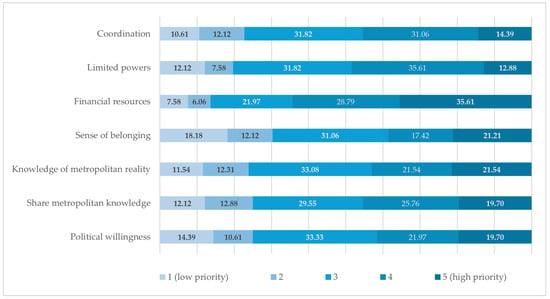
As indicated earlier, however, a notable exception is the issue of limited economic resources. In this case, 28.79% of those surveyed assigned a high priority (4), and 35.61% a very high priority (5), thereby revealing how financial capacity remains the local authorities’ most tangible and immediate concern. This finding concurs with Farinós’s interpretation of resource constraints as one of the main obstacles to effective governance arrangements [27]. Financial dependence thus continues to constrain the municipalities’ ability to tackle metropolitan problems autonomously.
Figure 2 complements this interpretation with a diverging bar chart representing the percentage distribution of responses for each priority level. The colour gradation, from lighter shades to darker blues, reflects the priority intensity assigned by municipalities. It is possible to observe how the concentration at intermediate levels confirms the moderate priority given to most metropolitan challenges, while the darker shades associated with limited economic resources highlight the particularly critical nature of this problem for local authorities.
Figure 2.
Percentage of responses by priority level assigned to each metropolitan challenge category.
Regarding the second objective, that is, to determine how local governments can respond to metropolisation challenges within the model framework, a clear preference was found for institutional arrangements based on metropolitan agencies and vertical coordination mechanisms supported by pre-existing government levels. By contrast, the more politically integrated formulas, such as direct or indirect metropolitan governments, consistently received less support. This pattern is of particular relevance because it suggests that municipalities tend to favour flexible, technical, and intergovernmental solutions over institutional models involving higher levels of political integration or power redistribution.
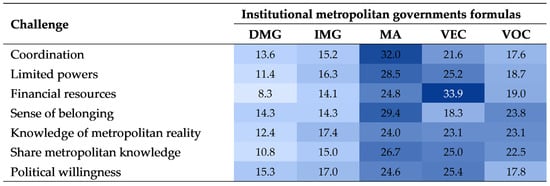
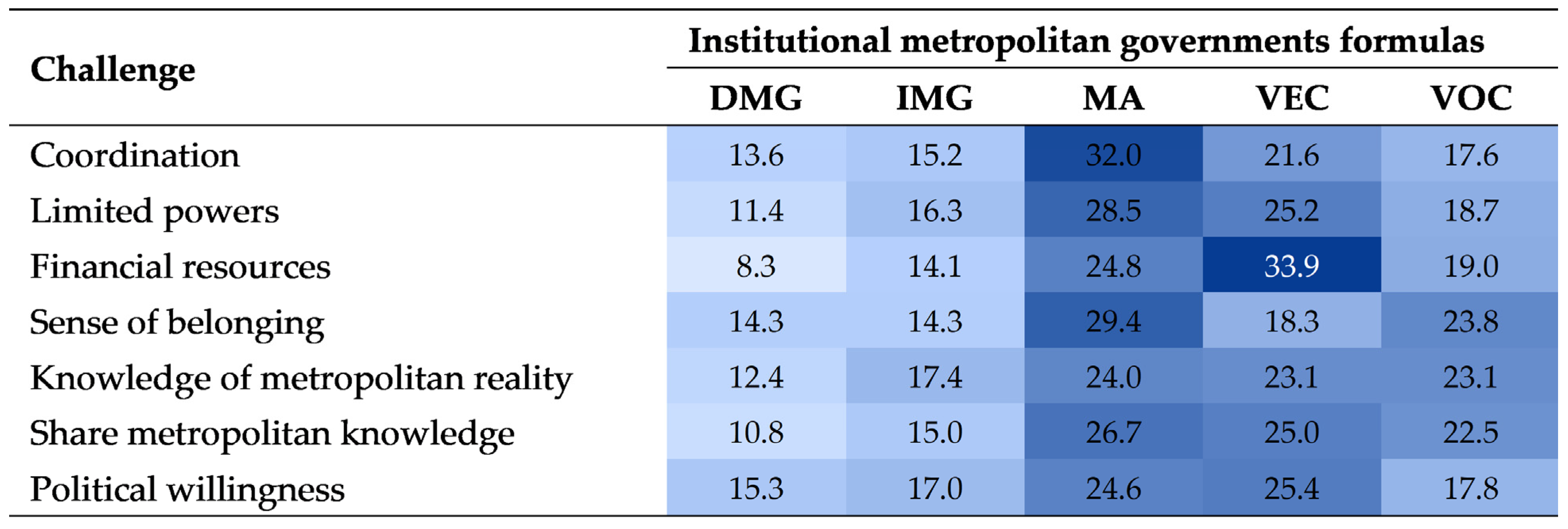
Figure 3 presents a heatmap that summarises the municipalities’ preferred institutional responses to each metropolitan challenge. The colour intensity makes it possible to identify clearly the institutional arrangements that attract greater municipal support in relation to each specific problem. Thus, the darker colour zones clearly show how solutions based on metropolitan agencies (MAs) and vertical coordination mechanisms (VECs) predominate. Conversely, the direct metropolitan government (DMG) formulas are systematically represented in lighter shades, reflecting a lower degree of institutional support. Indirect metropolitan government (IMG) and voluntary cooperation (VOC) are at an intermediate level. The heatmap summarises the distribution of responses while illustrating the functional and pragmatic patterns that characterise metropolitan governance preferences in Andalusia.
Figure 3.
Heatmap of institutional preferred responses to metropolitan challenges.
More specifically, regarding the lack of coordination between the various public and private actors operating in the metropolitan area, 32% of the municipalities surveyed identified metropolitan agencies as the most appropriate institutional response, followed by 21.6% who opted for vertical coordination mechanisms. These results reveal a functionalist governance strategy oriented towards pragmatic coordination instruments capable of reducing political-institutional tensions in fragmented territorial contexts [38]. The fragmentation itself has been widely identified as a major obstacle to developing coherent metropolitan policies [33,45].
A similar pattern was found in relation to the limited competencies and weak metropolitan sense of belonging. In both cases, metropolitan agencies constituted the respondents’ preferred option (28.46% and 29.37%, respectively). These results indicate that municipalities seek to strengthen specific coordination capacities without necessarily promoting deeper transformations in the systems of political representation or democratic legitimacy. Such a trend confirms the existence of both institutional and social capital deficits noted by Farinós [27] and González-Medina and Huete [52]. In turn, it reflects the absence of a consolidated metropolitan citizenship capable of sustaining more ambitious forms of metropolitan political integration.
In the case of limited economic resources, the preferred institutional response shifts to vertical coordination, selected by 33.88% of municipalities. This result is striking because it reveals how strong vertical dependency relationships persist between municipalities and higher government levels. Local authorities continue to view regional or provincial institutions as the main providers of financial resources, leadership and institutional capacity [56]. Metropolitan governance thus seems to be conditioned by expectations of support and coordination directed towards higher government levels.
The responses linked to knowledge deficits and metropolitan information dissemination showed somewhat more fragmented patterns. Preferences were distributed across metropolitan agencies, vertical coordination and voluntary cooperation mechanisms, with no clearly prevailing institutional formula. Such response fragmentation suggests that municipalities recognise the existence of deficits related to the generation, transfer and diffusion of metropolitan knowledge, despite the absence of any consolidated governance strategy to address these constraints [52]. In this sense, the metropolitan issue appears to be not only institutional and financial in nature but also cognitive and relational.
Finally, for the challenge defined as political willingness to empower metropolitan institutions, vertical coordination mechanisms received the greatest support, while metropolitan agencies also attracted considerable support. This pattern should be interpreted as a stated institutional preference rather than as direct evidence of the political feasibility of reform. It nevertheless suggests that respondents tend to locate coordination capacity in existing higher-level institutions or specialised metropolitan bodies rather than in the creation of a new, strongly integrated metropolitan government.
Overall, the results suggest that municipalities acknowledge metropolitan challenges while expressing greater support for flexible, technical and functionally oriented arrangements—particularly metropolitan agencies and vertical coordination—than for strongly integrated metropolitan governments. These data capture stated preferences and perceived barriers; they do not, by themselves, demonstrate the political feasibility or infeasibility of institutional reform. Assessing feasibility would require evidence on decision-making processes, intergovernmental negotiations, coalition formation and the behaviour of actors during concrete reform initiatives. The present findings are therefore interpreted more cautiously as evidence of a gap between some institutional solutions emphasised in the literature and the institutional preferences expressed by local actors.
Taken together, the results allow for a broader interpretation of how local governments in Andalusian metropolitan areas understand metropolitan governance. Although municipalities recognise the existence of problems related to institutional fragmentation, insufficient resources and coordination among actors, these challenges do not generally appear to be perceived as sufficiently urgent to justify profound institutional transformations. At the same time, the preference for metropolitan agencies and vertical coordination mechanisms over more highly institutionalised forms of metropolitan government indicates that local actors tend to favour technical, functional and gradual solutions. In this sense, the findings suggest that metropolitan governance is primarily understood as a matter of coordination, management capacity and resource provision, rather than as a process aimed at constructing new metropolitan political structures.
From a public policy perspective, these findings have relevant implications for the development of metropolitan governance in Andalusia. The preference for technical and flexible arrangements suggests that metropolitan cooperation could be strengthened progressively through sectoral agencies, stable mechanisms of inter-municipal coordination and multi-level governance instruments. Likewise, given that insufficient financial resources emerge as the highest-priority challenge and that vertical coordination receives substantial support among the institutional responses considered, the regional government could play a particularly relevant role through financial incentives linked to shared metropolitan projects, as well as through the reinforcement of technical assistance, planning and knowledge-generation mechanisms. In this context, a gradual strategy may be more consistent with the preferences expressed by local governments than the immediate creation of highly institutionalised metropolitan structures.
Nevertheless, these results should be interpreted in light of some limitations of the study. The analysis is based on perceptions expressed by political and technical representatives of local governments and focuses specifically on the case of Andalusian metropolitan areas. The findings therefore allow relevant trends in local actors’ institutional preferences to be identified, while future research could extend this analysis to other metropolitan contexts and further explore the factors underlying these preferences.
5. Conclusions, Implications, and Limitations
This study yields three principal conclusions. First, Andalusian local governments recognise metropolitan governance problems, but most challenges are assigned moderate rather than critical priority, suggesting that metropolitan fragmentation has become partly normalised within existing institutional arrangements. Second, respondents frame metropolitan governance primarily in functional and administrative terms: financial capacity, coordination and institutional resources receive greater attention than metropolitan identity, citizenship or political integration. Third, when respondents are asked how these challenges should be addressed, they prefer metropolitan agencies and vertical coordination over direct or indirect metropolitan governments. Taken together, these findings point to a pattern of “metropolitan governance without metropolitan government”, in which coordination is accepted more readily than the creation of a new autonomous political tier.
The main contribution is not simply to describe metropolitan problems or institutional models separately, but to connect three analytical levels: the dilemmas identified in the literature, the challenges perceived by local governments, and the institutional responses those governments prefer. This makes it possible to assess the degree of correspondence between problem diagnosis and preferred solutions in a context—Spain—where metropolitanisation has advanced further than formal metropolitan institutionalisation [23,24]. The results therefore add actor-based empirical evidence to explanations of the Spanish metropolitan governance anomaly.
The study reveals a prevalent tendency among local governments to consider that metropolitan challenges are neither urgent nor critical, suggesting institutional weakness and a lack of clear political agenda [41]. Limited economic resources emerged as the most pressing challenge, consistent with prior research [27].
Most local governments favoured institutional arrangements such as sectoral metropolitan agencies or vertical coordination by existing government levels, that is, technical, flexible and functional solutions rather than more politically oriented models such as metropolitan governments. Although some local governments support establishing government institutions with specific and direct competences over the metropolitan area, such options were not widely favoured for resolving metropolitan governance challenges, reflecting a preference for adapting to socioeconomic and territorial realities at any given time without major institutional overhaul.
The concept of “metropolitan governance without metropolitan government” summarises this configuration. Coordination mechanisms are supported insofar as they improve administrative capacity, service management and access to resources, whereas stronger forms of metropolitan political integration receive less support. This does not demonstrate that metropolitan government is politically unfeasible; rather, it shows that the local actors surveyed express preferences for incremental and functionally oriented arrangements over more far-reaching institutional redesign. This distinction is important because stated preferences are only one component of actual reform processes.
The visual materials included in the analysis—the table of averages, the divergent bar graph and the institutional heatmap—made it possible to synthesise the results obtained and to identify structural patterns of interpretation and action by local authorities. In this sense, the visualisations supported the finding that Andalusia persists in organising metropolitan governance mainly through functional, technical and intergovernmental mechanisms, rather than through arrangements involving strong metropolitan political integration.
On the other hand, as indicated in the literature [26,35,41,46,49], local governments play a fundamental role in responding to metropolitan area challenges. It is therefore essential to understand their attitudes towards these challenges. Specifically, the study’s methodological design and questionnaire directed at the local political and technical leaders allowed to shed light on how the latter perceived Andalusia’s metropolitan area challenges, thereby helping to fill a gap in the literature.
Similarly, among the various public policy approaches highlighted in the scientific literature to address contemporary metropolisation processes, strategic governance models are gaining significant relevance, despite remaining underdeveloped to date. In this sense, the present work addresses part of this research deficit by identifying how local governments understand and respond to these processes, thus advancing knowledge and current debates on metropolitan governance and planning.
The findings have several policy implications for Andalusia. First, the regional government could strengthen metropolitan cooperation through sector-specific agencies in fields where interdependence is most visible, including mobility, spatial planning, housing, environmental management and shared services. Second, because financial resources emerge as the highest-priority challenge and vertical coordination is frequently preferred, regional funding programmes could include incentives for inter-municipal cooperation and joint metropolitan projects rather than financing municipalities exclusively through isolated initiatives. Third, horizontal coordination could be reinforced through stable inter-municipal forums, shared technical units and metropolitan data or knowledge platforms, especially in areas where no formal metropolitan authority exists. Fourth, any move towards stronger metropolitan institutions should be preceded by structured negotiation with municipalities and other stakeholders, since the survey indicates limited support for reforms that imply substantial redistribution of political authority. These measures would not impose a single metropolitan model across Andalusia; instead, they would provide differentiated pathways for progressively aligning governance arrangements with functional metropolitan realities.
The study nevertheless has important limitations. The survey captures perceptions and stated preferences rather than the reasons that produce those preferences or the actual political feasibility of institutional reforms. It also analyses two questions from a broader 18-question instrument and relies on descriptive aggregate patterns rather than inferential comparisons between metropolitan areas or respondent groups. Future research should therefore combine the survey with in-depth qualitative interviews, process tracing of metropolitan negotiations and larger comparative samples that permit robust subgroup analysis. Replication in other Spanish and European metropolitan areas would also help determine whether the Andalusian pattern reflects a broader feature of metropolitan governance in weakly institutionalised contexts.
Author Contributions
Conceptualization, R.M.R. and O.L.G.; Methodology, R.M.R., O.L.G. and E.G.S.; Validation, R.M.R., O.L.G. and E.G.S.; Formal analysis, R.M.R., O.L.G. and E.G.S.; Investigation, E.G.S.; Data curation, E.G.S.; Writing – original draft, R.M.R., O.L.G. and E.G.S.; Writing – review & editing, O.L.G.; Supervision, R.M.R. and O.L.G. All authors have read and agreed to the published version of the manuscript.
Funding
This research was co-funded by the European Regional Development Fund (ERDF) and the Regional Government of Andalusia (Junta de Andalucía), through the Operational Programme ERDF Andalusia 2014–2020 (project reference UPO-1264428).
Institutional Review Board Statement
The study was conducted in accordance with the Declaration of Helsinki and approved by the Ethics Committee of Pablo de Olavide University.
Informed Consent Statement
Informed consent was obtained from all subjects involved in the study.
Data Availability Statement
The data presented in this study are available from the corresponding author upon reasonable request. The data will be provided in anonymized form, subject to applicable confidentiality and data protection requirements.
Conflicts of Interest
The authors declare no conflict of interest.
References
- Mukim, M.; Roberts, M. (Eds.) Thriving: Making Cities Green, Resilient, and Inclusive in a Changing Climate; World Bank: Washington, DC, USA, 2023. [Google Scholar]
- Lefebvre, H. The Urban Revolution; University of Minnesota Press: London, UK, 2003. [Google Scholar]
- Parr, J. Spatial Definitions of the City: Four Perspectives. Urban Stud. 2007, 44, 381–392. [Google Scholar] [CrossRef] [Scilit]
- Brenner, N. (Ed.) Implosions/Explosions: Towards a Study of Planetary Urbanization; Jovis: Berlin, Germany, 2002. [Google Scholar]
- Katz, B.; Bradley, J. The Metropolitan Revolution: How Cities and Metros are Fixing our Broken Politics and Fragile Economy; Brookings Institution Press: Washington, DC, USA, 2013. [Google Scholar]
- Bosker, M.; Park, J.; Roberts, M. Definition Matters. Metropolitan Areas and Agglomeration Economies in a Large Developing Country; World Bank: Washington, DC, USA, 2018. [Google Scholar]
- Tomàs, M. (Ed.) Metrópolis sin Gobierno. La Anomalía Española en Europa; Tirant lo Blanch: Valencia, Spain, 2023. [Google Scholar]
- Soja, E. Postmetropolis. Critical Studies of Cities and Regions; Wiley-Blackwell: Oxford, UK, 2000. [Google Scholar]
- Scott, A. Globalization and the Rise of City-regions. Eur. Plan. Stud. 2001, 9, 813–826. [Google Scholar] [CrossRef] [Scilit]
- Soja, E.; Kanai, M. The urbanization of the world. In The Endless City; Burdett, R., Sudjic, D., Eds.; Phaidon: London, UK, 2007; pp. 54–69. [Google Scholar]
- Nijkamp, P.; Kourtit, K. The ‘new urban Europe’: Global challenges and local responses in the urban century. Eur. Plan. Stud. 2013, 21, 291–315. [Google Scholar] [CrossRef] [Scilit]
- Storper, M. Keys to the City: How Economics, Institutions, Social Interactions and Politics Shape Development; Princeton University Press: Princeton, NJ, USA, 2013. [Google Scholar]
- Dijkstra, L.; Poelman, H. A Harmonised Definition of Cities and Rural Areas: The New Degree of Urbanization; European Commission—Working Paper; European Commission: Brussels, Belgium, 2014. [Google Scholar]
- Harrison, J.; Hoyler, M. Governing the new metropolis. Urban Stud. 2014, 51, 2249–2266. [Google Scholar] [CrossRef] [Scilit]
- Hoffmann-Martinot, V.; Sellers, J. (Eds.) Metropolisation and Political Change; VS Verlag: Wiesbaden, Germany, 2005. [Google Scholar]
- Roy, A. The 21st-Century Metropolis: New Geographies of Theory. Reg. Stud. 2007, 43, 819–830. [Google Scholar] [CrossRef] [Scilit]
- Rodríguez-Pose, A. The Rise of the “City-region” Concept and its Development Policy Implications. Eur. Plan. Stud. 2008, 16, 1025–1046. [Google Scholar] [CrossRef] [Scilit]
- Valenzuela, M.; Salom, J. Los procesos de urbanización en España. Nuevos factores, nuevas tendencias. In Proceedings of the 31st International Congress of Geography, Tunis, Tunisia, 12–15 August 2008. [Google Scholar]
- Bahl, R. The descentralization of governance in metropolitan areas. In Financing Metropolitan Governments in Developing Countries; Bahl, R., Linn, J., Wetzel, D., Eds.; Lincoln Institute and Land Policy: Cambridge, MA, USA, 2013; pp. 85–105. [Google Scholar]
- Ahrend, R.; Schumann, A. Approaches to Metropolitan Area Governance: A Country Overview; Working Paper; OECD: Paris, France, 2014. [Google Scholar]
- Gómez-Álvarez, D.; Rajack, R.; López-Moreno, E.; Lanfranchi, G. (Eds.) Gobernanza Metropolitana: El Gobierno de las Metrópolis para el Desarrollo Urbano Sostenible; Banco Interamericano de Desarrollo: Washington, DC, USA, 2019. [Google Scholar]
- Barres, R.; Martí-Costa, M. La anomalía española: El proceso de institucionalización metropolitana en Europa Occidental. In Metrópolis sin Gobierno. La Anomalía Española en Europa; Tomàs, M., Ed.; Tirant lo Blanch: Valencia, Spain, 2023; pp. 23–42. [Google Scholar]
- Pano, E.; Navarro, C. Governing Large Urban Areas in Spain: Multiple Scales, Models and Challenges. In Local Government Structure and Intergovernmental Relations; Kössler, K., Belser, E., Eds.; Springer: Cham, Switzerland, 2026; pp. 81–96. [Google Scholar] [CrossRef] [Scilit]
- Tomàs, M. Explaining Metropolitan Governance. The Case of Spain. Raumforsch. Raumord. 2017, 75, 243–252. [Google Scholar] [CrossRef] [Scilit]
- Subirats, J. ¿Gobierno metropolitano? Ventajas e inconvenientes de la centralización y la descentralización en la esfera metropolitana de Gobierno. In Proceedings of the 22nd CLAD International Congress on State and Public Administration Reform, Madrid, Spain, 14–17 November 2017. [Google Scholar]
- Barber, B. If Mayors Ruled the World: Dysfunctional Nations, Rising Cities; Yale University Press: New Haven, CT, USA, 2013. [Google Scholar]
- Farinós, J. Gobernanza territorial para el desarrollo sostenible: Estado de la cuestión y agenda. Bol. Asoc. Geogr. Esp. 2008, 46, 11–32. [Google Scholar]
- National Institute of Statistics. Urban Audit. Available online: https://www.ine.es/jaxiT3/Datos.htm?t=69308 (accessed on 13 October 2026).
- National Institute of Statistics. Censo Anual de Población. Available online: https://www.ine.es/jaxiT3/Datos.htm?t=67988 (accessed on 13 October 2026).
- Junta de Andalucía. Agenda Urbana de Andalucía 2030; Consejería de Medioambiente y Ordenación del Territorio: Seville, Spain, 2018; Available online: https://www.juntadeandalucia.es/export/drupaljda/02_agenda_urbana_andalucia_2030.pdf (accessed on 1 June 2026).
- National Institute of Statistics. Detalle Municipal. Available online: https://www.ine.es/dynt3/inebase/index.htm?padre=525 (accessed on 13 October 2026).
- Junta de Andalucía. Plan de Ordenación del Territorio de Andalucía (POTA); Consejería de Fomento, Articulación del Territorio y Vivienda: Seville, Spain, 2006; Available online: https://www.juntadeandalucia.es/export/drupaljda/pota_completo.pdf (accessed on 26 June 2026).
- Tomàs, M. Metropolitan Governance in Europe: Challenges & Models; AMB: Barcelona, Spain, 2015. [Google Scholar]
- OECD. Governing the City; OECD Publishing: Paris, France, 2015. [Google Scholar]
- OECD. The Metropolitan Century: Understanding Urbanisation and its Consequences; OECD Publishing: Paris, France, 2015. [Google Scholar]
- Plüss, L. Municipal councillors in metropolitan governance: Assessing the democratic deficit of new regionalism in Switzerland. Eur. Urban Reg. Stud. 2015, 22, 261–284. [Google Scholar] [CrossRef] [Scilit]
- Subirats, J. Dilemas: Gobierno multinivel, gobernanza en red y coproducción de políticas. In Gobernanza Metropolitana. El Gobierno de las Metrópolis para el Desarrollo Urbano Sostenible; Gómez-Álvarez, D., Rajack, R., López-Moreno, E., Lanfranchi, G., Eds.; Banco Interamericano de Desarrollo: Washington, DC, USA, 2019; pp. 92–104. [Google Scholar]
- Birch, L. Instituciones para la gobernanza metropolitana: Lecciones para las naciones y las partes interesadas. In Gobernanza Metropolitana. El Gobierno de las Metrópolis para el Desarrollo Urbano Sostenible; Gómez-Álvarez, D., Rajack, R., López-Moreno, E., Lanfranchi, G., Eds.; Banco Interamericano de Desarrollo: Washington, DC, USA, 2019; pp. 65–77. [Google Scholar]
- Hildenbrand, A. Gobernanza y Planificación Territorial en las Áreas Metropolitanas. Análisis Comparado de las Experiencias Recientes en Alemania y de su Interés para la Práctica en España; Universidad de Valencia: Valencia, Spain, 2017. [Google Scholar]
- Gañán, E.; Merinero, R.; Huete, M. Cuatro dilemas y un obstáculo a la gobernanza metropolitana: Respuestas desde la planificación estratégica urbana. Bol. Asoc. Geogr. Esp. 2022, 93. [Google Scholar] [CrossRef] [Scilit]
- UCLG. Co-Creando el Futuro Urbano. La Agenda de las Metrópolis, las Ciudades Intermedias y los Territorios; United Cities and Local Governments: Barcelona, Spain, 2017; Available online: https://www.uclg.org/sites/default/files/gold_esp-web.pdf (accessed on 24 October 2026).
- United Nations. World Urbanization Prospects. The 2014 Revision; United Nations: New York, NY, USA, 2015. [Google Scholar]
- Heinelt, H.; Kübler, D. (Eds.) Metropolitan Governance. Capacity, Democracy and the Dynamics of Place; Routledge: London, UK, 2005. [Google Scholar]
- UCLG. The Localization of the Global Agendas. How Local Action is Transforming Territories and Communities; United Cities and Local Governments: Barcelona, Spain, 2019. [Google Scholar]
- Ahrend, R.; Kim, S.; Lembcke, A.; Schumann, A. Por qué es importante la gobernanza metropolitana y cómo lograrla. In Gobernanza Metropolitana. El Gobierno de las Metrópolis para el Desarrollo Urbano Sostenible; Gómez-Álvarez, D., Rajack, R., López-Moreno, E., Lanfranchi, G., Eds.; Banco Interamericano de Desarrollo: Washington, DC, USA, 2019; pp. 55–64. [Google Scholar]
- Anderson, M. Gobernanza metropolitana: La nueva normalidad para una mejor calidad de vida. In Gobernanza Metropolitana. El Gobierno de las Metrópolis para el Desarrollo Urbano Sostenible; Gómez-Álvarez, D., Rajack, R., López-Moreno, E., Lanfranchi, G., Eds.; Banco Interamericano de Desarrollo: Washington, DC, USA, 2019; pp. 78–91. [Google Scholar]
- Roberts, B.; Abbott, A. Gobernanza colaborativa: Mejora de la sostenibilidad del desarrollo en las metrópolis. In Gobernanza Metropolitana. El Gobierno de las Metrópolis para el Desarrollo Urbano Sostenible; Gómez-Álvarez, D., Rajack, R., López-Moreno, E., Lanfranchi, G., Eds.; Banco Interamericano de Desarrollo: Washington, DC, USA, 2019; pp. 131–148. [Google Scholar]
- Xu, J.; Yeh, A. Gobernanza de las regiones de megaciudades y planificación urbana. In Gobernanza Metropolitana. El Gobierno de las Metrópolis para el Desarrollo Urbano Sostenible; Gómez-Álvarez, D., Rajack, R., López-Moreno, E., Lanfranchi, G., Eds.; Banco Interamericano de Desarrollo: Washington, DC, USA, 2019; pp. 149–163. [Google Scholar]
- Ortiz, P.; Kamiya, M. Economía política en el norte y sur globales: Conectando, financiando, gobernando. In Gobernanza Metropolitana. El Gobierno de las Metrópolis para el Desarrollo Urbano Sostenible; Gómez-Álvarez, D., Rajack, R., López-Moreno, E., Lanfranchi, G., Eds.; Banco Interamericano de Desarrollo: Washington, DC, USA, 2019; pp. 105–120. [Google Scholar]
- Gleaser, E.; Joshi-Ghani, A. The Urban Imperative: Toward Shared Prosperity; World Bank: Washington, DC, USA, 2013. [Google Scholar]
- Tomás, M. Institucions, política i democràcia metropolitanes. FRC. Rev. Debat Polít. 2009, 19, 44–47. [Google Scholar]
- González-Medina, M.; Huete, M. Real innovation in urban planning? Assessing the institutional capacity in the frame of the integrated sustainable urban development programmes. Eur. Plan. Stud. 2020, 28, 1139–1160. [Google Scholar] [CrossRef] [Scilit]
- Heinelt, H.; Magnier, A.; Cabria, M.; Reynaert, H. (Eds.) Political Leaders and Changing Local Democracy. The European Mayor; Palgrave Macmillan: Cham, Switzerland, 2018. [Google Scholar]
- Botella, J. La galaxia local en el sistema político español. Rev. Estud. Polít. 1992, 76, 145–160. [Google Scholar]
- Andalusian Government. Diagnóstico para la Elaboración de la Agenda Urbana de Andalucía; Ministry of Environment and Land Use Planning: Seville, Spain, 2018.
- Gañán, E.; Merinero, R.; Huete, M. La gobernanza metropolitana en Andalucía: Hacia el reconocimiento político e institucional del hecho metropolitano. In Metrópolis sin Gobierno. La Anomalía Española en Europa; Tomàs, M., Ed.; Tirant lo Blanch: Valencia, Spain, 2023; pp. 241–270. [Google Scholar]
- Feria, J. Los modelos de organización y dinámicas espaciales metropolitanas en Andalucía. Cuad. Geogr. 2015, 54, 196–219. [Google Scholar]
- Navarro, C.; Sanz, A. The social base and career development of Spanish mayors. Rev. Esp. Cienc. Polít. 2018, 46, 21–48. [Google Scholar] [CrossRef] [Scilit]
- Ponce, J.; Villoria, M. Estudio introductorio. In Anuario del Buen Gobierno y de la Calidad de la Regulación; Fundación Democracia y Gobierno Local: Madrid, Spain, 2021; pp. 29–58. [Google Scholar]
- Bäck, H.; Heinelt, H.; Magnier, A. (Eds.) The European Mayor. Political Leaders in the Changing Context of Local Democracy; VS Verlag: Wiesbaden, Germany, 2006. [Google Scholar]

Disclaimer/Publisher’s Note: The statements, opinions and data contained in all publications are solely those of the individual author(s) and contributor(s) and not of MDPI and/or the editor(s). MDPI and/or the editor(s) disclaim responsibility for any injury to people or property resulting from any ideas, methods, instructions or products referred to in the content. |
© 2026 by the authors. Licensee MDPI, Basel, Switzerland. This article is an open access article distributed under the terms and conditions of the Creative Commons Attribution (CC BY) license.