


Abstract
Critical-mineral strategies are often promoted as circular economy policies, but circularity metrics do not reveal the locations of land disturbance, processing impacts, recovery improvements or governance authority. Here we present a telecoupled circular land governance framework to examine the differing policy trajectories of the European Union (EU) and China. From the land system and telecoupling literature, published research on mineral supply chains and recycling, and an original compilation of ten selected policy instruments adopted by 30 June 2026, with their legal status and application schedules distinguished, we analyze four linked systems: mining lands; processing and production facilities; use markets; and end-of-life recovery infrastructure. Our analysis highlights divergent but interrelated control points. EU policies connect product-level due diligence, recycled content and information requirements with domestic capacity targets; Chinese policies bring together state-directed industrial governance with growing traceability, extended producer responsibility and recovery regulations. The comparison identifies conditions under which recycling gains may coexist with displaced burdens or growing primary demand. We suggest a four-part combination of governance levers: spatially explicit footprint accounting; interoperable chain-of-custody information; place-based safeguards and benefit sharing; and demand-side sufficiency combined with recycling. The framework redefines circularity as an allocation problem across connected land systems and identifies testable propositions for comparative research and policy evaluation.
1. Introduction
A higher recycling rate does not reveal where the environmental pressures associated with critical minerals are reduced, retained, or relocated. A battery containing recycled material may still depend on expanding extraction, water-intensive processing, or poorly managed residues elsewhere in its supply chain. The problem is therefore spatial as well as material. Assessing circularity requires attention to the land systems connected by production, use, and recovery, including places that bear indirect effects without receiving a corresponding share of the benefits [1,2,3,4,5,6,7,8].
This problem is particularly important for the energy transition. Critical-mineral supply chains connect deposits, processing facilities, manufacturing centres, use markets, and recovery networks across jurisdictions [9,10]. Trade separates the location of final demand from many of its environmental and social consequences [8,11]. Recycling can alter these connections, but it does not remove them. Secondary supply depends on product lifetimes, collection, material quality, technology, and the rate of demand growth [12,13,14,15,16,17]. A gain recorded within one jurisdiction may therefore coexist with additional extraction or residual waste treatment elsewhere. The land-system question is whether circular practices reduce primary pressure across these connected places and how responsibility for the remaining pressure is allocated.
Telecoupling research provides a framework for studying flows, actors, and effects across sending, receiving, and spillover systems [18,19,20,21]. Circular-economy research explains strategies for retaining product and material value and identifies limits arising from rebound, system boundaries, and contested environmental claims [22,23,24,25]. Work on trade footprints and comparative circular-economy policy already addresses cross-border relationships [8,11,26]. Building on these contributions, a more specific gap remains at their intersection: a circular flow can pass through several uses and jurisdictions, while information, regulatory obligations, and responsibility for land impacts may stop at different points. A framework that follows these mismatches through the mineral lifecycle can connect the spatial analysis of telecoupling with the institutional analysis of circularity.
The EU and China provide a useful comparison because their policies act on connected markets and production networks through different institutional arrangements. The EU combines product and market requirements with a growing emphasis on strategic capacity, while China combines industrial planning with more specific traceability and recovery obligations [27,28,29,30,31,32,33,34,35,36]. Earlier comparisons help explain their differing policy traditions [26], but an opposition between market-led and state-led approaches is insufficient for examining their interaction. Both portfolios can affect where extraction, processing, and recovery take place. Their interfaces also raise practical questions about compatible identifiers, the transfer of responsibility, and the treatment of impacts outside the regulating jurisdiction [37].
This Perspective develops a telecoupled circular land governance framework and asks three questions. First, through which mechanisms can changes in mineral production, use, and recovery alter direct and indirect land-system pressures? Second, how do ten selected EU and Chinese policy instruments allocate information duties and responsibility across those connected stages, and where do their arrangements complement or constrain one another? Third, which gaps in this institutional comparison motivate testable propositions and targeted governance responses? The contribution is to connect lifecycle stages, spillover places, and regulatory responsibilities within one comparative framework, supported by an instrument-level evidence matrix. The analysis identifies institutional mechanisms and conditions for empirical testing; it does not establish that circularity has already reduced primary extraction or achieved absolute decoupling [38,39].
2. Materials and Methods
2.1. Research Design, Scope, and Terminology
We choose a theory-led and structured qualitative comparative approach, consistent with the type of paper we are writing. Our approach has three parts (addressing the three research questions in Section 1): (i) a review of the literature on land systems, telecoupling, the circular economy and critical minerals; (ii) a purpose-built selection of policy instruments from the European Union (EU) and China; and (iii) a deductive qualitative document analysis. Our unit of analysis is not a specific mineral, company, project or administrative area, but the suite of policies governing each stage in the life cycle of critical minerals. We selected the EU and China as two influential global markets and industries with distinctive institutional contexts and recent policy development related to the life cycle of critical minerals. Our analysis focuses on policy institutions and their potential role in connecting land systems, rather than attempting to identify the causal impacts of policies. The main results are presented in Section 3 and Section 4, followed by discussion in Section 5.
We define critical minerals as an evolving policy-driven concept. A mineral becomes critical when its importance as an economic input or a strategic resource coincides with one or more factors related to supply risk, market concentration, substitutability, or geopolitical considerations. These criteria are highly variable across different countries and regions and have evolved over time. Therefore, our analytical framework is applicable to minerals deemed to have strategic importance for either the EU or China, as well as those that feature prominently in supply chains for the energy transition (including lithium, cobalt, nickel, natural graphite, rare-earth elements, and, as appropriate, copper). Circularity encompasses practices designed to maintain the functionality or material value of products and components throughout their life cycles, using techniques such as extending product lifespans, repairs, reusing parts, repurposing components, remanufacturing, collection, and recycling, all while minimizing waste generation and dependence on virgin materials. Recycling is only one form of circularity, not synonymous with it.
Land system transformation refers to both direct and indirect changes in land cover, land use, access, infrastructure, water resources, ecological status and livelihood opportunities. This broad definition is required because a mine’s impact can extend well beyond the perimeter of the mine site. Infrastructure associated with a mining operation such as roads, energy grids, worker housing, tailings dams and water extraction facilities can transform areas at a range of spatial scales. Mining activities can also spur the development of other industries in the region. Likewise, processing and recycling plants take up land in industrial zones, and generate localised pollution, residues, transportation activity and safety hazards. However, we do not assume that all impacts will be negative or that all land uses are passive recipients. Mining and recycling operations may also provide fiscal revenues, jobs, infrastructure and technology transfer. The analytical issue is how those benefits and burdens are distributed, governed, and made visible.
2.2. Evidence Materials and Literature-Synthesis Procedure
The evidence base contains three layers. First, foundational and review literature was used to define telecoupling, land-system transformation, circularity, material footprints, and critical-mineral sustainability. Second, peer-reviewed empirical and modeling studies were used to identify recurrent mechanisms relevant to the framework, including spatial overlap with vulnerable ecosystems, delayed scrap availability, collection and recovery losses, technology dependence, displacement, leakage, and rebound. Third, authoritative institutional reports were used where they synthesized supply-chain concentration, recycling prospects, traceability, or responsible-sourcing practice. Targeted searches were conducted in scholarly search interfaces and publisher platforms and were supplemented by backward and forward citation chaining from major reviews and high-relevance studies. The search logic combined (“critical mineral*” OR lithium OR cobalt OR nickel OR graphite OR “rare earth*” OR copper) with one or more of the terms land, biodiversity, water, livelihood*, “circular econom*”, recycl*, telecoupl*, traceab*, EU, “European Union”, and China. Searches and policy checks were updated through 30 June 2026. Sources were retained for conceptual clarification, empirical or modeled evidence of a mechanism, or direct relevance to lifecycle governance. Because the objective was mechanism identification and theory building rather than exhaustive evidence aggregation or effect-size estimation, this procedure is a structured qualitative synthesis and not a systematic review. The ten core policy instruments in Table 1 form the comparative corpus; the remaining references provide conceptual, empirical, modelling, and institutional context.
Table 1.
Core policy corpus used for the EU–China institutional comparison.
2.3. Policy-Corpus Construction, Coding, and Comparative Analysis
The purposive policy corpus was compiled using official EUR-Lex, European Commission, and Chinese central-government or ministry sources. Inclusion criteria were: (i) entered into force, adopted or formally promulgated on or before 30 June 2026; (ii) covered at least one phase of the critical mineral/material lifecycle; and (iii) had cross-cutting or strategic implications for circularity, industrial base, traceability, extended producer responsibility, resource governance, or end-of-life management. The core policy corpus contains four EU and six Chinese instruments (Table 1). The corpus aimed to represent the governing focal point in each jurisdiction across different instrument categories, not to exhaustively catalogue all delegated acts, standards, subnational measures, subsidies or enforcement actions. English translations of Chinese instrument titles are provided for accessibility; where the operative text is in Chinese, the Chinese title and document number are retained in the reference to make the source independently identifiable.
The unit of analysis was the policy instrument, and the unit of coding was an explicit objective, rule, target, responsibility, information requirement, or implementation mechanism bearing on a lifecycle stage. A deductive codebook was constructed from the seven analytical dimensions in Table 2: system position, land-system effect, agency and power, information architecture, circular mechanism, spatial responsibility, and dynamic effect. Codes were non-exclusive because one provision can operate across several lifecycle stages or governance mechanisms. For each instrument, the analysis extracted legal or policy status, responsible actors, instrument type, lifecycle coverage, spatial reach, information requirements, and explicit environmental or social provisions.
Table 2.
Analytical dimensions for telecoupled circular land governance.
Supplementary Table S1 reports instrument-level evidence for all seven dimensions in Table 2, with article or section locators for the provisions supporting each entry. It distinguishes explicit policy content from our interpretation of possible cross-system mechanisms. Where a selected provision does not establish a relationship, this is recorded as a limit of the evidence rather than as proof that the wider jurisdiction has no relevant policy. The matrix provides the intermediate step between provision-level reading and the portfolio comparison in Table 3. Binding obligations, framework powers, and planning objectives are identified separately, together with relevant application dates and planning horizons. Amendments are treated as updates to the relevant core instrument rather than as additional independent cases.
Table 3.
Comparison of EU and Chinese critical-mineral circular-governance pathways.
The EU–China comparison was performed at portfolio level using a structured matrix. Within-jurisdiction patterns were identified first; similarities, differences, partial convergence, and ungoverned spillovers were then compared across jurisdictions. The analysis did not use word frequencies as a proxy for regulatory strength. Policy aspirations were not coded as achieved outcomes, and numerical targets were not treated as evidence that capacity would be sustainable, timely, or fully utilized. Since these measures are embedded in different legal/administrative regimes, we cannot assume that identical terms used across the two systems have the same meaning. Rather, each term needs to be understood in light of the relevant provisions of the specific instrument, its governing authorities, and actual practices. This is not a matter of preference, but of methodological necessity; otherwise, our approach would confuse similar appearance with similar reality, since it is the institutional context, not just the wording, that matters. Accordingly, each of the variables covered in this section, from member-state implementation to provincial enforcement, firm-level capacity, technological adoption, and trade, is conceived as producing variations within the regime, not uniformly across the EU or China. In other words, they serve as variables of observation, which allow us to understand why similar terms could lead to quite different realities under different mediating circumstances and still remain comparable between the EU and China. These precautions help to guarantee that the study stays anchored in institutional design and plausible causal mechanisms rather than straying into claims of observed causal effects.
2.4. Analytical Framework Construction and Interpretation
The framework was constructed in three stages. First, the activities and impacts identified in the evidence base were allocated to four analytically different (though geographically overlapping) systems: extraction landscapes; processing and manufacturing hubs; markets in use; and collection, reuse, and recycling networks. Second, material flows were tracked along with reverse flows of information, finance, prices, standards, and policy signals, and locations indirectly impacted by water competition, infrastructure, waste treatment, trade diversion, or other transmitted pressures were identified as spillover systems. Third, the coding dimensions in Table 2 were used to code each lifecycle position, identifying actors, governance, information gaps, spatial responsibilities, and dynamics. The framework provides a structured basis for comparing policy mechanisms across spatially connected lifecycle stages.
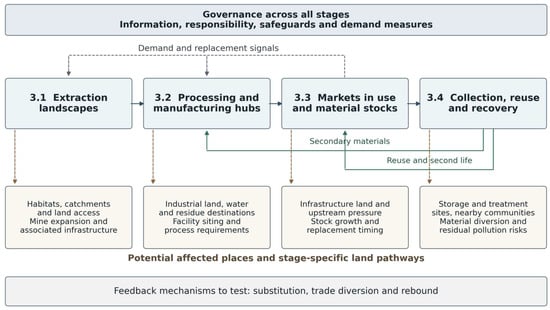
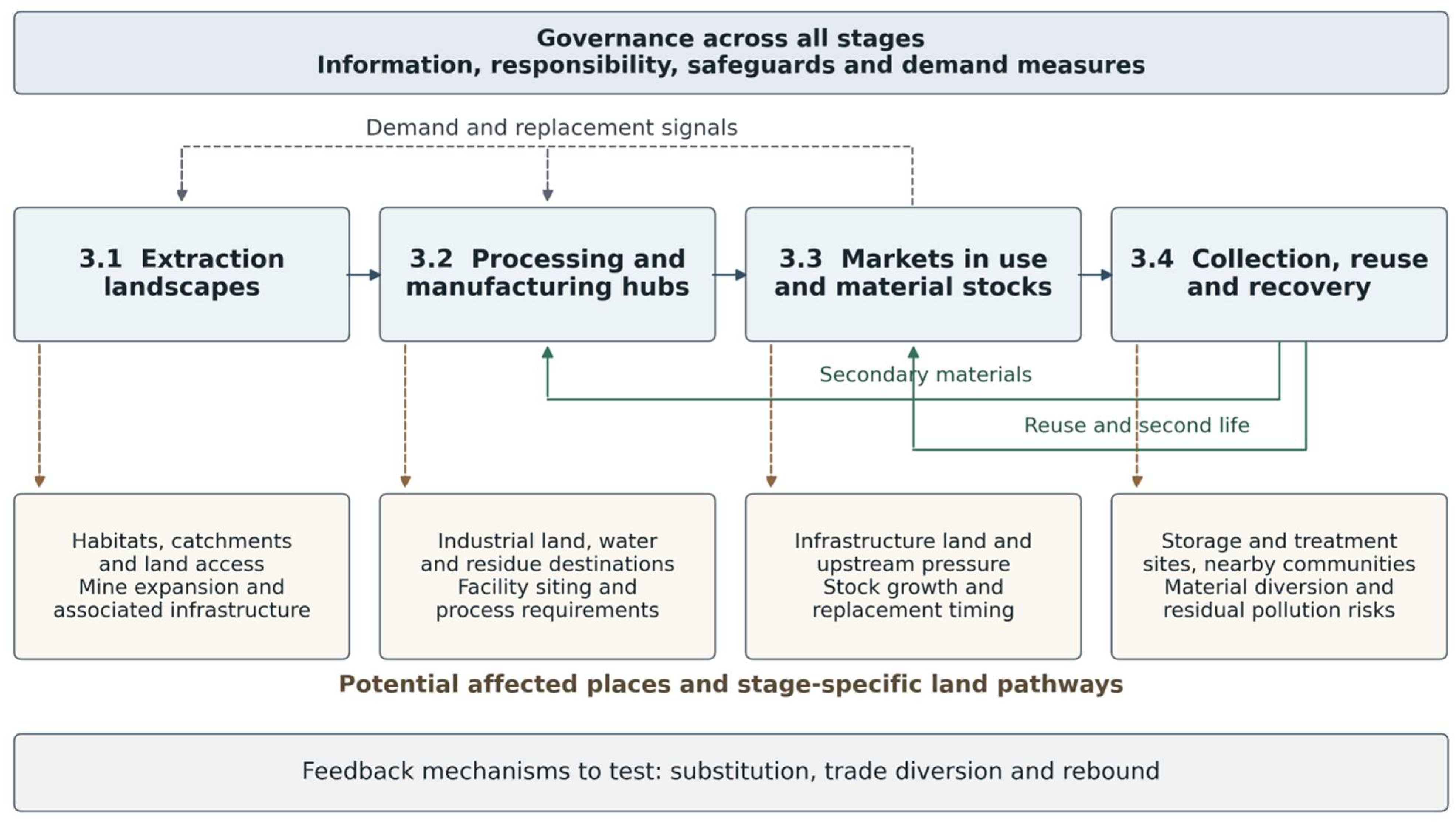
Figure 1 illustrates the critical-mineral lifecycle as four connected but geographically variable systems. Extraction landscapes produce an ore and concentrate and feature the greatest direct land impacts. Processing and manufacturing hubs convert geological materials into chemicals, parts, and products, where energy consumption, industrial land, pollution, and technology are concentrated. Markets in use contain accumulated material stocks in vehicles, infrastructure, electronics, and energy storage. Collection, reuse, and recycling networks activate those stocks post-consumption and return materials or second-life components to production. Material flows travel from one system to the next, whereas information, finance, prices, standards, and political signals flow bidirectionally.
Figure 1.
Telecoupled circular land governance across four lifecycle systems. Stage labels correspond to Section 3.1, Section 3.2, Section 3.3 and Section 3.4. Solid arrows represent forward material flows and possible reuse or secondary-material returns. Dashed links identify potential transmission pathways to affected landscapes and communities. Demand feedback is distinguished from the places receiving spillover pressures. The governance layer acts across all four systems. The figure represents analytical mechanisms, not measured flows or verified policy effects. Source: Authors’ conceptualization based on [18,19,21,22,23,24,25].
The framework distinguishes focal lifecycle systems, places receiving spillover pressures, and the mechanisms transmitting those pressures. A catchment, neighbouring community, transport corridor, or residue destination may be affected even when it is not the principal origin or destination of the traded product. Governance is not a final system or output in the flow but is instead overlaid onto the circular economy loop, meaning that product standards, extended producer responsibility, strategic project permitting, due diligence, trade rules, community rights, and demand-side policies all act at different points of intervention in the loop but have potential to affect other parts of the loop. For example, a requirement for recycled content would alter demand for secondary feedstocks, which would then change the incentives for collection, trade in waste and recyclables, technological innovation, and could impact where and how well recycling occurs.
The result of this change is that we are not asking the question “How much material is recycled?” but rather, “What primary pressures are avoided? Where are residual pressures occurring? How are the benefits and costs distributed, and who is accountable for them?” We also note that avoiding primary extraction cannot be assumed to happen with every ton of material recycled. Avoided primary extraction is a counterfactual statement that can only be evaluated empirically. Secondary material production will displace primary material production depending on the quality of the secondary material, whether it is functionally equivalent, the rate of displacement, the growth of markets, and the extent to which secondary material production merely adds to rather than substitutes for primary material production. Spatial accountability requires circularity metrics to be linked to origin, destination, ecosystem status, and the people involved.
The comparison can be traced through the corpus and eligibility criteria in Table 1, the analytical dimensions in Table 2, and the provision-level locators in Supplementary Table S1. The matrix links the policy evidence to the interpretations summarized in Table 3. Cross-system effects that are not established by policy text or implementation evidence are presented as analytical propositions. All materials are published literature or public policy documents. The study involved no human participants, personal data collection, experiments, or interventions.
3. Critical-Mineral Loops as Land-System Transformations
3.1. Extraction Landscapes as Sending Systems
From a telecoupled perspective, extraction landscapes are “sending systems” for physical material, but the term should not be construed as implying that they only respond to external demand. Rather, the landscape’s evolution will be driven by domestic development priorities, political dynamics, property rights, access to finance, infrastructure, social movements, and biophysical conditions. External demand might lead to expanding production at an existing mine, opening new lower-grade resources to exploitation, expediting approval processes, and prompting construction of access roads, power lines, processing facilities, and mining towns. Alternatively, demand could be redirected to other deposits through moratoria, benefit sharing, water limits, or changes in technology. Thus, the appropriate scale of analysis is a coupled landscape–institutional system rather than a mine.
Direct land disturbance is an important but incomplete indicator of mining pressure. Effects may extend beyond mine boundaries through catchment hydrology, dust deposition, habitat fragmentation, tailings risks, and changes in access to land. Spatial screening therefore needs to account for variation in ecological conditions and land-connected communities within, as well as across, jurisdictions [3,4,5,6,7]. A circularity assessment should ask whether secondary supply displaces primary production at particular sites, delays proposed expansion, or adds to total supply. It should also examine whether lower upstream demand supports rehabilitation or shifts production towards operators with weaker environmental safeguards.
Strategic-project designation and shorter permitting procedures may improve supply security, but their land-system consequences depend on the quality of assessment, participation, and enforcement. Faster approval should not be treated as evidence of weaker safeguards, just as longer procedures should not be assumed to reduce global pressure. Investment may move to other deposits while demand remains unchanged. A telecoupled assessment therefore examines where production may relocate, how the ecological and rights-related risks of alternative sites differ, and whether demand-side measures could reduce the need for additional extraction. This assessment is particularly important for Indigenous Peoples and other land-connected communities, whose relationships with land extend beyond its productive use [6].
At this stage, the central land-system effects are changes in disturbed area, habitat connectivity, water access, and rights over land. Demand and investment decisions transmit pressure to particular deposits and their associated infrastructure. Permitting, sourcing requirements, and demand-side measures are therefore potential intervention points, but their assessment must include the possibility that production moves to other landscapes.
3.2. Processing and Manufacturing Hubs
Processing and manufacturing hubs transform land through facility construction and the infrastructure required to supply energy, water, transport, and waste treatment. Refineries, smelters, and battery plants may occupy or expand industrial land, while roads, pipelines, and residue storage extend their spatial effects. Water abstraction can connect a facility to competing users elsewhere in a catchment. Where containment or treatment is inadequate, releases from process water, dust, or residues can affect soils and water beyond the plant boundary. The relevant assessment therefore follows both the industrial site and the pathways through which its inputs and wastes reach surrounding land systems [1,2,13].
Circular production changes these pathways rather than eliminating them. Secondary feedstocks can reduce demand for some primary processes, but sorting, refining, and recovery also require facilities and generate residues. Feedstock composition, recovery technology, and treatment quality determine which pressures are avoided and which remain [12,13,14]. If recyclable intermediates are exported, the jurisdiction reporting material recovery may differ from the place managing residual contamination. Capacity indicators should consequently be accompanied by information on facility location, water demand, residue composition, and final treatment destinations.
The policy intervention points are facility siting, investment conditions, environmental assessment, process standards, and custody records. China’s Circular Economy Promotion Law explicitly addresses industrial-park land and water use [31], while capacity-oriented instruments in both portfolios influence investment locations [29,34]. The main land-system mechanism is the redistribution of industrial land occupation and associated resource and pollution burdens. A change in capacity location can shift those burdens to another catchment or community even when material-recovery performance improves.
3.3. Markets in Use and Urban Material Stocks
Products in use connect current land pressures to future material availability. Vehicles, buildings, electricity networks, and storage systems retain minerals for different periods, determining when secondary material can return to production. During rapid stock expansion, recycling may be unable to supply growing demand because much of the material remains in service [12,15,16]. Stock location and service life therefore influence the timing and geography of extraction and processing, as well as the future need for collection and recovery sites.
Land consequences also depend on how services are provided. Transport and infrastructure choices affect both direct land occupation and mineral demand. Longer product lives, repair, and greater use of existing assets can reduce replacement demand for a given service, potentially lowering upstream pressure. These effects are conditional: added stock, larger products, or increased consumption may offset efficiency gains [25]. Comparison should therefore hold service provision explicit and examine stock size, replacement rates, and absolute primary-material requirements rather than treating every efficiency improvement as avoided mining.
Product information can support this assessment when it links composition, maintenance, and custody to subsequent recovery decisions [28,30,37]. Passports alone do not demonstrate that a mine has been avoided. The land-system mechanism at the use stage operates through stock accumulation, replacement demand, and the location of supporting infrastructure. Design standards, procurement, repair provision, and transport or infrastructure planning are intervention points whose spillovers reach extraction landscapes and the future geography of recovery.
3.4. End-of-Life Networks, Spillovers, and Rebound
End-of-life networks connect users, collectors, transporters, dismantlers, reuse operators, recyclers, and regulators. Collection determines which discarded products enter recoverable streams, while subsequent handling determines recovery quality and residual risks. Material may instead remain in storage, enter unrecorded trade, or reach poorly controlled treatment. Evaluation should therefore follow custody and treatment destinations as well as collection and recovery rates.
Reuse and second lives create other opportunities as well. Recovering more value through extended service life could outweigh immediate material recovery, but each pathway raises different concerns regarding safety, warranty, testing, and performance. Transporting damaged batteries is hazardous. There are many factors to consider when determining the best strategy for managing EoL battery material: how much virgin material it displaces, the quality of the service it provides, how long it takes to recover, the amount of energy it consumes, what safety risks it introduces, and how much value remains. A reflexive preference for reuse might be wrong if the product is unsafe or if extended use creates bottlenecks elsewhere, while a default preference for recycling might lose value that is still recoverable [17].
Stricter treatment requirements can change the routes taken by discarded products and secondary feedstocks. Where enforcement and coordination are weak, material may move to less controlled destinations. Increased demand for recycled content can also change scrap prices, trade patterns, or storage incentives. These are possible mechanisms requiring shipment, price, and facility evidence; they should not be described as observed consequences of the instruments reviewed here. Customs classifications and custody documentation matter because they influence which authorities can follow and regulate these movements.
Circular-economy rebound may occur when lower material costs or perceived environmental benefits stimulate additional demand, partly offsetting savings [25]. Its magnitude depends on market responses and should not be assumed. Evaluation should distinguish changes in the material required per unit of service from changes in the total quantity of services and products supplied. For critical minerals, both absolute primary requirements and the distribution of their land-system effects remain relevant outcomes.
The physical land-system link at end of life lies in collection sites, storage yards, dismantling facilities, recovery plants, and residue destinations. Unsafe storage or treatment can create local contamination and fire risks; moving discarded products or intermediate materials can transfer those risks to other places [13,14,17]. Collection responsibility and treatment standards therefore need to be assessed together with facility conditions and the final fate of residues. The relevant spillover is a change in where material and environmental burdens end up, not simply a change in the reported recovery rate. Whether these flows also reduce mining depends on substitution and demand.
4. EU and China Governance Pathways
4.1. European Union: Compliance-Led Market Governance with an Industrial Turn
EU market access can transmit regulatory requirements along supply chains beyond EU territory. This mechanism is commonly described as the Brussels effect [40]. In the circularity context, the Circular Economy Action Plan sets a strategic agenda, while the Ecodesign for Sustainable Products Regulation provides a framework for product-specific requirements [27,30]. Firms serving the EU market may consequently adjust product design, supplier information, or compliance practices. Whether these adjustments extend to their wider operations depends on commercial and organizational conditions. For land governance, the relevant question is whether compliance changes decisions at extraction and processing sites, rather than merely improving documentation. Verification costs and limited access to information may also disadvantage smaller suppliers and recovery operators.
The most explicit example of the EU using its market power to extend its sustainability standards beyond its borders is the Batteries Regulation [28], which addresses all stages of the battery life cycle. It bundles product sustainability and safety requirements with due diligence, carbon footprint, recycled content, extended producer responsibility, collection and recovery targets and a battery passport. From a telecoupling perspective it tries to link upstream sourcing characteristics, product information, use and end-of-life responsibility. The advantage is strong institutional linkage between life-cycle stages. The disadvantage is that the quality of the linkage will depend on delegated acts, data accessibility, verification, enforcement and whether upstream governance arrangements are recognised. A passport may record a statement, but it does not ensure meaningful involvement of communities, access to remedy or better landscape impacts. Adoption is distinguished from application. At the review cutoff, the battery-passport requirement was scheduled to apply from 18 February 2027 [28]. Regulation (EU) 2025/1561 had postponed the application of battery due-diligence obligations to 18 August 2027 [41]. These provisions are analyzed as adopted institutional arrangements, not as evidence of implementation by June 2026.
The Critical Raw Materials Act introduces an industrial and geopolitical angle [29]. Its 2030 sets Union-level benchmarks the EU to have extraction capacity equivalent to at least 10% of its annual consumption, processing capacity equivalent to at least 40% of its annual consumption and recycling capacity equivalent to at least 25% of its annual consumption of strategic raw materials, plus a target that no more than 65% of any relevant processing stage of annual consumption comes from one third country. Strategic project rules aim to speed up and make more certain the approval process. These rules shift EU circular policy from being exclusively environmental regulation to also covering the design of industrial capacity, investment, permitting, monitoring and external cooperation.
There are three land-related questions left unanswered in the EU portfolio. First, domestic extraction and processing targets could shorten supply chains and strengthen oversight but do not eliminate issues around water, biodiversity or social licence. Second, diversification could lower the risk of over-concentration but spread extraction to new places; a more diversified geographic footprint is not necessarily a lower-impact or more equitable footprint. Third, product-level requirements could generate more detailed data in the EU market while creating loopholes for material that is exported, used in products not covered by the rules or recycled in other countries. The overarching policy question is how to tie together market regulations and industrial policy with place-based safeguards and balanced relationships.
4.2. China: State-Coordinated Industrial Governance with a Regulatory Turn
China’s pathway derives from a long-standing pattern of centralized planning that pervades the whole industrial base. The Circular Economy Promotion Law, adopted in 2008 and amended in 2018, establishes the framework for reduction, reuse, recycling, planning, and resource recovery [31], while the Fourteenth Five-Year Plan for Circular Economy Development sets objectives for resource efficiency, recycling systems, remanufacturing, industrial ecology, and targeted waste streams [32]. Circularity is thus a core part of the development agenda and industrial upgrading strategy rather than a secondary concern related to waste management.
Sectoral plans translate circular-economy objectives into industrial priorities. The New Energy Vehicle Industry Development Plan links vehicle and battery innovation with lifecycle management and recovery infrastructure [33]. The raw materials plan combines supply security, industrial upgrading, resource efficiency, and cleaner production [34]. These planning instruments provide a basis for coordinating investment and technical standards. Their land-system implications depend on facility siting, cumulative environmental assessment, local enforcement, and the opportunities available to affected communities to influence decisions.
Regulatory instruments add more specific responsibilities. The Regulations on Rare-Earth Management combine resource planning, total-quantity control, product traceability, and environmental obligations [35]. For waste power batteries, Order No. 73 is dated 31 December 2025, was published on the MIIT website on 16 January 2026, and took effect on 1 April 2026 [36]. It establishes coding and reporting duties, collection responsibilities, regulated transfers, and requirements for comprehensive utilization. These provisions support the interpretation of China’s pathway as state-coordinated industrial governance with increasingly specific lifecycle obligations. They do not establish that all forms of battery reuse are mandatory or environmentally preferable.
Important spatial questions remain. Domestic product tracking does not by itself identify the land and water impacts of imported minerals or the consequences of subsequent cross-border transfers. Formal recovery requirements may improve accountability, but their effects on small operators depend on access to compliant facilities, finance, and collection networks. Similarly, additional processing capacity may change demand for primary and secondary feedstocks without reducing total extraction. Evaluation should therefore examine treatment quality, residue destinations, worker transitions, and changes in primary production alongside the number or capacity of regulated facilities.
4.3. Different Centers of Gravity, Partial Convergence
Table 3 outlines these as governance portfolios. The EU’s portfolio is based mainly on binding product- and market-oriented regulation implemented via harmonized rules and national authorities; China’s relies on industrial planning and administrative coordination. However, there is some overlap between the two. The EU now has capacity targets, flagship projects and diversification policies. China has introduced coding and traceability, EPR and controlled recycling. Both include security, competitiveness and environmental goals. Both increasingly treat data as infrastructure.
Table 3 summarizes differences in institutional emphasis, while Supplementary Table S1 identifies the provisions behind the comparison. The contrast is not between regulation and planning as mutually exclusive approaches. The selected instruments combine product requirements, recovery duties, information systems, and industrial objectives in different ways. Three policy interfaces show how these differences may matter for connected land systems.
First, lifecycle information creates opportunities for coordination but does not establish equivalence. The EU battery-passport provisions link product records to differentiated access rights, whereas China’s battery measures combine unique coding, platform reporting, and a digital-identity framework [28,36]. The two approaches could support continuity of product identity and custody. However, identifiers alone do not align the meaning of recycled content, responsibility for updating records after dismantling or repurposing, or the evidence needed to support an environmental claim. A feasible interface would map identifiers, custody events, and claim definitions, with agreed verification and access procedures. Linking records to actual processing and recovery sites would then allow land-related information to inform decisions. These are proposed interoperability conditions; the policy texts do not demonstrate that such an interface already exists.
Second, collection responsibility and recovery requirements shape competing routes for secondary material. Both portfolios assign responsibilities to firms and seek to direct discarded batteries into regulated recovery [28,36]. This creates a possible basis for cooperation on custody transfers and treatment documentation. Tension may nevertheless arise when the party meeting a collection obligation, the operator claiming recovery, and the plant managing residues are located in different jurisdictions. Recovered mass, product-level recycled content, and avoided primary production measure different things. Their accounting boundaries should be reconciled to prevent the same material from supporting incompatible claims. The land-system issue is whether a compliant transfer also preserves accountability for the location and quality of treatment; its resolution requires shipment and facility evidence beyond this document analysis.
Third, industrial capacity and environmental safeguards interact through investment location. The EU Critical Raw Materials Act combines strategic capacity and diversification objectives with sustainability criteria and environmental-assessment procedures [29]. Chinese resource and industrial instruments combine planning and supply coordination with environmental and resource-use provisions [31,34,35]. These arrangements may complement one another through cleaner technology and more accountable processing. They may also create competition for feedstock or redistribute facility construction and residual waste burdens. Neither faster permitting nor administrative coordination establishes environmental performance. A comparison should ask whether investment decisions incorporate catchment conditions, cumulative impacts, residue management, and participation at affected sites.
A further shared issue concerns demand. The corpus includes durability, repair, reduction, and resource-efficiency provisions [27,29,30,31,32]; it would therefore be inaccurate to describe demand-side policy as absent. The narrower finding is that these provisions do not, by themselves, establish an absolute decline in primary demand or identify the landscapes in which extraction would be displaced. This gap motivates the propositions in Section 5.1. The comparison concerns policy architecture at the cutoff date, including adopted provisions with later application dates, rather than verified interoperability or environmental outcomes.
Convergence, however, does not mean harmonization. While EU rules tend to set requirements for information and performance conditions for products in a market, China’s approach relies on enterprise reporting and administrative supervision. This means terms like recycled content, chain of custody, waste status, due diligence, confidentiality, and authorized recovery can differ. Multinationals with operations in both markets might maintain two distinct sets of data that cannot be aligned, leading to increased cost with no clear picture of land use upstream. So interoperability should aim for a narrow common data layer, specifically material identity, mass balance or chain-of-custody method, origin at an appropriate level of granularity, recycled content methodology, custody events, and verified sustainability attributes, while leaving substantive law in place.
The comparison also underscores a shared preoccupation with supply. Recycling, domestic capacity, diversification, and technology all aim to render material available. Instruments that lower total material-service demand are less advanced in both paths. This matters, because recycling cannot source material that has not yet reached end-of-life, and fast-growing demand may outstrip secondary supply for decades [12,15,16]. A land-accountable approach must blend circular supply with demand-side instruments that manage material-service needs, including longer-lived products, efficient mobility and infrastructure, repair, lower material footprints where consistent with service needs, and procurement that rewards durability.
5. Discussion: From Circularity Rates to Spatial Responsibility
5.1. Four Propositions for Research and Evaluation
The following propositions combine theory-led mechanisms with the institutional gaps identified in Section 4.1, Section 4.2 and Section 4.3 and Supplementary Table S1. The policy corpus motivates the propositions but does not test them. The first is that for comparable services and material quality, greater secondary supply is more likely to reduce primary land pressure when it displaces primary production rather than adding to total supply. Recycling and recycled-content provisions establish material-recovery objectives [28,29,32], but they do not measure a counterfactual reduction in extraction at particular sites. This distinction motivates the proposition. Tests should link recovered quantities and functional substitution to stock-flow and market scenarios, then examine the location and timing of changes in primary production [12,15,16].
The second is that lifecycle traceability is more likely to improve outcomes at affected sites when information is usable for decisions and linked to verification, responsibility, and remedy. The information provisions in the battery instruments and the rare-earth regulation establish relevant records and reporting duties [28,35,36]. Their existence does not establish that information changes sourcing or land management. The proposition therefore concerns the connection between records and action. Tests should compare traceability arrangements with different spatial detail, assurance, and access conditions, examining changes in procurement, treatment, remediation, and opportunities for affected people to obtain redress [37,42].
Third, formal recovery requirements are more likely to reduce displaced environmental burdens when enforcement is combined with accessible routes into compliant activity. Collection and regulated-transfer provisions provide the institutional basis for examining this relationship [28,36]. The corpus does not demonstrate how informal workers or small operators respond, so exclusion and leakage remain hypotheses. Comparative implementation studies should measure entry costs, access to collection networks and training, changes in livelihoods, and the destinations of material diverted from non-compliant operations.
The fourth is that at a given level of service provision, combining recovery with longer product life and lower material requirements is more likely to reduce primary demand than expanding recovery capacity alone. Durability, repair, and reduction are present in the corpus [27,29,30,31,32], alongside strong recovery and capacity objectives. The gap is evidence that these measures jointly reduce absolute primary requirements under stock growth. Tests should compare policy combinations using service demand, stock accumulation, replacement rates, recovery lags, and rebound assumptions, reporting both material intensity and total primary footprints [12,15,16,25].
5.2. A Governance Portfolio for Land-Accountable Circularity
The comparison supports four targeted governance priorities. First is recovery and capacity indicators need to be connected to spatially explicit footprint and stock-flow accounts. This responds to the gap identified in Proposition 1 between recovered material and avoided primary pressure. Accounts should distinguish primary and secondary inputs, material quality, final residue destinations, and the places supplying the material. Mine-area data can support screening [7], but site-level ecological and social conditions are needed to interpret land consequences.
Second is information cooperation should focus on the specific interfaces identified in Section 4.3. A shared mapping of identifiers, custody events, and claim definitions could help connect EU product records with Chinese reporting systems without requiring one database or identical legal rules. Verification, access rights, and responsibility for updating records should accompany this mapping. This priority responds to the gap in Proposition 2 between traceability and decisions that affect land; information exchange alone is not the intended outcome.
Third is capacity development and regulated recovery need place-based safeguards and feasible participation. The comparison shows that these instruments influence facility location and access to material, while their distributional consequences remain unresolved. Environmental assessment should follow associated water use, infrastructure, and residues. Participation and remedy should be accessible to affected communities, and transitions into compliant recovery should be assessed for small operators and workers. This priority follows from the siting issues in Section 4.3 and the formalization mechanism in Proposition 3.
Fourth is the existing reduction, durability, and repair provisions should be evaluated together with recovery and capacity measures. Proposition 4 identifies the need to assess whether this combination changes replacement demand and absolute primary requirements. Procurement, product design, and service planning can be compared against explicit service needs. Both material use per unit of service and total footprints should be reported, because a lower intensity can coexist with greater total pressure. Table 4 translates these priorities into proposed indicators and intervention points; it does not report measured policy performance.
Table 4.
Suggested indicators and complementary levers across the telecoupled mineral lifecycle.
5.3. Priorities for EU–China and Multilateral Cooperation
The prospect of EU–China cooperation on critical-mineral circularity appears politically fraught. However, material interconnectedness demands this collaboration because firms, products, processing steps and secondary feedstocks connect the two systems. Full alignment of environmental and industrial policy is not required; a modest starting point could include agreement on technical equivalence and interoperable data, such as definitions of battery status and recycled content; interoperable identifiers; common protocols for recording custody transfers; common standards for second-life battery testing; and common methods for calculating recovery rates and carbon footprints. Third country suppliers and recyclers should also be involved in pilot programmes to avoid interoperability being enshrined as a bilateral norm that is then applied to other land systems.
Second, cooperation could focus on transboundary enforcement. Customs classifications and waste-product delineation decide if used batteries, black mass or other metal-rich materials arrive at the right destination. Regulators can benefit from risk-based inspections, improved information exchange and a clear process for managing rejected, defective or misdeclared shipments. These rules must be coupled with viable pathways for reuse and quality recycling; otherwise prohibitions can restrict desirable flows or entrench large players.
Third, cooperation should create partnerships with supplier countries. While both the EU and China have a shared interest in securing primary and secondary feedstocks, uncoordinated competition to gain access can compromise environmental standards or funnel economic benefits towards downstream phases of the supply chain. Joint or parallel initiatives could support more accurate geological and environmental information, enhanced regulatory capacity, transparent contracting processes, environmentally and economically viable local processing, closure financing, and community-led monitoring. The challenge lies in determining whether such measures promote local autonomy and longer-term capabilities, rather than merely securing supply.
Finally, multilateral institutions could facilitate methodological and assurance tools. Standardised guidance on chain of custody, material footprinting, due diligence, and material categorisation for secondary feedstocks could help avoid duplication. However, international standards should establish minimum thresholds rather than supplant national decisions. Limits on water use, the recognition of biodiversity values, the protection of cultural landscapes, and the requirement for community consent should not be collapsed into a single, universally applicable metric if they are to retain their regulatory force.
5.4. Limitations and Research Agenda
Four limitations define the scope of our analysis. First, our purposive corpus covers selected policy instruments and does not exhaust delegated acts, technical standards, subnational measures, subsidies, trade rules, or enforcement decisions. Second, legal adoption and policy objectives do not establish implementation quality or attributable land-system outcomes; several obligations also have future application dates. Third, differences in legal status, sectoral coverage, and administrative context limit direct equivalence between instruments. Fourth, our analysis does not quantify material flows, estimate primary-material displacement, or test the net land effects of alternative policy scenarios. The propositions in Section 5.1 therefore identify relationships for subsequent empirical testing.
These are not mere caveats but a constructive agenda for further study. Comparative implementation studies of mineral-product chains should be conducted across matched sites in the EU, China, and other countries. These studies should combine material flow analysis, company and customs data, remote sensing, environmental impact assessment, interviews, and participatory techniques. Longitudinal studies need to test how much passports and traceability affect sourcing, recovery, investment and remedies. Stock-flow models need to account for the lifespan of products, their chemical composition, the quality of their reuse and recycling, trade and the demands and supply of primary production that vary spatially. Distributive research needs to ask who has access to the information, who pays for verification and whether formalizing value chains increases or decreases the independence of small businesses, workers, Indigenous Peoples and local communities.
Evaluating these policies needs a stronger counterfactual. It is not a matter of circular policy versus no policy, but what other alternatives could be used to perform the same functions? Subsidies for recycling, standards for longevity, investments in shared mobility and incentives for smaller batteries may each operate with different time lags, spatial distributions and constituencies. Studies should look to optimize across multiple goals for climate, material security, land, water, biodiversity, labour, cost and access, rather than just minimize one metric. Such analyses would take a telecoupled circular governance support empirical evaluation of the framework.
6. Conclusions
Critical-mineral circularity is a relationship between material retention, spatially distributed land pressures, and the institutions responsible for those pressures. Closing a material loop can reorganize where burdens occur without necessarily reducing them. The telecoupled circular land governance perspective makes that distinction central to the assessment of circularity.
The EU–China comparison shows how different policy arrangements act on connected chains. Product requirements and strategic capacity measures interact with planning, traceability, and regulated recovery. Their partial convergence creates opportunities for coordination, but shared terminology or more complete records do not establish equivalent obligations or better outcomes at affected sites.
The resulting research task is to test when changes in material circulation alter primary production, facility location, residual burdens, and the distribution of benefits. For policy evaluation, circularity indicators should be connected to these spatial consequences and to the actors able to address them. The framework and evidence matrix provide a basis for making those relationships explicit; whether particular policy combinations reduce land pressure remains an empirical question.
Supplementary Materials
The following supporting information can be downloaded at https://www.mdpi.com/article/10.3390/land15112060/s1, Table S1: Instrument-level evidence matrix for telecoupled circular land governance.
Author Contributions
Conceptualization, F.P.; methodology, F.P.; formal analysis, Y.Z.; investigation, F.P.; data curation, Y.Z.; writing—original draft preparation, F.P.; writing—review and editing, Y.Z.; visualization, F.P. All authors have read and agreed to the published version of the manuscript.
Funding
This research received no external funding.
Data Availability Statement
The policy documents examined in this study are publicly available through the official sources cited in the reference list. Table 1 and Table 2 report the analytical framework and core policy corpus. Supplementary Table S1 provides the qualitative instrument-level evidence matrix and the locators used to support the comparison. No new quantitative dataset was generated.
Conflicts of Interest
The authors declare no conflict of interest.
References
- Ali, S.H.; Giurco, D.; Arndt, N.; Nickless, E.; Brown, G.; Demetriades, A.; Durrheim, R.; Enriquez, M.A.; Kinnaird, J.; Littleboy, A.; et al. Mineral supply for sustainable development requires resource governance. Nature 2017, 543, 367–372, Correction in Nature 2017, 547, 246. https://doi.org/10.1038/nature22982. [Google Scholar] [CrossRef] [Scilit] [PubMed]
- Sovacool, B.K.; Ali, S.H.; Bazilian, M.; Radley, B.; Nemery, B.; Okatz, J.; Mulvaney, D. Sustainable minerals and metals for a low-carbon future. Science 2020, 367, 30–33. [Google Scholar] [CrossRef] [Scilit] [PubMed]
- Sonter, L.J.; Dade, M.C.; Watson, J.E.M.; Valenta, R.K. Renewable energy production will exacerbate mining threats to biodiversity. Nat. Commun. 2020, 11, 4174. [Google Scholar] [CrossRef] [Scilit] [PubMed]
- Lèbre, É.; Stringer, M.; Svobodova, K.; Owen, J.R.; Kemp, D.; Côte, C.; Arratia-Solar, A.; Valenta, R.K. The social and environmental complexities of extracting energy transition metals. Nat. Commun. 2020, 11, 4823. [Google Scholar] [CrossRef] [Scilit] [PubMed]
- Luckeneder, S.; Giljum, S.; Schaffartzik, A.; Maus, V.; Tost, M. Surge in global metal mining threatens vulnerable ecosystems. Glob. Environ. Chang. 2021, 69, 102303. [Google Scholar] [CrossRef] [Scilit]
- Owen, J.R.; Kemp, D.; Lechner, A.M.; Harris, J.; Zhang, R.; Lèbre, É. Energy transition minerals and their intersection with land-connected peoples. Nat. Sustain. 2023, 6, 203–211, Correction in Nat. Sustain. 2023, 6, 1024. https://doi.org/10.1038/s41893-022-01057-6. [Google Scholar] [CrossRef] [Scilit]
- Maus, V.; Giljum, S.; Gutschlhofer, J.; da Silva, D.M.; Probst, M.; Gass, S.L.B.; Luckeneder, S.; Lieber, M.; McCallum, I. A global-scale data set of mining areas. Sci. Data 2020, 7, 289. [Google Scholar] [CrossRef] [Scilit] [PubMed]
- Wiedmann, T.; Lenzen, M. Environmental and social footprints of international trade. Nat. Geosci. 2018, 11, 314–321. [Google Scholar] [CrossRef] [Scilit]
- International Energy Agency. The Role of Critical Minerals in Clean Energy Transitions; IEA: Paris, France, 2021; Available online: https://www.iea.org/reports/the-role-of-critical-minerals-in-clean-energy-transitions (accessed on 16 July 2026).
- International Energy Agency. Global Critical Minerals Outlook 2025; IEA: Paris, France, 2025; Available online: https://www.iea.org/reports/global-critical-minerals-outlook-2025 (accessed on 16 July 2026).
- Bruckner, M.; Giljum, S.; Lutz, C.; Wiebe, K.S. Materials embodied in international trade—Global material extraction and consumption between 1995 and 2005. Glob. Environ. Change 2012, 22, 568–576. [Google Scholar] [CrossRef] [Scilit]
- International Energy Agency. Recycling of Critical Minerals: Strategies to Scale Up Recycling and Urban Mining; IEA: Paris, France, 2024; Available online: https://www.iea.org/reports/recycling-of-critical-minerals (accessed on 16 July 2026).
- Harper, G.; Sommerville, R.; Kendrick, E.; Driscoll, L.; Slater, P.; Stolkin, R.; Walton, A.; Christensen, P.; Heidrich, O.; Lambert, S.; et al. Recycling lithium-ion batteries from electric vehicles. Nature 2019, 575, 75–86, Correction in Nature 2020, 578, E20. https://doi.org/10.1038/s41586-019-1862-3. [Google Scholar] [CrossRef] [Scilit] [PubMed]
- Binnemans, K.; Jones, P.T.; Blanpain, B.; Van Gerven, T.; Yang, Y.; Walton, A.; Buchert, M. Recycling of rare earths: A critical review. J. Clean. Prod. 2013, 51, 1–22. [Google Scholar] [CrossRef] [Scilit]
- Xu, C.; Dai, Q.; Gaines, L.; Hu, M.; Tukker, A.; Steubing, B. Future material demand for automotive lithium-based batteries. Commun. Mater. 2020, 1, 99. [Google Scholar] [CrossRef] [Scilit]
- Zeng, A.; Chen, W.; Rasmussen, K.D.; Zhu, X.; Lundhaug, M.; Müller, D.B.; Tan, J.; Keiding, J.K.; Liu, L.; Dai, T.; et al. Battery technology and recycling alone will not save the electric mobility transition from future cobalt shortages. Nat. Commun. 2022, 13, 1341. [Google Scholar] [CrossRef] [Scilit] [PubMed]
- Ma, R.; Tao, S.; Sun, X.; Ren, Y.; Sun, C.; Ji, G.; Xu, J.; Wang, X.; Zhang, X.; Wu, Q.; et al. Pathway decisions for reuse and recycling of retired lithium-ion batteries considering economic and environmental functions. Nat. Commun. 2024, 15, 7641. [Google Scholar] [CrossRef] [Scilit] [PubMed]
- Liu, J.; Hull, V.; Batistella, M.; DeFries, R.; Dietz, T.; Fu, F.; Hertel, T.W.; Izaurralde, R.C.; Lambin, E.F.; Li, S.; et al. Framing sustainability in a telecoupled world. Ecol. Soc. 2013, 18, 26. [Google Scholar] [CrossRef] [Scilit]
- Friis, C.; Nielsen, J.Ø.; Otero, I.; Haberl, H.; Niewöhner, J.; Hostert, P. From teleconnection to telecoupling: Taking stock of an emerging framework in land system science. J. Land Use Sci. 2016, 11, 131–153. [Google Scholar] [CrossRef] [Scilit]
- Meyfroidt, P.; Chowdhury, R.R.; de Bremond, A.; Ellis, E.C.; Erb, K.-H.; Filatova, T.; Garrett, R.D.; Grove, J.M.; Heinimann, A.; Kuemmerle, T.; et al. Middle-range theories of land system change. Glob. Environ. Change 2018, 53, 52–67. [Google Scholar] [CrossRef] [Scilit]
- Cotta, B.; Coenen, J.; Challies, E.; Newig, J.; Lenschow, A.; Schilling-Vacaflor, A. Environmental governance in globally telecoupled systems: Mapping the terrain towards an integrated research agenda. Earth Syst. Gov. 2022, 13, 100142. [Google Scholar] [CrossRef] [Scilit]
- Geissdoerfer, M.; Savaget, P.; Bocken, N.M.P.; Hultink, E.J. The Circular Economy—A new sustainability paradigm? J. Clean. Prod. 2017, 143, 757–768. [Google Scholar] [CrossRef] [Scilit]
- Kirchherr, J.; Reike, D.; Hekkert, M. Conceptualizing the circular economy: An analysis of 114 definitions. Resour. Conserv. Recycl. 2017, 127, 221–232. [Google Scholar] [CrossRef] [Scilit]
- Corvellec, H.; Stowell, A.F.; Johansson, N. Critiques of the circular economy. J. Ind. Ecol. 2022, 26, 421–432. [Google Scholar] [CrossRef] [Scilit]
- Zink, T.; Geyer, R. Circular economy rebound. J. Ind. Ecol. 2017, 21, 593–602. [Google Scholar] [CrossRef] [Scilit]
- McDowall, W.; Geng, Y.; Huang, B.; Barteková, E.; Bleischwitz, R.; Türkeli, S.; Kemp, R.; Doménech, T. Circular economy policies in China and Europe. J. Ind. Ecol. 2017, 21, 651–661. [Google Scholar] [CrossRef] [Scilit]
- European Commission. A New Circular Economy Action Plan: For a Cleaner and More Competitive Europe, COM(2020) 98 Final; European Commission: Brussels, Belgium, 2020; Available online: https://eur-lex.europa.eu/legal-content/EN/TXT/?uri=CELEX:52020DC0098 (accessed on 16 July 2026).
- European Parliament; Council of the European Union. Regulation (EU) 2023/1542 of 12 July 2023 concerning batteries and waste batteries. Off. J. Eur. Union 2023, L191, 1–117. Available online: https://eur-lex.europa.eu/eli/reg/2023/1542/oj/eng (accessed on 16 July 2026).
- European Parliament; Council of the European Union. Regulation (EU) 2024/1252 of 11 April 2024 Establishing a Framework for Ensuring a Secure and Sustainable Supply of Critical Raw Materials. Off. J. Eur. Union 2024, L, 2024/1252. Available online: https://eur-lex.europa.eu/eli/reg/2024/1252/oj/eng (accessed on 16 July 2026).
- European Parliament; Council of the European Union. Regulation (EU) 2024/1781 of 13 June 2024 Establishing a Framework for the Setting of Ecodesign Requirements for Sustainable Products. Off. J. Eur. Union 2024, L, 2024/1781. Available online: https://eur-lex.europa.eu/eli/reg/2024/1781/oj/eng (accessed on 16 July 2026).
- Standing Committee of the National People’s Congress. Circular Economy Promotion Law of the People’s Republic of China; Standing Committee of the National People’s Congress: Beijing, China, 2018. Available online: https://www.mee.gov.cn/ywgz/fgbz/fl/201811/t20181114_673624.shtml (accessed on 10 October 2026).
- National Development and Reform Commission. Notice on Issuing the 14th Five-Year Plan for Circular Economy Development; National Development and Reform Commission: Beijing, China, 2021. Available online: https://www.ndrc.gov.cn/xxgk/zcfb/ghwb/202107/t20210707_1285527.html (accessed on 16 July 2026).
- General Office of the State Council. New Energy Vehicle Industry Development Plan (2021–2035); General Office of the State Council: Beijing, China, 2020. Available online: https://www.mee.gov.cn/zcwj/gwywj/202011/t20201103_806156.shtml (accessed on 16 July 2026). (In Chinese)
- Ministry of Industry and Information Technology; Ministry of Science and Technology; Ministry of Natural Resources. 14th Five-Year Plan for Raw Materials Industry; Ministry of Industry and Information Technology: Beijing, China, 2021. Available online: https://www.miit.gov.cn/zwgk/zcwj/wjfb/tz/art/2021/art_2960538d19e34c66a5eb8d01b74cbb20.html (accessed on 10 October 2026). (In Chinese)
- State Council of the People’s Republic of China. Regulations on Rare-Earth Management; State Council of the People’s Republic of China: Beijing, China, 2024. Available online: https://www.mee.gov.cn/zcwj/gwywj/202407/t20240701_1080564.shtml (accessed on 16 July 2026).
- Ministry of Industry and Information Technology; National Development and Reform Commission; Ministry of Ecology and Environment; Ministry of Transport; Ministry of Commerce; State Administration for Market Regulation. Interim Measures for the Administration of Recycling and Comprehensive Utilization of Waste Power Batteries from New Energy Vehicles; Ministry of Industry and Information Technology: Beijing, China, 2025. Available online: https://www.miit.gov.cn/gyhxxhb/jgsj/cyzcyfgs/bmgz/jdcjxl/art/2026/art_392462fdc40c415ea4a4129cac3028c2.html (accessed on 10 October 2026).
- International Energy Agency. The Role of Traceability in Critical Mineral Supply Chains; IEA: Paris, France, 2025; Available online: https://www.iea.org/reports/the-role-of-traceability-in-critical-mineral-supply-chains (accessed on 16 July 2026).
- Wiedenhofer, D.; Virág, D.; Kalt, G.; Plank, B.; Streeck, J.; Pichler, M.; Mayer, A.; Krausmann, F.; Brockway, P.; Schaffartzik, A.; et al. A systematic review of the evidence on decoupling of GDP, resource use and GHG emissions, part I: Bibliometric and conceptual mapping. Environ. Res. Lett. 2020, 15, 063002. [Google Scholar] [CrossRef] [Scilit]
- Haberl, H.; Wiedenhofer, D.; Virág, D.; Kalt, G.; Plank, B.; Brockway, P.; Fishman, T.; Hausknost, D.; Krausmann, F.; Leon-Gruchalski, B.; et al. A systematic review of the evidence on decoupling of GDP, resource use and GHG emissions, part II: Synthesizing the insights. Environ. Res. Lett. 2020, 15, 065003. [Google Scholar] [CrossRef] [Scilit]
- Bradford, A. The Brussels Effect: How the European Union Rules the World; Oxford University Press: New York, NY, USA, 2020. [Google Scholar] [CrossRef] [Scilit]
- European Parliament; Council of the European Union. Regulation (EU) 2025/1561 of 18 July 2025 amending Regulation (EU) 2023/1542 as Regards Obligations of Economic Operators concerning Battery Due Diligence Policies. Off. J. Eur. Union 2025, L, 2025/1561. Available online: https://eur-lex.europa.eu/eli/reg/2025/1561/oj/eng (accessed on 10 October 2026).
- Organisation for Economic Co-operation and Development. OECD Due Diligence Guidance for Responsible Supply Chains of Minerals from Conflict-Affected and High-Risk Areas, 3rd ed.; OECD Publishing: Paris, France, 2016. [Google Scholar] [CrossRef] [Scilit]

Disclaimer/Publisher’s Note: The statements, opinions and data contained in all publications are solely those of the individual author(s) and contributor(s) and not of MDPI and/or the editor(s). MDPI and/or the editor(s) disclaim responsibility for any injury to people or property resulting from any ideas, methods, instructions or products referred to in the content. |
© 2026 by the authors. Licensee MDPI, Basel, Switzerland. This article is an open access article distributed under the terms and conditions of the Creative Commons Attribution (CC BY) license.