


Abstract
Agricultural planning at the district level requires a transparent comparison of investments, production, financial returns, and resource availability. This study evaluates the relative production and economic performance of 13 districts in the North Kazakhstan Region based on seven groups of indicators: investment activity, gross agricultural output, crop yields, livestock productivity, crop profitability, livestock profitability, and capital intensity. To compare heterogeneous indicators, proportional normalization was used, in which each district’s value is expressed as a share of the region’s total value. The final score is calculated by summing the scores for the seven factors, after which the districts are grouped into five levels of production and economic activity using the equal-interval method. The absence of certain types of livestock products is treated as a zero contribution to the corresponding subindex and is interpreted with regard to the territorial specialization of the districts. A sensitivity analysis using Min-Max normalization demonstrated high stability of the ranking (Spearman’s correlation coefficient ρ = 0.94). The Kyzylzhar District received the highest total score (140.9), while the Ualikhanov District received the lowest (59.0). The results obtained are intended for a comparative spatial–economic assessment of districts and to support regional agricultural planning.
1. Introduction
The agro-industrial sector of the North Kazakhstan Region (NKO) plays a key role in the economy, meeting domestic demand for agricultural products while simultaneously supporting the region’s export potential. Amid market instability, price fluctuations, climate change, and rising production costs, the analytical focus is shifting from mere production volume to relative production and economic efficiency.
The region’s districts vary significantly in terms of natural and climatic conditions, production structure, technological infrastructure, and investment activity. Some areas possess significant potential, while others face constraints such as an underdeveloped material and technical base, high production costs, or a low return on investment. This heterogeneity requires a comparative assessment to identify regions with stronger and weaker production and economic profiles, pinpoint problem areas, and justify strategic directions for agricultural development.
Despite positive changes in the region’s agro-industrial complex, significant inter-district disparities persist. A key paradox is that geographically large districts do not always demonstrate high productivity and financial returns, largely due to the historically extensive nature of their agricultural production. At the same time, districts actively transitioning to intensive farming exhibit high capital intensity, which reflects necessary technological modernization rather than a mere rise in costs. The lack of a unified spatial assessment that coordinates territorial scale, investment flows, and actual production outcomes hinders the development of an effective regional agricultural policy [1].
The objective of this study is to conduct a comprehensive, multidimensional assessment of the production and economic activities of the districts in the North Kazakhstan Region (NKO) and to rank them according to their relative production and economic performance in order to improve the management of the region’s agricultural sector.
The object of the study is the 13 administrative districts of the North Kazakhstan Region. The methodology is based on a scoring system that allows for the comparison of districts based on a comprehensive set of production, financial, investment, and technical indicators. Rather than assessing technical or allocative efficiency in the econometric sense, this approach considers relative production and economic performance as the aggregate result of several observable measures.
The study uses seven assessment blocks. Investment activity is measured by the volume of capital investment per 100 hectares of agricultural land. Production performance is assessed by the value of gross output per unit of area. The crop production block combines the yields of grains, oilseeds, potatoes, and vegetables, while the livestock production block reflects the available productivity indicators for livestock and poultry. Additionally, the profitability of crop production, the profitability of livestock production, and capital intensity—defined as the ratio of the value of fixed production assets to output volume—are taken into account [2,3].
The normalized scoring procedure makes it possible to identify regional differences and compare the observed relationships between investment intensity, production outcomes, and financial returns. The resulting comparative benchmark can be used to tailor policy measures at the regional level, allocate resources, and set priorities for agricultural development, without serving as an absolute measure of efficiency.
The study goes beyond a simple comparison of gross output volumes and establishes a multidimensional benchmark for the performance of regional agriculture. The assessment combines the scale of production, profitability, technological indicators, and livestock production indicators, as well as investment intensity and capital utilization.
The results provide an analytical basis for managerial decision-making within the framework of regional agricultural policy. They can be applied in the allocation of government support measures, the attraction of private investment, and strategic planning for the technological modernization of the agro-industrial complex, taking into account the specific characteristics of the identified typological groups of regions.
The analysis is organized as a sequential evaluation scheme in which the districts’ production, investment, financial, and technical indicators are first standardized and then combined into an aggregated comparative score. The resulting ranking is interpreted in conjunction with the districts’ geographic location and sectoral specialization. The scientific contribution of this study lies in the integration of diverse agricultural indicators at the district level into a unified territorial assessment of the North Kazakhstan Region. Unlike approaches that focus on a single production or financial indicator, the proposed framework simultaneously takes into account investment and output normalized by land area, crop and livestock production indicators, profitability, and capital utilization. This makes it possible to identify discrepancies between the scale of production, the intensity of investment, and economic returns—factors that are significant for regional agricultural planning.
2. Literature Review and Research Context
The economic efficiency of the agro-industrial complex (AIC) plays a significant role in modern agricultural science, as it reflects not only production volumes but also the quality of resource utilization, the level of financial return, investment activity, and the technological state of the industry. Assessing the agro-industrial complex requires a comprehensive approach, as agriculture is highly dependent on natural and climatic conditions, the structure of land resources, technological capabilities, market dynamics, and management decisions.
Various approaches to studying the efficiency of agro-industrial systems have been developed in both domestic and foreign literature. In agricultural economics, efficiency is viewed as a multidimensional category capable of integrating production, financial, technological, social, and innovation-related parameters. M.V. Kivarina and Yurina propose a methodology for assessing the efficiency of a regional digital platform for the agro-industrial complex, illustrating a broader shift toward integrated systems of technical, economic, and social indicators [4]. Serebryakova and Zhuravlev have also developed a scoring methodology for evaluating the innovative development of regional agriculture [5].
Investment activity is one of the key factors in improving agricultural performance. International studies show a direct link between the volume of capital investments in agricultural machinery and production infrastructure and the growth of agricultural output [6]. Russian authors similarly emphasize the impact of investments on labor productivity, the modernization of the material and technical base, and the profitability of agricultural enterprises [7].
Production indicators are traditionally used in agricultural statistics as basic criteria for assessing the sector’s performance. These include crop yields, gross harvest, livestock numbers, animal productivity, and output per worker. Analyzing the dynamics of these indicators helps identify the strengths and limitations of regional agriculture. Kazakhstani researchers also use index-based approaches to compare regional competitiveness, which confirms the advisability of using standardized multidimensional indicators in territorial assessment [8].
Comprehensive assessment methods, including point-based indices, multi-criteria rankings, and integrated indicators, have become widely used in the study of regional economic systems. In his work, R. A. Vakhrameev proposes a methodology for constructing an integrated indicator of agribusiness development, comprising four main components: productivity, financial stability, investment, and innovation activity [9,10]. This approach allows for viewing the effectiveness of the agro-industrial complex as the result of the interaction of factors, rather than as a simple sum of isolated production characteristics.
Regional specificity occupies a distinct place in the literature on the agro-industrial complex. Studies in Kazakhstan examine the role of the agro-industrial complex in sustainable regional development, as well as the environmental and socio-economic modernization of agricultural systems [11,12]. These studies emphasize the need for a differentiated territorial approach, since regions and districts can vary significantly in terms of resource availability, technological conditions, investment activity, and financial performance.
The scientific literature confirms that the efficiency of the agro-industrial complex is a multifaceted concept that requires an analysis of production, investment, financial, and technological parameters. Scoring systems and composite indices allow for a more objective comparison of agricultural systems, the identification of leading and lagging regions, and the determination of factors driving differences in development. Investment activity, technological capacity, and financial stability are the most important prerequisites for improving the efficiency of the agro-industrial complex [13].
Comparative regional assessments also emphasize that production and economic performance must be interpreted with due regard for territorial heterogeneity, specialization, and resource conditions [14].
Despite a significant number of studies devoted to grain production in Kazakhstan, there is a lack of comprehensive studies that integrate investment, production, financial, and technological factors into a unified system of regional assessment. Most publications focus on individual aspects of agricultural development, such as soil fertility, crop yields, financial results, or macroeconomic indicators. This approach does not always provide a comprehensive picture of the relative production and economic status of individual regions.
Recent studies on the growth of the agro-industrial complex and digital land management further highlight the interconnection between production modernization, technological development, and spatial resource management [15,16].
Recent studies provide a more specific empirical context for North Kazakhstan. Research on crop production in the North Kazakhstan Region highlights the role of the grain sector, agricultural clustering, and investment in ensuring regional food security [17]. Field studies of crop rotations and spring wheat show that production efficiency depends on agronomic structure and cultivation techniques [18], while weather variability and hydroclimatic instability remain important factors affecting grain yields in the northern steppe zone [19,20]. Studies on land sustainability also highlight soil degradation, moisture retention, and the need for long-term land resource management in Northern Kazakhstan [21].
At the national level, recent studies in Kazakhstan supplement these findings with an analysis of the technical efficiency of wheat production [22] and regional differences in total factor productivity and government support for agriculture [23]. At the same time, agricultural mapping based on GIS and remote sensing data is being increasingly used in Northern Kazakhstan to support land monitoring, productivity assessment, and spatial planning [24]. Taken together, these studies confirm that the performance of regions should be interpreted as the result of the interaction of production, technological, resource, and institutional conditions, rather than through a single output indicator.
From a methodological standpoint, the use of composite indicators requires special attention to normalization, aggregation, and the interpretation of weights. Studies on agricultural sustainability show that different normalization and aggregation procedures can significantly alter the final rankings [25], whereas the application of composite indicators at the regional and farm levels demonstrates their usefulness for territorial comparisons and targeted policies [26,27,28]. Multi-criteria approaches provide a structured way to integrate heterogeneous indicators [29], while more recent studies emphasize the sensitivity of composite results to methodological choices and trade-offs [30]. Regional agricultural studies also confirm the value of composite measures for identifying spatial differences [31].
Comprehensive reviews of composite index methodology emphasize that procedures for weighting, aggregation, uncertainty analysis, and robustness must be explicitly described, as they can significantly influence the ranking of the assessed objects [32,33,34,35,36]. Furthermore, the literature on land-use planning and regional sustainability provides an additional spatial framework for interpreting agricultural development and resource management [37,38,39,40]. In recent years, global and macro-regional studies have increasingly relied on spatial assessments to evaluate the performance and potential of the agro-industrial complex [38]. In line with these international practices, recent regional studies in Northern Kazakhstan also confirm the usefulness of integrated economic and spatial zoning for analyzing structural changes and crop diversification [41].
3. Materials and Methods
The study covers 13 administrative districts of the North Kazakhstan Region. Districts are used as the basic spatial units because this is the level at which agricultural management, statistical reporting, investment allocation, and land-use planning take place.
The data sources included official statistical indicators of the districts’ activities in the North Kazakhstan Region, reports from the Department of Agriculture, and data on fixed assets for the reporting period (2021–2023), the National Statistics Bureau of the Agency for Strategic Planning and Reforms of the Republic of Kazakhstan, and the “Consolidated Analytical Report on the Status and Use of Land in the Republic of Kazakhstan for 2024” from the Committee on Land Resource Management of the Ministry of Agriculture of the Republic of Kazakhstan [42,43,44].
The indicator database combines official statistical and administrative sources; since the source data sets have different reporting periods, their time coverage is explicitly specified below and is not treated as a fully synchronized dataset for a single year. The assessment of the production and economic activities of the districts in the North Kazakhstan Region is based on a comprehensive scoring analysis method. This approach allows for the comparison of heterogeneous indicators (in tenge, centners, and percentages) by converting them to a unified measurement scale. To establish an objective ranking, seven key groups of indicators were selected that reflect the full production cycle in the agro-industrial complex:
Investment Factors (Input Data):
- -
- Investment activity: calculated as the ratio of the volume of annual investments to the area of agricultural land in the district (thousand tenge per 100 hectares).
- -
- Capital intensity: the ratio of the value of fixed production assets to the value of agricultural output.
Productivity factors (process):
- -
- Yield: an integrated score based on four crop types (grains, oilseeds, vegetables, potatoes).
- -
- Livestock productivity: average milk yield per cow, egg production, and weight gain of horses and sheep.
Outcome (output) factors:
- -
- Gross output: the value of produced output per 100 hectares of agricultural land.
- -
- Profitability: the profitability level of the crop and livestock sectors, expressed as a percentage.
For each incentive-type indicator p, the district value Fpn is converted into a proportionally normalized score Ipn = 100 × Fpn/ΣnFpn. This conversion expresses each district’s value as a share of the regional total and brings variables measured in different units onto a common relative scale within the region. For relative indicators, such as profitability, the transformation is used solely for comparability during aggregation and does not alter the economic meaning of the original ratio [25,32,33,34,35,36].
where Ipn is the normalized score of the p-th evaluation indicator in the n-th district, %.
Fpn is the value of the p-th evaluation indicator in the n-th district in the corresponding unit of measurement. In Equation (1), the denominator ΣFpn represents the sum of the p-th indicator across all N districts.
Formulation of a Composite Assessment
To conduct a spatio-economic differentiation of the administrative districts under study and their subsequent classification within the framework of territorial planning, the method of typological statistical grouping was applied. The composite score for industrial and economic activity in the agro-industrial complex served as the integrated assessment criterion.
To eliminate expert subjectivity in the formation of typological groups and to ensure the comparability of data for subsequent spatial analysis (including geoinformation mapping in ArcGIS 10.8/QGIS environments), the equal-interval method was used. This approach allows for the uniform distribution of the range of values of the integrated indicator among the specified groups.
The mathematical algorithm for grouping boiled down to determining the interval step size using the following formula:
where:
h—interval size;
Xmax—the maximum value of the aggregate score in the sample under study;
Xmin—the minimum value of the aggregate score;
k—the specified number of typological groups (k = 5).
The district’s final composite score was determined by summing the scores for all seven factors. In the final stage, a typological analysis was conducted. To assess production and economic activity, the districts were divided into five groups according to the range of scores obtained. When calculating the composite index of livestock productivity, the specific characteristics of the regional economy were taken into account: the absence of data on certain sectors (e.g., industrial poultry farming) was interpreted not as an indicator of low efficiency, but rather as a reflection of the objectively determined sectoral specialization of the regions.
Districts not engaged in a particular type of activity were assigned a zero value, reflecting their actual contribution to the regional balance. At the same time, the linear aggregation model allows highly specialized districts to compensate for the absence of certain sectors through high performance in their core sectors (e.g., in sheep or horse breeding). Thus, the index comprehensively assesses economic sustainability through the balance between the intensity of dominant industries and the level of diversification. To standardize the data, we used a method that calculates each district’s share of the aggregate regional indicator. This approach allows us to assess not so much the isolated performance of districts as their contribution to the region’s overall economic profile. This makes it possible to correctly combine physical production volumes with financial ratios and to offset the influence of zero values. The reliability of this method was confirmed by a sensitivity analysis using alternative Min-Max normalization, which demonstrated the stability of the final ranking.
4. Results
The industrial and economic activity of the districts in the North Kazakhstan Region was assessed based on investments in the agro-industrial complex, the value of gross agricultural output, the yields of major crops, the productivity of major livestock species, the profitability of crop and livestock production, and capital intensity. The calculations were based on official statistical indicators for the districts, reports from the Department of Agriculture, data on fixed assets for 2021–2023, materials from the National Statistics Bureau of the Agency for Strategic Planning and Reforms of the Republic of Kazakhstan, and the Consolidated Analytical Report “On the Status and Use of Land in the Republic of Kazakhstan for 2024” by the Land Resources Management Committee of the Ministry of Agriculture of the Republic of Kazakhstan [11,12,13].
The analysis reveals a significant disparity among districts. The key indicator here is not the total amount, but rather investment per 100 hectares of agricultural land, which reflects the actual intensity of land capitalization (Table 1) [11,13].
Table 1.
Calculation of District Scores Based on Annual Investments in the Agricultural Sector by District in the North Kazakhstan Region (2023).
The highest investment intensity is observed in the Kyzylzhar District, where the investment score is 17.9. High values are also characteristic of the Tayynshin and Esil districts—13.6 and 11.2, respectively. At the same time, the lowest value was recorded in the Ualikhanov District (2.5), indicating significant regional variation in investment activity in the agro-industrial complex.
Table 2 allows for an analysis of the performance of agricultural production in the North Kazakhstan Region based on the indicator of gross output (GO). While the first table reflected “inputs” (investments), this one shows “outputs” (land productivity) [12,13].
Table 2.
Calculation of the District Score Based on the Value of Gross Agricultural Output by District in the North Kazakhstan Region for the Year (2023).
A comparison of districts shows that a high value of gross output is not always determined by the total area of agricultural land. The highest output value per 100 hectares was recorded in the Kyzylzhar District—25.0—while in the Ualikhanov District, the figure stands at 4.2. This confirms the need to consider the intensity of land use alongside the absolute volumes of agricultural production.
Table 3 complements the overall picture by revealing qualitative indicators of crop production. It analyzes crop yields—the most important indicator of the technological level and bioclimatic potential of each district [13].
Table 3.
Determination of District Scores Based on Yields of Major Agricultural Crops in the Districts of North Kazakhstan Region (2023).
The results show that differences between districts are evident not only in the scale of production but also in crop productivity. Higher overall yield scores are characteristic of the Akkayin, Mamlyut, and Kyzy-Lzhar districts, while the lowest score is observed in the Ualikhanov district. This differentiation reflects differences in natural and climatic conditions, crop structure, and the technological level of agricultural production.
Table 4 focuses primarily on livestock production. Livestock productivity is an indicator of the quality of the forage base, the genetic potential of the herd, and the level of automation on farms [13].
Table 4.
Determination of District Scores for the Productivity of Major Livestock Species in the Districts of the North Kazakhstan Region (2023).
The spatial differentiation of crop-yield and livestock-productivity scores is shown in Figure 1.
Figure 1.
Spatial Distribution of Crop Yield and Livestock Productivity Scores by District in the North Kazakhstan Region.
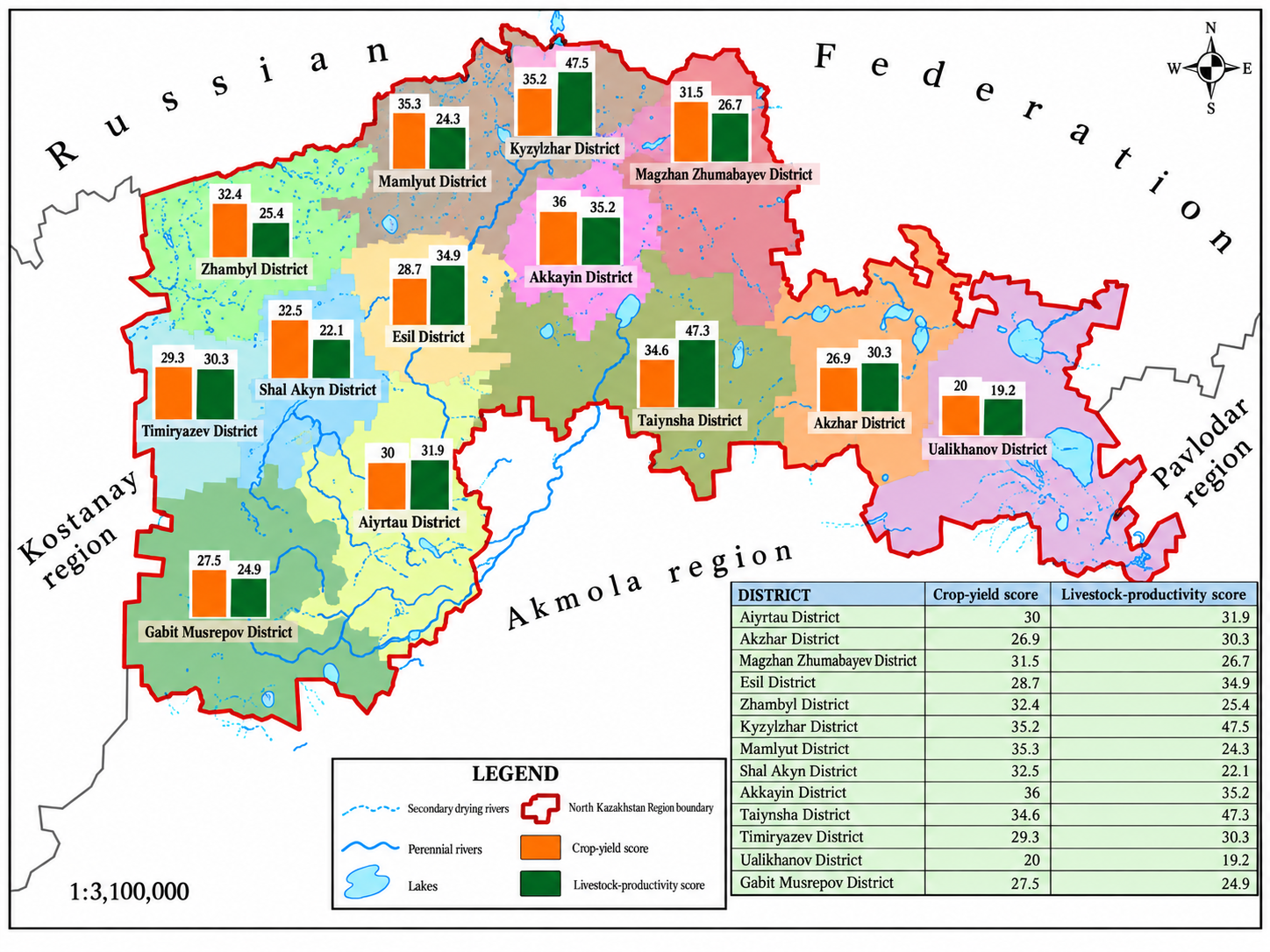
Table 5 characterizes the financial performance of crop production in the districts of the North Kazakhstan Region. The profitability ratio reflects the relationship between profit earned and production costs and allows for a comparison of the financial returns of the districts regardless of the scale of gross output [11,13].
Table 5.
Profitability of Agricultural Production (Crop Production) (2023).
An analysis of Table 6, which focuses on the profitability of livestock farming, complements the overall picture of the agricultural sector in the North Kazakhstan Region. This sector exhibits even more striking differences in financial performance than crop farming [11,13].
Table 6.
Profitability of the livestock sector, in %.
Inter-district differences are particularly noticeable in the financial results of livestock farming. The highest profitability was recorded in the Akzhar District (86.2%) and in the Esil District (60.6%). In contrast, lower figures were observed in the Zhambyl District and the G. Musrepov District, indicating uneven economic returns from livestock production specialization within the region.
Table 7 presents a critically important economic indicator—capital intensity. It shows how many tenge of fixed assets (machinery, buildings, equipment) are required to produce 1 tenge of agricultural output. This indicator helps to understand how “expensive” a district’s production is in terms of capital utilization [11,13].
Table 7.
Determination of District Scores Based on Capital Intensity of Agricultural Production in the Districts of the North Kazakhstan Region.
Table 8 combines scores for investment, gross output, crop yields, livestock productivity, the profitability of crop and livestock production, and capital intensity. The composite score is used to rank districts comparatively and for subsequent typological grouping [11,12,13].
Table 8.
Aggregate score for the production and economic activities of districts in the North Kazakhstan Region in the agribusiness sector.
The final comparison shows that a district’s high ranking is not determined by a single indicator, but rather by a combination of several components of production and economic activity. The Kyzylzhar District achieved the highest aggregate score—140.9—followed by the Esil (122.6), Tayyn-Shin (122.1), and Akkayin (113.1) districts. The lowest score was recorded in the Ualikhanov District—59.0 points. The resulting range of values serves as the basis for the subsequent typological grouping of territories.
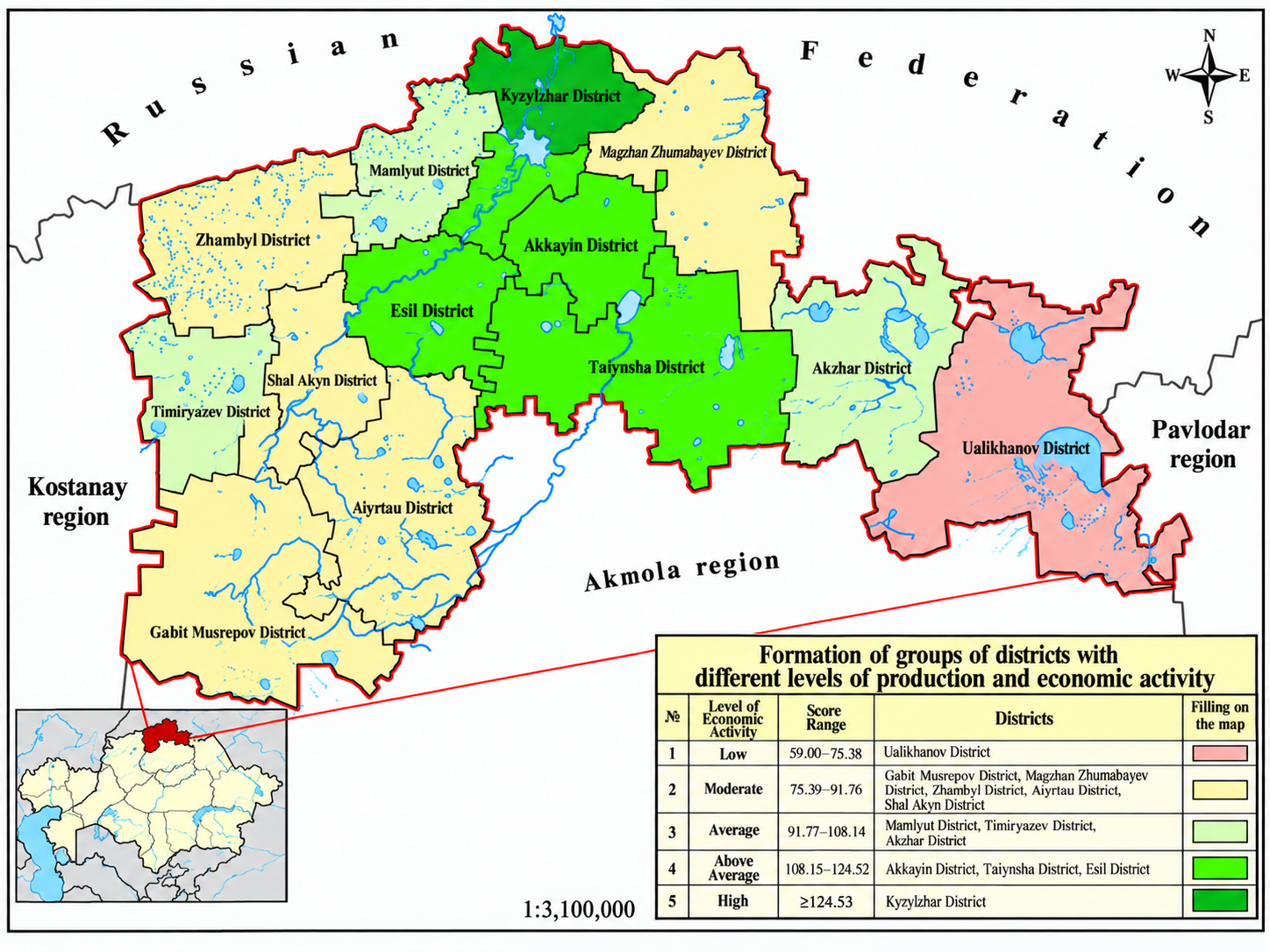
The five levels identified allow us to move from a simple ranking of regions to a spatio-economic typology. The majority of the studied territories fall into the moderate level, while the extreme groups are represented by individual regions. For a clearer interpretation of the results, Table 9 presents these levels as zones reflecting differences in the nature and intensity of agro-industrial development.
Table 9.
Formation of Groups of Districts with Different Levels of Production and Economic Activity.
An analysis of the spatial–economic differentiation in the North Kazakhstan Region revealed significant disparities in regional development. The use of a five-level matrix made it possible to assess the gaps in investment attractiveness, production volumes, and financial performance across the territories (Table 10). The undisputed leader is the Kyzylzhar District (140.9 points). Its dominance is due to the following actors:
- -
- Investment capacity: The highest score (17.9) confirms the district’s status as a key hub for processing industries and warehousing infrastructure.
- -
- Production efficiency: High indicators for gross output (13.4) and productivity (47.5) have been achieved through the development of intensive suburban agribusiness—poultry farming and dairy farming—which ensure a rapid turnover of funds.
- -
- Geographic factor: Proximity to the regional center creates logistical advantages, simplifying access to sales fmarkets.
Table 10.
Matrix of Spatial–Economic Differentiation of Regions.
Most of the region’s administrative units (Ayyrtau, Zhambyl, G. Musrepov, M. Zhumabaev, and Shal-Akyna) fall into the group with average indicators. They are characterized by moderate production activity with more modest financial and investment results.
- Monocultural Specialization: The economies of these territories are traditionally based on rain-fed grain farming. Despite satisfactory yields (27.5–32.5 centners per hectare), high dependence on weather conditions and the volatility of global commodity prices pose significant risks to profitability.
- Low Investment Activity: Investment attractiveness indicators in this group (4.1–8.3 points) lag significantly behind those of leading regions, indicating an insufficient inflow of capital.
- Structural Imbalances: The low profitability of the livestock sector (profitability of 2.5–2.9 in several districts) hinders these territories’ transition to the “above-average” development category.
The Ualikhanovsky District shows the worst indicators (overall score of 59.0). Low investment activity (2.5), small volumes of gross output (2.3), and low crop yields (20.0) require the development of targeted support measures that take into account the region’s harsh natural and climatic constraints.
From a spatial planning perspective, a differentiated approach is necessary: for districts with average indicators, the priority should be the introduction of new technologies and the development of processing, while for the Ualikhanov District, measures must be adapted to its specific landscape and production conditions.
The grouping of districts by production and economic activity is presented in Figure 2.
Figure 2.
Formation of groups of districts with varying levels of productive and economic activity [compiled by the author].
5. Discussion
Multifactor analysis and spatial ranking revealed structural characteristics and pronounced territorial differentiation in the agricultural sector of the North Kazakhstan Region. The primary methodological innovation of this study lies in the transition from isolated, single-metric evaluations to a unified spatial–economic matrix. By proportionally normalizing heterogeneous indicators—ranging from capital intensity to livestock profitability—this approach provides a multidimensional benchmark that coordinates territorial scale with actual financial returns. Unlike traditional agricultural statistics that often penalize territorially specialized districts, our linear aggregation model objectively accounts for regional sectoral dominance. By zero-weighting absent activities rather than treating them as inefficiencies, the proposed composite index reflects the economic balance and spatial–economic differentiation of the North Kazakhstan Region. The primary methodological innovation of this study lies in the transition from isolated, single-metric evaluations to a unified spatial–economic matrix. By proportionally normalizing heterogeneous indicators—ranging from capital intensity to livestock profitability—this approach provides a multidimensional benchmark that coordinates territorial scale with actual financial returns. Unlike traditional agricultural statistics that often penalize territorially specialized districts, our linear aggregation model objectively accounts for regional sectoral dominance. By zero-weighting absent activities rather than treating them as inefficiencies, the proposed composite index reflects the true economic balance and spatial–economic differentiation of the North Kazakhstan Region. The Kyzylzhar District’s leading position is due to the synergy of investment attractiveness, high productivity, and a diversified agricultural structure. Although its suburban location provides logistical advantages, the final index primarily reflects the aggregate of quantitative indicators. The Ualikhanov District’s lag is explained by its lower production and investment results. At the same time, zero scores in a number of categories do not indicate low efficiency but rather the region’s narrow specialization, which is consistent with the study’s methodology. The indicators for the G. Musrepov and M. Zhumabaev districts require special analysis. Despite significant land resources and volumes of gross output, they occupy only mid-range positions in the ranking. This underscores the importance of assessing not only the scale of production but also its intensity, profitability, and other qualitative parameters of the composite index.
These findings align with the observations of Solovyov et al. [18] and Nurpeissov et al. [19], who highlighted that in the northern steppe zone, sheer land volume does not guarantee high efficiency due to the heavy reliance on agronomic structure and hydroclimatic instability. Furthermore, our results corroborate the assertions of Chaplitskaya et al. [31] and Volkov et al. [38], demonstrating that multidimensional composite indicators are essential for capturing the true regional disparities that simple gross output metrics obscure. As noted in the literature on land-use planning [37,39], integrating financial ratios with physical production volumes is crucial for avoiding misleading assessments in extensive farming regions.
An analysis of profitability demonstrates that significant volumes of gross output do not guarantee a proportionally high financial return. The Akzhar District serves as a striking example: with moderate levels of investment and capital intensity, it achieves a high level of profitability in livestock production (18.2). This confirms the effectiveness of narrow sectoral specialization and the rational use of local resources. Based on the data obtained, the districts were classified according to the level of integration between raw material production and processing. Thus, the Tayynshin District (total score of 122.1) was classified as “above average,” due to its strong production and investment potential. At the same time, it is important to take into account the dual nature of capital intensity: on the one hand, it reflects the development of processing infrastructure; on the other, it creates an additional financial burden on capital.
The reliability of the ranking is confirmed by a sensitivity analysis: the application of an alternative normalization method (Min–Max) showed a high degree of convergence in the results (Spearman’s rank correlation coefficient of 0.94), which demonstrates the stability of the final classification of the districts.
Within the framework of this methodology, capital intensity is considered an indicator of the level of material and technical equipment and modernization in the agro-industrial complex. However, since a high level of capital intensity does not always correlate with economic efficiency (due to significant capital investments), this indicator requires a comprehensive interpretation in conjunction with data on gross output and profitability. The results obtained have practical significance for spatial and landscape planning. Territorial development strategies should be based on the existing specialization of regions. Integrating economic zoning with a landscape-based approach will allow for a more informed placement of processing facilities and allocation of government support measures.
Despite the robustness of the findings, this study has certain limitations that must be acknowledged. First, the evaluation relies on a specific temporal cross-section of official administrative and statistical data (2021–2023), which captures the static production and economic conditions rather than long-term dynamic trends. Second, while the linear aggregation model successfully accounts for regional specialization by assigning zero values to non-applicable sectors, it may inadvertently mask deep structural vulnerabilities inherent in heavily monocultural districts. Future research should address these constraints by incorporating longitudinal data over a more extended period. Additionally, integrating specific spatial-landscape planning metrics—such as soil degradation assessments, seismic or mudflow hazard factors, and water retention indices [21]—into the composite assessment would provide a more holistic view of agricultural land suitability and regional sustainability.
6. Conclusions
The analysis revealed significant heterogeneity within the agricultural sector of the North Kazakhstan Region. The use of a composite index (based on seven groups of indicators) and typological grouping made it possible to classify districts into five levels of productive and economic activity (see Table 9). The Kyzylzhar (140.9), Esil (122.6), Tayynshin (122.1), and Akkayin (113.1) districts demonstrated the best indicators. The high scores in this group are due to the synergy of investment, efficient production, and financial returns.
The middle segment. This category includes the Akzhar (104.8), Timiryazev (101.1), and Mamlyut (99.9) districts. Their results confirm that stable performance is achieved not only through volume but also through sound sectoral specialization and high profitability.
Moderate performance. This group includes the G. Musrepov (79.0), M. Zhumabaev (84.6), Zhambyl (90.0), Ayyrtau (91.4), and Shal Akyna (91.6). Despite having extensive land resources, these territories need to focus on modernizing technologies and improving the efficiency of land use.
Low-performance zone. The Ualikhanov District (59.0) ranks last. Low production and investment results require the development of a development strategy that takes into account both the region’s climatic characteristics and the specifics of the local agro-industrial sector.
Practical Recommendations for Regional Planning:
- -
- Intensification of Production: In regions with extensive land resources, it is necessary to implement advanced technologies to increase productivity per hectare, drawing on best practices from regions with high levels of investment activity.
- -
- Assessment of Specialization: The absence of performance indicators in certain sectors should not be interpreted as a sign of decline; rather, it reflects the existing structure of the economy. Government support should be directed toward developing existing core sectors of the agro-industrial complex.
- -
- Specifics of the Ualikhanov District: The development strategy must take into account geographical remoteness and climatic constraints, focusing on the development of pasture-based livestock farming and attracting investment.
- -
- A Comprehensive Approach: Analysis of agricultural performance should be based not only on gross output volumes but also on a combination of spatial, production, and financial factors affecting the development of districts in the North Kazakhstan Region.
Overall, the results confirm the need to move away from evaluating agriculture solely based on the scale of gross output toward a comprehensive assessment of the spatial, production, investment, and financial characteristics of the districts in the North Kazakhstan Region.
Author Contributions
Conceptualization, A.Z.; methodology, B.D.; formal analysis, A.B.; investigation, U.K.; resources, A.S.; data curation, D.N. and K.D.; writing—original draft preparation, N.K.; writing—review and editing, A.Z.; visualization, Y.A.; supervision, S.A. and G.K.; project administration, A.B.; funding acquisition, U.K. and Z.A. All authors have read and agreed to the published version of the manuscript.
Funding
This research was funded by the Science Committee of the Ministry of Science and Higher Education of the Republic of Kazakhstan, grant number BR24993222, within the project “Construction of a decision support system for the natural and economic development of the territory of the North Kazakhstan Region in the context of sustainable development”.
Data Availability Statement
To be completed by the authors before submission in accordance with the Land data policy.
Conflicts of Interest
The authors declare no conflicts of interest.
References
- Kassenova, A.Z.; Bodaukhan, K.; Khapova, A.V. Analysis of the Infrastructure and Material Base of the Agro-Industrial Complex in the Northern Regions of Kazakhstan. Probl. Agri-Mark. 2025, 3, 149–157. (In Kazakh) [Google Scholar] [CrossRef] [Scilit]
- Zhumanova, B. Financing of Innovative Projects in Kazakhstan’s Agro-Industrial Complex. Bull. Taras Shevchenko Natl. Univ. Kyiv. Econ. 2013, 11, 92–96. [Google Scholar] [CrossRef] [Scilit]
- Shaldarov, B.; Syzdikov, B.; Medeni, T.D.; Oralbayeva, Z. Paths for the Investment Development of Kazakhstan’s Agro-Industrial Complex at the Present Stage. Izdenis-Ter. Natizheler 2024, 2, 607–615. [Google Scholar] [CrossRef] [Scilit]
- Kivarina, M.V.; Yurina, N.N. Methodology for Evaluating the Effectiveness of a Regional Digital Platform for the Agro-Industrial Complex. Agrar. Bull. Ural. 2025, 25, 1443–1455. [Google Scholar] [CrossRef] [Scilit]
- Serebryakova, T.Y.; Zhuravlev, E.V. Methodology for Assessing the Innovative Development of Regional Agriculture. Agrar. Bull. Ural. 2024, 24, 1748–1762. [Google Scholar] [CrossRef] [Scilit]
- Swarooprani, K. Agricultural Investments and Economic Growth. Int. J. Sci. Res. Sci. Technol. 2022, 9, 472–475. [Google Scholar] [CrossRef] [Scilit]
- Vodyannikov, V.T. Economic Evaluation of Investment Projects in Agriculture: Textbook; Russian State Agrarian University—K.A. Timiryazev Moscow Agricultural Academy: Moscow, Russia, 2023; 242p, ISBN 978-5-9675-1997-0. (In Russian) [Google Scholar]
- Dyussembekova, G.S.; Bekniyazova, D.S.; Kenzhin, Z.B. Assessment of Regional Competitiveness Based on an Index Approach. Cent. Asian Econ. Rev. 2020, 3, 67–79. (In Russian) [Google Scholar]
- Vakhrameev, R.A. A Method for Developing a Comprehensive Index for the Holistic Assessment of the Sustainability of the Agro-Industrial Complex. Vestn. Nauk. Sib. 2018, 4, 82–92. (In Russian) [Google Scholar]
- Sinilo, D. Theoretical aspects of fostering sustainable development in the agro-industrial complex. Agric. Econ. 2025, 4, 37–54. [Google Scholar] [CrossRef] [Scilit]
- Shaikin, D.N.; Omirzhan, S.M. The Role of the Agro-Industrial Complex in Sustainable Regional Development: An Economic Assessment. Probl. AgriMarket 2023, 1, 57–63. [Google Scholar] [CrossRef] [Scilit]
- Maknmetova, D.; Korabayev, B.; Zeinullina, A.; Basshieva, Z.; Dauit, Z.; Zhax-alykov, K. Greening the agro-industrial complex: Challenges of socioeconomic modernization as exemplified by the East Kazakhstan Region. Bull. Natl. Acad. Sci. Repub. Kazakhstan 2022, 4, 331–344. [Google Scholar] [CrossRef] [Scilit]
- Gusev, A.Y.; Koshkina, I.G.; Klimyuk, L.Y. An Analytical Assessment of the Economic Efficiency of Innovations in the Agro-Industrial Complex. E3S Web Conf. 2023, 449, 09017. [Google Scholar] [CrossRef] [Scilit]
- Petrova, L.A. A Comparative Analysis of the Production and Economic Activities of the Agro-Industrial Complex. In Strategic Guidelines for the Development of Socio-Economic Systems; Chernov, S.S., Ed.; Center for Development of Scientific Cooperation: Novosibirsk, Russia, 2022; pp. 148–162. [Google Scholar]
- Petrunenko, I.; Dukhnevych, A.V.; Kliutsa, S.O.; Karpinska, N.; Demianyshyna, O. Growth of the agro-industrial complex under current economic conditions. Rev. San. Gregor. 2020, 42, 131–143. Available online: https://www.academia.edu/72771117/Growth_of_agro_industrial_complex_in_modern_economic_conditions (accessed on 30 September 2026).
- Volkov, S.N.; Shapovalov, D.A.; Shirokorad, I.I.; Klyushin, P.V.; Khutorova, A.O. Digital Land Management: Methodological Foundations and Practice. In Proceedings of the 11th International Conference on the Theory and Applications of Soft Computing, Word and Perception Computing, and Artificial Intelligence—ICSCCW 2021; Aliev, R.A., Kacprzyk, J., Pedrycz, W., Jamshidi, M., Babanli, M., Sadikoglu, F.M., Eds.; Springer: Cham, Switzerland, 2022; pp. 325–331. [Google Scholar] [CrossRef] [Scilit]
- Chistyakova, G.N.; Salykbayeva, G.M.; Dosmakhov, S.M.; Kozhakhmetova, L.T.; Kulmaganbetova, A.O. Crop Production in the North Kazakhstan Region as the Foundation of an Agricultural Cluster and a Means of Ensuring Food Security for the Population. Fundam. Exp. Biol. 2022, 106, 168–177. (In Russian) [Google Scholar] [CrossRef] [Scilit]
- Solovyov, O.Y.; Shvidchenko, V.K.; Plyushchenko, Y.A.; Davydenko, M.G. The effectiveness of grain-steam crop rotations and continuous spring wheat cultivation in the North Kazakhstan Region. Eurasian Agrotech. J. 2022, 4, 56–65. (In Russian) [Google Scholar] [CrossRef] [Scilit]
- Nurpeissov, D.N.; Savin, T.V.; Aituganov, A.K.; Shestakova, N.A.; Soloviev, O.Y.; Shvidchenko, V.K. The Effect of Weather Conditions in the Steppe Zone of Northern Kazakhstan on the Yield of Spring Soft Wheat. Eurasian Agrotech. J. 2023, 2, 201–212. [Google Scholar] [CrossRef] [Scilit]
- Panyushkina, I.P.; Shayakhmetova, A.; Pashkov, S.; Agafonov, L.I. Hydrological Instability and Grain Yields in Northern Kazakhstan Based on Dendrochronological Proxies. Agriculture 2024, 14, 790. [Google Scholar] [CrossRef] [Scilit]
- Sarsekova, D.; Sagin, J.; Perzadayeva, A.; Arystanova, R.; Arystanov, A.; Kezheneva, A.; Jumassultanova, S.; Satybaldiyeva, G.; Ospangaliyev, A. Improving the sustainability of farmers’ land use based on assessments of soil, geology, and water retention capacity in Northern Kazakhstan. Sustainability 2026, 18, 1316. [Google Scholar] [CrossRef] [Scilit]
- Tleubayev, A.; Syzdykov, Y. Technical Efficiency of Wheat Production in Central Asia: Empirical Evidence from Kazakhstan. J. Asian Afr. Stud. 2026, 61, 1656–1667. [Google Scholar] [CrossRef] [Scilit]
- Seitov, S.K. Total Factor Productivity and Subsidies in Kazakhstan’s Agricultural Sector. J. New Econ. Assoc. 2025, 3, 188–215. [Google Scholar] [CrossRef] [Scilit]
- Nurpeissova, M.; Kirgizbayeva, D.; Zhildikbayeva, A.; Utesbayev, A.; Azizov, E. Automated mapping of agricultural land using Landsat-8, ArcGIS, and NDVI: The case of Northern Kazakhstan. Int. J. Des. Nat. Ecodynamics 2026, 21, 685–694. [Google Scholar] [CrossRef] [Scilit]
- Talukder, B.; Hipel, K.W.; van Loon, G.W. Development of composite indicators for assessing agricultural sustainability: The influence of normalization and aggregation methods. Resources 2017, 6, 66. [Google Scholar] [CrossRef] [Scilit]
- Xavier, A.; Freitas, M.B.C.; Fragoso, R.; Rosário, M.S. A regional composite indicator for analyzing the sustainability of Portuguese agriculture: A goal-programming approach. Ecol. Indic. 2018, 89, 84–100. [Google Scholar] [CrossRef] [Scilit]
- Gómez-Limón, J.A.; Sanchez-Fernandez, G. An empirical assessment of agricultural sustainability using composite indicators. Ecol. Econ. 2010, 69, 1062–1075. [Google Scholar] [CrossRef] [Scilit]
- Reig-Martínez, E.; Gómez-Limón, J.A.; Picazo-Tadeo, A.J. Ranking farms using a composite sustainability index. Agric. Econ. 2011, 42, 561–575. [Google Scholar] [CrossRef] [Scilit]
- Talukder, B.; Hipel, K.W.; van Loon, G.W. The use of multi-criteria decision analysis to assess the sustainability of agricultural systems. Sustain. Dev. 2018, 26, 781–799. [Google Scholar] [CrossRef] [Scilit]
- Sinisterra-Solís, N.K.; Sanjuán, N.; Ribal, J.; Estruch-Guitart, V.; Clemente Polo, G.; Rozakis, S. Development of a composite indicator for assessing agricultural sustainability: The impact of certain critical decisions. Ecol. Indic. 2024, 161, 111934. [Google Scholar] [CrossRef] [Scilit]
- Chaplitskaya, A.; Heijman, W.; van Ophem, J. Composite indicators and the sustainable development of regional agriculture: The case of the Stavropol Krai, Russia. Appl. Stud. Agribus. Commer. 2017, 11, 81–88. [Google Scholar] [CrossRef] [Scilit]
- Greco, S.; Ishizaka, A.; Tasiou, M.; Torrisi, G. On the Methodological Basis of Composite Indices: A Review of Weighting, Aggregation, and Stability Issues. Soc. Indic. Res. 2019, 141, 61–94. [Google Scholar] [CrossRef] [Scilit]
- OECD; European Union; Joint Research Centre. Guide to the Construction of Composite Indicators: Methodology and User Guide; OECD Publishing: Paris, France, 2008. [Google Scholar] [CrossRef] [Scilit]
- Saisana, M.; Saltelli, A.; Tarantola, S. Uncertainty and sensitivity analysis methods as tools for assessing the quality of composite indicators. J. R. Stat. Soc. Ser. A Stat. Soc. 2005, 168, 307–323. [Google Scholar] [CrossRef] [Scilit]
- Saltelli, A. Composite indicators: Between analysis and argumentation. Soc. Indic. Res. 2007, 81, 65–77. [Google Scholar] [CrossRef] [Scilit]
- Nardo, M.; Saisana, M.; Saltelli, A.; Tarantola, S.; Hoffmann, A.; Giovannini, E. A Guide to Constructing Composite Indicators: Methodology and User Guide; OECD Statistics Working Papers No. 2005/03; OECD Publishing: Paris, France, 2005. [Google Scholar] [CrossRef]
- Ivanov, N.I.; Fomkin, I.V.; Ananicheva, E.P.; Solovyev, A.I. Land-Use Planning: A Teaching and Methodological Guide for Studying the Subject and Completing Computational and Graphic Assignments; State University of Land Management: Moscow, Russia, 2016; 176p, ISBN 978-5-9215-0376-2. (In Russian) [Google Scholar]
- Volkov, S.N. General Land Use Plan for the Territory of the Russian Federation: Content and Methods of Development; State University of Land Management: Moscow, Russia, 2009; 369p, ISBN 978-5-9215-0152-2. (In Russian) [Google Scholar]
- Kartsev, G.A.; Isaev, A.S. Forecasting and Planning the Use and Protection of Land Resources: Textbook; Moscow State University of Environmental Management: Moscow, Russia, 2010; Volume 2, ISBN 978-5-89231-285-1. (In Russian) [Google Scholar]
- Shapovalov, D.A.; Klyushin, P.V.; Khutorova, A.O.; Savinova, S.V.; Shirokorad, I.I. Methodological Approaches to Fostering Sustainable Development and Environmental Security in Regions. In Proceedings of the 12th International Conference on the Theory and Applications of Soft Computing, Word and Perception Computing, and Artificial Intelligence—ICSCCW 2022; Aliev, R.A., Kacprzyk, J., Pedrycz, W., Jamshidi, M., Babanli, M., Sadikoglu, F.M., Eds.; Springer: Cham, Switzerland, 2023; pp. 488–493. [Google Scholar] [CrossRef] [Scilit]
- Solovyov, O.Y.; Evseenko, I.A.; Kadirov, B.U. A Comparative Assessment of the Effectiveness of Crop Diversification in the North Kazakhstan Region. Eurasian Agrotech. J. 2025, 3, 288–302. (In Russian) [Google Scholar] [CrossRef] [Scilit]
- Department of Agriculture of the North Kazakhstan Region. Administrative Reports and Data on Major Fixed Assets for 2021–2023; (Administrative data); Department of Agriculture of the North Kazakhstan Region: North Kazakhstan Region, Kazakhstan, 2021–2023. [Google Scholar]
- National Statistics Bureau of the Agency for Strategic Planning and Reforms of the Republic of Kazakhstan. Official Agricultural Statistics at the District Level; National Statistics Bureau: Astana, Kazakhstan.
- Land Resources Management Committee of the Ministry of Agriculture of the Republic of Kazakhstan. Consolidated Analytical Report on the Condition and Use of Land in the Republic of Kazakhstan for 2024; Ministry of Agriculture of the Republic of Kazakhstan: Astana, Kazakhstan, 2025. (In Russian)

Disclaimer/Publisher’s Note: The statements, opinions and data contained in all publications are solely those of the individual author(s) and contributor(s) and not of MDPI and/or the editor(s). MDPI and/or the editor(s) disclaim responsibility for any injury to people or property resulting from any ideas, methods, instructions or products referred to in the content. |
© 2026 by the authors. Licensee MDPI, Basel, Switzerland. This article is an open access article distributed under the terms and conditions of the Creative Commons Attribution (CC BY) license.