


Abstract
Exploring the spatial pattern and development strategies of urbanization from the perspective of the multi-dimensional coordination of population, economy, and land is the key to solving the problems of the urban–rural gap and human–land contradiction. This paper analyzed the spatial agglomeration of population, economy, and construction land area growth rates and explored their coordinated development in Chinese prefecture-level cities from 2010 to 2020 by using the spatial autocorrelation model, elasticity coefficient model, and coupling coordination model. The results are as follows: (1) China’s population, economy, and construction land area were all growing, with the highest economic growth and the lowest population growth, and most prefecture-level cities in central and northeastern China had negative population growth. (2) The growth rates of the population, economy, and construction land in Chinese prefecture-level cities had significant positive spatial clustering characteristics; the spatial agglomeration of the economy was the most prominent and the high-value areas were mainly concentrated in western China. (3) The elasticity coefficients between the population, economy, and construction land in most Chinese prefecture-level cities indicate uneven development of urbanization, manifested as population growth lagging behind construction land expansion and further lagging behind economic development. (4) More than 56% of Chinese prefecture-level cities have uncoordinated development among the population, economy, and construction land mainly distributed in northeast China and central China. The results can provide references and decision-making support for promoting the sustainable development of China’s new urbanization.
1. Introduction
With the acceleration of industrialization since the reform and opening up, China’s urbanization has gone through a low starting point but rapid development process [1]. China’s urbanization has grown rapidly from only 17.9% in 1978 to 65.22% in 2022 [2]. The rapid advancement of urbanization has attracted a large number of rural laborers to migrate to cities for employment which has optimized the allocation of production factors in urban and rural areas, promoted sustained economic development, and brought about profound changes in social structure [3]. Although urbanization in China is making significant progress, there are some prominent problems that must be highly valued. Firstly, regional development is imbalanced and spatial differentiation is complex [4,5]. The urbanization in the east and northeast regions is obviously higher than that in the central and northwest regions [6]; the development of urbanization subsystems is not coordinated [7]. For example, land urbanization (i.e., the process of transforming agricultural land into urban construction land) is faster than population urbanization (i.e., the process of population migration from rural areas to cities) and urban land use is extensive, exacerbating the pressure on farmland and ecological land protection [8,9]. Additionally, there is a spatial mismatch between the regional economy and population. The population agglomeration in the central and western regions exceeds the economic agglomeration while in the eastern regions the case is the opposite [10]. After the 19th National Congress of the Communist Party of China, China’s development is transitioning from high growth to high quality which has new requirements for the quality of urbanization [11,12]. The future of urbanization should be people-centered and entail coordinated development between various subsystems and regions [13]. Therefore, it is necessary to conduct research on regional differences and subsystem conflicts in China’s urbanization and also explore how to embark on the path of coordinated and sustainable development of urbanization.
Scholars’ exploration of urbanization mainly involves aspects such as population growth, economic development, and construction land expansion. Pacione [14] believed that urbanization has three connotations: firstly, urbanization is accompanied by an increase in the proportion of the urban population; secondly, growth refers to the growth of the urban population; thirdly, urbanism refers to the extension of urban lifestyles and social and behavioral characteristics to the entire society. Friedmann and Wolff [15] proposed a comprehensive analysis method which considered that urbanization actually reflects the whole society and is a multidimensional reflection of physical, spatial, institutional, economic, demographic, and social characteristics. Chun [16] held the opinion that the core of urbanization is population urbanization, the driving force is economic urbanization, and the carrier is land urbanization. The issue of urbanization in China has always been a hot topic of global scholars’ attention. Fujita and Hu [17] analyzed the regional differences in China’s per capita GDP from 1985 to 1994 using the variation coefficient and Theil index and found that there was an imbalance in China’s economic development between regions; this trend of imbalance gradually expanded during the period after the reform and opening up. Kanbur and Zhang [18] used generalized entropy to analyze the per capita consumption between rural and urban areas in China from 1952–2000 and also concluded that the imbalance in regional development was expanding. The urbanization subsystem in China usually refers to population urbanization, economic urbanization, and land urbanization. Chinese scholars have conducted quantitative research on the spatial matching and regional differences between the population and economy using a mismatch index, incremental analysis, imbalance index, and the center of gravity coupling model, confirming that the degree of economic agglomeration was greater than that of population agglomeration; the mismatch between population and economy showed a trend of first increasing and then decreasing [19,20,21], population urbanization generally lagged behind land urbanization and shown an uncoordinated state [22,23]. The current research mainly focused on the spatial mismatch between population and economy or population and urban land use, lacking research on the spatiotemporal agglomeration and imbalanced characteristics of the three subsystems of urbanization. Moreover, due to the availability of samples, research has mostly focused on provincial-level regions or urban agglomerations and there were few studies on the coupling coordination of multiple indicators of urbanization across the country.
This paper analyzed the spatial agglomeration and coordinated development characteristics of the growth rate of the population, economy, and construction land in 342 prefecture-level cities in China based on statistical data from 2010 and 2020. It aimed to provide a practical reference for narrowing the urban–rural development gap, promoting regional coordination and sustainable development, and formulating differentiated regional development policies.
2. Data Sources and Methods
2.1. Data Sources
This paper selected the permanent population, gross domestic product (GDP), and construction land area to represent the development of the three urbanization subsystems of the population, economy, and land, respectively. The permanent population was sourced from the sixth and seventh National Population Censuses. The sixth and seventh National Population Censuses were organized and implemented by the State Council in 2010 and 2020, respectively, which can accurately reflect the situation of China’s population [24]. GDP was sourced from the China Urban Statistical Yearbook [25,26] and missing data were supplemented by annual statistical bulletins from various prefecture-level cities. The land use data was interpreted from multi-temporal Landsat TM/ETM remote sensing images at the time nodes of 2010 and 2020 with a spatial resolution of 30 m. According to the LUCC classification system proposed by the Institute of Geographic Sciences and Natural Resources Research of the Chinese Academy of Sciences, with the use of supervised classification and human–computer interaction interpretation to extract information, the interpreted land use types were divided into 6 categories and 25 subcategories [27]. The construction land area was the sum of various types of construction land areas such as urban land, rural residential areas, and industrial and mining land in each prefecture-level city. We used the spatial statistical tool of ArcGIS 10.6 software to calculate the construction land area of 342 prefecture-level cities in China.
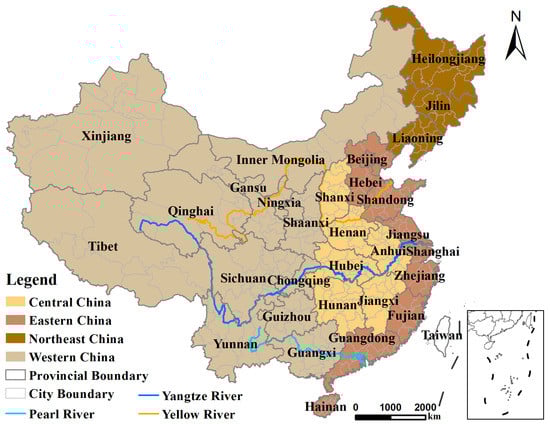
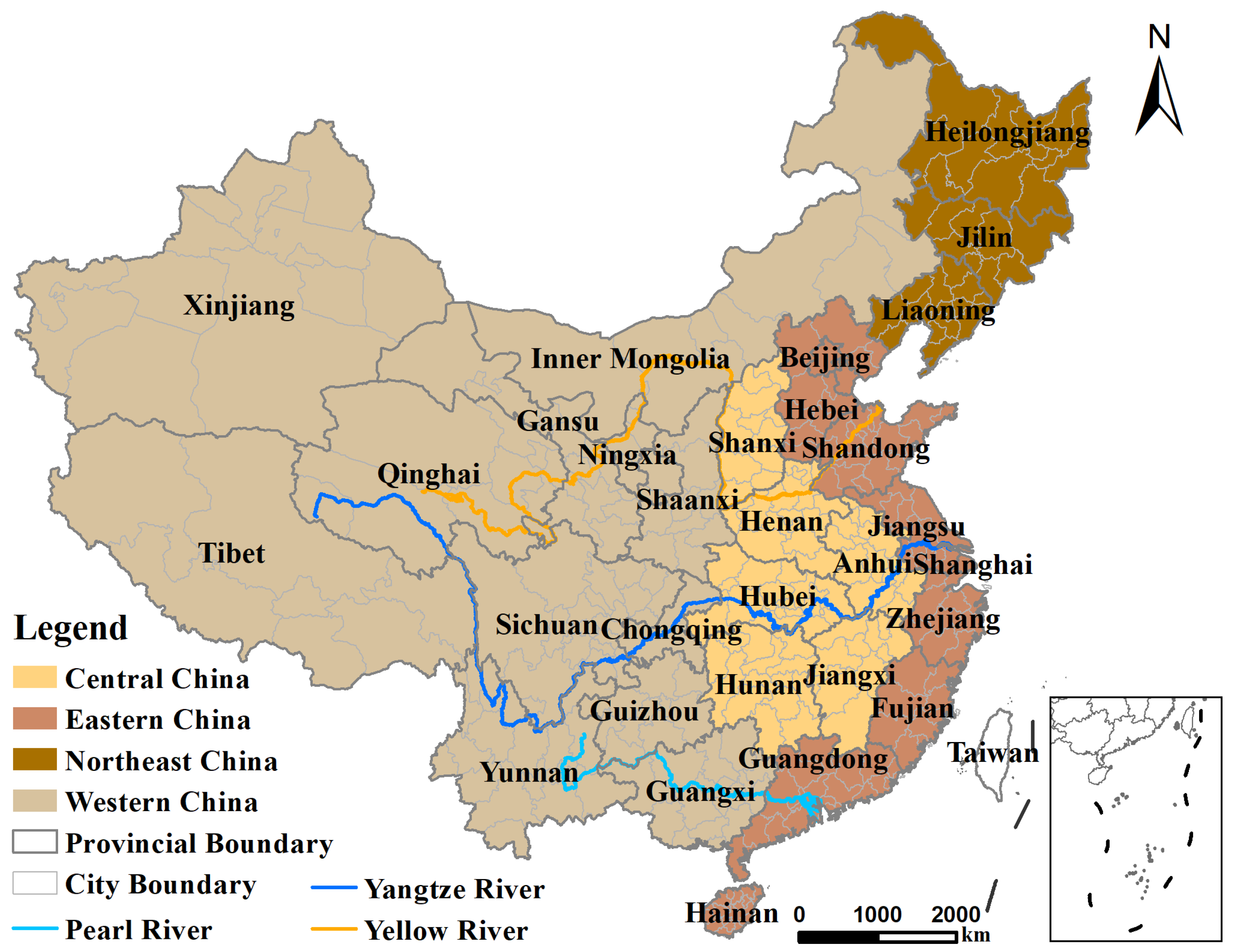
Considering the lack of relevant data, Hong Kong, Macao, and Taiwan were excluded from the study area and the study subjects were 342 prefecture-level cities in the Chinese Mainland. These prefecture-level cities belong to 31 Provinces (Figure 1). According to the regional socio-economic development, the Chinese Mainland is divided into eastern China, central China, western China, and northeast China, of which eastern China is the region with the best natural conditions and the most developed economy; central China has an underdeveloped economy and is an important base for grain production and energy supply. Western China has a relatively small population, fragile ecology, and relatively backward economy; northeast China is an old industrial base that is undergoing an economic and social development transformation.
Figure 1.
Provincial and municipal administrative units in China.
2.2. Methods
2.2.1. Spatial Autocorrelation Model
This paper used the global Moran’s I index and the local Moran’s I index to reveal the spatial patterns of the population, economic, and construction land area growth rates in various prefecture-level cities in China and identified the spatial cold and hot spots of each variable. The global Moran’s I index can comprehensively determine the spatial agglomeration pattern of the population, economy, and construction land growth rate [28]. The calculation formula is as follows:
where n is the total number of samples; wij is the spatial weight matrix; Xi and Xj are the observed values of a certain attribute (referring to the population, GDP, or construction land area) at spatial locations i and j and and are their average values, respectively; S0 is the sum of all the elements in the spatial weight matrix. The range of Moran’s I index is [−1, 1]. When the value is 1, it indicates a complete positive correlation between the two, when it is −1, it indicates a complete negative correlation between the two, and when it is 0, it indicates that the two are not correlated and exhibit a random distribution pattern.
The local indicators of spatial association (LISA) can reveal the spatial “hot spot” and “cold spot” areas of the population, economy, and construction land area growth within a certain region, identify the high-value clustering and low-value clustering of the three variables at different spatial positions, and demonstrate their spatial heterogeneity. The calculation formula is as follows:
where S is the variance of the observed values, .
2.2.2. Elastic Coefficient Model
The elasticity coefficient is the ratio of the growth rate of two interrelated indicators over a certain period of time. It measures the dependence of the growth rate of one variable on the growth rate of another variable and can be used to measure the degree of coordination between any two indicators of the population, economy, and construction land area [29,30]. The specific calculation formula is as follows:
where Ei is the elastic coefficient of two variables; L and P and Li and L0 were the values of the variable L at the end and beginning of the study period, respectively, and Pi and P0 were the values of the variable P at the end and beginning of the study period, respectively.
2.2.3. Coupling Coordination Model
The coupling coordination model has become an effective evaluation tool for studying regionally balanced development [31]. This paper constructed a coupling coordination model for three factors of population, economy, and construction land area and quantitatively analyzes the coupling coordination degree of urbanization development in 342 prefecture-level cities in China. The coupling model is calculated as follows:
where C is the degree of coupling among variables; U1, U2, and U3 represent the population growth rate, economic growth rate, and construction land area growth rate, respectively.
The coupling coordination degree shows the strength of the interaction between various variables, but it cannot show whether the variables are coordinated. Therefore, referring to the relevant literature, a coupling coordination development model suitable for this study was constructed and its formula is as follows:
where D is the coupling coordination degree; T represents the comprehensive harmonic index between urbanization subsystems; and α, β and γ, respectively, represent the contribution proportions of each subsystem (we believe that population, economy, and construction land subsystems have the same effect on the overall coordinated development of urbanization, so they were all taken as 1/3).
3. Results
3.1. Changes in the Population, Economy, and Construction Land Area
3.1.1. Population, GDP, and Construction Land Area in 2020
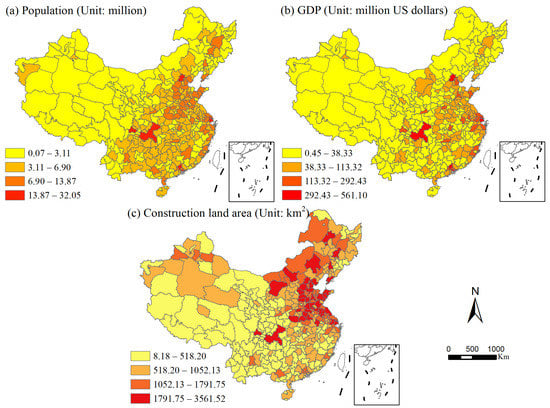
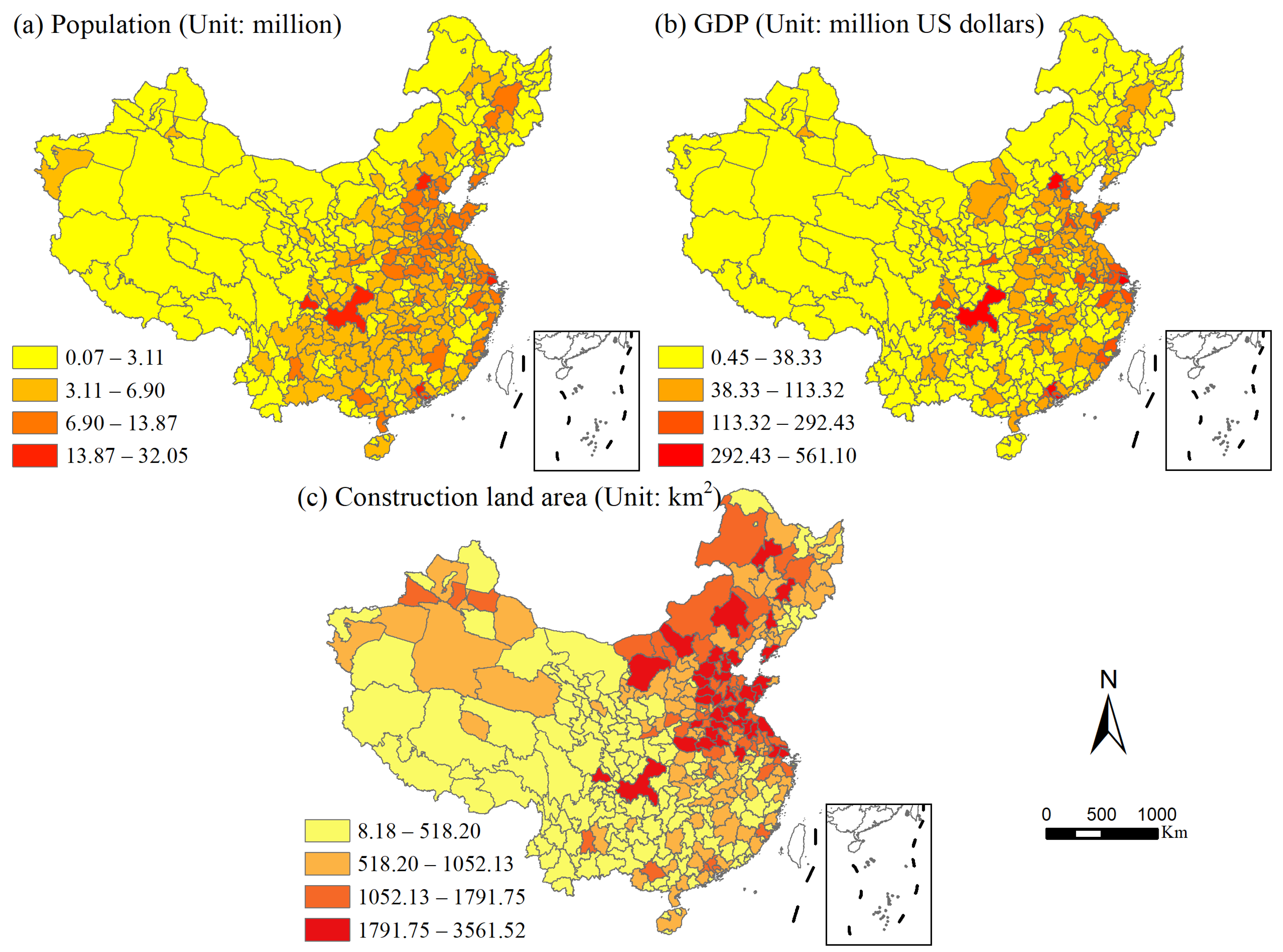
The population, GDP, and construction land area of Chinese prefecture-level cities in 2020 were divided into four levels using the natural discontinuity method and their distribution exhibits significant spatial heterogeneity (Figure 2). The prefecture-level cities with a large population generally exceeding three million were concentrated in central and eastern China. The population of prefecture-level cities in western and northeastern China was generally less than three million. Similarly to the population situation, prefecture-level cities with a higher GDP in 2020 were mainly concentrated in eastern China and central China. The GDP of coastal prefecture-level cities in eastern China was generally higher but many prefecture-level cities in Anhui, Jiangxi, and northern Guangdong still have relatively lower GDPs. In 2020, the prefecture-level cities with large construction land areas in China were mainly concentrated in northern China, especially in Shandong, Hebei, Henan, and northeast China, reflecting the significant consumption of land resources in the urbanization development of these prefecture-level cities. The construction land area of prefecture-level cities in southern and western China was relatively low.
Figure 2.
Population, GDP, and construction land area of prefecture-level cities in 2020.
3.1.2. Changes in the Population, GDP, and Construction Land Area from 2010 to 2020
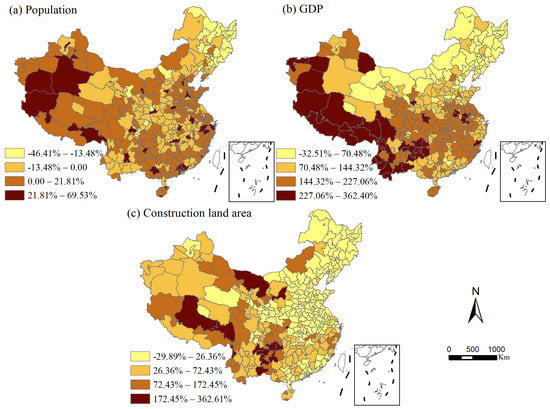
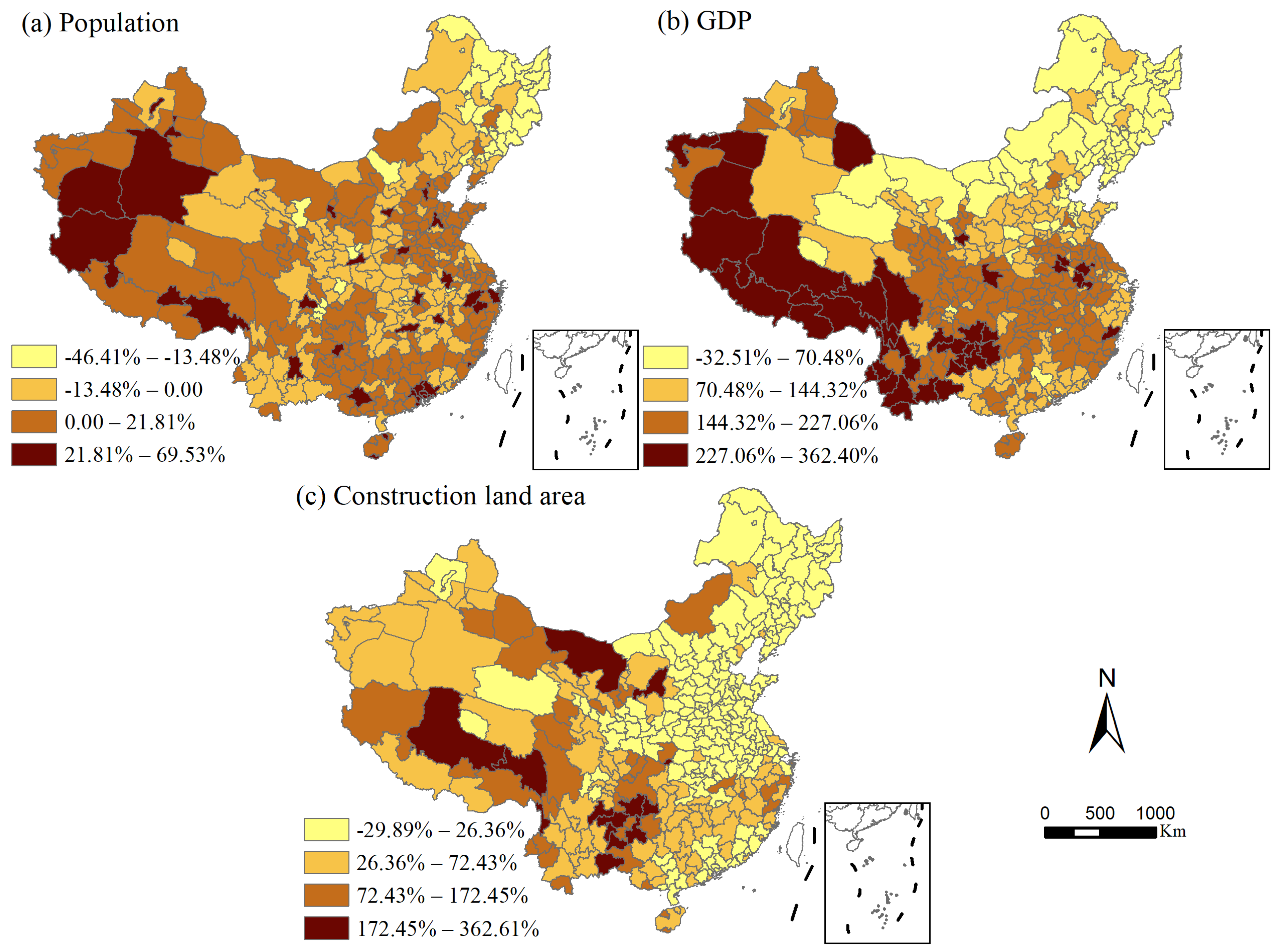
The changes were represented by the growth rate of the population, GDP, and construction land area in Chinese prefecture-level cities from 2010 to 2020 (Figure 3). The population of 189 prefecture-level cities in China increased, accounting for over 55% of the total, with Shenzhen in Guangdong Province having the largest population growth rate of 69.53%. There were 153 prefecture-level cities with decreased populations, among which Siping in Jilin Province has the largest population reduction of −46.41%. Northeast China’s population has been continuously declining due to sluggish economic development and reduced attractiveness to talent in recent years. Central China has always been a grain production base and population-rich area in China but due to the population rainbow effect of economically developed prefecture-level cities in eastern China, it has been a labor exporting region in China for decades, resulting in a continuous decline in population. The population of prefecture-level cities in western China is generally small but it has been stimulated by the national policies of “aiding Xinjiang and Tibet” and “Western Development” since the 1990s to achieve rapid socio-economic development which have attracted a large number of immigrants and led to significant population growth [32]. Prefecture-level cities in eastern China were constantly attracting immigrants due to their developed economy.
Figure 3.
Changes in the population, GDP, and construction land area from 2010 to 2020.
From 2010 to 2020, the GDP of Chinese prefecture-level cities generally maintained rapid growth. The prefecture-level cities with the fastest economic growth were mainly distributed in the western regions of Tibet, Yunnan, and Guizhou followed by prefecture-level cities along the Yangtze River. The economy in the western prefecture-level cities is relatively backward but in recent years, it has maintained high-speed economic growth due to national incentive policies and industrial upgrading. The Yangtze River Economic Belt is a key economic growth pole supported by China after entering the 21st century. Thanks to the transportation advantages of the Yangtze River’s golden waterway and the undertaking of industrial specialties in developed eastern regions, the economic development momentum was strong. The prefecture-level cities in the north, especially in northeast China, have always been heavy industrial bases in China, with relatively imbalanced industrial structures and difficulties in industrial upgrading; their economic development has lagged behind that of other prefecture-level cities.
From 2010 to 2020, the construction land area in Chinese cities generally maintained a significant increase. The cities in western China have the largest increase in construction land area, with Alashan in Inner Mongolia and Nagqu and Changdu in Tibet both experiencing more than twice the increase in construction land area. Driven by industrial specialty and huge investment, the urbanization and infrastructure construction of western cities were developing rapidly and the demand for construction land resources was strong which made the construction land area increase significantly. The stock of construction land in eastern and central China was large and has gone through a stage of rapid urbanization. In past decades, due to the implementation of the strictest policy of the intensive use of construction land by the central government and strict control of the total scale of urban and rural construction land, the growth rate of construction land in these cities has slowed down.
3.2. Spatial Agglomeration of the Population, Economy, and Construction Land Growth Rates
Table 1 shows that Moran’s I index for the growth rate of the population, economy, and construction land area in various cities from 2010 to 2020 had passed the significance test. Moran’s I index is greater than 0 and significant at a 10% confidence interval, indicating a similarity in the growth rate of the population, economy, and construction land in adjacent cities. The three variables had significant positive spatial clustering characteristics, namely high–high clustering and low–low clustering. From Moran’s I index value, the agglomeration significance of the population, economy, and construction land area was as follows: urban population < construction land area < economy. Compared with population and construction land area, the spatial agglomeration characteristics of economic development in Chinese cities were more prominent.
Table 1.
The global Moran’s I of the population, economy, and construction land area.
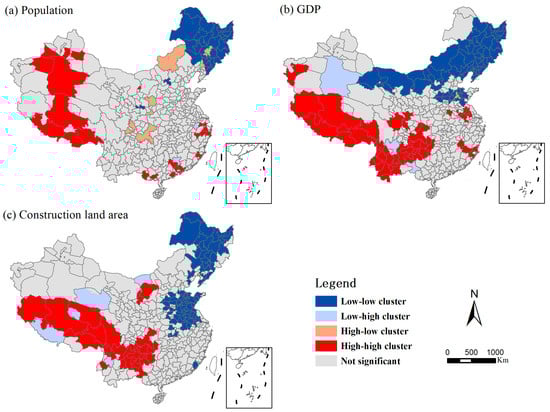
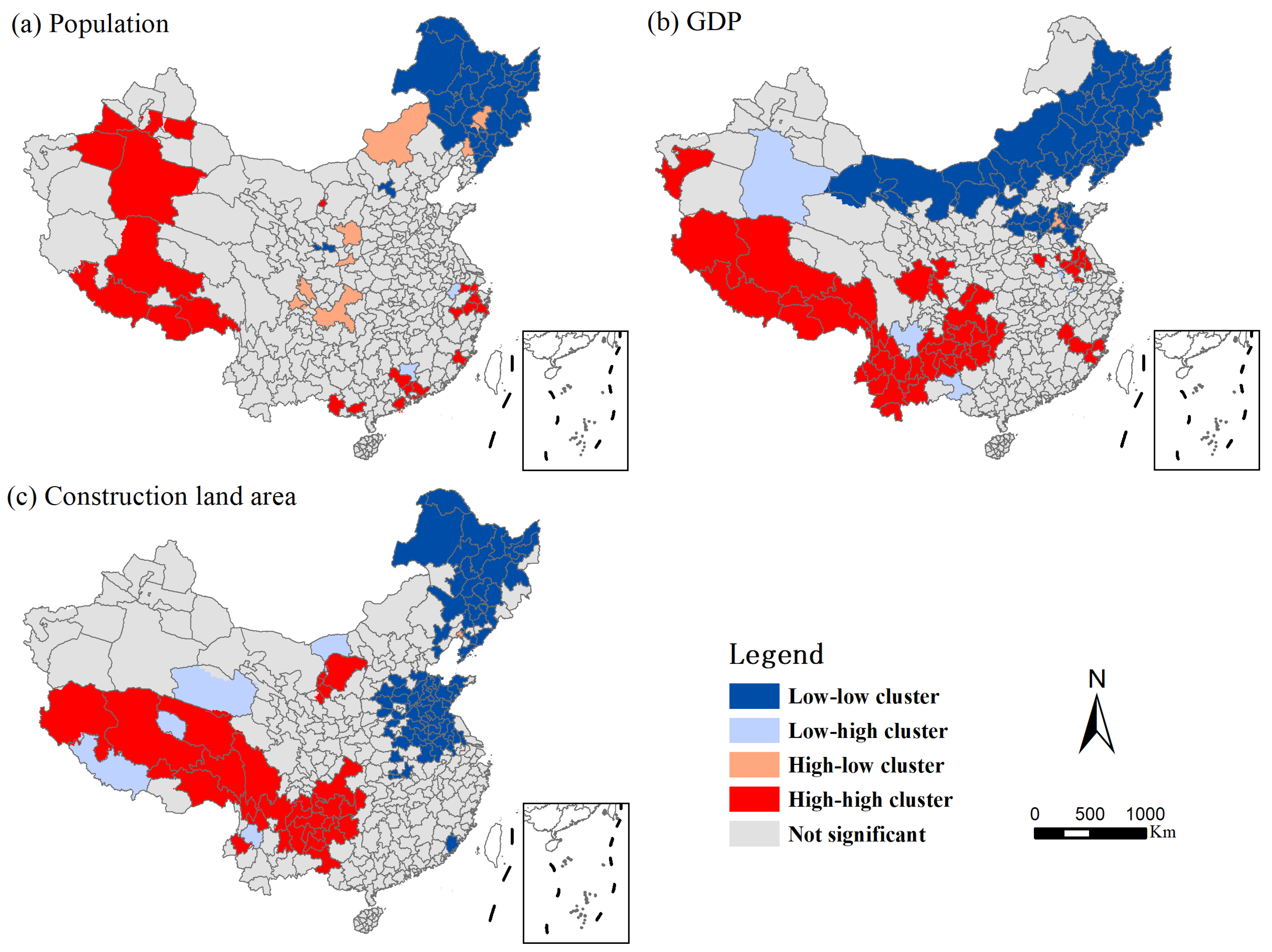
The local Moran’s I index further specifically examines the spatial agglomeration pattern in the growth rate of the population, GDP, and construction land area in Chinese cities. Figure 4 shows that the high–high clusters of population growth were mainly distributed in western China and eastern coastal cities. Cities in western China were prone to areas with rapid population growth due to their small population size and significant growth rate. The eastern coast zone is a concentrated area of economically developed cities in China with a strong population adsorption capacity, making it easy to form high–high clusters of population growth. Low–low cluster areas were mainly distributed in northeast China. Due to the industrial recession and resource depletion, the labor force was constantly flowing out and the population was gradually decreasing in northeast China which has formed low–low clusters of population growth.
Figure 4.
LISAs of the population, economy, and construction land growth rates.
The high–high clusters of GDP growth are mainly distributed in western China. These cities are relatively backward in terms of their economy and have been improved in economic development by incentive policies such as industrial transfer from developed eastern regions and poverty alleviation, resulting in significant economic growth. There were 69 cities in the low–low cluster of GDP growth mainly distributed in the northeast and west of China. These cities are mainly heavy-industrial or resource-based cities and have been caught in the dilemma of industrial transformation and resource depletion in past decades; their economic growth has been sluggish.
There were 32 cities in the high–high cluster area of construction land area growth, all located in western China. The rapid economic development has driven these cities’ construction land into a stage of rapid expansion, presenting a high-value agglomeration area of construction land area growth rate. The low–low cluster areas of construction land area growth rate were mainly distributed in northeast China and Shandong, Hebei, and Henan in the north of China. Due to population outflow and economic recession, the demand for construction land expansion in northeast China was relatively small and the growth rate was relatively low. The northern provinces of Shandong, Henan, and Hebei are important grain production areas in China. To ensure food security, they have implemented strict land regulation policies such as controlling the scale of construction land, which has slowed down the expansion of construction land.
3.3. Coordination of thhe Population, Economy, and Construction Land
3.3.1. Elasticity Coefficients Analysis
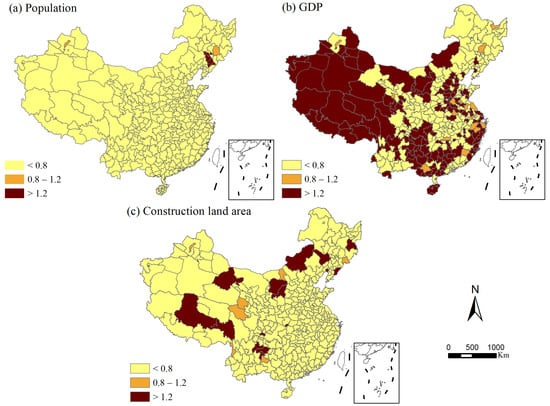
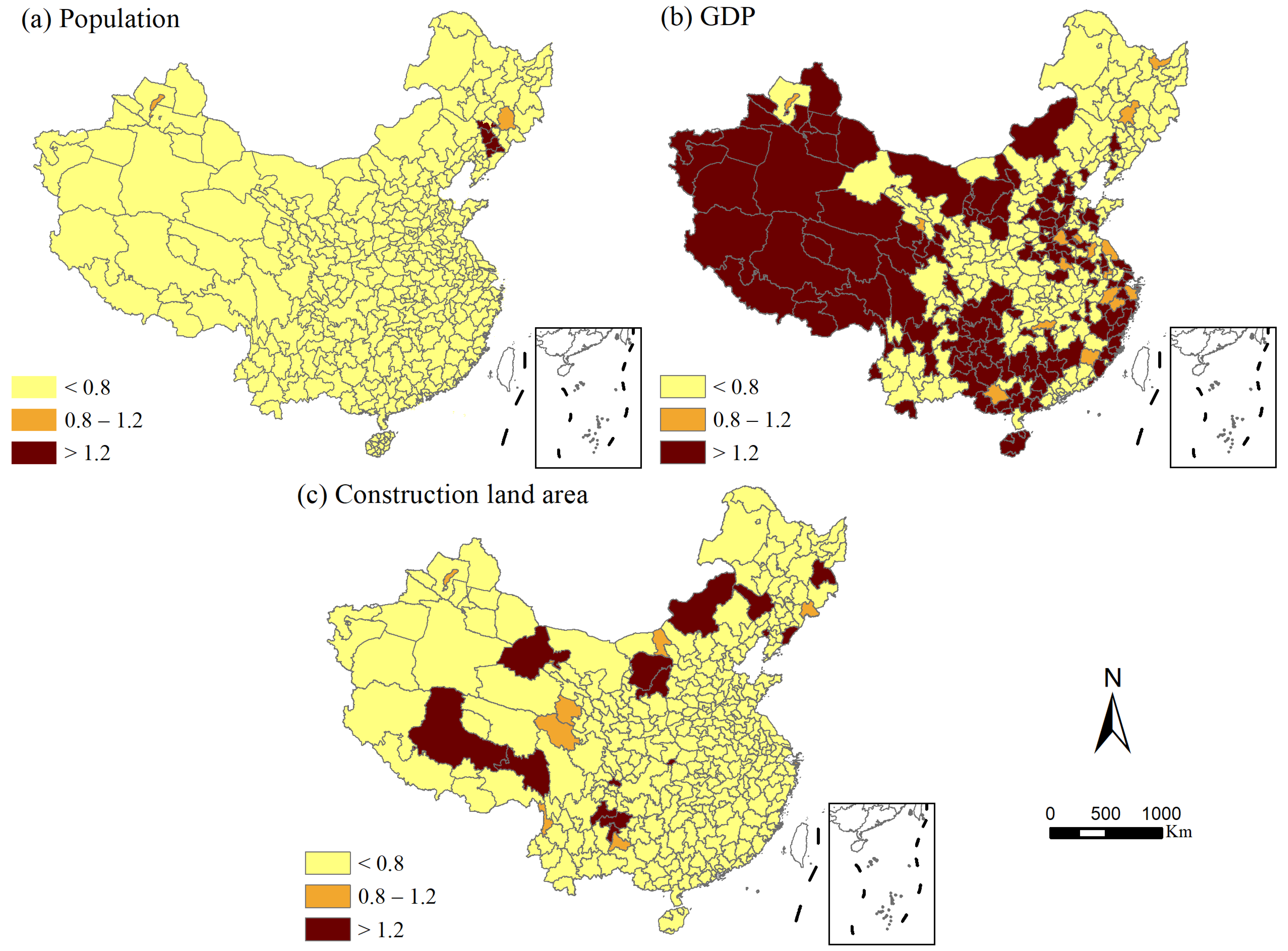
The elasticity coefficients between the population and GDP, population and construction land area, and construction land and GDP in Chinese cities were calculated and represented by Ei, Ki, and βi, respectively. Referring to the relevant literature [33], this paper proposed that when the growth rates of two variables are close to the same, they are considered coordinated, that is, when the elasticity coefficient values are within the range of [0.8, 1.2], it is a coordinated interval and other intervals are all incompatible. The results are shown in Figure 5.
Figure 5.
Elasticity coefficients of the population, economy, and construction land.
There were 336 cities with an elasticity coefficient of the population and GDP less than 0.8, accounting for over 98%, and four cities with an elasticity coefficient greater than 1.2. There was only one city with a coordinated elasticity coefficient. The population growth and economic development of Chinese cities were almost in an uncoordinated state, with the performance of population growth lagging behind the GDP growth.
There were 180 cities with a coefficient of elasticity between the construction land and a population less than 0.8, 146 cities with a coefficient of elasticity greater than 1.2, and only 14 cities within the coordination values range of [0.8, 1.2]. Cities with an elasticity coefficient of less than 0.8 were mainly distributed in central China and northeast China and the expansion rate of the construction land in these cities was slower than the population growth. Cities with an elasticity coefficient greater than 1.2 were mainly concentrated in western China. The construction land expansion in these cities exceeded population growth and the rapid development of land urbanization may lead to problems such as disorderly urban sprawl and low land use efficiency.
There were 318 cities with an elastic coefficient of less than 0.8 for construction land expansion and economic development, accounting for 93%. There were 15 cities with an elastic coefficient greater than 1.2 and only 9 cities with an elastic coefficient in the coordinated range. The expansions of urban construction land and economic development in China were generally in an uncoordinated state, manifested by the faster economic growth rate than the construction land expansion while the construction land expansion in some cities in western China exceeded the speed of economic development, resulting in a decrease in the economic benefits of construction land utilization.
3.3.2. Coupling Coordination of the Population, Economy, and Construction Land
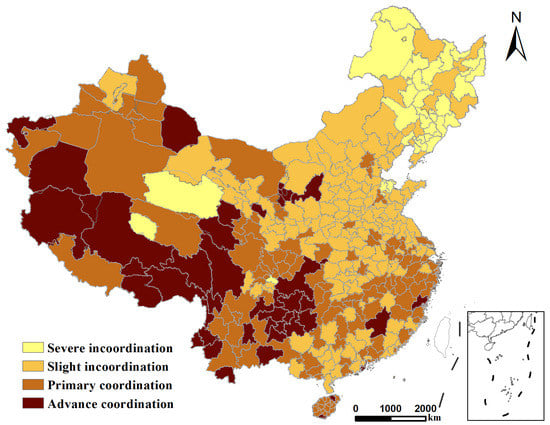
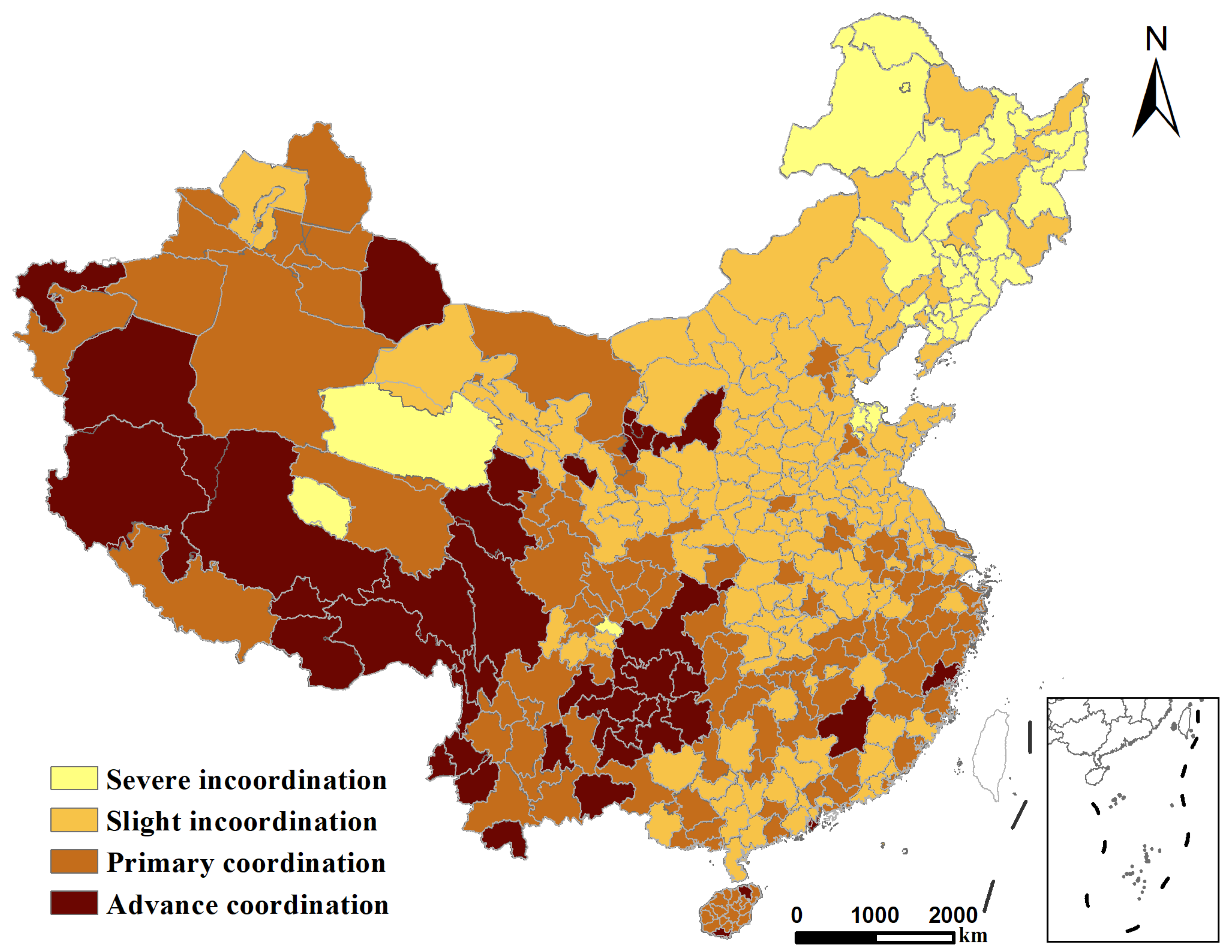
The coupling coordination degree model was used to calculate the coordination degree among population growth rates, economic growth rates, and construction land area growth rates among Chinese cities from 2010 to 2020. Based on the coordination degree values of 342 cities, their coupling coordination degrees were divided into severe incoordination (0–0.40), slight incoordination (0.40–0.55), primary coordination (0.55–0.65), and advanced coordination (0.65–1.00) using the natural discontinuity method. The results were shown in Figure 6.
Figure 6.
The coordination degree among population, economy, and construction land.
The coordination between population, economy, and construction land in 150 cities was either primary or advanced coordination, accounting for 43% of the total. Advanced coordinated cities were mainly distributed in western China, such as Tibet, western Sichuan, Guizhou, and Chongqing. These cities have always been one of the most underdeveloped regions in China. Due to undertaking industrial transfer from developed eastern regions and being incentivized by multiple national support policies, their urbanization has developed rapidly, resulting in rapid growth in the population, economy, and construction land in the past decade. Primary coordinated cities were mainly distributed in western China such as Xinjiang and Yunnan as well as in areas south of the Yangtze River. Among them, cities in Xinjiang and Yunnan belong to the second most underdeveloped areas in China. There, urbanization has developed rapidly but the development of a certain urbanization factor in the population, economy, or construction land was relatively lagging behind. Cities south of the Yangtze River are among the most developed regions in China, with high levels of urbanization and rapid population and economic growth in the past decade but the growth of construction land has been controlled at a relatively low level as it has been faced with severe pressure on land resource supply.
The coordination degree value between the population, economy, and construction land in most cities (194 of 342) was less than 0.55, resulting in slight and severe incoordination types. The cities with slight incoordination are mainly distributed in the northern part of central China and eastern China. Although some of these cities have a rapid population and economic growth, they have been greatly affected by land policies such as farmland protection; the expansion of construction land has been controlled at the lowest level and there was a widespread phenomenon of a large number of labor migrating to eastern developed cities, resulting in a decrease in population. The urbanization development in the past decade has been relatively unsatisfactory. The severely uncoordinated cities were mainly concentrated in northeast China where economic growth and construction land expansion were at a relatively low level and the population decreased significantly. In terms of the dynamic development of the population, economy, and construction land from 2010 to 2020, these cities are facing a decline in urbanization development.
4. Discussion
4.1. Differentiated Strategies for Urbanization Development
The coordinated and sustainable development of the population, economy, and land is an important goal of China’s new urbanization [34,35]. Any backwardness in one of the three will cause abnormal urban development and low-quality of urbanization [36]. The results in this paper confirmed that in the process of urbanization in China, the spatial distribution of population growth, economic development, and construction land expansion was unreasonable and the mismatch between population, economy, and construction land was prominent. The main manifestation was that population growth lagged behind economic development and construction land expansion which led to the problems that economic development has been slowed down and constrained by land resource supply in eastern China and excessive construction land expansion reduced land use efficiency in western China. The population, economy, and land development issues in different regions of China were inconsistent and differentiated urbanization development strategies need to be adopted to achieve urban–rural balance and sustainable development.
Eastern China should optimize the spatial structure of land development and shift urban development from incremental expansion to tapping existing potential, leveraging the advantages of innovative factor agglomeration to accelerate the cultivation of world-class advanced manufacturing clusters, strengthen emerging industries, and improve factor output efficiency. Eastern China ought to be made a model for coordinated development of urbanization in China.
Central China should grasp its strategic positioning, promote the rational flow and efficient agglomeration of production factors, fully utilize its central location and transportation advantages, and promote the development of industries that are in line with local comparative advantages to attract the return of the migrant population, realizing the coordinated development of all elements of urbanization in central China.
Western China should strengthen land use regulation in accordance with national spatial planning to prevent disorderly construction land expansion; it is necessary to improve the infrastructure of connectivity, increase openness led by the joint construction of the “the Belt and Road”, fully leverage the resource endowment advantages to attract investment and promote the local industrial upgrading, and integrate domestic and international demand to explore broader markets.
Northeast China needs to effectively integrate resources based on a market economy and accelerate economic transformation to change the industrial structure dominated by heavy industry. Furthermore, it ought to promote the concentration of industries and populations towards urban agglomerations, enhance the comprehensive carrying capacity and radiating force of advantageous regions, and explore new driving forces for economic development.
4.2. Changes in Human–Land Relations
Thanks to the world’s largest population, China’s abundant cheap labor advantage has driven its economic boom for nearly half a century [37,38]. However, this study found that China’s population growth slowed down significantly from 2010 to 2020. The average population growth of 342 prefecture-level cities in China was only 2.93%, far lower than the 139.23% and 40.37% of economic and construction land. There were a large number of prefecture-level cities with negative population growth in central China and northeast China. The uncoordinated relationship between the population, economy, and construction land was reflected in the decoupling between slow population growth and rapid economic and construction land growth. Unlike the development experience of the past few decades, China will inevitably enter an era of stagnant or even negative population growth which will have a significant impact on China’s future human–land relations.
As the population growth slows down or even becomes negative, the problem that China’s urbanization needs to solve is to further improve the output efficiency of construction land while strictly controlling the expansion of construction land and the occupation of arable land through the “land determined by people” policy [39,40]. In order to promote the coordinated development of China’s urbanization, it is necessary for the government departments to re-examine the current policy of controlling urban and rural land use with construction land indicators and further analyze the carrying capacity of regional population resources, assess the consistency of population distribution, economic development and land use, formulate land use policies to promote orderly, reasonable and balanced utilization of national territory space and resolve the future major strategic issues such as population urbanization, urban–rural integration and high-quality economic development.
4.3. Comparison with Previous Studies
High-quality urbanization should enable the coordinated development of various internal subsystems. Henderson [41] and Cohen [42] demonstrated the importance of coordinating population and economy in urban agglomerations for healthy urbanization development. Ravallion [43] pointed out that the population engaged in agricultural production activities in the surrounding areas of cities was absorbed into the urban population in urbanization, the cost of such population transfer leads to poverty concentration and irreversible negative externality [44]. This incomplete transformation of the rural–urban population was called semi-urbanization which is due to the incoordination between population urbanization and economic urbanization [45]. The research on the coordinated development of subsystems such as population, economy, and land in China’s urbanization focused on the dual agglomeration or coordination characteristics of the population and economy or population and urban land, mainly concentrated in eastern China [23], the Beijing–Tianjin–Hebei Region [46], and specific provinces and prefecture-level cities [47]. This paper studied the spatial agglomeration and coordination characteristics of the population, economy, and construction land in 342 prefecture-level cities in China and compared the development differences in eastern, central, western, and northeastern China. There are two main contributions: firstly, this paper quantitatively analyzed the spatial agglomeration and non-equilibrium characteristics of the population, economy, and construction land, making up for the lack of research on coordinated development among the three. Secondly, most of the current studies were conducted at the scale of prefecture-level cities, provinces, or urban agglomerations and cannot directly compare the development differences of different regions in China; this paper conducted a nationwide study at the prefectural-city scale which helps deepen the understanding of the development of urbanization subsystems in China and facilitates macro policy regulation.
This study only used a single indicator of GDP, population, and construction land area to reflect the coordinated development of urbanization subsystems such as economy, society, and land from 2010 to 2020. In the future, a long-term series of urbanization composite evaluation index systems should be established based on regional carrying capacity to comprehensively evaluate the consistency of population distribution, economic development, and land development.
5. Conclusions
In this paper, the spatial agglomeration characteristics and coordinated development of population, economy, and construction land in 342 prefecture-level cities in China from 2010 to 2020 were analyzed by using the spatial autocorrelation model, elasticity coefficient, and coupling coordination model. The main conclusions are as follows:
- (1)
- From 2010 to 2020, China’s population, economy, and construction land area all increased, with an economic growth rate greater than that of construction land and population. The prefecture-level cities with faster growth were mainly distributed in western China while prefecture-level cities in eastern and central China have slower growth and some prefecture-level cities in central and northeastern China have negative population growth;
- (2)
- The growth rate of population, economy, and construction land area in Chinese prefecture-level cities show significant positive spatial clustering characteristics. The overall agglomeration pattern of the three was manifested as high-value agglomeration in western China and low-value agglomeration in northeastern China with the agglomeration characteristics of economic growth being the most obvious. Western China has become a hot spot for urbanization development in China while northeast China is in a development dilemma;
- (3)
- The results of the elasticity coefficient show that there was an imbalanced development state between the growth rate of population, economy, and construction land, reflecting that China’s economic urbanization was faster than land urbanization and that land urbanization was faster than population urbanization. The slowdown in population growth has become the main constraint factor for the coordinated development of urbanization;
- (4)
- The development of population, economy, and construction land in most Chinese prefecture-level cities was not coordinated. More than 56% of prefecture-level cities were in an uncoordinated state, mainly distributed in northeast China and central China. The urbanization of these prefecture-level cities faced development bottlenecks in one or more aspects of population, economy, and construction land. There were 150 prefecture-level cities in a coordinated state, among which the western coordinated prefecture-level cities developed rapidly in all aspects of urbanization while the coordinated prefecture-level cities south of the Yangtze River had relatively balanced development in urbanization.
Author Contributions
Conceptualization, E.C. and X.Z.; methodology, S.Z.; software, L.L.; validation, E.C. and L.L.; formal analysis, E.C. and X.Z.; investigation, S.Z.; resources, X.Z.; data curation, E.C.; writing—original draft preparation, E.C. and X.Z.; writing—review and editing, E.C.; visualization, X.Z.; supervision, X.Z.; project administration, E.C.; funding acquisition, L.L. All authors have read and agreed to the published version of the manuscript.
Funding
This research was funded by the National Key R and D Program of China (grant no. 2021YFD1700900), the Natural Science Foundation of Henan (grant number 232300421398), the Research topic of Henan Social Science Federation (grant no. SKL-2023-2575), and the Teaching Reform Research and Practice Project of Henan Agricultural University (grant no. 2022XJGLX105).
Data Availability Statement
Not applicable.
Conflicts of Interest
The authors declare no conflict of interest.
References
- Li, H.; Wang, T. Historical Stages of China’s Urbanization Since 1949. Urban Plan. Forum 2012, 204, 4–13. [Google Scholar]
- Statistical Bulletin on National Economic and Social Development of the People’s Republic of China in 2022. Available online: https://www.gov.cn/xinwen/2023-02/28/content_5743623.htm (accessed on 5 June 2023).
- Bai, X.; Shi, P.; Liu, Y. Society: Realizing China’s urban dream. Nature 2014, 509, 158–160. [Google Scholar] [CrossRef] [Scilit] [PubMed]
- Anderson, G.; Ge, Y. The size distribution of Chinese cities. Reg. Sci. Urban Econ. 2005, 35, 756–776. [Google Scholar] [CrossRef] [Scilit]
- Liang, B.; Luo, Z. Spatial Pattern and Convergence of the Level of New Urbanization in Chinese Cities at Prefecture-level in Recent 10 Years. Mod. Urban Res. 2017, 5, 67–74. [Google Scholar]
- Wang, J.; Gu, G.; Yao, L.; Chen, Y. Analysis of New Urbanization’s Spatial Pattern Evolution and Influence Factors in China. Sci. Geogr. Sin. 2016, 36, 63–71. [Google Scholar]
- Cui, X.F. Population Urbanization and Land Urbanization in Ethnic Minority Areas: Disequilibrium and Spatial Heterogeneity. China Popul. Resour. Environ. 2014, 24, 63–72. [Google Scholar]
- Kovács, Z.; Farkas, Z.J.; Egedy, T.; Kondor, A.C.; Szabó, B.; Lennert, J.; Baka, D.; Kohán, B. Urban sprawl and land conversion in post-socialist cities: The case of metropolitan Budapest. Cities 2019, 92, 71–81. [Google Scholar] [CrossRef] [Scilit]
- Xu, G.; Zheng, M.; Wang, Y.; Li, J. The Urbanization of Population and Land in China: Temporal Trends, Regional Disparities, Size Effect and Comparisons of Measurements. China Land Sci. 2022, 36, 80–90. [Google Scholar]
- Xiao, Z. Spatial Effect of Population-Economic Distribution Consistency in China. Popul. Res. 2013, 35, 227–241. [Google Scholar]
- Hou, M.; Deng, Y.; Yao, S. Coordinated relationship between urbanization and grain production in China: Degree measurement, spatial differentiation and its factors detection. J. Clean. Prod. 2022, 331, 129957. [Google Scholar]
- Pan, W.; Wang, J.; Lu, Z.; Liu, Y.; Li, Y. High-quality development in China: Measurement system, spatial pattern, and improvement paths. Habitat Int. 2021, 118, 102458. [Google Scholar] [CrossRef] [Scilit]
- Yu, B. Ecological effects of new-type urbanization in China. Renew. Sustain. Energy Rev. 2021, 135, 110239. [Google Scholar] [CrossRef] [Scilit]
- Pacione, M. Urban geography: A global perspective. Routledge 2001, 23, 97–102. [Google Scholar]
- Friedmann, J.; Wolff, G. World City Formation: An Agenda for Research and Action. Int. J. Urban Reg. Res. 2010, 6, 309–344. [Google Scholar] [CrossRef] [Scilit]
- Chun, C. Research on healthy development of urbanization. Territ. Nat. Resour. Study 2008, 4, 7–9. [Google Scholar]
- Fujita, M.; Hu, D. Regional disparity in China 1985–1994: The effects of globalization and economic liberalization. Ann. Reg. Sci. 2001, 35, 3–37. [Google Scholar] [CrossRef] [Scilit]
- Kanbur, R.; Zhang, X. Fifty Years of Regional Inequality in China: A Journey Through Central Planning, Reform, and Openness. Rev. Dev. Econ. 2010, 9, 87–106. [Google Scholar] [CrossRef] [Scilit]
- Chen, F.J.T.A. The Coupling Mechanism of the Centroids of Economic Gravity and Population Gravity and Its Effect on the Regional Gap in China. Prog. Geogr. 2010, 29, 87–95. [Google Scholar]
- Jiang, Z.L.; Fan, J.; Chen, D. Analysis of Spatial Agglomeration and Equilibrium Characteristics for Population and Economic in China during 2001–2010. Econ. Geogr. 2014, 34, 9–13. [Google Scholar]
- Zhang, J.; Cai, Y. Balanced Regional Development in China: Demographic and Economic Distribution Mismatch. Popul. Res. 2013, 37, 3–16. [Google Scholar]
- Jianchun, F.; Gang, L.; Hua, Z. Relation Between the Population and the Land Area of Urban Built-up Area in China: An Empirical Research of 652 Counties. China Land Sci. 2015, 29, 46–53. [Google Scholar]
- Zhou, K.; Tan, R. Characterizing the coordination and disequilibrium pattern of urban population, economics and urban built-up area in Eastern and Mid-China region. World Reg. Stud. 2021, 30, 90–100. [Google Scholar]
- Notice of the State Council on Conducting the Seventh National Population Census. Available online: https://www.gov.cn/gongbao/content/2019/content_5456806.htm (accessed on 18 June 2023).
- National Bureau of Statistics of China, China Statistical Yearbook 2021; China Statistical Press: Beijing, China, 2021.
- National Bureau of Statistics of China, China Statistical Yearbook 2011; China Statistical Press: Beijing, China, 2011.
- Liu, J.; Liu, M.; Zhuang, D.; Zhang, Z.; Deng, X. Study on spatial pattern of land-use change in China during 1995–2000. Sci. China Ser. D Earth Sci. 2003, 46, 373–384. [Google Scholar]
- Tillé, Y.; Dickson, M.M.; Espa, G.; Giuliani, D. Measuring the spatial balance of a sample: A new measure based on Moran’s I index. Spat. Stat. 2018, 23, 182–192. [Google Scholar] [CrossRef] [Scilit]
- Shi, L.; Wang, Y. Evolution characteristics and driving factors of negative decoupled rural residential land and resident population in the Yellow River Basin. Land Use Policy 2021, 109, 105685. [Google Scholar] [CrossRef] [Scilit]
- Tapio, P. Towards a theory of decoupling: Degrees of decoupling in the EU and the case of road traffic in Finland between 1970 and 2001. Transp. Policy 2005, 12, 137–151. [Google Scholar] [CrossRef] [Scilit]
- Naikoo, M.W.; Talukdar, S.; Ishtiaq, M.; Rahman, A. Modelling built-up land expansion probability using the integrated fuzzy logic and coupling coordination degree model. J. Environ. Manag. 2023, 325, 116441. [Google Scholar] [CrossRef] [Scilit]
- Yang, F.; Yang, M.; Xue, B.; Luo, Q. The effects of China’s western development strategy implementation on local ecological economic performance. J. Clean. Prod. 2018, 202, 925–933. [Google Scholar] [CrossRef] [Scilit]
- Cai, E.; Chen, W.; Wei, H.; Li, J.; Wang, H.; Guo, Y.; Feng, X. The coupling characteristics of population and residential land in rural areas of China and its implications for sustainable land use. Sustain. Dev. 2020, 28, 646–656. [Google Scholar] [CrossRef] [Scilit]
- Tan, Y.; Xu, H.; Zhang, X. Sustainable urbanization in China: A comprehensive literature review. Cities 2016, 55, 82–93. [Google Scholar] [CrossRef] [Scilit]
- Ji, Y.; Guo, X.; Zhong, S.; Wu, L. Land Financialization, Uncoordinated Development of Population Urbanization and Land Urbanization, and Economic Growth: Evidence from China. Land 2020, 9, 481. [Google Scholar] [CrossRef] [Scilit]
- Jiang, H.; Sun, Z.; Guo, H.; Weng, Q.; Du, W.; Xing, Q.; Cai, G. An assessment of urbanization sustainability in China between 1990 and 2015 using land use efficiency indicators. Npj Urban Sustain. 2021, 1, 34. [Google Scholar] [CrossRef] [Scilit]
- Li, S. Population Migration and Urbanization in China: A Comparative Analysis of the 1990 Population Census and the 1995 National One Percent Sample Population Survey. Int. Migr. Rev. 2004, 38, 655–685. [Google Scholar] [CrossRef] [Scilit]
- Aunan, K.; Wang, S. Internal migration and urbanization in China: Impacts on population exposure to household air pollution (2000–2010). Sci. Total Environ. 2014, 481, 186–195. [Google Scholar] [CrossRef] [Scilit] [PubMed]
- Wang, J.; Zhang, X. Land-based urbanization in China: Mismatched land development in the post-financial crisis era. Habitat Int. 2022, 125, 102598. [Google Scholar] [CrossRef] [Scilit]
- Jin, G.; Deng, X.; Zhao, X.; Guo, B.; Yang, J. Spatiotemporal patterns in urbanization efficiency within the Yangtze River Economic Belt between 2005 and 2014. J. Geogr. Sci. 2018, 28, 1113–1126. [Google Scholar] [CrossRef] [Scilit]
- Henderson, V. Urbanization in Developing Countries. World Bank Res. Obs. 2002, 17, 89–112. [Google Scholar] [CrossRef] [Scilit]
- Cohen, B. Urbanization in developing countries: Current trends, future projections, and key challenges for sustainability. Technol. Soc. 2006, 28, 63–80. [Google Scholar] [CrossRef] [Scilit]
- Ravallion, M.; Chen, S.; Sangraula, P. New Evidence on the Urbanization of Global Poverty. Popul. Dev. Rev. 2007, 33, 667–701. [Google Scholar] [CrossRef] [Scilit]
- Li, A. Peri-urbanization in China. Popul. Res. 2013, 37, 80–91. [Google Scholar]
- Liu, H.; Deng, H.; Li, X.L. Research on the Spatial and Temporal Difference of Coordinated Development Between Population Urbanization and Land Urbanization in Yangtze River Economic Belt. China Popul. Resour. Environ. 2016, 26, 160–166. [Google Scholar]
- He, S.; Shao, X. Spatial Clustering and Coupling Coordination of Population-Land-Economic Urbanization in Beijing-Tianjin-Hebei Region. Econ. Geogr. 2018, 38, 95–102. [Google Scholar]
- Zhang, H.; Su, H.; Xue, R.; Zhang, G. Multidimensional coordination pattern of provincial land population economy and its zoning development strategy. Trans. Chin. Soc. Agric. Eng. 2019, 35, 262–270. [Google Scholar]

Disclaimer/Publisher’s Note: The statements, opinions and data contained in all publications are solely those of the individual author(s) and contributor(s) and not of MDPI and/or the editor(s). MDPI and/or the editor(s) disclaim responsibility for any injury to people or property resulting from any ideas, methods, instructions or products referred to in the content. |
© 2023 by the authors. Licensee MDPI, Basel, Switzerland. This article is an open access article distributed under the terms and conditions of the Creative Commons Attribution (CC BY) license (https://creativecommons.org/licenses/by/4.0/).