


Abstract
Attempts at assessing the monetary value of cultural ecosystem services has proven challenging due to their non-material and non-market characteristics. Innovative methods are needed to fill this methodological gap. In this paper, a novel approach is developed for evaluating the inspirational service, one type of valuable cultural service, of a specific ecosystem embodied in published books. Taking the Weser River in Germany as an example, a breadth of evidence found in 19 books shows the strong inspiration of the river to people living around it who create plenty of literary and artistic works that represent different faces of the river, such as novels, poems, folklore and paintings. Based on the prices of these books and the estimated number of persons who have read these books, the total value of the inspirational service provided by the Weser River is calculated as 168,499 € from 1980 to 2019, leading to the annual value of 5616.63 €/year and the unit value of 0.24 €/ha/year with the water surface area of 23,123 ha and the period of 30 years. The advantages and shortcomings of this approach are discussed, and suggestions for the improvement and further research are made.
1. Introduction
Ecosystems provide a wide range of direct and indirect services including provisioning, regulating, and cultural services, which are important for human life, health, and well-being [1]. Cultural ecosystem services (CES) are defined as “the nonmaterial benefits people obtain from ecosystems through spiritual enrichment, cognitive development, reflection, recreation, and aesthetic experiences” [1], including: cultural identity, cultural heritage, spiritual service, inspirational service, aesthetic service, as well as recreation and tourism [2]. In general, valuation of ecosystem services is inevitable because many decisions on ecosystems involve trade-offs among their services that affect human wellbeing differently; thus, the explicit assessment of ecosystem services’ value can help society to make better decisions regarding trade-offs [3]. Owing to non-material and non-market characteristics as well as the issue of value plurality, the assessment of CES, particularly the monetary valuation, has proven more challenging than that of provisioning and regulating services, thus requiring a totally different set of tools [4,5].
The monetary valuation of recreation and tourism has attracted the most attention because of well-established non-market valuation techniques [6,7,8]. Moreover, a number of indicators [9] and non-economic approaches [10] have been developed to overcome the difficulties in assessing CES. Scholars have increasingly focused on the subject perceptions of tourists [11], stakeholders [12], aboriginal people [13] or local residents [14]. This approach is often combined with public participatory GIS [15,16] or geo-tagged photographs from social media [17,18]. These approaches are often time-consuming and depend highly on the reactions of participants.
Human cultures are always influenced and shaped by the natural ecosystems, while humankind always influences and shapes its environment to enhance the availability of these services [2]. As with provisioning and regulating services, CES must demonstrate a certain relationship between ecosystems in the biophysical domain and human needs in the social domain [19]. There is an increasing consensus that ecosystems cannot deliver benefits to people by themselves without incorporating human inputs [3,19,20]. In comparison to provisioning and regulating services, CES may depend less on ecosystems but more on humans. This means that obtaining benefits of CES probably leave discernible manifestations in the physical landscape or in the human society, e.g., artificial constructions [21], stories [14], popular songs [22], photographs [23], and education programs [24].
Inspirational service is an important type of CES. Natural ecosystems inspire an almost unlimited amount of cultural and artistic expressions; such representations of ecosystems consciously or subconsciously remind us of our connections with nature and shape our views and appreciation of the represented ecosystems [2]. Five types of inspirational service can be distinguished: verbal arts including poems, fiction, essays and folklore—Henry Thoreau’s “Walden” is a famous example; performing arts including music, song, dance, drama and opera—Johann Strauss Jr.’s “The Blue Danube Waltz” and Peter Tchaikovsky’s “Swan Lake Ballet” are famous examples; fine arts including paintings, sculptures and crafts—Claude Monet’s Water Lilies and Camille Corot’s Souvenir de Mortefontaine are famous examples; design and fashion including home furnishing and clothing; and media in general, including radio, video, television, film, advertising, photography and websites [2].
Although the number of research pieces on CES has rapidly increased in recent years [25,26], the inspirational service has still been understudied in comparison to other types of CES, such as the aesthetic service [27], the educational service [28], the sense of place [29], the spiritual service [30], and cultural heritage [31]. Coscieme [22] made the first effort to estimate the inspirational value of different ecosystems reflected by popular songs. Hiron et al. [32] considered bird species as a source of inspiration for poetry. Katayama and Baba [33] measured the inspirational service embodied in Japanese children’s songs.
As early in the late 1990s, river ecosystems have been recognized as a natural capital that could be assigned economic value for their multiple services such as wildlife habitat, electric power, and transportation [34]. Rivers also provide valuable inspirational service and have become one of the most represented ecosystem types because their constant flow is often associated with the irreversible passing of time or the conformity of society [22,33]. Following the direction developed by Coscieme [22] but different from the consideration of unspecific ecosystems in popular songs, we attempt to develop a novel approach for evaluating the inspirational service provided by a specific river ecosystem that is artistically represented in published books and take the Weser River in Germany as an example to show how this approach works and what the inspirational value of this river is.
2. Materials and Methods
2.1. Study Area
The Weser River is the only large river that lies entirely within German national territory. The history of human activities along the Weser can be dated back to the first four centuries. The Weser region flourished since Charlemagne conquered this region when a number of important settlements began to arise by reason of military or ecclesial relevance. In the eighth century, this river was given the name Weser [35,36]. The river is an important lifeline that provides not only food (such as fish) but also drinking and processing water. It also serves as wastewater disposal and an important transportation route. For the sake of better navigability, people began early to reconstruct and improve the waterway by means of hydro-engineering interventions. Moreover, the river plays an outstanding role for recreational activities due to its diversified and attractive landscapes. Meanwhile, the terrifying and destructive effects of floods also accompanied the human history [35,36]. All of these facts indicate the intensive and longtime interactions between humans and the Weser.
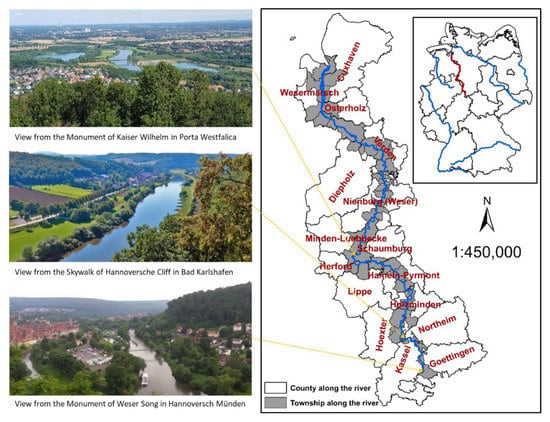
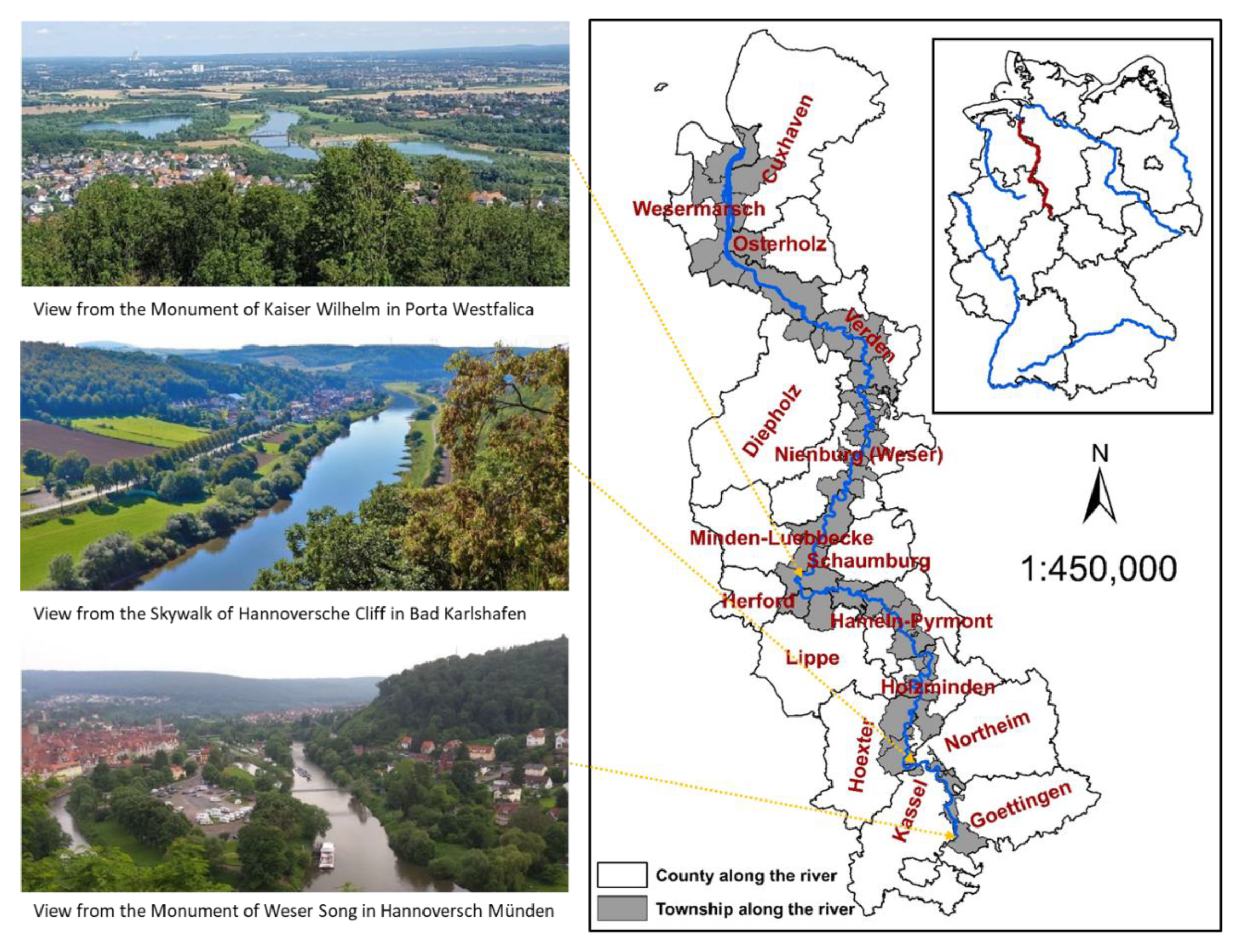
With an overall length of 453 km, the Weser River mainstream forms at Hannoversch Münden by the confluence of the rivers Werra and Fulda, flows in the northern direction through the Central Upland Ranges and the North German Plain, and empties into the North Sea. The water surface area of the river is 23,123 ha. Currently, there are around 1.5 million residents living along the Weser River, distributed in 66 municipalities or cities in 16 districts of four federal states (Figure 1).
Figure 1.
The geographical location of the Weser River in Germany.
2.2. Methods
Our searching strategy was based on the so-called “snowball approach”; i.e., a small number of books that are highly relevant were selected, then the references or citations in the selected books were looked for by thoroughly reading them. The online searching system of the Göttingen State and University Library (https://opac.sub.uni-goettingen.de) was used on 6 June 2021. The keyword “Weser” in the title plus the keyword “geography” in the topic were searched, and only books were considered for the results. This search led to a total of 22 books, from which two books were selected as “seeds” according to their relevance and availability, i.e., “Die Weser: vom Thüringer Wald bis zur Nordsee” [37] and “Die Weser: 1800–2000” [38]. Based on both the books, more books were found by the citations and references in them. Thus, 19 books were chosen for further analysis (Table 1). We then searched for evidence that reflects the inspiration of the Weser by intensively reading the selected books. Since the books were written in German, we translated relevant contents into English (Table 2 and Table 3).
Table 1.
Selected books about the Weser (in alphabetical order of author names).
Table 2.
Folklores about the Weser, in order from upstream to downstream (translated from [50]).
Table 3.
Literary works about the Weser, in the order from upstream to downstream.
For evaluating the inspirational service of the Weser River, the prices of selected books and the number of persons who ever read these books were taken into account. The prices of the selected books were taken from Amazon (https://www.amazon.de) and eBay (https://www.ebay.de (accessed on 15 December 2020)); the lowest price of each book was adopted. The data for the accurate number of persons who have read these books and the printing copies of one book is not available. Hence, we estimated the number of persons who have read these books in two steps. First, the number of persons who borrowed these books from the Göttingen State and University Library from 1980 to 2019 was obtained through contact with the colleague of the library. Then, considering that those books often have multiple editions and reprints, and that people can borrow them from other libraries, buy them from bookstores or download them in digital forms, the number of persons who borrowed those books from Göttingen was multiplied by a conservative factor of 10 (Table 1). Thus, the inspirational service value of the Weser River is calculated by the following formula:
where V denotes the inspirational value in Euros/ha/year, Pi is the price of book i, and Ni is the number of persons who borrowed book i from Göttingen, A denotes the surface area of the river, and Y denotes years.
3. Results
3.1. Evidences on the Inspirational Service of the Weser River
The evidence we found are classified into three main classes—folklore, literary works, and artistic works. In each class, the evidence is arranged in order from upstream to downstream of the river. The Weser plays an essential role in the regional folklore. There are a number of folklore tales that represent the diverse faces of the Weser along the river (Table 2). The Weser was deemed a natural obstacle and a traffic way (number 1, 5, 7, 9, 10, 12), a source of hydropower (number 3), a fatal threat because of floods (number 14, 15), and a huge sink that collected various unusual items such as blood (number 2), babies (number 4), and rats (number 8). Moreover, the flowing water as the visual feature of the Weser gave people wonderful imaginations, describing it as floating ice (number 6), a drifting shell (number 13), and a battle between water and hills (number 11). The last example is strong evidence of the inspirational service provided by the Weser because it reflects people’s imagination on the river per se according to its morphology and landscape.
Except for folklore, a number of literary works reflect the inspiration of the Weser (Table 3). Natemann likened the forming of the Weser to a kiss of two rivers (number 1), von Fallersleben praised the beauty of the Weser valley (number 2), Engel also praised the scene when the Weser passes the Westphalian Gorge (number 4), Raabe meticulously delineated a garden near the river and the stars reflected in the Weser as a mirror (number 3), Rogge (number 5) and von Dingelstedt (number 6) described their view of mountains, villages, the sky and the water when travelling on the river, von Dingelstedt (number 7) and von Schenkendorf (number 8) wrote poems to express their feelings of the river.
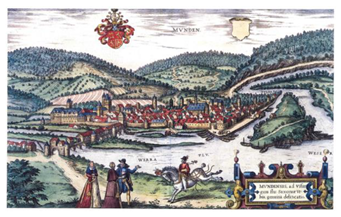
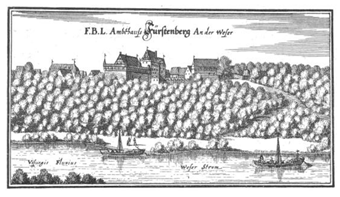
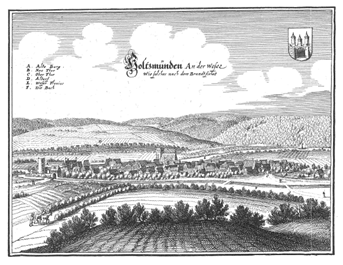
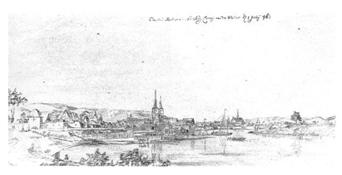
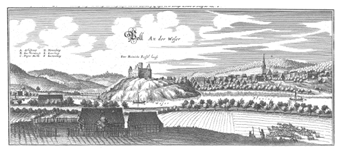
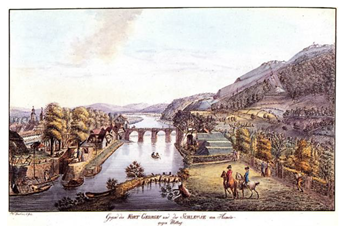
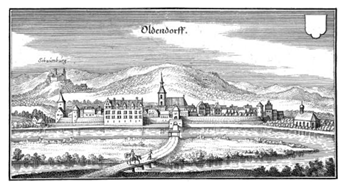
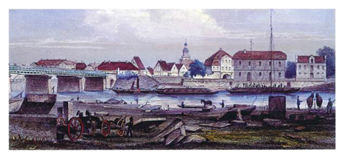
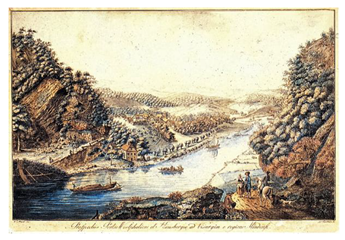
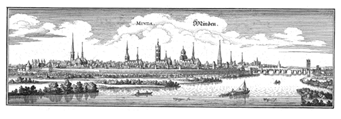
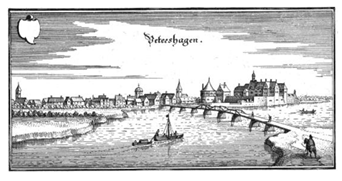
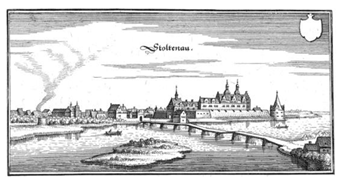
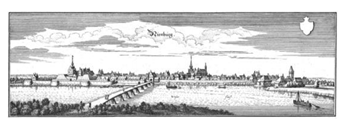
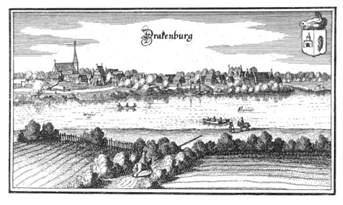
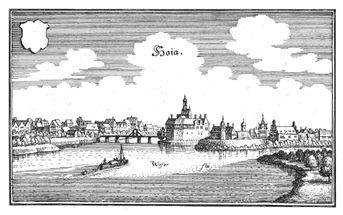
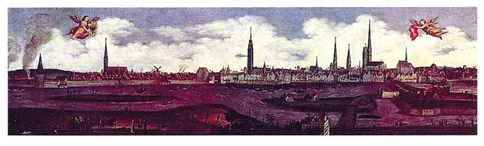
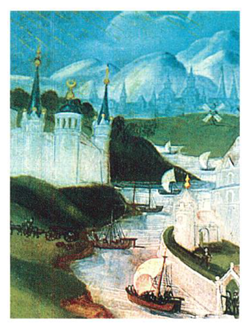
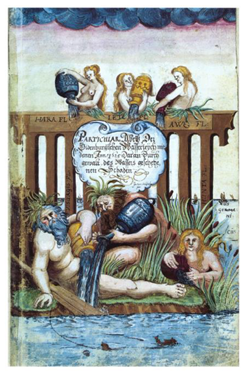
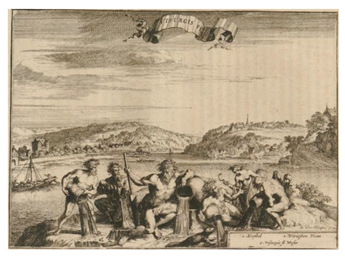
Paintings are another form of artistic reflection of the Weser (Table 4). The Weser is a momentous part of the cities where the river flows through; thus, it was often drawn in the most conspicuous place of the paintings (number 1–8, 10–16). The landscape of the Westphalian Gorge where the Weser passes not only inspired the creation of a folklore and a poem, but also a painting (number 9). The beautiful Weser Valley provided great inspiration for creating two excellent paintings of panorama (number 17, 18). The inspiration of the Weser was more obviously embodied in the imagination of the Weser Valley (number 19), which was not the delineation of the scenery that actually existed, and in the two paintings where the Weser was given the shape of human beings (number 20, 21).
Table 4.
Paintings about the Weser, in order from upstream to downstream.
3.2. The Inspirational Service Value of the Weser River
According to the method described above, the number of persons who borrowed these 19 books from the library of University Göttingen in the period of 1980 to 2019 is 681, so the total number of persons who have read those books is estimated as 6810. Hence, the total value of the inspirational service provided by the Weser River is calculated as 168,499 €, leading to the annual value of 5616.63 €/year and the unit value of 0.24 €/ha/year with the water surface area of 23,123 ha and the period of 30 years.
4. Discussion
Bieling and Plieninger [21] proposed the assumption that making use of CES leaves discernible marks on the physical landscape and developed an approach for analyzing correlations between visible manifestations of CES in a field walk-based landscape and landscape features or ecosystem service bundles. Bieling [14] expanded the assumption that making use of CES also leaves traces in the social society like stories, which revealed rich evidence regarding connections to identity, heritage, inspiration, aesthetic and recreation. Furthermore, Figueroa-Alfaro and Tang [23] developed an approach for identifying aesthetic value in non-monetary terms by geo-tagged photographs in social media. A step forward, Hutcheson et al. [24] considered educational programs as the educational service of the Hudson River and estimated their economic value (11,500 $/year) based on the travel cost method; Coscieme [22] estimated the inspirational value (6.78 million $/year) of rivers in popular music by the product of the number of songs inspired by rivers, the average price for downloading a song, and the number of times downloaded. Since all river ecosystems in general terms were taken into account, the quantity of rivers that provide inspirational services was unknown; thus, the value of a single river cannot be calculated.
In summary, this approach searches for diverse manifestations both in physical and social domains that represent cultural services provided by different ecosystems to humans, and further evaluates cultural services in monetary terms if the manifestations imply market characteristics. Following this direction, we considered folklores, literary works and artistic works published in books as the inspirational service of a specific ecosystem, the Weser River in Germany as an example, and evaluated the inspirational value based on the market price of relevant books. Compared to the value 11,500 $/year of the educational service of the Hudson River [24], the value 5616.63 €/year of the inspirational service of the Weser River in our study is in the same order.
The approach we developed has the following advantages. It can be used to find a variety of literary or artistic works that represent the inspirational service provided by a certain ecosystem; it focuses on a specific ecosystem, making the assessment of ecosystem services more interactive and complete, and it can be easily applied to all ecosystem types. On the other side, this approach also has several limitations. First, due to the problem of data availability, the precision of the result depends significantly on the critical estimation of the number of persons who have read the selected books. Second, there could potentially be a huge amount of works inspired by the Weser River; our selection of books is far from being exhaustive. Third, only writings and paintings in the form of published books have been taken into account without the consideration of other forms of inspirational service such as music, media, fine arts, etc., thus leading to underestimation of the value.
Future research can be considered from the following perspectives. The first one is the data issue. A more precise number of persons who have read a certain book would lead to a more accurate result. If the data for the yearly number of persons who read a certain book is available, even the year-by-year changes in the inspirational value can be calculated. An empirical estimate on the inspirational value, other than the market price of books used in this study, can be developed by calculating human inputs for reading certain books such as travel costs for acquiring the books or time spent on reading. Since the inspiration of a certain ecosystem may be embodied in any kind of works, a more systematic search strategy should be used to cover as many relevant references as possible. Moreover, more kinds of manifestations of other CES should be identified for further analysis, such as the sense of place, also understood as cultural identity, which can possibly be represented by municipal coats of arms in a European context.
5. Conclusions
Ecosystems provide multiple valuable cultural services to people. Due to the uniqueness of CES in comparison to provisioning and regulating services, there has long been a methodological gap for the assessment of CES. In this paper, we made an effort to develop an approach for evaluating inspirational service in monetary terms, which consists of two steps: searching for published books that include literary and artistic works inspired by a specific ecosystem, and estimating the economic value based on the market prices of books. Taking the Weser River in Germany as an example, we found a breadth of evidence in 19 books, showing that people living around the Weser are intensely inspired by the river and thus create plenty of folklore, poems, novels and paintings that represent different facets of the river. Based on the prices of these books and the estimated number of persons who have read these books, the total value of the inspirational service provided by the Weser River is calculated as 168,499 € from 1980 to 2019. Taking the water surface area of 23,123 ha and the period of 30 years into account, the annual value is 5616.63 €/year and the unit value is 0.24 €/ha/year. This approach has obvious advantages but also has potential limitations which need to be improved in future research. This approach provides a feasible way for capturing the inspirational benefit people obtain from ecosystems and can be applied to other specific ecosystems over the world.
Author Contributions
Conceptualization, W.J.; methodology, W.J.; data curation, W.J.; writing—original draft preparation, W.J.; writing—review and editing, W.J.; supervision, R.M. All authors have read and agreed to the published version of the manuscript.
Funding
This work was supported by the National Key R&D Program of China (2017YFA0604702).
Conflicts of Interest
The authors declare no conflict of interest.
References
- MA. Ecosystems and Human Well-being: Synthesis; Island Press: Washington, DC, USA, 2005. [Google Scholar]
- MA. Ecosystems and Human Well-being: Current State and Trends; Island Press: Washington, DC, USA, 2005. [Google Scholar]
- Costanza, R.; de Groot, R.; Braat, L.; Kubiszewski, I.; Fioramonti, L.; Sutton, P. Twenty years of ecosystem services: How far have we come and how far do we still need to go? Ecosyst. Serv. 2017, 28, 1–16. [Google Scholar] [CrossRef] [Scilit]
- Katz-Gerro, T.; Orenstein, D.E. Environmental tastes, opinions and behaviors: Social sciences in the service of cultural ecosystem service assessment. Ecol. Soc. 2015, 20, 28. [Google Scholar] [CrossRef] [Scilit]
- Satz, D.; Gould, R.K.; Chan, K.M.A.; Guerry, A.; Norton, B.; Satterfield, T.; Halpern, B.S.; Levine, J.; Woodside, U.; Hannahs, N.; et al. The Challenges of Incorporating Cultural Ecosystem Services into Environmental Assessment. AMBIO 2013, 42, 675–684. [Google Scholar] [CrossRef] [Scilit]
- Seidl, A. Cultural ecosystem services and economic development: World Heritage and early efforts at tourism in Albania. Ecosyst. Serv. 2014, 10, 164–171. [Google Scholar] [CrossRef] [Scilit]
- Villamagna, A.M.; Mogollón, B.; Angermeier, P.L. A multi-indicator framework for mapping cultural ecosystem services: The case of freshwater recreational fishing. Ecol. Indic. 2014, 45, 255–265. [Google Scholar] [CrossRef] [Scilit]
- Paracchini, M.L.; Zulian, G.; Kopperoinen, L.; Maes, J.; Schägner, J.P.; Termansen, M. Mapping cultural ecosystem services: A framework to assess the potential for outdoor recreation across the EU. Ecol. Indic. 2014, 45, 371–385. [Google Scholar] [CrossRef] [Scilit]
- Hernández-Morcillo, M.; Plieninger, T.; Bieling, C. An empirical review of cultural ecosystem service indicators. Ecol. Indic. 2013, 29, 434–444. [Google Scholar] [CrossRef] [Scilit]
- Scholte, S.S.K.; van Teeffelen, A.J.A.; Verburg, P.H. Integrating socio-cultural perspectives into ecosystem service valuation: A review of concepts and methods. Ecol. Econ. 2015, 114, 67–78. [Google Scholar] [CrossRef] [Scilit]
- Zoderer, B.M.; Tasser, E.; Erb, K.-H.; Stanghellini, P.S.L.; Tappeiner, U. Identifying and mapping the tourists’ perception of cultural ecosystem services: A case study from an Alpine region. Land Use Policy 2016, 56, 251–261. [Google Scholar] [CrossRef] [Scilit]
- Darvill, R.; Lindo, Z. The inclusion of stakeholders and cultural ecosystem services in land management trade-off decisions using an ecosystem services approach. Landsc. Ecol. 2016, 31, 533–545. [Google Scholar] [CrossRef] [Scilit]
- Pert, P.L.; Hill, R.; Maclean, K.; Dale, A.; Rist, P.; Schmider, J. Mapping cultural ecosystem services with rainforest aboriginal peoples: Integrating biocultural diversity, governance and social variation. Ecosyst. Serv. 2015, 13, 41–56. [Google Scholar] [CrossRef] [Scilit]
- Bieling, C. Cultural ecosystem services as revealed through short stories from residents of the Swabian Alb (Germany). Ecosyst. Serv. 2014, 8, 207–215. [Google Scholar] [CrossRef] [Scilit]
- Ribeiro, F.P.; Ribeiro, K.T. Participative mapping of cultural ecosystem services in Pedra Branca State Park, Brazil. Nat. Conserv. 2016, 14, 120–127. [Google Scholar] [CrossRef] [Scilit]
- Darvill, R.; Lindo, Z. Quantifying and mapping ecosystem service use across stakeholder groups: Implications for conservation with priorities for cultural values. Ecosyst. Serv. 2015, 13, 153–161. [Google Scholar] [CrossRef] [Scilit]
- Martinez, P.G.; Peri, P.L.; Lencinas, M.V.; Garcia-Llorente, M.; Martin-Lopez, B. Spatial patterns of cultural ecosystem services provision in Southern Patagonia. Landsc. Ecol. 2016, 31, 383–399. [Google Scholar] [CrossRef] [Scilit]
- Richards, D.R.; Friess, D.A. A rapid indicator of cultural ecosystem service usage at a fine spatial scale: Content analysis of social media photographs. Ecol. Indic. 2015, 53, 187–195. [Google Scholar] [CrossRef] [Scilit]
- Daniel, T.C.; Muhar, A.; Arnberger, A.; Aznar, O.; Boyd, J.W.; Chan, K.M.A. Contributions of cultural services to the ecosystem services agenda. Proc. Natl. Acad. Sci. USA 2012, 109, 8812–8819. [Google Scholar] [CrossRef] [Scilit]
- Remme, R.P.; Schröter, M.; Hein, L. Developing spatial biophysical accounting for multiple ecosystem services. Ecosyst. Serv. 2014, 10, 6–18. [Google Scholar] [CrossRef] [Scilit]
- Bieling, C.; Plieninger, T. Recording Manifestations of Cultural Ecosystem Services in the Landscape. Landsc. Res. 2013, 38, 649–667. [Google Scholar] [CrossRef] [Scilit]
- Coscieme, L. Cultural ecosystem services: The inspirational value of ecosystems in popular music. Ecosyst. Serv. 2015, 16, 121–124. [Google Scholar] [CrossRef] [Scilit]
- Figueroa-Alfaro, R.W.; Tang, Z. Evaluating the aesthetic value of cultural ecosystem services by mapping geo-tagged photographs from social media data on Panoramio and Flickr. J. Environ. Plan. Manag. 2017, 60, 266–281. [Google Scholar] [CrossRef] [Scilit]
- Hutcheson, W.; Hoagland, P.; Di, J. Valuing environmental education as a cultural ecosystem service at Hudson River Park. Ecosyst. Serv. 2018, 31, 387–394. [Google Scholar] [CrossRef] [Scilit]
- Jaligot, R.; Hasler, S.; Chenal, J. National assessment of cultural ecosystem services: Participatory mapping in Switzerland. Ambio 2019. [Google Scholar] [CrossRef] [Scilit] [PubMed]
- Nowak-Olejnik, A.; Mocior, E.; Hibner, J.; Tokarczyk, N. Human perceptions of cultural ecosystem services of semi-natural grasslands: The influence of plant communities. Ecosyst. Serv. 2020, 46, 101208. [Google Scholar] [CrossRef] [Scilit]
- Casalegno, S.; Inger, R.; Desilvey, C.; Gaston, K.J. Spatial covariance between aesthetic value & other ecosystem services. PLoS ONE 2013, 8, e68437. [Google Scholar] [CrossRef] [Scilit]
- Ghermandi, A.; Fichtman, E. Cultural ecosystem services of multifunctional constructed treatment wetlands and waste stabilization ponds: Time to enter the mainstream? Ecol. Eng. 2015, 84, 615–623. [Google Scholar] [CrossRef] [Scilit]
- Urquhart, J.; Acott, T. A Sense of Place in Cultural Ecosystem Services: The Case of Cornish Fishing Communities. Soc. Nat. Resour. 2014, 27, 3–19. [Google Scholar] [CrossRef] [Scilit]
- Laband, D.N. The neglected stepchildren of forest-based ecosystem services: Cultural, spiritual, and aesthetic values. For. Policy Econ. 2013, 35, 39–44. [Google Scholar] [CrossRef] [Scilit]
- Tengberg, A.; Fredholm, S.; Eliasson, I.; Knez, I.; Saltzman, K.; Wetterberg, O. Cultural ecosystem services provided by landscapes: Assessment of heritage values and identity. Ecosyst. Serv. 2012, 2, 14–26. [Google Scholar] [CrossRef] [Scilit]
- Hiron, M.; Pärt, T.; Siriwardena, G.M.; Whittingham, M.J. Species contributions to single biodiversity values under-estimate whole community contribution to a wider range of values to society. Sci. Rep. 2018, 8, 7004. [Google Scholar] [CrossRef] [Scilit]
- Katayama, N.; G.Baba, Y. Measuring artistic inspiration drawn from ecosystems and biodiversity: A case study of old children’s songs in Japan. Ecosyst. Serv. 2020, 43, 101116. [Google Scholar] [CrossRef] [Scilit]
- Lansing, J.S.; Lansing, P.S.; Erazo, J.S. The Value of a River. J. Political Ecol. 1998, 5, 1–22. [Google Scholar] [CrossRef] [Scilit]
- Löbe, K. Das Weserbuch. Roman eines Flusses, 2. Aufl; Niemeyer: Hameln, Germany, 1969. [Google Scholar]
- Braun, H.-G.; Eckoldt, M. (Eds.) Flüsse und Kanäle-Die Geschichte der Deutschen Wasserstrassen; DSV-Verlag: Hamburg, Germany, 1998. [Google Scholar]
- Below, M. Die Weser-Vom Thüringer Wald bis zur Nordsee; 2. korr. und aktualis. Aufl.; Temmen: Bremen, Germany, 2011. [Google Scholar]
- Küster, B. Die Weser: 1800–2000; Donat: Bremen, Germany, 1999. [Google Scholar]
- Albrecht, T.; Strack, A.W. Malerische Reise durch das Weserbergland: Anton Wilhelm Strack, Hofmaler und Professor für Zeichenkunst in Bückeburg (1758–1829); Verl. Createam: Bückeburg, Germany, 1997. [Google Scholar]
- Braun, G.; Hogenberg, F.; Novellanus, S. Beschreibung und Contrafactur der Vornembster Stät der Welt; Müller und Schindler: Stuttgart, Germany, 1978. [Google Scholar]
- Engel, A.W. Ein Erklärender Begleiter auf der Weserreise mit Berücksichtigung der Fulda von Kassel ab; Repr. d. Ausg. Hameln, Becker, 1845; Niemeyer: Hameln, Germany, 1990. [Google Scholar]
- Von Furstenberg, F.; Micus, F.J. Denkmale des Landes Paderborn; Junfermann: Paderborn, Germany, 1844. [Google Scholar]
- Von Fallersleben, H.; August, H. Gedichte und Lieder; 1. Aufl.; Hoffmann u. Campe: Hamburg, Germany, 1974. [Google Scholar]
- Kastler, J.; Die, W. (Eds.) EinFluss in Europa. Aufbruch in die Neuzeit; Mitzkat (Die Weser-Einfluss in Europa, Bd. 2): Holzminden, Germany, 2000. [Google Scholar]
- Marbach, G.O. (Ed.) Deutsche Lieder zu Schutz und Trutz; Breitkopf und Härtel (Volksbücher, 19/20): Leipzig, Wigand, Germany, 1841. [Google Scholar]
- Merian, M. Topographia Westphaliae; 4. Aufl. 1984; Bärenreiter-Verl. (Topographia Germaniae/Matthäus Merian 5): Kassel Germany, 1984. [Google Scholar]
- Merian, M. Topographia Saxoniae Inferioris; Repr. der Ausg. von 1653; Archiv-Verl. (Topographia Germaniae, 2): Braunschweig, Germany, 2005. [Google Scholar]
- Merian, M. Topographia Braunschweig und Lüneburg; Repr. der Ausg. 1654 Ed.; Offizin (Topographia Germaniae, 4): Lahnstein, Germany, 2012. [Google Scholar]
- Musculus, J.C.; Eckhardt, A. Der Deichatlas des Johann Conrad Musculus von 1625/26; Holzberg: Faks. Oldenburg, Geramny, 1985. [Google Scholar]
- Paetow, K. Die schönsten Wesersagen; 3., durchges. und erw. Aufl.; Sponholtz: Hameln, Germany, 1974. [Google Scholar]
- Raabe, W. Der heilige Born; Vandenhoeck & Ruprecht: Göttingen, Germany, 1968. [Google Scholar]
- Rogge, A. An Deich und Strom. Ausgewählte Erzählungen; Carl Schünemann Verlag: Bremen, Germany, 1958. [Google Scholar]
- Von Dingelstedt, F. Das Wesertal von Münden bis Minden; Reprograf. Nachdr. der Ausg. Kassel und Leipzig 1838; Olms (Das Malerische und Romantische Deutschland, Suppl.-Bd): Hildesheim, Germany, 1972. [Google Scholar]



Publisher’s Note: MDPI stays neutral with regard to jurisdictional claims in published maps and institutional affiliations. |
© 2021 by the authors. Licensee MDPI, Basel, Switzerland. This article is an open access article distributed under the terms and conditions of the Creative Commons Attribution (CC BY) license (https://creativecommons.org/licenses/by/4.0/).