Review

Social Vulnerability Assessment for Landslide Hazards in Malaysia: A Systematic Review Study
by
Mohd Idris Nor Diana
1,*,
Nurfashareena Muhamad
1,
Mohd Raihan Taha
2,
Ashraf Osman
3 and
Md. Mahmudul Alam
4
1
Institute for Environment and Development, Universiti Kebangsaan Malaysia, Bangi 43600, Selangor, Malaysia
2
Department of Civil Engineering, Universiti Kebangsaan Malaysia, Bangi 43600, Selangor, Malaysia
3
Department of Engineering, The Palatine Centre, Durham University, Stockton Road, Durham DH1 3LE, UK
4
School of Economics, Finance and Banking, Universiti Utara Malaysia, Sintok 06010, Kedah, Malaysia
*
Author to whom correspondence should be addressed.
Land 2021, 10(3), 315; https://doi.org/10.3390/land10030315
Submission received: 11 February 2021 / Revised: 27 February 2021 / Accepted: 28 February 2021 / Published: 19 March 2021

Abstract

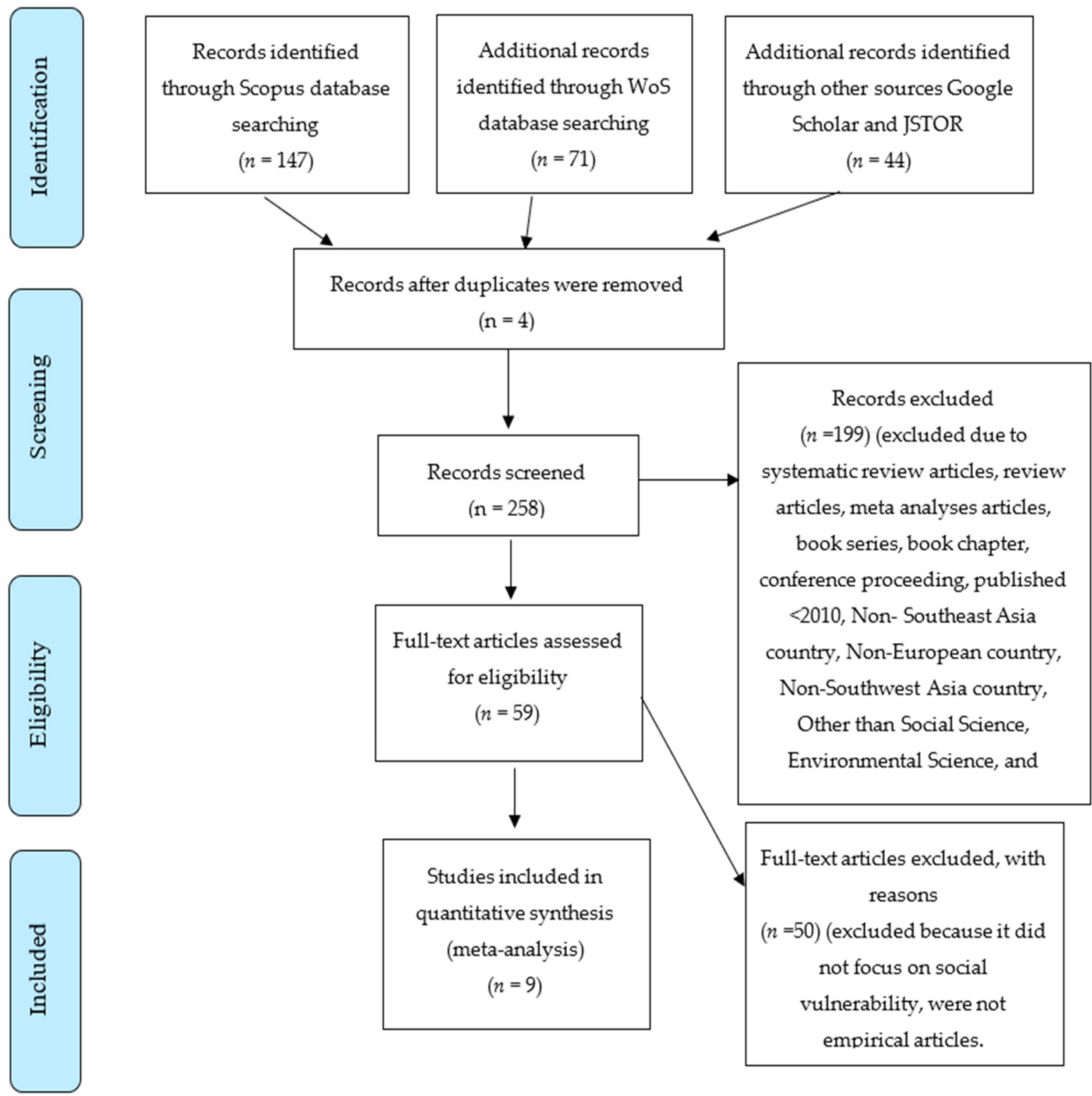
Landslides represent one of the world’s most dangerous and widespread risks, annually causing thousands of deaths and billions of dollars worth of damage. Building on and around hilly areas in many regions has increased, and it poses a severe threat to the physical infrastructure and people living within such zones. Quantitative assessment of social vulnerability in Malaysia is worrying because it has been given less attention than hazard-related studies. Therefore, this study’s objective is to find out the indicators used for social vulnerability assessment in the context of a landslide in Malaysia. The analysis is critical for understanding the measures of social vulnerability, given that the incorporation of climate change and disaster risk mitigation issues in urban planning and management are considered priorities in ensuring a stable population growth and avoiding economic disruption. A systematic study on the Scopus and Web of Science repositories was conducted based on the PRISMA Report analysis method. This article concluded that there are six important indicators of social vulnerability in the context of landslide in Malaysia.
Keywords: social vulnerability assessment; landslide; social indicator; disaster risk reduction; Malaysia social vulnerability assessment; landslide; social indicator; disaster risk reduction; Malaysia