


Abstract
This study investigated the influence of physicochemical properties of carbon black (porosity and surface chemistry) on the adsorption of acetylsalicylic acid (ASA) from aqueous solutions. Three unmodified carbon blacks (XC72, N220, and N550) with different specific surface areas, as well as two surface-modified carbon blacks (oxidized carbon black (N220-Ox) and 3-aminopropyltriethoxysilane-modified carbon black (N220-APTES)), were used in the study. The kinetics and equilibrium of adsorption were studied, along with the effects of the initial adsorbent mass, solution pH, and ionic strength on adsorption efficiency. The results showed that the adsorption equilibrium for acetylsalicylic acid was reached after 30–60 min, with the adsorption kinetics being well characterized by a pseudo-second-order equation. Under equilibrium conditions, the adsorption of acetylsalicylic acid on carbon blacks followed the Langmuir isotherm model. The best adsorption capacity was observed for XC72 carbon black, which has the highest BET area, while the lowest was observed for N550 carbon black. For unmodified carbon blacks, adsorption was found to be correlated with their porous structure. Functionalization of the surface with APTES increased the carbon black’s adsorption capacity, whereas surface oxidation reduced its effectiveness. Additionally, it was found that adsorption depended on solution pH: acetylsalicylic acid was adsorbed most efficiently in an acidic environment (pH ~3.5), and the solution ionic strength had no effect on its adsorption onto the tested carbon blacks.
1. Introduction
As substances with targeted biological effects, pharmaceuticals play a key role in modern medicine and pharmacology. Their global production and consumption constitute a massive and rapidly growing sector of the economy [1]. Over the past few years, the global demand for pharmaceutical products has grown exponentially, driven in part by an ageing population and increased societal demand due to the rising prevalence of lifestyle-related and chronic diseases (e.g., depression, obesity, and diabetes) [1,2,3]. Unfortunately, high levels of pharmaceutical consumption carry the risk of their release into the environment. Sources of pharmaceutical contamination include municipal and industrial wastewater, medical waste, agriculture, and everyday use of medicine [2,3,4,5,6,7,8,9]. Instead of being disposed of properly, unused or expired pharmaceuticals often end up in the garbage and sometimes directly in the sewage system.
Furthermore, many pharmaceuticals are not fully metabolized by the organism and can therefore be excreted in body fluids such as urine and feces. Consequently, most pharmaceuticals and their metabolites end up in groundwater and surface water, the primary sources of drinking water. The occurrence of various types of pharmaceuticals in aquatic ecosystems has been reported in numerous manuscripts compiled in many review articles [4,5,8,9,10].
The most commonly detected pharmaceuticals in water include estrogens and other hormonal compounds (including contraceptives and endocrine disruptors), beta-blockers, antiepileptic drugs, antidepressants, anticancer drugs, antibiotics, analgesics, and anti-inflammatory drugs [2,6,7,9]. These compounds are highly stable chemically and decompose slowly; furthermore, most of them are highly biologically active and can cause adverse effects even at very low concentrations. The presence of drugs and their metabolites in ecosystems has a significant environmental burden. They are responsible for disruptions in the development of microorganisms in water and soil, disturbances in the growth of phytoplankton and zooplankton, hormonal imbalances and pathological changes in fish, and the occurrence of drug resistance, especially antibiotic resistance [2,4,6].
A very important group of medications detected in the environment is non-steroidal anti-inflammatory drugs (NSAIDs) [5,8,11]. These are the pharmaceuticals most frequently used in human therapy and are employed as anti-inflammatory, analgesic, and antipyretic drugs. Most of them (e.g., paracetamol, diclofenac, and ibuprofen) are also available over the counter outside pharmacies, which increases their use and potential environmental impact [12]. As Huynh et al. reported in their review paper [5], NSAIDs in water can cause endocrine disruption, physical deformities, and organ damage in animals, as well as impaired photosynthesis in phytoplankton and aquatic plants.
For this reason, the presence of pharmaceuticals in water is highly concerning, and action is required to reduce their concentrations or eliminate them. Unfortunately, due to the diverse chemical structures of drugs, currently available removal technologies are not fully effective. Consequently, new, more effective degradation techniques are constantly being developed.
Conventional wastewater treatment technologies use mechanical, biological, and chemical processes, including biodegradation, advanced oxidation processes, electrochemical methods, chemical precipitation, membrane filtration, biosorption, and adsorption [2,3,6,7,9]. Among the available technologies, adsorption is currently considered one of the most popular and effective methods of water treatment. This is because adsorption is inexpensive, easy to operate, and does not generate additional secondary pollutants. The effectiveness of adsorption depends on the nature and properties of the adsorbents used. These are most often activated carbons (ACs) [3,6,11,13], but also other carbonaceous materials (e.g., biochars, carbon nanotubes, graphene oxide) [7,11,14], nanomaterials (e.g., silica- and metal-based materials) [3,7,11], and low-cost adsorbents, including various agro-industrial wastes [6,9]. However, new adsorbents that could be useful for purifying aquatic environments are still under investigation.
Carbon black, widely used in industry, seems to be an interesting carbon-based material. Carbon black essentially consists of elemental carbon in the form of near-spherical particles of colloidal size, coalesced into particle aggregates and agglomerates, and is obtained by the partial combustion or thermal decomposition of hydrocarbons. This amorphous carbon material has a relatively high surface area-to-volume ratio. Depending on the synthesis and fabrication procedures, it is categorized as one of the following types of carbon black: thermal black, lampblack, channel black, furnace black, or acetylene black. Carbon black can also be categorized based on particle size distribution, surface chemical immobilization, particle aggregation, and agglomeration degree [15,16]. From the standpoint of its solid-state properties, carbon black is a paracrystalline form of carbon with fine particles in the range of a few tens of nanometers and a relatively high specific surface area. Carbon black is mainly used as an electric-conductive agent, a color pigment, an ink additive, and a filler for reinforcement [17,18,19,20,21,22]. Carbon black has been much less frequently studied and used as an adsorbent for organic substances contaminating aquatic environments. This is due to the much greater suitability of activated carbons for this purpose, which are produced in large quantities and possess very good adsorption properties thanks to their large specific surface area and well-developed porous structure. In this respect, they significantly outperform carbon black and other carbon materials, such as biochars, carbon nanotubes, and graphene-based materials. In the latter case, porosity is significantly less developed. On the other hand, biochars, although significantly cheaper than activated carbons, are not produced on a large scale and exhibit variable properties due to the time-dependent characteristics of the precursors used in their production [6,13]. Carbon nanotubes and graphene oxide, on the other hand, are too expensive for large-scale production [7,14]. Furthermore, they have a significantly less developed porous structure compared to activated carbon. Therefore, they are not comparable to activated carbon in aquatic purification. Only carbon black seemed more suitable for adsorption studies. One reason was its extensive large-scale production in various defined types, and another was its distinct structure from activated carbon. This could aid in interpreting and understanding the adsorption process. The potential use of carbon black as an adsorbent for removing acetylsalicylic acid from water was described by Azman et al. [23]. In their study, the authors used a single type of carbon black obtained from tyre waste via pyrolysis at 800 °C. This was then treated with a 6 mol/L nitric acid solution at 90 °C for 30 min, followed by heating at 600 °C for 60 min. The authors investigated the effects of contact time, solution pH, temperature, initial adsorbate concentration, and adsorbent dosage. Under optimal experimental conditions (pH = 3, temperature = 30 °C, initial ASA concentration = 100 mg/L, and adsorbent dose = 0.02 g), they found that the adsorption capacity was 40.4 mg/g (0.224 mmol/g). The results presented in this paper do not cover the entire subject. Therefore, we have provided a more comprehensive description of the adsorption of ASA on carbon black.
The aim of this paper was to evaluate the usefulness of carbon black as an alternative adsorbent for the removal of aspirin from aqueous solutions. This study investigated the effects of carbon black’s physicochemical properties (porosity and surface chemistry) on the adsorption of acetylsalicylic acid (aspirin, ASA), a popular, over-the-counter analgesic, antipyretic, and anti-inflammatory drug, from aqueous solutions. Three unmodified carbon blacks (XC72, N220, and N550) with different specific surface areas, as well as two surface-modified carbon blacks (oxidized carbon black (N220-Ox) and 3-aminopropyltriethoxysilane-modified carbon black (N220-APTES)), were used in the study. The modification techniques used (oxidation with hydrogen peroxide and modification with ATPES) were intended to produce adsorbents with acidic and basic surface properties. As expected, N220-Ox carbon black, obtained through oxidation with 30% hydrogen peroxide, should be characterized by the presence of acidic oxygen-containing functional groups. These groups make the surface hydrophilic and facilitate hydrogen bonding with polar adsorbates. Conversely, N220-APTES carbon black, functionalized with 3-aminopropyltriethoxysilane, should contain basic amino groups on its surface that are protonated in an acidic environment (–NH3+). This enables strong electrostatic interactions with the anionic forms of the adsorbate.
2. Materials and Methods
2.1. Reagents and Adsorbents
Acetylsalicylic acid (aspirin, ASA), C9H8O4, CAS 50-78-2, with 99% purity, was purchased from Thermo Fisher GmbH (Kandel, Germany). 3-Aminopropyltriethoxysilane (APTES), ≥98.0, was received from Sigma-Aldrich (St. Louis, MO, USA). All other analytical-grade chemicals, including 30% hydrogen peroxide, methanol, hydrochloric acid, sodium hydroxide, and sodium chloride, were obtained from Avantor Performance Materials (Gliwice, Poland).
Three commercially available carbon blacks were used in the study: N220 (Orion Engineered Carbons, Eschborn, Germany); N550 (Orion Engineered Carbons, Eschborn, Germany); Vulcan XC72, abbreviated in the text as XC72 (Cabot Corporation, Boston, MA, USA). Carbon black N220 was also modified in two different ways—by oxidation with 30% hydrogen peroxide (N220-Ox) and by functionalization with 3-aminopropyltriethoxysilane (N220-APTES). The detailed procedure for modifying the carbon black surface has been described elsewhere [24]. Briefly, the N220 carbon black was chemically treated in an Erlenmeyer flask at 23 °C. To 20 mL of 30% H2O2 solution, 1 g of the material was added, and the flask was agitated at 200 rpm for 24 h. At the end of this period, the carbon black (designated N220-Ox) was filtered, washed several times with distilled water, and dried at room temperature for 24 h. The APTES modification process was carried out in an ethanol environment. The 10 g of N220 carbon black and 1 g of APTES were added to 30 mL of an 98% ethanol. After stirring for 3 h, the solvent was evaporated, and modified carbon black, denoted as N220-APTES, was obtained. All carbon black samples (unmodified, N220-Ox, and N220-APTES) were dried at 120 °C for 6 h and then kept in a desiccator until use.
The carbon black samples were characterized using various methods. To characterize the porous structures of the original (raw) and modified carbon blacks, low-temperature nitrogen adsorption–desorption isotherms were measured using an ASAP 2020 (Micromeritics, Norcross, GA, USA) analyzer. On this basis, the Brunauer–Emmett–Teller (BET) surface areas as well as pore volumes were calculated.
A CHNS elemental analysis was performed using a Vario EL Cube apparatus (Elementar Analysensysteme, Langenselbold, Germany).
SEM-EDS analysis of the surface chemical composition of all carbon blacks was performed. The scanning electron microscope (SEM, LEO 1430 VP, Leo Electron Microscopy Ltd., Cambridge, UK) coupled with energy-dispersive X-ray detection (EDX) (XFlash 4010, Bruker AXS, Berlin, Germany) was used.
Surface oxygen groups were determined according to a procedure similar to the Boehm method. Approximately 0.25 g of each carbon black sample was placed in a 250 mL flask. After adding 25 mL of 0.1 mol/L solution of NaOH (for the determination of carboxyl, lactonic, and phenolic surface groups) or 0.1 mol/L HCl (for the determination of basic groups), the mixtures were shaken for 24 h. After filtering the mixtures, 10 mL of each filtrate was pipetted, and the excess base and acid were titrated using 0.1 mol/L HCl or NaOH, respectively. All experiments were repeated twice.
The point of zero charge (pHPZC) of the materials was determined according to the following procedure. In Erlenmeyer flasks, a series of 0.01 mol/L NaCl solutions (20 mL) was adjusted to the required initial pH (2–12) by adding small amounts of 0.01 mol/L HCl or NaOH. Next, 0.05 g of the carbon black sample was added to each prepared solution, and the mixture was agitated for 24 h. The solutions were then filtered, and their pH was determined. The pHPZC value was identified graphically as the x-intercept of the experimental curve on the graph of ΔpH (pHfinal − pHinitial) vs. pHinitial.
2.2. Batch Adsorption Experiments
All adsorption experiments were conducted in duplicate at 23 °C. The average value was used for the calculations. The maximum deviation was found to be less than 6%. Briefly, 20 mL of an appropriate concentration of ASA solution and a weighed amount of carbon black were added to Erlenmeyer flasks. The resulting mixtures were shaken at 200 rpm for 4 h, then filtered through filter paper and analyzed for aspirin content. The effects of the initial mass of the adsorbent, kinetics of adsorption, and equilibrium adsorption, as well as the effect of pH and the ionic strength of the solution on the ASA adsorption onto carbon blacks, were investigated. All experiments (but not adsorption isotherms) were carried out using ASA solutions with an initial concentration of 1 mmol/L (~180 mg/L). To investigate the effect of the adsorbent mass, various amounts of each carbon black (0.01, 0.02, 0.03, and 0.04 g) were added to glass flasks containing 20 mL of a 1.0 mmol/L ASA solution. Converted to the volume of the adsorbate solution, these doses equated to 0.5, 1.0, 1.5, and 2.0 g/L, respectively. In the kinetic studies (C0 = 1 mmol/L, m = 0.03 g), the samples were mixed for 2, 5, 10, 15, 30, 45, 60, 90, and 120 min. Aspirin adsorption isotherms were determined for initial concentrations ranging from 0.5 to 2.0 mmol/L (~90 to 360 mg/L). The experiments were conducted in unbuffered ASA solutions with a natural (original) pH of ~3.5. The experiments on the effect of solution pH on adsorption were an exception. In this case, the ASA solutions (1 mmol/L) were adjusted to the required pH values (2.5–10) using 0.1 mol/L HCl and NaOH solutions, and the pH was monitored with a pH meter. The effect of ionic strength was studied similarly—appropriate amounts of NaCl were added to 20 mL of a 1 mmol/L ASA solution to obtain the following salt concentrations: 0.1, 0.5, and 1.0 mol/L.
The amount of ASA adsorbed onto the adsorbent surface at a given time (qt) and under equilibrium conditions (qe) was determined. This is expressed in terms of mmol/g and as the adsorption percentage. The following formulas were used for this determination:
where C0, Ce, and Ct (mmol/L) are the initial ASA concentration, concentration under equilibrium, and concentration at time t, respectively; m is the mass of carbon black in grams, and V is the volume of the ASA solution in liters.
The studies on desorption and regeneration of the adsorbent were conducted according to the following procedure. Eight Erlenmeyer flasks were prepared, each containing 20 mL of a 1 mmol/L ASA solution and 0.03 g of adsorbent material. The flasks were shaken for 4 h, and their contents were then transferred to Falcon polypropylene tubes and centrifuged at 5000 rpm. After measuring the aspirin concentration remaining in the solution, the qe values (Equation (2)) were determined and averaged. The ASA-loaded adsorbent was collected, averaged, and washed several times with water, then dried. Additional portions of 0.03 g of the adsorbent were then placed into Erlenmeyer flasks containing 20 mL of methanol. After shaking for four hours, the solutions were centrifuged, and the amount of desorbed ASA was measured. The regenerated adsorbent was then washed with water again, mixed, and dried to prepare it for the next adsorption–desorption cycle. Five cycles were performed in total, and the regeneration effectiveness was determined as a percentage using the formula:
where q0 and qn are the initial adsorption capacity and the reuse adsorption capacity after the n-th number of adsorption–desorption cycles, respectively.
A Varian Carry 3E UV-Vis spectrophotometer (Palo Alto, CA, USA) was used to measure the concentration of aspirin in solutions. The absorbance of the ASA solutions was measured at an analytical wavelength of 273 nm. The calibration curve, prepared over the ASA concentration range of 0.2–2.0 mmol/L, was linear (R2 = 0.9987) and was described by the equation y = 0.8048x + 0.0063.
3. Results and Discussion
3.1. Properties of Carbon Black Samples
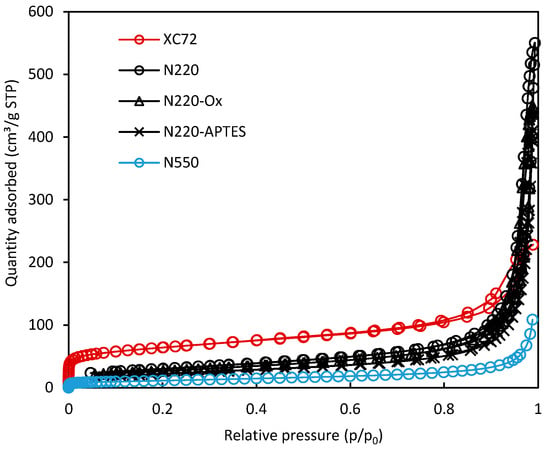
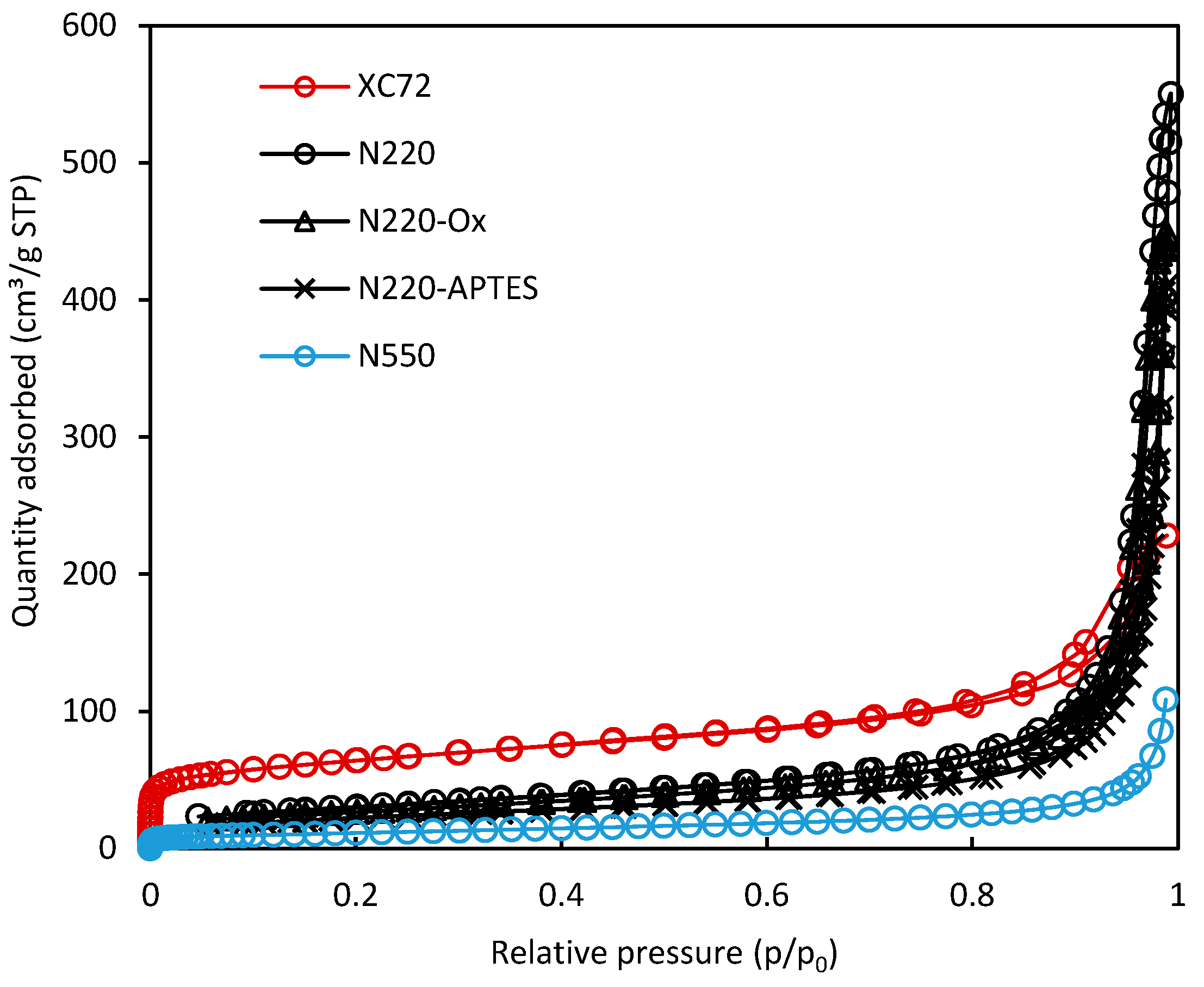
The porous structure parameters of the used carbon black samples were obtained from the nitrogen adsorption–desorption isotherms at 77 K, as shown in Figure 1. Considering the curves presented here, they can all be classified as type II according to the IUPAC classification [25]. Hysteresis loops, on the other hand, can be classified as type H3. All isotherms presented in Figure 1 for a wide range of p/p0 (0–0.85) occur for low nitrogen adsorption values. The hysteresis loops for all adsorption isotherms are very narrow. Only starting from p/p0 around 0.9 does the amount of adsorbed nitrogen begin to increase rapidly, reaching high values. This results in much larger mesopore volumes than micropore volumes. These observations are related to the mesoporous/aggregated structure of the carbon black. All calculated values of the porous structure parameters, including SBET, Vt, Vmi, and Vme, are collected in Table 1. One can observe decreasing values of each of the above parameters depending on the type of carbon black and the modification method used for N220 (NM, Ox, APTES).
Figure 1.
N2 adsorption–desorption isotherms of carbon blacks.
Table 1.
Textural properties of the carbon black samples.
The chemical properties of the carbon black samples studied, as characterized by elemental analysis and given in Table 2 as elemental content, show that increasing oxygen content with respect to the type of carbon black and the method of modification is inversely correlated with porous structure parameters. Only the N220-Ox oxidized carbon black sample shows twice the oxygen content compared to its non-modified sample. The higher oxygen content is due to the presence of oxygen-containing surface groups on the surface of carbon black. The inverse correlation between oxygen content and textural parameters of the carbon blacks may be due to pore blockage, partial structural collapse, surface coating, or simply variation among commercial carbon blacks. This phenomenon may also be attributed to partial structural collapse. However, hydrogen peroxide is a relatively ‘soft’ oxidizing agent and typically results in surface oxidation without significantly destroying the porous structure, unlike more aggressive oxidizing agents such as HNO3 [26]. According to Gómez-Serrano et al. [27], the oxidation of activated carbon surfaces by hydrogen peroxide first increases the –OH group, followed by the C=O and –COOH groups. The nitrogen content shows similar small values for all carbon black samples except for N220 modified with APTES (a four times greater value).
Table 2.
Elemental analysis data for carbon black samples.
The C, O, Si, S, and N contents, additionally determined in this work using the EDS method, for the surfaces of all carbon black samples used are presented in Table 3. They show some similarity to the results of elemental analysis (Table 2). However, higher oxygen contents can be observed, which occur mainly in the surface layer of the carbon black.
Table 3.
The surface EDS analysis results for all carbon black samples.
Surface chemistry parameters of carbon black samples, i.e., the contents of acidic and basic surface functional groups as well as pHPZC, are determined and presented in Table 4.
Table 4.
Chemical properties of the surface of the carbon blacks.
The XC72 sample surface has the strongest acidic properties, and the N550 surface has the weakest acidic properties. Also, in the case of pHPZC values (Table 4), one can observe an interesting correlation with the effects of modifying the carbon black N220 surface. The lowest value in the case of the oxidized surface, this carbon black is the result of the creation of acidic functional groups (carboxylic, carbonyl, hydroxylic). The highest value of pHPZC in the case of the N220-APTES sample is the result of the presence of a relatively high quantity of basic nitrogen functional groups. For this carbon black sample, the highest pHPZC value is observed. These considerations are of fundamental importance to the adsorption capacity of a given carbon black sample, in addition to its porous structure.
3.2. Adsorption of ASA on Carbon Black
3.2.1. Effect of Adsorbent Dosage
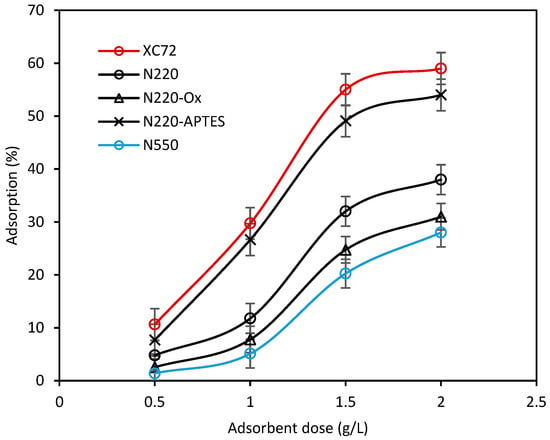
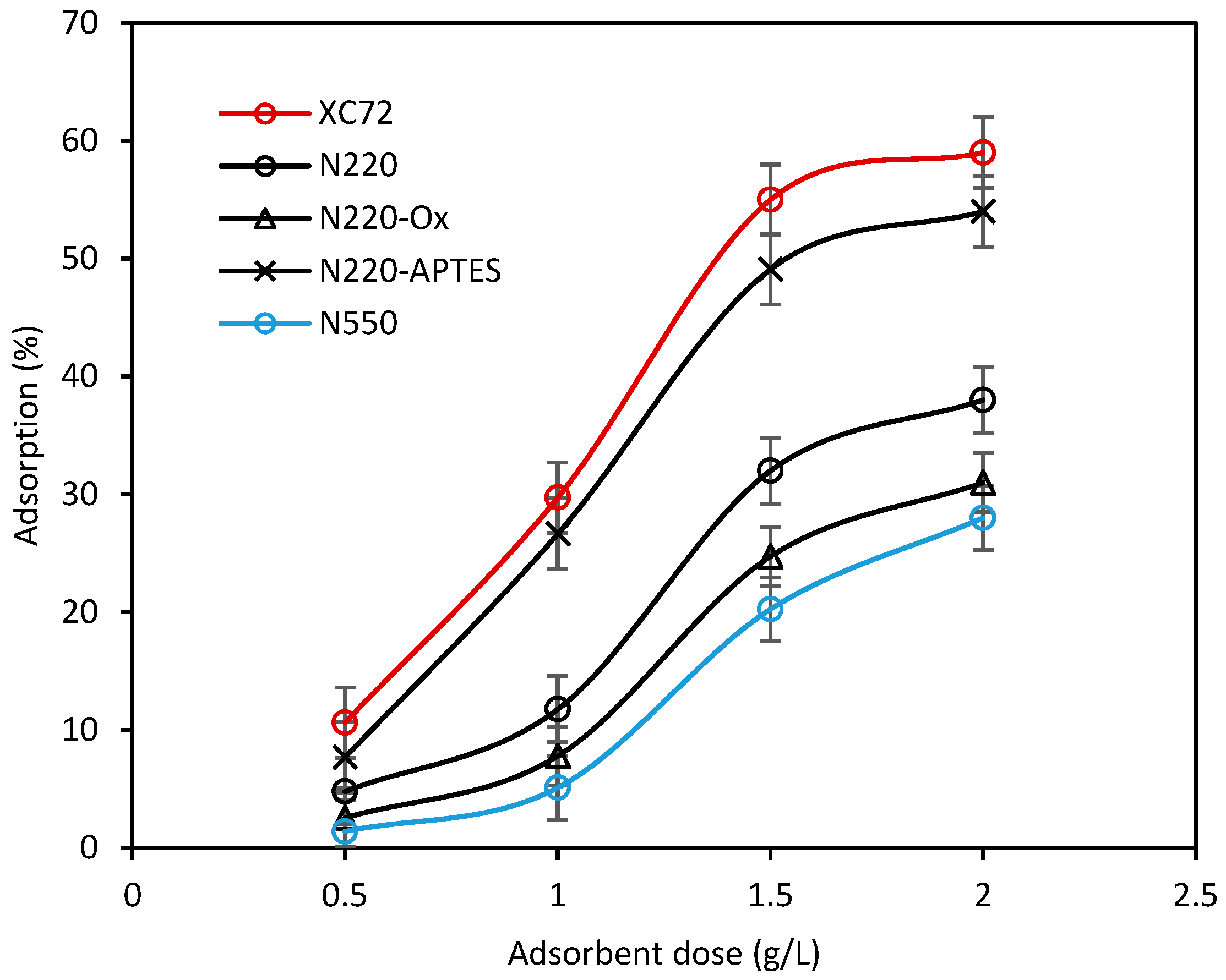
The effects of adsorbent dose on ASA adsorption are presented as a plot of percentage adsorption versus adsorbent dose (Figure 2).
Figure 2.
Influence of adsorbent dosage on the adsorption of ASA from aqueous solutions.
As shown, increasing the adsorbent dose increases adsorption efficiency in each case. This is a logical and expected result, since increasing the amount of adsorbent, while keeping the number of adsorbate molecules constant, increases the availability of active sites on its surface, thereby enhancing adsorption efficiency. Further adsorption studies used a fixed adsorbent mass of 0.03 g (1.5 g/L). Although the most logical choice would be the largest amount of adsorbent (0.04 g), this would carry the risk of total adsorption, especially at the lowest adsorbate concentrations.
3.2.2. Effects of Solution pH and Ionic Strength
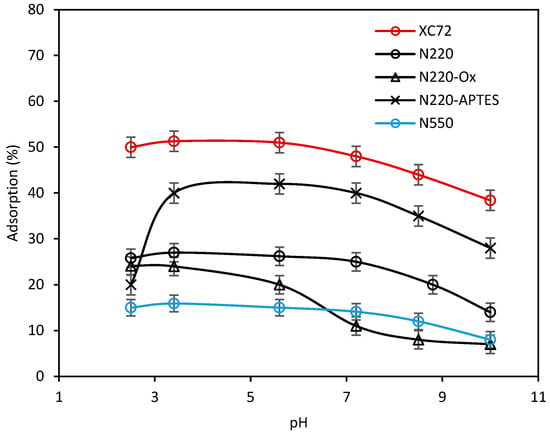
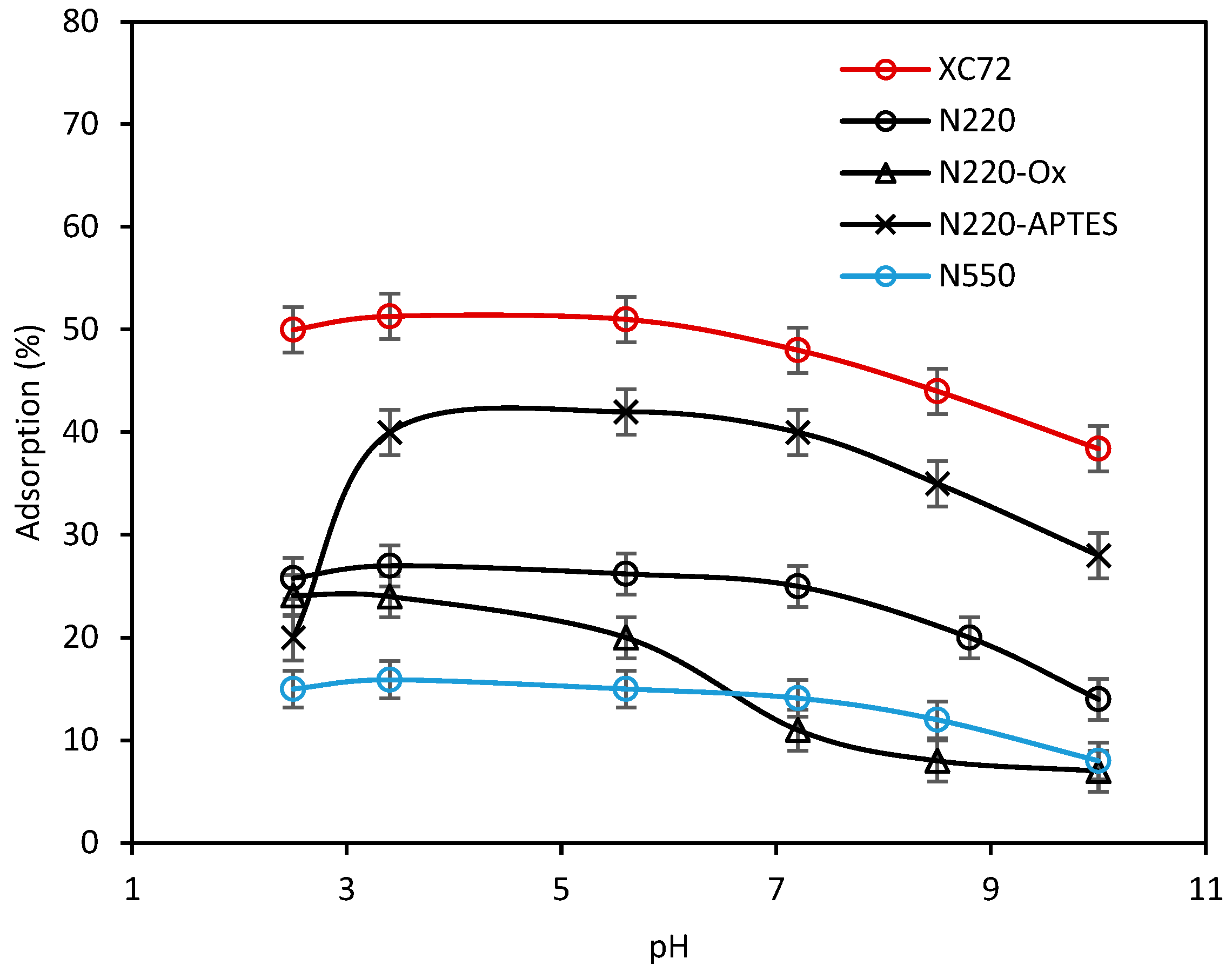
The effect of solution pH on the adsorption of ASA onto carbon blacks is shown in Figure 3.
Figure 3.
Influence of solution pH on the adsorption of ASA on carbon blacks.
The effect of pH on ASA adsorption is essentially the same for unmodified carbon blacks (XC72, N220, and N550). This is because their surfaces have comparable acid–base properties. Initially, in an acidic environment, adsorption remained constant. As the pH exceeded ~7 and the solution’s alkalinity increased, a slight decrease in adsorption efficiency was observed. Similar effects of solution pH on ASA adsorption were also reported for other adsorbents, including carbon nanotubes [28], and activated carbons prepared from rice hulls [29], lovegrass [30], and Casuarina equisetifolia fruit [31].
Understanding the pKa of the adsorbate and the pHPZC of the adsorbent helps explain this phenomenon. The pKa value for aspirin is 3.5 [8], which means in practice that at pH = 3.5, the concentrations of both the undissociated and dissociated drug are the same. At pH < 3.5, the undissociated ASA molecule predominates in the aqueous solution, and at pH > 3.5, the dissociated (anionic) species predominates. The pHPZC determined for XC72, N220, and N550 were 6.3, 6.6, and 6.3, respectively. This means that in an aqueous solution with a pH below pHPZC, the adsorbent surface is positively charged, whereas in a solution with a pH higher than pHPZC, a negative charge accumulates on the adsorbent surface.
In an acidic environment, where adsorption is constant and independent of pH changes, the surface of carbon black is positively charged. ASA, on the other hand, initially exists in its molecular form (at pH < pHPZC) and then, once the pKa is exceeded, in its dissociated form as a negative ion. A further increase in the solution’s pH (above the pHPZC) results in the adsorbent’s surface charge becoming negative. The observed effective adsorption under acidic conditions is therefore likely due to attractive electrostatic interactions between the positively charged carbon black surface and dissociated ASA molecules. In contrast, the slight decrease in adsorption observed in an alkaline environment results from repulsive electrostatic interactions between the negatively charged carbon black surface and the negatively charged ASA ions.
A similar electrostatic interaction mechanism likely occurs in the case of ASA adsorption on oxidized carbon black. ASA adsorption on N220-Ox was stable in an acidic environment, but decreased as the alkalinity of the solution increased. A similar phenomenon was reported by Ouasfi et al. [32], who studied the adsorption of ASA onto a carbonaceous material derived from algae (CMBB@H2SO4). This material exhibited properties similar to N220-Ox, characterized by strong acidity and low basicity (pHPZC = 2.8). It should be noted that the decrease in adsorption efficiency in a basic environment was much more significant for N220-Ox than for the three unmodified carbon blacks. This may be attributed to repulsive electrostatic interactions between the adsorbent and the adsorbate. This effect is further enhanced by the presence of oxygen-containing surface groups on the carbon black, which dissociate almost completely under these conditions. These groups block ASA molecules from accessing the active adsorption sites, thereby further reducing the adsorption efficiency.
The adsorption of ASA onto APTES-modified carbon black proceeds via a different mechanism (Figure 3). At the most acidic pH (2.5), adsorption is less effective; as the pH increases to approximately 3.5, adsorption increases significantly. Almost identical behavior of ASA in dependence on pH changes in this range was observed during the drug’s adsorption onto amine-modified silica [33]. The authors explain this phenomenon as resulting from the protonation of the amino group on the surface of the modified silicate, which limits the availability of the adsorbent’s binding sites. In the pH range from 3.5 to approximately 7, adsorption remained constant, and a further increase in pH (above 7) led to a gradual decrease in efficiency. The different behavior of N220-APTES towards aspirin may be attributed to the amino groups that are introduced onto the carbon black surface during the modification process. These groups are dissociated (–NH3+) in an acidic environment, and as the pH increases, they lose a proton and become neutral (–NH2). As shown in Figure 3, adsorption of ASA onto APTES-modified carbon black is therefore most favorable at a pH of approximately 3.5–7. Under these conditions, the ASA molecule exists in its dissociated (anionic) form, and the surface amino groups exist in their protonated (cationic) form. Attractive electrostatic interactions between the adsorbate and the adsorbent therefore occur under these conditions, promoting adsorption.
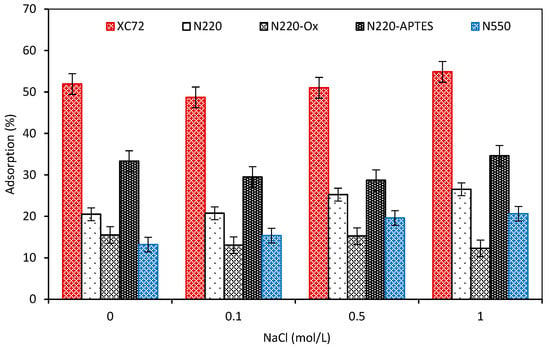
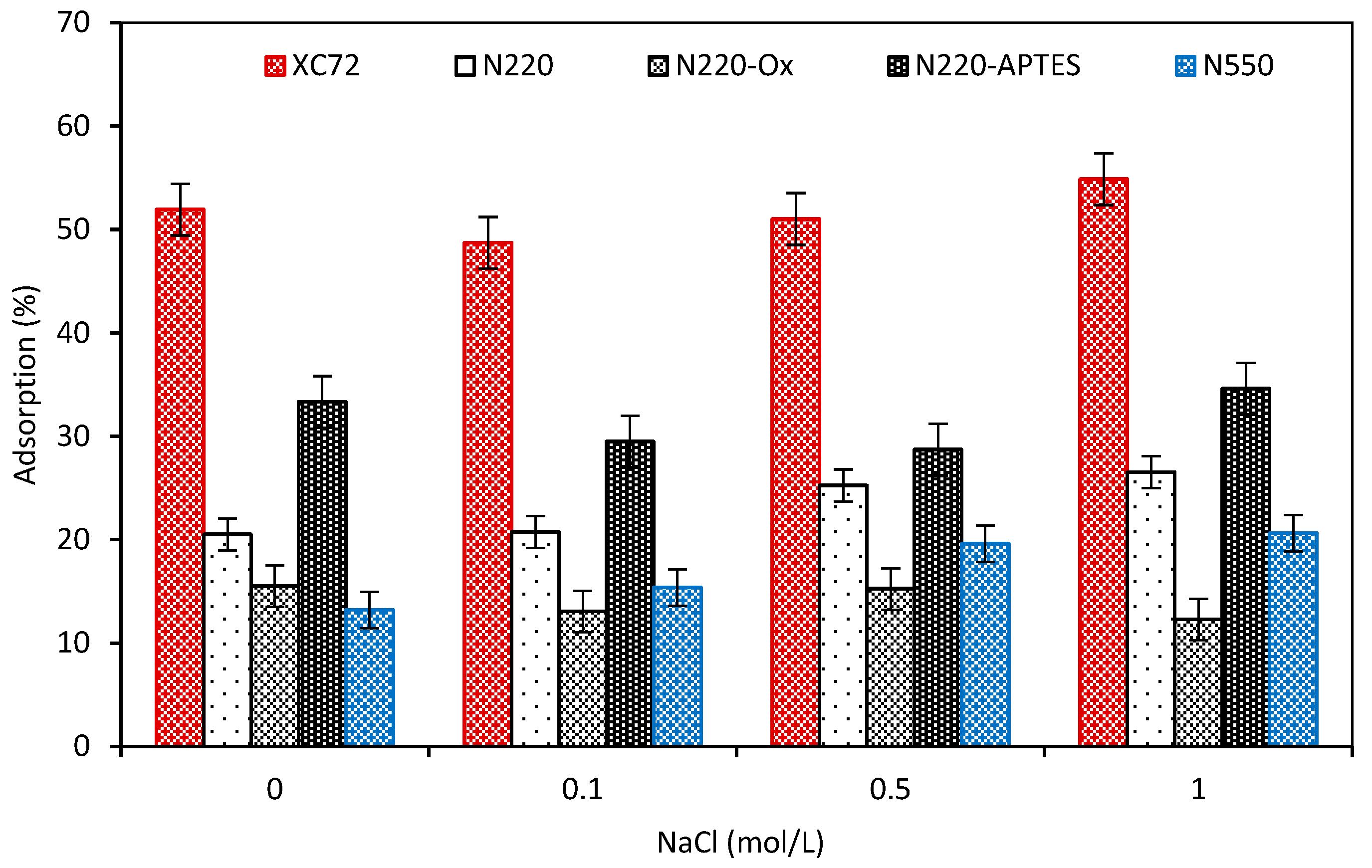
The adsorption of ASA from solutions containing various concentrations of sodium chloride (0–1.0 mol/L) is shown in Figure 4.
Figure 4.
Effect of solution ionic strength on the adsorption of ASA on carbon blacks.
The results suggest that the presence of inorganic salts, and therefore the solution’s ionic strength, has no impact on adsorption. Variations between individual results do not exceed 5%, suggesting that measurement errors, rather than actual changes in adsorption efficiency, account for the slight fluctuations observed. The effect of ionic strength on ASA adsorption has previously been investigated on carbon nanotubes [28] and graphene nanoplatelets [34]. The authors of these studies reported that ionic strength was not involved in the ASA adsorption process.
3.2.3. Effects of Contact Time and Adsorption Kinetics
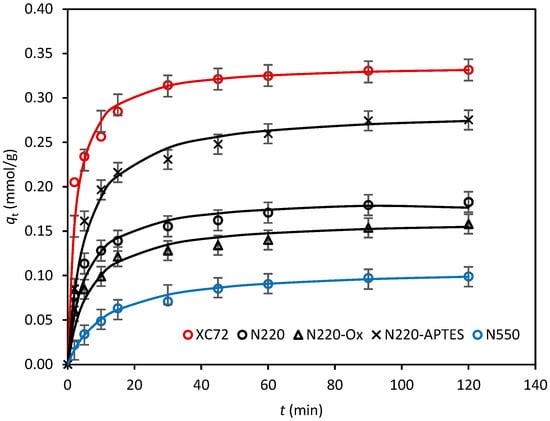
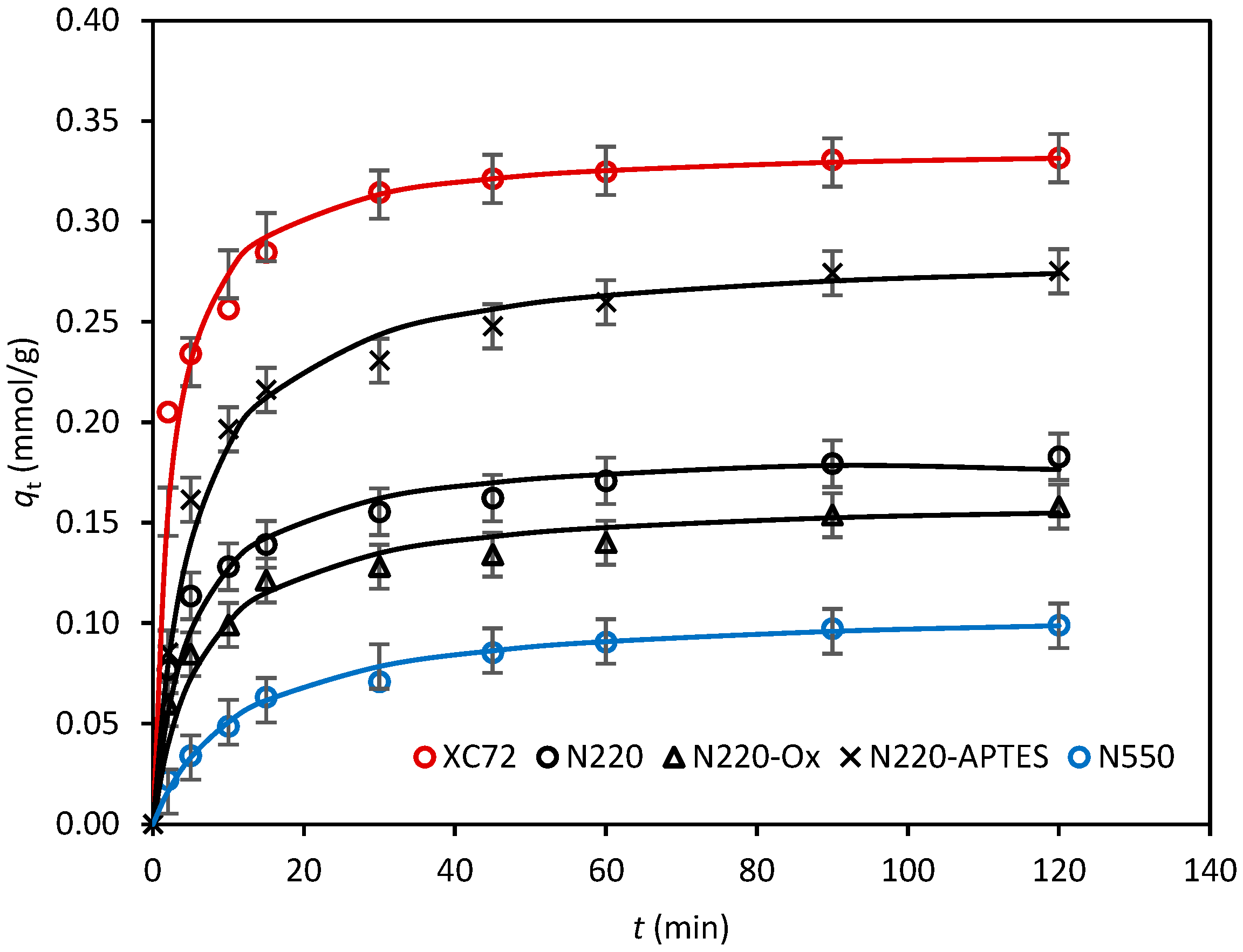
The effect of contact time on the adsorption of ASA on carbon blacks from aqueous solutions is listed in Figure 5. Adsorption of aspirin by carbon blacks increases until the adsorbent is fully saturated (after about 30–60 min), and no further changes are observed.
Figure 5.
Adsorption kinetics of ASA on the carbon blacks (the lines represent the model fitting of the PSO equation).
The two most commonly used kinetic models [35]—the pseudo-first-order (PFO) and the pseudo-second-order (PSO)—were applied to describe the experimental data obtained. The PFO and PSO equations can be expressed as follows:
After conversion, their non-linear forms are as follows:
where k1 (1/min) and k2 (g/mmol∙min) are the PFO and the PSO adsorption rate constants, respectively.
The values of k1 and k2 were determined by a nonlinear least-squares method using OriginPro 8.0 (OriginLab Corporation, Northampton, MA, USA). The kinetic rate constants and the adsorption capacities (qe(cal)) determined from both models are presented in Table 5.
Table 5.
The PFO and PSO kinetic parameters for the adsorption of ASA from aqueous solutions on carbon blacks.
The fit of a given model to the experimental data was assessed by the coefficient of determination (R2) and the root-mean-square error (RMSE) obtained for each model. These values were calculated using the following formulas [35]:
where qe(cal) is the adsorption capacity calculated from the theoretical model (PFO or PSO), qe(exp) is the experimental adsorption capacity, and n is the number of data.
The model is a better fit when the R2 values are higher (closer to 1), and the RMSE values are lower.
Analysis of the results presented in Table 5 shows that the adsorption of ASA on all of the carbon blacks studied followed the PSO model. For this model, higher R2 values and lower RMSE values were obtained. Furthermore, the qe(cal) values calculated using this model are closer to the experimentally determined adsorption capacities (qe(exp)).
Based on the k2 and qe(cal) values obtained from the PSO model, the time required to reach 50% of the adsorption capacity—referred to as the half-life (t1/2)—can be determined using the following formula:
It was found that, for non-modified carbon blacks XC72, N220, and N550, the 50% of the adsorption capacity was achieved after 2.3, 4.8, and 11.3 min, respectively. For N220-Ox and N220-APTES, the half-times were 6.2 and 5.2 min, respectively.
The adsorption rate constants (k2) increased in the following order: N-220-APTES < N550 < N220-Ox < N220 < XC72. Therefore, aspirin was adsorbed most rapidly onto XC72 carbon black and most slowly onto APTES-modified carbon black. However, if only unmodified carbon blacks are considered, the order is as follows: N550 < N220 < XC72. This order is not accidental and is closely correlated with their pore structure (Table 1). Generally, the greater the porosity of the adsorbent (i.e., the larger the pore volume and BET surface area), the greater its adsorption capacity. The type of pore is also important because, depending on their size (micro- or mesopores), they play a different role in the adsorption process. Micropores (pore diameter < 2 nm) are primarily responsible for adsorption (the adsorbate–adsorbent reaction), while mesopores (2–50 nm) mainly operate as transport pathways. A well-developed mesoporous structure in the adsorbent material is crucial for adsorbate transport and typically results in improved kinetic properties, i.e., the ability to uptake adsorbate from the liquid phase more quickly. The rate of ASA adsorption on unmodified carbon blacks observed in this study is therefore correlated with their porous structure—it increases with increasing mesopore volume. The N220-Ox and N220-APTES carbon blacks do not follow this trend. In this case, adsorption kinetics result from both textural properties and surface chemistry. The k2 values determined for N220-APTES and N220-Ox (0.701 ± 0.032 g/mmol∙min and 1.003 ± 0.050 g/mmol∙min, respectively) are significantly lower than those of the source material (N220). The presence of oxygen groups and APTES molecules on the adsorbent surface induces a steric effect, hindering the access of ASA molecules to the adsorbent’s active site. Consequently, the adsorption rate decreases.
The PSO model accurately described the adsorption of ASA onto carbon blacks, enabling a comparison of their kinetic properties. However, to understand the adsorption mechanism, diffusion models such as the Weber–Morris and Boyd models were necessary [36]. The Weber–Morris intraparticle diffusion model can be expressed using the following equation:
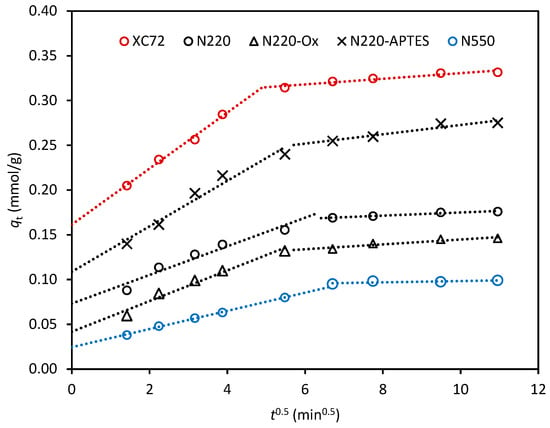
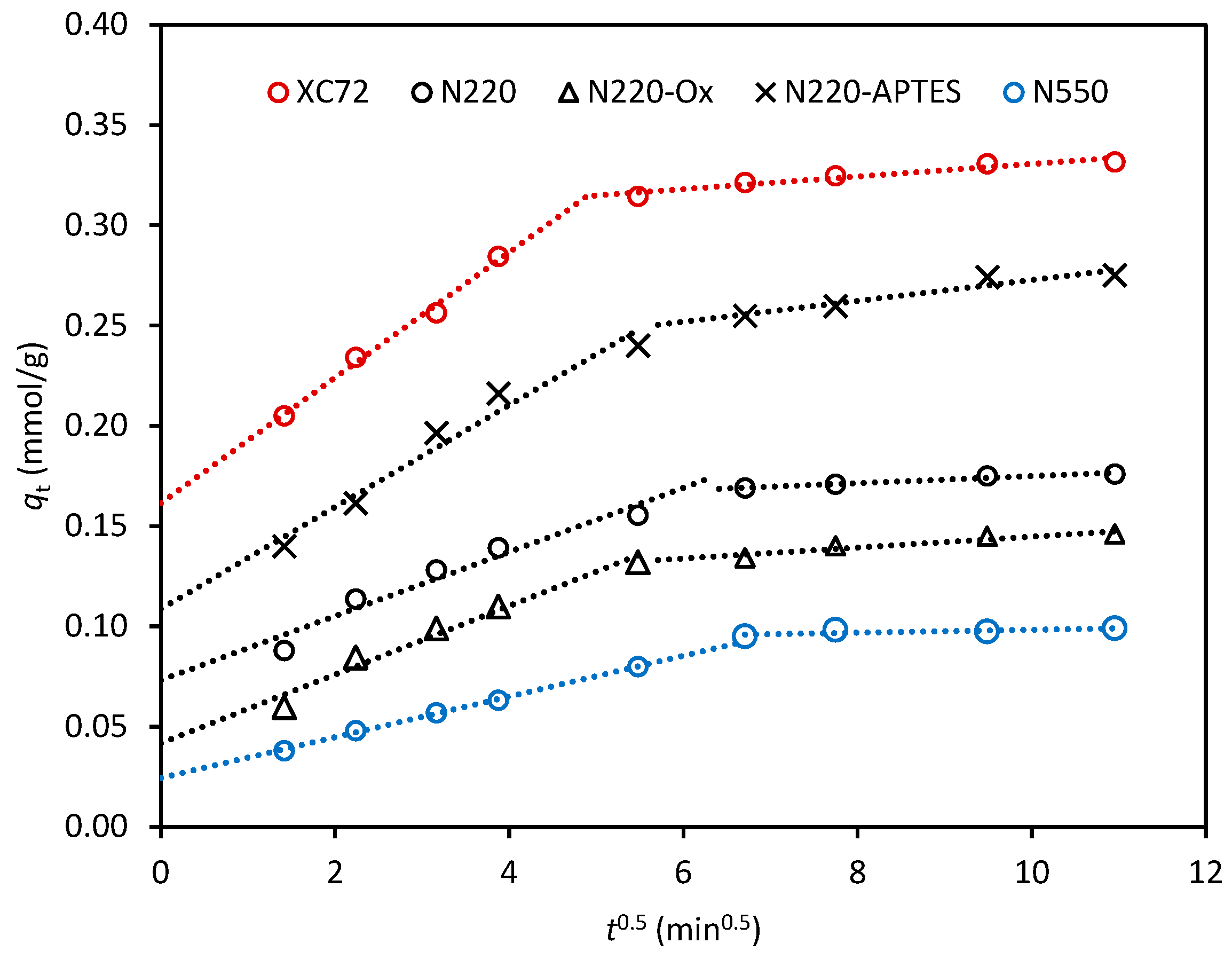
where kid and Ci are the model rate constant (mmol/g·min−0.5) and the model constant, respectively. The Weber–Morris plots are presented in Figure 6.
Figure 6.
Intraparticle diffusion model plots for the adsorption of ASA on carbon blacks.
The rate of the entire adsorption process depends on the rate of its slowest stage: film diffusion (diffusion through the boundary layer around the adsorbent) or intraparticle diffusion. The third stage, the surface reaction between the adsorbate and the adsorbent, occurs very quickly and does not affect the kinetics of adsorption. As shown in Figure 6, the relationship between qt and t0.5 is not linear (broken line), and none of the curves pass through the origin. The first step describes diffusion in the boundary layer, and the second step describes intraparticle diffusion. The calculated parameters of the Weber–Morris model, including Ci and the kid intraparticle diffusion rate constants for the two diffusion steps, are presented in Table 6.
Table 6.
The Weber–Morris intraparticle diffusion model constants.
In the W-M model, Ci is a measure of the importance of external diffusion resistance in the initial adsorption phase. Generally, the higher the Ci value, the thicker the boundary layer and the greater the resistance encountered by adsorbate molecules diffusing into the pores. As can be seen, the intra-particle diffusion rate constants for the first stage are approximately an order of magnitude higher than those for the second stage.
According to this model’s assumptions [36,37], the adsorption rate is determined by both film diffusion and intraparticle diffusion, with pore diffusion not being the main rate-limiting step.
The Boyd kinetic model (modified by Reichenberg) consists of two equations [38]:
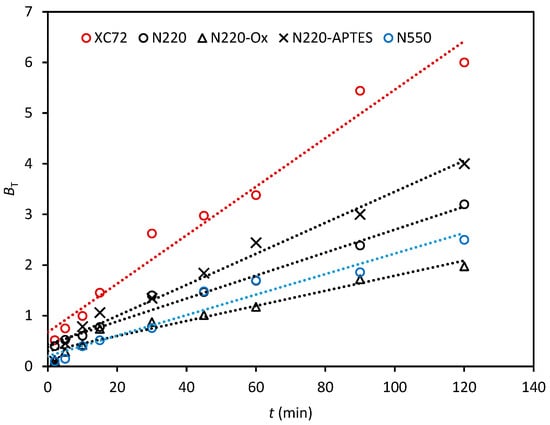
If qt/qe is less than 0.85, use Equation (13) to determine Boyd’s constant BT. If qt/qe exceeds 0.85, then Equation (14) should be applied. The Boyd plots are presented in Figure 7.
Figure 7.
The Boyd kinetic diffusion model plots for the adsorption of ASA on the carbon blacks.
This model assumes that if the plot of BT vs. t is linear and intersects the origin, intraparticle diffusion controls adsorption. Conversely, if the line does not pass through the origin, film diffusion dominates the adsorption rate [36]. As shown in Figure 7, the curves do not pass through the origin and are linear over their whole range. This confirms earlier observations that the kinetics of ASA adsorption on the carbon blacks may be attributed to film diffusion.
3.2.4. Adsorption Isotherms
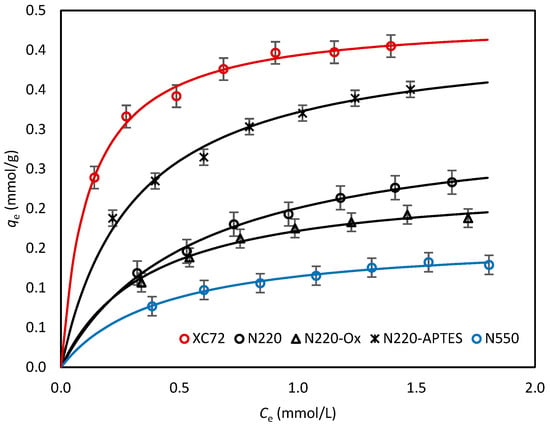
The ASA adsorption isotherms for carbon blacks from aqueous solutions are given in Figure 8.
Figure 8.
Adsorption isotherms of ASA on the carbon blacks (the lines represent the model fitting of the Langmuir equation).
The Freundlich, Langmuir, and Sips models [39] were applied to describe the experimental isotherms. The non-linear forms of these isotherms can be expressed as follows:
where KF ((mmol/g)(L/mmol1/n)) and 1/n (dimensionless) are the Freundlich relative adsorption capacity and heterogeneity factor, respectively; qmL (mmol/g) and KL (L/mmol) are the monolayer coverage capacity and the Langmuir constant, respectively; and the qmS (mmol/g), KS (L/mmol)m and m are the Sips maximum adsorption constants, Sips equilibrium constant and Sips model parameter, respectively.
All the isotherm parameters were calculated using a nonlinear least-squares method (OriginPro 8.0). The results are shown in Table 7. As before, the fit of each isotherm model was evaluated using R2 and RMSE.
Table 7.
Freundlich, Langmuir, and Sips isotherm parameters characterizing the adsorption of ASA from aqueous solutions onto carbon blacks.
Analysis of the R2 and RMSE values indicates that all models provided a fairly accurate description of the experimental data. The Langmuir equation yielded the lowest RMSE values and the R2 values closest to unity, suggesting that the adsorption of ASA on carbon blacks followed the Langmuir isotherm. However, this is not conclusive due to the minor differences among the three models. A comparison of qm parameters ranks the adsorbents used in this study as follows: N550 < N220-Ox < N220 < N220-APTES < XC72. For unmodified carbon blacks, there is a clear correlation between the specific surface area (SBET), total pore volume (VT), and adsorption capacity. The greater the porosity and specific surface area, the greater the adsorption capacity towards ASA. Therefore, adsorption is positively correlated with the porous structure of unmodified carbon blacks.
Using the Langmuir equation constant (KL), the Gibbs free energy of change (ΔGo) can be determined, providing information on the spontaneity and feasibility of the ASA adsorption process on carbon blacks. The value of ΔGo was calculated using this formula [40]:
where R is the universal gas constant (8.314 J/mol·K), and T is the temperature (23 °C) expressed in Kelvin (296.15 K).
The calculated ΔGo values for XC72, N220, N220-Ox, N220-APTES, and N550 were −32.2, −28.3, −29.3, −29.8, and −29.0 kJ/mol, respectively. A negative ΔGo value suggests that adsorption of ASA onto all carbon blacks was spontaneous.
The adsorption of aspirin from aqueous solutions occurs through three possible mechanisms: (1) electrostatic interactions, (2) hydrophobic interactions (van der Waals or π–π interactions), and (3) the formation of hydrogen bonds between the adsorbent and adsorbate [30,41,42]. For carbon blacks, it can be assumed that adsorption occurs in the same way, especially since, as described in Section 3.2.2, electrostatic interactions indeed play an important role in the adsorption process. The mechanism of ASA adsorption on porous carbonaceous adsorbents was discussed in detail in a review article [41].
The results showed that modification of carbon black with APTES significantly increases its adsorption capacity compared to the source material (N220). This is likely due to ionic interactions, primarily electrostatic attraction between the protonated amino groups of the adsorbent and the ionized carboxyl groups of ASA. Such an adsorption mechanism is especially favorable when the solution pH exceeds the pKa of ASA (when it exists in the dissociated form) and when the pH is lower than the pHPZC, which results in a positive charge on the adsorbent surface. Under such conditions, interactions occur between the dissociated (negatively charged) carboxyl groups of ASA and the positively charged amine groups (–NH3+) on the adsorbent surface (C6H4(OCOCH3)COO·····+H3N–carbon black). Similar findings (enhanced adsorption) have been reported by other authors in studies on ASA adsorption on amine-modified silica [31] and MCM-41 functionalized with aminopropyl groups [43].
The decrease in the adsorption capacity of N220-Ox compared to N220 is due to a decrease in its porosity during modification (oxidation) and the presence of acidic oxygen groups on its surface. Surface oxidation degrades the pore structure, reducing micropore volume. As a result of the increased concentration of oxygen groups, π electrons are removed from the carbon black structure, weakening the bond between the adsorbent and the adsorbate and thereby decreasing adsorption efficiency. Surface oxygen groups are hydrophilic, thereby increasing the adsorbent surface’s polarity. Consequently, the more polar water molecule will adsorb more easily onto the carbon black surface than the more hydrophobic ASA molecule. Hydrogen bonds will form more easily between the surface’s carboxyl groups and a water molecule than with an ASA molecule. This may also lead to the formation of water clusters that block micropores, thereby reducing the surface area available for ASA adsorption [44].
3.2.5. Comparison with Other Adsorbents
To accurately assess the adsorption capacities of the carbon blacks, it is necessary to compare their adsorption of aspirin with that of other adsorbents described in the literature. Such a comparison is presented in Table 8. Other carbon-based materials were selected as reference materials. Of course, this is only an indirect comparison, and it is imperfect because the adsorbents were evaluated under widely varying experimental conditions, including pH, initial concentration, temperature, equilibrium time, aqueous matrix, and the method used to calculate capacity. Consequently, the comparison serves as a general reference, but not as conclusive evidence of relative superiority or inferiority. Nevertheless, this gives some idea of the adsorption capacities of the activated carbons under study. A detailed comparison of the various adsorbents used for the removal of ASA from water can be found in the review article [41].
Table 8.
Comparison of aspirin adsorption on various carbonaceous adsorbents.
3.3. Regeneration of the Carbon Blacks
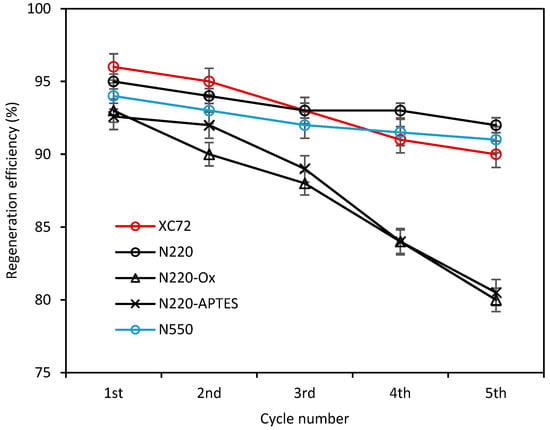
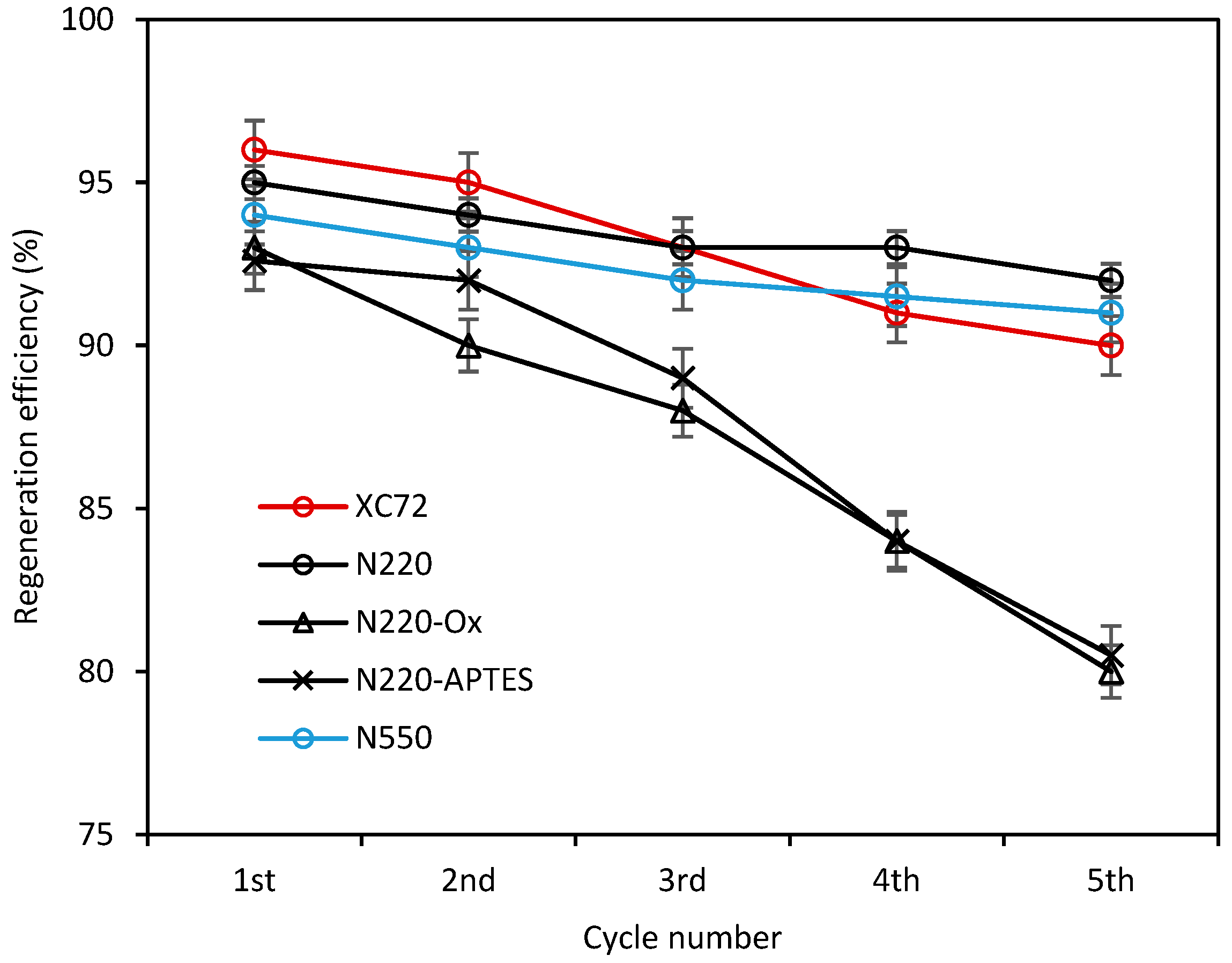
The literature data [32,33,42,47,51] show that the solvent elution method was most commonly used for ASA desorption. Therefore, in this paper, the regeneration of the carbon blacks was studied by using solvent elution with methanol as the desorbing agent. Five consecutive adsorption–desorption cycles were performed, and the results are shown in Figure 9.
Figure 9.
Regeneration of carbon blacks loaded with aspirin by successive adsorption–desorption cycles.
The adsorption effectiveness of unmodified carbon blacks after 5 regeneration cycles was ~90%. For surface-modified carbon blacks (N220-Ox and N220-APTES), approximately 80% efficiency was observed. This suggests that, in these two cases, adsorption is less reversible and ASA is more permanently bound to the adsorbent surface. For comparison, desorption efficiencies reported for MCM-41 encapsulated with graphene oxide and reduced graphene oxide were 74–80% and 76–84%, respectively, after 4 desorption cycles with acidic ethanol [51]. Hoppen et al. [47] reported that after the 3rd regeneration cycle, the adsorption capacity of activated carbon prepared from babassu coconut mesocarp was approximately 93%. The adsorption capacity of carbonaceous material from algae after 10 regeneration cycles, reported by Ouasfi et al. [32], was about 95%. The adsorption capacity of the amine-modified silica after 10 cycles decreased by 18.6% [33]. Wong et al. [42] reported that the ASA adsorption efficiency on spent tea leaves-derived activated carbon decreased from 98.6% (1st cycle) to 85.5% (6th cycle). The results obtained in this study (~80–90%) are therefore comparable to those reported by other authors and indicate that carbon blacks exhibit good stability and can be reused multiple times without a significant decrease in ASA adsorption efficiency. Of course, such a comparison is limited because it involves materials tested under different regeneration protocols (different desorbing agents), with different numbers of cycles, and with adsorbents of varying types. Additionally, the experiments were conducted in single-component systems at relatively high concentrations, in simple solutions, and under conditions far removed from those of actual wastewater or natural aquatic matrices. Moreover, from an environmental perspective and due to the relatively high costs involved, methanol (or other organic solvents) is not the best option. Therefore, if carbon blacks were to be used on a large scale, it would be necessary to develop a cheaper, more eco-friendly method for regenerating spent adsorbents.
4. Conclusions
This study investigated the adsorption of aspirin from aqueous solution onto three unmodified carbon blacks with different textural properties and two surface-modified carbon blacks. The surface of N220 carbon black was chemically modified to improve its adsorption properties by introducing specific functional groups. N220-Ox carbon black was oxidized with H2O2 to introduce acidic, oxygen-containing functional groups such as carboxyl (–COOH), hydroxyl (–OH), and carbonyl (C=O) groups onto its surface. N220-APTES carbon black was modified with 3-aminopropyltriethoxysilane (APTES) to introduce basic amine groups. The results showed that the adsorption equilibrium for ASA was reached after approximately 30–60 min. The adsorption kinetics followed a pseudo-second-order model. The Weber–Morris and Boyd analyses suggest that film diffusion made a major contribution to the overall rate control. For unmodified carbon blacks, a clear correlation was observed between the adsorption rate and the pore structure (mesopore volume) of the adsorbents. Under equilibrium conditions, the adsorption of ASA on carbon blacks was best described by the Langmuir isotherm model. The highest adsorption capacity (0.440 ± 0.018 mmol/g) was observed for carbon black XC72, which had the most developed porous structure, while the lowest capacity (0.160 ± 0.009 mmol/g) was observed for carbon black N550. For unmodified carbon blacks, adsorption was found to correlate with the total pore volume and BET surface area of the adsorbents. Surface functionalization with APTES increased the adsorption capacity of the carbon black (qm = 0.420 ± 0.019 mmol/g), whereas surface oxidation with H2O2 reduced adsorption efficiency (qm = 0.235 ± 0.009 mmol/g). The adsorption process depended on the solution pH—ASA was adsorbed most effectively at the natural (original) pH of ~3.5. The concentration of inorganic salts and, consequently, the ionic strength of the solution did not affect the adsorption of ASA onto the carbon blacks studied. Regeneration studies conducted over five cycles demonstrated good stability and reusability of these materials. Overall, the study showed that carbon blacks are promising adsorbents for the removal of aspirin from water. Therefore, further research into the practical/applied use of carbon blacks as alternative sorbents seems to be reasonable. For its potential practical application, e.g., in water treatment systems, the entire process must be optimized to maximize efficiency and minimize costs. The effects of competing ions and other organic compounds commonly present in wastewater, as well as the potential risk of secondary pollution, must be investigated. The desorption/regeneration of spent adsorbent and the replacement of methanol with a cheaper and more eco-friendly desorption method also require optimization.
Author Contributions
Conceptualization, K.K.; methodology, K.K. and A.Ś.; validation, K.K.; investigation, K.K.; resources, K.K. and A.Ś.; data curation, K.K. and A.Ś.; writing—original draft preparation, K.K. and A.Ś.; writing—review and editing, K.K. and A.Ś.; supervision, K.K. All authors have read and agreed to the published version of the manuscript.
Funding
The authors thank the MUT University grant UGB 22-094.
Data Availability Statement
The original contributions presented in this study are included in the article. Further inquiries can be directed to the corresponding author.
Acknowledgments
The authors of this paper would like to thank all those who contributed to the realization of this work.
Conflicts of Interest
The authors declare no conflicts of interest.
References
- Bashirynejad, B.; Soleymani, F.; Nikfar, S.; Kebriaeezadeh, A.; Majdzadeh, R.; Fatemi, B.; Zackery, A.; Zare, N. Trends analysis and future study of the pharmaceutical industry field: A scoping review. Daru J. Pharm. Sci. 2025, 33, 6. [Google Scholar] [CrossRef] [Scilit]
- Firmansyah, M.L.; Alwan, Y.; Ullah, N. A comprehensive review on the adsorptive removal of pharmaceutical pollutants: Occurrence, toxicology, molecular simulation and mechanistic insights. Talanta Open 2025, 12, 100491. [Google Scholar] [CrossRef] [Scilit]
- Munuhe, L.N.; Madivoli, E.S.; Nzilu, D.M.; Lemeitaron, P.N.; Kimani, P.K. Advances in Adsorbent Materials for Pharmaceutical Pollutant Removal: A Review of Occurrence, Fate, and State-of-the-Art Remediation. J. Chem. 2025, 2025, 4477822. [Google Scholar] [CrossRef] [Scilit]
- Ślósarczyk, K.; Jakóbczyk-Karpierz, S.; Różkowski, J.; Witkowski, A.J. Occurrence of Pharmaceuticals and Personal Care Products in the Water Environment of Poland: A Review. Water 2021, 13, 2283. [Google Scholar] [CrossRef] [Scilit]
- Zeeshan, M.; Hashmi, S.I.; Iqbal, A.; Khayyam, U.; Zahara, N.; Sillanpää, M. Occurrence and treatment of emerging contaminants in water: A comprehensive review. Chem. Eng. J. Adv. 2026, 25, 100994. [Google Scholar] [CrossRef] [Scilit]
- Estrada-Almeida, A.G.; Castrejón-Godínez, M.L.; Mussali-Galante, P.; Tovar-Sánchez, E.; Rodríguez, A. Pharmaceutical Pollutants: Ecotoxicological Impacts and the Use of Agro-Industrial Waste for Their Removal from Aquatic Environments. J. Xenobiot. 2024, 14, 1465–1518. [Google Scholar] [CrossRef] [Scilit] [PubMed]
- Aziz, K.; Raza, N.; Kanwal, N.; Khairy, M.; Ahmadi, Y.; Kim, K.-H. Recent advances in nanomaterial-based adsorbents for removal of pharmaceutical pollutants from wastewater. Mater. Horiz. 2025, 12, 6043. [Google Scholar] [CrossRef] [Scilit]
- Przedpełska, L.; Witczak, A.; Pokorska-Niewiada, K. Non-steroidal anti-inflammatory drugs as emerging water and food contaminants: Review. Rev. Environ. Sci. Biotechnol. 2025, 24, 571–605. [Google Scholar] [CrossRef] [Scilit]
- Onyekachukwu, E.; Nesbitt, H.; Tretsiakova-McNally, S.; Coleman, H. Low-Cost Adsorbents for the Removal of Pharmaceuticals from Surface Waters. Water 2025, 17, 2619. [Google Scholar] [CrossRef] [Scilit]
- Chaber-Jarlachowicz, P.; Gworek, B.; Kalinowski, R. Removal efficiency of pharmaceuticals during the wastewater treatment process: Emission and environmental risk assessment. PLoS ONE 2025, 20, e0331211. [Google Scholar] [CrossRef] [Scilit]
- Yamkelani Mlunguza, N.; Ncube, S.; Nokwethemba Mahlambi, P.; Chimuka, L.; Mzukisi Madikizela, L. Adsorbents and removal strategies of non-steroidal anti-inflammatory drugs from contaminated water bodies. J. Environ. Chem. Eng. 2019, 7, 103142. [Google Scholar] [CrossRef] [Scilit]
- Montuori, P.; Shojaeian, S.Z.; Pennino, F.; D’Angelo, D.; Sorrentino, M.; Di Sarno, S.; Nubi, R.; Nardo, A.; Triassi, M. Consumer awareness and knowledge regarding use of non-steroidal anti-inflammatory drugs (NSAIDs) in a metropolitan area. Front. Pharmacol. 2024, 15, 1362632. [Google Scholar] [CrossRef] [Scilit]
- Mechnou, I.; Benabdallah, A.; Chham, A.; Rachdi, Y.; Hlaibi, M.; El Kartouti, A.; Saleh, N. Activated carbons for effective pharmaceutical adsorption: Impact of feedstock origin, activation agents, adsorption conditions, and cost analysis. Result Eng. 2025, 27, 105966. [Google Scholar] [CrossRef] [Scilit]
- Sundar, S.; Jayaprakash, N.; Govindaraj, D. Carbon-based nanomaterials in the remediation of antibiotics from aquatic environments: Advances, mechanisms, and future perspectives. Environ. Pollut. Manag. 2026, 3, 99–116. [Google Scholar] [CrossRef] [Scilit]
- Donnet, J.-B.; Bansal, R.C.; Wang, M.-J. Carbon Black. Science and Technology, 2nd ed.; Marcel Dekker Inc.: New York, NY, USA, 1993. [Google Scholar]
- Singh, M.; Wal, R.L.V. Nanostructure Quantification of Carbon Blacks. C J. Carbon Res. 2019, 5, 2. [Google Scholar] [CrossRef] [Scilit]
- Khodabakhshi, S.; Fulvio, P.F.; Andreoli, E. Carbon black reborn: Structure and chemistry for renewable energy harnessing. Carbon 2020, 162, 604–649. [Google Scholar] [CrossRef] [Scilit]
- Andreu, A.; Stoeckli, H.F.; Bradley, R.H. Specific and non-specific interactions on non-porous carbon black surfaces. Carbon 2007, 45, 1854–1864. [Google Scholar] [CrossRef] [Scilit]
- Al-Hartomy, O.A.; Al-Solamy, F.; Al-Ghamdi, A.; Dishovsky, N.; Ivanov, M.; Mihaylov, M.; El-Tantawy, F. Influence of Carbon Black Structure and Specific Surface Area on the Mechanical and Dielectric Properties of Filled Rubber Composites. Int. J. Polym. Sci. 2011, 2011, 521985. [Google Scholar] [CrossRef] [Scilit]
- Schröder, A.; Klüppel, M.; Schuster, R.H. Characterisation of surface activity of carbon black and its relation to polymer-filler interaction. Macromol. Mater. Eng. 2007, 292, 885–916. [Google Scholar] [CrossRef] [Scilit]
- Zainol, M.M.; Abidin, A.Z.; Mustaffa, N.; Rahman, S.N.F.S.A.; Azli, A.A.M.; Mustapa, A.N.; Mamat, M.H.; Syed-Hassan, S.S.A.; Ali, N.H.N.; Ahmad, M.H.; et al. A review on carbon black production, properties, and its applications toward energy storage. Energy 2025, 340, 139123. [Google Scholar] [CrossRef] [Scilit]
- Zhang, X.; Cui, Y.; Lv, Z.; Li, M.; Ma, S.; Cui, Z.; Kong, Q. Carbon nanotubes, Conductive Carbon Black and Graphite Powder Based Paste Electrodes. Int. J. Electrochem. Sci. 2011, 6, 6063–6073. [Google Scholar] [CrossRef] [Scilit]
- Azman, A.; Ngadi, N.; Zaini, D.K.A.; Jusoh, M.; Mohamad, Z.; Arsad, A. Effect of Adsorption Parameter on the Removal of Aspirin Using Tyre Waste Adsorbent. Chem. Eng. Trans. 2019, 72, 157–162. [Google Scholar] [CrossRef] [Scilit]
- Legocka, I.; Kuśmierek, K.; Świątkowski, A.; Wierzbicka, E. Adsorption of 2,4-D and MCPA Herbicides on Carbon Black Modified with Hydrogen Peroxide and Aminopropyltriethoxysilane. Materials 2022, 15, 8433. [Google Scholar] [CrossRef] [Scilit]
- Thommes, M.; Kaneko, K.; Neimark, A.V.; Olivier, J.P.; Rodriguez-Reinoso, F.; Rouquerol, J.; Sing, K.S.W. Physisorption of gases, with special reference to the evaluation of surface area and pore size distribution (IUPAC Technical Report). Pure Appl. Chem. 2015, 87, 1051–1069. [Google Scholar] [CrossRef] [Scilit]
- Moreno-Castilla, M.; Ferro-Garcia, M.A.; Joly, J.P.; Bautista-Toledo, I.; Carrasco-Marin, F.; Rivera-Utrilla, J. Activated Carbon Surface Modifications by Nitric Acid, Hydrogen Peroxide, and Ammonium Peroxydisulfate Treatments. Langmuir 1995, 11, 4386–4392. [Google Scholar] [CrossRef] [Scilit]
- Gómez-Serrano, V.; Acedo-Ramos, M.; López-Peinado, A.J.; Valenzuela-Calahorro, C. Oxidation of activated carbon by hydrogen peroxide. Study of surface functional groups by FT-i.r. Fuel 1994, 73, 387–395. [Google Scholar] [CrossRef] [Scilit]
- Elamin, M.R.; Abdulkhair, B.Y.; Elzupir, A.O. Insight to aspirin sorption behavior on carbon nanotubes from aqueous solution: Thermodynamics, kinetics, influence of functionalization and solution parameters. Sci. Rep. 2019, 9, 12795. [Google Scholar] [CrossRef] [Scilit]
- Mukoko, T.; Mupa, M.; Guyo, U.; Dziike, F. Preparation of Rice Hull Activated Carbon for the Removal of Selected Pharmaceutical Waste Compounds in Hospital Effluent. J. Environ. Anal. Toxicol. 2015, S7, 1–9. [Google Scholar] [CrossRef]
- Cimirro, N.F.G.M.; Lima, E.C.; Cunha, M.R.; Dias, S.L.P.; Thue, P.S.; Mazzocato, A.C.; Dotto, G.L.; Gelesky, M.A.; Pavan, F.A. Removal of pharmaceutical compounds from aqueous solution by novel activated carbon synthesized from lovegrass (Poaceae). Environ. Sci. Pollut. Res. 2020, 27, 21442–21454. [Google Scholar] [CrossRef] [Scilit]
- Al-Ma’abreh, A.M.; Al-Essa, E.M.; Hmedat, D.A.; Edri, G.; Odeh, F.F.; Hamed, M. Green remediation: Casuarina equisetifolia fruit-based activated carbon for pharmaceutical removal. Sci. Prog. 2025, 108, 1–16. [Google Scholar] [CrossRef] [Scilit]
- Ouasfi, N.; Bouzekri, S.; Zbair, M.; Ahsaine, H.A.; Bakkas, S.; Bensitel, M.; Khamliche, L. Carbonaceous material prepared by ultrasonic assisted pyrolysis from algae (Bifurcaria bifurcata): Response surface modeling of aspirin removal. Surf. Interfaces 2019, 14, 61–71. [Google Scholar] [CrossRef] [Scilit]
- Danil de Namor, A.F.; Al Nuaim, M.; Fairclough, G.; Khalife, R.; Al Hakawati, N. Amine-modified silica for removing aspirin from water. Int. J. Environ. Sci. Technol. 2022, 19, 4143–4152. [Google Scholar] [CrossRef] [Scilit]
- Al-Khateeb, L.A.; Almotiry, S.; Abdel Salam, M. Adsorption of pharmaceutical pollutants onto graphene nanoplatelets. Chem. Eng. J. 2014, 248, 191–199. [Google Scholar] [CrossRef] [Scilit]
- Tan, K.L.; Hameed, B.H. Insight into the adsorption kinetics models for the removal of contaminants from aqueous solutions. J. Taiwan Inst. Chem. 2017, 74, 25–48. [Google Scholar] [CrossRef] [Scilit]
- Nasser, S.M.; Abbas, M.; Trari, M. Understanding the rate-limiting step adsorption kinetics onto biomaterials for mechanism adsorption control. Prog. React. Kinet. Mec. 2024, 49, 1–26. [Google Scholar] [CrossRef] [Scilit]
- Doczekalska, B.; Kuśmierek, K.; Świątkowski, A. The Adsorptive Removal of Paracetamol as a Model Pollutant from an Aqueous Environment Using Activated Carbons Made from Selected Nutshells as Agricultural Waste. Processes 2025, 13, 2198. [Google Scholar] [CrossRef] [Scilit]
- Yao, C.; Chen, T. A film-diffusion-based adsorption kinetic equation and its application. Chem. Eng. Res. Des. 2017, 119, 87–92. [Google Scholar] [CrossRef] [Scilit]
- Hamdaoui, O.; Naffrechoux, E. Modeling of adsorption isotherms of phenol and chlorophenols onto granular activated carbon. Part I. Two-parameter models and equations allowing determination of thermodynamic parameters. J. Hazard. Mater. 2007, 147, 381–394. [Google Scholar] [CrossRef] [Scilit]
- Zhou, X.; Zhou, X.X. The unit problem in the thermodynamic calculation of adsorption using the Langmuir equation. Chem. Eng. Commun. 2014, 201, 1459–1467. [Google Scholar] [CrossRef] [Scilit]
- Nordin, A.H.; Samad, N.A.; Paiman, S.H.; Noor, S.F.M.; Rushdan, A.I.; Ngadi, N. A mini review on aspirin removal by carbon/noncarbon-based adsorbents from aqueous solution. Mater. Today Proc. 2024, 96, 30–34. [Google Scholar] [CrossRef] [Scilit]
- Wong, S.L.; Noor, M.H.M.; Ngadi, N.; Inuwa, I.M.; Mat, R.; Amin, N.A.S. Aspirin Adsorption onto Activated Carbon Derived from Spent Tea Leaves: Statistical Optimization and Regeneration Study. Int. J. Environ. Res. 2021, 15, 413–426. [Google Scholar] [CrossRef] [Scilit]
- Datt, A.; El-Maazawi, I.; Larsen, S.C. Aspirin Loading and Release from MCM-41 Functionalized with Aminopropyl Groups via Co-condensation or Postsynthesis Modification Methods. J. Phys. Chem. C 2012, 116, 18358−18366. [Google Scholar] [CrossRef] [Scilit]
- Derylo-Marczewska, A.; Sternik, D.; Swiatkowski, A.; Kusmierek, K.; Gac, W.; Buczek, B. Adsorption of phenol from aqueous and cyclohexane solutions on activated carbons with differentiated surface chemistry. Thermochim. Acta 2022, 715, 179299. [Google Scholar] [CrossRef] [Scilit]
- Asmadi, M.; Amin, N.A.S.; Zainol, M.M.; Wahid, M.A.; Abdullah, S.; Khor, W.M. Activated Carbon Cryogel as a Potential Adsorbent for Removal of Aspirin. Chem. Eng. Trans. 2021, 83, 403–408. [Google Scholar] [CrossRef] [Scilit]
- Mandal, S.; Stephen, D.; Janardhanan, S.K. Activated carbon with composite pore structures made from peanut shell and areca nut fibers as sustainable adsorbent material for the efficient removal of active pharmaceuticals from aqueous media. RSC Sustain. 2024, 2, 3022–3035. [Google Scholar] [CrossRef] [Scilit]
- Hoppen, M.I.; Carvalho, K.Q.; Ferreira, R.C.; Passig, F.H.; Pereira, I.C.; Rizzo-Domingues, R.C.P.; Lenzi, M.K.; Bottini, R.C.R. Adsorption and desorption of acetylsalicylic acid onto activated carbon of babassu coconut mesocarp. J. Environ. Chem. Eng. 2018, 7, 102862. [Google Scholar] [CrossRef] [Scilit]
- da Costa, M.L.; Oviedo, L.R.; Pavoski, G.; Tenório, J.A.S.; Espinosa, D.C.R.; Moreno, Y.P.; Druzian, D.M.; Loureiro, S.N.; da Silva, W.L. A Novel Biochar from Agro-Industrial Waste: Synthesis, Characterization, and Application for Acetylsalicylic Acid Removal. ACS Omega 2025, 10, 57532−57544. [Google Scholar] [CrossRef] [Scilit] [PubMed]
- Narloch, I.; Wejnerowska, G.; Wojewódzki, P. Biosorption of Aspirin, Salicylic Acid, Ketoprofen, and Naproxen in Aqueous Solution by Walnut Shell Biochar: Characterization, Equilibrium, and Kinetic Studies. Molecules 2025, 30, 4731. [Google Scholar] [CrossRef] [Scilit]
- Wong, S.; Lee, Y.; Ngadi, N.; Inuwa, I.M.; Mohamed, N.B. Synthesis of activated carbon from spent tea leaves for aspirin removal. Chin. J. Chem. Eng. 2018, 26, 1003–1011. [Google Scholar] [CrossRef] [Scilit]
- Akpotu, S.O.; Moodley, B. Application of as-synthesised MCM-41 and MCM-41 wrapped with reduced graphene oxide/graphene oxide in the remediation of acetaminophen and aspirin from aqueous system. J. Environ. Manag. 2018, 209, 205–215. [Google Scholar] [CrossRef] [Scilit]

Disclaimer/Publisher’s Note: The statements, opinions and data contained in all publications are solely those of the individual author(s) and contributor(s) and not of MDPI and/or the editor(s). MDPI and/or the editor(s) disclaim responsibility for any injury to people or property resulting from any ideas, methods, instructions or products referred to in the content. |
© 2026 by the authors. Licensee MDPI, Basel, Switzerland. This article is an open access article distributed under the terms and conditions of the Creative Commons Attribution (CC BY) license.