Leak Detection in Pipe Systems Using Transients: A Statistical and Methodological Review


Abstract
1. Introduction
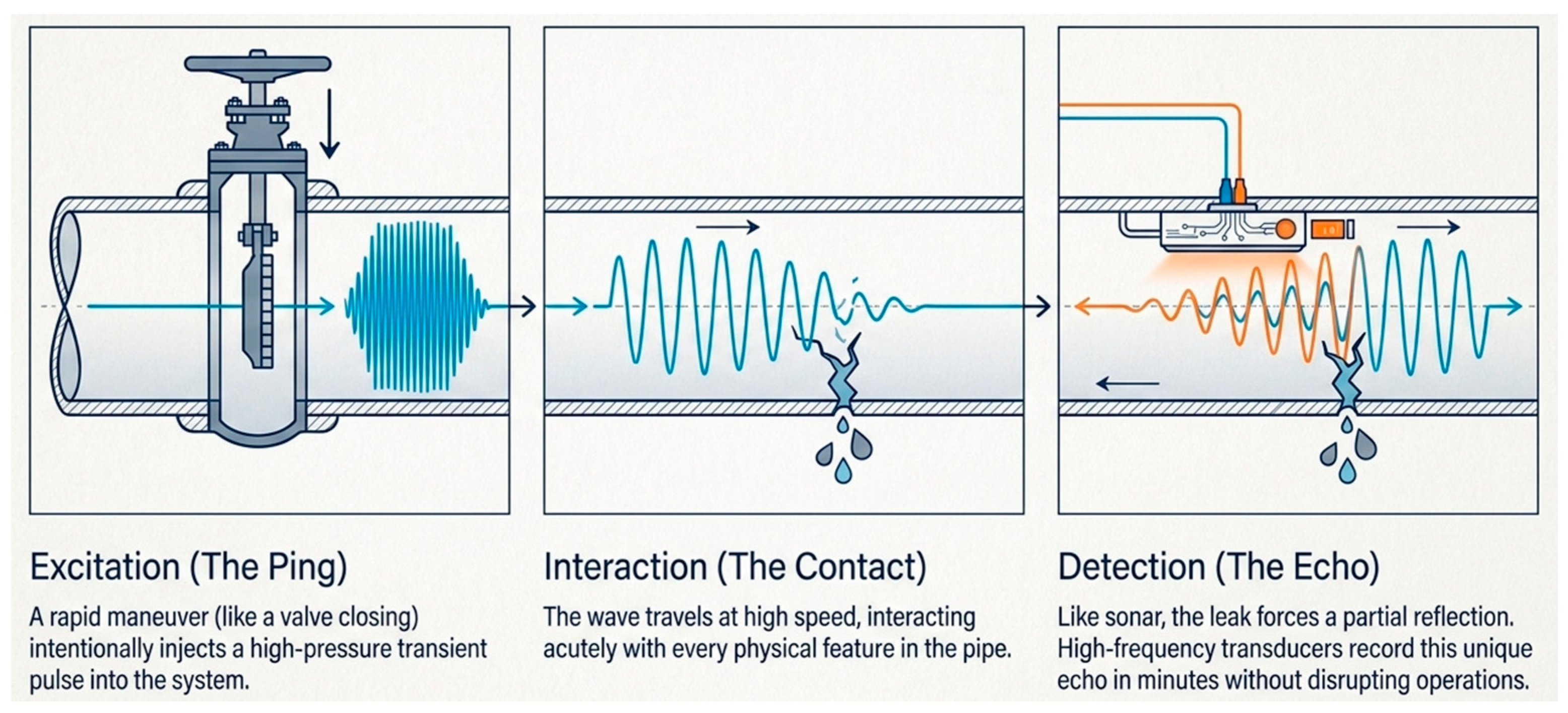
- Transient waves interact acutely with structural features such as bends, valves, blockage, and leaks. As a transient wave encounters a leak, it undergoes partial reflection and attenuation, resulting in distinctive alterations in the system’s pressure profile [5]. This sensitivity enables high-resolution leak detection by analyzing how pressure waves are distorted and reflected by anomalies.
- A primary benefit of transient-based methods is their efficiency in data utilization. Instead of requiring a network of continuously monitoring sensors, transient-based approaches leverage short, high-resolution data collected during transient events, typically within minutes. This data minimality reduces the need for extensive, costly sensor networks, enabling more streamlined sensor placement and overall cost savings [2]. This feature is particularly advantageous for large-scale or older infrastructure systems, where widespread sensor installation might be impractical or cost-prohibitive, and historical data is unavailable.
- Steady-state approaches rely on significant pressure differentials to reliably detect leaks, a requirement that limits their applicability in low-pressure systems. However, transient-based methods circumvent this issue by dynamically inducing high-pressure conditions [6]. These pressure pulses amplify the leak signal, making leaks detectable even in low-pressure scenarios.
- Steady-state models are prone to ill-posed conditions, where the low sensitivity of steady-state hydraulic equations, combined with minor inaccuracies in sensor data or model parameters, can lead to significant error propagation, compromising the accuracy of leak detection results [7]. In contrast, transient-based methods offer exceptional resolution by capturing the unique “fingerprints” of various system elements. Each wave’s interaction with pipeline features such as a junction, valve, or leak imprints a distinct pattern on the transient response [5]. This results in enhanced resolution for leaks, as transient waves provide specific information on the leak’s location, size, and nature. Additionally, transient-based methods can distinguish between different types of anomalies, such as blockages or structural faults, due to their sensitivity to the spatial arrangement of system components.
- Transient-based approaches are highly effective for non-destructive testing (NDT), enabling rapid assessment of pipeline conditions in minutes without relying on leak-free and extensive historical data or significantly disrupting regular operations [8]. Transient events, such as those induced by routine valve closures or pump operations during off-peak hours (e.g., midnight tests), facilitate real-time diagnostics without the need for extended shutdowns. This non-invasive capability makes transient methods particularly well-suited for in situ diagnostics.
2. Review Methodology
2.1. Literature Search and Selection
2.2. General Classification Framework
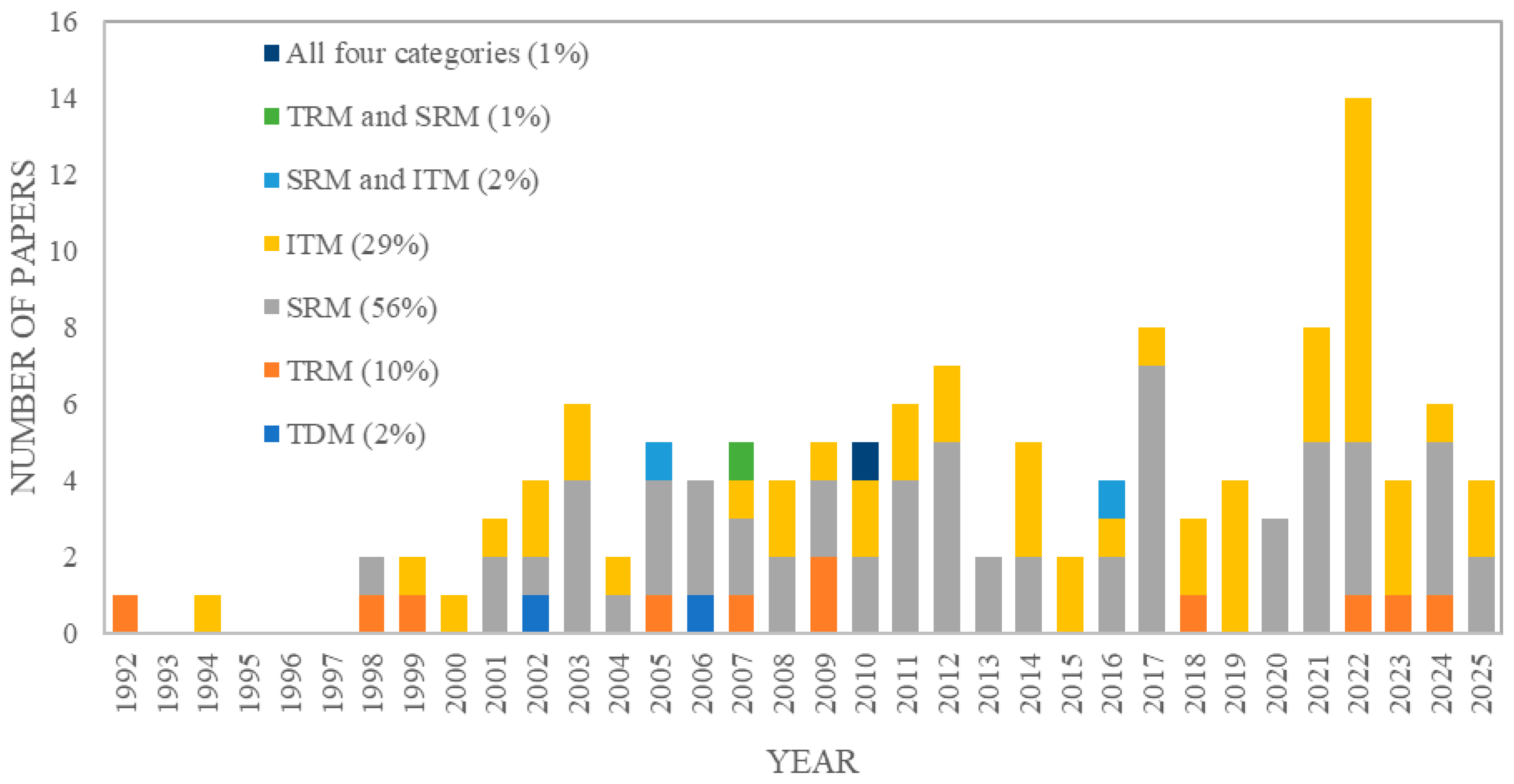
- Transient Damping Methods (TDMs);
- Transient Reflection Methods (TRMs);
- System Response Methods (SRMs);
- Inverse Transient Methods (ITMs).
2.3. Classification Based on Analysis Approach
- Model-Based Methods (time or frequency domains);
- Signal Processing Techniques;
- AI-Enhanced Methods.
2.4. Quantitative and Qualitative Analytical Approach
2.5. Comparative Evaluation of Methods
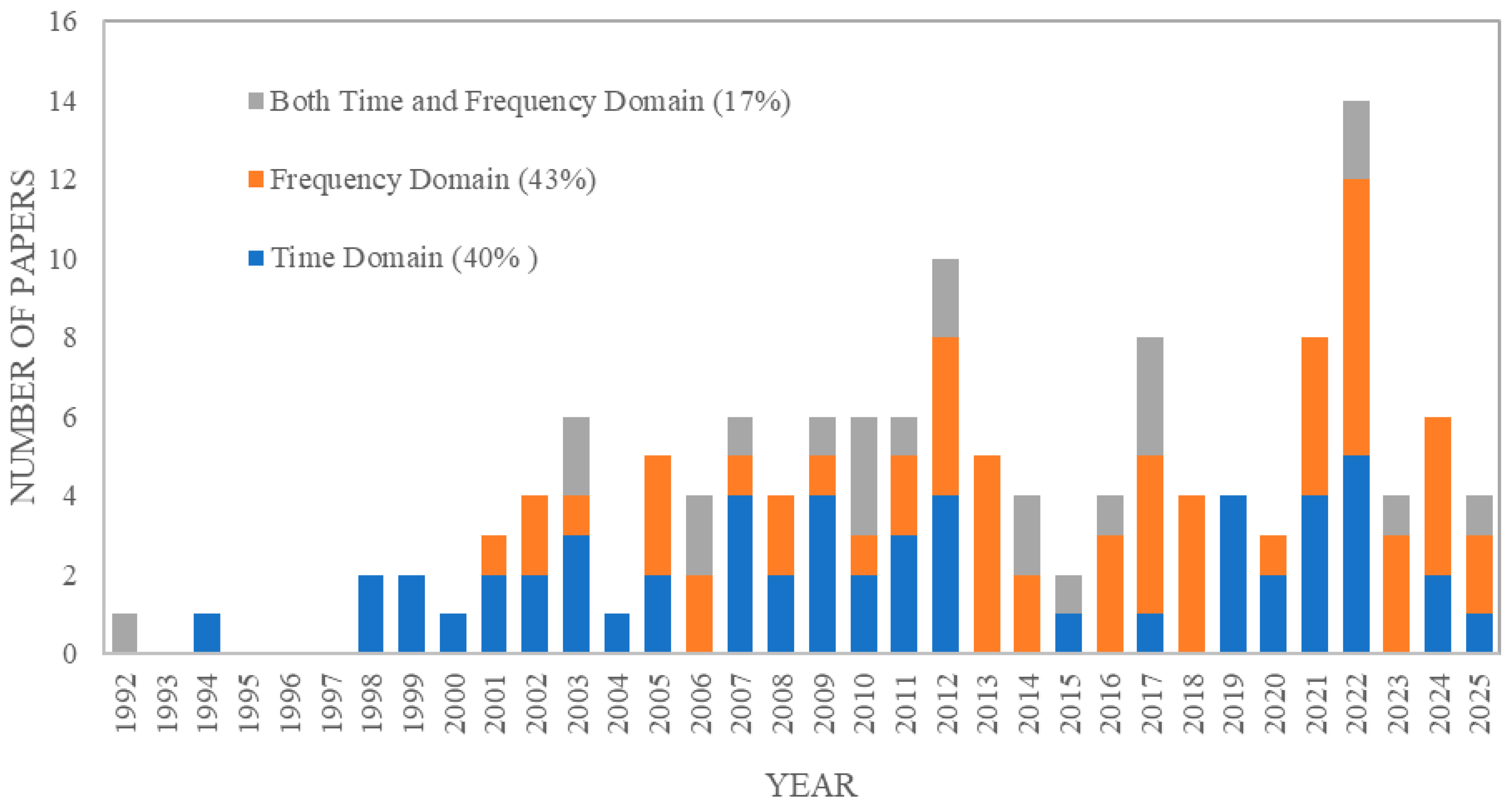
- Time vs. Frequency Domain Analysis: Examines real-time applicability of time-domain methods versus the accuracy of frequency-domain techniques in noisy environments.
- Single-Pipe vs. Network Applications: Evaluates effectiveness across network types, from simple pipelines to large, branched systems.
- Data Requirements: Analyze the data efficiency of transient-based methods.
- Scalability and Accuracy: Highlights models’ robustness in large networks with complex dynamics.
2.6. Identification of Research Gaps and Challenges
2.7. Future Directions
3. Transient Flow Governing Equations
3.1. Solving the Governing Equations in the Time Domain
3.2. Solving the Governing Equations in the Frequency Domain
4. General Classification of Transient-Based Leak Detection Methods
4.1. Transient Damping Methods (TDMs)
4.2. Transient Response Methods (TRMs)
4.3. Transient Reflection Methods (SRM)
4.4. Inverse Transient Methods (ITMs)
- A transient flow is induced by performing a rapid maneuver of a control valve.
- Transient pressure heads are measured at some sampling sites.
- The pipe system hydraulics is simulated as a function of unknown leaks.
- Using the measured data and numerical model responses, a nonlinear optimization problem is formulated. A least-squares criterion objective function is defined to evaluate the discrepancies between the measured and simulated pressure signals, with the leak parameters as the decision variables.
- An optimization solver is employed to minimize the objective function, iteratively adjusting leak parameters until the best fit between measured and simulated signals is achieved.
5. Classification Standpoints
5.1. Domains of Hydraulic Analysis (Time/Frequency)
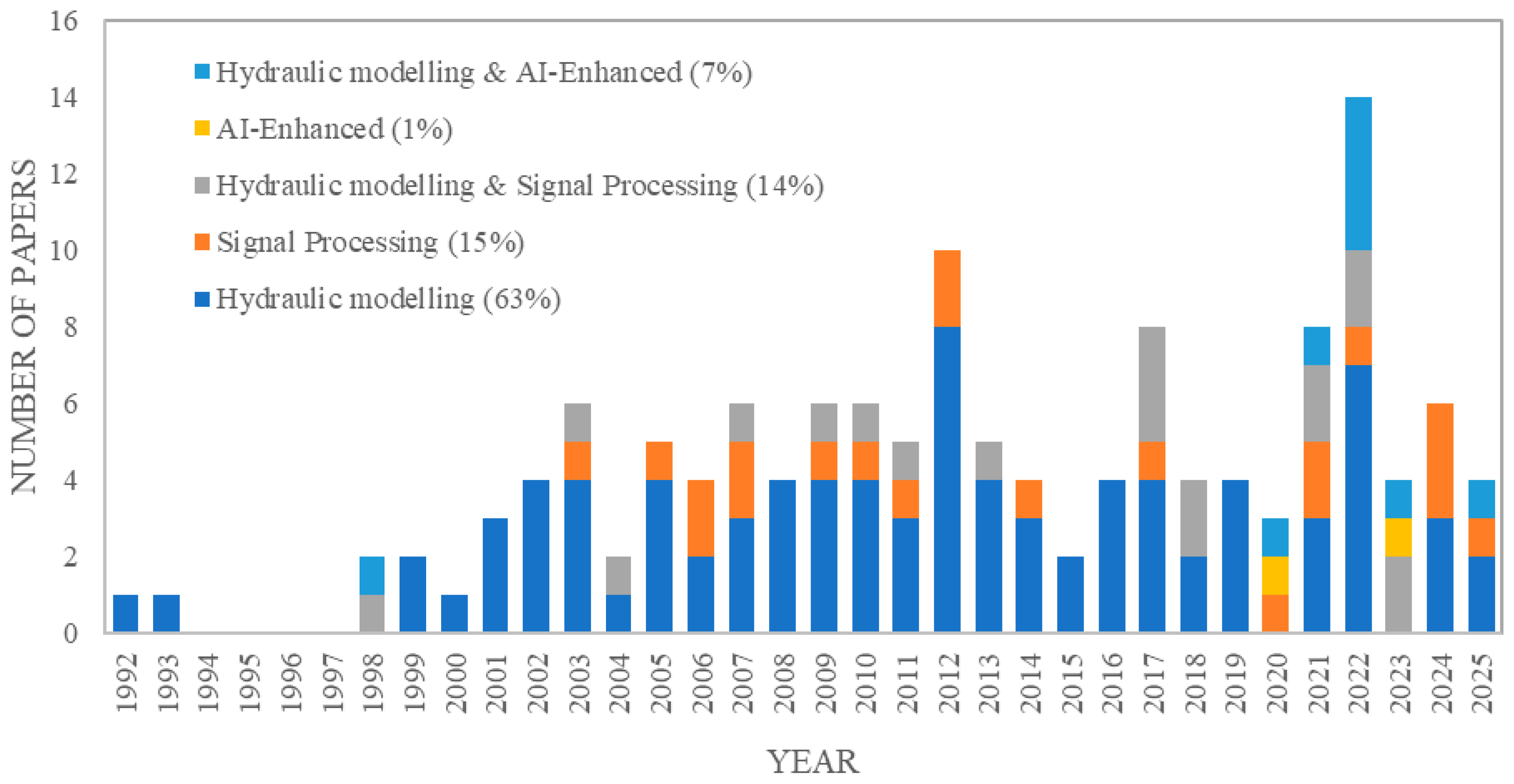
5.2. Analysis Approaches: Hydraulic Modeling, Signal Processing, and AI-Enhanced
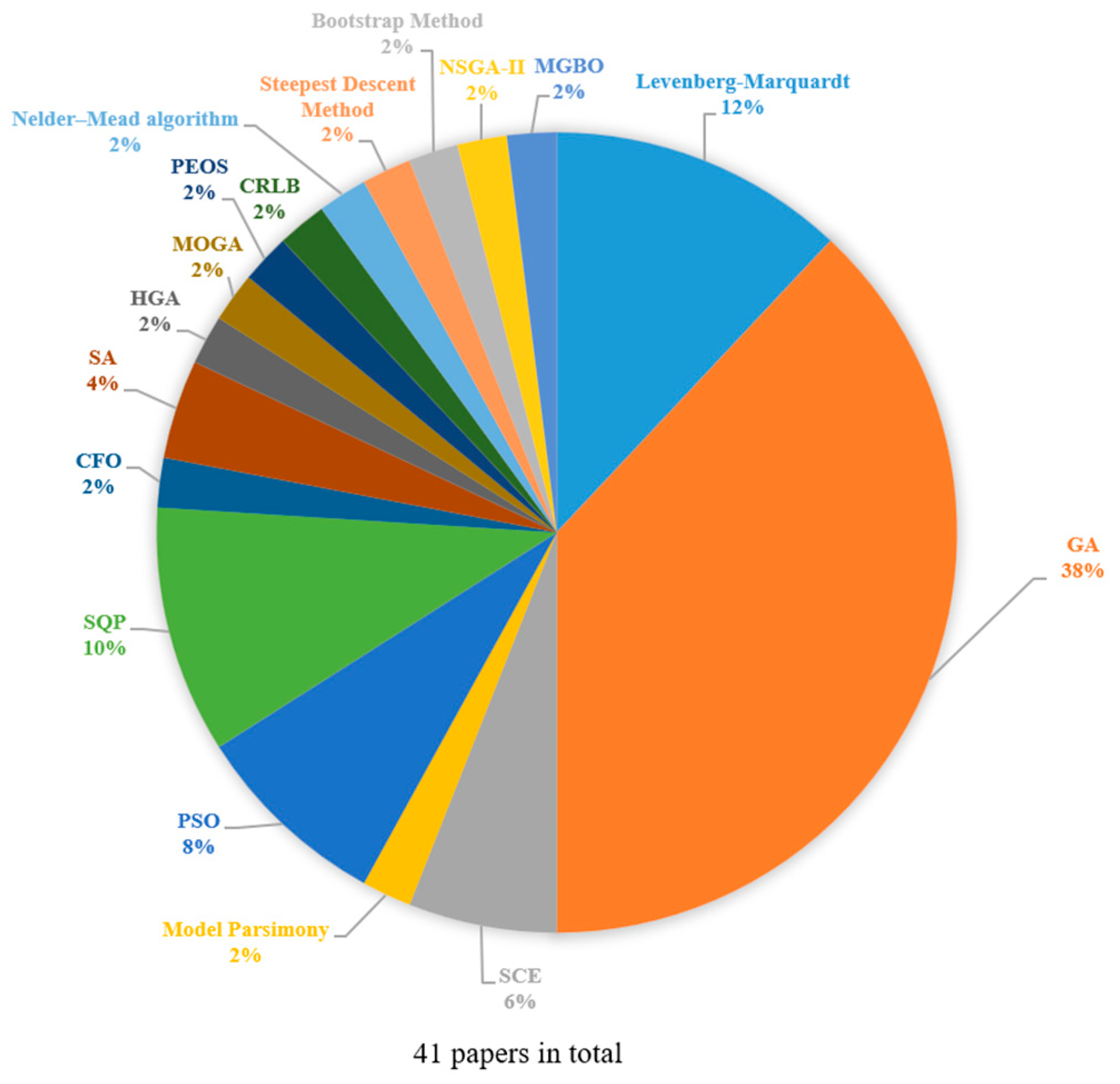
5.3. Applied Solver (Optimization) Techniques
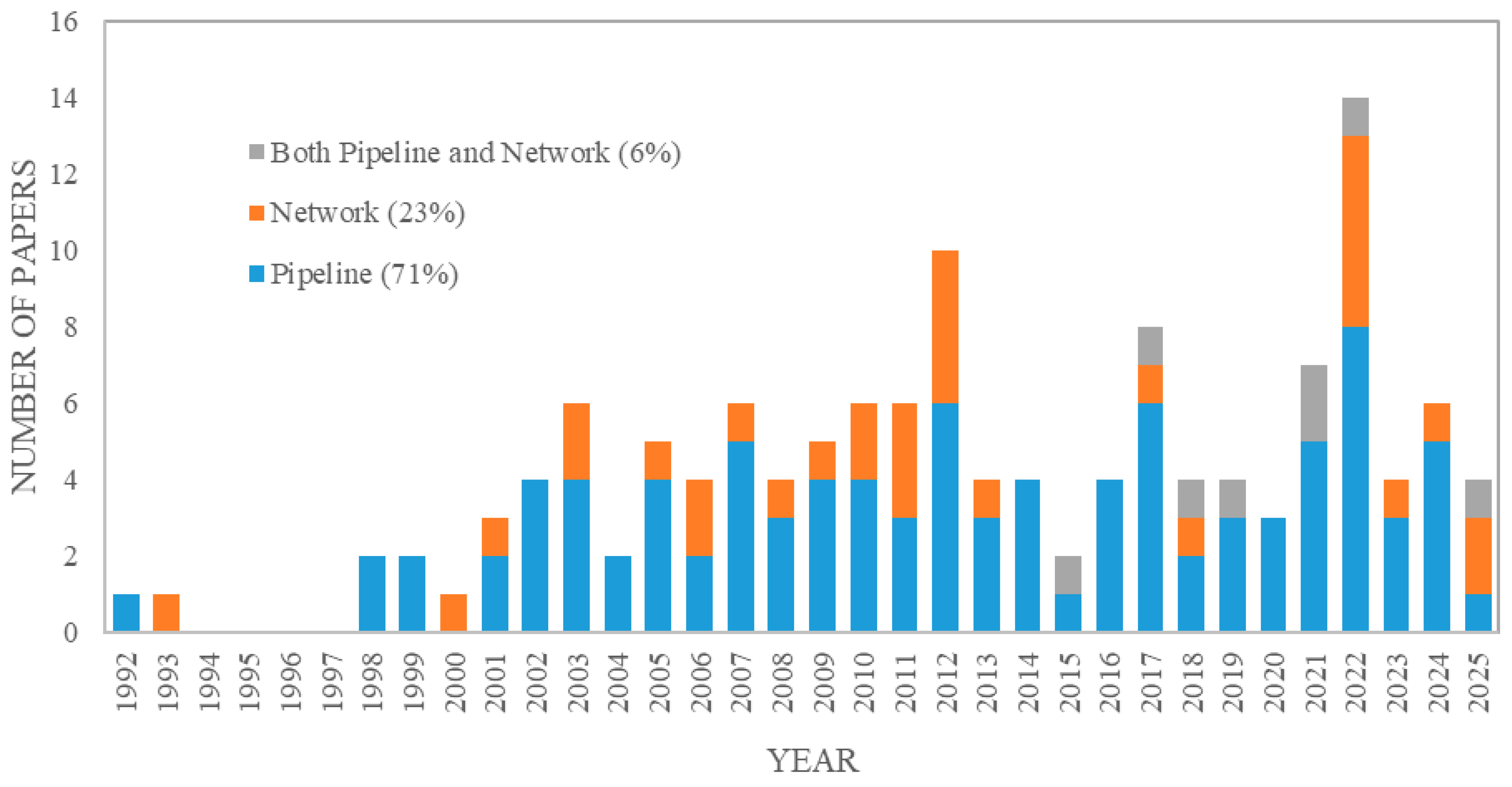
5.4. Topographic Complexity (Network/Pipeline)
5.5. Characterization of Leak Specifications: Single vs. Multiple Leaks, Location, and Intensity
5.6. Consideration of Noise and Uncertainty
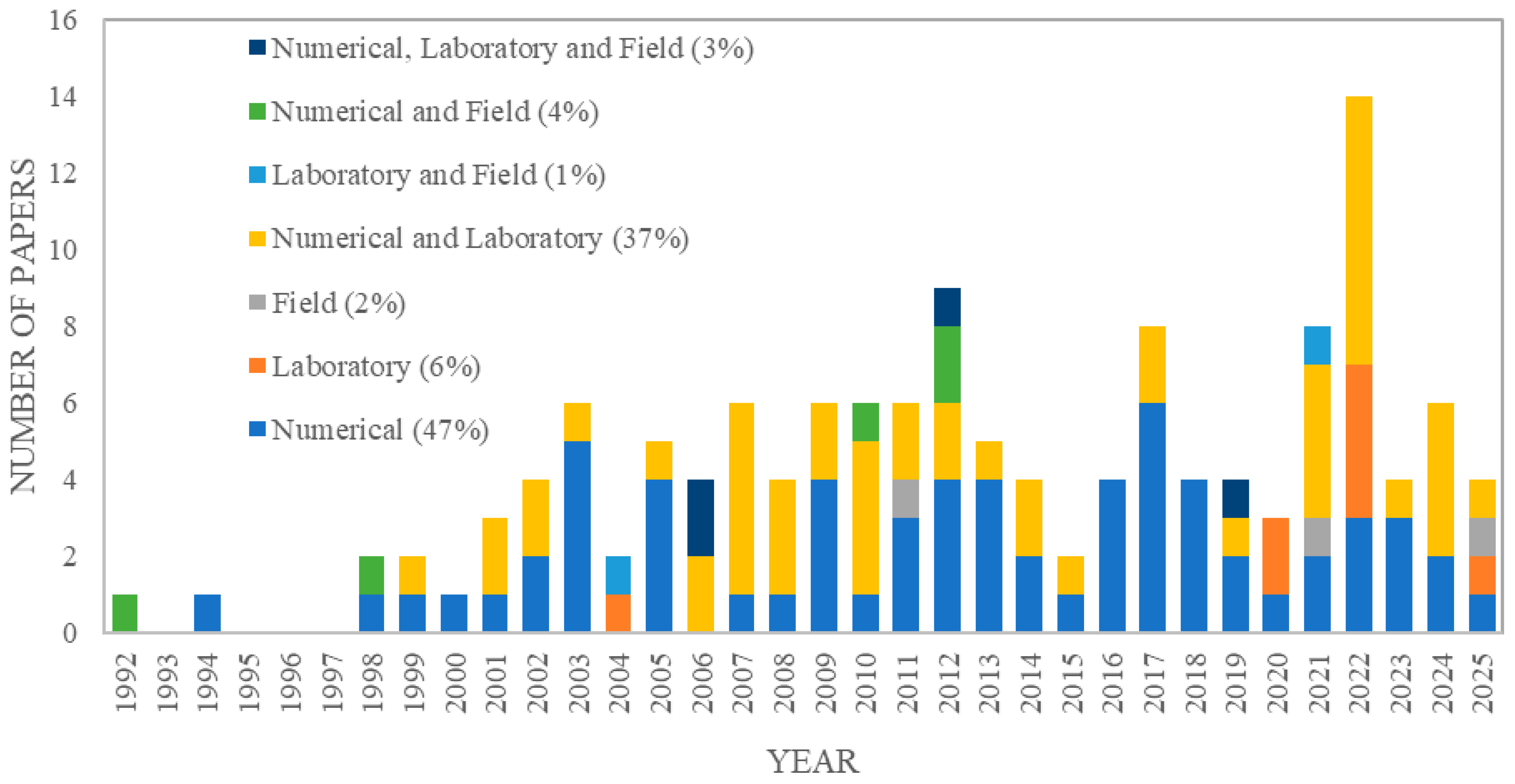
5.7. Validation Approach
5.8. Transient Test Considerations
6. Key Technical Challenges in Leak Detection Methods
6.1. Transient Excitation
6.2. Optimal Measurement Site Design
6.3. The Impact of Unsteady Friction and Viscoelasticity on Transient Modeling in Pressurized Pipe Networks
7. Conclusions
Supplementary Materials
Author Contributions
Funding
Data Availability Statement
Acknowledgments
Conflicts of Interest
References
- Ranginkaman, H.; Bakhshipour, A.E.; Haghighi, A.; Krumke, S.O.; Dittmer, U. Leak detection in water supply networks using inverse transient analysis in time and frequency domain: A comparative investigation. Front. Water 2025, 7, 1661148. [Google Scholar] [CrossRef]
- Ayati, A.H.; Haghighi, A. Multiobjective Wrapper Sampling Design for Leak Detection of Pipe Networks Based on Machine Learning and Transient Methods. J. Water Resour. Plan. Manag. 2023, 149, 04022076. [Google Scholar] [CrossRef]
- Sophocleous, S.; Savić, D.; Kapelan, Z. Leak Localization in a Real Water Distribution Network Based on Search-Space Reduction. J. Water Resour. Plan. Manag. 2019, 145, 04019024. [Google Scholar] [CrossRef]
- Chaudhry, M.H. Applied Hydraulic Transients; Springer: New York, NY, USA, 2014. [Google Scholar] [CrossRef]
- Xu, X.; Karney, B. An Overview of Transient Fault Detection Techniques. In Modeling and Monitoring of Pipelines and Networks: Advanced Tools for Automatic Monitoring and Supervision of Pipelines; Verde, C., Torres, L., Eds.; Springer International Publishing: Cham, Switzerland, 2017; pp. 13–37. [Google Scholar] [CrossRef]
- Haghighi, A.; Ramos, H.M. Detection of Leakage Freshwater and Friction Factor Calibration in Drinking Networks Using Central Force Optimization. Water Resour. Manag. 2012, 26, 2347–2363. [Google Scholar] [CrossRef]
- Zaman, D.; Tiwari, M.K.; Gupta, A.K.; Sen, D. A review of leakage detection strategies for pressurised pipeline in steady-state. Eng. Fail. Anal. 2020, 109, 104264. [Google Scholar] [CrossRef]
- Gong, J.; Lambert, M.; Zecchin, A.; Simpson, A.; Arbon, N.; Kim, Y.-I. Field study on non-invasive and non-destructive condition assessment for asbestos cement pipelines by time-domain fluid transient analysis. Struct. Health Monit. 2016, 15, 113–124. [Google Scholar] [CrossRef]
- Romero-Ben, L.; Alves, D.; Blesa, J.; Cembrano, G.; Puig, V.; Duviella, E. Leak detection and localization in water distribution networks: Review and perspective. Annu. Rev. Control 2023, 55, 392–419. [Google Scholar] [CrossRef]
- Wang, X.J.; Simpson, A.R.; Lambert, M.F.; Vitkovsky, J.P. Leak detection in pipeline systems and networks: A review. In Proceedings of the 6th Conference on Hydraulics in Civil Engineering: The State of Hydraulics; Institution of Engineers: Barton, Australia, 2001; p. 391. [Google Scholar]
- Williams, J.A.; Kozak, S.; Rodenbaugh, T.J. Leak Location Methods for HV Underground Cables. IEEE Trans. Power Appar. Syst. 1983, PAS-102, 2029–2037. [Google Scholar] [CrossRef]
- Liou, C.P. Mass Imbalance Error of Waterhammer Equations and Leak Detection. J. Fluids Eng. 1994, 116, 103–109. [Google Scholar] [CrossRef]
- Fukushima, K.; Maeshima, R.; Kinoshita, A.; Shiraishi, H.; Koshijima, I. Gas pipeline leak detection system using the online simulation method. Comput. Chem. Eng. 2000, 24, 453–456. [Google Scholar] [CrossRef]
- Nash, G.A.; Karney, B.W. Efficient inverse transient analysis in series pipe systems. J. Hydraul. Eng. 1999, 125, 761–764. [Google Scholar] [CrossRef]
- Pudar, R.S.; Liggett, J.A. Leaks in Pipe Networks. J. Hydraul. Eng. 1992, 118, 1031–1046. [Google Scholar] [CrossRef]
- Brunone, B. Transient test-based technique for leak detection in outfall pipes. J. Water Resour. Plan. Manag. 1999, 125, 302–306. [Google Scholar] [CrossRef]
- Covas, D.; Ramos, H. Leakage detection in single pipelines using pressure wave behaviour. In Water Industry System: Modelling and Optimisation Application; Research Studies Press: Baldock, UK, 1999; Volume 1, pp. 287–299. [Google Scholar]
- Mpesha, W.; Gassman, S.L.; Chaudhry, M.H. Leak Detection in Pipes by Frequency Response Method. J. Hydraul. Eng. 2001, 127, 134–147. [Google Scholar] [CrossRef]
- Belsito, S.; Lombardi, P.; Andreussi, P.; Banerjee, S. Leak detection in liquefied gas pipelines by artificial neural networks. AIChE J. 1998, 44, 2675–2688. [Google Scholar] [CrossRef]
- Colombo, A.F.; Lee, P.; Karney, B.W. A selective literature review of transient-based leak detection methods. J. Hydro-Environ. Res. 2009, 2, 212–227. [Google Scholar] [CrossRef]
- Covas, D.; Ramos, H. Hydraulic transients used for leakage detection in water distribution systems. In Proceedings of the 4th International Conference on Water Pipeline Systems; BHR Group: Bedford, UK, 2001; pp. 227–241. [Google Scholar]
- Beck, S.B.; Curren, M.D.; Sims, N.D.; Stanway, R. Pipeline Network Features and Leak Detection by Cross-Correlation Analysis of Reflected Waves. J. Hydraul. Eng. 2005, 131, 715–723. [Google Scholar] [CrossRef]
- Wang, X.-J.; Lambert, M.F.; Simpson, A.R.; Liggett, J.A.; Vitkovsky, J.P. Leak Detection in Pipelines using the Damping of Fluid Transients. J. Hydraul. Eng. 2002, 128, 697–711. [Google Scholar] [CrossRef]
- Puust, R.; Kapelan, Z.; Savic, D.A.; Koppel, T. A review of methods for leakage management in pipe networks. Urban Water J. 2010, 7, 25–45. [Google Scholar] [CrossRef]
- Pilcher, R.; Hamilton, S.; Chapman, H.; Field, D.; Ristovski, B.; Stapely, S. Leak Location and Repair Guidance Notes; International Water Association: London, UK, 2007; p. 16. [Google Scholar]
- Ferrante, M.; Brunone, B. Pipe system diagnosis and leak detection by unsteady-state tests. 1. Harmonic analysis. Adv. Water Resour. 2003, 26, 95–105. [Google Scholar] [CrossRef]
- Kapelan, Z.S.; Savic, D.A.; Walters, G.A. A hybrid inverse transient model for leakage detection and roughness calibration in pipe networks. J. Hydraul. Res. 2003, 41, 481–492. [Google Scholar] [CrossRef]
- Misiunas, D.; Vitkovsky, J.; Olsson, G.; Simpson, A.; Lambert, M. Pipeline break detection using pressure transient monitoring. J. Water Resour. Plan. Manag. 2005, 131, 316–325. [Google Scholar] [CrossRef]
- Mounce, S.R.; Machell, J. Burst detection using hydraulic data from water distribution systems with artificial neural networks. Urban Water J. 2006, 3, 21–31. [Google Scholar] [CrossRef]
- Brunone, B.; Ferrante, M. Pressure waves as a tool for leak detection in closed conduits. Urban Water J. 2004, 1, 145–155. [Google Scholar] [CrossRef]
- Brunone, B.; Ferrante, M. Detecting leaks in pressurised pipes by means of transients. J. Hydraul. Res. 2001, 39, 539–547. [Google Scholar] [CrossRef]
- Farley, B.; Boxall, J.B.; Mounce, S.R. Optimal Locations of Pressure Meters for Burst Detection. In Water Distribution Systems Analysis; ASCE: Reston, VA, USA, 2008. [Google Scholar] [CrossRef]
- Cascetta, F.; Vigo, P. Location and Assessment of Water Leakage. Meas. Control 1992, 25, 269–275. [Google Scholar] [CrossRef]
- Muggleton, J.; Brennan, M. Axisymmetric wave propagation in buried, fluid-filled pipes: Effects of wall discontinuities. J. Sound Vib. 2005, 281, 849–867. [Google Scholar] [CrossRef]
- Datta, S.; Sarkar, S. A review on different pipeline fault detection methods. J. Loss Prev. Process Ind. 2016, 41, 97–106. [Google Scholar] [CrossRef]
- Lile, N.L.T.; Jaafar, M.H.M.; Roslan, M.R.; Azmi, M.S.M. Blockage detection in circular pipe using vibration analysis. Int. J. Adv. Sci. Eng. Inf. Technol. 2012, 2, 252–255. [Google Scholar] [CrossRef][Green Version]
- Duan, W.; Kirby, R.; Prisutova, J.; Horoshenkov, K.V. On the use of power reflection ratio and phase change to determine the geometry of a blockage in a pipe. Appl. Acoust. 2015, 87, 190–197. [Google Scholar] [CrossRef]
- Wang, X.; Lennox, B.; Turner, J.; Lewis, K.; Ding, Z.; Short, G.; Dawson, K. Blockage detection in long lengths of pipeline using a new acoustic method. In Proceeding of 16th International Congress on Sound and Vibration, ICSV16, Kraków, Poland; International Institute of Acoustics and Vibration: Auburn, AL, USA, 2009; Volume 1, pp. 140–147. [Google Scholar]
- Sun, L.; Chang, N. Integrated-signal-based leak location method for liquid pipelines. J. Loss Prev. Process Ind. 2014, 32, 311–318. [Google Scholar] [CrossRef]
- Qu, Z.; Feng, H.; Zeng, Z.; Zhuge, J.; Jin, S. A SVM-based pipeline leakage detection and pre-warning system. Measurement 2010, 43, 513–519. [Google Scholar] [CrossRef]
- Huang, S.-C.; Lin, W.-W.; Tsai, M.-T.; Chen, M.-H. Fiber optic in-line distributed sensor for detection and localization of the pipeline leaks. Sensors Actuators A Phys. 2007, 135, 570–579. [Google Scholar] [CrossRef]
- Lay-Ekuakille, A.; Vendramin, G.; Trotta, A. Spectral analysis of leak detection in a zigzag pipeline: A filter diagonalization method-based algorithm application. Measurement 2009, 42, 358–367. [Google Scholar] [CrossRef]
- Gupta, A.; Kulat, K.D. A Selective Literature Review on Leak Management Techniques for Water Distribution System. Water Resour. Manag. 2018, 32, 3247–3269. [Google Scholar] [CrossRef]
- Khulief, Y.A.; Khalifa, A.; Ben Mansour, R.; Habib, M.A. Acoustic Detection of Leaks in Water Pipelines Using Measurements inside Pipe. J. Pipeline Syst. Eng. Pract. 2012, 3, 47–54. [Google Scholar] [CrossRef]
- Ozevin, D.; Harding, J. Novel leak localization in pressurized pipeline networks using acoustic emission and geometric connectivity. Int. J. Press. Vessel. Pip. 2012, 92, 63–69. [Google Scholar] [CrossRef]
- Fan, C.; Sun, F.; Yang, L. Investigation on nondestructive evaluation of pipelines using infrared thermography. In 2005 Joint 30th International Conference on Infrared and Millimeter Waves and 13th International Conference on Terahertz Electronics; IEEE: Piscataway, NJ, USA, 2005; Volume 2, pp. 339–340. [Google Scholar] [CrossRef]
- Covas, D.; Stoianov, I.; Mano, J.F.; Ramos, H.; Graham, N.; Maksimovic, C. The dynamic effect of pipe-wall viscoelasticity in hydraulic transients. Part II—Model development, calibration and verification. J. Hydraul. Res. 2005, 43, 56–70. [Google Scholar] [CrossRef]
- Liggett, J.A.; Chen, L.-C. Inverse Transient Analysis in Pipe Networks. J. Hydraul. Eng. 1994, 120, 934–955. [Google Scholar] [CrossRef]
- Ye, G.; Fenner, R.A. Kalman Filtering of Hydraulic Measurements for Burst Detection in Water Distribution Systems. J. Pipeline Syst. Eng. Pract. 2011, 2, 14–22. [Google Scholar] [CrossRef]
- Bokde, N.; Asencio-Cortés, G.; Martínez-Álvarez, F.; Kulat, K. PSF: Introduction to R Package for Pattern Sequence Based Forecasting Algorithm. R J. 2017, 9, 324–333. [Google Scholar] [CrossRef]
- Ayati, A.H.; Haghighi, A.; Lee, P. Statistical Review of Major Standpoints in Hydraulic Transi-ent-Based Leak Detection. J. Hydraul. Struct. 2019, 5, 1–26. [Google Scholar] [CrossRef]
- Duan, H.-F.; Pan, B.; Wang, M.; Chen, L.; Zheng, F.; Zhang, Y. State-of-the-art review on the transient flow modeling and utilization for urban water supply system (UWSS) management. J. Water Supply Res. Technol. 2020, 69, 858–893. [Google Scholar] [CrossRef]
- Che, T.-C.; Duan, H.-F.; Lee, P.J. Transient wave-based methods for anomaly detection in fluid pipes: A review. Mech. Syst. Signal Process. 2021, 160, 107874. [Google Scholar] [CrossRef]
- Colebrook, C.F. Turbulent Flow in Pipes, with Particular Reference to the Transition Region Between the Smooth-and Rough-Pipe Laws. J. Inst. Civ. Eng. 1939, 12, 133–156. [Google Scholar] [CrossRef]
- Brunone, B.; Golia, U.M.; Greco, M. Effects of Two-Dimensionality on Pipe Transients Modeling. J. Hydraul. Eng. 1995, 121, 906–912. [Google Scholar] [CrossRef]
- Bergant, A.; Simpson, A.R.; Vìtkovsk, J. Developments in unsteady pipe flow friction modelling. J. Hydraul. Res. 2001, 39, 249–257. [Google Scholar] [CrossRef]
- Wylie, E.B.; Streeter, V.L. Fluid Transient; McGraw-Hill International Book Co.: New York, NY, USA, 1978; Volume 1. [Google Scholar]
- Wylie, E.B.; Streeter, V.L. Fluid Transients in Systems; Prentice Hall: Englewood Cliffs, NJ, USA, 1993. [Google Scholar]
- Wang, X.-J.; Lambert, M.F.; Simpson, A.R. Detection and Location of a Partial Blockage in a Pipeline Using Damping of Fluid Transients. J. Water Resour. Plan. Manag. 2005, 131, 244–249. [Google Scholar] [CrossRef]
- Nixon, W.; Ghidaoui, M.S.; Kolyshkin, A.A. Range of Validity of the Transient Damping Leakage Detection Method. J. Hydraul. Eng. 2006, 132, 944–957. [Google Scholar] [CrossRef]
- Duan, H.-F.; Lee, P.J.; Ghidaoui, M.S.; Tung, Y.-K. Essential system response information for transient-based leak detection methods. J. Hydraul. Res. 2010, 48, 650–657. [Google Scholar] [CrossRef]
- Jönsson, L.; Larson, M. Leak Detection through Hydraulic Transient Analysis. In Pipeline Systems; Coulbeck, B., Evans, E.P., Eds.; Springer: Dordrecht, The Netherlands, 1992; pp. 273–286. [Google Scholar] [CrossRef]
- Lee, P.J.; Lambert, M.F.; Simpson, A.R.; Vítkovsky, J.P.; Misiunas, D. Leak location in single pipelines using transient reflections. Australas. J. Water Resour. 2007, 11, 53–65. [Google Scholar] [CrossRef]
- Ferrante, M.; Brunone, B.; Meniconi, S. Wavelets for the Analysis of Transient Pressure Signals for Leak Detection. J. Hydraul. Eng. 2007, 133, 1274–1282. [Google Scholar] [CrossRef]
- Ferrante, M.; Brunone, B.; Meniconi, S. Leak-edge detection. J. Hydraul. Res. 2009, 47, 233–241. [Google Scholar] [CrossRef]
- Ferrante, M.; Brunone, B.; Meniconi, S. Leak detection in branched pipe systems coupling wavelet analysis and a Lagrangian model. J. Water Supply Res. Technol. 2009, 58, 95–106. [Google Scholar] [CrossRef]
- Zhang, Y.; Duan, H.-F.; Keramat, A.; Che, T.-C. On the leak-induced transient wave reflection and dominance analysis in water pipelines. Mech. Syst. Signal Process. 2022, 167, 108512. [Google Scholar] [CrossRef]
- Duan, H.-F. Accuracy and Sensitivity Evaluation of TFR Method for Leak Detection in Multiple-Pipeline Water Supply Systems. Water Resour. Manag. 2018, 32, 2147–2164. [Google Scholar] [CrossRef]
- Li, J.; Wu, Y.; Lu, C. Pipeline leak detection using the multiple signal classification-like method. J. Hydroinform. 2020, 22, 1321–1337. [Google Scholar] [CrossRef]
- Mpesha, W.; Chaudhry, M.H.; Gassman, S.L. Leak detection in pipes by frequency response method using a step excitation. J. Hydraul. Res. 2002, 40, 55–62. [Google Scholar] [CrossRef]
- Ayati, A.H.; Haghighi, A.; Ghafouri, H.R. Machine Learning–Assisted Model for Leak Detection in Water Distribution Networks Using Hydraulic Transient Flows. J. Water Resour. Plan. Manag. 2022, 148, 04021104. [Google Scholar] [CrossRef]
- Lee, P.J.; Vítkovský, J.P.; Lambert, M.F.; Simpson, A.R.; Liggett, J. Leak location in pipelines using the impulse response function. J. Hydraul. Res. 2007, 45, 643–652. [Google Scholar] [CrossRef]
- Vitkovsky, J.P.; Lee, P.J.; Stephens, M.L.; Lambert, M.F.; Simpson, A.R.; Liggett, J.A.; Cabrera, E. Leak and blockage detection in pipelines via an impulse response method. In Pumps, Electromechanical Devices and Systems Applied to Urban Water Management; Swets & Zeitlinger: Lisse, The Netherlands, 2003; Volume 1, pp. 423–430. [Google Scholar]
- Duan, H.F.; Lee, P.J. Transient-Based Frequency Domain Method for Dead-End Side Branch Detection in Reservoir Pipeline-Valve Systems. J. Hydraul. Eng. 2016, 142, 04015042. [Google Scholar] [CrossRef]
- Duan, H.-F.; Lee, P.J.; Ghidaoui, M.S.; Tung, Y.-K. System Response Function–Based Leak Detection in Viscoelastic Pipelines. J. Hydraul. Eng. 2012, 138, 143–153. [Google Scholar] [CrossRef]
- Lee, P.J. Leak location using the pattern of the frequency response diagram in pipelines: A numerical study. Shock. Vib. Dig. 2006, 38, 248–249. [Google Scholar] [CrossRef]
- Liao, Z.; Yan, H.; Tang, Z.; Chu, X.; Tao, T. Deep learning identifies leak in water pipeline system using transient frequency response. Process. Saf. Environ. Prot. 2021, 155, 355–365. [Google Scholar] [CrossRef]
- Pan, B.; Duan, H.-F.; Meniconi, S.; Brunone, B. FRF-based transient wave analysis for the viscoelastic parameters identification and leak detection in water-filled plastic pipes. Mech. Syst. Signal Process. 2021, 146, 107056. [Google Scholar] [CrossRef]
- Guo, X.; Yang, K.; Guo, Y. Leak detection in pipelines by exclusively frequency domain method. Sci. China Technol. Sci. 2012, 55, 743–752. [Google Scholar] [CrossRef]
- Kim, S.H. Extensive Development of leak detection algorithm by impulse response method. J. Hydraul. Eng. 2005, 131, 201–208. [Google Scholar] [CrossRef]
- Kim, S. Inverse Transient Analysis for a Branched Pipeline System with Leakage and Blockage Using Impedance Method. Procedia Eng. 2014, 89, 1350–1357. [Google Scholar] [CrossRef]
- Kim, S. Time-domain impedance method for transient analysis and leakage detection in reservoir pipeline valve systems. Mech. Syst. Signal Process. 2022, 167, 108527. [Google Scholar] [CrossRef]
- Keramat, A.; Duan, H.-F. Spectral based pipeline leak detection using a single spatial measurement. Mech. Syst. Signal Process. 2021, 161, 107940. [Google Scholar] [CrossRef]
- Lee, P.J.; Vitkovsky, J.P.; Lambert, M.F.; Simpson, A.R.; Liggett, J.A. Frequency Domain Analysis for Detecting Pipeline Leaks. J. Hydraul. Eng. 2005, 131, 596–604. [Google Scholar] [CrossRef]
- Sattar, A.M.; Chaudhry, M.H. Leak detection in pipelines by frequency response method. J. Hydraul. Res. 2008, 46, 138–151. [Google Scholar] [CrossRef]
- Ranginkaman, M.H.; Haghighi, A.; Samani, H.M.V. Application of the Frequency Response Method for Transient Flow Analysis of Looped Pipe Networks. Int. J. Civ. Eng. 2017, 15, 677–687. [Google Scholar] [CrossRef]
- Al-Shidhani, I.; Beck, S.; Staszewski, W. Leak Monitoring in pipeline networks using wavelet analysis. Key Eng. Mater. 2003, 245, 51–58. [Google Scholar] [CrossRef]
- Amin, M.M.; Hadi, A.; Ghazali, M.F. Leakage Detection in Pipeline Using Synchrosqueeze Wavelet Transform. Appl. Mech. Mater. 2014, 465–466, 467–471. [Google Scholar] [CrossRef]
- Beck, S.B.M.; Foong, J.; Staszewski, W.J. Wavelet and Cepstrum Analyses of Leaks in Pipe Networks. In Progress in Industrial Mathematics at ECMI 2004, Berlin, Heidelberg, 2006; Springer: Berlin/Heidelberg, Germany, 2006; pp. 559–563. [Google Scholar] [CrossRef]
- Ferrante, M.; Brunone, B. Pipe system diagnosis and leak detection by unsteady-state tests. 2. Wavelet analysis. Adv. Water Resour. 2003, 26, 107–116. [Google Scholar] [CrossRef]
- Ghazali, M.; Staszewski, W.; Shucksmith, J.; Boxall, J.; Beck, S. Instantaneous phase and frequency for the detection of leaks and features in a pipeline system. Struct. Health Monit. 2010, 10, 351–360. [Google Scholar] [CrossRef]
- Ghazali, M.; Beck, S.; Shucksmith, J.; Boxall, J.; Staszewski, W. Comparative study of instantaneous frequency based methods for leak detection in pipeline networks. Mech. Syst. Signal Process. 2012, 29, 187–200. [Google Scholar] [CrossRef]
- Hamat, A.M.; Ghazali, M.F.; Priyandoko, G. The Use of Transmission Line Modelling for Detection of Leakage in Pipeline. J. Mech. Eng. 2017, 4, 74–83. [Google Scholar]
- Yusop, M.H.; Ghazali, M.F.; Yusof, M.F.M.; Hamat, W.S.W. Improvement of Cepstrum Analysis for the Purpose to Detect Leak, Feature and Its Location in Water Distribution System based on Pressure Transient Analysis. J. Mech. Eng. 2017, 4, 103–122. [Google Scholar]
- Hu, J.; Zhang, L.; Liang, W. Detection of small leakage from long transportation pipeline with complex noise. J. Loss Prev. Process Ind. 2011, 24, 449–457. [Google Scholar] [CrossRef]
- Liou, C.P. Pipeline Leak Detection by Impulse Response Extraction. J. Fluids Eng. 1998, 120, 833–838. [Google Scholar] [CrossRef]
- Meniconi, S.; Brunone, B.; Ferrante, M.; Massari, C. Small Amplitude Sharp Pressure Waves to Diagnose Pipe Systems. Water Resour. Manag. 2011, 25, 79–96. [Google Scholar] [CrossRef]
- Motazedi, N.; Beck, S. Leak detection using cepstrum of cross-correlation of transient pressure wave signals. Proc. Inst. Mech. Eng. Part C J. Mech. Eng. Sci. 2017, 232, 2723–2735. [Google Scholar] [CrossRef]
- Srirangarajan, S.; Allen, M.; Preis, A.; Iqbal, M.; Lim, H.B.; Whittle, A.J. Wavelet-based Burst Event Detection and Localization in Water Distribution Systems. J. Signal Process. Syst. 2012, 72, 1–16. [Google Scholar] [CrossRef]
- Taghvaei, M.; Beck, S.B.M.; Staszewski, W.J. Leak detection in pipelines using cepstrum analysis. Meas. Sci. Technol. 2006, 17, 367. [Google Scholar] [CrossRef]
- Wang, X.; Ghidaoui, M.S. Pipeline leak detection using the matched-field processing method. J. Hydraul. Eng. 2018, 144, 04018023. [Google Scholar] [CrossRef]
- Wang, X.; Ghidaoui, M.S. Identification of multiple leaks in pipeline: Linearized model, maximum likelihood, and super-resolution localization. Mech. Syst. Signal Process. 2018, 107, 529–548. [Google Scholar] [CrossRef]
- Zhang, Y.; Keramat, A.; Duan, H.-F. Formulation and analysis of transient flows in fluid pipelines with distributed leakage. Mech. Syst. Signal Process. 2024, 212, 111294. [Google Scholar] [CrossRef]
- Haghighi, A.; Covas, D.; Ramos, H. Direct backward transient analysis for leak detection in pressurized pipelines: From theory to real application. J. Water Supply Res. Technol. 2012, 61, 189–200. [Google Scholar] [CrossRef]
- Shamloo, H.; Haghighi, A. Leak detection in pipelines by inverse backward transient analysis. J. Hydraul. Res. 2009, 47, 311–318. [Google Scholar] [CrossRef]
- Ranginkaman, M.H.; Haghighi, A.; Vali Samani, H.M. Inverse Frequency Response Analysis For Pipe-Lines Leak Detection Using The Particle Swarm Optimization. Int. J. Urban Sci. 2016, 6, 1–12. [Google Scholar]
- Capponi, C.; Zecchin, A.C.; Ferrante, M.; Gong, J. Numerical study on accuracy of frequency-domain modelling of transients. J. Hydraul. Res. 2017, 55, 813–828. [Google Scholar] [CrossRef]
- Shamloo, H.; Haghighi, A. Optimum leak detection and calibration of pipe networks by inverse transient analysis. J. Hydraul. Res. 2010, 48, 371–376. [Google Scholar] [CrossRef]
- Haghighi, A.; Shamloo, H. Transient generation in pipe networks for leak detection. Proc. Inst. Civ. Eng. Water Manag. 2011, 164, 311–318. [Google Scholar] [CrossRef]
- Vitkovsky, J.P.; Liggett, J.A.; Simpson, A.R.; Lambert, M.F. Optimal Measurement Site Locations for Inverse Transient Analysis in Pipe Networks. J. Water Resour. Plan. Manag. 2003, 129, 480–492. [Google Scholar] [CrossRef]
- Ranginkaman, M.H.; Haghighi, A.; Lee, P.J. Frequency domain modelling of pipe transient flow with the virtual valves method to reduce linearization errors. Mech. Syst. Signal Process. 2019, 131, 486–504. [Google Scholar] [CrossRef]
- Al-Khomairi, A. Leak detection in long pipelines using the least squares method. J. Hydraul. Res. 2008, 46, 392–401. [Google Scholar] [CrossRef]
- Covas, D.; Ramos, H. Case Studies of Leak Detection and Location in Water Pipe Systems by Inverse Transient Analysis. J. Water Resour. Plan. Manag. 2010, 136, 248–257. [Google Scholar] [CrossRef]
- Haghighi, A.; Keramat, A. A fuzzy approach for considering uncertainty in transient analysis of pipe networks. J. Hydroinform. 2012, 14, 1024–1035. [Google Scholar] [CrossRef]
- Huang, Y.-C.; Lin, C.-C.; Yeh, H.-D. An Optimization Approach to Leak Detection in Pipe Networks Using Simulated Annealing. Water Resour. Manag. 2015, 29, 4185–4201. [Google Scholar] [CrossRef]
- Jung, B.; Karney, B. Systematic exploration of pipeline network calibration using transients. J. Hydraul. Res. 2008, 46, 129–137. [Google Scholar] [CrossRef]
- Nixon, W.; Ghidaoui, M.S. Numerical Sensitivity Study of Unsteady Friction in Simple Systems with External Flows. J. Hydraul. Eng. 2007, 133, 736–749. [Google Scholar] [CrossRef]
- Rahmanshahi, M.; Fathi-Moghadam, M.; Haghighi, A. Leak Detection in Viscoelastic Pipeline using Inverse Transient Analysis. J. Water Wastewater 2017, 28, 11–22. [Google Scholar] [CrossRef]
- Soares, A.K.; Covas, D.I.C.; Reis, L.F.R. Leak detection by inverse transient analysis in an experimental PVC pipe system. J. Hydroinform. 2011, 13, 153. [Google Scholar] [CrossRef]
- Torres, L.; Besançon, G.; Georges, D. Multi-leak estimator for pipelines based on an orthogonal collo-cation model. In Proceedings of the 48th IEEE Conference on Decision and Control (CDC) Held Jointly with the 2009 28th Chinese Control Conference (CCC); IEEE: Piscataway, NJ, USA, 2009; pp. 410–415. [Google Scholar] [CrossRef]
- Vitkovsky, J.P.; Stephens, M.L.; Lambert, M.F.; Simpson, A.R. Experimental Observation and Analysis of Inverse Transients for Pipeline Leak Detection. J. Water Resour. Plan. Manag. 2007, 133, 519–530. [Google Scholar] [CrossRef]
- Vitkovsky, J.P.; Simpson, A.R.; Lambert, M.F. Minimization algorithms and experimental inverse transi-ent leak detection. In Conference on Water Resources Planning and Management; ASCE: Roanoke, VA, USA, 2002. [Google Scholar]
- Vitkovsky, J.P.; Simpson, A.R.; Lambert, M.F. Leak Detection and Calibration Using Transients and Genetic Algorithms. J. Water Resour. Plan. Manag. 2000, 126, 262–265. [Google Scholar] [CrossRef]
- Zecchin, A.C.; Lambert, M.F.; Simpson, A.R. Inverse Laplace Transform for Transient-State Fluid Line Network Simulation. J. Eng. Mech. 2012, 138, 101–115. [Google Scholar] [CrossRef]
- Covas, D.; Ramos, H.; de Almeida, A.B. Standing wave difference method for leak detection in pipeline systems. J. Hydraul. Eng. 2005, 131, 1106–1116. [Google Scholar] [CrossRef]
- Gong, J.; Lambert, M.F.; Simpson, A.R.; Zecchin, A.C. Single-Event Leak Detection in Pipeline Using First Three Resonant Responses. J. Hydraul. Eng. 2013, 139, 645–655. [Google Scholar] [CrossRef]
- Gong, J.; Zecchin, A.C.; Simpson, A.R.; Lambert, M.F. Frequency Response Diagram for Pipeline Leak Detection: Comparing the Odd and Even Harmonics. J. Water Resour. Plan. Manag. 2014, 140, 65–74. [Google Scholar] [CrossRef]
- Kim, S.H. Multiple Leakage Function for a Simple Pipeline System. Water Resour. Manag. 2017, 31, 2659–2673. [Google Scholar] [CrossRef]
- Kim, S.H.; Zecchin, A.; Choi, L. Diagnosis of a Pipeline System for Transient Flow in Low Reynolds Number with Impedance Method. J. Hydraul. Eng. 2014, 140, 04014063. [Google Scholar] [CrossRef]
- Lee, P.J.; Vitkovsky, J.P.; Lambert, M.F.; Simpson, A.R.; Liggett, J.A. Leak detection in pipelines using an inverse resonance method. In Conference on Water Resources Planning & Management; ASCE: Reston, VA, USA, 2002. [Google Scholar]
- Lee, P.J. Energy analysis for the illustration of inaccuracies in the linear modelling of pipe fluid transients. J. Hydraul. Res. 2013, 51, 133–144. [Google Scholar] [CrossRef]
- Lee, P.J.; Lambert, M.F.; Simpson, A.R.; Vitkovsky, J.P.; Liggett, J. Experimental verification of the frequency response method for pipeline leak detection. J. Hydraul. Res. 2006, 44, 693–707. [Google Scholar] [CrossRef]
- Lee, P.J.; Vitkovsky, J.P. Quantifying Linearization Error When Modeling Fluid Pipeline Transients Using the Frequency Response Method. J. Hydraul. Eng. 2010, 136, 831–836. [Google Scholar] [CrossRef]
- Scola, I.R.; Besançon, G.; Georges, D. Blockage and Leak Detection and Location in Pipelines Using Frequency Response Optimization. J. Hydraul. Eng. 2017, 143, 04016074. [Google Scholar] [CrossRef]
- Sabzkouhi, A.M.; Haghighi, A. Uncertainty Analysis of Transient Flow in Water Distribution Networks. Water Resour. Manag. 2018, 32, 3853–3870. [Google Scholar] [CrossRef]
- Vítkovský, J.P.; Lee, P.J.; Zecchin, A.C.; Simpson, A.R.; Lambert, M.F. Head-and Flow-Based Formulations for Frequency Domain Analysis of Fluid Transients in Arbitrary Pipe Networks. J. Hydraul. Eng. 2011, 137, 556–568. [Google Scholar] [CrossRef]
- Zecchin, A.C.; Simpson, A.R.; Lambert, M.F.; Vitkovsky, J.P. Transient Modeling of Arbitrary Pipe Networks by a Laplace-Domain Admittance Matrix. J. Eng. Mech. 2009, 135, 538–547. [Google Scholar] [CrossRef]
- Asghari, V.; Kazemi, M.H.; Duan, H.-F.; Hsu, S.-C.; Keramat, A. Machine learning modeling for spectral transient-based leak detection. Autom. Constr. 2022, 146, 104686. [Google Scholar] [CrossRef]
- Taghvaei, M.; Beck, S.B.M.; Staszewski, W.J. Leak detection in pipeline networks using low-profile piezoceramic transducers. Struct. Control. Health Monit. 2007, 14, 1063–1082. [Google Scholar] [CrossRef]
- Stephens, M.L.; Lambert, M.F.; Simpson, A.R.; Vitkovsky, J.P.; Nixon, J.B. Field Tests for Leakage, Air Pocket, and Discrete Blockage Detection Using Inverse Transient Analysis in Water Distribution Pipes. In 6th Annual Symposium on Water Distribution Systems Analysis; American Society of Civil Engineers: Salt Lake City, UT, USA, 2004. [Google Scholar] [CrossRef]
- Duan, H.-F. Transient frequency response based leak detection in water supply pipeline systems with branched and looped junctions. J. Hydroinform. 2017, 19, 17–30. [Google Scholar] [CrossRef]
- Ferrante, M.; Capponi, C.; Collins, R.; Edwards, J.; Brunone, B.; Meniconi, S. Numerical transient analysis of random leakage in time and frequency domains. Civ. Eng. Environ. Syst. 2016, 33, 70–84. [Google Scholar] [CrossRef]
- Kashima, A.; Lee, P.J.; Nokes, R. Numerical errors in discharge measurements using the KDP method. J. Hydraul. Res. 2012, 50, 98–104. [Google Scholar] [CrossRef]
- Lee, P.J.; Duan, H.-F.; Tuck, J.; Ghidaoui, M. Numerical and Experimental Study on the Effect of Signal Bandwidth on Pipe Assessment Using Fluid Transients. J. Hydraul. Eng. 2014, 141, 04014074. [Google Scholar] [CrossRef]
- Lee, P.J.; Duan, H.-F.; Vitkovsky, J.P.; Zecchin, A.; Ghidaoui, M. The effect of time–frequency discretization on the accuracy of the transmission line modelling of fluid transients. J. Hydraul. Res. 2013, 51, 273–283. [Google Scholar] [CrossRef]
- Bohorquez, J.; Lambert, M.F.; Alexander, B.; Simpson, A.R.; Abbott, D. Stochastic Resonance Enhancement for Leak Detection in Pipelines Using Fluid Transients and Convolutional Neural Networks. J. Water Resour. Plan. Manag. 2022, 148, 04022001. [Google Scholar] [CrossRef]
- Duan, H.-F.; Lee, P.J.; Ghidaoui, M.S.; Tung, Y.-K. Leak detection in complex series pipelines by using the system frequency response method. J. Hydraul. Res. 2011, 49, 213–221. [Google Scholar] [CrossRef]
- Bartecki, K. Frequency-and time-domain analysis of a simple pipeline system. IFAC Proc. Vol. 2009, 42, 366–371. [Google Scholar] [CrossRef]
- Priemer, R. Introductory Signal Processing; World Scientific: Singapore, 1990; Volume 6. [Google Scholar]
- Sengupta, N.; Sahidullah, M.; Saha, G. Lung sound classification using cepstral-based statistical features. Comput. Biol. Med. 2016, 75, 118–129. [Google Scholar] [CrossRef]
- Oppenheim, A.V.; Schafer, R.W. Digital Time-Signal Proccessing; Prentice-Hall Inc.: Upper Saddle River, NJ, USA, 1998. [Google Scholar]
- Ayati, A.H.; Haghighi, A.; Ghafouri, H.R. Machine learning approach to transient-based leak detection of pressurized pipelines: Classification vs Regression. J. Civ. Struct. Health Monit. 2022, 12, 611–628. [Google Scholar] [CrossRef]
- Amini, I.; Jing, Y.; Chen, T.; Colin, A.; Meyer, G. A Two-Stage Deep-Learning Based Detection Method for Pipeline Leakage and Transient Conditions. In Proceedings of the 2020 IEEE Electric Power and Energy Conference (EPEC); IEEE: New York, NY, USA, 2020; pp. 1–5. [Google Scholar] [CrossRef]
- Bohorquez, J.; Alexander, B.; Simpson, A.R.; Lambert, M.F. Leak Detection and Topology Identification in Pipelines Using Fluid Transients and Artificial Neural Networks. J. Water Resour. Plan. Manag. 2020, 146, 04020040. [Google Scholar] [CrossRef]
- Waqar, M.; Memon, A.M.; Louati, M.; Ghidaoui, M.S.; Alhems, L.M.; Meniconi, S.; Brunone, B.; Capponi, C. Pipeline leak detection using hydraulic transients and domain-guided machine learning. Mech. Syst. Signal Process. 2024, 224, 111967. [Google Scholar] [CrossRef]
- Li, J.; Zhang, Z. Pipeline leakage localization method based on transient signal detection and data fusion from multi-sensor. J. Hydroinform. 2024, 26, 2235–2250. [Google Scholar] [CrossRef]
- Wang, X. Fast computation of inverse transient analysis for pipeline condition assessment via surrogate modeling with sparse sampling strategy. Mech. Syst. Signal Process. 2022, 162, 107995. [Google Scholar] [CrossRef]
- Zhang, Q.; Wu, Z.Y.; Zhao, M.; Qi, J.; Huang, Y.; Zhao, H. Leakage Zone Identification in Large-Scale Water Distribution Systems Using Multiclass Support Vector Machines. J. Water Resour. Plan. Manag. 2016, 142, 04016042. [Google Scholar] [CrossRef]
- Levenberg, K. A Method for the Solution of Certain Non-Linear Problems in Least Squares. Q. Appl. Math. 1944, 2, 164–168. [Google Scholar] [CrossRef]
- Petrowski, A.; Ben-Hamida, S. Evolutionary Algorithms; Wiley: Hoboken, NJ, USA, 2017. [Google Scholar]
- Duan, Q.Y.; Gupta, V.K.; Sorooshian, S. Shuffled complex evolution approach for effective and efficient global minimization. J. Optim. Theory Appl. 1993, 76, 501–521. [Google Scholar] [CrossRef]
- Kennedy, J.; Eberhart, R. Particle swarm optimization. In Proceedings of ICNN’95-International Conference on Neural Networks; IEEE: New York, NY, USA, 1995; Volume 4, pp. 1942–1948. [Google Scholar] [CrossRef]
- Gill, P.E.; Wong, E. Sequential Quadratic Programming Methods; Springer: New York, NY, USA, 2012; pp. 147–224. [Google Scholar] [CrossRef]
- Formato, R.A. Central Force Optimization: A New Nature Inspired Computational Framework for Multidi-mensional Search and Optimization. In Nature Inspired Cooperative Strategies for Optimization (NICSO 2007); Krasnogor, N., Nicosia, G., Pavone, M., Pelta, D., Eds.; Springer: Berlin/Heidelberg, Germany, 2008; pp. 221–238. [Google Scholar] [CrossRef]
- Pardalos, P.M.; Mavridou, T.D. Simulated annealing. In Encyclopedia of Optimization; Floudas, C.A., Pardalos, P.M., Eds.; Springer: Boston, MA, USA, 2009; pp. 3591–3593. [Google Scholar]
- Kim, S.H. Development of multiple leakage detection method for a reservoir pipeline valve system. Water Resour. Manag. 2018, 32, 2099–2112. [Google Scholar] [CrossRef]
- Lee, P.J.; Vitkovsky, J.P.; Lambert, M.F.; Simpson, A.R.; Liggett, J.A. Valve Design for Extracting Response Functions from Hydraulic Systems Using Pseudorandom Binary Signals. J. Hydraul. Eng. 2008, 134, 858–864. [Google Scholar] [CrossRef]
- Vítkovský, J.P.; Stephens, M.L.; Bergant, A.; Lambert, M.F.; Simpson, A.R. Efficient and accurate calculation of Zielke and Vardy-Brown unsteady friction in pipe transients. In Proceedings of the 9th International Conference on Pressure Surges; BHR Group: Cranfield, UK, 2004; Volume 2, pp. 405–419. [Google Scholar]
- Wang, X.-J. Leakage and Blockage Detection in Pipetines and Pipe Network Systems Using Fluid Transients. Ph.D. Dissertation, University of Adelaide, Adelaide, Australia, 2002. [Google Scholar]
- Che, T.; Wang, X.; Ghidaoui, M.S. Leak Localization in Looped Pipe Networks Based on a Factorized Transient Wave Model: Theoretical Framework. Water Resour. Res. 2022, 58, e2021WR031364. [Google Scholar] [CrossRef]
- Vaseghi, S.V. Noise and Distortion. In Advanced Digital Signal Processing and Noise Reduction, 4th ed.; A John Wiley and Sons, Ltd., Publication: Chichester, UK, 2008. [Google Scholar]
- Wang, X.; Waqar, M.; Yan, H.-C.; Louati, M.; Ghidaoui, M.S.; Lee, P.J.; Meniconi, S.; Brunone, B.; Karney, B. Pipeline leak localization using matched-field processing incorporating prior information of modeling error. Mech. Syst. Signal Process. 2020, 143, 106849. [Google Scholar] [CrossRef]
- Zecchin, A.C.; White, L.B.; Lambert, M.F.; Simpson, A.R. Parameter identification of fluid line networks by frequency-domain maximum likelihood estimation. Mech. Syst. Signal Process. 2013, 37, 370–387. [Google Scholar] [CrossRef]
- Waqar, M.; Louati, M.; Wang, X.; Ghidaoui, M.S. Model-Free Matched Field Processing for Condition Assessment of Pressurized Pipes. J. Water Resour. Plan. Manag. 2021, 147, 04021066. [Google Scholar] [CrossRef]
- Brunone, B.; Maietta, F.; Capponi, C.; Keramat, A.; Meniconi, S. A review of physical experiments for leak detection in water pipes through transient tests for addressing future research. J. Hydraul. Res. 2022, 60, 894–906. [Google Scholar] [CrossRef]
- Ranginkaman, M.H.; Haghighi, A.; Vitkovsky, J.P. Transient Measurement Site Design in pipe networks using the Decision Table Method (DTM). J. Hydraul. Struct. 2019, 5, 32–48. [Google Scholar] [CrossRef]
- Zhang, D.; Yang, Y. Development of a sectionalizing method for simulation of large-scale complicated natural gas pipeline networks. J. Pipeline Sci. Eng. 2024, 4, 100209. [Google Scholar] [CrossRef]
- Zheng, F.; Simpson, A.R.; Zecchin, A.C.; Deuerlein, J.W. A graph decomposition-based approach for water distribution network optimization. Water Resour. Res. 2013, 49, 2093–2109. [Google Scholar] [CrossRef]
- Gong, J.; Simpson, A.R.; Lambert, M.F.; Zecchin, A.C. Determination of the linear frequency response of single pipelines using persistent transient excitation: A numerical investigation. J. Hydraul. Res. 2013, 51, 728–734. [Google Scholar] [CrossRef][Green Version]
- Yu, G.; Powell, R.S. Optimal design of meter placement in water distribution systems. Int. J. Syst. Sci. 1994, 25, 2155–2166. [Google Scholar] [CrossRef]
- Bush, C.A.; Uber, J.G. Sampling Design Methods for Water Distribution Model Calibration. J. Water Resour. Plan. Manag. 1998, 124, 334–344. [Google Scholar] [CrossRef]
- Meier, R.W.; Barkdoll, B.D. Sampling Design for Network Model Calibration Using Genetic Algorithms. J. Water Resour. Plan. Manag. 2000, 126, 245–250. [Google Scholar] [CrossRef]
- De Schaetzen, W.B.F.; Walters, G.A.; Savic, D.A. Optimal sampling design for model calibration using shortest path, genetic and entropy algorithms. Urban Water 2000, 2, 141–152. [Google Scholar] [CrossRef]
- Wang, X. Uniformly optimal multi-sensor design in pipe networks for transient-based leakage localization. Mech. Syst. Signal Process. 2021, 149, 107216. [Google Scholar] [CrossRef]
- Duan, H.-F.; Ghidaoui, M.; Lee, P.J.; Tung, Y.-K. Unsteady friction and visco-elasticity in pipe fluid transients. J. Hydraul. Res. 2010, 48, 354–362. [Google Scholar] [CrossRef]
- Duan, H.-F.; Ghidaoui, M.S.; Lee, P.J.; Tung, Y.K. Relevance of Unsteady Friction to Pipe Size and Length in Pipe Fluid Transients. J. Hydraul. Eng. 2012, 138, 154–166. [Google Scholar] [CrossRef]
- Pan, B.; Capponi, C.; Meniconi, S.; Brunone, B.; Duan, H.-F. Efficient leak detection in single and branched polymeric pipeline systems by transient wave analysis. Mech. Syst. Signal Process. 2022, 162, 108084. [Google Scholar] [CrossRef]





| Method Category | Primary Mathematical Backbone | Handling of Nonlinear Friction | Handling of Viscoelastic Effects | Theoretical and Application Boundaries |
|---|---|---|---|---|
| TDM | Fourier series decomposition and harmonic analysis. | Often assumes steady/quasi-steady friction; accuracy depends heavily on the precision of the unsteady-friction representation. | Generally neglected; assumes a linear system where damping is primarily attributed to leaks and steady friction. | Restricted to single-pipe systems; fails in complex networks where other features introduce competing damping patterns. |
| TRM | Wave propagation theory and signal pattern recognition. | Analyzes timing of reflections; the physical accuracy of friction models is secondary to time-of-flight localization. | Viscoelasticity causes signal dispersion and attenuation, complicating the extraction of clear leak-reflected patterns. | Inherently, a pattern recognition problem requires accurate, leak-free benchmarks, which are difficult to obtain for real-world systems. |
| SRM | Convolutional integrals (Time-domain) or Transfer Functions (Frequency-domain). | Linearized in the frequency domain; can incorporate unsteady friction factors in the transfer matrix, but struggles with large-amplitude nonlinearities. | Can model viscoelasticity through FRF-based wave analysis, especially in plastic pipes, by identifying retardation parameters. | Limited by linearization assumptions; inaccurate for large-amplitude transients where nonlinear effects are non-negligible. |
| ITM | Nonlinear optimization and least-squares objective functions. | Fully integrates nonlinearities by using the MOC to solve governing equations. | Capable of simultaneous identification of leaks and viscoelastic parameters within the optimization framework. | High computational intensity due to iterative MOC evaluations; potentially limited for real-time use in large-scale networks. |
Disclaimer/Publisher’s Note: The statements, opinions and data contained in all publications are solely those of the individual author(s) and contributor(s) and not of MDPI and/or the editor(s). MDPI and/or the editor(s) disclaim responsibility for any injury to people or property resulting from any ideas, methods, instructions or products referred to in the content. |
© 2026 by the authors. Licensee MDPI, Basel, Switzerland. This article is an open access article distributed under the terms and conditions of the Creative Commons Attribution (CC BY) license.
Share and Cite
Ayati, A.H.; Haghighi, A.; Bahkshipour, A.E.; Dittmer, U. Leak Detection in Pipe Systems Using Transients: A Statistical and Methodological Review. Water 2026, 18, 1007. https://doi.org/10.3390/w18091007
Ayati AH, Haghighi A, Bahkshipour AE, Dittmer U. Leak Detection in Pipe Systems Using Transients: A Statistical and Methodological Review. Water. 2026; 18(9):1007. https://doi.org/10.3390/w18091007
Chicago/Turabian StyleAyati, Amir Houshang, Ali Haghighi, Amin E. Bahkshipour, and Ulrich Dittmer. 2026. "Leak Detection in Pipe Systems Using Transients: A Statistical and Methodological Review" Water 18, no. 9: 1007. https://doi.org/10.3390/w18091007
APA StyleAyati, A. H., Haghighi, A., Bahkshipour, A. E., & Dittmer, U. (2026). Leak Detection in Pipe Systems Using Transients: A Statistical and Methodological Review. Water, 18(9), 1007. https://doi.org/10.3390/w18091007