


Abstract
Islands often suffer from relatively limited freshwater resources, and the effective utilization and distribution of water resources are a key issues for the sustainable development of island-based economies and societies. While island water security has been widely discussed, few studies trace the socio-technical construction of island water-supply systems across the stages of planning, construction, and operation. Integrating Actor-Network Theory with political ecology, this study investigates the water-supply infrastructure of Kinmen. Drawing on official archives, participant observation, and in-depth interviews, this research analyzes the collective actions mobilized to address Kinmen’s water scarcity following the lifting of martial law in 1992. These efforts jointly reshaped both water-supply practices and the infrastructural network. Over the past three decades, Kinmen’s water-supply system has transformed into a sophisticated technological network, integrating reservoirs, desalination plants, and advanced sewage infrastructure. The introduction of these technologies, which function as critical non-human actors within the system, marks a clear shift in how water is managed and distributed. However, the rapid expansion of water-intensive industries, especially tourism, liquor distilling, and cattle farming, has outpaced local ecological limits, precipitating the current water crisis. The study concludes that this shortage has been mitigated through the strategic integration of water sources, most notably the cross-strait pipeline from mainland China, which now provides more than 80 percent of the island’s water. This transition marks a profound shift in the island’s socio-technical and geopolitical network.
1. Introduction
“Islandness” designates a distinctive geographical formation that differs from other spatial objects. In terms of size, islands are conventionally defined as being smaller than continents. This island-continent dichotomy is in many ways arbitrary, largely due to habit and the lack of more adequate terminology. As Jędrusik notes, it reflects an inherited terminological split between “island” and “continent” [1]. Viewed relationally, the most salient characteristic of islands is isolation. For small islands in particular, key features include distance, smallness, and insularity [2]. Geographically, an island is also understood as “land surrounded by water” [3]. Owing to their separation from continental landmasses, islands have long faced multiple structural constraints, such as the scarcity of natural resources, geographic isolation, and infrastructural vulnerability. Freshwater supplies on islands typically depend on rainfall, groundwater, and small-scale catchment facilities. Most islands lack large reservoirs or reliable surface-water systems, rendering water-supply infrastructures fragile, unstable, and low in resilience [4,5]. Under contemporary sustainability imperatives, population growth, tourism, and industrial upgrading further intensify water demand, turning water bottlenecks and the governance of sustainable supply into major challenges for island regions [1].
Research on water governance has largely concentrated on inter-state water disputes, inter-basin or interregional allocation, and the optimization of urban water-supply infrastructures [6,7,8,9,10]. Although some policy and technology-oriented studies address the ecological vulnerability of island environments, insufficient attention is given to the political-social dynamics and infrastructural bargaining processes that shape water provisioning [11,12,13]. From a political ecology perspective, accelerating climate change, uneven urban-rural development, and industrial restructuring mean that water governance is no longer a matter of “natural conditions”. It increasingly entails composite practices that couple technological deployment with institutional and political negotiation. Yet, for small islands, existing studies still rarely focus on the development of fragile aquatic ecosystems toward diversified, resilient, and sustainable water infrastructure systems under specific constellations of political and technological enablement.
Kinmen County consists of two populated islands located on the western side of the Taiwan Strait and only 6 km from the coast of mainland China, but nearly 190 km to the east of Taiwan island. As such, Kinmen County occupies a position of considerable geostrategic and political sensitivity. Water management and supply have long been central issues of local governance in Kinmen, and the governing logic has evolved alongside shifts in political regime, economic structure, and development objectives [14]. Historically, Kinmen’s water governance trajectory can be divided into three major stages that correspond to distinct governing logics, from “military administration” to “tourism-led economy”, then into “cross-strait interdependence”. In response to chronic water scarcity, Kinmen has gradually established, through decades of collective actions and policy experimentations, a multi-source water-supply system that transcends spatial and institutional boundaries, including substantial volumes of water imported by pipeline from mainland China. The construction of this system can be understood as the “infrastructuralization process”; it reflects not only the technological evolution of water infrastructure as a socio-technical artifact, but also the dynamic reconfiguration of actor-networks and the transformation of governance modes.
This study focuses on three historically distinct rounds of material deployment of water resources in Kinmen. It examines how water has been “infrastructuralized” as part of the island’s urban modernization, how the infrastructural actor-network has been assembled, and how water has been rendered a manageable and allocable social resource through material deployments, technical networks, and governing mechanisms. In other words, the concept of “the infrastructuralization of water” serves as a micro-analytic lens for understanding an island’s transition in water governance. It asks, under shifting agendas of sustainable development, how Kinmen has leveraged material deployments and infrastructural construction to address chronic scarcity and governance challenges. Specifically, this research attends not only to policy and engineering outcomes, but also to the historical process through which infrastructure itself, including transmission pipelines, reservoirs, desalination facilities, and the cross-border water-supply project, acts as a non-human actant, reassembling Kinmen’s hydro-ecology and reshaping its governing logics.
This study adopts a qualitative approach that combines analysis of official archives, participant observation and in-depth interviews. It centers on Kinmen’s governance practices and infrastructural construction in response to water crises during its transformation from a military frontline to a tourism destination. To move beyond the limits of structuralist research, this research draws on Actor-Network Theory (ANT), emphasizing how non-human actants (i.e., reservoirs and transmission pipelines) participate in coordinating and steering the practical processes of water governance. This study is organized as follows: Section 2 develops the theoretical dialogue, highlighting the integrative potential of infrastructure politics, ANT, and political ecology. Section 3 presents the research design and methodology. Section 4 and Section 5 proceed chronologically and use governance objectives to examine how Kinmen has pursued sustainability goals through successive deployments of water resources and the construction of related infrastructure. Section 6 concludes the study. This research finds that water infrastructures on geopolitically sensitive islands often become the material carriers of political negotiation strategy and cross-strait governance. Island water governance in Kinmen is an instance of “the infrastructuralization of water” that encompasses not only the construction of pumps, reservoirs, pipelines, and water-quality monitoring devices, but also the interweaving of institutional design, governmental negotiation, and social acceptance. Kinmen’s water infrastructure is not a singular technological fix but the outcome of dynamic networked negotiation, which is an evolving political practice whose governing logic tracks a broader sustainability transition from “technical fix” to “cross-strait integration”. In other words, the “cross-strait interdependence” is not just an optimal result of water shortage, but a stabilized socio-technical network that achieves resilience through specific commercial and cross-strait cooperation mechanisms.
2. Literature Review: Actor-Network Theory and Political Ecology in Infrastructure Studies
Contemporary infrastructure research has shifted from technical functionality to its governing effects, political characteristics, and social meanings. In the field of water governance, infrastructure is not only treated as a neutral conduit for transporting and allocating a natural resource, but also as a governance apparatus with potent political mobilizing capacities and institution-building effects [15,16]. To understand Kinmen’s water-governance and infrastructural practices, this research develops an analytical framework that integrates ANT with political ecology.
2.1. Actor–Network Theory
Developed by Callon and Latour, ANT conceives social phenomena as a dynamic network composed of both human and nonhuman actants [17,18]. Its core concepts include actor heterogeneity, the agency of nonhuman actors, and the processes of translation, enrollment, and stabilization through which networks are formed and maintained. From an ANT perspective, non-human actors such as transmission pipelines, reservoirs, metering systems, and regulatory texts are not passive instruments that merely carry policy intent; they are actants that participate in negotiation, shape institutions, and redefine the boundaries of governance.
ANT is used to analyze the concrete construction of Kinmen’s water-supply system: specifically, how water is incorporated into governable, measurable, and controllable domains through sequences of technical devices, institutional designs, and cross-strait agreements. By tracing the trajectories of diverse non-human actants within the system, we can see how cross-strait conveyance works, with desalination facilities and groundwater wells exerting material effects in policy formation and local bargaining, at times becoming nodal points through which local governance is recorded.
2.2. Political Ecology: Water as a Site of Power and Governance
Political ecology underscores that natural-resource governance is not merely a matter of technical decision-making or economic rationality; it is a profoundly political process embedded in power distribution, institutional choice, and social inequality [19,20]. Water is intimately tied to human survival and economic development and is especially prone to incorporation into state governance architectures and frequently serves as a symbol and instrument of governing capacity and political control.
On islands, especially geopolitically sensitive islands, the political character of water governance is even more pronounced. Who determines sources of supply, who controls conveyance nodes, who sets prices and allocates distribution, and whether water may cross boundaries? These questions together constitute the “political ecology” of water. Political ecology thus offers an interpretive framework for understanding how social contestation, institutional reconfiguration, and technological choice within water governance shape local and regional political orders.
2.3. Infrastructure as Technical Artifact and Political Device
Infrastructure is not merely a material–technical system; it is also the materialization of governing action [21,22]. To speak of “infrastructure as a political apparatus” is to recognize that technical systems, in practice, carry institutional rules, value choices, and power relations. They can depoliticize governance conflicts by translating political problems into engineering solutions; yet they can also re-politicize social issues when breakdowns occur or distributive inequities emerge, turning infrastructure itself into the focal point of public controversy.
In the Kinmen case, the design, selection, and implementation of water-supply infrastructures reflect regional and local technological capacities and development strategies while responding to cross-strait interaction, flexible governance, and patterns of local dependence. The diversion project, an artifact that “traverses the geographic divide without naming it”, exemplifies infrastructure as a political apparatus.
2.4. The Specificity of Border Infrastructures: Kinmen as a Cross-Strait Testbed
Kinmen is situated only 6 km from the coast of mainland China, while being nearly 190 km from the east of Taiwan island. Kinmen’s acquisition and governance of water require not only overcoming the physical barriers of conveyance but also undertaking protracted institutional and political negotiation, alongside technical adaptation. These “cross-strait” conditions turn the construction of Kinmen’s water infrastructure into a political laboratory. The relevant actants include not only department of Kinmen County, Taiwan region, Jinjiang City and Fujian Province, but also technical standards, cross-strait agreements, and infrastructural components. This cross-strait, cross-institution governance network is precisely the kind of setting in which ANT demonstrates its explanatory power.
This study integrates ANT with political ecology to overcome the former’s relative neglect of power and the latter’s underemphasis on the roles of technological materials. It argues that non-human actants are not merely mediators of institutional operations, but pivotal nodes of “institutional coupling” between governance arrangements and political order. Drawing on field observation and documentary analysis of Kinmen’s water system, this article shows how technical devices, supply agreements, and pricing regimes function within a political-ecological field to bridge disparate institutional logics, ultimately shaping a governance regime for infrastructure that combines distinctive features of local administration with cross-jurisdictional collaboration.
3. Research Design
3.1. Research Object and Scope
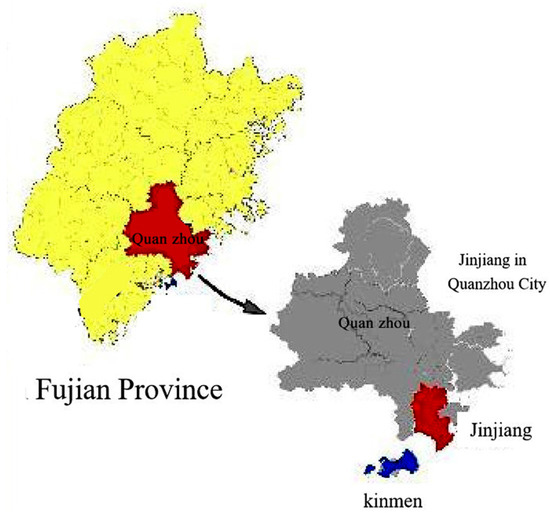
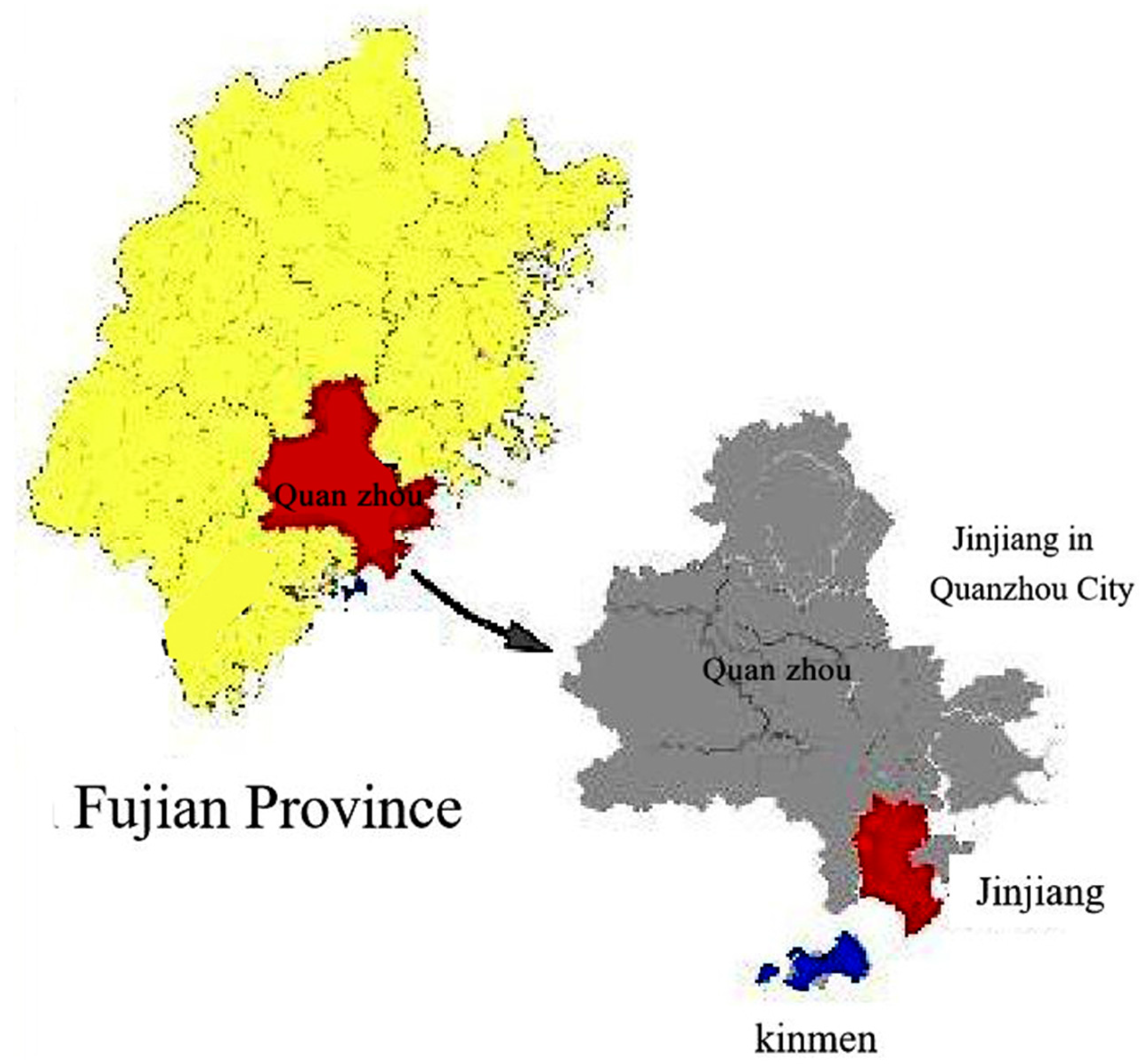
The study examines the water-infrastructure system of Kinmen County (see Figure 1).
Figure 1.
Research area. Sources: Drawn by the authors.
Kinmen County comprises several islands, including Greater Kinmen Island, Lesser Kinmen (Lieyu) Island, Dadan Island, Erdan Island, Dongding Island, and Xiding Island. The region has a subtropical monsoon climate, and average annual rainfall is roughly 1000 mm, yet evaporation from May to September far exceeds precipitation. The islands’ predominantly granitic geomorphology and low soil water-retention capacity result in rapid surface runoff, limited groundwater storage, and severe scarcity of freshwater resources.
3.2. Research Methods and Instruments
This study adopts qualitative methods that integrate the official archives, participant observation and in-depth interviews. The aim is to elucidate the technological deployments, institutional arrangements, and roles of non-human actors underlying Kinmen’s water-governance practices.
Fieldwork was conducted intermittently from 2023 to 2025 in Kinmen (February 2023; July 2023; August 2023; September 2024; February 2025; March 2025; June 2025), Quanzhou (August 2023; June 2024; March 2025), Xiamen, and Taipei. More than 70 interviews were conducted with key informants, including government officials, engineers from the Kinmen Waterworks, environmental and water resources specialists, local councilors, industry representatives (e.g., distilleries and livestock producers), and community residents. The researchers also attended multiple public briefings and water-governance events in Kinmen to observe governance practices and everyday infrastructure operations.
This study uses three methods: (1) Document analysis. Official materials were collected from the Kinmen County Government, the Water Resources Agency and related bodies, including policy reports, water-use statistics, infrastructure plans, and council proceedings. (2) Participant observation. The researchers made more than 10 field visits to reservoirs, desalination plants, water-treatment facilities, intake points, pumping stations, and distribution stations from 2023 to 2025. (3) In-depth interviews. More than 70 interviews were conducted, covering local government officials (e.g., Water Resources Department), Kinmen Waterworks engineering and management personnel, infrastructure engineering personnel, industrial water users (Kinmen Kaoliang Liquor, livestock producers), elected representatives, community residents, and water-advocacy actors. These interviews investigate how infrastructures operate in practice and how they are interpreted and negotiated by officials and residents.
Research began by using publicly available materials from the Kinmen County Government and Taiwan region Water Resources Agency to reconstruct the policy context and the trajectory of technological change in water governance. It then combined on-site observation with in-depth interviews to rebuild the history of supply modes and the transformation and reassembly of infrastructures since 1949, and to trace the roles and agencies of nonhuman actants (i.e., pipelines, sources, and facilities) within governance processes. Interview protocols were designed around the research questions, probing user experiences among different water actors, specific policy measures, infrastructural construction practices, and the processes of cross-strait water-supply cooperation.
3.3. Data Analysis and Use
For analysis and data use, the study first identifies the key actors involved in constructing the water-supply system based on interviews and documentary sources. To recognize nonhuman actants and assess their agency, the analysis follows Latour and Sayes in operationalizing three dimensions: mediation, controversy, and connectivity [18,23]. Data for this qualitative research were collected through participatory observation and semi-structured in-depth interviews. For in-depth interviews, the researcher drew up a semi-structured interview outline based on the study structure and research theme, used follow-up questions to explore issues in greater depth, and expanded the breadth of the interview with probing questions while remaining focused on the main axis of the research, and following up with additional questions as needed, to facilitate deeper discussion. In participatory observation, the researcher adopted the role of a peer bystander as different actors pursued their daily activities regarding the water supply [24].
4. Historical Survey of the Material Deployment of Water Resources in Kinmen
4.1. Water Governance in Kinmen Under Military Administration (1949–1992)
4.1.1. Deployment of Water-Supply Infrastructure During the Military Period
In 1949, following the retreat of “Chinese Kuomintang (KMT) government” to Taiwan region, Kinmen became the “Taiwan region’s frontline” outpost facing mainland China. The influx of large numbers of “KMT” troops caused a sharp population increase, and the area’s already fragile water conditions could not meet the demand; tensions between military and civilian water users intensified. Recurrent disputes over drinking-water access, outbreaks of diarrhea associated with deteriorating groundwater quality due to over-extraction, and the water-intensive afforestation policies of the time [25] all underscored urgent problems generated by scarcity under the wartime administration. In 1952, the “Ministry of Economic Affairs” of Taiwan region established the Kinmen Technical Taskforce to plan and assist in the development of agriculture, forestry, fisheries, animal husbandry, and water conservancy on the islands [26]. Even so, Kinmen’s water-governance agenda did not formally advance to systematic planning and construction until after 1956.
4.1.2. Water-Supply Infrastructure and Governance Under Military Rule (1956–1992)
In 1956, the “Chinese KMT government” formally instituted the Wartime Administration system, placing Kinmen under military control. According to “Articles 10 and 4 of the Experimental Measures for Wartime Administration in the Kinmen and Matsu Areas”, “Ministry of National Defense” was responsible for the overall planning and guidance; a “Wartime Administration Committee” was established in Kinmen as the highest command organ, with the defense-area commander concurrently serving as the committee chair. The Kinmen County Government was subordinate to the committee, and the county magistrate served concurrently as a committee member [27]. Under this “unitary civil-military” governance model, the local administrative authority was fully subject to the military command structure, and civil affairs had to align with military defense needs [27]. Statistics indicate that after the wartime regime began, troop levels in Kinmen peaked at around 100,000, which far exceed the contemporaneous non-military resident population of roughly 39,400. To meet the surge in military water demand, the “Wartime Administration Committee”, in collaboration with Kinmen local administrative bodies, led the planning and construction of water resources. The principal infrastructures initiated in this period included dams and reservoirs. However, in line with defense priorities, water-planning objectives prioritized the needs of the 100,000 stationed troops over the civilian population.
After 1956, the “Kinmen Wartime Administration Committee” constructed a series of small reservoirs and retention basins across the island, including the Taihu Reservoir, Tianpu Reservoir, Ronghu Reservoir, and Chenggong Reservoir. The Taihu project, which began in 1966 and was completed in 1967, is the most emblematic of these projects. With a total storage capacity of 900,000 m3, it remains the largest artificial impoundment in Kinmen [28]. Formerly known as Yellow Dragon Pond (Huanglongtan), Taihu was expanded to ensure secure water supplies for the stationed troops, especially under wartime conditions. In 1965, Kinmen garrison commander Yin Jun obtained approval from “the Minister of National Defense” of Taiwan region, Chiang Ching-Kuo, to enlarge Huanglongtan [29]. Fed by the Jinhu Stream flowing south from Mount Taiwu, Huanglongtan’s transformation is described by Hu Lien as follows:
“Originating at Xieyan Spring, it had been a wild, narrow ravine, a grassy place. Later, with successive check-dams, roads built on both sides, lotus was planted, and a tunnel cut through the mountainside with houses erected along the way. It became the site from which orders were issued across Kinmen Island. This project was completed by the Ninth and Tenth Divisions together with units formerly under the Fifth Army’s direct command.” [25].
This military-first water infrastructure configuration reveals how water, as a critical material, was appropriated during martial administration to prioritize garrison needs while relegating local residents to secondary status, leaving most civilians to rely on shallow wells for daily use [26]. Such cases in Kinmen were common between 1956 and 1992, as additional reservoirs were developed. First, the Qingtian Reservoir, the first concrete gravity dam in Kinmen, was completed in October 1969. It initially provided irrigation for farmlands in the Shamei area. Given the scarcity of water on the islands and the limited irrigation return, agricultural use was discontinued; raw water was instead conveyed to the Qingtian Water Treatment Plant to supply troops stationed in the Mount Taiwu area [30]. Second, the Tianpu Reservoir, located near the mouth of the Jinpu River, construction began in 1978 and was finished in October 1981, serving the main island’s northeastern districts. Unlike Taihu, Tianpu’s design explicitly incorporated defense considerations, that is, “to block enemy landings on beaches” [31], and it became the second-largest reservoir after Taihu in Kinmen [30].
During 1956–1992, under Cold War logic, Kinmen’s water-infrastructure planning followed a clear hierarchy: dams and reservoirs for military use were planned and executed by the Water Conservancy Section of the “Kinmen Wartime Administration Committee” together with engineering battalions, in coordination with the local government [31]. While these facilities primarily served the garrison, they also partially supported civilian needs, establishing a “military-led, military-civilian-sharing” supply regime.
It is important to note that this regime was a highly centralized governance model. The siting and development of dams, reservoirs, and deep wells were directed by the military without civic participation. Civilian water use centered on surface-water collection, supplemented by groundwater wells, infiltration galleries, and basic treatment unit practices, which in effect demarcated the boundaries between military and civilian spaces. This “water-resource boundary” was not only physical but also political, a form of non-economic spatial governance. It later became a focal point of criticism during Kinmen’s post-1992 transition in local water-governance arrangements. Despite the Kinmen County Government rhetoric of a unified military-civilian community and shared interests, in practice, there were often fundamental conflicts between military and civilian needs. Military prioritization in water allocation, constraints on land use, and defense-related limits on economic development all manifested these structural contradictions nowhere more visibly than in the domain of water. For example, the dispersed siting of reservoirs and related facilities reduced the risk of a concentrated attack and increased the survivability of the supply system.
4.1.3. Water Scarcity and Collective Responses
During this period, the “Kinmen Wartime Administration Committee” undertook large-scale development of water infrastructure. Site selection and storage capacity followed a “military-first” allocation logic and reflected short-term spatial planning. Because existing reservoirs had small catchment areas and high evaporation rates, their impoundment efficiency was low. Each dry season, both troops and civilians relied on emergency measures such as rationed, time-specific distribution and tanker deliveries, generating public dissatisfaction and policy pressure.
At the same time, because civilian demand was not treated as a planning priority under the military-first regime, residents resorted to the self-extraction of groundwater. Unregulated and excessive pumping lowered groundwater levels and exacerbated seawater intrusion. Ironically, this neglect of civilian water planning undermined the sustainability of military water supplies as well.
By the late 1980s, chronic shortages had become acute, with shortages being particularly critical for domestic water use. Local society in Kinmen grew more skeptical of the wartime system there, and water issues shifted to matters of local public concern. County media, council representatives, and some township offices urged the Chinese KMT to improve water infrastructure, proposing solutions such as expanding reservoirs, constructing municipal waterworks, and exploring seawater desalination.
Meanwhile, some local officials and technical personnel began advocating for a sustainability-oriented governance perspective to reassess Kinmen’s water challenges, gradually animating a policy oriented toward civilian welfare. This shift laid the groundwork for the post-1992 transition in water governance that followed the formal termination of the wartime system and Kinmen’s move toward local governance.
4.2. Democratization, Economic Development, and the Transformation of Water Governance (1993–2018)
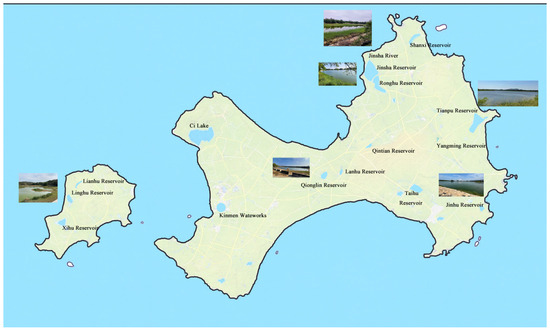
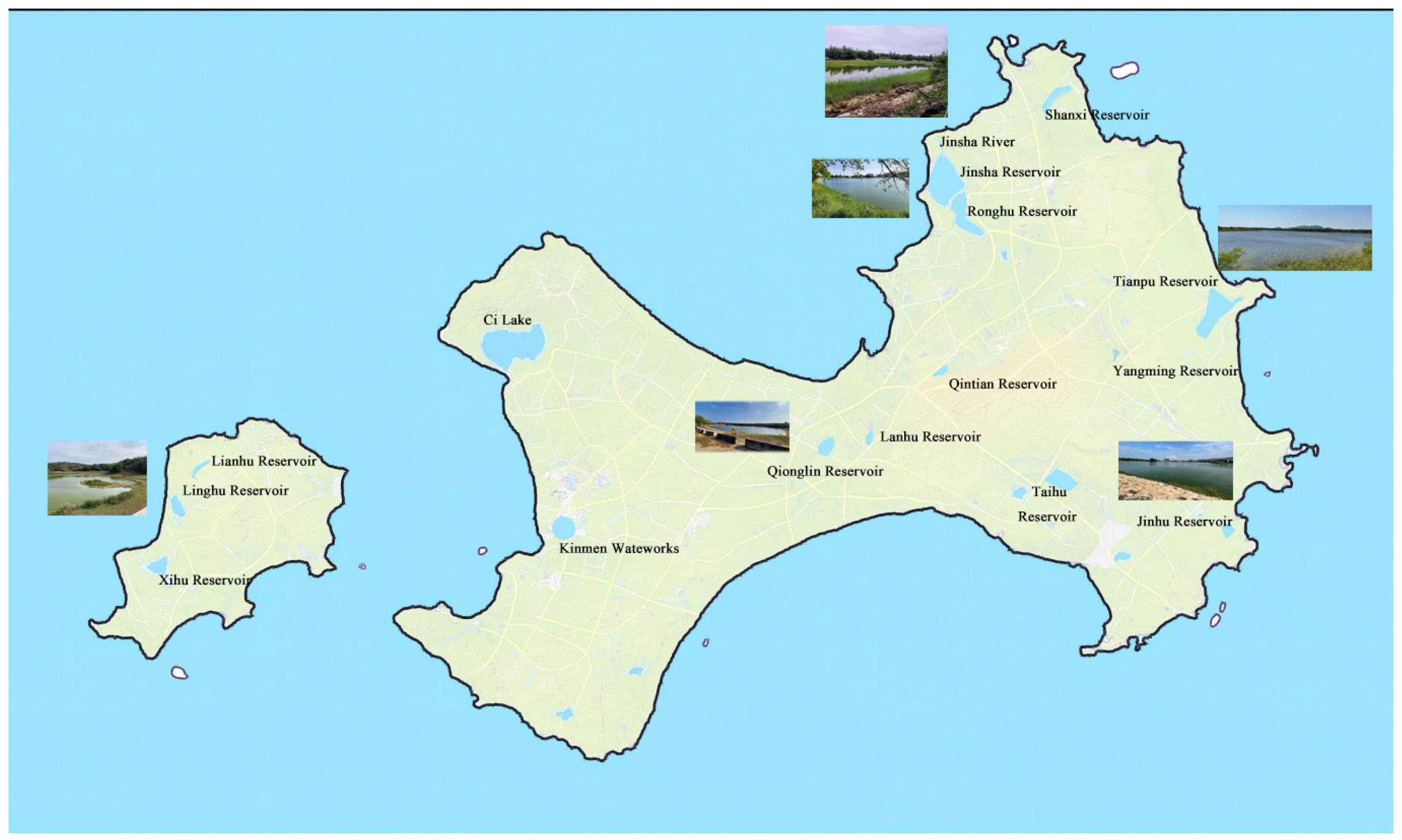
Under the wartime administration, avenues for political participation in Kinmen’s local society were extremely limited. With the lifting of martial law in Kinmen in 1992, Kinmen ended more than three decades of military rule, giving the Kinmen County Government the same autonomy as “other jurisdictions in Taiwan region” and ushering in a period of local self-government. During this transition, water issues gradually emerged as central challenges for local development and livelihood improvements. The spatial distribution of reservoirs in Kinmen County is shown in Figure 2. The Kinmen County Government advanced a sustainability agenda centered on “tourism-led development” and “industrial diversification”, actively promoting the visitor economy and the commodification of local specialties. Notably, the Kaoliang liquor industry, anchored by Kinmen Kaoliang Liquor, emerged as a key pillar of county finances and the broader local economy.
Figure 2.
Spatial distribution of reservoirs in Kinmen County. Sources: Drawn by the authors.
4.2.1. Post-Wartime Economic Transition and Shifts in the Water-Use Regime
In Kinmen’s water governance, the change in decision-making over supply and demand proved even more consequential. Following the end of wartime administration, the military in Kinmen was no longer the sole arbiter of water allocation. The Kinmen County Government and local elected representatives gained a greater voice and scope for participation, with the Kinmen County Government assuming primary responsibility for water planning and management. Elected representatives at the county and township levels acquired legitimate standing to speak on hydraulic policy, and residents articulated their water needs through formal political channels.
During this period, Kinmen’s major water-using sectors developed as follows. First, agriculture began to pivot toward low-consumption and higher value-added livestock production, especially beef and dairy, while introducing water-saving irrigation and privately operated well-pumping systems. Second, the tourism, construction and service sectors expanded quickly to meet tourism demand, driving sharp increases in water use for lodging, dining, and public facilities. Kinmen’s rich wartime heritage resources, distinctive Minnan architecture sites, and opaque military history attracted large numbers of visitors. In particular, after direct transport links with mainland China opened in 2001, the number of tourists from mainland China tourists grew rapidly and continuously, making tourism revenue one of the pillars of the local economy. Third, the grain-spirits industry, an NT$12 billion industry, requires high volumes of high-quality water.
According to statistics from the Kinmen Waterworks, total water withdrawal in 2021 was 518,074 tons, with an average daily withdrawal of 1419 tons. Based on the author’s fieldwork, however, daily withdrawals at KKL exceed 20,000 (units as recorded in the source); 70.25% of KKL’s withdrawals come from water supplied from mainland China, with the remainder drawn from groundwater.
This economic transformation and the resulting structural shifts increased Kinmen’s overall water consumption, throwing the legacy allocation regime out of balance. Statistics from the Kinmen Waterworks indicate that between 1992 and 2015, the average daily supply rose from roughly 9000 tons to more than 15,000 tons, well beyond the recharge capacity of reservoirs and aquifers. This exacerbated depletion risks and imposed unprecedented pressures on water governance.
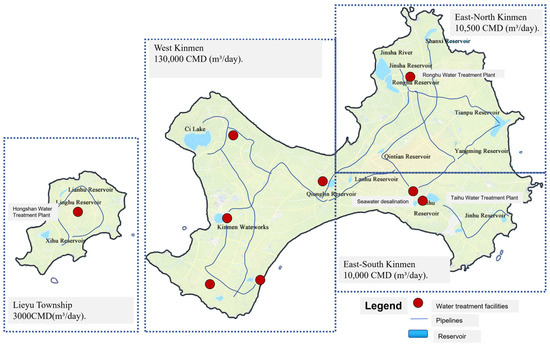
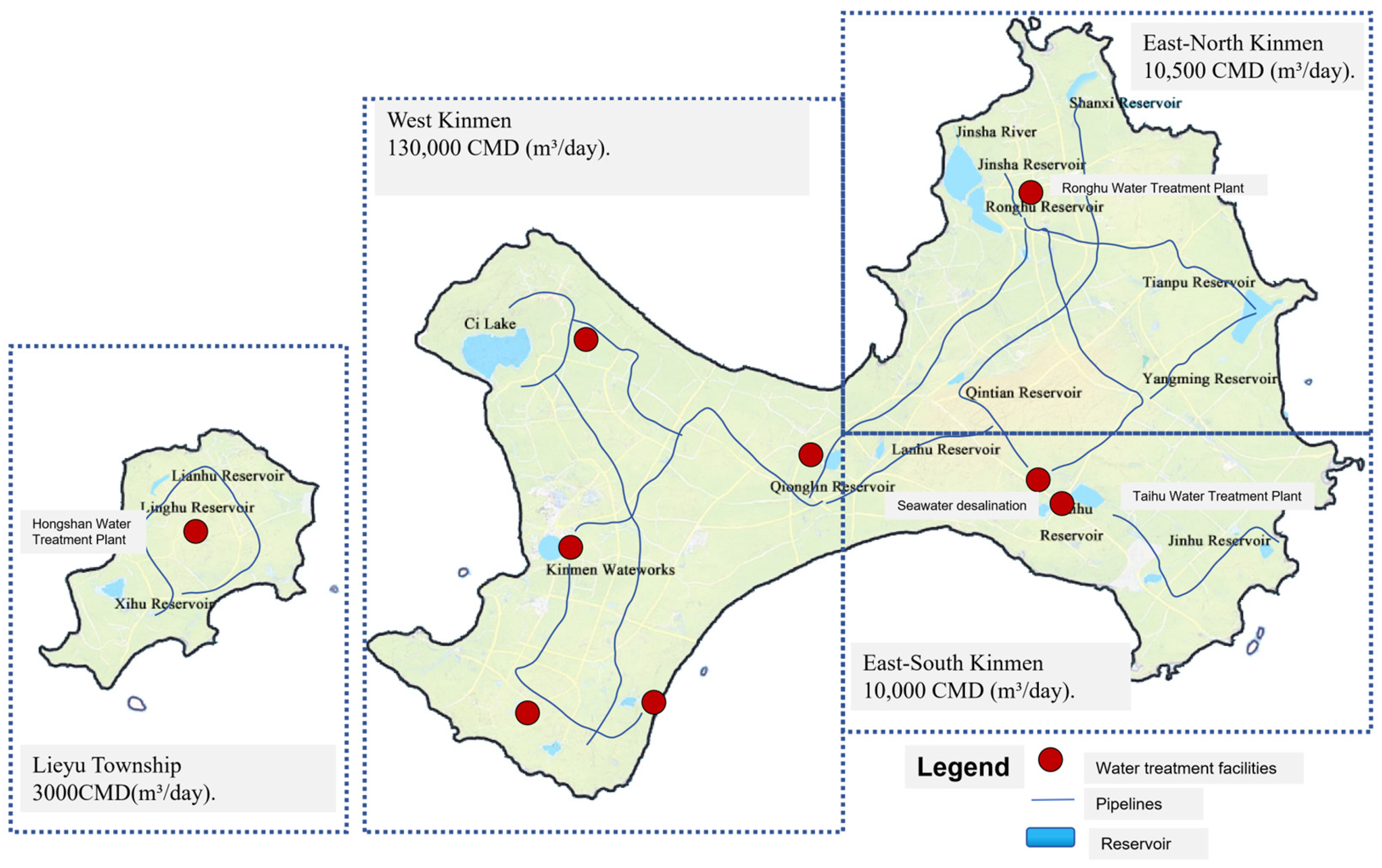
Historically, the island maintained a localized, fragmented water supply structure (see Figure 3): (1) Lieyu Township relied on three reservoirs with a modest capacity of 100–3000 CMD; (2) West Kinmen was heavily dependent on groundwater, with five wells providing a total of 130,000 CMD; (3) Northeast Kinmen utilized seven reservoirs (2200–10,500 CMD); and (4) Southeast Kinmen integrated four reservoirs (6000–8000 CMD) with a 2000 CMD seawater desalination supplement [32].
Figure 3.
Water resource utilization in Kinmen County, 2011. Source: Huang and Xu [32].
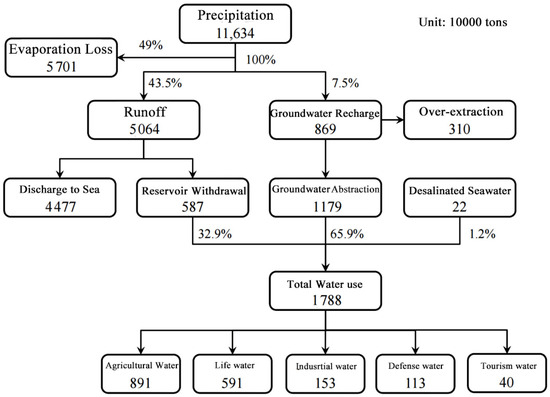
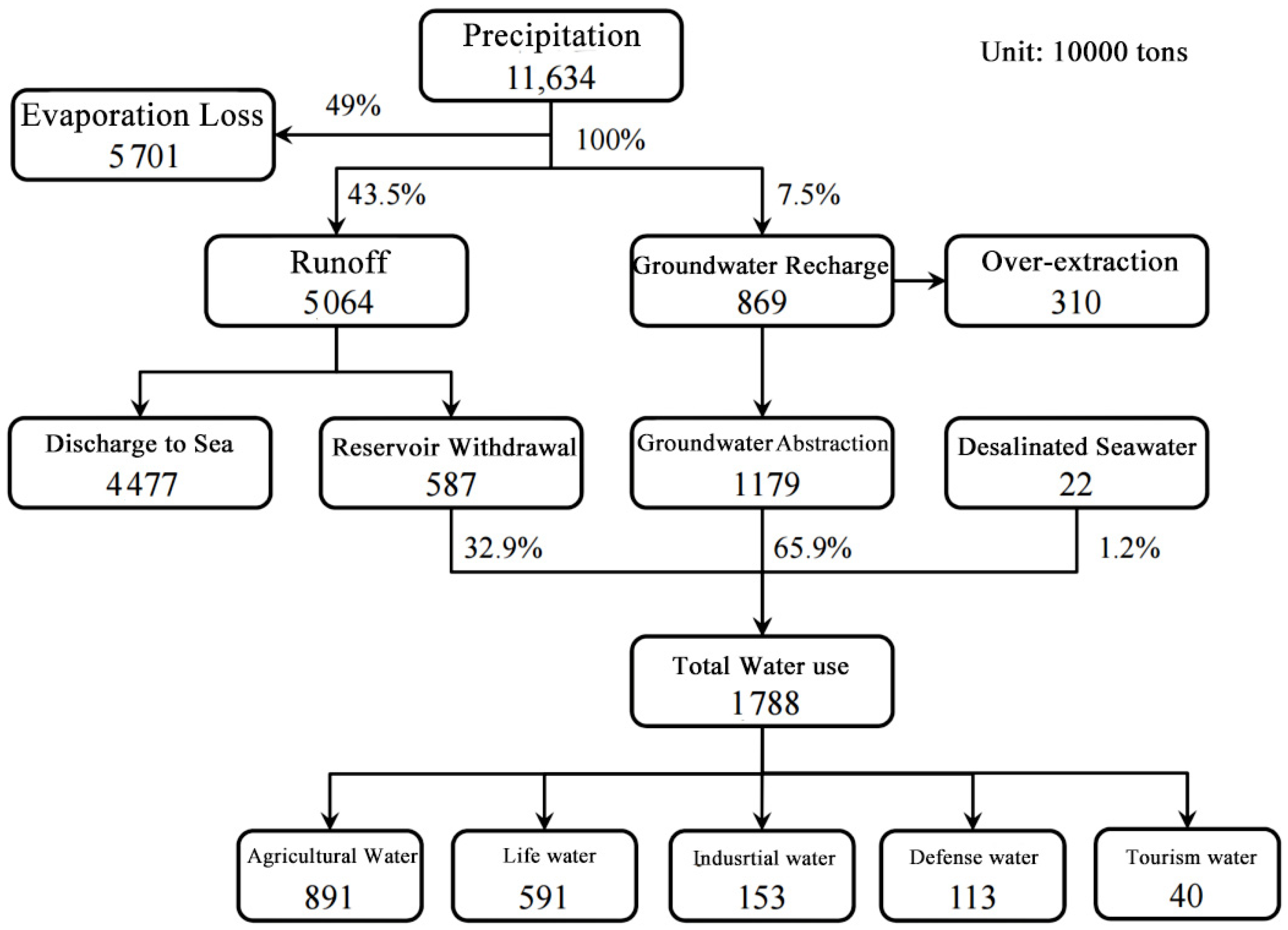
These data are critical, as they illustrate a “vulnerable equilibrium”, a state in which the island’s survival was precariously balanced against local ecological limits and fluctuating precipitation. The introduction of the cross-strait pipeline has fundamentally optimized this balance, transitioning it from a closed, resource-constrained loop into a stabilized socio-technical network that seeks resilience through sustainable strategy (see Figure 3). By integrating objective institutional protocols with this new technical network, Kinmen has not only secured a more abundant water supply but has also allowed its over-taxed groundwater wells and reservoirs to “rest” and recharge. Consequently, the “cross-strait interdependence” functions as a robust safety mechanism: while the pipeline now meets over 80 percent of daily demand, the original localized infrastructure (including reservoirs and desalination facilities) is maintained as an active backup system, providing the objective parameters for systemic resilience against potential environmental shocks.
4.2.2. Deployment of Water Supply Infrastructure and Water-Saving Strategies During the Transition
Confronted with steadily rising demand, in the mid-1990s, the Kinmen County Government and relevant agencies launched a suite of new supply-side works and conservation measures (see Figure 4). The main initiatives included: (1) expanding five existing reservoirs and strengthening their storage and capture capacity, for example by raising embankments and storage volumes at Taihu and Tianpu; (2) constructing small water-source stations and water towers to enable township-level zoned supply and emergency dispatch; (3) installing more than 100 water storage tanks, each with a capacity of 3 tons and supplied with modular seawater–desalination water, in Jinhu Township and Jinsha Township as alternative water sources. In terms of water storage tanks, the Kinmen County Waterworks set up three-ton stainless steel water storage tanks in natural villages in Jinhu Township and Jinsha Township, with at least one in each natural village. The free water-filling stations set up in each natural village currently mainly use water transported by truck from the desalination plant. (4) advancing water-saving agriculture and graded demand management by restricting livestock groundwater pumping depths and hours, while promoting rainwater harvesting and wastewater reuse. These strategies technically enhanced the supply resilience, and, through zoned allocation and tiered pricing, used market mechanisms and technological differentiation to stabilize the local water-use structure.
Figure 4.
Schematic diagram of Kinmen’s water supply and distribution structure (prior to supply from mainland China). Sources: Drawn by the authors.
4.2.3. Recurrence of Water-Shortage Crises and Collective Responses
Post-1992 water governance remained fraught with contradictions, compounded by several severe shortages in the 2010s: from 2014 to 2016, consecutive drought years drove reservoir storage to historic lows, and some townships activated water deliveries by ship and tanker, reviving collective memories of the 1980s water panic. These predicaments prompted both the Kinmen County Government and the broader public to reconsider Kinmen’s water strategy and the prospects for cross-jurisdictional cooperation.
Local media in Kinmen repeatedly highlighted the social anxiety captured by headlines such as “Kinmen must drink seawater,” while petitions, “Kinmen County Council” interpellations, and grassroots mobilization intensified. In 2015, the “Kinmen County Council” formally passed a resolution “requesting that the Taiwan authorities expedite the introduction of external water sources” and the Kinmen County magistrate publicly endorsed “pragmatic and non-political” negotiations with mainland China on water resource cooperation. Under the combined weight of social pressure and policy momentum, the Taiwan authorities agreed to advance the water-diversion project from Jinjiang to Kinmen, which would supply freshwater to Kinmen from Quanzhou in Fujian Province via an undersea pipeline. Following cross-strait consultations and technical feasibility assessments, regular supply commenced in 2018. The project signaled a strategic shift in Kinmen’s water-governance logic, from “intra-island conservation” to “cross-strait provisioning”, and opened a new chapter in the infrastructure politics of cross-strait relations.
4.3. The Diversion Project and the Reshaping of Kinmen’s Water Regime (After 2018)
4.3.1. Rethinking Local Limits and the Commercial Logic Under Engineering Discourse
By the 2010s, the Kinmen County Government and broader society had come to recognize that the island’s internal water resources were approaching their physical limits and that the county faced structural challenges. First, precipitation in Kinmen fluctuates sharply under the effects of extreme climate, making reservoir storage unreliable and undermining prospects for sustainable economic development. Second, prolonged over-extraction of groundwater by the distilling, agriculture, and hospitality sectors has depressed water tables and heightened risks of seawater intrusion, degrading water quality and harming local ecosystems. Third, although seawater desalination is technically feasible, its high costs, high energy intensity, and operational volatility constrain its viability as a long-term primary source.
Overall, Kinmen faces a structural contradiction in which “development drives up water demand, but water acts as a brake on development.” To sustain tourism and local construction, the Kinmen County Government and technical agencies gradually accepted the practical option of “receiving cross-strait water” and forged a consensus regarding medium-to long-term planning for a diversified water portfolio: water transfer from the mainland China, seawater desalination, surface water (lakes and reservoirs) and groundwater [33]. Yet, because Kinmen sits within a politically sensitive cross-strait zone, receiving water from mainland China carries strong symbolic valence. To defuse potential sovereignty disputes, negotiations and policy statements have been heavily couched in an engineering idiom as a depoliticizing device. Officials emphasize terms such as livelihood project and technical cooperation, and “Kinmen local request with the approval of the Taiwan authorities”. This engineering language serves as an intermediary that both sides can accept, enabling Kinmen under the pressure of acute scarcity to pursue “pragmatic cooperation” as a pathway to incremental institutional breakthrough.
4.3.2. Cross-Strait Infrastructure Construction and Institutional Coupling
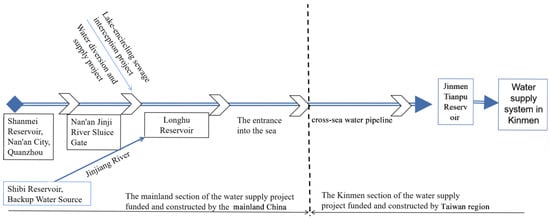
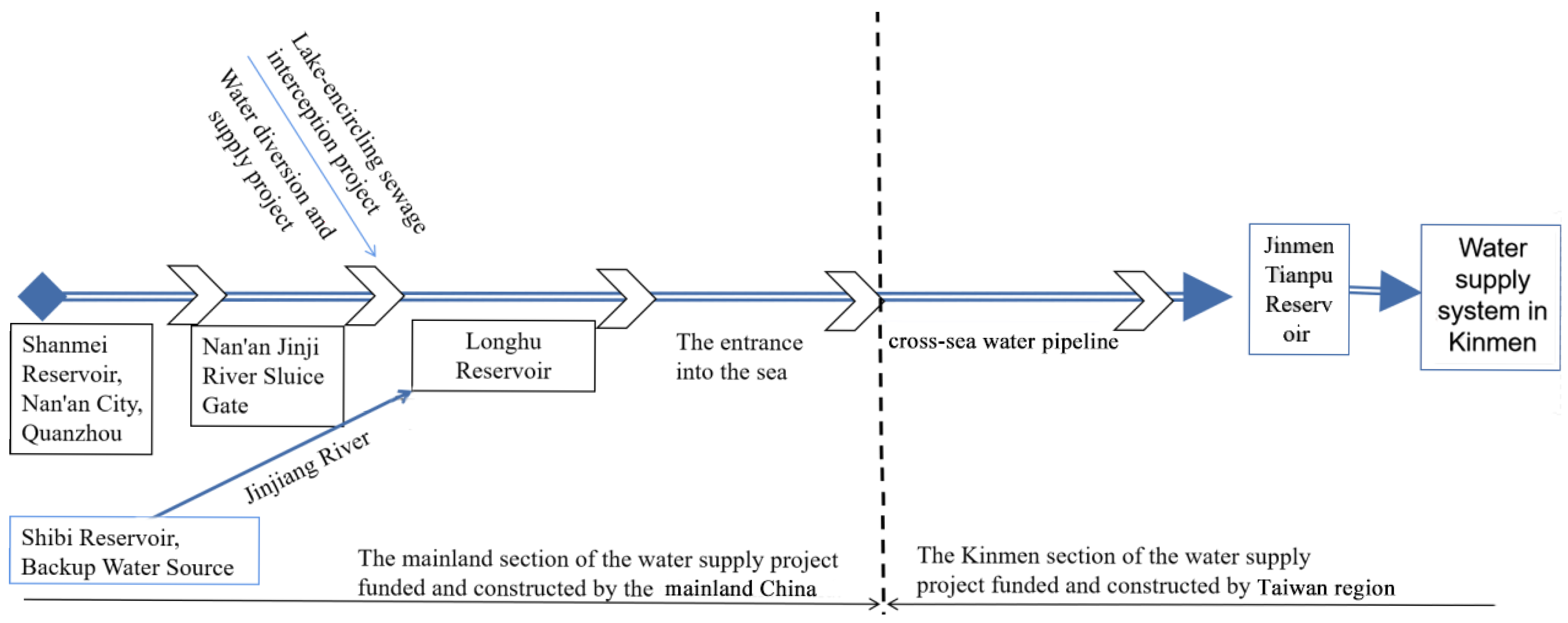
In 2013, the Kinmen County Government and Jinjiang City in Fujian Province initiated preliminary source assessments and engineering planning, with technical reviews supported by Fujian Province’s water authorities and the Water Resources Agency under the Taiwan authorities. In 2015, under a non-public negotiation mechanism, the two sides finalized a memorandum of cooperation that specified key terms regarding source reliability, water-quality testing, pipeline design, construction timelines, and pricing mechanisms (see Figure 5). Groundbreaking occurred in 2015, and regular supply commenced in 2018 [34,35].
Figure 5.
Kinmen Water Diversion Project from Fujian of mainland China. Source: Drawn by the authors.
4.3.3. Negotiation, Technical Adjustment, and Systemic Reconfiguration
Although the water supply project was carefully depoliticized at the discursive level, its negotiation and implementation were rife with institutional and technical bargaining, illustrating the nature of infrastructure as a “site of negotiation.” The principal challenges included: (1) Divergent water-quality standards. The Chinese mainland applies the standards for drinking water quality, whereas Kinmen follows the drinking-water standards applied by the Taiwan authorities. The two sides had to align parameters such as residual chlorine, heavy-metal testing, and algal monitoring through detailed comparison and technical translation. (2) Pricing and supply-stability terms. Kinmen sought a guaranteed daily delivery of no less than 10,000 tons, a unit price below the cost of seawater desalination, and a cap on supply interruptions not exceeding three days. (3) Division of construction responsibility and acceptance criteria. The subsea pipeline was principally built by a company in Jiangsu Province, whereas on-island interconnection and acceptance were undertaken by Kinmen. Acceptance testing was conducted against neutral technical specifications that were mutually defined in the agreement.
These negotiations proceeded via technical reports, third-party testing, and intergovernmental working meetings, while eschewing open discussion of political issues. From an ANT perspective, pipelines, water-quality reports, pricing formulas, and acceptance documents functioned as non-human actants that effectively became key actors in the bargaining process, reassembling the network of governance.
Since the diversion project came online in 2018, Kinmen’s overall supply architecture has undergone a fundamental transformation. By 2025, deliveries from Jinjiang accounted for more than 80 percent of Kinmen’s water supply, thereby displacing reservoirs and groundwater as the primary sources; legacy conservation infrastructure has shifted to gap-filling and backup roles. Kinmen’s water regime has thus moved from “island-bounded self-regulation” to a “cross-strait dependency-based network.” Meanwhile, local expectations for water quality and service stability have risen sharply, prompting the county government to advance information transparency, anomaly reporting, and price disclosure. In governance terms, Kinmen’s system has transitioned from a logic of military sustainability and internal, conservation-centered circulation to a pluralized regime that combines external inputs, technical redundancy, and social acceptability.
5. Assembling the ANT: Non-Human Actants and Cross-Strait Water Infrastructures
5.1. Solving Scarcity as a History of Material Deployment
Kinmen’s water-governance trajectory is not only a record of policy and institutional change; it is also a materially inscribed pathway along which heterogeneous nonhuman actants are continually deployed, assembled, and stabilized. From water itself, reservoirs, transmission pipelines, and storage facilities to desalination units, groundwater wells, engineering drawings, regulatory texts, and contractual agreements, these elements constitute the core nodes of Kinmen’s water-supply actor-network. Historically, water management and provision have remained central to local governance, and the governing logic has evolved with shifts in political regime, economic structure, and developmental objectives. Viewed chronologically, Kinmen’s experience can be divided into three major stages, each corresponding to a distinct sustainability logic: military administration, tourism-led economy, and cross-strait interdependence.
From a historical perspective, Kinmen’s water governance can be divided into three stages.
Stage I (1949–1992): A military-centered regime of reservoir construction and centralized supply that prioritized security, stability, and emergency dispatch. The actor-network was anchored in reservoirs, military engineering units, and the military chain of command. Between the cross-strait separation in 1949 and the termination of the wartime administration in 1992, Kinmen functioned as a frontline fortress hosting more than 100,000 troops; the population density surged and water demand was exceptionally high. To meet the needs of military preparedness and long-term garrison life, Kinmen built more than a dozen small- and medium-sized reservoirs including Taihu, Ronghu, and Tianpu, forming a storage-led, military-type supply system whose governing objective emphasized “military sustainability.”
Stage II (1993–2018): With demilitarization and the introduction of local self-government, water governance shifted from “control” to “regulation” in order to underpin economic growth and tourism. Following the end of the wartime administration in 1992, authority moved from military rule to elected institutions, and Kinmen advanced a tourism-led development agenda. The county progressively built a multi-source supply system, including seawater desalination, groundwater wells, and small-scale storage, while reorienting policy to serve local economic transformation. During this phase, the government promoted water-saving agriculture (e.g., livestock with higher water-use efficiency) and high-value-added manufacturing (notably Kinmen Kaoliang Liquor), as well as lower-consumption services such as tourism. Rising demand was met through diversified sourcing including groundwater, desalination and reclaimed water, and Kinmen consolidated a governance mode oriented toward economic sustainability [33,34].
Stage III (2018–present): Cross-strait diversion became the system’s backbone, with the primary supply sourced from Jinjiang (Fujian), while on-island infrastructure shifted to regulating and receiving roles. Non-human actants, such as the subsea pipeline, water-quality monitoring instruments, and contractual pricing formulas, operate as crucial technical mediators linking institutions across the strait. Since the Jinjiang-to-Kinmen project commenced in August 2018, Kinmen’s water landscape has been fundamentally reconfigured: the cross-sea pipeline and institutionalized cross-strait arrangements provide stable daily inflows, easing dry-season pressures and buffering the uncertainties presented by extreme weather. At present, deliveries from mainland China account for more than 80 percent of the total supply, constituting a central pillar of local water governance and signaling the consolidation of a cross-strait interdependence regime [33,34,35,36,37].
These reassemblies and redeployments of actants trace Kinmen’s shift in water governance from a militarized regime to cross-strait collaboration. As Kinmen moved from a frontline garrison to a tourism island, and ultimately to a forward node in cross-strait infrastructural linkage, its water system evolved through more than technical adjustments; it embodied the dynamic entanglement of island governance logics, infrastructural construction, and local politics. This research takes that entanglement as its analytical field, probing how water becomes an object of governance and, through infrastructural practice and cross-strait negotiation, is infrastructuralized, thereby reshaping the island’s developmental structure and political positioning.
5.2. Technology as a “Mediator of Cross-Strait Governance”
From an ANT perspective, technology is not neutral, but is rather the concretization of governance. Across periods, infrastructural design has served specific political logics and governing aims: (1) Military era reservoirs underwrote a “closed wartime administration,” targeting soldiers and military units with designs that emphasized centralized, command-style provision. (2) “Post-democratization” multi-source systems responded to a balancing logic among economic development, local governance, and technical flexibility, enrolling firms, residents, and electoral actors into the network. (3) Cross-strait water works since 2018 demonstrate how technology fills the governance gap and negotiations over flow reliability, cost control, and quality standards displaced overt political contention, allowing engineering discourse to function as an alternative framework of legitimacy. These modes of “technical governance” are not merely physical constructions; they are mediating devices within political contexts that enable the two sides to pursue substantive cooperation in a non-sovereign register.
Island residents, government agencies, and industrial sectors have repeatedly mobilized collective actions to address water stress, constructing reservoirs, commissioning desalination facilities, improving groundwater extraction technologies, installing gap-filling supply stations, and, most decisively, implementing the cross-strait diversion project. Together, these measures enabled the diversified development and allocation of water resources, yielding a composite network with five major sources: groundwater, rainwater harvesting, reservoir storage, seawater desalination, and water from mainland China. They also established the institutional and material foundations of Kinmen’s water-supply actor-network.
As Table 1 shows, specific quantitative data and objective parameters are used to evaluate the system’s sustainability and resilience. Details are as follows: (1) Objective reservoir parameters. Kinmen maintains 13 primary reservoirs with a total designed capacity of m3 and an effective capacity of m3 (see Table 1). These are distributed across Greater Kinmen Island and Lieyu Island to provide localized storage buffers. (2) Minimum operational capacity of backup systems: In the event of a prolonged interruption of the subsea pipeline, the backup network, comprising local reservoirs and seawater desalination plants, can be reactivated. Specifically, Southeast Kinmen integrates reservoirs with a capacity of 6000–8000 m3 per day (CMD), supplemented by a 2000 CMD desalination plant. Combined with West Kinmen’s groundwater wells (totaling 130,000 CMD capacity) and other regional reservoir outputs (ranging from 100 to 10,500 CMD, depending on the township), the system retains a robust baseline capacity. (3) Duration of guaranteed supply. Based on the current storage levels and historical consumption data, these backup “non-human actants” can meet basic survival and essential industrial demand for approximately three to six months. This duration depends on seasonal precipitation for reservoir recharge and the implementation of tiered rationing. By utilizing these objective conditions, future research may assess the “material resilience” of the actor-network, demonstrating that the cross-strait interdependence is not a state of total vulnerability but rather a strategically redundant system designed to withstand potential shocks.
Table 1.
Summary of reservoir data.
Kinmen’s water system was not built in a single stroke. It is the product of a more than three-decade-long assembly process that spans technological deployments, institutional formation, and negotiation among actants. Its governance model is not the outcome of a single, centralized blueprint. Rather, it has emerged through local experimentation, policy adjustment, the stabilization of non-human actants, and cross-domain institutional coupling, coalescing into a heterogeneous infrastructural network that includes reservoirs, desalination plants, gap-filling stations, cross-strait intake points, sewerage, and distribution mains. The technical compatibility, governance legitimacy, and social acceptability among these elements are all contingent on ongoing negotiations.
The longevity of Kinmen’s water system is safeguarded by a combination of institutionalized technical protocols and material mechanisms. First, there is a contractual and commercial framing that sustains the cross-strait water supply. This water supply is governed by a 30-year commercial contract that specifies source reliability, unit pricing below desalination costs, and strict caps on supply interruptions. By framing the infrastructure as a livelihood project and a commercial cooperation, the system discursively creates a technical buffer against political volatility. Meanwhile, the system maintains active technical redundancy. While the subsea pipeline currently provides over 80 percent of daily demand, Kinmen maintains a localized multi-source portfolio as an “active backup”. This includes 13 reservoirs with a total effective capacity of 5,062,000 m3 and seawater desalination plants with expanded modular capacities. Additionally, the governance network relies on cross-jurisdictional working meetings and the alignment of technical standards (e.g., cross-strait standards), which translate political issues into manageable engineering tasks.
5.3. Transformational and Sustainability-Oriented Development
At its core, Kinmen’s water-governance decision-making reflects the spatial expression of a political transformation, namely, the local shift from military dominance to democratic governance. Beginning in 1993, the “Kinmen County Council” gradually acquired the authority to review budgets and plans for major infrastructure projects, and water issues moved from a closed logistical matter to an open political agenda. The diversion project advanced through a sequence of procedures: council resolutions, media exposure, professional reports by the water utility, public hearings, and wider opinion mobilization. Especially at the height of the 2014 drought crisis, public pressure on the Taiwan authorities and the Kinmen County Government acted as a crucial catalyst for the diversion decision. This evolution indicates that Kinmen’s water decisions have increasingly evolved into a tripartite governance structure encompassing local politics, expert knowledge, and public opinion, rather than a continuation of a closed, military-style logic.
At the same time, the sustainability of supply infrastructure hinges not only on resilience but also on a balance between stability and dependence. Since the Jinjiang diversion came online in 2018, the service reliability of Kinmen’s water supply has improved significantly. Stable daily deliveries can be maintained even under extreme weather, effectively supporting the tourism sector and distillery operations. Greater predictability in water governance has also helped to raise public satisfaction with county administration. Meanwhile, this trade-off is a structural dependence on water sources from mainland China. Although framed as technical cooperation, this arrangement produces an institutionalized “new cross-strait interdependence” that places Kinmen local governance in a position in which it cannot unilaterally manage risks. In this sense, infrastructure is simultaneously a problem-solving device and a mechanism that reproduces resource vulnerabilities.
In terms of the reliability of Kinmen’s water supply system, this research advocates a theoretical shift from a descriptive historical survey to a socio-technical resilience framework. First, the system demonstrates increased physical reliability through technological “rest.” The transition to cross-strait provisioning has strategically allowed Kinmen’s over-extaxed groundwater wells and reservoirs to recharge. This ecological recovery is critical for the long-term viability of local aquifers, which previously faced severe seawater intrusion and declining water tables due to decades of over-extraction to meet military and industrial demands. Second, the system has achieved systemic robustness through structural diversity. The reliability of the current local system stems from the transformation from a “closed, resource-constrained loop” into a “pluralized, resilient network.” By integrating five heterogeneous sources, namely groundwater, rainwater harvesting, reservoir storage, seawater desalination, and cross-strait water transfer, the infrastructure has coalesced into a stabilized socio-technical network that is capable of buffering the uncertainties of extreme weather and fluctuating local precipitation. Finally, the network is sustained by institutionalized monitoring and maintenance protocols. The reliability of the subsea pipeline as a key non-human actor is ensured through rigorous technical translation, including the alignment of water-quality standards for heavy metals and algae, alongside shared responsibilities for construction and acceptance criteria. These mechanisms collectively ensure that the cross-strait infrastructure remains a “stabilized mediator” that bridges disparate institutional logics while maintaining service continuity.
In this context, the Kinmen County Government has demonstrated strong governing capacity by fashioning a distinctive role between the Taiwan region and mainland China, positioning itself as a local governance innovator. On one hand, it cultivates an image of pragmatic governance through council deliberations, technical agencies, and policy discourse; on the other, it intervenes proactively in cross-strait interaction through infrastructural planning, becoming a key node of institutional cooperation.
From an ANT perspective, the Kinmen County Government is not merely an implementer of policy but a strategic assembler of the actor–network. It links non-human actors (pipelines, regulatory standards, pricing mechanisms), institutional platforms (the Kinmen County Government Act and public-works procedures), and cross-strait actors (the water authorities in mainland China and the Water Resources Agency under the Taiwan region) to constitute a new infrastructure-as-governance device. This illustrates that the locality is no longer a passive recipient of resources; rather, situated between the Taiwan region and mainland China, it acts as an agentive local actor that actively secures resources, manages risk, and constructs legitimacy.
The “Kinmen Model” represents a sustainable local governance innovation, characterized by a transition from a fragmented “closed loop” to a stabilized socio-technical network. Its long-term effectiveness is demonstrated through three core indicators: (1) increased source diversity through the integration of five distinct water sources, including groundwater, rainwater, reservoirs, desalination, and cross-strait water transfer, thereby reducing systemic vulnerability; (2) economic viability, achieved by strategically negotiating import prices below the energy-intensive costs of local desalination, ensuring financial sustainability; and (3) institutionalized interdependence, where shared technical standards and maintenance protocols transform cross-strait infrastructure into a “stabilized mediator” that balances external resource needs with internal operational autonomy. Ultimately, this model offers a replicable framework for resource-constrained boundary regions to navigate the complexities of infrastructural integration and geopolitical sensitivity.
6. Conclusions: Infrastructure, Sustainability, and Island Development Contestation
Using Kinmen Island water governance as a case, this study draws on Actor-Network Theory and political ecology to examine how water infrastructures are constructed, negotiated, and deployed within a cross-strait boundary region. Reconstructing three phases from 1949 to the present, the article argues that the crux of water governance is not merely allocation, but the political practice through which material devices shape governing orders and institutional arrangements.
Advancing the concept of the infrastructuralization of water, the study shows that Kinmen’s supply system is a multi-scalar, multi-temporal assemblage of actants. Non-human entities, including reservoirs, desalination plants, subsea pipelines, technical specifications, pricing algorithms, and water-quality instruments, are not neutral components, but are rather negotiating agents within the governance network. In concert with human actors, such as local government officials and residents, these non-human actants co-produce distinct governance configurations across periods, while an engineering-centered discourse both signals shifts in governing objectives and mediates political compromise.
First, water-supply infrastructure in Kinmen has coalesced into a complex, dynamic actor-network. (1) Residents, local government bodies, and industrial sectors have repeatedly mobilized collective actions to cope with water stress. These efforts enabled diversified development and allocation, producing a composite network with five sources including groundwater, rainwater harvesting, reservoir storage, seawater desalination, and receiving water from mainland China, that together constitute the institutional and material foundations of Kinmen’s water-supply actor-network. (2) Distinct actor groups are paired with specific technological dependencies and institutional arrangements. Households rely primarily on the metered, tier-priced municipal system supplemented by gap-filling facilities; sectors prioritized under an economic sustainability strategy (tourism and livestock) draw on groundwater, reclaimed water, and irrigation schemes; and the high-value-added distilling industry operates a relatively autonomous system of groundwater extraction. (3) Local government can be both a catalyst for public problem-solving and a driver of resource stress. The push for economically sustainable sectors (tourism, liquor production, livestock) intensified supply-demand imbalances and forced a reframing of water as a security issue. Brought online in 2018, the Jinjiang-to-Kinmen water diversion project has become the system’s pivotal node, now supplying more than 80 percent of Kinmen demand, alleviating structural scarcity while reconfiguring Kinmen’s institutional linkages and governance interdependence with both the Taiwan region and mainland China.
Second, Kinmen’s water supply system is the product of a three-decade-long “infrastructuralization” process. Rather than a single technological fix, it is a sophisticated, multi-temporal assemblage of actors that spans technical deployment, institutional formation, and actant negotiation. This “cross-strait interdependence” is not merely a passive response to water scarcity but a stabilized socio-technical network that achieves resilience through commercial agreements and specific cross-strait cooperation mechanisms. The governance model emerged through local experimentation and the stabilization of non-human actants, such as reservoirs, desalination plants, subsea pipelines, and water-quality instruments, which function as active negotiating agents. Consequently, this infrastructural network comprising reservoirs, desalination facilities, gap-filling supply stations, and cross-strait intake points, acts as a technopolitical device. It actively participates in problem definition, resource bargaining, and the construction of governance legitimacy.
Third, on geopolitically sensitive islands, infrastructure serves as a material carrier of political strategy beyond mere resource management. Its inherent politicality lies in how material deployments and technical designs forge institutionalized interdependence. Since 2018, Kinmen’s 80 percent reliance on water from mainland China has exemplified a governance model that is discursively “depoliticized” as a livelihood project, yet substantively repoliticized by constructing cross-strait institutional coupling and risk-sharing mechanisms. By foregrounding the power of non-human actants within the political ecology of interdependence, this study demonstrates that infrastructure can simultaneously integrate boundaries and reshape an island’s geopolitical positioning, turning it from a frontline garrison into a node of cross-strait infrastructural linkage.
This study has certain limitations. By focusing on a single case, it offers granular insight into contextual specificities and the stepwise assembly of networks, yet warrants caution regarding generalizability. While this study offers a comprehensive socio-technical analysis of Kinmen’s water infrastructure evolution, it also opens several avenues for future research. A critical next step is a detailed cost-benefit and risk-resilience analysis within the cross-strait interdependence regime. Specifically, future studies should aim to quantify the economic and political costs of maintaining standby infrastructure, such as the operational maintenance of seawater desalination plants and local reservoirs while they are in a “backup” state. Establishing a set of objective performance indicators, including the minimum operational capacity of backup systems, relative to daily demand and the financial commitments required for long-term system maintenance, would provide the “predictive power” necessary to assess how this equilibrium might withstand severe political or environmental shocks. Furthermore, future research should investigate the optimal configuration of reserve capacity and system redundancy in order to refine the “Kinmen Model”. To demonstrate its long-term effectiveness beyond subjective assessments such as public satisfaction, greater attention should be given to the development of three objective performance indicators: source diversity, the stability and economic viability of unit water costs, and infrastructural integration.
Author Contributions
Conceptualization, Y.Z. (Yong Zhou) and Y.Z. (Yan Zhou); methodology, Y.Z. (Yan Zhou); software, Y.Z. (Yan Zhou); validation, Y.Z. (Yong Zhou) and Y.Z. (Yan Zhou); formal analysis, Y.Z. (Yan Zhou); investigation, Y.Z. (Yan Zhou) and Y.Z. (Yong Zhou); resources, Y.Z. (Yan Zhou); data curation, Y.Z. (Yan Zhou) and Y.Z. (Yong Zhou); writing—original draft preparation, Y.Z. (Yan Zhou); writing—review and editing, Y.Z. (Yan Zhou) and Y.Z. (Yong Zhou); visualization, Y.Z. (Yan Zhou) and Y.Z. (Yong Zhou); supervision, Y.Z. (Yan Zhou) and Y.Z. (Yong Zhou); project administration, Y.Z. (Yan Zhou); funding acquisition, Y.Z. (Yong Zhou). All authors have read and agreed to the published version of the manuscript.
Funding
This research received no external funding.
Informed Consent Statement
The study reported in our manuscript involves qualitative interviews and field observations with adult participants, focusing on non-sensitive issues related to water management and infrastructure on Kinmen Island. Meanwhile, participation in the study was entirely voluntary. All participants were informed about the purpose of the research, the use of the data, and their right to withdraw at any time, and informed consent was obtained from all participants prior to the interviews. Personal identifiers were removed during transcription and analysis, and no identifying information is reported in the manuscript.
Data Availability Statement
The original contributions presented in this study are included in the article. Further inquiries can be directed to the corresponding author.
Acknowledgments
The authors have reviewed and edited the output and take full responsibility for the content of this publication.
Conflicts of Interest
The authors declare no conflicts of interest.
References
- Jędrusik, M. Island studies. Island geography. But what is an island? Misc. Geogr. Reg. Stud. Dev. 2011, 15, 201–212. [Google Scholar] [CrossRef] [Scilit]
- Klock, C. Geography of small islands: Outposts of globalisation. Isl. Stud. J. 2019, 14, 263–265. [Google Scholar]
- Royle, S.A. A human geography of islands. Geography 1989, 74, 106–116. [Google Scholar] [CrossRef] [Scilit]
- Amer, R. China, Vietnam, and the South China Sea: Disputes and dispute management. Ocean Dev. Int. Law 2014, 45, 17–40. [Google Scholar] [CrossRef] [Scilit]
- Kent, M.; Newnham, R.; Essex, S. Tourism and sustainable water supply in Mallorca: A geographical analysis. Appl. Geogr. 2002, 22, 351–374. [Google Scholar] [CrossRef] [Scilit]
- Anthonj, C.; Tracy, J.W.; Fleming, L.; Shields, K.F.; Tikoisuva, W.M.; Kelly, E.; Bartram, J. Geographical inequalities in drinking water in the Solomon Islands. Sci. Total Environ. 2020, 712, 135241. [Google Scholar] [CrossRef] [Scilit]
- Kazumba, S.; Gillerman, L.; Oron, G. Managing Trans-regional water transfer in dry African countries to mitigate shortages. J. Innov. Res. Eng. Sci. 2011, 2, 249–273. [Google Scholar]
- Megdal, S.B.; Eden, S.; Shamir, E. Water governance, stakeholder engagement, and sustainable water resources management. Water 2017, 9, 190. [Google Scholar] [CrossRef] [Scilit]
- Woodhouse, P.; Muller, M. Water governance—A historical perspective on current debates. World Dev. 2017, 92, 225–241. [Google Scholar] [CrossRef] [Scilit]
- Mahmoudi, S.A.; Hekmat Ara, H. Water diplomacy and water disputes in the central Asian region. Cent. Eurasia Stud. 2019, 12, 199–218. [Google Scholar]
- Gupta, S.K.; Deshpande, R.D. Water for India in 2050: First-order assessment of available options. Curr. Sci. 2004, 86, 1216–1224. [Google Scholar]
- Ribeiro, M.M.R. A few comments on the Brazilian Water Resource Policy. New Water Policy Pract. 2017, 3, 22–32. [Google Scholar] [CrossRef] [Scilit]
- Ingold, K.; Tosun, J. Public policy analysis of integrated water resource management. Water 2020, 12, 2321. [Google Scholar] [CrossRef] [Scilit]
- Mao, Z.-T. Current status and future prospects of water resources on offshore islands. Natl. Land Public Gov. Q. 2020, 8, 60–75. (In Chinese) [Google Scholar]
- Larkin, B. The politics and poetics of infrastructure. Annu. Rev. Anthropol. 2013, 42, 327–343. [Google Scholar] [CrossRef] [Scilit]
- Carse, A. Nature as infrastructure: Making and managing the Panama Canal watershed. Soc. Stud. Sci. 2012, 42, 539–563. [Google Scholar] [CrossRef] [Scilit]
- Callon, M. The sociology of an actor-network: The case of the electric vehicle. In Mapping the Dynamics of Science and Technology: Sociology of Science in The Real World; Palgrave Macmillan: London, UK, 1986. [Google Scholar]
- Latour, B. Reassembling the Social: An Introduction to Actor-Network-Theory; Oxford University Press: Oxford, UK, 2005. [Google Scholar]
- Robbins, P. Political Ecology: A Critical Introduction; John Wiley & Sons: New York, NY, USA, 2019. [Google Scholar]
- Bassett, T.J.; Zimmerer, K.S. Cultural ecology. In Geography in America at The Dawn of the 21st Century; Oxford University Press: Oxford, UK, 2003; Volume 100, p. 97. [Google Scholar]
- Barry, A. Material Politics: Disputes Along the Pipeline; John Wiley & Sons: New York, NY, USA, 2013. [Google Scholar]
- Furlong, K. Small technologies, big change: Rethinking infrastructure through STS and geography. Prog. Hum. Geogr. 2011, 35, 460–482. [Google Scholar] [CrossRef] [Scilit]
- Sayes, E. Acto-Network Theory and methodology: Just what does it mean to say that nonhumans have agency? Soc. Stud. Sci. 2014, 44, 134–149. [Google Scholar] [CrossRef] [Scilit]
- Zhou, Y. Locality from hybridization to integration: Cultural politics and space production of Taiwan Mazu temples in mainland China. Religions 2022, 13, 836. [Google Scholar] [CrossRef] [Scilit]
- Hu, L. Memories of Kinmen, 3rd ed.; Liming Cultural Enterprise Co., Ltd.: Taipei, Taiwan, 1978. (In Chinese) [Google Scholar]
- Kinmen County Government. Compilation of Kinmen Water Conservancy Data; Kinmen County Government: Kinmen, Taiwan, 1970. (In Chinese) [Google Scholar]
- Peng, T.-N. (Ed.) Ready for battle: Oral history of wartime administration in Kinmen and Matsu. In Political Warfare Office; Ministry of National Defense: Taipei, Taiwan, 2013. (In Chinese) [Google Scholar]
- Kuo, C.-M. A Small Encyclopedia of Wuxiang; Kinmen County Cultural Affairs Bureau: Kinmen, Taiwan, 2006. (In Chinese)
- Kinmen Daily News. Old Photos, Telling Stories: Huang Long-Yao and Taihu. Kinmen Daily News, 18 September 2004. Available online: https://www.kmdn.gov.tw/1117/1271/1274/33777 (accessed on 15 January 2025). (In Chinese)
- Chang, L.-H. Tourism planning in conflictual borderlands under globalization: A case study of Kinmen. J. City Des. 2008, 20, 131–163. [Google Scholar]
- Li, C.-F. School Education in Kinmen During the Period of Wartime Administration. Master’s Thesis, National Kinmen Institute of Technology, Kinmen, Taiwan, 2009. (In Chinese) [Google Scholar]
- Huang, R.-G.; Hsu, Z.-F. Before and after water diversion from mainland China: Adjustment and development of water supply and distribution operations in Kinmen. J. Chin. Water Work. Assoc. 2011, 38, 40–53. (In Chinese) [Google Scholar]
- Kinmen County Government. Chronicle of Cross-Strait Water Supply: New “Three Links”, New Kinmen; Kinmen County Government: Kinmen, Taiwan, 2018. (In Chinese)
- Kinmen-Matsu Joint Services Center, Executive Yuan. Cross-Strait Water Supply: Three Thousand Residents Witness a Historic Moment. 6 August 2018. Available online: https://www.ey.gov.tw/eykm/4E10528878CEAC6A/4699575c-27bd-4c31-859e-8030c6d69a24 (accessed on 15 January 2025). (In Chinese)
- Huaxia Jingwei Net. Four Years of Cross-Strait Water Supply: Kinmen’s Water Situation Is Becoming More Stable Day by Day. 1 August 2022. Available online: https://www.huaxia.com/c/2022/08/01/1292900.shtml (accessed on 16 January 2025). (In Chinese)
- Fujian Provincial Department of Water Resources. Water Supply to Kinmen: A Tortuous 23-Year Journey. Strait Communication. 30 September 2018. Available online: https://slt.fujian.gov.cn/wzsy/mtjj/201809/t20180930_4524304.htm (accessed on 16 January 2020). (In Chinese)
- Tourism Department, Kinmen County Government. Once a Year: Countdown to the 2018 Kinmen–Xiamen Maritime Event. Kinmen Tourism, 25 July 2018. Available online: https://kinmen.travel/zh-tw/news/details/2150 (accessed on 16 January 2020). (In Chinese)

Disclaimer/Publisher’s Note: The statements, opinions and data contained in all publications are solely those of the individual author(s) and contributor(s) and not of MDPI and/or the editor(s). MDPI and/or the editor(s) disclaim responsibility for any injury to people or property resulting from any ideas, methods, instructions or products referred to in the content. |
© 2026 by the authors. Licensee MDPI, Basel, Switzerland. This article is an open access article distributed under the terms and conditions of the Creative Commons Attribution (CC BY) license.