


Abstract
The secondary effluent from printing and dyeing wastewater contains recalcitrant organic pollutants, such as azo dye derivatives. Their persistence in aquatic environments not only creates ecological risks but also hampers the high-value reuse of reclaimed water. This study investigated the influence of typical binary anions on the degradation performance of low-concentration azo dye wastewater using a Ti/RuO2-IrO2 anode electrochemical oxidation system. The results demonstrated that maximum COD removal efficiency could reach 50.22%, and the controlling factors synergistically regulated the contribution and competition between Reactive Chlorine Species and free radicals. This led to a characteristic “rapid rise–decline–slow rebound” phenomenon in the COD removal rate, with the inflection points co-influenced by the current density, conductivity, and binary anion ratio of the electrochemical process. Furthermore, it alters the degradation pathway of the azo dye to “azo bond cleavage → demethylation/desulfonation → dehydroxylation/deamination oxidation → benzene ring opening”. Within a fixed duration of 60 min, the Response Surface Methodology model identified the optimal COD degradation conditions as follows: current density of 19.72 mA/cm2, Cl−/SO42− ratio of 5.40, and conductivity of 8.30 mS/cm. This research elucidates the differences between the electrochemical oxidation degradation pathway of low-concentration azo dye wastewater under the regulation of typical binary anions and the conventional pathway. It also reveals the regulatory effects of current density, conductivity, and binary anion ratio on the degradation patterns.
1. Introduction
The textile dyeing and printing industry is a crucial pillar of the global economy. However, the challenges to its sustainable development posed by high water consumption and substantial wastewater discharge have attracted widespread global concern [1]. The advanced treatment and efficient purification reuse of secondary effluent with low Chemical Oxygen Demand (COD) from the dyeing industry are of paramount importance. This process is essential to meet stringent water quality regulations, fulfill water recycling demands, reduce the environmental footprint, and ultimately alleviate water resource pressures while promoting sustainable industrial development.
Azo dyes currently represent the most widely used class of dyes in the global dyeing industry, accounting for nearly 70% of annual consumption, valued for their properties such as high color intensity, dust-free form, and high solubility [2]. In addition, they also find widespread applications in food coloring, leather finishing, dye-sensitized solar cells, biomedical sensors, and catalytic applications [3,4]. However, these compounds possess stable molecular structures and extensive benzene ring conjugation systems, exhibit carcinogenic and mutagenic potential [5], and are resistant to complete degradation by conventional wastewater treatment processes. Their discharge into the environment via textile wastewater poses a threat to aquatic ecosystems and human health.
Electrochemical oxidation (EO) is recognized as a highly promising advanced treatment technology for dyeing wastewater, owing to its strong oxidation capacity, avoidance of chemical additives, minimal secondary pollution, environmental compatibility, and operational flexibility [6]. During the electrochemical oxidation process, ion effects play a significant role. Various anions and cations contribute by providing free ions, enhancing solution conductivity, and supplying reactants for electrochemical reactions [7]. Under specific conditions, ions in the electrolyte can promote reaction activity and selectivity [8], for instance, through non-covalent interactions with reaction intermediates involved in rate-determining or selectivity-determining steps [9,10], or through specific adsorption of some ions on the electrode surface, which alters the surface charge and consequently affects reactant adsorption and mass transfer rates [11,12]. Sulfate (SO42−) and chloride ions (Cl−) are among the most typical anions present in dyeing processes [13], and also serve as key reactants for generating reactive oxygen species. During electrochemical oxidation involving sulfate radicals (·SO4−) in organic degradation, low concentrations of Cl− can generate the conversion of relatively nonselective ·SO4− to more selective ·Cl, which would focus the oxidizing strength on specific pollutants that are highly reactive with the oxidizing species, thus increasing the oxidation rate [14]. In contrast, high concentrations of Cl−, by reacting extensively with ·SO4−, can severely reduce degradation efficiency [15]. Numerous studies have confirmed certain ion effects, research has largely been confined to single-anion systems and focused primarily on treating wastewater with high COD or high dye concentrations [16,17]. The underlying influence mechanisms remain controversial [18,19], with scarce reports on the advanced purification of bio-treated, low-concentration COD dyeing wastewater and the synergistic mechanisms of binary anions.
Among various anode materials, the r Ti/RuO2-IrO2 electrode exhibits a low chlorine evolution potential, excellent electrochemical stability, and superior electrocatalytic activity, benefiting from the good catalytic performance of RuO2 and the robust structural stability and long service life provided by IrO2 [20]. It can generate reactive chlorine species capable of oxidizing a wide range of organic and inorganic pollutants [21], as well as chlorine radical species with strong selective degradation ability towards specific functional groups [22], during the degradation of chlorine-containing wastewater, demonstrating considerable potential in the treatment of such wastewater [23].
In conclusion, although research on the single Cl− or SO42− systems has made progress, the dynamic competitive relationship between the two when they coexist and how it regulates the oxidation pathway as an overall variable remains unexplored. In particular, whether and how the ratio of Cl−/SO42− acts as a key to influence the generation sequence of reactive species, the degradation priority of pollutants, and the generation path of by-products still lacks systematic mechanism exploration [14]. Therefore this study employs simulated wastewater prepared with the typical azo dye Methyl Orange (MO). Through batch experiments, it investigates the influence of typical binary anions on the degradation performance of low-concentration azo dye wastewater using Ti/RuO2-IrO2 anode electrochemical oxidation. Response Surface Methodology (RSM) and Pareto analysis are utilized to explore the regulatory effects of three core parameters: current density, conductivity, and the Cl−/SO42− binary anion ratio, on MO degradation efficiency, reaction pathways, and the formation of the chlorate (ClO3−) byproduct. This research aims to provide new insights for the advanced treatment of low-concentration COD dyeing wastewater and its safe reuse using the Ti/RuO2-IrO2 anode electrochemical system. The analysis of the MO transformation process based on binary anion synergy is crucial for understanding the degradation mechanism.
2. Materials and Methods
2.1. Chemicals
Methyl orange (C14H14N3SO3Na, ACS ≥ 96%), dichloromethane (CH2Cl2), isopropanol (CH2CH(OH)CH2), phosphoric acid (H3PO4), methanol (CH3OH), sulfanilic acid (C6H7NO3S), N,N-Dimethyl-1,4-benzenediamine (C8H12N2), 1,4-Dinitrosobenzene (C8H10N2O), sodium sulfate (Na2SO4), sodium chloride (NaCl), sodium hydroxide (NaOH), oxalic acid decahydrate (H2C2O4·10H2O) are purchased from Shanghai Aladdin Biochemical Technology Co., Ltd., Shanghai, China. Ruthenium chloride trihydrate (RuCl3·3H2O), iridium chloride trihydrate (IrCl3·3H2O), silver sulfate (Ag2SO4), concentrated sulfuric acid (H2SO4), potassium dichromate (K2Cr2O7), sodium carbonate (Na2CO3), tert-butanol (TBA, C4H10O), benzoic acid (BA, C7H6O2), nitrobenzene (NB, C6H5NO2) are purchased from Shanghai Macklin Biochemical Technology Co., Ltd., Shanghai, China.
2.2. Electrochemical Experiments
The electrodes used in the electrochemical oxidation experiments were prepared according to a patented method previously published by the authors [24]. The anode was a Ti/IrO2-RuO2 electrode fabricated using a titanium plate (TA2 grade, 80 mm × 50 mm × 1 mm) as the substrate.
The simulated wastewater was prepared using MO to match the COD level typically found in the secondary effluent of centralized printing and dyeing wastewater treatment plants. The composition was 75 mg/L MO, with a solution conductivity adjusted to the range of 6–9 mS/cm. The electrolyte conductivity was varied from 2 to 24 mS/cm, and the applied current density ranged from 10 to 50 mA/cm2.
The forced circulation driven by a peristaltic pump enables the solution to flow across the electrode surface along a defined path and at a controlled velocity, establishing well-defined convective conditions. The resulting hydrodynamic characteristics closely resemble those of pilot-scale or engineering-scale reactors. Thus a peristaltic pump maintained a flow rate of 360 mL/min, and samples were collected at 5–10 min intervals. All experiments were conducted at 25 °C. Other details were described in Text S1.
Printing and dyeing wastewater samples collected from three different sewage treatment plants in Guangdong Province after primary biochemical treatment were collected to refer. The water quality indices were listed in Text S2.
Additional tests were conducted by adding 50 μM nitrobenzene (NB) and 50 μM benzoic acid (BA) as the probe compounds to evaluate the concentrations of homogeneous ·OH and ·Cl. The calculation method was described in Text S3 [25,26].
The ionic concentrations corresponding to different anion ratios at a constant conductivity of 8.0 ± 0.2 mS/cm are listed in Table 1.
Table 1.
Ionic concentrations corresponding to different anion ratios at a constant conductivity of 8.0 mS/cm.
2.3. Analytical Methods
COD analysis was performed in accordance with the standard method HJ/T 399-2007, using a heating digester (DRB 200, Hach, Loveland, CO, USA) and a spectrophotometer (DR3900, Hach, Loveland, CO, USA). The COD removal (Y) was calculated using Equation (1).
where ct is COD at time t. c0 is COD at 0 min.
Cl−, SO42−, and ClO3− were quantified using ion chromatography (IC-16, Shimadzu, Kyoto, Japan) equipped with a Shodex SI-52 4E column. The mobile phase consisted of 1.2 g/L Na2CO3 solution, delivered at a flow rate of 0.8 mL/min.
The reaction orders of chloride ions and chlorate ions were fitted according to Equation (2) (zero-order) and Equation (3) (first-order), and the reaction was considered to conform to the fitting result when the correlation coefficient (k) exceeded 0.99.
Reaction intermediates were identified and analyzed using high-performance liquid chromatography (HPLC-20, Shimadzu, Kyoto, Japan). The mobile phase was a mixture of phosphoric acid solution (pH = 3.0) and methanol in a 7:3 ratio, with a flow rate of 0.3 mL/min. Additional characterization was performed using UV-Vis spectroscopy between 200 and 700 nm with 0.5 nm interval (UV-2600, Shimadzu, Kyoto, Japan).
The concentrations of NB and BA were quantified by the high-performance liquid chromatography (HPLC, Shimadzu, Kyoto, Japan) equipped with a C18 column (Shimadzu, Kyoto, Japan, 3.0 mm × 60 mm, 3.0 μm).
Reaction products were identified and analyzed using liquid chromatography–Ion mobility spectrometry–quadrupole time-of-flight mass spectrometry (LC-IMS-QTof, Synapt G2-Si, Waters, Milford, MA, USA).
RSM was conducted employing Design Expert 13 software (Version 13.0.1.0, Stat-Ease Inc, Minneapolis, MN, USA).
3. Results
3.1. Effect of Current Density
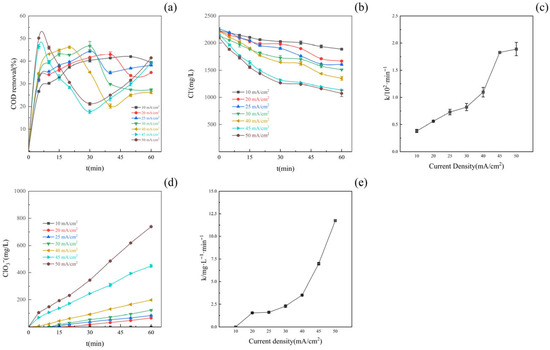
Figure 1 illustrates the effect of current density and reaction time on COD degradation under the conditions of Cl−/SO42− = 6 and a conductivity of 8 mS/cm. As shown in Figure 1a, the COD removal rate under different current densities exhibited a consistent evolutionary trend of “increase–decrease–increase” over time. Given the limitations of the COD test method using K2Cr2O7, this phenomenon should primarily be attributed to the differing susceptibility of the intermediate degradation products to oxidation by K2Cr2O7. Increasing the current density progressively shortened the time required to reach the first peak in COD removal and increased the peak value itself, while also reducing the duration from the peak to the subsequent trough. At a current density of 10 mA/cm2, the COD removal rate reached its first peak of 40.36% at 50 min. In contrast, at 50 mA/cm2, it rapidly reached the first peak of 50.22% within just 5 min, followed by a decline to a trough over the next 25 min. Prior to the first peak in COD removal, the anodic process was dominated primarily by chlorine-mediated oxidation (via ·Cl, Cl2). During this stage, both the MO pollutant and Cl− concentrations in the solution remained high, leading to enhanced mass transfer and accelerated reaction kinetics. The Cl− ions readily scavenged adsorbed ·OH on the electrode surface, simultaneously reducing the adsorption rate of ·OH. Figure 1b shows a relative decrease in Cl− concentration within the first 20 min across all current densities, which is further supported by the data in Figure 1d. The change in Cl− concentration during the initial 20 min conformed to first-order reaction kinetics. When the current density increased from 10 mA/cm2 to 50 mA/cm2, the reaction rate constant k for Cl− consumption increased from 0.383 × 10⁻² min−1 to 1.891 × 10⁻² min−1. This stage was driven by rapid chlorine evolution, generating substantial reactive chlorine species (RCS) that preferentially attacked and cleaved the azo bond, forming aniline-based intermediates. As the reaction progressed, the dominant chlorine-mediated oxidation gradually shifted towards the weaker oxidant ClO−-mediated pathway. This transition was particularly pronounced between higher current densities (40–50 mA/cm2) and lower current densities (10–30 mA/cm2), as evidenced by the gradual increase in ClO3− concentration after initial 10 min in Figure 1c, consistent with previous reports [27,28]. Under lower current densities (10–30 mA/cm2), limited chlorine evolution capacity resulted in ·OH becoming the primary oxidant, slowly degrading MO via non-selective oxidation. The initial cleavage of the azo bond by active chlorine led to the formation of –NH2 or –NO2 groups, contributing to the initial rise in COD removal. While higher active chlorine levels accelerated the preliminary oxidation of MO, the energy transfer efficiency might have decreased [29], accompanied by a rapid increase in energy consumption, aligning with earlier reports [30]. During the experiments the cell voltage changed less than 10% as shown in Figure S1, which means that the system showed good stability.
Figure 1.
Effect of current density and time on the degradation of MO. (a) COD removal, (b) c(Cl−); (c) Reaction rate constant of Cl− within the initial 20 min, (d) c(ClO3−), (e) Reaction rate constant of ClO3− after initial 5 min.
During the intermediate reaction phase, characterized by declining COD removal, the initial pollutant concentration decreased, and in situ generated ·OH began to dominate the deep transformation of benzene ring substituents. Some early-stage intermediates, such as various benzene derivatives, were resistant to oxidation during the COD test, resulting in a measured COD value lower than the Theoretical Oxygen Demand (ThOD) required for their complete mineralization. ThOD refers to the stoichiometric amount of oxygen required to oxidize a compound to end products like CO2, H2O, and NH3 [31]. However, as these initial intermediates underwent further electrochemical oxidation, they became more readily oxidized by K2Cr2O7 in the COD test. This increased oxidant consumption led to a temporary rise in the measured COD. Analysis of Figure 1d,e, which depicts the effect of current density and time on ClO3− concentration, confirms that the ClO3− concentration change followed zero-order kinetics from 5 min onward, based on the fitting results. This indicates that when the local active chlorine concentration exceeded a critical threshold, it triggered a secondary reaction pathway involving its further electrochemical oxidation to ClO3−. This process exhibits zero-order kinetics, meaning its rate is directly controlled by the interfacial active chlorine concentration rather than the bulk Cl− concentration. Similar to Cl− consumption, higher current densities accelerated ClO3− formation. No ClO3− was detected at 10 mA/cm2, whereas at 50 mA/cm2, 373.4 mg/L of ClO3− was rapidly generated within 60 min, with a reaction rate constant k = 11.742 mg/(L·min).
In the later reaction stage, the second rise in COD removal, excess active chlorine at high current densities, lacking sufficient reaction targets, was progressively converted to ClO3− byproducts. Meanwhile, the remaining intermediates continued to be oxidized, leading to the final increase in COD removal. After initial 30 min, the Cl− consumption rate had slowed and stabilized, while the COD removal rate and ClO3− concentration continued to change significantly. This indicates that the rates of chlorine evolution and active chlorine generation from Cl− had decreased markedly, but the existing active chlorine continued to react with organic pollutants and undergo conversion to ClO3−. A greater proportion of active chlorine was channeled into ClO3− formation rather than the oxidation of organic pollutants. This suggests that as the pollutant concentration decreased, the excess, unutilized active chlorine favored continuous oxidation at the anode interface. This spatiotemporal evolution of oxidant distribution reveals that current density not only governs the initial selection of oxidation pathways but also, by altering the dynamic balance of active species at different stages, ultimately determines the overall efficiency and completeness of the degradation process.
3.2. Effect of Binary Ions
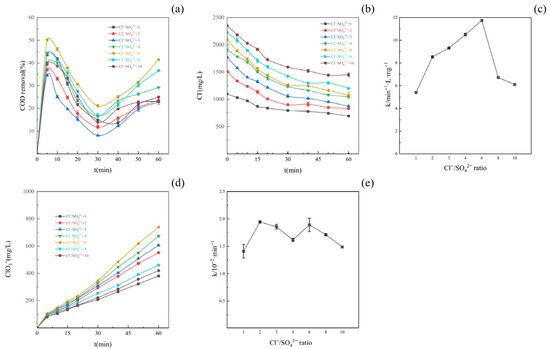
Figure 2a illustrates the effect of binary anions and time on COD removal. Under different binary anion ratios, the COD removal rate reached its maximum around the 5 min mark, subsequently decreased to a minimum from 10 to 30 min, and then gradually increased again. For instance, at a Cl−/SO42− ratio of 6, the COD removal rate rapidly increased to 50.22% within 5 min, then decreased to 21.17% from 5 to 30 min, before finally rising to 41.49% from 30 to 60 min.
Figure 2.
Effect of binary anions and time on the degradation of MO. (a) COD removal; (b) c(Cl−); (c) reaction rate constant of Cl− within the initial 20 min; (d) c(ClO3−); (e) reaction rate constant of ClO3− after initial 5 min.
While the overall trend of COD removal rate change was consistent across different binary anion ratios, significant differences were observed at specific time points between similar ratios. At these lower Cl−/SO42− ratios (≤3), despite the applied current density being 50 mA/cm2, the initial reaction stage was still primarily driven by active chlorine species facilitating the cleavage of the azo bond and initial oxidation of the benzene ring. However, insufficient generation of active chlorine led to inadequate degradation driving force, resulting in a relatively slow initial degradation rate. The relatively non-selective nature of free radicals caused them to be consumed and dispersed by the numerous intermediates [32], preventing them from forming an effective primary degradation pathway. Consequently, the overall COD removal rate remained low. As the reaction progressed into the middle and later stages, the persistently available free radicals gradually achieved the deep oxidation of intermediates such as aromatic amines and phenols. When the Cl−/SO42− ratio was ≤3, an increase in this ratio led to a decrease in the COD removal rate at all measured time points. The maximum COD removal rate declined from 43.83% to 34.51%, while the COD removal rate at 60 min decreased from 25.03% to 22.82%.
When 3 < Cl−/SO42− ≤ 6, an increase in the ratio resulted in an increase in the COD removal rate at all time points. The maximum COD removal rate rose to 50.22%, and the value at 60 min increased to 41.49%. Sufficient Cl− ensured the rapid generation of active chlorine species, enabling the swift disruption of the initial MO structure.
When the 6 < Cl−/SO42− ≤ 10, a further increase in the ratio led to a decrease in the COD removal rate at all time points. The maximum COD removal rate dropped to 39.64%, and the value at 60 min decreased to 23.08%. An excessively high Cl−/SO42− ratio caused surplus Cl− to compete for active sites on the anode surface, inhibiting the generation of free radicals and severely impairing the radical-based pathway [33]. This resulted in insufficient ·OH during the middle and late stages, which are crucial for benzene ring opening and the mineralization of small molecular acids, ultimately leading to reduced degradation efficiency and the accumulation of by-products.
The behavior of Cl− and ClO3− corroborates the differences in COD removal rate observed under different Cl−/SO42− ratios. From Figure 2d,e, which depict the effect of the binary anion ratio on ClO3− concentration and its formation rate, it can be seen that based on the fitting results, the variation in ClO3− concentration followed zero-order kinetics from 5 min onwards. The final formation rate of ClO3− remained relatively constant across various ion ratios. This phenomenon suggests that under the applied current density, the electro-generation of chlorate was likely governed by the surface saturation of adsorbed chlorine intermediates like a steady-state concentration of ClO−, rather than the bulk chloride concentration. The value of k increased from 5.400 mg/(L·min) at a ratio of 1, reached a maximum of 11.742 mg/(L·min) at a ratio of 6, and subsequently decreased to 6.105 mg/(L·min) at a ratio of 10. Therefore, at Cl−/SO42− ratios ≤ 3, increasing the ratio moderately accelerated the Cl− reaction rate, thereby promoting chlorine evolution. However, this diverted a greater proportion of energy towards chlorine evolution and the formation of by-products like ClO3−, rather than towards generating oxidants such as ·OH and active chlorine. As the Cl−/SO42− ratio increased into the intermediate range (3 < Cl−/SO42− ≤ 6), the elevated Cl− concentration favored an enhanced rate of active chlorine species generation. When the Cl−/SO42− ratio exceeded 6, the reactions responsible for active chlorine generation and its subsequent reaction with organic pollutants approached a state near saturation. Meanwhile, the significantly reduced SO42− concentration limited the production of ·OH. This pattern demonstrates that the binary anion ratio governs the progression efficiency and thoroughness of the degradation pathway by regulating the dynamic balance of active oxidizing species at different stages.
3.3. Effect of Conductivity
While the anion ratio determines the intrinsic composition of active species, the solution conductivity governs their mass transfer and interfacial reaction kinetics. Therefore, the effect of conductivity was investigated under the optimal anion ratio identified above.
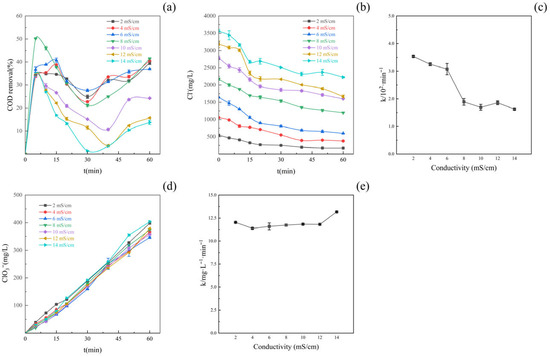
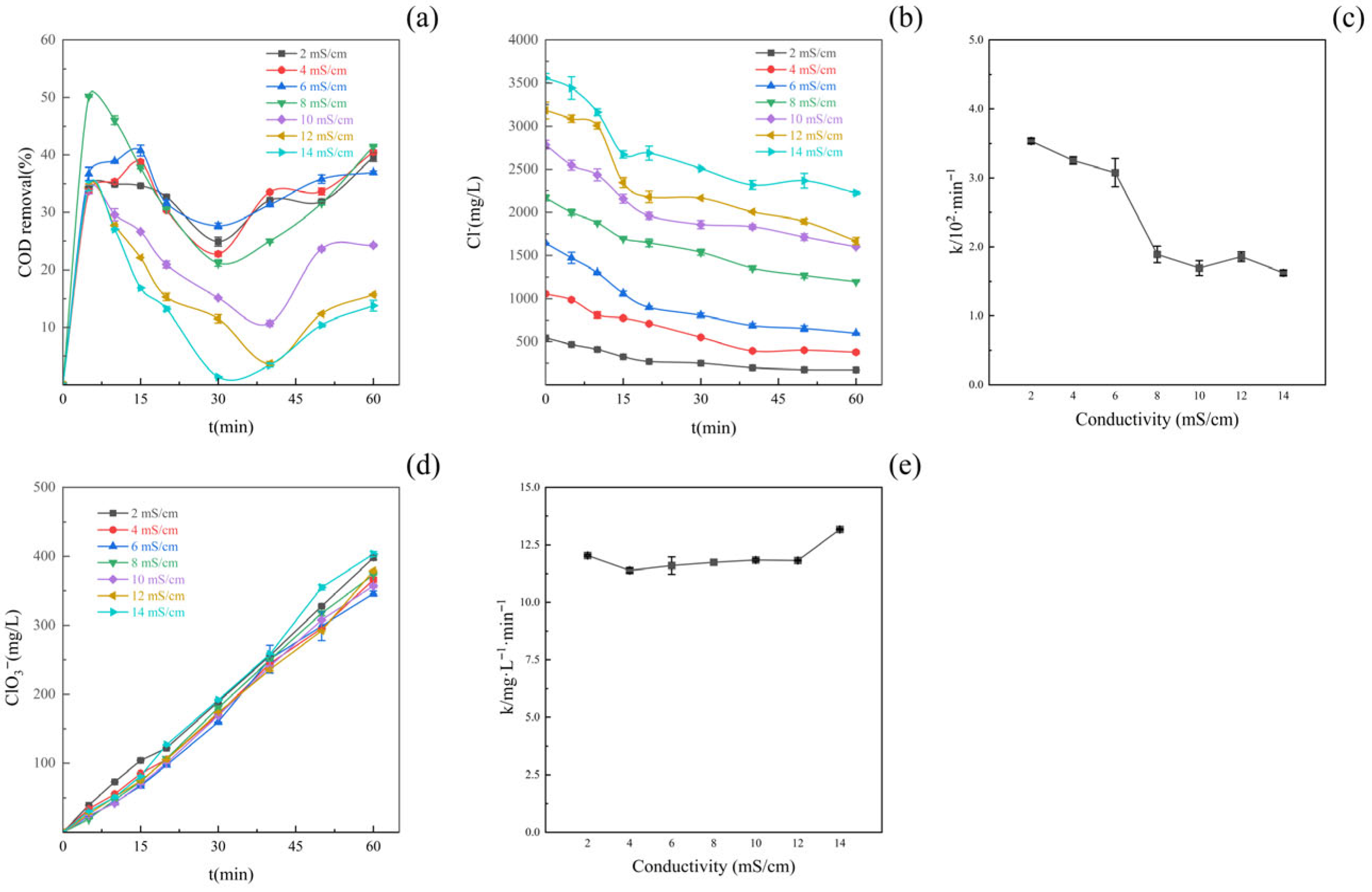
Figure 3a illustrates the effect of conductivity and reaction time on COD degradation. The variations in COD removal under different conductivity levels primarily stem from the dual influence of solution ionic strength on mass transfer efficiency and the balance between reaction pathways.
Figure 3.
Effect of conductivity and time on the degradation of MO. (a) COD removal; (b) c(Cl−); (c) reaction rate constant of Cl− within the initial 20 min; (d) c(ClO3−); (e) reaction rate constant of ClO3− after initial 5 min.
At lower conductivity levels (≤6 mS/cm), the limited ion migration rate resulted in slow reactant transport, rendering both active chlorine generation and pollutant oxidation processes mass-transfer controlled. The slow and localized generation of active chlorine, combined with reactions limited to pollutants that diffused to the electrode interface, led to a lower initial degradation rate. The COD removal rate reached its maximum around 15 min. Subsequently, from 15 to 30 min, the gradually accumulating free radicals began participating in the preliminary oxidation of benzene-ring intermediates. However, due to mass transfer limitations, the overall efficiency remained constrained, and the COD removal rate slowly decreased before eventually rising again. As conductivity increased within this low range, improved mass transfer allowed for faster active chlorine generation and more sufficient reaction with pollutants, increasing the maximum COD removal rate from 34.87% to 50.22%.
At higher conductivity levels (>6 mS/cm), sufficient ionic strength ensured rapid mass transfer during the initial stage, promoting the fast generation of active chlorine and achieving efficient cleavage of the azo bond. Consequently, the COD removal rate peaked around 5 min. During the middle reaction stage, the moderate ionic strength maintained continuous active chlorine generation while also supporting the stable presence of free radicals [34], establishing a synergistic oxidation mechanism that promoted the deep transformation of phenolic and aromatic amine intermediates [35]. The COD removal rate then gradually decreased before increasing again. While the maximum COD removal rate remained largely unchanged with further increases in conductivity within this high range, the extent of the subsequent decrease became more pronounced. For instance, at a conductivity of 10 mS/cm, the COD removal rate decreased from its maximum of 34.04% to a minimum of 10.70%. At 14 mS/cm, it decreased from a maximum of 34.57% to a minimum of 1.39%. An excessively high ionic environment can quench ·OH [36], severely impairing the deep mineralization capacity. This inhibition of the free radical pathway, essential for benzene ring opening and small acid mineralization, leads to the accumulation of numerous incompletely oxidized small molecular intermediates. These products are more readily oxidized by potassium dichromate during COD testing, causing a significant rebound in the apparent COD value. This manifests as a greater drop in COD removal rate from its peak value at higher conductivities.
Figure 3b,c illustrate the effect of conductivity on Cl− concentration. A relatively rapid decrease in Cl− concentration occurred within the first 20 min, after which the consumption rate declined. Kinetic fitting indicated that the change in Cl− concentration during the initial 20 min period conformed relatively well to first-order reaction kinetics. As the conductivity increased, the Cl− consumption rate showed a decreasing trend, with the reaction rate constant k decreasing from 3.537 × 10⁻² min−1 to 1.625 × 10⁻² min−1. The influence of conductivity on the Cl− reaction rate stems from its dual role in regulating both the system’s mass transfer efficiency and the interfacial reaction environment [37,38]. While increased conductivity enhances the solution’s ionic concentration and improves the mass transfer of Cl− towards the electrode surface [39], which theoretically should accelerate its electrochemical oxidation to active chlorine. The relative migration rate of Cl− actually decreases in the practical system, leading to a limited surface reaction rate.
Figure 3d,e illustrate the effect of conductivity on ClO3− concentration. The rate of ClO3− generation within the system remained largely unchanged across different conductivity levels. Based on the fitting results, the variation in ClO3− concentration followed zero-order kinetics starting from 5 min. Approximately 640–740 mg/L of ClO3− was generated at a relatively constant rate over 60 min, with a reaction rate constant k ranging from 11.599 to 12.038 mg/(L·min). The ClO3− formation rate exhibited decoupling from conductivity changes because its generation primarily depends on the further oxidation of already-formed active chlorine at the electrode surface.
Under lower conductivity conditions, the system contained fewer free ions. Although the Cl− reaction rate constant was higher, the total amount of active chlorine species generated was limited. Crucially, the ClO3− formation rate remained consistent with that under higher conductivity conditions. This indicates that a larger proportion of the active chlorine was converted to ClO3−. Consequently, after the initial oxidation of MO to primary intermediates, the system lacked sufficient capacity for their further oxidation, which explains the absence of a rebound in the COD removal rate under these low conductivity conditions.
3.4. RSM Development and Statistical Analysis
3.4.1. Combined RSM
The preceding sections have individually revealed the complex effects of current density, Cl−/SO42− ratio, and conductivity on the degradation process. To decipher their interactions and identify the global optimal operational window, an RSM approach was employed.
This study employed a coupled modeling approach integrating multi-objective Box–Behnken Design (BBD) with Pareto analysis. Building upon the qualitative analysis provided by BBD, the Pareto optimization strategy was applied for further quantitative analysis to investigate the influence of response variables on MO degradation efficiency and degradation pathways, as well as the underlying principles governing these relationships. This methodology aims to provide strategic guidance for optimizing operational parameters and developing sustainable pathways for the advanced electrocatalytic oxidation treatment of low-concentration COD dyeing wastewater.
The key factors affecting MO degradation response—current density (A), Cl−/SO42− ratio (B), and conductivity (C)—were selected. The maximum COD removal rate was designated as the response variable. A three-factor, three-level response surface methodology experiment and analysis were conducted to qualitatively determine the order of significance of the driving factors in the MO degradation reaction. The experimental variables are detailed in Table 2.
Table 2.
Coded level and independent variables of the model.
The relationship between the independent variables and response variable was estimated using a second-order polynomial model as shown in Equation (3) [36]:
where β0, βi, βij are model coefficients for intercept, linear, quadratic, and interaction, respectively; xi and xj are the coded input factors; ε is the residual.
Analysis of Variance (ANOVA) was used to examine the relationships between the independent variables and their interactions, as well as between the dependent and independent variables. Correlations between experimental conditions and response values were determined within a 95% confidence interval. A second-order model was used to evaluate the optimal conditions, and the significance of the developed model was assessed through p-values. A model variable is considered significant when p < 0.05, indicating that the factor has an important and non-random influence on the COD removal rate. When p < 0.0001, the model variable is deemed highly significant, demonstrating that the established quadratic regression model can describe the true relationship between the variable and the response value with high reliability, strong predictive capability, and considerable statistical significance [40].
The contribution percentage (Pi) of each independent variable and its interactions to the response was determined according to Equation (5), quantifying the relative weight of each factor’s influence on the outcome. This allows for the precise identification and ranking of key driving factors by importance, where bi represents the estimated main effect of variable [41].
where bi denotes the principal influence of variable i estimation.
In this study, Pi quantitatively defines the importance level of the response variables driving the MO degradation reaction. For dominant factors with an importance level exceeding 80%, process adjustments, optimization, or even re-engineering should be conducted to enhance the degradation efficiency.
3.4.2. Data Analysis
A second-order polynomial model regression analysis was performed using Design Expert 13 software. The experimental design matrix and corresponding results are presented in Table 3.
Table 3.
RSM matrix and experimental results.
Based on the response surface experimental design and results, the following multiple quadratic response surface regression model, given in Equation (6), was developed.
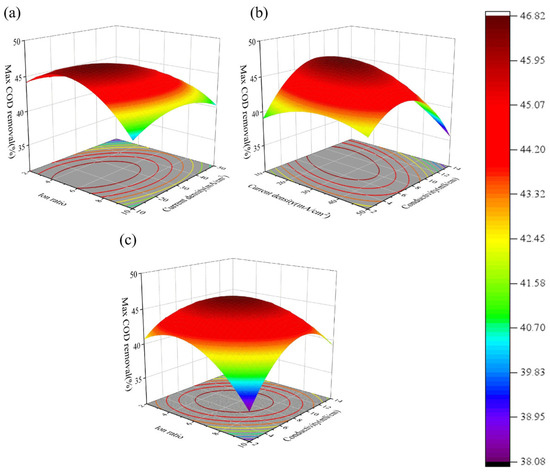
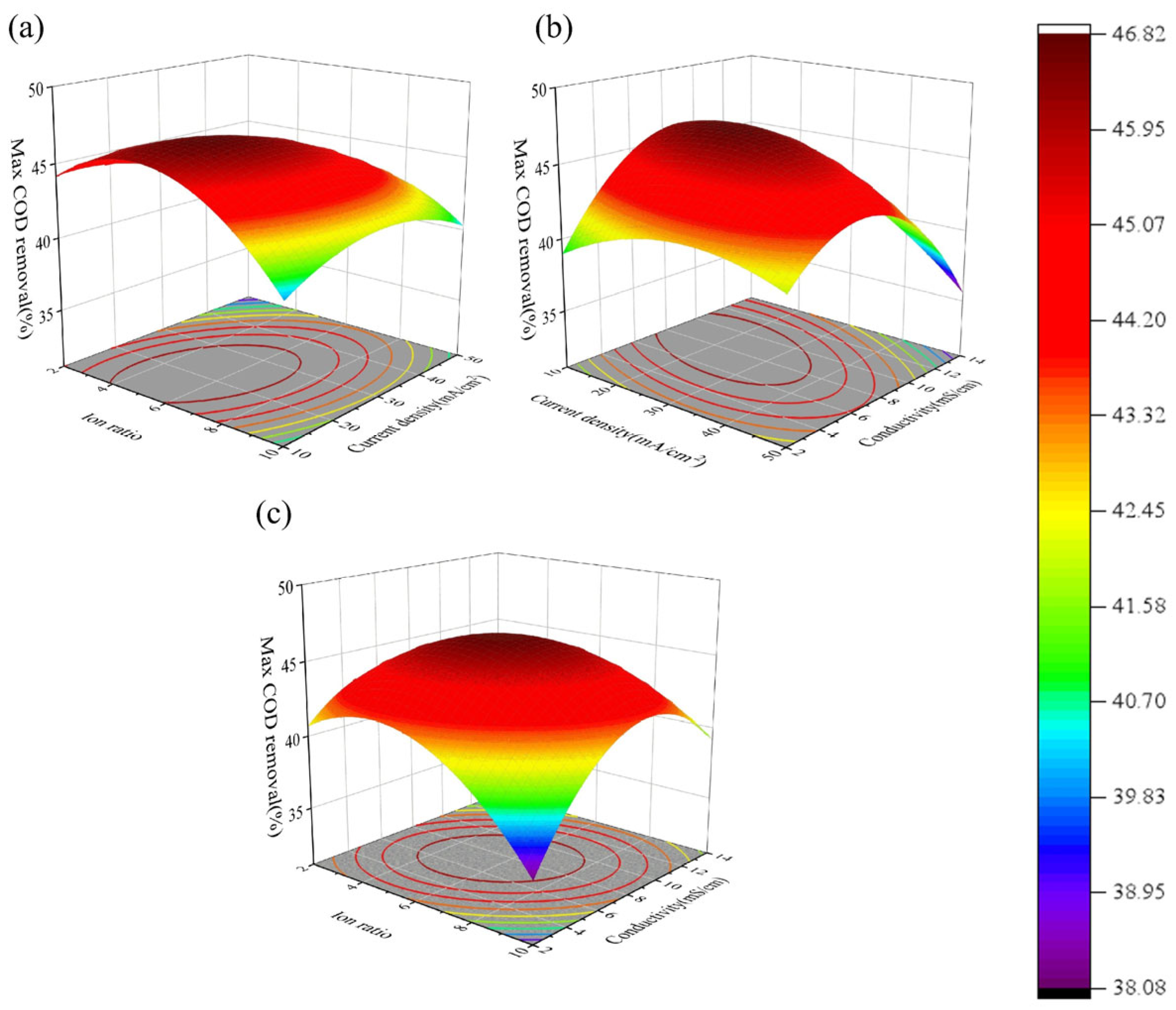
Response surface of maximum COD removal rate is shown in Figure 4.
Figure 4.
Binary interaction of 3D surface graphs of process variables. (a) AB; (b) AC; (c) BC.
Table 4 illustrates that the regression model for the maximum COD removal rate demonstrated a significant linear term for current density, significant quadratic terms for all factors, and significant interaction terms among them, indicating strong interactive effects between the influencing factors. Furthermore, the overall regression model was highly significant, confirming that the regression equation provides an excellent fit to the experimental data.
Table 4.
ANOVA.
Based on the validated model and the perturbation analysis, the optimal conditions for maximizing COD removal within 60 min were predicted as follows: the current density should be 19.72 mA/cm2, while Cl−/SO42− ratio is 5.40, and the conductivity is 8.30 mS/cm.
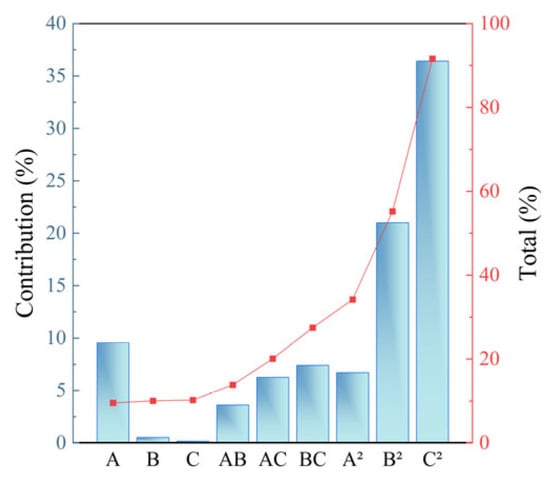
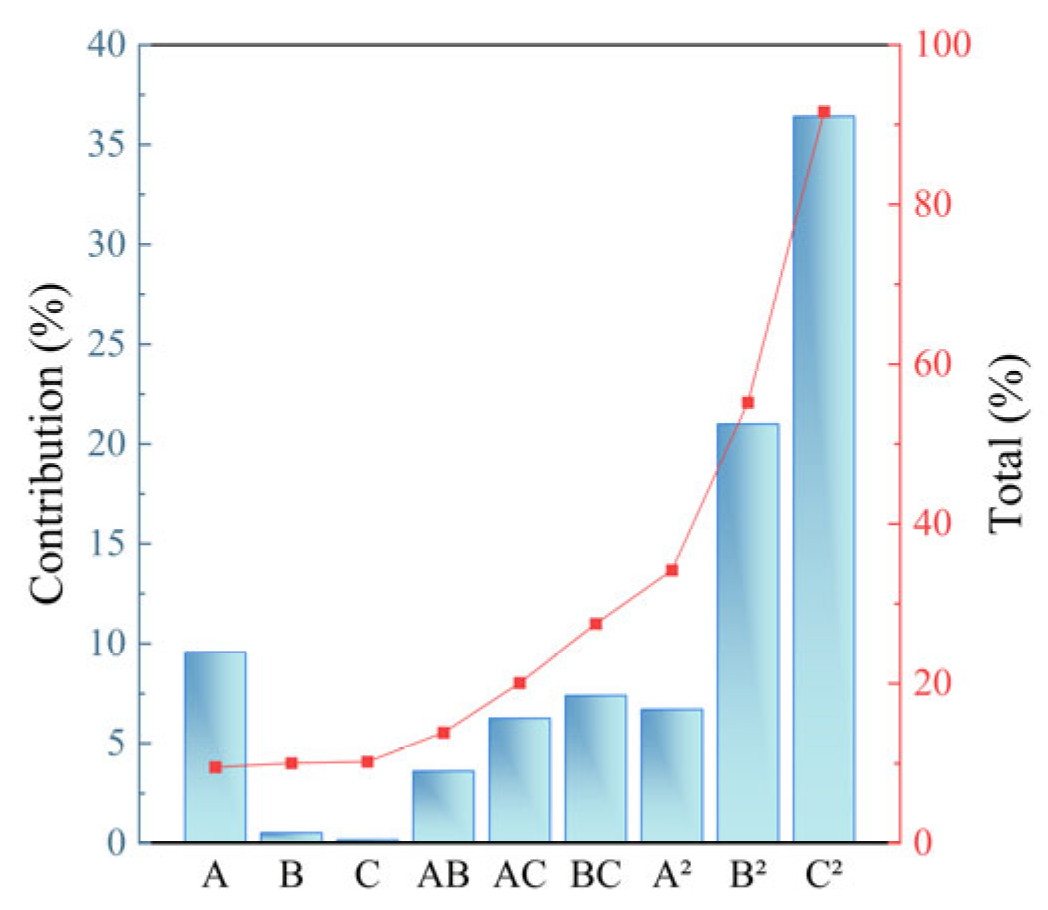
Figure 5 illustrates the results of Pareto analysis. Among the primary variables, the binary ion concentration ratio and conductivity made the largest contributions to the maximum COD removal rate. Specifically, the squared terms of the binary ion concentration ratio and conductivity contributed 21.0% and 36.4%, respectively. The underlying reason lies in the complex synergistic and competitive balance between Cl− and SO42− within the system. When the ratio is too low, the generation of active chlorine is insufficient, resulting in limited oxidative capacity. Conversely, when the ratio is excessively high, surplus Cl− not only fiercely competes for active sites on the anode, inhibiting the formation of ·OH, but also consumes ·SO4− via radical chain reactions [30]. Simultaneously, it significantly increases the risk of generating ClO3− and chlorinated organic by-products, collectively leading to the decline in the maximum COD removal rate.
Figure 5.
Results of Pareto analysis.
Concurrently, the significant contribution of the squared term for conductivity reveals the dual regulatory role of solution ionic strength on the reaction pathways. Below a certain threshold, increasing the conductivity significantly reduces the system’s ohmic resistance and enhances mass transfer efficiency [42], thereby promoting the generation and utilization of reactive oxidative species. However, beyond the optimal value, excessively high ionic concentrations may quench free radicals in the solution and intensify the competing oxygen evolution side reaction at the electrode surface, lowering the current efficiency [36] and causing the maximum COD removal rate to decrease instead of increase. Therefore, within the Ti/RuO2-IrO2 anode electrocatalytic system, an appropriate Cl−/SO42− ratio and a suitable conductivity level are key to synergistically optimizing the free radical and active chlorine pathways, thereby achieving efficient pollutant degradation while minimizing by-product formation.
4. Discussion
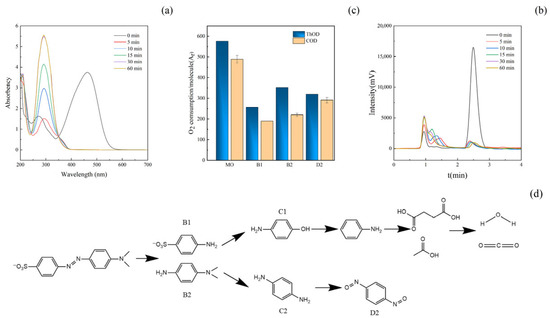
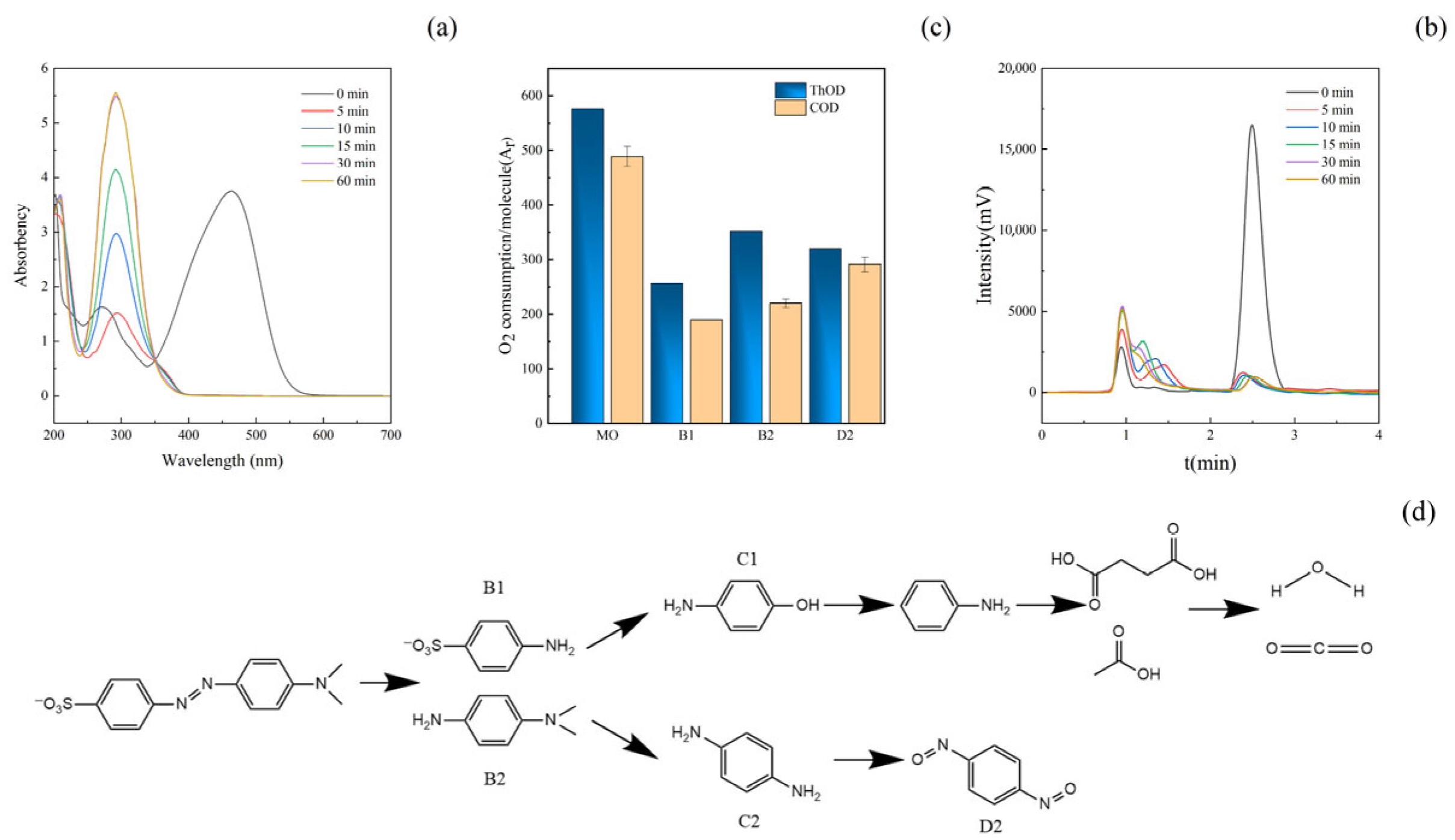
The degradation MO under the conditions of 50 mA/cm2 current density, Cl−/SO42− = 6, and conductivity of 8 mS/cm was characterized using UV-Vis spectroscopy and HPLC. The UV-Vis spectrum of the initial solution exhibited two characteristic absorption peaks at 270 nm and 465 nm. As shown in Figure 6a, after 60 min of electrochemical oxidation, the absorption peak at 465 nm completely disappeared, indicating the complete degradation of the chromophoric azo group (–N=N–) in MO. This group represents a relatively weak linkage within the MO structure, with a bond energy of approximately 100 kJ/mol, making it the most susceptible to initial degradation. Concurrently, the initial peak at 270 nm, associated with the benzene ring, underwent a red-shift to 300 nm within the first 5 min. The red-shift indicated a slight enhancement in the polarity of the benzene ring. The intensity of this new peak gradually increased, reaching its maximum before 30 min. This observation suggests that the benzene rings did not undergo immediate ring opening and complete mineralization during the initial stages. Instead, the primary reaction was the cleavage of the azo bond, generating sulfanilic acid (B1) and N,N-dimethyl-p-phenylenediamine (B2).
Figure 6.
Results of (a) UV-Vis; (b) HPLC; (c) ThOD and COD of MO and intermediate products; (d) degradation pathways of MO.
Subsequently, the reaction shifted towards the higher bond energy substituents. Demethylation occurred, cleaving the C–N bond with a bond energy of 305 kJ/mol, yielding p-phenylenediamine (C2). Meanwhile, the sulfonic acid group (–SO3H) in B1 was oxidized to a hydroxyl group (–OH), forming p-aminophenol (C1). The two amino groups (–NH2) of C2 were then oxidized to nitroso groups (–NO), resulting in the formation of p-dinitrosobenzene (D2). Finally, C1 was oxidized to aniline, after which the most stable structural component—the benzene ring—underwent ring opening. This was followed by further oxidation to butylamine and ultimately to small molecular carboxylic acids such as acetic acid and oxalic acid.
For the COD measurement using the potassium dichromate spectrophotometric method, theoretical calculations indicate that complete oxidation of 75 mg/L MO to CO2, H2O, NH3, and SO42− would correspond to a theoretical COD of approximately 132.0 mg/L. However, the experimentally measured value was 115.7 mg/L, demonstrating that MO cannot be completely oxidized by K2Cr2O7 under the standard test conditions. Similarly, as illustrated in Figure 6d, the theoretical oxygen demand for the complete oxidation of one MO molecule is 576 Ar, whereas the measured consumption was 488.8 Ar O2. The theoretical oxygen demands for the complete oxidation of one molecule each of B1, B2, and D2 are 256 Ar, 352 Ar, and 320 Arr respectively, with their experimentally measured values being 189.7 Ar, 219.7 Ar, and 297.0 Ar.
Therefore, during the initial phase of the electrochemical oxidation process, MO is oxidized to B1 and B2, leading to a rapid decrease in the measured COD. Subsequently, as B2 is oxidized to D2, which presents lower resistance to oxidation in the COD test, it consumes more K2Cr2O7. This increased consumption of the oxidant results in the observed rebound of the measured COD value.
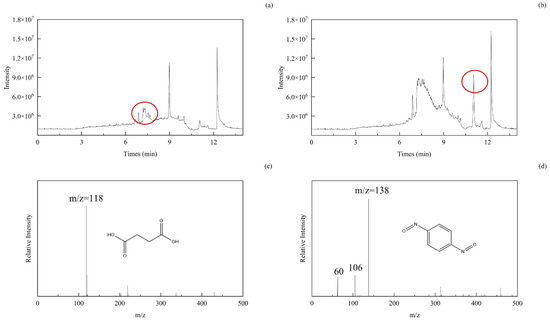
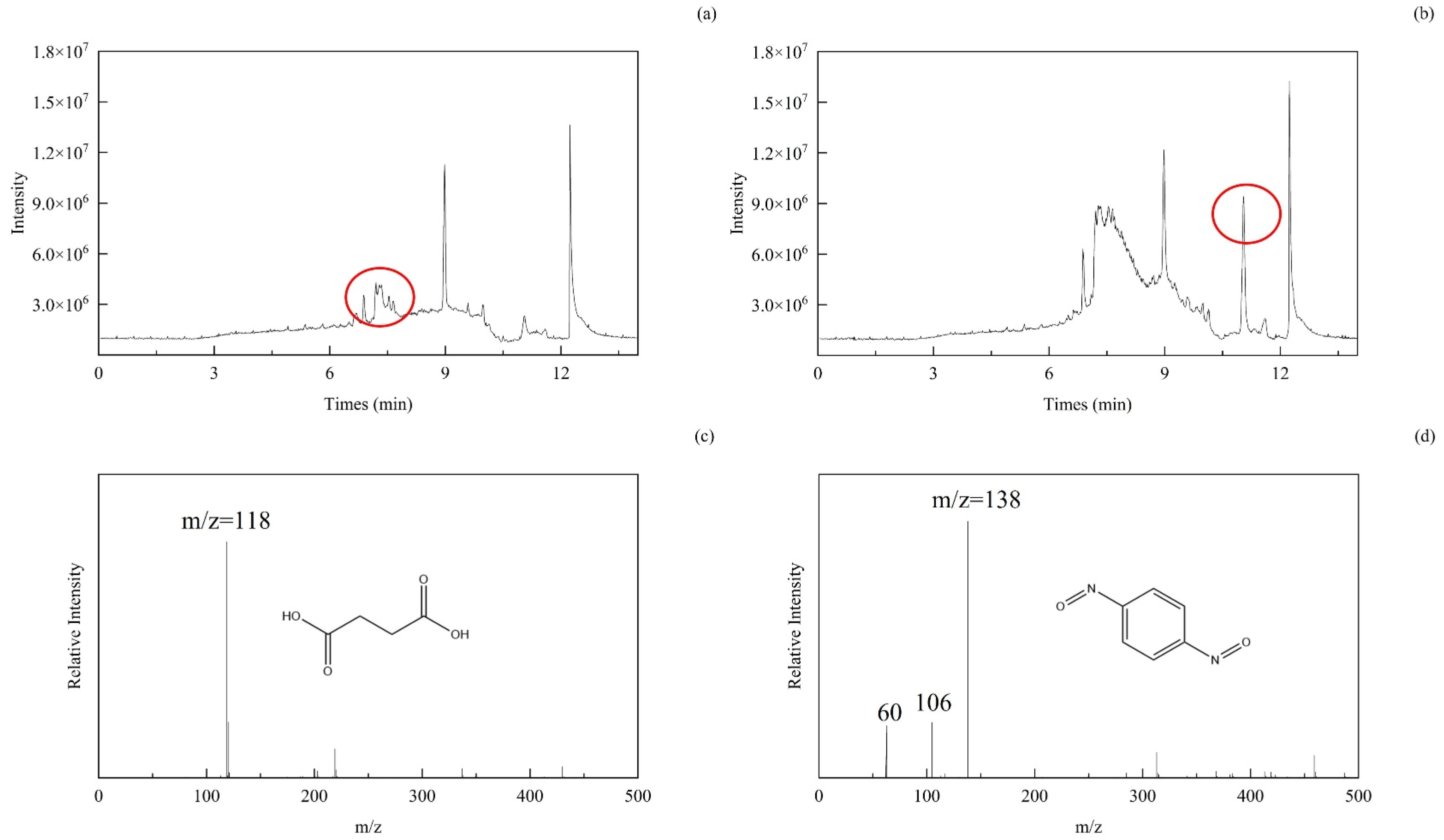
To further substantiate the above hypothesis, water samples collected during the electrochemical oxidation process were extracted using dichloromethane as the solvent to isolate the organic components. The extracted samples were then analyzed using LC-IMS-QTof mass spectrometry. As shown in Figure 7, two significantly enhanced peaks appeared at 6.8 min and 10.7 min, respectively. Based on the mass spectrometry analysis results, these peaks were speculated to correspond to succinic acid (m/z = 118) and 1,4-Dinitrosobenzene (m/z = 136), the predicted intermediates illustrated in Figure 6.
Figure 7.
Results of LC-IMS-QTof. Chromatography after initial (a) 5 min and (b) 60 min of EO. Mass spectra of peaks red-circled at (c) 6.8 min and (d) 10.7 min.
The oxidation of –NH2 groups by RCS follows a progressive pathway, typically involving the initial conversion of –NH2 to –NHOH, subsequent oxidation to –NO, and finally to –NO2. The employed Ti/RuO2-IrO2 electrode is a typical active anode, characterized by high catalytic activity for the chlorine evolution reaction but a relatively limited capacity for ·OH generation [39]. This characteristic enables RCS to assume a dominant role throughout the reaction system [43]. Under these conditions, the oxidation of the -N(CH3)2 group on the benzene ring by RCS essentially halts at the –NO stage, without further progression to –NO2. Concurrently, the presence of SO42− sustains the overall oxidation potential of the system through the auxiliary action of ·SO4−, yet it does not alter the dominance of RCS in amine oxidation, ultimately leading to the detection of 1,4-Dinitrosobenzene as a stable intermediate.
The emergence of succinic acid provides complementary evidence from another perspective, confirming the synergistic mechanism involving RCS-modified ring-opening pathways and radical-assisted ring-opening within the binary anion system. In conventional advanced oxidation processes dominated by ·OH, benzene ring opening tends to favor the formation of maleic acid, which is rapidly converted to oxalic acid and subsequently mineralized [44]. However, in this system, the participation of RCS alters the bond cleavage sites and subsequent reaction pathways during benzene ring opening. This modification leads to the saturation of the double bond in maleic acid, resulting in the formation of the more stable succinic acid. Furthermore, the Ti/RuO2-IrO2 anode exhibits a relatively weak capacity for the deep oxidation of small carboxylic acid molecules, which facilitates the accumulation of succinic acid within the experimental timeframe. Additionally, while ·SO4− derived from SO42− primarily contributes to the initial ring-opening of the aromatic ring, its capacity to mineralize the resulting small carboxylic acids is limited, further contributing to the observed accumulation.
The detection of 1,4-Dinitrosobenzene confirms the intermediate state characteristic of the deamination oxidation step, while the presence of succinic acid signifies a stabilized product following benzene ring opening as the process enters the small carboxylic acid phase. These findings collectively highlight that, under the synergistic regulation of the Cl−/SO42− binary system and the Ti/RuO2-IrO2 anode, the electrochemical oxidation of low-concentration azo dye wastewater indeed proceeds via a unique reaction pathway distinct from the traditional radical-dominated pathway.
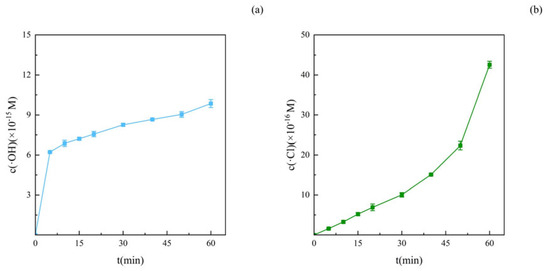
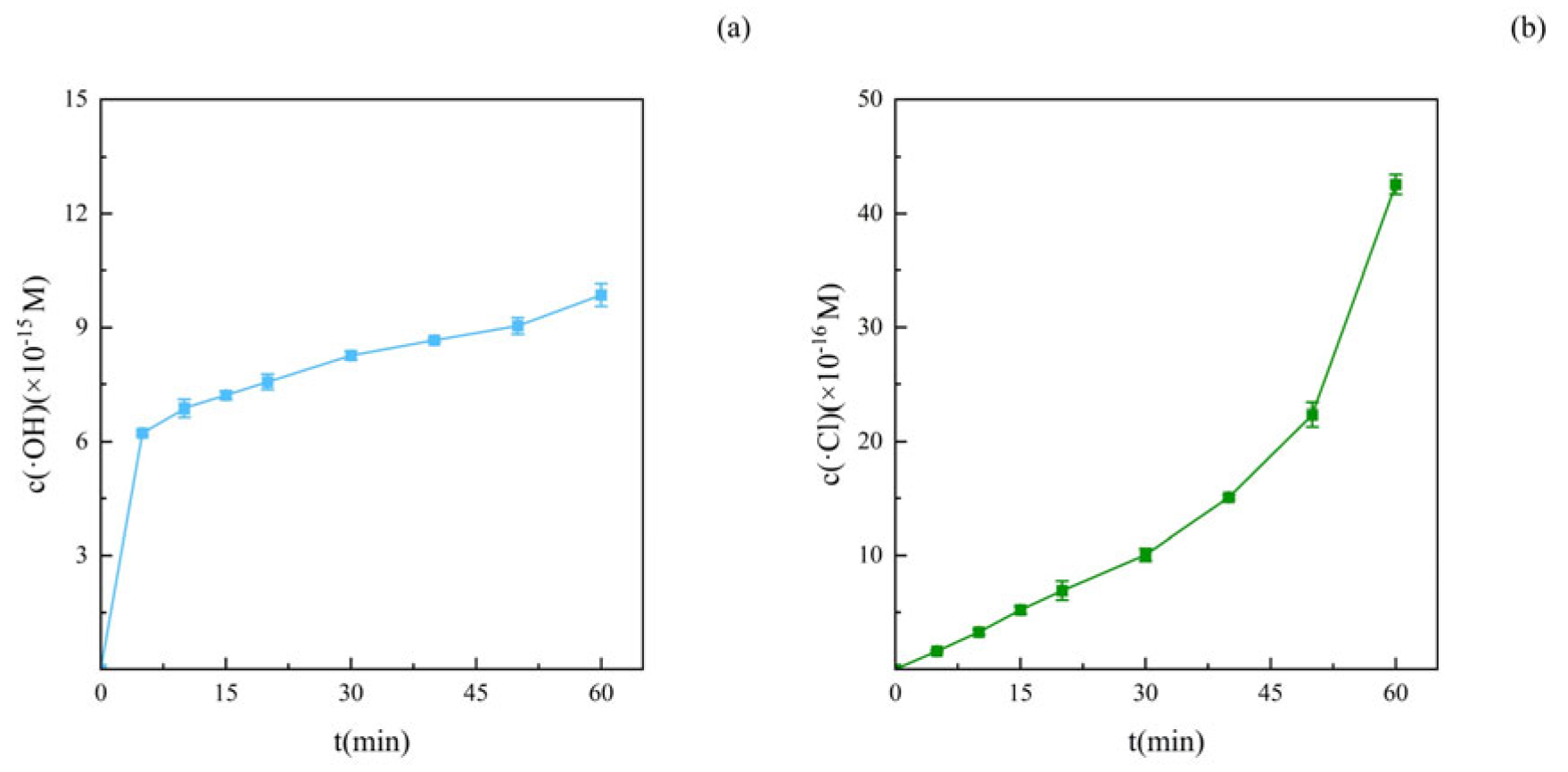
After testing the cumulative generation of ·OH and ·Cl, the results are shown in Figure 8. Within the first 5 min, ·OH was rapidly generated, reaching 6.23 × 10⁻¹⁵ mM, but its generation rate subsequently decreased significantly. In contrast, ·Cl exhibited a relatively low generation rate in the initial stage, which continuously accelerated, culminating in a cumulative production of 42.58 × 10⁻¹⁶ mM at 60 min.
Figure 8.
Cumulatively generated concentration of (a) ·OH; (b) ·Cl.
In the initial reaction stage, the abundance of active sites on the electrode surface enabled rapid ·OH accumulation and participation in oxidation reactions [45]. However, as the reaction progressed, Cl− underwent discharge on the anode surface, generating Cl2 and ·Cl. The generation rate of RCS, including ·Cl, continued to rise. These species not only consumed a substantial amount of adsorbed ·OH on the electrode surface but also inhibited further ·OH generation by competing for adsorption sites [46]. Concurrently, the rapid chlorine evolution within the first 5 min depleted Cl− near the interface, yet Cl− from the bulk solution could still be replenished through mass transfer, allowing the RCS generation reaction to persist and even accelerate [21]. As the reaction advanced, a chloro-oxide intermediate layer may have formed on the electrode surface, gradually enhancing its catalytic activity for the chlorine evolution reaction. The initial phase featured synergistic bond cleavage driven by high concentrations of ·OH and RCS. However, with the establishment of the RCS pathway as the dominant route, the oxidation process shifted towards a more selective chlorine-mediated mechanism. This transition in the predominant reactive species also corroborates the aforementioned reason why the final products were primarily succinic acid and 1,4-Dinitrosobenzene.
In studies exploring MO degradation pathways by other methods [47,48,49], the primary routes often involve hydroxyl substitution of hydrogen atoms before azo bond cleavage, or oxidation of the amino group on the benzene ring to a nitro or hydroxyl group at intermediate stages. This is followed by oxidation to hydroquinone and then to quinone, culminating in complete oxidation of the quinone structure. These reported pathways further highlight the distinctiveness of the degradation route observed in our system. In summary, under the synergistically optimized conditions of the binary anion system and key operational parameters (current density 50 mA/cm2, Cl−/SO42− = 6:, conductivity 8 mS/cm), the types of active species and the oxidation selectivity in the electrochemical oxidation of the azo dye were altered. This reshaped the degradation pathway to “Azo bond cleavage → Demethylation/Desulfonation → Dehydroxylation/Deamination oxidation → Benzene ring opening”, which is distinct from conventional pathways.
5. Conclusions
This study systematically investigated the effects of current density, conductivity, and the Cl−/SO42− ratio on the electrochemical degradation of low-concentration azo dye wastewater in a binary anion system using a Ti/RuO2-IrO2 anode. By combining batch experiments with RSM and Pareto analysis, the regulatory roles of these key parameters on COD removal behavior, reactive species evolution, and degradation pathways were clarified. The main conclusions are as follows.
- First, the COD removal of MO exhibited a characteristic “rapid increase–subsequent decline–gradual rebound” trend during electrochemical oxidation. This dynamic behavior reflects the staged transition of the dominant oxidation pathway, from the initial rapid cleavage of the azo bond by RCS, to the intermediate accumulation of partially oxidized aromatic intermediates, and finally to the further oxidation of residual intermediates in the later stage.
- Second, significant interaction effects were identified among current density, conductivity, and the Cl−/SO42− ratio. Increasing current density accelerated both pollutant degradation and chloride conversion but simultaneously promoted chlorate formation and may increase energy consumption. The binary anion ratio and conductivity were found to play particularly important roles in determining the balance between RCS-mediated selective oxidation and radical-mediated deep oxidation. The RSM model showed high statistical significance (p < 0.0001), and Pareto analysis indicated that the most influential factors governing COD removal were conductivity, followed by Cl−/SO42− ratio and current density.
- Third, optimization of the binary anion composition and operational parameters reshaped the degradation mechanism of MO. Under the synergistic regulation of Cl− and SO42−, the oxidation pathway was altered from a conventional radical-dominated route to a characteristic pathway of azo bond cleavage → demethylation/desulfonation → dehydroxylation/deamination oxidation → benzene ring opening. This pathway was further supported by spectroscopic and mass spectrometric analyses, which identified key intermediates such as 1,4-dinitrosobenzene and succinic acid.
Finally, within 60 min of treatment, the optimal operational conditions predicted by the RSM model were a current density of 19.72 mA/cm2, a Cl−/SO42− ratio of 5.40, and a conductivity of 8.30 mS/cm. These findings provide both mechanistic insight and practical guidance for optimizing electrochemical processes for the advanced treatment and safe reuse of low-concentration printing and dyeing wastewater.
Overall, this work demonstrates that the binary anion system is not merely a background electrolyte condition but a critical regulatory factor governing reactive species distribution, degradation selectivity, and treatment efficiency. The results provide a theoretical basis for developing greener and more controllable electrochemical treatment strategies for complex dyeing wastewater matrices.
Supplementary Materials
The following supporting information can be downloaded at: https://www.mdpi.com/article/10.3390/w18070769/s1. Text S1: Other Information of electrochemical experiments; Text S2: Water quality indices of wastewater collected in Guangdong province; Text S3: Calculation of the steady-state concentrations of active chlorine and homogeneous radicals; Figure S1: The cell voltage under different current densities.
Author Contributions
Conceptualization, M.C., K.L. and L.S.; methodology, M.C., K.L. and L.S.; validation, M.C., K.L. and L.S.; formal analysis, H.D.; investigation, C.C. and J.C.; data curation, M.C., K.L., H.D. and C.C.; writing—original draft preparation, M.C. and K.L.; writing—review and editing, C.Y. and L.S.; supervision, L.S.; project administration, L.S.; funding acquisition, L.S. All authors have read and agreed to the published version of the manuscript.
Funding
This research was funded by the Science and Technology Planning Project of Guangdong Province of Guangdong Provincial Department of Science and Technology (Project 2024A0505090013).
Data Availability Statement
The original contributions presented in the study are included in the article/Supplementary Materials. Further inquiries can be directed to the corresponding authors.
Conflicts of Interest
The authors declare no conflicts of interest.
References
- Gabris, M.A.; Periyasamy, A.P.; Tehrani-Bagha, A. Top Ten Super-Adsorbents for Removal of Textile Dyes from Wastewater. Environ. Res. 2025, 285, 122424. [Google Scholar] [CrossRef] [Scilit]
- Li, Y.; Cao, P.; Wang, S.; Xu, X. Research on the treatment mechanism of anthraquinone dye wastewater by algal-bacterial symbiotic system. Bioresour. Technol. 2022, 347, 126691. [Google Scholar] [CrossRef] [Scilit] [PubMed]
- Fleischmann, C.; Lievenbrueck, M.; Ritter, H. Polymers and Dyes: Developments and Applications. Polymers 2015, 7, 717–746. [Google Scholar] [CrossRef] [Scilit]
- Siri, C.N.K.; Ali, R.A.S.; Latha, M.S.; Betageri, V.S.; Byadagi, K.S. A Reflection of literature reports on Synthesis, Spectral Studies, Multilateral applications of Azo dyes. Results Chem. 2025, 18, 102878. [Google Scholar] [CrossRef] [Scilit]
- Balapure, K.H.; Jain, K.; Chattaraj, S.; Bhatt, N.S.; Madamwar, D. Co-metabolic degradation of diazo dye-Reactive blue 160 by enriched mixed cultures BDN. J. Hazard. Mater. 2014, 279, 85–95. [Google Scholar] [CrossRef] [Scilit] [PubMed]
- Knozowski, D.; Gmurek, M. Non-active anodes based on boron-doped diamond, PbO2 and SnO2-Sb for anodic oxidation of water contaminants: Synthesis, properties, and recent advances. Desalination Water Treat. 2024, 320, 100655. [Google Scholar] [CrossRef] [Scilit]
- Liang, R.; Zhang, B.; Du, Y.; Han, X.; Li, S.; Xu, P. Understanding the Anion Effect of Basic Cobalt Salts for the Electrocatalytic Oxygen Evolution Reaction. Acs Catal. 2023, 13, 8821–8829. [Google Scholar] [CrossRef] [Scilit]
- Noh, J.; Kim, H.; Park, H.; Chung, D.Y. The Roles of Ions in Electrochemical Interface for Electrocatalysis. Acs Catal. 2025, 15, 7780–7791. [Google Scholar] [CrossRef] [Scilit]
- Bender, J.T.; Petersen, A.S.; Ostergaard, F.C.; Wood, M.A.; Heffernan, S.M.J.; Milliron, D.J.; Rossmeisl, J.; Resasco, J. Understanding Cation Effects on the Hydrogen Evolution Reaction. ACS Energy Lett. 2023, 8, 657–665. [Google Scholar] [CrossRef] [Scilit]
- Michael, J.D.; Demeter, E.L.; Illes, S.M.; Fan, Q.; Boes, J.R.; Kitchin, J.R. Alkaline Electrolyte and Fe Impurity Effects on the Performance and Active-Phase Structure of NiOOH Thin Films for OER Catalysis Applications. J. Phys. Chem. C 2015, 119, 11475–11481. [Google Scholar] [CrossRef] [Scilit]
- Kim, H.; Park, H.S.; Hwang, Y.J.; Min, B.K. Surface-Morphology-Dependent Electrolyte Effects on Gold-Catalyzed Electrochemical CO2 Reduction. J. Phys. Chem. C 2017, 121, 22637–22643. [Google Scholar] [CrossRef] [Scilit]
- Yoo, J.M.; Ingenmey, J.; Salanne, M.; Lukatskaya, M.R. Anion Effect in Electrochemical CO2 Reduction: From Spectators to Orchestrators. J. Am. Chem. Soc. 2024, 146, 31768–31777. [Google Scholar] [CrossRef] [Scilit] [PubMed]
- Guo, Y.; Yuan, D.; Ren, Y.; Wu, F.; Niu, Q.; Chen, D. Multi field coupled three-dimensional electrochemical system driven collaborative transformation of wastewater: Zero emission closed-loop and high-value resource recovery. Reg. Stud. Mar. Sci. 2025, 90, 104416. [Google Scholar] [CrossRef] [Scilit]
- Yang, Y.; Pignatello, J.J.; Ma, J.; Mitch, W.A. Comparison of Halide Impacts on the Efficiency of Contaminant Degradation by Sulfate and Hydroxyl Radical-Based Advanced Oxidation Processes (AOPs). Environ. Sci. Technol. 2014, 48, 2344–2351. [Google Scholar] [CrossRef] [Scilit]
- Ma, J.; Ding, Y.; Chi, L.; Yang, X.; Zhong, Y.; Wang, Z.; Shi, Q. Degradation of benzotriazole by sulfate radical-based advanced oxidation process. Environ. Technol. 2021, 42, 238–247. [Google Scholar] [CrossRef] [Scilit]
- Du, P.; Wang, P.; Zhao, K.; Meng, F.; Zhang, X.; Wang, Y. CoAl-LDO ozonation catalysts for efficient methyl orange removal from printing and dyeing wastewater: The roles of precipitants and synthesis strategies. Colloids Surf. A-Physicochem. Eng. Asp. 2025, 726, 138094. [Google Scholar] [CrossRef] [Scilit]
- Ganash, A.; Alajlani, L.; Ganash, E.; Al-Moubaraki, A. Efficient electrochemical degradation of congo red dye by Pt/CuNPs electrode with its attractive performance, energy consumption, and mechanism: Experimental and theoretical approaches. J. Water Process Eng. 2023, 56, 104497. [Google Scholar] [CrossRef] [Scilit]
- Wang, R.; Cao, X.; Gong, M. Unlocking the power of ions toward enhanced electrocatalysis. Sci. China-Chem. 2024, 67, 4098–4109. [Google Scholar] [CrossRef] [Scilit]
- Malkani, A.S.; Li, J.; Oliveira, N.J.; He, M.; Chang, X.; Xu, B.; Lu, Q. Understanding the electric and nonelectric field components of the cation effect on the electrochemical CO reduction reaction. Sci. Adv. 2020, 6, eabd2569. [Google Scholar] [CrossRef] [Scilit]
- Zhi, D.; Zhang, J.; Wang, J.; Luo, L.; Zhou, Y.; Zhou, Y. Electrochemical treatments of coking wastewater and coal gasification wastewater with Ti/Ti4O7 and Ti/RuO2-IrO2 anodes. J. Environ. Manag. 2020, 265, 110571. [Google Scholar] [CrossRef] [Scilit]
- Luna-Trujillo, M.; Palma-Goyes, R.; Vazquez-Arenas, J.; Manzo-Robledo, A. Formation of active chlorine species involving the higher oxide MOx+1 on active Ti/RuO2-IrO2 anodes: A DEMS analysis. J. Electroanal. Chem. 2020, 878, 114661. [Google Scholar] [CrossRef] [Scilit]
- Liu, Y.; Meng, X.; Li, C.; Gong, Y.; Wang, J.; Bo, J. Electrochemical Degradation of Pharmaceuticals Using Ti/SnO2-Sb2O5-IrO2-RuO2 Anode: Electrode Properties, Performance and Contributions of Diverse Reactive Species. J. Electrochem. Soc. 2020, 167, 143503. [Google Scholar] [CrossRef] [Scilit]
- Gonzaga, I.M.D.; Doria, A.R.; Vasconcelos, V.M.; Souza, F.M.; dos Santos, M.C.; Hammer, P.; Rodrigo, M.A.; Eguiluz, K.I.B.; Salazar-Banda, G.R. Microwave synthesis of Ti/(RuO2)0.5(IrO2)0.5 anodes: Improved electrochemical properties and stability. J. Electroanal. Chem. 2020, 874, 114460. [Google Scholar] [CrossRef] [Scilit]
- Li, K.; Sun, L.; Deng, H.; Chen, M.; Yang, C.; Zhang, X. Usage Method for an Integrated Membrane Electrode Impregnation-Reverse Withdrawal-Drying System. C.N. patent application No. ZL 2024 1 0625638.8, 20 May 2024. [Google Scholar]
- Lai, W.; Yang, X.; Hua, Z.; Wang, A.; He, D.; Wei, Z.; Yang, M.; Fang, J. Differentiating reactive chlorine species for micropollutant abatement in chloride containing water by electrochemical oxidation process. Water Res. 2025, 271, 122984. [Google Scholar] [CrossRef] [Scilit] [PubMed]
- Buxton, G.V.; Greenstock, C.L.; Helman, W.P.; Ross, A.B. Critical review of rate constants for reactions of hydrated electrons, hydrogen atoms and hydroxyl radicals (·OH/·O) in aqueous solution. J. Phys. Chem. Ref. Data 1988, 17, 513–886. [Google Scholar] [CrossRef] [Scilit]
- Kaur, P.; Kushwaha, J.P.; Sangal, V.K. Evaluation and disposability study of actual textile wastewater treatment by electro-oxidation method using Ti/RuO2 anode. Process Saf. Environ. Prot. 2017, 111, 13–22. [Google Scholar] [CrossRef] [Scilit]
- Dos Santos, A.J.; Cabot, P.L.; Brillas, E.; Sires, I. A comprehensive study on the electrochemical advanced oxidation of antihypertensive captopril in different cells and aqueous matrices. Appl. Catal. B-Environ. 2020, 277, 119240. [Google Scholar] [CrossRef] [Scilit]
- Atrashkevich, A.; Garcia-Segura, S. Engineering decentralized electrodisinfection to sustain consistent chlorine generation under varying drinking water chloride content. Appl. Catal. O Open 2024, 195, 207012. [Google Scholar] [CrossRef] [Scilit]
- Wang, N.; Li, L.; Ma, W.; Li, Z.; Chen, X.; Sun, Q.; Chen, P.; Liu, B. MnO2-RuO2/CFC composite electrode used in the treatment of high-chlorine organic wastewater: Preparation, performance, mechanism and application feasibility. J. Water Process Eng. 2024, 57, 104626. [Google Scholar] [CrossRef] [Scilit]
- Dentel, S.K. Comment on “Relationship between chemical and theoretical oxygen demand for specific classes of organic chemicals”. Water Res. 1999, 33, 3220–3222. [Google Scholar]
- Dou, J.; Cheng, J.; Lu, Z.; Tian, Z.; Xu, J.; He, Y. Biochar co-doped with nitrogen and boron switching the free radical based peroxydisulfate activation into the electron-transfer dominated nonradical process. Appl. Catal. B Environ. 2022, 301, 120832. [Google Scholar] [CrossRef] [Scilit]
- Zolfaghari, A.; Conway, B.E.; Jerkiewicz, G. Elucidation of the effects of competitive adsorption of Cl- and Br- ions on the initial stages of Pt surface oxidation by means of electrochemical nanogravimetry. Electrochim. Acta 2002, 47, 1173–1187. [Google Scholar] [CrossRef] [Scilit]
- Wintrich, D.; Oehl, D.; Barwe, S.; Ganassin, A.; Moeller, S.; Tarnev, T.; Botz, A.; Ruff, A.; Clausmeyer, J.; Masa, J.; et al. Enhancing the Selectivity between Oxygen and Chlorine towards Chlorine during the Anodic Chlorine Evolution Reaction on a Dimensionally Stable Anode. ChemElectroChem 2019, 6, 3108–3112. [Google Scholar] [CrossRef] [Scilit]
- Chen, L.; Campo, P.; Kupferle, M.J. Identification of chlorinated oligomers formed during anodic oxidation of phenol in the presence of chloride. J. Hazard. Mater. 2015, 283, 574–581. [Google Scholar] [CrossRef] [Scilit] [PubMed]
- Xiang, M.; Zhu, S.; Ren, X.; Yang, Z.; Wang, C.; Chen, L.; Zhang, J.; Li, H. Fast diffusion kinetics improves electron transfer regime selectivity to boost peroxymonosulfate activation. Chem. Eng. J. 2024, 497, 154983. [Google Scholar] [CrossRef] [Scilit]
- De Moura, D.C.; Costa de Araujo, C.K.; Zanta, C.L.P.S.; Salazar, R.; Martinez-Huitle, C.A. Active chlorine species electrogenerated on Ti/Ru0.3Ti0.7O2 surface: Electrochemical behavior, concentration determination and their application. J. Electroanal. Chem. 2014, 731, 145–152. [Google Scholar] [CrossRef] [Scilit]
- Jung, Y.J.; Baek, K.W.; Oh, B.S.; Kang, J.-W. An investigation of the formation of chlorate and perchlorate during electrolysis using Pt/Ti electrodes: The effects of pH and reactive oxygen species and the results of kinetic studies. Water Res. 2010, 44, 5345–5355. [Google Scholar] [CrossRef] [Scilit]
- Cheng, P.; Xu, J.; Feng, W.; Jiang, L.; Mei, Y. Influence of polycarboxylate superplasticizer on the chloride binding in cement paste. J. Hohai Univ. Nat. Sci. 2019, 47, 48–54. [Google Scholar]
- Rouder, J.N.; Engelhardt, C.R.; McCabe, S.; Morey, R.D. Model comparison in ANOVA. Psychon. Bull. Rev. 2016, 23, 1779–1786. [Google Scholar] [CrossRef] [Scilit]
- Chaudhari, U.S.; Watkins, D.W.; Handler, R.M.; Reck, B.K.; Johnson, A.T.; Hossain, T.; Hartley, D.S.; Thompson, V.S.; Shonnard, D.R. Environmental and socio-economic Pareto-front trade-off analysis of U.S. PET packaging material in a circular economy. Sustain. Prod. Consum. 2025, 60, 141–158. [Google Scholar] [CrossRef] [Scilit]
- Li, Y.; Pan, X.; Amini Horri, B. Design and optimisation of a novel Mn-MnSO4 redox pair electrolyser for cyclic water splitting applications. Electrochim. Acta 2026, 545, 147780. [Google Scholar] [CrossRef] [Scilit]
- Mukimin, A.; Zen, N.; Purwanto, A.; Wicaksono, K.A.; Vistanty, H.; Alfauzi, A.S. Application of a full-scale electrocatalytic reactor as real batik printing wastewater treatment by indirect oxidation process. J. Environ. Chem. Eng. 2017, 5, 5222–5232. [Google Scholar] [CrossRef] [Scilit]
- Du, Y.; Zhou, M.; Lei, L. The role of oxygen in the degradation of p-chlorophenol by Fenton system. J. Hazard. Mater. 2007, 139, 108–115. [Google Scholar] [CrossRef] [Scilit] [PubMed]
- Ai, S.Y.; Wang, Q.J.; Li, H.; Jin, L.T. Study on production of free hydroxyl radical and its reaction with salicylic acid at lead dioxide electrode. J. Electroanal. Chem. 2005, 578, 223–229. [Google Scholar] [CrossRef] [Scilit]
- Guo, K.; Wu, Z.; Chen, C.; Fang, J. UV/Chlorine Process: An Efficient Advanced Oxidation Process with Multiple Radicals and Functions in Water Treatment. Acc. Chem. Res. 2022, 55, 286–297. [Google Scholar] [CrossRef] [Scilit]
- He, Y.; Grieser, F.; Ashokkumar, M. The mechanism of sonophotocatalytic degradation of methyl orange and its products in aqueous solutions. Ultrason. Sonochem. 2011, 18, 974–980. [Google Scholar] [CrossRef] [Scilit]
- Gunawan, G.; Adiwibawa Prasetya, N.B.; Wijaya, R.A. Investigation of the Electrochemical Methylene Orange Effluent Degradation Using Graphite Battery Waste and Seawater. Trends Sci. 2024, 22, 8764. [Google Scholar] [CrossRef] [Scilit]
- Cirillo, C.; Iuliano, M.; Funicello, N.; Iannone, G.; De Pasquale, S.; Sarno, M. Advanced electrochemical degradation of Methyl Orange using a silver-functionalized 3D-printed electrode. J. Water Process Eng. 2025, 79, 108930. [Google Scholar] [CrossRef] [Scilit]

Disclaimer/Publisher’s Note: The statements, opinions and data contained in all publications are solely those of the individual author(s) and contributor(s) and not of MDPI and/or the editor(s). MDPI and/or the editor(s) disclaim responsibility for any injury to people or property resulting from any ideas, methods, instructions or products referred to in the content. |
© 2026 by the authors. Licensee MDPI, Basel, Switzerland. This article is an open access article distributed under the terms and conditions of the Creative Commons Attribution (CC BY) license.