


Abstract
Microbial community structure and its carbon, nitrogen, and sulfur metabolic potentials are playing crucial roles in biogeochemical cycles within river ecosystems. However, in karst terrain regions, the impact of the distinctive baijiu industry on these ecosystems remains incompletely understood. This study integrates hydrogeochemical and metagenomic techniques to elucidate how microbial communities and their metabolic potentials respond to the baijiu industry. The results indicate that microbial community richness was higher in the downstream section than in the upstream and core zones. Microbial network modularity decreased from 0.832 upstream to 0.439 downstream, indicating reduced network stability. The migration rate decreased from upstream to downstream, suggesting that species diffusion limitation was gradually enhanced. The NST index gradually decreased from upstream to downstream, reflecting a weakening of random processes and strengthening of deterministic processes within the community. We found significant enrichment of genes associated with dissimilatory nitrate reduction, sulfur oxidation, carbon fixation, and methanogenesis in the core zone, whereas the abundance of denitrification genes decreased. Environmental factor analysis revealed that pH, DO, and elevation are the key hydrochemical parameters driving changes in microbial community structure and metabolic functions. This study reveals the potential impact mechanisms of the baijiu industry on karst river ecosystems from the perspectives of microbial community ecology and metabolic functions, providing a scientific basis for watershed ecological conservation and sustainable management.
1. Introduction
Rivers are vital freshwater resources essential for human health, socioeconomic development, and the conservation of biodiversity [1,2]. In recent years, rapid urbanization has led to the discharge of substantial amounts of industrial wastewater and domestic sewage, resulting in imbalances in river water pH, elevated concentrations of heavy metals, and nutrient levels—such as nitrogen and phosphorus—that exceed regulatory standards [3]. The persistent deterioration of water quality is often linked to a decline in aquatic biodiversity, which places pressure on the structural and functional integrity of river ecosystems and their essential ecosystem service values, which may potentially hinder regional sustainable development [2,4,5]. Therefore, an in-depth study of the impacts of industrial development on river ecosystems is of significant practical importance for guiding comprehensive river water management and the precise regulation of aquatic ecological functions.
Microorganisms are essential components of river ecosystems, driving fundamental ecological processes such as nutrient cycling, organic matter degradation, and energy flow, and are ideal indicator organisms for assessing water quality impacts and ecosystem functions [6]. However, anthropogenic pollutant emissions generally reduce microbial diversity and disrupt normal functions. Wastewater from different sources and of varying compositions elicits distinct microbial responses [7,8]. The input of secondary sewage may increase overall microbial abundance, whereas chlorinated effluent selectively suppresses sensitive taxa, thereby reshaping community structure [9]. These structural changes are often accompanied by alterations in ecological network complexity and increased microbial dispersal [10]. Wang et al. found that the reduced potential for nitrification by planktonic microorganisms in receiving water bodies may be associated with effluent discharge from wastewater treatment plants [11]. Existing research has primarily focused on the impact of effluents from urban wastewater treatment plants on the diversity and composition of riverine microbial communities [12,13,14]. However, under the combined interference of agricultural nonpoint source pollution and industrial wastewater, the response mechanisms of microorganisms remain unclear. Filling this knowledge gap not only helps reveal the microbiological mechanisms underlying river ecological stability under multiple stresses but also provides scientific basis and microbial indicator support for assessing and monitoring the ecological impacts of industrial activities.
In addition to changes in community composition, the impact of human disturbances on microbial functional processes is also worthy of attention. Industrial development not only reshapes the structure of microbial communities but is also closely related to the regulation of key element cycling processes such as carbon, nitrogen, and sulfur. Existing studies have shown that industrial activities may be associated with the inhibition of the nitrogen cycle, while NO3−-N from agricultural sources often accompanies an enhancement of the nitrogen cycling process [15]. The accumulation of NO3−-N in agricultural land and its irrigation drainage systems is often associated with the enrichment of denitrification genes (nirK, nirS, and nosZ) [16]. Sulfur pollution caused by industrial emissions has been found to be related to the proliferation of sulfur-oxidizing bacteria and an increase in the abundance of sulfur oxidation genes (such as soxB), while it may also be accompanied by a decrease in the abundance of sulfur reduction processes and related genes (such as dsrB) [17,18]. Moreover, human pressures such as agricultural pollution, sewage discharge, and land use changes lead to a large input of terrestrial organic carbon into river systems. This process not only alters the composition and bioavailability of the water carbon pool but may also affect the abundance distribution of carbon fixation genes (such as cbbL and accA) and methanogenesis genes (mcrA), which is manifested as a sharp increase and significant spatial heterogeneity in CH4 and CO2 concentrations and fluxes [19,20,21].
The Chishui River is a first-class tributary on the southern bank of the upper reaches of the Yangtze River and serves as a critical ecological barrier in the middle and upper sections of this river system. The Maotai Town area within the watershed exhibits a high concentration of distilling industries, with 1212 baijiu distilleries operating in the town—accounting for 74.36% of all baijiu enterprises in Renhuai City [22]. Remote sensing monitoring indicates that since the 1970s, the number of construction land patches in Maotai Town has increased approximately fivefold, with industrial and mining land expansion contributing 42.48% to the significance of land use changes [23]. With the rapid expansion of the baijiu production industry and the increasing conversion of land for industrial and mining purposes within the basin, the region’s original ecological environment is facing mounting pressures [24,25]. The water quality in the main production area of Maotai Town is substandard, posing significant health risks [26]. Monitoring data indicates that the average TN concentration in the water body of this area reached 3.04 mg·L−1, exceeding the Class V water standard limit (mg·L−1) specified in the Surface Water Environmental Quality Standards of China (GB 3838-2002) [27]. The Renhuai section of the Chishui River Basin exhibits exceedances of TP and NO3−-N, with concentrations of CODMn and NH4+-N showing a gradual increase from upstream to downstream [28,29]. Wu et al. reported that urbanization and agricultural land use, driven by shifts in industrial structure and policy interventions, have significantly reduced the total ecosystem service value in the Chishui River Basin [30]. Previous studies have demonstrated that the input of baijiu industrial wastewater into the Maotai Town section of the Chishui River has led to increased concentrations of nitrogen, phosphorus, and organic matter in sediments. This, on one hand, directly promotes the relative abundance of taxa such as Bacteroidetes, and on the other hand, creates advantageous conditions for the growth of tolerant bacteria like Firmicutes, accompanied by changes in bacterial structure [31,32]. However, although research on the effects of water quality, sediment physicochemical properties and microbial composition in the Chishui River Basin has been relatively abundant, reports on the response mechanisms of microbial-mediated carbon, nitrogen and sulfur metabolic functional genes in this basin are still relatively scarce.
The Chishui River is a typical river basin with a highly concentrated liquor industry in China. The industrial wastewater discharged into it is characterized by complex composition, high organic load, and significant characteristic pollutants (such as ethanol, esters, and trace fermentation by-products). These unique features make it an ideal natural laboratory for studying the succession of river microbial community structure and the functional response mechanisms of key element biogeochemical cycles (such as carbon, nitrogen, and sulfur) mediated by it under the drive of a characteristic industry. In view of the current research status that lacks systematic understanding of the functional adaptability mechanisms of river microorganisms under the influence of multiple anthropogenic stresses (especially the fermentation industry of characteristic foods), this study proposes the following scientific hypotheses: (1) The microbial diversity in the water of the liquor industry wastewater discharge area will increase, and the abundance of core functional genes closely related to processes such as methanogenesis, sulfate reduction, and sulfur oxidation will exhibit a significant elevation; (2) the spatial heterogeneity of water physicochemical factors (especially DO, electrical conductivity, and pH) is the dominant environmental driving factor regulating the coordinated changes in the composition of the microbial community and the abundance of functional genes for carbon, nitrogen, and sulfur cycles. Based on this, the objectives of this study are to (1) investigate the spatial distribution of microbial community structure and functional genes involved in carbon, nitrogen, and sulfur metabolism and (2) elucidate the association patterns between microbial community structure and elemental metabolic function dynamics in baijiu production areas and the Chishui River basin.
2. Materials and Methods
2.1. Study Area and Sample Collection
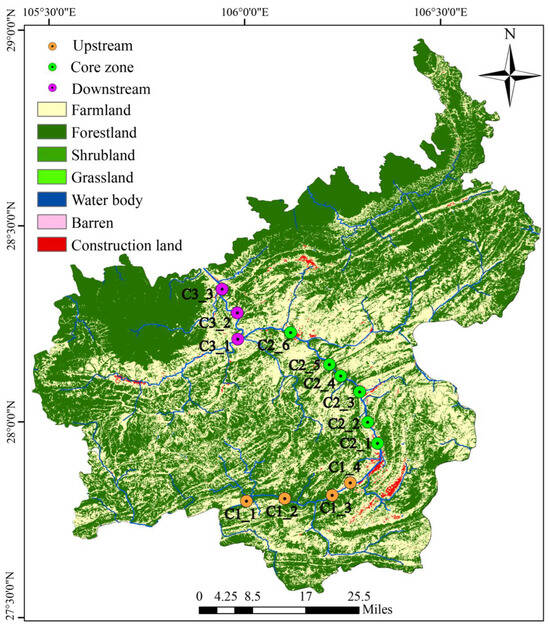
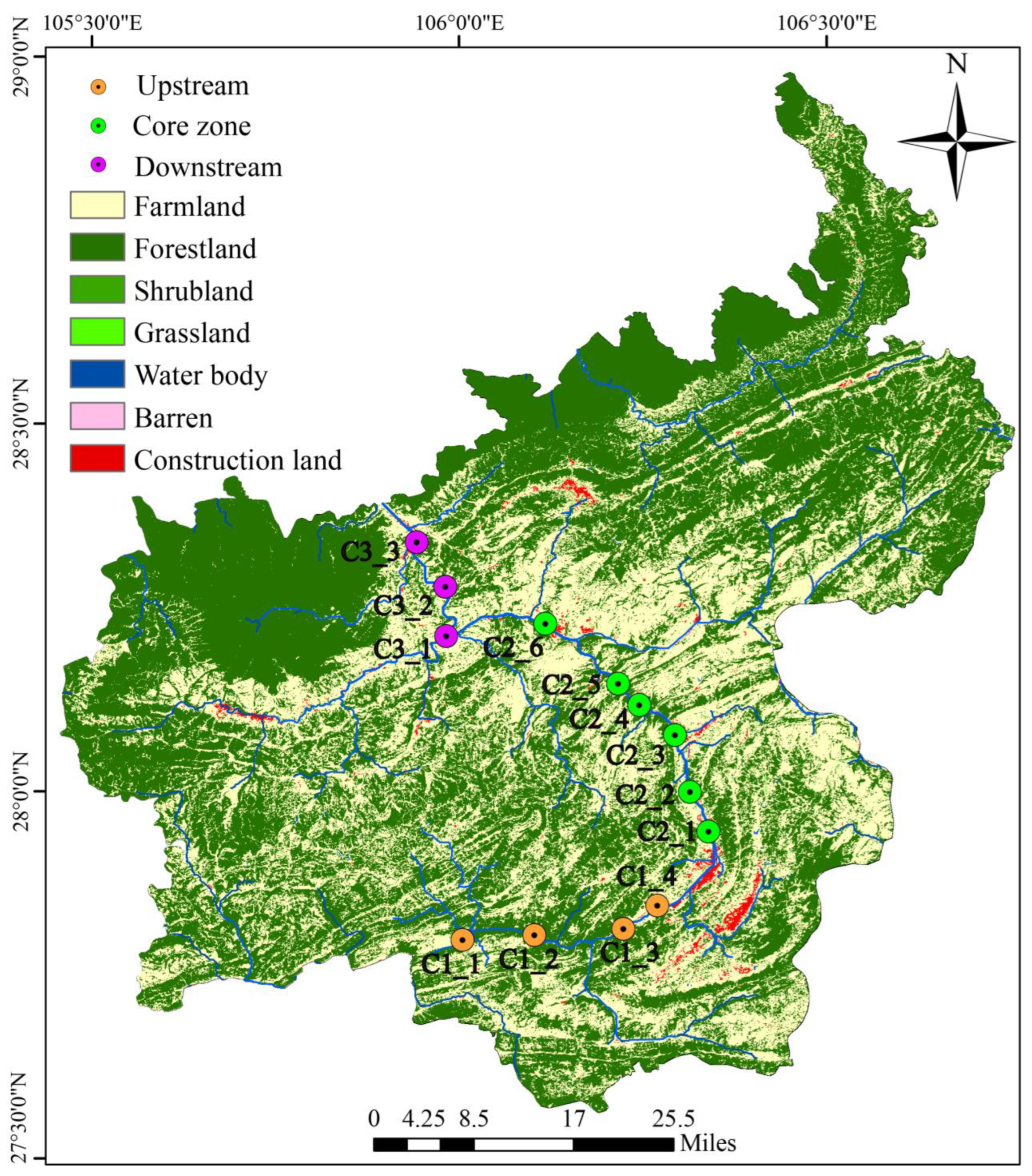
The Chishui River (104°44′–106°59′ E, 27°13′–28°50′ N) originates in Zhenxiong County, Yunnan Province, flows eastward across the border between Sichuan and Guizhou Provinces, and ultimately empties into the Yangtze River in Hejiang County, Sichuan Province [33]. The unique water, climate, soil, and microbial conditions of the Chishui River Basin have given rise to the production of world-renowned soy sauce liquor, further promoting the development of agriculture and urbanization. However, with population growth and agricultural expansion, pressure on the water resources in the Chishui River Basin has increased, leading to degradation of the natural ecosystem [30,34,35]. This study established 13 sampling stations along the Chishui River Basin from Maotai Town to Xishui Town in July 2024, forming a spatial gradient. July coincides with the basin’s rainy season when river flows peak, facilitating tracking of downstream transport and mixing effects of industrial wastewater. Concurrently, this period marks the peak production season for baijiu, where high production rates overlap with increased precipitation, significantly elevating wastewater discharge risks. This provides a representative scenario for investigating the baijiu industry’s impact on the Chishui River Basin. This gradient sequentially encompasses three typical zones: the upstream background zone dominated by pristine forests (C1_1 to C1_4), the core zone centered on the baijiu industry (C2_1 to C2_6), and the downstream transitional zone characterized by agricultural activities (C3_1 to C3_3) (Figure 1). To minimize random errors associated with single-point sampling, five composite sampling points were established within a 200 m radius of each predefined station. Water samples collected from each sub-point were combined in equal volumes to create a composite water sample representing the station. In total, 13 composite water samples were obtained for subsequent analysis.
Figure 1.
Study area and sampling points in the Zunyi section of the Chishui River.
2.2. Water Quality Analysis
All sampling bottles were laboratory-precleaned and field-rinsed before sample collection. For each water sample, 50 mL of water was preserved in the field in a black polyethylene bottle protected from light. The samples were filtered through a 0.22 μm membrane, the air bubbles were removed, and the samples were then flash frozen on dry ice for anion analysis. The dissolved organic carbon (DOC) content was measured in each 50 mL water sample after it had passed through a 0.45 µm filter membrane. A total of 400 mL of water from each sample was filtered through a 0.22 µm filter for microbiological analyses via a polycarbonate membrane (Merck Millipore, Carrigtwohill, Ireland), and the filter membranes were quickly frozen on dry ice for further DNA extraction. Water temperature (T), pH, electronic conductivity (EC), dissolved oxygen (DO), and turbidity (NTU) were measured on-site with a portable water quality analyzer (WTW, Weilheim, BY, Germany; Lei Magnetics, Shanghai, SH, China). Transparency (SD) was measured on-site using a plug-type transparency disk. The total nitrogen (TN) and ammonium nitrogen (NH4+-N) contents were determined via the alkaline potassium persulfate digestion UV spectrophotometric and Nessler’s reagent spectrophotometry methods, respectively [36]; the total phosphorus (TP) content was determined via the ammonium molybdate spectrophotometric method [37]; the chlorophyll a (Chl. a) content was determined via ethanol spectrophotometry [38]; and the permanganate index (CODMn) was determined via permanganate titration [39].
2.3. Metagenomic Analysis
Total DNA was extracted from the samples using the E.Z.N.A.® Soil DNA Kit (Omega Bio-tek, Norcross, GA, USA). Following extraction, DNA concentration was quantified using a TBS-380 microfluorometer (Turner BioSystems, Sunnyvale, California, USA), and DNA purity was assessed with a NanoDrop 2000 microvolume spectrophotometer (Thermo Fisher Scientific, Waltham, MA, USA). DNA integrity was verified by 1% agarose gel electrophoresis. The DNA was sheared to an average fragment size of approximately 350 bp using a Covaris M220 Focused Ultrasonic System (Gene Company Limited, Hong Kong, HK, China). Paired-end (PE) libraries were constructed using the NEXTFLEX Rapid DNA-Seq Library Kit (Bioo Scientific, USA). After bridge PCR amplification, the libraries were sequenced on the Illumina NovaSeq/HiSeq X Ten platform (Illumina, San Diego, CA, USA) for metagenomic sequencing, generating 150 bp paired-end (PE150) reads. The sequencing depth was an average of 10 Gb of raw data per sample.
2.4. Data Quality Control and Stitching Assembly
Quality control on raw data was performed using Fastq v0.20.0, trimming low-quality reads to obtain higher-quality sequences for subsequent analysis. Optimized sequences were assembled using the MEGAHIT (v1.1.2) assembler, which employs succinct de Bruijn graphs. Contigs ≥ 300 bp in length were selected from the assembly results as the final assembly. ORF prediction was performed on contigs from the assembly using Prodigal (v2.6.3) in -p meta mode (metagenomic mode) to optimize gene prediction in complex communities. Genes with nucleotide lengths ≥100 bp were selected and translated into amino acid sequences. All predicted gene sequences across samples were clustered using CD-HIT (v4.6.1) (clustering parameters: sequence similarity ≥ 95%, coverage ≥ 90%). The longest gene in each cluster was designated as the representative sequence to construct a non-redundant gene set. Each sample’s high-quality reads were aligned against the non-redundant gene set using SOAPaligner (soap2.21release). Alignment parameters allowed a maximum of 2 mismatches, retained only uniquely mapped reads, and required a minimum alignment quality score (MAPQ) ≥ 30. Based on the alignment results, the read counts for each gene across samples were tallied, and RPKM (Reads Per Kilobase per Million mapped reads) was calculated to normalize for length and sequencing depth. Genes with RPKM ≥ 1 in at least one sample were retained for subsequent analysis. Functional genes involved in nitrogen, sulfur, and carbon cycling were annotated using DIAMOND (v0.8.35) against the Kyoto Encyclopedia of Genes and Genomes (KEGG) database (http://www.genome.jp/kegg/) (accessed on 15 October 2024).
2.5. Statistical Analysis
The sample point distribution was mapped via ArcGIS 10.8 software. R4.4.1 and Origin2024 software were used for statistical analysis and plot construction. Alpha diversity indices (Ace richness, Chao richness, Simpson evenness, and Shannon diversity) of the samples were calculated via MOTHUR. The analysis of the beta diversity of microbial communities was based on a principal coordinate analysis (PCoA) generated from a Bray–Curtis distance matrix, and analysis of similarities (ANOSIM) was used to examine the differences in microbial communities between the sampling groups. A one-way ANOVA was used to test for significant differences between groups [11]. The above analyses were conducted with the vegan package in R (4.5.0) [40]. Neutral community model (NCM) analyses were performed via the Stats4 and Hmisc packages in R to investigate the process of microbial community assembly [36]. The pheatmap package in R was used to construct heatmaps of differentially expressed C, N, and S cycle-related genes across various river reaches to investigate how their metabolism was influenced by varying intensities of anthropogenic activity. To explore the interactions between microbial communities through the co-occurrence network, the psych package in R was used to perform Spearman’s correlation analysis, and nodes with p > 0.001 or |R| < 0.6 were deleted [41]. The retained nodes were computed and visualized with Gephi (0.10.1) software. Spearman correlation, Mantel test, and PLS-PM analyses were performed to assess environmental and species/functional interactions via the vegan, pheatmap, LinkET, and plspm packages in R [42].
3. Results
3.1. Key Hydrogeochemical Parameters Exhibit Significant Spatial Differentiation Along the River Gradient
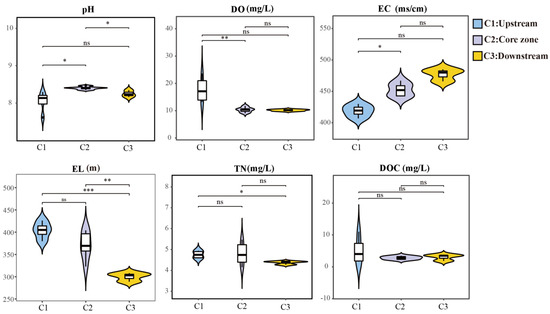
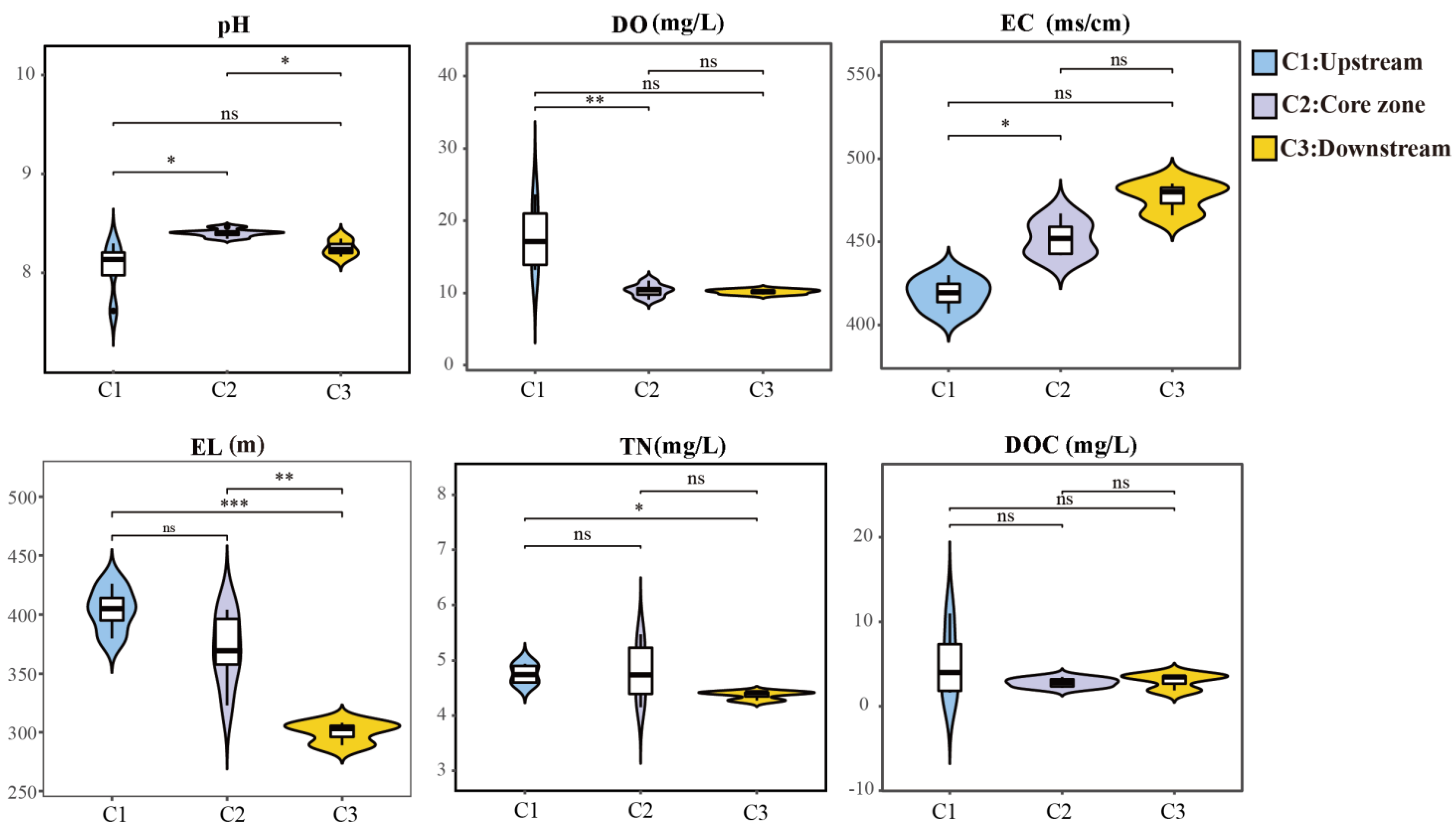
Hydrological geochemical parameter data are shown in Table S1. It is found that the elevation (EL), pH, DO, EC, and TN significantly differed between the upstream, core zone, and downstream of the river (p < 0.05) (Figure 2). In particular, the EL was significantly greater upstream than downstream (p < 0.001), and the same trend was noted (p < 0.01) for the core zone. The pH varied between 8.37 and 8.49 in the core zone, which was slightly greater than that upstream and downstream, whereas the DO concentration range upstream was 13.2~23.6 mg/L, and the TN concentration range of 4.40~4.92 mg/L was significantly higher (p < 0.01) than that in the core zone and downstream. In addition, EC showed significant differences between the upstream and core zones (p < 0.05), ranging from 407 to 430 ms/cm upstream and from 442 to 467 ms/cm in the core zone. There were no significant changes in TP, NH4+-N, SO42−, Chl. a, CODMn, or NO3−-N among the different zones.
Figure 2.
Boxplots of hydrogeochemical parameters. Statistical comparisons among groups were performed using the Kruskal–Wallis test followed by Dunn’s post hoc test with Bonferroni correction for multiple pairwise comparisons (C1. upstream; C2. core zone; C3. downstream). Asterisk (*) denotes p-value (* indicates p < 0.05; ** indicates p < 0.01; *** indicates p < 0.001; ns indicates p > 0.05). Note: pH: hydrogen ion concentration index; DO: dissolved oxygen; EC: electrical conductivity; EL: elevation; TN: total nitrogen; DOC: dissolved organic carbon.
3.2. Microbial Community Composition and Diversity Exhibit Significant Spatial Differentiation Along River Gradients
Metagenomic sequencing revealed distinct shifts in microbial community composition and diversity across the river zones (Figure S1). Pseudomonadota, Bacteroidota, Actinomycota, and Verrucomicrobiota were the dominant phyla in all the samples, with average relative abundances greater than 70% (Figure S1a). Among them, the relative abundance of Pseudomonadota tended to increase and then decrease from upstream to downstream, whereas the relative abundances of Bacteroidota and Actinomycota gradually decreased, and the relative abundances of Uroviricota, Bacillota, and Planctomycota downstream were significantly higher than those upstream and concentrated. The dominant species in the upstream to downstream zones changed from Armatimonadota to Ciliophora.
At the genus level, the number of genera with a relative abundance greater than 0.01% progressively increased from the upstream section (310) to the core zone (564) and then to the downstream section (589). The main dominant genera in the upstream and core zones were Limnohabitans, Candidatus Planktophila, and Sediminibacterium, whereas the main dominant genera in the downstream zone were Acinetobacter, Limnohabitans, and Thalassiosira (Figure S1b). Using the Kruskal–Wallis rank-sum test, we found significant differences in the relative abundance of most genera between samples from different sites at the genus level among the upstream, core, and downstream zones, and the relative abundance of most genera differed significantly across samples from different locations. Candidatus Planktophila, Sphingorhabdus, and Sediminibacterium were substantially greater in the upstream section than in the core zone and downstream (p < 0.05). Limnohabitans abundance was significantly higher in the core zone than in the upstream and downstream sections (p < 0.05). Additionally, Acinetobacter and Thalassiosira were substantially more abundant in the downstream section compared to the upstream section (p < 0.05) (Figure S1c).
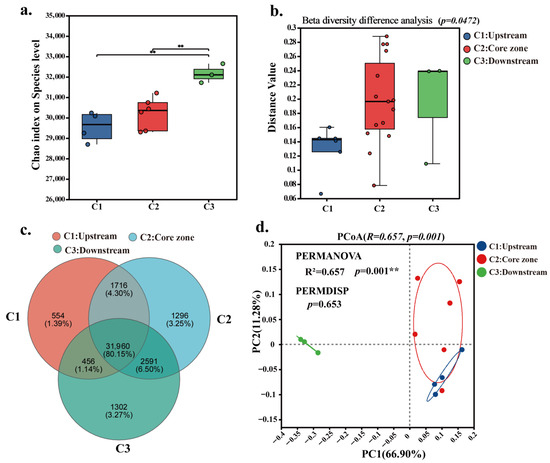
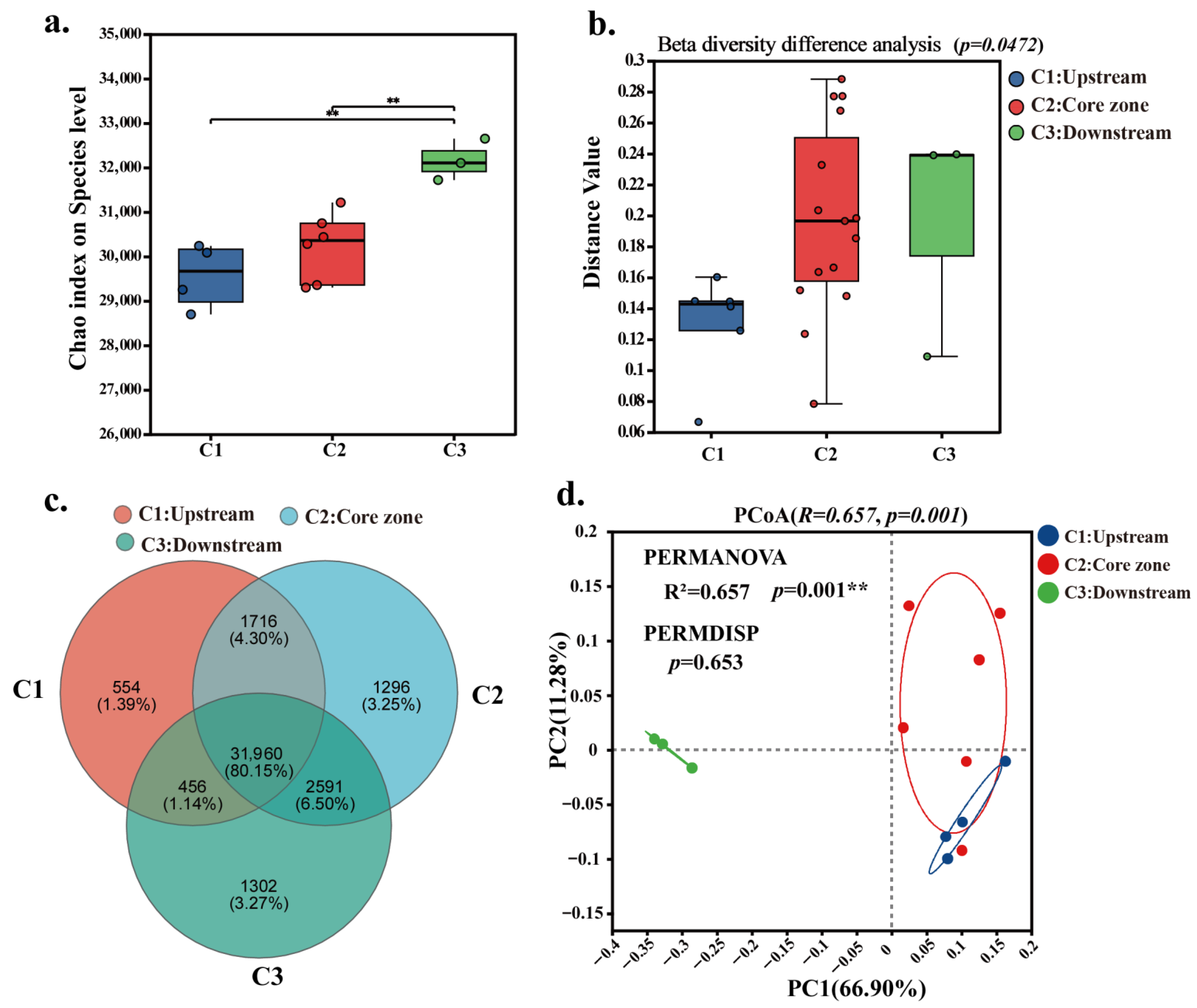
At the spatial scale, there were significant differences in microbial community diversity (Figure 3). The Chao1 and Ace indices revealed that alpha diversity was greater downstream than upstream or in the core zone, whereas the Simpson and Shannon diversity indices were not significantly different (Figure 3a and Figure S2). Beta diversity indices differed significantly among the upstream, core, and downstream zones, as determined by the Kruskal–Wallis test (p < 0.05) (Figure 3b). Venn analysis revealed that the shared microbial community across the three zones comprised 31,960 OTUs, accounting for 80.15% of the total. The downstream zone exhibited the highest species specificity, with 1302 unique OTUs identified, followed by the core zone, which had 1296 unique OTUs (Figure 3c). The β diversity of the microbial communities was evaluated by principal coordinate analysis (PCoA) based on Bray–Curtis dissimilarity and combined with ANOSIM and PERMANOVA tests (Figure 3d). The PCoA ordination revealed that the first two principal coordinates accounted for 66.9% and 11.2% of the total variation in community composition, respectively. Samples from the upstream, core, and downstream groups formed distinct clusters, indicating a clear spatial segregation of microbial communities along the river continuum. The ANOSIM test confirmed significant dissimilarities among the three groups, with intra-group similarity being significantly higher than inter-group similarity. PERMANOVA further demonstrated a significant group effect (R2 = 0.657, p < 0.001). To exclude the possibility that the observed segregation was driven by differences in group dispersion rather than compositional shifts, a PERMDISP analysis was performed. The results showed no significant difference in dispersion among groups (p = 0.653), confirming that the dispersion was homogeneous across groups.
Figure 3.
Analysis of microbial community diversity. (a) Microbial α -diversity indices. (b) Intergroup differences in β diversity based on the Kruskal–Wallis rank-sum test. (c) Venn diagram showing the number of OTUs detected across all sampling groups. (d) β diversity assessed via principal coordinate analysis (PCoA) based on Bray–Curtis distance. Each point represents an individual sample, colored by group. Ellipses indicate 95% confidence intervals around group centroids. Statistical significance of group separation was assessed by PERMANOVA (adonis) with 999 permutations. A test of homogeneity of multivariate dispersions (PERMDISP) was also performed to evaluate whether group dispersions were comparable; differences were considered significant at a false discovery rate (FDR)-adjusted p-value < 0.05. C1. upstream; C2. core zone; C3. downstream (FDR adjusted, p < 0.05 indicates significant differences, ** indicates p < 0.01).
3.3. Co-Occurrence Network and Neutral Model Analyses Reveal Transformations in Microbial Community Interactions and Assembly Processes
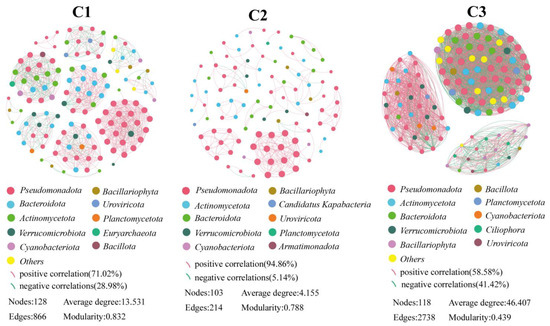
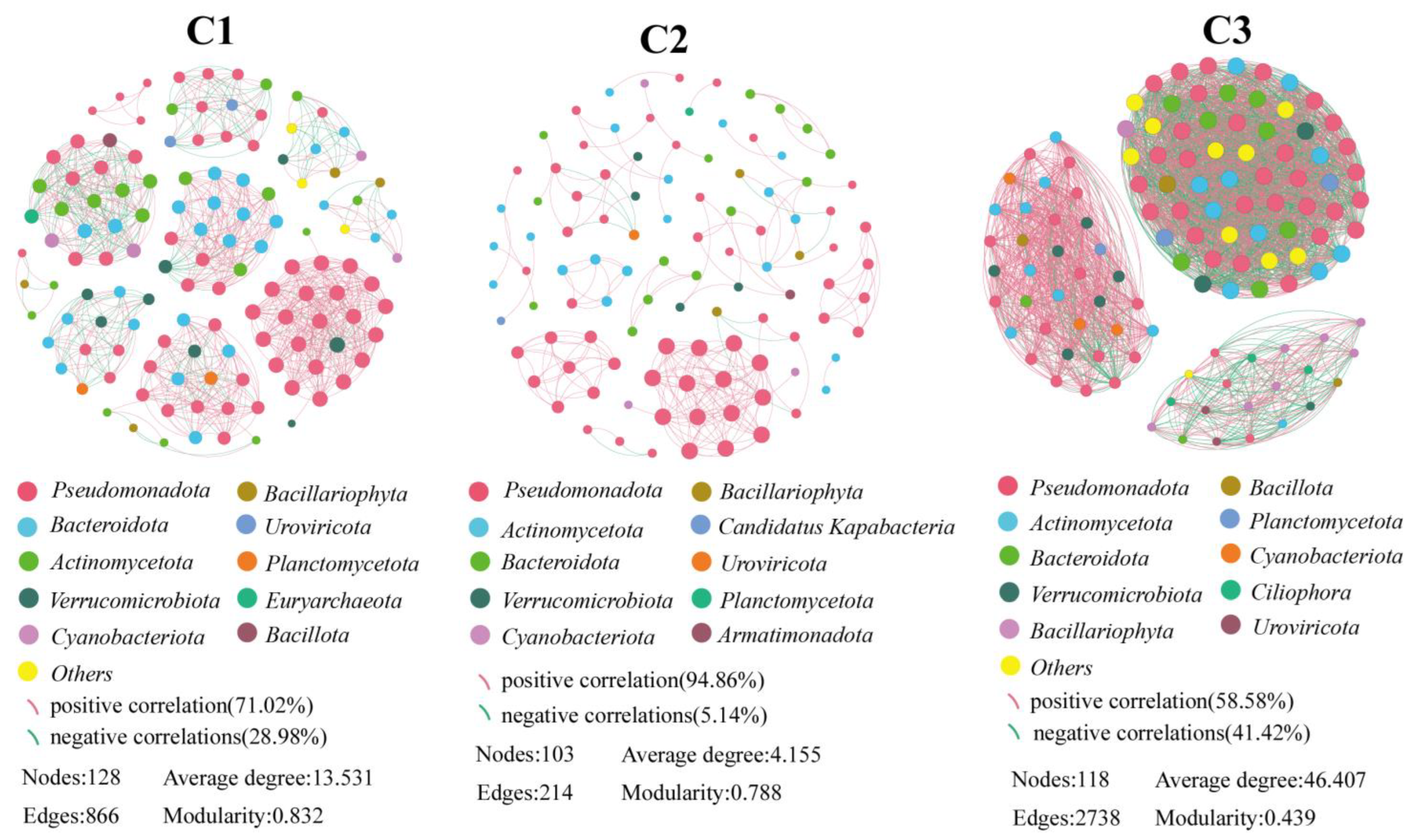
Co-occurrence networks were constructed to reveal potential interactions among microbial communities (Table S2). The co-occurrence network consisted of 128 nodes and 866 links (correlations) upstream, 103 nodes and 214 links in the core zone, and 118 nodes and 2738 links downstream, with the proportion of positive correlations in both upstream and core networks exceeding 80%, exhibiting a high degree of positive correlation distribution (Figure 4). The number of microbial network nodes and edges was significantly lower in the upstream and midstream samples than in the downstream. Network topological connectivity (in terms of global efficiency) and structural complexity (in terms of average clustering coefficients) increased along the flow direction, with the upstream network structure being the simplest. The modularity of these networks was significantly lower in the downstream regions compared to the upstream and core zones, and the network stability of downstream microbial communities is relatively weak.
Figure 4.
Co-occurrence network of microbial communities in the upper, core, and lower reaches of the Chishui River Basin. Node size is proportional to its degree (number of connections); edge color indicates species–species correlation (red: positive correlation; green: negative correlation); and node color represents taxonomic affiliation at the phylum level.
The equilibrium states of the deterministic and stochastic processes in the Chishui River Basin were analyzed using the neutral model and normalized stochastic ratios (Figure S3). The overall goodness of fit of the neutral model to the microbial community was as follows: upstream (R2 = 0.838) > core zone (R2 = 0.813) > downstream (R2 = 0.716) (Figure S3a). Based on the migration rate m, the order was upstream (m = 0.186) > core zone (m = 0.179) > downstream (m = 0.176) (Figure S3a), and the degree of community diffusion decreased from upstream to downstream. NST analysis indicated that both the upstream background and core zones exhibited NST values exceeding 0.5 (0.85 and 0.65, respectively), and community assembly in these zones is predominantly driven by random processes. In contrast, the downstream zone showed a reduced NST value of 0.34, where deterministic processes significantly intensified and became dominant (Figure S3b).
3.4. Functional Gene Analysis Reveals Distinct Variations in the Potential for Carbon, Nitrogen, and Sulfur Metabolism Along the Gradient
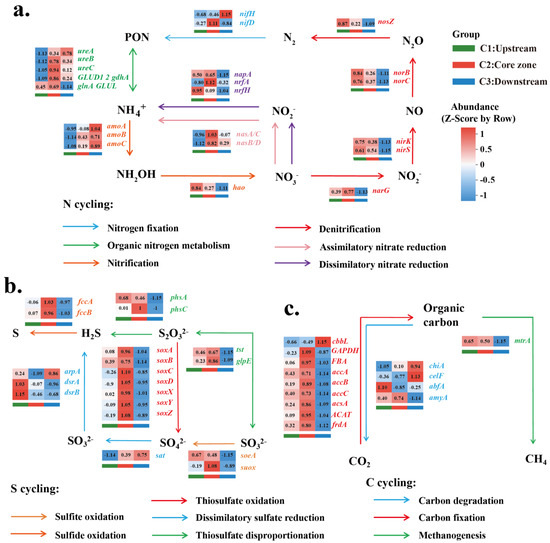
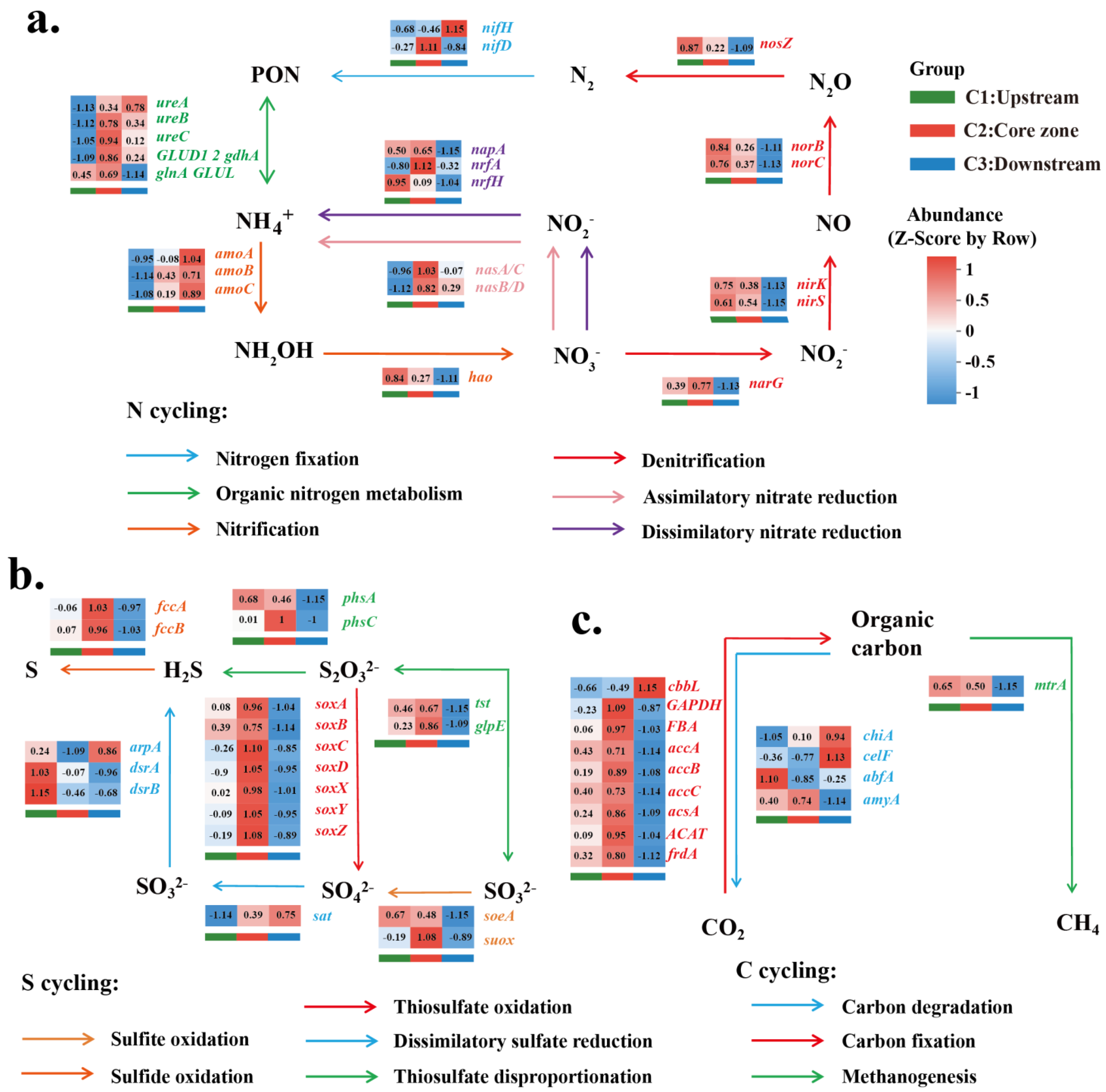
We observed high abundances of functional genes associated with assimilatory nitrate reduction (nasA/B/C/D), dissimilatory nitrate reduction (napA, nrfA, and nrfH), nitrogen fixation (nifH), and organic nitrogen metabolism (ureA/B/C, GLUD1_2 gdhA, and glnA GLUL). However, the abundance of genes related to denitrification (narG, nirK/S, and norB/C/Z) significantly decreased (Figure 5a). We also found that genes associated with thiosulfate oxidation (soxA/B/C/D/X/Y/Z), thiosulfate disproportionation (phsA/C, glpE, and tst), sulfide oxidation (fccA/B), sulfite oxidation (soeA and suox), carbon fixation (frdA, atoB, acsA/C, accA/B, FBA, GAPDH, and cbbL), and methanogenesis (mtrA) exhibited higher abundance in the upstream and core zones (Figure 5b,c).
Figure 5.
Spatial variation in carbon, nitrogen, and sulfur metabolic potential of microbial communities in the Chishui River Basin. The heatmap displays the functional gene enrichment of metabolic pathways involved in (a) nitrogen cycling, (b) sulfur cycling, and (c) carbon cycling across the three study areas. Gene abundance variations underwent row-wise Z-score normalization using the scale () function. C1. upstream; C2. core zone; C3. downstream.
The abundances of carbon-, nitrogen-, and sulfur-related functional genes exhibited significant spatial variation among the upstream, core, and downstream zones (Figure S4). The results revealed that nosZ genes (encoding nitrous oxide reductase) differed highly significantly (p < 0.01) during the nitrogen cycle (Figure S4a). Notably, the abundances of the glnA GLUL genes (encoding glutamine synthetase) were significantly greater upstream than downstream and concentrated. During the sulfur cycle, the presence of the tst gene (encoding thiosulfate/3-mercapto-pyruvate sulfotransferase) and the soeA gene (encoding sulfite dehydrogenase (quinone) subunit c) was highly significant (p < 0.01) (Figure S4b). The expression of the cbbL gene, which controls Calvin cycle carbon fixation, was significantly greater downstream than upstream and concentrated (Figure S4c).
3.5. Multivariate Statistics Reveal the Key Driving Role of Environmental Factors in Community Structure and Metabolic Potential
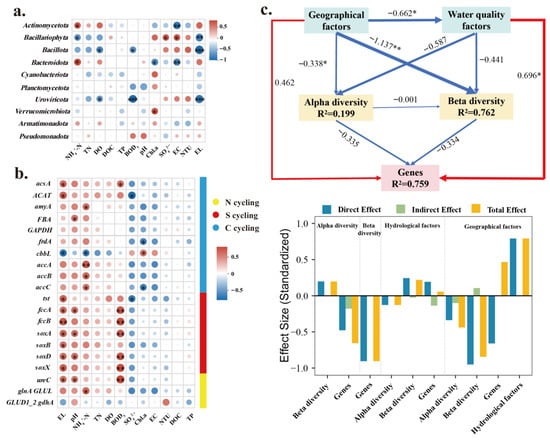
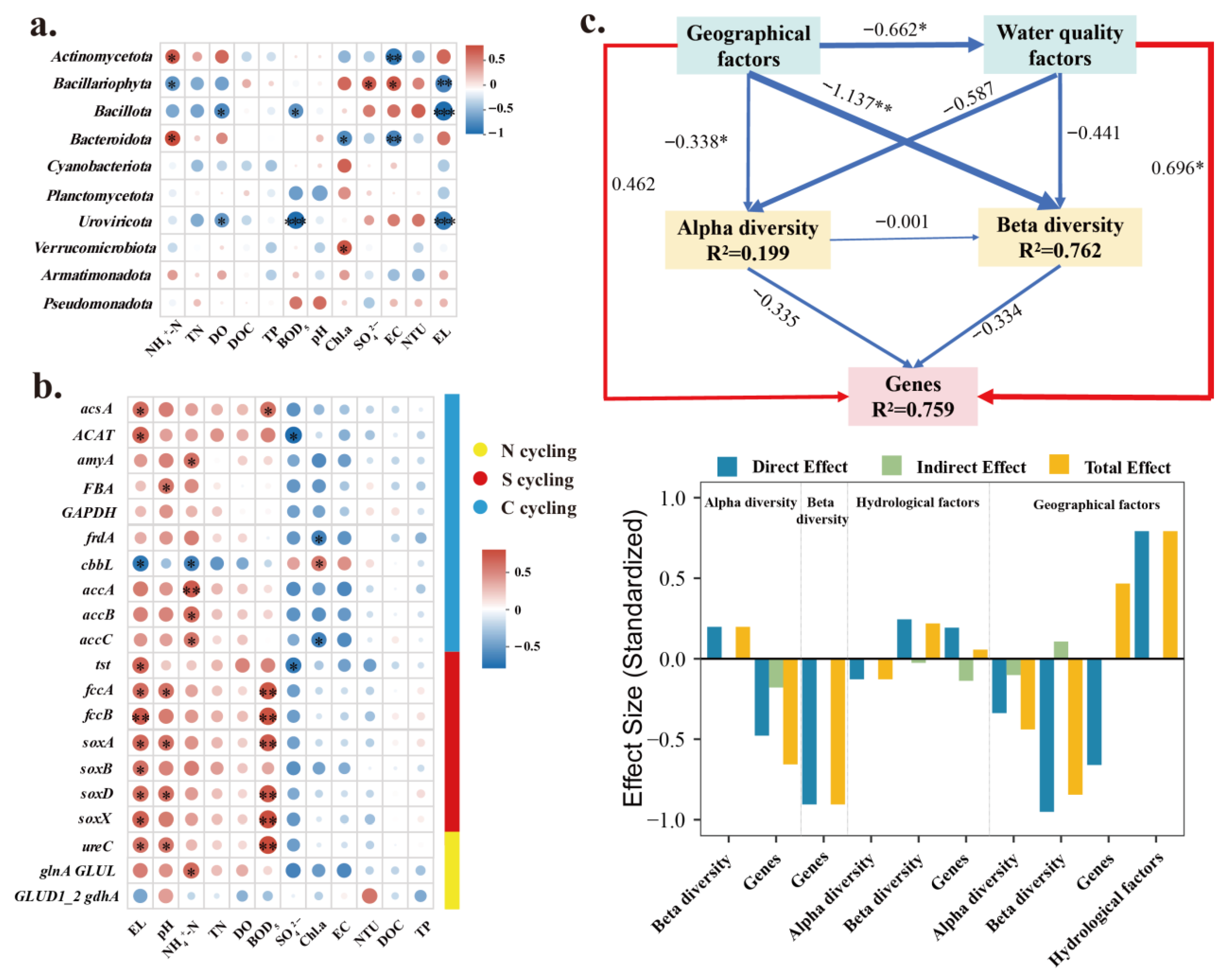
As shown in Figure 6a,b, Spearman correlation analysis indicated significant correlations between multiple key hydrogeochemical parameters and the abundance of major microbial phyla-level taxa, as well as key functional genes involved in carbon, nitrogen, and sulfur cycling. In general, inorganic nitrogen (NH4+-N) and fundamental hydrological parameters (DO, T, EC, and BOD5) are key variables influencing microbial taxonomic composition (Actinomycota, Bacteroidota, Uroviricota, and Bacillota, among others). The responses of functional genes are more complicated. Organic nitrogen metabolism genes (ureC and GLUD1_2 gdhA) were positively regulated by multiple water quality parameters. Sulfur cycle genes (soxA/B/D/X and tst) were primarily correlated with EL, BOD5, and T, whereas core carbon fixation genes (accA/B/C, frdA, ACAT, acsA, FBA, amyA, GAPDH, and cbbL) were positively regulated by relatively fewer factors (NH4+-N and pH). The RDA results further revealed the correlation patterns between environmental factors and the spatial distribution of carbon-, nitrogen-, and sulfur-metabolism-related functional genes (Figure S5). SO42−, EC, NTU, and CODMn were positively correlated with carbon metabolism genes in the downstream zone, while pH, DO, DOC, NO3−-N, TN, and EL were positively correlated with carbon metabolism genes in the upstream and core zones. SO42−, pH, NTU, and CODMn were positively correlated with nitrogen metabolism genes in the downstream zone; DO, DOC, NO3−-N, TN, and EL were positively correlated with nitrogen metabolism genes in the core zone; and DO, EC, TN, NO3−-N, and DOC were positively correlated with nitrogen metabolism genes in the upstream zone. NTU and SO42− were positively correlated with sulfur metabolism genes in the downstream zone; pH, TN, NO3−-N, EC, and DOC were positively correlated with sulfur metabolism genes in the upstream and core zones; and NO3−-N, DOC, and DO were positively correlated in the core zone.
Figure 6.
Relationship between hydrogeochemical parameters and microbial communities in the Chishui River Basin, along with their C, N, and S cycling components. Spearman correlations between (a) microorganisms and (b) functional genes with hydrogeochemical parameters. Correlation coefficients R and corresponding p-values were calculated. R values are displayed in different colors in the figure, while p-values are marked with asterisks: * indicates p < 0.05; ** indicates p < 0.01; *** indicates p < 0.001. Notes: NH4+-N: ammonium nitrogen; TN: total nitrogen; DO: dissolved oxygen; DOC: dissolved organic carbon; BOD5: five-day biochemical oxygen demand; pH: hydrogen ion concentration index; TP: total phosphorus; Chl. a: chlorophyll a; SO42−: sulfate ions; EC: electrical conductivity; NTU: turbidity; CODMn: permanganate index; EL: elevation; NO3−-N: nitrate nitrogen. (c) The partial least squares path model (PLS-MS) reveals the direct and indirect effects of geographic factors and water quality parameters on microbial community diversity (α and β diversity) and the abundance of functional genes involved in C, N, and S cycling. Solid red and blue lines represent positive and negative effects, respectively. Numbers adjacent to arrows denote standardized path coefficients, while arrow width indicates the magnitude of path coefficients. R2 values indicate the proportion of variance explained by each variable.
Mantel tests further confirmed that functional genes associated with sulfur, carbon, and nitrogen cycles were significantly correlated with specific environmental factors (TN, BOD5, EL, etc.) and microbial community structure (Figure S6). PLS-PM was used to analyze the driving factors of microbial community structure and functional potential (Figure 6c). The stability of path coefficients was assessed using bootstrap resampling (n = 100) with 95% confidence intervals (Table S3). The results showed that geographical factors (elevation, EL) had a significant negative effect on microbial β diversity (path coefficient = −1.137, p < 0.01; bootstrap confidence interval: [−1.653, −0.164]), and this relationship was robust, as the confidence interval did not include zero. Geographical factors also significantly influenced water quality factors (pH, DO, and NTU) (path coefficient = −0.662, p < 0.05), but the bootstrap confidence interval contained zero ([−0.919, 0.906]). Water quality factors had a significant positive effect on the abundance of C-, N-, and S-related functional genes (path coefficient = 0.696, p < 0.05), but the bootstrap confidence interval also encompassed zero ([−0.468, 1.358]).
4. Discussion
4.1. The Baijiu Industry Significantly Impacts the Spatial Heterogeneity of Microbial Communities
In this study, we found significant differences in microbial community diversity among the upper, core, and lower reaches of the Chishui River Basin (Figure 2). In particular, microbial diversity increased significantly in the core zone and downstream zone, and the dominant species and genera in the downstream zone were more diverse (Figure S1). This phenomenon may be related to the input of winemaking tailings water from the core zone and the superimposed effect of downstream agricultural surface pollution. Both pollution sources increase nutrient levels in the Chishui River Basin, providing microorganisms with more abundant energy and substrate sources. This allows microbial groups that are naturally scarce due to nutrient limitations to proliferate extensively, thereby enhancing microbial community diversity [43,44,45]. Additionally, winery wastewater and agricultural runoff can be considered complex microbial inoculants that continuously introduce exogenous microorganisms—such as microbial communities involved in brewing fermentation, soil microorganisms, and fecal indicator bacteria—into rivers [46,47]. Venn analysis revealed that the downstream zone harbored the highest number of unique OTUs, providing direct evidence of external input (Figure 3c). These newly introduced microbial taxa became locally established, effectively expanding the species pool and consequently leading to a significant increase in the Chao1 and Ace indices downstream. It is worth noting that the results of this study differ from those reported. Liu et al. [48] found that the increase in agricultural and urbanized land area would lead to a simplification of the microbial community structure in freshwater rivers. However, in this study, we observed a significant increase in nutrient salt indicators (CODMn, SO42−, EC, and Chl. a) in the middle and lower reaches of the river, and the microbial diversity did not decrease but presented a unique spatial pattern. We believe that this contradiction may be due to the regional specificity of the pollution input mode. The discharge of winery wastewater in the core zone and the input of agricultural non-point sources in the downstream zone precisely conform to the Intermediate Disturbance Hypothesis proposed by Connell [49]: the moderate disturbance from winery industrial wastewater and agricultural activities can prevent dominant species from completely occupying ecological niches, providing survival opportunities for species with relatively weak competitiveness but strong adaptability to disturbance, such as Ciliophora. Di et al. also confirmed that the discharge of distillery tailings can affect the diversity of microbial communities in rivers by disrupting their balance and promoting the formation of new interspecies relationships [50]. In terms of spatial ecological processes, the downstream zone receives a variety of pollutants from core zones, and the cumulative effect of these pollutants leads to higher concentrations in the downstream waters, which in turn directly affects the dynamics of the microbial community [51].
In the core zone of Maotai Town, the assembly process of microbial communities is mainly dominated by random processes (NST > 0.5), and the degree of diffusion among communities (migration rate) is significantly lower than that in the upstream zone (Figure 4 and Figure S3). Urbanization drives the evolution of microbial community diversity by regulating the assembly process, thereby influencing their ecological functional potential [52]. Wang et al. [10] observed that the diffusion rate of microorganisms increased in the sewage discharge area, which is contrary to the results of this study. We speculate that this contradictory pattern of enhanced randomness and restricted diffusion may be related to the dual anthropogenic pressure sources existing in the core zone. Specifically, the industrial wastewater discharged by hundreds of wineries in the study area contains characteristic fermentation microbial communities, whose community structure and functional characteristics are significantly different from those of microbial populations from domestic sewage sources [53]. The continuous input of these exogenous microorganisms directly expands the species pool in the core zone (Figure 3c), increasing the randomness of community assembly. In addition, the combined discharge of industrial and domestic sewage, along with the disturbance of urban runoff, may form an ecological barrier to the diffusion and colonization of local species by altering the physicochemical microenvironment of the water body (such as fluctuations in DO and BOD5), leading to a fragmented community structure and thereby restricting the uniform diffusion of species within the region [54]. However, it is currently impossible to directly quantify the relative contributions of diffusion limitation and exogenous input to the random process. In the future, species source tracking (SourceTracker) and microcosm simulation experiments can be combined to further verify the mechanism of microbial community construction driven by dual pressure sources.
The correlation network analysis conducted in this study has certain limitations. Due to the relatively small sample size and uneven distribution of sample sizes between groups (especially in the downstream group), the stability and robustness of network indicators (such as centrality and complexity) cannot be fully guaranteed. Small sample sizes are prone to overfitting and false associations, which may exaggerate or distort the apparent complexity of the network. Although the visualization of network analysis is helpful for hypothesis generation, the current research results only have exploratory value.
4.2. Response Mechanisms of Microbial Carbon, Nitrogen, and Sulfur Metabolic Potential Driven by the Baijiu Industry
Functional genes associated with denitrification exhibited higher relative abundance upstream and decreased downstream, whereas functional genes related to nitrate heterotrophic reduction showed increased relative abundance downstream (Figure 5a). This might be due to that the human interference in the upstream zone is relatively weak, preserving a more original forest ecosystem. The organic matter produced by the decomposition of forest litter provides a carbon source for denitrifying bacterial communities, which is associated with the enrichment of genes related to denitrification. In contrast, the agricultural activities in the downstream zone are more intense, which is related to the enrichment of genes associated with DNRA. Son et al. reported that high altitudes and high plant diversity resulted in enhanced denitrification processes [55]. Previous studies have also demonstrated that environmental factors such as elevation gradient and plant abundance dominated the community construction of nirS/nirK-type denitrifying bacteria and that the denitrification rate increased significantly with increasing elevation [56,57]. Downstream agricultural activities (e.g., irrigation, drainage, and pesticide use) may destroy microbial habitats or inhibit denitrifying flora through heavy metal/antibiotic contamination [58]. In addition, excessive agricultural activities tend to lead to soil erosion, where large quantities of sediment and soil particles are washed into the river, covering the biofilm and denitrifying bacterial habitat at the bottom of the river and affecting the contact of denitrifying bacteria with the substrate, thus inhibiting denitrification [59,60,61]. Liu et al. found that an increase in the proportion of agricultural and urbanized land zones led to a simple microbial community structure in freshwater streams that stimulated microbial-mediated denitrification, which is the opposite of the findings of the present study [48]. This may be because humus, polysaccharides, and other substances formed by the microbial decomposition of upstream forest litter can provide abundant carbon sources for denitrifying bacteria and promote the denitrification process [62,63]. Notably, we observed a decrease in the abundance of denitrifying genes in the downstream area, whereas the abundance of DNRA genes increased, even though the highest total nitrogen (TN) concentration was detected in the upstream zone. This phenomenon may be primarily driven by the combined effects of nitrate availability changes and altered carbon loading. Although high upstream TN concentrations provided ample substrate for nitrogen transformation, the reducing power in the environment may have been insufficient for denitrification to fully outcompete other nitrogen transformation pathways. With the injection of baijiu industrial wastewater into the downstream river section, the carbon-to-nitrogen ratio (C/N) became imbalanced, forcing microorganisms to turn to the use of other electron donors to promote heterogeneous nitrate reduction [64]. Moreover, nitrate-isomerizing reducing bacteria compete with denitrifying bacteria for substrates (NO3−) and electron donors, thus further inhibiting the denitrification process [65].
The functional genes for carbon sequestration and methanogenesis were enriched in the core zone and repressed upstream and downstream (Figure 5c). Carbon sequestration genes (e.g., accA/B) may be highly expressed in organic load-tolerant bacteria that break down long-chain fatty acids in brewing wastewater via the β-oxidation pathway and use accA/B to convert acetyl coenzyme A to malonyl coenzyme A for their biomass synthesis [66]. The enrichment of the methanogenesis gene (mtrA) may be related to the special carbon source input in the core zone. Some methanogenic archaea (such as Methanosarcina) have the metabolic ability to utilize methanol (a by-product of winemaking) for methylotrophic methanogenesis [67,68]. In addition, some studies have suggested that sewage discharge and land-use changes have increased organic loads in rivers, inducing phytoplankton proliferation and algal blooms. Algae-derived organic matter provides electron donors for carbon sequestering microorganisms and methanogens and removes nitrogen/sulfur nutrients from the water column. Methyl compounds (dimethylsulfoxide, methylamine) released by their cleavage further promote the methanogenesis process, which ultimately leads to a sharp increase in the concentration and flux of riverine CH4 and significant spatial heterogeneity [21,69,70,71]. However, in this study, there is no direct evidence to show that the enhanced methane metabolism in the downstream or core zone is related to the methyl substrates derived from algae. To verify the above mechanism hypothesis, research can be combined with DNA stable isotope probing (DNA-SIP) to track the actual flow direction of key carbon sources (such as methanol, fatty acids, and algal secretions) in the microbial community.
We observed a significant enrichment of sulfur-oxidizing genes in the core zone under intense anthropogenic impacts (Figure 5b). This indicates that the nitrate enrichment in this region is likely driven by the baijiu industry, which promotes sulfur oxidation processes. Multiple human activities (domestic/industrial wastewater discharge, synthetic detergent use, fossil fuel combustion, and mine drainage) directly or indirectly lead to increased concentrations of SO42−, which results in significantly higher relative abundance of sulfate adenylyltransferase (sat) genes in the core zone and downstream than upstream, facilitating the reduction of SO42− to SO32− [72,73,74]. Previous studies have shown that microbial communities in sulfide-rich habitats are significantly enriched in sulfur cycling functional genes (sox, dsr, apr, and sir) when exposed to high concentrations of nitrates [75,76]. In addition, inputs of dissolved or particulate organic matter from brewing industry wastewater are degraded by sulfate-reducing bacteria in rivers to produce inorganic hydrogen sulfide (H2S), leading to a significant increase in the abundance of genes encoding flavin cytochrome sulfide dehydrogenase (fccA/B), which then catalyzes the oxidation of H2S to monomeric sulfur [53,77].
4.3. The Cascading Response Mechanism of Environment, Community, and Function
The high-altitude and high-DO oxidative environment in the upstream zone, combined with the natural carbon source provided by forest litter, constitutes the core screening pressure, directly selecting for a community structure dominated by aerobic bacteria such as Limnohabitans and denitrifying bacteria [78]. The relative abundance of denitrification genes (narG, nirK/S, and norB/C/Z) is relatively high in this area, and nitrification–denitrification becomes the dominant path of the nitrogen cycle. RDA analysis further confirmed that altitude and DO are the core environmental factors driving the variation of the upstream community (Figure 6). In the core zone, affected by the input of winery wastewater, DO decreases, BOD5 and EC increase, and pH slightly rises to 8.37–8.49. Organic load becomes a new screening pressure. Under this environment, heterotrophic bacterial groups such as Bacteroidota are enriched [79], and the exogenous microorganisms introduced by winery wastewater significantly expand the species pool (Figure 3c). Low DO and high organic carbon give DNRA bacterial groups a competitive advantage, making DNRA genes (nrfA/H) replace denitrification genes as the core of the nitrogen cycle [80]; in addition, high SO42− and organic load jointly drive the enrichment of sulfur oxidation genes (sox and tst). This study also found that the concentration of chlorophyll a was significantly positively correlated with the abundance of the carbon fixation gene cbbL, and both were at high levels in the downstream section, indicating that the photosynthesis of phytoplankton is an important factor driving the autotrophic carbon fixation process in this basin. In the downstream zone, due to the enhanced input of nutrients, it promotes the massive reproduction of algae, promoting the co-metabolic carbon fixation process of facultative autotrophic or chemolithoautotrophic bacteria [81]. This result is consistent with previous studies, that is, the primary production driven by algae can couple and regulate the carbon fixation potential of water microorganisms [81].
5. Conclusions
This study reveals the impact of the baijiu industry on the microbial community structure and carbon, nitrogen, and sulfur metabolic potential of the Chishui River. Microbial community α/β diversity significantly increased from the industrial core zone to the downstream transition zone compared to the upstream background zone, while collinear network modularity decreased and community stability declined. The community formation process exhibits a trend toward reduced randomness and increased determinism, with species dispersal being constrained. Additionally, under the influence of the baijiu industry, the abundance of genes associated with dissimilatory nitrate reduction, sulfur oxidation, carbon fixation, and methanogenesis increased, while denitrification gene abundance decreased. These shifts in functional gene abundance may be linked to the introduction of exogenous species and nutrient substrates via distillery wastewater discharge, reflecting the disruption caused by the liquor industry to the microbial community structure and carbon, nitrogen, and sulfur metabolic potential in the local river segment. It should be noted that samples were collected during a single high-water period, and conclusions primarily reflect spatial differentiation characteristics during this timeframe. Subsequent research should integrate seasonal dynamics with laboratory simulation experiments to further validate the association between functional gene changes and material flux.
These findings also carry practical implications for river management. Incorporating microbial indicators into routine monitoring programs could serve as early warning signals of ecosystem degradation. Priority should be given to controlling nitrogen inputs from distillery wastewater and strengthening riparian buffer zones to mitigate nitrogen loads. In addition, future monitoring efforts should include measurements of sulfate, sulfide, and methane fluxes to comprehensively assess the ecological impacts of industrial activities.
Supplementary Materials
The following supporting information can be downloaded at https://www.mdpi.com/article/10.3390/w18060688/s1, Text S1: The Normalized Stochasticity Ratio (NST) Method. Text S2: Gene Abundance Z-Score Standardization. Text S3: Partial Least Squares Method (PLS-MS). Table S1: Hydrogeochemical Parameters and Physical-Chemical Properties. Table S2: Topological Properties of Microbial Networks. Table S3: Bootstrap 95% confidence intervals and robustness assessment of path coefficients in the PLS-PM model. Figure S1: Microbial community composition. (a) Top 10 most abundant microbial groups at the phylum level, with the figures in the chart representing the proportion of the top four; (b) Top 10 most abundant microbial groups at the genus level, with the figures in the chart representing the proportion of the top four; (c) Kruskal-Wallis H test bar plot for differential analysis at the genus level. Genera with significant differences (FDR-adjusted p < 0.05) are displayed (*, p < 0.05 indicates significant difference). Figure S2: Alpha diversity of the microbial communities. Asterisks represent p values (*, p < 0.05; **, p < 0.01; ns, p > 0.05). C1 represents the upstream zone; C2 represents the core zone; and C3 represents the downstream zone. Figure S3: (a) Neutral Community Model (NCM) (species with frequencies higher than model predictions are shown in light green; species with lower frequencies are shown in brown; species within the prediction range are shown in black; blue dashed lines indicate the 95% confidence interval of model predictions). The overall goodness-of-fit of the neutral community model is quantified by the R2 value. R2 represents the overall goodness-of-fit of the neutral community model, m quantifies the diffusion process between communities via community migration rates, and the Nm parameter assesses the extent of inter-community diffusion; (b) Comparison of normalized stochasticity ratios (NST) for microbial communities in the upstream, core, and downstream regions. Based on a null model test of Bray-Curtis dissimilarity, results are normalized between 0 and 1 by calculating the ratio of observed community dissimilarity to the expected value of the zero distribution. The dashed line represents the threshold separating deterministic and stochastic processes. An NST value greater than 0.5 indicates dominance by stochastic processes, while a value less than 0.5 indicates dominance by deterministic processes. (*** indicates p < 0.001) (C1. Upstream; C2. Core zone; C3. Downstream). Figure S4: Bar plot showing differentially abundant functional metabolic genes of microbial communities in water samples from the Chishui River basin among different groups. Genes with significant differences (FDR-adjusted p < 0.05) (* indicates p < 0.05; ** indicates p < 0.01). (a) Nitrogen cycle functional genes. (b) Sulfur cycle functional genes. (c) Carbon cycle functional genes. Figure S5: Redundancy analysis (RDA) of carbon (a), nitrogen (b), and sulfur (c) metabolism-related functional genes and environmental factors. This figure shows the relationship between the abundance distribution of functional genes and environmental parameters along the river gradient (upstream, core zone, downstream). The arrows represent environmental factors, with their lengths indicating the degree of explanation of the distribution of functional genes by the factor, and the arrow direction indicating the positive correlation direction. Different colored symbols represent samples from different regions. Figure S6: (a)Mantel test examining C, N, and S cycle-related functional genes and environmental physicochemical factors;(b) The relationship between microbial communities and their functional composition in C, N, and S cycling. The statistical significance of 9999 permutations is indicated by the color, as shown on the right side. Mantel’s R statistic corresponding to the distance correlation is represented by the width, as shown on the right side, and Spearman’s correlation coefficients are indicated by the color gradient. Asterisks indicate a significant correlation between the indicated factor.
Author Contributions
Conceptualization, C.Q. and X.H.; methodology, L.Z., S.L., P.X. and C.Q.; software, L.Z., P.X. and H.W.; validation, P.X. and H.W.; formal analysis, P.X. and B.C.; investigation, L.Z., S.L. and X.H.; resources, B.C. and C.Q.; data curation, S.L.; writing—original draft, L.Z.; writing—review and editing, S.L., P.X., C.Q. and X.H.; visualization, B.C. and X.H.; supervision, H.W. and B.C.; project administration, H.W. and X.H.; funding acquisition, C.Q. and X.H. All authors have read and agreed to the published version of the manuscript.
Funding
This research was financially supported by the Major Project of Guizhou Province (No. [2024]006), the Entrusted Project of Kweichow Moutai Group (No. GF20241212004), the Guizhou Provincial Basic Research Program (No. MS [2025] 258), the Chishui River Middle Basin, Watershed Ecosystem, Observation and Research Station of Guizhou Province (No. Qiankehe platform YWZ [2024]007), and the Guizhou Science and Technology Cooperation Platform (No. ZSYS [2025] 015).
Data Availability Statement
The datasets generated during this current study were submitted to the National Center for Biotechnology Information (NCBI) Sequence Read Archive (SRA) under Bioproject accession PRJNA1280956(https://dataview.ncbi.nlm.nih.gov/object/PRJNA1280956?reviewer=djsmhusp4m0u1d1mt8krcrvdtn)(accessed on 23 June 2025).
Conflicts of Interest
Author Song Liu, Hui Wang, Bi Chen was employed by the company Kweichow Moutai Group. The remaining authors declare that the research was conducted in the absence of any commercial or financial relationships that could be construed as a potential conflict of interest. The funder was not involved in the study design, collection, analysis, interpretation of data, the writing of this article, or the decision to submit it for publication.
References
- Qu, Q.; Wang, S.; Hu, X.; Mu, L. The impact of anthropogenic pressures on microbial diversity and river multifunctionality relationships on a global scale. Sci. Total Environ. 2024, 950, 175293. [Google Scholar] [CrossRef] [Scilit] [PubMed]
- Wang, J.; Yang, S.; Tian, Y.; Liang, E.; Zhao, X.; Li, B. Intensified anthropogenic disturbances impair planktonic algae in an urban river. J. Clean. Prod. 2024, 468, 143091. [Google Scholar] [CrossRef] [Scilit]
- He, B.; Kanae, S.; Oki, T.; Hirabayashi, Y.; Yamashiki, Y.; Takara, K. Assessment of global nitrogen pollution in rivers using an integrated biogeochemical modeling framework. Water Res. 2011, 45, 2573–2586. [Google Scholar] [CrossRef] [Scilit]
- Zhao, X.; Wang, J.; Xie, H.; Liang, E.; Cai, H. Anthropogenic activities disturb phytoplankton taxa and functional groups in an urban river. Environ. Res. 2025, 265, 120411. [Google Scholar] [CrossRef] [Scilit] [PubMed]
- Dong, Y.-Y.; Wang, P.; Hua, Z.-L.; Huang, S.-H. Human activities exacerbate river network degrading in the Qinhuai River basin. Sci. Total Environ. 2024, 952, 176021. [Google Scholar] [CrossRef] [Scilit]
- Fang, W.; Fan, T.; Wang, S.; Yu, X.; Lu, A.; Wang, X.; Zhou, W.; Yuan, H.; Zhang, L. Seasonal changes driving shifts in microbial community assembly and species coexistence in an urban river. Sci. Total Environ. 2023, 905, 167027. [Google Scholar] [CrossRef] [Scilit]
- Ouyang, L.; Chen, H.; Liu, X.; Wong, M.H.; Xu, F.; Yang, X.; Xu, W.; Zeng, Q.; Wang, W.; Li, S. Characteristics of spatial and seasonal bacterial community structures in a river under anthropogenic disturbances. Environ. Pollut. 2020, 264, 114818. [Google Scholar] [CrossRef] [Scilit]
- Xie, Y.; Liu, X.; Wei, H.; Chen, X.; Gong, N.; Ahmad, S.; Lee, T.; Ismail, S.; Ni, S.-Q. Insight into impact of sewage discharge on microbial dynamics and pathogenicity in river ecosystem. Sci. Rep. 2022, 12, 6894. [Google Scholar] [CrossRef] [Scilit] [PubMed]
- Su, D.; Ben, W.; Strobel, B.W.; Qiang, Z. Impacts of chlorine disinfection of municipal sewage effluent on receiving rivers: Changes in organic matter and microbial communities. J. Hazard. Mater. 2025, 492, 138232. [Google Scholar] [CrossRef] [Scilit]
- Wang, L.; Wang, Z.; Li, Y.; Cai, W.; Zou, Y.; Hui, C. Deciphering solute transport, microbiota assembly patterns and metabolic functions in the hyporheic zone of an effluent-dominated river. Water Res. 2024, 251, 121190. [Google Scholar] [CrossRef] [Scilit] [PubMed]
- Wang, J.; Chen, Y.; Cai, P.; Gao, Q.; Zhong, H.; Sun, W.; Chen, Q. Impacts of municipal wastewater treatment plant discharge on microbial community structure and function of the receiving river in Northwest Tibetan Plateau. J. Hazard. Mater. 2022, 423, 127170. [Google Scholar] [CrossRef] [Scilit]
- Castellano-Hinojosa, A.; Gallardo-Altamirano, M.J.; Pozo, C.; González-Martínez, A.; González-López, J.; Marshall, I.P.G. Salinity levels influence treatment performance and the activity of electroactive microorganisms in a microbial fuel cell system for wastewater treatment. J. Environ. Manag. 2025, 379, 124858. [Google Scholar] [CrossRef] [Scilit] [PubMed]
- Lorentz, B.; Rauhauser, M.; Krantz, R.T.; Snow, D.D.; Kelly, J.J. Treated wastewater effluent increases pharmaceutical concentrations and alters benthic microbial communities in streams. Front. Microbiol. 2025, 16, 1649739. [Google Scholar] [CrossRef] [Scilit]
- Diesbourg, E.E.; Kidd, K.A.; Perrotta, B.G. Effects of municipal wastewater effluents on the invertebrate microbiomes of an aquatic-riparian food web. Environ. Pollut. 2025, 372, 125948. [Google Scholar] [CrossRef] [Scilit] [PubMed]
- Zhong, S.; Li, B.; Chen, Q.; Zhang, J.; Cai, H.; An, R.; Liu, G.; Zhou, S. Identifying groundwater anthropogenic disturbances and their predominant impact on microbial nitrogen cycling at a former contamination site adjacent to Baiyangdian Lake. Water Res. 2025, 280, 123544. [Google Scholar] [CrossRef] [Scilit] [PubMed]
- Kasak, K.; Espenberg, M.; Anthony, T.L.; Tringe, S.G.; Valach, A.C.; Hemes, K.S.; Silver, W.L.; Mander, Ü.; Kill, K.; Mcnicol, G.; et al. Restoring wetlands on intensive agricultural lands modifies nitrogen cycling microbial communities and reduces N2O production potential. J. Environ. Manag. 2021, 299, 113562. [Google Scholar] [CrossRef] [Scilit]
- Lin, S.; Mackey, H.R.; Hao, T.; Guo, G.; Van Loosdrecht, M.C.M.; Chen, G. Biological sulfur oxidation in wastewater treatment: A review of emerging opportunities. Water Res. 2018, 143, 399–415. [Google Scholar] [CrossRef] [Scilit]
- Pokorna, D.; Zabranska, J. Sulfur-oxidizing bacteria in environmental technology. Biotechnol. Adv. 2015, 33, 1246–1259. [Google Scholar] [CrossRef] [Scilit]
- Cole, J.J.; Prairie, Y.T.; Caraco, N.F.; Mcdowell, W.H.; Tranvik, L.J.; Striegl, R.G.; Duarte, C.M.; Kortelainen, P.; Downing, J.A.; Middelburg, J.J.; et al. Plumbing the Global Carbon Cycle: Integrating Inland Waters into the Terrestrial Carbon Budget. Ecosystems 2007, 10, 172–185. [Google Scholar] [CrossRef] [Scilit]
- Nai, H.; Zhong, J.; Yi, Y.; Lai, M.; He, D.; Dittmar, T.; Liu, C.-Q.; Li, S.-L.; Xu, S. Anthropogenic Disturbance Stimulates the Export of Dissolved Organic Carbon to Rivers on the Tibetan Plateau. Environ. Sci. Technol. 2023, 57, 9214–9223. [Google Scholar] [CrossRef] [Scilit]
- Gu, C.; Waldron, S.; Bass, A.M. Anthropogenic land use and urbanization alter the dynamics and increase the export of dissolved carbon in an urbanized river system. Sci. Total Environ. 2022, 846, 157436. [Google Scholar] [CrossRef] [Scilit]
- Wu, S.; Lan, A. Spatial Distribution Characteristics and Influencing Factors of the Baijiu Industry in the Chishui River Basin—A Case Study of Renhuai City. Agric. Technol. 2022, 42, 169–173. [Google Scholar] [CrossRef]
- Yang, R.; Chen, B.; Xiao, L. Research on the Dynamic Coordinated Development of “Pattern-Function” of Characteristic Towns—Take Maotai Town, Guizhou Province as an Example. J. Guizhou Univ. (Nat. Sci.) 2024, 41, 92–102. [Google Scholar] [CrossRef]
- Chen, W.; Wang, G.; Gu, T.; Fang, C.; Pan, S.; Zeng, J.; Wu, J. Simulating the impact of urban expansion on ecosystem services in Chinese urban agglomerations: A multi-scenario perspective. Environ. Impact Assess. 2023, 103, 107275. [Google Scholar] [CrossRef] [Scilit]
- Xiong, K.N.; Chi, Y.K. The Problems in Southern China Karst Ecosystem in Southern of China and Its Countermeasures. Ecol. Econ. 2015, 1, 23–30. [Google Scholar] [CrossRef]
- Zhan, J.; Wu, Z. Effects of liquor production wastewater discharge on water quality and health risks in the Chishui River Basin, Southwest China. J. Clean. Prod. 2023, 418, 138136. [Google Scholar] [CrossRef] [Scilit]
- Wu, X.; Yu, J.L.; Chen, B.; Lou, Y.K.; He, M.; Miao, P.; Yang, F.; Tang, T. The Ecological Carrying Capacity of Nitrogen and Phosphorus in Chishui River Basin Based on Stress-Response Relationship. Ecol. Environ. 2026, 35, 134–146. [Google Scholar] [CrossRef]
- Liu, Y.X.; Zhang, X.Y.; Yu, C. A Study on the Hydrochemical Characteristics of Typical Sites in Renhuai, Guizhou in the Chishui River Basin. Innov. Sci. Technol. 2023, 18, 35–38. [Google Scholar]
- Zhou, W.; Gao, J.F.; Wang, Y. Water quality evolution characteristics and pollution source identification in Chishui River Basin. Environ. Prot. Sci. 2022, 48, 74–78. [Google Scholar] [CrossRef]
- Wu, C.; Wang, Z. Multi-scenario simulation and evaluation of the impacts of land use change on ecosystem service values in the Chishui River Basin of Guizhou Province, China. Ecol. Indic. 2024, 163, 112078. [Google Scholar] [CrossRef] [Scilit]
- Lv, X.B.; Wu, Y.C.; Chen, L.Q. Characteristics of the bacterioplankton community and their relationships with water quality in Chishui River Basin. Acta Sci. Circumstantiae 2021, 41, 4596–4605. [Google Scholar] [CrossRef]
- Ma, H.; Feng, C.Y.; Song, T.; Ji, W.; Yang, J.; Li, F.J. Study on the characteristics of land use change in Chishui River Basin from 1990 to 2018. J. Environ. Eng. Technol. 2021, 11, 428–436. [Google Scholar] [CrossRef]
- Kulaixi, Z.; Chen, Y.; Wang, C.; Xia, Q. Spatial differentiation of ecosystem service value in an arid region: A case study of the Tarim River Basin, Xinjiang. Ecol. Indic. 2023, 151, 110249. [Google Scholar] [CrossRef] [Scilit]
- He, X.; Wang, L.; Ke, B.; Yue, Y.; Wang, K.; Cao, J.; Xiong, K. Progress on ecological conservation and restoration for China Karst. Acta Ecol. Sin. 2019, 39, 6577–6585. [Google Scholar] [CrossRef] [Scilit]
- Sloan, W.T.; Lunn, M.; Woodcock, S.; Head, I.M.; Nee, S.; Curtis, T.P. Quantifying the roles of immigration and chance in shaping prokaryote community structure. Environ. Microbiol. 2006, 8, 732–740. [Google Scholar] [CrossRef] [Scilit]
- Murphy, J.; Riley, J.P. A modified single solution method for the determination of phosphate in natural waters. Anal. Chim. Acta 1962, 27, 31–36. [Google Scholar] [CrossRef] [Scilit]
- Wintermans, J.F.G.M.; De Mots, A. Spectrophotometric characteristics of chlorophylls a and b and their phenophytins in ethanol. Biochim. Biophys. Acta 1965, 109, 448–453. [Google Scholar] [CrossRef] [Scilit]
- Zhu, Z.; Li, X.; Bu, Q.; Yan, Q.; Wen, L.; Chen, X.; Li, X.; Yan, M.; Jiang, L.; Chen, G.; et al. Land–Water Transport and Sources of Nitrogen Pollution Affecting the Structure and Function of Riverine Microbial Communities. Environ. Sci. Technol. 2023, 57, 2726–2738. [Google Scholar] [CrossRef] [Scilit]
- Oksanen, J.; Blanchet, F.G.; Friendly, M.; Kindt, R.; Legendre, P.; Mcglin, D.; Minchin, P.; O’hara, R.B.; Simpson, G.L.; Sólymos, P.; et al. vegan: Community Ecology Package; R Package Version 2.4-3; Vienna, Austria, 2012; Available online: http://CRAN.R-project.org/package=vegan (accessed on 15 March 2025).
- Lawson, C.E.; Wu, S.; Bhattacharjee, A.S.; Hamilton, J.J.; Mcmahon, K.D.; Goel, R.; Noguera, D.R. Metabolic network analysis reveals microbial community interactions in anammox granules. Nat. Commun. 2017, 8, 15416. [Google Scholar] [CrossRef] [Scilit] [PubMed]
- Liu, K.; Li, Y.; Ge, Z.; Huang, D.; Zhang, J. Microbial communities and mobile genetic elements determine the variations of antibiotic resistance genes for a continuous year in the urban river deciphered by metagenome assembly. Environ. Pollut. 2024, 362, 125018. [Google Scholar] [CrossRef] [Scilit] [PubMed]
- Zhang, L.; Li, S.; Zhang, S.; Cai, H.; Fang, W.; Shen, Z. Recovery trajectories of the bacterial community at distances in the receiving river under wastewater treatment plant discharge. J. Environ. Manag. 2023, 326, 116622. [Google Scholar] [CrossRef] [Scilit] [PubMed]
- Ruprecht, J.E.; Birrer, S.C.; Dafforn, K.A.; Mitrovic, S.M.; Crane, S.L.; Johnston, E.L.; Wemheuer, F.; Navarro, A.; Harrison, A.J.; Turner, I.L.; et al. Wastewater effluents cause microbial community shifts and change trophic status. Water Res. 2021, 200, 117206. [Google Scholar] [CrossRef] [Scilit]
- Pandey, P.; Soupir, M.L.; Wang, Y.; Cao, W.; Biswas, S.; Vaddella, V.; Atwill, R.; Merwade, V.; Pasternack, G. Water and Sediment Microbial Quality of Mountain and Agricultural Streams. J. Environ. Qual. 2018, 47, 985–996. [Google Scholar] [CrossRef] [Scilit]
- Hilario Garcia, A.L.; Matzenbacher, C.A.; Santos, M.S.; Prado, L.; Picada, J.N.; Premoli, S.M.; Corrêa, D.S.; Niekraszewicz, L.; Dias, J.F.; Grivicich, I.; et al. Genotoxicity induced by water and sediment samples from a river under the influence of brewery effluent. Chemosphere 2017, 169, 239–248. [Google Scholar] [CrossRef] [Scilit]
- Zhu, Z.; Li, Z.; Chen, A.; Li, X.; Zhang, Z.; Li, W.; Lu, L.; Gao, X.; Zeng, G.; Liang, J. Watershed-scale pollution pattern shifts affecting the structure, function, and state of riverine microbiota: The role of legacy effects. J. Hazard. Mater. 2025, 498, 139992. [Google Scholar] [CrossRef] [Scilit]
- Liu, X.; Pan, B.; Huang, Z.; Liu, X.; He, H.; Zhu, X. Anthropogenic land uses drive shifts in denitrification-related microbiota in freshwater river ecosystems. Land Degrad. Dev. 2022, 34, 269–282. [Google Scholar] [CrossRef] [Scilit]
- Connell, J.H. Diversity in Tropical Rain Forests and Coral Reefs. Science 1978, 199, 1302–1310. [Google Scholar] [CrossRef] [Scilit] [PubMed]
- Di, F.; Han, D.; Wang, G.; Zhao, W.; Zhou, D.; Rong, N.; Yang, S. Characteristics of bacterial community structure in the sediment of Chishui River (China) and the response to environmental factors. J. Contam. Hydrol. 2024, 263, 104335. [Google Scholar] [CrossRef] [Scilit] [PubMed]
- Wang, X.; Li, H.; Zhang, R.; Liu, X.; Nan, F.; Liu, Q.; Lv, J.; Feng, J.; Xie, S.; Liu, Y. Bacterial community and dissolved organic matter networks in urban river: The role of human influence. Environ. Res. 2024, 263, 120021. [Google Scholar] [CrossRef] [Scilit] [PubMed]
- Zhang, L.; Yin, W.; Wang, C.; Zhang, A.; Zhang, H.; Zhang, T.; Ju, F. Untangling Microbiota Diversity and Assembly Patterns in the World’s Largest Water Diversion Canal. Water Res. 2021, 204, 117617. [Google Scholar] [CrossRef] [Scilit]
- Chowdhary, P.; Raj, A.; Bharagava, R.N. Environmental pollution and health hazards from distillery wastewater and treatment approaches to combat the environmental threats: A review. Chemosphere 2018, 194, 229–246. [Google Scholar] [CrossRef] [Scilit]
- Shuwang, X.; Zhang, G.; Li, D.; Wen, Y.; Zhang, G.; Sun, J. Spatial and temporal changes in the assembly mechanism and co-occurrence network of the chromophytic phytoplankton communities in coastal ecosystems under anthropogenic influences. Sci. Total Environ. 2023, 877, 162831. [Google Scholar] [CrossRef] [Scilit]
- Son, K.; Fang, Y.; Gomez-Velez, J.D.; Byun, K.; Chen, X. Combined Effects of Stream Hydrology and Land Use on Basin-Scale Hyporheic Zone Denitrification in the Columbia River Basin. Water Resour. Res. 2022, 58, e2021WR031131. [Google Scholar] [CrossRef] [Scilit]
- Deng, D.; He, G.; Yang, Z.; Xiong, X.; Liu, W. Activity and community structure of nitrifiers and denitrifiers in nitrogen-polluted rivers along a latitudinal gradient. Water Res. 2024, 254, 121317. [Google Scholar] [CrossRef] [Scilit] [PubMed]
- Zhang, S.; Qin, W.; Bai, Y.; Zhang, Z.; Wang, J.; Gao, H.; Gu, J.-D.; Xia, X. Linkages between anammox and denitrifying bacterial communities and nitrogen loss rates in high-elevation rivers. Limnol. Oceanogr. 2021, 66, 765–778. [Google Scholar] [CrossRef] [Scilit]
- Li, Z.-L.; Cheng, R.; Chen, F.; Lin, X.-Q.; Yao, X.-J.; Liang, B.; Huang, C.; Sun, K.; Wang, A.-J. Selective stress of antibiotics on microbial denitrification: Inhibitory effects, dynamics of microbial community structure and function. J. Hazard. Mater. 2021, 405, 124366. [Google Scholar] [CrossRef] [Scilit] [PubMed]
- Li, K.; Yang, J.; Wang, J.; Wang, Z.; Zeng, Y.; Borrelli, P.; Hubacek, K.; Hu, Y.; Xu, B.; Fang, N.; et al. Human-altered soil loss dominates nearly half of water erosion in China but surges in agriculture-intensive areas. One Earth 2024, 7, 2008–2018. [Google Scholar] [CrossRef] [Scilit]
- Xia, P.; Li, G.; Huang, X.; Shi, L.; Du, X.; Lin, T. Temporal characteristics of algae-denitrifying bacteria co-occurrence patterns and denitrifier assembly in epiphytic biofilms on submerged macrophytes in Caohai Lake, SW China. J. Oceanol. Limnol. 2023, 41, 2276–2291. [Google Scholar] [CrossRef] [Scilit]
- Störiko, A.; Pagel, H.; Mellage, A.; Van Cappellen, P.; Cirpka, O.A. Denitrification-Driven Transcription and Enzyme Production at the River-Groundwater Interface: Insights from Reactive-Transport Modeling. Water Resour. Res. 2022, 58, e2021WR031584. [Google Scholar] [CrossRef] [Scilit]
- Wang, W.; Pan, X.; Shu, X.; Tan, X.; Zhao, B.; Zhang, Q. Direct evidence indicates that revegetation improves organic carbon limitation in sediment denitrification in a eutrophic headwater river. Ecol. Eng. 2024, 198, 107132. [Google Scholar] [CrossRef] [Scilit]
- O’brien, J.M.; Warburton, H.J.; Graham, S.E.; Franklin, H.M.; Febria, C.M.; Hogsden, K.L.; Harding, J.S.; Mcintosh, A.R. Leaf litter additions enhance stream metabolism, denitrification, and restoration prospects for agricultural catchments. Ecosphere 2017, 8, e02018. [Google Scholar] [CrossRef] [Scilit]
- Huang, X.; Tie, W.; Xie, D.; Li, Z. Low C/N Ratios Promote Dissimilatory Nitrite Reduction to Ammonium in Pseudomonas Putida Y-9 Under Aerobic Conditions. Microorganisms 2021, 9, 1524. [Google Scholar] [CrossRef] [Scilit]
- Jiang, X.; Liu, C.; Cai, J.; Hu, Y.; Shao, K.; Tang, X.; Gong, Y.; Yao, X.; Xu, Q.; Gao, G. Relationships between environmental factors and N-cycling microbes reveal the indirect effect of further eutrophication on denitrification and DNRA in shallow lakes. Water Res. 2023, 245, 120572. [Google Scholar] [CrossRef] [Scilit] [PubMed]
- Yuan, Y.; Leeds, J.A.; Meredith, T.C. Pseudomonas aeruginosa directly shunts β-oxidation degradation intermediates into de novo fatty acid biosynthesis. J. Bacteriol. 2012, 194, 5185–5196. [Google Scholar] [CrossRef] [Scilit]
- Welander, P.V.; Metcalf, W.W. Loss of the mtr operon in Methanosarcina blocks growth on methanol, but not methanogenesis, and reveals an unknown methanogenic pathway. Proc. Natl. Acad. Sci. USA 2005, 102, 10664–10669. [Google Scholar] [CrossRef] [Scilit] [PubMed]
- Müller, V.; Blaut, M.; Gottschalk, G. Utilization of Methanol plus Hydrogen by Methanosarcina barkeri for Methanogenesis and Growth. Appl. Environ. Microb. 1986, 52, 269–274. [Google Scholar] [CrossRef] [Scilit]
- Zhang, P.; Zhang, L.; Wang, F.; Chen, N.; Yan, W.; Wang, J.; Wang, D.; Xia, X. S-containing molecular markers of dissolved organic carbon attributing to riverine dissolved methane production across different land uses. Water Res. 2024, 261, 122056. [Google Scholar] [CrossRef] [Scilit]
- Que, Z.; Wang, X.; Liu, T.; Wu, S.; He, Y.; Zhou, T.; Yu, L.; Qing, Z.; Chen, H.; Yuan, X. Watershed land use change indirectly dominated the spatial variations of CH4 and N2O emissions from two small suburban rivers. J. Hydrol. 2023, 619, 129357. [Google Scholar] [CrossRef] [Scilit]
- Williams, C.J.; Frost, P.C.; Morales-Williams, A.M.; Larson, J.H.; Richardson, W.B.; Chiandet, A.S.; Xenopoulos, M.A. Human activities cause distinct dissolved organic matter composition across freshwater ecosystems. Glob. Change Biol. 2016, 22, 613–626. [Google Scholar] [CrossRef] [Scilit]
- Mirzavand, M.; Ghazban, F. Isotopic and hydrochemical evidence for the source and mechanism of groundwater salinization in Kashan Plain aquifer in Iran. Environ. Sci. Pollut. Res. 2022, 29, 34575–34593. [Google Scholar] [CrossRef] [Scilit]
- Mao, H.; Wang, C.; Qu, S.; Liao, F.; Wang, G.; Shi, Z. Source and evolution of sulfate in the multi-layer groundwater system in an abandoned mine-Insight from stable isotopes and Bayesian isotope mixing model. Sci. Total Environ. 2022, 859, 160368. [Google Scholar] [CrossRef] [Scilit] [PubMed]
- Nabhan, S.; Marin-Carbonne, J.; Mason, P.R.D.; Heubeck, C. In situ S-isotope compositions of sulfate and sulfide from the 3.2 Ga Moodies Group, South Africa: A record of oxidative sulfur cycling. Geobiology 2020, 18, 426–444. [Google Scholar] [CrossRef] [Scilit]
- Li, E.; Deng, T.; Yan, L.; Zhou, J.; He, Z.; Deng, Y.; Xu, M. Elevated nitrate simplifies microbial community compositions and interactions in sulfide-rich river sediments. Sci. Total Environ. 2021, 750, 141513. [Google Scholar] [CrossRef] [Scilit]
- Xu, M.; Zhang, Q.; Xia, C.; Zhong, Y.; Sun, G.; Guo, J.; Yuan, T.; Zhou, J.; He, Z. Elevated nitrate enriches microbial functional genes for potential bioremediation of complexly contaminated sediments. ISME J. 2014, 8, 1932–1944. [Google Scholar] [CrossRef] [Scilit]
- Yan, Q.; Song, J.; Zhou, J.; Han, Y.; Cai, Z. Biodeposition of oysters in an urbanized bay area alleviates the black-malodorous compounds in sediments by altering microbial sulfur and iron metabolism. Sci. Total Environ. 2022, 817, 152891. [Google Scholar] [CrossRef] [Scilit]
- Kasalický, V.; Zeng, Y.; Piwosz, K.; Šimek, K.; Kratochvilová, H.; Koblížek, M. Aerobic Anoxygenic Photosynthesis Is Commonly Present Within the Genus Limnohabitans. Appl. Environ. Microbiol. 2018, 84, e02116-17. [Google Scholar] [CrossRef] [Scilit] [PubMed]
- Wang, C.; Li, A.; Ji, B. Stirring speed optimization for improved microalgal-bacterial granular sludge morphology and performance in complex organic wastewater treatment. Bioresour. Technol. 2025, 438, 133187. [Google Scholar] [CrossRef] [Scilit]
- Handler, A.M.; Suchy, A.K.; Grimm, N.B. Denitrification and DNRA in Urban Accidental Wetlands in Phoenix, Arizona. J. Geophys. Res. Biogeosci. 2022, 127, e2021JG006552. [Google Scholar] [CrossRef] [Scilit]
- Zhang, N.; Yang, Z.; Qi, D.; Li, L.; Chen, K.; Fu, L.; Sun, J. Regulatory mechanisms of simulated precipitation on cbbL carbon-fixing microbial communities in the alpine source wetland. Front. Microbiol. 2025, 16, 1592315. [Google Scholar] [CrossRef] [Scilit]
- Zhang, N.; Chen, K.; Wang, S.; Qi, D.; Zhou, Z.; Xie, C.; Liu, X. Dynamic Response of the cbbL Carbon Sequestration Microbial Community to Wetland Type in Qinghai Lake. Biology 2023, 12, 1503. [Google Scholar] [CrossRef] [Scilit] [PubMed]
Disclaimer/Publisher’s Note: The statements, opinions and data contained in all publications are solely those of the individual author(s) and contributor(s) and not of MDPI and/or the editor(s). MDPI and/or the editor(s) disclaim responsibility for any injury to people or property resulting from any ideas, methods, instructions or products referred to in the content. |
© 2026 by the authors. Licensee MDPI, Basel, Switzerland. This article is an open access article distributed under the terms and conditions of the Creative Commons Attribution (CC BY) license.