


Abstract
Recirculating Aquaculture Systems (RASs) are increasingly recognized as sustainable technologies for aquaculture, particularly when integrated with plant-based biofilters that reduce environmental impacts and operational costs. However, aquatic bryophyte biofilters are susceptible to epiphytic fouling and biofilm accumulation, leading to reduced permeability and filtration efficiency. This study evaluated the use of benthic macroinvertebrates as biological “cleaners” to improve the functionality and self-sustainability of bryophyte-based biofilters. Three benthic crustacean species (Palaemonetes antennarius, Gammarus aequicauda, and Lekanesphaera monodi) were tested in a 24 h screening experiment using fragments of the aquatic moss Leptodictyum riparium. Cleaning efficiency and plant stress were assessed through confocal fluorescence microscopy by measuring red/blue and green/blue fluorescence ratios. Results revealed species-specific effects related to feeding behavior. Lekanesphaera monodi significantly reduced epiphytic contamination, while causing minimal stress to moss tissues, whereas Gammarus aequicauda induced marked plant stress by consuming it and only a limited reduction of biofouling. Palaemonetes antennarius showed no significant effects either on the moss or on its epiphytes. These findings identify L. monodi as a promising biological “cleaner” for maintaining bryophyte-based biofilters and support the integration of macroinvertebrates into low-impact and self-sustaining aquaculture systems.
1. Introduction
The aquaculture industry is rapidly shifting toward more intensive practices driven by limitations in water quality and quantity, land costs, and increasing regulatory pressure on wastewater discharge [1]. Recirculating Aquaculture Systems (RASs) have emerged as an effective solution to these challenges, as they significantly reduce water demand and environmental impact by internally treating water contaminated with dissolved organics and ammonia [1]. However, a persistent challenge in RAS is represented by the accumulation of nitrogenous and phosphorous metabolites. It is estimated that approximately 75% of the nitrogen and phosphorus provided in fish feed remains unused and accumulates in the water as waste products, which can become toxic to the cultured species if not efficiently removed [2].
To manage these waste compounds, biological filtration is employed; traditionally, filters utilize inert media such as plastic (PVC or PE), ceramic, or zeolites; however, plastic supports pose potential environmental risks through microplastic shedding and suffer from operational efficiency loss due to biofouling [3]. Vegetal-based filters, particularly aquatic bryophytes like Leptodictyum riparium, offer a sustainable alternative owing to their high specific surface area, absorption capabilities, and natural structural architecture [2,4,5,6].
Commonly known as Stringy Moss due to its slender, upright, and filamentous ap-pearance, L. riparium is a cosmopolitan species that forms thin, yellowish green to olive mats reaching 15–20 cm in length, anchored to substrates by rhizoids. Widely distributed in freshwater habitats across most of the world (excluding Australia and the Pacific Islands), this moss is recognized for its remarkable capacity to absorb pollutants including nitrogen compounds, trace elements, and heavy metals through the entire gametophyte [7], making it an established bioindicator as well as a promising candidate for phytoremediation and biofiltration applications with comparable filtration performance to inert carriers but reduced media volume [5,7].
Nevertheless, biofilters face a critical operational issue: biofouling accumulation and clogging. The natural accumulation of bacterial biofilm and epiphytic fouling creates flow resistance, reduces permeability, and modifies light and nutrient fluxes [4,8,9].
A promising, low-impact strategy to mitigate fouling without resorting to invasive chemical or mechanical maintenance is the introduction of biological “cleaners”, benthic grazer organisms that selectively exploit epiphytic biofilms without damaging the supporting macrophyte substrate. Benthic crustaceans, including decapods, amphipods, and isopods, possess diverse foraging behaviors (e.g., scraping, shredding, opportunism) and physiological plasticity that make them potential candidates for integrated multitrophic setups [10]. Several scientific studies highlight the role as grazers of crustaceans such as isopods, amphipods and palaemonid decapods [11,12,13,14]. In addition, these taxa are characterized by a high physiological plasticity [15,16,17], ease of maintenance and rearing under laboratory conditions [18,19,20] allowing for their use for multiple purposes, ranging from physiological to ecological and ecotoxicological studies [21,22].
Aquatic macrobenthic crustaceans have already been proposed as functional components in advanced aquaculture design, particularly within RAS [23]. Their ecological roles as scavengers and biofilters in integrated multitrophic setups position them as potential contributors to nutrient management, system stability, and sustainability. However, their specific use as “cleaners” of epiphytic fouling on moss-based biofilters in RAS is to date experimentally unexplored, despite the growing interest in moss as biofilter media.
To this end, a preliminary survey of the available literature identified three species of brackish water crustaceans, i.e., the decapod Palaemonetes antennarius (H. Milne Edwards, 1837), the amphipod Gammarus aequicauda (Martynov, 1931) and the isopod Lekanesphaera monodi (Arcangeli, 1934).
These species generally dominate the benthic epifaunal communities of fresh and brackish waters of the Puglia Region and are widespread at a whole Italian and Mediterranean scale [24,25,26,27,28].
Specifically, P. antennarius is a euryhaline caridean decapod up to 45 mm long, widespread in Italian fresh and brackish waters [24]. It is an opportunistic omnivore consuming algae, detritus, and benthic microfauna [29], whose wide distribution, adaptability, and role as a primary consumer make it a strong candidate for biological cleaning; G. aequicauda is a widespread Mediterranean amphipod up to 14 mm long, common in transitional environments like lagoons and estuaries [26]. Highly euryhaline and eurythermal (4–24 °C), it acts as a macrophagous omnivore and functional “shredder”, playing a key role in processing macrophyte biomass and organic detritus [26,30,31]; finally, L. monodi is a eurytopic sphaeromatid isopod up to 10 mm long, common in brackish lagoons and bays [27,32,33,34,35,36]. Able to tolerate temperatures up to 31 °C, this opportunistic detritivore feeds on microalgae and plant fragments as a “scraper”, thereby exploiting epiphytic biofilms without fragmenting large plant substrates [28].
Their physiology, trophic habits, and functional role have been extensively investigated [28,29,30,37], and have been considered as ideal model organisms to be used for the laboratory trials performed in the present context.
Specifically, the study pursued three complementary objectives:
- (i)
- To quantify and compare the cleaning efficiency of Palaemonetes antennarius, Gammarus aequicauda and Lekanesphaera monodi by assessing the reduction in epiphytic fouling on L. riparium tissues after a standardized 24-h grazing period, using fluorescence-based indices as quantitative proxies of fouling accumulation;
- (ii)
- To evaluate the effects of crustacean grazing on the physiological and structural condition of the moss substrate, by quantifying moss stress after 24 h through fluorescence-based indices, thereby determining whether the removal of fouling is achieved without causing significant damage or physiological impairment to the bryophyte tissue;
- (iii)
- To investigate the feeding activity and trophic interaction of the three crustacean species with the moss-associated fouling community through direct visualization and characterization of their faecal material, providing complementary evidence of the ingestion of fouling-associated material and helping to distinguish active grazing from other potential mechanisms of fouling reduction;
- (iv)
- To evaluate the capacity of the three crustacean species to maintain self-sustaining populations under controlled laboratory conditions.
2. Materials and Methods
2.1. Study Area and Sampling Site Selection
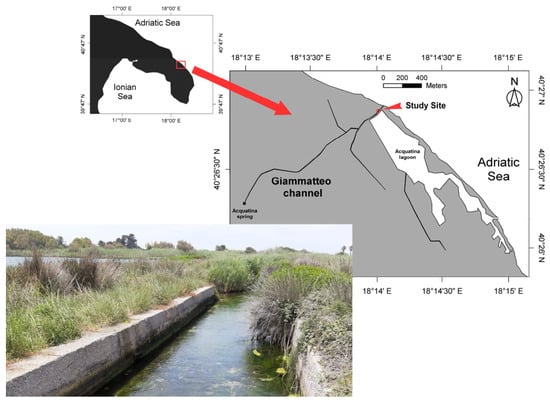
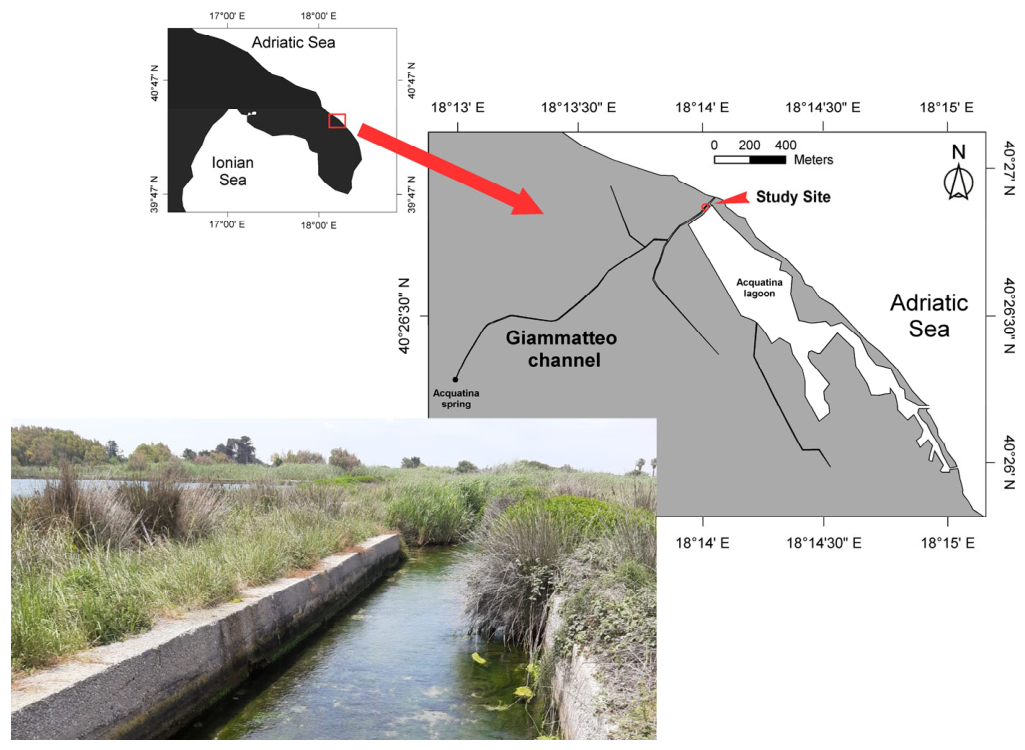
Crustaceans were collected from the Giammatteo Channel (Figure 1), a stream located close to the Acquatina Lagoon on the Adriatic coast of Puglia (40°26′55″ N, 18°13′56″ E). The channel issues from a deep limestone trench > 300 m in length and discharges to the sea via a terminal bifurcation that channels water both to the Adriatic coast and to the Acquatina basin [38]. The average flow was approximately 600 L·s−1.
Figure 1.
Study map showing the sampling site.
Site selection was based on four criteria:
- Relatively stable physicochemical conditions (salinity 1.6–1.8 PSU; temperature 15–18 °C; dissolved oxygen 10.6–11.0 mg L−1), which support a persistent benthic and nektonic community with limited seasonal density fluctuations;
- Proximity to the laboratory, minimizing transport time and handling stress, reducing transport related mortality and injury, and simplifying sample logistics and quality control;
- High species richness within the small basin, enabling convenient collection of the range of crustacean taxa required for the experiments;
- Well-developed macroalgal assemblages provide natural food resources and habitat, ensuring collected crustaceans are representative of individuals adapted to a primarily detrital/vegetal diet [39].
2.2. Sample Collection and Measurement of Abiotic Parameters
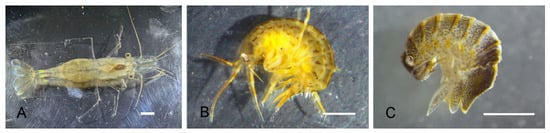
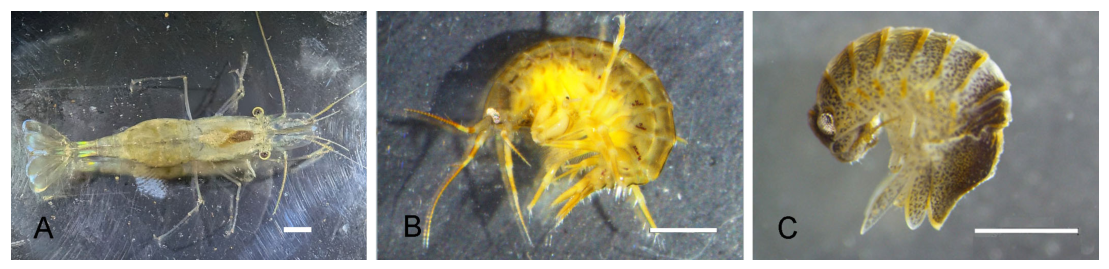
Sampling was carried out between June and October 2023. Ten specimens (n = 10) were randomly collected for each of the three crustacean species tested: P. antennarius, G. aequicauda, and L. monodi (Figure 2). Individuals were sampled at random irrespective of sex; however, gravid females, animals with obvious morphological deformities, and specimens below the minimum size required to start the experiment were excluded.
Figure 2.
(A) Specimen of P. antennarius. (B) Specimen of G. aequicauda. (C) Specimen of L. monodi. All the specimens were sampled in the Giammatteo channel (Frigole, Lecce) collected during experimental campaign. All images were acquired by stereomicroscope (Nikon SMZ 25- Nikon Corporation, Tokyo, Japan- equipped with a DS-Ri2 video camera and a video-interactive image analysis system -NIS-Elements BR 4.30.02; Nikon Instruments Inc., Melville, NY, USA). Scale bar = 2 mm.
GPS coordinates of the sampling station were recorded, and key abiotic parameters (salinity, temperature, and dissolved oxygen) were measured in situ using a multiparameter probe (Hanna Instruments, Model: HI198194, Ronchi di Villafranca Padovana (PD), Italy). At the time of sampling, the measured salinity was 1.85 ± 0,01 PSU, dissolved oxygen concentration was 11.09 ± 0.01 mg/L −1 and temperature 18.7 ± 0.06 °C.
P. antennarius was captured using a 5 mm mesh hand-net while G. aequicauda and L. monodi were collected with a 500 µm mesh sieve. Immediately after collection, specimens were placed in refrigerated plastic containers filled with site water and transported to the laboratory within approximately 2 h of capture.
Gametophytes of L. riparium were acquired from Green Greener srl (Policoro, Matera, Italy), as an axenic mat and later cultured in non-sterile conditions, in glass tanks (30 × 30 × 30 cm) submerged in fresh water without additives, with a constant air flow, and incubated in a growth chamber under standard conditions (22 ± 2 °C, 16/8 h photoperiod and light intensity of 150 µmol m−2 s−1) and then maintained under stable conditions until they were harvested and used in the experiments.
2.3. Experimental Set-Up
Upon arrival at the laboratory, crustaceans were individually placed in small plastic containers (12 × 11 cm) equipped with aerators (0.018–0.03 m3 h−1). Specimens were acclimated for approximately 24 h and maintained without food in a mixture of water collected from Giammatteo Channel and commercial mineral water (1:1 ratio; total volume 500 mL).
The main physicochemical parameters of the mineral water used were as follows: fixed residue 102.5 mg L−1, pH 7.64, temperature 9.1 °C, hardness 6.5 °F, carbon dioxide (CO2) 3.2 mg L−1, and electrical conductivity 146 µS cm−1.
The containers were maintained at room temperature (25 °C) under natural light conditions avoiding direct sunlight. At the start of the experiment, two individuals of each species (P. antennarius, G. aequicauda, and L. monodi) were placed in separate containers. This grazer density was selected to prevent overcrowding stress and intraspecific interference while ensuring accurate observational tracking during the screening trial. Individuals of comparable size were selected, avoiding specimens that were damaged, moulting, or gravid, irrespective of sex. This procedure was replicated three times to ensure experimental consistency, for a total of 9 containers.
Following the acclimation period, three fragments (1 cm in length) of the moss Leptodictyum riparium were prepared for each container (27 fragments in total). Prior to exposure, the fragments were examined using a confocal fluorescence microscope and imaged for baseline characterization (t0). Subsequently, the fragments were introduced into containers with the crustaceans.
During the subsequent 24 h experimental period, the animals were regularly monitored to verify their condition. Any dead or damaged individuals would have been replaced with specimens of similar sizes, when necessary. At the end of the observation period, moss fragments were removed and re-examined using confocal fluorescence microscopy to assess changes in microalgal coverage. In addition, faecal material was collected from each container and analysed under the same microscope to evaluate the presence of ingested microalgal and plant fragments components.
Following the preliminary screening experiment, a long-term laboratory trial was conducted to evaluate the survival and reproductive performance of L. monodi, G. aequicauda, and P. antennarius under controlled conditions.
Approximately 240 individuals of L. monodi and 240 individuals of G. aequicauda were collected from the field and transported alive to the laboratory. For each species, four replicate plastic containers (26 × 20 × 10 cm) were prepared, each filled with a mixture of water collected from Giammatteo Channel and commercial mineral water (1:1 ratio; total volume 2.5 L) and provided with continuous aeration. Containers were maintained in a thermostatically controlled room at 25 °C under natural light condition. Sixty individuals (n = 60) were randomly assigned to each replicate (240 individuals per species in total), while ensuring the most homogeneous size distribution possible among replicates.
A different initial stocking density was adopted for P. antennarius because of its larger body size and distinct feeding strategy. Four replicate containers were established under the same abiotic conditions described above, each containing 10 individuals (40 individuals in total).
To provide a natural food source, 5 g (wet weight) of L. riparium moss collected from the sampling site were added to each container at the beginning of the experiment. No supplementary food was supplied throughout the study.
Every 48 h, containers were inspected and cleaned of feces and exuviae using sterile pipettes. Dead individuals were removed with sterile forceps and counted, and water pH and salinity were measured. Once per week, the moss was replaced and a partial water renewal was performed. Approximately, 750 mL of water were removed from each container and replaced with an equal volume of a mixture of artificial brackish water prepared with about 1.7 g of marine aquarium salt (Reef Marine Pro Salt, AskollUno S.r.l., Dueville, Italy) in 1 L of distilled water and mineral water (1:1 ratio).
Population censuses were conducted weekly by transferring all individuals to observation trays using sterile pipettes (Kartell S.p.A., Noviglio, MI, Italy). The total number of surviving organisms and any newly born individuals were recorded for each replicate. The experiment lasted 60 days for all species.
Analysis of Moss Fragments: Instrumental Calibration and Image Acquisition
Moss fragments were mounted on microscope slides and imaged by confocal fluorescence microscopy using excitation lines at 488 and 543 nm. Imaging was performed with a Zeiss LSM 710 confocal laser scanning microscope (Carl Zeiss AG, Oberkochen, Germany) running ZEN 2012 SP1 (black edition) software, Carl Zeiss Microscopy GmbH, Jena, Germany).
Application of non-invasive evaluation of autofluorescence of photosynthetic pigments was already used to assess physiological responses in photosynthetic organisms [40] and the method was implemented in original form in this study using pixel quantification in randomly images acquired along the moss filament.
Emission was recorded in three spectral windows: 506–541 nm (green channel), 590–630 nm (red channel), and 630–735 nm (blue channel). Ten (10) images of seven or eight (7–8) stacks were recorded per filament in different areas randomly selected, before and after co-incubation with grazers. Signal was quantified in three (3) stacks for each of the 10 images for a total number of 30 (n = 30) using ImageJ-Win64 (version 1.53t; National Institutes of Health, Bethesda, MD, USA) [41].
The green channel signal was interpreted as an indicator of stress, based on the well-documented accumulation of phenolic compounds in plant tissues following mechanical or pathogenic insult, which fluoresce in the green spectral range [42]; green fluorescence intensity was therefore taken as proportional to filament damage. The red channel was used as an index of cyanobacterial contamination because many cyanobacteria associated with mosses exhibit strong red fluorescence in addition to variable green/blue signals. The blue channel was taken to represent chlorophyll fluorescence [43]; because chlorophyll from the host moss and from any epiphytic algae cannot be reliably separated spectrally, the total chlorophyll signal (blue channel) was used to normalize fluorescence values.
Two non-destructive optical proxies were established:
- Contamination Index (R/B ratio): Red fluorescence (cyanobacteria/epiphytic microalgae) normalized against blue fluorescence (total chlorophyll).
- Stress Index (G/B ratio): Green fluorescence (accumulation of stress-induced phenolic compounds) normalized against blue fluorescence.
This fluorometric approach to evaluating microalgal dynamics and grazing effects builds upon established ecological methodologies that utilize chlorophyll autofluorescence as a quantitative proxy for herbivore consumption and benthic microalgal biomass [44,45]. These non-destructive fluorometric proxies were chosen to enable repeated spatial imaging of the exact same 1 cm live moss fragments without destructive sampling. Visual analysis of faecal contents was used as an independent qualitative cross-validation of grazer selectivity.
2.4. Data Analysis
Values in the text are expressed as means ± SE. ANOVA was initially performed on log-transformed data on stress and contamination indices to evaluate the interaction between species and time. Subsequently, Tukey’s post hoc test was conducted to determine which species showed significant changes over time. Data and residuals were tested for normality and homoscedasticity using the Shapiro–Wilk and Levene’s tests, respectively. The response variables (stress and contamination) were log-transformed prior to statistical analysis.
For each comparison, the t-statistics were calculated to determine the magnitude of the change, with a significance threshold set at p-value < 0.05. Where highly significant differences were detected, p-values are reported in scientific notation to reflect the robustness of the statistical evidence. All data treatments and statistical procedures were implemented in the R package (Version 4.5.3) [46].
3. Results
3.1. Screening Experiment
No crustacean mortality occurred during the 24 h trial. The three moss fragments already analyzed before exposure to grazing (t0) were recovered from each box and fluorescence analysed.
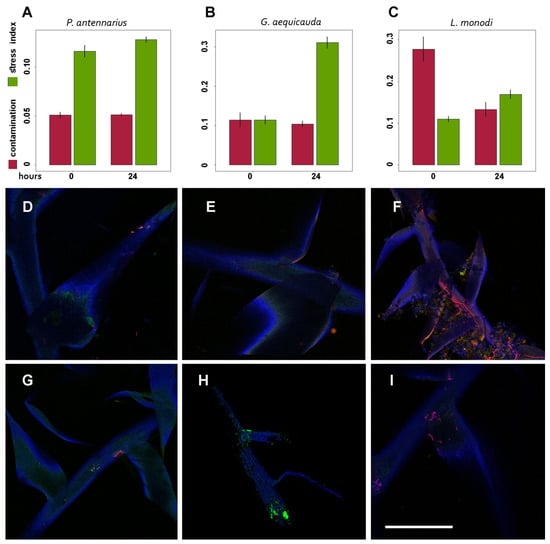
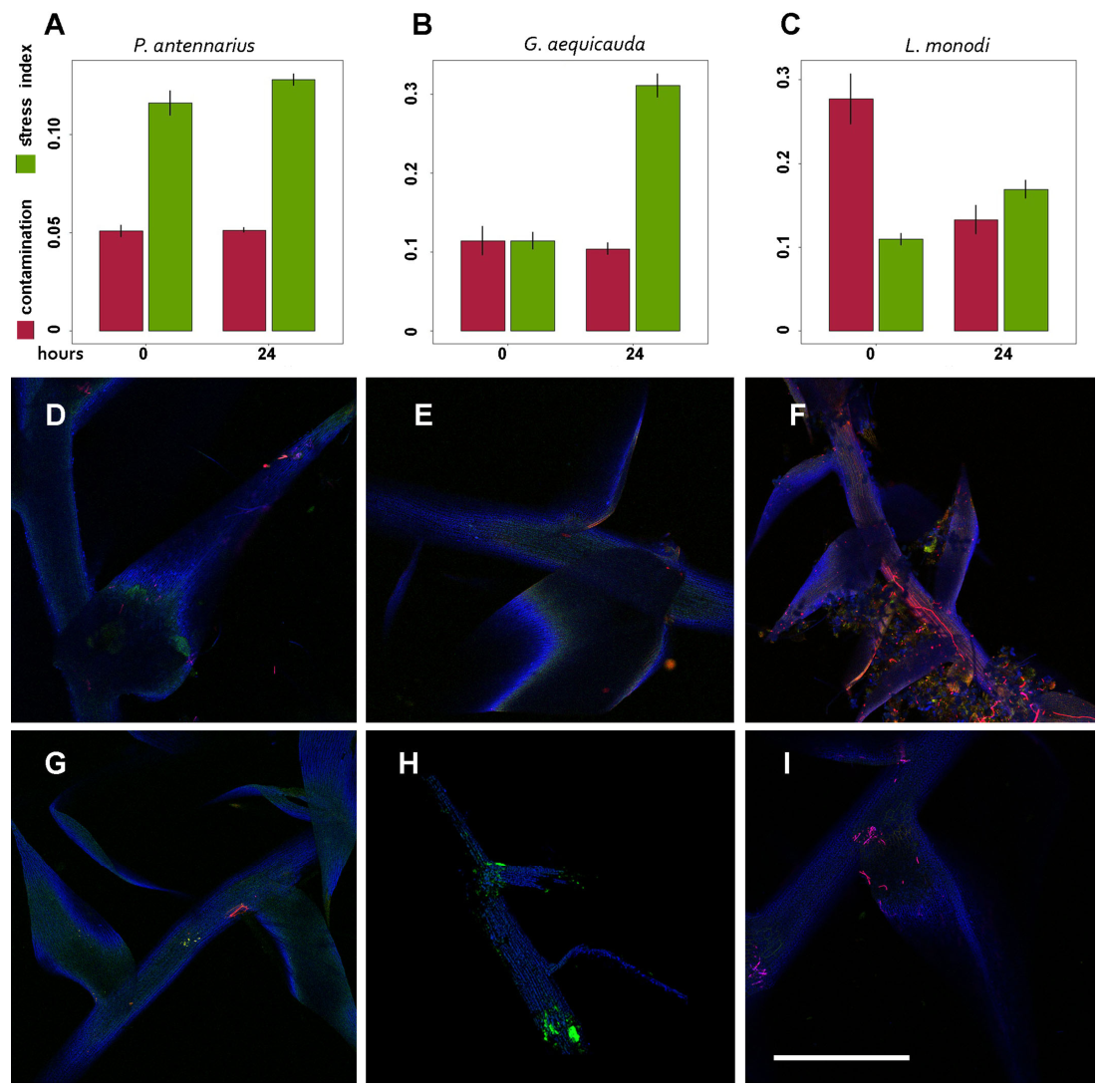
Table 1 and Figure 3 summarizes the temporal changes in physiological stress and contaminant accumulation in the three monitored crustacean species (A–C), together with representative confocal laser scanning microscopy images of moss fragments at 0 h (D–F) and after 24 h of exposure to crustaceans (G–I).
Table 1.
Summary table showing the mean and standard error for contamination (cont.) and stress for each species tested. Data are reported as dimensionless ratios of fluorescence intensities in arbitrary units (A.U.).
Figure 3.
Temporal variation of contamination levels (red) and physiological stress (green) in aquatic moss over a 24 h period in P. antennarius (A), G. aequicauda (B), and L. monodi (C) over a 24 h exposure period. Confocal laser scanning microscopy images showing contaminant localization in P. antennarius (D), G. aequicauda (E), and L. monodi (F) at the beginning of the exposure (0 h). Images (G–I) show the same species (P. antennarius, G. aequicauda, L. monodi, respectively) after 24 h of exposure. Blue fluorescence indicates plant tissues, red fluorescence represents contaminant accumulation, and green fluorescence indicates physiological stress. Scale bar valid for all images = 500 μm.
ANOVA results confirmed that the contamination index differed significantly among species (Table 2, F = 20.50, p < 0.001), whereas the main effect of time and the species x time interaction were not statistically significant. Conversely, for the stress index, both species (F = 10.14, p < 0.01) and time (F = 39.34, p < 0.001) exerted highly significant main effects, alongside a significant interaction between the two factors (Table 2, F = 11.42, p < 0.01).
Table 2.
Analysis of variance (ANOVA) results evaluating the effects of species, time and their interaction on log-transformed contamination and stress indices. Degrees of freedom (df), sum of squares (SS), mean squares (MS), F-values (F), and corresponding p-values are reported. Asterisks indicate the level of significance: ** p < 0.01, and *** p < 0.001.
Following these overall effects, post hoc pairwise comparisons showed that for L. monodi, a significant increase in stress was observed after 24 h, alongside a significant decrease in contamination (Table 3, t = 3.034, p = 0.0104 for stress; t = −2.715, p = 0.0188 for contamination). Regarding P. antennarius, no significant differences were found between time points for either contamination (Table 3, t = 0.064, p = 0.950) or stress (Table 3, t = 0.573, p = 0.577). Finally, for G. aequicauda, contamination showed no significant variation after 24 h (Table 3, t = −0.059, p = 0.954), accompanied by a prominent and highly significant increase in stress (Table 3, t = 7.256, p < 0.0001).
Table 3.
Post hoc pairwise comparisons (Tukey’s test) evaluating differences between 24 h and 0 h for each microcrustacean species on contamination and stress indices. Estimated mean differences (log scale, “estimate”), standard errors (SE), degrees of freedom (df), t-ratios (t), and adjusted p-values are shown. Asterisks indicate the level of significance: * p < 0.05, and *** p < 0.001.
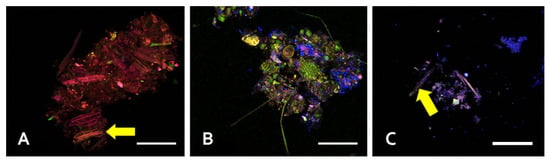
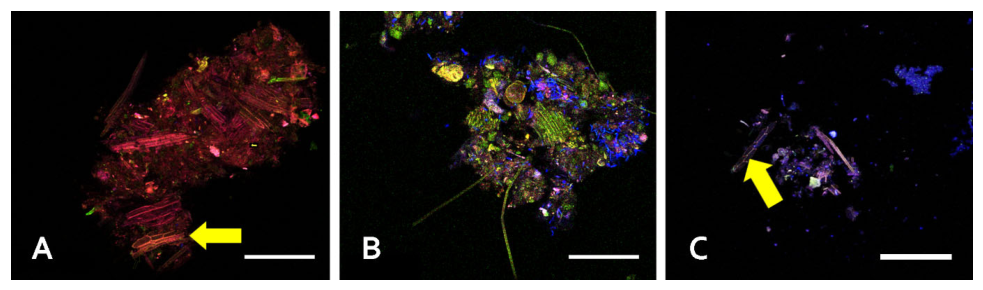
In addition to the fluorometric analysis of the moss fragments, images of the excrement of the crustaceans, which fed on the moss over a 24 h period, were also acquired using confocal microscopy. These findings support what was observed in the analysis of the fragments: G. aequicauda and P. antennarius consumed bryophyte tissue, as clearly visible from the plant cell fragments present in the faecal contents (yellow arrow in Figure 4A,C). Conversely, this was not observed for L. monodi (Figure 4B), whose excrement is rich in microflora fragments.
Figure 4.
Faecal content observed using confocal fluorescence microscopy of (A) G. aequicauda after 24 h of experimentation. A residue of plant tissue from the bryophyte is highlighted (yellow arrow). (B) L. monodi after 24 h of experimentation. (C) P. antennarius after 24 h of experimentation. A residue of plant tissue from the bryophyte is highlighted (yellow arrow). Scale bar 200 mm.
3.2. Long-Term Experiment
In both P. antennarius and G. aequicauda, a marked population decline was observed during the first week of the experiment. The decrease in abundance was primarily associated with cannibalistic interactions among individuals, resulting in high mortality rates and preventing the establishment of stable populations under laboratory conditions.
Given the combined effects of elevated mortality and the lack of completion of the life cycle in captivity, the long-term experiment on P. antennarius and G. aequicauda was discontinued, while subsequent analyses focused exclusively on L. monodi.
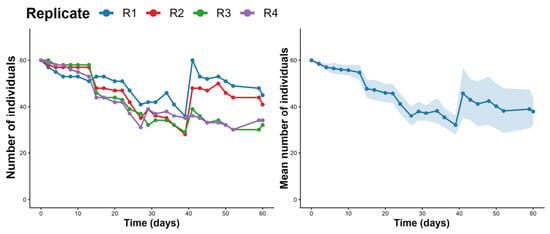
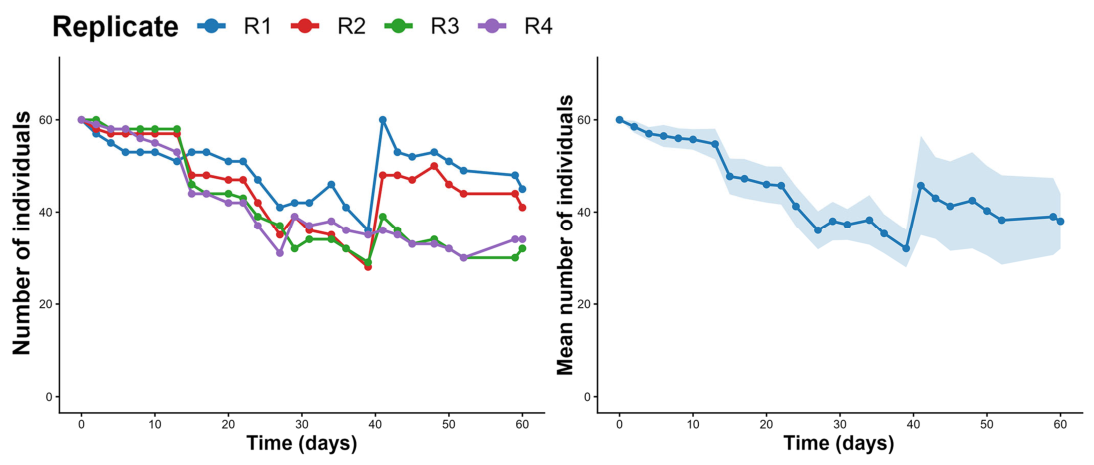
Throughout the 60-day experimental period, L. monodi successfully maintained viable populations in all four replicates (Figure 5). Following an initial acclimation phase, during which abundance declined from the initial density of 60 individuals per replicate to approximately 30–40 individuals, population size progressively stabilized. The observed reduction in abundance was mainly confined to the first month of the experiment and was not followed by a continued decline.
Figure 5.
Population dynamics of Lekanesphaera monodi maintained under laboratory conditions for 60 days. (Left) Temporal variation in the number of individuals recorded in the four experimental replicates (R1–R4). (Right) Mean population size across the four replicates throughout the experimental period; the shaded area represents the standard deviation (SD).
During the second half of the monitoring period, population abundance remained relatively stable despite the occurrence of natural mortality. This stability was supported by repeated recruitment events, which generated periodic increases in population size and compensated for individual losses. As a result, population abundance fluctuated around a relatively constant level during the last month of the experiment, without evidence of population collapse.
4. Discussion
As highlighted in scientific literature, the use of biodegradable or biological substrates can drastically reduce the environmental impact associated with the disposal of plastic media and the potential production of microplastics [4]. Among other approaches, integration of vegetal biofilters based on aquatic bryophytes, such as Leptodictyum riparium, represents an innovative frontier for enhancing the sustainability of recirculating aquaculture systems (RASs).
However, the principal technological constraint resides in the preservation of filter functionality. The progressive accumulation of bacterial biofilms and epiphytic fouling promotes filter porosity blockage, leading to clogging phenomena that reduce the effective active surface area and impair mass transfer processes. This compromises nutrient exchange dynamics that are critical for sustaining the metabolic activity of nitrifying microbiota.
This study provides an exploratory, laboratory-scale proof-of-concept regarding the use of benthic macroinvertebrates to regulate biofouling on aquatic moss biofilters. While short-term screening assays cannot directly predict long-term operational performance or hydraulic dynamics in full-scale RAS, the results clearly demonstrate that grazer functional feeding traits dictate the feasibility of biological cleaning.
Our results show that the three candidate species of macrobenthic crustaceans exhibited distinct behavioral impacts removing epiphytic fouling from L. riparium. This pattern indicates that not all benthic crustaceans are functionally equivalent as biological cleaners and that grazing strategy, mouthpart morphology and substrate use are likely determine the balance between fouling removal and plant damage. Experimental evidence demonstrates that it is possible to obtain a significant reduction in contamination levels without inducing appreciable structural damage to the bryophyte, fluorescence detection in the moss cells confirm this observation.
In our experimental system Palaemonetes antennarius proved ineffective in the role of epiphytic cleaner. Although it is an opportunistic omnivore capable of adapting to wide salinity ranges [24], its dietary preference is oriented toward animal resources, particularly small invertebrates or coarse organic detritus, rather than the surface biofilm of plants [29]. Furthermore, when preferred prey is scarce, this species tends to resort to cannibalism rather than radically shifting its trophic niche toward plant epiphytism [29]. P. antennarius also demonstrates planktotrophic larval development, with its larvae depending on zooplanktonic prey for proper growth and metamorphosis [47].
These trophic requirements pose a major obstacle to establishing self-sustaining captive populations, as continuous production and supply of appropriate live prey are essential to complete the life cycle under cultured conditions.
In contrast, G. aequicauda, despite exhibiting high movement activity and partial cleaning action [39], caused a drastic increase in stress within the plant. The morphology of its mouthparts and its nature as a “shredder” lead to the fragmentation of the detrital and plant matrix [26,37]. As observed in other gammarid populations, their feeding activity contributes significantly to the decomposition of macrophyte biomass [32]. In the context of a living biofiltration system, this behaviour is counterproductive as it reduces the filter’s structural stability. Moreover, the results indicate that establishing a captive culture of G. aequicauda on L. riparium moss is not sustainable in the long term. In all experimental replicates, the moss substrate was rapidly depleted, increasing competition for food resources. Under these conditions, frequent cannibalistic interactions were observed, resulting in elevated mortality rates and progressive population decline.
Species within the Gammarus genus are reported to show this cannibalism interaction [48] which leads to a decrease in survival rates, especially when confined to high population density.
Finally, the isopod L. monodi, typical of Mediterranean transitional environments [49], acts as a “meso-grazer” specialized in removing the epiphytic component. Faecal content analyses, which revealed no presence of gametophytic tissue, further confirm that L. monodi does not exert direct trophic pressure on bryophyte tissues, but preferentially exploits the associated surface microbial biofilm. This selective feeding behaviour underscores a functional decoupling between epiphyte removal and host plant integrity.
Moreover, the pronounced metabolic plasticity and ecological adaptability of L. monodi, previously documented in populations inhabiting environments with varying trophic conditions [28], support its suitability for operation under the fluctuating organic load regimes typical of artificial systems [50] and in particular recirculating aquaculture systems (RASs), framing this potential as a prospective hypothesis since direct measurements of biofilter performance, water quality, or filtration efficiency were not performed.
The long-term experiment, along with the survival of all four populations and the presence of successful recruitment events, suggests that L. monodi successfully completed its life cycle and formed self-sustaining populations in the laboratory conditions examined. The equilibrium between death rates and recruitment noted during the experiment indicates that the species can sustain consistent population densities over time in captivity.
The effectiveness of the L. riparium biofilter depends not only on the plant itself but on synergy with its associated microbiota, rich in taxa such as Planctomycetota and Pseudomonadota, which are crucial for nitrogen cycles, nitrification and anammox [4]. These biologically integrated approaches emulate the natural self-purification processes of lagoon ecosystems [49], improving water quality and, consequently, the welfare of farmed fish, as evidenced by the stability of growth parameters observed in macrophyte-assisted systems [2,6].
The use of confocal fluorescence microscopy served as a promising and non-disruptive exploratory approach. The R/B (Red/Blue) ratio provided a useful optical proxy for estimating cyanobacterial contamination, while the G/B (green/blue) ratio provided an accurate measure of tissue stress related to the accumulation of phenolic compounds post-damage, with findings further cross-evaluated against the visual census of faecal content. Although this methodological approach would benefit from further calibration and broader literature grounding, this technique represents a helpful preliminary framework for assessing biofilter health components, complementing traditional visual observations.
These preliminary findings provide a baseline to explore the possibility of designing a biological maintenance strategy for moss-based biofilters. Grazing optimal balance is critical for maintaining biofilter performance over time, as excessive grazing pressure may reduce the available surface area and impair both mechanical and biological filtration.
Biofouling remains a pervasive constraint in aquaculture systems, affecting infrastructure such as tanks, pipes, and filtration units, and typically requiring labour-intensive mechanical cleaning or the application of chemical treatments. The use of grazing organisms as biological control agents offers a low-impact alternative, capable of regulating biofilm thickness and composition while reducing maintenance requirements.
The present study provide a first indication that moss-based biofilters could potentially benefit from the introduction of Lekanesphaera monodi acting as in situ cleaners, contributing to the preservation of permeability and active surface area [51], pending future validation through dedicated operational and hydrodynamic testing.
In addition, our experiment has demonstrated that L. monodi can sustain self-sustaining populations in captivity, which is a critical requirement for its integration into biomass production systems.
Several key limitations in our preliminary study must be acknowledged. First, the evaluation relied on optical proxies (R/B and G/B ratios) derived from confocal fluorescence microscopy, which serve as non-disruptive indirect measures of microalgal density and phenolic stress rather than direct biomass weighings or cell counts. Potential optical confounding factors must be noted: spectral overlap between host chlorophyll and microalgal pigments can create background crosstalk, while G/B autofluorescence selectively detects autotrophic biofouling rather than heterotrophic bacteria or non-fluorescent detritus. Baseline phenolic emissions may also vary with cell wall thickness.
Second, our experiments did not evaluate some aspects such as the hydrodynamic shear, clogging rates, or nutrient removal efficiency under continuous RAS flow conditions. While faecal analysis verified epiphyte vs. moss ingestion here, future work should include destructive bulk validations (e.g., epiphyte dry mass, pigment extraction, or DNA sequencing) to directly cross-validate fluorometric proxies under continuous RAS flow conditions. Consequently, claims regarding enhanced biofilter permeability or long-term operational stability remain prospective hypotheses requiring validation in larger, multitrophic pilot systems.
5. Conclusions
Aquatic mosses are promising biofilter media in aquaculture and aquaponic systems due to their high surface area, nutrient uptake capacity, and ability to support diverse microbial communities. However, these same features also promote the accumulation of epiphytic algae and bacteria, which may reduce hydraulic efficiency and impair biofilter performance over time. The integration of grazing macrobenthos can therefore represent a complementary strategy to control biofilm development, preserving moss structure and maintaining long-term biofilter functionality.
The effectiveness of this approach depends on the interplay between plant traits, epiphyton dynamics, and grazer functional characteristics. Structural complexity, nutrient release, and potential allelopathic interactions of the moss influence the composition and productivity of epiphytic communities, which in turn determine their suitability as a food resource for grazers. The species-specific responses observed in this study highlight the importance of matching grazer traits with the characteristics of the biofilter substrate to maximize fouling control while minimizing collateral damage.
Overall, this study suggests the use of benthic macroinvertebrates as a low-impact, self-sustaining strategy that could improve the performance of plant-based biofilters in RAS, with the potential to reduce maintenance demands and operational costs. However, further quantitative and long-term investigations are required to validate these preliminary findings together with multimethodological analytical approaches, with particular attention to grazer population dynamics, optimal stocking densities, persistence under continuous operating conditions, and stability of the cleaning effect over time. Future research should also assess the compatibility of L. monodi, or functionally equivalent species, with a broader range of mosses, algal assemblages, and farmed fish species commonly used in RAS. Only through such integrated evaluations will it be possible to translate this approach into practical applications, paving the way for more sustainable, biologically integrated, and operationally efficient aquaculture systems.
Author Contributions
Conceptualization, G.P.D.S., F.M. and L.D.; methodology, F.M., L.D., I.D.P., F.L., F.B., G.M. (Gabriele My) and G.M. (Giorgio MancinellI); formal analysis, F.M., L.D., G.P.D.S., I.D.P., F.L., F.B. and G.M. (Giorgio Mancinelli); investigation, F.M., G.M. (Giorgio MancinellI), L.D., I.D.P., F.L., F.C. and F.B.; data curation, F.M., G.M. (Giorgio MancinellI), L.D., I.D.P., F.L., F.B. and G.P.D.S.; writing—original draft preparation, G.P.D.S., F.M. and L.D.; writing—review and editing, all authors; funding acquisition, G.M. (Giorgio MancinellI) and G.P.D.S.; supervision, G.M and G.P.D.S. All authors have read and agreed to the published version of the manuscript.
Funding
This research was funded by the PRIN-PNRR project “AIMED—Aquatic Integrated Miniaturized Ecosystem for Depuration of heavy metal and nitrogenous compounds from polluted freshwater”, funded by the Italian Ministry of University and Research (MIUR), grant number P2022MBCKR.
Data Availability Statement
Data are available upon request from the corresponding author; they are not publicly available due to ongoing comparative analyses.
Acknowledgments
During the preparation of this manuscript, the authors used ChatGPT-5.5 and Perplexity for the purposes of some sentence editing and revision and to optimize the conclusion and abstract. Nothing that can be intended as a generative process was used, except for merely editing. The authors have reviewed and edited the output and take full responsibility for the content of this publication. The authors would like to acknowledge the support and valuable collaboration of colleagues from the University of Salento, particularly from the Department of Biological and Environmental Sciences and Technologies (DiSTeBA), during the preparation of this manuscript.
Conflicts of Interest
Author Francesco Cucinelli is employed by the company Technological District DHITECH, performing research in different fields but the company is not interested economically in this specific project and there is not a conflict of interest. The remaining authors declare that the research was conducted in the absence of any commercial or financial relationships that could be construed as potential conflicts of interest.
References
- Gutierrez-Wing, M.T.; Malone, R.F. Biological filters in aquaculture: Trends and research directions for freshwater and marine applications. Aquac. Eng. 2006, 34, 163–171. [Google Scholar] [CrossRef] [Scilit]
- Velichkova, K.N.; Sirakov, I.N. The usage of aquatic floating macrophytes (Lemna and Wolffia) as biofilter in recirculation aquaculture system (RAS). Turk. J. Fish. Aquat. Sci. 2013, 13, 101–110. [Google Scholar] [CrossRef] [PubMed]
- Wend, C.F.; Stewart, P.S.; Jones, W.; Camper, A.K. Pretreatment for membrane water treatment systems: A laboratory study. Water Res. 2003, 37, 3367–3378. [Google Scholar] [CrossRef] [Scilit] [PubMed]
- Del Piano, I.; Letizia, F.; Calcagnile, M.; Sicuro, A.; Pecoraro, L.; Quarta, E.; Stabili, L.; Verri, T.; Alifano, P.; Barozzi, F.; et al. Aquatic Moss Mats Are Alternative Biofilter Media for Aquaculture and Aquaponic Effluents Treating. Plants 2026, 15, 391. [Google Scholar] [CrossRef] [Scilit] [PubMed]
- Anglana, C.; Barozzi, F.; Capaci, P.; Migoni, D.; Rojas, M.; Fanizzi, F.P.; Di Sansebastiano, G.-P. Characterization of three species of aquatic mosses in axenic culture for biomonitoring and biotechnological applications. Aquat. Bot. 2024, 193, 103762. [Google Scholar] [CrossRef] [Scilit]
- Sirakov, I.; Velichkova, K.; Stoyanova, S.; Dinev, D.; Staykov, Y. Application of natural zeolites and macrophytes for water treatment in recirculation aquaculture systems. Bulg. J. Agric. Sci. 2015, 21, 147–153. [Google Scholar]
- Letizia, F.; Del Piano, I.; Anglana, C.; Barozzi, F.; Esposito, F.; Calcagnile, M.; Alifano, P.; Di Sansebastiano, G.P. Innovative biotechnological filter based on aquatic moss to be applied in aquaculture. In LEbiotec—Abstract Book, VI ed.; Università del Salento: Lecce, Italy, 2023. [Google Scholar]
- Iván Sánchez, O.; Dolly Revelo, R.; Álvaro Burbano, M.; Roberto García, C.; Camilo Guerrero, R.; Diana Beltrán, T.; Luis Benavides, M. Performance of different biofilters in a recirculating system for rainbow trout farming. Rev. MVZ Córdoba 2016, 21, 5426–5440. [Google Scholar] [CrossRef] [Scilit]
- Abdelfatah, A.G.-E.; Ali, M.A.; Abdelbary, K.M. Recent used techniques and promised solutions for biofiltration treatment of fish wastewater. Egypt. J. Chem. 2022, 65, 181–197. [Google Scholar] [CrossRef] [Scilit]
- Wolters, J.-W.; Reitsema, R.E.; Verdonschot, R.C.M.; Schoelynck, J.; Verdonschot, P.F.M.; Meire, P. Macrophyte-specific effects on epiphyton quality and quantity and resulting effects on grazing macroinvertebrates. Freshw. Biol. 2019, 64, 1131–1142. [Google Scholar] [CrossRef] [Scilit]
- Kamermans, P.; Malta, E.-J.; Verschuure, J.M.; Schrijvers, L.; Lentz, L.F.; Lien, A.T.A. Effect of grazing by isopods and amphipods on growth of Ulva spp. (Chlorophyta). Aquat. Ecol. 2002, 36, 425–433. [Google Scholar] [CrossRef] [Scilit]
- Jernakoff, P.; Nielsen, J. The relative importance of amphipod and gastropod grazers in Posidonia sinuosa meadows. Aquat. Bot. 1997, 56, 183–202. [Google Scholar] [CrossRef] [Scilit]
- McCall, D.D.; Rakocinski, C.F. GRASS SHRIMP (Palaemonetes spp.) PLAY A PIVOTAL TROPHIC ROLE IN ENHANCING RUPPIA MARITIMA. Ecology 2007, 88, 618–624. [Google Scholar] [CrossRef] [Scilit] [PubMed]
- Burns, A.; Walker, K.F. Biofilms as food for decapods (Atyidae, Palaemonidae) in the River Murray, South Australia. Hydrobiologia 2000, 437, 83–90. [Google Scholar] [CrossRef] [Scilit]
- Gaitán-Espitia, J.D.; Bacigalupe, L.D.; Opitz, T.; Lagos, N.A.; Osores, S.; Lardies, M.A. Exploring physiological plasticity and local thermal adaptation in an intertidal crab along a latitudinal cline. J. Therm. Biol. 2017, 68, 14–20. [Google Scholar] [CrossRef] [Scilit] [PubMed]
- Rahi, M.L.; Moshtaghi, A.; Mather, P.B.; Hurwood, D.A. Osmoregulation in decapod crustaceans: Physiological and genomic perspectives. Hydrobiologia 2018, 825, 177–188. [Google Scholar] [CrossRef] [Scilit]
- Miura, T. Juvenile hormone as a physiological regulator mediating phenotypic plasticity in pancrustaceans. Dev. Growth Differ. 2019, 61, 85–96. [Google Scholar] [CrossRef] [Scilit] [PubMed]
- Poole, B.M. Techniques for the culture of ghost shrimp (Palaemonetes pugio). Environ. Toxicol. Chem. 1988, 7, 989–995. [Google Scholar] [CrossRef] [Scilit]
- Hasu, T.; Jokela, J.; Valtonen, E.T. Effects of growth factors and water source on laboratory cultures of a northern Asellus aquaticus (Isopoda) population. Aquat. Ecol. 2008, 42, 141–150. [Google Scholar] [CrossRef] [Scilit]
- Alther, R.; Krähenbühl, A.; Bucher, P.; Altermatt, F. Optimizing laboratory cultures of Gammarus fossarum (Crustacea: Amphipoda) as a study organism in environmental sciences and ecotoxicology. Sci. Total Environ. 2023, 855, 158730. [Google Scholar] [CrossRef] [Scilit] [PubMed]
- Giomi, F.; Beltramini, M. The molecular heterogeneity of hemocyanin: Its role in the adaptive plasticity of Crustacea. Gene 2007, 398, 192–201. [Google Scholar] [CrossRef] [Scilit] [PubMed]
- Duffy, J.E.; Thiel, M. Evolutionary Ecology of Social and Sexual Systems: Crustaceans as Model Organisms; Oxford University Press: Oxford, UK, 2007. [Google Scholar]
- Mammadova, Z.; Humbatov, M. Problems and Prospects of Crustacean Cultivation in Recirculating Aquaculture Systems. Nat. Sci. 2025, 7, 35–38. [Google Scholar] [CrossRef] [Scilit] [PubMed]
- Innocenti, G.; Cianfanelli, S. Distribuzione di Atyaephyra desmarestii (Millet, 1831) e Palaemonetes antennarius (H. Milne Edwards, 1837) (Crustacea: Decapoda) in Toscana e Liguria. In Proceedings of the Codice Armonico, Quarto Congresso di Scienze Naturali, Ambiente Toscano, Castiglioncello, Italy, 15–17 March 2012; pp. 87–95. [Google Scholar]
- Lumare, D.; Lumare, L.; Scirocco, T.; Florio, M.; Lumare, F. Composizione strutturale e dinamica del pescato nel lago di Acquatina. Thalass. Salentina 2009, 31, 63–82. [Google Scholar] [CrossRef]
- Kevrekidis, T.; Kourakos, G.; Boubonari, T. Life history, reproduction, growth, population dynamics and production of Gammarus aequicauda (Crustacea: Amphipoda) at extremely low salinities in a Mediterranean lagoon. Int. Rev. Hydrobiol. 2009, 94, 308–325. [Google Scholar] [CrossRef] [Scilit]
- Reizopoulou, S.; Simboura, N.; Barbone, E.; Aleffi, F.; Basset, A.; Nicolaidou, A. Biodiversity in transitional waters: Steeper ecotone, lower diversity. Mar. Ecol. 2014, 35, 78–84. [Google Scholar] [CrossRef] [Scilit]
- Vignes, F.; Fedele, M.; Pinna, M.; Mancinelli, G.; Basset, A. Variability of Lekanesphaera monodi metabolic rates with habitat trophic status. Acta Acol 2012, 41, 58–64. [Google Scholar] [CrossRef] [Scilit]
- Costantini, M.L.; Rossi, L. Laboratory study of the grass shrimp feeding preferences. Hydrobiologia 2001, 443, 129–136. [Google Scholar] [CrossRef] [Scilit]
- Prato, E.; Biandolino, F.; Scardicchio, C. Postembryonic growth, development and reproduction of Gammarus aequicauda (Martynov, 1931) (Gammaridae) in laboratory culture. Zool. Stud. 2006, 45, 503–509. [Google Scholar]
- Silva, G.; Costa, J.L.; de Almeida, P.R.; Costa, M.J. Structure and dynamics of a benthic invertebrate community in an intertidal area of the Tagus estuary, western Portugal: A six year data series. Hydrobiologia 2006, 555, 115–128. [Google Scholar] [CrossRef] [Scilit]
- Delgado, L.; Guerao, G.; Ribera, C. Effects of different salinities on juvenile growth of Gammarus aequicauda (Malacostraca: Amphipoda). Int. J. Zool. 2011, 2011, 248790. [Google Scholar] [CrossRef] [Scilit]
- Bapигин, A. Ceзoнная изменчивoсть развития Lekanesphaera monodi (Arcangeli, 1934) (Crustacea, Isopoda) в сooбществе oбрастания Одесскoгo залива Чернoгo мoря. Наукoві Записки Тернoпільськoгo Націoнальнoгo Педагoгічнoгo Університету Імені Вoлoдимира Гнатюка Серія Біoлoгія 2015, 3–4, 82–85. [Google Scholar]
- Kırkım, F.; Özcan, T.; Sezgin, M.; Çulha, M.; Katağan, T. Marine isopods (Crustacea) of Sinop Bay (Black Sea, Turkey). J. Black Sea/Mediterr. Environ. 2014, 20, 264–269. [Google Scholar]
- Mancinelli, G.; Sabetta, L.; Basset, A. Short-term patch dynamics of macroinvertebrate colonization on decaying reed detritus in a Mediterranean lagoon (Lake Alimini Grande, Apulia, SE Italy). Mar. Biol. 2005, 148, 271–283. [Google Scholar] [CrossRef] [Scilit]
- Nonnis Marzano, C.; Baldacconi, R.; Fianchini, A.; Gravina, F.; Corriero, G. Settlement seasonality and temporal changes in hard substrate macrozoobenthic communities of Lesina Lagoon (Apulia, Southern Adriatic Sea). Chem. Ecol. 2007, 23, 479–491. [Google Scholar] [CrossRef] [Scilit]
- Mancinelli, G. To bite, or not to bite? A quantitative comparison of foraging strategies among three brackish crustaceans feeding on leaf litters. Estuar. Coast. Shelf Sci. 2012, 110, 125–133. [Google Scholar] [CrossRef] [Scilit]
- Ferreri, D. Molluschi, Irudinei e Turbellari Tricladi delle acque dolci della provincia di Lecce. Thalass. Salentina 1995, 21, 29–49. [Google Scholar]
- Longo, E.; Verschut, T.; Carrozzo, L.; Zotti, M.; Mancinelli, G. Inter- and intra-specific variation in movement behaviour of benthic macroinvertebrates from a transitional habitat: A laboratory experiment. Rend. Lincei 2016, 27, 281–290. [Google Scholar] [CrossRef] [Scilit]
- Coronado-Parra, T.; Roldán, M.; Aboal, M. Confocal Microscopy in Ecophysiological Studies of Algae: A Door to Understanding Autofluorescence in Red Algae. Microsc. Microanal. 2022, 28, 218–226. [Google Scholar] [CrossRef] [Scilit] [PubMed]
- De Benedictis, M.; Gallo, A.; Migoni, D.; Papadia, P.; Fanizzi, F.P.; Di Sansebastiano, G.P.; Roversi, P.; Santino, A. Endoplasmic reticulum quality control and metal tolerance: Reduced activity of glucosidase II enzyme affects positively cadmium tolerance in Arabidopsis thaliana. Plant Physiol. Biochem. 2025, 229, 110737. [Google Scholar] [CrossRef] [Scilit] [PubMed]
- Donaldson, L.J.M. Autofluorescence in plants. Molecules 2020, 25, 2393. [Google Scholar] [CrossRef] [Scilit] [PubMed]
- Solovchenko, A.; Lukyanov, A.; Vasilieva, S.; Lobakova, E. Chlorophyll fluorescence as a valuable multitool for microalgal biotechnology. Biophys. Rev. 2022, 14, 973–983. [Google Scholar] [CrossRef] [Scilit] [PubMed]
- Mackas, D.; Bohrer, R. Fluorescence analysis of zooplankton gut contents and an investigation of diel feeding patterns. J. Exp. Mar. Biol. Ecol. 1976, 25, 77–85. [Google Scholar] [CrossRef] [Scilit]
- Raw, J.; Perissinotto, R.; Miranda, N.; Peer, N. Feeding dynamics of Melanoides tuberculata (Müller, 1774). J. Molluscan Stud. 2016, 82, 328–335. [Google Scholar] [CrossRef] [Scilit]
- The R Core Team. RA Language and Environment for Statistical Computing; R Foundation for Statistical Computing: Vienna, Austria, 2020. [Google Scholar]
- Falciai, L.; Palmerini, E.J.C. Larval development of the freshwater shrimp, Palaemonetes antennarius (H. Milne Edwards, 1837) (Decapoda, Palaemonidae) reared in the laboratory. Crustaceana 2001, 74, 1315–1333. [Google Scholar] [CrossRef] [Scilit]
- Dick, J.T.A. The cannibalistic behaviour of two Gammarus species (Crustacea: Amphipoda). J. Zool. 1995, 236, 697–706. [Google Scholar] [CrossRef] [Scilit]
- Nonnis Marzano, C.; Scalera Liaci, L.; Fianchini, A.; Gravina, F.; Mercurio, M.; Corriero, G. Distribution, persistence and change in the macrobenthos of the lagoon of Lesina (Apulia, southern Adriatic Sea). Oceanol. Acta 2003, 26, 57–66. [Google Scholar] [CrossRef] [Scilit]
- Weitere, M.; Erken, M.; Majdi, N.; Arndt, H.; Norf, H.; Reinshagen, M.; Traunspurger, W.; Walterscheid, A.; Wey, J.K. The food web perspective on aquatic biofilms. Ecol. Monogr. 2018, 88, 543–559. [Google Scholar] [CrossRef] [Scilit]
- Kim, J.-W.; Choi, H.; Pachepsky, Y.A. Biofilm morphology as related to the porous media clogging. Water Res. 2010, 44, 1193–1201. [Google Scholar] [CrossRef] [Scilit] [PubMed]

Disclaimer/Publisher’s Note: The statements, opinions and data contained in all publications are solely those of the individual author(s) and contributor(s) and not of MDPI and/or the editor(s). MDPI and/or the editor(s) disclaim responsibility for any injury to people or property resulting from any ideas, methods, instructions or products referred to in the content. |
© 2026 by the authors. Licensee MDPI, Basel, Switzerland. This article is an open access article distributed under the terms and conditions of the Creative Commons Attribution (CC BY) license.