


Abstract
Metal mining affects an estimated 479,200 km of river channels worldwide, and contaminated sediments threaten aquatic ecosystems and human health long after mining ceases. This study examined 53 surface sediment samples from the Xiaozi River and six tributaries in a historical coal-mining area of Chongqing, southwestern China. As, Cd, Pb, Hg and Cr were evaluated using the geoaccumulation index, potential ecological risk assessment and freshwater sediment quality guidelines; differences among rivers were tested with the Kruskal–Wallis test, and sources were explored using APCS–MLR and PMF. Hg and Cd showed the greatest enrichment (mean geoaccumulation indices 1.19 and 0.35). Hg exceeded the background value at all sites and dominated potential ecological risk, accounting for 93.4% of the maximum risk index (914) in the Xibu River. Cr exceeded the probable effect level at 19 sites, whereas As and Hg showed localized exceedances. Concentrations of As, Cd, Pb and Cr differed significantly among rivers (p < 0.01), whereas those of Hg did not. Both receptor models identified Cr–Pb and As–Cd components, whereas Hg was associated mainly with a separate component. These findings identify Hg as the main management priority, together with tributary-specific monitoring of As, Cd and Cr.
1. Introduction
The environmental effects of mining can persist long after extraction has ceased. Contaminants released from mine wastes may enter rivers and accumulate in downstream sediments, extending the affected area beyond the mine site [1,2]. A global assessment estimated that metal mines affect 479,200 km of river channels and 164,000 km2 of floodplains, and that approximately 23 million people live on floodplains affected by potentially dangerous concentrations of mining waste [3]. Considering all types of mining, up to 1.8 million km of rivers worldwide may be polluted downstream of mines, and the rivers potentially affected by coal mining far exceed those linked to key energy-transition minerals [4]. Exposure to As, Cd, Pb and Hg through contaminated water, soil, dust or food can cause oxidative stress and toxic effects in multiple organ systems [5], and Hg is of particular concern because its methylated form is a potent neurotoxin that bioaccumulates in aquatic food webs [6]. Similar concerns apply to former coal-mining areas: historical coal mines in the Canadian Rockies continued to affect downstream water and sediment quality decades after closure, including at a partially reclaimed site [7]. Ni in fine sediments of coal-mining-influenced streams in Appalachia (USA) approached or exceeded threshold-effect concentrations [8], and 32% of bottom-sediment samples from the Rybnik reservoir in the hard-coal-mining region of Silesia (Poland) were classified as potentially toxic [9]. In China, Hg was the major contributor to the ecological risk of river sediments near an industrial park in the Kuye River coal-mining area [10], and anthropogenic activities control heavy-metal dynamics in river water of the ‘Mn Triangle’, China’s largest manganese-mining region [11]. Sediment investigations are therefore needed to assess the environmental condition of river systems draining historical mining areas [12,13].
Spatial variation in sediment composition provides useful evidence of contaminant accumulation, but elevated concentrations alone do not establish a mining origin, because natural variations in parent material and sediment composition can also produce substantial differences in elemental concentrations [14,15,16] and enrichment relative to a reference composition may reflect natural geochemical variability as well as anthropogenic inputs [17]. In river networks, tributaries drain different parts of a catchment and may exhibit contrasting elemental distributions [18]; comparisons among tributaries and the main channel can therefore identify localized accumulation that is obscured by catchment-wide averages [19], provided that the reference background and assessment criteria are explicitly defined [20].
Sediment enrichment and potential ecological effects are commonly evaluated using background-based indices and sediment quality guidelines [21,22]. These approaches provide different information. The geoaccumulation index (Igeo) measures enrichment relative to a geochemical background, while the potential ecological risk index additionally accounts for element-specific toxic-response factors [23]. Sediment quality guidelines instead use concentration thresholds to screen for possible adverse biological effects [24,25]. For freshwater sediments, such thresholds have been evaluated against paired chemical and toxicity data [26]. Consequently, the elements showing the greatest relative enrichment may differ from those most frequently exceeding biological-effect thresholds. Comparing these outcomes can help distinguish widespread enrichment from locations requiring closer ecological investigation [27]. Guideline exceedances nevertheless indicate a need for further assessment rather than direct evidence of toxicity at an individual site.
Identifying possible sources can help explain these spatial and assessment patterns. Absolute principal component scores–multiple linear regression (APCS-MLR) estimates factor contributions through regression of measured concentrations on absolute component scores, whereas positive matrix factorization (PMF) incorporates measurement uncertainties and constrains factor profiles and contributions to non-negative values [28,29]. Comparing the two approaches can show whether the inferred elemental associations depend on model formulation [30,31]. However, the resulting factors do not necessarily correspond to individual sources, and their interpretation requires supporting information on potential inputs and spatial distributions [32]. Model uncertainty also matters: apparently well-fitted PMF solutions may remain sensitive to rotational ambiguity and variability in the input data [33]. Source assignments should therefore reflect the combined evidence from sediment chemistry, model performance and catchment setting, and can be further constrained by metal stable-isotope tracers [34,35].
This study examined As, Cd, Pb, Hg and Cr in surface sediment samples from the Wansheng section of the Xiaozi River and its six tributaries in Chongqing, southwestern China. The river network traverses historical coal-mining areas and allows spatial comparisons among tributaries and the main channel. The objectives were to characterize elemental distributions and enrichment, compare the priority elements and locations identified by background-based indices and sediment quality guidelines, and investigate possible sources using APCS-MLR and PMF. The assessment provides a basis for identifying where further sediment monitoring and source investigation are most needed within the catchment.
2. Materials and Methods
2.1. Study Area
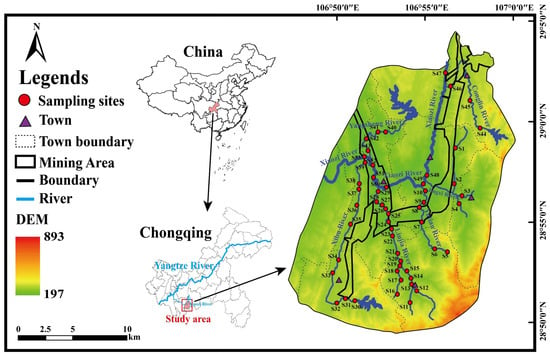
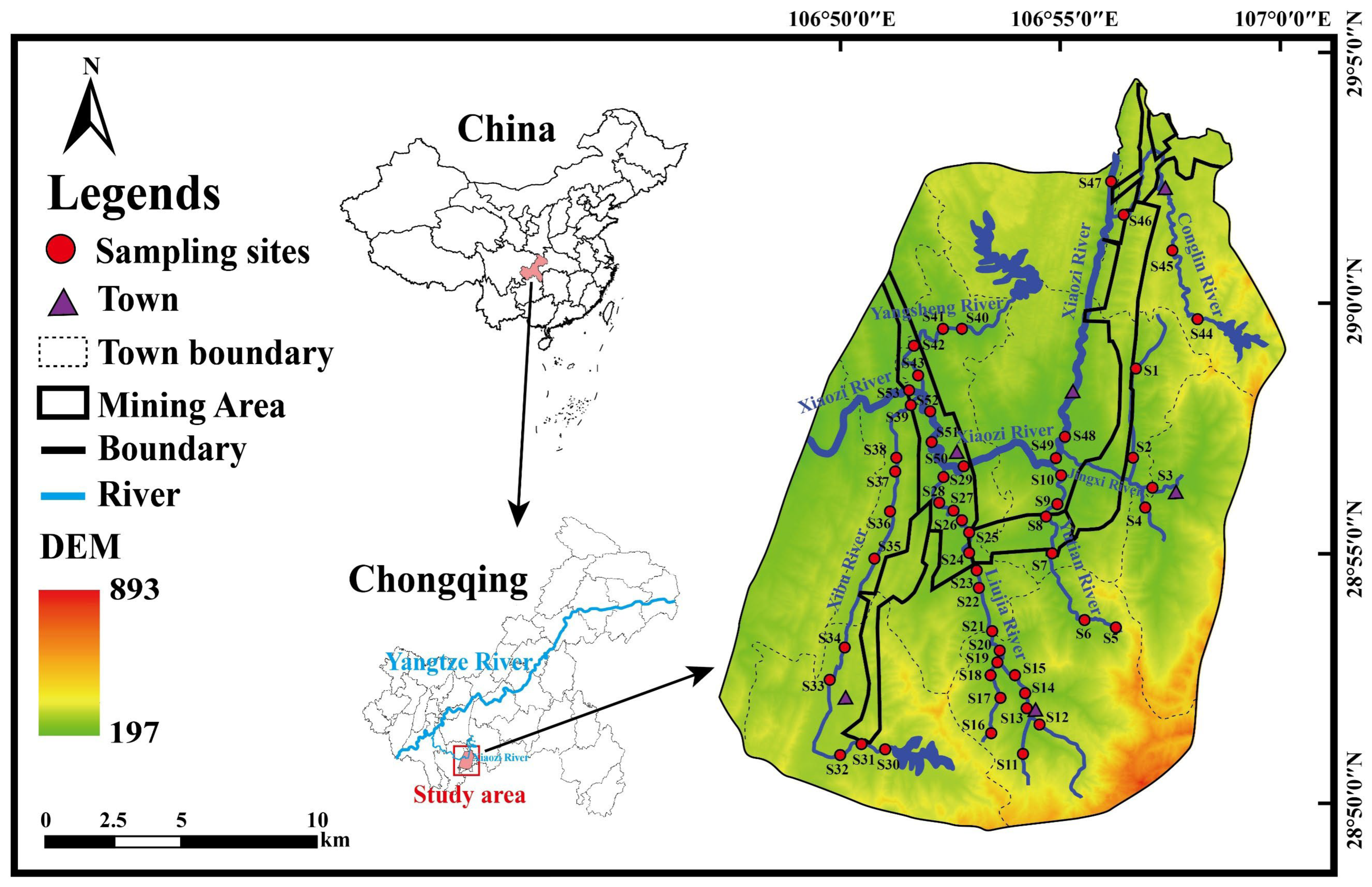
The study area covers the Wansheng section of the Xiaozi River in southern Chongqing, southwestern China (Figure 1), approximately between 28°50′–29°05′ N and 106°50′–107°00′ E. Administratively, the area belongs to the Wansheng Economic and Technological Development Zone, which covers 566 km2 and comprises eight towns and two subdistricts [36]; its year-end resident population was approximately 229,000 in 2024 [37]. The sampled river network extends approximately 17 km from north to south and 13 km from east to west. The Xiaozi River is a tributary of the Qijiang River within the Yangtze River basin, with approximately 29 km of its channel located in Wansheng. The region has mountainous terrain, with elevations ranging from 197 to 893 m and generally decreasing from east to west (Figure 1). The climate is humid subtropical, corresponding to the Köppen–Geiger Cfa type [38]. In 2024, the year of sampling, the mean annual air temperature was 18.5 °C and the total annual precipitation was 1164 mm [37].
Figure 1.
Location of the study area, sampling sites (S1–S53), towns, mapped mining areas and reservoirs in the Xiaozi River catchment, Wansheng, Chongqing.
The coal resources of the area occur in Late Permian coal-bearing strata of the Nantong coalfield [39]. Late Permian coals in this region can be locally enriched in trace elements, including Cr in the nearby Songzao coalfield of Chongqing [40] and As and Hg in southwestern China where low-temperature hydrothermal fluids were involved [41,42]. Ordovician limestones also crop out in the district and form distinctive karst landforms [43]. The soils are dominated by yellow soils, paddy soils and purple soils, with smaller areas of limestone soils, yellow-brown soils and fluvo-aquic soils; yellow soils account for approximately 75% of the forest soils, whereas paddy soils account for 45.9% of the agricultural soils [44]. Forest coverage reached 61.1% in 2024 [37], and towns and villages are distributed mainly along the river valleys (Figure 1). Large-scale coal mining began in 1938, and the Nantong mining district was established in 1955; coal from the area once accounted for half of the coal supply of Chongqing [36]. Wansheng was listed as a national resource-exhausted city in 2009; outdated coal production capacity was fully phased out in 2021, and the local economy has since shifted towards new energy, new materials and ecotourism [36].
The investigated river network comprises the Xiaozi River main channel and six tributaries: the Jingxi, Yutian, Liujia, Xibu, Yangsheng and Conglin rivers (Figure 1). Several tributaries intersect or run alongside mapped mining areas, while towns, including Wandong, Nantong, Shilin, Qingnian and Conglin, are distributed along the river network. Reservoirs in the upper reaches of the Yangsheng, Conglin and Xibu rivers (Figure 1) may trap sediment and modify the downstream transport of particle-bound elements [45]. The distribution of former mining areas relative to the river network provides the geographical context for examining differences in sediment composition among tributaries and the main channel.
2.2. Sample Collection and Processing
A total of 53 surface sediment samples (0–10 cm) were collected from the Xiaozi River main channel and six tributaries between 16 July and 2 August 2024 (Figure 1): Jingxi River (n = 4), Yutian River (n = 6), Liujia River (n = 19), Xibu River (n = 10), Yangsheng River (n = 4), Conglin River (n = 3) and the Xiaozi main channel (n = 7). Sampling sites were selected to cover the upstream, midstream and downstream reaches of each river near villages, as well as tributary branches and confluences, both within and outside the mapped mining areas.
Sediment analysis was carried out by Chongqing Stand Testing Technology Co., Ltd. (Chongqing, China). The samples were cleaned to remove debris, dehydrated, dried, and ground to pass a 100-mesh sieve. Sediment pH was measured potentiometrically in a sediment–water suspension with a PHS-3C pH meter (Shanghai, China) [46]. Cd and Pb were determined by graphite furnace atomic absorption spectrometry (GF-AAS; AA-240Z, Agilent Technologies, Santa Clara, CA, USA) after HCl–HNO3–HF–HClO4 total digestion [47]; Cr was determined by flame atomic absorption spectrometry (FAAS; 240FS AA, Agilent Technologies, Santa Clara, CA, USA) after HCl–HNO3–HF-based total digestion [48]; and As and Hg were determined by atomic fluorescence spectrometry (AFS-8530, Beijing Titan Instruments Co., Ltd., Beijing, China) after aqua regia digestion [49,50]. The acids used for digestion (HCl, HNO3, HF and HClO4) were of BV-III grade (Beijing Institute of Chemical Reagents Co., Ltd., Beijing, China). Analytical accuracy was checked with the national certified reference material for stream sediment GSD-1 (GBW07301; Institute of Geophysical and Geochemical Exploration, Chinese Academy of Geological Sciences, Langfang, China), which was analyzed together with the sediment samples. Recoveries of GSD-1 were 93.2% for As, 95.3% for Cd, 94.1% for Pb, 93.5% for Hg and 102.3% for Cr (Table S1). All analyses met the quality control standards of the monitoring unit. The heavy metals analyzed were Cr, Pb, Cd, As, and Hg. Analytical methods, instruments, detection limits, the certified reference material and recoveries are listed in Table S1.
2.3. Environmental Contamination Assessment
The Igeo is widely used for sediment pollution assessment [51]. It was applied to determine the contamination level of sediments in the study area. The calculation is as in Equation (1) [52]:
where Ci represents the concentration of heavy metals (HMs) in surface sediments, and Bi represents the background value of stream sediments in China (BSS) [53]. The constant 1.5 is a natural variation factor of HMs in the environment [54]. The classification of contamination levels is shown in Table S2.
2.4. Sediment Quality Guidelines
Sediment quality guidelines (SQGs) are widely used to evaluate the potential biological toxicity of HMs in river sediments [55]. Each pollutant has two benchmark values: the Threshold Effect Level (TEL) and the Probable Effect Level (PEL). These values indicate the likelihood of toxic effects on benthic organisms [56]. When the concentration of an HM is lower than the TEL, biological toxicity is rare. When it exceeds the PEL, toxic effects are likely to occur frequently [57]. Concentrations between TEL and PEL suggest a potential risk of biological harm [21]. The freshwater TEL and PEL values are listed in Table S3 [26].
2.5. Ecological Risk Assessment
The potential ecological risk index is used to evaluate the impact of each pollutant in a specific environment [58]. It also measures the combined effect of multiple pollutants [23]. The calculation is shown in Equations (2) and (3):
where represents the ecological risk factor of HM i in sediments. represents the toxicity coefficient of HM i. represents the contamination factor of HM i. The toxicity coefficients for As, Cd, Pb, Cr and Hg are 10, 30, 5, 2 and 40, respectively. Evaluation categories are shown in Table S4.
2.6. Source Apportionment of Trace Elements
2.6.1. Positive Matrix Factorization
Positive matrix factorization (PMF) was applied to investigate the possible sources of As, Cd, Pb, Hg and Cr in the sediments [59]. PMF decomposes the measured concentration matrix into non-negative factor contributions and factor profiles by minimizing uncertainty-weighted residuals [28]:
where Xij is the measured concentration of element j in sample i, gik is the contribution of factor k to sample i, fkj is the loading of element j in factor k, eij is the residual, and p is the number of factors. The objective function is expressed as:
where n and m are the numbers of samples and elements, respectively, and uij is the uncertainty associated with Xij. Concentration uncertainties were calculated following [33]:
where RSD is the analytical error fraction of each element and MDL is its method detection limit. The MDLs for Cd, Cr, Hg, Pb and As were 0.01, 4.0, 0.002, 0.1, 0.01 mg kg−1, respectively.
2.6.2. Absolute Principal Component Scores–Multiple Linear Regression
The APCS–MLR model was used to quantify the contributions of the resolved factors to the sediment elemental concentrations [29,60]. The measured concentrations were first standardized to dimensionless values:
where is the standardized concentration of element i in sample j, is the measured concentration, and and are the mean and standard deviation of element i across all samples, respectively. Principal component analysis with varimax rotation was then performed on the standardized data, and the two components with eigenvalues greater than 1 were retained. To convert the factor scores into absolute values, an artificial sample with zero concentrations of all elements was introduced, whose standardized value equals . The absolute principal component score (APCS) of factor k for sample j was obtained by subtracting the factor score of this zero-concentration sample from that of the sample:
where and are the factor scores of sample j and of the zero-concentration sample, respectively. Multiple linear regression was subsequently performed with the concentration of each element as the dependent variable and the APCS values as the independent variables:
where is the regression constant of element i, is the regression coefficient of factor k for element i, p is the number of factors, and represents the contribution of factor k to the concentration of element i in sample j. The mean of over all samples represents the mean absolute contribution of factor k to element i. Because negative contributions may arise from the regression and would bias the allocation of source contributions, all contributions were converted to positive values by taking their absolute values [31]. The contribution rate of factor k to element i was then calculated as:
where is the percentage contribution of factor k to element i and is the mean APCS of factor k over all samples. The contribution of sources not represented by the extracted components was calculated as bi0 divided by the same denominator.
2.7. Spatial Interpolation and Statistical Analysis
Spatial distribution maps of element concentrations were generated in ArcGIS (version 10.7) using inverse distance weighting interpolation and clipped to the river network; the middle value of each color scale corresponds to the BSS value. Because the distributions of pH, As, Cd and Hg deviated significantly from normality (Shapiro–Wilk test [61], p < 0.001) and the number of samples differed among rivers (n = 3–19), differences among the seven rivers were tested using the non-parametric Kruskal–Wallis test [62], followed by Dunn’s post hoc test [63] with Holm-adjusted p values. Spearman’s rank correlation coefficients (ρ) were used to evaluate the associations among elements and pH. Statistical significance was set at p < 0.05, and these analyses were performed in Python (version 3.13) using SciPy (version 1.18.1) [64] and scikit-posthocs (version 0.17.1) [65].
3. Results and Discussion
3.1. Concentrations and Spatial Distributions of Trace Elements in Sediments
Sediment pH ranged from 6.68 to 8.96, with a mean of 8.35, indicating generally alkaline conditions across the study area. Concentrations of As, Cd, Pb, Hg, and Cr ranged from 3.21 to 19.60, 0.11 to 0.66, 12.80 to 45.30, 0.053 to 0.726, and 25.00 to 140.00 mg kg−1, respectively (Table S5). Mean concentrations decreased in the order Cr (80.17 mg kg−1) > Pb (28.44 mg kg−1) > As (8.73 mg kg−1) > Cd (0.27 mg kg−1) > Hg (0.13 mg kg−1). These differences in absolute abundance should be distinguished from enrichment relative to background, because the natural concentrations of the five elements differ substantially.
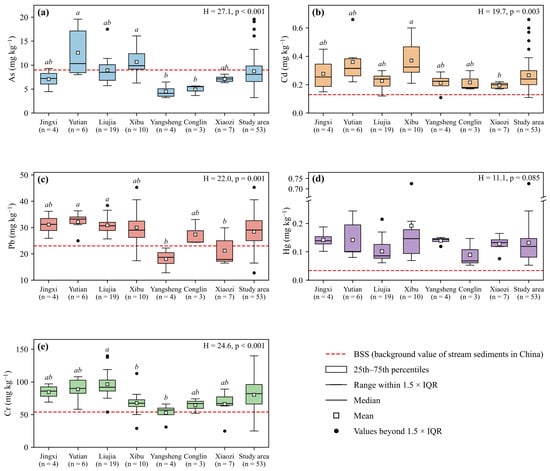
Relative to the Chinese stream-sediment background values adopted in this study, mean concentrations of Cr, Pb, and Cd were elevated by factors of 1.48, 1.24, and 2.05, respectively, whereas mean As was slightly below background. Hg showed the greatest relative elevation, and its minimum measured concentration also exceeded the adopted background. Nevertheless, comparison with a national reference provides an initial indication of enrichment rather than definitive evidence of anthropogenic contamination. Concentrations of As, Cd, Pb and Cr differed significantly among rivers (Kruskal–Wallis test: As, H = 27.1, p < 0.001; Cd, H = 19.7, p = 0.003; Pb, H = 22.0, p = 0.001; Cr, H = 24.6, p < 0.001), whereas the differences in Hg (H = 11.1, p = 0.085) and pH (H = 10.0, p = 0.126) were not significant (Figure 2; Table S6). As was significantly higher in the Yutian and Xibu rivers than in the Yangsheng and Conglin rivers (Dunn’s test, adjusted p < 0.05), whereas Cd was highest in the Xibu River, where it was significantly higher than in the Xiaozi mainstem, and was also comparatively elevated in the Yutian River. The broad As distribution in the Yutian River indicates substantial variation within this tributary, which is obscured by the catchment-wide mean below background. Pb was significantly higher in the Yutian and Liujia rivers than in the Yangsheng River and Xiaozi mainstem, and the Jingxi River samples had median values similar to those of the Yutian and Liujia rivers. Cr was highest in the Liujia River, where it was significantly higher than in the Xibu and Yangsheng rivers, and was also relatively high in the Jingxi and Yutian rivers, differing from the more pronounced As and Cd elevations in the Xibu River. These contrasting river rankings are consistent with spatial differences in sediment provenance, external inputs, and element retention, which are examined below in relation to sediment composition, catchment geology and mining history.
Figure 2.
Concentrations of (a) As, (b) Cd, (c) Pb, (d) Hg and (e) Cr in surface sediments of each river and the whole study area. Boxes show the 25th–75th percentiles, horizontal lines the medians, squares the means, whiskers the ranges within 1.5 × the interquartile range (IQR), and dots the values beyond this range. The red dashed line indicates the background value of stream sediments in China. H and p values are from the Kruskal–Wallis test. No letters are shown for Hg because the Kruskal–Wallis test was not significant. Different lowercase letters (a, b) above the boxes indicate significant differences among rivers (Dunn’s post hoc test with Holm-adjusted p < 0.05); rivers sharing at least one letter (e.g., a and ab) do not differ significantly. No letters are shown for Hg because the Kruskal–Wallis test was not significant.
Sediment composition may explain part of this spatial variability. In a mining-affected river in Hunan, Cd, Pb and As were found to be concentrated mainly in finer sediment fractions, although metal-rich coarse particles also occurred near mining inputs [66]. Using X-ray diffraction and energy-dispersive spectroscopy, the same study showed that these elements were associated mainly with sulfide minerals (galena, sphalerite and pyrite) and that both particle size and mineral composition influenced elemental distributions. Therefore, elevated bulk concentrations in the Xiaozi River catchment could reflect a greater proportion of fine particles, an increased abundance of metal-bearing mineral grains, or additional contaminant inputs. Consequently, differences between rivers should not be attributed solely to differences in input intensity. Grain-size distributions, organic carbon and mineralogical measurements, or normalization to conservative elements such as Al or Li [67], would be required to distinguish these mechanisms.
Hg exhibited widespread elevation relative to background together with a pronounced local maximum. All 53 samples exceeded the BSS value of 0.034 mg kg−1, and Hg concentrations did not differ significantly among rivers (Table S6), suggesting a spatially extensive contribution, such as a regionally elevated geochemical background associated with Hg-bearing coals or atmospheric deposition related to coal mining and combustion [42,68], superimposed on local inputs. The highest concentration (0.726 mg kg−1 at site S39), recorded in the Xibu River near the Xibu–Xiaozi confluence, was approximately 5.5 times the catchment-wide mean (Figure 2d). This site had the lowest As (6.29 mg kg−1), Pb (17.4 mg kg−1) and Cr (29 mg kg−1) concentrations in the Xibu River, indicating an Hg-specific input rather than a general increase in fine-grained or metal-rich material. Along the Yangtze River Estuary–East China Sea transect, sedimentary total Hg distributions were closely associated with grain size and organic carbon, whereas methylmercury exhibited a different spatial pattern [69]. Although that estuarine setting differs from the present freshwater system, the findings illustrate why a bulk Hg maximum need not coincide with maximum Hg availability or methylmercury production. The Xibu River therefore warrants closer investigation of Hg sources and sediment binding phases [70].
The environmental significance of sediment Hg depends on its chemical form. In anoxic sediments, the geochemical forms and bioavailability of Hg(II) are governed largely by reactions with inorganic sulfides and natural organic matter, which produce dissolved, nanoparticulate and crystalline Hg species [6]. In stream sediments affected by hard-coal mining in Czechia, Hg occurred mainly as stable β-HgS, which limits its mobility [71], whereas sediments of the Almadén mining district contained relatively large proportions of Hg in non-residual fractions, indicating greater potential mobility [70]. Methylation of Hg(II) to methylmercury is mediated by anaerobic microorganisms and depends on the availability of Hg(II) and nutrients, electron acceptors such as sulfate and iron, and the abundance and composition of organic matter [72]. In the Xiaozi catchment, sulfate released by the weathering of sulfide-bearing coal wastes could therefore influence Hg methylation. Because Hg speciation, organic carbon, sulfide and methylmercury were not measured, the present results describe total-Hg enrichment rather than bioavailable Hg, and the Xibu River hotspot should be prioritized for speciation and methylmercury analyses.
Historical coal mining and catchment geology provide more specific explanations for these distributions. As noted in Section 2.1, Late Permian coals in southwestern China can be locally enriched in As and Hg, which may be hosted by sulfide minerals [41], and high-sulfur coal gangue releases trace elements during weathering and leaching [73]. As released by sulfide oxidation is commonly adsorbed by Fe oxyhydroxides, although its desorption can increase at high pH [74]. Erosion and leaching of such mine wastes, together with the redistribution of previously affected sediment, are therefore likely contributors to the As and Cd enrichment observed in tributaries that run through or alongside mapped mining areas, such as the Xibu and Yutian rivers (Figure 1). The significantly lower Pb concentrations in the Xiaozi mainstem than in the Yutian and Liujia rivers (Table S6) are consistent with the dilution of tributary-derived sediment by less enriched material and with hydrodynamic sorting at confluences [75]. The observed distributions identify tributaries and elements requiring closer assessment while providing a spatial basis for the subsequent contamination and source-apportionment analyses.
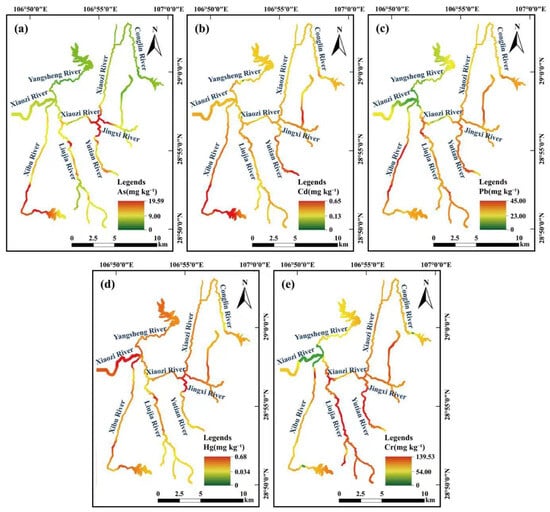
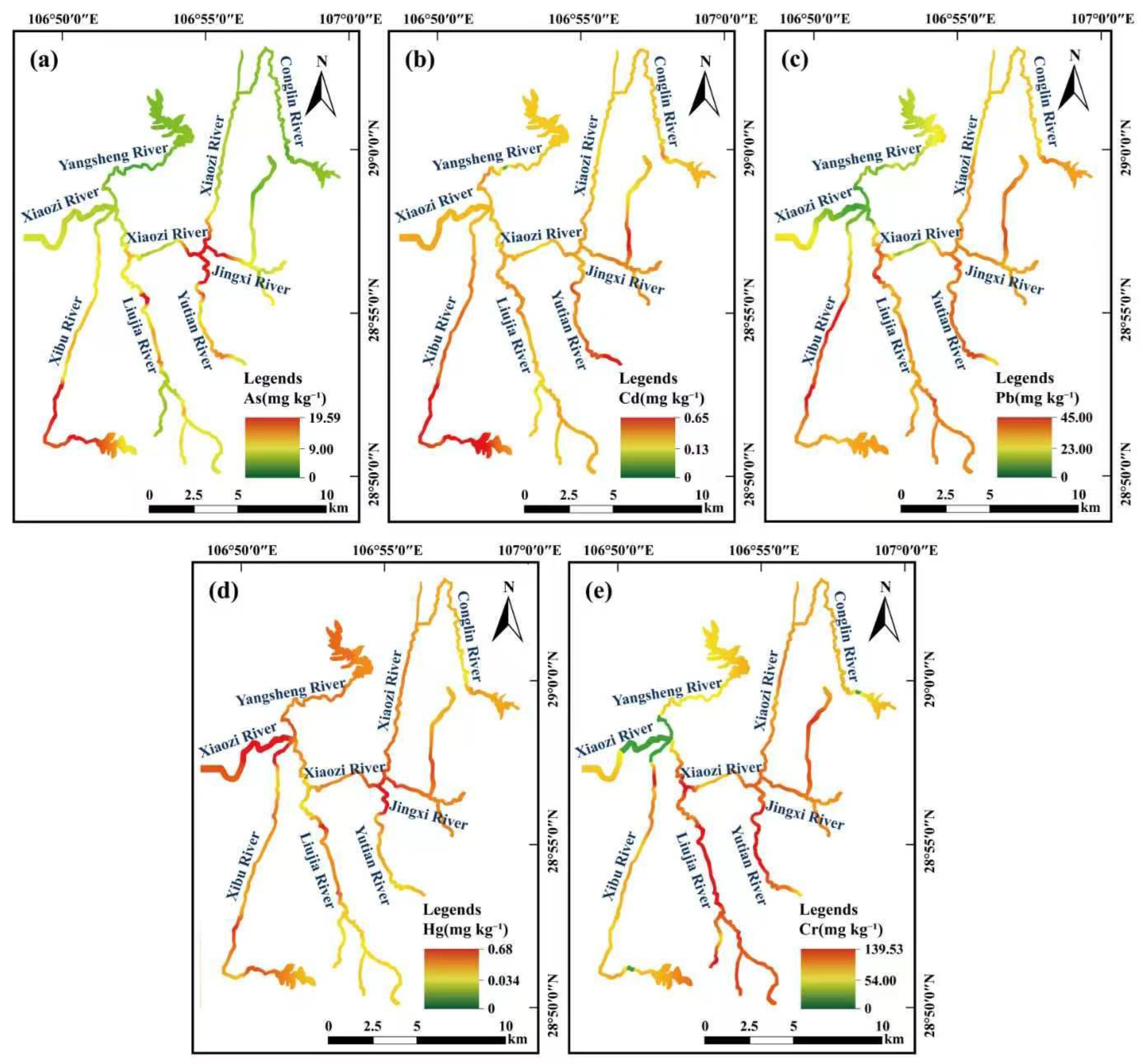
The interpolated concentration maps showed spatial variation both among rivers and along individual river reaches (Figure 3). Elevated As concentrations were concentrated in the upper Xibu River and the central confluence area connecting the Jingxi, Yutian, and Xiaozi rivers (Figure 3a). Relatively low As concentrations characterized the Yangsheng and Conglin rivers and much of the northern Xiaozi mainstem. This distribution indicates that the catchment-wide mean below background coexisted with localized As enrichment, particularly in the southwestern and central parts of the river network. This pattern arises because As exceeded the BSS at only 22 of the 53 sites: the four highest concentrations (16.1–19.6 mg kg−1 at sites S9, S10, S25 and S33) occurred in the Yutian, Liujia and Xibu rivers, whereas all samples from the Yangsheng and Conglin rivers and the Xiaozi mainstem were below background. These four sites also had Hg Igeo values of 2–3, indicating local co-enrichment of As and Hg, possibly from sulfide-bearing coal-related materials [41]. Cd concentrations were generally elevated relative to background across the mapped network, with higher values in the upper Xibu River, the southern Yutian River, and parts of the Jingxi River (Figure 3b). The upper Xibu River therefore represented an area of overlapping As and Cd enrichment. Pb also exhibited elevated concentrations along substantial sections of the Xibu, Yutian, Jingxi, and Liujia rivers, whereas lower concentrations occurred in the Yangsheng River and several western reaches of the Xiaozi mainstem (Figure 3c). The Pb distribution partly overlapped with that of Cd, although the positions of their most elevated reaches differed. Hg showed widespread exceedance of the adopted background, with prominent high-value zones in the western Xiaozi mainstem and the central confluence area (Figure 3d). Comparatively lower Hg concentrations occurred along the southern Liujia River and parts of the Conglin River. Cr displayed a different pattern, with relatively high concentrations extending along the Liujia and Yutian rivers and sections of the Jingxi River, while lower values occurred in the Yangsheng River and parts of the western mainstem (Figure 3e). The occurrence of elevated Hg alongside comparatively low Pb and Cr in the western mainstem further illustrates the differences among elemental distributions.
Figure 3.
Spatial distributions of (a) As, (b) Cd, (c) Pb, (d) Hg and (e) Cr concentrations (mg kg−1) in surface sediments of the Xiaozi River network. The middle value of each color scale corresponds to the BSS value.
These spatial relationships are supported by Spearman correlation analysis (Table S7). As was significantly correlated with Cd (ρ = 0.55), Pb (ρ = 0.47) and Cr (ρ = 0.40) (p < 0.01), and Pb was significantly correlated with Cr (ρ = 0.44, p < 0.01) and Cd (ρ = 0.28, p < 0.05). In contrast, Hg was not significantly correlated with any other element (|ρ| ≤ 0.18, p > 0.19), and pH was not significantly correlated with any element (p > 0.05). The positive correlations among As, Cd, Pb and Cr (except for the Cd–Cr pair) indicate partly shared sources or carrier phases, whereas the independence of Hg indicates a distinct source or accumulation pathway, consistent with the receptor-model results.
The overlapping As and Cd enrichment in the upper Xibu River is consistent with inputs of sediment or runoff carrying both elements. At sites S30, S31 and S33 in this reach, Cd concentrations were 0.51–0.60 mg kg−1 and As concentrations were 12.6–16.1 mg kg−1, and As and Cd were significantly correlated across the catchment (ρ = 0.55, p < 0.001). Both elements are chalcophile and, in mining-affected sediments, are commonly associated with sulfide minerals such as pyrite, sphalerite and galena [66]; oxidative weathering of sulfide-bearing coal gangue can release them to runoff [73]. In this coal-mining catchment, weathering and erosion of mining-related materials provide a plausible contribution to such localized enrichment. The elevated As and Hg concentrations around the central confluence may additionally reflect the redistribution of material supplied by adjoining tributaries. Variations in flow structure and channel morphology at river confluences influence sediment mixing and can produce spatially uneven dispersal of tributary-derived particles [75]. Differences in sediment composition may also contribute to the contrasting elemental patterns. Spatial changes in the proportions of fine particles and metal-bearing mineral grains can alter bulk sediment concentrations, producing different distributions even within a connected river network [66]. Such variation offers a plausible explanation for the more extensive Cr enrichment along the Liujia River compared with the localized As enrichment. For Hg, differences in retention by organic matter and fine particles may contribute to the high concentrations in the western mainstem and central confluence area, where its distribution diverged from those of several other elements [69].
3.2. Evaluation of HMs in Sediments
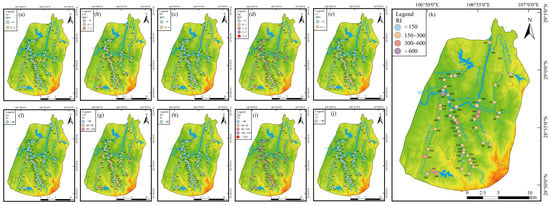
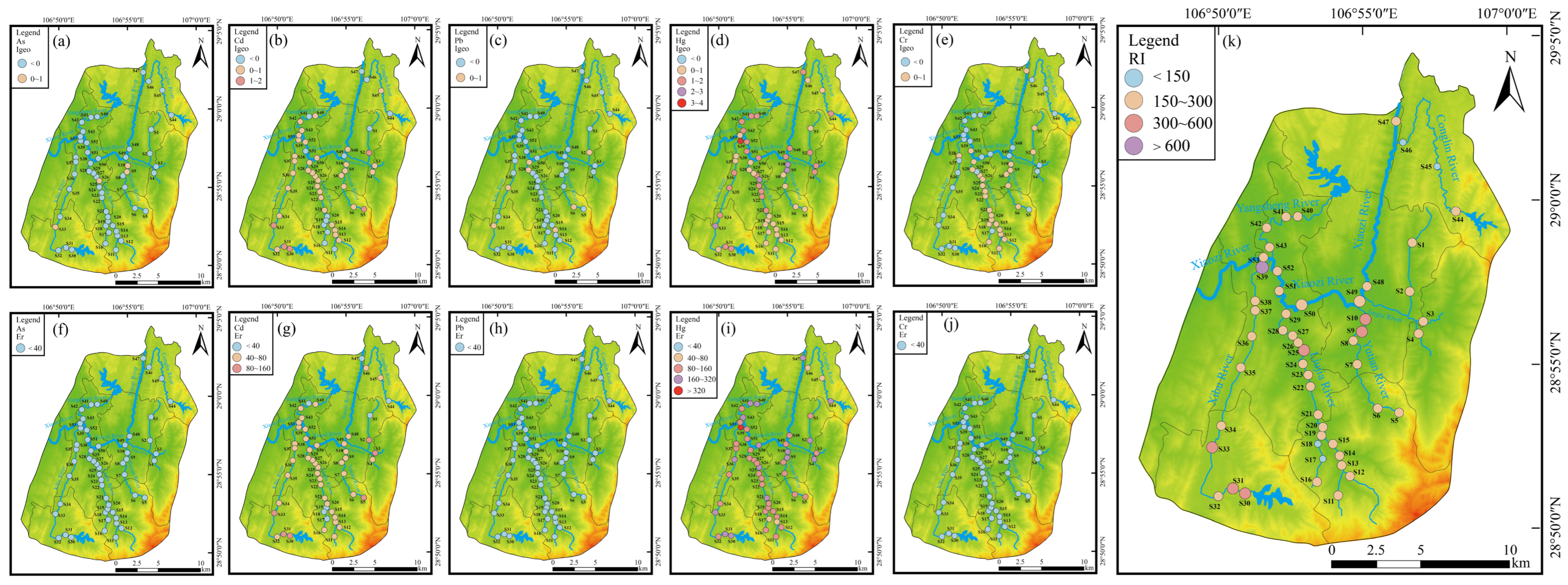
The geoaccumulation index (Igeo) indicated contrasting contamination levels among the five elements (Figure 4a–e). Mean Igeo values decreased in the order Hg (1.19) > Cd (0.35) > Cr (−0.09) > Pb (−0.32) > As (−0.73). Based on these mean values, Hg fell within the moderately contaminated category, whereas Cd was classified as uncontaminated to moderately contaminated. As, Pb, and Cr belonged to the practically uncontaminated category, although positive Igeo values occurred at individual sampling sites. Spatially, Cd contamination was generally characterized by Igeo values between 0 and 1, with localized values of 1–2 in the Xibu, Yutian, and Jingxi rivers (Figure 4b). Negative values occurred at several sites, particularly in the northern river network and parts of the Liujia River. Hg exhibited more widespread positive Igeo values, commonly within the 1–2 interval, with localized values of 2–3 and a heavily contaminated site in the 3–4 category near the Xibu–Xiaozi confluence (Figure 4d). As and Pb showed predominantly negative values, with scattered sites in the 0–1 category (Figure 4a,c). Cr contamination was also limited to the 0–1 category at affected sites, mainly along portions of the Liujia, Yutian, and Jingxi rivers (Figure 4e).
Figure 4.
Spatial distributions of heavy metal contamination and potential ecological risk in surface sediments of the Xiaozi River catchment: (a–e) geoaccumulation index (Igeo), (f–j) single-element potential ecological risk index (Er), and (k) integrated potential ecological risk index (RI). Elements in panels (a–e) and (f–j) are ordered as As, Cd, Pb, Hg, and Cr.
The single-element potential ecological risk index (Er) further distinguished Hg and Cd from the other elements (Figure 4f–j). As, Pb, and Cr had Er values below 40 at all sampling sites, corresponding to low potential ecological risk. Cd was predominantly associated with moderate risk (40 ≤ Er < 80), while considerable risk (80 ≤ Er < 160) occurred at selected sites in the Xibu, Yutian, and Jingxi rivers. Several sites remained in the low-risk category. Hg showed the highest potential risk, with many sites falling within the considerable- and high-risk categories (80 ≤ Er < 320). A localized very high-risk site, with Er exceeding 320, occurred near the Xibu–Xiaozi confluence.
The integrated potential ecological risk index (RI) was dominated by the moderate-risk category (150 ≤ RI < 300), with fewer sites classified as low risk (RI < 150) or considerable risk (300 ≤ RI < 600; Figure 4k). Sites with considerable risk occurred in parts of the Xibu, Jingxi, Yutian, and Liujia rivers. The maximum RI of 914 was recorded near the Xibu–Xiaozi confluence, placing this site in the very high-risk category. At the same location, the Hg Er value reached 854, accounting for approximately 93.4% of RI. Thus, the most pronounced integrated-risk hotspot was overwhelmingly associated with Hg.
The difference between the contamination and potential-risk classifications is particularly evident for Cd. Its modest mean Igeo value coexisted with moderate or considerable Er values at many sites because Igeo describes enrichment relative to background, whereas Er additionally incorporates an element-specific toxic-response factor. Under the coefficients used in this study, a Cd Igeo value between 0 and 1 corresponds to an Er value between 45 and 90, spanning the moderate- and considerable-risk categories. This relationship explains the ecological relevance assigned to Cd despite its relatively limited enrichment. The complementary interpretation of enrichment and toxicity-weighted indices is consistent with recent comparisons of sediment assessment methods [76].
Hg combined the highest mean enrichment with a large toxic-response factor, producing both widespread elevated Er values and a strong local contribution to RI [77]. Conversely, Cr had the highest absolute concentration among the measured elements but remained within the low Er category. The resulting emphasis on Hg and Cd is consistent with assessments of urban river sediments in southern China, where these elements were the principal contributors to potential ecological risk [78]. A substantial contribution from Cd despite low absolute concentrations has also been reported in the Guan River Estuary [79]. For the Xiaozi River catchment, these results support prioritizing Hg at the Xibu–Xiaozi confluence and maintaining targeted Cd monitoring in the Xibu, Yutian, and Jingxi rivers.
The comparison with sediment quality guidelines revealed distinct patterns among the five elements (Figure 5). As concentrations generally fell between the TEL and PEL, with individual samples from the Yutian and Liujia rivers exceeding the PEL of 17 mg kg−1 (Figure 5a). Concentrations in the Xibu and Xiaozi rivers were predominantly within the intermediate interval, whereas lower concentrations occurred in the Yangsheng and Conglin rivers, where several observations fell below the TEL. These distributions indicate that elevated As concentrations were concentrated in particular tributaries. Most Cd and Pb concentrations remained below their respective TELs (Figure 5b,c). Isolated Cd observations in the Yutian and Xibu rivers exceeded the TEL of 0.596 mg kg−1, while all samples remained below the PEL. Pb concentrations exceeded the TEL of 35 mg kg−1 at some sites in the Jingxi, Yutian, Liujia, and Xibu rivers, but none exceeded the PEL. Samples from the Yangsheng, Conglin, and Xiaozi rivers consistently fell below the Pb TEL. Thus, exceedances of the lower guideline values for these two elements were restricted to a subset of the sampled sites.
Figure 5.
Distributions of heavy metal concentrations in surface sediments of the Xiaozi River catchment relative to sediment quality guidelines: (a) As, (b) Cd, (c) Pb, (d) Hg, and (e) Cr. Purple violins represent concentration distributions, and green dots indicate individual samples. Blue, orange, and red shading denote concentrations below the threshold effect level (TEL), between the TEL and probable effect level (PEL), and above the PEL, respectively. The TEL and PEL are freshwater sediment quality guidelines: adverse biological effects are rarely expected below the TEL and are expected to occur frequently above the PEL.
Hg showed a distribution dominated by concentrations below the TEL, together with several observations in the intermediate interval and an isolated PEL exceedance in the Xibu River (Figure 5d). The maximum Hg concentration of 0.726 mg kg−1 exceeded the PEL of 0.486 mg kg−1, highlighting a local area of concern. Cr exhibited more widespread guideline exceedances: most observations were above the TEL, and concentrations exceeding the PEL of 90 mg kg−1 occurred in the Jingxi, Yutian, Liujia, and Xibu rivers, particularly in the Yutian and Liujia rivers (Figure 5e). Most Cr observations from the Yangsheng, Conglin, and Xiaozi rivers fell between the two thresholds. These distributions identify Cr as a concern across several tributaries, alongside localized As and Hg elevations. Within the sediment quality guideline framework, concentrations below the lower threshold, between the two thresholds, and above the PEL correspond to ranges rarely, occasionally, and frequently associated with adverse biological effects, respectively. Accordingly, the PEL exceedances indicate an increased potential for adverse effects on sediment-associated organisms at the affected sites.
The emphasis on Cr in the guideline assessment complements the prominence of Hg and Cd in the potential ecological risk assessment (Figure 4). These methods use different reference criteria: the geoaccumulation index evaluates concentrations relative to background values, the potential ecological risk index additionally applies element-specific toxicity-response factors, and the sediment quality guidelines compare concentrations with empirical biological-effect thresholds. Differences in the elements highlighted by these approaches therefore reflect their assessment criteria [76]. In this study, the mean Cd concentration of 0.27 mg kg−1 was approximately twice the adopted background value but remained below its TEL. Conversely, the mean Cr concentration of 80.17 mg kg−1 exceeded its TEL despite the low Cr ecological risk index. Hg combined elevated background-normalized risk with a localized PEL exceedance, supporting particular attention to the affected Xibu River site. Taken together, the assessments support targeted attention to Hg in the Xibu River and to As and Cr in the Yutian and Liujia rivers. Cd remains relevant because of its enrichment and contribution to potential ecological risk, although most concentrations were below the effects-based lower threshold.
Total concentrations do not necessarily reflect bioavailability, which depends on the chemical forms of the elements [58]. In sediment cores from the Shima River, South China, the residual fraction was the largest Cr fraction (44%), whereas Cd occurred mainly in the acid-soluble and residual fractions, and the acid-soluble fraction was mainly responsible for acute sediment toxicity [80]. In the present sediments, Cr(VI), the most toxic and mobile form of Cr, was extremely low in all samples, indicating that Cr occurred almost entirely as Cr(III). If Cr in the Xiaozi catchment is similarly hosted mainly in detrital minerals, its widespread PEL exceedances may overestimate its biological effects. Cd, in contrast, may be associated with exchangeable and carbonate phases under the alkaline conditions of the study area and may therefore be more mobile than its moderate total concentrations suggest [80]. As is commonly retained by adsorption onto Fe oxyhydroxides, but its mobility can increase at high pH or under reducing conditions [74], and As has been found predominantly in non-residual fractions in mining-affected river sediments [70].
3.3. Comparison with Other Studies
The Hg concentrations in the Xiaozi River catchment (0.053–0.726 mg kg−1; mean 0.132 mg kg−1) were within the range reported for river sediments across China (0.02–8.67 mg kg−1), where Hg and Cd also contributed most to RI [81]. They were higher than those in sediments of coal-mining subsidence areas (0.028–0.114 mg kg−1; mean 0.066 mg kg−1), where coal gangue was estimated to be the main Hg source [82], whereas their mean was more than an order of magnitude lower than those in river sediments of the Xikuangshan antimony–coal mining district (2.01 ± 1.64 mg kg−1) [68] and the Almadén Hg-mining district (mean 106.3 mg kg−1) [70]. In the Kuye River, a coal-mining area in northern China, the mean sediment Hg concentration was 3.42 times the regional soil background value, Hg Igeo exceeded 1 in 69% of the samples, and Hg contributed 75% of the ecological risk near an industrial park [10,83]. Similarly, 29 of the 53 sites (55%) in the present study had Hg Igeo values greater than 1, and Hg contributed 93.4% of RI at the maximum-risk site. In stream sediments affected by hard-coal mining in the Upper Silesian Coal Basin (Czechia), Hg enrichment was attributed mainly to industrial processes rather than to coal and associated rocks [71], whereas in the Canadian Rockies, legacy coal mining increased Se and Pb in downstream lake sediments for decades [7]. In southwestern China, As and Hg can also be enriched in Late Permian coals affected by hydrothermal fluids, as reported in Guizhou [41]. These comparisons indicate that Hg enrichment in the Xiaozi catchment is moderate in absolute terms but, because of the high toxic-response factor of Hg, dominates the potential ecological risk, as also observed in other coal-mining catchments.
For the other elements, the frequent exceedances of the TEL for As and of the PEL for Cr are consistent with a nationwide review of Chinese river sediments, in which As and Cr showed the largest numbers of sites exceeding SQGs [81]. In the dam-regulated Lancang River, Cr was a major contributor to the toxic risk of suspended particulate matter but was derived mainly from natural inputs such as soil erosion [45], which supports a lithogenic contribution to Cr in the Xiaozi catchment. Cd enrichment in the present study (mean Igeo = 0.35) was much lower than that in suspended particulate matter of the Mun River, Thailand (Igeo = 3.7), where Cd was the major contributor to toxic risk [84]. These differences illustrate that the priority elements in mining-affected sediments vary with regional geology and the history of industrial activity.
3.4. Source Apportionment of HMs Using APCS–MLR and PMF
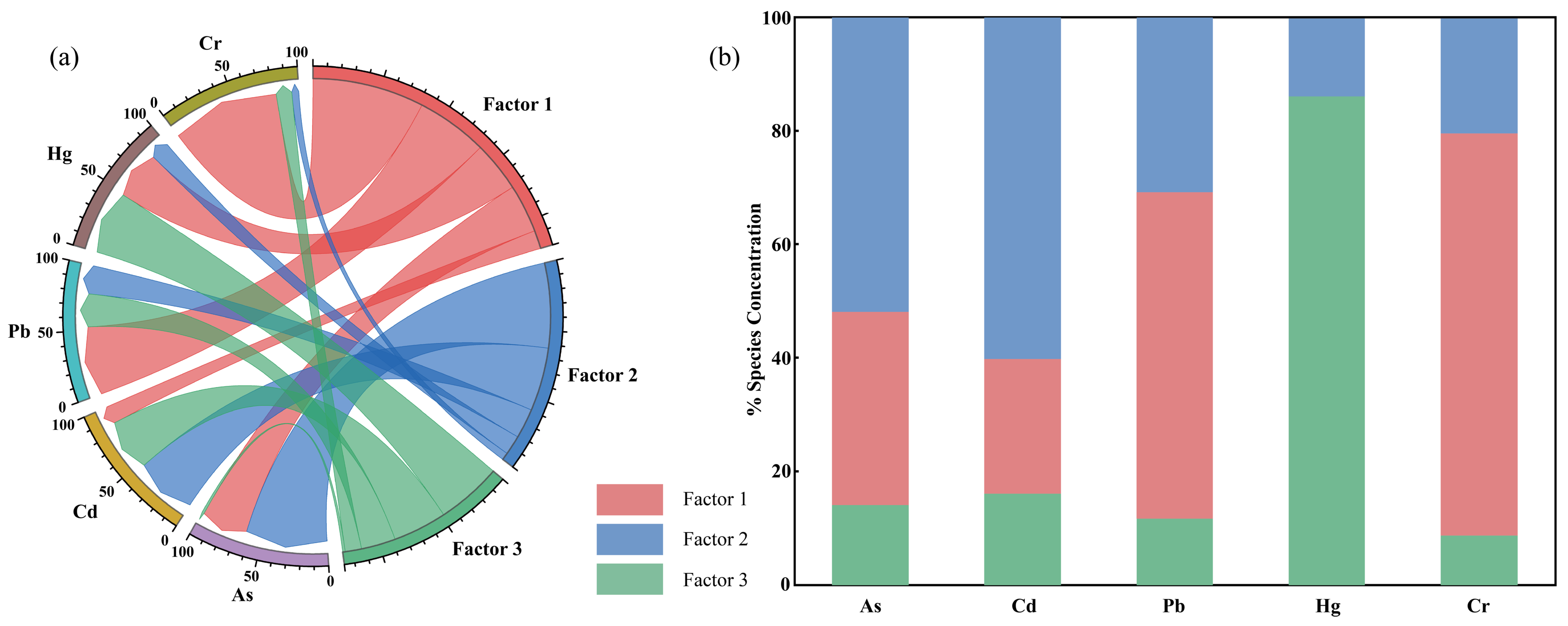
The PMF three-factor solution and the APCS–MLR solution, consisting of two varimax-rotated components and an unidentified source (Factor 3), showed similar dominant elemental associations (Figure 6). In the APCS–MLR results, Factor 1 accounted for 82.47% of Cr and 52.73% of Pb, and Factor 2 for 62.64% of As and 46.76% of Cd. Factor 3 was the largest contributor to Hg (48.33%) and also accounted for 39.72% of Cd (Figure 6a). As and Hg received additional contributions from Factor 1 (35.53% and 37.34%, respectively), indicating that their concentrations were distributed across multiple factors. The PMF results reproduced these dominant associations while allocating different proportions of individual elements among the factors (Figure 6b). Factor 1 accounted for approximately 71% of Cr and 57% of Pb, together with 34% of As and 24% of Cd. Factor 2 contributed approximately 52% of As and 60% of Cd. Factor 3 accounted for approximately 86% of Hg, whereas its contributions to the other elements were comparatively small. Relative to APCS–MLR, PMF assigned a larger proportion of Hg and a smaller proportion of Cd to Factor 3. The agreement between the models was therefore clearest in the dominant factor associated with each element. Factor 1 represents a Cr–Pb-associated component with a plausible contribution from mineral-derived material. The generally modest enrichment of Cr and Pb indicated by their mean geoaccumulation indices is compatible with the delivery of weathered rock and soil particles to the river network. A substantial natural contribution to Cr has also been identified in coal-mining environments, including soils surrounding a coal gangue heap in Chongqing and sediments from the Xutuan mining area [60,85]. Within the Xiaozi River catchment, mining disturbance could facilitate the transport of such material together with particles affected by human activities. Factor 1 is consequently interpreted as a mixed component involving mineral-derived inputs and potential anthropogenic additions.
Figure 6.
Relative factor contributions to heavy metal concentrations in surface sediments of the Xiaozi River catchment estimated using (a) APCS–MLR and (b) PMF. Ribbon widths in the chord diagram and segment heights in the stacked bars represent the contributions of individual factors to each element. Red, blue, and green denote Factors 1, 2, and 3, respectively.
Factor 2 was characterized by its substantial contributions to As and Cd. Their elevated concentrations in parts of the Yutian and Xibu rivers provide spatial support for partly shared inputs (Figure 2 and Figure 3). Given the coal-mining history of the catchment, weathering and leaching of exposed coal-bearing materials offer a plausible pathway for the delivery of both elements [86], because both are commonly associated with sulfide minerals in mining-affected sediments [66]. Regional investigations have identified coal gangue accumulation as an important contributor to As and Cd in surrounding soils, supporting the relevance of this pathway in Chongqing [60]. Factor 2 can thus be regarded as an As–Cd-associated component potentially influenced by mining residues. The distribution of As and Cd across additional factors suggests that these inputs overlap with other components of the sediment mixture. Factor 3 was distinguished by its dominant contribution to Hg, particularly in the PMF solution. This association is consistent with an Hg-rich input component that may be linked to legacy coal-related activities. Coal gangue, coal particles, and combustion residues have been identified as sources of sedimentary Hg through stable-isotope tracing in coal-mining subsidence areas [82]. In the present catchment, the pronounced Hg enrichment and localized high concentration in the Xibu River make this component especially relevant to environmental management. Its separation from the main Cr–Pb and As–Cd associations suggests that Hg accumulation follows a distinct pattern within the broader mixture of catchment inputs.
The correspondence between the dominant elemental associations provides a consistent basis for interpreting the two model solutions. Differences in the apportioned percentages are compatible with the different mathematical treatments of the concentration data: APCS–MLR estimates contributions through regression on absolute principal component scores, whereas PMF resolves contributions and profiles through a constrained factorization incorporating measurement uncertainty. Comparable differences in source partitioning have been reported when these models were jointly applied to coal-mining sediments [85]. When considered alongside the ecological assessments, the results support particular attention to Hg-associated inputs and the As–Cd component, while the widespread Cr guideline exceedances justify continued attention to the Cr–Pb-associated component [87,88]. These priorities connect the source-apportionment results with the distinct enrichment and potential biological-effect patterns observed across the catchment.
4. Conclusions
Sediment contamination in the Xiaozi River catchment requires differentiated management that considers both geochemical enrichment and potential biological effects. The combined evidence identifies Hg-associated inputs as the foremost concern, while Cd enrichment and As and Cr guideline exceedances warrant complementary attention. The recurring elemental associations across the receptor models support multiple contributing components, plausibly involving mineral-derived material and legacy coal-related inputs. These results favor targeted management of affected tributaries, particularly the Xibu River for Hg and the Yutian and Liujia rivers for As and Cr. Combining control of catchment inputs with sediment monitoring in these areas would address the distinct contamination patterns more effectively than applying a single element ranking across the entire river network. Nevertheless, these conclusions are subject to several limitations. The samples were collected in a single summer campaign, and grain size, organic carbon and normalizing elements (Al, Fe) were not determined, so seasonal variation and grain-size effects could not be evaluated. Enrichment was assessed against the national stream-sediment background rather than local background values, and the unequal number of samples among rivers (n = 3–19) limits the comparisons and interpolation in sparsely sampled reaches. Future work should include seasonal sampling, grain-size, organic carbon and Al-normalized analyses, Hg speciation and methylmercury measurements, sequential extraction and isotope-based source tracing.
Supplementary Materials
The following supporting information can be downloaded at: https://www.mdpi.com/article/10.3390/w18212645/s1, Table S1: Analytical methods, instruments, detection limits and quality control results of the measured indicators; Table S2: Geoaccumulation index [52,54]; Table S3: Freshwater sediment quality guideline values (threshold effect level, TEL; probable effect level, PEL) used in this study [26]; Table S4: Potential Ecological Risk Factor , Risk Index (RI), and Ecological Risk Level [23,89]; Table S5: Statistical characteristics of pH and heavy metal contents (mg kg−1) in surface sediments of each river and the whole study area (n, number of samples; Q1, first quartile; Q3, third quartile; SD, standard deviation). BSS represents the background value of stream sediments in China [53]; Table S6: Kruskal–Wallis test results for differences in pH and heavy metal concentrations among the seven rivers (df = 6) and significant pairwise differences identified by Dunn’s post hoc test with Holm-adjusted p values (adjusted p < 0.05, shown in parentheses); Table S7: Spearman rank correlation coefficients (ρ) among heavy metal concentrations and pH in surface sediments (n = 53). * p < 0.05; ** p < 0.01.
Author Contributions
Conceptualization, R.Q.; methodology, R.Q.; validation, S.H.; formal analysis, S.H.; investigation, S.H.; resources, S.H.; data curation, S.H.; writing—original draft preparation, C.S., G.C., L.L., Q.S., S.H. and B.H.; writing—review and editing, Z.Y., S.H. and R.Q.; supervision, R.Q.; funding acquisition, G.C. All authors have read and agreed to the published version of the manuscript.
Funding
This research was funded by the National Key R&D Program of China, grant number [2025ZD1009006].
Data Availability Statement
The original contributions presented in this study are included in the article and Supplementary Materials. Further inquiries can be directed to the corresponding author.
Acknowledgments
The authors would like to thank Zongyan Liu from the Chongqing Bureau of Geology and Minerals Exploration No. 107 Geological Team, for participating in the discussions and providing constructive comments.
Conflicts of Interest
The authors declare no conflicts of interest.
References
- Yahyaoui, A.; Ben Amor, R. Environmental Contamination and Health Risk Assessment of Heavy Metals in the Stream Sediments of Oued Kasseb (Northerwest of Tunisia) in the Vicinity of Abandoned Pb–Zn Mine. Water Air Soil Pollut. 2024, 235, 230. [Google Scholar] [CrossRef] [Scilit]
- Han, W.; Zhao, R.; Liu, W.; Wang, Y.; Zhang, S.; Zhao, K.; Nie, J. Environmental contamination characteristics of heavy metals from abandoned lead–zinc mine tailings in China. Front. Earth Sci. 2023, 11, 1082714. [Google Scholar] [CrossRef] [Scilit]
- Macklin, M.G.; Thomas, C.J.; Mudbhatkal, A.; Brewer, P.A.; Hudson-Edwards, K.A.; Lewin, J.; Scussolini, P.; Eilander, D.; Lechner, A.; Owen, J.; et al. Impacts of metal mining on river systems: A global assessment. Science 2023, 381, 1345–1350. [Google Scholar] [CrossRef] [Scilit]
- Braz Pires, M.; Baltus, N.; Marques, A.; Kleijn, R.; Buxton, M.; Maus, V.; Barbarossa, V. Freshwater Conservation Priority Areas Are Threatened by Global Mining Activities. Glob. Change Biol. 2026, 32, e70774. [Google Scholar] [CrossRef] [Scilit]
- Jomova, K.; Alomar, S.Y.; Nepovimova, E.; Kuca, K.; Valko, M. Heavy metals: Toxicity and human health effects. Arch. Toxicol. 2025, 99, 153–209. [Google Scholar] [CrossRef] [Scilit]
- Hsu-Kim, H.; Kucharzyk, K.H.; Zhang, T.; Deshusses, M.A. Mechanisms Regulating Mercury Bioavailability for Methylating Microorganisms in the Aquatic Environment: A Critical Review. Environ. Sci. Technol. 2013, 47, 2441–2456. [Google Scholar] [CrossRef] [Scilit]
- Cooke, C.A.; Emmerton, C.A.; Drevnick, P.E. Legacy coal mining impacts downstream ecosystems for decades in the Canadian Rockies. Environ. Pollut. 2024, 344, 123328. [Google Scholar] [CrossRef] [Scilit]
- Clark, E.V.; Soucek, D.J.; Schoenholtz, S.H.; Whitmore, K.M.; Zipper, C.E. Trace Elements and Consequent Ecological Risks in Mining-Influenced Streams of Appalachia. Environ. Toxicol. Chem. 2023, 42, 2651–2665. [Google Scholar] [CrossRef] [Scilit]
- Baran, A.; Tarnawski, M.; Koniarz, T. Spatial distribution of trace elements and ecotoxicity of bottom sediments in Rybnik reservoir, Silesian-Poland. Environ. Sci. Pollut. Res. 2016, 23, 17255–17268. [Google Scholar] [CrossRef] [Scilit]
- Zhang, Y.; Wu, X.; Dong, Y.; Liu, J. Quantitative risk analysis of sediment heavy metals using the positive matrix factorization-based ecological risk index method: A case of the Kuye River, China. Environ. Geochem. Health 2024, 46, 50. [Google Scholar] [CrossRef] [Scilit]
- Zhang, J.; Zeng, J.; Wu, Q.; He, X.; Yang, K.; Wang, Z.-J.; Ma, Z.; Ma, Q.; Liu, S.; Ge, X. Anthropogenic controls on heavy-metal dynamics in river water within the ‘Mn Triangle’, China’s largest manganese-mining region. Anthropocene 2026, 56, 100580. [Google Scholar] [CrossRef] [Scilit]
- Mu, G.; Zhang, Z.; Luo, W.; Qin, W.; Wan, H.; Yang, X.; Hu, W.; Liu, Y.; Wu, X. Health Risk Assessment of Heavy Metals in River Water and Sediment Surrounding Abandoned Coal Mining Areas: A Case Study of Yudong River in Guizhou Province. Soil Sediment Contam. Int. J. 2025, 34, 2472–2490. [Google Scholar] [CrossRef] [Scilit]
- Rezapour, S.; Asadzadeh, F.; Nouri, A.; Khodaverdiloo, H.; Heidari, M. Distribution, source apportionment, and risk analysis of heavy metals in river sediments of the Urmia Lake basin. Sci. Rep. 2022, 12, 17455. [Google Scholar] [CrossRef] [Scilit]
- Luo, M.; Kang, X.; Liu, Q.; Yu, H.; Tao, Y.; Wang, H.; Niu, Y.; Niu, Y. Research on the geochemical background values and evolution rules of lake sediments for heavy metals and nutrients in the Eastern China Plain from 1937 to 2017. J. Hazard. Mater. 2022, 436, 129136. [Google Scholar] [CrossRef] [Scilit]
- Wu, J.; Huang, C. Machine learning-supported determination for site-specific natural background values of soil heavy metals. J. Hazard. Mater. 2025, 487, 137276. [Google Scholar] [CrossRef] [Scilit]
- Ding, Z.; Han, G.; Qu, R.; Liu, J.; Wang, P. Review on Zinc Isotopes in River Systems: Distribution and Application. Water 2024, 16, 87. [Google Scholar] [CrossRef] [Scilit]
- Reimann, C.; de Caritat, P. Distinguishing between natural and anthropogenic sources for elements in the environment: Regional geochemical surveys versus enrichment factors. Sci. Total Environ. 2005, 337, 91–107. [Google Scholar] [CrossRef] [Scilit]
- Han, G.; Li, X. Calcium isotopic evidence for secondary carbonate precipitation in a large river catchment, Southeastern Tibetan Plateau. Sci. China Earth Sci. 2025, 68, 4163–4174. [Google Scholar] [CrossRef] [Scilit]
- Chi, Y.; Wang, J.; Bi, J.; Liu, T.; Huang, M.; Li, G.; Ma, Y.; Zhang, B.-T. Heavy Metals in Sediments of the Yangtze River, Poyang Lake and Its Tributaries: Spatial Distribution, Relationship Analysis and Source Apportionment. Water 2025, 17, 1295. [Google Scholar] [CrossRef] [Scilit]
- Xue, Z.; Wang, Z.; Tan, L.; Fan, M. Geochemical baseline assessment and ecological risk evaluation of potentially toxic elements in soils: A case in Han River, China. J. Soils Sediments 2022, 23, 745–764. [Google Scholar] [CrossRef] [Scilit]
- Chen, J.; Zhang, H.; Xue, J.; Yuan, L.; Yao, W.; Wu, H. Study on spatial distribution, potential sources and ecological risk of heavy metals in the surface water and sediments at Shanghai Port, China. Mar. Pollut. Bull. 2022, 181, 113923. [Google Scholar] [CrossRef] [Scilit]
- Wang, Q.; Huang, X.; Zhang, Y. Heavy Metals and Their Ecological Risk Assessment in Surface Sediments of the Changjiang River Estuary and Contiguous East China Sea. Sustainability 2023, 15, 4323. [Google Scholar] [CrossRef] [Scilit]
- Hakanson, L. An ecological risk index for aquatic pollution control.a sedimentological approach. Water Res. 1980, 14, 975–1001. [Google Scholar] [CrossRef] [Scilit]
- Le, P.-C.; Le, V.H.; Luong Van, T. Assessment of the accumulation level and ecological risk of heavy metals in surface sediments of Bong Mieu River, Quang Nam Province, Vietnam. Environ. Monit. Assess. 2024, 196, 395. [Google Scholar] [CrossRef] [Scilit]
- Jeong, C.; Song, J.; Kong, D. Integrated risk assessment of sediment-bound heavy metals using macroinvertebrate indicators in South Korea’s major river basins. Ecol. Indic. 2025, 181, 114380. [Google Scholar] [CrossRef] [Scilit]
- MacDonald, D.D.; Ingersoll, C.G.; Berger, T.A. Development and Evaluation of Consensus-Based Sediment Quality Guidelines for Freshwater Ecosystems. Arch. Environ. Contam. Toxicol. 2000, 39, 20–31. [Google Scholar] [CrossRef] [Scilit]
- Zhou, Y.; Cheng, Y. Spatial distribution and source-specific ecological risk assessment of heavy metals in surface sediments of Dongting Lake, China. Trans. Nonferrous Met. Soc. China 2025, 35, 2354–2371. [Google Scholar] [CrossRef] [Scilit]
- Paatero, P.; Tapper, U. Positive matrix factorization: A non-negative factor model with optimal utilization of error estimates of data values. Environmetrics 1994, 5, 111–126. [Google Scholar] [CrossRef] [Scilit]
- Thurston, G.D.; Spengler, J.D. A quantitative assessment of source contributions to inhalable particulate matter pollution in metropolitan Boston. Atmos. Environ. 1985, 19, 9–25. [Google Scholar] [CrossRef] [Scilit]
- Lv, H.; Lu, Z.; Fu, G.; Lv, S.; Jiang, J.; Xie, Y.; Luo, X.; Zeng, J.; Xue, S. Pollution characteristics and quantitative source apportionment of heavy metals within a zinc smelting site by GIS-based PMF and APCS-MLR models. J. Environ. Sci. 2024, 144, 100–112. [Google Scholar] [CrossRef] [Scilit]
- Zhang, X.; Wang, L.; Feng, S.; Gao, Y.; Shang, T.; Meng, X.-Z. Application evaluation of APCS-MLR and PMF in source apportionment of heavy metals in farmland soil. J. Soils Sediments 2025, 25, 3360–3368. [Google Scholar] [CrossRef] [Scilit]
- Yang, Z.; Zhang, T.; Tan, S. Comprehensive assessment of pollution status, health risks and source apportionment of heavy metals in surface wetland soils of Yellow River Delta using Monte Carlo simulation and positive matrix factorization. Environ. Geochem. Health 2024, 47, 29. [Google Scholar] [CrossRef] [Scilit]
- Brown, S.G.; Eberly, S.; Paatero, P.; Norris, G.A. Methods for estimating uncertainty in PMF solutions: Examples with ambient air and water quality data and guidance on reporting PMF results. Sci. Total Environ. 2015, 518–519, 626–635. [Google Scholar] [CrossRef] [Scilit]
- Ding, Z.; Han, G.; Zhang, Q.; Qu, R.; Hu, J.; Wang, D.; Sun, W.; Zhao, Y. Stage-resolved zinc isotope dynamics in firefighters’ hair after firefighting. J. Hazard. Mater. 2026, 515, 143081. [Google Scholar] [CrossRef] [Scilit]
- Zeng, J.; Han, G. Preliminary copper isotope study on particulate matter in Zhujiang River, southwest China: Application for source identification. Ecotoxicol. Environ. Saf. 2020, 198, 110663. [Google Scholar] [CrossRef] [Scilit]
- Zhou, K. From “One-Coal Dominance” to Green Development: Observations on the Transformation of Wansheng, a Resource-Exhausted City in Chongqing. Available online: https://www.xinhuanet.com/20240708/4646e6e2a699413f9051926db393d05d/c.html (accessed on 13 October 2026).
- 2024 Statistical Communiqué on the National Economic and Social Development of Chongqing Wansheng Economic and Technological Development Zone. Available online: https://ws.cq.gov.cn/bm/tjj/zwgk_70287/fdzdgknr_70290/tjxx_197374/tjgb/202506/P020250925525534771469.pdf (accessed on 13 October 2026).
- Beck, H.E.; Zimmermann, N.E.; McVicar, T.R.; Vergopolan, N.; Berg, A.; Wood, E.F. Present and future Köppen-Geiger climate classification maps at 1-km resolution. Sci. Data 2018, 5, 180214. [Google Scholar] [CrossRef] [Scilit]
- Chen, J.; Chen, P.; Yao, D.; Liu, Z.; Wu, Y.; Liu, W.; Hu, Y. Mineralogy and geochemistry of Late Permian coals from the Donglin Coal Mine in the Nantong coalfield in Chongqing, southwestern China. Int. J. Coal Geol. 2015, 149, 24–40. [Google Scholar] [CrossRef] [Scilit]
- Dai, S.; Wang, X.; Chen, W.; Li, D.; Chou, C.-L.; Zhou, Y.; Zhu, C.; Li, H.; Zhu, X.; Xing, Y.; et al. A high-pyrite semianthracite of Late Permian age in the Songzao Coalfield, southwestern China: Mineralogical and geochemical relations with underlying mafic tuffs. Int. J. Coal Geol. 2010, 83, 430–445. [Google Scholar] [CrossRef] [Scilit]
- Dai, S.; Zeng, R.; Sun, Y. Enrichment of arsenic, antimony, mercury, and thallium in a Late Permian anthracite from Xingren, Guizhou, Southwest China. Int. J. Coal Geol. 2006, 66, 217–226. [Google Scholar] [CrossRef] [Scilit]
- Dai, S.; Ren, D.; Chou, C.-L.; Finkelman, R.B.; Seredin, V.V.; Zhou, Y. Geochemistry of trace elements in Chinese coals: A review of abundances, genetic types, impacts on human health, and industrial utilization. Int. J. Coal Geol. 2012, 94, 3–21. [Google Scholar] [CrossRef] [Scilit]
- Li, D.W.; Liao, Y.P.; Li, G.B.; Chen, S. Research on Limestone “Dragon Scale Felsenmeer” and its Causes in Wansheng District of Chongqing. Procedia Environ. Sci. 2011, 10, 1692–1697. [Google Scholar] [CrossRef] [Scilit][Green Version]
- Wansheng Economic and Technological Development Zone Management Committee. Natural Environment. Available online: https://ws.cq.gov.cn/zjws/qqjs/zrhj/202402/t20240205_12906050.html (accessed on 14 October 2026).
- Zeng, J.; Han, G.; Zhang, S.; Liang, B.; Qu, R.; Liu, M.; Liu, J. Potentially toxic elements in cascade dams-influenced river originated from Tibetan Plateau. Environ. Res. 2022, 208, 112716. [Google Scholar] [CrossRef] [Scilit]
- HJ 962-2018; Soil—Determination of pH—Potentiometry. Ministry of Ecology and Environment: Beijing, China, 2018.
- GB/T 17141-1997; Soil Quality—Determination of Lead, Cadmium—Graphite Furnace Atomic Absorption Spectrophotometry. Ministry of Environmental Protection of the People’s Republic of China: Beijing, China, 1997.
- HJ 491-2019; Soil and Sediment—Determination of Copper, Zinc, Lead, Nickel and Chromium—Flame Atomic Absorption Spectrophotometry. Ministry of Ecology and Environment: Beijing, China, 2019.
- GB/T 22105.1-2008; Soil Quality—Analysis of Total Mercury, Arsenic and Lead Contents—Atomic Fluorescence Spectrometry—Part 1: Analysis of Total Mercury Contents in Soils. Ministry of Environmental Protection of the People’s Republic of China: Beijing, China, 2008.
- GB/T 22105.2-2008; Soil Quality—Analysis of Total Mercury, Arsenic and Lead Contents—Atomic Fluorescence Spectrometry—Part 2: Analysis of Total Arsenic Contents in Soils. Ministry of Environmental Protection of the People’s Republic of China: Beijing, China, 2008.
- Shen, C.; Huang, S.; Huang, B.; Liu, Z.; Yi, Z.; Tang, J.; Yin, S.; Zhang, J. Distribution characteristics, risks and sources of heavy metals in surface sediments from typical industrial and mining complex area in Southwest China. Front. Environ. Sci. 2025, 13, 1646212. [Google Scholar] [CrossRef] [Scilit]
- Muller, G. Index of geoaccumulation in sediments of the Rhine River. J. Geol. 1969, 2. [Google Scholar]
- Shi, C.-y.; Liang, M.; Feng, B. Average background values of 39 chemical elements in stream sediments of China. Earth Sci. 2016, 41, 234–251. [Google Scholar] [CrossRef] [Scilit]
- Shen, C.; Wang, W.-J.; Sha, C.-Y.; Xie, Y.-Q.; Wang, M.; Wu, J. Distribution Characteristics, Source Analysis and Ecological Risk Assessment of Heavy Metals in the Typical Industry Reclaimed Soil. Environ. Sci. 2024, 45, 1769–1780. [Google Scholar] [CrossRef] [Scilit]
- Macdonald, D.D.; Carr, R.S.; Calder, F.D.; Long, E.R.; Ingersoll, C.G. Development and evaluation of sediment quality guidelines for Florida coastal waters. Ecotoxicology 1996, 5, 253–278. [Google Scholar] [CrossRef] [Scilit]
- Sojka, M.; Jaskuła, J. Heavy Metals in River Sediments: Contamination, Toxicity, and Source Identification—A Case Study from Poland. Int. J. Environ. Res. Public Health 2022, 19, 10502. [Google Scholar] [CrossRef] [Scilit]
- Li, W.; Qian, H.; Xu, P.; Zhang, Q.; Chen, J.; Hou, K.; Ren, W.; Qu, W.; Chen, Y. Distribution characteristics, source identification and risk assessment of heavy metals in surface sediments of the Yellow River, China. CATENA 2022, 216, 106376. [Google Scholar] [CrossRef] [Scilit]
- Li, J.; Zhao, A.; Xuan, H.; You, X. Speciation Distribution Characteristic and Ecological Risk of Heavy Metals in Surface Sediments of Cascading Hydropower Dams in Lancang River. Water 2022, 14, 3248. [Google Scholar] [CrossRef] [Scilit]
- Chen, Z.; Zhao, Y.; Liang, N.; Yao, Y.; Zhao, Y.; Liu, T. Pollution, cumulative ecological risk and source apportionment of heavy metals in water bodies and river sediments near the Luanchuan molybdenum mining area in the Xiaoqinling Mountains, China. Mar. Pollut. Bull. 2024, 205, 116621. [Google Scholar] [CrossRef] [Scilit]
- Ma, J.; Shen, Z.; Wang, S.; Deng, L.; Sun, J.; Liu, P.; She, Z. Source apportionment of heavy metals in soils around a coal gangue heap with the APCS-MLR and PMF receptor models in Chongqing, southwest China. J. Mt. Sci. 2023, 20, 1061–1073. [Google Scholar] [CrossRef] [Scilit]
- Shapiro, S.S.; Wilk, M.B. An analysis of variance test for normality (complete samples). Biometrika 1965, 52, 591–611. [Google Scholar] [CrossRef] [Scilit]
- Kruskal, W.H.; Wallis, W.A. Use of Ranks in One-Criterion Variance Analysis. J. Am. Stat. Assoc. 1952, 47, 583–621. [Google Scholar] [CrossRef]
- Dunn, O.J. Multiple Comparisons Using Rank Sums. Technometrics 1964, 6, 241–252. [Google Scholar] [CrossRef]
- Virtanen, P.; Gommers, R.; Oliphant, T.E.; Haberland, M.; Reddy, T.; Cournapeau, D.; Burovski, E.; Peterson, P.; Weckesser, W.; Bright, J.; et al. SciPy 1.0: Fundamental algorithms for scientific computing in Python. Nat. Methods 2020, 17, 261–272. [Google Scholar] [CrossRef] [Scilit]
- Terpilowski, M. scikit-posthocs: Pairwise multiple comparison tests in Python. J. Open Source Softw. 2019, 4, 1169. [Google Scholar] [CrossRef] [Scilit]
- Que, W.; Yi, L.; Wu, Y.; Li, Q. Analysis of heavy metals in sediments with different particle sizes and influencing factors in a mining area in Hunan Province. Sci. Rep. 2024, 14, 20318. [Google Scholar] [CrossRef] [Scilit]
- Loring, D.H. Normalization of heavy-metal data from estuarine and coastal sediments. ICES J. Mar. Sci. 1991, 48, 101–115. [Google Scholar] [CrossRef] [Scilit]
- Mao, L.; Ren, W.; Tang, Y.; Liu, X.; He, M.; Sun, K.; Zhang, B.-T.; Lin, C.; Ouyang, W. Comprehensive insight into mercury contamination in atmospheric, terrestrial and aquatic ecosystems surrounding a typical antimony-coal mining district. J. Hazard. Mater. 2024, 469, 133880. [Google Scholar] [CrossRef] [Scilit]
- Cao, F.; Yang, S.; Yin, D.; Wang, R. Geochemical controls on the distribution of total mercury and methylmercury in sediments and porewater from the Yangtze River Estuary to the East China Sea. Sci. Total Environ. 2023, 892, 164737. [Google Scholar] [CrossRef] [Scilit]
- Garcia-Ordiales, E.; Barral, N.; Higueras, P.; Cienfuegos, P.; Barquero, J.I. Geochemical fractionation of mercury and trace metals in river sediments of the Almadén mining district (Spain): Implications for ecological risk. Environ. Res. 2026, 305, 125064. [Google Scholar] [CrossRef] [Scilit]
- Vöröš, D.; Baizán, P.D.; Slavíček, K.; Díaz-Somoano, M.; Geršlová, E. Mercury occurrence and speciation in sediments from hard coal mining in Czechia. J. Hazard. Mater. 2023, 459, 132204. [Google Scholar] [CrossRef] [Scilit]
- Bravo, A.G.; Cosio, C. Biotic formation of methylmercury: A bio–physico–chemical conundrum. Limnol. Oceanogr. 2020, 65, 1010–1027. [Google Scholar] [CrossRef] [Scilit]
- Dong, Y.; Lu, H.; Lin, H. Release characteristics of heavy metals in high-sulfur coal gangue: Influencing factors and kinetic behavior. Environ. Res. 2023, 217, 114871. [Google Scholar] [CrossRef] [Scilit]
- Smedley, P.L.; Kinniburgh, D.G. A review of the source, behaviour and distribution of arsenic in natural waters. Appl. Geochem. 2002, 17, 517–568. [Google Scholar] [CrossRef] [Scilit]
- Kwon, S.; Seo, I.W.; Lyu, S. Investigating mixing patterns of suspended sediment in a river confluence using high-resolution hyperspectral imagery. J. Hydrol. 2023, 620, 129505. [Google Scholar] [CrossRef] [Scilit]
- Liao, J.; Cui, X.; Feng, H.; Yan, S. Environmental Background Values and Ecological Risk Assessment of Heavy Metals in Watershed Sediments: A Comparison of Assessment Methods. Water 2022, 14, 51. [Google Scholar] [CrossRef] [Scilit]
- Yang, Z.; Wang, M.; Dong, Z.; Tan, Z.; Guo, X. Potentially toxic elements contamination, risk and source analysis in sediments of Beiyun River supplied with reclaimed water, China. Ecol. Indic. 2023, 154, 110622. [Google Scholar] [CrossRef] [Scilit]
- Wu, X.; Yang, K.; Lu, J.; Li, B.; Li, Y.; Zhang, Y.; Ye, L. Contamination and ecological risk of heavy metals in sediments of urban rivers in a typical economic development zone, southern China. J. Environ. Sci. 2025, 153, 264–274. [Google Scholar] [CrossRef] [Scilit]
- Xu, W.; Meng, K.; Du, W.; Cai, Z.; Li, Y.; Chen, X.; Zhang, Y. Cadmium dominance in heavy metal pollution: Ecological risks and human health implications in the Guan River Estuary, China. Front. Mar. Sci. 2025, 12, 1554838. [Google Scholar] [CrossRef] [Scilit]
- Gao, L.; Wang, Z.; Li, S.; Chen, J. Bioavailability and toxicity of trace metals (Cd, Cr, Cu, Ni, and Zn) in sediment cores from the Shima River, South China. Chemosphere 2018, 192, 31–42. [Google Scholar] [CrossRef] [Scilit]
- Lian, G.; Lee, X. Concentrations, Distribution, and Pollution Assessment of Metals in River Sediments in China. Int. J. Environ. Res. Public Health 2021, 18, 6908. [Google Scholar] [CrossRef] [Scilit]
- Chen, X.; Zheng, L.; Sun, R.; Liu, S.; Li, C.; Chen, Y.; Xu, Y. Mercury in sediment reflecting the intensive coal mining activities: Evidence from stable mercury isotopes and Bayesian mixing model analysis. Ecotoxicol. Environ. Saf. 2022, 234, 113392. [Google Scholar] [CrossRef] [Scilit]
- Zhang, Y.; He, X.; Dong, Y.; Wu, X.; Liu, J.; Zhang, F.; He, Y.; Zhao, J. Risk sources quantitative identification of heavy metals in coal mining hinterland river sediments, Northern China. Sci. Rep. 2026, 16, 7046. [Google Scholar] [CrossRef] [Scilit]
- Zeng, J.; Han, G.; Yang, K. Assessment and sources of heavy metals in suspended particulate matter in a tropical catchment, northeast Thailand. J. Clean. Prod. 2020, 265, 121898. [Google Scholar] [CrossRef] [Scilit]
- Xia, J.; Gao, L.; Yang, J. Analysis of Heavy Metal Sources in Xutuan Mining Area Based on APCS-MLR and PMF Model. Appl. Sci. 2025, 15, 4249. [Google Scholar] [CrossRef] [Scilit]
- Zhang, H.; Li, Q.; Zhao, M.; Yang, Y.; Bai, R.; Jiang, X.; Li, T. Leaching law of heavy metals in coal gangue: A combination of experimental optimization and simulation. J. Hazard. Mater. 2025, 484, 136790. [Google Scholar] [CrossRef] [Scilit]
- Xiao, H.; Shahab, A.; Ye, F.; Wei, G.; Li, J.; Deng, L. Source-specific ecological risk assessment and quantitative source apportionment of heavy metals in surface sediments of Pearl River Estuary, China. Mar. Pollut. Bull. 2022, 179, 113726. [Google Scholar] [CrossRef] [Scilit]
- Yang, Z.; Li, C.; Chen, H.; Shan, X.; Chen, J.; Zhang, J.; Liu, S.; Liu, Q.; Wang, X. Source-oriented ecological and resistome risks associated with geochemical enrichment of heavy metals in river sediments. Chemosphere 2023, 336, 139119. [Google Scholar] [CrossRef] [Scilit]
- Lin, Q.; Liu, E.; Zhang, E.; Li, K.; Shen, J. Spatial distribution, contamination and ecological risk assessment of heavy metals in surface sediments of Erhai Lake, a large eutrophic plateau lake in southwest China. CATENA 2016, 145, 193–203. [Google Scholar] [CrossRef] [Scilit]
Disclaimer/Publisher’s Note: The statements, opinions and data contained in all publications are solely those of the individual author(s) and contributor(s) and not of MDPI and/or the editor(s). MDPI and/or the editor(s) disclaim responsibility for any injury to people or property resulting from any ideas, methods, instructions or products referred to in the content. |
© 2026 by the authors. Licensee MDPI, Basel, Switzerland. This article is an open access article distributed under the terms and conditions of the Creative Commons Attribution (CC BY) license.