


Abstract
Aged landfill leachate is difficult to treat biologically because of its low biodegradability and limited carbon availability. Carbon-rich transfer station wastewater is a potential co-substrate, but its use in staged biological co-treatment requires evaluation. This study examined coagulation pretreatment of transfer station wastewater followed by co-treatment with aged leachate in a two-stage anoxic/oxic system. Water-quality and optical analyses showed differences in biodegradable-carbon availability and dissolved organic matter composition: protein-like components were more prominent in transfer station wastewater, whereas humic- and fulvic-like components predominated in aged leachate. During 60 d of operation, average removal efficiencies for chemical oxygen demand, ammonium nitrogen, and total nitrogen were 93.4%, 91.12%, and 85.0%, respectively. Amphiplicatus was among the dominant bacterial taxa, and unclassified groups dominated the fungal community. Defluviicoccus was relatively more abundant in the first anoxic compartment, whereas Candida was more abundant in the final oxic compartment. The results support the use of transfer station wastewater as a carbon-rich co-substrate for biological treatment of aged leachate.
1. Introduction
Landfill leachate remains one of the most challenging wastewater streams generated during municipal solid waste management. Its composition is controlled by landfill age, waste composition, rainfall, hydrology, and biochemical stabilization. Aged landfill leachate is commonly characterized by high ammonium, elevated salinity, refractory dissolved organic matter (DOM), and a low BOD5/COD ratio, which jointly restrict biological treatment efficiency [1,2,3,4]. The lack of biodegradable carbon is particularly unfavorable for denitrification, while high ammonium, ionic strength, and refractory organic matter may inhibit microbial activity and destabilize nitrification-related processes.
A variety of technologies have been applied to landfill leachate treatment, including biological treatment, coagulation-flocculation, adsorption, Fenton oxidation, electrochemical oxidation, membrane separation, and integrated treatment trains [2,5,6,7,8]. However, mature leachate rarely responds satisfactorily to a single process. Membrane systems may generate concentrate that requires further management, advanced oxidation increases chemical or energy demand, and biological treatment is commonly constrained by carbon deficiency and microbial inhibition. Therefore, an important issue in aged leachate treatment is not only how to remove specific pollutants, but how to construct an influent matrix that is more suitable for stable biological carbon and nitrogen removal.
Transfer station wastewater is generated upstream in the same solid waste management chain, mainly from waste compression, temporary storage, leachate drainage, floor washing, equipment washing, and vehicle cleaning. Compared with aged landfill leachate, it is generally fresher, more acidic, and richer in readily biodegradable organic matter and volatile fatty acids (VFAs) [9,10,11]. These characteristics create difficulties when transfer station wastewater is treated independently because of high COD, high colloidal loading, and strong temporal fluctuation. However, when it is considered together with aged leachate, the same characteristics may become useful. Carbon-rich transfer station wastewater may supply electron donors for denitrification, whereas aged leachate contributes a nitrogen-rich substrate. Previous co-substrate studies have also shown that adding biodegradable wastewater can improve the treatment of poorly biodegradable mature leachate [12].
Unlike the use of dairy wastewater as a co-substrate in previous work [12], the present approach combines two wastewater streams generated within the municipal solid waste management chain. Here, internal carbon utilization refers to the use of carbon supplied by transfer station wastewater in the joint treatment process. Its high biodegradable-carbon content may help address the carbon limitation of aged leachate, while the contrasting pH values suggest the potential for partial moderation of acidity upon mixing. This provides a practical reason to evaluate the two wastewaters together rather than treating them as unrelated streams.
Two-stage anoxic/oxic (A/O) treatment provides a practical biological platform for this purpose. Repeated exposure to anoxic and oxic environments can organize carbon utilization, ammonium transformation, and denitrification into a staged treatment sequence [13,14]. In principle, the first anoxic unit can rapidly consume readily biodegradable carbon and promote denitrification, the first oxic unit can support aerobic oxidation and nitrification-related reactions, the second anoxic unit can provide secondary denitrification, and the final oxic unit can stabilize the effluent. For high-strength mixed wastewater, such spatial separation may improve resistance to influent fluctuation and reduce the risk of biological process failure.
Microbial community composition provides additional context for interpreting treatment performance. Taxa associated with nitrification, denitrification, organic matter hydrolysis, and carbon storage have been reported in biological wastewater treatment systems [15,16,17,18,19]. For example, Saprospiraceae-related bacteria can contribute to protein hydrolysis in activated sludge, while Defluviicoccus-related bacteria are associated with carbon storage under alternating redox conditions [18,19]. Islam et al. reported COD and NH4+-N removal efficiencies above 88% and 96%, respectively, in an anoxic-aerobic-anaerobic side-stream system for treating municipal wastewater; Proteobacteria predominated, and nitrifiers and denitrifiers were detected [20]. Fungi may also contribute to organic matter transformation in wastewater treatment [21,22]. Examining both bacterial and fungal communities therefore provides complementary information on the microbial responses during co-treatment.
The objectives of this study were to (i) characterize the physicochemical and dissolved organic matter differences between transfer station wastewater and aged landfill leachate that may support co-treatment; (ii) evaluate carbon and nitrogen removal during two-stage A/O treatment of the mixed wastewater; and (iii) describe bacterial and fungal community responses in the first anoxic and final oxic units. The study focuses on the feasibility of using transfer station wastewater as a source of biodegradable carbon within a biological load-reduction process, rather than on final effluent polishing.
2. Materials and Methods
2.1. Wastewater Sources and Initial Characterization
Transfer station wastewater was collected from a municipal solid waste transfer station in Dongguan, Guangdong Province, China. It originated mainly from waste compression, temporary storage, leachate drainage, and washing activities. Aged landfill leachate was collected from a municipal solid waste landfill in the same region. For the reactor experiment, a bulk batch of each wastewater was collected from the on-site equalization tank, homogenized, and divided into sealed aliquots for frozen storage. The aliquots were thawed and mixed before feed preparation. Using the collected batches reduced the introduction of additional batch-to-batch variability during the experiment, while the feed composition and loading were adjusted according to reactor performance.
The two wastewater streams were characterized in terms of pH, COD, BOD5, NH4+-N, TN, TP, volatile fatty acids, major cations and anions, and selected metals. BOD5/COD and C/N ratios were calculated to evaluate biodegradability and carbon availability for denitrification. The core physicochemical characteristics are summarized in Table 1. Initial wastewater characteristics were determined using three independent samples of each wastewater stream and are reported as mean ± standard deviation.
Table 1.
Core physicochemical characteristics of aged landfill leachate and transfer station wastewater.
2.2. UV-Vis and 3D-EEM Fluorescence Analysis
Wastewater samples were filtered through 0.45 μm membranes before optical analysis. UV-vis spectra were recorded from 190 to 800 nm using a UV-1600PC spectrophotometer (MAPADA, Shanghai, China) after 50-fold dilution, with a 10-mm quartz cuvette and ultrapure water as the blank. E254 and E280 denote absorbance at 254 and 280 nm, respectively; E250/E365, E465/E665, and E665/E765 denote absorbance ratios at the corresponding wavelengths.
Three-dimensional excitation-emission matrix (3D-EEM) fluorescence spectra were measured using an F-7000 fluorescence spectrophotometer (Hitachi, Tokyo, Japan) with a 10-mm quartz cuvette. Filtered samples were diluted with ultrapure water to approximately 10 mg C/L total organic carbon before measurement. Excitation and emission wavelengths were scanned over 200–400 and 250–550 nm, respectively. Fluorescence regions were interpreted using established DOM assignments [23,24,25,26,27].
2.3. Coagulation Pretreatment
Coagulation pretreatment was evaluated for transfer station wastewater before mixing with aged landfill leachate. Four coagulants were compared: polyaluminum chloride (PAC), aluminum sulfate, polyaluminum ferric chloride (PAFC), and ferric chloride. Cationic polyacrylamide (CPAM) was used as a coagulant aid. The effects of coagulant type, dosage, CPAM dosage, and initial pH were assessed using COD, NH4+-N, and TN concentrations in the settled supernatant.
Tests were conducted at 20–25 °C, with rapid mixing at approximately 150–200 rpm for 1–2 min, slow mixing at 50–60 rpm for 10–15 min, and quiescent settling for 20–30 min. The supernatant was then collected for analysis.
PAC at 7 g/L, CPAM at 3 mg/L, and an initial pH of 8 were selected for the subsequent pretreatment experiments. The purpose of this pretreatment was not deep nitrogen removal but stabilization of the influent matrix and partial reduction in particulate or colloidal organic loading before the two-stage A/O process [28,29,30].
2.4. Two-Stage A/O Reactor Operation
The laboratory-scale system comprised a first anoxic tank (A1), first oxic tank (O1), intermediate sedimentation tank, second anoxic tank (A2), second oxic tank (O2), and final sedimentation tank. The working volumes of A1, O1, A2, and O2 were 4, 8, 4, and 8 L, respectively. At an influent flow rate of 2 L/d, the corresponding nominal hydraulic retention times, based on working volume and influent flow, were 2, 4, 2, and 4 d.
Activated sludge was obtained from a municipal wastewater treatment plant. The initial mixed liquor suspended solids (MLSS) concentration was 3.52 ± 0.21 g/L. Excess sludge was withdrawn daily, with the amount adjusted using the 30-min settled sludge volume (SV30), maintained at approximately 30%, as an operational guide.
Dissolved oxygen was maintained at 0.2–0.5 mg/L in the anoxic tanks and above 2.0 mg/L in the oxic tanks. Internal mixed-liquor recirculation was provided from O1 to A1 and from O2 to A2, with recirculation ratios adjusted within approximately 400–600% and 200–400%, respectively, according to nitrogen-removal performance. Influent pH was adjusted to 7.0 ± 0.5 using NaOH or HCl to provide near-neutral conditions for biological treatment.
Transfer station wastewater was coagulated before mixing with aged landfill leachate. Feed preparation was guided by the measured COD and TN concentrations of the two streams rather than a fixed volumetric mixing ratio. Their proportions and, where needed, dilution were adjusted as the influent loading increased. The resulting COD/TN ratio varied within approximately 5.0–12.5 during the 60-d observation period, which included acclimation and increasing loading.
2.5. Chemical Analysis and Calculations
Samples were collected from the influent and the A1, O1, A2, and O2 sampling points. COD was determined by dichromate digestion, BOD5 by the dilution and seeding method, and NH4+-N by Nessler reagent spectrophotometry. TN was determined by alkaline potassium persulfate digestion followed by UV spectrophotometry, and TP by ammonium molybdate spectrophotometry. VFAs were determined using the Nordmann FOS/TAC titration method [31].
Removal efficiency was calculated as R (%) = (Cin − Cout)/Cin × 100, where Cin and Cout denote the corresponding inlet and outlet concentrations. Changes between compartment sampling points are reported as apparent concentration-based removal, not as independent mass-load contributions, because the system included internal recirculation. Comparisons among reactor units and coagulation conditions were descriptive.
2.6. Bacterial and Fungal Community Analysis
Sludge samples were collected from the first anoxic compartment (A1) and final oxic compartment (O2) on days 10, 20, 30, 40, 50, and 60. One biological sample was collected per compartment at each time point, providing 12 reactor samples. The initial seed sludge (W1) was included in the community-composition and diversity analyses. Samples were centrifuged, washed with sterile saline, and stored at −80 °C before DNA extraction.
Genomic DNA was extracted and its quality checked before amplification. The bacterial 16S rRNA gene was amplified using primers 338F and 806R, and the fungal ITS region was amplified using ITS1F and ITS2R. Three PCR amplifications were performed per sample and the products were pooled before sequencing on an Illumina platform. Sequences were quality-filtered using fastp and merged using FLASH [32,33]. Operational taxonomic units (OTUs) were clustered at 97% sequence similarity, and taxonomy was assigned using the RDP Classifier with the SILVA and UNITE databases for bacteria and fungi, respectively [34,35,36].
The bacterial and fungal datasets contained 59,980–73,317 and 49,653–95,528 quality-filtered and merged sequences per sample, respectively. OTU tables used for alpha-diversity analysis were standardized to 55,609 bacterial and 48,574 fungal sequences per sample. Shannon, Simpson, and Chao1 indices were used to describe within-sample diversity and richness.
Community composition was summarized as relative abundance, and heatmaps were used to describe variation among samples. Spearman correlations between dominant taxa and pollutant concentrations or removal efficiencies were calculated on the Majorbio Cloud Platform 2024 (Majorbio Bio-Pharm Technology Co., Ltd., Shanghai, China) using the 12 reactor samples (n = 12); the seed sludge was excluded. These correlations describe associations across sampling times and compartments within the continuously operated system.
3. Results and Discussion
3.1. Wastewater Complementarity and Biochemical Feasibility of Co-Treatment
The transfer station wastewater and aged landfill leachate differed substantially in pH, carbon availability, nitrogen loading, biodegradability, and DOM characteristics. The aged leachate was weakly alkaline, with a pH of approximately 7.8, whereas the transfer station wastewater was strongly acidic, with a pH of approximately 3.5. This acid-base contrast suggests that co-treatment may partly moderate extreme pH conditions, although operational pH control remains necessary for biological treatment.
The carbon and nitrogen profiles were more important for the biological treatment strategy. Transfer station wastewater contained approximately 32,000 mg/L COD and 26,800 mg/L BOD5, giving a BOD5/COD ratio of 0.85. It also contained an abundance of VFAs, indicating a large pool of readily biodegradable carbon. In contrast, aged leachate contained approximately 4000 mg/L COD but only 240 mg/L BOD5, with a BOD5/COD ratio of 0.05. Its NH4+-N and TN concentrations reached approximately 2147 and 4000 mg/L, respectively, whereas the C/N ratio was only approximately 1.2. Thus, aged leachate supplied high nitrogen loading but lacked biodegradable carbon, while transfer station wastewater supplied electron donors required for denitrification. This contrast is consistent with the general behavior of aged landfill leachate, in which ammonia tends to persist while biodegradable organic carbon decreases as stabilization progresses [1,2,3,4].
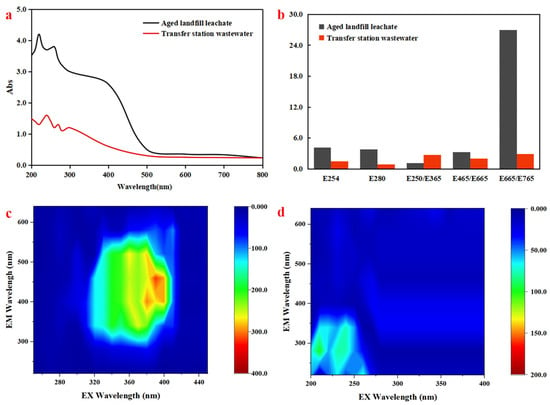
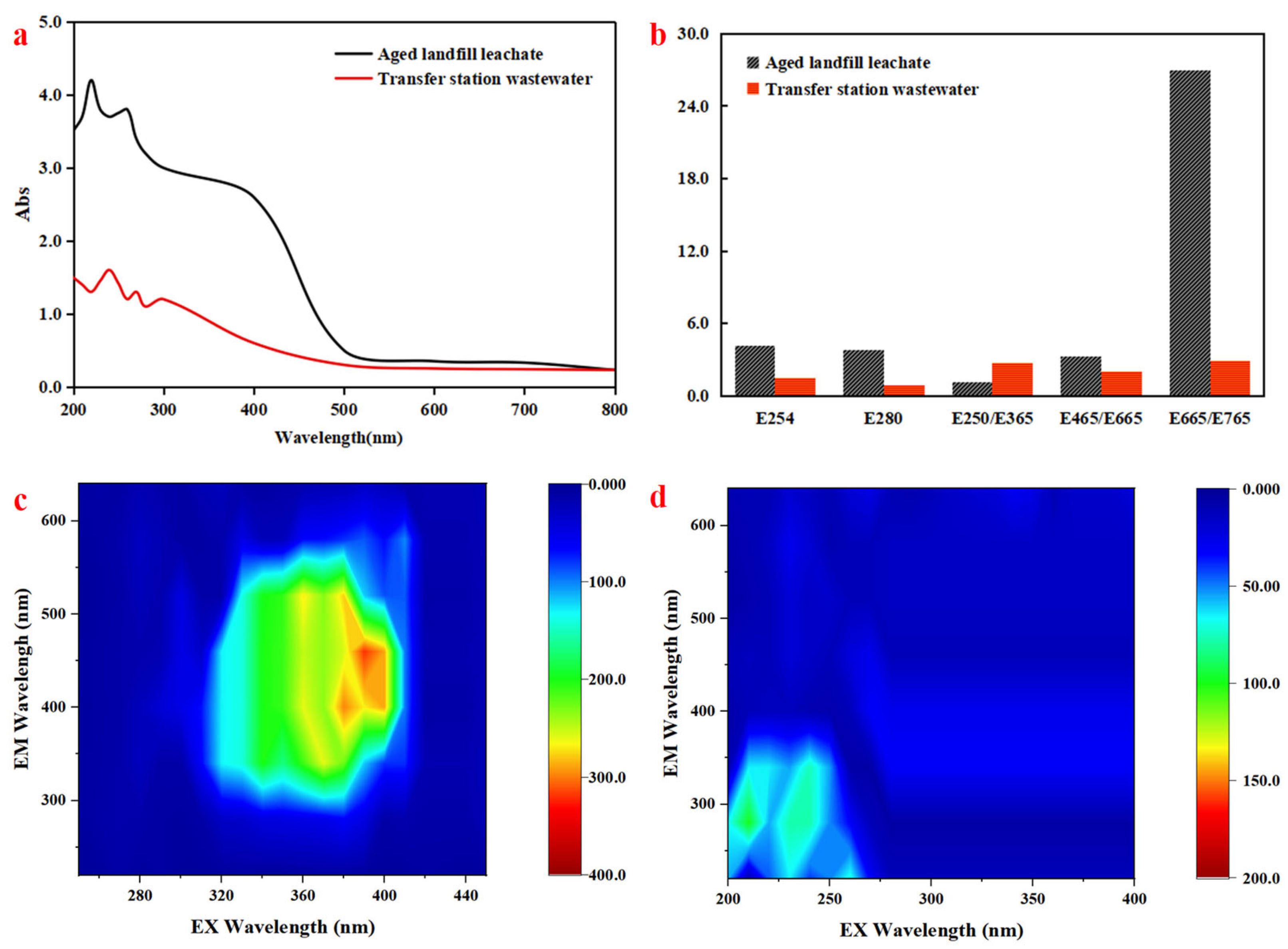
The optical characteristics of DOM further supported this interpretation (Figure 1). Aged leachate showed stronger absorbance at 254 and 280 nm and a more pronounced visible-region tailing effect than transfer station wastewater. The E254 and E280 values of aged leachate were 4.12 and 3.82, respectively, whereas those of transfer station wastewater were 1.51 and 0.84. The lower E250/E365 ratio of aged leachate (1.17) was consistent with more humified DOM and an empirically inferred difference in apparent molecular size [37].
Figure 1.
DOM characteristics of transfer station wastewater and aged landfill leachate. (a) UV-vis spectra; (b) characteristic absorbance indices; (c) 3D-EEM spectrum of aged landfill leachate; (d) 3D-EEM spectrum of transfer station wastewater.
The 3D-EEM spectra showed that aged leachate DOM was dominated by humic-like and fulvic-like fluorescence regions, with broad fluorescence signals in longer excitation and emission wavelength ranges (Figure 1c). This is consistent with the presence of highly humified, aromatic, and biologically refractory organic matter. By contrast, transfer station wastewater showed stronger protein-like fluorescence in shorter wavelength regions (Figure 1d), indicating the presence of fresher and more biodegradable organic components. Protein-like fluorescence has often been linked to labile microbial or wastewater-derived organic matter, whereas humic-like fluorescence is more frequently associated with refractory DOM [24,25,26,27]. Therefore, the two wastewaters differed not only in COD concentration but also in the biochemical quality of their organic matter.
The contrasting carbon and nitrogen characteristics provided the basis for co-treatment: transfer station wastewater supplied a carbon-rich stream, while aged leachate contributed a high nitrogen load. Their contrasting pH values also suggested the potential for partial moderation of acidity upon mixing. The feed-preparation strategy and measured COD/TN range are described in Section 2.4. The corresponding treatment profiles are discussed in Section 3.3.
3.2. Coagulation Pretreatment as Influent Regulation
Coagulation was evaluated as a preliminary conditioning step for transfer station wastewater before biological co-treatment. The comparison of four coagulants was used to select suitable pretreatment conditions, consistent with the use of coagulation to reduce particulate and colloidal loading in similar wastewaters [28,29].
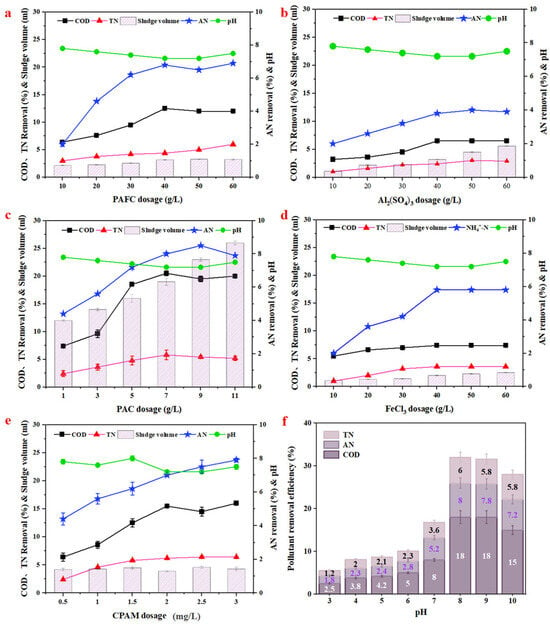
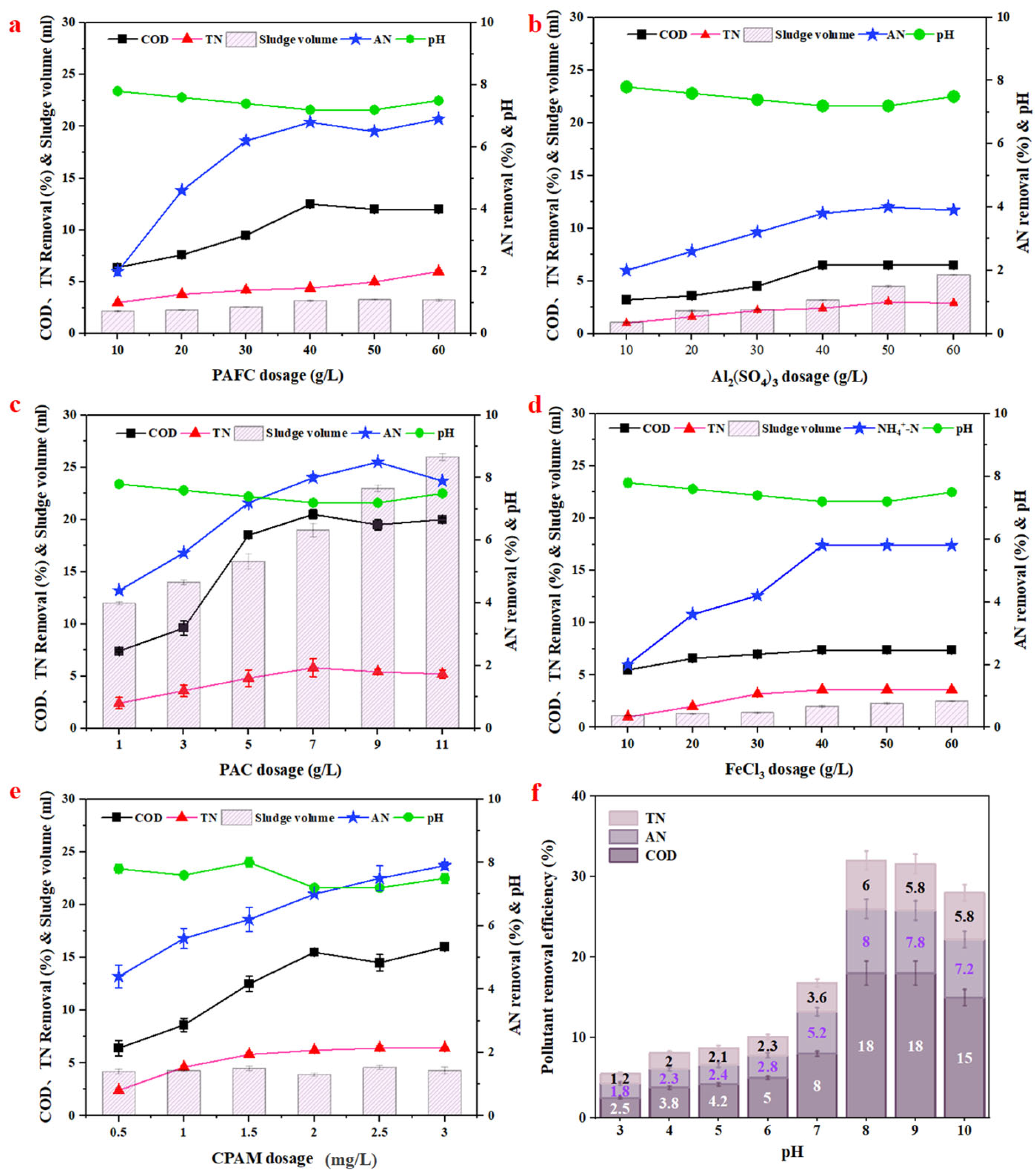
For PAC, COD removal increased with dosage up to approximately 7 g/L and showed little further improvement at higher dosages (Figure 2c). CPAM was used to assist floc formation and settling (Figure 2e). The separate pH-screening results are shown in Figure 2f: at pH 8, the COD, NH4+-N, and TN removal efficiencies were approximately 18%, 8%, and 6%, respectively. These results, considered together with the dosage tests, supported the selection of PAC at 7 g/L, CPAM at 3 mg/L, and an initial pH of 8.
Figure 2.
Coagulation pretreatment of transfer station wastewater. Effects of (a) PAFC dosage, (b) Al2(SO4)3 dosage, (c) PAC dosage, (d) FeCl3 dosage, (e) CPAM dosage, and (f) initial pH. In panels (a–e), COD and TN removal efficiencies and settled sludge volume are plotted using the left axis; AN removal efficiency and pH are plotted using the right axis and are distinguished by the legend symbols and colors. In panel (f), the segment heights and numerical labels represent the individual removal efficiencies of COD, AN, and TN. AN denotes NH4+-N.
Most of the measured nitrogen remained in the supernatant, indicating that coagulation served mainly as a pretreatment rather than a nitrogen removal treatment. Retaining biodegradable carbon for the biological stage was a design consideration rather than a demonstrated selective separation of organic fractions. The suitability of the pretreated wastewater was subsequently assessed during continuous two-stage A/O operation.
3.3. Long-Term COD, NH4+-N, and TN Removal in the Two-Stage A/O System
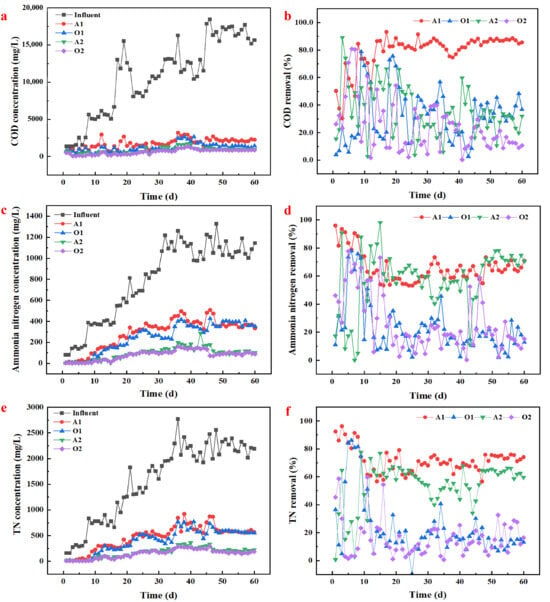
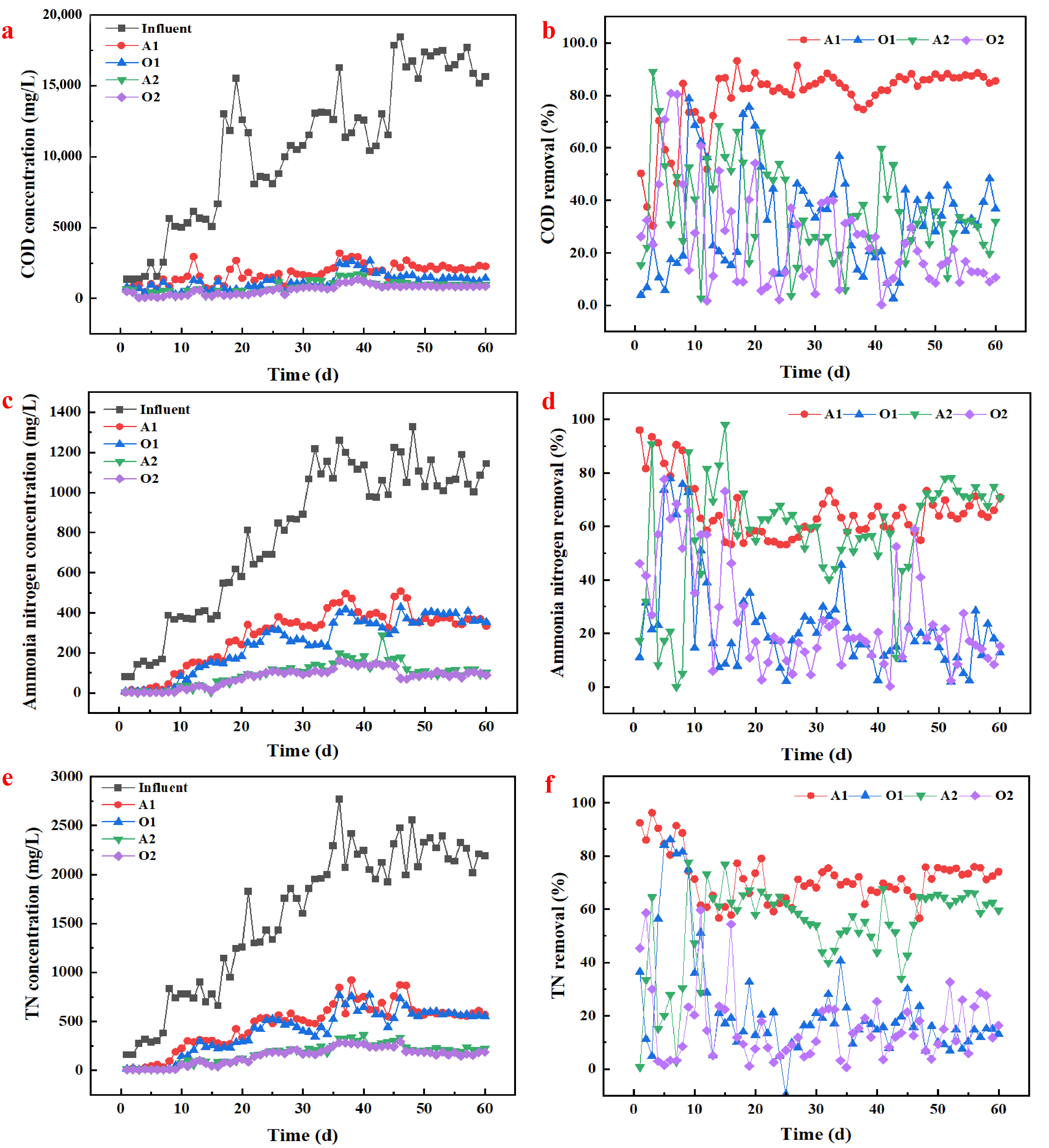
The two-stage A/O system maintained substantial pollutant removal during 60 d of continuous operation despite strong influent fluctuation (Figure 3). The influent COD increased and fluctuated markedly during operation, reflecting gradual loading increase and the complexity of the mixed wastewater. The overall COD removal efficiency reached 93.4%. The whole-period average final effluent COD was 627.24 mg/L, while the stable-stage effluent COD was approximately 420 mg/L. The difference between the whole-period and stable-stage COD values reflects the acclimation and loading-up period before the reactor approached stable operation.
Figure 3.
Continuous performance of the two-stage A/O system during 60 d of operation. (a) COD concentrations in the influent and reactor units; (b) COD removal efficiencies of A1, O1, A2, and O2; (c) AN concentrations in the influent and reactor units; (d) AN removal efficiencies of A1, O1, A2, and O2; (e) TN concentrations in the influent and reactor units; (f) TN removal efficiencies of A1, O1, A2, and O2. AN denotes ammonia nitrogen expressed as NH4+-N.
A marked decrease in COD concentration was observed from the influent to A1, with further decreases across the downstream compartments (Figure 3a,b). The profile is consistent with utilization of readily biodegradable organic matter near the front of the treatment train. These are apparent concentration changes within a recirculating system rather than separate mass-removal contributions from each compartment.
NH4+-N removal also remained high (Figure 3c,d), averaging 91.12%. After approximately 15 d, the overall removal efficiency was generally 85–98%. Influent NH4+-N increased from approximately 100 mg/L early in operation to approximately 1200 mg/L later in the run. The concentration profiles describe the combined response of the treatment train under increasing nitrogen loading; internal recirculation also influenced the concentrations at individual sampling points.
TN removal averaged 85.0%, with a stable-stage final effluent concentration of approximately 56 mg/L (Figure 3e,f). Influent TN increased from approximately 200 mg/L to approximately 2000–2800 mg/L during operation. A marked concentration decrease was observed between the influent and A1, with further TN reduction downstream. In the presence of biodegradable carbon and alternating anoxic/oxic conditions, these trends are consistent with biological nitrogen removal involving denitrification [13,14]. Because NO2−-N and NO3−-N were not monitored along the treatment train, the TN decrease is not presented as direct evidence of a particular nitrogen-transformation pathway.
The sustained removal of COD, NH4+-N, and TN under increasing influent loading supports the feasibility of the adopted co-treatment strategy. Here, operational stability refers to the observed pollutant-removal performance during the monitored period. The results are consistent with the rationale for using biodegradable co-substrates in mature-leachate treatment [12].
3.4. Bacterial and Fungal Community Responses to Co-Treatment
Alpha-diversity indices varied during operation for both bacterial and fungal communities (Table 2). The A1 and O2 samples showed broadly similar temporal patterns, with lower Shannon and Chao1 values at day 60 than at the preceding sampling times. These patterns describe changes in community diversity and richness alongside the compositional results.
Table 2.
Alpha-diversity indices of bacterial and fungal communities.
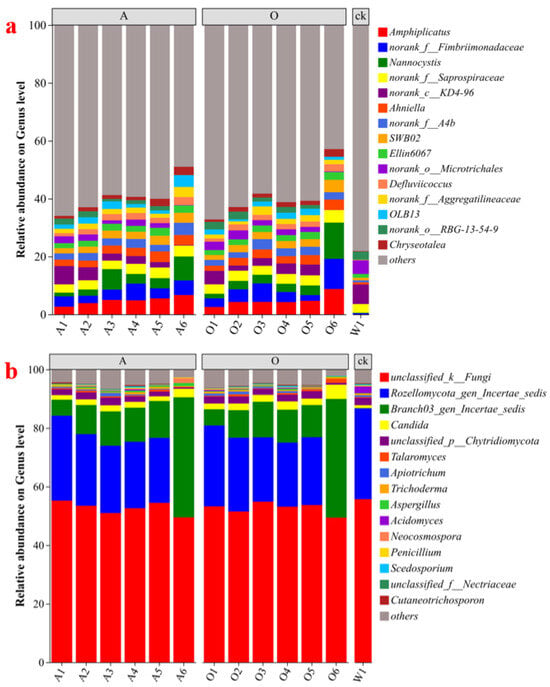
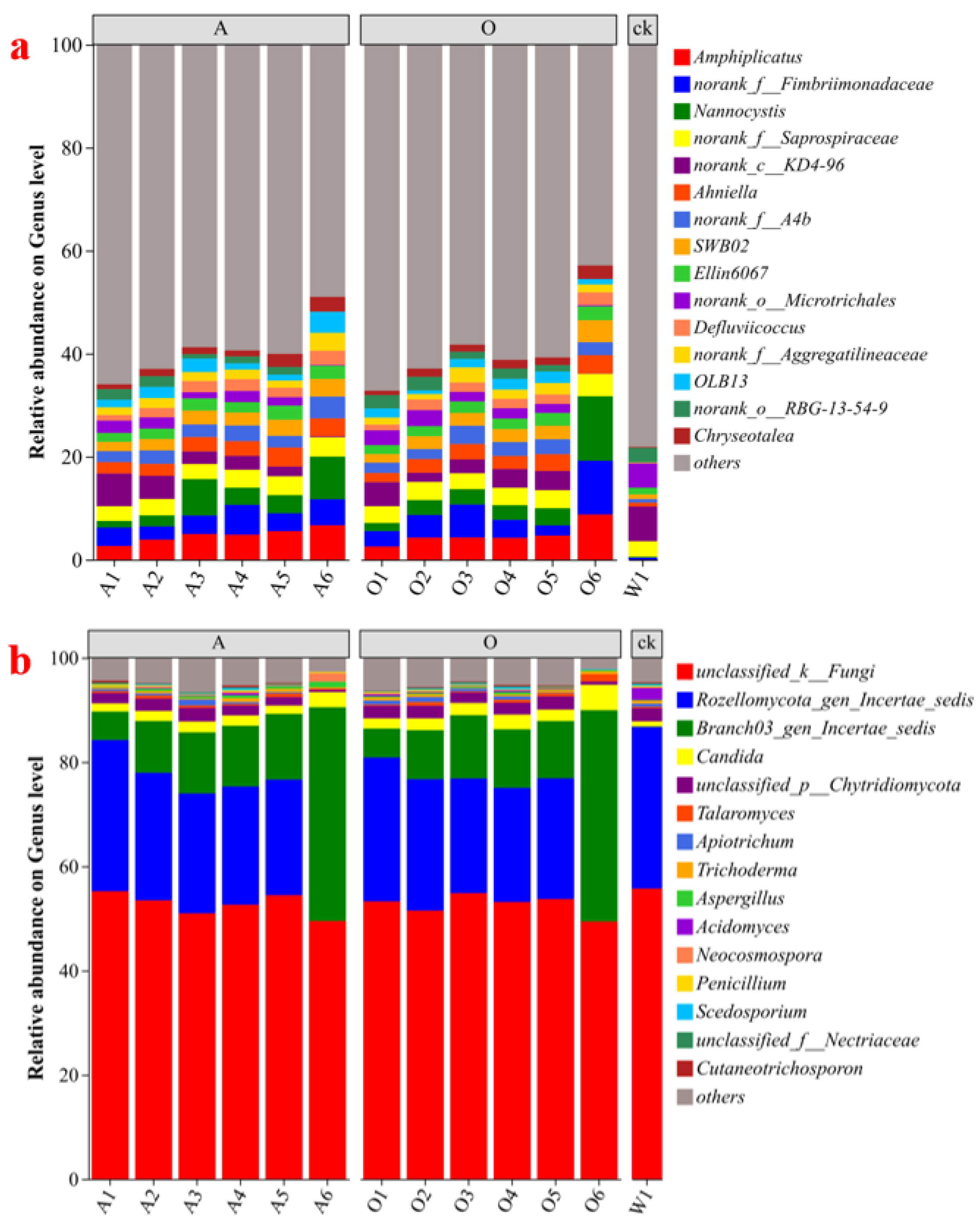
The dominant bacterial taxa included Amphiplicatus, norank_f_Fimbriimonadaceae, Nannocystis, norank_f_Saprospiraceae, norank_c_KD4-96, Ahniella, norank_f_A4b, SWB02, Ellin6067, norank_o_Microtrichales, and Defluviicoccus (Figure 4a). Together, these taxa accounted for mean relative abundances of 38.94% in A1 and 39.54% in O2. The profiles include named genera and unresolved higher-rank taxa; for example, norank_f_Fimbriimonadaceae, norank_o_Microtrichales, and norank_c_KD4-96 are assigned at the family, order, and class levels, respectively.
Figure 4.
Bacterial and fungal community composition during two-stage A/O operation. (a) Bacterial taxonomic composition in A1, O2, and the seed sludge, including genus-level assignments and taxa that could not be resolved at higher ranks; (b) fungal taxonomic composition in A1, O2, and the seed sludge, including genus-level assignments and taxa that could not be resolved at higher ranks.
The two compartments shared many dominant bacterial groups, with some differences in relative abundance. Compared with 0.40% in the seed sludge, norank_f_Fimbriimonadaceae accounted for mean abundances of 4.01% in A1 and 4.94% in O2. OLB13, norank_c_KD4-96, norank_f_A4b, and Defluviicoccus were relatively more abundant in A1. Saprospiraceae-related bacteria and Defluviicoccus-related bacteria have previously been associated with protein hydrolysis and carbon storage, respectively [18,19]. These reports provide context for the observed community composition without assigning a specific treatment contribution to unresolved taxa.
Overall, the fungal profiles were dominated by unclassified fungi, Rozellomycota_gen_Incertae_sedis, and Branch03_gen_Incertae_sedis (Figure 4b). Their mean relative abundances were 52.71%, 20.22%, and 15.40% in A1, compared with 52.64%, 19.98%, and 14.98% in O2. Branch03_gen_Incertae_sedis increased from approximately 0.08% in the seed sludge, providing a further example of a compositional change during operation. The two compartments therefore shared the main fungal groups, although within-sample diversity varied over time (Table 2).
Several low-abundance fungal genera showed compartmental variation. Candida increased from 2.00% in A1 to 2.73% in O2, and Talaromyces increased from 0.43% to 0.62%. By contrast, Aspergillus and Neocosmospora were more abundant in A1 than in O2. Although these genera represented a smaller fraction of the total fungal community, their distribution suggests that fungal succession responded to the substrate and redox gradients along the reactor sequence. Fungal communities in activated sludge have been reported to contribute to organic matter transformation, floc-associated ecological stability, and tolerance to stressful wastewater conditions [21,22,38,39]. In this context, the fungal data provide complementary ecological evidence for the biological adaptation of the co-treatment system.
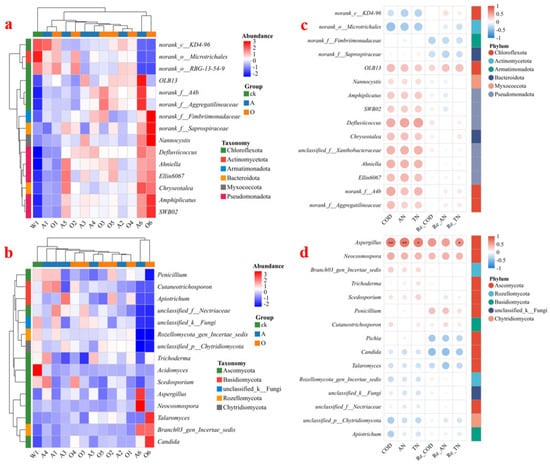
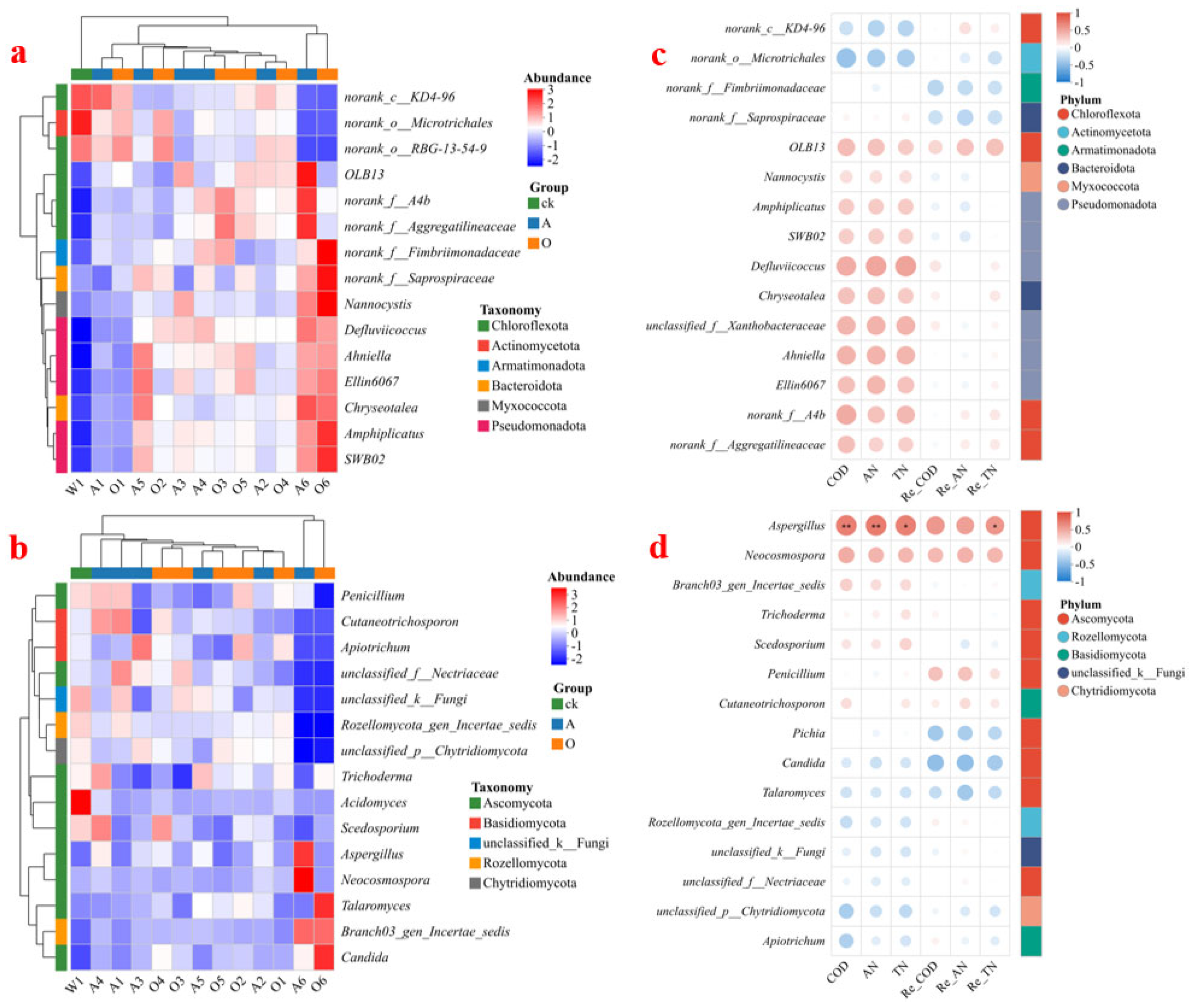
The bacterial heatmap further showed temporal and compartment-associated variation in dominant taxa (Figure 5a). Several taxa differed between A1 and O2, and the correlation analysis showed moderate associations with pollutant concentrations or removal efficiencies (Figure 5c). For instance, Defluviicoccus showed positive correlations with COD, AN, and TN concentrations, while OLB13 showed positive correlations with removal efficiencies. These correlation patterns indicate that bacterial succession was linked to changes in influent loading and staged pollutant removal, although the results should be interpreted as ecological associations rather than as direct causal evidence.
Figure 5.
Succession of dominant microbial taxa and their associations with treatment performance. (a) Heatmap of dominant bacterial taxa during operation; (b) heatmap of dominant fungal taxa during operation; (c) Spearman correlations between dominant bacterial taxa and COD, TN, AN, and their removal efficiencies; (d) Spearman correlations between dominant fungal taxa and COD, TN, AN, and their removal efficiencies. AN denotes ammonia nitrogen expressed as NH4+-N. In panels (c,d), circle size is proportional to the absolute value of the Spearman correlation coefficient (|r|), while color indicates the direction and magnitude of the correlation (red, positive; blue, negative). * p < 0.05; ** p < 0.01. AN denotes ammonia nitrogen expressed as NH4+-N.
The fungal heatmap also showed temporal variation in lower-abundance genera, including Candida, Talaromyces, Aspergillus, Penicillium, Scedosporium, and Cutaneotrichosporon (Figure 5b). The fungal correlation analysis indicated that selected fungal taxa responded to pollutant loading and removal performance. Aspergillus showed positive correlations with COD, AN, and TN concentrations, with correlation coefficients of approximately 0.72, 0.73, and 0.71, respectively, and it was also positively associated with TN removal efficiency (r = 0.58, p < 0.05, n = 12; Figure 5d). This association suggests that Aspergillus responded to higher-load conditions and may be related to organic matter transformation or stress adaptation within the sludge community. The broader literature also shows that fungal communities in wastewater treatment systems are shaped by wastewater characteristics, floc structure, and environmental stress [38,39].
Taken together, the community profiles show temporal and compartment-associated changes during co-treatment. Their relationships with treatment performance are interpreted as ecological associations, not as direct evidence that individual taxa caused pollutant removal.
3.5. Comparison with Previous Studies and Process Boundary
The performance of the present system was compared with representative studies on landfill leachate, transfer station wastewater, and other high-strength wastewaters (Table 3). Bolognesi et al. [12] reported a maximum COD removal of 84.9% during bioelectrochemical co-treatment of mature landfill leachate and dairy wastewater. Islam et al. [20] reported COD and NH4+-N removal efficiencies above 88% and 96%, respectively, in a side-stream biological system for treating municipal wastewater. The corresponding mean removal efficiencies in the present study were 93.4% and 91.12%. These values provide useful context rather than a direct ranking because wastewater composition and operating conditions differed among the studies.
Table 3.
Comparison of the present study with representative studies on landfill leachate, transfer station wastewater, and high-strength wastewater treatment.
Biological and membrane-based systems can achieve substantial pollutant removal, although membrane fouling and concentrate management remain relevant considerations [2,40,41]. Advanced oxidation, adsorption, Fenton-based treatment, and electrochemical processes may be used where further removal of refractory pollutants is required [7,8,42,43].
The present study therefore focuses on biological load reduction through the combined use of two municipal solid waste-derived wastewater streams. Transfer station wastewater serves as a carbon-rich co-substrate for the treatment of aged leachate, potentially reducing the demand for external carbon addition while leaving further polishing to be selected according to effluent requirements.
4. Conclusions
This study demonstrates that transfer station wastewater and aged landfill leachate can be treated as complementary substrates rather than as independent waste streams. Transfer station wastewater supplied readily biodegradable carbon and VFAs, whereas aged leachate contributed a high nitrogen load but showed poor biodegradability. Coagulation pretreatment provided partial COD removal while leaving most of the measured nitrogen in the supernatant, thereby reducing the load entering biological treatment. During 60 d of operation, the two-stage A/O process achieved average COD, NH4+-N, and TN removal efficiencies of 93.4%, 91.12%, and 85.0%, respectively. Concentration profiles showed substantial carbon and nitrogen removal across the staged system, and the observed TN decrease was consistent with biological nitrogen removal under alternating anoxic/oxic conditions. Bacterial and fungal communities also showed temporal and compartment-associated changes during operation. Overall, the results support two-stage A/O treatment as a biological load-reduction platform for co-treating municipal solid waste-derived wastewater. Under stringent discharge requirements, the biological effluent can be further coupled with an appropriate polishing process.
Author Contributions
Conceptualization, Z.Y. and X.Y.; methodology, X.Y. and F.S.; validation, X.Y. and F.S.; formal analysis, X.Y. and F.S.; investigation, X.Y.; resources, Z.Y., F.S. and L.L.; data curation, X.Y. and F.S.; writing—original draft preparation, X.Y.; writing—review and editing, Z.Y. and X.Y.; supervision, Z.Y. and L.L.; funding acquisition, L.L. All authors have read and agreed to the published version of the manuscript.
Funding
This research was funded by Hunan Provincial Key R&D (Grant No. 2024AQ2006).
Data Availability Statement
The data presented in this study are available from the corresponding author upon reasonable request.
Acknowledgments
The authors thank Qiaoqiao Li for her assistance with selected experimental work, data collection, and early-stage manuscript preparation. During the preparation of this manuscript, the authors used ChatGPT (GPT-5.6, OpenAI) to assist with language refinement and improvement of textual clarity and organization. All scientific content, data analysis, interpretation, and conclusions were reviewed and verified by the authors, who take full responsibility for the content of the publication.
Conflicts of Interest
The authors declare no conflicts of interest.
References
- Kjeldsen, P.; Barlaz, M.A.; Rooker, A.P.; Baun, A.; Ledin, A.; Christensen, T.H. Present and long-term composition of MSW landfill leachate: A review. Crit. Rev. Environ. Sci. Technol. 2002, 32, 297–336. [Google Scholar] [CrossRef] [Scilit]
- Renou, S.; Givaudan, J.G.; Poulain, S.; Dirassouyan, F.; Moulin, P. Landfill leachate treatment: Review and opportunity. J. Hazard. Mater. 2008, 150, 468–493. [Google Scholar] [CrossRef] [Scilit]
- Kulikowska, D.; Klimiuk, E. The effect of landfill age on municipal leachate composition. Bioresour. Technol. 2008, 99, 5981–5985. [Google Scholar] [CrossRef] [Scilit]
- Naveen, B.P.; Mahapatra, D.M.; Sitharam, T.G.; Sivapullaiah, P.V.; Ramachandra, T.V. Physico-chemical and biological characterization of urban municipal landfill leachate. Environ. Pollut. 2017, 220, 1–12. [Google Scholar] [CrossRef] [Scilit]
- Wiszniowski, J.; Robert, D.; Surmacz-Gorska, J.; Miksch, K.; Weber, J.-V. Landfill leachate treatment methods: A review. Environ. Chem. Lett. 2006, 4, 51–61. [Google Scholar] [CrossRef] [Scilit]
- Kamaruddin, M.A.; Yusoff, M.S.; Aziz, H.A.; Hung, Y.-T. Sustainable treatment of landfill leachate. Appl. Water Sci. 2015, 5, 113–126. [Google Scholar] [CrossRef] [Scilit]
- Guo, Z.; Zhang, Y.; Jia, H.; Guo, J.; Meng, X.; Wang, J. Electrochemical methods for landfill leachate treatment: A review on electrocoagulation and electrooxidation. Sci. Total Environ. 2022, 806, 150529. [Google Scholar] [CrossRef] [Scilit]
- Deng, Y.; Englehardt, J.D. Treatment of landfill leachate by the Fenton process. Water Res. 2006, 40, 3683–3694. [Google Scholar] [CrossRef] [Scilit]
- Xiang, H.; Cheng, L.; Liu, W.; Wang, S.; Zhang, Y.; Su, L.; Tan, C.; Li, Y. Characteristics of leachate from refuse transfer stations in rural China. Environ. Sci. Pollut. Res. 2023, 30, 3056–3069. [Google Scholar] [CrossRef] [Scilit]
- Thanh, B.X.; Dan, N.P.; Visvanathan, C. Low flux submerged membrane bioreactor treating high strength leachate from a solid waste transfer station. Bioresour. Technol. 2013, 141, 25–28. [Google Scholar] [CrossRef] [Scilit]
- Huang, S.; Zheng, Q.; Zhu, Z.; Geng, X.; Wang, L.; Xu, B.; Zhao, Y. Efficient treatment of leachate from municipal solid waste transfer stations via a bioreactor–nanofiltration system: A pilot-scale study. Sustainability 2024, 16, 11305. [Google Scholar] [CrossRef] [Scilit]
- Bolognesi, S.; Cecconet, D.; Callegari, A.; Capodaglio, A.G. Bioelectrochemical treatment of municipal solid waste landfill mature leachate and dairy wastewater as co-substrates. Environ. Sci. Pollut. Res. 2021, 28, 24639–24649. [Google Scholar] [CrossRef] [Scilit]
- Cao, S.; Jiang, W.; Zhao, M.; Liu, A.; Wang, M.; Wu, Q.; Sun, Y. Pretreatment hydrolysis acidification/two-stage AO combination process to treat high-concentration resin production wastewater. Water 2022, 14, 2949. [Google Scholar] [CrossRef] [Scilit]
- Yang, C.; Zhang, L.; Hu, S.; Diao, Y.; Jin, X.; Jin, P.; Chen, C.; Wu, X.; Wang, X.C. Electro-dissolved ozone flotation (E-DOF) integrated anoxic/oxic membrane reactor for leachate treatment from a waste transfer station. Environ. Sci. Pollut. Res. 2022, 29, 55803–55815. [Google Scholar] [CrossRef] [Scilit]
- Daims, H.; Lebedeva, E.V.; Pjevac, P.; Han, P.; Herbold, C.; Albertsen, M.; Jehmlich, N.; Palatinszky, M.; Vierheilig, J.; Bulaev, A.; et al. Complete nitrification by Nitrospira bacteria. Nature 2015, 528, 504–509. [Google Scholar] [CrossRef] [Scilit]
- van Kessel, M.A.H.J.; Speth, D.R.; Albertsen, M.; Nielsen, P.H.; Op den Camp, H.J.M.; Kartal, B.; Jetten, M.S.M.; Lücker, S. Complete nitrification by a single microorganism. Nature 2015, 528, 555–559. [Google Scholar] [CrossRef] [Scilit]
- Liu, B.; Zhang, F.; Feng, X.; Liu, Y.; Yan, X.; Zhang, X.; Wang, L.; Zhao, L. Thauera and Azoarcus as functionally important genera in a denitrifying quinoline-removal bioreactor as revealed by microbial community structure comparison. FEMS Microbiol. Ecol. 2006, 55, 274–286. [Google Scholar] [CrossRef] [Scilit]
- Xia, Y.; Kong, Y.; Thomsen, T.R.; Nielsen, P.H. Identification and ecophysiological characterization of epiphytic protein-hydrolyzing Saprospiraceae (“Candidatus Epiflobacter” spp.) in activated sludge. Appl. Environ. Microbiol. 2008, 74, 2229–2238. [Google Scholar] [CrossRef] [Scilit]
- Bessarab, I.; Maszenan, A.M.; Haryono, M.A.S.; Arumugam, K.; Saw, N.M.M.T.; Seviour, R.J.; Williams, R.B.H. Comparative genomics of members of the genus Defluviicoccus with insights into their ecophysiological importance. Front. Microbiol. 2022, 13, 834906. [Google Scholar] [CrossRef] [Scilit]
- Islam, M.S.; Zhang, Y.; Dong, S.; McPhedran, K.N.; Rashed, E.M.; El-Shafei, M.M.; Noureldin, A.M.; Gamal El-Din, M. Dynamics of microbial community structure and nutrient removal from an innovative side-stream enhanced biological phosphorus removal process. J. Environ. Manag. 2017, 198, 300–307. [Google Scholar] [CrossRef] [Scilit]
- Niu, L.; Li, Y.; Xu, L.; Wang, P.; Zhang, W.; Wang, C.; Cai, W.; Wang, L. Ignored fungal community in activated sludge wastewater treatment plants: Diversity and altitudinal characteristics. Environ. Sci. Pollut. Res. 2017, 24, 4185–4193. [Google Scholar] [CrossRef] [Scilit]
- Harms, H.; Schlosser, D.; Wick, L.Y. Untapped potential: Exploiting fungi in bioremediation of hazardous chemicals. Nat. Rev. Microbiol. 2011, 9, 177–192. [Google Scholar] [CrossRef] [Scilit]
- Coble, P.G. Characterization of marine and terrestrial DOM in seawater using excitation-emission matrix spectroscopy. Mar. Chem. 1996, 51, 325–346. [Google Scholar] [CrossRef] [Scilit]
- Chen, W.; Westerhoff, P.; Leenheer, J.A.; Booksh, K. Fluorescence excitation–emission matrix regional integration to quantify spectra for dissolved organic matter. Environ. Sci. Technol. 2003, 37, 5701–5710. [Google Scholar] [CrossRef] [Scilit]
- Hudson, N.; Baker, A.; Reynolds, D. Fluorescence analysis of dissolved organic matter in natural, waste and polluted waters: A review. River Res. Appl. 2007, 23, 631–649. [Google Scholar] [CrossRef] [Scilit]
- Baker, A.; Inverarity, R. Protein-like fluorescence intensity as a possible tool for determining river water quality. Hydrol. Process. 2004, 18, 2927–2945. [Google Scholar] [CrossRef] [Scilit]
- Murphy, K.R.; Stedmon, C.A.; Graeber, D.; Bro, R. Fluorescence spectroscopy and multi-way techniques. PARAFAC. Anal. Methods 2013, 5, 6557–6566. [Google Scholar] [CrossRef] [Scilit]
- Amokrane, A.; Comel, C.; Veron, J. Landfill leachates pretreatment by coagulation-flocculation. Water Res. 1997, 31, 2775–2782. [Google Scholar] [CrossRef] [Scilit]
- Tatsi, A.A.; Zouboulis, A.I.; Matis, K.A.; Samaras, P. Coagulation-flocculation pretreatment of sanitary landfill leachates. Chemosphere 2003, 53, 737–744. [Google Scholar] [CrossRef] [Scilit]
- Al-Hamadani, Y.A.J.; Yusoff, M.S.; Umar, M.; Bashir, M.J.K.; Adlan, M.N. Application of psyllium husk as coagulant and coagulant aid in semi-aerobic landfill leachate treatment. J. Hazard. Mater. 2011, 190, 582–587. [Google Scholar] [CrossRef] [Scilit]
- Liu, X.; André, L.; Mercier-Huat, M.; Grosmaître, J.-M.; Pauss, A.; Ribeiro, T. Accurate estimation of bicarbonate and acetic acid concentrations with wider ranges in anaerobic media using classical FOS/TAC titration method. Appl. Sci. 2021, 11, 11843. [Google Scholar] [CrossRef] [Scilit]
- Chen, S.; Zhou, Y.; Chen, Y.; Gu, J. fastp: An ultra-fast all-in-one FASTQ preprocessor. Bioinformatics 2018, 34, i884–i890. [Google Scholar] [CrossRef] [Scilit]
- Magoč, T.; Salzberg, S.L. FLASH: Fast length adjustment of short reads to improve genome assemblies. Bioinformatics 2011, 27, 2957–2963. [Google Scholar] [CrossRef] [Scilit]
- Wang, Q.; Garrity, G.M.; Tiedje, J.M.; Cole, J.R. Naïve Bayesian classifier for rapid assignment of rRNA sequences into the new bacterial taxonomy. Appl. Environ. Microbiol. 2007, 73, 5261–5267. [Google Scholar] [CrossRef] [Scilit]
- Quast, C.; Pruesse, E.; Yilmaz, P.; Gerken, J.; Schweer, T.; Yarza, P.; Peplies, J.; Glöckner, F.O. The SILVA ribosomal RNA gene database project: Improved data processing and web-based tools. Nucleic Acids Res. 2013, 41, D590–D596. [Google Scholar] [CrossRef] [Scilit]
- Nilsson, R.H.; Larsson, K.-H.; Taylor, A.F.S.; Bengtsson-Palme, J.; Jeppesen, T.S.; Schigel, D.; Kennedy, P.; Picard, K.; Glöckner, F.O.; Tedersoo, L.; et al. The UNITE database for molecular identification of fungi: Handling dark taxa and parallel taxonomic classifications. Nucleic Acids Res. 2019, 47, D259–D264. [Google Scholar] [CrossRef] [Scilit]
- Peuravuori, J.; Pihlaja, K. Molecular size distribution and spectroscopic properties of aquatic humic substances. Anal. Chim. Acta 1997, 337, 133–149. [Google Scholar] [CrossRef] [Scilit]
- Zhang, H.; Feng, J.; Chen, S.; Li, B.; Sekar, R.; Zhao, Z.; Jia, J.; Wang, Y.; Kang, P. Disentangling the drivers of diversity and distribution of fungal community composition in wastewater treatment plants across spatial scales. Front. Microbiol. 2018, 9, 1291. [Google Scholar] [CrossRef] [Scilit]
- Zhang, S.; Fan, F.; Meng, F. Seasonality and community separation of fungi in a municipal wastewater treatment plant. Appl. Environ. Microbiol. 2020, 86, e00991-20. [Google Scholar] [CrossRef] [Scilit]
- Bodzek, M.; Łobos-Moysa, E.; Zamorowska, M. Removal of organic compounds from municipal landfill leachate in a membrane bioreactor. Desalination 2006, 198, 16–23. [Google Scholar] [CrossRef] [Scilit]
- Xue, Y.; Zhao, H.; Ge, L.; Chen, Z.; Dang, Y.; Sun, D. Comparison of the performance of waste leachate treatment in submerged and recirculated membrane bioreactors. Int. Biodeterior. Biodegrad. 2015, 102, 73–80. [Google Scholar] [CrossRef] [Scilit]
- Foo, K.Y.; Hameed, B.H. An overview of landfill leachate treatment via activated carbon adsorption process. J. Hazard. Mater. 2009, 171, 54–60. [Google Scholar] [CrossRef] [Scilit]
- Umar, M.; Aziz, H.A.; Yusoff, M.S. Trends in the use of Fenton, electro-Fenton and photo-Fenton for the treatment of landfill leachate. Waste Manag. 2010, 30, 2113–2121. [Google Scholar] [CrossRef] [Scilit]

Disclaimer/Publisher’s Note: The statements, opinions and data contained in all publications are solely those of the individual author(s) and contributor(s) and not of MDPI and/or the editor(s). MDPI and/or the editor(s) disclaim responsibility for any injury to people or property resulting from any ideas, methods, instructions or products referred to in the content. |
© 2026 by the authors. Licensee MDPI, Basel, Switzerland. This article is an open access article distributed under the terms and conditions of the Creative Commons Attribution (CC BY) license.