


Abstract
Water scarcity in transboundary river basins is increasingly driven by interacting climatic, hydrological, and anthropogenic pressures. The Ili–Balkhash River Basin, a vulnerable endorheic system in Central Asia, is particularly sensitive to changes in transboundary Ili River inflow, which directly affects downstream water availability and the hydrological condition of Lake Balkhash. Although previous studies have advanced understanding of basin hydrology, the combined effects of multiple drivers and associated uncertainties remain insufficiently assessed within integrated scenario-based frameworks. This study develops a dynamic–stochastic modeling framework for assessing future water availability, allocation, and system response through 2050. Historical hydrological observations, climate conditions, sectoral water demand, transboundary inflow, reservoir operation, and management assumptions are combined within a unified simulation environment. Four transboundary-inflow stress scenarios (S1–S4) are evaluated through 2050. Stochastic hydrological simulations represent runoff variability, while the scenarios impose progressively stronger levels of transboundary-inflow stress. Scenario comparison shows a progressive deterioration from comparatively resilient conditions under S1 to increasing water stress under S2 and S3 and persistent system-wide scarcity under S4. Transboundary Ili River inflow emerges as the principal quantitatively perturbed driver of basin performance, while water demand, evaporative losses, and reservoir regulation provide contextual controls on system response. Increasing inflow stress is associated with greater pressure on sectoral water availability, environmental flows to the Ili Delta, and inflow to Lake Balkhash. The results indicate that basin vulnerability is strongly influenced by transboundary water availability and its interaction with water-management conditions. The findings also highlight the potential importance of water-management efficiency, environmental-flow protection, and transboundary water management. The framework provides a basis for comparing alternative transboundary-inflow conditions under uncertainty and supporting long-term water-resource planning in the Ili–Balkhash Basin.
1. Introduction
The Ili–Balkhash River Basin is a major transboundary endorheic watershed in arid Central Asia, increasingly exposed to water-security pressures from climate change and human water use [1,2]. As a closed hydrological system, it is sensitive to changes in river inflow associated with glacier retreat, increasing evaporation, and upstream water abstraction [3]. Following the desiccation of the Aral Sea, Lake Balkhash has become one of the largest endorheic lakes in Central Asia and plays a vital role in regional ecological stability [4,5].
Rapid climate change, irrigation expansion, population growth, and transboundary water use are increasing pressure on the basin and uncertainty in long-term water-resource planning [6,7,8,9]. More broadly, long-term evidence from Central Asia demonstrates the close relationship between hydroclimatic variability, river dynamics, and the development and sustainability of irrigation-dependent societies [10].
The Ili River originates in the Xinjiang Uyghur Autonomous Region of China and contributes approximately 70–80% of the total river inflow to Lake Balkhash, making downstream water availability strongly dependent on upstream conditions [11,12]. Since the 1970s, reservoir regulation, irrigation development, and changes in water abstraction have altered Ili River inflow, Lake Balkhash water levels, and downstream ecosystems [13,14,15]. Continued agricultural and socio-economic development in both countries may further increase pressure on available water resources [15,16,17].
Previous studies have primarily focused on hydro-climatic variability, upstream water demand, and transboundary water use in the Ili–Balkhash Basin [3,16,17,18]. Integrated hydrological–water-resource modeling and scenario-neutral approaches, including Robust Decision Making (RDM), have also been applied to assess water security under climatic and socio-economic uncertainty [17]. However, long-term assessments that jointly represent hydrological variability, reservoir operation, sectoral water demand, and transboundary inflow within a dynamic scenario framework remain limited. This is particularly relevant given the substantial multi-decadal variability in basin runoff documented by historical reconstructions [18,19].
This study therefore develops an integrated dynamic–stochastic framework to assess future water availability, allocation, and system response in the Ili–Balkhash River Basin. The model integrates stochastic hydrological simulation, spatially distributed water-management units, climate conditions, sectoral water demand, reservoir operation, and transboundary inflow within a unified modeling environment. Alternative development pathways are evaluated through 2050 to examine basin response to progressively increasing transboundary-inflow stress.
2. Materials and Methods
2.1. Study Area and Data Sources
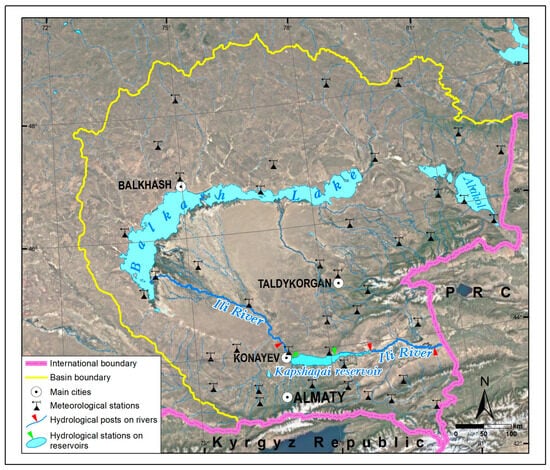
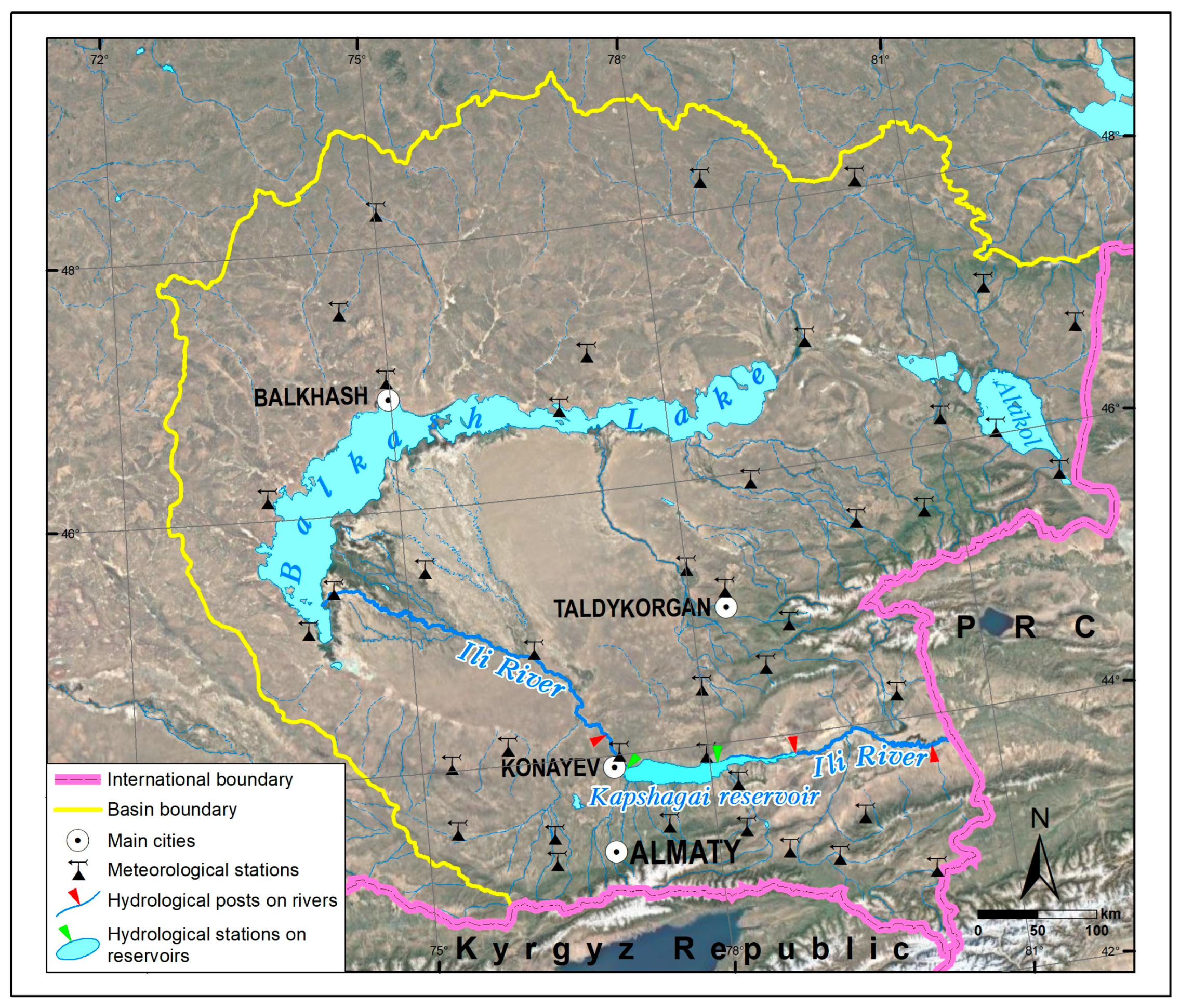
The Ili–Balkhash River Basin is located in arid Central Asia, extending approximately from 42° to 49° N and from 72° to 86° E (Figure 1). The basin covers more than 400,000 km2, of which approximately 80% (about 353,000 km2) lies within Kazakhstan and the remaining 20% within the Xinjiang Uyghur Autonomous Region of China [20,21]. The basin is characterized by an arid continental climate, low precipitation, high evaporation, and strong spatial and seasonal variability in water availability. A substantial proportion of the basin’s surface runoff originates in the glacier- and snow-fed Tian Shan Mountains [2,8,22]. The Ili River exhibits pronounced seasonal runoff variability associated with snow and glacier melt in its mountainous headwaters. Discharge generally increases during the warm season, when snowmelt and glacier melt enhance runoff, whereas substantially lower flows occur during the cold season [2,3]. The study area and spatial distribution of the monitoring network are shown in Figure 1.
Figure 1.
The study area and spatial distribution of the monitoring network.
The Ili River represents the dominant component of its surface-water inflow. The river originates in the Tian Shan Mountains of China and flows approximately 1439 km through China and southeastern Kazakhstan before discharging into Lake Balkhash. The Ili contributes approximately 70–80% of the lake’s annual inflow and therefore exerts a major influence on the lake’s hydrological balance [2,23,24]. As a transboundary river, its flow regime is affected by water abstraction and hydraulic regulation in both China and Kazakhstan. In the Kazakhstani part of the basin, the Kapshagay Reservoir regulates river discharge and supports irrigation, hydropower generation, and municipal water supply. The Ili River and its delta also provide water resources for irrigated agriculture and sustain downstream wetland ecosystems [15,23,25].
The downstream part of the basin is occupied by Lake Balkhash, a large endorheic lake in southeastern Kazakhstan and the terminal water body of the Ili–Balkhash hydrological system. The lake covers approximately 17,000 km2 and is characterized by a pronounced longitudinal salinity gradient, with the western basin being predominantly freshwater and the eastern basin being brackish [16,25]. The Ili Delta and adjacent southern shores of Lake Balkhash form an ecologically important wetland complex that supports diverse wetland habitats, fisheries, migratory birds, and reed-dominated ecosystems [11,15,26]. As the terminal component of the basin, Lake Balkhash integrates changes in upstream inflow, water abstraction, and hydrological regulation, making its water level and hydrological balance important indicators of basin-scale water availability.
The hydroclimatic characteristics of the Ili–Balkhash Basin, together with its transboundary water-use structure and downstream dependence on Ili River inflow, define the principal boundary conditions for the analysis. To characterize these conditions, hydrological observations, water-use statistics, reservoir operation, and spatial datasets were compiled from national monitoring agencies and publicly available datasets. The resulting dataset was used to parameterize and evaluate the dynamic–stochastic modeling framework and to develop the alternative scenarios considered in this study.
2.2. Hydrological and Climatic Data
The climatic and hydrological characterization of the Ili–Balkhash Basin was based on long-term records of air temperature, precipitation, river discharge, and Lake Balkhash water levels. The basin has a strong hydroclimatic gradient, from glacier- and snow-fed headwaters of the Ili River to the arid downstream Balkhash plain. Mean annual air temperature in the Ili–Balkhash Basin exhibited a statistically significant increasing trend during 1970–2022, at a rate of approximately 0.3 °C per decade [27], while annual precipitation ranges from approximately 800 mm year−1 in the mountainous headwaters to about 120 mm year−1 in the downstream plain [17].
Hydrological observations were obtained from 16 gauging stations, including five stations along the Ili River, with station-specific record lengths reflecting differences in monitoring history. The available national hydrological archive for the Balkhash–Alakol basin extends from 1936 to 2024, while individual long-term Ili River series extend further back; for example, the Ili–Kapshagay annual discharge record used by RSE Kazhydromet covers 1930–2023. The hydrological station network and observational data used in the basin analysis are consistent with the Kazhydromet datasets described by Abdrakhimov et al. [28]. Meteorological observations of precipitation and air temperature were obtained from five stations. The station data were provided by the Republican State Enterprise “Kazhydromet”, the national hydrometeorological service of Kazakhstan [29]. The original hydrological and meteorological records were available at daily and monthly time steps, depending on the variable and station, and were aggregated to annual values for consistency with the annual computational time step of the model. Lake Balkhash has a long history of systematic hydrological monitoring. Water-level observations have been conducted at 19 observation points operating during different periods, while four stations remain operational at present; long-term records have been used to characterize multi-decadal lake-level variability [22]. Recent water-balance assessments for Lake Balkhash further indicate that its hydrological state is strongly controlled by the balance between river inflow and evaporation, with long-term mean surface inflow estimated at approximately 14.5 km3 yr−1 and evaporation at approximately 17.5 km3 yr−1 over 1947–2021 [30]. Water-use statistics, reservoir operation records, and spatial data were compiled from national monitoring agencies, published sources, and publicly available datasets. These data included irrigation demand, water abstraction, transboundary water use, and reservoir regulation, and were harmonized to the spatial and temporal resolution required for model parameterization and evaluation. The modeling framework builds on the authors’ previously developed dynamic–stochastic approach for sustainable water-resource management in Kazakhstan [31]. In the downstream Balkhash District, annual precipitation is approximately 100–150 mm, whereas potential evapotranspiration exceeds 1000 mm year−1 [32].
The Ili River is the primary source of river inflow to Lake Balkhash, accounting for approximately 80% of its total river inflow [15,16]. Before major regulation of the Ili River, lake levels generally fluctuated around 342 m a.s.l. The period 1971–1990 was characterized by substantial hydrological changes associated with the construction and operation of the Kapshagay Reservoir and expansion of irrigation in the Almaty region, coinciding with declining lake levels and increased mineralization [13,14]. Changes in water abstraction and irrigation also affected inflows from several tributaries [33]. During 1991–2015, Ili River inflow partially recovered to approximately 14.0 km3 yr−1, while Lake Balkhash levels generally remained within 341.0–341.5 m a.s.l. [14]. Transboundary water use was represented through upstream and downstream water-demand components, accounting for differences in irrigation development and water abstraction between the Chinese and Kazakhstani parts of the basin [15,16]. Environmental water requirements for the Ili Delta and Lake Balkhash were included as water-allocation constraints where applicable [17].
3. Water-Resource Modeling Framework
3.1. Dynamic–Stochastic Approach
The dynamic–stochastic approach was used to represent the joint effects of key factors affecting the Ili–Balkhash River Basin, including hydrological variability, water demand, reservoir operation, and transboundary conditions. The dynamic component describes changes in basin states through time, while the stochastic component accounts for uncertainty in hydrological and external forcing. This combination allows alternative system trajectories to be evaluated rather than relying on a single deterministic projection [34,35].
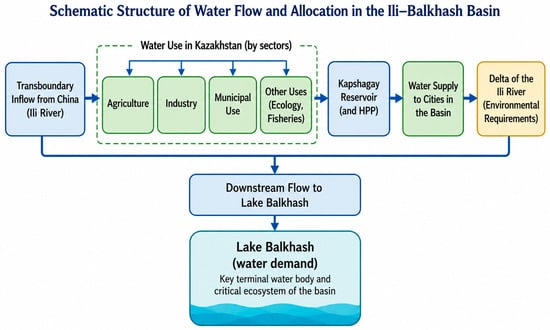
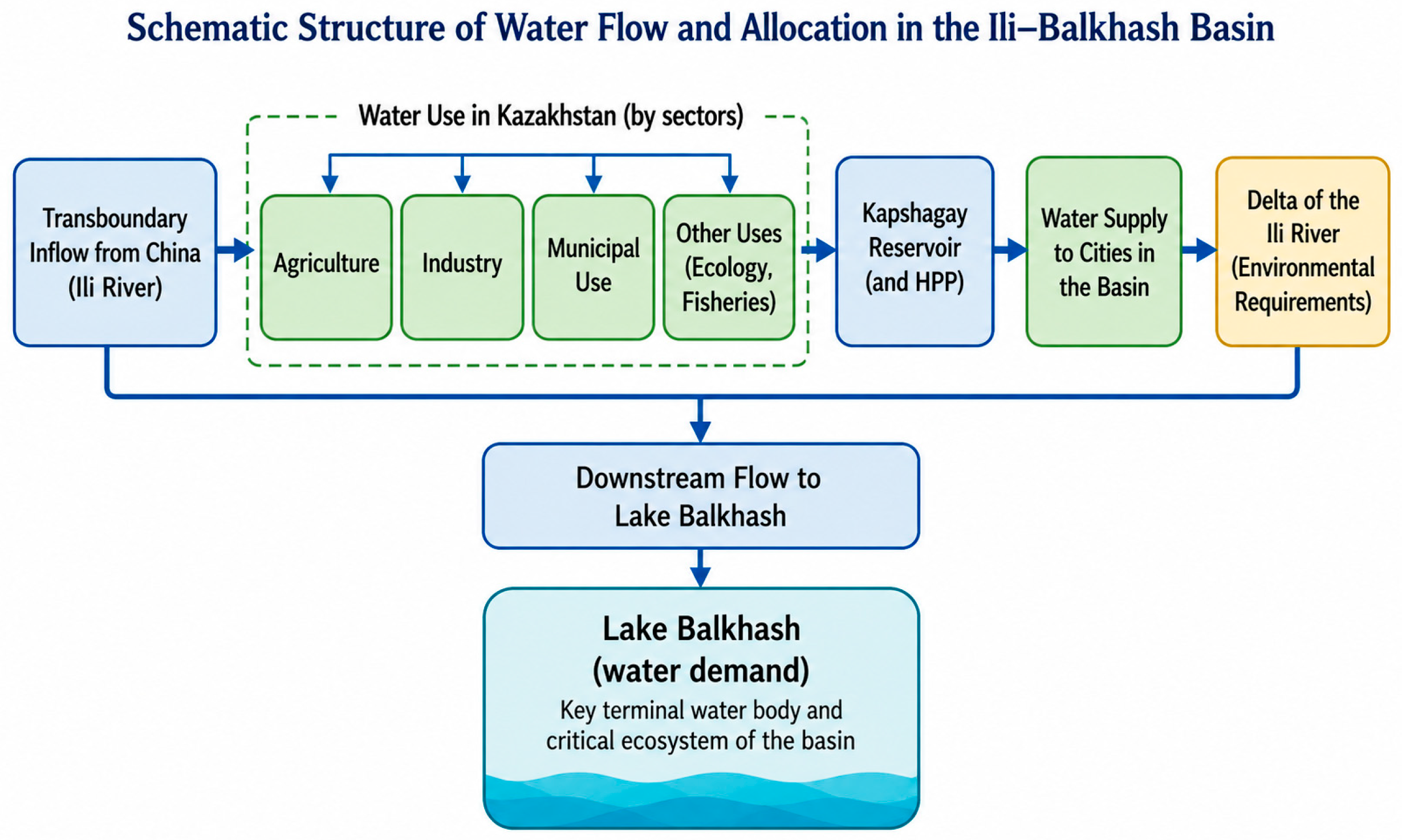
The conceptual framework links climatic, socio-economic, and transboundary drivers with runoff, sectoral water demand, reservoir regulation, and environmental-flow requirements (Figure 2). Generated runoff contributes to the available water resources, which are subsequently allocated among agricultural, municipal, industrial, and environmental uses. Reservoir regulation, water withdrawals, and return flows determine downstream water availability, with the Ili Delta and Lake Balkhash representing the terminal components of the basin system.
Figure 2.
Conceptual framework for scenario-based assessment of the Ili–Balkhash River Basin.
The model operates at an annual time step and updates river discharge, water demand and allocation, reservoir operation, and downstream environmental flows. Uncertainty is represented through stochastic hydrological inputs and alternative assumptions for transboundary inflow, socio-economic demands, and management. Model outputs are used to compare water availability, sectoral deficits, environmental flows, and overall basin response across the development scenarios.
The framework builds on earlier scenario-based modeling of the Kazakh part of the Ili–Balkhash Basin [36,37] and extends it by jointly considering climatic, hydrological, socio-economic, and transboundary drivers. This formulation provides the basis for the scenario simulations.
3.2. Logical and Mathematical Representation of the Model
The Dynamic Stochastic Model (DSM) represents the Ili–Balkhash River Basin as an interconnected water-resource system linking river runoff, water demand and allocation, reservoir operation, and the Lake Balkhash water balance. The model combines deterministic water-balance calculations with stochastic simulation of hydrological variability to examine changes in water availability under different conditions [17,38].
The DSM consists of four computational modules linked at an annual time step. River discharge generated by the stochastic hydrology module enters the water-allocation and reservoir calculations, and regulated downstream releases contribute to inflow to Lake Balkhash. The resulting basin state is carried forward to the next simulation year. The model can therefore be expressed as a discrete-time state-transition system:
where is the vector of basin state variables at time step t, including Kapshagay reservoir storage, Balkhash lake level, water allocation, and water balance components; represents management decisions such as reservoir releases and water allocation rules; denotes hydrological inputs generated by the stochastic runoff module; and contains external scenario parameters describing climatic and socio-economic conditions. The transition function updates the basin state at each time step based on these inputs and the corresponding water-balance calculations.
- The Dynamic Water Demand Model estimates sectoral water requirements using spatially distributed demand functions for agriculture, municipal supply, industry, and other major users. Demand is represented spatially across the basin and projected from the historical reference period (1992–2015) to 2050 using annual time steps. For prospective assessment, the simulation horizon is structured into three planning periods: 2021–2030, 2031–2040, and 2041–2050, while calculations within each period are performed at an annual time step.
- The Kapshagay Reservoir and Integrated Water-Management Module simulates reservoir storage and releases, water allocation, inter-basin transfers, environmental-flow requirements, and downstream water demand. This module links hydrological variability with reservoir operation and basin-scale water allocation.
- The Lake Balkhash Hydrometric Module represents the Western and Eastern parts of Lake Balkhash as interconnected water bodies, with hydraulic exchange through the Uzynaral Strait. The module accounts for the main water-balance processes governing changes in lake conditions.
Hydraulic exchange through the Uzynaral Strait is variable and bidirectional, driven mainly by wind, seiche, runoff, and density effects [39,40]. In the present annual water-balance model, these short-term processes are represented as the net annual exchange between Western and Eastern Balkhash. The annual water balance of Lake Balkhash is represented separately for its western and eastern compartments. For each compartment j, the change in lake storage is expressed as
where is the annual change in storage; is river inflow; is groundwater contribution; represents the net hydraulic exchange between the western and eastern parts of the lake through the Uzynaral Strait; is evaporation loss from the lake surface; represents water withdrawals; and denotes other explicitly represented outflows, where applicable. The western compartment receives the regulated Ili River inflow, whereas the eastern compartment receives inflow from the eastern tributaries. Hydraulic exchange through the Uzynaral Strait links the two compartments.
Water allocation is represented through the annual water-balance structure linking transboundary and locally generated river flow, reservoir storage and releases, groundwater resources, and sectoral water requirements, following the dynamic–stochastic modeling framework previously developed for the Ili–Balkhash water-management system [31,36]. Available water is allocated among agricultural, municipal, industrial, and environmental requirements according to the water-balance and operational constraints specified for the corresponding water-management units. Groundwater and local runoff are represented as additional water sources where applicable, whereas evaporation from river reaches, the Kapshagay Reservoir, and Lake Balkhash is accounted for as a natural component of the basin water balance. When available water is insufficient to meet the specified requirements, the unmet portion is recorded as a sectoral or environmental-flow deficit and is propagated through the downstream water-balance calculations. The Ili Delta and Lake Balkhash are represented as downstream environmental components whose water availability depends on the regulated flow remaining after upstream withdrawals, reservoir operation, and hydrological losses. For interpretation of downstream environmental conditions, an annual Ili River inflow of approximately 11 km3 yr−1 to the Ili Delta was adopted as an environmental-flow benchmark. This value is consistent with previous Ili–Balkhash basin assessments that identified approximately 11 km3 yr−1 as a minimum annual inflow target for supporting the Ili Delta wetlands and Lake Balkhash [17]. In the present study, this value is used as an environmental reference threshold for interpreting the occurrence and persistence of environmental-flow deficits rather than as a deterministic prediction of ecosystem response. This environmental-flow benchmark is also consistent with the conservation context of the Ili River Delta and South Lake Balkhash Ramsar Site, where maintenance of the hydrological regime is important for sustaining wetland habitats [41]. The Ramsar designation itself does not prescribe a specific annual environmental-flow requirement; therefore, the 11 km3 yr−1 value used here should be interpreted as a basin-specific hydrological benchmark rather than as a Ramsar-defined flow standard [17]. Rather than imposing a universal fixed priority ranking among water users, the model evaluates the extent to which specified sectoral demands and environmental requirements can be satisfied under the available annual water balance and the prescribed scenario conditions.
Stochastic Hydrology and Transboundary Inflow Parameterization
The stochastic hydrology component of the model was used to represent interannual variability in the transboundary inflow of the Ili River entering Kazakhstan from the upstream Chinese part of the basin. Transboundary inflow was treated separately from locally generated runoff because it represents one of the principal external hydrological controls on water availability within the Kazakhstan part of the Ili–Balkhash system.
The baseline mean annual transboundary inflow was set to 13.63 km3 yr−1, corresponding to the long-term mean discharge of 432 m3 s−1 reported for the Ili River at the Dobyn gauging station near the China–Kazakhstan border over 1929–2006 [15], with a coefficient of variation of Cv = 0.17 retained from the basin water-resource dataset used for stochastic parameterization.
The standard deviation corresponding to these baseline parameters is
where denotes the mean annual transboundary inflow and is the coefficient of variation.
The adopted baseline magnitude was based on published hydrological information for the transboundary Ili River. Thevs et al. [15] reported a long-term mean discharge of 432 m3 s−1 at the Dobyn gauging station near the China–Kazakhstan border for the period 1929–2006, corresponding to approximately 13.63 km3 yr−1. This value was adopted as the baseline mean annual transboundary inflow for the stochastic model.
Interannual variability was represented using the Pearson Type III probability distribution, which allows the asymmetric frequency behavior characteristic of annual hydrological series to be represented using the mean, variability, and skewness parameters [42]. The coefficient of variation (Cv = 0.17) was retained from the basin water-resource dataset used for stochastic parameterization, while the coefficient of skewness (Cs ≈ 0.53) was retained from the previously fitted Pearson Type III distribution. Thus, replacing the baseline mean with 13.63 km3 yr−1 rescales the distribution while preserving its relative variability and skewness.
The resulting Pearson Type III distribution gives approximately 17.75, 15.06, 13.42, 11.97, and 10.20 km3 yr−1 at the 5%, 25%, 50%, 75%, and 95% exceedance probabilities, respectively. Accordingly, the baseline stochastic representation of annual transboundary inflow can be summarized as
For the prospective period 2021–2050, stochastic sampling was used to propagate interannual inflow variability through the water-balance and water-allocation calculations. The stochastic simulations should therefore be interpreted as probabilistic representations of hydrological variability under the prescribed scenario assumptions, rather than as forecasts of the exact sequence of future annual flows.
The stochastic runoff-generation procedure used in this study is based on the Pearson Type III probability distribution, characterized by the mean annual runoff, coefficient of variation (Cv), and coefficient of skewness (Cs). For the transboundary Ili River inflow, the distribution was parameterized using the adopted baseline mean (13.63 km3 yr−1), the retained coefficient of variation (Cv = 0.17), and the coefficient of skewness (Cs ≈ 0.53) from the previously fitted Pearson Type III distribution. In the present implementation, annual transboundary inflows are sampled independently from the fitted Pearson Type III distribution; temporal autocorrelation is therefore not explicitly represented. This assumption is consistent with the annual-scale stress-testing purpose of the model but may underestimate persistence in multi-year wet or dry conditions and is acknowledged as a limitation of the stochastic representation.
Long-term changes in transboundary water availability were introduced through the boundary conditions defined for scenarios S1–S4. The stochastic component and the scenario assumptions consequently serve different purposes within the modeling framework: stochastic sampling represents interannual hydrological variability, whereas the scenarios represent alternative long-term conditions affecting water availability and demand. This separation allows the model to evaluate the response of the Ili–Balkhash water-management system to both natural hydrological variability and alternative future development pathways without interpreting individual stochastic realizations as deterministic predictions.
3.3. Program Architecture and Implementation
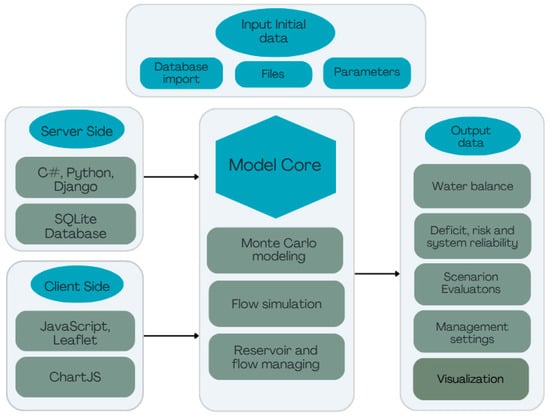
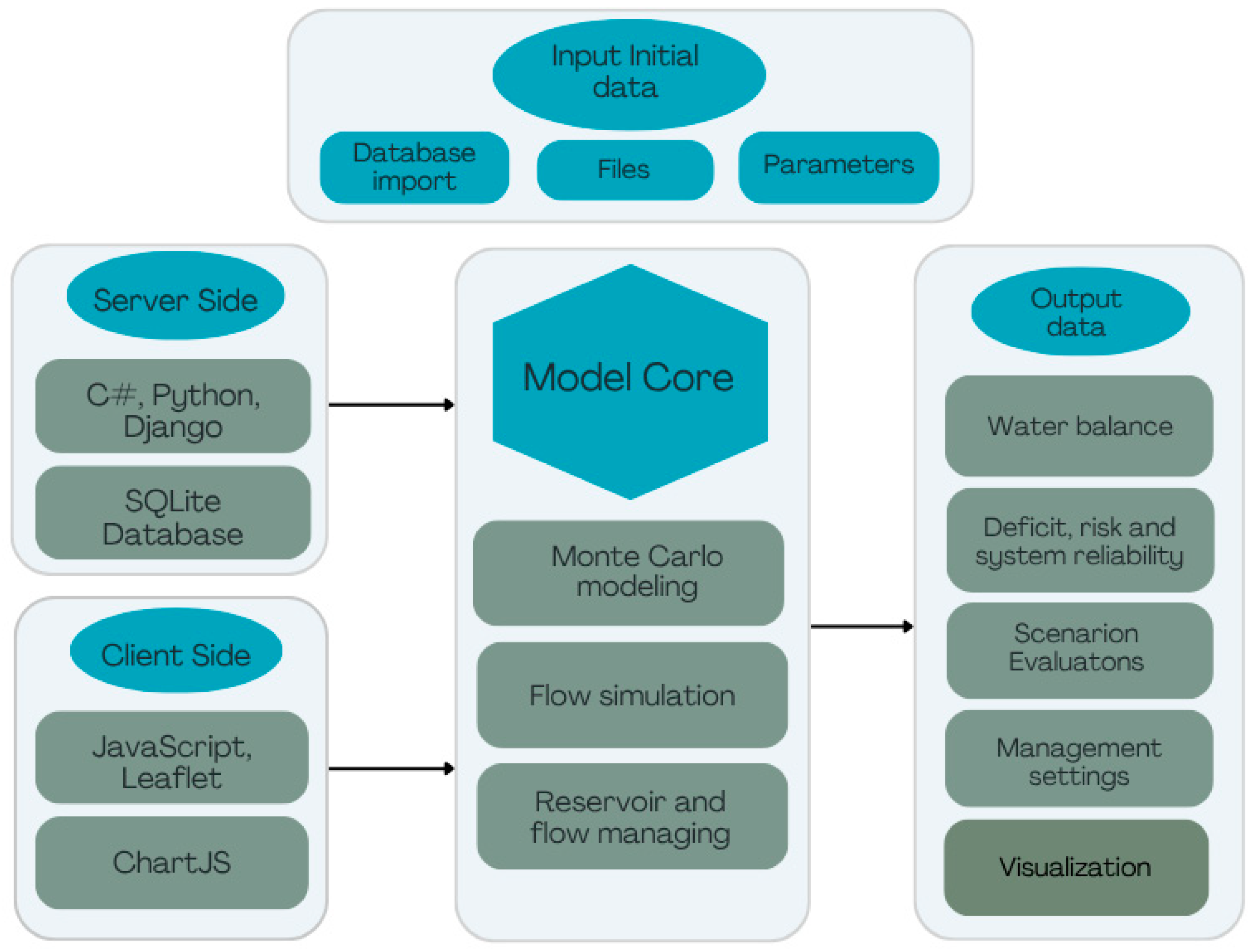
The Dynamic Stochastic Model (DSM) was implemented as a modular decision-support system integrating hydrological simulation, scenario analysis, statistical evaluation, and visualization within a single computational environment. The software architecture separates the computational core from data management and visualization components, thereby supporting independent development of individual modules while maintaining consistent information exchange throughout the modeling workflow. The computational core was developed in Python (version 3.14.2) and performs stochastic runoff generation, annual water-balance calculations, reservoir operation, and scenario simulations. Data management and communication between computational modules are handled by the Django framework (version 6.0), whereas SQLite (version 3.51.2) serves as the central repository for hydrological observations, model parameters, scenario data, and simulation results. Spatial visualization is implemented using Leaflet (version 1.9.4), while statistical outputs are generated with Chart.js (version 4.5.1). Data exchange between the computational and visualization layers is performed using JavaScript Object Notation (JSON), ensuring compatibility between software components. The overall computational architecture and data flow of the model are illustrated in Figure 3.
Figure 3.
Computational architecture and data flow of the Dynamic Stochastic Model for the Ili–Balkhash River Basin.
The computational workflow links input data and scenario parameters with the principal simulation procedures, including stochastic runoff generation, water-balance calculations, reservoir operation, and water allocation.
The spatial configuration of the model is based on a hierarchical representation of the basin using Water-Management Units (WMUs) and Water Balance Units (WBUs). The WMUs comprise the Upper Ili, Lower Ili, Eastern Rivers, and Northern Balkhash regions, whereas the WBUs represent the Kapshagay Reservoir and the western and eastern parts of Lake Balkhash. This spatial discretization defines the computational domain for water-allocation calculations and aggregation of model outputs. The transboundary inflow coefficient (α) represents the proportion of upstream river flow entering the Kazakhstan sector of the basin and enables assessment of alternative upstream abstraction scenarios and their effects on downstream water availability, reservoir operation, and Lake Balkhash [16]. The framework builds on the dynamic–stochastic approach developed for water- resource management in Kazakhstan [31] and extends it to scenario-based assessment of water availability and allocation in the Ili–Balkhash River Basin.
The modeling framework has been implemented as an operational computer simulation system rather than solely as a conceptual model. Previous applications of the computational framework generated spatially distributed quantitative indicators of water availability, water stress, and hydrological risk and reliability for basin–administrative units at different planning horizons. The model explicitly represents surface- and groundwater sources, water-demand nodes, reservoir regulation, evaporation, flow redistribution, and the Western and Eastern parts of Lake Balkhash [43].
3.4. Model Evaluation and Limitations
The Dynamic Stochastic Model was evaluated against available historical hydrological observations for the Ili–Balkhash River Basin. Because the model operates at an annual time step and is intended primarily for long-term scenario and water-balance assessment, the evaluation focused on reproducing basin-scale hydrological behavior rather than short-term discharge dynamics. Monthly or daily observations were aggregated to annual values where necessary to ensure consistency with the computational time step. Particular attention was given to the Ili River because it represents the dominant source of inflow to the Kazakhstan part of the basin and Lake Balkhash. The computational framework had previously undergone calibration and verification during its development using historical and measured basin data, including an independent dataset for verification [36].
The hydrological evaluation was supported by long-term discharge observations from the national monitoring network of RSE Kazhydromet. The available monitoring system includes gauging stations along the main stem of the Ili River and its tributaries. Published analyses based on the Kazhydromet archive include observations from 16 hydrological stations within the Ili River Basin [29]. Long-term annual discharge records for the main Ili River are also available for the Dobyn station near the China–Kazakhstan border and for downstream stations associated with the Kapshagay Reservoir and lower Ili River. These independent observational records were used to verify the magnitude, long-term variability, and hydrological plausibility of the runoff characteristics adopted in the modeling framework. For example, official Kazhydromet records indicate a long-term mean annual discharge of approximately 470 m3 s−1 for the Ili River at Kapshagay over the 1930–2023 observation period [28]. This observational record provides an independent hydrological benchmark for assessing whether the runoff characteristics adopted in the stochastic model are consistent with the historical magnitude and variability of Ili River discharge.
The model evaluation was therefore formulated as a hydrological consistency and plausibility assessment rather than as a conventional deterministic calibration–validation exercise. The stochastic component is designed to reproduce the statistical characteristics and interannual variability of annual runoff rather than the exact chronological sequence of observed flows. Consequently, deterministic goodness-of-fit statistics such as NSE, KGE, and RMSE, which are commonly used for evaluating deterministic hydrological simulations [44,45], would not provide an appropriate measure of stochastic model performance when applied between individual observed and randomly generated annual sequences. Instead, stochastic-model performance was evaluated for consistency with the available reference hydrological characteristics, including the long-term magnitude and variability of Ili River discharge. As reported in the Stochastic Hydrology and Transboundary Inflow Parameterization Section, the fitted Pearson Type III distribution was parameterized using the adopted baseline mean annual transboundary inflow and the specified variability and skewness parameters. The resulting exceedance characteristics were used to represent interannual variability in annual transboundary inflow within the stochastic modeling framework.
Previous applications of the modeling framework have produced quantitative water-balance, water-availability, and hydrological reliability indicators for the Balkhash–Alakol system and other water-management basins of Kazakhstan [43]. These applications demonstrate that the computational framework has been implemented and used for numerical scenario analysis rather than existing solely as a conceptual framework.
Lake salinity is not dynamically simulated in the present model and is therefore treated as a limitation of the current framework. In addition, limitations in continuous observations of sectoral water use and reservoir operation restrict independent quantitative validation of all model components. Data limitations affecting the representation of upstream water use and Kapshagay Reservoir operation have also been reported in previous modeling studies of the Ili–Balkhash Basin [17]. The annual time step is appropriate for long-term basin-scale water-balance assessment but does not resolve seasonal reservoir operation, irrigation-demand peaks, or intra-annual environmental-flow requirements; the results should therefore be interpreted at the annual planning scale. The stochastic representation also assumes independence between successive annual inflows and therefore does not reproduce potential multi-year hydrological persistence. Structural uncertainty arises from the simplified annual representation of basin processes, including reservoir operation, water allocation, and lake response. This stress-testing perspective is consistent with scenario-neutral approaches, in which system sensitivity is evaluated across a range of plausible changes rather than treating individual scenarios as deterministic predictions [46]. Consequently, the model is intended for comparative basin-scale stress testing rather than detailed prediction of short-term hydrological dynamics. The framework is therefore applied primarily as a comparative scenario and stress-testing tool rather than as a deterministic forecasting model.
Uncertainty in transboundary inflow is represented through the fitted Pearson Type III distribution and its exceedance characteristics. Such a bottom-up treatment of uncertainty is consistent with decision-scaling approaches that use stochastic analysis to identify system vulnerabilities before relating them to uncertain future climate conditions [47]. Because probabilistic uncertainty intervals were not estimated for individual scenario outputs, differences among scenarios are interpreted comparatively rather than as bounded probabilistic forecasts. Future applications should propagate input uncertainty through repeated model realizations to quantify uncertainty ranges for water deficits, reservoir storage, and Lake Balkhash inflow.
4. Scenario Development: Criteria and Analytical Framework
4.1. Identification and Selection of Scenario Drivers
Scenario-based modeling was used to assess basin response to interacting hydrological, socio-economic, and water-management drivers under uncertainty [35,48,49]. This approach is particularly relevant to transboundary river basins, where future water availability depends on interacting drivers operating across different spatial and temporal scales. The Ili–Balkhash River Basin is highly sensitive to both natural and anthropogenic changes because the transboundary Ili River contributes approximately 70–80% of the total river inflow to Lake Balkhash [2,17]. Consequently, future water availability within the basin is controlled not only by regional climatic conditions but also by upstream water abstraction, reservoir operation, socio-economic development, and institutional cooperation between riparian countries. These interacting processes create substantial uncertainty regarding future water security and require integrated assessment rather than evaluation of individual factors in isolation [17,36]. Recent modeling of Lake Balkhash used CMIP6 projections under SSP2-4.5 and SSP5-8.5 to assess future changes in climatic and water-balance components [22]. In contrast, the present scenarios are controlled stress tests of transboundary water availability rather than SSP-based climate projections, with climatic and socio-economic factors treated as contextual drivers.
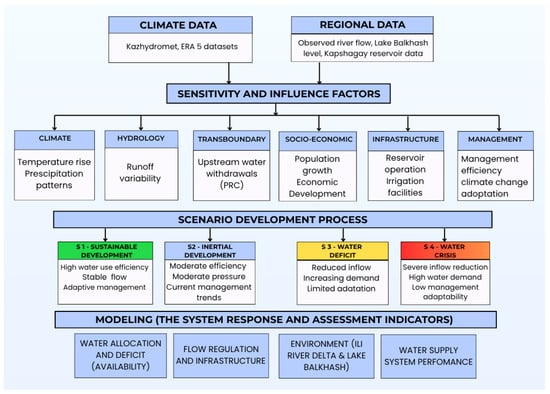
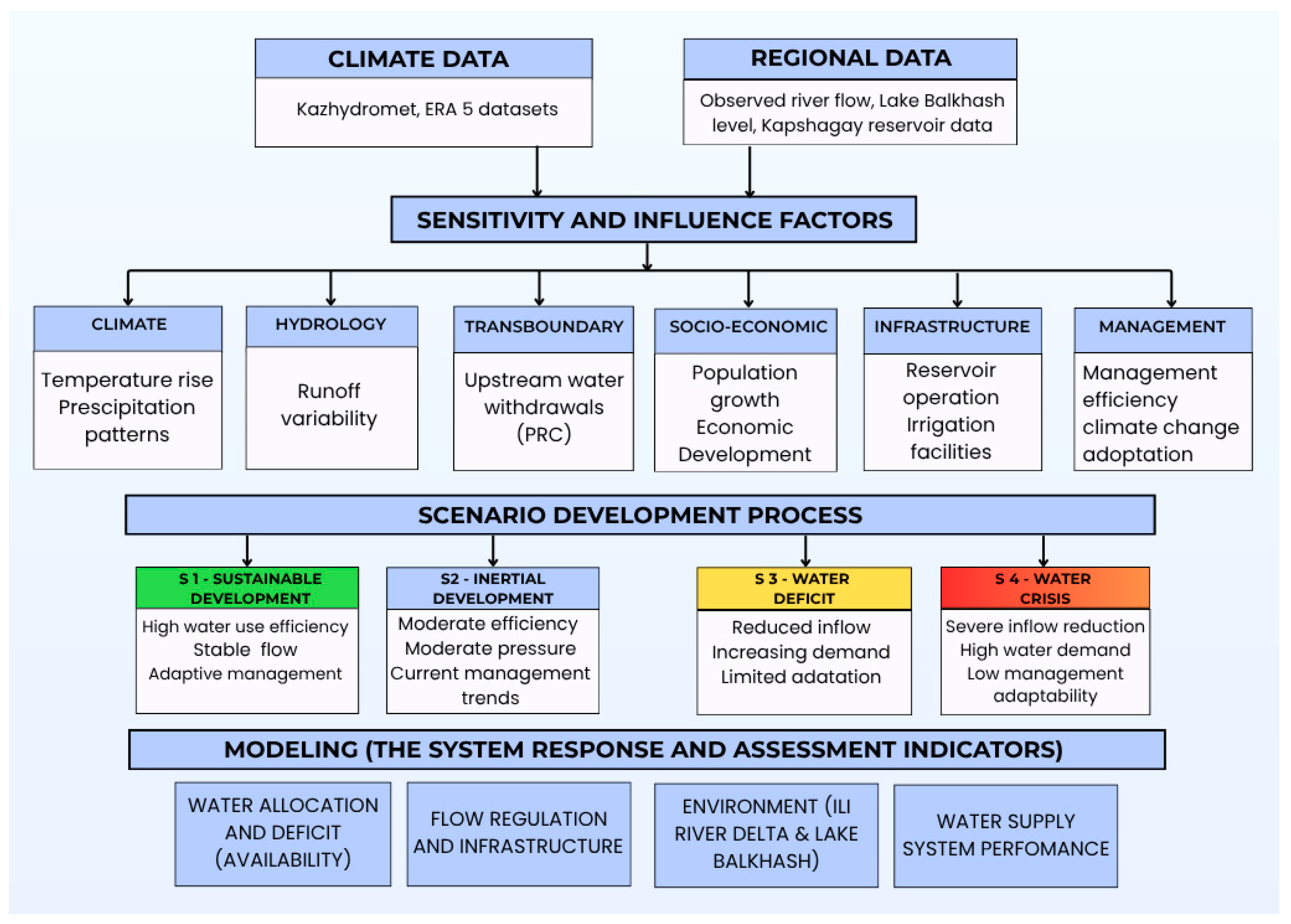
The conceptual framework adopted in this study represents alternative socio-hydrological states of the basin under different combinations of climatic and anthropogenic pressures and water-management conditions (Figure 4). These states provide the conceptual basis for translating the principal drivers into alternative scenario assumptions subsequently implemented in the Dynamic Stochastic Model.
Figure 4.
Conceptual framework linking data sources, key drivers, and alternative development scenarios in the Ili–Balkhash River Basin.
The drivers were selected based on three criteria: (i) documented influence on basin hydrology, (ii) relevance to long-term water-resource management, and (iii) suitability for representation within the modeling framework. Seven principal driver categories were considered: climate, hydrology, transboundary water use, agriculture, socio-economic development, infrastructure, and governance. Climatic and hydrological drivers represent changes in temperature, precipitation, snow and glacier dynamics, and runoff variability, which influence water availability within the basin [48,50]. Anthropogenic pressures are represented through upstream water withdrawals, irrigation development, population and industrial water demand, while infrastructure and water-management drivers account for Kapshagay Reservoir operation, irrigation facilities, water-use efficiency, and allocation rules [15,16,17].
These drivers are evaluated jointly because their effects may reinforce or partially offset one another. For example, increasing irrigation demand may have a limited effect under favorable hydrological conditions but can intensify water deficits during low-flow periods, whereas improvements in irrigation efficiency and water allocation may reduce pressure on available water resources. The drivers and their expected influence on the hydrological system are summarized in Table 1.
Table 1.
Principal drivers used for scenario development in the Ili–Balkhash River Basin.
These drivers provide the contextual basis for the scenarios described in Section 4.2.
4.2. Development of Future Scenarios
The future scenarios were formulated as controlled stress-test experiments rather than deterministic forecasts of future hydrological conditions. Interannual variability in transboundary Ili River inflow was represented by the stochastic procedure described in Stochastic Hydrology and Transboundary Inflow Parameterization Section. Scenario-specific stress was then imposed on the generated annual inflow sequences to examine how progressively lower water availability affects the Kazakhstan part of the Ili–Balkhash water-management system. Other hydro-climatic, demand, reservoir-operation, and management conditions were retained as contextual scenario assumptions and were not assigned unsupported numerical trajectories where sufficiently robust quantitative inputs were unavailable.
Four transboundary-inflow stress scenarios (S1–S4) were defined by applying progressively stronger perturbations to the same stochastic baseline (Table 2). S1 represents the reference condition with no imposed reduction, whereas S2, S3, and S4 apply 10%, 20%, and 30% reductions, respectively, to each generated annual transboundary-inflow value. These perturbations are used as controlled stress-test increments rather than as deterministic forecasts of future transboundary inflow.
Table 2.
Quantitative transboundary-inflow stress assumptions for scenarios S1–S4.
A substantial proportion of Ili River runoff is generated in the upstream part of the basin in China, while water resources are used for agricultural and other purposes in both riparian countries [15,17]. Consequently, future transboundary inflow to Kazakhstan may reflect the combined effects of climatic variability, upstream water use, and water-management decisions. In the present model, these upstream processes are not attributed to any individual driver or explicitly simulated as Chinese sectoral water demand. Instead, their potential combined influence is represented through alternative transboundary-inflow boundary conditions applied in scenarios S1–S4.
For a generated annual baseline inflow Qt, the scenario inflow is calculated as Qt,s = ksQt for S1–S4, where ks equals 1.00, 0.90, 0.80, and 0.70, respectively. The same stochastic framework is retained across scenarios, separating interannual hydrological variability from the imposed scenario stress. Scenario assessments were conducted through 2050 using the water-availability, allocation, reservoir, environmental-flow, and Lake Balkhash indicators described in the modeling framework.
A scenario-based sensitivity assessment was conducted using S1 as the reference condition to examine the response of the water-management system to progressively stronger transboundary-inflow stress. Sensitivity was evaluated by comparing changes in water availability, sectoral water deficits, reservoir regulation capacity, environmental-flow deficits, and inflow to Lake Balkhash under the baseline (ks = 1.00), −10% (ks = 0.90), −20% (ks = 0.80), and −30% (ks = 0.70) conditions. Because transboundary inflow is the principal quantitatively perturbed driver, while the remaining scenario drivers are retained as qualitative contextual assumptions, this analysis is interpreted as a comparative scenario-based sensitivity assessment rather than as a formal variance-based global sensitivity analysis.
5. Results and Discussion
The scenario-based sensitivity assessment indicates a progressive deterioration in basin conditions from S1 to S4 as progressively stronger transboundary-inflow stress is imposed on the stochastic baseline. The accompanying hydro-climatic, demand, reservoir-operation, and management conditions provide the qualitative context for interpreting the alternative development pathways. Differences among the scenarios become progressively more pronounced as the imposed transboundary-inflow stress increases, indicating increasing divergence in water availability and system response.
Under S1 (Sustainable/adaptive development), transboundary Ili River inflow remains at the stochastic baseline (ks = 1.00). Water demand remains broadly compatible with available resources, while Kapshagay Reservoir regulation buffers hydrological variability. Environmental flows to the Ili Delta and Lake Balkhash are largely maintained, resulting in the highest relative system reliability among the four scenarios.
Under S2 (Inertial development), a 10% reduction in annual transboundary inflow (ks = 0.90) reduces the margin between water availability and demand, leading to increasing water deficits and greater pressure on environmental flows. The existing management system partly buffers these pressures, but the basin gradually shifts towards persistent water stress.
Under S3 (Water deficit), a 20% reduction in annual transboundary inflow (ks = 0.80) further constrains water availability. The Kapshagay Reservoir becomes less effective in buffering these pressures, while sectoral and environmental-flow deficits become more frequent. Reduced downstream discharge limits water delivery to the Ili Delta and Lake Balkhash, indicating a transition towards a structurally constrained water-resource system.
Under S4 (Water crisis), a 30% reduction in annual transboundary inflow (ks = 0.70) reduces the reference mean inflow to approximately 9.54 km3 yr−1. Under this extreme stress condition, reservoir regulation becomes increasingly constrained, while pressure on environmental flows and Lake Balkhash inflow intensifies. Water scarcity shifts from episodic stress towards a persistent basin-wide condition.
The quantitative values reported in Table 3 correspond to the prescribed transboundary-inflow conditions used to define the stress-test scenarios. The remaining indicators are reported comparatively to characterize the direction and relative severity of the simulated system response under progressively stronger inflow stress. They should therefore be interpreted as comparative scenario responses rather than as absolute quantitative forecasts.
Table 3.
Comparative assessment of water-resource system responses under alternative development scenarios.
The scenario comparison identifies transboundary Ili River inflow as the principal quantitatively perturbed driver of basin performance in the present stress-test framework. Environmental and economic water demands, climatic conditions, and evaporative losses provide the broader context within which the imposed inflow reductions propagate through the water-management system. This response is consistent with the basin’s strong dependence on Ili River discharge, which contributes approximately 70–80% of the total inflow to Lake Balkhash, and with previous assessments highlighting upstream abstraction and growing water demand as important sources of vulnerability.
The results further indicate that reservoir regulation cannot fully offset the effects of reduced transboundary inflow. The Kapshagay Reservoir buffers moderate hydrological variability, but this capacity becomes increasingly constrained under S3 and S4. This finding is consistent with historical evidence that reservoir operation and irrigation development have substantially altered the Ili–Balkhash hydrological regime, particularly during and after reservoir filling in 1971–1990 [13,14]. Environmental-flow deficits further illustrate how reduced upstream water availability propagates through the regulated system and affects downstream conditions. The broader hydro-climatic, demand, and management conditions may amplify or mitigate these effects but are not independently quantified here.
6. Conclusions
This study developed a dynamic–stochastic scenario framework to assess future water security in the transboundary Ili–Balkhash River Basin under hydrological and water-management uncertainty. The four scenarios (S1–S4) were formulated as controlled stress-test experiments in which progressively stronger reductions in transboundary Ili River inflow were imposed on stochastic hydrological sequences. The results show a clear transition from relatively stable conditions under S1 to increasing water stress under S2 and S3 and persistent basin-wide scarcity under S4.
As inflow stress intensifies, pressure on water availability increases, reservoir regulation becomes increasingly constrained, and environmental flows to the Ili Delta and Lake Balkhash decline. The Kapshagay Reservoir can buffer moderate hydrological variability, but its capacity to compensate for reduced upstream water availability becomes increasingly limited under S3 and S4.
The scenario comparison therefore identifies transboundary inflow as a key factor influencing long-term water-security conditions in the basin. These results also highlight the potential importance of water-management efficiency, environmental-flow protection, and transboundary water management. Rather than predicting a single future state, the proposed framework provides a practical basis for stress-testing the Ili–Balkhash water-management system under alternative transboundary-inflow conditions through 2050. Further work should extend the framework by quantitatively parameterizing future water-demand, climate, and adaptation pathways and evaluating their interactions with transboundary-inflow uncertainty.
Author Contributions
Conceptualization, M.L.; methodology and validation, M.L. and F.M.-A.; software, formal analysis, investigation, data curation, and visualization and GIS mapping, M.L. and Z.S.; writing—original draft, M.L.; writing—review and editing, F.M.-A. and A.A.; supervision, F.M.-A. and A.A. All authors have read and agreed to the published version of the manuscript.
Funding
This research received no external funding.
Data Availability Statement
Data were obtained from national hydrometeorological observations, international climate datasets, and published sources. Restricted data may be obtained from the respective providers. Additional supporting data are available from the corresponding author upon reasonable request.
Acknowledgments
The authors acknowledge the School of Natural Resources, University of Nebraska–Lincoln (USA), Institute of Geography and Water Security (Kazakhstan), for their academic and research support during this study. ChatGPT (GPT-5.6, OpenAI) was used for language editing, readability, and presentation. The authors reviewed and edited the content and take full responsibility for the final manuscript.
Conflicts of Interest
The authors declare no conflicts of interest.
References
- Hu, W.; Liu, H.; Bao, A.; El-Tantawi, A.M. Influences of Environmental Changes on Water Storage Variations in Central Asia. J. Geogr. Sci. 2018, 28, 985–1000. [Google Scholar] [CrossRef] [Scilit]
- Kezer, K.; Matsuyama, H. Decrease of River Runoff in the Lake Balkhash Basin in Central Asia. Hydrol. Process. 2006, 20, 1407–1423. [Google Scholar] [CrossRef] [Scilit]
- Sorg, A.; Bolch, T.; Stoffel, M.; Solomina, O.; Beniston, M. Climate Change Impacts on Glaciers and Runoff in Tien Shan (Central Asia). Nat. Clim. Change 2012, 2, 725–731. [Google Scholar] [CrossRef] [Scilit]
- Shimkevich, A. Surface Water Resources of the USSR: Central and Southern Kazakhstan, Issue 2: Lake Balkhash Basin; Gidrometeoizdat: Leningrad, Russia, 1973; Volume 13. [Google Scholar]
- Tairov, A.Z.; Leman, M.; Tolekova, A.; Abdibekov, D.U.; Sorokina, T.E. Hydrochemistry and Ion Flow Dynamics of Syr Darya Transboundary River within Kazakhstan. News Natl. Acad. Sci. Repub. Kazakhstan Ser. Geol. Tech. Sci. 2025, 2, 290–306. [Google Scholar] [CrossRef] [Scilit]
- Abdolvand, B.; Mez, L.; Winter, K.; Mirsaeedi-Gloßner, S.; Schütt, B.; Rost, K.T.; Bar, J. The Dimension of Water in Central Asia: Security Concerns and the Long Road of Capacity Building. Environ. Earth Sci. 2015, 73, 897–912. [Google Scholar] [CrossRef] [Scilit]
- Hijioka, Y.; Lin, E.; Pereira, J.J.; Corlett, R.T.; Cui, X.; Insarov, G.E.; Lasco, R.D.; Lindgren, E.; Surjan, A. Asia. In Climate Change 2014: Impacts, Adaptation, and Vulnerability. Part B: Regional Aspects; Barros, V.R., Field, C.B., Dokken, D.J., Mastrandrea, M.D., Mach, K.J., Bilir, T.E., Chatterjee, M., Ebi, K.L., Estrada, Y.O., Genova, R.C., Girma, B., et al., Eds.; Cambridge University Press: Cambridge, UK, 2014; pp. 1327–1370. [Google Scholar]
- Reyer, C.P.O.; Otto, I.M.; Adams, S.; Albrecht, T.; Baarsch, F.; Cartsburg, M.; Coumou, D.; Eden, A.; Ludi, E.; Marcus, R.; et al. Climate Change Impacts in Central Asia and Their Implications for Development. Reg. Environ. Change 2017, 17, 1639–1650. [Google Scholar] [CrossRef] [Scilit]
- Siegfried, T.; Bernauer, T.; Guiennet, R.; Sellars, S.; Robertson, A.W.; Mankin, J.; Bauer-Gottwein, P.; Yakovlev, A. Will Clim. Change Exacerbate Water Stress Cent. Asia? Clim. Change 2012, 112, 881–899. [Google Scholar] [CrossRef] [Scilit]
- Toonen, W.H.J.; Macklin, M.G.; Dawkes, G.; Durcan, J.A.; Leman, M.; Nikolayev, Y.; Yegorov, A. A Hydromorphic Reevaluation of the Forgotten River Civilizations of Central Asia. Proc. Natl. Acad. Sci. USA 2020, 117, 32982–32988. [Google Scholar] [CrossRef] [Scilit] [PubMed]
- Imentai, A.; Thevs, N.; Schmidt, S.; Nurtazin, S.; Salmurzauli, R. Vegetation, Fauna, and Biodiversity of the Ile Delta and Southern Lake Balkhash—A Review. J. Great Lakes Res. 2015, 41, 688–696. [Google Scholar] [CrossRef] [Scilit]
- Pueppke, S.G.; Zhang, Q.; Nurtazin, S.T. Central Asia’s Ili River Ecosystem as a Wicked Problem: Unraveling Complex Interrelationships at the Interface of Water, Energy, and Food. Water 2018, 10, 541. [Google Scholar] [CrossRef] [Scilit]
- Sala, R.; Deom, J.-M.; Aladin, N.V.; Plotnikov, I.S.; Nurtazin, S. Geological History and Present Conditions of Lake Balkhash. In Large Asian Lakes in a Changing World: Natural State and Human Impact; Mischke, S., Ed.; Springer: Cham, Switzerland, 2020; pp. 143–175. [Google Scholar] [CrossRef] [Scilit]
- Mukhitdinov, A.; Nurtazin, S.; Alimova, S.; Ablaikhanova, N.; Yessimsiitova, Z.; Salmurzauly, R.; Margulan, I.; Mirasbek, Y. The Transformation of Ecosystems of the Ili River Delta (Kazakhstan) under the Flow Regulation and Climate Change. Appl. Ecol. Environ. Res. 2020, 18, 2483–2498. [Google Scholar] [CrossRef] [Scilit]
- Thevs, N.; Nurtazin, S.; Beckmann, V.; Salmyrzauli, R.; Khalil, A. Water Consumption of Agriculture and Natural Ecosystems along the Ili River in China and Kazakhstan. Water 2017, 9, 207. [Google Scholar] [CrossRef] [Scilit]
- Duan, W.; Zou, S.; Chen, Y.; Nover, D.; Fang, G.; Wang, Y. Sustainable Water Management for Cross-Border Resources: The Balkhash Lake Basin of Central Asia, 1931–2015. J. Clean. Prod. 2020, 263, 121614. [Google Scholar] [CrossRef] [Scilit]
- de Boer, T.; Paltan, H.; Sternberg, T.; Wheeler, K. Evaluating Vulnerability of Central Asian Water Resources under Uncertain Climate and Development Conditions: The Case of the Ili-Balkhash Basin. Water 2021, 13, 615. [Google Scholar] [CrossRef] [Scilit]
- Panyushkina, I.P.; Meko, D.M.; Macklin, M.G.; Toonen, W.H.J.; Mukhamadiev, N.S.; Konovalov, V.G.; Ashikbaev, N.Z.; Sagitov, A.O. Runoff Variations in Lake Balkhash Basin, Central Asia, 1779–2015, Inferred from Tree Rings. Clim. Dyn. 2018, 51, 3161–3177. [Google Scholar] [CrossRef] [Scilit]
- Chen, F.; Yu, S. Tree-Ring Indicators of Rainfall and Streamflow for the Ili-Balkhash Basin, Central Asia since CE 1560. Palaeogeogr. Palaeoclimatol. Palaeoecol. 2017, 482, 48–56. [Google Scholar] [CrossRef] [Scilit]
- Karthe, D. Environmental Changes in Central and East Asian Drylands and Their Effects on Major River-Lake Systems. Quat. Int. 2018, 475, 91–100. [Google Scholar] [CrossRef] [Scilit]
- Seversky, I.; Malkovsky, I. Ili-Balkhash Basin: The State and Prospects of Nature Management. In Restoration of Degraded Rivers: Challenges, Issues and Experiences; Loucks, D.P., Ed.; Springer: Dordrecht, The Netherlands, 1998; pp. 285–300. [Google Scholar] [CrossRef] [Scilit]
- Alimkulov, S.; Makhmudova, L.; Talipova, E.; Baspakova, G.; Myrzakhmetov, A.; Smagulov, Z.; Zagidullina, A. Long-Term Water Level Projections for Lake Balkhash Using Scenario-Based Water Balance Modeling under Climate and Socioeconomic Uncertainties. Water 2025, 17, 2021. [Google Scholar] [CrossRef] [Scilit]
- Nurtazin, S.; Thevs, N.; Iklasov, M.; Graham, N.; Salmurzauli, R.; Pueppke, S. Challenges to the Sustainable Use of Water Resources in the Ili River Basin of Central Asia. E3S Web Conf. 2019, 81, 01009. [Google Scholar] [CrossRef] [Scilit]
- Petr, T. Lake Balkhash, Kazakhstan. Int. J. Salt Lake Res. 1992, 1, 21–46. [Google Scholar] [CrossRef] [Scilit]
- Propastin, P. Assessment of Climate and Human Induced Disaster Risk Over Shared Water Resources in the Balkhash Lake Drainage Basin. In Climate Change and Disaster Risk Management; Leal Filho, W., Ed.; Springer: Berlin/Heidelberg, Germany, 2013; pp. 41–54. [Google Scholar] [CrossRef] [Scilit]
- Ramsar Convention Secretariat. Ili River Delta and South Lake Balkhash; Ramsar Sites Information Service: Gland, Switzerland, 2012. [Google Scholar]
- Bissenbayeva, S.; Shokparova, D.; Iskaliyeva, G.; Ahmed, T.; Xing, J. Climate Elasticity of Streamflow in the Ile–Balkhash Basin, Kazakhstan. Adv. Meteorol. 2026, 2026, 3588352. [Google Scholar] [CrossRef] [Scilit]
- Abdrakhimov, R.G.; Akzharkynova, A.N.; Rodrigo-Ilarri, J.; Nahiduzzaman, K.M.; Dautaliyeva, M.E.; Rodrigo-Clavero, M.-E. Assessment of Changes in Hydrometeorological Indicators and Intra-Annual River Runoff in the Ile River Basin. Water 2024, 16, 1921. [Google Scholar] [CrossRef] [Scilit]
- RSE Kazhydromet. Annual Hydrological Bulletin for 2023; Republican State Enterprise Kazhydromet: Astana, Kazakhstan, 2025. Available online: https://www.kazhydromet.kz/en/post/3142 (accessed on 17 September 2026).
- Konovalov, V.G.; Pimankina, N.V. Spatial-Temporal Variability of Water Balance Components in the North Area of the Zailiisky Alatau Range. Ice Snow 2016, 56, 453–471. [Google Scholar] [CrossRef] [Scilit]
- Alimkulov, S.K.; Myrzakhmetov, A.B.; Talipova, E.K.; Baspakova, G.R.; Kanay, M.A.; Rustem, D.A. Water Balance of Lake Balkhash, Taking into Account the Main Climatic Factors and Major Water Management Activities in the Basin. Geogr. Water Resour. 2025, 1, 41–55. [Google Scholar] [CrossRef] [Scilit]
- Leman, M.; Tairov, A.; Malkovskiy, I.; Toleubaeva, L.; Aldiyarova, A. Dynamic-Stochastic Model of Sustainable Water Resources Management in Kazakhstan. News Natl. Acad. Sci. Repub. Kazakhstan Ser. Geol. Tech. Sci. 2025, 6, 151–167. [Google Scholar] [CrossRef] [Scilit]
- Nurtazin, S.; Pueppke, S.; Ospan, T.; Mukhitdinov, A.; Elebessov, T. Quality of Drinking Water in the Balkhash District of Kazakhstan’s Almaty Region. Water 2020, 12, 392. [Google Scholar] [CrossRef] [Scilit]
- Chen, Y.; Li, Z.; Fang, G.; Li, W. Large Hydrological Processes Changes in the Transboundary Rivers of Central Asia. J. Geophys. Res. Atmos. 2018, 123, 5059–5069. [Google Scholar] [CrossRef] [Scilit]
- Loucks, D.P.; van Beek, E. Water Resource Systems Planning and Management: An Introduction to Methods, Models, and Applications; Springer: Cham, Switzerland, 2017. [Google Scholar] [CrossRef] [Scilit]
- Walker, W.E.; Haasnoot, M.; Kwakkel, J.H. Adapt or Perish: A Review of Planning Approaches for Adaptation under Deep Uncertainty. Sustainability 2013, 5, 955–979. [Google Scholar] [CrossRef] [Scilit]
- Dolbeshkin, M.; Puzikov, E.; Povetkin, R. Modeling of Transboundary Ile-Balkhash River Basin in Central Asia. News Natl. Acad. Sci. Repub. Kazakhstan Ser. Geol. Tech. Sci. 2017, 5, 171–180. [Google Scholar]
- Puzikov, E.M.; Povetkin, R.D.; Dolbeshkin, M.V. Computer Simulation for Analyzing and Forecasting the Ile-Balkash Water Supply of Natural-Economic System. Issues Geogr. Geoecol. 2016, 2, 29–37. (In Russian) [Google Scholar]
- Alimkulov, S.K.; Myrzakhmetov, A.B.; Tursunova, A.A.; Tairov, A.Z.; Bolatov, K.M. Features of Water Flow in the Uzynaral Strait of Lake Balkhash. Geogr. Water Resour. 2022, 4, 27–35. [Google Scholar] [CrossRef] [Scilit]
- Zulpykharov, B.A.; Assanbekov, B.A.; Rahman, S.; Yakovlev, A.A.; Kalybekova, Y.M. Study of Internal Water Exchange in Lake Balkhash. Biosci. Biotechnol. Res. Asia 2015, 12, 35–44. [Google Scholar] [CrossRef] [Scilit][Green Version]
- Ramsar Sites Information Service. Ili River Delta and South Lake Balkhash, Ramsar Site No. 2020; Convention on Wetlands: Gland, Switzerland, 2012; Available online: https://rsis.ramsar.org/ris/2020 (accessed on 17 September 2026).
- Vogel, R.W.; McMartin, D.E. Probability Plot Goodness-of-Fit and Skewness Estimation Procedures for the Pearson Type 3 Distribution. Water Resour. Res. 1991, 27, 3149–3158. [Google Scholar] [CrossRef] [Scilit]
- Medeu, A.R.; Malkovsky, I.M.; Toleubayeva, L.S.; Tairov, A.Z.; Sorokina, T.E.; Puzikov, E.M.; Dolbeshkin, M.V.; Povetkin, R.D.; Abdibekov, D.U.; Tolekova, A. Strategy of Sustainable Water Supply of the Republic of Kazakhstan for the Period up to 2050. Issues Geogr. Geoecol. 2018, 1, 18–46. (In Russian) [Google Scholar]
- Moriasi, D.N.; Arnold, J.G.; Van Liew, M.W.; Bingner, R.L.; Harmel, R.D.; Veith, T.L. Model Evaluation Guidelines for Systematic Quantification of Accuracy in Watershed Simulations. Trans. Am. Soc. Agric. Biol. Eng. 2007, 50, 885–900. [Google Scholar] [CrossRef] [Scilit]
- Nash, J.E.; Sutcliffe, J.V. River Flow Forecasting through Conceptual Models Part I—A Discussion of Principles. J. Hydrol. 1970, 10, 282–290. [Google Scholar] [CrossRef] [Scilit]
- Prudhomme, C.; Wilby, R.L.; Crooks, S.; Kay, A.L.; Reynard, N.S. Scenario-Neutral Approach to Climate Change Impact Studies: Application to Flood Risk. J. Hydrol. 2010, 390, 198–209. [Google Scholar] [CrossRef] [Scilit]
- Brown, C.; Ghile, Y.; Laverty, M.; Li, K. Decision Scaling: Linking Bottom-Up Vulnerability Analysis with Climate Projections in the Water Sector. Water Resour. Res. 2012, 48, W09537. [Google Scholar] [CrossRef] [Scilit]
- Intergovernmental Panel on Climate Change. Climate Change 2023: Synthesis Report; Core Writing Team, Lee, H., Romero, J., Eds.; Intergovernmental Panel on Climate Change: Geneva, Switzerland, 2023. [Google Scholar] [CrossRef] [Scilit]
- Mahmoud, M.; Liu, Y.; Hartmann, H.; Stewart, S.; Wagener, T.; Semmens, D.; Stewart, R.; Gupta, H.; Dominguez, D.; Dominguez, F.; et al. A Formal Framework for Scenario Development in Support of Environmental Decision-Making. Environ. Model. Softw. 2009, 24, 798–808. [Google Scholar] [CrossRef] [Scilit]
- Huss, M.; Hock, R. Global-Scale Hydrological Response to Future Glacier Mass Loss. Nat. Clim. Change 2018, 8, 135–140. [Google Scholar] [CrossRef] [Scilit]
- UN-Water. Climate Change and Water: UN-Water Policy Brief; UN-Water: Geneva, Switzerland, 2019. [Google Scholar]
- Global Water Partnership. Integrated Water Resources Management; Technical Advisory Committee Background Papers No. 4; Global Water Partnership: Stockholm, Sweden, 2000. [Google Scholar]
- Pahl-Wostl, C. Transitions towards Adaptive Management of Water Facing Climate and Global Change. Water Resour. Manag. 2007, 21, 49–62. [Google Scholar] [CrossRef] [Scilit]

Disclaimer/Publisher’s Note: The statements, opinions and data contained in all publications are solely those of the individual author(s) and contributor(s) and not of MDPI and/or the editor(s). MDPI and/or the editor(s) disclaim responsibility for any injury to people or property resulting from any ideas, methods, instructions or products referred to in the content. |
© 2026 by the authors. Licensee MDPI, Basel, Switzerland. This article is an open access article distributed under the terms and conditions of the Creative Commons Attribution (CC BY) license.