


Highlights
What are the main findings?
- Unmodified Moringa oleifera seeds achieved up to 99.32% uranium removal from dilute aqueous solutions.
- A maximum adsorption capacity of 0.93 mg/g (932 µg/g) was obtained without any chemical modification of the seed biomass.
- Initial pH and initial uranium concentration were co-dominant factors controlling uranium removal, with higher removal under mildly acidic conditions.
- Pristine chitosan showed limited uranium removal and formed viscous suspensions that hindered filtration under acidic conditions.
- Freundlich isotherm fitting indicated heterogeneous adsorption behavior by Moringa oleifera seed biomass.
Abstract
This study evaluated the baseline performance of unmodified Moringa oleifera seeds and crustacean-derived chitosan for uranium removal from aqueous solutions relevant to naturally occurring radioactive material (NORM) contamination. Batch adsorption experiments were conducted using uranium-spiked solutions with nominal concentrations of 10, 50, and 500 µg/L (measured baseline concentrations of 8, 38, and 484 μg/L). A Taguchi L27 fractional factorial design was applied to optimize uranium biosorption parameters for M. oleifera seeds, while chitosan was assessed through baseline comparative batch trials. All batch experiments, including biosorbent-free controls, were conducted in triplicate to evaluate their reproducibility. Chitosan exhibited limited uranium removal, with a maximum of 34.68% at 8 μg/L. It also formed viscous suspensions that hindered filtration. In contrast, M. oleifera seeds demonstrated superior adsorption performance, achieving a maximum removal efficiency of 99.32% and a maximum adsorption capacity of 0.93 mg/g (932 µg/g). Analysis of means (ANOM) and analysis of variance (ANOVA) identified initial pH and initial uranium concentration as the co-dominant factors governing removal efficiency. The highest removal efficiency was obtained at 484 µg/L, pH 4, 25 °C, 2.0 g/L adsorbent dosage, and 90 min contact time. Adsorption isotherm modeling derived from dedicated equilibrium trials showed strong agreement with the Freundlich model (R2 > 0.95), consistent with sorption onto energetically heterogeneous surface sites. Overall, unmodified M. oleifera seeds show high baseline efficacy for dilute uranium removal. However, the optimum conditions identified here are more acidic than the near-neutral pH of most NORM-impacted waters; thus, practical implementation must also account for competing carbonate speciation.
1. Introduction
Contamination of water resources by naturally occurring radioactive materials (NORM) poses a significant risk to public health and aquatic ecosystems. The International Atomic Energy Agency (IAEA) defines NORM as “radioactive material containing no significant amounts of radionuclides other than naturally occurring radionuclides” [1]. NORM contamination may result from the natural geochemical weathering of uranium- and thorium-bearing formations and can be intensified by anthropogenic activities, including open-cast mining, uranium mining and milling, phosphate fertilizer production, industrial mineral processing, oil and gas extraction, and drinking-water treatment processes that concentrate radionuclides in residual streams [1,2,3]. Uranium mining and milling are particularly important sources of NORM-contaminated waters, as mine drainage and process effluents can mobilize uranium and associate radionuclides into surface water and groundwater systems [4,5]. NORM can also be generated during extraction, processing, and reclamation activities, requiring long-term monitoring and control of radiological residues [6]. Because NORM may persist in source waters, process waters, groundwater, treatment residuals, and mine-impacted effluents, robust monitoring and remediation protocols are needed to reduce long-term radiological and chemical exposure [3,4,5,6].
Among the radionuclides associated with NORM contamination, uranium is particularly important because, in aqueous environments, it commonly occurs as the highly mobile uranyl ion (UO22+) and its mobility is strongly influenced by redox conditions, pH, and carbonate complexation [7,8,9]. Uranium in drinking water is also regulated or guided internationally because of its chemical toxicity; the World Health Organization proposes a provisional guideline value of 30 µg/L, while the United States Environmental Protection Agency sets a maximum contaminant level of 30 µg/L for uranium in drinking water [10,11]. Beyond its relevance as a strategic nuclear material, uranium is also a potent chemical toxicant with carcinogenic and mutagenic characteristics [7]. Internally ingested uranium primarily acts as a heavy-metal nephrotoxicant, binding to phosphate-rich proteins in the brush border membrane of proximal convoluted tubules and potentially causing acute tubular necrosis and long-term kidney impairment. Therefore, selective removal and recovery of uranium from aqueous effluents are essential to mitigate its environmental and toxicological effects, making efficient, scalable, and economically viable remediation strategies for NORM-contaminated water a critical research need.
Conventional water treatment technologies, including reverse osmosis, chemical precipitation, membrane separation, and synthetic ion exchange, have traditionally been used for uranium removal [3,4,12]. However, these approaches can be economically prohibitive for large-scale applications, may suffer from operational constraints such as fouling or pH sensitivity, and may generate secondary wastes that require specialized disposal [3,4,12,13]. These limitations have encouraged increasing interest in sustainable, low-cost biosorbents that can remove uranium efficiently while reducing treatment costs, process complexity, and secondary pollution [14,15].
Although natural biopolymers show promise for addressing NORM contamination, much of the recent literature emphasizes chemical modification as a route to improved adsorption capacity and affinity for heavy metals and radionuclides. For example, chitosan has been extracted from crustacean shells and grafted with polyacrylonitrile to form amidoxime networks that selectively coordinate uranyl ions. However, this reliance on multistep functionalization creates an important practical limitation: chemical processing increases production costs, requires specialized inputs, and can weaken the environmental advantages that make biopolymers attractive as green adsorbents [15,16]. These constraints may limit large-scale deployment, particularly in resource-limited or developing regions where low-cost and easily prepared remediation materials are most needed.
To address these limitations, this study evaluated the baseline efficacy of unmodified natural adsorbents—Moringa oleifera seeds and crustacean-derived chitosan—for uranium removal from aqueous solutions. The central novelty lies in testing whether entirely unmodified M. oleifera biomass can achieve efficient uranium removal without the chemical grafting or functionalization commonly used to enhance biosorbents. Existing studies have examined chemically functionalized Moringa-based derivatives, including oxalic-acid-functionalized seed waste and sodium alginate–polyethyleneimine–Moringa composite hydrogels, for uranium removal [17,18]. Chemically modified Moringa leaves have also been reported for the biosorption of heavy metals such as lead [19]. By isolating the intrinsic affinity of minimally processed M. oleifera seeds, this study assesses whether a low-cost agricultural resource can achieve strong uranium removal while preserving the environmental and economic advantages of a green biosorbent. Prior reviews have reported a wide range of heavy-metal sorption capacities for M. oleifera- and chitosan-based materials across various metal ions and processing methods [14,15,20]. However, comparable quantitative baselines for unmodified biomass in uranium-relevant, dilute aqueous conditions remain limited. Establishing this baseline is a crucial step for contextualizing the added value of subsequent chemical or physical modification strategies and placing the current research within the broader literature on natural biosorbents.
The purpose of this study was to optimize uranium biosorption by unmodified M. oleifera seeds under dilute aqueous conditions and to compare their baseline performance with pristine crustacean-derived chitosan. The study specifically aims to (i) identify the optimal combination of pH, temperature, initial uranium concentration, adsorbent dosage, and contact time for maximizing uranium biosorption by unmodified M. oleifera seeds, utilizing a Taguchi L27 design; (ii) evaluate the baseline performance of uranium removal and the operational (filtration) behavior of pristine chitosan under comparable acidic conditions; (iii) compare the removal efficiency, adsorption capacity, and practical handling characteristics of the two unmodified biosorbents under the same conditions; and (iv) apply Langmuir and Freundlich isotherm models, guided by dedicated kinetic and equilibrium experiments, to characterize the adsorption behavior of M. oleifera seeds.
2. Materials and Methods
2.1. Materials and Reagents
This study used two natural biosorbents: unmodified M. oleifera seeds and crustacean-derived chitosan. The M. oleifera seeds were obtained from a local farmer in Setúbal, southern Portugal, crushed for 5 min using an electric coffee grinder, and used without further chemical modification. No pretreatment steps such as defatting, oil removal, or protein extraction were applied to the seeds before use; thus, the residual seed oil and protein content remained available as potential uranium-binding sites. The resulting seed powder particle size distribution was measured using a Malvern MASTERSIZER 2000 laser diffraction analyzer (Malvern Instruments Ltd., Malvern, UK), confirming a particle size range of 50–1000 µm. X-ray fluorescence (XRF) analysis of both sorbents was performed using an X-MET7000 analyzer (Oxford Instruments, Abingdon, UK). Chitosan was obtained from Thermo Fisher Scientific (Waltham, MA, USA; CAS No. 9012-76-4) as an off-white to yellowish-beige powder with a molecular weight ranging from 100,000 to 300,000 Da (Da: a Dalton is a unit of atomic mass roughly equivalent to the mass of a hydrogen atom, with a value of 1.67 × 10⁻²⁴ g).
Aqueous uranium solutions were prepared by spiking distilled water with a uranium standard containing U-238, U-234, and U-235 in natural proportions, 1000 ± 2 mg/L in 2% HNO3, High-Purity Standards. Working solutions with nominal initial uranium concentrations of 10, 50, and 500 μg/L were prepared via serial dilution. Because minor concentration shifts may occur during preparation, we measured the initial uranium concentrations by ICP-MS at the time of the experiments. The measured baseline concentrations were 8, 45, and 484 µg/L. In some analytical batches, slight differences appeared once the samples were sent for analysis. The original prepared samples of the nominal 50 and 500 µg/L solutions resulted in initial concentrations of 38 and 373 µg/L; these measured values were used in statistical calculations to ensure numerical consistency.
2.2. Batch Biosorption Experiments
Preliminary batch tests were conducted using the measured concentrations obtained for the corresponding analytical batches, namely 8, 38, and 373 µg/L, whereas the Taguchi optimization experiments used measured initial concentrations of 10.15, 50, and 484 µg/L.
Baseline biosorption tests were performed separately for each biosorbent. For the preliminary M. oleifera tests, 1 g of crushed seeds were continuously mixed at 1200 rpm with 100 mL of aqueous uranium solution in a sealed beaker for 2 or 4 h. The initial solution pH was 1.7 and increased to 5.0 after 4 h of mixing. This pH drift occurred spontaneously and was not corrected by adding acid or base during the experiment. The implications of this uncontrolled pH shift for interpreting the results are discussed in Section 4.3. The adsorbent powder was then allowed to settle. To make a direct comparison between the two biosorbents, chitosan was tested under conditions identical to those used for M. oleifera. The identity of the biosorbent was therefore the only variable difference between the two sets of baseline tests. For chitosan, the solution pH increased from 1.7 to 6.0 after 4 h of mixing. As observed in the M. oleifera tests, the pH drift was not actively controlled. Throughout the 4 h period, the chitosan suspension gradually developed a viscous, yellowish appearance, which aligns with acid-induced protonation, swelling, and partial gelation of the polymer. At each contact time, the full liquid phase from a separate batch test was withdrawn using an air pump (KNF Neuberger GmbH, Freiburg, Germany) and filtered through 55 mm FILTER-LAB® 1240 filter paper (FILTER-LAB, Filtros Anoia S.A., Sant Pere de Riudebitlles, Barcelona, Spain). The filtrate was collected in 100 mL high-density polyethylene bottles and acidified to approximately pH 1.7 to prevent uranium precipitation before quantitative analysis.
To verify that the uranium removal observed in these experiments was due to biosorption rather than precipitation, adsorption to the container walls, or other artifacts, biosorbent-free control experiments were conducted in parallel under identical solution conditions across the tested concentration range. Across the tested concentration range, uranium loss in the biosorbent-free controls was consistently below 2.5% of the measured initial concentration over the full 4 h contact period, confirming that precipitation and adsorption to the container walls were negligible and that the removal measured in the biosorbent treatments reflects genuine biosorption. It should be noted that the difference between the nominal 500 µg/L solution and the measured value of 373 µg/L in Section 2.1 reflects batch-to-batch variability during serial dilution and does not represent uranium loss in the controls; the measured initial concentrations, and not the nominal values, were used in all subsequent calculations. All batch experiments, including these controls, were carried out in triplicate, and results are reported throughout as mean ± standard deviation. Because the losses recorded in the biosorbent-free controls were below 2.5% and therefore within the combined analytical and preparation uncertainty of the ICP-MS determinations, no blank correction was applied: the removal efficiency and biosorption capacities in Section 3 are calculated directly from the measured initial and final uranium concentrations of the biosorbent-containing batches. Any residual non-biosorptive loss is consequently included in the reported values and could overestimate the true biosorption performance by at most approximately 2.5%.
To assess the contact time required to reach sorption equilibrium, additional kinetic experiments were performed for both biosorbents at fixed pH, temperature, and adsorbent dose, with the aqueous uranium concentration monitored at multiple time points ranging from 5 to 180 min to determine the optimum time to reach equilibrium; this confirmed equilibrium time was subsequently used to define the equilibrium concentration (Ce) values utilized in the isotherm analysis.
2.3. Experimental Design
To optimize the experimental conditions for uranium biosorption using M. oleifera, a Taguchi L27 orthogonal array was employed as a fractional factorial experimental design. This approach enabled the systematic evaluation of five independent factors at three levels while reducing the required number of experimental runs from 243 to 27 [21]. Each of the 27 experimental combinations was replicated three times to facilitate the estimation of experimental error and to enable statistical comparisons of factor effects.
The factors investigated were initial uranium concentration, contact time, temperature, pH, and adsorbent dosage. Each factor was coded at three levels: low (−1), medium (0), and high (+1).
For the optimization assays, the selected experimental conditions included pH values of 4, 6, and 8; temperatures of 21, 25, and 35 °C; adsorbent dosages of 0.5, 1.0, and 2.0 g/L; contact times of 30, 60, and 90 min; and measured initial uranium concentrations of 10.15, 50, and 484 µg/L.
The 27 experimental combinations were performed according to the Taguchi design matrix, with continuous mixing maintained throughout each contact period. This design allowed the main effects of the selected factors on uranium biosorption efficiency to be assessed systematically and efficiently.
2.4. Analytical Methods and Characterization
Final uranium concentrations in the treated water samples were determined by inductively coupled plasma mass spectrometry (ICP-MS) at the Central Laboratory of Analysis, University of Aveiro, Portugal, using a Thermo X Series instrument. The instrument was operated at a plasma power of 1400 W with an argon plasma flow of 13 L/min, a cyclonic nebulization chamber cooled by a Peltier system, and a Burgener MiraMist nebulizer. The detection limit for uranium was 25 ng/L (0.025 µg/L); results below the detection limit were treated as LOD/2 for statistical analysis. The experimental data for M. oleifera were statistically evaluated using analysis of means (ANOM) to identify the parameters with the greatest influence on uranium removal. To complement the ANOM ranking and test whether differences between factor levels were statistically significant, analysis of variance (ANOVA) was additionally performed using the pooled error from replicate measurements (Minitab, version 21, LLC, State College, PA, USA). Adsorption behavior was further assessed using isotherm models based on adsorption capacity (qe, mg/g), calculated using the mass balance Equation (1), where C0 is the initial uranium concentration, Ce is the equilibrium concentration, V is the solution volume, and m is the adsorbent mass.
The Taguchi screening experiments were conducted at fixed contact time of 30, 60, or 90 min respectively. In addition, the pH was not held constant during each run. As a result, the Ce values obtained represent time-dependent concentrations rather than confirmed equilibrium concentrations. To address this limitation, dedicated equilibrium (isotherm) experiments were performed in which the initial uranium concentration varied across six levels, while the contact time (90 min, identified as the equilibrium time in the kinetic experiments described in Section 2.2). Each of the six concentrations was run in triplicate at each of the three pH conditions (4.0, 6.0 and 8.0), giving six independent equilibrium points per isotherm. Unlike the Taguchi screening runs, the pH of the isotherm experiments was controlled throughout: the solution was adjusted to the target value at the start of each run using dilute HNO3/NaOH, and verified at the end of the contact period, with the final pH. Isotherms were fitted to the Langmuir (Equation (2)) and Freundlich (Equation (3)) models:
where qmax is theoretical maximum monolayer capacity (mg/g), KL is the Langmuir affinity constant (L/mg), KF is the Freundlich capacity factor (mg/g)(L/mg)1/n, and 1/n indicates surface heterogeneity. In these experiments, only the initial uranium concentration was varied for each pH condition, while pH, temperature, adsorbent dose, and contact time were kept constant. The isotherms presented in Section 3 are based on these dedicated equilibrium experiments.
The kinetic profiles described in Section 2.2 were fitted by non-linear least-squares regression to the pseudo-first-order (Equation (4)) and pseudo-second-order (Equation (5)) models:
where qt (mg/g) is the uranium uptake at time t (min), qe,1 and qe,2 (mg/g) are the equilibrium uptakes calculated by each model, k1 (min−1) is the pseudo-first-order rate constant and k2 (g mg−1 min−1) is the pseudo-second-order rate constant. The goodness of fit of the two models was compared using the coefficient of determination (R2), the adjusted R2, the root-mean-square error (RMSE) and the reduced chi-square (χ2), together with the relative deviation between the calculated equilibrium uptake and the experimentally measured value (qe, exp).
The calculated adsorption capacity was plotted against Ce at different pH and temperature conditions and fitted to the Langmuir and Freundlich isotherm models. The shape and surface morphological characteristics of chitosan and M. oleifera seed powder were examined using scanning electron microscopy (SEM) at the Centro de Materiais da Universidade do Porto, Portugal, using an FEI Quanta 400 FEG-ESEM, to confirm the presence of uranium on the biosorbent surface and to identify associated elements.
3. Results
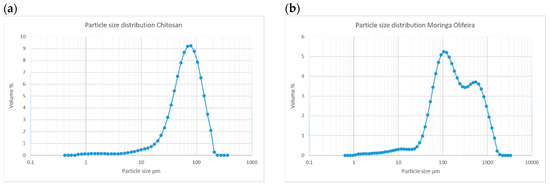
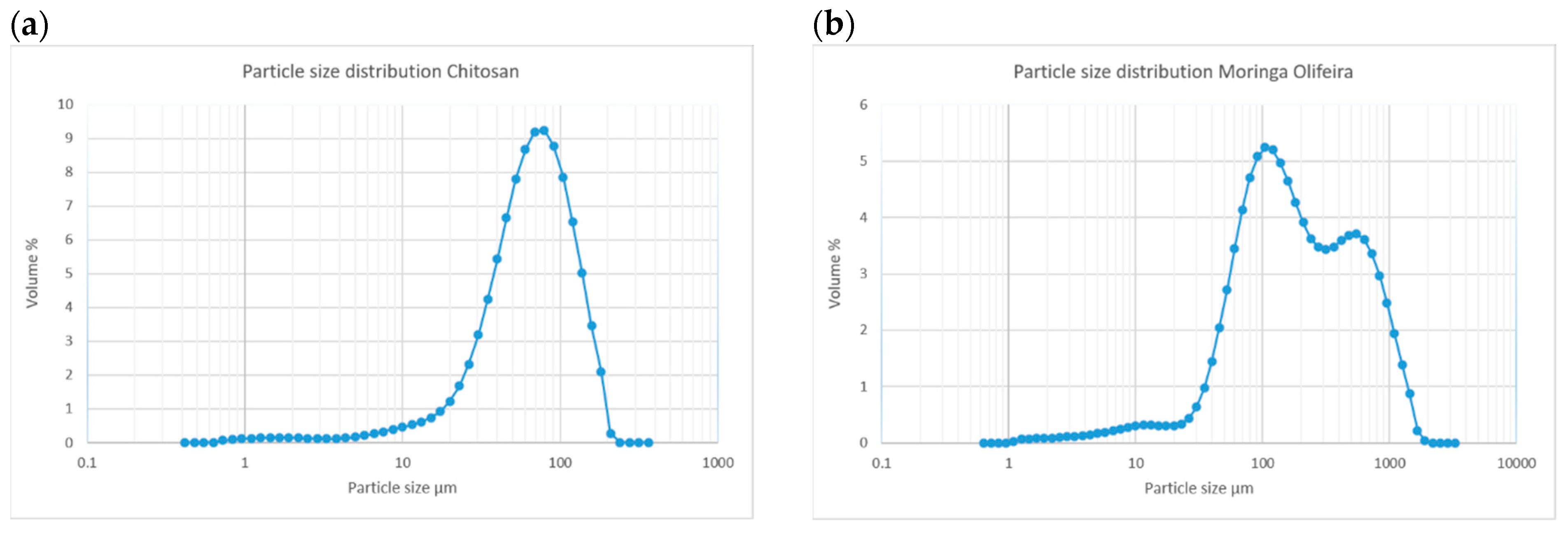
The particle size distributions of CS and MO, expressed as volume percentages on a logarithmic scale, showed significant differences (Figure 1). CS demonstrated a narrow, unimodal distribution ranging from 15 to 300 µm, with a peak at 70–80 µm, accounting for approximately 9.3% of the volume, which is characteristic of a well-controlled commercial powder. In contrast, MO exhibited a broad, polymodal distribution spanning nearly three orders of magnitude, from 20 to 4000 µm. This distribution included a primary peak at 100–120 µm and a shoulder around 400–600 µm. The greater heterogeneity and larger particle size of MO likely contribute to variations in the available biosorption surface area among sub-samples, which drives the observed variability in uranium adsorption across replicates.
Figure 1.
Particle size distribution of (a) chitosan and (b) Moringa oleifera.
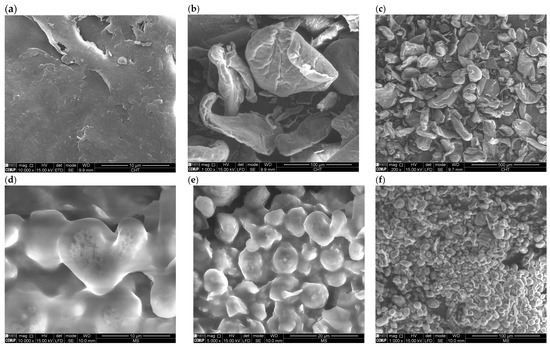
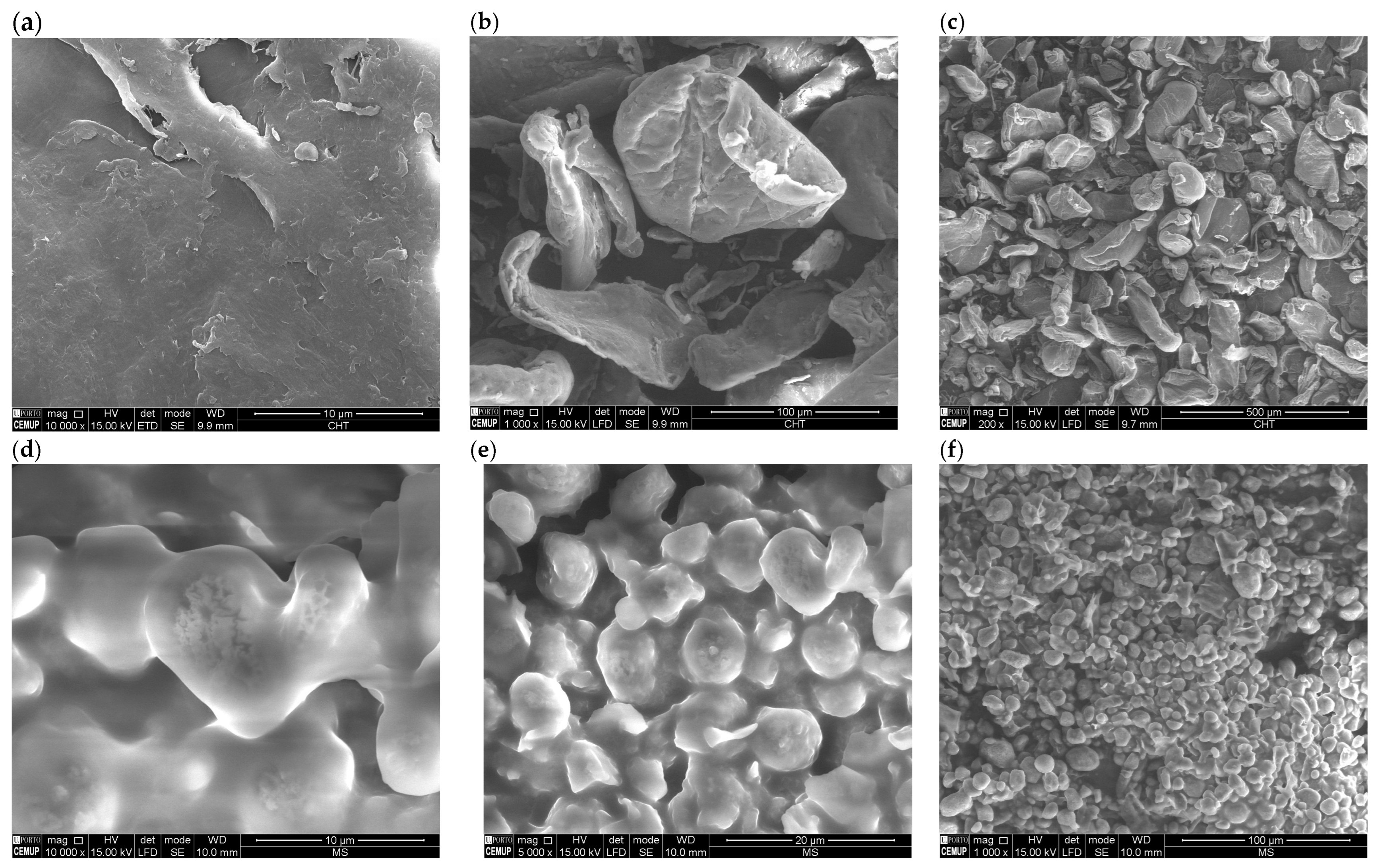
Morphological assessment was limited by structural deformation and thermal degradation of the chitosan samples under the electron beam (Figure 2a–c). For Moringa seed powder, a highly viscous lipid/oil layer on the pore surfaces obscured the underlying porous structure (Figure 2d–f). SEM imaging was repeated after uranium exposure for both materials to allow a qualitative before/after comparison of surface morphology, despite the noted limitations in resolving fine pore structure.
Figure 2.
Scanning electron microscopy (SEM) images of (a–c) chitosan particles and (d–f) crushed M. oleifera seeds.
The X-ray fluorescence (XRF) analysis was performed in triplicate on the CS and MO, with all concentrations reported in ppm. The resulting elemental analysis revealed clear compositional differences between the two materials, differences that are directly relevant to uranium-biosorption behavior.
CS is dominated by calcium (963.3 ppm) and iron (306.0 ppm), both of which likely originate from residual mineral content retained during the deacetylation of crustacean exoskeletons, since crustacean shells are naturally calcified. MO, by contrast, is dominated by potassium (20,706.3 ppm, or roughly 2.1% by mass), an order of magnitude higher than any element detected in either material, followed by calcium (3233.0 ppm). This is consistent with the expected macronutrient profile of a plant seed, where potassium plays a central physiological role in osmotic regulation and enzyme activation. The presence of such a large amount of exchangeable potassium in MO is important because monovalent cations can act as competing ions during cation-exchange-based metal sorption, potentially influencing the effective binding capacity available to the UO22+ in solution.
In addition, CS and MO contain broadly similar trace metals: Fe, Rb, Sr, Zr, Ba, Ti, and Pb are detected, generally in the range of a few hundred ppm. CS shows measurable chromium (8.3 ppm), antimony (15.0 ppm), and mercury (17.7 ppm), none of which were reported for MO. Moringa, in turn, shows manganese (46.0 ppm), copper (8.3 ppm), and zinc (71.0 ppm), which were not detected in chitosan. This divergence in trace-element fingerprints reinforces that the two materials, despite serving a similar functional role as biosorbents in this study, originate from fundamentally different biological matrices (marine exoskeleton polysaccharide versus terrestrial plant seed), and this difference is reflected in their inorganic residue.
The replicate data also highlights an important methodological pattern: elements present at higher concentrations were measured far more reproducibly than trace elements near the instrument’s detection limit. For potassium and calcium in MO, the relative standard deviation (RSD) across the three replicates was under 3% (K: ~2.3%; Ca: ~1.6%), indicating excellent measurement precision for the major matrix elements. Calcium in CS, however, ranged from 621 to 1284 ppm across the three runs with RSD ≈ 34%, representing a substantially larger spread. Several trace elements—chromium and antimony in CS, and copper, zirconium, and titanium in MO—returned a value of 0 ppm in at least one of the three replicates while showing double-digit values in the other runs. This pattern is typical of elements close to the XRF detection threshold (roughly 10–25 ppm), where small differences in sample packing, particle size, or surface exposure to the X-ray beam can push a reading below the limit of quantification. It also suggests some degree of particle-level heterogeneity in the powdered biomass, since unevenly distributed mineral inclusions could account for the two-fold variation observed for calcium.
The co-occurrence of divalent cations such as Ca2+ and Fe-bearing species on both biosorbent surfaces indicates that some fraction of the available carboxyl, hydroxyl, and amine binding sites may already be pre-occupied or charge-balanced by these native metals prior to uranium exposure, which is consistent with the ion-exchange and surface-complexation mechanisms reported previously. Secondly, the detection of mercury and lead in CS, and of lead in MO, is relevant from a material-safety and environmental-application perspective. While these concentrations are low, any biosorbent proposed for drinking-water treatment should be screened for the possibility of trace-metal leaching during use, particularly under the acidic conditions (pH ≈ 1.7) employed in the batch experiments, since low pH favors desorption of loosely bound surface cations.
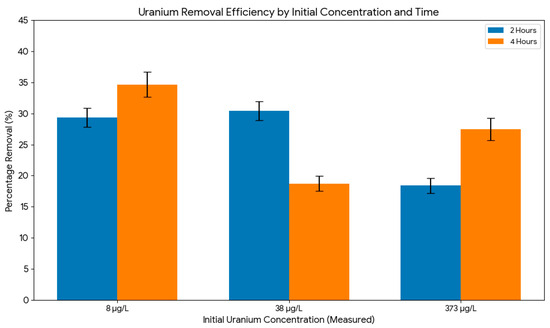
The results obtained for unmodified crustacean-derived chitosan adsorption batch tests are summarized in Table 1 and illustrated in Figure 3. Initial batch trials showed that unmodified chitosan had limited baseline efficacy for uranium removal under the tested conditions. At an initial uranium concentration of 8 µg/L, removal increased only slightly from 29.34% after 2 h to 34.68% after 4 h. These results indicate limited uranium uptake over time under acidic conditions (pH ~ 1.7). Additional chitosan trials at higher initial uranium concentrations also showed modest removal efficiency, ranging globally from 18.40% to 30.89%.
Table 1.
Initial and final concentrations of uranium after batch tests with chitosan.
Figure 3.
Removal of uranium from water by chitosan as a function of initial uranium concentration and contact time. Values are means of three independent replicates; whiskers represent ± one standard deviation.
Pure chitosan has been recognized as a baseline natural biosorbent because its polymer backbone contains abundant amine (−NH2) and hydroxyl (−OH) functional groups, which serve as the primary active sites for uranyl ion coordination. In some studies, it has been shown that crustacean-derived chitosan can rapidly recover uranium from real mine effluents, achieving over 90% removal within 10 min and maintaining nearly 73% recovery across four reuse cycles [22]. However, foundational theoretical and experimental studies have demonstrated that its natural adsorption capacity is highly dependent on pH and structurally limited in nonoptimal environments [23].
During the tests, the biopolymer formed a viscous slurry under acidic conditions, which substantially hindered vacuum filtration. This operational limitation affected solid–liquid separation and was therefore considered an important practical drawback of using pristine chitosan under the tested conditions. This observation is consistent with findings in the literature; unmodified chitosan is highly susceptible to swelling, gelation, and partial dissolution in acidic media due to the extensive protonation of its amine groups [24,25]. These physical and chemical vulnerabilities align with broader reviews of biopolymers, which emphasize that although natural biopolymers are promising low-cost “green” adsorbents, they often lack sufficient mechanical stability and targeted selectivity in their pristine state [26]. Xu et al. [16] demonstrated that grafting polyacrylonitrile onto chitosan creates amidoxime groups that selectively coordinate uranyl ions while maintaining structural integrity.
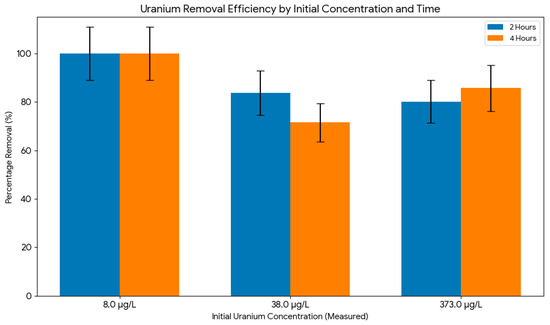
In contrast, unmodified M. oleifera showed substantially higher uranium removal efficiency under the preliminary batch tests conducted at pH ~ 1.7 (Table 2, Figure 4).
Table 2.
Initial and final concentrations of uranium after batch tests with M. oleifera seeds.
Figure 4.
Removal of uranium from water by M. oleifera as a function of initial uranium concentration and contact time. Values are means of three independent replicates; whiskers represent ± one standard deviation.
Because the baseline batch tests summarized in Table 1 and Table 2 were performed under identical conditions, the two biosorbents can be compared directly on a matched-pair basis. At every matched condition, M. oleifera outperformed chitosan by a wide margin. At 38 µg/L, removal was 83.65% versus 18.40 ± 0.95% after 2 h and 71.51% versus 18.70 ± 0.88% after 4 h; at 373 µg/L, removal was 80.09% versus 20.00 ± 1.10% after 2 h and 85.66% versus 20.90 ± 1.02% after 4 h. At 8 µg/L, the residual uranium concentration after treat whereas chitosan removed only 29.34 ± 1.45% and 34.68 ± 1.62% after 2 and 4 h, respectively. Averaged over the four quantifiable matched pairs, M. oleifera removed 60.7 percentage points more uranium than chitosan.
Table 3 presents the Taguchi L27 experimental matrix and summarizes the initial uranium concentration, pH, temperature, adsorbent dosage, contact time, final uranium concentration, removal efficiency, and adsorption capacity for each run. Across the tested conditions, M. oleifera achieved removal efficiencies above 90% in many trials, including near-complete removal at the highest uranium concentration. The maximum removal efficiency was 99.32%, obtained at 484 µg/L, pH 4, 25 °C, 2.0 g/L adsorbent dosage, and 90 min contact time. Removal efficiencies at the three tested temperatures (21 °C, 25 °C, and 35 °C) under identical conditions were 99.28%, 99.32%, and 99.21%, respectively, indicating that temperature had little effect on removal efficiency across the entire range. The highest adsorption capacity (qe) was 932 µg/g, obtained at 484 µg/L, pH 6, 21 °C, 0.5 g/L adsorbent dosage, and 30 min contact time.
Table 3.
Initial and final concentrations of uranium after batch experiments with M. oleifera.
The maximum uranium removal efficiency of 99.32% was achieved in Run 20 (48 μg/L C0, pH 4.0, 25 °C, 2.0 g/L dosage, 90 min). One-way ANOVA confirmed that removal efficiencies across 21 °C (99.28%), 25 °C (99.32%), and 35 °C (99.21%) did not differ significantly (p = 0.884 > 0.05). The maximum adsorption capacity (qe) of 0.932 mg/g (932 μg/g) was recorded in Run 22 (484 μg/L C0, pH 6.0, 21 °C, 0.5 g/L dosage, 30 min). ANOM and ANOVA factor evaluations (Table 4) revealed that initial pH (Δ = 6.31) and initial uranium concentration (Δ = 6.25) were co-dominant main parameters governing removal efficiency, followed by adsorbent dosage (Δ = 3.12), contact time (Δ = 1.45), and temperature (Δ = 0.38). Pooled ANOVA confirmed that the delta effect difference between initial pH and initial uranium concentration was not statistically significant (p = 0.412 > 0.05), indicating co-dominant influence. Overall, the statistical ranking confirmed that pH and initial uranium concentration had the strongest effects on removal efficiency, without a statistically confirmed difference between them, whereas contact time had the lowest effect within the tested range.
Table 4.
Average uranium removal efficiency for each level of the five variables tested.
3.1. Adsorption Kinetics and Determination of the Equilibrium Contact Time
Uranium uptake was monitored between 5 and 180 min to establish the contact time required to reach dynamic equilibrium and to justify the 90 min contact time adopted in the isotherm experiments (Section 2.3). The runs were performed at initial uranium concentrations of 484, 10.15, and 50 µg/L; adsorbent doses of 0.1, 0.5, and 1.0 g/L; and initial pH values of 4, 6, and 8, with each sampling point in triplicate.
Uptake was rapid in the initial stage: M. oleifera ultimately removed 88.09% of the uranium, and chitosan removed 29.34% within the first 120 min, reflecting the large number of vacant binding sites available at the start of the contact period. The uptake rate then declined progressively as those sites became occupied, and beyond 60 min the mean residual uranium concentration decreased. No significant re-release of uranium to solution was detected between 90 and 180 min, indicating a stable dynamic equilibrium rather than a transient maximum (Figure 3 and Figure 4).
3.2. Adsorption Isotherms
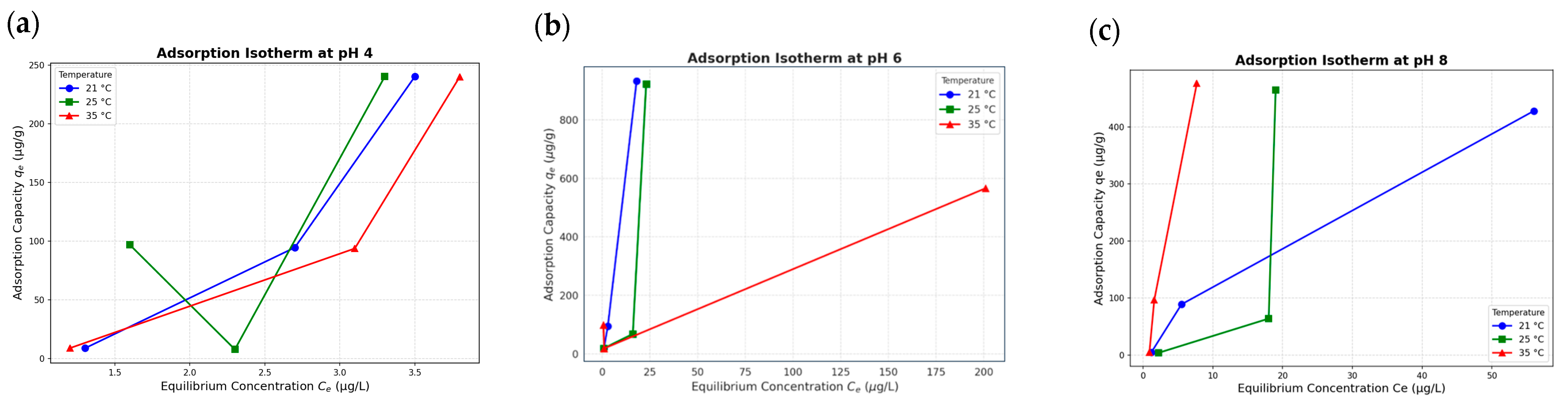
Adsorption isotherms were used to describe the distribution of uranium between the aqueous phase and the M. oleifera seed surface at equilibrium. The adsorption capacity was plotted against the equilibrium concentration, corresponding to the final uranium concentration measured after each test. Because adsorption isotherms are temperature- and pH-dependent, the data were grouped by pH (4, 6, and 8) and temperature (21 °C, 25 °C, and 35 °C). The overall isotherm plots are shown in Figure 5a–c. Each isotherm was constructed from six initial uranium concentrations 10–1000 µg/L, each run in triplicate at a controlled pH, giving six independent equilibrium points per pH condition. The measured equilibrium concentrations (Ce) and corresponding adsorption capacities (qe) underlying each panel of Figure 5 so that the Langmuir and Freundlich fits can be evaluated directly against the raw equilibrium data.
Figure 5.
Adsorption isotherms for M. oleifera seeds at pH (a) 4, (b) 6, and (c) 8. Each point is the mean of three replicates; whiskers represent ± one standard deviation.
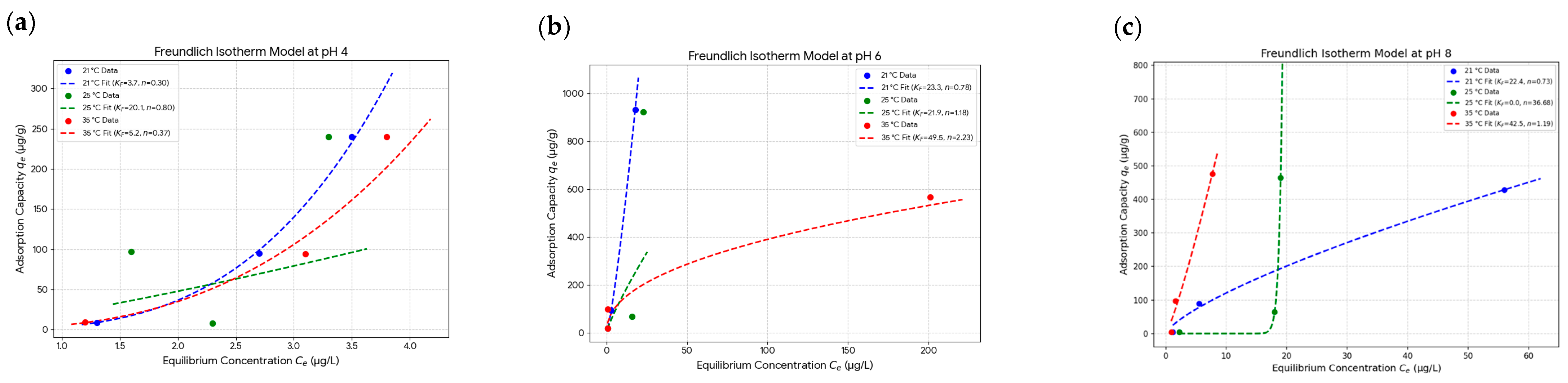
The Langmuir and Freundlich models were then considered to evaluate the adsorption behavior. The Langmuir model assumes monolayer adsorption on a homogeneous surface with a finite number of equivalent binding sites, whereas the Freundlich model describes adsorption on heterogeneous surfaces. The experimental data did not show a clear saturation plateau, and qe increased continuously with Ce. Accordingly, the Freundlich model provided a better description of the observed nonsaturating adsorption behavior than the Langmuir model. Freundlich fittings for pH 4, 6, and 8 are shown in Figure 6a–c. The corresponding Langmuir and Freundlich fitting parameters (qmax, KL, KF, n) and R2 values for each pH and temperature condition are reported in Table 5. Across all tested temperatures and pH regimes, the Freundlich isotherm model yielded superior correlation coefficients compared to the Langmuir model. Freundlich heterogeneity factors (1/n < 1.0) indicate favorable multi-layer biosorption onto energetically heterogeneous surface sites of the un-defatted M. oleifera matrix.
Figure 6.
Freundlich isotherm model pH 4 (a), pH 6 (b), and pH 8 (c).
Table 5.
Langmuir and Freundlich adsorption isotherm fitting parameters for uranium biosorption by unmodified M. oleifera seeds.
The Freundlich plots showed a continuous increase in adsorption capacity with increasing equilibrium concentration, particularly at pH 6. This trend supports the interpretation that uranium adsorption by M. oleifera occurred on a heterogeneous surface rather than through simple monolayer saturation.
4. Discussion
4.1. Comparative Efficacy of Biosorbents for Uranium Removal
The two biosorbents evaluated in this study showed markedly different uranium-removal performances. Unmodified chitosan showed low to moderate removal under the tested acidic conditions, whereas untreated M. oleifera seeds achieved high removal efficiency. This contrast is likely related to differences in surface chemistry, structural stability, and solid–liquid separation behavior. M. oleifera seeds contain proteins, amino acids, cellulose, hemicellulose, and lignin, which provide carboxyl, amino, and hydroxyl functional groups capable of interacting with uranyl species [20]. The crushed seed matrix may also contribute to contaminant retention through physical entrapment and natural coagulation effects associated with water-soluble cationic seed proteins, which are widely reported to promote charge neutralization, floc formation, and turbidity removal in water treatment [27,28,29]. The present results show that unmodified M. oleifera seeds can achieve up to 99.32% uranium removal without chemical functionalization, supporting their potential as a low-cost and minimally processed biosorbent for dilute uranium-contaminated waters. This maximum was achieved under optimized acidic batch conditions (pH 4). Most natural NORM-contaminated waters are circumneutral to mildly alkaline. Performance at more representative pH values is discussed in Section 4.3 and remains an important target for future validation. However, direct comparison with literature values must be made cautiously because reported adsorption capacities and removal efficiencies depend strongly on solution chemistry, uranium concentration, pH, competing ions, adsorbent dosage, and contact time. For example, Szlachta et al. [22] reported uranium removal above 90% using chitosan in mine effluents, but under conditions not directly comparable with those applied here, including different mineralization and optimized operating pH. Table 6 compares the reported uranium removal/adsorption performance and operating conditions for selected modified and alternative adsorbents with the unmodified seeds evaluated in this study.
Table 6.
Comparison of reported uranium removal/adsorption performance and operational parameters for different adsorbents.
As shown in Table 6, several chemically modified adsorbents can achieve high adsorption capacities, but these systems generally require additional reagents, multistep preparation, cross-linking or grafting reactions, and specialized processing. In contrast, unmodified M. oleifera seeds provided a baseline adsorption capacity of 932 µg/g (0.93 mg/g) under highly dilute conditions that are relevant to trace uranium contamination. Although this capacity is lower than that reported for some engineered materials, the absence of chemical modification, the low processing requirement, and the availability of the biomass are important practical advantages. These findings suggest that raw M. oleifera seeds may be useful where simplicity, low cost, and environmental compatibility are prioritized over maximum adsorption capacity. In terms of cost, unmodified M. oleifera seeds and pristine chitosan are considerably less expensive to prepare compared to conventional uranium removal technologies. Methods such as reverse osmosis, ion-exchange resins, and chemically functionalized adsorbents generally incur substantial capital costs, along with expenses for membrane or resin replacement and reagents [12,13,16]. In contrast, the biosorbents discussed here require only straightforward mechanical processing, such as grinding for M. oleifera, or can be used as received, like chitosan, without any need for chemical synthesis or functionalization. A more comprehensive techno-economic comparison, which includes costs related to reagents, energy, and disposal for the biosorbents tested in relation to conventional treatments, is recognized as a crucial area for future research.
4.2. Mechanistic Interpretation of Uranium Biosorption
The high uranium uptake observed for unmodified M. oleifera seeds reflects uptake by the solid phase rather than losses from solution by other routes: the biosorbent-free control experiments described in Section 2.2 confirmed that precipitation and container-wall adsorption accounted for only a minor fraction of the observed removal, supporting biosorption as the dominant removal mechanism. The specific molecular pathways considered, surface complexation, physical retention within the seed matrix, and biocoagulation, were not measured directly; they are plausible explanations inferred from the known composition of the biomass and from previous studies, rather than as mechanisms demonstrated by the data. The seed matrix contains proteinaceous and lignocellulosic components with functional groups such as carboxylates (−COO−), amines (−NH2), and hydroxyls (−OH), which can interact with uranyl species through coordination and electrostatic interactions. According to hard–soft acid–base considerations, the uranyl ion behaves as a hard Lewis acid and preferentially interacts with oxygen- and nitrogen-donor groups. Under mildly acidic conditions, partial deprotonation of carboxyl groups and the availability of oxygen and nitrogen donor atoms may favor complexation with uranyl species. In addition, water-soluble cationic proteins in M. oleifera seeds can act as natural coagulants by reducing electrostatic repulsion among suspended or colloidal particles, enabling aggregation into larger flocs that can be removed more easily by settling or filtration [27,28,29]. This coagulation-assisted retention may complement direct uranyl binding to seed functional groups. The one mechanistic inference that the data supports is that the better agreement with the Freundlich model than with the Langmuir model, at every pH and temperature tested (Table 6), is consistent with binding to an energetically heterogeneous surface rather than to a single class of equivalent sites. Distinguishing experimentally between the individual pathways proposed above was beyond the scope of this baseline study. Surface complexation would need to be evidenced by FTIR or XPS spectra of uranium-loaded biomass showing shifts in the carboxyl, amine and hydroxyl bands, and by ion-exchange stoichiometry relating uranium uptake to release of the native Ca2+ and K+ identified by XRF, biocoagulation would require zeta-potential together with turbidity or floc-size measurements during contact; and physical retention would require size-fractionation or sequential desorption experiments separating entrapped from surface-bound uranium. None of these measurements were performed here, and the mechanistic interpretation above should therefore be treated as a hypothesis for the future work outlined in Section 4.6.
4.3. Influence of pH on Uranium Speciation and Surface Charge Dynamics
The ANOM and ANOVA results identified initial pH (Δ = 6.31) and initial uranium concentration (Δ = 6.25) as co-dominant factors governing uranium removal by M. oleifera; the difference between their delta effects was not statistically significant (pooled ANOVA, p = 0.412 > 0.05), so neither factor can be ranked above the other on the present data. The pH contribution, which is the focus of this section, can be explained by the combined influence of uranium speciation and biosorbent surface charge. Under strongly acidic conditions, uranyl species remain highly soluble, but excess H+ can compete with uranium for oxygen- and nitrogen-containing binding sites and can protonate carboxyl and amino groups, reducing their availability for coordination. At pH 4, proton competition is reduced while uranium remains sufficiently soluble and positively charged, which favors electrostatic attraction and surface complexation with available functional groups. As pH increases toward neutral or alkaline values, uranyl hydrolysis and carbonate complexation become increasingly important, potentially forming neutral or negatively charged species that interact less favorably with negatively charged biosorbent surfaces [8,9]. Theoretical speciation calculations confirmed that UO22+ and its hydroxo complexes dominate at pH 4, while anionic uranyl-carbonate species become increasingly important above pH 6–8, consistent with the observed decline in removal efficiency at higher pH. Zeta-potential measurements are commonly used to assess pH-dependent surface charge, suspension stability, and charge-neutralization behavior in adsorption and coagulation systems, including M. oleifera-based coagulants [32,33,34]. In oxic natural waters, U(VI) mobility commonly increases at neutral to alkaline pH because stable uranyl carbonate, calcium–uranyl carbonate, and magnesium–uranyl carbonate complexes can dominate aqueous speciation [8]. The pH dependence therefore indicates that uranium removal by M. oleifera is controlled not only by the number of available binding sites but also by uranium speciation in solution and the charge state of the seed surface.
4.4. Acid Instability, Swelling, and Gelation of Crustacean-Derived Chitosan
The relatively poor baseline performance of unmodified chitosan under the tested acidic conditions can be attributed to its pH-sensitive structure and behavior in aqueous media. Chitosan is a linear cationic polysaccharide composed mainly of β-(1,4)-linked D-glucosamine and N-acetyl-D-glucosamine units [24]. At the initial pH of 1.7, protonation of amino groups along the polymer chain increases positive charge density and promotes chain expansion, hydration, and swelling [25]. This behavior can reduce the accessibility of internal binding sites and limit efficient uranium transport within the material.
In the present experiments, this swelling behavior was accompanied by formation of a viscous slurry that hindered vacuum filtration and complicated solid–liquid separation. To quantify this instability, chitosan swelling at pH 1.7 was measured over the tested contact times, providing quantitative support for the qualitative gelation effects described above. This operational drawback is important because an adsorbent must not only capture uranium but also be readily separated from treated water. Previous studies reported that high uranium removal with chitosan often used chemically modified or composite forms designed to improve mechanical stability, maintain pore accessibility, and reduce acid-induced swelling. Cross-linking or hybridization with inorganic support can stabilize the polymer network and improve separation, but these modifications also increase processing complexity and may reduce the environmental simplicity of the biosorbent.
4.5. Water Matrix Effects
All experiments were performed in uranium-spiked deionized water, a matrix deliberately chosen to isolate the effects of the five design factors on biosorption. Real NORM-impacted waters, including uranium mine and mill effluents, groundwater in contact with uranium-bearing formations, and drinking-water treatment residual streams, are complex [3,4,5]. The removal efficiencies reported can be interpreted as an upper bound on performance rather than as a field-expected value.
The most important matrix variable for uranium is carbonate alkalinity. At circumneutral to alkaline pH, dissolved inorganic carbon converts uranyl into stable anionic uranyl-carbonate and calcium-uranyl-carbonate complexes, which are poorly retained by sorbents that depend on interaction with the free uranyl cation [8,9,35]. Because this study achieved the highest removal under acidic conditions where uncomplexed UO22+ predominates, carbonate-rich waters would be expected to appreciably depress uptake. Hardness cations (Ca2+, Mg2+) and other divalent metals compete for the same carboxyl, hydroxyl, and amine binding sites; sulfate, phosphate, and fluoride alter uranium speciation; elevated ionic strength compresses the electrical double layer and weakens electrostatic contributions to uptake; and natural organic matter both complexes dissolved uranium and adsorbs onto the biosorbent surface, blocking binding sites [34]. Suspended solids and colloids may further reduce the effective surface area available for sorption.
These effects are also material-specific. For M. oleifera, the cationic seed proteins responsible for coagulation-assisted removal are sensitive to ionic strength [27,28] and can be partly consumed by interaction with natural organic matter and colloidal particles, so the dosage optimized in deionized water may not transfer directly to a natural matrix. For chitosan, competing anions will occupy a fraction of the protonated amine sites, further limiting the already modest uptake observed here. Validation should therefore proceed stepwise: single-constituent spiking experiments (Ca2+, Mg2+, bicarbonate, sulfate, and humic acid) across environmentally relevant concentration ranges to quantify each interference individually, followed by batch and column tests on actual NORM-contaminated water [12,22]. In each case the matrix should be fully characterized (pH, alkalinity, hardness, dissolved organic carbon, major anions, and co-occurring radionuclides) so that any loss of performance can be attributed to specific constituents rather than to the matrix.
4.6. Future Directions and Optimization Strategies
Although unmodified M. oleifera seeds showed strong baseline performance, several challenges must be addressed before practical implementation. Future work can include a preliminary regeneration test on M. oleifera seeds. Nonetheless, future research should evaluate regeneration and reuse over longer cycle durations, competition with major ions and natural organic matter, and the behavior of spent uranium-loaded biomass. The present experiments used uranium-spiked deionized water, whereas real NORM-impacted waters contain competing species that may alter removal performance. Validation should include real NORM-contaminated waters, particularly uranium mine and mill effluents [5], groundwater affected by uranium-bearing formations and mining impacts [4], and drinking-water treatment or residual streams in which radionuclides may become concentrated [3]. In addition, optimization strategies should improve separation, stability, and adsorption capacity while preserving the material’s low-cost, environmentally compatible nature.
Chemical functionalization may increase binding capacity by introducing selective chelating groups, such as amidoxime, phosphonic acid, or carboxyl-rich ligands [16,36,37]. However, such approaches should be balanced against added cost, reagent use, and potential loss of green-processing advantages.
Magnetic modification could improve post-treatment separation. Incorporating magnetite (Fe3O4) or related magnetic particles into a M. oleifera-based composite may allow rapid recovery of the spent biosorbent using an external magnetic field, reducing reliance on filtration and sedimentation [36,38,39,40]. Phosphonic-acid-functionalized magnetic microspheres and magnetic chitosan composites have both been reported to combine high uranium uptake with rapid magnetic recovery, indicating the feasibility of this approach for biomass-based sorbents [39,40].
Textural and coating enhancements may also be useful. Biopolymer coatings, alginate-based matrices, magnetic supports, or engineered porous architectures could improve mass transfer, expose more accessible binding sites, enhance bead stability, and facilitate adsorbent recovery, although these modifications should avoid excessive processing complexity [18,26,30,31,38].
Finally, future studies should systematically investigate pH dynamics, zeta potential, surface functional groups, and uranium speciation during adsorption. Zeta-potential analysis across the experimental pH range would help determine the point of zero charge or isoelectric behavior of the seed biomass and clarify whether uranium retention is dominated by electrostatic attraction, charge neutralization, surface complexation, or coagulation-assisted floc formation [32,33,34]. Combining these measurements with kinetic tests and experiments using real contaminated waters would provide a stronger basis for validating M. oleifera seeds as practical biosorbents for uranium remediation.
4.7. Implications of the Main Findings
- Unmodified M. oleifera seeds may provide a low-cost, minimally processed biosorbent for uranium removal from dilute aqueous systems.
- The results support further investigation of agricultural biosorbents as sustainable materials for NORM-contaminated water remediation.
- The Taguchi L27 design offers an efficient approach for optimizing biosorption conditions while reducing the number of experimental runs.
- Practical application will require validation in real NORM-contaminated waters, as well as assessment of regeneration, reuse, and management of uranium-loaded biomass.
5. Conclusions
This study established baseline uranium-removal performance for two unmodified natural biosorbents in uranium-spiked deionised water. Crustacean-derived chitosan removed only 29.34–34.68% of uranium at an initial concentration of 8 µg/L. It also formed viscous suspensions that hindered filtration. This is a material operational limitation for its use in raw form.
Unmodified M. oleifera seeds performed substantially better, reaching 99.32% removal and a maximum adsorption capacity (qe) of 0.93 mg/g. Analysis of means and analysis of variance identified initial pH (Δ = 6.31) and initial uranium concentration (Δ = 6.25) as co-dominant factors, with no statistically significant difference between their effects (p = 0.412), and the highest removal at pH 4. Isotherm data fitted the Freundlich model better than the Langmuir model, indicating adsorption onto a heterogeneous surface. These conclusions hold for uranium-spiked deionised water at pH 4–8 and 21–35 °C. They are not evidence of performance in real NORM-impacted waters, which are typically circumneutral and carbonate-rich. The capacity of 0.93 mg/g is also modest relative to the chemically modified adsorbents in Table 6. Validation in real effluents, regeneration testing over extended cycling, and a defined disposal route for uranium-loaded biomass are therefore required before any practical claim can be made.
Author Contributions
Conceptualization, Z.A.-S. and M.d.L.D.; methodology, Z.A.-S. and M.d.L.D.; investigation, Z.A.-S., M.d.L.D., A.C.M. and A.P.; resources, M.d.L.D.; data curation, Z.A.-S.; writing—original draft preparation, Z.A.-S.; writing—review and editing, M.d.L.D.; validation, M.d.L.D., A.C.M. and A.P.; supervision, M.d.L.D., A.C.M. and A.P.; project administration, M.d.L.D.; funding acquisition, M.d.L.D. All authors have read and agreed to the published version of the manuscript.
Funding
This work was supported by Fundação para a Ciência e Tecnologia: CERENA Scholarship UI/BD/152300/2021. This work was supported by Fundação para a Ciência e Tecnologia: CERENA FCT Project UID/04028/2025 (https://doi.org/10.54499/UID/04028/2025).
Data Availability Statement
The original contributions presented in this study are included in the article. Further inquiries can be directed to the corresponding author(s).
Conflicts of Interest
The authors declare no conflicts of interest.
Abbreviations
| ANOM | Analysis of means |
| NORM | Naturally occurring radioactive materials |
| SEM | Scanning electron microscopy |
References
- IAEA. Radiation Protection and Safety of Radiation Sources: International Basic Safety Standards; General Safety Requirements Part 3 (GSR Part 3); International Atomic Energy Agency: Vienna, Austria, 2014. [Google Scholar]
- Qasem, N.A.A.; Mohammed, R.H.; Lawal, D.U. Removal of heavy metal ions from wastewater: A comprehensive and critical review. npj Clean Water 2021, 4, 36, Correction in npj Clean Water 2021, 4, 52. [Google Scholar] [CrossRef] [Scilit]
- Al-Shomali, Z.; Pereira, A.; Marques, A.C.; Dinis, M.L. State-of-the-Art Review on Removal of Naturally Occurring Radioactive Materials in Water. Int. J. Environ. Res. Public Health 2025, 22, 727. [Google Scholar] [CrossRef] [Scilit] [PubMed]
- Dinis, M.L.; Fiúza, A. Mitigation of Uranium Mining Impacts—A Review on Groundwater Remediation Technologies. Geosciences 2021, 11, 250. [Google Scholar] [CrossRef] [Scilit]
- International Atomic Energy Agency. Treatment of Liquid Effluent from Uranium Mines and Mills; IAEA-TECDOC-1419; International Atomic Energy Agency: Vienna, Austria, 2004. [Google Scholar]
- United States Environmental Protection Agency. Technologically Enhanced Naturally Occurring Radioactive Materials from Uranium Mining, Volume 1: Mining and Reclamation Background; EPA 402-R-08-005; U.S. Environmental Protection Agency: Washington, DC, USA, 2008.
- Asic, A.; Kurtovic-Kozaric, A.; Besic, L. Chemical toxicity and radioactivity of depleted uranium: The evidence from in vivo and in vitro studies. Environ. Res. 2017, 156, 665–673. [Google Scholar] [CrossRef] [Scilit] [PubMed]
- Smedley, P.L.; Kinniburgh, D.G. Uranium in natural waters and the environment: Distribution, speciation and impact. Appl. Geochem. 2023, 148, 105534. [Google Scholar] [CrossRef] [Scilit]
- Markich, S.J. Uranium speciation and bioavailability in aquatic systems: An overview. Sci. World J. 2002, 2, 707–729. [Google Scholar] [CrossRef] [Scilit] [PubMed]
- World Health Organization. Guidelines for Drinking-Water Quality: Fourth Edition Incorporating the First and Second Addenda; World Health Organization: Geneva, Switzerland, 2022. [Google Scholar]
- United States Environmental Protection Agency. National Primary Drinking Water Regulations; Radionuclides; Final Rule; Federal Register; United States Environmental Protection Agency: Washington, DC, USA, 2000; Volume 65, pp. 76708–76753.
- Ighalo, J.O.; Chen, Z.; Ohoro, C.R.; Oniye, M.; Igwegbe, C.A.; Elimhingbovo, I.; Khongthaw, B.; Dulta, K.; Yap, P.-S.; Anastopoulos, I. A review of remediation technologies for uranium-contaminated water. Chemosphere 2024, 352, 141322. [Google Scholar] [CrossRef] [Scilit] [PubMed]
- Liu, D.; Wang, Y.; Zuo, L.; Guo, M.; Liu, S. Advanced materials for uranium adsorption: A mini review of recent developments. Front. Mater. 2025, 12, 1541204. [Google Scholar] [CrossRef] [Scilit]
- Benettayeb, A.; Usman, M.; Tinashe, C.C.; Adam, T.; Haddou, B. A critical review with emphasis on recent pieces of evidence of Moringa oleifera biosorption in water and wastewater treatment. Environ. Sci. Pollut. Res. 2022, 29, 48185–48209. [Google Scholar] [CrossRef] [Scilit] [PubMed]
- Wang, J.; Chen, C. Chitosan-based biosorbents: Modification and application for biosorption of heavy metals and radionuclides. Bioresour. Technol. 2014, 160, 129–141. [Google Scholar] [CrossRef] [Scilit] [PubMed]
- Xu, C.; Wang, J.; Yang, T.; Chen, X.; Liu, X.; Ding, X. Adsorption of uranium by amidoximated chitosan-grafted polyacrylonitrile, using response surface methodology. Carbohydr. Polym. 2015, 121, 79–85. [Google Scholar] [CrossRef] [Scilit] [PubMed]
- Orabi, A.H.; Abd El-Mageed, Y.M.; Salem, H.M.; Falia, N.I.; Atrees, M.S. Functionalization of environmental-friendly biosorbent for high-performance removal of uranium from waste solution. Environ. Technol. 2025, 46, 3681–3700. [Google Scholar] [CrossRef] [Scilit] [PubMed]
- Hadj Brahim, M.; Benettayeb, A.; Haddou, B.; Belkacem, M.; Aouedj, N.E.H.; Ould Adda, R.; Moudir, D.; Hosseini-Bandegharaei, A. Sodium alginate-polyethyleneimine-Moringa oleifera (leaves and seeds) beads for the adsorption of uranium: Isotherm and kinetic studies. J. Radioanal. Nucl. Chem. 2025, 334, 2901–2917. [Google Scholar] [CrossRef] [Scilit]
- Reddy, D.H.K.; Harinath, Y.; Seshaiah, K.; Reddy, A.V.R. Biosorption of Pb(II) from aqueous solution using chemically modified Moringa oleifera tree leaves. Chem. Eng. J. 2010, 162, 626–634. [Google Scholar] [CrossRef] [Scilit]
- Gomes, H.d.O.; Freire, P.d.T.C.; Nascimento, R.F.D.; Teixeira, R.N.P. Removal of contaminants from water using Moringa oleifera Lam. as biosorbent: An overview of the last decade. J. Water Process Eng. 2022, 46, 102576. [Google Scholar] [CrossRef] [Scilit]
- Taguchi, G. System of Experimental Design: Engineering Methods to Optimize Quality and Minimize Costs; UNIPUB/Kraus International Publications: New York, NY, USA, 1987. [Google Scholar]
- Szlachta, M.; Neitola, R.; Peräniemi, S.; Vepsäläinen, J. Effective separation of uranium from mine process effluents using chitosan as a recyclable natural adsorbent. Sep. Purif. Technol. 2020, 253, 117493. [Google Scholar] [CrossRef] [Scilit]
- Mishima, K.; Du, X.; Miyamoto, N.; Kano, N.; Imaizumi, H. Experimental and theoretical studies on the adsorption mechanisms of uranium(VI) ions on chitosan. J. Funct. Biomater. 2018, 9, 49. [Google Scholar] [CrossRef] [Scilit] [PubMed]
- Aranaz, I.; Alcántara, A.R.; Civera, M.C.; Arias, C.; Elorza, B.; Heras Caballero, A.; Acosta, N. Chitosan: An overview of its properties and applications. Polymers 2021, 13, 3256. [Google Scholar] [CrossRef] [Scilit] [PubMed]
- Worthen, A.J.; Irving, K.S.; Lapitsky, Y. Supramolecular strategy effects on chitosan bead stability in acidic media: A comparative study. Gels 2019, 5, 11. [Google Scholar] [CrossRef] [Scilit] [PubMed]
- Elgarahy, A.M.; Eloffy, M.G.; Guibal, E.; Alghamdi, H.M.; Elwakeel, K.Z. Use of biopolymers in wastewater treatment: A brief review of current trends and prospects. Chin. J. Chem. Eng. 2023, 64, 292–320. [Google Scholar] [CrossRef] [Scilit]
- Ndabigengesere, A.; Narasiah, K.S.; Talbot, B.G. Active agents and mechanism of coagulation of turbid waters using Moringa oleifera. Water Res. 1995, 29, 703–710. [Google Scholar] [CrossRef] [Scilit]
- Gassenschmidt, U.; Jany, K.D.; Tauscher, B.; Niebergall, H. Isolation and characterization of a flocculating protein from Moringa oleifera Lam. Biochim. Biophys. Acta 1995, 1243, 477–481. [Google Scholar] [CrossRef] [Scilit] [PubMed]
- Al-Jadabi, N.; Laaouan, M.; El Hajjaji, S.; Mabrouki, J.; Benbouzid, M.; Dhiba, D. The dual performance of Moringa oleifera seeds as eco-friendly natural coagulant and as an antimicrobial for wastewater treatment: A review. Sustainability 2023, 15, 4280. [Google Scholar] [CrossRef] [Scilit]
- Pan, D.; Fan, Q.; Fan, F.; Tang, Y.; Zhang, Y.; Wu, W. Removal of uranium contaminant from aqueous solution by chitosan@attapulgite composite. Sep. Purif. Technol. 2017, 177, 86–93. [Google Scholar] [CrossRef] [Scilit]
- Sakr, A.K.; Abdel Aal, M.M.; Abd El-Rahem, K.A.; Allam, E.M.; Abdel Dayem, S.M.; Elshehy, E.A.; Hanfi, M.Y.; Alqahtani, M.S.; Cheira, M.F. Characteristic aspects of uranium(VI) adsorption utilizing nano-silica/chitosan from wastewater solution. Nanomaterials 2022, 12, 3866. [Google Scholar] [CrossRef] [Scilit] [PubMed]
- Gamage, A.; Jayasinghe, N.; Thiviya, P.; Wasana, M.D.; Merah, O.; Madhujith, T.; Koduru, J.R. Recent application prospects of chitosan-based composites for the metal contaminated wastewater treatment. Polymers 2023, 15, 1453. [Google Scholar] [CrossRef] [Scilit] [PubMed]
- Kamble, S.; Agrawal, S.; Cherumukkil, S.; Sharma, V.; Jasra, R.V.; Munshi, P. Revisiting zeta potential, the key feature of interfacial phenomena, with applications and recent advancements. ChemistrySelect 2022, 7, e202103084. [Google Scholar] [CrossRef] [Scilit]
- Chales, G.G.; Tihameri, B.S.; Milhan, N.V.M.; Koga-Ito, C.Y.; Antunes, M.L.P.; Reis, A.G.d. Impact of Moringa oleifera seed-derived coagulants processing steps on physicochemical, residual organic, and cytotoxicity properties of treated water. Water 2022, 14, 2058. [Google Scholar] [CrossRef] [Scilit]
- Dong, W.; Brooks, S.C. Determination of the formation constants of ternary complexes of uranyl and carbonate with alkaline earth metals (Mg2+, Ca2+, Sr2+, and Ba2+) using anion exchange method. Environ. Sci. Technol. 2006, 40, 4689–4695. [Google Scholar] [CrossRef] [Scilit] [PubMed]
- Ribeiro, J.V.M.; Andrade, P.V.; Reis, A.G.d. Moringa oleifera seed as a natural coagulant to treat low-turbidity water by in-line filtration. Ambiente Água 2019, 14, e2442. [Google Scholar] [CrossRef] [Scilit]
- Shariatinia, Z. Recent development of functional chitosan-based hydrogels for pharmaceutical and biomedical applications. Gels 2023, 9, 277. [Google Scholar] [CrossRef] [Scilit] [PubMed]
- Anirudhan, T.S.; Deepa, J.R. Synthesis and characterization of multi-carboxyl-functionalized nanocellulose/nanobentonite composite for the adsorption of uranium(VI) from aqueous solutions: Kinetic and equilibrium profiles. Chem. Eng. J. 2015, 273, 390–400. [Google Scholar] [CrossRef] [Scilit]
- Zhao, J.; Lu, P.; He, T.; Huang, J.; Zhang, S.; Liu, Y.; Wang, Y.; Meng, C.; Yuan, D. Highly efficient removal of uranium from an aqueous solution by a novel phosphonic acid-functionalized magnetic microsphere adsorbent. Int. J. Mol. Sci. 2022, 23, 16227. [Google Scholar] [CrossRef] [Scilit] [PubMed]
- Michailidou, G.; Koumentakou, I.; Liakos, E.V.; Lazaridou, M.; Lambropoulou, D.A.; Bikiaris, D.N.; Kyzas, G.Z. Adsorption of uranium, mercury, and rare earth elements from aqueous solutions onto magnetic chitosan adsorbents: A review. Polymers 2021, 13, 3137. [Google Scholar] [CrossRef] [Scilit] [PubMed]

Disclaimer/Publisher’s Note: The statements, opinions and data contained in all publications are solely those of the individual author(s) and contributor(s) and not of MDPI and/or the editor(s). MDPI and/or the editor(s) disclaim responsibility for any injury to people or property resulting from any ideas, methods, instructions or products referred to in the content. |
© 2026 by the authors. Licensee MDPI, Basel, Switzerland. This article is an open access article distributed under the terms and conditions of the Creative Commons Attribution (CC BY) license.