


Abstract
Microalgae in high-rate algal pond (HRAP) systems sustain elevated rates of photosynthetic carbon fixation and nutrient assimilation compared with natural aquatic ecosystems, owing to their optimized operating conditions, such as shallow depth, continuous mixing, and high light and nutrient availability. HRAPs offer a low-cost option for wastewater treatment and CO2 sequestration, yet their combined performance under tropical conditions, particularly when treating landfill leachate, remains poorly documented. This case study reports the operation of a single pilot-scale HRAP treating undiluted constructed-wetland effluent receiving landfill leachate in Valle del Cauca, Colombia, monitored over one continuous experimental run to jointly assess water-quality performance, daytime CO2 uptake, and the resident algal community. The pond was operated continuously at 0.14 m3 d−1, and physicochemical variables (pH, dissolved oxygen, conductivity, and redox potential) were monitored three times per week. Carbon fixation was estimated from a daytime inorganic-carbon mass balance (influent and effluent carbon, gas exchange, and respiration) combined with static-chamber measurements. The system effectively removed the soluble organic fraction of the leachate (soluble COD of 22.2%; soluble BOD5 of 58.9%), whereas the apparent increases in total COD, total BOD5, and suspended solids were attributable to in-pond microalgal biomass production. Under tropical sunlight, the pond fixed approximately 33.1 g C d−1 (95% CI 14.8–51.5), acting as a net CO2 sink during daylight hours. Sixteen algal taxa, mainly from the Chlorophyceae and Chlamydophyceae, were identified by morphological keys, several of which have not been previously reported in leachate-treatment systems. As an unreplicated pilot-scale case study without a parallel control, the quantitative estimates should be interpreted as system-specific rather than generalizable; nonetheless, the results provide a field reference for CO2 biofixation and leachate treatment in tropical HRAPs and a basis for future controlled, replicated studies.
1. Introduction
In high-rate algal ponds (HRAPs), microalgae use solar energy to fix dissolved inorganic carbon through photosynthesis, releasing oxygen that heterotrophic bacteria then use to aerobically degrade organic matter [1,2,3]. These systems not only provide a treatment option but also contribute to mitigating the effects of excess CO2 in the atmosphere and thus climate change [4]. Since the Industrial Revolution (1760–1840), global atmospheric CO2 concentrations have increased by approximately 49%, mainly owing to burning fossil fuels primarily for energy production. Worldwide, approximately 32,840 million metric tons of CO2 from the combustion of fossil fuels were added to the atmosphere in 2017 [5]. Thus, in 2022, atmospheric concentration was 417 ppm versus 280 ppm in preindustrial times [6]. This concentration is projected to increase as world population estimates forecast nearly 10 billion people by 2050 [7,8].
Given the urgent need to mitigate rising atmospheric CO2 concentrations, high-rate algal ponds (HRAPs) offer a promising mitigation strategy; their rapid algal growth and high CO2 fixation efficiency make them a technically viable option for large-scale implementation in tropical climates [9,10]. Microalgae exhibit several characteristics that make them attractive for CO2 biofixation compared to terrestrial crops, including simple nutrient requirements (nitrogen, phosphate, trace metals, water, CO2, and sunlight). Moreover, their efficient water use enhances their viability as a solution for increased atmospheric CO2 levels [11,12]. While concerns about the high surface area required for microalgal cultivation persist, recent research suggests that this space can be utilized for both agricultural and productive activities, further supporting their commercial viability [13,14,15]. Additionally, microalgal crops have gained attention as a potential commercial and food production alternative [16]. The growing understanding of microalgal CO2 biofixation capacity has become increasingly relevant for climate mitigation strategies [10,17].
High-rate algal ponds (HRAPs) are shallow raceway systems generally 0.2–0.7 m deep whose paddle-wheel mixing keeps the water column well mixed; the combination of shallow depth and vertical mixing allows microalgae to attain high biomass densities [12,18]. These systems are called so because of their improved biomass yields or productivity rates and their wastewater treatment capacity compared with other systems, such as facultative ponds [19,20], as their cellular retention time is longer than their hydraulic retention time [12]. The utilization of these systems has been predominantly focused on the treatment of municipal, industrial, and agricultural wastewater [21,22]. The functionality of these systems is subject to the diurnal rhythm of the algae in the mixture and water column, which may result in fluctuations in dissolved oxygen (DO) concentrations and pH levels during the day [21,22]. DO concentrations and pH can reach a maximum peak at noon. DO concentrations decline sharply at night, often reaching anoxic conditions, whereas pH also decreases as a result of CO2 accumulation from respiration; DO concentrations at midday can exceed 20 mg L−1 [21]. Performance in these systems therefore depends not merely on the presence of microalgae but on the operational conditions under which the consortium is maintained: hydraulic retention time and feeding pattern, irradiance, temperature, pH, and dissolved oxygen jointly determine the balance between photosynthetic production and microbial respiration, and thus the treatment and carbon-uptake performance attained [23,24]. The establishment of the microalgal–bacterial community is itself an operational variable: in pilot-scale high-rate ponds, inoculation with activated sludge shortened the stabilization period and improved biomass settleability relative to an uninoculated pond [24]. Nutrient removal in these systems is, moreover, not attributable to algal assimilation alone: nitrification and ammonia volatilization can account for a substantial fraction of the nitrogen removed, particularly at the elevated pH generated by photosynthesis [25].
The technology used in these systems is characterized by low cost and low maintenance requirements. The operational principle is predicated on the oxidation of organic matter through photosynthetic oxygenation. This process is mediated by the microalgae present within the system, which are driven by solar energy and the CO2 dissolved in the water. The latter derives from the mineralization of organic matter, performed by the existing microbial community [26]. The algae subsequently release oxygen via photosynthesis, which is used by bacteria to mineralize nutrients, such as nitrogen and phosphorus. Furthermore, microalgal biomass assimilation occurs [22], thereby achieving efficient nutrient recycling [27].
Landfill leachate, however, differs markedly from the municipal and agro-industrial effluents for which HRAPs were originally developed. Its composition varies widely with landfill age, waste composition, and hydrological regime, and mature leachates are typically characterized by high ammonium concentrations, low biodegradability, and a large proportion of refractory humic and fulvic substances [28,29]. Each of these features constrains algal performance. Ammonium acts simultaneously as a nutrient and as an inhibitor: at the alkaline pH generated by photosynthetic CO2 uptake, the ammonium-ammonia equilibrium shifts toward free ammonia (NH3), which diffuses across the cell membrane and impairs photosystem II, with photosynthetic activity in intensive algal cultures declining markedly at free-ammonia concentrations of only a few milligrams per liter [30]. The dark brown coloration imparted by humic substances attenuates light penetration and thereby restricts the photic depth available for growth, which is why shallow reactor configurations are preferred for this matrix [31]. Recalcitrant organic compounds and heavy metals impose an additional toxicity burden, and for these reasons most reported studies dilute the leachate before treatment, commonly to 10–50% of its original strength, a practice that compromises the water footprint and the practical sustainability of the approach [31]. Despite these constraints, algal systems have been operated successfully on this matrix: Mustafa et al. [32] treated landfill leachate in an HRAP using a five-species algal consortium, and Lian et al. [33] recently reported simultaneous nitrogen and phosphorus removal coupled to a net negative carbon balance. Table 1 summarizes the operating conditions and treatment performance reported for these systems, together with the values obtained in the present study. The comparison reveals a consistent trade-off: the high removal efficiencies reported for algal systems treating landfill leachate were obtained on strongly diluted leachate and at retention times of 25–100 days, whereas the pond described here operated on undiluted leachate at a 2-day hydraulic retention time.
Table 1.
Reported performance of algal systems treating landfill leachate and of pilot-scale HRAPs treating other wastewaters.
Carbon metabolism in an HRAP results from the balance between photosynthetic assimilation of dissolved inorganic carbon, microbial respiration, and gas exchange across the pond surface, a balance that varies substantially over diel and seasonal timescales [34]. Carbon balances in algal ponds have been approached in three distinct ways, and the distinction is relevant for comparison. Most studies infer carbon fixation indirectly from biomass productivity and an assumed carbon content of the dry weight, which provides gross values but does not resolve the exchange with the atmosphere. A second group quantifies CO2 transfer and utilization efficiency in reactors supplied with flue gas or pure CO2, where the inlet flux is known by design. A third and considerably smaller group, to which the present work belongs, closes an inorganic-carbon balance around the pond using measured influent and effluent concentrations together with direct gas-exchange measurements. This last approach has been applied mainly to waste stabilization ponds and constructed wetlands [35,36] rather than to HRAPs, and rarely under field conditions on real wastewater. The present study therefore reports a net daytime inorganic-carbon flux measured by static chambers on an unsupplemented pond, rather than a gross fixation rate derived from biomass.
Despite this potential, quantitative evidence of CO2 biofixation in HRAPs remains scarce and is derived almost exclusively from laboratory or mesocosm systems operated under controlled conditions; only a limited number of studies report outdoor, pilot-scale performance in real wastewater, where productivity can be roughly half that attained in the laboratory [23]. These reports, however, have focused almost exclusively on nutrient and organic matter removal rather than on the carbon exchange of the system [32]. Biofixation under tropical field conditions characterized by high, fluctuating irradiance and uncontrolled temperature, and over a chemically aggressive matrix such as landfill leachate, therefore remains poorly documented. Within this context, the present case study documents the operation of a single pilot-scale HRAP treating landfill leachate under American tropical conditions. Its objectives were threefold: (i) to characterize the water-quality performance of the pond, with emphasis on the removal of the soluble organic and nitrogenous fractions of the leachate; (ii) to estimate daytime inorganic-carbon (CO2) biofixation through a mass balance combined with static-chamber gas measurements; and (iii) to describe the morphologically identified algal community established in the system. To the best of our knowledge, this is the first field-measured inorganic-carbon balance reported for a high-rate algal pond treating landfill leachate under tropical conditions. The pond operated on undiluted leachate at a 2-day hydraulic retention time; carbon uptake was measured by direct gas exchange rather than inferred from biomass, and water quality, carbon exchange, and algal community composition are reported jointly for the same system. Given its unreplicated, single-run design, the study is framed as an exploratory field case rather than a controlled quantitative demonstration.
2. Materials and Methods
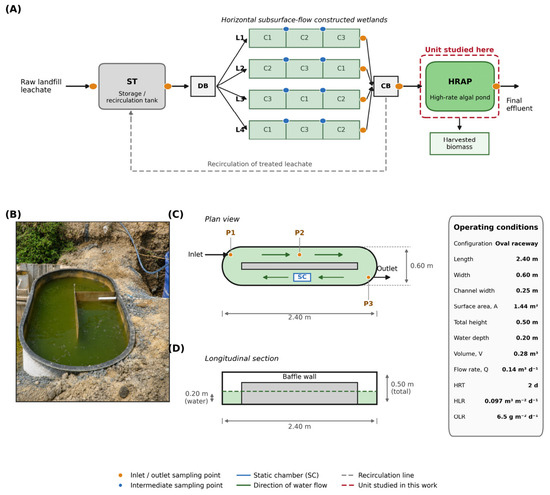
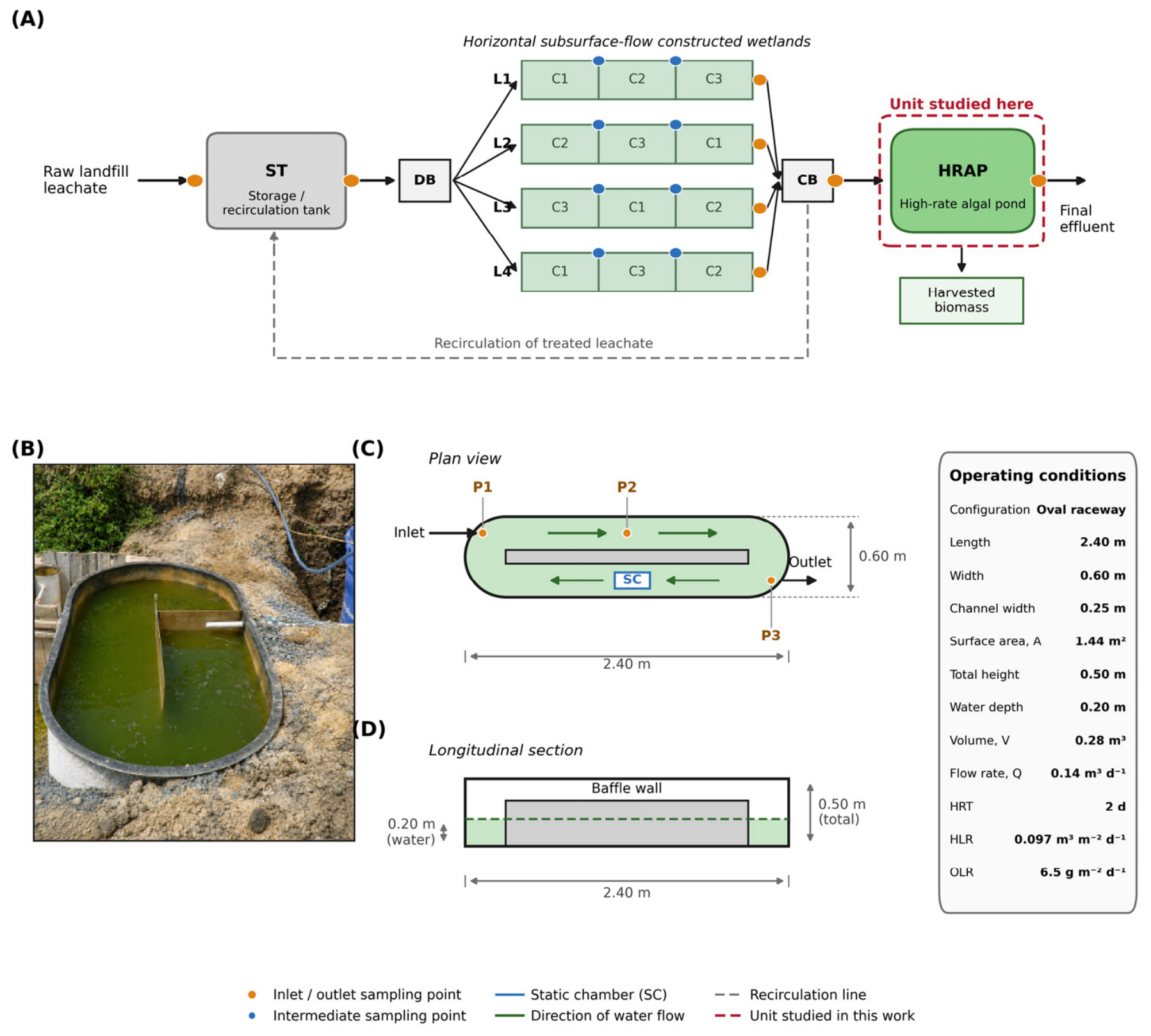
The study was carried out at the Presidente Landfill in the municipality of San Pedro, Valle del Cauca, Colombia (3.9687°, −76.2542). The high-rate algal pond (HRAP) received effluent from subsurface horizontal-flow constructed wetlands treating landfill leachate (inlet physicochemical characteristics; inlet values) (Figure 1). The Presidente Landfill (Parque Tecnológico Ambiental Presidente, operated by Veolia, San Pedro, Colombia) is a regional municipal solid waste disposal facility located in the corregimiento of Presidente, municipality of San Pedro, approximately 12 km from Guadalajara de Buga along the road to Tuluá, in the Valle del Cauca department. It has been in operation since January 1998 under environmental licence Resolution 0019 of 1997, and during the study period it received approximately 800 t d−1 of municipal solid waste generated in 12 municipalities of the central Valle del Cauca region [37]. The site includes dedicated leachate and biogas management facilities, and leachate collected from the waste mass is treated on site. The high-rate algal pond (HRAP) studied here received effluent from the subsurface horizontal-flow constructed wetlands forming part of that treatment train (inlet physicochemical characteristics are reported in Section 3.2 (Figure 1); the pond was therefore not fed with raw leachate. No dilution, pH adjustment, nutrient supplementation, or CO2 addition was applied to this effluent: the pond was fed continuously with the wetland effluent at its natural strength.
Figure 1.
Pilot-scale high-rate algal pond (HRAP) at the Presidente Landfill. (A) Treatment train: raw leachate is collected in a storage and recirculation tank (ST), distributed by a distribution box (DB) among four parallel lines (L1–L4) of horizontal subsurface-flow constructed wetlands of three cells each (C1–C3), and the treated effluent is gathered in a collection box (CB) before entering the HRAP. (B) Photograph of the pond in operation. (C) Plan view, to scale, showing the baffle wall, the direction of flow, the sampling points (P1, inlet; P2, mid-point; P3, outlet) and the static camber for CO2 flux measurements (SC). (D) Longitudinal section. Q, flow rate; A, surface area; HRT, hydraulic retention time; HLR, hydraulic loading rate; OLR, organic loading rate.
The influent to the pond corresponded to a partially stabilized leachate. Its BOD5/COD ratio of 0.15 is characteristic of a mature leachate in the methanogenic phase, in which the readily biodegradable fraction has largely been consumed, and residual organic load is dominated by refractory humic and fulvic substances [28,29]. This is consistent with the high true color of the influent (435.9 Pt-Co) and with the limited removal of the total organic fraction reported in Section 3.2. Although pre-treated, this influent remained markedly different from domestic wastewater: its ammoniacal nitrogen (131.5 mg L−1) and alkalinity (1624.7 mg L−1 as CaCO3) exceeded typical medium-strength municipal sewage by approximately five- to eight-fold, respectively, and its BOD5/COD ratio was about one-third as high [38]. The pond therefore operated on a leachate-derived matrix, as the final polishing stage of the landfill’s leachate treatment train. Two features of this matrix are potentially inhibitory to microalgae: the high ammoniacal nitrogen content (131.5 mg L−1 NH4+–N), which shifts towards free ammonia at the alkaline pH generated by photosynthesis [30]; and light attenuation imposed by the colored humic fraction [31]. Heavy metals and specific organic micropollutants were not determined in this study, and their possible contribution to the inhibition of algal activity therefore cannot be assessed.
The system operated continuously at pilot scale with an average flow rate of 0.14 m3d−1. Water movement through the raceway was driven by the influent flow, corresponding to a hydraulic retention time of 2 days. These operating conditions were not optimized. The flow rate was determined by the discharge of the constructed wetlands upstream, and the pond was operated under a fixed regime throughout the study. No optimization or sensitivity analysis of the operation variables was undertaken. Table 2 summarizes the specific characteristics of the HRAP. Data collected during an initial 6-week pond acclimation period, when the algal community was still establishing, were excluded from the carbon balance; the reported fixation rate corresponds to the subsequent 5-month post-establishment monitoring period.
Table 2.
High-Rate Algal Pond Specifications.
2.1. Monitoring Physicochemical Variables
Water samples were collected at the inlet, at the mid-point along the flow path, and at the outlet of the high-rate algal pond. At each location, in situ physicochemical parameters pH, dissolved oxygen (DO), electrical conductivity, and oxidation–reduction potential (ORP)- were monitored three times per week using a WTW 340i multiparameter probe (WTW GmbH, Weilheim, Germany). Chlorophyll a was monitored in situ as a proxy for algal biomass using an AquaFluor handheld fluorometer (Turner Designs, San Jose, Jose, CA, USA) at the same sampling points and frequency. We calibrated the fluorometric readings against chlorophyll a concentration obtained by solvent extraction and spectrophotometric determination, reducing measurement error associated with in situ fluorescence. In addition, water samples were collected at the same points and analyzed in the laboratory for alkalinity, total organic carbon (TOC), total and soluble chemical oxygen demand (COD), total and soluble five-day biochemical oxygen demand (BOD5), total Kjeldahl nitrogen (TKN), ammonium nitrogen (NH4+–N), nitrate nitrogen (NO3−–N), orthophosphate (PO4 3−), total and volatile suspended solids (TSS and VSS), and true and apparent color. Soluble fractions were determined after filtration of the samples through a 0.45 µm membrane filter. Inorganic CO2 was derived from alkalinity following Standard Method 4500-CO2 D. All sampling, preservation, and analytical procedures were carried out in accordance with the standard protocols of APHA [39] and IDEAM [40]. Removal efficiencies were calculated on a paired, sample-by-sample basis and are reported both as concentration removal and as mass-load removal (concentration × flow rate).
Chlorophyll a Determination
The reference values used to calibrate the in situ fluorometric readings (Section 2.1) were obtained as follows. Chlorophyll a was determined spectrophotometrically following APHA Standard Method 10200 H [39]. Water samples were filtered through GF/C glass-fiber (Whatman, Maidstone, UK;1.2 µm nominal pore size), and pigments were extracted from the retained biomass using 90% aqueous acetone at 4 °C in the dark for 24 h. Extracts were centrifuged (3000 rpm, 10 min) to remove cellular debris, and absorbance was measured at 664, 647, and 630 nm, with turbidity correction at 750 nm, using a UV-vis spectrophotometer. Chlorophyll a concentration was calculated using the trichromatic equations of Jeffrey and Humphrey [41].
2.2. CO2 Fixation
CO2 uptake was determined from an inorganic-carbon mass balance over the pond during daylight hours, since photosynthetic carbon fixation requires light. The Calvin cycle depends on ATP and NADPH generated in the light reactions, and therefore no photosynthetic fixation occurs in darkness. At night, the photosynthetic term of the balance is zero, and CO2 dynamics are governed solely by respiratory processes; nocturnal respiration was therefore not measured directly but approximated from oxygen-balance measurements and from respiration coefficients reported for high-rate algal ponds [42]. The balance accounted for influent and effluent carbon mass flows, atmosphere-pond and pond-atmosphere diffusion, aerobic respiration, photosynthetic CO2 fixation, and conversion of CO2 to carbonates (measured as alkalinity). It was adapted from the pond carbon- and nitrogen-transformation model of [42] and applied to the HRAP control volume in this study:
CO2 accumulation = Influent − Effluent + Atmosphere-Pond Diffusion − Pond-Atmosphere Diffusion + Aerobic Respiration − Fixation from Photosynthesis − Alkalinity
From the proposed balance, CO2 accumulation was determined as in Equation (1) below.
where CO2 (Inorganic)/t is the net rate of change in inorganic CO2 mass within the pond (g C d−1), and the terms on the right-hand side represent the fluxes contributing to this balance, as follows (Table 3).
Table 3.
Definitions, Units, and Determination Methods for the Terms in the CO2 Mass Balance (Equation (1)).
2.2.1. Calculation of the Different Mass Balance Components
Dissolved inorganic carbon (DIC) concentration in the water matrix was determined by the titrimetric method APHA Method 4500-CO2 D [39]: samples were titrated with standardized NaOH to the phenolphthalein endpoint (pH 8.3), and DIC concentration was calculated (expressed as CO2 equivalent) as: DIC (mg L−1, as CO2) = (A × N × 44,000)/B, where A is the volume of NaOH titrant (mL), N is the NaOH normality, and B is the sample volume (mL). Note that at the prevailing pH range of this system (7.6–8.9), the titrated inorganic carbon is predominantly present as bicarbonate rather than free dissolved CO2; this titrimetric determination therefore reflects total titratable DIC rather than free CO2 specifically. Alkalinity was determined on the same samples and used jointly with DIC concentration in the mass balance (Equation (1)). The aerobic respiration rate (R1 Res aero) was set at 101.19 g C d−1, following the parameters established by [42].
All terms of Equation (1) were expressed as g C d−1 before closure. Concentrations reported as CO2 equivalent were converted to elemental carbon using the factor 12/44. Influent and effluent mass flows were obtained as concentration flow rates (0.14 m3 d−1). Areal gas fluxes from Equation (2) were multiplied by the pond surface area (1.44 m2, Table 2); positive slopes indicate the net flux into the pond. The accumulation term was the change in DIC mass within the operating volume (0.28 m3) between consecutive sampling events, divided by elapsed time. Aerobic respiration was fixed at 101.19 g C d−1 [42] and not measured here. R2 (Photosynthesis) was then obtained by difference. The balance was solved for each sampling day of the post-establishment period (n = 37), and the reported rate is the mean of these daily values. This residual approach differs from whole-pond metabolic methods, which resolve gross primary production and ecosystem respiration independently from high-frequency diel series of dissolved oxygen or dissolved inorganic carbon [34]. Those methods separate the two processes, whereas the present balance returns photosynthetic fixation as a single closure term and therefore accumulates the uncertainty of all other terms, including the literature-derived respiration coefficient. Their application requires continuous or sub-hourly monitoring over complete diel cycles, which the sampling frequency of this study did not permit; the two approaches are thus complementary rather than interchangeable.
2.2.2. Gas Flux Calculation
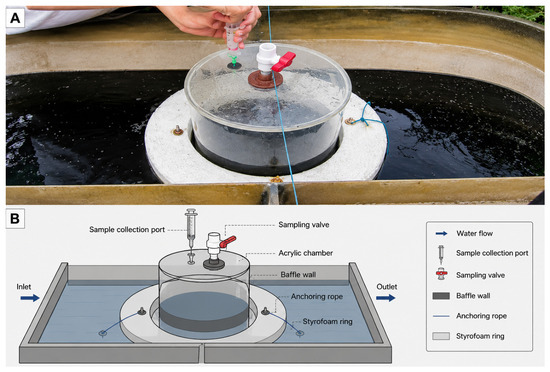
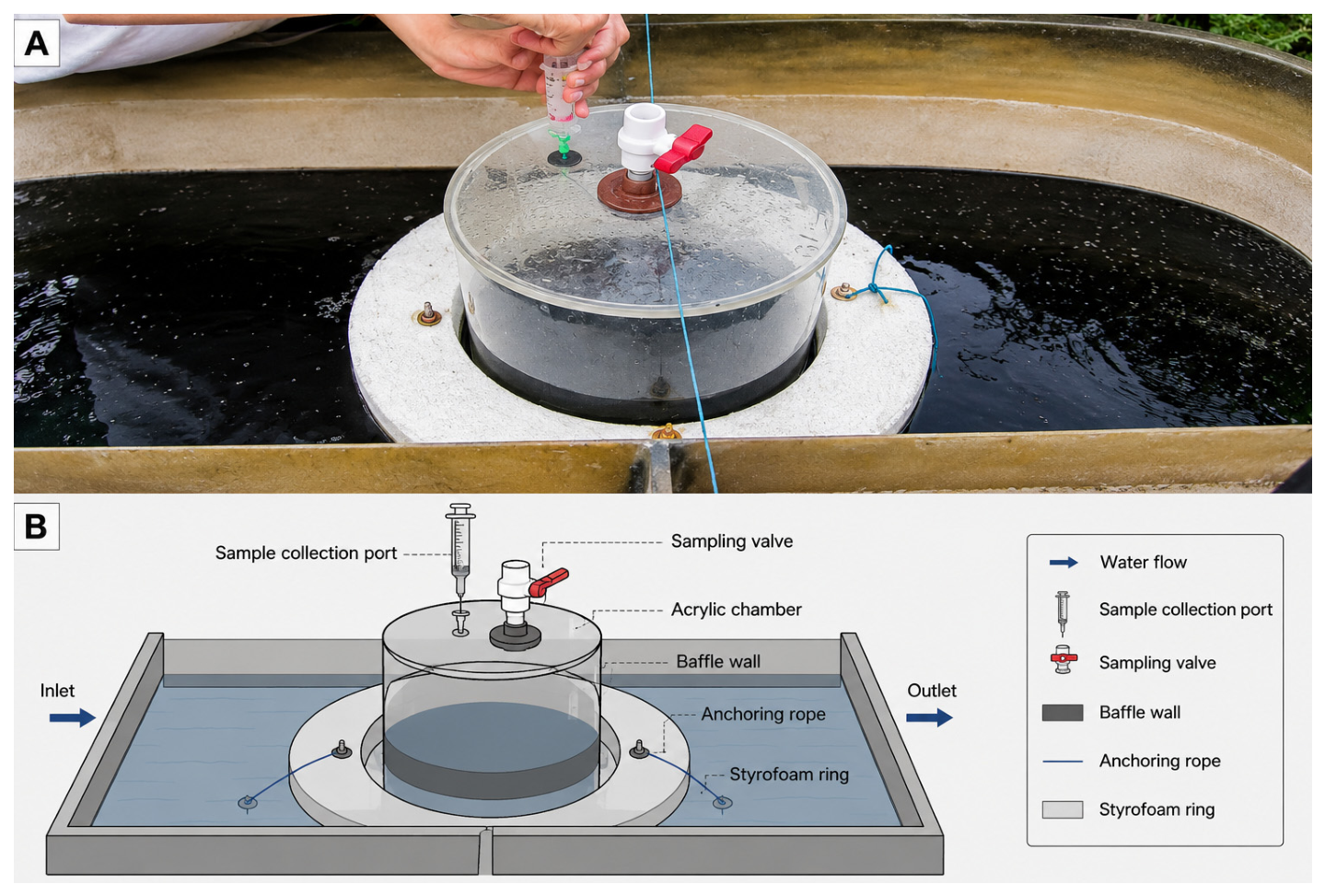
To determine pond-atmosphere or atmosphere-pond gas flux, a static chamber was used according to the protocols described by [43,44]. A gas capture chamber was installed at a fixed point on the surface of the pond to determine the CO2 concentration emitted or captured by the HRAP system (Figure 2); a single chamber was positioned at the midpoint of the channel. Its footprint (0.0707 m2) covered approximately 5% of the pond surface (1.44 m2, Table 2); the continuous influent flow kept the channel circulating; and dissolved oxygen and pH inside the pond and at the outlet were comparable (9.4 ± 5.54 versus 9.0 ± 5.41 mg L−1; 7.6–8.9 versus 7.7–8.9; Section 3.1), indicating a well-mixed water column. Fine-scale spatial variability in surface flux was therefore not resolved, as noted in Section 3.4. Measurements were performed weekly at 10:00 and 12:00 h (daylight) and, on selected days when logistically feasible, at 18:00 and 20:00 h (nighttime; n = 5 nocturnal measurement events), given site-access and weather-related constraints that limited routine nighttime sampling. At each sampling session, multiple gas samples were collected and averaged to obtain the reported flux value.
Figure 2.
Static gas capture chamber used for CO2 flux measurements on the high-rate algal pond. (A) Chamber in operation during a sampling event, showing gas withdrawal through the sample collection port. (B) Schematic of the chamber assembly (not to scale): acrylic chamber, sampling valve, sample collection port, buoyant Styrofoam ring, and anchoring ropes fixed to the pond walls; arrows indicate the direction of water flow along the channel.
Gas samples were taken using a 20 mL syringe and stored in 2 mL glass vials under vacuum [45], which were then sent for analysis by gas chromatography. CO2 concentration was determined using a G264 Gas Controller and Flow Monitor (Qubit Systems Inc., Kingston, ON, Canada). All these measurements were performed at the CIAT (International Center for Tropical Agriculture) Environmental Services Laboratory.
Flux calculation was conducted as per [43]. In this methodology, concentration (C) vs. sampling time (t; every 10 min) is plotted, thus allowing the observation of data trends. Once data trends were observed, linear regressions were performed for all datasets obtained. Regressions with a correlation coefficient greater than 0.75 (R2 > 0.75) were accepted since these values were consistent with [46]. After determining the dataset’s linear behavior, Equation (2) was used to determine the system flux:
where F denotes the flux in g m−2 d−1, Pc represents the chamber pressure in atmospheres, R is the universal gas constant (0.082 atm L mol−1 K−1), M is the molecular weight of CO2, Tc denotes the chamber temperature in K, is the slope of the C vs. t plot (ppmv min−1), Vc is the volume of the chamber in m3, and Ac represents the cross-sectional area of the chamber in m2. Table 4 displays the constant values used in system flux calculation.
Table 4.
Fixed Flux Calculation Parameters.
2.3. Microalgal Sampling and Morphological Identification
Samples were taken to determine which microalgae species were established in the system, comparing this identification with records from other works conducted in the Valle del Cauca region and international literature. Approximately 200 mL were taken from the algae samples, which were fixed with 10 mL formaldehyde at 4% as a preservation agent based on the recommendations of [47,48].
For taxonomic identification, water samples were preserved with Lugol’s iodine, mounted on slides, and examined under light microscopy at 400× and 1000× magnification. Lower magnification (400×) was used for the initial observation of colonies and overall cell arrangement, and oil-immersion (1000×) for resolving diagnostic features such as colony formation, cell shape and dimensions, surface ornamentation, and the presence of mucilage, flagella, heterocysts, and pyrenoids. Because most freshwater algae are minute, accurate identification requires high-power microscopy and careful observation of distinguishing features, following standard phycological keys and illustrated guides [47,48]. Taxonomic assignments to genus and, where possible, to species level were based on the morphological criteria described in these classic references. As molecular analyses were beyond the scope of this study, taxa were assigned solely on morphological evidence. We acknowledge that cryptic diversity and morphological plasticity can complicate species delimitation and that molecular markers could refine the identifications.
2.4. Data Analysis
The pond was operated as a single unit, and no biological or system-level replicates were available. Repeated measurements therefore constitute temporal replicates of one system, and all inferences are restricted to the pond studied; no between-treatment hypothesis testing was possible, as no comparison unit existed. Results are reported as mean ± standard deviation. Removal efficiencies were computed for each paired inlet-outlet sample and are reported as the mean of those individual values. For the photosynthetic fixation rate, the mean of the 37 daily balances of the post-establishment period was −33.13 g C d−1 (SD 55.00; SE 9.04), with a 95% confidence interval of −51.5 to −14.8 g C d−1. A one-sample t-test against zero gave t(36) = 3.66, p < 0.001, with an effect size of Cohen’s d = 0.60. The confidence interval does not include zero, indicating that the daytime net uptake of inorganic carbon was statistically distinguishable from zero for this pond; this conclusion does not extend to HRAP systems in general.
2.5. Use of Generative Artificial Intelligence
A generative artificial intelligence tool (Claude, Anthropic, Opus 5) was used in the preparation of Figure 2. The authors supplied the pond dimensions, operating conditions, sampling locations, and treatment-train configuration, together with an earlier hand-drawn schematic of the pilot plant, and the tool generated the Python code (Python 3.11 with the matplotlib 3.8 library) used to render the diagram to scale. The tool did not generate, analyze, or interpret any experimental data. Every dimension, label, and numerical value in the figure was verified by the authors against the primary field records.
3. Results and Discussion
3.1. Monitoring
Throughout the study period, the pond remained well oxygenated during daylight hours, with dissolved oxygen averaging 9.4 mg L−1 and reaching maxima of up to 24.7 mg L−1 at times of high solar irradiance (10:00–14:00 h, Figure 3), reflecting intense photosynthetic activity by the algal community [21]. This value corresponds to approximately 300–310% saturation at the prevailing water temperature (~27 °C) but represents a transient midday maximum rather than a sustained condition, as reflected in the high variability of DO over the diel cycle (SD ± 5.54 mg L−1; Table 5). This peak coincides with the period of highest solar radiation (10:00–14:00 h), during which the algal community exhibited vertical migration behavior (Section 3.3), potentially limiting sustained co-exposure to combined hyperoxia and high irradiance. Comparable transient DO supersaturation has been reported in other HRAP systems [21,22]. Consistently positive ORP values confirmed oxidizing conditions during the day, favoring the rapid oxidation of organic matter. As is characteristic of open high-rate ponds, however, dissolved oxygen followed a marked diurnal cycle, declining to minimum values at night (0.1–1.9 mg L−1; Table 5) once photosynthesis ceased and community respiration prevailed. CO2 mg L−1
Figure 3.
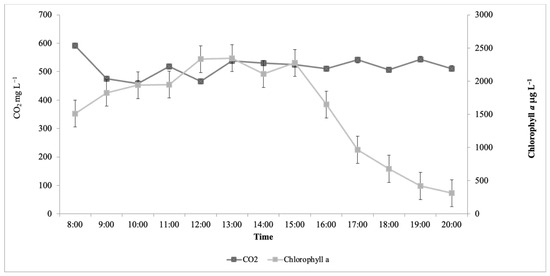
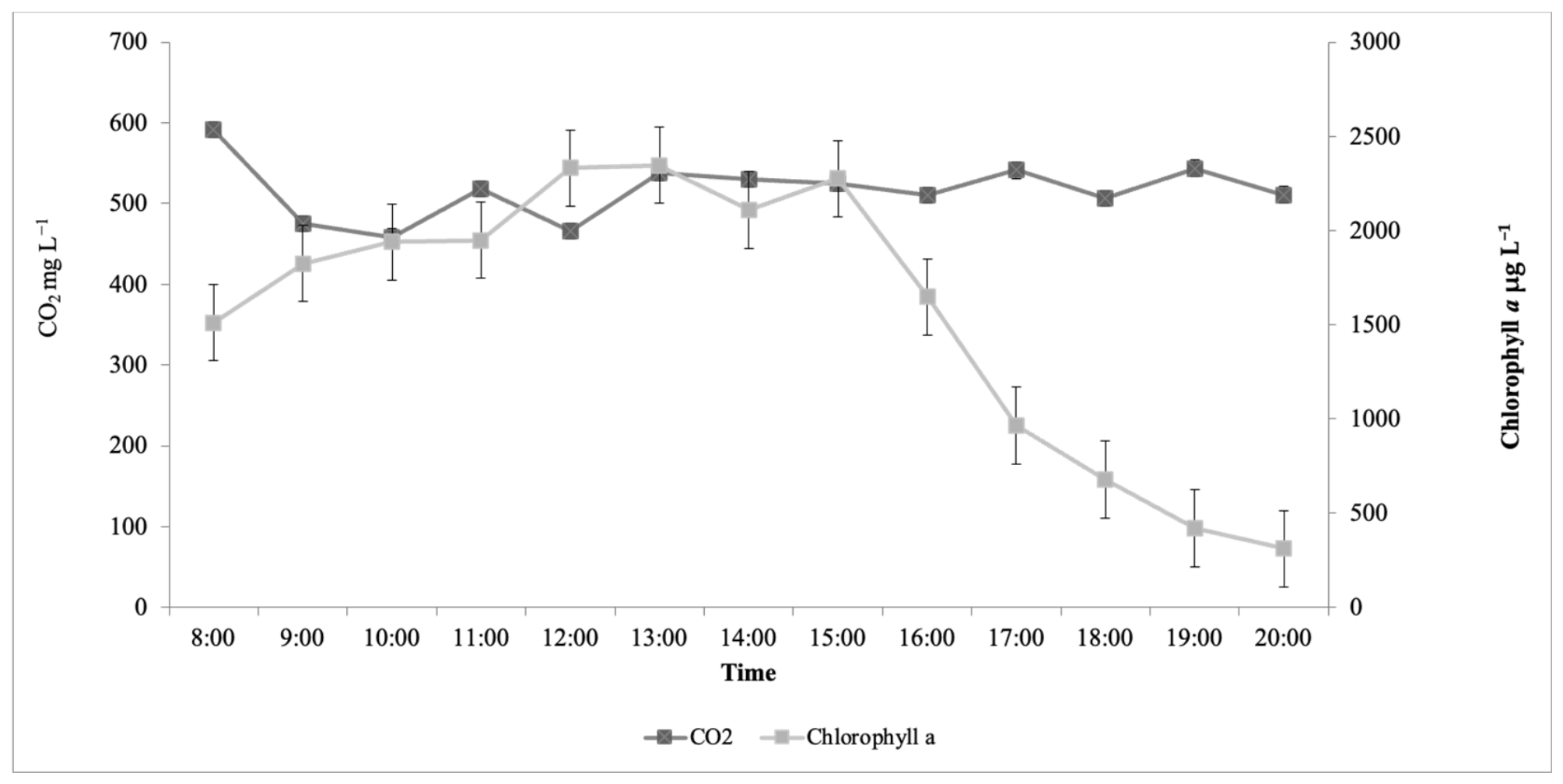
Behaviors of the DIC and Chlorophyll a Concentrations.
Table 5.
Water Temperature, Dissolved Oxygen (DO) Concentration, Oxidation–Reduction Potential (ORP), Chlorophyll a, and pH of the complete system.
Furthermore, high pH values were recorded, reaching maximum of 8.9 within the reactor, since algal photosynthesis increases the pH through CO2 and HCO3− consumption [49,50]. The elevated pH is not metabolically neutral: in full-scale wastewater HRAPs, rising diurnal pH increased ecosystem respiration while free ammonia reduced gross primary production [34]. Both conditions applied here, where a daytime pH of up to 8.9 coincided with an influent ammoniacal nitrogen of 131.5 mg L−1, offering a plausible mechanism for the day-to-day variability of the fixation rate reported in Section 3.3.
However, the temperature recorded by the water was within the optimum values reported for the development of these organisms, which can vary between 20 °C and 35 °C, depending on environmental conditions. Maximum algal growth in the system was governed by solar irradiance and nutrient availability, with the response varying among the taxa present in the community [51]. The Chlorophyll a monitoring performed during the experimentation time demonstrates the behavior of an HRAP system, reporting average concentrations of 1560.1 µg L−1, reaching a concentration value of 3787 µg L−1. Similar values were reported by [20,50], who measured concentrations at approximately 4200 µg L−1 in their wastewater reactor. The wastewater they used was more stable and of better quality than the wastewater used in our study, wherein an effluent from leachate treatment was used. Other studies, such as [52,53], report Chlorophyll a concentrations of approximately 26,000 µg L−1, even when only a single algal species was cultivated and used for producing lipids while managing appropriate growth conditions. Assuming a Chlorophyll a content of ~2% of algal dry weight, typical for nutrient-replete microalgae [54,55,56], the observed Chlorophyll a concentrations correspond to an estimated biomass of ~76.5 mg DW L−1 (mean) to ~189.4 mg DW L−1 (peak), equivalent to ~21.4–53.0 g DW within the pond volume (0.28 m3). Normalizing the CO2 fixation rate (33.1 g C d−1) to this estimated biomass yields ~0.24–0.60 g C g DW−1 d−1, though this figure should be interpreted with caution given that it relies on a literature-derived chlorophyll-to-biomass ratio rather than direct gravimetric measurement.
3.2. Organic Matter and Nutrient Removal
The physicochemical characterization of the influent and effluent (Table 6) revealed contrasting trends between the soluble and particulate fractions of organic matter. The soluble indicators decreased markedly across the pond: soluble COD declined by 22.2% (from 324 to 253.9 mg L−1) and soluble BOD5 by 58.9% (from 33.3 to 13.3 mg L−1), confirming effective degradation of dissolved organic matter. In contrast, total COD, BOD5, total suspended solids (TSS), and volatile suspended solids (VSS) increased at the outlet, yielding apparent negative removals (e.g., −83.8% for TSS, from 73.9 to 115.8 mg L−1). This pattern is well documented in HRAP systems and reflects the conversion of dissolved substrates into particulate algal biomass rather than a failure of the underlying biological process; however, it also means that, without a downstream biomass-harvesting step, the raw pond effluent alone does not meet conventional discharge standards for TSS, total COD, or total BOD5 [57]. Because soluble-fraction analyses were performed on filtered samples (0.45 µm; Section 2.1), the observed reductions in soluble COD and BOD5 reflect genuine removal of dissolved pollutants, independent of the unharvested biomass reflected in the total-fraction values. Realizing the pollutant-removal capacity indicated by the soluble-fraction data therefore requires downstream solid–liquid separation to harvest the algal biomass generated in the pond, an integral component of a complete HRAP treatment train that has been demonstrated at pilot scale using dissolved air flotation [25]. The predominance of volatile over fixed solids, VSS accounting for approximately 90% of TSS at the outlet, is consistent with a biomass of organic, algal origin rather than inert material. Total organic carbon (TOC) showed a modest net removal of 9.5% (from 162.2 to 144.6 mg L−1), reflecting the balance between bacterial mineralization of incoming organic carbon and the simultaneous synthesis of new algal biomass. Together with the concurrent removal of ammonia nitrogen (21.8%) and the strongly oxidizing, oxygen-rich conditions reported in Section 3.1, these patterns are consistent with the carbon-fixation behavior described in Section 3.3: the pond simultaneously degrades dissolved organic and nitrogenous pollutants while incorporating carbon into algal biomass, whose accumulation accounts for the apparent rise in particulate parameters. Three independent measurements support this interpretation: the contrast between filtered and unfiltered fractions, which separates dissolved removal from particulate accumulation; the predominance of volatile over fixed solids at the outlet; and the increase in chlorophyll a along the pond (Table 5). Definitive attribution would require 13C labeling or respirometric partitioning, which were beyond the scope of this study.
Table 6.
Physicochemical characterization of influent/effluent of the HRAP and removal efficiencies.
The low removal of phosphorus (6.5% for total orthophosphate) should be read in the light of the influent composition rather than as a failure of uptake. With a TKN of 176.5 mg L−1 against 3.5 mg L−1 of total orthophosphate, the influent N:P ratio was an order of magnitude above the stoichiometric requirement of algal biomass, so that phosphorus was most likely the growth-limiting nutrient and was present in quantities too small for its removal to be resolved reliably as a percentage. A large excess of nitrogen relative to phosphorus is characteristic of landfill leachate [28], and phosphorus limitation therefore offers a coherent explanation for the modest nitrogen removal obtained here despite a large nitrogen supply. By contrast, Sátiro et al. [24] reported phosphate removals above 92% in an algal–bacterial system in which nitrogen, rather than phosphorus, was the scarce nutrient. The nitrogen removed cannot be attributed to algal assimilation alone. In HRAPs treating anaerobically digested wastewater, only 57% of the influent nitrogen was incorporated into biomass, the remainder being lost through nitrification and volatilization [25]. Given the daytime pH of up to 8.9 and the water temperature of approximately 27 °C recorded here, ammonia volatilization is likely to have contributed appreciably to the 21.8% NH4+–N reduction observed, a pathway that the present measurements cannot separate from biological uptake.
The efficiencies obtained here are lower than those reported for algal systems on this matrix (Table 6). Mustafa et al. [32] achieved 91% COD and 99.9% ammoniacal nitrogen removal, but on leachate diluted to 1–4% at retention times of 25–100 days, conditions under which the volumetric nitrogen load is one to two orders of magnitude lower. The present pond treated undiluted wetland effluent (influent NH4+–N 131.5 mg L−1) at a 2-day HRT, with a substantial free-ammonia fraction at the daytime pH of 8.9, a recognized inhibitor of algal photosynthesis [24]. Against the 7.7-day reference HRT reported for pilot-scale HRAPs [23], retention time and matrix strength, rather than community performance, appear to be the principal constraints. The importance of retention time in algal–bacterial systems is consistent with the findings of Sátiro et al. [24], who reported that hydraulic retention time and the feeding regime, rather than the presence of microalgae as such, governed organic matter and nutrient removal in algal–bacterial aerobic granular sludge treating pulp mill wastewater.
3.3. CO2 Biofixation
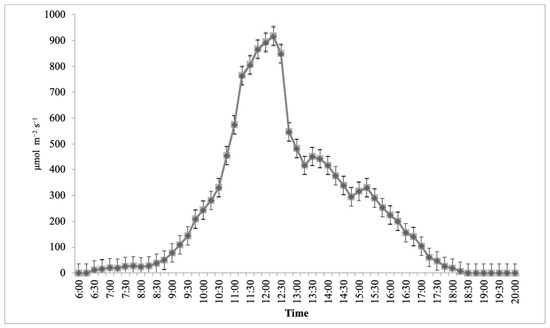
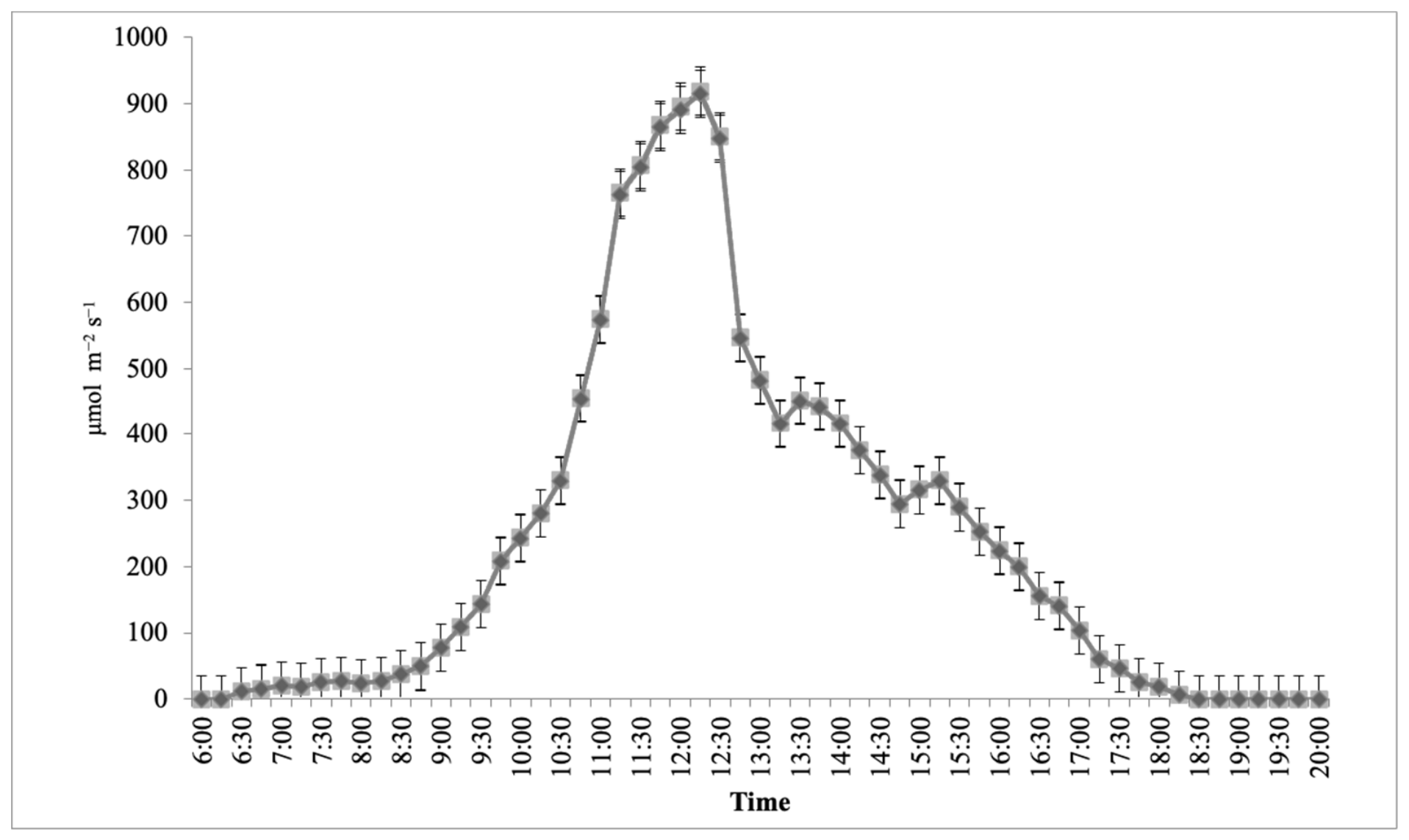
The DIC concentration accumulated within the reactor was approximately 516.44 mg L−1 and remained constant throughout the day (8:00 a.m.–8:00 p.m.), indicating that the system was in a stationary phase [58]. This concentration in the water matrix depends on the photosynthetic activity that allows atmospheric CO2 to be transferred to the water through concentration gradients. The algae acquire CO2 as a carbon source to synthesize organic compounds [11,21,59], thereby enabling an increase in their biomass. Figure 3 illustrates how the concentration of Chlorophyll a within the reactor increases over time, reaching a maximum concentration of 2346 µg L−1 at the times of day with the highest solar radiation (peak PAR ≈ 900 µmol photons m−2 s−1), around 11:00 a.m. to 12:00 p.m. (Figure 4). After this period, the biomass decreases, reaching a minimum concentration of approximately 100 µg L−1 at around 8:00 p.m. The same occurs with DIC concentrations within the reactor, which fluctuate during high algal activity hours (10:00 a.m.–3:00 p.m.), only reaching a stable concentration of 500 to 543 mg L−1 after 4:00 p.m., as algal activity diminishes accordingly due to reduced solar radiation. However, biological and chemical processes, such as bacterial respiration, atmosphere-pond diffusion, and alkalinity contributions, occur inside the reactor, providing CO2 to the system and holding it at a constant value.
Figure 4.
Diel variation in photosynthetically active radiation (PAR, µmol photons m−2 s−1) throughout the day.
However, upon reaching peak solar radiation (≈900 µmol photons m−2 s−1 PAR) at midday (≈12:00–13:00 h) (Figure 4), the surface biomass in the reactor decreases (Figure 3). This decline is attributed to diel vertical migration: microalgal cells adjust their buoyancy and move to deeper layers to escape excessive light. Such behavioral photoprotection prevents photoinhibition caused by strong solar radiation and helps maintain carbon-fixation rates [60]. The migration reduces the light available for photosynthesis, diminishing the regeneration of Calvin-cycle substrates [11,54] and temporarily lowering the efficiency of CO2 fixation [61,62]. As a result, CO2 uptake declines during this midday period and the DIC concentration in the pond increases (up to 588.77 mg L−1).
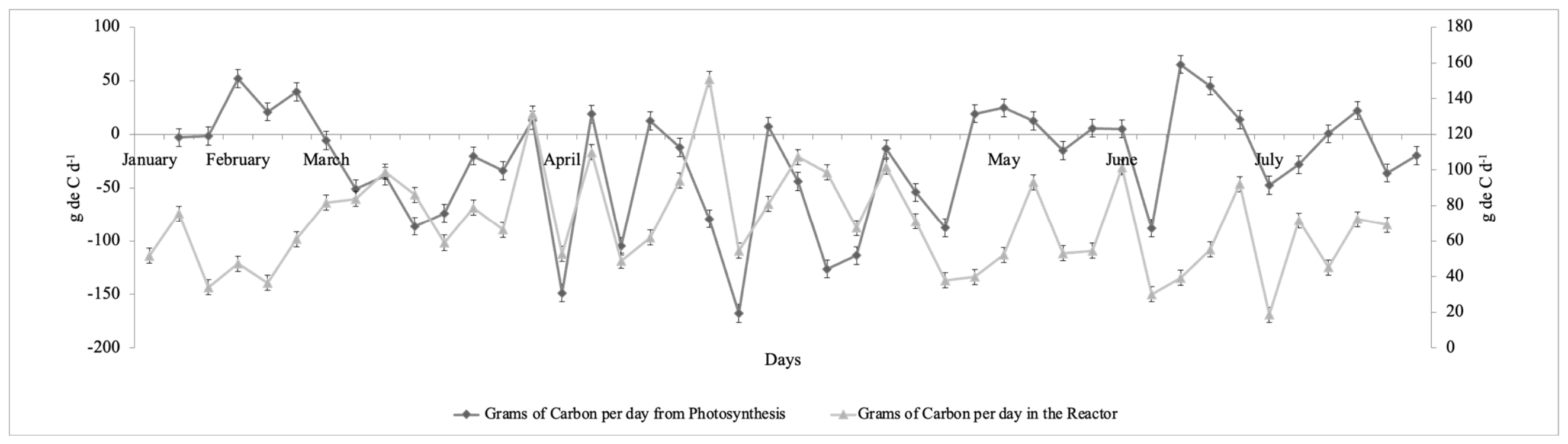
Once the CO2 accumulation behavior has been established for the reactor during daylight hours, we can determine that the reactor is in a stationary state. Figure 5 shows the amount of carbon fixed by photosynthesis in the reactor during the post-establishment monitoring period, with an average of −33.13 ± 55.00 g C d−1 (n = 37; 95% CI −51.5 to −14.8 g C d−1). The high standard deviation, which exceeds the mean, reflects the substantial day-to-day variability inherent to an unreplicated outdoor pilot system, with occasional net-source days during periods of algal community disturbance. The negative value indicates that this system acts as a carbon sink [35] during daylight hours. This characterizes the daytime portion of the diel cycle only. A negative daytime flux does not by itself demonstrate net sequestration over 24 h, since night-time respiration returns carbon to the water column and to the atmosphere; establishing a net diel balance would require the nocturnal term to be measured rather than estimated (Section 3.4). However, at times, the system functioned as a carbon source as some positive values were recorded owing to algal community disturbances from pollutants that can hinder their growth and, in turn, their carbon fixation capabilities [11]. Similarly, this condition occurred during the initial stage of the pond, when the algal populations were just adjusting to the system and beginning to establish the algal community. Once the community was established, the algae started fixing CO2 and their fixation capabilities began to increase until reaching high fixation values (Figure 5). The community in the present system was established spontaneously, without inoculation, over an initial six-week period. In pilot-scale high-rate ponds treating domestic wastewater, inoculation with activated sludge reduced the stabilization period to approximately 20 days and improved both biomass settleability and organic matter removal [24], suggesting that inoculation could shorten the establishment phase and mitigate the effluent biomass carry-over discussed in Section 3.2.
Figure 5.
Carbon Quantity Fixed by the System during the Experiment. The X axis represents the number of days. The main Y axis is the fixation from photosynthesis. The secondary Y axis represents the carbon quantity in the reactor.
Furthermore, Figure 5 shows that the amount of carbon in the system depends on the fixation capacity exhibited by the algae. Moreover, despite operating in a harsh environment such as treated leachate, the algae showed adequate carbon fixation levels according to the values reported by [54], which indicate a value of 216 mg CO2 L−1 d−1, which would be equivalent to 14 g C d−1. In addition, Watanabe and Hall [55] reported 14.6 g C m−2 d−1 (equivalent to 21.02 g C d−1). However, these reports came from laboratory-scale systems, wherein most conditions are controlled. Under pilot and outdoor conditions, it has been estimated that algae can fix 1.83 g of CO2, which would be equivalent to 0.49 g of C [56]. These values are consistent with the ranges summarized by [10], who reported up to 1.8 kg CO2 per kg of biomass under optimized conditions.
Notably, most of the values above derive from laboratory-scale or closed photobioreactor systems, which typically afford tighter control over light, temperature, and CO2 supply than open pilot-scale ponds. A recent meta-analysis of pilot-scale HRAPs [23] reports mean reference operating conditions of 7.7-day HRT, 18 °C, and 210 W m−2 irradiance, markedly different from the present system (2-day HRT, ~27 °C, tropical irradiance). The shorter HRT and higher temperature in this study likely accelerated microbial and photosynthetic turnover, while year-round tropical irradiance sustained higher photosynthetic activity than in the temperate pilot systems typically reported, potentially explaining the comparatively high fixation rate obtained despite the absence of the CO2 supplementation used in [47,48,49]. The shorter HRT and higher temperature of the present system may have accelerated microbial and photosynthetic turnover, while year-round tropical irradiance would sustain higher photosynthetic activity than in the temperate pilot systems usually reported, despite the absence of the CO2 supplementation used in [54,55]. This interpretation remains inferential, as hydraulic retention time was not manipulated experimentally in this study. It is nonetheless consistent with controlled experiments in which retention time was varied: Satiro et al. [24] found that hydraulic retention time and feeding regime, rather than the presence of microalgae, governed organic matter and nutrient removal in an algal–bacterial system, with an intermediate retention time yielding the most stable performance. Confirming this effect in tropical HRAPs would require parallel ponds operated at contrasting retention times, which was beyond the scope of the present case study.
The net sink behavior observed here is consistent with the predominantly net autotrophic metabolism of full-scale wastewater HRAPs [34]. That study also identified dissolved inorganic carbon supply as a constraint at peak photosynthesis, which is pertinent to a pond receiving no CO2 supplementation and relying on leachate alkalinity and atmospheric exchange alone.
3.4. Algal Species Diversity
Sixteen algal taxa were identified based on morphological characteristics observed under high-magnification microscopy—colony morphology, cell dimensions, surface ornamentation, and the presence of heterocysts or mucilage—and matched to descriptions in standard taxonomic keys and illustrated guides; no molecular analyses were performed. Ten taxa were assigned to Chlorophyceae, two to Chlamydophyceae, and two to Cryptophyceae. To our knowledge, the organisms of the Cryptophyceae lineage have not been previously reported in these systems. In addition, two cyanobacterial genera were recorded; although these fall outside the sensu stricto classification of algae [54], they carry out photosynthesis like eukaryotic algae. Table 7 details the taxonomic classification of the identified species. Some of these species are reported in the literature as common organisms in wastewater treatment systems. Given the limited diagnostic morphological characters and documented dimorphism within Cryptophyceae with genera such as Chilomonas sp. and Chroomonas sp., which typically require molecular confirmation for reliable species-level resolution [57], these taxa are reported at the genus level in this study. General reports of Chilomonas sp. and Chroomonas sp. are consistent with their broad distribution in wetlands with abundant nutrients and organic matter [54].
Furthermore, organisms of the genus Desmodesmus were identified (reported at the genus level given the taxonomic instability discussed below), consistent with records under the closely related genus Scenedesmus by [63]. These organisms were historically classified within the genus Scenedesmus, its former designation before the taxonomic revision described below. This change occurred because the Desmodesmus genus [63] originated from the Scenedesmus genus when all species with spines at the ends of their cells or in the middle of the coenocyte were removed from the latter genus [64], as this is the main characteristic of species in the Desmodesmus genus. This situation reflects the limited knowledge and gaps in the taxonomy and evolutionary relationships of algal species used to treat wastewater in these systems.
This study characterizes algal taxonomic composition qualitatively (presence/absence) rather than quantitatively; relative abundances, cell counts, and biomass contribution per taxon were not determined. The ecological relevance of specific taxa to carbon uptake in this system remains to be investigated.
Table 7.
Microalgae Identified in the High-Rate Algal Pond System.
This investigation was carried out at a pilot scale using a single high-rate algal pond, so the results may not be directly transferable to commercial installations. Furthermore, the experimental design lacked biological or system-level replication, a parallel control pond, and a comparison non-algal treatment unit. Most research on microalgal carbon capture and utilization remains confined to the laboratory, and only a few pilot- or industrial-scale demonstrations have been reported [30,68]. Consequently, caution is warranted when extrapolating these findings to larger scales. The carbon balance was, in addition, constrained in both temporal coverage and scope. CO2 fixation was quantified only during daylight hours, because photosynthetic carbon assimilation requires light. Night-time respiration was estimated rather than measured; photosynthetic organisms store carbon during the day and consume these reserves at night through respiration [71], which causes biomass losses and CO2 release. This distinction matters because pond respiration can offset a substantial part of the apparent carbon sequestration in HRAPs, and whole-pond metabolism varies on hourly, daily, and seasonal scales [34]; the value reported here therefore describes daytime photosynthetic fixation rather than the net ecosystem carbon balance of the pond. Gas-flux measurements, though repeated across multiple sampling days and averaged per session, covered a single location and limited nighttime hours, leaving some uncertainty in fine-scale spatial and temporal variability.
Continuous monitoring over complete day/night cycles is needed to refine net carbon sequestration estimates. A related limitation concerns the scope of the carbon balance itself. In dense high-rate algal ponds, mutual shading induces light limitation, and microalgal–bacterial consortia may complement photoautotrophic growth with mixotrophic or heterotrophic assimilation of organic carbon [23]. The mass balance applied here quantifies the photosynthetic fixation of inorganic carbon (CO2) and does not resolve the assimilation of organic carbon by the consortium. Although the influent organic-carbon load was characterized (TOC and COD; Table 6) and a net removal of the soluble organic fraction was observed, this removal reflects the combined effect of bacterial mineralization, which releases CO2, and possible mixotrophic uptake, contributions that cannot be separated with the present measurements. Resolving the autotrophic, mixotrophic, and heterotrophic contributions would require 13C stable-isotope labeling or respirometric partitioning, which we recommend for future work. Finally, algal species were identified solely based on morphology. While light microscopy and taxonomic keys provide a practical identification framework, phenotypic plasticity and morphological similarity among genera can lead to misclassification [72]. Future work should incorporate molecular markers (e.g., rRNA and ITS sequences) to confirm species identities and to better characterize the algal communities that develop in engineering-scale ponds. Additionally, mixing was governed by the influent flow rather than mechanical agitation, which likely limited the pond-to-atmosphere CO2 diffusion term (R1DL-A ≈ 0). This is consistent with the daytime net CO2 sink behavior of the system, where dissolved CO2 rarely exceeded atmospheric equilibrium, reducing the driving force for outward stripping.
These constraints delimit the inferences the dataset supports. Without replication or a parallel control, the reported values characterize this specific system and cannot attribute carbon uptake to algal activity alone, nor link community composition to fixation rate. Because the balance is restricted to daylight hours and to inorganic carbon, 33.1 g C d−1 is an upper bound on net diel sequestration rather than an estimate of it. Because the community was characterized qualitatively, the taxa in Table 7 document the assemblage established under these conditions but cannot be ranked functionally. The results are therefore offered as a field reference and a basis for hypothesis generation, not as a generalizable performance level.
4. Conclusions
This single-run pilot study documents a high-rate algal pond (HRAP) treating undiluted landfill leachate under tropical field conditions. The pond removed the soluble organic and nitrogenous fractions of the leachate (soluble COD of 22.2%, soluble BOD5 of 58.9%, and NH4 +-N of 21.8%) and acted as a net sink of inorganic carbon during daylight hours, with a mean photosynthetic fixation of 33.1 g C d−1 (95% CI 14.8–51.5; n = 37). These findings, however, derive from a single, non-replicated pond operated without parallel controls or continuous day–night carbon monitoring, and the reported value corresponds to net inorganic-carbon fixation during daylight rather than a complete diel or organic-plus inorganic carbon budget. The reported figure therefore characterizes the specific pond studied rather than the performance of HRAP technology, and constitutes an upper bound on net diel carbon sequestration rather than an estimate of it. Consequently, while consistent with recent reviews that integrate microalgae into circular-economy strategies for enhanced sustainability [10] and with studies on the feasibility of capturing CO2 directly from industrial flue gases, despite the technical challenges of scaling up [73], these results should be interpreted as a field reference and preliminary indication of local-scale mitigation potential rather than direct evidence for site-scale or regional CO2 mitigation, which would require replicated ponds, parallel controls, and full diel carbon accounting to establish.
Moreover, the scalability of HRAP technology depends on economic and technical factors, as large-scale microalgae-based carbon capture still faces significant challenges, and the economic feasibility of producing biomass at an industrial scale remains a major obstacle to commercialization. Future work should therefore combine replicated pilot-scale trials, continuous diel carbon monitoring, techno-economic analysis, and life-cycle assessment to evaluate the viability of deploying HRAPs at larger scales. Finally, the taxonomy and ecological roles of the organisms inhabiting these systems remain insufficiently explored. The application of classical taxonomic and ecological tools, complemented by molecular markers, will enable more informed system design and operation, particularly given that previously unreported taxa, such as Chlorolobium sp. and Chilomonas sp., were identified here, and little is known about their functional role in these systems.
Author Contributions
Conceptualization: V.C. and C.M.; methodology: V.C. and C.M., investigation: V.C., C.M., and J.S.P.; data curation: V.C.; formal analysis: V.C. and J.S.P.; writing—original draft: V.C. and J.S.P.; writing—review and editing: V.C., C.M., and J.S.P.; supervision: C.M. and J.S.P. All authors have read and agreed to the published version of the manuscript.
Funding
This work was supported by Universidad del Valle and Universidad Santiago de Cali (institutional research support). This research has been funded by the Dirección General de Investigaciones of Universidad Santiago de Cali under call No. DGI-01-2026. Also, project 934-621124-775 from the Dirección General de Investigaciones of Universidad Santiago de Cali.
Data Availability Statement
All the datasets used in this study are presented in this manuscript. If any raw data files are needed, the corresponding author can provide them upon reasonable request.
Acknowledgments
This work is a collaborative contribution by the Research Group on Ecology and Biodiversity Conservation (ECOBIO) from Universidad Santiago de Cali. This research has been funded by the Dirección General de Investigaciones of Universidad Santiago de Cali under call No. DGI-01-2026 and project 934-621124-775 from the Dirección General de Investigaciones of Universidad Santiago de Cali. The authors express their gratitude to Universidad del Valle for providing financial support for this research through its institutional research funding programs. This research was made possible thanks to the support of the laboratory infrastructure at the Meléndez Campus. During the preparation of this manuscript, the authors used Claude (Anthropic, Opus 5) for the purposes of generating the drawing code for Figure 2. The authors have reviewed and edited the output and take full responsibility for the content of this publication.
Conflicts of Interest
The authors declare no conflict of interest.
References
- Craggs, R.J.; Davies Colley, R.J.; Tanner, C.C.; Sukias, J.P. Advanced Pond system: Performance with high rate ponds of different depths and areas. In Proceedings of the 5th International IWA Specialist Group Conference on Waste Stabilisation Ponds, Auckland, New Zealand, 2–5 April 2002. [Google Scholar]
- Munasinghe-Arachchige, S.P.; Sparks, K.; Ahmed, A.; Delanka-Pedige, H.; Abeysiriwardana-Arachchige, I.; Schaub, T.; Trainor, P.; Nirmalakhandan, N. Algal-based wastewater treatment: Evaluation of nitrogenous byproducts in chlorinated effluent. Algal Res. 2021, 59, 102443. [Google Scholar] [CrossRef] [Scilit]
- Young, P.; Taylor, M.J.; Buchanan, N.; Lewis, J.; Fallowfield, H.J. Case study on the effect continuous CO2 enrichment, via biogas scrubbing, has on biomass production and wastewater treatment in a high rate algal pond. J. Environ. Manag. 2019, 251, 109614. [Google Scholar] [CrossRef] [Scilit] [PubMed]
- Intergovernmental Panel on Climate Change. Climate Change 2021: The Physical Science Basis Contribution of Working Group I to the Sixth Assessment Report of the Intergovernmental Panel on Climate Change; Cambridge University Press: Cambridge, UK; New York, NY, USA, 2021; Volume 1. [Google Scholar]
- Environmental Protection Agency. Inventory of U.S. Greenhouse Gas Emissions and Sinks: 1990–2018; Environmental Protection Agency: Washington, DC, USA, 2020.
- Richardson, K.; Steffen, W.; Lucht, W.; Bendtsen, J.; Cornell, S.E.; Donges, J.F.; Drüke, M.; Fetzer, I.; Bala, G.; von Bloh, W.; et al. Earth beyond six of nine planetary boundaries. Sci. Adv. 2023, 9, eadh2458. [Google Scholar] [CrossRef] [Scilit] [PubMed]
- United Nations. World Population Prospects 2024: Summary of Results; UN DESA/POP/2024/TR/NO. 9; United Nations: New York, NY, USA, 2024. [Google Scholar]
- Gerten, D.; Heck, V.; Jägermeyr, J.; Bodirsky, B.L.; Fetzer, I.; Jalava, M.; Kummu, M.; Lucht, W.; Rockström, J.; Schaphoff, S.; et al. Feeding ten billion people is possible within four terrestrial planetary boundaries. Nat. Sustain. 2020, 3, 200–208. [Google Scholar] [CrossRef] [Scilit]
- Yuan, D.T.C.; Ramaraj, R.; Tsai, D.D.-W.; Unpaprom, Y.; Chen, P.H. Exploring algae role in global carbon dynamics and CO2 biofixation 2023. Available online: https://www.researchgate.net/publication/377219634 (accessed on 1 September 2026).
- Riouchi, O.; Elkalay, K.; Khalil, K.; Damsiri, Z.; Skalli, A.; Akodad, M.; Baghour, M. The potential of microalgae for CO2 capture in the face of climate change challenges. In E3S Web of Conferences; EDP Sciences: Les Ulis, France, 2025; Volume 632, p. 01028. [Google Scholar] [CrossRef] [Scilit]
- Zhang, S.; Liu, Z. Advances in the biological fixation of carbon dioxide by microalgae. J. Chem. Technol. Biotechnol. 2021, 96, 1475–1495. [Google Scholar] [CrossRef] [Scilit]
- Magalhães, I.B.; Pereira, A.S.A.d.P.; Silva, T.A.; Ferreira, J.; Braga, M.Q.; Couto, E.A.; Assemany, P.P.; Calijuri, M.L. Advancements in high-rate algal pond technology for enhanced wastewater treatment and biomass production: A review. J. Water Process Eng. 2024, 66, 105929. [Google Scholar] [CrossRef] [Scilit]
- Chelf, P.; Brown, L.M.; Wyman, C.E. Aquatic biomass resources and carbon dioxide trapping. Biomass Bioenergy 1994, 4, 175–183. [Google Scholar] [CrossRef] [Scilit]
- Gjertsen, A.; Bay-Larsen, I.; Bjørkhaug, H.; Vangelsten, B.V. Access to areas for algae cultivation in Norway. Mar. Policy 2020, 115, 103853. [Google Scholar] [CrossRef] [Scilit]
- Pompei, C.M.E.; Ruas, G.; Bolzani, H.R.; da Silva, G.H.R. Assessment of total coliforms and E. coli removal in algae-based pond under tropical temperature in addition of carbon dioxide (CO2) and shading. Ecol. Eng. 2023, 196, 107102. [Google Scholar] [CrossRef] [Scilit]
- Alami, A.H.; Alasad, S.; Ali, M.; Alshamsi, M. Investigating algae for CO2 capture and accumulation and simultaneous production of biomass for biodiesel production. Sci. Total Environ. 2021, 759, 143529. [Google Scholar] [CrossRef] [Scilit] [PubMed]
- Guduru, R.K.; Gupta, A.A.; Dixit, U. Chapter 13—Biological Processes for CO2 Capture. In Emerging Carbon Capture Technologies; Khalid, M., Dharaskar, S.A., Sillanpää, M., Siddiqui, H., Eds.; Elsevier: Amsterdam, The Netherlands, 2022; pp. 371–400. [Google Scholar] [CrossRef] [Scilit]
- de Godos, I.; Muñoz, R.; Guieysse, B. Tetracycline removal during wastewater treatment in high-rate algal ponds. J. Hazard. Mater. 2012, 229, 446–449. [Google Scholar] [CrossRef] [Scilit] [PubMed]
- Valigore, J.M. Microbial (Microalgal-Bacterial) Biomass Grown on Municipal Wastewater for Sustainable Biofuel Production. Ph.D. Thesis, University of Canterbury, Christchurch, New Zealand, 2011. [Google Scholar]
- Kube, M.; Fan, L.; Roddick, F.; Whitton, R.; Pidou, M.; Jefferson, B. High rate algal systems for treating wastewater: A comparison. Algal Res. 2022, 65, 102754. [Google Scholar] [CrossRef] [Scilit]
- Kishi, M.; Tanaka, K.; Akizuki, S.; Toda, T. Development of a gas-permeable bag photobioreactor for energy-efficient oxygen removal from algal culture. Algal Res. 2021, 60, 102543. [Google Scholar] [CrossRef] [Scilit]
- Picot, B.; Moersidik, S.; Casellas, C.; Bontoux, J. Using Diurnal Variations in a High Rate Algal Pond for Management Pattern. Water Sci. Technol. 1994, 28, 169–175. [Google Scholar] [CrossRef] [Scilit]
- Velásquez-Orta, S.B.; Yáñez-Noguez, I.; Ramírez, I.M.; Ledesma, M.T.O. Pilot-scale microalgae cultivation and wastewater treatment using high-rate ponds: A meta-analysis. Environ. Sci. Pollut. Res. Int. 2024, 31, 46994–47021. [Google Scholar] [CrossRef] [Scilit] [PubMed]
- Sátiro, J.; Fernandes, J.P.; Mucha, A.P.; Gomes, A.P.; Calheiros, C.S.C.; Muñoz, R.; Simões, R.; Albuquerque, A. Effect of slow feeding and hydraulic retention time on algal-bacterial aerobic granular sludge for low-nitrogen pulp mill wastewater treatment. J. Environ. Chem. Eng. 2025, 13, 118216. [Google Scholar] [CrossRef] [Scilit]
- de Godos, I.; Arbib, Z.; Lara, E.; Rogalla, F. Evaluation of High Rate Algae Ponds for treatment of anaerobically digested wastewater: Effect of CO2 addition and modification of dilution rate. Bioresour. Technol. 2016, 220, 253–261. [Google Scholar] [CrossRef] [Scilit] [PubMed]
- Oron, G.; Shelef, G.; Levi, A.; Meydan, A.; Azov, Y. Algae/Bacteria Ratio in High-Rate Ponds Used for Waste Treatment. Appl. Environ. Microbiol. 1979, 38, 570–576. [Google Scholar] [CrossRef] [Scilit] [PubMed]
- Pagand, P.; Blancheton, J.; Lemoalle, J.; Casellas, C. The use of high rate algal ponds for the treatment of marine effluent from a recirculating fish rearing system. Aquaculture 2000, 31, 729–736. [Google Scholar] [CrossRef] [Scilit]
- Kjeldsen, P.; Barlaz, M.A.; Rooker, A.P.; Baun, A.; Ledin, A.; Christensen, T.H. Present and Long-Term Composition of MSW Landfill Leachate: A Review. Crit. Rev. Environ. Sci. Technol. 2002, 32, 297–336. [Google Scholar] [CrossRef] [Scilit]
- Renou, S.; Givaudan, J.G.; Poulain, S.; Dirassouyan, F.; Moulin, P. Landfill leachate treatment: Review and opportunity. J. Hazard. Mater. 2008, 150, 468–493. [Google Scholar] [CrossRef] [Scilit] [PubMed]
- Azov, Y.; Goldman, J.C. Free Ammonia Inhibition of Algal Photosynthesis in Intensive Cultures. Appl. Environ. Microbiol. 1982, 43, 735–739. [Google Scholar] [CrossRef] [Scilit] [PubMed]
- Nawaz, T.; Rahman, A.; Pan, S.; Dixon, K.; Petri, B.; Selvaratnam, T. A Review of Landfill Leachate Treatment by Microalgae: Current Status and Future Directions. Processes 2020, 8, 384. [Google Scholar] [CrossRef] [Scilit]
- Mustafa, E.-M.; Phang, S.-M.; Chu, W.-L. Use of an algal consortium of five algae in the treatment of landfill leachate using the high-rate algal pond system. J. Appl. Phycol. 2012, 24, 953–963. [Google Scholar] [CrossRef] [Scilit]
- Lian, X.; Wang, Z.; Liu, Z.; Xiong, Z.; Dai, H.; Yang, L.; Liu, Y.; Yang, J.; Geng, Y.; Hu, M.; et al. A new microalgal negative carbon technology for landfill leachate treatment: Simultaneous removal of nitrogen and phosphorus. Sci. Total Environ. 2024, 948, 174779. [Google Scholar] [CrossRef] [Scilit] [PubMed]
- Sutherland, D.L.; Park, J.; Ralph, P.J.; Craggs, R. Ammonia, pH and dissolved inorganic carbon supply drive whole pond metabolism in full-scale wastewater high rate algal ponds. Algal Res. 2021, 58, 102405. [Google Scholar] [CrossRef] [Scilit]
- Silva-Vinasco, J.P.; Valverde-solís, A. Estimación de gases de efecto invernadero en humedales construidos de flujo. Ing. Univ. Bogotá 2011, 15, 519–533. [Google Scholar]
- Silva, J.P.; Ruiz, J.L.; Peña, M.R.; Lubberding, H.; Gijzen, H. Influence of photoperiod on carbon dioxide and methane emissions from two pilot-scale stabilization ponds. Water Sci. Technol. 2012, 66, 1930–1940. [Google Scholar] [CrossRef] [Scilit] [PubMed]
- Veolia Colombia, Parque Tecnológico Ambiental Presidente y La Esperanza. Available online: https://www.valle.veolia.co/servicios/disposicion-final/parque-tecnologico-ambiental-presidente-esperanza (accessed on 1 September 2026).
- Metcalf & Eddy, Inc. Wastewater Engineering: Treatment and Resource Recovery, 5th ed.; McGraw-Hill: New York, NY, USA, 2014. [Google Scholar]
- American Public Health Association. Standard Methods for the Examination of Water and Wastewater; American Public Health Association: Washington, DC, USA, 2005. [Google Scholar]
- Instituto de Hidrología, Meteorología y Estudios Ambientales. Procedimiento Para El Muestreo de Aguas Y Sedimentos Para Determinación de Metales; Instituto de Hidrología, Meteorología y Estudios Ambientales: Bogotá, Colombia, 2009.
- Jeffrey, S.W.; Humphrey, G.F. New Spectrophotometric Equations for Determining Chlorophylls a, b, c1 and c2 in Higher Plants, Algae and Natural Phytoplankton. Biochem. Physiol. Pflanz. 1975, 167, 191–194. [Google Scholar] [CrossRef] [Scilit]
- Rosero, Á. Propuesta de un modelo matemático para la transformación de nitrógeno y carbono presentes en lagunas facultativas secundarias, utilizadas en el tratamiento de aguas residuales (Proposal of a Mathematical Model for Nitrogen and Carbon Transformation in Secondary Facultative Ponds Used in Wastewater Treatment). Master’s Thesis, Universidad del Valle, Santiago de Cali, Colombia, 2013. [Google Scholar]
- Lasso, A. Cámaras estáticas para la estimación de gases de efecto invernadero en lagunas de estabilización para el tratamiento de aguas residuales domésticas (Static Chambers for the Estimation of Greenhouse Gases in Stabilization Ponds for Domestic Wastewater Treatment). Master’s Thesis, Universidad del Valle, Santiago de Cali, Colombia, 2006. [Google Scholar]
- Parra, R.; Apaza, G.; Agramont, A. Estimación de factores de emisión de gases de efecto invernadero en una planta de tratamiento de aguas residuales. Rev. Boliv. De Quím. 2010, 27, 81–88. [Google Scholar]
- Wang, X.; Feng, Y.; Liu, J.; Lee, H.; Li, C.; Li, N.; Ren, N. Sequestration of CO2 discharged from anode by algal cathode in microbial carbon capture cells (MCCs). Biosens. Bioelectron. 2010, 25, 2639–2643. [Google Scholar] [CrossRef] [Scilit] [PubMed]
- Silva, J.P.; Lasso, A.; Lubberding, H.J.; Peña, M.R.; Gijzen, H.J. Biases in greenhouse gases static chambers measurements in stabilization ponds: Comparison of flux estimation using linear and non-linear models. Atmos. Environ. 2015, 109, 130–138. [Google Scholar] [CrossRef] [Scilit]
- Zaixso, H. Manual de Campo Para El Muestreo de Columna de Agua; Universidad Nacional de la Patagonia San Juan Bosco: Chubut, Argentina, 2002. [Google Scholar]
- Goméz, N.; Donato, J.; Giorgi, A.; Guasch, H.; Mateo, P.; Sabater, S. La Biota De Los Ríos: Los Microorganismos Autótrofos. In Conceptos Y Técnicas en Ecología Fluvial; Chapter 12; Elosegi, A., Sabater, S., Eds.; Fundación BBVA: Madrid, Spain, 2009. [Google Scholar]
- Park, J.; Craggs, R.J.; Shilton, N. Wastewater treatment high rate algal ponds for biofuel production. Bioresour. Technol. 2011, 102, 35–42. [Google Scholar] [CrossRef] [Scilit] [PubMed]
- Park, J.; Craggs, R. Wastewater treatment and algal production in high rate algal ponds with carbon dioxide addition. Water Sci. Technol. 2010, 61, 633–639. [Google Scholar] [CrossRef] [Scilit] [PubMed]
- Qiang, H. Enviromental Effects on Cell Composition. In Handbook of Microalgal Cultere: Biotechnology and Applied Phycology; Richmond, A., Ed.; Blackwell Science: Oxford, UK, 2004; p. 566. [Google Scholar]
- Ranga Rao, A.; Ravishankar, G.A.; Sarada, R. Cultivation of green alga Botryococcus braunii in raceway, circular ponds under outdoor conditions and its growth, hydrocarbon production. Bioresour. Technol. 2012, 123, 528–533. [Google Scholar] [CrossRef] [Scilit] [PubMed]
- Rörig, L.R.; Gressler, P.D.; Tramontin, D.P.; Schneider, R.d.C.d.S.; Derner, R.B.; Bastos, E.d.O.; de Souza, M.P.; Oliveira, C.Y.B. Biomass productivity and characterization of Tetradesmus obliquus grown in a hybrid photobioreactor. Bioprocess Biosyst. Eng. 2024, 47, 367–380. [Google Scholar] [CrossRef] [Scilit] [PubMed]
- Choi, W.; Kim, G.; Lee, K. Influence of the CO2 absorbent monoethanolamine on growth and carbon fixation by the green alga Scenedesmus sp. Bioresour. Technol. 2012, 120, 295–299. [Google Scholar] [CrossRef] [Scilit] [PubMed]
- Watanabe, Y.; Hall, D.O. Photosynthetic CO2 Fixation Technologies Using a Helical Tubular Bioreactor Incorporating the Filamentous Cyanobacterium Spirulina platensis. Energy Convers. Manag. 1995, 36, 721–724. [Google Scholar] [CrossRef] [Scilit]
- Rosenberg, J.N.; Mathias, A.; Korth, K.; Betenbaugh, M.J.; Oyler, G.A. Microalgal biomass production and carbon dioxide sequestration from an integrated ethanol biorefinery in Iowa: A technical appraisal and economic feasibility evaluation. Biomass Bioenergy 2011, 35, 3865–3876. [Google Scholar] [CrossRef] [Scilit]
- Hoef-Emden, K.; Melkonian, M. Revision of the Genus Cryptomonas (Cryptophyceae): A Combination of Molecular Phylogeny and Morphology Provides Insights into a Long-Hidden Dimorphism. Protist 2003, 154, 371–409. [Google Scholar] [CrossRef] [Scilit] [PubMed]
- Akca, M.S.; Kinaci, O.K.; Inanc, B. Improving light availability and creating high-frequency light–dark cycles in raceway ponds through vortex-induced vibrations for microalgae cultivation: A fluid dynamic study. Bioprocess Biosyst. Eng. 2024, 47, 1863–1874. [Google Scholar] [CrossRef] [Scilit] [PubMed]
- Rasineni, G.K.; Guha, A.; Reddy, A.R. Elevated atmospheric CO2 mitigated photoinhibition in a tropical tree species, Gmelina arborea. J. Photochem. Photobiol. B 2011, 103, 159–165. [Google Scholar] [CrossRef] [Scilit] [PubMed]
- Marques da Silva, J.; Duarte, B.; Utkin, A.B. Travelling Expenses: The Energy Cost of Diel Vertical Migrations of Epipelic Microphytobenthos. Front. Mar. Sci. 2020, 7, 433. [Google Scholar] [CrossRef] [Scilit]
- Sayre, R. Microalgae: The potential for carbon capture. Bioscience 2010, 60, 722–727. [Google Scholar] [CrossRef] [Scilit]
- Dolganyuk, V.; Belova, D.; Babich, O.; Prosekov, A.; Ivanova, S.; Katserov, D.; Patyukov, N.; Sukhikh, S. Microalgae: A Promising Source of Valuable Bioproducts. Biomolecules 2020, 10, 1153. [Google Scholar] [CrossRef] [Scilit] [PubMed]
- An, S.S.; Friedl, T.; Hegewald, E. Phylogenetic Relationships of Scenedesmus and Scenedesmus-like Coccoid Green Algae as Inferred from ITS-2 rDNA Sequence Comparisons. Plant Biol. 1999, 1, 418–428. [Google Scholar] [CrossRef]
- Bicudo, C.E.; Menezes, N. Generos de Algas de Aguas Continentales Do Brasil. Chave Para Identificacao e Descricoes, 2nd ed.; RIMA: Minas Gerais, Brazil, 2006. [Google Scholar]
- Arauzo, M.; Colmenarejo, M.F.; Martínez, E.; García, M.G. The role of algae in a deep wastewater self- regeneration pond. Water Res. 2000, 34, 3666–3674. [Google Scholar] [CrossRef] [Scilit]
- Tsai, D.D.-W.; Ramaraj, R.; Chen, P.H. Growth condition study of algae function in ecosystem for CO2 bio-fixation. J. Photochem. Photobiol. B 2012, 107, 27–34. [Google Scholar] [CrossRef] [Scilit] [PubMed]
- Park, J.B.K.; Craggs, R.J.; Shilton, A.N. Recycling algae to improve species control and harvest efficiency from a high rate algal pond. Water Res. 2011, 45, 6637–6649. [Google Scholar] [CrossRef] [Scilit] [PubMed]
- Doria, E.; Longoni, P.; Scibilia, L.; Iazzi, N.; Cella, R.; Nielsen, E. Isolation and characterization of a Scenedesmus acutus strain to be used for bioremediation of urban wastewater. J. Appl. Phycol. 2011, 24, 375–383. [Google Scholar] [CrossRef] [Scilit]
- Aguirre, P.; Álvarez, E.; Ferrer, I.; García, J. Treatment of piggery wastewater in experimental high rate algal ponds. Rev. Latinoam. Biotecnol. Amb. Algal 2011, 2, 57–66. [Google Scholar]
- Mata, T.M.; Martins, A.A.; Caetano, N.S. Microalgae for biodiesel production and other applications: A review. Energy 2010, 14, 217–232. [Google Scholar] [CrossRef] [Scilit]
- Abiusi, F.; Wijffels, R.H.; Janssen, M. Oxygen Balanced Mixotrophy under Day–Night Cycles. ACS Sustain Chem. Eng. 2020, 8, 11682–11691. [Google Scholar] [CrossRef] [Scilit]
- Badr, A.A.; Fouad, W.M. Comparative study of multiple approaches for identifying cultivable microalgae population diversity from freshwater samples. PLoS ONE 2023, 18, e0285913. [Google Scholar] [CrossRef] [Scilit] [PubMed]
- Padhi, D.; Kashyap, S.; Mohapatra, R.K.; Dineshkumar, R.; Nayak, M. Microalgae-based flue gas CO2 sequestration for cleaner environment and biofuel feedstock production: A review. Environ. Sci. Pollut. Res. 2025, 32, 13539–13565. [Google Scholar] [CrossRef] [Scilit] [PubMed]

Disclaimer/Publisher’s Note: The statements, opinions and data contained in all publications are solely those of the individual author(s) and contributor(s) and not of MDPI and/or the editor(s). MDPI and/or the editor(s) disclaim responsibility for any injury to people or property resulting from any ideas, methods, instructions or products referred to in the content. |
© 2026 by the authors. Licensee MDPI, Basel, Switzerland. This article is an open access article distributed under the terms and conditions of the Creative Commons Attribution (CC BY) license.