


Abstract
The global dissemination of antimicrobial resistance (AMR) poses a serious threat to public health, with wastewater increasingly recognized as an important reservoir and a dissemination interface for antibiotic-resistant bacteria (ARB), antibiotic resistance genes (ARGs), and mobile genetic elements (MGEs). Within the One Health framework, wastewater integrates human, animal, industrial, and environmental inputs, creating conditions that promote the selection, persistence, and dissemination of resistance determinants across interconnected ecosystems. Current advances in understanding the global wastewater resistome are reviewed, with particular emphasis on the ecological and anthropogenic drivers shaping its composition and dynamics, including antibiotic residues, co-selective contaminants, microbial community interactions, horizontal gene transfer (HGT), and wastewater treatment processes. The integration of wastewater-based genomic surveillance with epidemiological data and treatment processes is further examined to characterize resistance transmission across environmental, animal, and human interfaces. In addition, recent developments in molecular surveillance, including metagenomics and high-throughput sequencing, are critically assessed with emphasis on methodological harmonization, global monitoring disparities, and the need for standardized benchmarking frameworks to facilitate meaningful comparisons across regions. The review highlights current limitations in linking wastewater resistome profiles with clinical infection trends and discusses strategies for integrating environmental, genomic, and epidemiological data to improve and strengthen risk assessment and support the development of early-warning systems. Particular attention is given to the challenges of translating wastewater resistome data into actionable public health indicators and outlining future priorities for standardized surveillance, quantitative risk assessment, and integrated One Health mitigation strategies.
1. Introduction
Since the introduction of the first antimicrobial agents, including penicillin and salvarsan, antimicrobial resistance (AMR) has emerged almost immediately following their clinical deployment, with most resistance mechanisms being mediated by antibiotic resistance genes (ARGs) [1]. Although resistance was initially investigated primarily in clinical pathogens, environmental studies subsequently demonstrated that resistance determinants also occur naturally in microbial communities and can share genetic relationships with clinically important resistance genes [2], thereby expanding our understanding of the origin, evolution, and dissemination of resistance genes across interconnected human, animal, and environmental microbiomes [1,3].
Aquatic environments are particularly important in this context because they receive inputs from human activities and provide conditions in which diverse microorganisms, antimicrobial residues, and other selective contaminants coexist. Within this framework, wastewater systems occupy a pivotal position at the interface of these microbial communities and have become central to understanding and mitigating the environmental dissemination of AMR [4]. Wastewater therefore represents more than a passive carrier of resistant bacteria: it is a complex microbial ecosystem in which ARGs can persist, accumulate, and potentially undergo genetic exchange [5]. Wastewater treatment plants (WWTPs), in particular, are especially important because they concentrate microorganisms from large populations while receiving contaminants that may exert selective or co-selective pressures on resistance determinants [4]. Consequently, understanding ARGs in wastewater and their fate during treatment and after environmental discharge has become an important component of contemporary AMR research. Current projections indicate that failure to curb the dissemination of resistant determinants could result in more than 10 million deaths annually by 2050 [6]. Against this backdrop, WWTPs have emerged as critical environmental reservoirs where diverse microbial communities, residual antimicrobials, and other selective agents including pharmaceuticals and heavy metals converge to promote the maintenance and dissemination of ARGs through horizontal gene transfer (HGT), reinforcing their relevance to environmental and public-health surveillance [7,8].
The significance of wastewater-associated AMR extends beyond the detection of ARGs within individual microbial populations, because wastewater connects human, animal, and environmental compartments within the One Health framework [9,10]. Resistance determinants can enter wastewater through domestic sewage, healthcare-related sources, agricultural activities, livestock production, aquaculture, industrial discharges, and other anthropogenic pathways [11]. Following treatment and discharge, antibiotic-resistant bacteria (ARB) and their associated genetic determinants may reach rivers, lakes, coastal waters, agricultural soils, and other environmental compartments, creating opportunities for subsequent exposure and transmission. Consequently, WWTPs serve not only as reservoirs but also as evolutionary hubs where resistance traits can readily spread from environmental bacteria to clinically significant pathogens, exacerbating the global burden of antimicrobial resistance [12]. This process is mediated, in part, by mobile genetic elements (MGEs), including plasmids, integrons, transposons, and insertion sequences, which facilitate the dissemination of resistance determinants across phylogenetically diverse bacterial hosts and contribute to their broader ecological distribution [9,10,11].
The development of metagenomics, high-throughput sequencing, and resistome-based approaches has substantially transformed the investigation of AMR in wastewater [13,14,15]. Traditional culture-based approaches remain valuable for characterizing viable resistant organisms and their phenotypes but capture only a fraction of the microorganisms and resistance determinants present in complex environmental samples. In contrast, shotgun metagenomics enables culture-independent characterization of microbial communities and simultaneous detection of a broad spectrum of ARGs, providing a more comprehensive representation of the wastewater resistome [16,17]. Recent wastewater surveillance studies have increasingly incorporated sequencing and quantitative molecular approaches, although substantial differences remain in sampling strategies, analytical pipelines, reference databases, normalization procedures, and interpretation of resistance abundance [18,19].
Notably, integration of resistome analysis with mobilome characterization can provide additional information on plasmids, integrons, transposons, conjugative elements, and other genetic determinants associated with ARG mobility [14,20,21]. Similarly, metagenomic assembly, genome-resolved approaches, and increasingly long-read sequencing can help link ARGs to their bacterial hosts and genetic contexts, thereby improving the distinction between resistance determinants that are simply present and those with greater potential for horizontal dissemination [22,23,24,25]. Recent studies illustrate the increasing capacity of metagenomic approaches to simultaneously characterize ARGs, microbial communities, and clinically relevant organisms in wastewater systems [26,27]. Nevertheless, translating comprehensive genomic datasets into comparable measures of transmission potential and health risk remains challenging. Standardization of sampling, sequencing, bioinformatic analysis, ARG annotation, mobilome characterization, and risk interpretation therefore remains an important research priority [28,29]. Recent global assessments similarly indicate that wastewater AMR surveillance is expanding rapidly but remains methodologically heterogeneous and geographically uneven [30,31].
Despite substantial progress, important gaps remain in connecting wastewater resistome observations with the mechanisms and consequences of resistance dissemination across One Health compartments. Existing reviews have provided valuable assessments of wastewater-associated AMR, including its occurrence, environmental significance, surveillance, and major transmission pathways. However, the rapidly expanding literature now requires a more integrated interpretation of drivers, resistome composition, mobilome, bacterial hosts, microbial community interactions, treatment processes, transmission pathways, and risk assessment. In particular, the distinction between the presence of ARGs and their actual potential for mobilization and transmission remains insufficiently resolved. This review therefore provides a synthesis of the wastewater resistome within a One Health framework, emphasizing the ecological and genetic processes that determine the emergence, persistence, mobilization, and dissemination of resistance determinants. The review examines the major drivers shaping the wastewater resistome and then considers the roles of HGT, MGEs, microbial community interactions, and different wastewater sources in resistance dissemination. It subsequently evaluates metagenomic and resistome-based surveillance approaches, transmission pathways across human, animal, and environmental interfaces, risk assessment within a One Health framework, and current mitigation strategies. Particular emphasis is placed on the relationship between the resistome and mobilome, ARG–host associations, and the factors that determine whether environmental resistance determinants have meaningful transmission potential. Finally, current methodological limitations, knowledge gaps, and priorities for future research are discussed with the aim of advancing wastewater surveillance from descriptive resistance profiling toward more mechanistically informed and predictive One Health assessment. By adopting this interdisciplinary framework, the review highlights how advances in microbial genomics, environmental microbiology, and wastewater epidemiology collectively improve our understanding of the evolution, persistence, and dissemination of antibiotic-resistant bacteria (ARB) and their associated genetic determinants.
Use of artificial intelligence tools: The authors used ChatGPT-5.6 (OpenAI, San Francisco, CA, USA) and Gemini 3.6 (Google, Mountain View, CA, USA) to assist in developing and refining prompts for the graphical design and generation of Figure 1, Figure 2 and Figure 3. The figures were subsequently reviewed, edited, and scientifically verified by the authors to ensure that all concepts, relationships, and information accurately reflect the scientific content of the manuscript.
2. Conceptual Foundations: One Health, Wastewater Systems, and the Resistome
The resistome encompasses the complete repertoire of ARGs, including intrinsic, acquired, and silent determinants, distributed across human, animal, and environmental microbiomes [32]. Several fundamental principles underpin the One Health perspective on antimicrobial resistance (AMR): resistance is an ancient and ubiquitous feature of microbial communities; the environmental resistome constitutes the primary evolutionary reservoir of ARGs; microbial community structure and anthropogenic activities continuously shape resistome composition; mobile genetic elements (MGEs) mediate the dissemination of ARGs; and resistance determinants circulate dynamically among humans, animals, and the environment [33]. This interconnectedness establishes wastewater as a valuable integrative matrix for monitoring population-level resistomes, capturing resistance signatures originating from both clinical and veterinary sources [34].
The One Health framework recognizes the intrinsic interdependence of human, animal, and environmental health and promotes multidisciplinary collaboration across research, policy, education, and public health practice to address complex health challenges, including AMR [1]. In 2008, the environmental dimension of One Health was formally reinforced through consultations involving the Food and Agriculture Organization (FAO), the World Organisation for Animal Health (WOAH), and the World Health Organization (WHO) [1]. Subsequently, AMR was recognized as one of the three principal priorities of the Tripartite One Health initiative during the 2011 international consultations [35]. From a microbial ecology perspective, environments are broadly classified into natural (aquatic and terrestrial) and anthropogenic ecosystems, the latter encompassing wastewater treatment plants (WWTPs), agricultural systems (including livestock production and aquaculture), and healthcare facilities [36].
Among these, wastewater systems represent one of the most important interfaces where human, animal, and environmental microbiomes intersect, making them a critical operational platform for One Health AMR surveillance and intervention [4]. Because wastewater integrates microorganisms, residual antimicrobials, and genetic material originating from multiple sources, wastewater-based surveillance provides a high-resolution and cost-effective platform for tracking the population-level resistome, including both established and emerging resistance determinants [37]. Integrating these molecular data into broader epidemiological models bridges the gap between clinical surveillance and environmental monitoring, enabling more comprehensive risk assessment and supporting evidence-based strategies to mitigate AMR across interconnected ecosystems [38]. Moreover, the persistent release of pharmaceutical residues and resistant pathogens from anthropogenic sources (healthcare, agricultural, and municipal sources) reinforces the need for integrated surveillance frameworks that consider the complete life cycle of antimicrobials and their environmental fate [39,40].
This paradigm shift aligns with the Global Action Plan on Antimicrobial Resistance, which emphasizes multisectoral collaboration to harmonize national strategies and effectively reduce the global burden of AMR [41]. However, current stewardship efforts remain predominantly focused on reducing antibiotic consumption in agricultural and clinical settings, while environmental drivers of AMR continue to receive comparatively limited attention [42]. This fragmentation in policy is further exacerbated by a lack of universally accepted standards and harmonized regulatory frameworks for monitoring AMR in aquatic environments [43]. To address these disparities, several recent national initiatives, including those implemented by the U.S. Food and Drug Administration and the Government of Japan, have prioritized the development of standardized surveillance systems capable of quantifying ARG prevalence across diverse aquatic environments, including drinking water sources, municipal wastewater, and environmental receiving waters [44]. These initiatives reinforce the need for globally harmonized wastewater resistome surveillance as a cornerstone of One Health strategies to combat antimicrobial resistance.
3. Drivers of the Global Wastewater Resistome
3.1. Antibiotic Selective Pressure
Antibiotics, heavy metals, and disinfectants present in wastewater and WWTPs can act as selective pressures for ARG transfer, even at concentrations well below therapeutic levels, and they drive co-selection of ARGs with metal and disinfectant resistance genes, thereby sustaining antimicrobial resistance under environmental pressure [45]. The continuous inputs of these selective agents maintain ARB and ARGs under sustained positive selection within WWTPs, resulting in dynamic temporal changes in resistome composition [46]. Moreover, residual pharmaceuticals that persist following treated effluents continue to exert selective pressure in receiving environments, extending the evolution resistant population beyond engineered treatment [11].
The co-occurrence of biocides and heavy metals alongside these pharmacological residues promotes the maintenance of resistance traits, as bacteria harboring multi-resistance mechanisms gain a significant survival advantage under these multifaceted chemical stresses [47]. Copper and zinc, which are frequently detected in municipal wastewater, act as persistent drivers that select for antibiotic resistance genes alongside metal resistance genes [48]. This co-selection mechanism is particularly critical because heavy metal contamination extends the selective window for antimicrobial resistance, facilitating the long-term persistence and proliferation of multidrug-resistant lineages even after antibiotic concentrations have declined [49]. The co-transfer of these resistance determinants via MGEs such as plasmids and integrons further facilitates their dissemination into environmental microbiota, effectively expanding the reservoir of resistance [50]. This physical linkage on shared genetic elements means that metal-induced selection pressure can inadvertently maintain or enrich antibiotic resistance even in the absence of direct antibiotic exposure, substantially expanding the environmental reservoir of ARGs [51].
3.2. Horizontal Gene Transfer and Mobile Genetic Elements
Wastewater and WWTPs are recognized as major hotspots for horizontal gene transfer (HGT), because they combine high bacterial densities, diverse microbial communities, residual antimicrobials, and other selective pressures that favor genetic exchange [28,46,52]. The mobile resistome constitutes an important component of the wastewater resistome, with plasmids, integrons, transposons, and other mobile genetic elements (MGEs) providing mechanisms for the acquisition, mobilization, and persistence of ARGs. Evidence from urbanized river systems receiving WWTP effluents further demonstrates that downstream ARG proliferation exceeds that expected from fecal contamination alone, suggesting that MGE-mediated gene mobilization drives resistome expansion in receiving waters beyond the passive bacterial transport [6,14,53].
Conjugative plasmids are among the most important vehicles for ARG dissemination in wastewater, particularly because they can facilitate resistance transfer between bacterial hosts through conjugation [27]. Broad-host-range plasmids, including members of the IncP, IncQ, and IncW groups, can transfer genetic material across taxonomically diverse bacterial populations, thereby expanding the ecological distribution of resistance determinants [27]. Conjugative transfer frequently mediates such mobilization events and contributes to the persistence and dissemination of clinically important resistance genes, including blaNDM1 and vanA, reinforcing the role of wastewater environments as critical reservoirs and dissemination pathways within the global antimicrobial resistance network [28].
Class 1 integrons, in particular, are widely recognized as robust molecular markers of resistome proliferation and anthropogenic pollution expansion because of their exceptional capacity to capture, rearrange, and express multiple resistance gene cassettes [5,54]. Together with plasmids and transposons, these genetic platforms facilitate the rapid dissemination of resistance determinants between environmental bacteria, commensal microorganisms, and clinically important pathogens, thereby promoting the long-term persistence of antimicrobial resistance across diverse ecological niches [55]. In particular, conjugative plasmid transfer enables ARGs to spread not only among closely related bacterial species but also across distantly related taxa, substantially expanding the host range and ecological distribution of resistance determinants [56]. Their association with clinically important determinants, including sul1, sul2, and β-lactamase genes, illustrates how integron-mediated gene capture can contribute to the persistence and dissemination of resistance within wastewater microbial communities [55]. Advanced genomic analyses have revealed that a substantial proportion of wastewater-associated ARGs are harbored on plasmids, where transposons and integrons are frequently co-localize to facilitate rapid genetic exchange and mobilization [14]. The frequent co-occurrence of these elements with genes encoding resistance to multiple antibiotic classes promotes co-selection and accelerates the emergence of multidrug-resistant bacterial populations in wastewater environments [20]. In addition, extracellular or cell-free DNA often referred to as ‘naked DNA’ represents an often-overlooked reservoir of transferable ARGs that can be acquired through natural transformation [21]. The persistence of clinically relevant MGEs, including Tn25-type transposases and class 1 integrons, in treated effluents further underscores the role of wastewater as an active conduit for disseminating multidrug resistance into natural ecosystems [22].
Beyond plasmids, integrons, and transposons, additional MGEs expand the potential mobility of the wastewater resistome. Integrative and conjugative elements (ICEs) can excise from bacterial chromosomes and transfer through conjugation, whereas integrative mobilizable elements (IMEs) can exploit the transfer machinery of conjugative elements [57]. These elements may carry multiple resistance determinants and provide additional routes for ARG dissemination that are not captured by plasmid-focused analyses [58]. Other specialized elements, including ISCR-associated structures, prophage-related elements, phage-inducible chromosomal islands, and CRISPR-associated transposons, have also been implicated in genetic mobilization [59,60,61]. However, their prevalence and quantitative contribution to ARG dissemination in wastewater remain less well-characterized, and they should therefore be considered emerging rather than universally dominant mechanisms.
The co-occurrence of ARGs with other resistance determinants provides an additional mechanism for their persistence. ARGs are frequently linked to genes conferring resistance to metals and other environmental stressors [62]. This genetic linkage enables co-selection, whereby exposure to metals such as copper and zinc can indirectly maintain antibiotic-resistant populations even when antibiotic selection is weak or absent [3]. Such co-selection is particularly relevant in wastewater systems receiving complex mixtures of domestic, industrial, agricultural, and pharmaceutical contaminants. The maintenance of these linked resistance architectures further strengthens bacterial survival under multiple environmental stressors and complicates mitigation strategies [63].
Conjugation is not the only route through which ARGs can move within wastewater systems. Transformation provides an additional pathway when extracellular ARG-containing DNA released from lysed cells is taken up by competent bacteria [21]. This mechanism is particularly relevant to wastewater treatment because bacterial inactivation does not necessarily eliminate extracellular DNA. Consequently, cell-free ARGs may persist after treatment and retain the potential for acquisition by susceptible environmental bacteria under favorable conditions. This possibility is especially important where treatment processes increase the relative abundance of extracellular DNA through cell disruption [15,17]. Other alternative HGT pathways, including bacteriophage-mediated transduction and extracellular vesicle-mediated gene transfer (vesiduction), provide auxiliary pathways for HGT, often protecting genetic material from enzymatic degradation during transit through heterogeneous wastewater matrices [10,64], although the quantitative contribution of phage-mediated transfer to wastewater ARG dissemination remains less clearly established than conjugation.
In addition to horizontal gene transfer, the long-term persistence of the wastewater resistome is driven by evolutionary processes that mitigate the fitness costs associated with resistance acquisition [65]. Although the carriage of ARGs and MGEs frequently imposes a metabolic burden on bacterial hosts, microbial populations in wastewater can rapidly undergo compensatory evolution through secondary mutations that restore cellular fitness while preserving resistance phenotypes [66]. Moreover, certain host–plasmid associations may even confer net fitness advantages, enabling resistant lineages to persist within wastewater microbial communities in the absence of continuous antibiotic exposure [67], observed in multiple phylotypes including Aeromonas, Enterobacteriaceae, and Pseudomonas, which resulted in community-level plasmid persistence [67,68]. This adaptation suggests that the wastewater resistome should be regarded not as a transient collection of resistance determinants but as a dynamic and evolutionarily stabilized genetic pool where composition is continuously shaped by environmental selection and microbial adaptation [69]. Metagenomic studies further indicate that this evolutionary trajectory is particularly pronounced in environments subjected to heavy metal contamination, where sustained selective pressure promotes the accumulation of multidrug- and multimetal-resistance genetic architectures [70,71,72].
3.3. Microbial Community Interactions
In natural ecosystems, resistome composition is generally determined by microbial community structure, but in aquatic systems subjected to anthropogenic wastewater inputs, this relationship becomes increasingly decoupled, reflecting the dominant influence of HGT and environmental selection on specific bacterial populations rather than the overall taxonomic composition of the microbial community [1,10,73]. Multiple factors, including antibiotic residues, physicochemical conditions, microbial diversity, biofilm formation and interactions, and anthropogenic pressures, have been associated with increased ARG abundance and shifts in riverine resistome [53,74].
Interactions between different bacterial populations can also create opportunities for resistance exchange between wastewater-derived and indigenous environmental microorganisms. Although fecal pollution represents an important source of ARGs, it cannot fully explain the substantial downstream enrichment of resistance determinants observed in highly urbanized systems [75,76]. Using molecular markers and fecal-associated bacterial taxa highlight that fecal contamination contributes significantly to ARG dissemination; however, metagenomic evidence indicates that autochthonous environmental bacteria may actively acquire and maintain clinically relevant resistance genes through horizontal gene transfer rather than merely acting as passive recipients of fecal-derived pollutants that promote the long-term persistence of antimicrobial resistance [77].
Complementing these direct selective pressures, the intrinsic biological complexity of urban wastewater systems, characterized by high microbial density and extensive biofilm formation, creates ideal conditions for HGT, facilitating the persistence and dissemination of MGEs across diverse aquatic compartments [2]. Within these structures, quorum sensing (QS)-mediated communication provides an additional layer of coordination that regulates population-level behaviors including biofilm formation, motility, extracellular polymeric substance production, and stress responses in a cell-density-dependent manner [78]. Biofilms act as highly structured microbial habitats that promote stable cell-to-cell interactions, prolonged genetic exchange, and the long-term persistence of mobile DNA, even after the disappearance of the original hosts [53,78]. Consequently, clinically relevant ARGs can become integrated into indigenous environmental bacterial populations, transforming biofilms into persistent ecological reservoirs rather than passive repositories of transported fecal bacteria [79]. Thus, QS and biofilm organization may act synergistically to create ecological conditions that facilitate the maintenance and horizontal dissemination of ARGs within wastewater-associated microbial communities. These processes are further exacerbated by the incomplete removal of clinical pathogens during conventional wastewater treatment, enabling resistant bacteria and ARGs to persist and be discharged into receiving water bodies, thereby sustaining environmental resistome dissemination [2].
Recent metagenomic studies provide direct evidence for this ecological integration by identifying indigenous environmental taxa, including members of the orders Aeromonadales and Chromatiales, which may act as reservoirs of clinically important resistance genes such as blaFOX and blaPER within riverine biofilms [80]. These specialized biofilm-associated communities therefore represent critical ecological interfaces linking anthropogenic wastewater discharges with natural aquatic ecosystems. Moreover, hydrological disturbances, particularly precipitation-driven runoff events, further accelerate resistome dissemination by mobilizing biofilm-associated bacteria and MGEs throughout connected aquatic networks [73]. Consequently, studies utilizing harmonized quantitative toolboxes demonstrate that while fecal pollution is a primary driver, the specific resistance profiles in these biofilms remain heterogeneous and decouple from the broader microbial community structure [81]. This suggests that the environmental resistome’s evolution is not solely dependent on the continuous input of external strains but is also shaped by intrinsic ecological pressures that promote the stable maintenance of resistance markers [82].
3.4. Anthropogenic and Environmental Interfaces
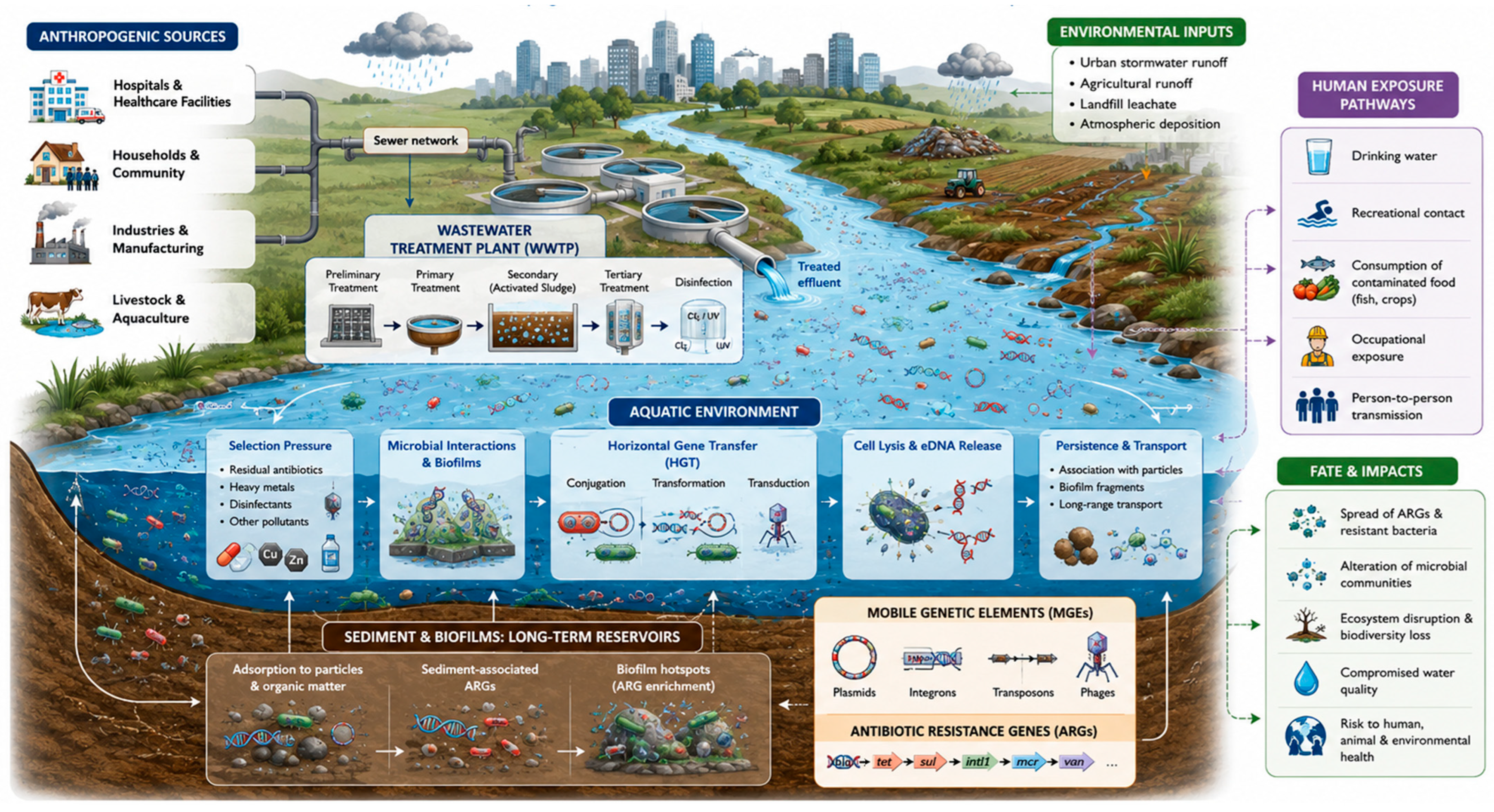
Anthropogenic activities play a central role in shaping the global wastewater resistome by continuously introducing ARB, ARGs, antimicrobial residues, and other selective contaminants into aquatic environments [20,83]. Under the One Health framework, wastewater discharges originating from healthcare facilities, livestock production, aquaculture, pharmaceutical manufacturing, and municipal wastewater systems represent major environmental interfaces through which AMR is introduced and spread across human, animal, and environmental compartments (Figure 1) [4,84,85]. AMR is currently one of the leading causes of death globally, with a disproportionate burden in low- and middle-income countries, where wastewater surveillance can fill existing data gaps and support targeted interventions even where clinical surveillance infrastructure is limited [86,87].
Following their release into aquatic environments, anthropogenic contaminants such as heavy metal contamination from agricultural fertilizers and industrial pesticides interact with complex environmental processes that govern the persistence and dissemination of resistance determinants [88]. Furthermore, the hydrodynamics of aquatic systems fundamentally alter the spatial distribution of these genetic determinants, as varying flow conditions dictate the physical contact frequency and nutrient availability within biofilm communities (Figure 1), thereby influencing the rates of horizontal gene transfer [89]. Overall, wastewater-impacted aquatic ecosystems function as dynamic environmental corridors through which resistance determinants are redistributed across interconnected freshwater networks [90,91].
The emergence of microplastics as ubiquitous environmental vectors has added a new dimension to these environmental interfaces, as their surfaces provide specialized ecological niches for microbial colonization and biofilm development referred to as the plastisphere [92]. These synthetic substrates act as long-range carriers, concentrating co-pollutants and heavy metals that exacerbate the selective pressure on associated microbial assemblages [92]. These materials fundamentally alter microbial evolutionary trajectories by fostering the co-selection of antibiotic and heavy metal resistance genes through genetic co-regulation and efflux mechanisms [93,94]. Comparative analyses have demonstrated that these microplastic-associated biofilms often harbor higher proportions of metabolically active resistant bacteria and high-risk resistance genes compared to natural surfaces, indicating that anthropogenic pollutants serve as specialized hotspots for genetic amplification [95]. Moreover, as these microplastic-laden biofilms traverse hydrological networks, they facilitate the long-distance transport of these resistance determinants, effectively connecting point-source wastewater discharges to downstream environments and potentially human exposure pathways [96].
Figure 1.
Environmental dissemination pathways of ARGs and MGEs from wastewater to aquatic ecosystems and human exposure.
4. Pathways of ARG Transmission Through Wastewater
4.1. Municipal Sewage Networks
Municipal sewage networks constitute the primary convergence point for ARGs, ARB, MGEs, and co-selective contaminants originating from households, healthcare facilities, commercial activities, and urban runoff [6,20]. By integrating urinary, fecal, and domestic wastewater into a single composite stream, sewer systems concentrate antibiotics, heavy metals, disinfectants, and diverse microbial populations before they enter wastewater treatment plants (WWTPs), thereby providing a representative snapshot of community-wide AMR dynamics [4]. During sewer conveyance, wastewater functions not only as a transport medium but also as a dynamic ecological compartment in which resistance determinants are redistributed among microbial populations [97]. These urban influent streams serve as primary reservoirs for broad-host-range conjugative plasmids, which facilitate the rapid horizontal transfer of resistance determinants within the high-density, nutrient-rich environments of sewer biofilms [98]. Furthermore, the release of pharmaceutical residues alongside these genetic elements promotes the assembly of complex resistance on MGE, allowing for MDR acquisition through a HGT event [9,99]. As a result, wastewater-based surveillance offers a community-level signal reflecting upstream antibiotic use patterns, as well as ARB and ARG carriage, that complements clinical surveillance [11,30].
While WWTPs are widely recognized as major hotspots for antimicrobial resistance, emerging data suggest a more nuanced reality where the activated sludge process can paradoxically achieve substantial reductions in specific fecal-derived mobile ARG loads, indicating that biological treatment also provides an important barrier against resistance dissemination [10]. However, the overall efficacy of these systems remains inconsistent, as the high bacterial densities and nutrient-rich conditions often foster an ideal environment for HGT, allowing ARGs to persist or even proliferate [18]. These dynamics are further complicated by the continuous influx of diverse microbial populations and amplicon sequence variants in influent wastewater, each exhibiting distinct persistence and removal patterns throughout biological treatment [19].
Despite the substantial reduction in microbial biomass during primary and secondary treatment, effluents often remain important transmission routes of ARGs and clinically relevant MGEs that bypass traditional disinfection processes into receiving environments [7]. Conjugative transposons such as Tn916, together with broad-host-range plasmids and integrons, may persist throughout treatment processes and remain associated with residual planktonic bacteria and biofilm-derived communities discharged in secondary effluents [12]. While absolute ARG abundance generally declines during treatment, several studies have reported increases in the relative abundance of specific resistance determinants, reflecting differential removal efficiencies among microbial populations and resistance elements [100,101].
Recent metagenomic and metatranscriptomic evidence further indicates that secondary effluents frequently exhibit elevated ARG expression, highlighting the limitations of conventional treatment processes in mitigating the dissemination of active resistance determinants and their associated MGEs [14]. These findings have shifted the focus of wastewater surveillance beyond monitoring resistant pathogens alone toward comprehensive characterization of the wastewater resistome. Notably, conventional disinfection processes such as chlorination may paradoxically increase the pool of extracellular ARGs (eARGs) by lysing bacterial cells and releasing cell-free DNA that remains available for natural transformation [15]. Recent full-scale investigations demonstrate that although chlorination effectively inactivates bacterial hosts, it induces a pronounced transition from intracellular ARGs (iARGs) to extracellular ARGs (eARGs), with cell-free ARGs increasing by several orders of magnitude even under moderate chlorine doses [16]. Mechanistically, chlorine-induced oxidative stress enhances membrane permeability, engages the bacterial SOS response, and stimulates the production of reactive oxygen species, collectively facilitating natural transformation and promoting the recombination of resistance determinants within downstream microbial communities [17].
These observations challenge the traditional perception of wastewater treatment as an effective barrier to resistance dissemination, suggesting instead that treatment processes can influence the evolutionary dynamics and post-treatment mobility of ARGs. This distinction highlights the importance of evaluating both absolute and relative resistome dynamics rather than relying solely on reductions in bacterial biomass or ARG abundance. Furthermore, the persistence of mobile genetic elements (MGEs) in treated effluents underscores the limitations of conventional activated sludge processes in completely attenuating ARG-associated risks, as microbial interactions within treatment systems may continue to facilitate horizontal gene transfer under selective and nutrient-limited conditions [102]. These findings emphasize the need for advanced treatment technologies and integrated resistome surveillance across municipal wastewater systems.
4.2. Hospital and Healthcare Facility Systems
Healthcare facilities can represent important hotspots for clinically relevant antimicrobial resistance, owing to intensive antimicrobial use and the high prevalence of resistant bacteria among hospitalized patients [6,84]. Metagenomic and PCR-based investigations consistently demonstrate that hospital effluents harbor significantly higher abundances and diversity of clinically relevant ARGs, particularly those conferring resistance to β-lactams, aminoglycosides, carbapenems, and other critically important antibiotics, compared to community-derived municipal wastewater [103]. However, the occurrence of highly concentrated or clinically relevant resistance determinants in hospital wastewater should not be equated with a dominant contribution to the overall municipal wastewater resistome.
Where hospital effluents are discharged into municipal sewer networks, they may introduce clinically important ARGs, ARB, and MGEs into the receiving wastewater stream. However, the magnitude of this contribution depends strongly on hospital characteristics, antimicrobial consumption, wastewater pretreatment, sewer infrastructure, and local regulatory requirements [103]. In many settings, hospital wastewater is subject to specific management or pretreatment requirements before discharge, and therefore the assumption that untreated hospital effluents directly enter municipal wastewater systems cannot be generalized across countries or healthcare systems. The mixing of these high-risk clinical effluents with domestic wastewater creates an important transmission interface and unique hotspot effect within sewer networks, facilitating the redistribution of clinically derived resistance determinants and significantly increasing the probability of HGT before wastewater reaches treatment facilities [28]. This burden may be further intensified by discharges from pharmaceutical manufacturing facilities, where exceptionally high antibiotic concentrations can promote the enrichment and dissemination of highly resistant bacterial populations in receiving environments [104]. As a result, there is an ongoing scientific debate on whether segregated treatment of hospital wastewater prior to its discharge into municipal sewer systems could substantially reduce the overall discharge of clinically relevant resistance determinants [105].
Recent analyses suggest that the relative contribution of hospital effluents to the total mass load of ARGs in municipal influent may be lower than previously hypothesized, as these clinical streams often represent less than 1% of the total influent volume [27,106] and their impact may therefore be partially diluted by the substantially larger contribution of ARGs already present in domestic sewage [107]. This variability underscores the importance of evaluating hospital wastewater contributions within the broader context of local wastewater infrastructure, antibiotic consumption patterns, and treatment capacity [108].
4.3. Industrial and Agricultural Interfaces
Intensive animal production, encompassing both confined livestock operations and aquaculture, functions as a significant reservoir of antibiotic resistance due to abundant prophylactic and therapeutic use of antibiotics that exert selective pressure on bacterial populations, makes these cultures a genetic hotspot for HGT and ARG [109]. The widespread use of manure and other waste streams from these high-density systems as agricultural fertilizers introduce these resistance determinants into the environment, where they can further propagate through HGT with indigenous soil microbial communities [110,111].
Organic manure and reclaimed wastewater are recognized as critical human and animal waste products that alter both the diversity and abundance of the soil resistome [112]. Agricultural sites where manure and wastewater are used for soil amendment are important pathways for ARG transmission from humans and animals to the environment and can be reintroduced into humans via agricultural products [1]. In addition, the regular application of manure as an agricultural fertilizer serves as a persistent vehicle for disseminating resistant determinants into soil and water systems [113]. Reflecting this public health significance, international organizations, including the FAO, WHO, and WOAH, have identified agricultural environments as critical components of One Health strategies addressing foodborne antimicrobial resistance [114]. Furthermore, the accumulation of residual antibiotics in these substrates can profoundly alter soil microbial community structures and enzyme kinetics, effectively creating long-term reservoirs for selection pressure [115].
The magnitude of this enrichment varies according to manure origin, with poultry and swine manure generally promoting higher soil ARG enrichment compared to bovine manure, correlating with the presence of integrase and transposase genes that promote HGT [116]. Although antibiotic residues represent the principal selective driver, heavy metals commonly used as livestock feed additives further reinforce the persistence of resistant populations through co-selection mechanisms [83]. These conditions promote genetic exchange between manure-associated microorganisms and indigenous rhizosphere communities, facilitating the integration of clinical-grade resistance into plant-associated microbiomes [109].
Increasing evidence indicates that these resistance determinants subsequently move beyond the soil compartment. High-throughput sequencing studies have demonstrated significant enrichment of tet-family genes (tetracycline resistance genes), including tet(W), tet(M), and tet(X), in both the soil matrix and the endosphere of edible crops, establishing a clear pathway for dietary human exposure [117]. In addition, the co-occurrence of heavy metals like zinc and copper in these organic amendments further catalyzes the selective pressure required for the maintenance and propagation of these gene pools [118], foster microbial co-selection, which ensures the persistent stability of a broad spectrum of resistance determinants beyond tetracycline genes, including sulfonamide resistance genes (e.g., sul1, sul2), beta-lactamases (e.g., blaTEM), and macrolide resistance determinants (e.g., ermB) [99,119,120].
Industrial activities represent an important anthropogenic interface in the environmental circulation of antimicrobial resistance, although their contribution varies considerably according to the industrial sector involved, wastewater management practices, and the stringency of regulatory controls [121]. Pharmaceutical manufacturing is of particular concern because inadequately treated discharges may contain high concentrations of antimicrobial compounds, imposing substantial selective pressure on bacterial communities and promoting the enrichment of resistant bacteria and ARGs [122]. Industrial effluents may also contain disinfectants, biocides, heavy metals, and other chemical stressors that contribute to the persistence and co-selection of resistance determinants [123]. In addition to exerting direct selective effects, industrial wastewater can introduce resistant bacteria and mobile genetic elements into municipal wastewater networks and receiving waters, where they may interact with resistance determinants originating from domestic, healthcare, agricultural, and animal-production sources [124]. Consequently, the industrial contribution to the wastewater resistome should not be assessed solely on the basis of ARG loading. Its broader significance lies in the capacity of industrial contaminants to alter selective conditions and affect the persistence, mobility, and horizontal dissemination of resistance determinants across interconnected microbial communities [125].
4.4. Environmental Dissemination and Ecosystem Contacts
Following their release from wastewater treatment systems, ARGs, ARB, MGEs, and residual antimicrobial compounds are transported into rivers, lakes, estuaries, coastal waters, and other receiving environments, where they contribute to the expansion of the environmental resistome [78]. Effluents from urban WWTPs have been consistently shown to alter the abundance, diversity, and composition of downstream riverine resistomes, showing that wastewater discharge represents one of the principal pathways linking anthropogenic resistance sources with natural aquatic ecosystems [126]. The continued dissemination of these resistance determinants into receiving waters also creates opportunities for their redistribution through environmental water reuse, including irrigation and, where treatment is inadequate, potential contamination of drinking-water resources [127].
Environmental dissemination extends beyond aquatic ecosystems through irrigation practices that utilize treated or inadequately treated wastewater, which facilitates the transfer of resistome elements from terrestrial runoff into the edible portions of crops [11]. This contamination cycle is further exacerbated when ARGs, MGEs, and ARB introduced into agricultural soils via organic fertilizers subsequently colonize crop-associated microbiomes, creating direct links between aquatic and terrestrial ecosystems and establishing a bridge into the human food chain [128]. While passive transfer via irrigation is well-documented, the role of soil fauna, such as earthworms, is increasingly acknowledged as a biological mechanism by modifying soil structure and microbial interactions, thereby modulating the vertical and horizontal dispersal of resistance determinants within soil–plant ecosystems [129]. Furthermore, the consumption of raw produce has become a significant pathway for transmission, as the plant microbiome functions as a crucial interface linking wastewater-impacted ecosystems with human exposure [130].
Within receiving environments, ARGs and MGEs frequently exploit biofilms on sediments, rocks, submerged vegetation, and engineered surfaces which act as reservoirs that facilitate HGT and long-term environmental persistence [131]. Moreover, the stability and dissemination of these biofilm-associated resistomes are further influenced by abiotic factors such as temperature, pH, nutrient availability, and hydrological conditions, which collectively regulate microbial activity and genetic exchange within aquatic ecosystems [132]. Collectively, these environmental processes enable wastewater-derived resistance determinants to persist, disperse, and become established across interconnected aquatic and terrestrial ecosystems, thereby extending the ecological footprint of the wastewater resistome far beyond engineered treatment facilities.
These diverse contributions to the global resistome are summarized in Table 1, which highlights the major wastewater compartments, their characteristic ARG profiles, bacterial hosts, mobile genetic elements (MGEs), selective pressures, dissemination pathways, and One Health implications. Collectively, these compartments illustrate that wastewater is not a single, homogeneous reservoir of AMR, but a dynamic network of interconnected environments in which ARGs can be introduced, selected, concentrated, exchanged, and disseminated across human, animal, and environmental interfaces.
Table 1.
Major wastewater compartments contributing to the global resistome.
5. Surveillance of the Wastewater Resistome
5.1. Methodological Approaches and Metrics
Global surveillance of AMR through wastewater depends on analytical methods that are robust, reproducible, and comparable across geographic regions [86]. Current wastewater-based surveillance (WWS) employs a wide spectrum of methodologies, including culture-based isolation, quantitative PCR (qPCR), high-throughput qPCR, Reverse-transcription PCR (RT-PCR), droplet digital PCR (dd-PCR) and metagenomic sequencing (Table 2), each providing complementary information on the occurrence, abundance, and diversity of ARB, ARGs, and MGEs [133]. Reflecting the rapid expansion of the field, a recent systematic scoping review identified 177 WWS-AMR studies published between 2014 and October 2024, of which more than three-quarters (76.8%) were published after 2019, demonstrating a marked shift toward molecular and sequencing-based surveillance approaches [134].
Each methodological platform offers distinct strengths and limitations. Culture-based methods remain indispensable for recovering viable resistant organisms and assessing phenotypic antimicrobial susceptibility, whereas PCR-based assays provide rapid and highly sensitive quantification of predefined resistance determinants [135,136,137,138,139]. As these techniques evolve, metagenomic sequencing, utilizing both long- and short-read data, has emerged as a powerful and comprehensive approach for characterization of the wastewater resistome without prior target selection, allowing simultaneous identification of ARGs, microbial community composition, and their potential genetic associations beyond what traditional culture-based methodologies can capture [86]. The integration of long-read sequencing with conventional short-read platforms has further enhanced the reconstruction of plasmids, integrons, and other MGEs, thereby improving the resolution of ARG genomic contexts and HGT events that cannot be reliably inferred using targeted molecular assays alone [140,141,142]. In addition, the high-resolution techniques further allow researchers to distinguish between intracellular ARGs and extracellular DNA fragments, providing a more comprehensive understanding of the mobilization potential and persistence of resistance within wastewater treatment systems [21].
Despite these technological advances, methodological heterogeneity remains one of the principal obstacles to global wastewater resistome surveillance [14,143]. Variability in sampling strategies, sample preservation, DNA extraction protocols, sequencing depth, bioinformatic workflows, and reporting practices introduces substantial analytical bias, limiting the comparability of resistome profiles across studies and countries [136,144]. Consequently, effective surveillance increasingly requires harmonized sampling protocols coupled with standardized bioinformatic pipelines capable of accurately detecting ARGs, MGEs, and their genetic linkages within highly complex wastewater microbial communities [38].
Future surveillance frameworks should therefore emphasize methodological harmonization while maintaining sufficient flexibility to accommodate diverse economic and technical settings [145]. Standardized high-throughput qPCR platforms and consensus metagenomic analytical pipelines would substantially improve inter-study comparability and facilitate the development of globally representative wastewater resistome databases [40]. However, the practical deployment of these high-resolution tools must be balanced against the necessity for low-cost, widely accessible monitoring options in resource-limited settings, where culture-based methods remain indispensable for actionable surveillance [146]. Looking ahead, the integration of artificial intelligence with long-read sequencing, advanced metagenomics, and automated bioinformatic workflows offers considerable potential to improve the detection of emerging high-risk resistance determinants, identify transmission patterns, and support real-time public health decision-making [147].
To realize this potential, the field must systematically address several research priorities, including source attribution, in situ quantification of horizontal gene transfer, and the development of robust, consensus-based environmental risk assessment models [35]. Furthermore, achieving global data harmonization remains critical to overcoming current methodological heterogeneities in sampling and bioinformatic workflows, a challenge that is particularly pronounced in low- and middle-income countries where laboratory infrastructure and technical training are frequently constrained [43,148]. By prioritizing the creation of standardized, affordable monitoring networks, leveraging metagenomic databases that incorporate environmental-specific ARG diversity, and establishing shared quality assurance frameworks, the research community can move beyond descriptive surveillance toward predictive frameworks that inform effective, policy-relevant public health interventions [134,138,149].
Table 2.
Comparative overview of wastewater resistome surveillance methodologies.
5.2. Global Monitoring Gaps and Data Harmonization
Although wastewater-based surveillance of AMR has expanded rapidly over the past decade, its implementation remains geographically uneven [87]. Most surveillance programs are concentrated in WWTPs in high-income countries, whereas low- and middle-income countries (LMICs), where the burden of AMR is often greatest, remain substantially underrepresented because of limited infrastructure, financial constraints, and reduced analytical capacity [134,148]. As result, major knowledge gaps persist regarding the global distribution, diversity, and transmission dynamics of wastewater-associated resistomes, limiting the development of globally representative surveillance networks [122].
From a One Health perspective, effective global WWS requires coordinated collaboration among the human, animal, and environmental health sectors together with a shared understanding of the capabilities and limitations of available surveillance methodologies [30]. Strengthening water, sanitation, and hygiene (WASH) infrastructure is equally important, as sustainable wastewater surveillance can provide an early-warning system for emerging resistance threats while supporting pandemic preparedness, particularly in regions where conventional clinical surveillance remains limited particularly in LMICs [4]. To facilitate this integration, the WHO has promoted coordinated surveillance frameworks that incorporate environmental monitoring into broader AMR surveillance strategies [86]. Integrating WWS with existing clinical surveillance systems therefore represents an important step toward establishing comprehensive One Health monitoring programs capable of capturing resistance dynamics across interconnected human, animal, and environmental compartments [87].
Expanding surveillance coverage alone will not ensure meaningful global comparisons. Recent large-scale metagenomic studies have demonstrated that sewage resistomes are shaped not only by local antimicrobial consumption but also by regional environmental conditions, sanitation infrastructure, bacterial community networks, and ecological processes [31,149]. Consequently, resistome composition varies substantially among geographical regions, indicating that surveillance strategies should move beyond universal ‘one-size-fits-all’ approaches and instead incorporate region-specific ecological, environmental, and socioeconomic determinants when interpreting wastewater resistome data [150].
Achieving global data harmonization therefore requires standardization across the entire surveillance workflow. International efforts should prioritize harmonized sampling strategies, inter-laboratory validated protocols, standardized DNA extraction and library preparation procedures, consensus bioinformatic pipelines, and curated reference databases to minimize methodological bias and improve comparability among studies [151,152]. Such harmonization would facilitate the integration of wastewater surveillance data generated across different countries while strengthening global surveillance initiatives coordinated through organizations such as the WHO and the European Centre for Disease Prevention and Control (ECDC) [153].
Moreover, establishing centralized data repositories and open-access reporting platforms is essential to ensure that metagenomic insights are actionable for medical professionals and policy makers. This necessity is exemplified by the diverse resistome findings across various global wastewater studies, which now increasingly integrate data from diverse geographical contexts, including France, Italy, and the Netherlands, to improve regional comparability and public health surveillance [154,155,156,157,158]. Such harmonization is crucial for translating metagenomic signals, which are shaped by local infrastructure, microbial community networks, and sanitation, into actionable public health data, allowing for meaningful cross-border comparisons and integrated One Health monitoring [154,155].
Wastewater-based AMR surveillance has been increasingly applied across diverse geographic regions and wastewater sources, using both culture-based and metagenomic approaches. Representative studies summarized in Table 3 illustrate the diversity of resistome patterns across community, hospital, municipal, and environmental settings, while also highlighting the influence of geography, wastewater source, treatment processes, and local environmental conditions.
Table 3.
Representative case studies of wastewater resistome surveillance worldwide.
5.3. Linking Wastewater Resistome Data to Public Health Indicators
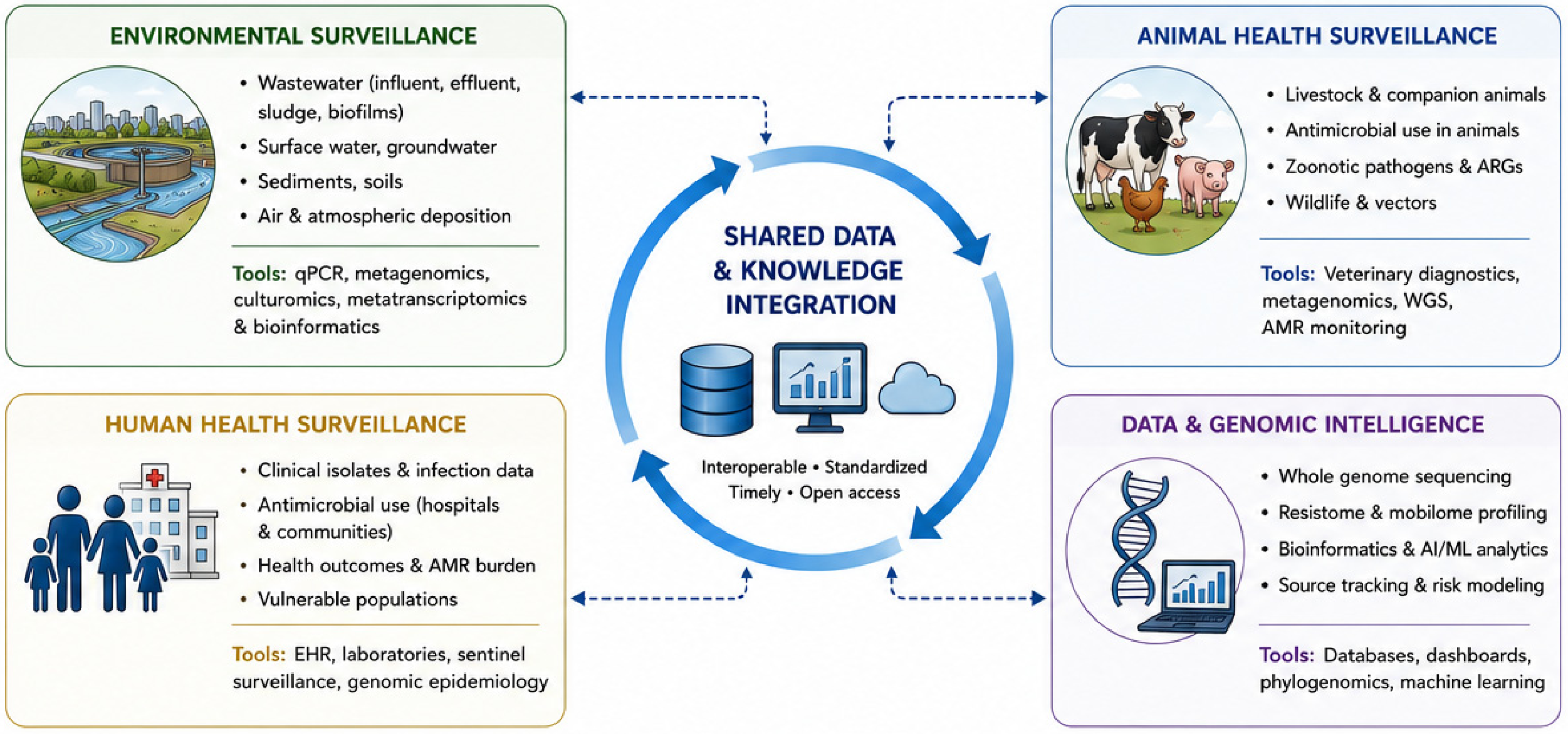
WWS provides composite population-level samples that integrate mixed community microbiome signatures, and active surveillance of ARB from entire communities, making it a valuable complement to conventional clinical surveillance within the One Health framework [78]. Unlike patient-based surveillance, wastewater captures both symptomatic and asymptomatic carriers while simultaneously reflecting antimicrobial consumption, resistance gene circulation, and the environmental dissemination of AMR [43,163]. Consequently, wastewater-based surveillance has emerged as a promising tool for monitoring community-wide AMR dynamics, supporting antimicrobial stewardship, and informing public health interventions before increases in clinical infections become apparent [137,164]. The integration of wastewater resistome data with clinical, demographic, antimicrobial-use, and environmental indicators provide a framework for translating environmental AMR signals into meaningful public health information, as illustrated in Figure 2.
Figure 2.
Integrated One Health surveillance framework for wastewater resistome monitoring and public health decision-making.
Despite this potential, translating wastewater resistome data into meaningful public health indicators remains challenging [165]. The clinical relevance, sensitivity, and predictive value of wastewater-derived ARG and ARB measurements are still incompletely understood, particularly regarding their relationship with infection prevalence and colonization patterns within corresponding sewershed populations [86]. A recent systematic review highlighted that relatively few studies have directly compared wastewater surveillance results with clinical epidemiological data, illustrating the limited evidence currently available to establish robust quantitative relationships between environmental resistomes and human disease burden [166].
Within a One Health framework, environmental surveillance must therefore distinguish between two complementary risks: the dissemination of resistance determinants across environmental compartments and their subsequent transmission to human populations [136]. Achieving this objective requires integrating wastewater resistome data with clinical surveillance, antimicrobial consumption records, sanitation infrastructure, demographic information, and environmental variables to better contextualize observed resistance patterns [167,168]. Quantitative ARG measurements may also be incorporated into mathematical and epidemiological models to estimate the risks of asymptomatic carriage, environmental exposure, and subsequent clinical infection [169].
Accurate interpretation of wastewater resistome data also requires distinguishing between ARGs introduced through human fecal contamination and those enriched through environmental selection [170]. Incorporating fecal pollution indicators, such as crAssphage and other human-associated microbial markers, provides an effective means of differentiating these processes and improves the interpretation of wastewater surveillance data [132,155]. This distinction is essential for identifying environmental hotspots of resistance selection and for strengthening the application of WWS in public health risk assessment and early-warning systems.
6. Risk Assessment Within a One Health Framework
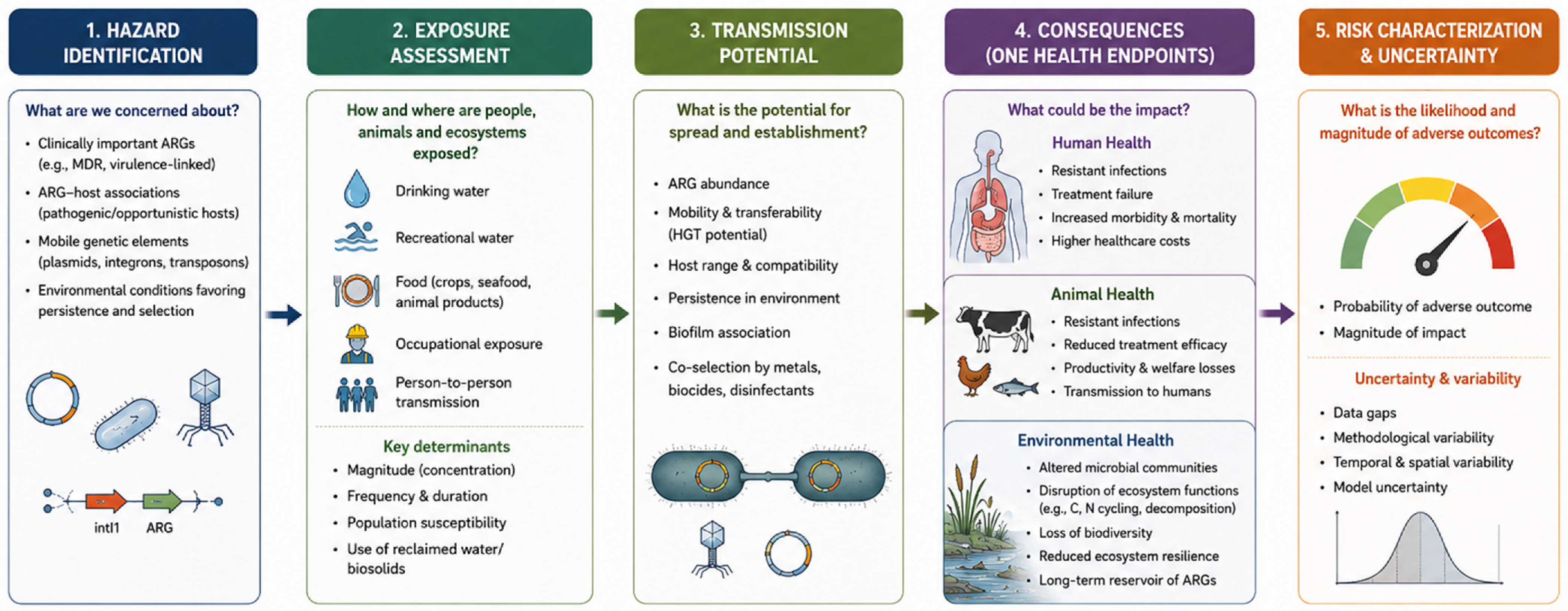
The public health significance of the WWR extends beyond the environmental presence of ARGs to the probability that these determinants ultimately reach human populations through relevant exposure pathways [146]. The detection of ARGs in environmental matrices should not be interpreted as direct evidence of human health risk, since successful transmission requires a sequence of biological events including environmental persistence, exposure, acquisition by compatible bacterial hosts, HGT, and eventual colonization or infection [171,172]. This progression from environmental occurrence to potential health impact provides the basis for a One Health risk-assessment framework, as illustrated in Figure 3. Risk assessment frameworks require a transition from descriptive measurements of ARG abundance toward a structured evaluation of hazard, exposure, transmission potential, consequences, and uncertainty, with particular emphasis on identifying clinically relevant ARG–host combinations together with the environmental conditions that facilitate their maintenance and transmission [79,173].
Consequently, human health assessment should distinguish between environmental occurrence, transmission potential, acquisition by a compatible host, and demonstrated clinical impact. Integrating wastewater resistome data with clinical AMR surveillance, epidemiological information, antimicrobial consumption records, microbial source attribution, and genomic epidemiology could provide a stronger basis for evaluating the potential contribution of wastewater-associated resistance to human AMR infection [174]. Quantitative microbial risk assessment (QMRA) and related probabilistic approaches can further integrate these data to estimate the likelihood and magnitude of adverse outcomes while explicitly accounting for variability and uncertainty. Such integrated frameworks would transform WWS from a descriptive monitoring tool into a predictive system capable of supporting early warning, antimicrobial stewardship, and evidence-based public health interventions [23].
Animals represent both important reservoirs and recipients of AMR within the One Health continuum, creating bidirectional exchange of ARB and ARGs between humans and the environment [175]. Animal health risk should be evaluated using a comparable framework, with particular attention to resistance determinants associated with animal pathogens, commensal bacteria, and mobile genetic elements. Relevant parameters include ARG abundance, persistence, mobility, host range, and evidence of establishment within animal-associated microbial populations [39,176]. However, quantitative evidence linking wastewater resistome measurements directly to AMR outcomes in livestock, aquaculture species, wildlife, or companion animals remains limited. Future assessments should therefore integrate environmental resistome data with veterinary AMR surveillance, antimicrobial-use records, longitudinal animal sampling, and genomic approaches capable of identifying ARG–host relationships [177,178]. Such integration would help determine whether environmental resistance represents a transient hazard or a persistent determinant with a measurable contribution to animal AMR, as the aquatic environment frequently serves as the final repository for both anthropogenic and livestock waste [179,180]. Longitudinal One Health studies are further needed to quantify the relative contribution of environmental transmission pathways to antimicrobial resistance in animal populations and to determine how these reservoirs contribute to subsequent human exposure.
From an environmental perspective, AMR is increasingly considered an emerging ecological pollutant capable of altering microbial community structure, ecosystem functioning, and the delivery of essential ecosystem services [181,182]. Rivers, lakes, estuaries, wetlands, and other wastewater-impacted environments function not only as recipients of resistant microorganisms but also as long-term ecological reservoirs where resistance determinants can persist, evolve, and disseminate across interconnected environmental compartments [82]. The ecological consequences of wastewater-derived resistance extend beyond immediate contamination events and may alter microbial community composition, nutrient cycling, carbon and nitrogen biogeochemical processes, and the ecological resilience that underpins essential ecosystem services [183,184]. The long-term accumulation of resistance determinants within environmental microbial communities may therefore compromise ecosystem stability while simultaneously increasing opportunities for future transmission into human and animal populations [185,186].
Risk assessment within the environmental compartment should therefore incorporate ecological endpoints alongside traditional microbiological indicators [187,188]. In addition to monitoring ARG abundance, future assessments should evaluate the mobility of resistance determinants, their persistence within environmental microbial communities, and their potential to disrupt ecosystem functions under changing environmental conditions [189]. Such approaches require multidisciplinary collaboration among environmental microbiologists, ecologists, clinicians, veterinarians, engineers, and public health specialists to develop integrated One Health frameworks capable of simultaneously protecting ecosystem integrity and reducing the long-term risks associated with environmental antimicrobial resistance [154]. Advancing these objectives will require longitudinal monitoring coupled with quantitative ecological modeling to identify environmental thresholds beyond which wastewater-derived resistance may compromise both ecosystem services and public health [190]. Because environmental antimicrobial resistance ultimately affects human and animal health through interconnected One Health pathways, future risk assessments must modify traditional dose–response models to specifically account for the contribution of environmental ARGs to clinical health outcomes and the potential for these pathways to increase treatment costs or exacerbate disease complications [191,192].
Figure 3.
One health risk assessment framework for the wastewater resistome.
7. Mitigation and Intervention Strategies
7.1. Source Control and Antimicrobial Stewardship
While advances in wastewater treatment technologies can substantially reduce the environmental release of ARG, effective long-term mitigation ultimately depends on preventing resistant microorganisms, resistance genes, and selective contaminants from entering wastewater systems [193]. Source control therefore represents one of the most sustainable strategies for limiting the expansion of the wastewater resistome by reducing selective pressures before they reach treatment facilities. Within the One Health framework, this requires coordinated interventions across human healthcare, veterinary medicine, agriculture, pharmaceutical production, and environmental management [4,194,195].
Prudent antimicrobial stewardship remains the cornerstone of source control. Reducing inappropriate antibiotic prescribing in human medicine, limiting prophylactic antibiotic use in livestock production, and promoting evidence-based antimicrobial use in aquaculture can substantially decrease the quantities of antibiotics and resistant microorganisms entering municipal wastewater systems [7,196,197]. Equally important is the implementation of regulatory policies governing pharmaceutical manufacturing, where inadequately treated industrial discharges may contain exceptionally high antibiotic concentrations capable of sustaining intense selective pressure and accelerating resistance evolution in receiving environments [198].
Healthcare facilities represent another important target for source-control interventions. Although hospital wastewater generally constitutes a relatively small proportion of total municipal influent, it frequently contains disproportionately high concentrations of clinically important pathogens, antibiotic residues, and MRD [7]. Consequently, decentralized pretreatment technologies, including ozonation, membrane filtration, and advanced oxidation processes, have been proposed to reduce the discharge of high-risk contaminants before hospital effluents enter municipal sewer networks, thereby complementing centralized wastewater treatment rather than replacing it [5].
Source control should likewise extend to agricultural and livestock systems, where manure, slurry, reclaimed wastewater, and sewage sludge constitute major pathways for environmental dissemination of AMR [12]. Improved manure treatment through composting, anaerobic digestion, or other stabilization processes can substantially reduce the abundance of ARB, antibiotic residues, and MGE before land application [50,199]. Similarly, strengthening regulations governing reclaimed wastewater reuse and biosolid application is essential for minimizing the transfer of resistance determinants into agricultural soils and crop production systems [183]. However, as these engineering controls often induce transcriptional shifts in bacterial stress responses, it is vital to assess how surviving microbial populations adapt their functional profiles in response to these advanced sanitization treatments [200].
Besides individual sectors, effective source control requires integrated governance that aligns antimicrobial stewardship with environmental protection policies. Surveillance data generated from wastewater monitoring should therefore be incorporated into antimicrobial stewardship programs, enabling public health authorities to identify emerging resistance trends, evaluate intervention effectiveness, and prioritize mitigation strategies in high-risk settings. By combining prudent antibiotic use, strengthened environmental regulations, targeted pretreatment of high-risk waste streams, and sustainable agricultural management, source-control measures can substantially reduce the selective pressures driving resistance evolution and complement downstream wastewater treatment technologies within a comprehensive One Health strategy [194,201].
7.2. Wastewater Treatment Upgrades and Technological Innovations
Although conventional wastewater treatment substantially reduces microbial biomass and organic pollutants, it was not originally designed to eliminate antimicrobial resistance determinants. Consequently, treatment optimization is increasingly directed toward minimizing the release of ARB, ARGs, residual antimicrobials, and co-selective contaminants into receiving environments [144].
Recent technological developments have improved the capacity of wastewater treatment systems to mitigate AMR. Advanced tertiary treatments, including advanced oxidation processes, membrane-based technologies, activated carbon adsorption, and hybrid treatment configurations, generally achieve greater removal efficiencies than conventional biological processes by simultaneously targeting resistant microorganisms, residual antibiotics, and other contaminants that contribute to resistance selection [106,202]. Increasing evidence suggests that combining complementary treatment processes in multi-barrier systems provides more reliable resistome attenuation than reliance on any single technology [203,204].
However, treatment performance remains highly variable and depends on operational conditions, wastewater composition, and the physicochemical properties of individual contaminants. Future treatment strategies should prioritize process optimization alongside technology selection, with treatment objectives extending beyond conventional water quality parameters to include the reduction in resistance determinants and selective agents. Such improvements will strengthen the capacity of wastewater treatment plants to function as effective barriers against the environmental dissemination of antimicrobial resistance within a One Health framework.
7.3. Environmental Management and Policy Measures
Technological advances alone are insufficient to mitigate the environmental dissemination of antimicrobial resistance. Sustainable control of the wastewater resistome requires integrated environmental policies that combine regulatory measures, antimicrobial stewardship, wastewater management, and environmental protection within a unified One Health framework [205,206]. Accordingly, international initiatives led by the WHO, FAO, WOAH, and United Nations Environment Programme (UNEP) should continue expanding environmental surveillance and wastewater management as integral components of global antimicrobial resistance action plans, recognizing environmental contamination as a key driver of resistance emergence and dissemination [40,42].
Effective policy should prioritize source reduction by strengthening regulations governing hospital effluents, pharmaceutical manufacturing discharges, agricultural runoff, reclaimed wastewater reuse, and biosolid application [9]. Simultaneously, investments in wastewater infrastructure, particularly in low- and middle-income countries, remain essential to reduce environmental exposure while improving sanitation, water quality, and public health protection [207]. Expanding Water, Sanitation and Hygiene (WASH) programs alongside wastewater treatment capacity will further reduce opportunities for resistance transmission across human, animal, and environmental compartments.
Successful implementation also depends on coordinated governance involving environmental agencies, public health authorities, water utilities, agricultural sectors, and healthcare systems [208]. Such cross-sector collaboration enables harmonized regulations, standardized environmental monitoring, and evidence-based decision-making for antimicrobial resistance mitigation. In this context, adopting a “One Water” management approach, which recognizes drinking water, wastewater, stormwater, and environmental waters as interconnected resources, provides an appropriate framework for integrating antimicrobial resistance control with broader environmental sustainability objectives and the United Nations Sustainable Development Goals [209].
7.4. Community Engagement and Education
Effective mitigation of AMR extends beyond technological innovation and regulatory measures to include active participation by healthcare professionals, veterinarians, farmers, water utilities, policymakers, and the general public. Community engagement is essential for promoting responsible antimicrobial use, improving compliance with infection prevention measures, and reducing the environmental release of antimicrobial residues and resistant microorganisms at their source [210]. Educational initiatives should therefore strengthen awareness of the environmental dimension of AMR, emphasizing that inappropriate antimicrobial use and improper disposal of pharmaceuticals contribute not only to clinical resistance but also to the expansion of environmental resistomes [148]. Public campaigns encouraging the prudent use of antimicrobials, safe disposal of unused medications, and improved sanitation practices can substantially reduce selective pressures entering wastewater systems while complementing broader antimicrobial stewardship programs [146].
Effective communication among stakeholders is equally important. Translating scientific findings into accessible guidance enables policymakers, wastewater utilities, agricultural producers, and healthcare providers to implement evidence-based mitigation strategies tailored to local contexts [148]. Capacity-building programs, professional training, and interdisciplinary collaboration further facilitate the adoption of best management practices across the human, animal, and environmental sectors, reinforcing the collaborative principles of the One Health approach [211].
8. Future Directions and Research Gaps
Despite major advances in wastewater-based antimicrobial resistance surveillance, several fundamental scientific and methodological questions remain unresolved. Future research should move beyond descriptive characterization of wastewater resistomes toward predictive frameworks capable of identifying where, when, and under which environmental conditions resistance determinants are most likely to emerge, mobilize, and reach clinically relevant bacterial populations [212]. Achieving this objective will require the integration of microbial ecology, evolutionary biology, environmental engineering, epidemiology, and computational modeling within a unified One Health framework [37].
One of the foremost research priorities is to distinguish resistance determinants that merely persist in environmental reservoirs from those that represent genuine public health threats [213]. Future investigations should therefore prioritize the identification of high-risk ARGs, their principal bacterial hosts, and the mobile genetic elements responsible for their dissemination across human, animal, and environmental compartments [78]. Although numerous environmental ARGs have been identified, only a small proportion have demonstrated the capacity to overcome taxonomic barriers and become established in clinically important pathogens. The ecological and evolutionary mechanisms governing these transitions, including HGT, host adaptation, and selective pressures acting within wastewater ecosystems, remain incompletely understood [10,12].
Another critical challenge lies in moving from resistance detection toward quantitative risk prediction [214,215]. Current surveillance programs primarily report ARG occurrence and abundance, whereas future frameworks should estimate the probability of ARG mobilization, persistence, and transmission under different environmental conditions [216]. Developing predictive models that integrate wastewater characteristics, microbial community dynamics, selective pressures, and hydrological processes would substantially improve early-warning capabilities and support evidence-based risk management within a One Health context [6]. In addition, future research should increasingly exploit emerging analytical technologies, including artificial intelligence, machine learning, quantitative microbial risk assessment, and digital epidemiology, to transform wastewater resistome datasets into predictive public health tools. Coupling these approaches with long-term longitudinal surveillance and functional metagenomics will improve the identification of emerging resistance threats, reveal previously unrecognized environmental resistance reservoirs, and strengthen preparedness against future antimicrobial resistance dissemination within interconnected One Health systems.
9. Conclusions
Wastewater represents a critical interface within the One Health framework, connecting human, animal, and environmental reservoirs of antimicrobial resistance. The evidence reviewed here demonstrates that wastewater is not merely a passive carrier of ARB and ARGs but a dynamic microbial ecosystem in which selective pressures, microbial interactions, HGT, and MGE collectively shape the persistence and dissemination of the resistome. The contribution of wastewater to AMR is therefore determined not only by the abundance of ARGs but also by their genetic context, bacterial hosts, mobility, persistence, and potential to reach clinically relevant populations. Integrating resistome and mobilome analyses, including characterization of plasmids, integrons, transposons, integrative and conjugative elements, and other mobile genetic elements, can therefore provide a more informative assessment of the resistance determinants with the greatest potential for horizontal dissemination.
Recent advances in metagenomics, resistome profiling, and genomic surveillance have substantially expanded the ability to characterize resistance across wastewater systems. However, major challenges remain in translating resistome detection into meaningful estimates of transmission potential and public health risk. Greater integration of resistome–mobilome data with epidemiological, clinical, veterinary, environmental, and antimicrobial-use information is required to distinguish resistance determinants of genuine public health concern from those that primarily reflect environmental background diversity. Ultimately, wastewater surveillance should evolve from a primarily descriptive approach toward an integrated and predictive component of One Health antimicrobial resistance surveillance. Harmonized methodologies, longitudinal monitoring, quantitative risk assessment, and improved characterization of ARG–host–MGE relationships will be essential to identify emerging threats and inform targeted mitigation strategies. Such an integrated approach can strengthen the capacity of wastewater-based surveillance to provide early warning of resistance dissemination while supporting evidence-based interventions across interconnected human, animal, and environmental systems.
Author Contributions
T.M. and N.Z. conceptualization, writing, original draft preparation, review and editing. All authors have read and agreed to the published version of the manuscript.
Funding
This research received no external funding.
Data Availability Statement
No new data were created or analyzed in this study. Data sharing is not applicable to this article.
Acknowledgments
Generative artificial intelligence (AI) tools were used for language editing and grammatical improvement, as well as for the preparation of figures. The authors reviewed, edited, and verified the accuracy, originality, scientific integrity, and final content of the manuscript.
Conflicts of Interest
The authors declare no conflict of interest.
Abbreviations
The following abbreviations are used in this manuscript:
| AMR | Antimicrobial resistance |
| ARB | Antibiotic-resistant bacteria |
| ARGs | Antibiotic resistance genes |
| CRISPR | Clustered regularly interspaced short palindromic repeats |
| dd-PCR | Droplet digital PCR |
| ECDC | European Centre for Disease Prevention and Control |
| eARGs | Extracellular antibiotic resistance genes |
| ESBL | Extended-spectrum β-lactamase |
| ESKAPE | ESKAPE pathogens |
| FAO | Food and Agriculture Organization |
| HGT | Horizontal gene transfer |
| ICEs | Integrative and conjugative elements |
| IMEs | Integrative mobilizable elements |
| IncP | Incompatibility group P |
| IncQ | Incompatibility group Q |
| IncW | Incompatibility group W |
| iARGs | Intracellular antibiotic resistance genes |
| ISCR | Insertion sequence common region |
| LMICs | Low- and middle-income countries |
| MDR | Multidrug-resistant/multidrug resistance |
| MGEs | Mobile genetic elements |
| PCR | Polymerase chain reaction |
| QMRA | Quantitative microbial risk assessment |
| QS | Quorum sensing |
| qPCR | Quantitative PCR |
| RT-PCR | Reverse-transcription PCR |
| SOS | SOS response |
| UNEP | United Nations Environment Programme |
| WASH | Water, sanitation and hygiene |
| WHO | World Health Organization |
| WOAH | World Organisation for Animal Health |
| WWS-AMR | Wastewater-based surveillance of antimicrobial resistance |
| WWR | Wastewater resistome |
| WWTS | Wastewater treatment system |
References
- Kim, D.; Cha, C. Antibiotic resistome from the One-Health perspective: Understanding and controlling antimicrobial resistance transmission. Exp. Mol. Med. 2021, 53, 301–309. [Google Scholar] [CrossRef] [Scilit] [PubMed]
- Eapen, J.V.; Thomas, S.; Antony, S.A.; George, P.R.; Antony, J. A review of the effects of pharmaceutical pollutants on humans and aquatic ecosystem. Explor. Drug Sci. 2024, 2, 484–507. [Google Scholar] [CrossRef] [Scilit]
- Pal, C.; Bengtsson-Palme, J.; Kristiansson, E.; Larsson, D.G.J. The structure and diversity of human, animal and environmental resistomes. Microbiome 2016, 4, 54. [Google Scholar] [CrossRef] [Scilit] [PubMed]
- Singer, A.C.; Thompson, J.R.; Filho, C.R.M.; Street, R.; Li, X.; Castiglioni, S.; Thomas, K.V. A world of wastewater-based epidemiology. Nat. Water 2023, 1, 408–415. [Google Scholar] [CrossRef] [Scilit]
- Nguyen, A.Q.; Vu, H.P.; Nguyen, L.N.; Wang, Q.; Djordjevic, S.P.; Donner, E.; Yin, H.; Nghiem, L.D. Monitoring antibiotic resistance genes in wastewater treatment: Current strategies and future challenges. Sci. Total Environ. 2021, 783, 146964. [Google Scholar] [CrossRef] [Scilit] [PubMed]
- Su, Z.; Chen, L.; Wen, D. Impact of wastewater treatment plant effluent discharge on the antibiotic resistome in downstream aquatic environments: A mini review. Front. Environ. Sci. Eng. 2023, 18, 36. [Google Scholar] [CrossRef] [Scilit]
- Cantas, L.; Shah, S.Q.; Cavaco, L.M.; Manaia, C.M.; Walsh, F.; Popowska, M.; Garelick, H.; Bürgmann, H.; Sørum, H. A brief multi-disciplinary review on antimicrobial resistance in medicine and its linkage to the global environmental microbiota. Front. Microbiol. 2013, 4, 96. [Google Scholar] [CrossRef] [Scilit] [PubMed]
- Beretsou, V.G.; Michael-Kordatou, I.; Michael, C.; Santoro, D.; El-Halwagy, M.; Jäger, T.; Besselink, H.; Schwartz, T.; Fatta-Kassinos, D. A chemical, microbiological and (eco)toxicological scheme to understand the efficiency of UV-C/H2O2 oxidation on antibiotic-related microcontaminants in treated urban wastewater. Sci. Total Environ. 2020, 744, 140835. [Google Scholar] [CrossRef] [Scilit] [PubMed]
- Singer, A.C.; Shaw, H.M.; Rhodes, V.; Hart, A. Review of Antimicrobial Resistance in the Environment and Its Relevance to Environmental Regulators. Front. Microbiol. 2016, 7, 1728. [Google Scholar] [CrossRef] [Scilit] [PubMed]
- Brown, C.L.; Maile-Moskowitz, A.; Lopatkin, A.J.; Xia, K.; Logan, L.K.; Davis, B.C.; Zhang, L.; Vikesland, P.J.; Pruden, A. Selection and horizontal gene transfer underlie microdiversity-level heterogeneity in resistance gene fate during wastewater treatment. Nat. Commun. 2024, 15, 5412. [Google Scholar] [CrossRef] [Scilit] [PubMed]
- Pillay, S.; Calderón-Franco, D.; Urhan, A.; Abeel, T. Metagenomic-based surveillance systems for antibiotic resistance in non-clinical settings. Front. Microbiol. 2022, 13, 1066995. [Google Scholar] [CrossRef] [Scilit] [PubMed]
- Marutescu, L.G.; Popa, M.; Gheorghe-Barbu, I.; Barbu, I.C.; Rodríguez-Molina, D.; Berglund, F.; Blaak, H.; Flach, C.-F.; Kemper, M.A.; Spießberger, B.; et al. Wastewater treatment plants, an ‘escape gate’ for ESCAPE pathogens. Front. Microbiol. 2023, 14, 1193907. [Google Scholar] [CrossRef] [Scilit] [PubMed]
- Sharma, P.; Pal, N.; Kumawat, M.; Mishra, S.; Verma, V.; Tiwari, R.R.; Nagpal, R.; Sarma, D.K.; Singh, S.; Kumar, M. Antibiotic and Non-Antibiotic Determinants of Antimicrobial Resistance: Insights from Water Ecosystems. ACS EST Water 2024, 4, 4671–4689. [Google Scholar] [CrossRef] [Scilit]
- Che, Y.; Xia, Y.; Liu, L.; Li, A.D.; Yang, Y.; Zhang, T. Mobile antibiotic resistome in wastewater treatment plants revealed by Nanopore metagenomic sequencing. Microbiome 2019, 7, 44. [Google Scholar] [CrossRef] [Scilit] [PubMed]
- Dodd, M.C. Potential impacts of disinfection processes on elimination and deactivation of antibiotic resistance genes during water and wastewater treatment. J. Environ. Monit. 2012, 14, 1754. [Google Scholar] [CrossRef] [Scilit] [PubMed]
- Zhang, Y.; Li, A.; Dai, T.; Li, F.; Xie, H.; Chen, L.; Wen, D. Cell-free DNA: A Neglected Source for Antibiotic Resistance Genes Spreading from WWTPs. Environ. Sci. Technol. 2017, 52, 248–257. [Google Scholar] [CrossRef] [Scilit] [PubMed]
- Zhang, S.; Wang, Y.; Lu, J.; Yu, Z.; Song, H.; Bond, P.L.; Guo, J. Chlorine disinfection facilitates natural transformation through ROS-mediated oxidative stress. ISME J. 2021, 15, 2969–2985. [Google Scholar] [CrossRef] [Scilit] [PubMed]
- McConnell, M.M.; Hansen, L.T.; Jamieson, R.C.; Neudorf, K.D.; Yost, C.K.; Tong, A. Removal of antibiotic resistance genes in two tertiary level municipal wastewater treatment plants. Sci. Total Environ. 2018, 643, 292–300. [Google Scholar] [CrossRef] [Scilit] [PubMed]
- Gibson, C.; Kraemer, S.A.; Klimova, N.; Guo, B.; Frigon, D. Antibiotic resistance gene sequencing is necessary to reveal the complex dynamics of immigration from sewers to activated sludge. Front. Microbiol. 2023, 14, 1155956. [Google Scholar] [CrossRef] [Scilit] [PubMed]
- Barancheshme, F.; Munir, M. Strategies to Combat Antibiotic Resistance in the Wastewater Treatment Plants. Front. Microbiol. 2018, 8, 2603. [Google Scholar] [CrossRef] [Scilit] [PubMed]
- Majeed, H.J.; Riquelme, M.V.; Davis, B.C.; Gupta, S.; Angeles, L.; Aga, D.S.; Garner, E.; Pruden, A.; Vikesland, P.J. Evaluation of Metagenomic-Enabled Antibiotic Resistance Surveillance at a Conventional Wastewater Treatment Plant. Front. Microbiol. 2021, 12, 657954. [Google Scholar] [CrossRef] [Scilit] [PubMed]
- Yu, D.; Ryu, K.; Zhi, S.; Otto, S.J.; Neumann, N.F. Naturalized Escherichia coli in Wastewater and the Co-evolution of Bacterial Resistance to Water Treatment and Antibiotics. Front. Microbiol. 2022, 13, 810312. [Google Scholar] [CrossRef] [Scilit] [PubMed]
- Mosaka, T.B.; Unuofin, J.O.; Daramola, M.O.; Tizaoui, C.; Iwarere, S.A. Inactivation of antibiotic-resistant bacteria and antibiotic-resistance genes in wastewater streams: Current challenges and future perspectives. Front. Microbiol. 2023, 13, 1100102. [Google Scholar] [CrossRef] [Scilit] [PubMed]
- Inda-Díaz, J.S.; Lund, D.; Parras-Moltó, M.; Johnning, A.; Bengtsson-Palme, J.; Kristiansson, E. Latent antibiotic resistance genes are abundant, diverse, and mobile in human, animal, and environmental microbiomes. Microbiome 2023, 11, 44. [Google Scholar] [CrossRef] [Scilit] [PubMed]
- Calderón-Franco, D.; Sarelse, R.; Christou, S.; Pronk, M.; van Loosdrecht, M.C.; Abeel, T.; Weissbrodt, D.G. Metagenomic profiling and transfer dynamics of antibiotic resistance determinants in a full-scale granular sludge wastewater treatment plant. Water Res. 2022, 219, 118571. [Google Scholar] [CrossRef] [Scilit] [PubMed]
- Dai, D.; Brown, C.; Bürgmann, H.; Larsson, D.J.; Nambi, I.; Zhang, T.; Flach, C.-F.; Pruden, A.; Vikesland, P.J. Long-read metagenomic sequencing reveals shifts in associations of antibiotic resistance genes with mobile genetic elements from sewage to activated sludge. Microbiome 2022, 10, 20. [Google Scholar] [CrossRef] [Scilit] [PubMed]
- Czekalski, N.; Berthold, T.; Caucci, S.; Egli, A.; Bürgmann, H. Increased Levels of Multiresistant Bacteria and Resistance Genes after Wastewater Treatment and Their Dissemination into Lake Geneva, Switzerland. Front. Microbiol. 2012, 3, 106. [Google Scholar] [CrossRef] [Scilit] [PubMed]
- Ng, C.; Tay, M.; Tan, B.; Le, T.H.; Haller, L.; Chen, H.; Koh, T.H.; Barkham, T.M.S.; Thompson, J.R.; Gin, K.Y.-H. Characterization of Metagenomes in Urban Aquatic Compartments Reveals High Prevalence of Clinically Relevant Antibiotic Resistance Genes in Wastewaters. Front. Microbiol. 2017, 8, 2200. [Google Scholar] [CrossRef] [Scilit] [PubMed]
- Munck, C.; Albertsen, M.; Telke, A.; Ellabaan, M.; Nielsen, P.H.; Sommer, M.O. Limited dissemination of the wastewater treatment plant core resistome. Nat. Commun. 2015, 6, 8452. [Google Scholar] [CrossRef] [Scilit] [PubMed]
- Hendriksen, R.S.; Munk, P.; Njage, P.; Van Bunnik, B.; McNally, L.; Lukjancenko, O.; Röder, T.; Nieuwenhuijse, D.; Pedersen, S.K.; Kjeldgaard, J.; et al. Global monitoring of antimicrobial resistance based on metagenomics analyses of urban sewage. Nat. Commun. 2019, 10, 1124. [Google Scholar] [CrossRef] [Scilit] [PubMed]
- Martiny, H.M.; Munk, P.; Fuschi, A.; Becsei, Á.; Pyrounakis, N.; Brinch, C.; Larsson, D.G.J.; Koopmans, M.; Remondini, D.; Csabai, I.; et al. Geographics and bacterial networks differently shape the acquired and latent global sewage resistomes. Nat. Commun. 2025, 16, 10278. [Google Scholar] [CrossRef] [Scilit] [PubMed]
- Hernando-Amado, S.; Coque, T.M.; Baquero, F.; Martínez, J.L. Antibiotic Resistance: Moving from Individual Health Norms to Social Norms in One Health and Global Health. Front. Microbiol. 2020, 11, 1914. [Google Scholar] [CrossRef] [Scilit] [PubMed]
- Surette, M.D.; Wright, G.D. Lessons from the Environmental Antibiotic Resistome. Annu. Rev. Microbiol. 2017, 71, 309–329. [Google Scholar] [CrossRef] [Scilit] [PubMed]
- Nataraj, A.; Mondhe, D.; Srikantaiah, V.; Ishtiaq, F. Metagenomic analysis reveals differential effects of sewage treatment on the microbiome and antibiotic resistome in Bengaluru, India. Water Reuse 2024, 14, 418–433. [Google Scholar] [CrossRef] [Scilit]
- Joshi, M.P.; Hafner, T.; Twesigye, G.; Ndiaye, A.; Kiggundu, R.; Mekonnen, N.; Kusu, N.; Berthé, S.; Lusaya, E.P.; Acho, A.; et al. Strengthening multisectoral coordination on antimicrobial resistance: A landscape analysis of efforts in 11 countries. J. Pharm. Policy Pract. 2021, 14, 27. [Google Scholar] [CrossRef] [Scilit] [PubMed]
- Dalton, K.R.; Rock, C.; Carroll, K.C.; Davis, M.F. One Health in hospitals: How understanding the dynamics of people, animals, and the hospital built-environment can be used to better inform interventions for antimicrobial-resistant gram-positive infections. Antimicrob. Resist. Infect. Control 2020, 9, 78. [Google Scholar] [CrossRef] [Scilit] [PubMed]
- Jin, L.; Pruden, A.; Boehm, A.B.; Alvarez, P.J.; Raskin, L.; Kohn, T.; Li, X. Integrating Environmental Dimensions of ‘One Health’ to Combat Antimicrobial Resistance: Essential Research Needs. Environ. Sci. Technol. 2022, 56, 14871–14874. [Google Scholar] [CrossRef] [Scilit] [PubMed]
- Javvadi, Y.; Mohan, S.V. Resistome Flux in the Environment: A 3Es and 3Ds Perspective with emphasis on Wastewater-Human Nexus. Total Environ. Microbiol. 2025, 1, 100036. [Google Scholar] [CrossRef] [Scilit]
- Ahmad, N.; Joji, R.M.; Shahid, M. Evolution and implementation of One Health to control the dissemination of antibiotic-resistant bacteria and resistance genes: A review. Front. Cell. Infect. Microbiol. 2023, 12, 1065796. [Google Scholar] [CrossRef] [Scilit] [PubMed]
- Al-Khalaifah, H.; Rahman, M.H.; Al-Surrayai, T.; Al-Dhumair, A.; Al-Hasan, M. A One-Health Perspective of Antimicrobial Resistance (AMR): Human, Animals and Environmental Health. Life 2025, 15, 1598. [Google Scholar] [CrossRef] [Scilit] [PubMed]
- Hill, R.; Stentiford, G.D.; Walker, D.I.; Baker-Austin, C.; Ward, G.; Maskrey, B.H.; van Aerle, R.; Verner-Jeffreys, D.; Peeler, E.; Bass, D. Realising a global One Health disease surveillance approach: Insights from wastewater and beyond. Nat. Commun. 2024, 15, 5324. [Google Scholar] [CrossRef] [Scilit] [PubMed]
- Kaiser, R.A.; Taing, L.; Bhatia, H. Antimicrobial Resistance and Environmental Health: A Water Stewardship Framework for Global and National Action. Antibiotics 2022, 11, 63. [Google Scholar] [CrossRef] [Scilit] [PubMed]
- Cutrupi, F.; Osinska, A.D.; Rahmatika, I.; Afolayan, J.S.; Vystavna, Y.; Mahjoub, O.; Cifuentes, J.I.; Pezzutto, D.; Muziasari, W. Towards monitoring the invisible threat: A global approach for tackling AMR in water resources and environment. Front. Water 2024, 6, 1362701. [Google Scholar] [CrossRef] [Scilit]
- Franklin, A.M.; Weller, D.L.; Durso, L.M.; Bagley, M.; Davis, B.C.; Frye, J.G.; Grim, C.J.; Ibekwe, A.M.; Jahne, M.A.; Keely, S.P.; et al. A one health approach for monitoring antimicrobial resistance: Developing a national freshwater pilot effort. Front. Water 2024, 6, 1359109. [Google Scholar] [CrossRef] [Scilit] [PubMed]
- Zhang, Y.; Gu, A.Z.; He, M.; Li, D.; Chen, J. Subinhibitory Concentrations of Disinfectants Promote the Horizontal Transfer of Multidrug Resistance Genes within and across Genera. Environ. Sci. Technol. 2016, 51, 570–580. [Google Scholar] [CrossRef] [Scilit] [PubMed]
- Ju, F.; Beck, K.; Yin, X.; Maccagnan, A.; McArdell, C.S.; Singer, H.P.; Johnson, D.R.; Zhang, T.; Bürgmann, H. Wastewater treatment plant resistomes are shaped by bacterial composition, genetic exchange, and upregulated expression in the effluent microbiomes. ISME J. 2018, 13, 346–360. [Google Scholar] [CrossRef] [Scilit] [PubMed]
- Zhang, D.; Peng, Y.; Chan, C.L.; On, H.; Wai, H.K.F.; Shekhawat, S.S.; Gupta, A.B.; Varshney, A.K.; Chuanchuen, R.; Zhou, X.; et al. Metagenomic Survey Reveals More Diverse and Abundant Antibiotic Resistance Genes in Municipal Wastewater Than Hospital Wastewater. Front. Microbiol. 2021, 12, 712843. [Google Scholar] [CrossRef] [Scilit] [PubMed]
- Garner, E.; Zhu, N.; Strom, L.; Edwards, M.; Pruden, A. A human exposome framework for guiding risk management and holistic assessment of recycled water quality. Environ. Sci. Water Res. Technol. 2016, 2, 580–598. [Google Scholar] [CrossRef] [Scilit]
- Hubeny, J.; Harnisz, M.; Korzeniewska, E.; Buta, M.; Zieliński, W.; Rolbiecki, D.; Giebułtowicz, J.; Nałęcz-Jawecki, G.; Płaza, G. Industrialization as a source of heavy metals and antibiotics which can enhance the antibiotic resistance in wastewater, sewage sludge and river water. PLoS ONE 2021, 16, e0252691. [Google Scholar] [CrossRef] [Scilit] [PubMed]
- He, Y.; Yuan, Q.; Mathieu, J.; Stadler, L.; Senehi, N.; Sun, R.; Alvarez, P.J. Antibiotic resistance genes from livestock waste: Occurrence, dissemination, and treatment. npj Clean Water 2020, 3, 4. [Google Scholar] [CrossRef] [Scilit]
- Barancheshme, F.; Munir, M. Development of Antibiotic Resistance in Wastewater Treatment Plants. In IntechOpen EBooks; IntechOpen: London, UK, 2019. [Google Scholar] [CrossRef] [Scilit]
- Yin, X.; Deng, Y.; Ma, L.; Wang, Y.; Chan, L.Y.; Zhang, T. Exploration of the antibiotic resistome in a wastewater treatment plant by a nine-year longitudinal metagenomic study. Environ. Int. 2019, 133, 105270. [Google Scholar] [CrossRef] [Scilit] [PubMed]
- Lee, K.; Kim, D.W.; Lee, D.H.; Kim, Y.S.; Bu, J.H.; Cha, J.H.; Thawng, C.N.; Hwang, E.-M.; Seong, H.J.; Sul, W.J.; et al. Mobile resistome of human gut and pathogen drives anthropogenic bloom of antibiotic resistance. Microbiome 2020, 8, 2. [Google Scholar] [CrossRef] [Scilit] [PubMed]
- Gillings, M.R.; Gaze, W.H.; Pruden, A.; Smalla, K.; Tiedje, J.M.; Zhu, Y.G. Using the class 1 integron-integrase gene as a proxy for anthropogenic pollution. ISME J. 2014, 9, 1269–1279. [Google Scholar] [CrossRef] [Scilit] [PubMed]
- Ghaly, T.M.; Chow, L.; Asher, A.J.; Waldron, L.S.; Gillings, M.R. Evolution of class 1 integrons: Mobilization and dispersal via food-borne bacteria. PLoS ONE 2017, 12, e0179169. [Google Scholar] [CrossRef] [Scilit] [PubMed]
- Wang, Y.; Lu, J.; Mao, L.; Li, J.; Yuan, Z.; Bond, P.L.; Guo, J. Antiepileptic drug carbamazepine promotes horizontal transfer of plasmid-borne multi-antibiotic resistance genes within and across bacterial genera. ISME J. 2018, 13, 509–522. [Google Scholar] [CrossRef] [Scilit] [PubMed]
- Johansson, M.H.; Petersen, T.N.; Nag, S.; Lagermann, T.M.; Birkedahl, L.E.; Tafaj, S.; Bradbury, S.; Collignon, P.; Daley, D.; Dougnon, V.; et al. Investigation of mobile genetic elements and their association with antibiotic resistance genes in clinical pathogens worldwide. PLoS ONE 2025, 20, e0330304. [Google Scholar] [CrossRef] [Scilit] [PubMed]
- Kumavath, R.; Gupta, P.; Tatta, E.R.; Mohan, M.S.; Salim, S.A.; Busi, S. Unraveling the role of mobile genetic elements in antibiotic resistance transmission and defense strategies in bacteria. Front. Syst. Biol. 2025, 5, 1557413. [Google Scholar] [CrossRef] [Scilit] [PubMed]
- Saffari Natanzi, A.; Poudineh, M.; Karimi, E.; Khaledi, A.; Haddad Kashani, H. Innovative approaches to combat antibiotic resistance: Integrating CRISPR/Cas9 and nanoparticles against biofilm-driven infections. BMC Med. 2025, 23, 486. [Google Scholar] [CrossRef] [Scilit] [PubMed]
- Tang, L.; Yang, W.; Yang, L.; Lv, Y.; Zhang, J. Targeting Horizontal Gene Transfer to Combat Antimicrobial Resistance: A Review of Mechanisms, Drivers, and Multi-Omics Strategies. Infect. Drug Resist. 2026, 19, 589962. [Google Scholar] [CrossRef] [Scilit] [PubMed]
- Li, Z.; Tang, J.; Wang, X.; Ma, X.; Yuan, H.; Gao, C.; Guo, Q.; Guo, X.; Wan, J.; Dagot, C. The Environmental Lifecycle of Antibiotics and Resistance Genes: Transmission Mechanisms, Challenges, and Control Strategies. Microorganisms 2025, 13, 2113. [Google Scholar] [CrossRef] [Scilit] [PubMed]
- Zhu, Y.; Gillings, M.R.; Simonet, P.; Stekel, D.J.; Banwart, S.A.; Peñuelas, J. Human dissemination of genes and microorganisms in Earth’s Critical Zone. Glob. Change Biol. 2018, 24, 1488–1499. [Google Scholar] [CrossRef] [Scilit] [PubMed]
- Zhao, Y.; Cocerva, T.; Cox, S.; Tardif, S.; Su, J.Q.; Zhu, Y.G.; Brandt, K.K. Evidence for co-selection of antibiotic resistance genes and mobile genetic elements in metal polluted urban soils. Sci. Total Environ. 2019, 656, 512–520. [Google Scholar] [CrossRef] [Scilit] [PubMed]
- Mukhopadhyay, R.; Drigo, B.; Sarkar, B. Mitigation potential of antibiotic resistance genes in water and soil by clay-based adsorbents. npj Mater. Sustain. 2024, 2, 26. [Google Scholar] [CrossRef] [Scilit]
- Delgado-Blas, J.F.; Ovejero, C.M.; David, S.; Montero, N.; Calero-Caceres, W.; Garcillan-Barcia, M.P.; de la Cruz, F.; Muniesa, M.; Aanensen, D.M.; Gonzalez-Zorn, B. Population genomics and antimicrobial resistance dynamics of Escherichia coli in wastewater and river environments. Commun. Biol. 2021, 4, 457. [Google Scholar] [CrossRef] [Scilit] [PubMed]
- Björkman, J.T.; Nagaev, I.Y.; Berg, O.G.; Hughes, D.; Andersson, D.I. Effects of environment on compensatory mutations to ameliorate costs of antibiotic resistance. Science 2000, 287, 1479–1482. [Google Scholar] [CrossRef] [Scilit] [PubMed]
- Li, L.; Dechesne, A.; Madsen, J.S.; Nesme, J.; Sørensen, S.J.; Smets, B.F. Plasmids persist in a microbial community by providing fitness benefit to multiple phylotypes. ISME J. 2020, 14, 1170–1181. [Google Scholar] [CrossRef] [Scilit] [PubMed]
- Klümper, U.; Recker, M.; Zhang, L.; Yin, X.; Zhang, T.; Buckling, A.; Gaze, W.H. Selection for antimicrobial resistance is reduced when embedded in a natural microbial community. ISME J. 2019, 13, 2927–2937. [Google Scholar] [CrossRef] [Scilit] [PubMed]
- Wu, D.; Dolfing, J.; Xie, B. Bacterial perspectives on the dissemination of antibiotic resistance genes in domestic wastewater bio-treatment systems: Beneficiary to victim. Appl. Microbiol. Biotechnol. 2018, 102, 597–604. [Google Scholar] [CrossRef] [Scilit] [PubMed]
- Yi, X.; Liang, J.L.; Su, J.Q.; Jia, P.; Lu, J.L.; Zheng, J.; Wang, Z.; Feng, S.-W.; Luo, Z.-H.; Ai, H.-X.; et al. Globally distributed mining-impacted environments are underexplored hotspots of multidrug resistance genes. ISME J. 2022, 16, 2099–2113. [Google Scholar] [CrossRef] [Scilit] [PubMed]
- Balcha, E.S.; Gómez, F.; Gemeda, M.T.; Bekele, F.B.; Abera, S.; Cavalazzi, B.; Woldesemayat, A.A. Shotgun metagenomics-guided prediction reveals the metal tolerance and antibiotic resistance of microbes in poly-extreme environments in the Danakil Depression, Afar Region. Antibiotics 2023, 12, 1697. [Google Scholar] [CrossRef] [Scilit] [PubMed]
- Xue, R.; Zhang, Y.; Li, H.; Li, J.; Ke, W.; Hu, S.; Li, C.; Chan, F.K.S.; Cui, L. Persistent antimicrobial resistance during soil remediation driven by residual heavy metal co-selection. ISME J. 2026, 20, wrag058. [Google Scholar] [CrossRef] [Scilit] [PubMed]
- Fang, P.; Peng, F.; Gao, X.; Xiao, P.; Yang, J. Decoupling the dynamics of bacterial taxonomy and antibiotic resistance function in a subtropical urban reservoir as revealed by high-frequency sampling. Front. Microbiol. 2019, 10, 1448. [Google Scholar] [CrossRef] [Scilit] [PubMed]
- Nolan, T.M.; Martin, N.A.; Reynolds, L.J.; Sala-Comorera, L.; O’Hare, G.M.; O’Sullivan, J.J.; Meijer, W.G. Agricultural and urban practices are correlated to changes in the resistome of riverine systems. Sci. Total Environ. 2024, 927, 172261. [Google Scholar] [CrossRef] [Scilit] [PubMed]
- Davis, B.C.; Riquelme, M.V.; Ramirez-Toro, G.; Bandaragoda, C.; Garner, E.; Rhoads, W.J.; Vikesland, P.; Pruden, A. Demonstrating an integrated antibiotic resistance gene surveillance approach in Puerto Rican watersheds post-Hurricane Maria. Environ. Sci. Technol. 2020, 54, 15108–15119. [Google Scholar] [CrossRef] [Scilit] [PubMed]
- Thornton, C.N.; Tanner, W.; VanDerslice, J.; Brazelton, W.J. Localized effect of treated wastewater effluent on the resistome of an urban watershed. GigaScience 2020, 9, giaa125. [Google Scholar] [CrossRef] [Scilit] [PubMed]
- Garner, E.; Wallace, J.S.; Argoty, G.A.; Wilkinson, C.; Fahrenfeld, N.; Heath, L.S.; Zhang, L.; Arabi, M.; Aga, D.S.; Pruden, A. Metagenomic profiling of historic Colorado Front Range flood impact on distribution of riverine antibiotic resistance genes. Sci. Rep. 2016, 6, 38432. [Google Scholar] [CrossRef] [Scilit] [PubMed]
- Gupta, S.; Arango-Argoty, G.; Zhang, L.; Pruden, A.; Vikesland, P.J. Identification of discriminatory antibiotic resistance genes among environmental resistomes using extremely randomized tree algorithm. Microbiome 2019, 7, 123. [Google Scholar] [CrossRef] [Scilit] [PubMed]
- Karkman, A.; Pärnänen, K.; Larsson, D.G.J. Fecal pollution can explain antibiotic resistance gene abundances in anthropogenically impacted environments. Nat. Commun. 2019, 10, 80. [Google Scholar] [CrossRef] [Scilit] [PubMed]
- Kneis, D.; Berendonk, T.U.; Forslund, S.K.; Heß, S. Antibiotic resistance genes in river biofilms: A metagenomic approach toward the identification of sources and candidate hosts. Environ. Sci. Technol. 2022, 56, 14913–14922. [Google Scholar] [CrossRef] [Scilit] [PubMed]
- Leopold, M.; Kolm, C.; Linke, R.B.; Schachner-Groehs, I.; Koller, M.; Kandler, W.; Kittinger, C.; Zarfel, G.; Farnleitner, A.H.; Kirschner, A.K. Using a harmonised study design and quantitative tool-box reveals major inconsistencies when investigating the main drivers of water and biofilm antibiotic resistomes in different rivers. J. Hazard. Mater. 2025, 488, 137343. [Google Scholar] [CrossRef] [Scilit] [PubMed]
- Zaatout, N.; Bouras, S.; Slimani, N. Prevalence of extended-spectrum β-lactamase (ESBL)-producing Enterobacteriaceae in wastewater: A systematic review and meta-analysis. J. Water Health 2021, 19, 705–723. [Google Scholar] [CrossRef] [Scilit] [PubMed]
- Aslam, B.; Khurshid, M.; Arshad, M.I.; Muzammil, S.; Rasool, M.; Yasmeen, N. Antibiotic resistance: One Health, one world outlook. Front. Cell. Infect. Microbiol. 2021, 11, 771510. [Google Scholar] [CrossRef] [Scilit] [PubMed]
- Khan, M.T.; Ribeiro-Almeida, M.; Yaman, Ü.; Prata, J.C. Healthcare facilities as an emerging source of antimicrobial resistance: A One Health perspective. Environments 2025, 12, 470. [Google Scholar] [CrossRef] [Scilit]
- Manaia, C.M.; Donner, E.; Vaz-Moreira, I.; Hong, P. Antibiotic resistance in the environment. Handb. Environ. Chem. 2020, 106, 59–62. [Google Scholar] [CrossRef] [Scilit]
- Tiwari, A.; Kurittu, P.; Al-Mustapha, A.I.; Heljanko, V.; Johansson, V.; Thakali, O.; Mishra, S.K.; Lehto, K.-M.; Lipponen, A.; Oikarinen, S.; et al. Wastewater surveillance of antibiotic-resistant bacterial pathogens: A systematic review. Front. Microbiol. 2022, 13, 977106. [Google Scholar] [CrossRef] [Scilit] [PubMed]
- Aarestrup, F.M.; Woolhouse, M. Using sewage for surveillance of antimicrobial resistance. Science 2020, 367, 630–632. [Google Scholar] [CrossRef] [Scilit] [PubMed]
- Balcázar, J.L.; Subirats, J.; Borrego, C. The role of biofilms as environmental reservoirs of antibiotic resistance. Front. Microbiol. 2015, 6, 1216. [Google Scholar] [CrossRef] [Scilit] [PubMed]
- Teban-Man, A.; Erdem, E.D.; Berendonk, T.U.; Klümper, U.; Coman, C.; Szekeres, E. Hydrodynamics shape antibiotic resistance in wastewater-impacted river biofilms. Microb. Ecol. 2026, 89, 82. [Google Scholar] [CrossRef] [Scilit] [PubMed]
- Aubertheau, É.; Stalder, T.; Mondamert, L.; Ploy, M.-C.; Dagot, C.; Labanowski, J. Impact of wastewater treatment plant discharge on the contamination of river biofilms by pharmaceuticals and antibiotic resistance. Sci. Total Environ. 2017, 579, 1387–1398. [Google Scholar] [CrossRef] [Scilit] [PubMed]
- Piergiacomo, F.; Brusetti, L.; Pagani, L. Understanding the interplay between antimicrobial resistance, microplastics and xenobiotic contaminants: A leap towards One Health? Int. J. Environ. Res. Public Health 2023, 20, 42. [Google Scholar] [CrossRef] [Scilit] [PubMed]
- Zarean, M.; Dave, S.R.; Brar, S.K.; Kwong, R.W.M. Environmental drivers of antibiotic resistance: Synergistic effects of climate change, co-pollutants, and microplastics. J. Hazard. Mater. Adv. 2025, 19, 100768. [Google Scholar] [CrossRef] [Scilit]
- McNeilly, O.; Mann, R.; Hamidian, M.; Gunawan, C. Emerging concern for silver nanoparticle resistance in Acinetobacter baumannii and other bacteria. Front. Microbiol. 2021, 12, 652863. [Google Scholar] [CrossRef] [Scilit] [PubMed]
- Balta, I.; Lemon, J.; Gadaj, A.; Cretescu, I.; Stef, D.; Pet, I. The interplay between antimicrobial resistance, heavy metal pollution, and the role of microplastics. Front. Microbiol. 2025, 16, 1550587. [Google Scholar] [CrossRef] [Scilit] [PubMed]
- Yang, K.; Xu, F.; Xing, X.; Wei, J.; Chen, Q.L.; Su, J.Q.; Cui, L. Microplastics pose an elevated antimicrobial resistance risk than natural surfaces via a systematic comparative study of surface biofilms in rivers. Environ. Sci. Technol. 2025, 59, 11216–11228. [Google Scholar] [CrossRef] [Scilit] [PubMed]
- Falomir, E.; Marín, A.; Gámez-Pérez, J.; Cabedo, L. Recent advances in the relationships between biofilms and microplastics in natural environments. World J. Microbiol. Biotechnol. 2024, 40, 220. [Google Scholar] [CrossRef] [Scilit] [PubMed]
- Mohammed, J.N.; Swalaha, F.M. Sewage intrusion into drinking water distribution systems: Implications for water resource management. Environ. Monit. Assess. 2025, 197, 1150. [Google Scholar] [CrossRef] [Scilit] [PubMed]
- Martínez-Campos, S.; González-Pleiter, M.; Fernández-Piñas, F.; Rosal, R.; Leganés, F. Early and differential bacterial colonization on microplastics deployed into the effluents of wastewater treatment plants. Sci. Total Environ. 2021, 757, 143832. [Google Scholar] [CrossRef] [Scilit] [PubMed]
- Pehrsson, E.C.; Tsukayama, P.; Patel, S.; Mejía-Bautista, M.; Sosa-Soto, G.; Navarrete, K.M.; Calderon, M.; Cabrera, L.; Hoyos-Arango, W.; Bertoli, M.T.; et al. Interconnected microbiomes and resistomes in low-income human habitats. Nature 2016, 533, 212–216. [Google Scholar] [CrossRef] [Scilit] [PubMed]
- Garner, E.; Maile-Moskowitz, A.; Angeles, L.F.; Flach, C.-F.; Aga, D.S.; Nambi, I.; Larsson, D.G.J.; Bürgmann, H.; Zhang, T.; Vikesland, P.J.; et al. Metagenomic profiling of internationally sourced sewage influents and effluents yields insight into selecting targets for antibiotic resistance monitoring. Environ. Sci. Technol. 2024, 58, 16547–16559. [Google Scholar] [CrossRef] [Scilit] [PubMed]
- Honda, R.; Matsuura, N.; Sorn, S.; Asakura, S.; Morinaga, Y.; Van Huy, T.; Sabar, M.A.; Masakke, Y.; Hara-Yamamura, H.; Watanabe, T. Transition of antimicrobial resistome in wastewater treatment plants: Impact of process configuration, geographical location and season. npj Clean Water 2023, 6, 46. [Google Scholar] [CrossRef] [Scilit]
- Krzeminski, P.; Tomei, M.C.; Karaolia, P.; Langenhoff, A.; Almeida, C.M.R.; Felis, E.; Gritten, F.; Andersen, H.R.; Fernandes, T.; Manaia, C.M.; et al. Performance of secondary wastewater treatment methods for the removal of contaminants of emerging concern implicated in crop uptake and antibiotic resistance spread: A review. Sci. Total Environ. 2019, 648, 1052–1081. [Google Scholar] [CrossRef] [Scilit] [PubMed]
- Silvester, R.; Perry, W.B.; Webster, G.; Rushton, L.; Baldwin, A.; Pass, D.A.; Healey, N.; Farkas, K.; Craine, N.; Cross, G.; et al. Metagenomics unveils the role of hospitals and wastewater treatment plants on the environmental burden of antibiotic resistance genes and opportunistic pathogens. Sci. Total Environ. 2025, 961, 178403. [Google Scholar] [CrossRef] [Scilit] [PubMed]
- Von Wintersdorff, C.J.; Penders, J.; Van Niekerk, J.M.; Mills, N.D.; Majumder, S.; Van Alphen, L.B.; Savelkoul, P.H.M.; Wolffs, P.F.G. Dissemination of antimicrobial resistance in microbial ecosystems through horizontal gene transfer. Front. Microbiol. 2016, 7, 173. [Google Scholar] [CrossRef] [Scilit] [PubMed]
- Li, L.; Nesme, J.; Quintela-Baluja, M.; Balboa, S.; Hashsham, S.; Williams, M.R.; Yu, Z.; Sørensen, S.J.; Graham, D.W.; Romalde, J.L.; et al. Extended-spectrum β-lactamase and carbapenemase genes are substantially and sequentially reduced during conveyance and treatment of urban sewage. Environ. Sci. Technol. 2021, 55, 5939–5949. [Google Scholar] [CrossRef] [Scilit] [PubMed]
- Leiva, A.M.; Piña, B.; Vidal, G. Antibiotic resistance dissemination in wastewater treatment plants: A challenge for the reuse of treated wastewater in agriculture. Rev. Environ. Sci. Bio/Technol. 2021, 20, 1043–1072. [Google Scholar] [CrossRef] [Scilit]
- Agga, G.E.; Arthur, T.M.; Durso, L.M.; Harhay, D.M.; Schmidt, J.W. Antimicrobial-resistant bacterial populations and antimicrobial resistance genes obtained from environments impacted by livestock and municipal waste. PLoS ONE 2015, 10, e0132586. [Google Scholar] [CrossRef] [Scilit] [PubMed]
- Hsiao, S.S.; Hsu, C.Y.; Ananthakrishnan, B.; Hsu, M.H.; Chien, Y.T.; Wang, L.P.; Tung, H.H. Ozone micron bubble pretreatment for antibiotic resistance genes reduction in hospital wastewater treatment. Sustain. Environ. Res. 2023, 33, 40. [Google Scholar] [CrossRef] [Scilit]
- Sessitsch, A.; Wakelin, S.; Schloter, M.; Maguin, E.; Cernava, T.; Champomier-Verges, M.C.; Charles, T.C.; Cotter, P.D.; Ferrocino, I.; Kriaa, A.; et al. Microbiome interconnectedness throughout environments with major consequences for healthy people and a healthy planet. Microbiol. Mol. Biol. Rev. 2023, 87, e0021222. [Google Scholar] [CrossRef] [Scilit] [PubMed]
- Armalytė, J.; Skerniškytė, J.; Bakienė, E.; Krasauskas, R.; Šiugždinienė, R.; Kareivienė, V.; Kerzienė, S.; Klimienė, I.; Sužiedėlienė, E.; Ružauskas, M. Microbial diversity and antimicrobial resistance profile in microbiota from soils of conventional and organic farming systems. Front. Microbiol. 2019, 10, 892. [Google Scholar] [CrossRef] [Scilit] [PubMed]
- Laconi, A.; Mughini-Gras, L.; Tolosi, R.; Grilli, G.; Trocino, A.; Carraro, L.; Di Cesare, F.; Cagnardi, P.; Piccirillo, A. Microbial community composition and antimicrobial resistance in agricultural soils fertilized with livestock manure from conventional farming in Northern Italy. Sci. Total Environ. 2021, 760, 143404. [Google Scholar] [CrossRef] [Scilit] [PubMed]
- Wu, J.; Wang, J.; Li, Z.; Guo, S.; Li, K.; Xu, P.; Ok, Y.S.; Jones, D.L.; Zou, J. Antibiotics and antibiotic resistance genes in agricultural soils: A systematic analysis. Crit. Rev. Environ. Sci. Technol. 2023, 53, 847–864. [Google Scholar] [CrossRef] [Scilit]
- Fernández-Trapote, E.; Oliveira, M.; Cobo-Díaz, J.F.; Álvarez-Ordóñez, A. The resistome of the food chain: A One Health perspective. Microb. Biotechnol. 2024, 17, e14530. [Google Scholar] [CrossRef] [Scilit] [PubMed]
- Checcucci, A.; Trevisi, P.; Luise, D.; Modesto, M.; Blasioli, S.; Braschi, I.; Mattarelli, P. Exploring the animal waste resistome: The spread of antimicrobial resistance genes through the use of livestock manure. Front. Microbiol. 2020, 11, 1416. [Google Scholar] [CrossRef] [Scilit] [PubMed]
- Sharma, S.; Chauhan, A.; Ranjan, A.; Mathkor, D.M.; Haque, S.; Ramniwas, S.; Tuli, H.S.; Jindal, T.; Yadav, V. Emerging challenges in antimicrobial resistance: Implications for pathogenic microorganisms, novel antibiotics, and their impact on sustainability. Front. Microbiol. 2024, 15, 1403168. [Google Scholar] [CrossRef] [Scilit] [PubMed]
- Cheng, G.; Ning, J.; Ahmed, S.; Huang, J.; Ullah, R.; An, B.; Hao, H.; Dai, M.; Huang, L.; Wang, X.; et al. Selection and dissemination of antimicrobial resistance in agri-food production. Antimicrob. Resist. Infect. Control 2019, 8, 158. [Google Scholar] [CrossRef] [Scilit] [PubMed]
- Olanrewaju, O.S.; Bezuidenhout, C.C. Harnessing beneficial bacteria to remediate antibiotic-polluted agricultural soils: Integrating source diversity, bioavailability modulators, and ecological impacts. Front. Microbiol. 2025, 16, 1635233. [Google Scholar] [CrossRef] [Scilit] [PubMed]
- Buta, M.; Korzeniewska, E.; Harnisz, M.; Hubeny, J.; Zieliński, W.; Rolbiecki, D.; Bajkacz, S.; Felis, E.; Kokoszka, K. Microbial and chemical pollutants on the manure-crops pathway in the perspective of ‘One Health’ holistic approach. Sci. Total Environ. 2021, 785, 147411. [Google Scholar] [CrossRef] [Scilit] [PubMed]
- Zhang, Y.; Zhang, C.; Parker, D.B.; Snow, D.D.; Zhou, Z.; Li, X. Occurrence of antimicrobials and antimicrobial resistance genes in beef cattle storage ponds and swine treatment lagoons. Sci. Total Environ. 2013, 463–464, 631–638. [Google Scholar] [CrossRef] [Scilit] [PubMed]
- Su, H.; Ying, G.; Tao, R.; Zhang, R.; Fogarty, L.R.; Kolpin, D.W. Occurrence of antibiotic resistance and characterization of resistance genes and integrons in Enterobacteriaceae isolated from integrated fish farms in South China. J. Environ. Monit. 2011, 13, 3229. [Google Scholar] [CrossRef] [Scilit] [PubMed]
- Hart, A.; Warren, J.; Wilkinson, H.; Schmidt, W. Environmental surveillance of antimicrobial resistance (AMR), perspectives from a national environmental regulator in 2023. Eurosurveillance 2023, 28, 2200367. [Google Scholar] [CrossRef] [Scilit] [PubMed]
- Murray, L.; Hayes, A.; Snape, J.; Kasprzyk-Hordern, B.; Gaze, W.H.; Murray, A.K. Co-selection for antibiotic resistance by environmental contaminants. npj Antimicrob. Resist. 2024, 2, 9. [Google Scholar] [CrossRef] [Scilit] [PubMed]
- Jian, Z.; Zeng, L.; Xu, T.; Sun, S.; Yan, S.; Yang, L.; Huang, Y.; Jia, J.; Dou, T. Antibiotic resistance genes in bacteria: Occurrence, spread, and control. J. Basic Microbiol. 2021, 61, 1049–1070. [Google Scholar] [CrossRef] [Scilit] [PubMed]
- Castañeda-Barba, S.; Top, E.M.; Stalder, T. Plasmids, a molecular cornerstone of antimicrobial resistance in the One Health era. Nat. Rev. Microbiol. 2024, 22, 18–32. [Google Scholar] [CrossRef] [Scilit] [PubMed]
- Liu, Y.; van der Heijden, M.G.A.; Riedo, J.; Sanz-Lazaro, C.; Eldridge, D.J.; Bastida, F.; Moreno-Jiménez, E.; Zhou, X.-Q.; Hu, H.-W.; He, J.-Z.; et al. Soil contamination in nearby natural areas mirrors that in urban greenspaces worldwide. Nat. Commun. 2023, 14, 1706. [Google Scholar] [CrossRef] [Scilit] [PubMed]
- Read, D.S.; Gweon, H.S.; Bowes, M.J.; Anjum, M.F.; Crook, D.W.; Chau, K.K.; Shaw, L.P.; Hubbard, A.; AbuOun, M.; Tipper, H.J.; et al. Dissemination and persistence of antimicrobial resistance (AMR) along the wastewater-river continuum. Water Res. 2024, 264, 122204. [Google Scholar] [CrossRef] [Scilit] [PubMed]
- Huerta, B.; Marti, E.; Gros, M.; López, P.; Pompêo, M.; Armengol, J.; Barceló, D.; Balcázar, J.L.; Rodríguez-Mozaz, S.; Marcé, R. Exploring the links between antibiotic occurrence, antibiotic resistance, and bacterial communities in water supply reservoirs. Sci. Total Environ. 2013, 463–464, 161–170. [Google Scholar] [CrossRef] [Scilit] [PubMed]
- Mahdi, I.; Fahsi, N.; Hijri, M.; Sobeh, M. Antibiotic resistance in plant growth promoting bacteria: A comprehensive review and future perspectives to mitigate potential gene invasion risks. Front. Microbiol. 2022, 13, 999988. [Google Scholar] [CrossRef] [Scilit] [PubMed]
- Zheng, F.; Bi, Q.F.; Giles, M.; Neilson, R.; Chen, Q.L.; Lin, X.Y.; Zhu, Y.-G.; Yang, X.-R. Fates of antibiotic resistance genes in the gut microbiome from different soil fauna under long-term fertilization. Environ. Sci. Technol. 2021, 55, 423–432. [Google Scholar] [CrossRef] [Scilit] [PubMed]
- Chen, Q.; Cui, H.-L.; Su, J.-Q.; Peñuelas, J.; Zhu, Y. Antibiotic resistomes in plant microbiomes. Trends Plant Sci. 2019, 24, 530–541. [Google Scholar] [CrossRef] [Scilit] [PubMed]
- Christou, A.; Beretsou, V.G.; Iakovides, I.C.; Karaolia, P.; Michael, C.; Benmarhnia, T.; Chefetz, B.; Donner, E.; Gawlik, B.M.; Lee, Y.; et al. Sustainable wastewater reuse for agriculture. Nat. Rev. Earth Environ. 2024, 5, 504–521. [Google Scholar] [CrossRef] [Scilit]
- Gatica, J.; Cytryn, E. Impact of treated wastewater irrigation on antibiotic resistance in the soil microbiome. Environ. Sci. Pollut. Res. 2013, 20, 3529–3538. [Google Scholar] [CrossRef] [Scilit] [PubMed]
- Su, J.Q.; An, X.L.; Li, B.; Chen, Q.L.; Gillings, M.R.; Chen, H.; Zhang, T.; Zhu, Y.-G. Metagenomics of urban sewage identifies an extensively shared antibiotic resistome in China. Microbiome 2017, 5, 84. [Google Scholar] [CrossRef] [Scilit] [PubMed]
- Punch, R.; Azani, R.; Ellison, C.; Majury, A.; Hynds, P.D.; Payne, S.J.; Brown, R.S. The surveillance of antimicrobial resistance in wastewater from a One Health perspective: A global scoping and temporal review (2014–2024). One Health 2025, 21, 101139. [Google Scholar] [CrossRef] [Scilit] [PubMed]
- Ferreira, C.; Otani, S.; Aarestrup, F.M.; Manaia, C.M. Quantitative PCR versus metagenomics for monitoring antibiotic resistance genes: Balancing high sensitivity and broad coverage. FEMS Microbes 2023, 4, xtad008. [Google Scholar] [CrossRef] [Scilit] [PubMed]
- Miłobedzka, A.; Ferreira, C.; Vaz-Moreira, I.; Calderón-Franco, D.; Gorecki, A.; Purkrtova, S.; Bartacek, J.; Dziewit, L.; Singleton, C.M.; Nielsen, P.H.; et al. Monitoring antibiotic resistance genes in wastewater environments: The challenges of filling a gap in the One-Health cycle. J. Hazard. Mater. 2021, 424, 127407. [Google Scholar] [CrossRef] [Scilit] [PubMed]
- Matsumura, Y.; Yamamoto, M.; Gomi, R.; Tsuchido, Y.; Shinohara, K.; Noguchi, T.; Nagao, M. Integrating whole-genome sequencing into antimicrobial resistance surveillance: Methodologies, challenges, and perspectives. Clin. Microbiol. Rev. 2025, 38, e0014022. [Google Scholar] [CrossRef] [Scilit] [PubMed]
- Aldea, A.C.; Diguță, C.; Presacan, O.; Voaideș, C.; Toma, R.C.; Matei, F. Detecting antibiotic resistance: Classical, molecular, advanced bioengineering, and AI-enhanced approaches. Front. Microbiol. 2025, 16, 1673343. [Google Scholar] [CrossRef] [Scilit] [PubMed]
- Penders, J.; Stobberingh, E.E.; Savelkoul, P.H.M.; Wolffs, P. The human microbiome as a reservoir of antimicrobial resistance. Front. Microbiol. 2013, 4, 87. [Google Scholar] [CrossRef] [Scilit] [PubMed]
- Davis, B.C.; Brown, C.; Gupta, S.; Calarco, J.; Liguori, K.; Milligan, E.; Harwood, V.J.; Pruden, A.; Keenum, I. Recommendations for the use of metagenomics for routine monitoring of antibiotic resistance in wastewater and impacted aquatic environments. Crit. Rev. Environ. Sci. Technol. 2023, 53, 1731–1756. [Google Scholar] [CrossRef] [Scilit]
- Munk, P.; Brinch, C.; Møller, F.D.; Petersen, T.N.; Hendriksen, R.S.; Seyfarth, A.M.; Kjeldgaard, J.S.; Svendsen, C.A.; van Bunnik, B.; Berglund, F.; et al. Genomic analysis of sewage from 101 countries reveals global landscape of antimicrobial resistance. Nat. Commun. 2022, 13, 7251. [Google Scholar] [CrossRef] [Scilit] [PubMed]
- Slizovskiy, I.B.; Bonin, N.; Bravo, J.E.; Ferm, P.M.; Singer, J.; Boucher, C.; Noyes, N.R. Factors impacting target-enriched long-read sequencing of resistomes and mobilomes. Genome Res. 2024, 34, 2048–2060. [Google Scholar] [CrossRef] [Scilit] [PubMed]
- Yuan, L.; Wang, Y.; Zhang, L.; Palomo, A.; Zhou, J.; Smets, B.F.; Bürgmann, H.; Ju, F. Pathogenic and indigenous denitrifying bacteria are transcriptionally active and key multi-antibiotic-resistant players in wastewater treatment plants. Environ. Sci. Technol. 2021, 55, 10862–10874. [Google Scholar] [CrossRef] [Scilit] [PubMed]
- Uluseker, C.; Kaster, K.M.; Thorsen, K.; Basiry, D.; Shobana, S.; Jain, M.; Kumar, G.; Kommedal, R.; Pala-Ozkok, I. A review on occurrence and spread of antibiotic resistance in wastewaters and in wastewater treatment plants: Mechanisms and perspectives. Front. Microbiol. 2021, 12, 717809. [Google Scholar] [CrossRef] [Scilit] [PubMed]
- Lou, E.G.; Fu, Y.; Wang, Q.; Treangen, T.J.; Stadler, L.B. Sensitivity and consistency of long- and short-read metagenomics and epicPCR for the detection of antibiotic resistance genes and their bacterial hosts in wastewater. J. Hazard. Mater. 2024, 469, 133939. [Google Scholar] [CrossRef] [Scilit] [PubMed]
- Drane, K.; Sheehan, M.; Whelan, A.; Ariel, E.; Kinobe, R. The role of wastewater treatment plants in dissemination of antibiotic resistance: Source, measurement, removal and risk assessment. Antibiotics 2024, 13, 668. [Google Scholar] [CrossRef] [Scilit] [PubMed]
- Daw Elbait, G.; Daou, M.; Abuoudah, M.; Elmekawy, A.; Hasan, S.W.; Everett, D.B.; Alsafar, H.; Henschel, A.; Yousef, A.F. Comparison of qPCR and metagenomic sequencing methods for quantifying antibiotic resistance genes in wastewater. PLoS ONE 2024, 19, e0298325. [Google Scholar] [CrossRef] [Scilit] [PubMed]
- Iskandar, K.; Molinier, L.; Hallit, S.; Sartelli, M.; Hardcastle, T.C.; Haque, M.; Lugova, H.; Dhingra, S.; Sharma, P.; Islam, S.; et al. Surveillance of antimicrobial resistance in low- and middle-income countries: A scattered picture. Antimicrob. Resist. Infect. Control 2021, 10, 63. [Google Scholar] [CrossRef] [Scilit] [PubMed]
- Balcázar, J.L. Could wastewater-based surveillance be key to combating antimicrobial resistance? mBio 2025, 16, e0277825. [Google Scholar] [CrossRef] [Scilit] [PubMed]
- Zhu, C.; Wu, L.; Ning, D.; Tian, R.; Gao, S.; Zhang, B.; Zhao, J.; Zhang, Y.; Xiao, N.; Wang, Y.; et al. Global diversity and distribution of antibiotic resistance genes in human wastewater treatment systems. Nat. Commun. 2025, 16, 4006. [Google Scholar] [CrossRef] [Scilit] [PubMed]
- Van Poelvoorde, L.A.E.; Bogaerts, B.; Vanneste, K.; Verhaegen, B.; Hutse, V.; De Keersmaecker, S.C.J.; Dufrasne, F.E.; Van Hoorde, K.; Roosens, N. Suitability of concentration and extraction protocols for genomic applications in wastewater-based epidemiology. Environ. Sci. Water Res. Technol. 2026, 12, 1466–1476. [Google Scholar] [CrossRef] [Scilit]
- Bautista, J.; Echeverría, C.E.; Maldonado-Noboa, I.; Ojeda-Mosquera, S.; Hidalgo-Tinoco, C.; López-Cortés, A. The human microbiome in clinical translation: From bench to bedside. Front. Microbiol. 2025, 16, 1632435. [Google Scholar] [CrossRef] [Scilit] [PubMed]
- Leifels, M.; Khalilur Rahman, O.; Sam, I.C.; Cheng, D.; Chua, F.J.D.; Nainani, D.; Kim, S.Y.; Ng, W.J.; Kwok, W.C.; Sirikanchana, K.; et al. The One Health perspective to improve environmental surveillance of zoonotic viruses: Lessons from COVID-19 and outlook beyond. ISME Commun. 2022, 2, 107. [Google Scholar] [CrossRef] [Scilit] [PubMed]
- Haenni, M.; Dagot, C.; Chesneau, O.; Bibbal, D.; Labanowski, J.; Vialette, M.; Bouchard, D.; Martin-Laurent, F.; Calsat, L.; Nazaret, S.; et al. Environmental contamination in a high-income country (France) by antibiotics, antibiotic-resistant bacteria, and antibiotic resistance genes: Status and possible causes. Environ. Int. 2022, 159, 107047. [Google Scholar] [CrossRef] [Scilit] [PubMed]
- Hock, L.; Luiken, R.; Valério, E.; Vargha, M.; Vierheilig, J.; Börjesson, S.; Pitkänen, T.; Schmitt, H. Integrating AMR surveillance into wastewater monitoring systems in 2025: A position on the implementation of Article 17 of the Urban Wastewater Treatment Directive (UWWTD). Eurosurveillance 2026, 31, 2500289. [Google Scholar] [CrossRef] [Scilit] [PubMed]
- Magnano San Lio, R.; Maugeri, A.; Barchitta, M.; Favara, G.; La Rosa, M.C.; La Mastra, C.; Ferrante, M.; Agodi, A. The wastewater resistome: A shotgun metagenomics analysis of urban treatment plants in Sicily. Antibiotics 2026, 15, 148. [Google Scholar] [CrossRef] [Scilit] [PubMed]
- Formenti, N.; Guarneri, F.; Bertasio, C.; Parisio, G.; Romeo, C.; Scali, F.; Birbes, L.; Boniotti, M.B.; Diegoli, G.; Candela, L.; et al. Wastewater-based surveillance in Italy leading to the first detection of mcr-10-positive Klebsiella quasipneumoniae. Antimicrob. Resist. Infect. Control 2022, 11, 155. [Google Scholar] [CrossRef] [Scilit] [PubMed]
- Blaak, H.; Lynch, G.; Italiaander, R.; Hamidjaja, R.A.; Schets, F.M.; de Roda Husman, A.M. Multidrug-resistant and extended spectrum beta-lactamase-producing Escherichia coli in Dutch surface water and wastewater. PLoS ONE 2015, 10, e0127752. [Google Scholar] [CrossRef] [Scilit] [PubMed]
- Perry, M.R.; Lepper, H.C.; McNally, L.; Wee, B.A.; Munk, P.; Warr, A.; Moore, B.; Kalima, P.; Philip, C.; Husman, A.M.d.R.; et al. Secrets of the hospital underbelly: Patterns of abundance of antimicrobial resistance genes in hospital wastewater vary by specific antimicrobial and bacterial family. Front. Microbiol. 2021, 12, 703560. [Google Scholar] [CrossRef] [Scilit] [PubMed]
- Meng, F.; Cheng, J.; Wang, Z.; Wang, C.; Jiang, J.; Lu, L.; Geng, J.; Sun, S.; Qi, H. Spatiotemporal distribution, driving factors, and ecological risks of antibiotics in the wastewater of urban-scale sewers. Water Res. 2025, 290, 125063. [Google Scholar] [CrossRef] [Scilit] [PubMed]
- Lee, J.; Ju, F.; Beck, K.; Bürgmann, H. Differential effects of wastewater treatment plant effluents on the antibiotic resistomes of diverse river habitats. ISME J. 2023, 17, 1993–2002. [Google Scholar] [CrossRef] [Scilit] [PubMed]
- Secker, B.; Nayak, A.; Husain, A.A.; Arora, S.; Nag, A.; Shrivastava, S.K.; Singer, A.C.; Gomes, R.L.; Acheampong, E.; Chidambaram, S.B.; et al. Metagenomic insights into the urban–rural variation of antimicrobial resistance and pathogen reservoirs in untreated wastewater from central India. Front. Microbiol. 2025, 16, 1722229. [Google Scholar] [CrossRef] [Scilit] [PubMed]
- Li, X. Wastewater-based and environmental surveillance of infectious diseases and antimicrobial resistance. Doctoral Dissertation, University of Michigan, Ann Arbor, MI, USA, 2025. [Google Scholar] [CrossRef] [PubMed]
- Clarke, L.; O’Brien, J.; Murray, A.K.; Gaze, W.H.; Thomas, K.V. A review of wastewater-based epidemiology for antimicrobial resistance surveillance. J. Environ. Expo. Assess. 2024, 3, 7. [Google Scholar] [CrossRef] [Scilit]
- Foxman, B.; Salzman, E.; Gesierich, C.; Gardner, S.; Ammerman, M.; Eisenberg, M.; Wigginton, K. Wastewater surveillance of antibiotic-resistant bacteria for public health action: Potential and challenges. Am. J. Epidemiol. 2024, 194, 1192–1199. [Google Scholar] [CrossRef] [Scilit] [PubMed]
- Milligan, E.G.; Calarco, J.; Davis, B.C.; Keenum, I.M.; Liguori, K.; Pruden, A.; Harwood, V.J. A Systematic Review of Culture-Based Methods for Monitoring Antibiotic-Resistant Acinetobacter, Aeromonas, and Pseudomonas as Environmentally Relevant Pathogens in Wastewater and Surface Water. Curr. Environ. Health Rep. 2023, 10, 154–171. [Google Scholar] [CrossRef] [Scilit] [PubMed]
- Nadimpalli, M.L.; Marks, S.J.; Montealegre, M.C.; Gilman, R.H.; Pajuelo, M.J.; Saito, M.; Tsukayama, P.; Njenga, S.M.; Kiiru, J.; Swarthout, J.; et al. Urban informal settlements as hotspots of antimicrobial resistance and the need to curb environmental transmission. Nat. Microbiol. 2020, 5, 787–795. [Google Scholar] [CrossRef] [Scilit] [PubMed]
- Salazar, C.; Giménez, M.; Riera, N.; Parada, A.; Puig, J.; Galiana, A.; Grill, F.; Vieytes, M.; Mason, C.E.; Antelo, V.; et al. Human microbiota drives hospital-associated antimicrobial resistance dissemination in the urban environment and mirrors patient case rates. Microbiome 2022, 10, 208. [Google Scholar] [CrossRef] [Scilit] [PubMed]
- Gitter, A.; Oghuan, J.; Godbole, A.R.; Chavarria, C.A.; Monserrat, C.; Hu, T.; Wang, Y.; Maresso, A.W.; Hanson, B.M.; Mena, K.D.; et al. Not a waste: Wastewater surveillance to enhance public health. Front. Chem. Eng. 2023, 4, 1112876. [Google Scholar] [CrossRef] [Scilit]
- Holcomb, D.; Stewart, J.R. Microbial Indicators of Fecal Pollution: Recent Progress and Challenges in Assessing Water Quality. Curr. Environ. Health Rep. 2020, 7, 311–324. [Google Scholar] [CrossRef] [Scilit] [PubMed]
- Crits-Christoph, A.; Hallowell, H.; Koutouvalis, K.; Suez, J. Good microbes, bad genes? The dissemination of antimicrobial resistance in the human microbiome. Gut Microbes 2022, 14, 2055944. [Google Scholar] [CrossRef] [Scilit] [PubMed]
- Zhou, Z.; Chen, H. Evaluating human exposure to antibiotic resistance genes. PubMed Cent. 2024, 6, 98–100. [Google Scholar] [CrossRef] [Scilit] [PubMed]
- Bengtsson-Palme, J.; Larsson, D.G.J. Antibiotic resistance genes in the environment: Prioritizing risks. Nat. Rev. Microbiol. 2015, 13, 396. [Google Scholar] [CrossRef] [Scilit] [PubMed]
- Liguori, K.; Keenum, I.; Davis, B.C.; Calarco, J.; Milligan, E.; Harwood, V.J.; Pruden, A. Antimicrobial Resistance Monitoring of Water Environments: A Framework for Standardized Methods and Quality Control. Environ. Sci. Technol. 2022, 56, 9149–9160. [Google Scholar] [CrossRef] [Scilit] [PubMed]
- Jothy, S.A.; Halami, P.M.; Arivazhagan, K.; Sivaraj, S.; Sabarish, R. Confronting Antimicrobial Resistance across Humans, Animals, and the Environment: Integrating the One Health Approach. Int. J. Curr. Microbiol. Appl. Sci. 2025, 14, 167–176. [Google Scholar] [CrossRef] [Scilit]
- Graham, D.W.; Bergeron, G.; Bourassa, M.W.; Dickson, J.; Gomes, F.; Howe, A.; Kahn, L.H.; Morley, P.S.; Scott, H.M.; Simjee, S.; et al. Complexities in understanding antimicrobial resistance across domesticated animal, human, and environmental systems. Ann. N. Y. Acad. Sci. 2019, 1441, 17–30. [Google Scholar] [CrossRef] [Scilit] [PubMed]
- Nkollo, M.I.; Nkollo-Ngwuede, R.N.-N.; Oronsaye-Oseghale, E.I.; Ogiemudia, O.M.; Emolade, M.O.; Efejene, I.O. Antimicrobial resistance at the human-animal-environment interface: Implications for global health and food security. J. Interv. Epidemiol. Public Health 2026, 9, 16. [Google Scholar] [CrossRef] [Scilit]
- Hinchliffe, S.; Butcher, A.; Rahman, M.M. The AMR problem: Demanding economies, biological margins, and co-producing alternative strategies. Palgrave Commun. 2018, 4, 142. [Google Scholar] [CrossRef] [Scilit]
- Flores-Vargas, G.; Bergsveinson, J.; Lawrence, J.R.; Korber, D.R. Environmental Biofilms as Reservoirs for Antimicrobial Resistance. Front. Microbiol. 2021, 12, 766242. [Google Scholar] [CrossRef] [Scilit] [PubMed]
- Măruțescu, L.G.; Jaga, M.; Postolache, C.; Barbuceanu, F.; Milita, N.M.; Romascu, L.M. Insights into the impact of manure on the environmental antibiotic residues and resistance pool. Front. Microbiol. 2022, 13, 965132. [Google Scholar] [CrossRef] [Scilit] [PubMed]
- Okocha, R.C.; Olatoye, I.O.; Adedeji, O.B. Food safety impacts of antimicrobial use and their residues in aquaculture. Public Health Rev. 2018, 39, 21. [Google Scholar] [CrossRef] [Scilit] [PubMed]
- Berisha, N.L.; Panovska, A.P.; Hajrulai-Musliu, Z. Antibiotic Resistance and Aquatic Systems: Importance in Public Health. Water 2024, 16, 2362. [Google Scholar] [CrossRef] [Scilit]
- Klümper, U.; Gionchetta, G.; Catão, E.; Bellanger, X.; Dielacher, I.; Elena, A.X.; Fang, P.; Galazka, S.; Goryluk-Salmonowicz, A.; Kneis, D.; et al. Environmental microbiome diversity and stability is a barrier to antimicrobial resistance gene accumulation. Commun. Biol. 2024, 7, 706. [Google Scholar] [CrossRef] [Scilit] [PubMed]
- Sanderson, H.; Fricker, C.; Brown, R.S.; Majury, A.; Liss, S.N. Antibiotic resistance genes as an emerging environmental contaminant. Environ. Rev. 2016, 24, 205–218. [Google Scholar] [CrossRef] [Scilit]
- Burdon, F.J.; Bai, Y.; Reyes, M.; Tamminen, M.; Staudacher, P.; Mangold, S.; Singer, H.; Räsänen, K.; Joss, A.; Tiegs, S.D.; et al. Stream microbial communities and ecosystem functioning show complex responses to multiple stressors in wastewater. Glob. Change Biol. 2020, 26, 6363–6382. [Google Scholar] [CrossRef] [Scilit] [PubMed]
- You, Y.; Silbergeld, E.K. Learning from agriculture: Understanding low-dose antimicrobials as drivers of resistome expansion. Front. Microbiol. 2014, 5, 284. [Google Scholar] [CrossRef] [Scilit] [PubMed]
- Vikesland, P.J.; Pruden, A.; Alvarez, P.J.; Aga, D.; Burgmann, H.; Li, X.D.; Manaia, C.M.; Nambi, I.; Wigginton, K.; Zhang, T.; et al. Toward a Comprehensive Strategy to Mitigate Dissemination of Environmental Sources of Antibiotic Resistance. Environ. Sci. Technol. 2017, 51, 13061–13069. [Google Scholar] [CrossRef] [Scilit] [PubMed]
- Makumbi, J.P.; Leareng, S.K.; Pierneef, R.; Makhalanyane, T.P. Synergizing Ecotoxicology and Microbiome Data Is Key for Developing Global Indicators of Environmental Antimicrobial Resistance. Microb. Ecol. 2024, 87, 150. [Google Scholar] [CrossRef] [Scilit] [PubMed]
- Gillieatt, B.F.; Coleman, N.V. Unravelling the mechanisms of antibiotic and heavy metal resistance co-selection in environmental bacteria. FEMS Microbiol. Rev. 2024, 48, fuae017. [Google Scholar] [CrossRef] [Scilit] [PubMed]
- Malcom, H.B.; Bowes, D.A. Use of wastewater to monitor antimicrobial resistance trends in communities and implications for wastewater-based epidemiology: A review of the recent literature. Microorganisms 2025, 13, 2073. [Google Scholar] [CrossRef] [Scilit] [PubMed]
- Kumar, M.; Sarma, D.K.; Shubham, S.; Kumawat, M.; Verma, V.; Nina, P.B.; Jp, D.; Kumar, S.; Singh, B.; Tiwari, R.R. Futuristic Non-antibiotic Therapies to Combat Antibiotic Resistance: A Review. Front. Microbiol. 2021, 12, 609459. [Google Scholar] [CrossRef] [Scilit] [PubMed]
- Menasria, T.; Aguilera, M. Genomic diversity of SARS-CoV-2 in Algeria and North African countries: What we know so far and what we expect? Microorganisms 2022, 10, 467. [Google Scholar] [CrossRef] [Scilit] [PubMed]
- Pruden, A.; Larsson, D.J.; Amézquita, A.; Collignon, P.; Brandt, K.K.; Graham, D.W.; Lazorchak, J.M.; Suzuki, S.; Silley, P.; Snape, J.R.; et al. Management Options for Reducing the Release of Antibiotics and Antibiotic Resistance Genes to the Environment. Environ. Health Perspect. 2013, 121, 878–885. [Google Scholar] [CrossRef] [Scilit] [PubMed]
- Craddock, H.A.; Kearney, A.; Fitzpatrick, F.; Finn, C.; Pryce, M.T.; Fitzgerald-Hughes, D. The challenge of reducing antimicrobial resistance (AMR) across the one health landscape: Diverse perspectives on AMR risks and their mitigation in sinks, drains, and wastewater. Sci. Total Environ. 2025, 992, 179935. [Google Scholar] [CrossRef] [Scilit] [PubMed]
- Zaatout, N.; Al-Mustapha, A.I.; Bouaziz, A.; Ouchene, R.; Heikinheimo, A. Prevalence of AmpC, ESBL, and colistin resistance genes in Enterobacterales isolated from ready-to-eat food in Algeria. Braz. J. Microbiol. 2023, 54, 2205–2218. [Google Scholar] [CrossRef] [Scilit] [PubMed]
- Kraemer, S.A.; Ramachandran, A.; Perron, G.G. Antibiotic Pollution in the Environment: From Microbial Ecology to Public Policy. Microorganisms 2019, 7, 180. [Google Scholar] [CrossRef] [Scilit] [PubMed]
- Topp, E.; Larsson, D.G.J.; Miller, D.N.; den Eede, C.V.; Virta, M. Antimicrobial resistance and the environment: Assessment of advances, gaps and recommendations for agriculture, aquaculture and pharmaceutical manufacturing. FEMS Microbiol. Ecol. 2018, 94, fix185. [Google Scholar] [CrossRef] [Scilit] [PubMed]
- Plaza, J.J.G.; Blau, K.; Milaković, M.; Jurina, T.; Smalla, K.; Udiković-Kolić, N. Antibiotic-manufacturing sites are hot-spots for the release and spread of antibiotic resistance genes and mobile genetic elements in receiving aquatic environments. Environ. Int. 2019, 130, 104735. [Google Scholar] [CrossRef] [Scilit] [PubMed]
- Katada, S.; Fukuda, A.; Nakajima, C.; Suzuki, Y.; Azuma, T.; Takei, A.; Takada, H.; Okamoto, E.; Kato, T.; Tamura, Y.; et al. Aerobic Composting and Anaerobic Digestion Decrease the Copy Numbers of Antibiotic-Resistant Genes and the Levels of Lactose-Degrading Enterobacteriaceae in Dairy Farms in Hokkaido, Japan. Front. Microbiol. 2021, 12, 737420. [Google Scholar] [CrossRef] [Scilit] [PubMed]
- Hauschild, K.; Suzuki, M.; Wolters, B.; Tokuda, M.; Yamazaki, R.; Masumoto, M.; Moriuchi, R.; Dohra, H.; Bunk, B.; Spröer, C.; et al. The transferable resistome of biosolids—Plasmid sequencing reveals carriage of clinically relevant antibiotic resistance genes. mBio 2025, 16, e0206825. [Google Scholar] [CrossRef] [Scilit] [PubMed]
- Cullen, C.M.; Aneja, K.K.; Beyhan, S.; Cho, C.E.; Woloszynek, S.; Convertino, M. Emerging Priorities for Microbiome Research. Front. Microbiol. 2020, 11, 136. [Google Scholar] [CrossRef] [Scilit] [PubMed]
- Zhang, Y.; Walsh, T.R.; Wang, Y.; Shen, J.; Yang, M. Minimizing Risks of Antimicrobial Resistance Development in the Environment from a Public One Health Perspective. China CDC Wkly. 2022, 4, 1105–1109. [Google Scholar] [CrossRef] [Scilit] [PubMed]
- Ait-Mouheb, N.; Bahri, A.; Thayer, B.B.; Benyahia, B.; Bourrie, G.; Cherki, B.; Condom, N.; Declercq, R.; Gunes, A.; Heran, M.; et al. The reuse of reclaimed water for irrigation around the Mediterranean Rim: A step towards a more virtuous cycle? Reg. Environ. Change 2018, 18, 693–705. [Google Scholar] [CrossRef] [Scilit]
- de Araújo, J.C.; Santos, H.A.; Vijande, C.; Garrido, J.M.; Tomei, M.C. Still open research questions on technologies, microplastics, and antibiotic resistance. In IWA Publishing EBooks; UWA Publishing: Nedlands, Australia, 2024; pp. 329–354. [Google Scholar] [CrossRef] [Scilit] [PubMed]
- Inyinbor, A.A.; Bello, O.S.; Fadiji, A.E.; Inyinbor, H.E. Threats from antibiotics: A serious environmental concern. J. Environ. Chem. Eng. 2018, 6, 784–793. [Google Scholar] [CrossRef] [Scilit]
- Singh, B.; Kaur, R.; Verma, S.; Singh, S. Antimicrobials and Antibiotic Resistance Genes in Water Bodies: Pollution, Risk, and Control. Front. Environ. Sci. 2022, 10, 830861. [Google Scholar] [CrossRef] [Scilit]
- Fletcher, S. Understanding the contribution of environmental factors in the spread of antimicrobial resistance. Environ. Health Prev. Med. 2015, 20, 243–252. [Google Scholar] [CrossRef] [Scilit] [PubMed]
- Anderson, M.; Schulze, K.; Cassini, A.; Plachouras, D.; Mossialos, E. A governance framework for development and assessment of national action plans on antimicrobial resistance. Lancet Infect. Dis. 2019, 19, e371–e384. [Google Scholar] [CrossRef] [Scilit] [PubMed]
- Kumlien, A.C.M.d.A.; González-Villalobos, E.; Balcázar, J.L. Making waves: How does the emergence of antimicrobial resistance affect policymaking? Water Res. 2021, 206, 117772. [Google Scholar] [CrossRef] [Scilit] [PubMed]
- Velázquez-Meza, M.E.; Galarde-López, M.; Carrillo-Quiroz, B.A.; Alpuche-Aranda, C. Antimicrobial resistance: One Health approach. Vet. World 2022, 15, 743–749. [Google Scholar] [CrossRef] [Scilit] [PubMed]
- Sano, D.; Louise Wester, A.; Schmitt, H.; Amarasiri, M.; Kirby, A.; Medlicott, K.; Roda Husman, A.M.D. Updated research agenda for water, sanitation and antimicrobial resistance. J. Water Health 2020, 18, 858–866. [Google Scholar] [CrossRef] [Scilit] [PubMed]
- Perry, J.; Wright, G.D. The antibiotic resistance ‘mobilome’: Searching for the link between environment and clinic. Front. Microbiol. 2013, 4, 138. [Google Scholar] [CrossRef] [Scilit] [PubMed]
- Pruden, A.; Alcalde, R.E.; Alvarez, P.J.; Ashbolt, N.; Bischel, H.; Capiro, N.L.; Crossette, E.; Frigon, D.; Grimes, K.; Haas, C.N.; et al. An Environmental Science and Engineering Framework for Combating Antimicrobial Resistance. Environ. Eng. Sci. 2018, 35, 1005–1011. [Google Scholar] [CrossRef] [Scilit]
- Burch, T.R.; Newton, R.J.; Kimbell, L.K.; LaMartina, E.L.; O’Malley, K.; Thomson, S.M.; Marshall, C.W.; McNamara, P.J. Targeting current and future threats: Recent methodological trends in environmental antimicrobial resistance research and their relationships to risk assessment. Environ. Sci. Water Res. Technol. 2022, 8, 1787–1802. [Google Scholar] [CrossRef] [Scilit]
- Boukoucha, M.; Menasria, T.; Bouguerra, N. Phenotypic characterization and genotypic subtyping of Salmonella enterica Serovars Enteritidis and Gallinarum isolated from human and poultry-related samples. Food Biotechnol. 2018, 32, 206–221. [Google Scholar] [CrossRef] [Scilit]
- Zhang, A.N.; Gaston, J.M.; Dai, C.L.; Zhao, S.; Poyet, M.; Groussin, M.; Yin, X.; Li, L.-G.; van Loosdrecht, M.C.M.; Topp, E.; et al. An omics-based framework for assessing the health risk of antimicrobial resistance genes. Nat. Commun. 2021, 12, 4765. [Google Scholar] [CrossRef] [Scilit] [PubMed]

Disclaimer/Publisher’s Note: The statements, opinions and data contained in all publications are solely those of the individual author(s) and contributor(s) and not of MDPI and/or the editor(s). MDPI and/or the editor(s) disclaim responsibility for any injury to people or property resulting from any ideas, methods, instructions or products referred to in the content. |
© 2026 by the authors. Licensee MDPI, Basel, Switzerland. This article is an open access article distributed under the terms and conditions of the Creative Commons Attribution (CC BY) license.