Abstract
Tesla valves have emerged as promising passive flow-regulation devices for sustainable water systems because they provide directional flow control without moving parts, external energy input, or complex maintenance requirements. This review systematically examines the fundamental mechanisms, structural evolution, and engineering applications of Tesla valves in water-related systems. The underlying rectification behavior is analyzed from the perspectives of flow separation, recirculation, jet interaction, vortex evolution, and mechanism switching under varying hydraulic conditions. Recent advances in geometric optimization, multistage configurations, three-dimensional architectures, topology optimization, and data-driven design approaches are summarized to illustrate the transition from classical Tesla geometries to next-generation passive flow-control structures. Current applications in microfluidic systems, water-quality monitoring, thermo-hydraulic devices, pressure-regulation networks, and hydraulic safety enhancement are critically reviewed. The analysis indicates that Tesla-valve performance is governed by coupled interactions among geometry, flow regime, fluid properties, and operating conditions, while multifunctional designs increasingly integrate flow regulation, mixing enhancement, heat transfer, and pressure management. Finally, key challenges related to performance standardization, realistic operating conditions, manufacturability, and system-level integration are discussed. Tesla valves are expected to play an increasingly important role in intelligent and energy-efficient water infrastructure, supporting the development of next-generation sustainable water and fluid-management systems.
1. Introduction
1.1. Growing Demand for Reliable and Energy-Efficient Flow Regulation in Water Systems
As global challenges associated with water scarcity, climate variability, aging infrastructure, and rising energy consumption continue to intensify, improving the resilience, efficiency, and sustainability of water transport systems has become an important research priority in water science and engineering. Conventional mechanical valves remain the dominant flow-control devices in water-related applications. These valves typically rely on moving components, such as valve cores, discs, springs, and sealing assemblies, to regulate flow and control fluid direction. However, under demanding hydraulic conditions, including large pressure differentials, highly transient flows, sediment-laden water, gas–liquid mixtures, and frequent switching operations, mechanical elements are susceptible to wear, fatigue, blockage, and sealing failure [1,2,3,4]. Such limitations often reduce operational reliability, increase maintenance requirements, and compromise the long-term performance of water infrastructure.
Among the various failure mechanisms encountered in hydraulic systems, cavitation erosion, flow-induced vibration, and sediment abrasion are particularly significant. When local pressure falls below the vapor pressure of water, cavitation bubbles form and subsequently collapse in downstream high-pressure regions, generating intense micro-jets and shock waves that can severely damage valve surfaces. Yang et al. [2] demonstrated that choking flow and cavitation evolution exhibit strong nonlinear coupling, substantially increasing erosion risk within industrial control valves. Liu et al. [3] further reported that the combined effects of cavitation and particle erosion can induce severe surface degradation and crack initiation under high-pressure operating conditions. In addition, transient hydraulic loading may generate strong fluid–structure interactions, pressure oscillations, and water-hammer effects, thereby threatening system stability and service life. Jin et al. [1] observed that complex throttling structures operating under high-pressure differentials can produce significant vibration and operational instability.
These challenges become even more pronounced in miniaturized hydraulic systems and microfluidic platforms used for water-quality monitoring and environmental sensing. At microscale dimensions, conventional mechanical valves often suffer from fabrication complexity, friction-induced wear, scaling, and reduced reliability. Thomas and Muruganandam [5] emphasized that the performance of rectifying elements directly influences the efficiency and durability of microscale fluidic systems. Similarly, Lu et al. [6] demonstrated that even advanced piezoelectric micropumps still rely on mechanically actuated check valves to achieve directional flow control.
Consequently, increasing attention has been directed toward passive flow-regulation technologies that can provide directional flow control, pressure regulation, and energy dissipation through geometric design rather than mechanical actuation. Such technologies offer opportunities to improve operational reliability while reducing maintenance requirements and energy losses. Within this context, Tesla valves have emerged as promising passive hydraulic structures for water and liquid transport systems.
1.2. Tesla Valves and Their Relevance to Water and Liquid Transport Systems
The Tesla valve, originally proposed by Nikola Tesla in 1920, is a fluidic diode that generates asymmetric hydraulic resistance through geometric channel design [7]. Unlike conventional valves, Tesla valves contain no moving components and achieve directional flow regulation solely through channel topology. This unique operating principle enables flow rectification while avoiding many of the reliability issues associated with conventional mechanical valves.
Although the concept was proposed more than a century ago, widespread investigation of Tesla valves was initially constrained by limitations in manufacturing technologies, flow diagnostics, and computational capabilities. Recent advances in additive manufacturing, microfabrication, high-resolution flow visualization, and computational fluid dynamics have renewed scientific interest in Tesla-valve research. Gamboa et al. [8] demonstrated that modifications in channel geometry can significantly improve rectification performance, while Bardell [9] established the theoretical basis for evaluating Tesla-valve diodicity. These advances have transformed Tesla valves from simple flow rectifiers into valuable model systems for investigating transport phenomena, hydraulic resistance asymmetry, and passive flow regulation in complex channels.
Interest in Tesla valves has expanded considerably because their operating characteristics align closely with the growing demand for reliable and energy-efficient flow control in water systems. In microfluidic water-analysis platforms, Tesla valves can provide flow rectification and mixing enhancement without requiring moving parts. Mansur et al. [10] highlighted that asymmetric channel geometries can substantially enhance transverse mixing and interfacial stretching, which is consistent with the recirculation and vortex structures generated within Tesla-valve configurations.
Beyond microfluidics, Tesla-inspired structures have attracted attention in oscillatory flow systems, hydraulic machinery, multiphase transport processes, and thermal–fluid applications. De Vries et al. [11] demonstrated that Tesla-type valves can promote directional circulation in pulsating two-phase flow systems. Thompson et al. [12] further showed that Tesla-inspired geometries can improve transport performance under oscillatory flow conditions. More recent studies have explored multistage configurations, gradient topologies, and topology-optimized designs to enhance flow regulation and hydraulic performance [13,14,15,16,17,18].
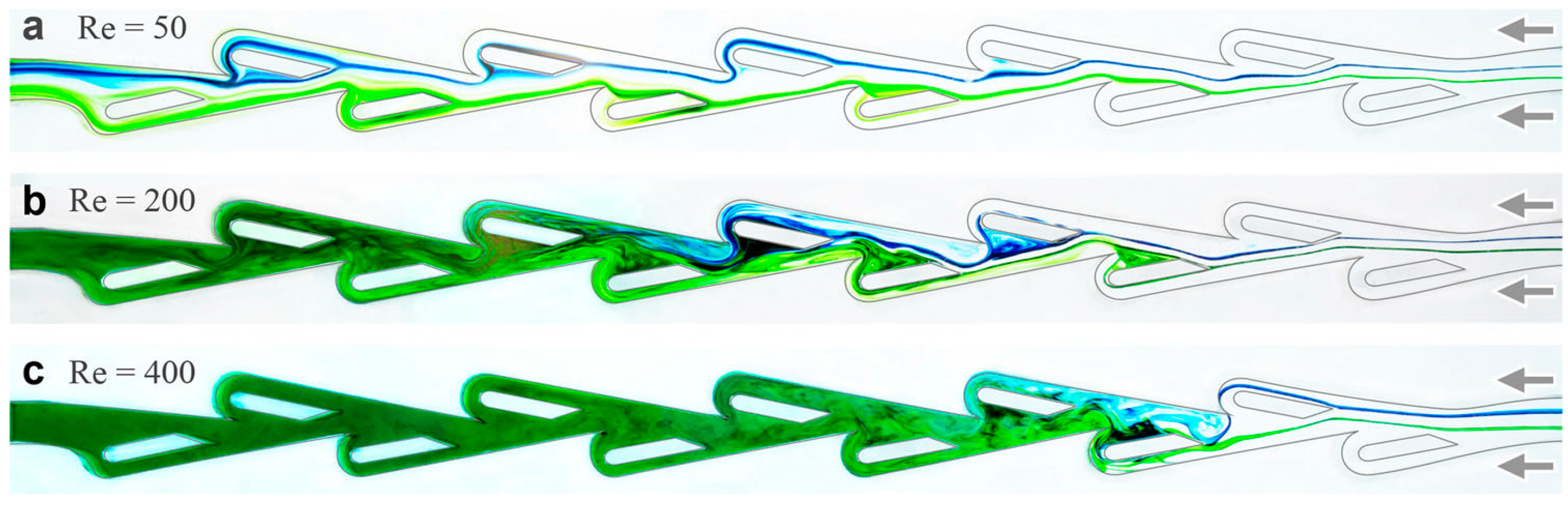
As illustrated by streak-line visualization (Figure 1), increasing Reynolds numbers promote flow instability and fluid mixing within Tesla valves, highlighting the underlying mechanisms responsible for passive flow regulation and transport enhancement [19]. These developments suggest that Tesla valves are evolving from specialized fluidic components into multifunctional passive flow-regulation devices with potential applications in water transport [19,20,21,22], wastewater treatment, hydraulic machinery, and sustainable fluid-management systems.
Figure 1.
Streak-line flow visualization using dye injected upstream. (a) Streak-line visualization at Re = 50. Blue and green dyed filaments disperse but do not intermix, and the flow is steady throughout the conduit. (b) At a transitional value of Re = 200, the filaments are laminar and steady for the first few units, unsteady and intermix in the middle, and are nearly completely mixed by the end of the conduit. (c) At Re = 400, unsteady and well-mixed flows appear throughout most of the channel [19].
1.3. Research Trends and Knowledge Gaps
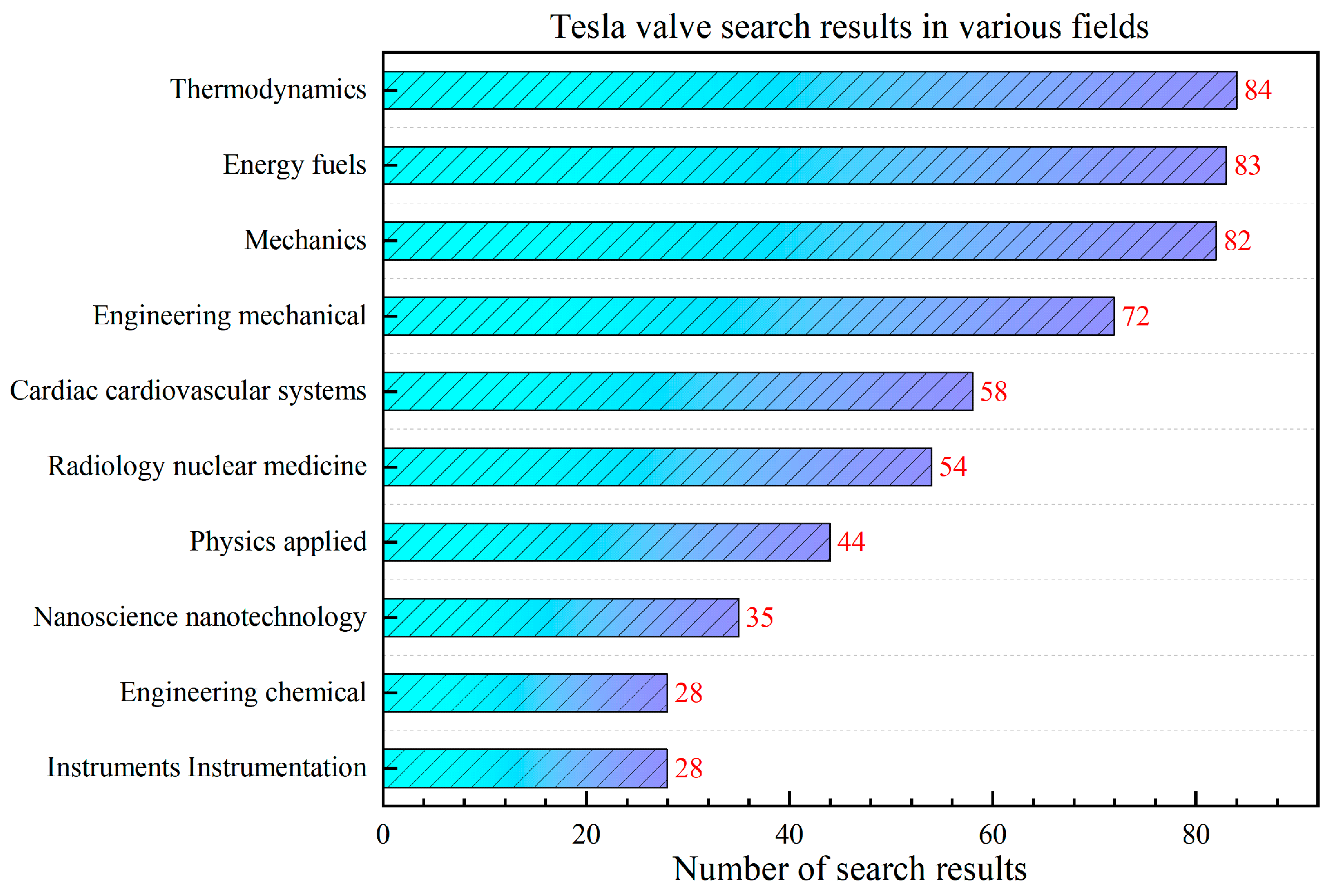
A bibliometric analysis was conducted using the Web of Science Core Collection (WoSCC). The literature retrieval was performed on 10 June 2026, using the topic search query TS = (“Tesla valve”). A total of 568 publications were identified and used for the bibliometric analysis (Figure 2). Current research activities are concentrated primarily in thermodynamics, energy and fuels, mechanics, and mechanical engineering [23,24,25,26,27,28]. These dominant research directions mainly focus on energy conversion and thermal–fluid performance enhancement in engineered systems, reflecting the strong interdisciplinary interest in Tesla-valve-based passive flow control mechanisms. Meanwhile, these research efforts also provide important references for sustainable water systems, particularly in terms of passive flow regulation and energy-efficient hydraulic transport. In contrast, studies explicitly addressing water transport, hydraulic regulation, water treatment processes, and urban water infrastructure remain relatively limited.
Figure 2.
Tesla valve search results in various fields.
Current Tesla-valve research can generally be grouped into three interconnected themes. The first concerns the fundamental mechanisms of passive flow regulation, including flow separation, jet interaction, vortex evolution, momentum redistribution, and hydraulic energy dissipation [29]. The second focuses on structural evolution and topology optimization, ranging from classical single-stage geometries to multistage, three-dimensional, gradient, and bio-inspired configurations [30]. The third addresses engineering applications in microfluidic systems, thermal management technologies, hydraulic machinery, oscillatory-flow devices, and emerging water-related systems [31].
Despite substantial progress, several important challenges remain unresolved. First, performance evaluation criteria, particularly the definition and quantification of diodicity under transient and multiphase flow conditions, have not yet been standardized [19]. Second, the trade-off between reverse-flow resistance and forward-flow energy consumption remains insufficiently understood, limiting practical optimization efforts [27]. Third, investigations under realistic hydraulic conditions involving sediment transport, cavitation, fouling, and long-term operation remain scarce. These limitations continue to hinder the large-scale implementation of Tesla-valve technologies in practical water-engineering applications [20].
1.4. Objectives and Scope of This Review
This review aims to provide a critical synthesis of recent advances in Tesla-valve-inspired passive flow regulation, with particular emphasis on their relevance to water-related applications. The specific objectives of this review are as follows:
- (1)
- To summarize the fundamental hydraulic mechanisms governing flow rectification, momentum transfer, vortex evolution, and energy dissipation under steady, pulsating, and multiphase flow conditions.
- (2)
- To evaluate the structural evolution of Tesla valves from classical geometries to advanced multistage, three-dimensional, gradient, and bio-inspired configurations, and to identify the key design parameters controlling hydraulic performance.
- (3)
- To critically assess current and emerging applications in water transport, wastewater treatment, hydraulic machinery, microfluidic water analysis, and thermal–fluid systems while highlighting technological challenges and future research opportunities.
By integrating advances in fluid mechanics, hydraulic engineering, and water-related applications, this review aims to establish a comprehensive knowledge framework for Tesla-valve-inspired passive flow regulation and to provide guidance for the development of resilient, energy-efficient, and sustainable water transport technologies.
1.5. The Structural Framework of This Review
As shown in Table 1, this review progresses logically from fundamental mechanisms (Section 2) through structural evolution (Section 3) to engineering applications (Section 4), framed by the motivation (Section 1) and future outlook (Section 5), with key findings synthesised in Section 6.
Table 1.
Chapter summary of this review.
2. Hydrodynamic Mechanism and Evaluation Indicators of Tesla Valves
2.1. Basic Rectification Mechanism
2.1.1. Difference Between Forward and Reverse Flow
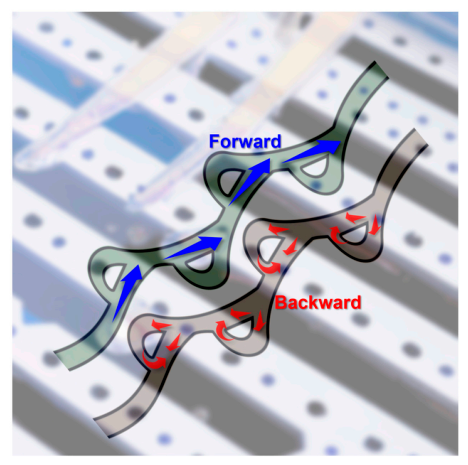
The rectification behavior of Tesla valves does not arise from the physical opening and closing of mechanical components but from asymmetric geometric topologies that generate distinct energy-dissipation pathways under forward and reverse-flow conditions [31,32]. As illustrated in Figure 3, the asymmetric geometry of Tesla valves produces direction-dependent flow resistance, which gives rise to nonlinear flow phenomena such as flow splitting, abrupt turning, recirculation, jet interaction, and flow remerging losses [33]. In hydraulic and fluid-control systems, these mechanisms collectively contribute to passive flow rectification and enhanced directional regulation. Rather than simply increasing flow resistance through longer flow paths, Tesla valves selectively amplify irreversible hydraulic losses in the reverse-flow direction through geometric flow reconfiguration, thereby achieving passive directional flow regulation without moving parts [32,33].
Figure 3.
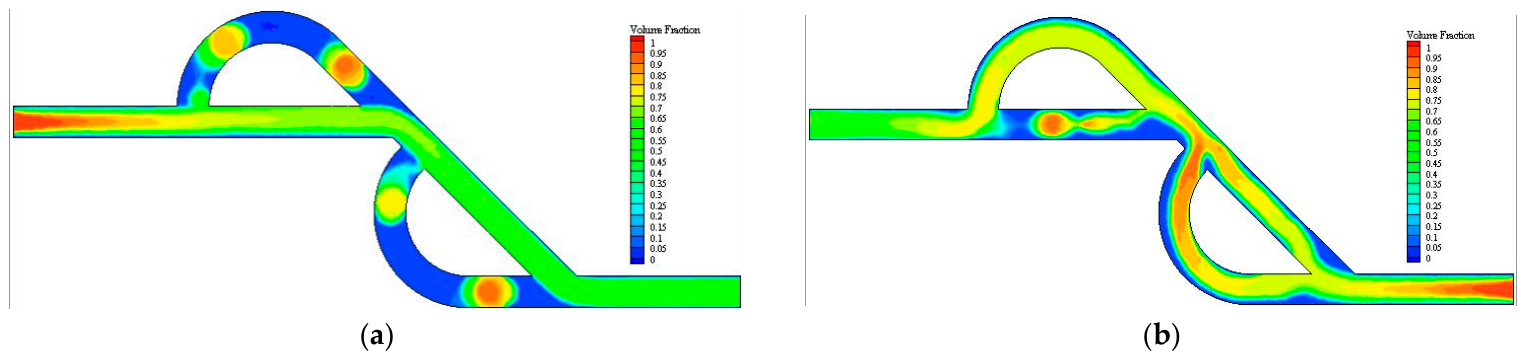
The main principle of the Tesla valve is showing one-directional flow using asymmetrical structures of the channel [33].
Under forward-flow conditions, the majority of the fluid passes through the main channel with only a small fraction entering the side branches. As a result, flow deflection remains relatively mild, adverse pressure gradients are limited, and only weak separation zones or recirculation regions are formed [34]. Consequently, forward-flow resistance is typically dominated by wall friction and minor local losses, leading to comparatively low pressure drops and stable hydraulic performance [35].
In contrast, reverse flow is forced to navigate through tortuous branch channels, where repeated flow division, turning, and remerging processes induce substantial momentum redistribution. As the Reynolds number increases, inertial effects become increasingly important, promoting boundary-layer separation and the formation of large-scale recirculation zones and vortex structures in expansion and junction regions [36]. These flow structures intensify momentum exchange and viscous dissipation, resulting in significantly greater pressure losses than those observed during forward flow. Previous studies have shown that local hydraulic losses associated with flow separation and remerging can substantially exceed frictional losses, particularly near branch junctions and channel exits [34,35,36].
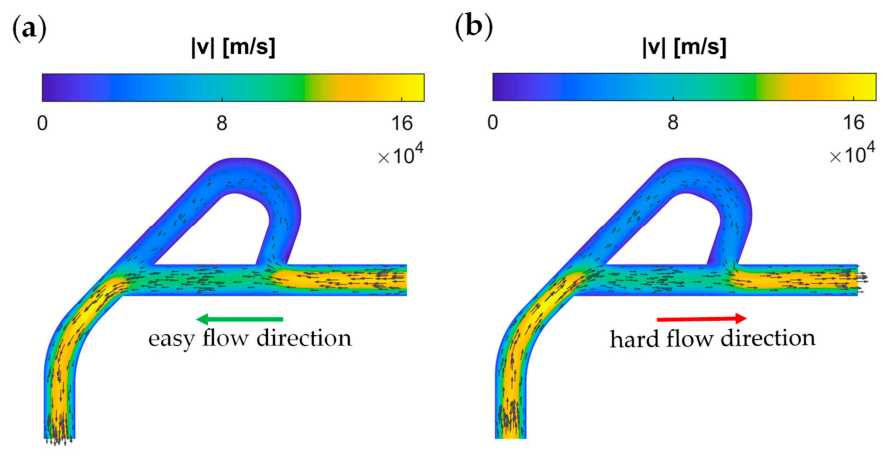
Another important source of reverse-flow resistance is jet interaction [37]. As illustrated in Figure 4, after passing through side branches, secondary streams re-enter the main channel with different velocity vectors, generating strong mixing layers and complex vortex structures [38,39].
Figure 4.
Hydrodynamic electron flow demonstrated in graphene Tesla valve. (a) Electron flow from right contact to the left, due to higher (50 mV) potential on the left; easy and less-resistive direction for the hydrodynamic flow. (b) Electron flow toward the right contact, harder and more resistive path for electrons, due to viscosity effects and momentum-loss, due to the large angle at the connection of the branches. The small difference in velocities causes the rectification effect [39].
The resulting kinetic-energy dissipation further enhances the hydraulic resistance of the reverse-flow direction [40]. In multistage Tesla-valve configurations, these mechanisms accumulate across successive stages, producing a nonlinear increase in overall reverse-flow resistance. However, increasing the number of stages does not always improve performance because excessive geometric complexity may also increase forward-flow pressure losses, thereby reducing the net hydraulic benefit of the system.
Therefore, the fundamental mechanism of Tesla-valve-based passive flow regulation is not the complete blockage of reverse flow but the selective amplification of energy-dissipation processes in the reverse-flow direction while maintaining relatively low resistance along the forward-flow path. From an engineering perspective, the primary objective of Tesla-valve optimization is to maximize this asymmetry in hydraulic losses and thereby improve flow-rectification performance [25].
2.1.2. Low-Dissipation Mechanism Under Forward Flow Conditions
The flow-rectification performance of Tesla valves depends not only on the generation of strong hydraulic resistance under reverse-flow conditions but also on the ability to maintain a relatively low-loss flow path in the forward direction [26]. If substantial flow separation, recirculation, and turbulent mixing were to occur under both flow directions, the pressure-drop asymmetry responsible for rectification would be significantly reduced [27]. Therefore, the preservation of a low-dissipation forward-flow pathway is a defining characteristic that distinguishes Tesla valves from conventional tortuous-channel structures [28].
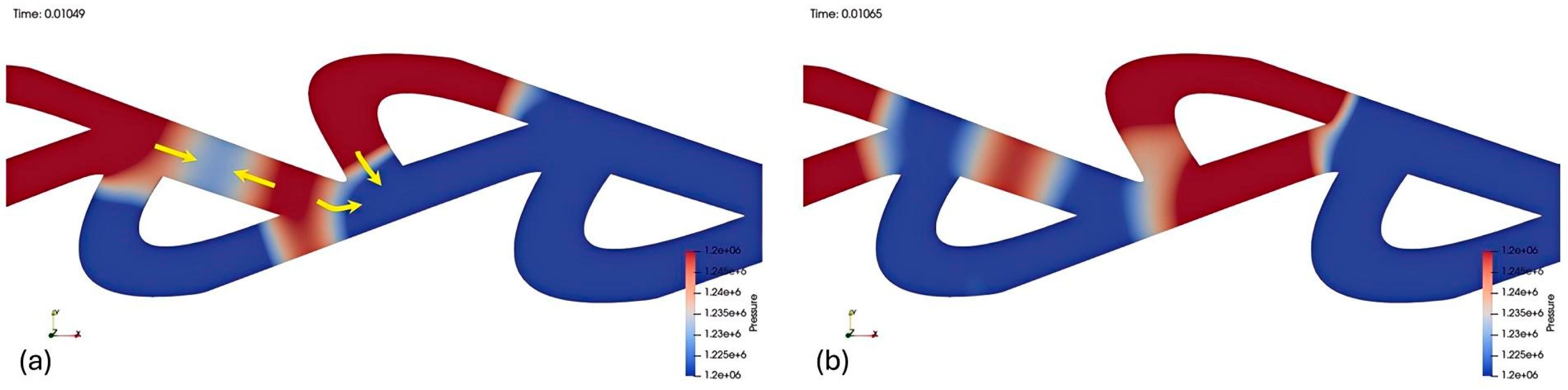
As illustrated in Figure 5, under forward-flow conditions, the bulk of the fluid travels through the primary channel, while only a limited fraction enters the side branches. Owing to the relatively smooth channel curvature and favorable flow alignment, the fluid experiences only modest changes in momentum direction. Consequently, flow separation, jet interaction, and remerging losses remain weak, resulting in comparatively low hydraulic resistance and pressure drop [29]. In multistage Tesla-valve configurations, if each stage effectively guides the main flow along a coherent pathway, the cumulative pressure loss can remain moderate despite the increasing structural complexity. This characteristic allows multistage designs to achieve improved rectification performance while maintaining acceptable forward-flow capacity [30].
Figure 5.
The projected trajectory for the pressure fronts from high to low pressure. (a) Illustrates the pressure pockets at 0.01049 s, while (b) shows the pressures a 0.00016 s after [29].
A key feature of the forward-flow regime is the stable attachment of the boundary layer to the channel walls. Compared with reverse flow, the forward direction generally experiences weaker adverse pressure gradients in expansion, turning, and junction regions. As a result, near-wall fluid retains sufficient momentum to resist separation, and recirculation zones remain limited in size [31]. When geometric parameters such as branch angles, channel alignment, and curvature are properly designed, the velocity profile remains relatively uniform, and the core flow region preserves its integrity. Under these conditions, local hydraulic losses are minimized, and viscous dissipation remains comparatively low [32]. However, inappropriate geometric configurations may still induce local separation and additional pressure losses, thereby reducing overall rectification efficiency [33].
Another important contributor to low forward-flow resistance is the relatively weak interaction between mainstream and branch flows. Because only a small proportion of the fluid enters side branches, the velocity vectors of merging streams remain closely aligned when rejoining the main channel. Consequently, strong shear layers, large-scale vortices, and intensive mixing processes are largely suppressed [34]. The resulting reduction in momentum exchange and turbulence production helps maintain a low-pressure-loss flow state. This characteristic is particularly advantageous for applications requiring energy-efficient liquid transport, including microfluidic water-analysis devices, lab-on-a-chip systems, and compact hydraulic control components, where minimizing pumping power is often a primary design objective [35].
2.1.3. High-Dissipation Mechanism Under Reverse Flow Conditions
When fluid enters a Tesla valve in the reverse direction, the asymmetric channel geometry forces the mainstream to deviate from the shortest flow path and traverse tortuous branch channels. Repeated flow division, abrupt turning, and channel remerging induce significant momentum redistribution throughout the flow field [20]. As a consequence, the velocity distribution becomes increasingly non-uniform, generating local acceleration and deceleration regions that contribute to elevated hydraulic losses. In multistage Tesla-valve configurations, these disturbances can propagate downstream and influence the inlet conditions of subsequent stages, leading to cumulative energy dissipation and enhanced flow resistance [21].
A major contributor to reverse flow resistance is the interaction between branch flows and the mainstream. After passing through side channels, secondary streams re-enter the primary channel with substantially different velocity vectors. The resulting flow collisions generate intense shear layers, strong mixing regions, and complex vortex structures that dissipate kinetic energy and increase local pressure losses [22]. This sequence of flow diversion, jet interaction, and remerging represents one of the most distinctive features of Tesla-valve-induced flow rectification. In multistage systems, these mechanisms can occur repeatedly, producing a nonlinear amplification of reverse-flow resistance [31].
Boundary-layer separation provides another important source of hydraulic dissipation. Because reverse flow experiences strong adverse pressure gradients in expansion regions and near channel junctions, low-momentum fluid adjacent to the wall can no longer remain attached to the surface, resulting in flow separation and the formation of recirculation zones [28]. These regions effectively reduce the available flow area and increase local velocity gradients, thereby enhancing viscous dissipation and pressure losses. Under high-Reynolds-number or pulsating-flow conditions, separation zones may become highly unsteady and exhibit periodic vortex shedding, further increasing hydraulic resistance [25].
The influence of Reynolds number is particularly significant. As illustrated in Figure 1, Nguyen et al. [19] demonstrated experimentally that pulsating flow conditions can further enhance directional resistance by strengthening vortex evolution and unsteady shear-layer interactions, suggesting that transient flow structures play an important role in Tesla-valve performance. Under reverse-flow conditions, the fluid is forced to repeatedly change direction within the asymmetric loop structures, generating adverse pressure gradients and flow separation. At low Reynolds numbers, viscous effects suppress the development of recirculation zones, resulting in relatively weak vortex structures and limited flow rectification. As the Reynolds number increases, inertial effects become dominant, promoting the formation and growth of coherent vortex cores within the loop regions. Meanwhile, the shear layers generated between the main stream and the recirculating flow become increasingly unstable, enhancing momentum exchange and energy dissipation. These intensified vortex interactions substantially increase the reverse-flow pressure loss while exerting only a limited influence on the forward-flow resistance, thereby improving the diodicity of the Tesla valve. These findings indicate that vortex dynamics and shear-layer instability are not merely secondary phenomena but are fundamental mechanisms governing the Reynolds-number-dependent rectification performance of Tesla valves.
In addition to hydraulic resistance, the complex flow structures generated during reverse flow may influence heat and mass transfer processes. Strong secondary flows, vortex motions, and mixing can enhance transport across thermal and concentration boundary layers, thereby coupling flow rectification with heat-transfer and mass-transfer performance in microfluidic and thermal–fluid systems [23]. Such interactions are particularly relevant in applications involving liquid cooling, microscale reactors, and water-quality monitoring devices.
Nevertheless, maximizing reverse-flow resistance alone does not necessarily result in superior overall performance. Excessive hydraulic losses may be accompanied by undesirable increases in forward-flow resistance, reducing the overall efficiency of the system. Consequently, Tesla valve design requires a careful balance between enhancing reverse flow dissipation and preserving acceptable forward-flow transport capacity [27].
Under multiphase-flow and high-pressure operating conditions, reverse-flow dissipation may further interact with cavitation dynamics, bubble transport, and interfacial momentum exchange. Recent studies suggest that multistage Tesla-valve configurations can distribute pressure reduction over multiple flow-redirection events, thereby mitigating localized cavitation intensity and reducing flow-induced vibration [39]. These characteristics highlight the potential of Tesla valves as passive hydraulic-control devices for pressure management, energy dissipation, and reliability enhancement in water and liquid transport systems.
2.2. Performance Evaluation Indicators
Quantitative evaluation of Tesla-valve performance is essential for assessing flow-rectification capability, hydraulic efficiency, and engineering applicability. Unlike conventional mechanical valves that physically block or permit flow through moving components, Tesla valves regulate fluid transport through asymmetric channel geometries that generate different hydraulic losses under forward and reverse flow conditions. Consequently, their performance is commonly characterized using four key metrics: diodicity (Di), pressure drop (ΔP), hydraulic resistance (R), and pumping power (Ppump) [32].
Among these parameters, diodicity is the most widely adopted indicator of flow-rectification performance. It is defined as the ratio of the pressure drop under reverse-flow conditions to that under forward-flow conditions at identical operating conditions, such as constant Reynolds number or constant flow rate:
where ΔPr and ΔPf denote the pressure drops in the reverse and forward directions, respectively. A value of (Di > 1) indicates directional flow asymmetry, and larger values generally correspond to stronger rectification capability. Previous studies have shown that high diodicity originates primarily from enhanced flow separation, recirculation, jet interaction, and vortex-induced dissipation during reverse flow rather than from a simple increase in frictional flow resistance [36]. Furthermore, experimental investigations by Nguyen et al. [19] demonstrated that diodicity is strongly influenced by Reynolds number and flow unsteadiness, indicating that it should be regarded as a flow-dependent performance parameter rather than a purely geometric property.
Although diodicity provides a convenient measure of directional flow regulation, it does not fully represent the overall hydraulic performance of Tesla valve. A high Di value may result from excessive reverse-flow resistance, but it may also be accompanied by undesirable increases in forward-flow pressure losses. Therefore, pressure drop and hydraulic resistance must be considered together with diodicity when evaluating engineering performance.
The total pressure drop across a Tesla valve is defined as
where Pin and Pout represent the inlet and outlet pressures, respectively. To eliminate the influence of flow rate variations, an equivalent hydraulic resistance is commonly introduced:
where Q is the volumetric flow rate. Hydraulic resistance provides a direct measure of the flow opposition generated by a given channel topology and is particularly useful for comparing different geometric configurations under varying operating conditions.
From a system-level perspective, pumping power Ppump is another critical parameter because it directly reflects the energy required to sustain fluid transport:
For practical water and liquid transport systems, an optimal Tesla-valve design should not simply maximize diodicity. Instead, it should achieve a balance between strong reverse-flow suppression and acceptable forward-flow pressure losses while minimizing energy consumption. Consequently, recent studies increasingly employ multi-objective performance evaluation frameworks that simultaneously consider rectification efficiency, hydraulic resistance, and pumping-power requirements [31].
In applications involving coupled hydraulic and thermal transport processes, additional performance metrics may be required. Commonly used parameters include the Nusselt number (Nu), Darcy friction factor (f), and the performance evaluation criterion (PEC), which evaluates the trade-off between heat-transfer enhancement and hydraulic penalty:
where the subscript “0” denotes a reference smooth channel under identical operating conditions. A value of (PEC > 1) indicates that heat-transfer enhancement outweighs the additional hydraulic losses introduced by the modified flow structure [35]. Such metrics are particularly relevant in liquid-cooling systems, microfluidic devices, and thermally coupled water-treatment technologies.
It is also important to note that the choice of boundary conditions significantly influences performance evaluation. Three comparison approaches are commonly adopted in the literature: constant Reynolds number, constant volumetric flow rate, and constant pressure-drop or pumping-power conditions. The constant Reynolds number is generally preferred for fundamental flow-mechanism studies, whereas constant flow rate and constant pumping-power conditions are more representative of practical engineering applications. Therefore, meaningful comparisons of Tesla-valve performance should always be conducted under clearly defined operating constraints [33].
Overall, Tesla-valve performance should be regarded as the result of coupled interactions among channel topology, flow regime, fluid properties, and operating conditions rather than as an intrinsic geometric characteristic alone [40].
2.3. Key Factors Governing Mechanism Switching
The hydraulic behavior of Tesla valves is highly dependent on operating conditions and fluid properties. Rather than exhibiting a fixed rectification mechanism, Tesla valves may undergo significant changes in dominant dissipation processes when flow conditions vary. Previous studies have shown that Reynolds number, cavitation, multiphase flow characteristics, thermal effects, and flow unsteadiness can substantially alter flow separation, recirculation structures, vortex evolution, and pressure-loss distributions, thereby influencing both hydraulic resistance and diodicity [29]. A summary of the major influencing factors and their effects on Tesla-valve performance is provided in Table 2.
Table 2.
Major factors governing mechanism switching in Tesla valves.
2.3.1. Reynolds Number Effects
Among the various controlling parameters, the Reynolds number (Re) is generally considered the most important factor governing flow-regime transitions and rectification performance. The Reynolds number is defined as Equation (6), where ρ is the fluid density, U is the mean inlet velocity, Dh is the hydraulic diameter of the channel, and μ is the dynamic viscosity of the working fluid. At very low Reynolds numbers, viscous forces dominate the flow field and suppress inertial effects. Under such conditions, both forward and reverse flows remain largely attached to the channel walls, resulting in limited flow separation and weak directional asymmetry. Consequently, the pressure-drop difference between the two directions is small, and the rectification capability is significantly reduced [30].
As the Reynolds number increases, inertial effects become increasingly important. Reverse flow is more likely to experience flow separation, recirculation, and jet interaction within branching and merging regions, leading to enhanced local energy dissipation and higher diodicity values [37]. However, further increases in the Reynolds number do not necessarily produce continuous improvements. At sufficiently high Reynolds numbers, flow separation may also develop under forward-flow conditions, causing substantial increases in forward pressure losses. As a result, the growth of diodicity may gradually level off or even decrease, indicating the existence of an optimal Reynolds-number range for a given Tesla-valve geometry [36].
Based on the systematic study of Liosis et al. on multi-staged micro-Tesla valves (as shown in Table 3), the design guideline can be summarised as: N = 6 offers the best cost-performance compromise (Di = 2.76 at Re = 450), with diminishing returns beyond six stages, and operation above Re ≥ 150 is required to activate the vortex-driven reverse flow redirection.
Table 3.
Comprehensive summary of multi-stage micro-Tesla valve performance and design guidelines.
In summary, the diodicity of Tesla valves is governed by a complex interplay between the Reynolds number and geometric staging. Low Re operation (Re < 100) yields negligible diodic benefit regardless of stage count, while moderate Re (100–450) provides substantial performance gains that saturate beyond N = 6 due to diminishing incremental returns. The existence of a critical Re threshold for N ≥ 6 further highlights that effective vortex generation and flow redirection require sufficient inertial forcing. These findings underscore that optimal Tesla-valve design is not merely a matter of adding more stages, but rather requires careful matching of stage number to the target Reynolds number, with N = 6 emerging as a robust and practical choice for most microfluidic applications.
It should be noted that the critical Reynolds number reported in the literature is not universal. Most studies suggest that appreciable rectification develops once Reynolds number exceeds approximately 100–150, whereas the exact threshold varies with valve geometry, channel aspect ratio, stage number, and scaling conditions. Therefore, the critical Reynolds number should be regarded as a geometry-dependent parameter that requires case-specific evaluation during valve design.
2.3.2. Cavitation and Multi-Phase Flow Effects
In high-pressure-drop applications, cavitation can significantly modify the internal flow structure and dissipation mechanisms of Tesla valves. When local pressure falls below the vapor pressure of the working fluid, vapor bubbles may form within narrow passages or high-velocity regions. Bubble growth, transport, and collapse alter local momentum transfer processes and may introduce additional pressure fluctuations and flow instabilities [38].
Multistage Tesla-valve configurations have been proposed as a potential approach for mitigating localized pressure peaks through gradual pressure reduction and distributed energy dissipation [39]. Although many of these studies were originally conducted in gas-flow systems, the underlying principle of staged pressure recovery may also provide useful insights for water-related applications involving cavitation suppression and energy dissipation.
As illustrated in Figure 6, the flow mechanisms become even more complex when gas–liquid or liquid–solid multiphase flows are involved. Interfacial interactions, phase slip, particle transport, and bubble deformation can substantially modify velocity distributions and local pressure losses. Under such conditions, the dominant dissipation mechanisms may shift from purely geometry-induced flow separation toward interfacial shear and multiphase mixing processes [40]. These findings highlight the sensitivity of Tesla-valve performance to multiphase flow conditions frequently encountered in water-treatment systems, slurry transport, and hydraulic machinery.
Figure 6.
Two-phase flow pattern, inlet velocity 0.1 m/s. (a) Forward flow. (b) Reverse flow [40].
2.3.3. Thermal Effects
Temperature variations can indirectly affect Tesla-valve performance by altering fluid properties such as viscosity and density. In liquid-cooling systems, microfluidic devices, and thermally coupled water-treatment processes, changes in fluid temperature may lead to significant variations in local Reynolds number and boundary-layer behavior [23].
Several studies have shown that temperature-induced property variations can shift separation locations and modify recirculation structures, thereby affecting both pressure-drop characteristics and thermo-hydraulic performance [26]. Consequently, Tesla valves operating under strong thermal gradients should be considered as coupled thermo-fluid systems rather than purely hydraulic components.
2.3.4. Unsteady and Pulsating Flow Effects
Many practical water and liquid transport systems operate under inherently unsteady conditions. Examples include pump-induced pulsations, water-hammer events, oscillatory flows, and periodically varying flow rates. Under such circumstances, Tesla valves may exhibit flow behaviors that differ substantially from those observed under steady-state conditions.
Experimental studies by Nguyen et al. [19] demonstrated that pulsating flow can significantly enhance rectification performance by strengthening reverse-flow recirculation and vortex formation. The resulting dynamic diodicity was found to exceed that measured under equivalent steady-flow conditions. Similar observations have been reported in oscillatory-flow devices and passive flow-control systems, where unsteady momentum exchange promotes directional asymmetry and energy dissipation [29].
These results suggest that flow unsteadiness should not be treated merely as a secondary correction factor. Instead, it may represent a primary mechanism governing Tesla-valve performance in many real-world applications. Future investigations should therefore focus on the coupling between geometric topology, transient flow structures, and dissipation mechanisms under realistic operating conditions.
Overall, the flow behavior of Tesla valves is governed by complex interactions among channel geometry, flow regime, fluid properties, and boundary conditions. Reynolds number, cavitation, multiphase effects, thermal conditions, and flow unsteadiness can all trigger transitions between different dominant dissipation mechanisms. Understanding these mechanism-switching processes is essential for developing Tesla-valve designs that achieve robust performance across a wide range of water and liquid transport applications [30].
3. Structural Evolution and Performance Optimization of Tesla Valves
3.1. From Classical Tesla Geometry to Modern Valve Architectures
The evolution of Tesla valves reflects a progressively deeper understanding of directional flow-control mechanisms. Since Tesla introduced the concept of the valvular conduit in 1920, a wide range of modified configurations has emerged for applications in microfluidics, thermal management, and intelligent water systems [41,42,43,44,45,46]. Despite their structural diversity, these developments have been driven by a common objective: maximizing the dissipation asymmetry between forward and reverse flows through channel-topology design, thereby achieving efficient passive rectification and flow regulation without moving parts [47,48,49].
Based on current studies, the geometric evolution of Tesla valves can be broadly summarized into three main pathways (Table 4).
Table 4.
Geometric evolution pathways of Tesla valves.
Early studies primarily focused on evaluating the hydrodynamic validity of the classical configuration. With advances in experimental diagnostics and computational fluid dynamics, researchers gradually recognized that rectification does not arise from simply increasing flow-path length, but from the generation of highly dissipative flow phenomena during reverse flow, including flow diversion, redirection, boundary-layer separation, recirculation, and jet interaction [41]. This mechanistic understanding provided the foundation for subsequent structural innovations.
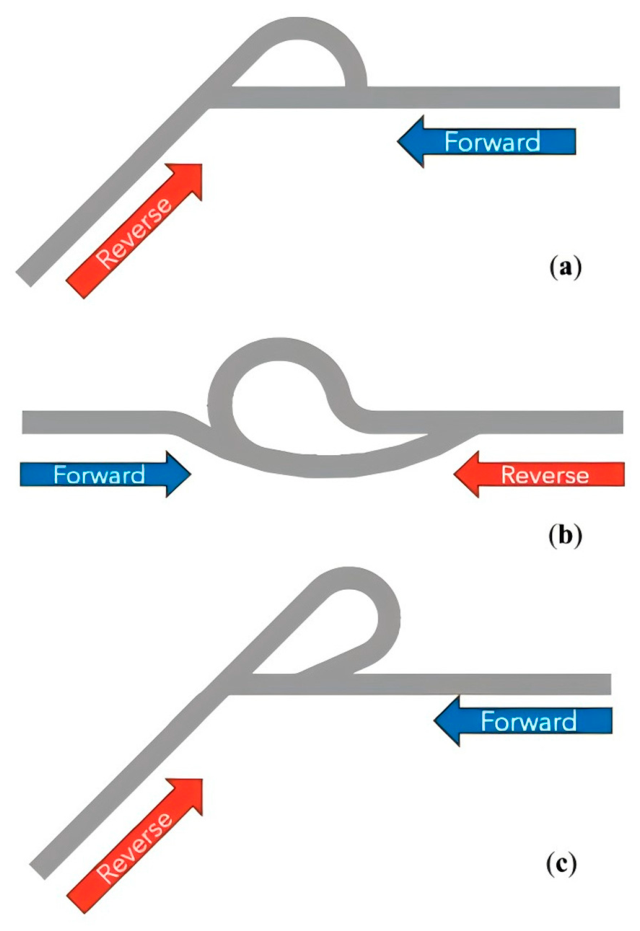
As illustrated in Figure 7, typical configurations include the T45-R valve, D-valve, and GMF valve. The T45-R valve is characterized by an approximately 45-degree deflection structure, offering compact geometry and improved rectification performance compared with conventional diffuser-type check valves in piezoelectric micropumps. The D-valve enhances reverse flow resistance by aligning inlet and outlet while introducing strongly curved side branches and has been applied in oscillating heat pipe systems. The GMF valve further extends the T45-R configuration by lengthening and strengthening branch channels to intensify disturbance and dissipation during reverse flow. These designs demonstrate that Tesla valves have evolved from a single prototype into a family of structures with distinct flow logic [42].
Figure 7.
Three types of Tesla valves: (a) T45-R valve; (b) D-valve; (c) GMF valve [42].
Importantly, the development of modern configurations does not follow the simplistic assumption that greater geometric complexity always leads to better performance. Recent studies on bifurcated structures indicate that the branching section in classical Tesla valves does not universally enhance rectification [42,43,44,45,46,47]. As illustrated in Figure 8, removing the bifurcation in the T45-R valve can improve diodicity at a high Reynolds numbers, whereas in the GMF valve, such structures are essential for maintaining performance. The D-valve exhibits a transitional behavior dependent on the Reynolds number [42]. These findings suggest that geometric evolution is fundamentally driven by the identification and reinforcement of dominant dissipation mechanisms rather than the preservation of traditional structural elements [47,48,49].
Figure 8.
Diodicity as a function of the Reynolds number for: (a) the T45-R valve with (blue) and without (red) the bifurcated section; (b) the D-valve with (blue) and without (red) the bifurcated section; (c) the GMF valve with (blue) and without (red) the bifurcated section [42].
As shown in Table 5, the three valves respond very differently to the removal of the bifurcated section. The bifurcated D-valve offers the most robust performance across the entire Re range (Di = 1.94 at Re = 2000), while the non-bifurcated T45-R actually outperforms its bifurcated counterpart at high Re (1.66 vs. 1.49). In contrast, the GMF valve suffers a significant drop without bifurcation and its bifurcated version peaks early then declines. These results demonstrate that the optimal choice depends strongly on the target Reynolds number and the specific role of the bifurcated geometry. Therefore, the evolution from classical two-dimensional configurations to modern variants can be interpreted as a process of decomposition of geometric functions, selection of key structural elements, and reconstruction of flow mechanisms [50]. This perspective reinforces that no single design universally excels; instead, the geometry should be tailored to the intended operating conditions.
Table 5.
Quantitative comparison of diodicity for the three Tesla-type valve designs.
Building upon modern variants, Tesla valve development has further progressed toward performance-driven and functionally integrated designs. Research emphasis has shifted from configuration comparison to objective-oriented design, focusing on rectification enhancement, operating-condition expansion, and multifunctional integration [66].
3.2. Geometry-Induced Regulation of Dissipation Mechanisms
Geometric parameter optimization represents a critical link between structural design and hydraulic performance in Tesla valves. Rather than identifying a universal set of optimal dimensions, the primary objective of parameter studies is to establish how geometric features influence local flow structures and, consequently, rectification performance. From this perspective, apparently inconsistent conclusions reported in the literature can often be interpreted within a common framework that relates geometry, flow mechanisms, and performance outcomes [42,44].
Existing studies generally distinguish between two categories of geometric parameters. The first comprises local parameters, including width ratio, curvature radius, side-branch dimensions, and transition-region geometry, which primarily control local separation, recirculation, jet interaction, and remerging processes [42]. The second includes global parameters, such as branching angle, merging angle, and main-channel dimensions, which determine the overall organization of flow paths and momentum redistribution [46]. Despite their different roles, the common objective of geometric optimization is to strengthen reverse-flow dissipation while maintaining acceptable forward-flow resistance, thereby maximizing directional asymmetry in pressure loss [47,48,49].
Among the global design parameters, branching and merging angles are widely recognized as major determinants of rectification performance. Small branching angles allow reverse flow to pass through relatively direct pathways, limiting flow diversion and momentum loss, whereas excessively large angles may increase dissipation in both directions and reduce overall hydraulic efficiency. Consequently, most studies report an optimal intermediate range that reflects a balance between low-resistance forward transport and enhanced reverse-flow dissipation. Numerical investigations further indicate that angle variations alter vortex formation, jet interaction, and velocity-field asymmetry, leading to different rectification behaviors across Reynolds-number regimes [48]. Similar observations have been reported in Tesla-inspired micromixers, where geometric angles govern flow splitting, redirection, and remerging, all of which are closely associated with energy-dissipation mechanisms [54].
The dimensions of the main channel also play an important role because they influence both the relative importance of inertial and viscous effects and the flow distribution between the main passage and side branches [46]. Liu et al. demonstrated that geometric scaling significantly affects the response of the flow field to channel asymmetry, implying that optimal parameters are not universally transferable across different size scales [27]. At small scales, viscous effects suppress flow separation and recirculation, whereas at larger scales or higher Reynolds numbers, inertial effects promote the formation of high-dissipation structures in the reverse flow [41]. As a result, geometric optimization must always be considered within the context of the intended operating conditions.
Local geometric features exert a more direct influence on the development of dissipation structures. Width ratio, for example, affects local velocity distribution and pressure-loss allocation. Increasing the contraction ratio generally accelerates the flow and promotes separation and vortex formation in expansion or merging regions, thereby enhancing reverse-flow dissipation. However, excessive contraction may simultaneously increase forward-flow losses, indicating a trade-off between stronger reverse-flow resistance and acceptable hydraulic efficiency. Similar conclusions have been reported by Gamboa et al., who showed that local width distribution strongly affects flow partitioning and pressure-drop characteristics in Tesla-type micropump structures [49].
Curvature radius influences rectification performance through its effect on centrifugal forces and secondary-flow development. Smaller curvature radii tend to intensify flow separation and recirculation under reverse-flow conditions, increasing energy dissipation. However, excessive curvature may also introduce significant losses in the forward direction. Differences in Reynolds-number sensitivity among configurations such as the D-valve and GMF valve have been partially attributed to variations in branch curvature and the resulting dissipation mechanisms [42].
The dimensions and placement of side branches likewise play a crucial role in determining flow behavior. Branches that are too small may fail to induce sufficient flow diversion, whereas excessively large branches can create extensive stagnant regions and unnecessary hydraulic volume. Studies by Wiley and Huang further demonstrated that the influence of bifurcation structures is strongly configuration-dependent: removing or weakening a bifurcated section may either improve or degrade rectification performance depending on the valve architecture [42]. These findings suggest that local geometric complexity alone does not guarantee superior performance; rather, effective dissipation depends on the coordinated interaction between branches, junctions, and the main flow path.
Although broad consensus exists regarding the mechanisms responsible for rectification—namely flow diversion, jet interaction, separation, recirculation, and remerging losses—substantial variation remains in the reported optimal geometric parameters [41]. Much of this variation originates from differences in operating conditions and evaluation criteria rather than genuine contradictions among studies. The Reynolds number is particularly influential, as geometric features that have little effect under low-Reynolds-number conditions may become dominant once flow separation and vortex formation emerge at higher Reynolds numbers [41]. For example, Wiley and Huang reported that removing bifurcation structures from a D-valve reduced diodicity at low Reynolds numbers but produced progressively less detrimental effects as Reynolds number increased [42].
Performance metrics also influence optimization outcomes. Fundamental studies often seek to maximize diodicity, whereas practical applications typically require simultaneous consideration of pressure drop, pumping power, mixing efficiency, heat-transfer enhancement, or other system-level objectives [61]. Consequently, the geometry that maximizes diodicity is not necessarily the geometry that delivers the best overall performance. Similar observations have been reported in Tesla-inspired micromixer optimization, where power-dissipation-based objectives produced different optimal designs from those obtained using mixing efficiency alone [52].
Additional discrepancies arise from differences in modeling assumptions and flow conditions, including two-dimensional versus three-dimensional geometries, steady versus unsteady flow, and single-phase versus multiphase systems [56]. Therefore, geometric optimization should not be viewed as the search for universally optimal parameter values. Instead, it should be understood as the process of identifying how geometric features modify dominant flow mechanisms under specific operating conditions and how those mechanisms ultimately determine rectification performance [66].
3.3. Multi-Stage and Three-Dimensional Strategies for Dissipation Amplification
The limited rectification capability of a single Tesla valve has driven the development of advanced dissipation-enhancement strategies. Beyond conventional geometric optimization, recent studies increasingly focus on multi-stage cascading, three-dimensional architectures, and function-oriented designs to amplify asymmetric energy dissipation and extend operating ranges [43].
Multi-stage cascading is the most widely adopted approach for rectification enhancement. By connecting multiple Tesla units in series, reverse-flow dissipation can be accumulated through repeated processes of flow splitting, separation, recirculation, and recombination, thereby increasing the overall pressure-drop asymmetry [45]. However, performance improvement is generally non-linear because stage-to-stage flow interactions, pressure recovery, and additional forward-flow losses gradually reduce the marginal benefit of adding more stages [47].
Three-dimensional and helical configurations provide another important route for dissipation amplification. By introducing spatial curvature, twisting, and cross-sectional flow circulation, these structures generate secondary flows and Dean vortices that are absent in conventional planar designs [50]. The resulting three-dimensional momentum exchange enhances reverse-flow energy dissipation while improving spatial compactness. Similar principles have also been exploited in Tesla-inspired micromixers, where chaotic advection significantly improves mixing performance [53].
To broaden application capabilities, Tesla valves have increasingly been integrated with nozzle, throttling, contraction–expansion, and obstacle-assisted structures [58]. These modifications strengthen jet impingement, flow separation, and shear-layer instability under reverse flow, making the valves more suitable for high-pressure-drop, pulsating, and compressible-flow conditions [59]. In parallel, irregular, obstacle-enhanced, and adaptive configurations have been proposed to improve operational flexibility and multifunctionality, extending Tesla valves from passive fluidic diodes to integrated platforms for flow regulation, thermal management, mixing enhancement, and multiphase-flow control [62].
Overall, the evolution from multi-stage cascading to three-dimensional and functionally integrated architectures reflects a common objective: maximizing asymmetric dissipation while adapting Tesla valves to increasingly complex engineering applications [44].
3.4. Design Methodologies for Next-Generation Tesla Valves
The evolution of the Tesla valve architecture has been accompanied by a fundamental shift in design philosophy, from intuition-driven geometry modification to data-driven and objective-oriented optimization. Early Tesla valve development largely relied on empirical design and iterative trial-and-error approaches, where a candidate geometry was proposed based on fluid–mechanical intuition and subsequently evaluated through experiments or computational fluid dynamics (CFD) simulations [44]. While effective for revealing physical mechanisms, this forward-design paradigm becomes increasingly inefficient when confronted with high-dimensional design spaces and multiple competing performance objectives.
As application requirements expand beyond rectification alone to include pressure loss, compactness, mixing efficiency, thermal performance, and structural constraints, Tesla valve design has progressively evolved toward intelligent inverse-design frameworks [51]. Rather than evaluating predefined geometries, modern approaches formulate optimization objectives first and then search the design space systematically to identify optimal flow configurations.
The earliest stage of this transition was based on parametric studies and sensitivity analysis. Key geometric variables, including branch angle, channel-width ratio, and curvature radius, were varied within established valve configurations such as T45-R and D-valve designs to assess their influence on performance [42,55]. These studies provided valuable physical insight into the relationship between geometry and flow behavior, revealing how individual parameters affect vortex formation, flow separation, and momentum dissipation. However, because geometric variables often interact nonlinearly, conventional parameter scanning is prone to local optima and becomes computationally expensive as the number of design variables increases [57].
To address these limitations, surrogate-model-based optimization has emerged as a powerful alternative. As illustrated in Figure 9, by combining design-of-experiment techniques with response surface models, Kriging methods, or machine-learning-based surrogate models, researchers can establish efficient mappings between geometric parameters and performance metrics [60,63]. These reduced-order models significantly decrease computational cost while enabling global optimization through evolutionary algorithms such as NSGA-II and particle swarm optimization. The resulting Pareto-optimal solutions allow designers to balance competing objectives, including rectification performance, pressure loss, mixing efficiency, and energy consumption.
Figure 9.
The basic scheme of Tesla valve design indicates different dimensions and parameters: W—valve width, L—length of the straight segment of the valve channel, α—valve side-channel leaving angle, and β—valve side-channel return angle [63].
As illustrated in Figure 10 and Figure 11, more recently, topology optimization has extended Tesla valve design beyond predefined geometric templates. Instead of modifying existing flow passages, topology optimization treats the entire design domain as a continuous medium and determines the optimal material distribution directly from governing equations and objective functions [64]. Density-based and level-set methods have been widely applied to fluidic diode design, generating highly non-intuitive channel topologies that differ substantially from traditional Tesla valve configurations. Studies have shown that such generated structures can achieve superior reverse-flow dissipation and broader operating ranges compared with conventional designs [65].
Figure 10.
Base Tesla geometry utilized for parameter optimization study (all units in millimeters) [64].
Figure 11.
Comparison of the symmetric Tesla (left) and the machine learning optimized final designs (right) [64].
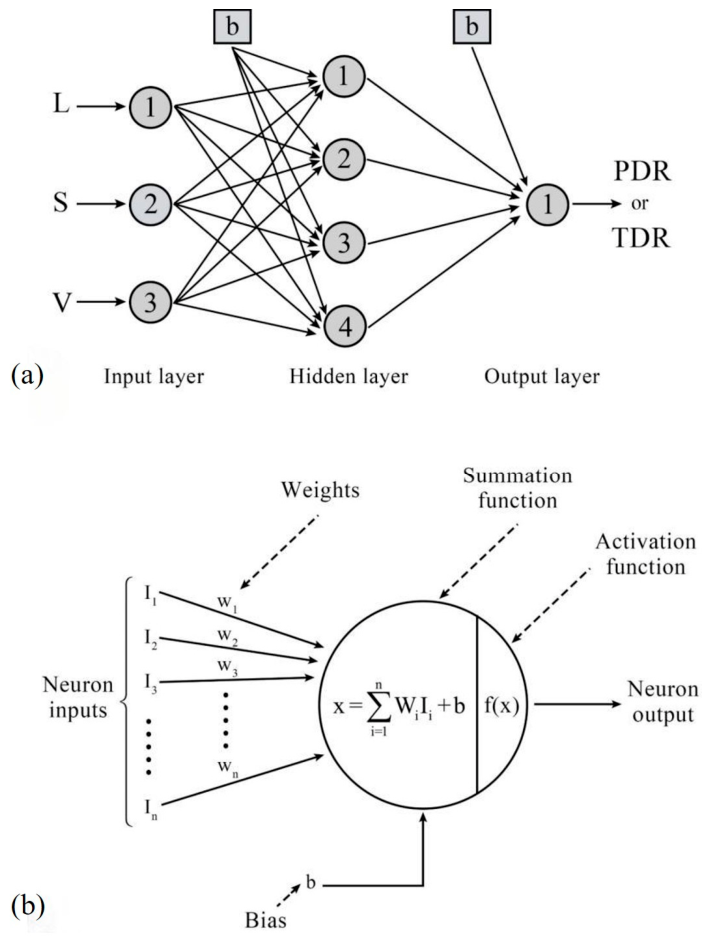
Looking forward, topology optimization is increasingly being integrated with machine learning, physics-informed neural networks, and generative artificial intelligence. This convergence is expected to enable automated design workflows that combine physical constraints, performance prediction, and advanced manufacturing, providing a promising pathway toward the next generation of high-performance passive flow-control devices [41,66] (Figure 12).
Figure 12.
(a) The three-layer structure of the ANN network; (b) calculations performed in neurons of the hidden and output lay [66].
As shown in Table 6, surrogate-based approaches (RSM, Kriging, machine learning) require significant upfront investment in training data and model training but offer fast online predictions, enabling global optimization that is infeasible with direct CFD alone. The key trade-off is that while direct methods (parametric studies, topology optimization) avoid offline training, their per-evaluation cost is substantially higher, making them impractical for high-dimensional design spaces. For Tesla-valve optimization involving more than 5–10 geometric variables, machine-learning-based surrogates or hybrid approaches generally offer the most favourable balance between computational investment and optimisation efficacy.
Table 6.
Comparison of computational costs for different optimization methodologies.
3.5. Summary and Design Guidelines for Structural Evolution
As shown in Table 7, the evolution of Tesla-valve designs from classical single-stage configurations to modern planar variants, multistage cascades, three-dimensional architectures, and topology-optimized geometries reflects a progressive enhancement in rectification capability, but each design category entails distinct trade-offs. Modern planar variants such as the D-valve offer robust performance (Di = 1.94 at Re = 2000) with moderate forward losses, making them suitable for a wide range of applications [42]. Multistage cascading significantly increases diodicity (up to 3.58 for N = 10 at Re = 450) but suffers from diminishing returns and elevated forward pressure drops as stages are added [43,45,47]. Three-dimensional and helical configurations introduce additional dissipation mechanisms (e.g., Dean vortices) that are absent in planar designs, though experimental validation remains limited [50,53]. Topology-optimized and bio-inspired designs represent the frontier of Tesla-valve development, offering the potential for superior performance and broader operating ranges, but they face substantial challenges in computational cost, manufacturing complexity, and experimental verification [60,63,64,65,66]. Overall, the optimal design choice depends strongly on the target Reynolds number, acceptable forward losses, fabrication constraints, and specific application requirements.

Table 7.
Comparison of classical, multistage, 3D, and bio-inspired/Topology-optimized Tesla-valve designs based on key performance metrics.
4. Engineering Applications of Tesla Valves
4.1. Tesla Valves in Microfluidic Hydraulic Systems
Tesla valves have attracted increasing attention in microfluidic water treatment and environmental-monitoring systems because they provide passive flow rectification without moving components. Through geometrically induced asymmetric hydraulic resistance, Tesla valves can establish directional flow isolation, enabling controlled sample transport while suppressing undesired backflow and fluid interference between interconnected microchannels [67,68]. Such characteristics are particularly valuable in highly integrated water-analysis platforms, where multiple chambers, capillary networks, and reagent reservoirs must operate reliably under limited driving pressures.
The rectification behavior originates from enhanced flow splitting, jet collision, recirculation, and viscous dissipation under reverse-flow conditions [69,70]. However, under the low-Reynolds-number conditions typical of microfluidic systems, inertial effects are significantly weakened, reducing the effectiveness of conventional Tesla geometries. Previous studies have shown that rectification becomes more pronounced under pulsatile or transient-flow conditions, suggesting that microfluidic Tesla valves should be specifically designed to amplify hydraulic dissipation at low Reynolds numbers rather than directly adopting macroscale valve concepts [71,72].
One of the most important applications of Tesla valves in microfluidic hydraulic systems is the prevention of backflow and cross-contamination. In lab-on-a-chip platforms for water-quality monitoring, reverse transport of samples or reagents can compromise measurement accuracy and long-term operational stability [73]. Compared with active microvalves, Tesla valves offer a fully passive solution that is particularly suitable for autonomous sensing devices operating in saline, turbid, or chemically complex water environments. Optimized Tesla-valve geometries have been incorporated into microchannel inlets and outlets to promote unidirectional capillary-driven sample injections while suppressing evaporation-induced backflow [74]. Studies have further demonstrated that channel dimensions, curvature radius, and branching angle strongly influence reverse-flow dissipation and pressure-drop asymmetry under ultra-low-flow conditions, thereby defining the practical operating limits of Tesla valves in microscale water systems [75].
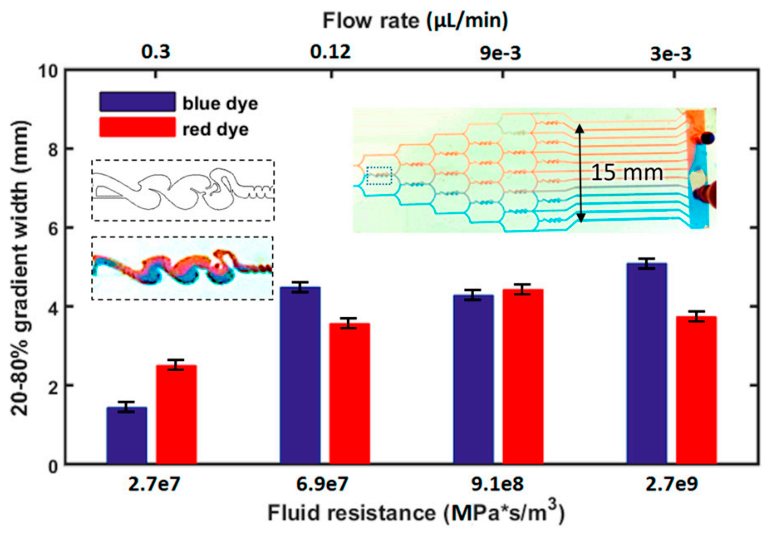
As illustrated in Figure 13, beyond flow isolation, Tesla-valve structures have also been widely exploited for micro-mixing and micro-reaction enhancement [76]. The flow splitting, recombination, and localized recirculation generated within Tesla geometries promote interfacial renewal and mass transfer, which are otherwise difficult to achieve under diffusion-dominated low-Reynolds-number conditions. Improved planar Tesla micromixers have been shown to outperform conventional T-type mixers by generating stronger mixing effects within compact microchannels [77]. Further studies revealed that branching angle governs jet-collision intensity, while embedded obstacles can enhance local flow disturbances and mixing efficiency (Figure 14) [78]. Topology-optimized Tesla-inspired micromixers have demonstrated additional potential for improving interfacial transport and reaction performance, highlighting the versatility of Tesla-valve principles beyond their original rectification function [79].
Figure 13.
µTesla driven, Tesla-inspired mixer microfluidics. The all-Tesla-fluidic system generated gradients using blue and red dyes at flow rates as low as 3 nL/min. The mixer incorporates flow folding structures similar to Tesla valves (CAD and enlarged insert on left). The widest gradient achieved spanned 4 mm across (20–80% intensity), as analyzed from their RGB channels. Errors bars denote maximum and minimum values from image analysis [76].
Figure 14.
Distribution of nanoparticles (diameter = 13.5 nm) in the micromixer for a rate equal to 1000 nanoparticles per second under (a) Vp/Vc = 20, (b) Vp/Vc = 10, and (c) Vp/Vc = 1 [78].
Despite these advantages, the localized high shear rates generated at the loop junctions and recirculation regions of Tesla valves may influence the transport of shear-sensitive biological samples and chemical reagents. In water-quality monitoring applications involving living microorganisms, enzymatic reactions, or trace-level biochemical analyses, excessive shear stresses may induce cell deformation, reduce microbial viability, alter enzyme activity, or affect the stability of sensitive analytes, thereby compromising analytical accuracy. Therefore, future Tesla-valve designs for microfluidic water-analysis systems should not only maximize flow rectification and mixing performance but also carefully control local shear-rate distributions through geometric optimization and operating-condition selection to ensure compatibility with delicate biological and chemical samples.
Overall, the role of Tesla valves in microfluidic hydraulic systems has expanded from passive flow rectification to multifunctional fluid management. Their ability to simultaneously provide directional transport, contamination control, and mixing enhancement makes them promising building blocks for next-generation water-monitoring and microfluidic analysis platforms [80].
4.2. Tesla Valves in Thermo-Hydraulic Coupling and Phase-Change Systems
Beyond flow rectification, Tesla valves have increasingly been employed in thermo-hydraulic and phase-change systems, where the key objective is to convert the additional dissipation generated during reverse flow into measurable thermal performance gains. Although Tesla-type structures inevitably introduce extra pressure losses, the enhanced flow disturbance, mixing, and boundary-layer disruption they induce can significantly improve convective heat transfer, often leading to a net thermal benefit [81,82].
In microchannel heat sinks and liquid-cooling systems, Tesla-inspired geometries promote repeated flow splitting, recirculation, and rejoining through side branches and curved passages. These mechanisms continuously disturb the near-wall flow, accelerate thermal boundary-layer redevelopment, and enhance fluid mixing, thereby improving heat transfer performance. Comparative studies by Han et al. demonstrated that Tesla-type channels substantially reduce thermal resistance relative to smooth channels through stronger thermal boundary-layer disruption [59]. Similarly, Bao and Wang reported that the rectification-induced flow asymmetry can significantly influence temperature-field distributions [43]. Using nanofluids and second-law analysis, Shahsavar et al. further showed that the thermal advantages of Tesla structures are strongly operating-condition dependent, and within certain regimes, the heat-transfer enhancement can outweigh the accompanying hydraulic penalties [83,84,85].
The application of Tesla valves has also expanded to liquid-cooling plates and integrated thermal management systems. Numerical studies have shown that flow deflection and localized recirculation generated by Tesla structures improve convective heat transfer while simultaneously promoting more uniform flow distribution. Lai et al. demonstrated that incorporating Tesla-type channels into layered cooling plates not only increased local heat-transfer coefficients but also altered heat-transport pathways within the cooling system [82]. Fan et al. further integrated Tesla-based liquid cooling with phase-change materials (PCM), creating hybrid thermal management systems capable of achieving effective temperature regulation with reduced energy consumption [86].
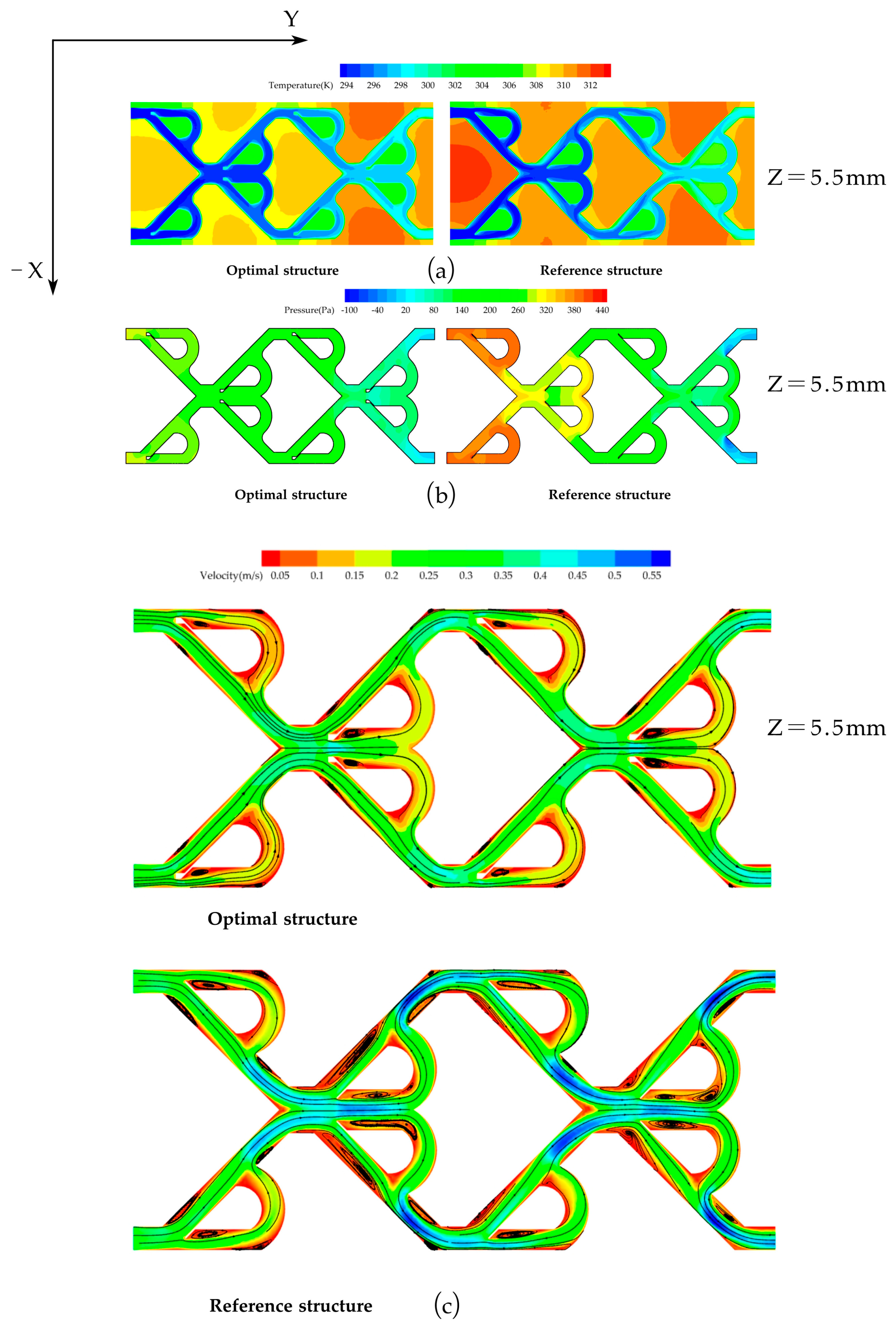
In phase-change applications, Tesla valves have evolved from simple flow-control elements into multifunctional thermal management components. In pulsating heat pipes (PHPs), Tesla structures are frequently employed as passive check-valve elements to introduce directional bias into the oscillatory two-phase flow. Studies have shown that Tesla-based designs can modify startup behavior and flow oscillation characteristics in pulsating heat pipes. In latent heat-storage systems, Cao et al. replaced conventional straight tubes with Tesla pipes and achieved substantially faster charging and discharging rates [87]. More recently, Li et al. [81] developed a switchable thermal regulator that combines Tesla valves with capillary structures, enabling controllable heat transport through coordinated regulation of fluid supply and vapor backflow [88,89] (Figure 15).
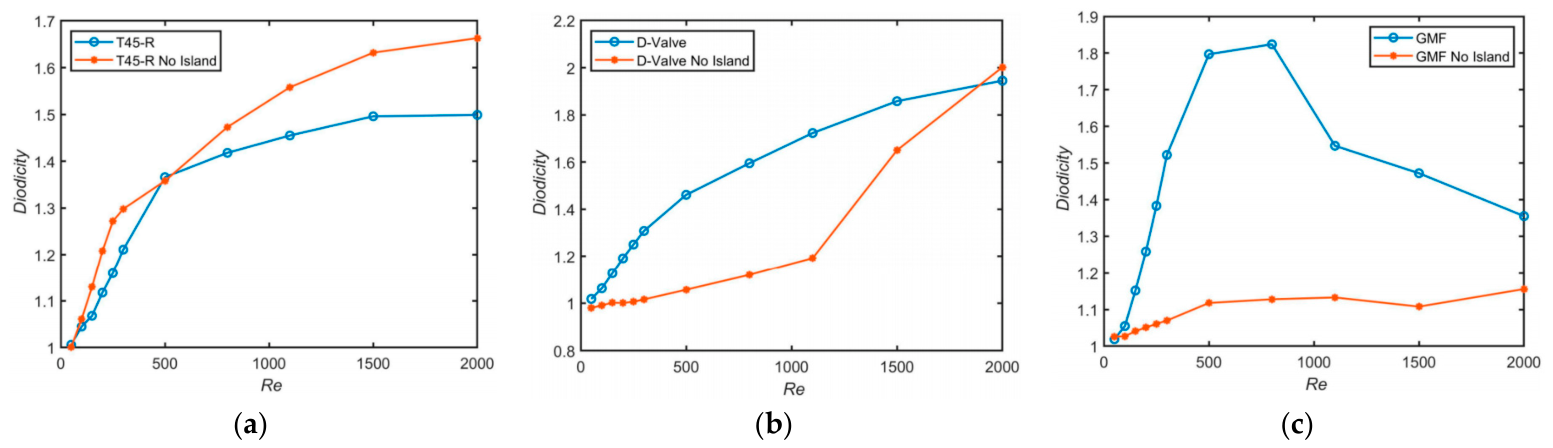
Figure 15.
Performance comparison between optimal structure and reference structure: (a) temperature distribution; (b) pressure distribution; (c) streamline and velocity distribution [88].
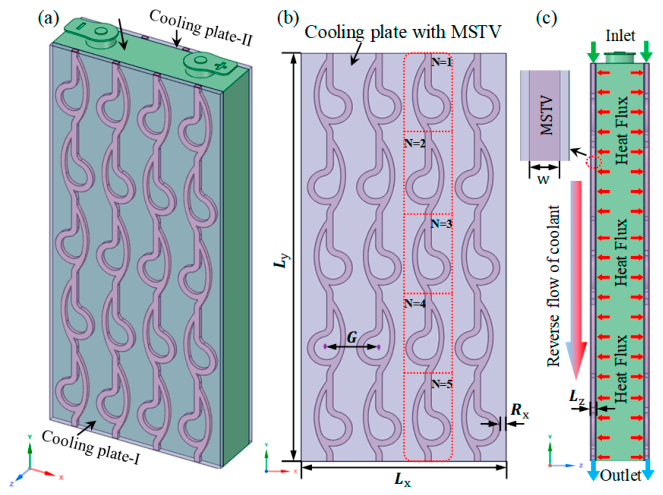
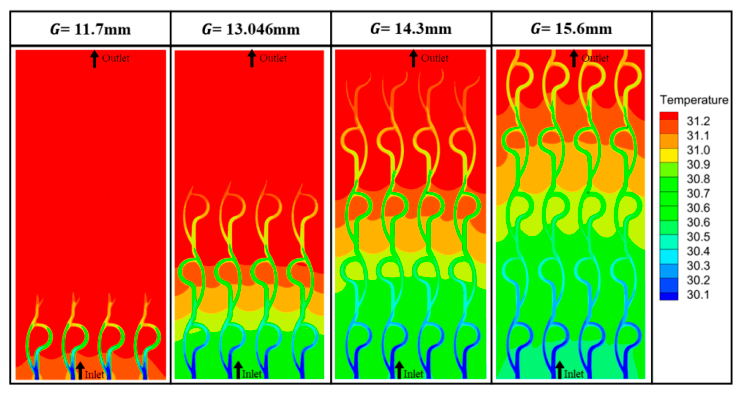
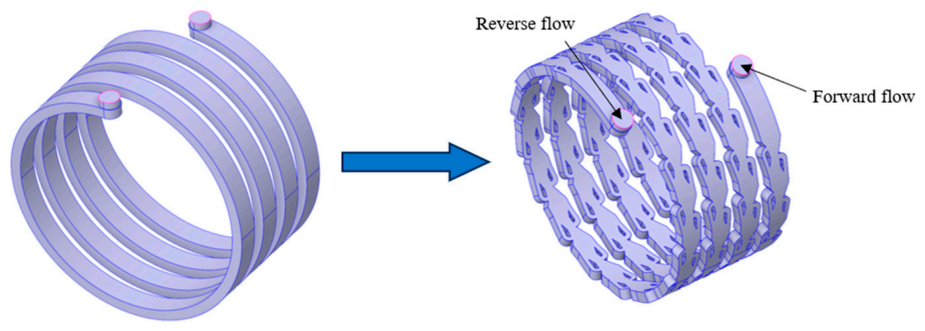
Overall, the role of Tesla valves in thermo-hydraulic systems has evolved from passive flow rectification toward active enhancement of heat and mass transfer. As illustrated in Figure 16, Figure 17 and Figure 18, by coupling flow asymmetry with thermal transport mechanisms, Tesla-inspired structures provide a versatile platform for advanced cooling technologies, phase-change devices, and multifunctional thermal management systems [90,91,92,93].
Figure 16.
Design of MSTV-BTMS: (a) cold plate with MSTV; (b) design parameters of the cold plate with Tesla valve-type channels; (c) CFD model of the MSTV channel [90].
Figure 17.
Evolution of temperature contours for a four-channeled cold plate with a reverse flow direction in MSTV at Re = 300 for varying G [90].
Figure 18.
Tesla-valved cooling runner [93].
4.3. Tesla Valves for Energy Dissipation, Pressure Reduction, and Safety Enhancement in High-Pressure Hydraulic Systems
In high-pressure hydraulic networks and specialized water-engineering systems, the role of Tesla valves extends beyond flow rectification toward passive pressure management and flow stabilization. Rather than maximizing diodicity alone, recent studies increasingly emphasize the ability of Tesla-based resistance networks to distribute pressure losses spatially and suppress localized hydraulic instabilities without moving components. Although much of the existing work has been conducted in high-pressure gas and hydrogen pressure-reduction systems, the underlying principles of staged energy dissipation and gradual pressure recovery are highly relevant to water systems operating under large pressure differentials [94,95,96].
A key strategy is the use of multistage Tesla configurations to achieve progressive pressure reduction. Geometric parameters strongly influence local pressure losses and flow resistance, and therefore directly determine the pressure-regulation capability of the valve. Studies by Jin et al. demonstrated that variations in branch geometry and channel dimensions can significantly alter the distribution of pressure losses within the structure [44]. Building on this concept, Qian et al. showed that multistage Tesla valves can divide a large overall pressure drop into a series of smaller pressure-reduction events, thereby mitigating sudden velocity acceleration and providing greater flexibility in hydraulic regulation [94,95].
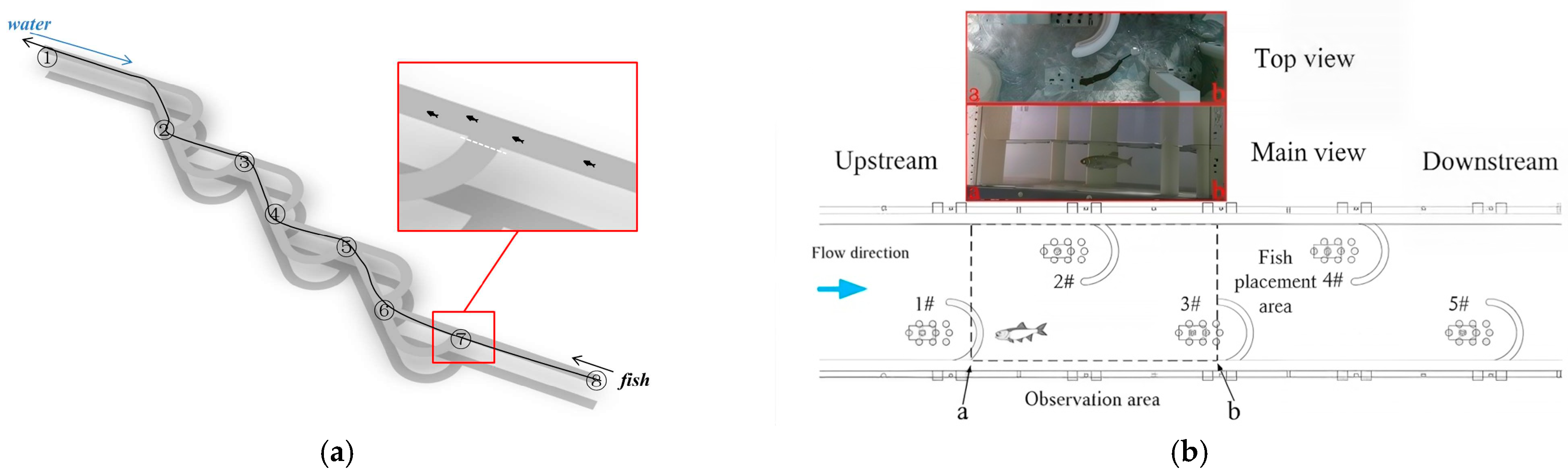
Beyond pressure reduction, Tesla valves can also contribute to local flow-field control and hydraulic safety [97,98]. Energy-loss analyses of multistage configurations revealed that appropriately designed valve networks reduce peak local velocities and promote a more uniform spatial distribution of energy dissipation [99,100]. Combined with findings on pulsating-flow dissipation mechanisms, these results suggest that optimizing flow pathways to minimize localized high-shear regions may be an effective strategy for improving operational safety and reducing the risk of transient hydraulic instabilities [101,102,103,104,105]. A representative example is shown in Figure 19, where Tesla-valve-based backflow control has been applied in fish-passage systems to support hydraulic safety while facilitating ecological connectivity and fish migration [105,106].
Figure 19.
Application of the blocking properties of Tesla valves in backflow safety during fish migration. (a) Schematic diagram of fish ascending in the fish passage pipeline (the vital positions for testing have been marked with numbers in the figure) [105]. (b) Schematic diagram of fish swimming behavior observation [106].
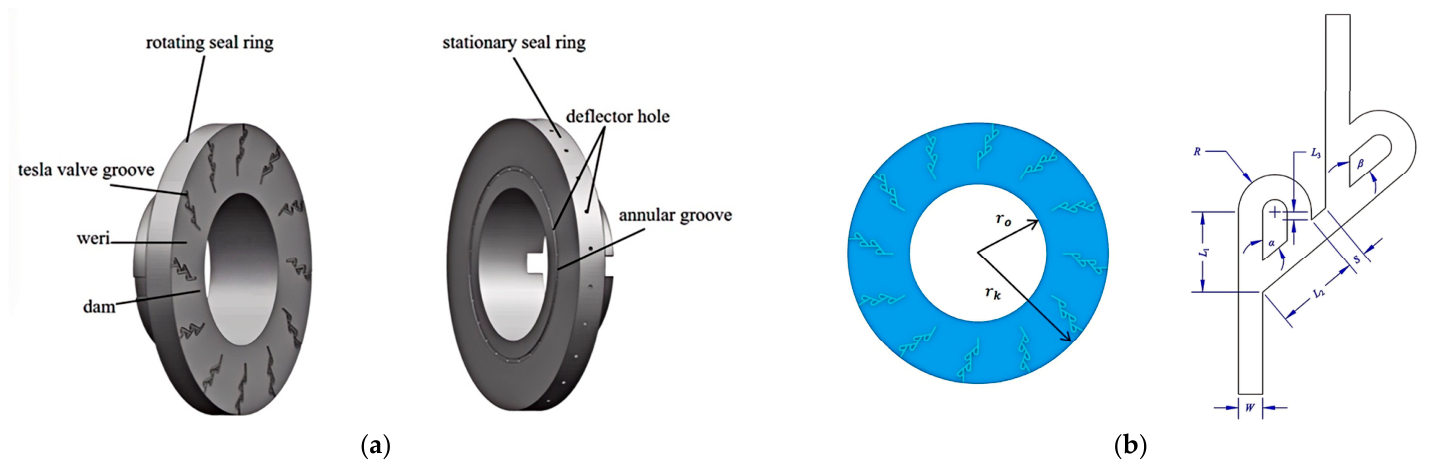
In practical systems, Tesla valves are often integrated with conventional throttling devices such as orifice plates [105,106]. In such hybrid configurations, the orifice provides the primary pressure reduction, while the Tesla valve restructures the downstream flow field, suppresses localized high-velocity jets, and promotes a smoother pressure-recovery process (Figure 20) [107,108,109,110,111]. As illustrated in Figure 21, by combining throttling, flow stabilization, and pressure-distribution functions within a compact passive-resistance network, Tesla-based designs offer a promising approach for next-generation hydraulic pressure-management systems [112,113].
Figure 20.
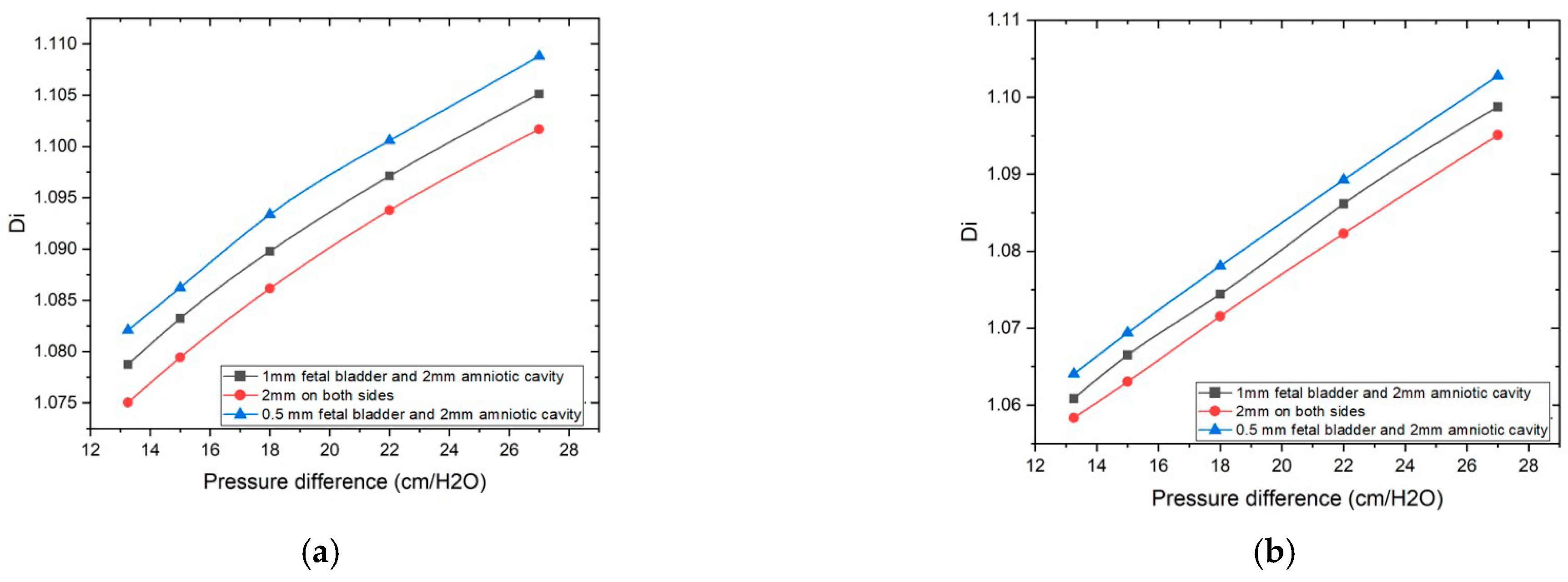
Geometric extension dimensions on the impact of diodicity based on pressure differences. (a) Fifty-degree valve: Di vs. pressure difference; (b) 60-degree valve: Di vs. pressure difference [107].
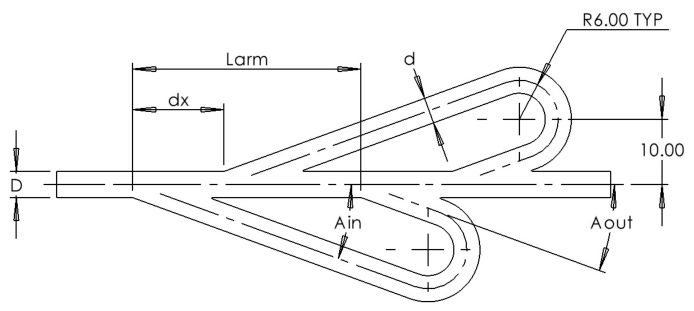
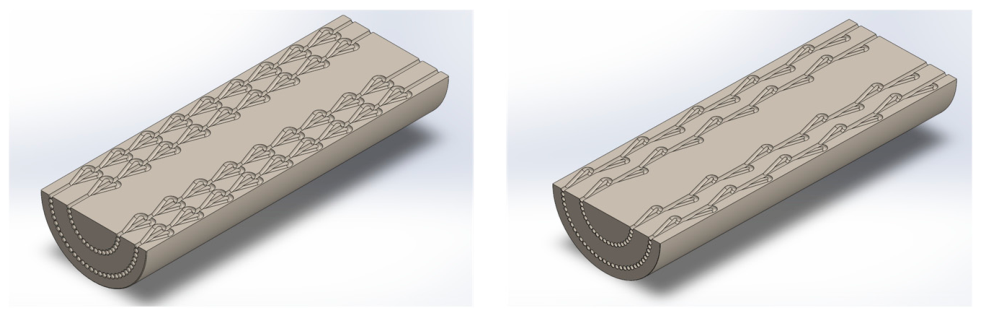
Figure 21.
Sealing performance and structural optimization of Tesla valve-type end-face groove self-pumping hydrodynamic mechanical seal. (a) Configuration of rotating and stationary rings in the mechanical seal; (b) Structural parameters of the groove on the rotating ring end face [112].
4.4. Tesla Valves in Pulsating and Oscillatory Flow Systems
Tesla valves have attracted increasing attention in pulsating, reciprocating, and oscillatory flow systems, where their primary function extends beyond steady-flow rectification to the regulation of time-dependent flow and pressure signals. In these applications, geometric asymmetry selectively redistributes transient momentum and energy, enabling non-steady rectification without moving components [114].
A notable feature of Tesla valves is the enhancement of rectification under pulsating flow conditions. Nguyen et al. demonstrated that diodicity can increase significantly when the flow transitions from steady to pulsating regimes [19]. During periodic acceleration and deceleration, different flow paths exhibit distinct inertial responses, leading to asymmetric flow partitioning and amplified differences in energy dissipation between forward and reverse directions. As a result, the time-averaged rectification performance can exceed that observed under steady-flow conditions [115].
In oscillatory fluid systems such as pulsating heat pipes (PHPs), Tesla valves function as passive oscillatory rectifiers. Although the instantaneous flow repeatedly reverses direction, the geometric asymmetry introduces a slight directional bias during each oscillation cycle. Over time, this bias accumulates into a measurable net circulation, enhancing fluid transport and thermal performance. Studies have shown that incorporating Tesla structures into PHPs can modify startup characteristics, influence oscillation behavior, and improve overall heat-transfer performance [116].
The ability of Tesla valves to manipulate transient pressure and flow waves has also enabled a range of emerging applications. In fluidic systems, Tesla valves can serve as passive signal-processing elements capable of filtering or converting pulsating flow inputs. In thermal management devices, coupling Tesla valves with capillary structures has demonstrated selective regulation of transient two-phase flows and local pressure fluctuations, enabling controllable heat-transfer modulation without active control components [114].
Overall, pulsating and oscillatory-flow applications highlight an important shift in Tesla-valve research. Performance evaluation is no longer limited to steady-state pressure-drop ratios or diodicity; instead, metrics such as frequency response, time-averaged rectification efficiency, transient energy dissipation, and system-level dynamic performance become increasingly important. In this sense, Tesla valves are evolving from passive rectifiers for continuous flows into versatile control elements for complex unsteady fluid networks, where geometric asymmetry governs not only flow direction but also the temporal evolution of fluid transport.
5. Challenges and Future Perspectives
Despite the advantages of passive flow rectification, fouling resistance, and compatibility with microfabrication technologies, Tesla valves still face several challenges that limit their widespread implementation in water and thermal–fluid systems [117]. While considerable progress has been achieved in flow characterization, structural optimization, and application development, future research should increasingly focus on engineering-oriented design strategies that improve scalability, manufacturability, and system integration [118].
A major limitation is the lack of standardized performance evaluation criteria. Existing studies employ application-specific metrics, including diodicity, pressure-loss coefficients, Nusselt number, and performance evaluation criteria (PEC), resulting in inconsistent definitions of optimal designs and limited comparability among studies [119]. Future efforts should establish unified testing protocols and application-oriented assessment frameworks that simultaneously consider rectification performance, hydraulic losses, thermal efficiency, operational reliability, and overall system effectiveness [120,121,122,123].
Another important challenge is understanding Tesla-valve behavior under realistic operating conditions. Most investigations remain limited to steady-state, single-phase flows, whereas practical systems often involve transient flow fluctuations, multiphase transport, phase change, fluid–structure interactions, and complex thermal conditions [123]. Integrating transient CFD, multiphase modeling, heat-transfer analysis, and advanced experimental diagnostics will provide a more comprehensive understanding of valve performance and long-term operational stability. Recent studies on complex hydraulic machinery have demonstrated that methodologies such as entropy-generation analysis, advanced vortex identification, and energy-balance approaches can effectively reveal flow-loss mechanisms and unsteady flow characteristics, providing valuable methodological references for future investigations of Tesla valves under realistic operating conditions [123,124,125]. Furthermore, emerging treatment technologies capable of handling variable-quality wastewater, such as ultrasound irradiation, have shown promise in addressing the inherent variability of real-world industrial effluents [126], highlighting the need for adaptive passive flow-control strategies that can maintain stable hydraulic performance under fluctuating feed conditions.
Recent advances in additive manufacturing, topology optimization, and generative design have expanded the design space of Tesla valves, enabling increasingly complex three-dimensional geometries [117,118]. However, manufacturing constraints, material behavior, dimensional tolerances, and durability considerations can significantly affect hydraulic performance and reliability [123,125]. Future optimization frameworks should therefore incorporate Design for Additive Manufacturing (DfAM) principles and simultaneously account for hydraulic performance, manufacturability, and structural reliability. Recent studies combining multi-objective optimization algorithms with energy-based performance evaluation have demonstrated the potential of such approaches for improving the efficiency and robustness of hydraulic components, providing useful methodological guidance for future Tesla-valve optimization [124].
Finally, future research should move beyond component-level optimization toward system-level integration. The practical value of Tesla valves depends on their contribution to overall system performance in applications such as water treatment, microfluidics, thermal management, and hydraulic distribution networks. Emerging digital-twin technologies integrating real-time sensing, data-driven prediction, and artificial intelligence offer promising opportunities for performance monitoring, predictive maintenance, and adaptive optimization [115,116,124]. At a broader scale, sustainable infrastructure development requires not only technological innovation at the component level but also strategic urban planning that integrates hydraulic systems with urban structure and land-use patterns [127]. Such frameworks emphasize that passive flow-control devices like Tesla valves should be designed and evaluated within the context of overall urban sustainability goals, including energy efficiency, water conservation, and climate resilience. These developments may facilitate the transition of Tesla valves from passive flow-control devices to intelligent flow-management components in next-generation sustainable water and thermal–fluid systems.
6. Conclusions
This review systematically examined Tesla valve-based passive flow regulation for sustainable water systems from the perspectives of flow mechanisms, structural evolution, and engineering applications. The main conclusions are as follows:
- (1)
- Flow rectification in Tesla valves originates from flow separation, recirculation, jet interaction, and vortex evolution. Its performance is strongly influenced by geometric configuration, Reynolds number, fluid properties, and operating conditions.
- (2)
- Tesla-valve designs have evolved from conventional planar structures to multistage, three-dimensional, and topology-optimized architectures, enabling enhanced hydraulic performance and expanding their functionality beyond passive rectification to flow regulation, mixing enhancement, pressure management, and hydraulic safety.
- (3)
- Tesla valves have demonstrated significant potential in microfluidic systems, water-quality monitoring, pressure-reduction networks, thermo-hydraulic devices, and other sustainable water-engineering applications, highlighting their versatility as passive flow-management components.
- (4)
- Future research should focus on standardized performance evaluation, realistic operating conditions, manufacturable designs, and system-level integration to facilitate the practical deployment of Tesla-valve technologies in next-generation sustainable water systems.
Author Contributions
Writing—Original Draft Preparation, P.L.; Writing—Review and Editing, G.T.; Writing—Review and Editing, H.C.; Validation, H.C.; Data Curation, G.T.; Investigation, P.L.; Formal Analysis, H.C. All authors have read and agreed to the published version of the manuscript.
Funding
The work was sponsored by the National Natural Science Foundation of China (Grant No.52409114) and Shandong Province Key Research and Development Program (2024TSGC0620).
Data Availability Statement
The original contributions presented in this review are included in the article. Further inquiries can be directed to the corresponding author.
Conflicts of Interest
The authors declare no conflict of interest.
Abbreviations
The following abbreviations are used in this manuscript:
| TV | Tesla valve |
| CFD | Computational fluid dynamics |
| PEC | Performance evaluation criterion |
| DfAM | Design for additive manufacturing |
| ANN | Artificial neural network |
| PCM | Phase change materials |
| PHP | Pulsating heat pipe |
| BTMS | Battery thermal management system |
| MSTV | Multi-stage Tesla valve |
| 3D | Three-dimensional |
References
- Jin, H.; Xu, Z.; Liu, X.; Wang, C. Study of rheological vibration of high-pressure differential string multistage control valve. Flow Meas. Instrum. 2025, 104, 102906. [Google Scholar] [CrossRef]
- Yang, X.; Lü, Y.; Xu, L.; Ma, Y.; Chen, R.; Zhao, X. Numerical investigation on cavitation erosion and evolution of choked flow in a tri-eccentric butterfly valve. Flow Meas. Instrum. 2024, 100, 102725. [Google Scholar] [CrossRef]
- Liu, B.; Wang, M.; Guo, S.; Zhang, C.; Zhao, J.; Qin, N.; Xin, G. Investigation of cavitation-induced failure mechanisms in charging flow control valves for nuclear power plants. Eng. Fail. Anal. 2026, 186, 110529. [Google Scholar] [CrossRef]
- Wang, Z.; Li, W.; Wang, X.; An, T.; Lin, Z.; Jin, Z.; Qian, J. Design of asymmetric combined flow-guiding valve core structure in hydraulic spool valve. Ann. Nucl. Energy 2026, 227, 111938. [Google Scholar] [CrossRef]
- Thomas, S.K.; Muruganandam, T.M. A review of acoustic compressors and pumps from fluidics perspective. Sens. Actuators A Phys. 2018, 283, 42–53. [Google Scholar] [CrossRef]
- Lu, F.; Zhou, Y.; Qiao, G.; Zhu, J.; Gong, G.; Yang, H.; Han, D. A high-pressure, high-flow piezoelectric ultrasonic micropump with a novel diaphragm check valve. Sens. Actuators A Phys. 2026, 402, 117582. [Google Scholar] [CrossRef]
- Tesla, N. Valvular Conduit. US Patent No. 1,329,559, 3 February 1920. [Google Scholar]
- Gamboa, A.R.; Morris, C.J.; Forster, F.K. Improvements in fixed-valve micropump performance through shape optimization of valves. J. Fluids Eng. 2005, 127, 339–346. [Google Scholar] [CrossRef]
- Bardell, R.L. The Diodicity Mechanism of Tesla-Type No-Moving-Parts Valves; University of Washington: Seattle, WA, USA, 2000. [Google Scholar]
- Mansur, E.A.; Mingxing, Y.E.; Yundong, W.; Youyuan, D. A state-of-the-art review of mixing in microfluidic mixers. Chin. J. Chem. Eng. 2008, 16, 503–516. [Google Scholar] [CrossRef]
- de Vries, S.F.; Florea, D.; Homburg, F.G.A.; Frijns, A.J.H. Design and operation of a Tesla-type valve for pulsating heat pipes. Int. J. Heat Mass Transf. 2017, 105, 1–11. [Google Scholar] [CrossRef]
- Thompson, S.M.; Ma, H.B.; Wilson, C. Investigation of a flat-plate oscillating heat pipe with Tesla-type check valves. Exp. Therm. Fluid Sci. 2011, 35, 1265–1273. [Google Scholar] [CrossRef]
- Schwarz, F.; Messmer, P.; Lodermeyer, A.; Danov, V.; Fleßner, C.; Becker, S.; Hellinger, R. Analysis of improved pulsating heat pipe designs for hot spot applications. Int. J. Heat Mass Transf. 2022, 196, 123294. [Google Scholar] [CrossRef]
- Ando, M.; Okamoto, A.; Nagai, H. Start-up and heat transfer characteristics of oscillating heat pipe with different check valve layouts. Appl. Therm. Eng. 2021, 196, 117286. [Google Scholar] [CrossRef]
- Hu, H.; Son, I.; Kikumoto, H.; Zhang, B.; Hayashi, K. Improving Tesla valve shape within fluid diode plates for building ventilation. Build. Environ. 2024, 252, 111259. [Google Scholar] [CrossRef]
- Feng, S.; Shan, S.; Lai, C.; Chen, J.; Li, X.; Mori, S. Multi-objective optimization on thermal performance and energy efficiency for battery module using gradient distributed Tesla cold plate. Energy Convers. Manag. 2024, 308, 118383. [Google Scholar] [CrossRef]
- Chen, C.Y.; Yang, M.; Li, Y.; Lu, G. Enhancing heat dissipation and temperature uniformity of microchannel heat sinks using fractal gradient honeycomb-reverse Tesla valve configuration. Case Stud. Therm. Eng. 2025, 72, 106371. [Google Scholar] [CrossRef]
- Liao, Y.J.; Chou, C.Y.; Chueh, C.C. Thermal-hydraulic analysis of PCHEs using supercritical methane and multistage Tesla valves with staggered alternatingly oriented flow baffles. Case Stud. Therm. Eng. 2025, 73, 106558. [Google Scholar] [CrossRef]
- Nguyen, Q.M.; Abouezzi, J.; Ristroph, L. Early turbulence and pulsatile flows enhance diodicity of Tesla’s macrofluidic valve. Nat. Commun. 2021, 12, 2884. [Google Scholar] [CrossRef] [PubMed]
- Koşar, A.; Kuo, C.J.; Peles, Y. Suppression of boiling flow oscillations in parallel microchannels by inlet restrictors. ASME J. Heat Mass Transf. 2006, 128, 251–260. [Google Scholar] [CrossRef]
- Wang, G.; Cheng, P.; Bergles, A.E. Effects of inlet/outlet configurations on flow boiling instability in parallel microchannels. Int. J. Heat Mass Transf. 2008, 51, 2267–2281. [Google Scholar] [CrossRef]
- Prajapati, Y.K.; Pathak, M.; Khan, M.K. A comparative study of flow boiling heat transfer in three different configurations of microchannels. Int. J. Heat Mass Transf. 2015, 85, 711–722. [Google Scholar] [CrossRef]
- Li, W.; Ma, J.; Alam, T.; Yang, F.; Khan, J.; Li, C. Flow boiling of HFE-7100 in silicon microchannels integrated with multiple micro-nozzles and reentry micro-cavities. Int. J. Heat Mass Transf. 2018, 123, 354–366. [Google Scholar] [CrossRef]
- Chang, W.; Luo, K.; Li, W.; Li, C. Enhanced flow boiling of HFE-7100 in silicon microchannels with nanowires coated micro-pinfins. Appl. Therm. Eng. 2022, 216, 119064. [Google Scholar] [CrossRef]
- Raffel, J.; Ansari, S.; Nobes, D.S. An experimental investigation of flow phenomena in a multistage micro-Tesla valve. J. Fluids Eng. 2021, 143, 111205. [Google Scholar] [CrossRef]
- Nguyen, Q.M.; Huang, D.; Zauderer, E.; Romanelli, G.; Meyer, C.L.; Ristroph, L. Tesla’s fluidic diode and the electronic-hydraulic analogy. Am. J. Phys. 2021, 89, 393–402. [Google Scholar] [CrossRef]
- Liu, Z.; Shao, W.Q.; Sun, Y.; Sun, B. Scaling law of the one-direction flow characteristics of symmetric Tesla valve. Eng. Appl. Comput. Fluid Mech. 2022, 16, 441–452. [Google Scholar] [CrossRef]
- Hu, P.; Wang, P.; Liu, L.; Ruan, X.; Zhang, L.; Xu, Z. Numerical investigation of Tesla valves with a variable angle. Phys. Fluids 2022, 34, 033603. [Google Scholar] [CrossRef]
- Zeidan, M.; Németh, M.; Abhijith, G.R.; Wéber, R.; Ostfeld, A. Transient flow dynamics in tesla valve configurations: Insights from computational fluid dynamics simulations. Water 2024, 16, 3492. [Google Scholar] [CrossRef]
- Rusin, K.; Wróblewski, W.; Malekshah, E.H.; Pahlavanzadeh, M.; Rulik, S. Extended analytical model of Tesla turbine with advanced modelling of velocity profile in minichannel between corotating disks with consideration of surface roughness. Energy 2024, 307, 132775. [Google Scholar] [CrossRef]
- Liosis, C.; Pagonis, D.N.; Peppa, S.; Drossos, M.; Sarris, L. 3D-printed Tesla valve with IoT-based flow and pressure sensing. Fluids 2026, 11, 69. [Google Scholar] [CrossRef]
- Stith, D. The Tesla valve—A fluidic diode. Phys. Teach. 2019, 57, 201. [Google Scholar] [CrossRef]
- Purwidyantri, A.; Prabowo, B.A. Tesla valve microfluidics: The rise of forgotten technology. Chemosensors 2023, 11, 256. [Google Scholar] [CrossRef]
- Huang, F.; Ren, L.; Xie, S.; Leng, M.; Liao, P. Numerical study of flow characteristics and heat transfer mechanism in Tesla valve tube. Results Eng. 2024, 21, 101795. [Google Scholar] [CrossRef]
- Bahrami, M.; Yovanovich, M.M.; Culham, J.R. Pressure drop of fully-developed, laminar flow in microchannels of arbitrary cross-section. In Proceedings of the ASME 3rd International Conference on Microchannels and Minichannels. ASME 3rd International Conference on Microchannels and Minichannels, Parts A and B, Toronto, ON, Canada, 13–15 June 2005; ASME: New York, NY, USA, 2025; pp. 269–280. [Google Scholar] [CrossRef]
- Liosis, C.; Papadatos, A.; Pagonis, D.N.; Peppa, S.; Sarris, L. Diodicity of microTesla valves under various Re numbers. Micromachines 2025, 16, 1329. [Google Scholar] [CrossRef] [PubMed]
- Qian, J.; Chen, M.; Liu, X.; Jin, Z. A numerical investigation of the flow of nanofluids through a micro Tesla valve. J. Zhejiang Univ. Sci. A 2019, 20, 50–60. [Google Scholar] [CrossRef]
- Pahlavanzadeh, M.; Rusin, K.; Wróblewski, W.; Rulik, S. Roughness effects on flow in Tesla turbine with parametric adjustment of porous layer model. Phys. Fluids 2025, 37, 015139. [Google Scholar] [CrossRef]
- Gungor, A.C.; Koepfli, S.M.; Baumann, M.; Ibili, H.; Smajic, J.; Leuthold, J. Modeling hydrodynamic charge transport in graphene. Materials 2022, 15, 4141. [Google Scholar] [CrossRef] [PubMed]
- Gong, J.; Li, G.; Liu, R.; Wang, Z. Numerical calculation of gas-liquid two-phase flow in Tesla valve. Aerospace 2024, 11, 409. [Google Scholar] [CrossRef]
- Thompson, S.M.; Paudel, B.J.; Jamal, T.; Walters, D.K. Numerical investigation of multistaged tesla valves. J. Fluids Eng. 2014, 136, 081102. [Google Scholar] [CrossRef]
- Wiley, S.; Huang, H.P. The effect of bifurcated geometry on the diodicity of Tesla valves. Fluids 2024, 9, 294. [Google Scholar] [CrossRef]
- Porwal, P.R.; Thompson, S.M.; Walters, D.K.; Jamal, T. Heat transfer and fluid flow characteristics in multistaged Tesla valves. Numer. Heat Transf. Part A Appl. 2018, 73, 347–365. [Google Scholar] [CrossRef]
- Thompson, S.M.; Walters, D.K.; Paudel, B.J.; Jamal, T. A numerical investigation of multi-staged tesla valves. In Proceedings of the Fluids Engineering Division Summer Meeting, Incline Village, NV, USA, 7–11 July 2013; American Society of Mechanical Engineers: New York, NY, USA, 2013; V01AT03A012. [Google Scholar] [CrossRef]
- Zhang, S.; Winoto, S.H.; Low, H.T. Performance simulations of Tesla microfluidic valves. In Proceedings of the International Conference on Integration and Commercialization of Micro and Nanosystems, Sanya, China, 10–13 January 2007; pp. 15–19. [Google Scholar] [CrossRef]
- Zhang, Y.L.; Tong, J.B.; Zhu, Z.C. Numerical calculation of forward and reverse flow in Tesla valves with different longitudinal width-to-narrow ratios. Sci. Rep. 2023, 13, 12496. [Google Scholar] [CrossRef] [PubMed]
- Bao, Y.; Wang, H. Numerical study on flow and heat transfer characteristics of a novel Tesla valve with improved evaluation method. Int. J. Heat Mass Transf. 2022, 187, 122540. [Google Scholar] [CrossRef]
- Jin, Z.; Gao, Z.; Chen, M.; Qian, J. Parametric study on Tesla valve with reverse flow for hydrogen decompression. Int. J. Hydrogen Energy 2018, 43, 8888–8896. [Google Scholar] [CrossRef]
- Gamboa, A.R.; Morris, C.J.; Forster, F.K. Optimization of the fixed-geometry valve for increased micropump performance. In Proceedings of the ASME International Mechanical Engineering Congress and Exposition, Washington, DC, USA, 15–21 November 2003; pp. 525–534. [Google Scholar] [CrossRef]
- Ozguc, S.; Pan, L.; Weibel, J.A. Topology optimization of microchannel heat sinks using a homogenization approach. Int. J. Heat Mass Transf. 2021, 169, 120896. [Google Scholar] [CrossRef]
- Feng, S.; Cao, W.; Li, X.; Lai, C.; Zhang, Y.; Dong, X.; Song, J.; Fu, L.; Mori, S.; He, Z. Inhibition of flow boiling instability for parallel microchannels using topological inlet restrictor at a reduced pressure drop. Appl. Therm. Eng. 2025, 288, 129653. [Google Scholar] [CrossRef]
- Hu, D.H.; Zhang, Z.W.; Li, Q. Numerical study on flow and heat transfer characteristics of microchannel designed using topological optimizations method. Sci. China Technol. Sci. 2020, 63, 105–115. [Google Scholar] [CrossRef]
- Lin, S.; Zhao, L.; Guest, J.K.; Weihs, T.P.; Liu, Z. Topology optimization of fixed-geometry fluid diodes. J. Mech. Des. 2015, 137, 081402. [Google Scholar] [CrossRef]
- Xiong, M.; Yang, J.; Ding, X.; Li, H.; Zhang, H. Topology optimization design of micromixer based on principle of Tesla valve: An experimental and numerical study. Chem. Eng. Process.-Process Intensif. 2023, 193, 109560. [Google Scholar] [CrossRef]
- Myers, R.H.; Montgomery, D.C.; Anderson-Cook, C.M. Response Surface Methodology: Process and Product Optimization Using Designed Experiments; John Wiley & Sons: Hoboken, NJ, USA, 2016. [Google Scholar]
- Deb, K. Multi-objective optimisation using evolutionary algorithms: An introduction. In Multi-Objective Evolutionary Optimisation for Product Design and Manufacturing; Springer: London, UK, 2011; pp. 3–34. [Google Scholar] [CrossRef]
- Borrvall, T.; Petersson, J. Topology optimization of fluids in Stokes flow. Int. J. Numer. Methods Fluids 2003, 41, 77–107. [Google Scholar] [CrossRef]
- Abdelwahed, M.; Chorfi, N.; Malek, R. Reconstruction of Tesla micro-valve using topological sensitivity analysis. Adv. Nonlinear Anal. 2019, 9, 567–590. [Google Scholar] [CrossRef]
- Na, J.; Li, H.; Yan, P.; Li, X.; Gao, X. An open-source topology optimization modeling framework for the design of passive micromixer structure. Chem. Eng. Sci. 2022, 259, 117820. [Google Scholar] [CrossRef]
- Han, Q.; Lai, W.; Liu, Z.; Li, L.; Li, W. A comparative study of enhanced thermal performance in Tesla-type microchannels. Appl. Therm. Eng. 2024, 239, 122157. [Google Scholar] [CrossRef]
- Du, G.; Basem, A.; Othman, N.A.; Sinnah, Z.A.B.; Alhumaid, S.; Ayadi, M.; Albalawi, H.; Ali, H.E.; Alkhalaf, S.; Garalleh, H.A. Optimizing thermo/hydro-diodic performance (T/H-DP) of Tesla valve designs by artificial neural network (ANN) and genetic algorithm (GA); a numerical simulation. Int. Commun. Heat Mass Transf. 2025, 169, 109711. [Google Scholar] [CrossRef]
- Alonso, D.H.; Silva, E.C.N. Topology optimization applied to the design of Tesla-type turbine devices. Appl. Math. Model. 2022, 103, 764–791. [Google Scholar] [CrossRef]
- Andriukaitis, D.; Vargalis, R.; Šerpytis, L.; Drevinskas, T.; Kornyšova, O.; Stankevičius, M.; Bimbiraitė-Survilienė, K.; Kaškonienė, V.; Maruškas, A.S.; Maruškas, L. Fabrication of microfluidic Tesla valve employing femtosecond bursts. Micromachines 2022, 13, 1180. [Google Scholar] [CrossRef] [PubMed]
- Sparrow, A.; Isley, J.; Smith, W.; Gannon, A. Geometric optimization of a Tesla valve through machine learning to develop fluid pressure drop devices. Fluids 2025, 10, 255. [Google Scholar] [CrossRef]
- Zhu, S.; Wang, P.; Liu, L.; Ding, C. Influence of baffle location on the diodicity of Tesla valves. Appl. Sci. 2025, 15, 5526. [Google Scholar] [CrossRef]
- Vaferi, K.; Vajdi, M.; Shadian, A.; Ahadnejad, H.; Moghanlou, F.S.; Nami, H.; Jafarzadeh, H. Modeling and optimization of hydraulic and thermal performance of a tesla valve using a numerical method and artificial neural network. Entropy 2023, 25, 967. [Google Scholar] [CrossRef] [PubMed]
- Hong, C.C.; Choi, J.W.; Ahn, C.H. A novel in-plane passive microfluidic mixer with modified Tesla structures. Lab Chip 2004, 4, 109–113. [Google Scholar] [CrossRef] [PubMed]
- Wang, X.; Yang, L.; Sun, F. CFD analysis and RSM optimization of obstacle layout in Tesla micromixer. Int. J. Chem. React. Eng. 2021, 19, 1045–1055. [Google Scholar] [CrossRef]
- Wang, J.; Cui, B.; Liu, H.; Chen, X.; Li, Y.; Wang, R.; Yang, H.; Li, L.; Pan, H.; Quan, J.; et al. Tesla valve-based flexible microhybrid chip with unidirectional flow properties. ACS Omega 2022, 7, 31744–31755. [Google Scholar] [CrossRef] [PubMed]
- Raza, W.; Hossain, S.; Kim, K.Y. Effective mixing in a short serpentine split-and-recombination micromixer. Sens. Actuators B Chem. 2018, 258, 381–392. [Google Scholar] [CrossRef]
- Shi, H.; Cao, Y.; Zeng, Y.; Zhou, Y.; Wen, W.; Zhang, C.; Zhao, Y.; Chen, Z. Wearable tesla valve-based sweat collection device for sweat colorimetric analysis. Talanta 2022, 240, 123208. [Google Scholar] [CrossRef] [PubMed]
- Stroock, A.D.; Dertinger, S.K.W.; Ajdari, A.; Mezić, I.; Stone, H.A.; Whitesides, G.M. Chaotic mixer for microchannels. Science 2002, 295, 647–651. [Google Scholar] [CrossRef] [PubMed]
- Hossain, S.; Ansari, M.A.; Kim, K.Y. Evaluation of the mixing performance of three passive micromixers. Chem. Eng. J. 2009, 150, 492–501. [Google Scholar] [CrossRef]
- Weng, X.; Yan, S.; Zhang, Y.; Liu, J.; Shen, J. Design, simulation and experimental study of a micromixer based on Tesla valve structure. Chem. Ind. Eng. Prog. 2021, 40, 4173. [Google Scholar]
- Ling, H.; Wu, Y.; Gu, Y.; Zhao, Y.; Zhu, X.; Jiang, F.; Ding, Y.; Ling, X.; Fang, D. Realizing rapid energy storage and efficient release in a tesla valve integrated cold energy storage unit for data center cooling. Appl. Therm. Eng. 2026, 129683. [Google Scholar] [CrossRef]
- Habhab, M.B.; Ismail, T.; Lo, J.F. A laminar flow-based microfluidic tesla pump via lithography enabled 3D printing. Sensors 2016, 16, 1970. [Google Scholar] [CrossRef] [PubMed]
- Liosis, C.; Sofiadis, G.; Karvelas, E.; Karakasidis, T.; Sarris, L. A Tesla valve as a micromixer for Fe3O4 nanoparticles. Processes 2022, 10, 1648. [Google Scholar] [CrossRef]
- Liosis, C.; Sofiadis, G.; Karvelas, E.; Karakasidis, T.; Sarris, L. Inverse Tesla valve as micromixer for water purification. Micromachines 2024, 15, 1371. [Google Scholar] [CrossRef] [PubMed]
- Ricart, D.; Dorado, A.D.; Lao-Luque, C.; Baeza, M. Microflow injection system for efficient Cu(II) detection across a broad range. Chemosensors 2024, 12, 119. [Google Scholar] [CrossRef]
- Liosis, C.; Sofiadis, G.; Karvelas, E.; Karakasidis, T.; Sarris, L. Simulations of Tesla valve micromixer for water purification with Fe3O4 nanoparticles. Environ. Sci. Proc. 2022, 21, 82. [Google Scholar] [CrossRef]
- Li, W.; Yang, S.; Chen, Y.; Li, C.; Wang, Z. Tesla valves and capillary structures-activated thermal regulator. Nat. Commun. 2023, 14, 3996. [Google Scholar] [CrossRef] [PubMed]
- Lai, C.; Shan, S.; Feng, S.; Chen, Y.; Zeng, J.; Song, J.; Fu, L. Numerical investigations on heat transfer enhancement and energy flow distribution for interlayer battery thermal management system using Tesla-valve mini-channel cooling. Energy Convers. Manag. 2023, 280, 116812. [Google Scholar] [CrossRef]
- Monika, K.; Chakraborty, C.; Roy, S.; Sujith, R.; Datta, S.P. A numerical analysis on multi-stage Tesla valve based cold plate for cooling of pouch type Li-ion batteries. Int. J. Heat Mass Transf. 2021, 177, 121560. [Google Scholar] [CrossRef]
- Gajjar, K.; Huang, H.P. Conjugate heat transfer for single phase immersion cooling of CPU. Case Stud. Therm. Eng. 2023, 52, 103728. [Google Scholar] [CrossRef]
- Shahsavar, A.; Hasani, M.; Alizadeh, A. Two-phase simulation of hydrothermal performance and entropy generation aspects of a biologically prepared nanofluid-cooled heat sink with helical Tesla valve-based microchannels. Case Stud. Therm. Eng. 2024, 58, 104429. [Google Scholar] [CrossRef]
- Fan, Y.; Wang, Z.; Xiong, X.; Zhu, J.; Gao, Q.; Wang, H.; Wu, H. Novel concept design of low energy hybrid battery thermal management system using PCM and multistage Tesla valve liquid cooling. Appl. Therm. Eng. 2023, 220, 119680. [Google Scholar] [CrossRef]
- Cao, L.; Cong, Y.; Fang, M. Numerical study on flow and heat transfer characteristics of a Tesla pipe-casing-type phase change heat storage device. Appl. Therm. Eng. 2023, 228, 120501. [Google Scholar] [CrossRef]
- Xu, L.; Lin, H.; Hu, N.; Xi, L.; Li, Y.; Gao, J. Multi-objective optimization towards heat dissipation performance of the new tesla valve channels with partitions in a liquid-cooled plate. Energies 2024, 17, 3106. [Google Scholar] [CrossRef]
- Chai, J.; Zhang, Q.; Lv, S.; He, P.; Yang, Y.; Li, T.; Lv, G.; Hu, X. Multi-objective optimization study on low-concentration methane combustion with Tesla valve configurations. Appl. Therm. Eng. 2025, 287, 129457. [Google Scholar] [CrossRef]
- Fan, Y.; Wang, Z.; Xiong, X.; Panchal, S.; Fraser, R.; Fowler, M. Multi-objective optimization design and experimental investigation for a prismatic lithium-ion battery integrated with a multi-stage Tesla valve-based cold plate. Processes 2023, 11, 1618. [Google Scholar] [CrossRef]
- Yang, B.; Yang, N.; Zhao, D.; Chen, F.; Yuan, X.; Kou, B.; Hou, Y.; Xie, G. Numerical simulation of graphene growth by chemical vapor deposition based on Tesla valve structure. Coatings 2023, 13, 564. [Google Scholar] [CrossRef]
- Zhou, J.; Huang, F.; Wang, W.; Yang, J.; Ruan, G. Numerical study and design optimization of geometry parameters of Tesla valve flow fields for proton exchange membrane fuel cell. Energies 2025, 18, 5095. [Google Scholar] [CrossRef]
- Zhou, N.; Wu, H.; Li, Z.; Ma, Y.; Lu, S. Optimization of Tesla valve cooling channels for high-efficiency automotive PMSM. World Electr. Veh. J. 2025, 16, 169. [Google Scholar] [CrossRef]
- Qian, J.; Chen, M.; Gao, Z.; Jin, Z. Mach number and energy loss analysis inside multi-stage Tesla valves for hydrogen decompression. Energy 2019, 179, 647–654. [Google Scholar] [CrossRef]
- Qian, J.; Wu, J.; Gao, Z.; Wu, A.; Jin, Z. Hydrogen decompression analysis by multi-stage Tesla valves for hydrogen fuel cell. Int. J. Hydrogen Energy 2019, 44, 13666–13674. [Google Scholar] [CrossRef]
- Sreekanth, N.; Sankaran, S.; Kenned, J.J. Development of soft seal and experimental investigation of soft seated safety relief valves for cryogenic applications. Cryogenics 2025, 146, 104005. [Google Scholar] [CrossRef]
- Qiu, G.; Zhu, S.; Wang, K.; Wang, W.; Hu, J.; Hu, Y.; Zhi, X.; Qiu, L. Effect of thermal conduction in cylinder wall on in-cylinder heat transfer in high-pressure liquid hydrogen pumps. Int. J. Hydrogen Energy 2025, 102, 937–946. [Google Scholar] [CrossRef]
- Wang, L.; Liao, Y.; Guo, Y.; Feng, J.; Peng, X.; Zhang, Z. Study on the influence of spring characteristics in the gas valves on the performance of the ionic liquid hydrogen compressor. Appl. Therm. Eng. 2025, 264, 125489. [Google Scholar] [CrossRef]
- Yang, X.; Song, F.; Wu, Y.; Guo, S.; Xu, S.; Zhou, J.; Liu, H. Suppression of pressure feedback of the rotating detonation combustor by a Tesla inlet configuration. Appl. Therm. Eng. 2022, 216, 119123. [Google Scholar] [CrossRef]
- Yuan, Z.; Wen, X.; Zhang, S.; Diao, S.; Guo, Z.; Wang, M. Explosive characterization of the pipe with Tesla valves for premixed CH4/CO/Air. Process Saf. Environ. Prot. 2024, 183, 821–834. [Google Scholar] [CrossRef]
- Chen, F.; Ren, X.; Hu, B.; Li, X.; Gu, C.; Jin, Z. Parametric analysis on multi-stage high pressure reducing valve for hydrogen decompression. Int. J. Hydrogen Energy 2019, 44, 31263–31274. [Google Scholar] [CrossRef]
- Zhang, Y.; Liu, B.; She, X.; Luo, Y.; Sun, Q.; Teng, L. Numerical study on the behavior and design of a novel multistage hydrogen pressure-reducing valve. Int. J. Hydrogen Energy 2022, 47, 14646–14657. [Google Scholar] [CrossRef]
- Tian, Y.; Han, J.; Bu, Y.; Qin, C. Simulation and analysis of fire and pressure reducing valve damage in on-board liquid hydrogen system of heavy-duty fuel cell trucks. Energy 2023, 276, 127572. [Google Scholar] [CrossRef]
- Talluri, L.; Fiaschi, D.; Neri, G.; Ciappi, L. Design and optimization of a Tesla turbine for ORC applications. Appl. Energy 2018, 226, 300–319. [Google Scholar] [CrossRef]
- Zeng, G.; Xu, M.; Mou, J.; Hua, C.; Fan, C. Application of Tesla Valve’s obstruction characteristics to reverse fluid in fish migration. Water 2022, 15, 40. [Google Scholar] [CrossRef]
- Dong, M.; Fan, B.; Xu, M.; Tang, Z.; Gu, Y.; Mou, J. Biological feasibility of a novel island-type fishway inspired by the Tesla valve. Appl. Sci. 2026, 16, 744. [Google Scholar] [CrossRef]
- Nakirekanti, S.S.; Sarkonda, V.C.; Dong, J.; Shi, D.; Alsaghir, A.M.; Bahk, J.H.; Forde, B. Computational study of Tesla valve design for vesico-amniotic shunt to manage lower urinary tract obstruction and pleural effusion. Bioengineering 2025, 12, 1126. [Google Scholar] [CrossRef] [PubMed]
- Wang, Y.; He, Y.; Xie, X.; Huang, Z.; Xu, H.; Ma, C. Design and simulation of a new near zero-wear non-contact self-impact seal based on the Tesla valve structure. Lubricants 2023, 11, 102. [Google Scholar] [CrossRef]
- Aghagoli, A.; Sorin, M.; Khennich, M. Exergy efficiency and COP improvement of a CO2 transcritical heat pump system by replacing an expansion valve with a Tesla turbine. Energies 2022, 15, 4973. [Google Scholar] [CrossRef]
- Guo, H.; Tian, S.; Wang, L.; Xiao, C.; Pan, Y.; Xie, W.; Yang, S. Influence of structural parameters of Tesla valve flow field on performance of fuel cells. Energies 2024, 17, 4442. [Google Scholar] [CrossRef]
- Gao, Y.; Li, W.; Qi, H.; Chen, Y. Optimized design of a multistage centrifugal pump based on volumetric loss reduction by auxiliary blades. Water 2023, 15, 2350. [Google Scholar] [CrossRef]
- Ji, Y.; Han, T.; Zhao, J.; Sun, J. Study on the sealing performance and structural optimization of a Tesla-valve-type end-face groove self-pumping hydrodynamic mechanical seal. Coatings 2026, 16, 565. [Google Scholar] [CrossRef]
- Yao, Y.; Zhou, Z.; Liu, H.; Li, T.; Gao, X. Valveless piezoelectric pump with reverse diversion channel. Electronics 2021, 10, 1712. [Google Scholar] [CrossRef]
- Liu, Z.; Yin, L. Mechanistic insights into fuzzy-coordinated dual-loop refrigerant cooling for electric vehicle thermal management. Int. J. Therm. Sci. 2026, 226, 110871. [Google Scholar] [CrossRef]
- Christopher, G.G.; Olalekan, O.R.; Maeva, M.N.H.; Hassan, B.; Ayegba, S. Artificial intelligence-driven digital twin for fault detection in solid oxide fuel cell stacks under dynamic thermal cycling. J. Power Sources 2026, 677, 239948. [Google Scholar] [CrossRef]
- Kang, J.L.; Wang, C.C.; Wong, D.S.H.; Jang, S.; Wang, C. Digital twin model and dynamic operation for a plant-scale solid oxide fuel cell system. J. Taiwan Inst. Chem. Eng. 2021, 118, 60–67. [Google Scholar] [CrossRef]
- Lee, C.Y.; Wang, W.T.; Liu, C.C.; Liu, C.; Fu, L. Passive mixers in microfluidic systems: A review. Chem. Eng. J. 2016, 288, 146–160. [Google Scholar] [CrossRef]
- Nguyen, N.T.; Hejazian, M.; Ooi, C.H.; Kashaninejad, N. Recent advances and future perspectives on microfluidic liquid handling. Micromachines 2017, 8, 186. [Google Scholar] [CrossRef]
- Cai, G.; Xue, L.; Zhang, H.; Lin, J. A review on micromixers. Micromachines 2017, 8, 274. [Google Scholar] [CrossRef] [PubMed]
- Liu, Y.; Jiang, X. Why microfluidics? Merits and trends in chemical synthesis. Lab Chip 2017, 17, 3960–3978. [Google Scholar] [CrossRef] [PubMed]
- Ji, G.; Chang, H.; He, H.; Peng, G.; Zhou, L.; Shi, W.; Huang, R. The investigation of flow mechanism and energy dissipation in multi-stage pump impeller based on energy balance theory. Energy 2026, 344, 140105. [Google Scholar] [CrossRef]
- Chang, H.; Tang, G.; Zhou, L.; Peng, G.; Shi, W.; Huang, R. Investigation of energy dissipation mechanisms and unsteady flow characteristics of a cooling pump based on sweeping jet inflow. Energy Convers. Manag. 2026, 351, 120959. [Google Scholar] [CrossRef]
- Chang, H.; Wang, Z.; Peng, G.; Shi, W.; Lin, R.; Zhou, L. Role of wall roughness on energy dissipation and vortex dynamics in self-priming centrifugal pump: A study via entropy generation and Liutex vortex identification. Energy 2025, 337, 138733. [Google Scholar] [CrossRef]
- Chang, H.; Yang, J.; Wang, Z.; Peng, G.; Lin, R.; Lou, Y.; Shi, W.; Zhou, L. Efficiency optimization of energy storage centrifugal pump by using energy balance equation and non-dominated sorting genetic algorithms-II. J. Energy Storage 2025, 114, 115817. [Google Scholar] [CrossRef]
- Chang, H.; Wang, Z.; Peng, G.; Zhou, L.; Shi, W. A comprehensive assessment of energy loss and nonlinear pressure pulsations caused by local roughness in self-priming pump. Appl. Therm. Eng. 2026, 295, 130685. [Google Scholar] [CrossRef]
- Ahmed Mohd, E.; Khajah, M.; Abdullah, H.; AI-Yaseen, R. Treatment of industrial wastewater of variable quality using ultrasound irradiation. Civ. Eng. J. 2025, 11, 1476–1491. [Google Scholar] [CrossRef]
- Al-Khafaji Ahmed, S.; Jasim, I.A.; Zumaya, J.Q.; Al-Maliki, L.A.; Al-Mamoori, S.K.; Alrobaee, T.R. The role of urban structure in enhancing the sustainability of cities: A comparative study. Civ. Eng. J. 2025, 11, 1513–1532. [Google Scholar] [CrossRef]
Disclaimer/Publisher’s Note: The statements, opinions and data contained in all publications are solely those of the individual author(s) and contributor(s) and not of MDPI and/or the editor(s). MDPI and/or the editor(s) disclaim responsibility for any injury to people or property resulting from any ideas, methods, instructions or products referred to in the content. |
© 2026 by the authors. Licensee MDPI, Basel, Switzerland. This article is an open access article distributed under the terms and conditions of the Creative Commons Attribution (CC BY) license.