


Abstract
Urban water scarcity and climate change pose significant challenges for sustainable development, particularly in rapidly expanding metropolitan areas. In cities like Casablanca, these pressures also threaten the preservation of cultural heritage sites such as traditional public bathhouses (Hammams). This study investigates how Hammams can integrate sustainable water management solutions in alignment with Sustainable Development Goal 11 (SDG 11), focusing on the treatment and reuse of graywater. This study compares three graywater treatment systems, a Membrane Bioreactor (MBR), a Sequencing Batch Reactor (SBR), and a Moving Bed Biofilm Reactor (MBBR), evaluated through literature review and dimensioning calculations, and also integrates an existing treatment plant in Berlin that functions as a real-scale laboratory. The comparison is based on a set of technical, economic, and environmental criteria used for comparative engineering design assessment and evaluation for the selected Hammam water reuse applications. All systems are technically feasible but show distinct trade-offs. The SBR has the lowest energy demand and highest cost savings, the MBBR offers a compact and simple design, and the MBR provides the highest effluent quality at a higher energy cost. Heat recovery provides a significant thermal energy recovery potential but is reported separately from the electrical energy demand of the treatment systems.
1. Introduction
In early 2024, Moroccan authorities introduced emergency water-saving measures that required public bathhouses (hammams) in Casablanca and several other cities to shut their doors three days a week [1]. The closures formed part of a broader package that also limited vehicle washing, domestic water pressure, and swimming-pool refills—an urgent response to shrink reservoir levels following prolonged drought and record-low rainfall [1,2]. Although hammams account for only a modest share of urban water demand compared to other sectors [3], the restrictions highlighted how climate-induced water scarcity can imperil heritage services whose operating models were never designed to adapt to today’s hydrological stress [4].
This episode typifies the vulnerability of cultural infrastructure to the converging pressures of climate change, rapid urbanisation, and ageing utilities [4]. In North Africa’s largest conurbations, projected temperature rises and declining precipitation threaten both water security and the continuity of traditional practices, which are anchored in high-consumption bathing rituals [5]. The resulting policy dilemma is acute: curbing demand through blanket closures safeguards dwindling supplies but risks accelerating the physical and economic decline of buildings that embody centuries-old social and architectural traditions [6].
One pathway out of this impasse is the on-site reclamation and reuse of graywater [7] generated from showers, washbasins, and laundry, but excluding toilet flows [8]. Graywater typically accounts for 50–80% of total household effluent and, once treated, can replace the non-potable hot-water streams that dominate hammam operations [9]. Over the past decade, cities from Singapore to Berlin have demonstrated compact membrane bioreactors, anaerobic baffled reactors, and hybrid vertical-flow wetlands that produce effluent meeting World Health Organization bathing standards while reducing mains water intake by up to 60% in dense urban settings [10,11,12]. Embedding such technologies within heritage structures offers a double dividend: mitigating water scarcity and lowering energy expenditure, while allowing hammams to remain open on a sustainable footing [13].
Hammams in urban areas such as Casablanca consume large volumes of water 25–65 m3/day [5], depending on visitor capacity, facility size, and location within the city, generating significant amounts of graywater that represent an important yet underutilized resource for reuse, particularly in water-scarce regions such as Morocco. However, no dedicated graywater treatment system has been implemented or validated for hammam applications in Urban Areas in Morocco. In addition, most existing studies focus on residential graywater, which can differ from hammam effluent in terms of temperature and surfactant content. This highlights a clear research gap in developing and comparatively evaluating treatment technologies adapted to hammam-specific conditions.
This study aims to compare three scenarios for treating graywater in a hammam located in the peri-urban area of Casablanca. Based on this analysis, a treatment technology design, including technical and cost requirements, will be proposed in which the graywater generated in the hammam is treated and can be reused for toilet flushing and watering the green spaces of a nearby public school [14]. This approach not only provides students with a pedagogical garden but also with access to a real laboratory, fostering early environmental awareness and sustainability education [14].
The study compares three treatment technologies, MBBR, SBR, and MBR, based on different criteria, mainly treatment efficiency, cost-effectiveness, ease of maintenance, scalability, flexibility, and sustainability. Based on this evaluation, a comparative engineering assessment is presented to guide the modernization of hammams, enabling them to cope with future water stress scenarios without compromising their cultural value or public health standards. This study does not claim compliance with reuse regulations but provides a preliminary engineering basis for system design.
2. Graywater: Characteristics and Treatment Technologies
2.1. Graywater Characteristics
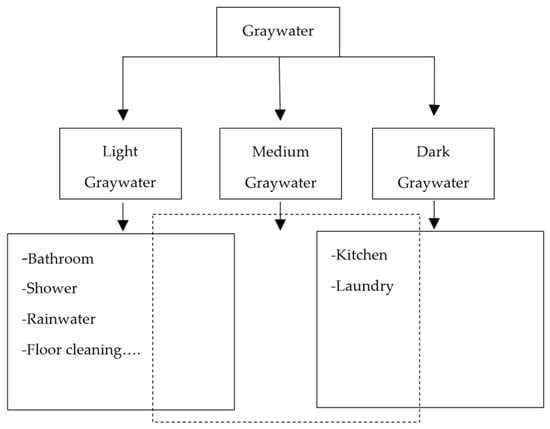
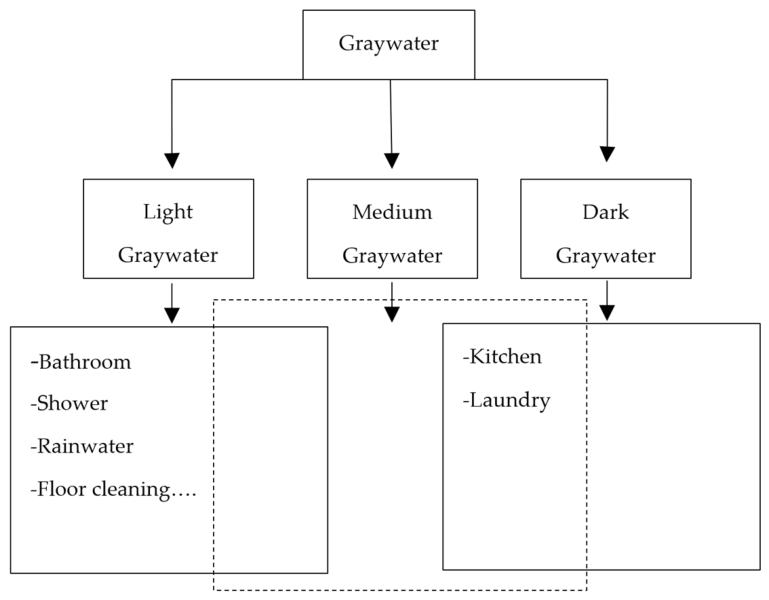
Khanam [15] defined graywater as wastewater generated after domestic and public consumption (bathing, washbasin, laundry, showering, ablution, and kitchen), excluding blackwater (toilet wastewater). The characteristics of graywater may exhibit considerable variability, influenced by factors such as its specific point within the life cycle, origin, and occasionally, the confluence of diverse sources. For instance, graywater from residential kitchen sinks may contain food residues and higher organic loads, while showers may present different pollutant profiles, such as personal care products [8,16]. This heterogeneity underscores the necessity for a systematic categorization, facilitating the distinction of pollutant burdens and informing the strategies for subsequent treatment and potential reuse. By categorizing graywater based on its distinct qualities, more targeted and efficient treatment methodologies can be developed, optimizing resource recovery and reuse scenarios [17]. Figure 1 provides a comprehensive summary of these diverse characterizations [15,16]. Light graywater usually originates from bathrooms, showers, rainwater, or floor cleaning, or a combination of these sources. Dark graywater, on the other hand, includes wastewater from kitchens and laundries. When light and dark graywater are mixed, this is referred to as medium graywater.
Figure 1.
Graywater classification [15,18].
2.2. Graywater Treatment Technologies
Graywater is suitable for treatment and reuse due to its lower contamination levels than toilet water [18]. Reusing graywater reduces the demand for freshwater supplies and decreases wastewater volumes. This section discusses different technologies utilized in treating graywater, ranging from basic to advanced methods.
- -
- Physical Treatment Methods
- Screening: This is a primary step in which graywater is passed through screens to remove larger debris like hair, lint, and particles [12].
- Sedimentation: This process allows heavier particles to settle at the bottom of a settling tank. Once settled, these particles (sludge) are periodically removed [19].
- Filtration: A more advanced form of physical treatment, water is passed through media like sand or gravel to capture finer particles. Systems can include slow or rapid sand filters [19,20].
- -
- Biological Treatment Methods
- Constructed Wetlands: These are man-made systems mimicking natural wetland functions. Graywater is passed through plants and microbial films that digest and filter out impurities [18].
- Subsurface Flow Wetlands (horizontal or vertical flow): Graywater flows beneath the surface, minimizing exposure to humans and pests, while microorganisms fixed at the roots and the soil material treat the water [13].
- Aerobic Treatment Units (ATUs): These units utilize aerobic bacteria (those that require oxygen) to degrade organic material in graywater [21].
- -
- Chemical Treatment Methods
- Disinfection: Chlorine or ozone can be used to disinfect graywater, killing pathogens and making it safe for certain non-potable applications [22].
- Coagulation and Flocculation: Chemicals like alum are added to graywater to bind small particles together, making them easier to settle or filter out [23].
- -
- Advanced Treatment Technologies
- Membrane Filtration: This includes technologies like ultrafiltration and reverse osmosis, which can remove very fine particles and even dissolved solids from graywater [24].
- Ultraviolet (UV) Disinfection: UV light can be used to disinfect graywater without adding chemicals [25].
- -
- Combined Systems
These systems combine two or more of the above methods. For example, a system might use both filtration and UV disinfection to ensure that graywater is adequately treated for its intended reuse application [26].
The choice of an appropriate graywater treatment method is influenced by various factors, including the volume of graywater, with larger amounts potentially requiring more substantial systems. The intended use is also crucial; for instance, treating water for toilet flushing might be less stringent than for garden irrigation, where human contact is more probable. Space constraints play a role since certain systems, like constructed wetlands, demand significant space. Additionally, the financial aspects, encompassing both initial setup and ongoing operational expenses, can differ considerably across technologies. Furthermore, it is essential to consider local regulations as some municipalities impose specific guidelines or restrictions on graywater treatment systems.
Table 1 presents a structured literature comparison of graywater treatment technologies (MBR, SBR, MBBR, and CW) based on references, while explicitly indicating the study type and graywater source associated with each reference. Due to significant variability in influent composition, system scale, and operational conditions across the reviewed studies, removal efficiencies are synthesized and reported at the technology level rather than attributed to individual studies. This approach allows for a generalizable comparison of treatment performance. Key parameters (TSS, turbidity, COD, BOD5, total N, and total P) were selected based on their consistent reporting in the literature and their relevance for assessing graywater treatment efficiency.
Table 1.
Average removal efficiency of selected biological graywater treatment technologies.
3. Innovative Projects for Graywater Reuse in Urban Areas
3.1. The Eco-Hammam Project in Casablanca
Hammams, Morocco’s traditional public bathhouses [32], play a central role in social life, particularly in cities like Casablanca, where they are both cultural landmarks and daily necessities [5]. Yet their high-water consumption makes them problematic in a country where per capita water availability has dropped from about 2500 m3 in the 1960s to roughly 600 m3 today, approaching absolute scarcity levels [33]. Casablanca faces acute hydraulic stress, exacerbated by declining rainfall, depleted groundwater, and reduced dam reserves [34].
The Eco-Hammam project seeks to address this challenge by modernizing hammams with sustainable technologies. Its strategy includes compact graywater treatment units with heat recovery and alternative energy integration, enabling the reuse of treated water for non-potable purposes such as toilet flushing and irrigation of green spaces [35]. This approach reduces freshwater demand while promoting environmental education and urban greening.
However, the project’s wider adoption is constrained by several barriers, including high investment and technical skill requirements, cultural resistance to water reuse, inadequate regulatory comparative assessments, and the spatial challenges of retrofitting existing facilities [36]. Despite these obstacles, the Eco-Hammam model suggests the potential for integrating cultural heritage with sustainable water management in urban areas facing hydraulic stress, offering a replicable solution for similar contexts worldwide [37].
In response to the environmental and socio-economic challenges associated with traditional bathhouses, the Sustainable Hammams project, known as UAC Pilot Project 2: Urban Agriculture + Informal Settlement, was initiated in Casablanca in 2012 as a pilot program, coordinated by GIZ (in collaboration with Moroccan partners [36]. The project integrated high-efficiency biomass boilers and solar preheating technologies to reduce energy demand and improve occupational health conditions [5,38]. On the water management side, constructed wetland systems were implemented to treat graywater, which was subsequently reused for garden irrigation, providing tangible benefits to local households and enabling a nearby school to establish a pedagogical garden for its students. Reported outcomes included reductions of up to 60% in CO2 emissions as well as significant cost savings for operators, while safeguarding the social function of hammams [4].
Despite these promising results, the project was discontinued in 2018, partly due to the extensive land requirements of planted filter systems, which were incompatible with the dense urban fabric of Casablanca. This limitation underscores the need for the development of compact, urban-adapted treatment solutions that can ensure the sustainability of hammams while addressing the constraints of limited space.
3.2. Nolde’s Innovative Water Concept in Berlin
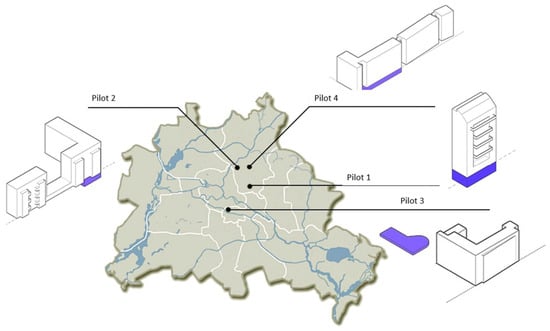
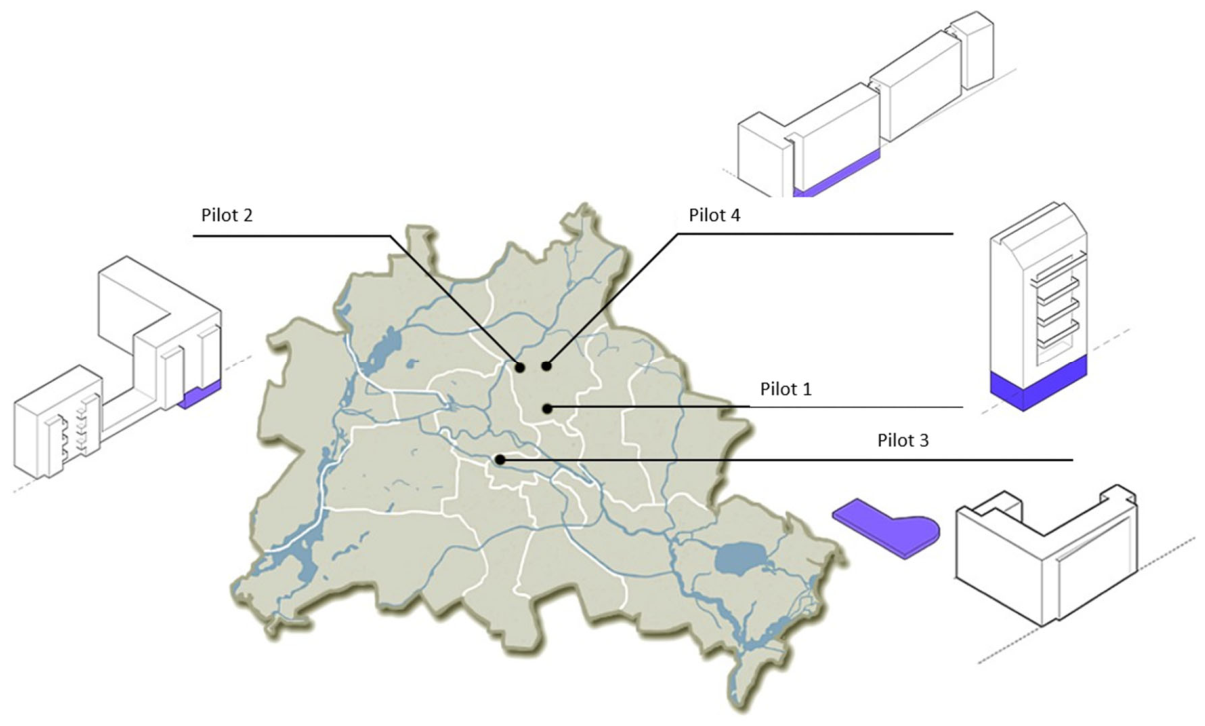
In a previous study, three Moving Bed Biofilm Reactor (MBBR) treatment facilities situated within Berlin [39] were investigated, each located in distinct residential complexes, or Multi-family dwellings that accounted for 86.6% of all Berlin dwellings [40]. Receiving graywater of varying categories at their respective inlets, the study showed the performance of the MBBR system for graywater treatment. In this paper, a 4th MBBR graywater treatment plant is to have a comparable graywater inlet quality to Hammam’s graywater. Pilot 4 in Figure 2 was investigated using the same methods as pilots 1, 2, and 3 in the previous study [39]. The project “Student Housing Prenzlauer Promenade” was implemented in Berlin-Pankow in 2022 as part of the “Grauwasserrecycling mit Wärmerückgewinnung” (graywater recycling with heat recovery) initiative. Commissioned by the state-owned Berlinovo Immobilien Gesellschaft mbH, the system was designed to serve approximately 400 residents in a student apartment complex with a total of 450 beds.
Figure 2.
Map of Berlin with the localization of the MBBR graywater treatment plants, purple color indicates the installed MBBR system locations within the pilots (Nolde-innovative Wasserkonzepte GmbH, Berlin, Germany).
The facility collects graywater from showers and hand washbasins, treating up to 15,000 L per day to produce high-quality service water. The reclaimed water is reused for toilet flushing and preheating domestic hot water, effectively reducing potable water consumption and energy demand.
In addition, the system incorporates an innovative heat recovery unit, capturing residual thermal energy from wastewater before discharge. This recovered heat is reused in the building’s hot water system, closing the last thermal loop within the facility.
4. Materials and Methods
4.1. Case Study: Hammam Moulay Yakoub in Casablanca
The selection of the pilot hammam hinged on several key criteria. These included factors such as its strategic location, the presence of available land, the enthusiastic support and commitment of the owners, the availability of space for photovoltaic panels, and, most importantly, its proximity to a school, college, and high school to facilitate the establishment of an educational garden.
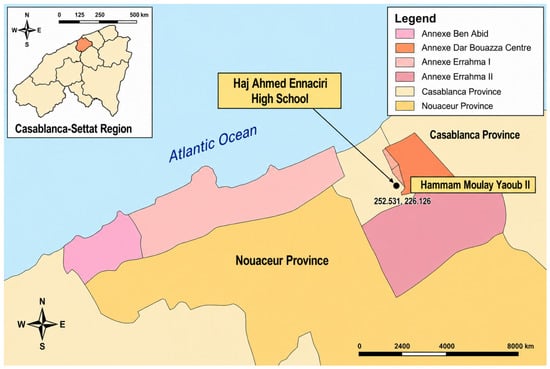
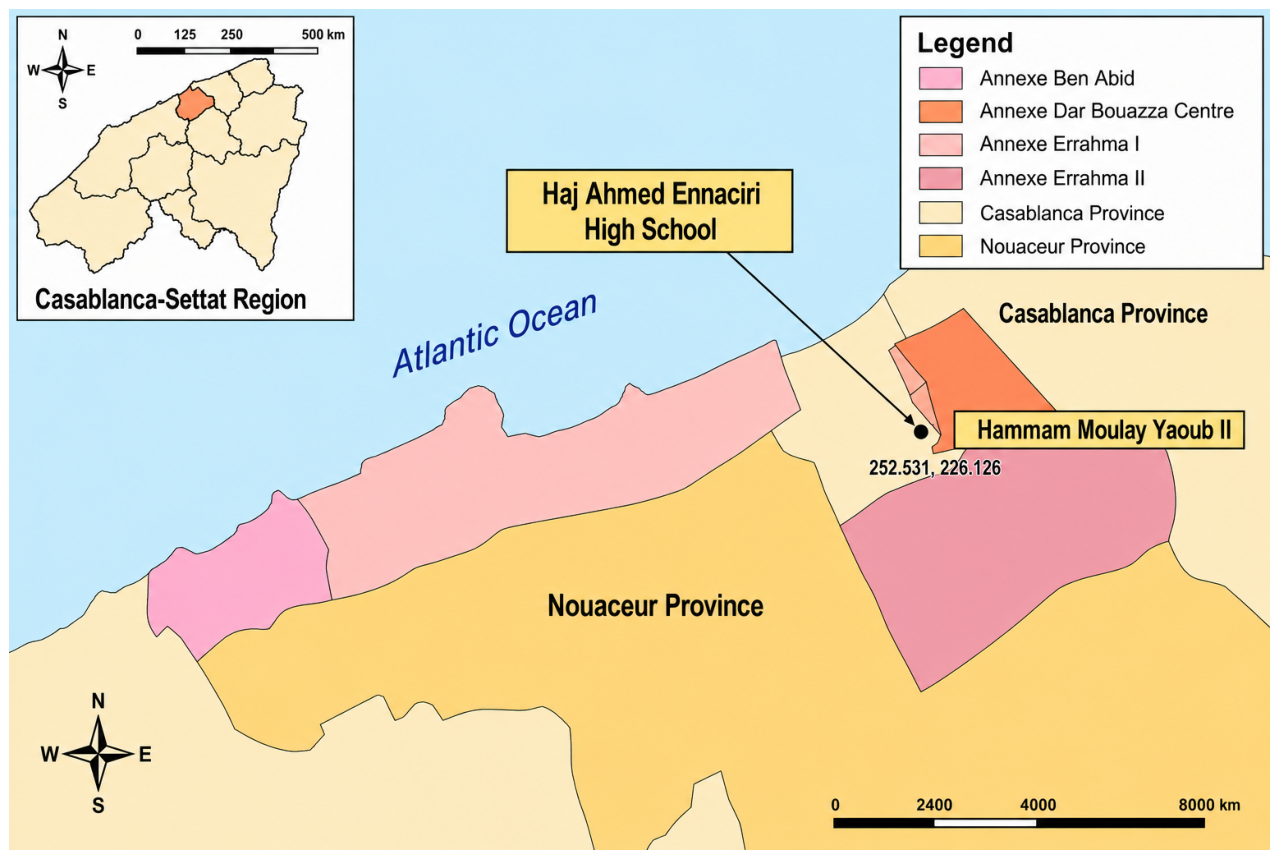
This hammam is located in the Errahma II administrative annex, near Hajj Med Naciri High School (Figure 3). Covering approximately 400 m2, it has been in operation since October 2017. The basement houses the boiler, hot water storage tanks, the traditional furnace, and wood and compressor storage. The ground floor is dedicated to the traditional hammam (hammam beldi), including a relaxation room and a hair salon, while the first floor accommodates the Turkish bath for women, a men’s hammam, treatment and shower areas, a changing room, a prayer room, and storage. For this case study, we focus on the traditional hammam area on the ground floor, as it represents the majority of hammams in Casablanca.
Figure 3.
Map showing the location of Hammam Moulay Yakoub II and the Public High School in Casablanca, Morocco.
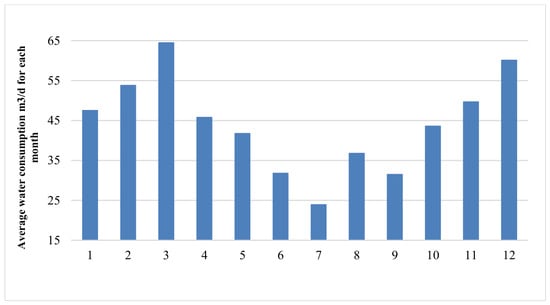
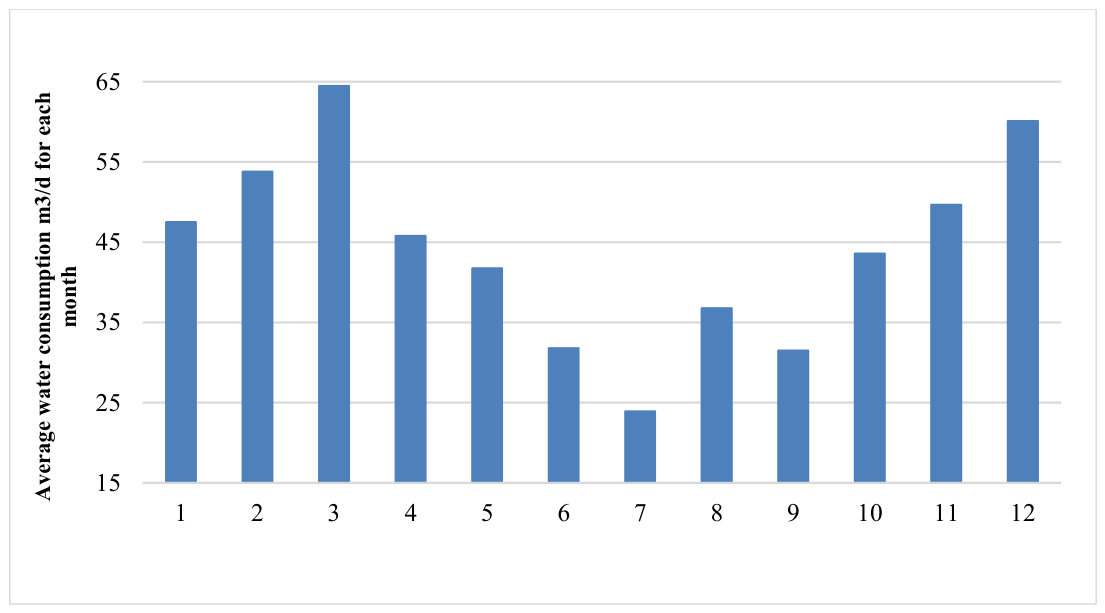
Consequently, the Moulay Yacoub II Hammam was selected as the pilot site. A formal agreement was signed between the hammam’s owner and the project sponsors, allowing access to operational data. Based on this agreement, the monthly average daily water consumption for the year 2018 was obtained and is presented in Figure 4.
Figure 4.
The daily average water consumption for each month of 2018.
Water consumption is high during the winter and autumn seasons, with a peak in March of 64.5 m3/d, resulting in a discharge volume of around 52 m3/d. In fact, according to ONEP, 80% of the water consumed is estimated to be returned to the sewer. This water is discharged into the sewage system at tepid, sometimes high temperatures (40 °C).
4.2. Data Collection and Methods
4.2.1. Hammam’s Data Collection
To assess the quality of the well water used and subsequently discharged by the Hammam Moulay Yacoub II, three samples were collected:
- −
- First sample: Cold well water collected from the faucet inside the Hammam.
- −
- Second sample: Hot well water collected from the faucet inside the Hammam.
- −
- Third sample: Graywater collected inside the Hammam before being discharged into the sewage system. The Graywater results are provided in Section 5.1.
Hammam’s water and graywater sampling, physicochemical and bacteriological analyses were conducted according to Rodier and Moroccan norms [41,42,43]. The sampling campaign was conducted in February 2020, one month before the COVID-19 lockdown in Morocco, during which Hammams were closed for almost a year. In total, approximately 50 samples were collected. All analyses were performed in collaboration with the Faculty of Science of Casablanca, ensuring methodological rigor and compliance with national and international analytical standards. The results for the first and second samples are presented in Table 2. The monitoring period was limited to 15 days; therefore, seasonal variations and operational fluctuations (e.g., visitor frequency, water temperature) were not captured and should be considered in future studies. It should be noted that this study represents a comparative engineering design assessment based on measured and literature-derived parameters, rather than a full-scale experimental validation. The results therefore provide a conceptual basis for system sizing and comparison under defined assumptions.
Table 2.
Characterization of Hammam’s water (inlet) Moulay Yacoub II.
4.2.2. Berlinovo Data Collection
Data were collected within the comparative assessment of the “Grauwasserrecycling mit Wärmerückgewinnung für 450 apartments in Berlin-Pankow” project to assess graywater characteristics and evaluate the performance of an integrated biological treatment system. The monitoring campaign took place over 15 days (24 April–8 May 2024), during which 53 samples were collected from five points: raw graywater, three Reactors (MBBR3, MBBR4, MBBR7), and the final biologically treated water.
Daily automatic samples were taken and preserved at 4 °C, and analyzed in accordance with Standard Methods used in the previous study [39]. All samples were transported to the laboratory and analyzed within 12–24 h to minimize physicochemical changes. In situ parameters, including pH, temperature, and dissolved oxygen, were measured using a portable multi-parameter probe (HQ40d, Hach Lange company, Berlin, Germany). Turbidity was determined using a Hach 2100Q turbidimeter. Chemical oxygen demand (COD) and orthophosphate (PO43−-P) were measured using Hach cuvette tests (DR6000 spectrophotometer), while ammonium (NH4+-N) and nitrate (NO3−-N) were analyzed according to standard colorimetric methods. Biological oxygen demand (BOD5) was determined using the respirometric OxiTop method (WTW). Total suspended solids (TSS) were measured according to standard filtration methods. All analyses were performed in duplicate following standard methods and DIN/ISO guidelines to ensure accuracy and reproducibility. The evolution of the measured parameters across the treatment stages is presented in Table 3. It should be noted that graywater composition may vary depending on user behavior, seasonal conditions, and system operation. Although the sampling campaigns were conducted over defined monitoring periods, the results are considered representative of typical operating conditions rather than long-term variability.
Table 3.
Mean Physicochemical Parameters for Each Reactor During the Monitoring Campaign.
Reproducibility and Data Transparency
All design calculations presented in this study are based on a combination of:
- −
- Measured graywater characteristics from the Hammam Moulay Yacoub II;
- −
- Operational data from the Berlin MBBR case study;
- −
- Literature-based design parameters.
The system was dimensioned based on the reuse demand (2.34 m3/day), rather than the total graywater production (~44 m3/day). The treated flow of 2.34 m3/day represents the reuse demand for toilet flushing and irrigation in the associated school, reflecting a partial graywater reuse strategy. All process calculations (SBR, MBBR, and MBR) follow standard engineering design approaches (Metcalf & Eddy, DWA guidelines) [44,45]. Where direct measurements were not available (e.g., membrane flux, oxygen transfer efficiency, heat exchanger efficiency), values were adopted from literature and comparable systems.
A summary of all input parameters used for design and energy calculations is provided in Table 4. This ensures full traceability and reproducibility of the results. Graywater production values are not directly measured but derived from measured water consumption using an empirical return factor.
Table 4.
Key input parameters used for system design and energy calculations.
4.3. SBR Design
The Sequencing Batch Reactor (SBR) was designed following Wastewater Engineering: Treatment Technologies [45]. Two tanks were implemented to ensure continuous operation, with alternating cycles of filling, aeration, settling, and decanting. Aeration during the filling phase was limited to 50% to prevent filamentous sludge expansion.
Cycle time was calculated as the sum of filling, aeration, settling, and decanting phases. The number of daily cycles per tank was derived accordingly, with the fill volume per cycle determined from the inlet flow rate of the graywater. Only 20% of the liquid depth was decantable, defining the tank volume requirement. Hydraulic retention time (HRT) and decant depth were then calculated based on tank geometry (2 m liquid depth, 0.3 m freeboard) [45].
Sludge production and sludge retention time (SRT) were estimated using kinetic equations for heterotrophic biomass growth and solids balance from [45]. Nitrification was excluded, reflecting the treatment objective, which is the limit value for graywater recycling for irrigation [47]. Sludge mass was determined as a function of biomass production, volatile suspended solids (VSSs), and total suspended solids (TSSs), with SRT solved iteratively.
Oxygen demand was calculated with WET’s oxygen balance equation, considering only carbon oxidation. Fine bubble diffusers were selected for aeration, and the aeration time per cycle was derived from filling and reaction phases. Mixing was provided by a submersible mixer (0.38 kW input, 0.25 kW output), with energy demand calculated from mixer efficiency and non-aerated cycle periods [48].
Sludge disposal was modeled as direct pumping to the sewer. Pumping power was calculated from hydraulic head (0.5 m), flow rate, and pump efficiency, with daily operation assumed at 5 min per cycle (~1 h/day) [49]. Tank sizing followed the same geometric approach as for MBBR, using a length-to-width ratio of 1.5 [50].
For the SBR system, the reported reactor volume corresponds to the total volume of the two-tank configuration. The equivalent hydraulic retention time (HRT) is calculated as V/Q based on the total reactor volume and treated flow.
4.4. MBBR Design
The Moving Bed Biofilm Reactor (MBBR) system was designed based on guidelines from Wastewater Engineering: Treatment Technologies [45]. Two reactors in series were selected to maximize BOD5 removal, improve process stability, and reduce reactor volume and media requirements, while minimizing short-circuiting in the inlet. The AnoxK™ K5 biofilm carrier (specific surface area 500 m2/m3) was used, with surface area loading rates (SALR) of 6 g-sBOD/m2·d for the first reactor and 3 g-sBOD/m2·d for the second [51], reflecting the lower BOD5 concentrations in graywater. A carrier filling fraction of 30% was applied, consistent with full-scale practice and recommended ranges of 30–60%.
Mixing was achieved via fine-bubble diffusers, and carriers were retained using perforated plates. Reactor sizing and BOD5 removal calculations followed [45,52], with required carrier area and volume determined by the target effluent concentration (5 mg/L BOD5). Hydraulic retention time (HRT), effluent BOD5, and BOD5 removal rates were calculated using stage-specific removal efficiencies from operational MBBR data in Berlinivo, described in Section 4.2.
Sludge production was considered negligible due to the low suspended solids in the MBBR effluent; solids separation was assumed to occur via sand filtration. Oxygen demand was estimated conservatively at 1.3 kg O2 per kg BOD5 removed. The actual oxygen transfer rate (AOTE) and air flow requirements were calculated based on diffuser characteristics and the standard oxygen transfer efficiency (SOTE), as per manufacturer data and literature [53].
Hydraulic pumping between reactors was designed using a submersible pressure pump, with power requirements calculated accounting for head loss, pump efficiency, and flow rates [49,54,55]. Cleaning tank volumes were sized based on standard geometric ratios (length-to-width ratio 1.5) and liquid depth, ensuring sufficient operational and maintenance capacity [56].
4.5. MBR Design
Membrane bioreactors (MBRs) were designed based on standard references [45] DWA-M 227 and DWA-A 131. Two membrane module configurations exist: hollow fiber and flat sheet [57,58]. While hollow fibers dominate large-scale applications due to their high packing density, flat membranes offer advantages in fouling resistance and low-pressure operation. For this study, flat plate modules were selected, suitable for small-scale graywater treatment [44].
The membrane flux was determined as 26.1 L/m2·h at 20 °C, and the minimum surface area requirement was calculated using DWA M-227. A packing density of 63.4 m2/m3 based on MicroClear MB3-1 modules (newterra GmbH, Langgoens, Germany). was applied, with the number of modules per tank derived from the required surface area. Since membranes are submerged in the aeration tank, no additional basin volume was required. COD was used as the design parameter (instead of BOD5), with COD fractionation into biodegradable and inert components estimated using a combined approach [45], DWA-A 131, and [59] to account for the specific graywater characteristics.
Sludge age was set at 5 days, consistent with guidelines for aerobic COD removal [60]. Mixed liquor suspended solids (MLSS) were assumed at 1000 mg/L, reflecting reported values in graywater MBR studies. Biomass production, sludge mass, and oxygen demand were calculated using activated sludge design equations from [45].
Air requirements for membrane scouring were based on manufacturer data (0.08–0.12 Nm3/m2·h), which is lower than typical municipal wastewater due to the reduced graywater load [61]. Permeate pumping was designed for a filtration pressure of 0.25 bar [49,55]. Sludge disposal requirements were minimal, with annual pumping assumed [62]. Tank sizing followed the same geometric approach as for MBBR and SBR. All assumed parameters (e.g., membrane flux, air scouring rate, and sludge age) are based on standard guidelines (DWA) and literature values.
5. Results and Conclusions
5.1. Hammam’s Water and Graywater Characterisation and Berlinovo Data Collection
Table 4 compares the physicochemical characteristics of graywater with general discharge limits for surface and groundwater. The results show that several parameters exceed permissible levels, indicating the need for treatment before disposal. The most notable exceedance concerns electrical conductivity, which reached 3690 µS cm−1, well above the limit of 2700 µS cm−1 (Table 5). This elevated conductivity is primarily linked to the intrinsic salinity of the local groundwater used for showering water. In Casablanca, the Chaouia coastal aquifer and adjacent groundwater systems are well documented to be affected by seawater intrusion from the Atlantic Ocean, resulting in elevated chloride levels and electrical conductivity in abstraction wells [63,64].
Table 5.
Presents the results of graywater characterization and general discharge limits for surface waters (rivers, lakes, etc.) or groundwater in Morocco.
The graywater treated in the Berlin case studies originates exclusively from showers and hand washbasins, which are comparable to the primary sources of graywater in hammams, where water is mainly generated from bathing and washing activities without the inclusion of kitchen or toilet wastewater. As a result, both streams exhibit similar characteristics in terms of organic load and surfactant content. However, it should be noted that hammam graywater may present higher temperatures and salinity due to specific operational conditions. The use of data from an existing full-scale treatment unit is particularly valuable, as it provides reliable performance data under real operating conditions, thereby enhancing the robustness of the analysis and supporting the applicability of the results for potential implementation in hammam systems.
It should be noted that, in Morocco, no specific regulatory comparative assessment currently distinguishes graywater from general wastewater or defines quality standards for its reuse. Consequently, graywater is typically managed under conventional wastewater discharge regulations, which do not account for its distinct characteristics and reuse potential. In contrast, WHO guidelines provide a general risk-based comparative assessment for wastewater reuse, mainly focused on agricultural applications, but do not include specific criteria for graywater reuse at the building scale. German standards (DIN/DWA), however, provide detailed technical requirements, including water quality thresholds, system design, and monitoring procedures specifically for graywater reuse. Therefore, in the absence of national graywater-specific regulations and due to the limited applicability of WHO guidelines for decentralized systems, German standards were adopted in this study as a reference comparative assessment. This also highlights the need for the development of dedicated graywater reuse guidelines adapted to the Moroccan context.
Table 6 summarizes the outcomes of the data collection conducted at the Hammam facility in Casablanca, which served as the input dataset for the design and sizing of the three graywater treatment plants. The empirical water balance reflects measured consumption depending on the visitor flow and estimated graywater production, providing a realistic operational comparative assessment for system design.
Table 6.
Hammam’s input Data for GW treatment design.
For the purpose of system design, it is important to distinguish between the total graywater production and the treated flow. The total graywater generated by the hammam is estimated at approximately 44 m3/day under median operating conditions. However, the treatment system is not designed to process the entire generated volume.
Instead, the system is dimensioned based on the reuse demand, corresponding to approximately 2.34 m3/day for non-potable applications such as toilet flushing and irrigation. This represents a partial reuse strategy, where only a fraction of the produced graywater is treated and reused, while the remaining volume is discharged. All subsequent process design calculations, energy estimations, and cost analyses are therefore based on the treated flow corresponding to the reuse demand rather than the total graywater production. Table 6 serves as the primary input dataset for all subsequent process design, energy, and cost calculations.
5.2. Results of the Comparative Study
5.2.1. Process Design
Using the revised single design basis of 2.34 m3/day, the three biological treatment systems show clear differences in hydraulic footprint and process configuration. The MBBR system remains compact, with a median total reactor volume of 0.26 m3 and a hydraulic retention time of 2.35 h. The SBR requires the largest reactor volume, the longest equivalent hydraulic retention time (15 h), while the operational cycle time is 33 h due to batch operation. The MBR combines the smallest reactor volume (0.20 m3) with a median hydraulic retention time of 2.07 h, while maintaining the highest effluent quality through membrane separation. All three systems were evaluated for the same treated flow of 2.34 m3/day and the same target reuse application [66]. Table 7 provides a comparative summary of the process design criteria.
Table 7.
Comparative Summary—Process Design Criteria for Graywater Treatment.
5.2.2. Energy Requirement
All energy values are calculated based on the treated flow of 2.34 m3/day and are presented as daily, specific, and annual values for consistency. The energy balances for the three systems (MBBR, SBR, and MBR) in Table 8 reveal significant variations in aeration, pumping, and auxiliary energy demands due to differences in process configuration and oxygen transfer efficiency.
Table 8.
Comparative Summary—Energy Requirement Criteria for Graywater Treatment.
For the MBBR system, the total specific energy demand was estimated at 0.417 kWh/m3, corresponding to a daily energy consumption of approximately 0.98 kWh/day and an annual demand of 356 kWh/year. The main energy contributions arise from aeration and transfer pumping.
The SBR system exhibited a total specific energy demand of 0.241 kWh/m3, corresponding to approximately 0.56 kWh/day and 208.05 kWh/year. In addition to aeration, energy is required for intermittent mixing and sludge handling processes associated with batch operation.
The MBR system showed the highest energy demand, with a specific energy consumption of 0.609 kWh/m3, corresponding to approximately 1.43 kWh/day and 520 kWh/year. This is mainly due to continuous aeration for biological treatment and membrane scouring, as well as additional operational requirements related to membrane filtration.
Heat recovery potential was estimated using the standard heat balance equation:
where ρ is water density (1000 kg/m3), cp is specific heat capacity (4.18 kJ/kg·K), ΔT is the temperature difference between inlet and outlet, V is the treated volume, and η is the heat exchanger efficiency.
Q = ρ·cp·ΔT·V·η
It should be noted that the recoverable heat represents thermal energy, whereas the treatment demand corresponds to electrical energy. These two energy forms are not directly comparable and are therefore reported separately. No direct net energy balance is calculated in this study. If desired, the recoverable heat could be converted into equivalent primary energy savings by assuming a specific end-use, such as the displacement of natural gas heating (with assumed boiler efficiency) or via a heat pump system with a defined coefficient of performance.
Assuming a treated flow of 2.34 m3/day, an inlet temperature of 35 °C, an outlet temperature of 20 °C, and efficiency between 50% and 75%, the recoverable heat ranges between approximately +19 to +29 kWh/day depending on efficiency. The heat recovery potential is calculated based on the treated flow and temperature difference, which are identical across all treatment scenarios. Therefore, heat recovery is independent of the selected biological process and primarily governed by hydraulic and thermal conditions rather than process configuration. In practice, higher recovery potentials could be achieved if heat recovery is applied to the full graywater stream (~44 m3/day).
5.2.3. Costs
The inclusion of both Moroccan and German tariffs is intended to distinguish between site-specific feasibility (Morocco) and the broader applicability of the results under different economic conditions. A comprehensive cost evaluation was conducted for the three biological graywater treatment technologies MBBR, SBR, and MBR to assess their operational and economic feasibility under the conditions of Morocco (2025) and Germany (2024–2025). The analysis focused on the balance between energy consumption and potable water savings, using national tariffs as a basis for economic comparison. The present analysis intentionally focuses on operational balance (energy and water savings) rather than total life-cycle cost. This decision is justified by the significant variability of installation and material costs, which depend strongly on local market conditions, construction requirements, material importation, and scale of implementation. Such parameters are highly site-specific and would compromise cross-country comparability between Morocco and Germany, where differences in construction labor and regulatory compliance can exceed an order of magnitude [67,68].
For Morocco, the industrial electricity tariff was considered at 1.072 MAD kWh−1 (Office National de l’Électricité et de l’Eau Potable, 2025) and the potable water tariff for professional consumers above 35 m3 month−1 at 16.48 MAD m−3 (Lydec Casablanca, 2024) [69]. For Germany, the average electricity price for household consumers reported by Eurostat (2025) for H2 2024—H1 2025 was 0.289 EUR kWh−1, and the potable water tariff from Berliner Wasserbetriebe (2025) was 1.813 EUR m−3 [70].
Based on the revised calculations using the single treated-flow basis of 2.34 m3/day, the specific energy demands were 0.417 kWh m−3 for MBBR, 0.241 kWh m−3 for SBR, and 0.609 kWh m−3 for MBR, corresponding to annual treatment-energy consumptions of 356.0 kWh a−1, 208.05 kWh a−1, and 520.3 kWh a−1, respectively. Results are presented in Table 9.
Table 9.
Comparative Summary—Costs Criteria for Graywater Treatment.
Operationally, MBBR requires minimal maintenance, mainly blower and carrier inspections, while SBR demands moderate attention for cycle control and decanting mechanisms. MBR requires intensive maintenance, including membrane backwashing, chemical cleaning, and membrane replacement every 5–7 years. These findings align with previous literature showing that biofilm and sequencing batch systems offer simpler and more durable operation in small-scale reuse applications [71,72].
Furthermore, isolating the operational phase allows for a more transferable and generalizable analysis. The operational balance/energy consumption versus potable water/savings provides a benchmark that can be recalculated for any local context by substituting region-specific tariffs or reuse rates. This approach aligns with methodologies used in comparative sustainability assessments for decentralized water reuse systems [71].
Although capital costs are not explicitly quantified, their potential influence on the technology ranking should be acknowledged. In particular, membrane replacement and higher installation costs associated with MBR systems may further reduce their economic attractiveness. A sensitivity analysis including capital and maintenance costs is recommended for future work.
The present study focuses on the reuse-demand-limited scenario (2.34 m3/day), which reflects realistic implementation constraints. A full-treatment scenario based on total graywater production (~44 m3/day) would significantly increase water savings and energy recovery potential but was not considered here due to limited reuse demand.
5.3. Conclusions
This study aimed to identify the most appropriate graywater treatment solution for reuse in a traditional Hammam in Casablanca, where water scarcity and high thermal demand make resource recovery essential. The comparison of the three biological treatment systems MBBR, SBR, and MBR shows clear differences in process configuration, energy performance, costs, and spatial efficiency, all of which are decisive for decentralized Hammam settings.
Among the evaluated options, MBBR offers moderate energy demand compared to the other systems, while SBR exhibits the lowest treatment-energy demand. The MBR achieves the highest effluent clarity due to membrane filtration but requires significantly more energy and higher investment, making it the most demanding technology in terms of operation and life-cycle costs.
For reuse applications such as toilet flushing and irrigation, additional disinfection steps and microbiological monitoring are required to ensure compliance with health standards. The present study focuses on physicochemical treatment performance only. Due to the absence of specific microbiological standards for graywater reuse in toilet flushing in Morocco, the DWA guidelines were adopted as a reference for treated graywater quality. In all considered treatment scenarios, a UV disinfection is included as a design assumption to provide pathogen reduction, but its performance must be verified under site-specific conditions. However, the performance of disinfection processes is not comparatively evaluated in this study and requires further investigation. A basic monitoring strategy should include routine measurement of indicator organisms, turbidity control before UV, and verification of UV system performance.
Under the revised single-flow design basis of 2.34 m3/day, the three systems showed comparable operational feasibility for the selected reuse application, with SBR exhibiting the lowest treatment-energy demand and the highest net annual operating savings, while MBBR remained attractive due to its compact configuration and operational simplicity. MBR provided the highest expected effluent quality but required the highest treatment-energy demand. Overall, the MBBR system represents the most balanced solution for decentralized Hammam applications when considering energy demand, operational simplicity, and spatial constraints.
6. General Conclusions and Further Recommendations
This study provides a comprehensive and comparative assessment of three biological treatment technologies, MBBR, SBR, and MBR, for graywater treatment in a Hammam facility in Casablanca. Its importance lies in addressing a critical research gap: despite the growing global interest in water reuse, there is a lack of detailed comparative design analyses specifically focused on Hammam-generated graywater. Most existing design methodologies and empirical equations are developed for municipal or industrial wastewater, not for graywater characterized by lower organic strength, variable salinity, and high surfactant content. Adapting these design comparative assessments to graywater, therefore, represents a major technical and methodological challenge.
The results of this research demonstrate that adapting process design and energy balance calculations originally developed for conventional wastewater to graywater systems requires significant recalibration, particularly regarding hydraulic retention times, oxygen transfer, and biomass loading. Nevertheless, the comparative evaluation showed that the MBBR system provides the most balanced solution, considering compactness, simplicity, and energy performance for decentralized applications such as Hammams, combining operational simplicity, compactness, and moderate energy demand. The SBR and MBR systems also offer viable alternatives depending on local objectives, SBR for moderate capacity and control flexibility, and the lowest treatment-energy demand, and MBR for achieving the highest effluent quality suitable for advanced reuse.
Beyond the technical findings, this study highlights the broader challenges of technology transfer in graywater reuse. Differences in climate and temperature conditions, regulatory comparative assessments, and social acceptance significantly influence the feasibility of implementing such systems. In Morocco and similar Mediterranean contexts, the perception and awareness of graywater reuse remain limited, often constrained by cultural factors and concerns over hygiene and health risks. Effective communication, public education, and clear policy comparative assessments are therefore crucial for promoting acceptance and safe reuse practices.
Moreover, the integration of energy recovery systems (such as heat exchangers) and the application of EU water reuse regulations (Regulation (EU) 2020/741) offer valuable guidance for developing sustainable graywater management strategies in North Africa. These comparative assessments can support local authorities in defining water quality classes and operational standards adapted to regional conditions.
Future research should focus on:
- −
- Developing localized design criteria and modeling tools specifically calibrated for graywater rather than municipal wastewater.
- −
- Conducting pilot-scale and long-term monitoring studies under varying climatic and operational conditions to validate and optimize system performance.
- −
- Investigating low-energy and nature-based treatment options, such as biofilm wetlands or hybrid systems, for small and medium-scale Hammams.
- −
- Enhancing policy integration, public outreach, and operator training to ensure sustainable implementation and acceptance of graywater recycling systems.
For reuse applications such as toilet flushing and irrigation, additional disinfection steps and microbiological monitoring are required to ensure compliance with health standards. Microbiological parameters such as E. coli are critical indicators for reuse safety. The performance of disinfection processes is not comparatively evaluated in this study, as the focus is placed on physicochemical treatment performance. The present study does not aim to demonstrate hygienic compliance but rather to provide a physicochemical design framework; full validation would require site-specific microbiological characterization and risk-based assessment.
In conclusion, this work provides an essential step toward bridging the gap between theoretical graywater design models and the practical realities of graywater treatment. It contributes a structured comparison of technologies, offering a foundation for both researchers and practitioners seeking sustainable, context-adapted water reuse solutions in the Mediterranean and beyond. This makes the MBBR system particularly suitable for practical implementation in decentralized Hammam applications under water-scarce urban conditions.
Supplementary Materials
The following supporting information can be downloaded at: https://www.mdpi.com/article/10.3390/w18101199/s1, File S1: Detailed Calculation Methods.
Author Contributions
Conceptualization, H.N. and M.B.; methodology, H.N.; validation, H.N. and M.B.; resources, H.N.; data curation, H.N.; writing—original draft preparation, H.N.; writing—review and editing, H.N. and M.B.; supervision, M.B.; project administration, H.N.; funding acquisition, H.N. All authors have read and agreed to the published version of the manuscript.
Funding
The study was carried out as part of the first author’s doctoral research project at TU Berlin. The research was funded through the Global Center of Spatial Methods for Urban Sustainability scholarship awarded to the first author, funding number: 20240202 NH.
Data Availability Statement
The main equations and input parameters used in the calculations are provided in Supplementary Materials File S1. These allow reconstruction of the presented results, while some intermediate steps may require interpretation. While the core calculation steps are documented, full independent reproduction may require interpretation of intermediate steps and assumptions. Site-specific operational data from the case study have been generalized to representative values to ensure confidentiality while preserving the validity of the engineering analysis.
Acknowledgments
We thank the German Research Foundation and the Open Access Publication Fund of the Technical University of Berlin for their invaluable support. We would also like to thank Erwin Nolde and Holger Sack from the Engineering Office of Nolde—innovative Wasserkonzepte GmbH for making the investigations possible and for their support and expertise.
Conflicts of Interest
The authors declare no conflicts of interest.
References
- Casablanca, Morocco Population (2022)—Population Stat. Available online: https://populationstat.com/morocco/casablanca (accessed on 6 February 2022).
- Drought-Hit Morocco Closes Hammans for Three Days a Week|Africanews. Available online: https://www.africanews.com/2024/03/07/drought-hit-morocco-closes-hammans-for-three-days-a-week/ (accessed on 13 August 2025).
- Architecture_of_the_Hammams_of_Fez-with-Cover-Page-v2.pdf. Available online: https://d1wqtxts1xzle7.cloudfront.net/47208892/Architecture_of_the_hammams_of_Fez-with-cover-page-v2.PDF?Expires=1639487700&Signature=MBWc~gTrz5l-cl0grbLFxzM~nBg885tOfylFugUFQET7v9OHpltcaC9DG8k1BXYibfMzb3X22ezQSaT9ghluGQ53ddF64eOAbtnOr6XyU6eQhd9UX0IHEFLwYvD4tmRA0La~-lf2LSXPIx7b41qJ0oaD5XFOH43dl9Y5u5eAv2u3GSvI54DdVATXyGUx1XQ4k8BaW2FkyhWR~EJi6LXhKozZ3zMBzRx3i988jFImAlK36mfSstziT26wHT~RSMl0ScPvSVKNeVSAuWAUOhefStl~IIJYi~IvmS4XQ9mLmWSGheMG8D5Wr50eo9Sr~MTcQo~nyX9Xxs8-KXzbgowaEQ__&Key-Pair-Id=APKAJLOHF5GGSLRBV4ZA (accessed on 14 December 2021).
- Sibley, M.; Pezzica, C.; Tweed, C. Eco-Hammam: The Complexity of Accelerating the Ecological Transition of a Key Social Heritage Sector in Morocco. Sustainability 2021, 13, 9935. [Google Scholar] [CrossRef] [Scilit]
- Chakri, N.; El Amrani, B.; Berrada, F.; Jounaid, H. Environmental diagnosis of traditional hammams of Dar Bouazza’s Commune, Morocco. Desalin. Water Treat. 2019, 170, 405–414. [Google Scholar] [CrossRef] [Scilit]
- Casablanca Region Reinstates Closure of Hammams Due to Morocco’s Water Crisis. Available online: https://www.moroccoworldnews.com/2024/08/15995/casablanca-region-reinstates-closure-of-hammams-due-to-moroccos-water-crisis/ (accessed on 13 August 2025).
- Meney, K.A.; Pantelic, L. Decentralized Water and Wastewater Systems for Resilient Societies: A Shift Towards a Green Infrastructure-Based Alternate Economy. In The Palgrave Handbook of Climate Resilient Societies; Brears, R.C., Ed.; Springer International Publishing: Cham, Switzerland, 2021; pp. 157–184. [Google Scholar]
- Boyjoo, Y.; Pareek, V.K.; Ang, M. A review of greywater characteristics and treatment processes. Water Sci. Technol. 2013, 67, 1403–1424. [Google Scholar] [CrossRef] [Scilit]
- Shaikh, I.N.; Ahammed, M.M. Quantity and quality characteristics of greywater from an Indian household. Environ. Monit. Assess. 2022, 194, 191. [Google Scholar] [CrossRef] [Scilit]
- Oh, K.S.; Leong, J.Y.C.; Poh, P.E.; Chong, M.N.; Lau, E.V. A review of greywater recycling related issues: Challenges and future prospects in Malaysia. J. Clean. Prod. 2018, 171, 17–29. [Google Scholar] [CrossRef] [Scilit]
- Nolde, E.; Partner, N. Greywater Recycling in Buildings. In Water Efficiency in Buildings; John Wiley & Sons, Ltd.: Hoboken, NJ, USA, 2013; pp. 169–189. [Google Scholar]
- Ajit, K. A Review on Grey Water Treatment and Reuse. Int. Res. J. Eng. Technol. 2016, 3, 2665–2668. [Google Scholar]
- Anigrou, Y.; Bahlami, A.; El Khlifi, M. Methodology for an ecological solution of subsurface flow constructed wetlands used in the treatment of greywater. Water Pract. Technol. 2022, 17, 2581–2597. [Google Scholar] [CrossRef] [Scilit]
- Nourredine, H.; Barjenbruch, M.; Million, A.; El Amrani, B.; Chakri, N.; Amraoui, F. Linking Urban Water Management, Wastewater Recycling, and Environmental Education: A Case Study on Engaging Youth in Sustainable Water Resource Management in a Public School in Casablanca City, Morocco. Educ. Sci. 2023, 13, 824. [Google Scholar] [CrossRef] [Scilit]
- Khanam, K.; Patidar, S.K. Greywater characteristics in developed and developing countries. Mater. Today Proc. 2022, 57, 1494–1499. [Google Scholar] [CrossRef] [Scilit]
- Halalsheh, M.; Dalahmeh, S.; Sayed, M.; Suleiman, W.; Shareef, M.; Mansour, M.; Safi, M. Greywater Characteristics and Treatment Options for Rural Areas in Jordan. Bioresour. Technol. 2008, 99, 6635–6641. [Google Scholar] [CrossRef] [Scilit] [PubMed]
- Sievers, J.C.; Wätzel, T.; Londong, J.; Kraft, E. Case study: Characterization of source-separated blackwater and greywater in the ecological housing estate Lübeck “Flintenbreite” (Germany). Environ. Earth Sci. 2016, 75, 1428. [Google Scholar] [CrossRef] [Scilit]
- Albalawneh, A. Review of the Greywater and Proposed Greywater Recycling Scheme for Agricultural Irrigation Reuses. Int. J. Res.-Granthaalayah 2015, 3, 16–35. [Google Scholar] [CrossRef] [Scilit]
- Sushmitha, M.; Hoysall, C.; Kumar, H. Efficient Grey Water Treatment and Reuse Options for India—A Review. In 7th IconSWM—ISWMAW 2017; Springer: Singapore, 2019; Volume 3, pp. 143–149. [Google Scholar]
- Li, F.; Wichmann, K.; Otterpohl, R. Evaluation of appropriate technologies for grey water treatments and reuses. Water Sci. Technol. 2009, 59, 249–260. [Google Scholar] [CrossRef] [Scilit]
- Seenirajan, M.; Sasikumar, S.; Antony, E. Design of Grey Water Treatment Units. Int. Res. J. Eng. Technol. 2018, 5, 4243–4250. [Google Scholar]
- Al-Gheethi, A.A.S.; Noman, E.A.; Radin Mohamed, R.M.S.; Talip, B.A.; Mohd Kassim, A.H.; Ismail, N. Disinfection Technologies for Household Greywater. In Management of Greywater in Developing Countries: Alternative Practices, Treatment and Potential for Reuse and Recycling; Radin Mohamed, R.M.S., Al-Gheethi, A.A.S., Mohd Kassim, A.H., Eds.; Water Science and Technology Library; Springer International Publishing: Cham, Switzerland, 2019; pp. 185–203. [Google Scholar]
- Esfandiari, A.; Mowla, D. Investigation of microplastic removal from greywater by coagulation and dissolved air flotation. Process Saf. Environ. Prot. 2021, 151, 341–354. [Google Scholar] [CrossRef] [Scilit]
- Bani-Melhem, K.; Al-Qodah, Z.; Al-Shannag, M.; Qasaimeh, A.; Qtaishat, M.R.; Alkasrawi, M. On the performance of real grey water treatment using a submerged membrane bioreactor system. J. Membr. Sci. 2015, 476, 40–49. [Google Scholar] [CrossRef] [Scilit]
- Crook, M.J.; Jefferson, B.; Autin, O.; MacAdam, J.; Nocker, A. Comparison of ultraviolet light emitting diodes with traditional UV for greywater disinfection. J. Water Reuse Desalin. 2015, 5, 17–27. [Google Scholar] [CrossRef] [Scilit]
- Rodríguez, C.; Sánchez, R.; Rebolledo, N.; Schneider, N.; Serrano, J.; Leiva, E. Life cycle assessment of greywater treatment systems for water-reuse management in rural areas. Sci. Total Environ. 2021, 795, 148687. [Google Scholar] [CrossRef] [Scilit]
- Oteng-Peprah, M.; De Vries, N.K.; Acheampong, M.A. Greywater characterization and generation rates in a peri urban municipality of a developing country. J. Environ. Manag. 2018, 206, 498–506. [Google Scholar] [CrossRef] [Scilit] [PubMed]
- Van de Walle, A.; Kim, M.; Alam, M.K.; Wang, X.; Wu, D.; Dash, S.R.; Rabaey, K.; Kim, J. Greywater reuse as a key enabler for improving urban wastewater management. Environ. Sci. Ecotechnol. 2023, 16, 100277. [Google Scholar] [CrossRef] [Scilit] [PubMed]
- Li, F.; Wichmann, K.; Otterpohl, R. ChemInform Abstract: Review of the Technological Approaches for Grey Water Treatment and Reuses. Cheminform 2009, 407, 3439–3449. [Google Scholar] [CrossRef] [Scilit]
- Masmoudi Jabri, K.; Fiedler, T.; Saidi, A.; Nolde, E.; Ogurek, M.; Geissen, S.U.; Bousselmi, L. Steady-state modeling of the biodegradation performance of a multistage moving bed biofilm reactor (MBBR) used for on-site greywater treatment. Environ. Sci. Pollut. Res. 2019, 26, 19047–19062. [Google Scholar] [CrossRef] [Scilit]
- Arden, S.; Ma, X. Constructed Wetlands for Greywater Recycle and Reuse: A Review. Sci. Total Environ. 2018, 630, 587–599. [Google Scholar] [CrossRef] [Scilit]
- Benhaddou, A. Public Bathhouse, Hammam for Aït Benhaddou, Morocco, S. 64. Available online: https://www.bing.com/ck/a?!&&p=d6f01b91ad88305323599677140f8a7117890362c722f01eab8659bca4ad1f8cJmltdHM9MTc3ODcxNjgwMA&ptn=3&ver=2&hsh=4&fclid=02db0607-be87-6736-1ccf-1068bfec66c6&psq=Benhaddou%2c+%e2%80%9ePublic+Bathhouse%2c+Hammam+for+A%c3%aft+Benhaddou%2c+Morocco&u=a1aHR0cHM6Ly9yZXBvc2l0b3J5LnR1ZGVsZnQubmwvZmlsZS9GaWxlXzYxZGNlNjJhLWE5MWUtNDI5NC05Y2E5LWUyYTY3MDhlYWUzOQ (accessed on 10 January 2026).
- Taouraout, A.; Chahlaoui, A.; Belghyti, D.; Taha, I.; Ouarrak, K. Improving Safe and Sustainable Gray Water Reuse: A New Solution to Curb Water Shortages in Moroccan Cities. In Proceedings of the Innovations in Smart Cities Applications Edition 3; Ben Ahmed, M., Boudhir, A.A., Santos, D., El Aroussi, M., Karas, İ.R., Eds.; Springer International Publishing: Cham, Switzerland, 2020; pp. 1167–1178. [Google Scholar]
- (PDF) Study of a Method for Treatment of Wastewater of Hammams Peri-Urban (Dar Bouazza). Available online: https://www.researchgate.net/publication/343880080_Study_of_a_method_for_treatment_of_wastewater_of_hammams_peri-urban_Dar_Bouazza (accessed on 13 August 2025).
- Ben-Daoud, M.; Mahrad, B.E.; Elhassnaoui, I.; Moumen, A.; Sayad, A.; ELbouhadioui, M.; Moroșanu, G.A.; Mezouary, L.E.; Essahlaoui, A.; Eljaafari, S. Integrated water resources management: An indicator framework for water management system assessment in the R’Dom Sub-basin, Morocco. Environ. Chall. 2021, 3, 100062. [Google Scholar] [CrossRef] [Scilit]
- Urban Agriculture Casablanca: Pilot Project 2. Available online: https://uac-m.freiraum.tu-berlin.de/pilot-projects/pilot-project-2/index.html (accessed on 13 June 2022).
- Urban Agriculture Casablanca: Accueil. Available online: https://uac-m.freiraum.tu-berlin.de/fr/index.html (accessed on 9 June 2022).
- Sibley, M. Hybrid Transitions: Combining Biomass and Solar Energy for Water Heating in Public Bathhouses. Energy Procedia 2015, 83, 525–532. [Google Scholar] [CrossRef] [Scilit]
- Nourredine, H.; Barjenbruch, M. Graywater Treatment Efficiency and Nutrient Removal Using Moving Bed Biofilm Reactor (MBBR) Systems: A Comprehensive Review. Water 2024, 16, 2330. [Google Scholar] [CrossRef] [Scilit]
- Wohnungsbestand Steigt Kontinuierlich. Available online: https://www.statistik-berlin-brandenburg.de/142-2022 (accessed on 12 February 2024).
- Rodier, J. L’analyse de L’eau, Eaux Naturelles, Eaux Résiduaires, Eau de Mer: Chimie, Physico-Chimie, Bactériologie, Biologie, 5th ed.; Série Bleue; Dunod: Paris, France, 1975. [Google Scholar]
- Rodier, J.; Legube, B.; Merlet, N. L’Analyse de L’eau, 9th ed.; Entièrement Mise À Jour; Dunod: Paris, France, 2009. [Google Scholar]
- N.M. 03.7. 059; Essais Eaux-Echantillonnage Guide Général Pour Conservation Manipulation Échantillon. Norme Marocaine: Rabat, Morocco, 1997.
- DWA-M 227—Membran-Bioreaktor-Verfahren (MBR-Verfahren)—Oktober 2014|PDF|M 227 PDF-14. Available online: https://shop.dwa.de/en/DWA-M-227-Membran-Bioreaktor-Verfahren-MBR-Verfahren-Oktober-2014/M-227-PDF-14 (accessed on 21 September 2025).
- Metcalf & Eddy, Inc.; Tchobanoglous, G.; Stensel, H.D.; Tsuchihashi, R.; Burton, F.L. Wastewater Engineering Treatment and Resource Recovery; McGraw-Hill Education: New York, NY, USA, 2014. [Google Scholar]
- Nagpal, H.; Spriet, J.; Murali, M.K.; McNabola, A. Heat Recovery from Wastewater—A Review of Available Resource. Water 2021, 13, 1274. [Google Scholar] [CrossRef] [Scilit]
- Maffettone, R.; Manoli, K.; Drei, P.; Cacciatori, C.; Bellini, R.; Gawlik, B.M. Water Reuse in the European Union: Risk Management Approach According to the Regulation (EU) 2020/741. In Water Reuse and Unconventional Water Resources: A Multidisciplinary Perspective; Minella, M., Bianco Prevot, A., Maurino, V., Eds.; Springer Nature: Cham, Switzerland, 2024; pp. 413–442. [Google Scholar]
- SM/SME-Series—Features—|Water Treatment Equipment Website|ShinMaywa Industries, Ltd. Available online: https://www.shinmaywa.co.jp/english/products/pump/introduction/sm_sme/sm-ftr.html (accessed on 21 September 2025).
- Will, D.; Gebhardt, N.; Nollau, R.; Herschel, D.; Ströhl, H. Berechnungsgrundlagen. In Hydraulik: Grundlagen, Komponenten, Schaltungen; Will, D., Gebhardt, N., Eds.; Springer: Berlin/Heidelberg, Germany, 2011; pp. 41–106. [Google Scholar]
- van den Brink, R.; Deutschland, F. Technischer Lehrgang Hydraulik; Springer-Verlag: Berlin/Heidelberg, Germany, 2013. [Google Scholar]
- Arabgol, R.; Vanrolleghem, P.A.; Piculell, M.; Delatolla, R. The impact of biofilm thickness-restraint and carrier type on attached growth system performance, solids characteristics and settleability. Environ. Sci. Water Res. Technol. 2020, 6, 2843–2855. [Google Scholar] [CrossRef] [Scilit]
- Bengtson, H.H. Biological Wastewater Treatment Process Design Calculations; Independently Published, 2017. [Google Scholar]
- Diffused Aeration Design Guide/Diffused-Aeration-Design-Guide.pdf/Pdf4pro. Available online: https://pdf4pro.com/view/diffused-aeration-design-guide-649710.html (accessed on 21 September 2025).
- GAP X120—Automatische Tauchdruckpumpe, Leistungsstark|GreenLife. Available online: https://shop.greenlife.de/Regenwasser/Pumpen/Tauchpumpen/automatische-Tauchdruckpumpe-GAP-X120-mit-seitlicher-Ansaugung-und-integriertem-Schaltautomaten (accessed on 21 September 2025).
- Grollius, H.-W. Grundlagen der Hydraulik; Carl Hanser Verlag GmbH Co KG: Munich, Germany, 2022. [Google Scholar]
- Humenberger, H.; Schuppar, B. Maße: Länge, Flächeninhalt, Volumen. In Anschauliche Elementargeometrie: Für (angehende) Lehrende der Primarstufe und Sekundarstufe I.; Humenberger, H., Schuppar, B., Eds.; Springer: Berlin/Heidelberg, Germany, 2024; pp. 331–363. [Google Scholar]
- DBU-Abschlussbericht-AZ-21841_02_29038.pdf. Available online: https://opac.dbu.de/ab/DBU-Abschlussbericht-AZ-21841_02_29038.pdf (accessed on 21 September 2025).
- Cote, P.; Alam, Z.; Penny, J. Hollow fiber membrane life in membrane bioreactors (MBR). Desalination 2012, 288, 145–151. [Google Scholar] [CrossRef] [Scilit]
- Myszograj, S.; Płuciennik-Koropczuk, E.; Jakubaszek, A.; Świętek, A. COD fractions—Methods of measurement and use in wastewater treatment technology. Civ. Environ. Eng. Rep. 2017, 24, 195–206. [Google Scholar] [CrossRef] [Scilit]
- Ittisupornrat, S.; Theepharaksapan, S. Greywater treatment performance of a pilot-scale membrane bioreactor and characteristics of bacterial biofilm signatures in permeate effluent. J. Water Process Eng. 2023, 55, 104098. [Google Scholar] [CrossRef] [Scilit]
- Supratec-Membrane.De. Available online: https://supratec-membrane.de/ (accessed on 21 September 2025).
- Sellner, M. Combined greywater treatment using a membrane bioreactor. Sustain. Sanit. Pract. 2009, 1, 1–5. [Google Scholar]
- Najib, S.; Fadili, A.; Mehdi, K.; Riss, J.; Makan, A. Contribution of hydrochemical and geoelectrical approaches to investigate salinization process and seawater intrusion in the coastal aquifers of Chaouia, Morocco. J. Contam. Hydrol. 2017, 198, 24–36. [Google Scholar] [CrossRef] [Scilit]
- Ez-Zaouy, Y.; Bouchaou, L.; Saad, A.; Hssaisoune, M.; Brouziyne, Y.; Dhiba, D.; Chehbouni, A. Morocco’s coastal aquifers: Recent observations, evolution and perspectives towards sustainability. Environ. Pollut. 2022, 293, 118498. [Google Scholar] [CrossRef] [Scilit]
- Ancien-VLGR-Grandeurs-Caracteristiques-Rendement-des-Dispositifs-Depuration.pdf. Available online: https://abht.ma/wp-content/uploads/2023/04/Ancien-VLGR-grandeurs-caracteristiques-rendement-des-dispositifs-depuration.pdf (accessed on 10 November 2025).
- fbr-Hinweisblatt H 202|Presse|FBR.de. Available online: https://www.fbr.de/presse/fbr-hinweisblatt-h-202/index.html (accessed on 3 June 2024).
- Al-Jayyousi, O.R. Greywater reuse: Towards sustainable water management. Desalination 2003, 156, 181–192. [Google Scholar] [CrossRef] [Scilit]
- Domènech, L.; Saurí, D. Socio-technical transitions in water scarcity contexts: Public acceptance of greywater reuse technologies in the Metropolitan Area of Barcelona. Resour. Conserv. Recycl. 2010, 55, 53–62. [Google Scholar] [CrossRef] [Scilit]
- Eau Potable. SRM-CS Ex-RADEEC. Available online: https://www.radeec.ma/comment-lire-sa-facture/eau-potable/ (accessed on 4 December 2025).
- Wasserbetriebe, B. Gebühren—Berliner Wasserbetriebe. Available online: https://www.bwb.de/de/gebuehren.php (accessed on 4 December 2025).
- Friedler, E.; Hadari, M. Economic feasibility of on-site greywater reuse in multi-storey buildings. Desalination 2006, 190, 221–234. [Google Scholar] [CrossRef] [Scilit]
- Pidou, M.; Avery, L.; Stephenson, T.; Jeffrey, P.; Parsons, S.A.; Liu, S.; Memon, F.A.; Jefferson, B. Chemical solutions for greywater recycling. Chemosphere 2008, 71, 147–155. [Google Scholar] [CrossRef] [Scilit]

Disclaimer/Publisher’s Note: The statements, opinions and data contained in all publications are solely those of the individual author(s) and contributor(s) and not of MDPI and/or the editor(s). MDPI and/or the editor(s) disclaim responsibility for any injury to people or property resulting from any ideas, methods, instructions or products referred to in the content. |
© 2026 by the authors. Licensee MDPI, Basel, Switzerland. This article is an open access article distributed under the terms and conditions of the Creative Commons Attribution (CC BY) license.