


Abstract
The current approach to coastal oyster reef restoration currently relies on conventional plastics, raising concerns about plastic pollution. Therefore, developing biodegradable alternatives, such as nano-montmorillonite-modified polylactic acid materials (PLA), has become a priority. This study compared oyster recruitment on PLA substrates with that on four conventional plastic substrates (polyethylene (PE), polyvinyl chloride (PVC), polyethylene terephthalate (PET) and polyvinylidene chloride (PVDC)) through field experiments, examining how PLA substrate thickness and surface roughness influence oyster recruitment. Additionally, we evaluated the responses of oyster populations and associated macroinvertebrate communities after ten months of restoration using PLA-based versus polyethylene (PE) shell-bag reefs. The results showed no significant difference in oyster recruitment between PLA and conventional plastic substrates (p > 0.05). However, increasing the thickness and surface roughness of the PLA substrates significantly enhanced the recruitment of juvenile oysters (p < 0.05). After ten months, there was no significant difference in oyster abundance between PLA and PE shell bag reefs; however, there was a significant difference in resident macroinvertebrate abundance, with abundances markedly higher on PLA reefs (1372 ± 220 ind./m2 vs. 545 ± 90 ind./m2; p < 0.05). This study highlights the potential of PLA as a promising alternative to conventional plastics. However, its rapid degradation limits its applicability in high-energy environments. Furthermore, given that a comprehensive assessment of the microplastic risks associated with its degradation has not yet been conducted, large-scale application is not currently recommended.
1. Introduction
Oyster reefs are biogenic structures formed by dense aggregations of oysters. They provide vital ecological services, including improving water quality, providing a habitat for other species, protecting the shoreline through wave attenuation and sequestering carbon [1,2]. However, over the past century, overharvesting, habitat destruction, environmental pollution, and disease outbreaks have resulted in an estimated global loss of around 85% of oyster reef area [3]. This severe decline has exacerbated eutrophication in many estuaries and bays, reduced biodiversity, and contributed to the depletion of fishery resources, highlighting the urgent need to protect and restore these ecosystems [3,4,5]. Over the past two decades, restoration efforts have increased in North America, Europe, Australia, and China in an attempt to mitigate the loss of natural oyster reefs [6,7].
The selection of materials and methods for oyster reef restoration should be tailored to the specific causes of local population decline [6]. Oyster shell cultch (loose shell) has traditionally been used in restoration projects because it provides a suitable surface for oyster larvae to settle on [8,9]. However, loose shells can be displaced by hydrodynamic forces such as boat wakes and storms and often require stabilisation with additional materials [10]. Common stabilisation approaches include filling polyethylene (PE) mesh bags (e.g., Naltex™ or Vexar™ aquaculture meshes manufactured by Conwed, Minneapolis, MN, USA) with shells to create “shell bags” or securing shell to mesh mats with cable ties to form “oyster mats”. These methods have been successfully employed in various restoration projects [10,11,12,13].
Growing awareness of plastic pollution has raised concerns about the environmental degradation caused by traditional plastic restoration materials in the environment and their potential to release microplastic fibres and fragments [8,9,10]. Over 800 animal species worldwide, including fish, sea turtles, seabirds, and mammals, have been recorded as having ingested microplastics [14]. Oysters, with their filter-feeding mechanism, are particularly vulnerable; exposure to microplastics can reduce egg production, sperm motility, larval survival, recruitment success, growth rates, and overall development [15,16,17]. Therefore, developing biodegradable alternatives is essential to mitigate the risk of plastic pollution associated with coastal restoration projects [10]. Conventional plastics such as polyethylene (PE) have been widely used in oyster reef restoration due to their durability, low cost, and ease of fabrication (e.g., plastic mesh bags, netting, and reef substrates). However, their persistence in the marine environment poses long-term pollution risks, including the generation of microplastic and hazards from entanglement [10]. Current alternatives include metal-based structures, such as steel mesh mats and cages, and bio-based plastics, such as BESE elements [18,19,20]. Natural fibres such as jute, hemp, and coir are also being used more frequently, either on their own or in combination with mineral binders such as cement [8,9,10]. While the biogeochemical properties, durability, and effects of biodegradable materials on oyster recruitment have been studied, systematic comparisons of their performance in supporting reef restoration outcomes are limited, and their relative ecological effectiveness remains unclear [10,21,22].
Polylactic acid (PLA), a biodegradable polymer synthesised from renewable plant starches such as corn, is widely regarded as a promising “green” material. However, its degradation behaviour is heavily dependent on environmental conditions such as temperature, pH, moisture, and microbial activity [23,24]. Despite its favourable biodegradability, PLA has limited mechanical strength and thermal stability, which restricts its application in marine environments where structural integrity is required. To enhance its performance, nano-montmorillonite (nano-MMT) can be incorporated as a reinforcing agent to produce nano-MMT/PLA composite fibres that exhibit improved mechanical properties, rendering them suitable for use in products such as fishing gear [24,25]. Although biodegradable materials have been tested in other marine restoration contexts (e.g., BESE structures and natural fibres), no study has systematically evaluated the ecological performance of PLA-based shell bags for oyster reef restoration or compared them directly with conventional plastics.
To determine whether poly PLA can replace conventional plastics in oyster reef restoration, it is essential to systematically evaluate its biogeochemical properties (including the release of inorganic nitrogen, phosphorus, and dissolved organic carbon), as well as its potential ecological impacts, oyster recruitment performance, and reef development indicators. The objectives of this study are threefold: (1) determining whether PLA substrates support oyster recruitment at levels comparable to those of standard synthetic polymers used in current restoration practices; (2) investigating how the physical properties of the substrate influence recruitment success; and (3) assessing the broader ecological impact of the biodegradable material on oyster recruitment and the development of the resident community compared to conventional non-degradable options. To address these objectives, two complementary experiments were conducted. The first experiment, which used planar sheets to evaluate the surface area and thickness of the material, investigated whether PLA can function as an effective substrate and tested its potential for use as an alternative material for spat collection. The second experiment, a shell-bag experiment, assessed whether PLA can replace polyethylene (PE) in the construction of shell-bag reefs, a widely used restoration approach. Together, these experiments form a stepwise evaluation framework: the planar sheet experiment examines material performance at the scale of individual settlement surfaces, while the shell-bag experiment extends this assessment to full-scale reef structures in the field.
2. Materials and Methods
2.1. Study Site
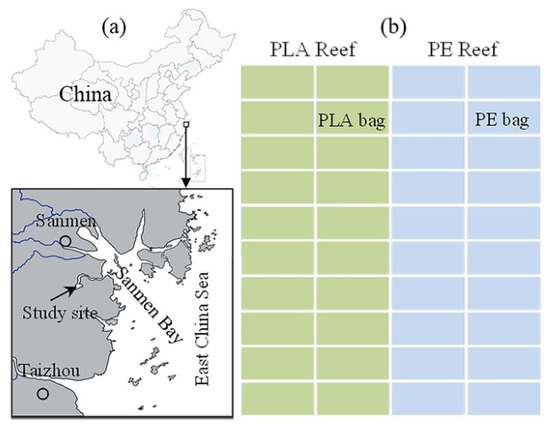
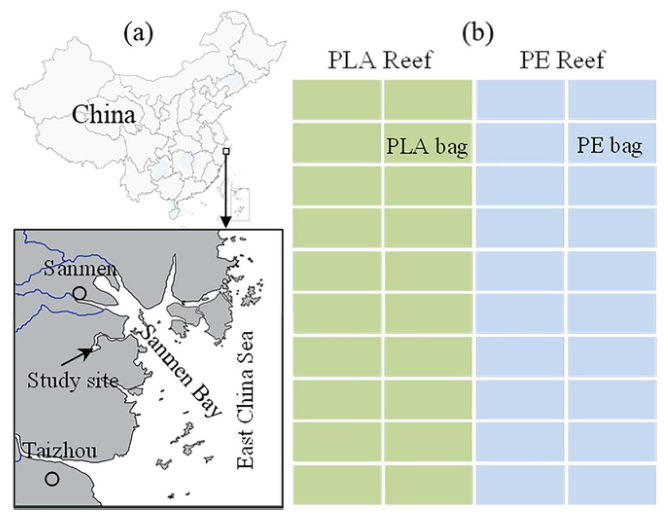
The study was conducted at the Lijiangtan oyster bed (Figure 1), which is located in the upper bay of Jiantiao Port in Sanmen County, Zhejiang Province. The site has an irregular semi-diurnal tidal regime with an average tidal range of approximately 4.24 m. The natural oyster bed is found in the low-intertidal zone in the form of patchy aggregations and covers an area of about 0.33 km2. The bed consists primarily of Suminoe oysters (Magallana ariakensis) and Kumamoto oysters (Magallana sikamea), which have settled and grown on natural gravel substrates. Hydrographic conditions exhibit distinct seasonality, with monthly mean seawater temperatures ranging from 7.9 to 32.0 °C (annual mean: 22.7 °C) and salinity fluctuating between 5.7 and 24.4 PSU (mean: 18.7 PSU). Chlorophyll concentrations range from 0.77 to 15.86 mg/m3 (mean: 4.22 mg/m3) and total suspended sediment concentrations vary from 17.4 to 266.0 g/m3 (mean: 68.75 g/m3) [7,26].
Figure 1.
(a) Location of the study area (Lijiangtan oyster bed) in Jiantiao Bay, Sanmen County, Zhejiang Province, China. (b) A schematic diagram showing an experimental unit for the small-scale shell-bag reef restoration experiment. Each experimental unit contained one PLA reef and one PE reef. Each reef consisted of twenty bags of the same material arranged in a 2 × 10 matrix (1.8 m × 0.8 m × 0.18 m) on the tidal flat, and the distance between adjacent reef bags was no more than 5 cm. Four replicate units were deployed.
2.2. Oyster Recruitment Experiment
The first experiment compared the success of oyster recruitment on four types of conventional, non-degradable plastics (polyethylene (PE) (Shenzhen Yuxin Plastic Co., Ltd., Shenzhen, Guangdong, China), polyvinyl chloride (PVC) (Dongguan Xindayuan Plastic Material Co., Ltd., Dongguan, Guangdong, China), polyethylene terephthalate (PET) (Dongguan Xindayuan Plastic Material Co., Ltd., Dongguan, Guangdong, China) and polyvinylidene chloride (PVDC) (Shenzhen Yuxin Plastic Co., Ltd., Shenzhen, Guangdong, China)) with polylactic acid (PLA) substrates. Five pre-deployed settlement racks ([26]) were used in the Lijiangtan oyster reef area. The PLA sheets (0.08 mm thick) were fabricated by melt extrusion using an injection moulding machine (Sumitomo Heavy Industries, Ltd., Tokyo, Japan), while the sheets made from the other four materials were purchased commercially. All substrates were standardised as transparent squares (10 cm × 10 cm × 0.08 cm), each perforated with a 6 mm hole at every corner, 1 cm from the edge. On 20 August 2024, one sheet of each material was fastened separately with cable ties to each rack in the 0.6 m tidal zone using cable ties. After approximately 30 days (18 September 2024), all sheets were retrieved. Oyster abundance and shell height on the upper surfaces were recorded. Juvenile oysters were counted under a stereomicroscope (Shanghai Biemu Optical Instrument Manufacturing Co., Ltd., Shanghai, China), and the shell heights of at least ten randomly selected individuals were measured to an accuracy of ±0.1 mm using a vernier calliper (Deli Group Co., Ltd., Zhejiang, China). Differences in juvenile abundance and shell height among substrate types were analysed using the Kruskal–Wallis rank-sum test, with significance set at p < 0.05.
A field experiment was conducted in the summer of 2025 to investigate influence of the physical properties of the substrate on recruitment success. A two-factor randomised block design was employed, with thickness (0.08 cm vs. 0.8 cm) and surface texture (rough vs. smooth) serving as the independent variables. This produced four substrate types, each of which was replicated five times: smooth thin plate (STP), smooth thick plate (SHP), rough thin plate (RTP), and rough thick plate (RHP) (Shenzhen Fuying Plastic Technology Co., Ltd., Shenzhen, Guangdong, China). Rough surfaces were prepared by sanding PLA plates, while unsanded plates served as smooth controls. The substrates were deployed using the same protocol as in 2024. The experiment began on 10 July 2025. After 30 days, on 9 August 2025, all substrates were collected and returned to the laboratory for the number of settled juvenile oysters to be quantified. For analysis, the abundances of recruited oysters for each substrate type were standardised to the number of spat per plate (ind./100 m2) for analysis.
2.3. Small-Scale Shell-Bag Reef Restoration Experiment
Although PLA fibres can be produced using conventional melt spinning, the ester bonds in the PLA chains are susceptible to hydrolysis, either chemically or enzymatically, which often results in the fibres having insufficient mechanical strength and thermal stability for practical use. One way to overcome this limitation is to incorporate organically modified nano-montmorillonite (nano-MMT) (Hubei Zhanshi Science Technology and Trade Co., Ltd., Wuhan, China), which has dual functional groups (i.e., montmorillonite that has been treated with organic surfactants to enhance compatibility with PLA), as a reinforcing phase during melt in order to produce nano-MMT/PLA composite fibres. These fibres have the potential to be used in applications such as fishing gear [17,18]. Nano-MMT/PLA and PE monofilaments (with a diameter of 0.20 mm, which are 0.20 mm diameter, common in aquaculture) were twisted into 18-ply yarns, which were then braided into three-strand threads and woven into 2.5 cm mesh panels on a net-making machine (Yangzhou Haili Precision Machinery Manufacturing Co., Ltd., Yangzhou, Jiangsu, China). Mesh bags were fabricated from these panels by cutting and sewing. All bags were standardised to 18 cm in diameter and 40 cm in length. Eighty bags per material were prepared, each filled with cleaned, recycled oyster shells (shell height ≥ 7 cm). In July 2024, four linearly arranged restoration units were established shoreward of the settlement racks, parallel to the shoreline and spaced ≥ 5 m apart. Each experimental unit contained one PLA reef and one PE reef. Each reef consisted of twenty bags made from the same material arranged in a 2 × 10 matrix (1.8 m × 0.8 m × 0.18 m) on the tidal flat (Figure 1). The long axis of each reef was aligned parallel to the dominant tidal flow. Four identical reefs were constructed per material for comparative monitoring purposes.
Over the five months following reef construction, one bag was randomly selected from each of the eight experimental shell-bag reefs at approximately 30-day intervals. A 5 cm × 5 cm square mesh section was then cut from the upper surface of each bag, yielding four replicates per material type. Excision sites were excluded from subsequent sampling. The samples were transported to the laboratory where the maximum tensile load of the PLA and PE monofilaments was measured using an Instron 4466 universal testing machine (Instron Corporation, Norwood, MA, USA). One interior mesh opening from each sampled 5 cm × 5 cm square mesh sample was secured, and a tensile force was applied at 200 mm/min until rupture. The maximum load (N) was recorded to a precision of 0.01 N.
Ten months after construction in May 2025, one shell-bag was randomly collected from each reef. The bag was preserved and transported to the laboratory with four replicates per material. The samples were rinsed and passed through a 0.5 mm benthic sieve to separate the live oysters and other macroinvertebrate organisms. Oyster counts were recorded on site. A minimum of 50 oysters were randomly selected from specimens pooled across the four replicate reefs of each material type, in order to obtain a representative sample. Shell height was measured to the nearest 0.1 mm using a Vernier calliper. To account for potential variability between reefs, reef identity was included as a random factor in the statistical analyses. The resident macroinvertebrate were identified to species level and the abundance of fauna per reef was quantified. Oyster and benthic macroinvertebrate densities were standardised to individuals per square metre (ind./m2) for analysis. The following were calculated from the density data of the species: species richness (the number of species per sample); the Shannon–Wiener diversity index; and the Simpson diversity index for the benthic community.
2.4. Statistical Analyses
All statistical analyses were performed using IBM SPSS Statistics (version 29.0.2; IBM Corp., Armonk, NY, USA) and GraphPad Prism (version 10.1.2; GraphPad Software, San Diego, CA, USA). First, the normality of the data was assessed using the Shapiro–Wilk test and the homogeneity of variances was assessed using Levene’s test. For the oyster recruitment experiment, a two-way ANOVA was performed to analyse the effects of thickness and surface roughness on oyster recruits and shell heights, as well as their interactions. Post hoc comparisons were then made using Dunn’s test. In the reef restoration experiment, independent samples t-tests were used to compare monofilament tensile strength, oyster abundance, and the density and diversity index of macroinvertebrate communities between PLA and PE reefs provided that the assumptions of normality and homogeneity of variance were met. Otherwise, the non-parametric Kruskal–Wallis one-way ANOVA on ranks was applied. A one-way repeated-measures ANOVA was used to evaluate differences in oyster shell height between the two material types. Non-metric multidimensional scaling was performed based on a Bray–Curtis dissimilarity matrix of log(x + 1)-transformed density data. ANOSIM was used to test for differences in resident macroinvertebrate communities between the two types of shell-bag reefs.
3. Results
3.1. Oyster Recruitment on PLA and Plastic Substrates
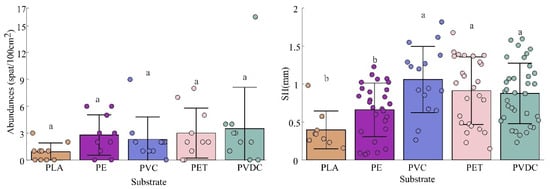
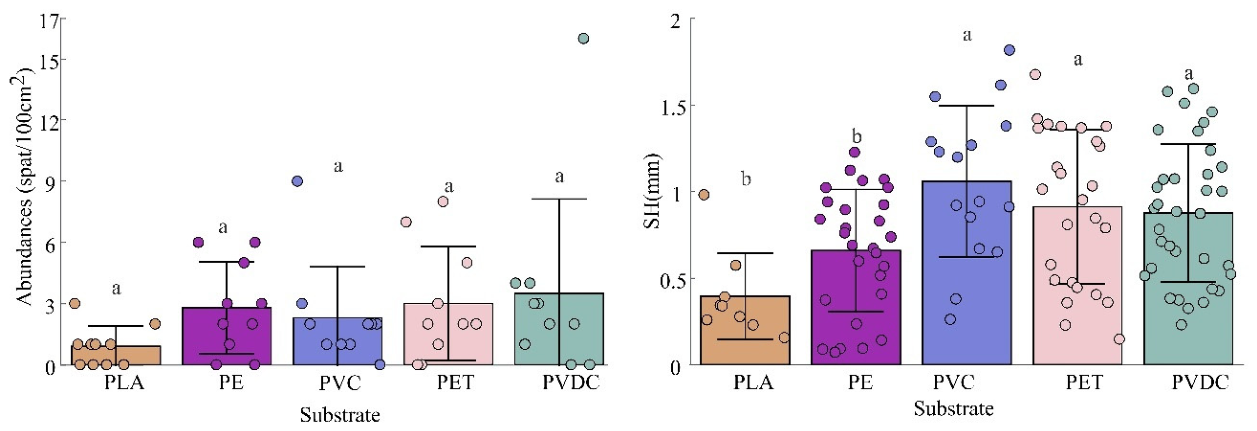
The Kruskal–Wallis rank-sum test showed that substrate type did not significantly affect oyster abundance (H = 6.698, p = 0.153; Figure 2 and Figure S1), but it did have a significant effect on juvenile shell height (H = 6.698, p < 0.001; Figure 2). Post hoc Dunn’s tests indicated that shell height followed the order: PLA = PE < PVC = PET = PVDC (p < 0.05; Figure 2).
Figure 2.
Abundances and shell height (SH) of newly recruited oyster spat among the five types of substrates. The error bars represent the standard error. Different lowercase letters indicate significant differences observed between treatments (p < 0.05).
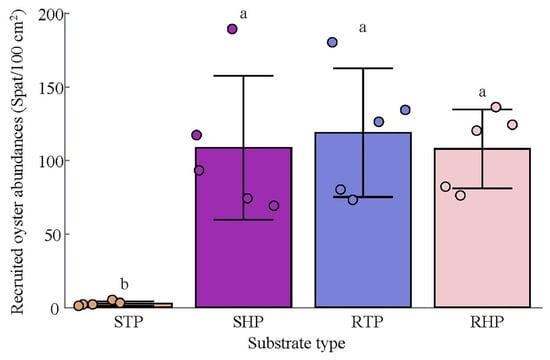
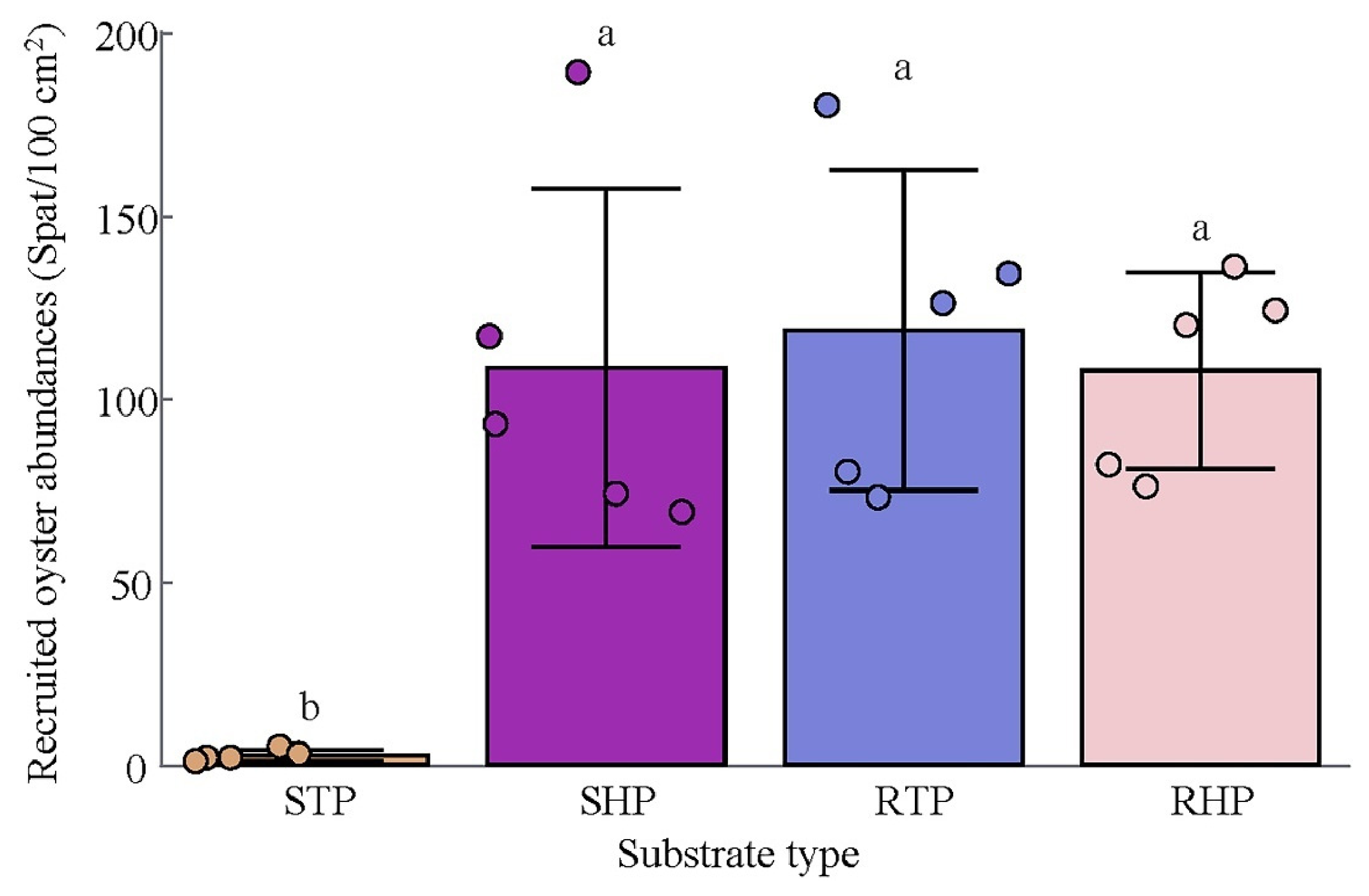
A two-way ANOVA revealed that both thickness (F1,16 = 8.957, p = 0.009) and surface roughness (F1,16 = 13.227, p = 0.002) significantly influenced oyster abundances on PLA substrates, with a significant interaction between the two factors (F1,16 = 13.597, p = 0.002; Figure 3). Tukey’s post hoc comparisons showed that oyster abundances ranked as follows: STP < SHP = RTP = RHP (p < 0.05; Figure 3 and Figure S2).
Figure 3.
Abundances of newly recruited oyster spat among the four types of PLA substrates. The error bars represent the standard error. Different lowercase letters indicate statistically significant differences (p < 0.05). STP: smooth thin plate; SHP: smooth thick plate; RTP: rough thin plate; RHP: rough thick plate.
3.2. Comparative Performance of PLA and PE Shell-Bag Reefs
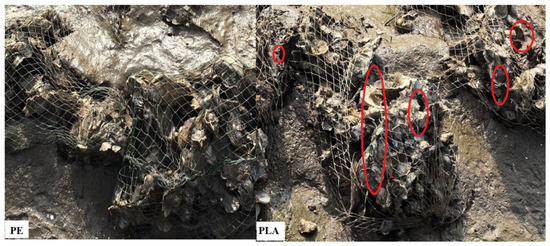
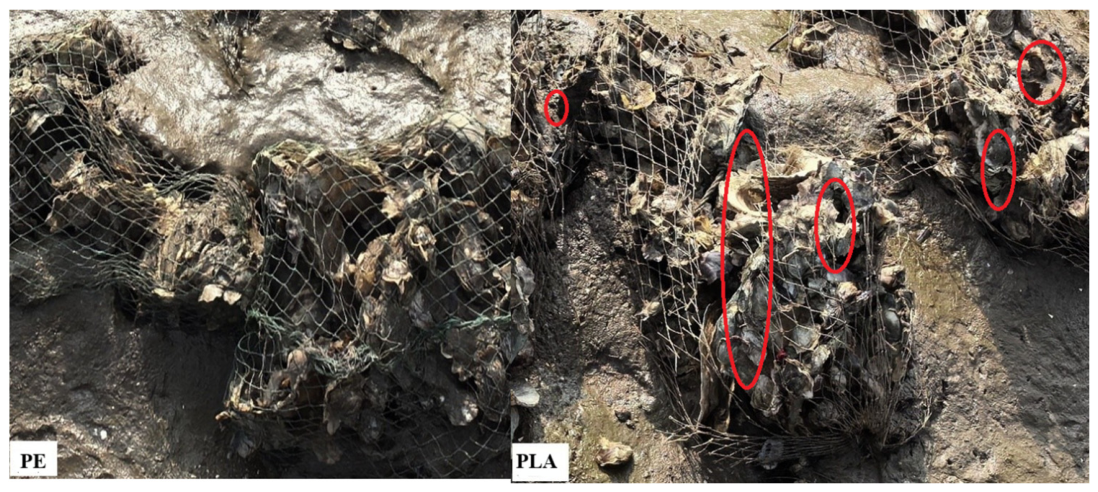
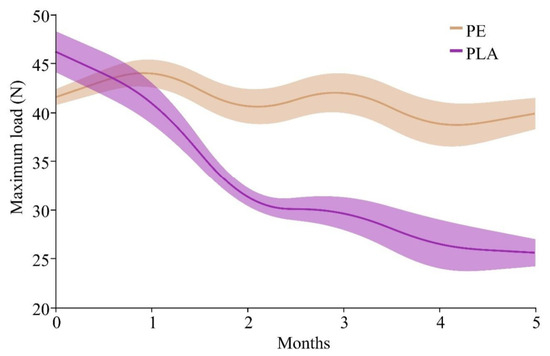
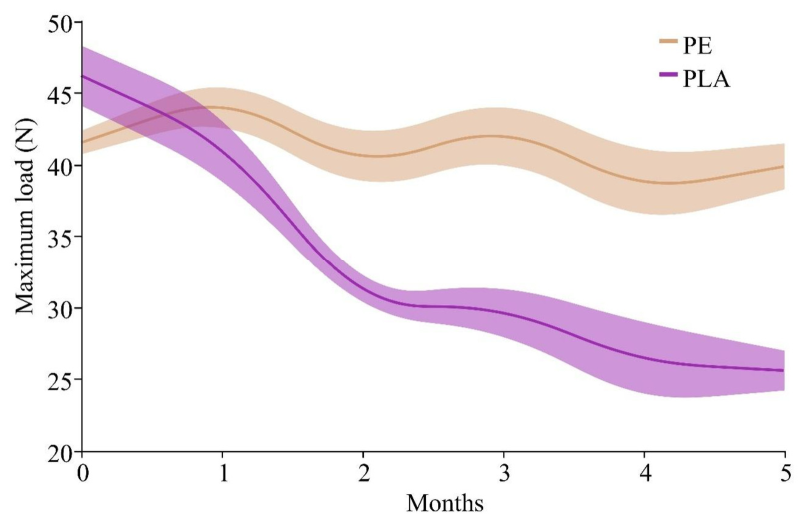
Five months after deployment, the PLA mesh bags had become extensively fragmented and had crumbled under light handling. In contrast, the PE bags had remained intact with no visible rupture (Figure 4). Prior to deployment, there was no significant difference in the maximum tensile load of the monofilaments between in the two types of bags (PE: 46.22 ± 2.09 N; PLA: 41.55 ± 0.82 N; t-test, p > 0.05; Figure 5). Following deployment, the maximum load of PE bags remained largely stable, while that of PLA bags declined progressively. Within two months, the maximum load of the PLA bags had become significantly lower than that of the PE bags (t-test, p < 0.05; Figure 5), and this difference continued to widen over time.
Figure 4.
Photographs of PE and PLA net bags in situ, taken five months following shell-in-bag reef deployment. The red circle marks the damaged part of the PLA shell bag.
Figure 5.
Maximum tensile load of PLA and PE monofilaments retrieved from deployed shell-in-bag reefs. Error bands show the standard error.
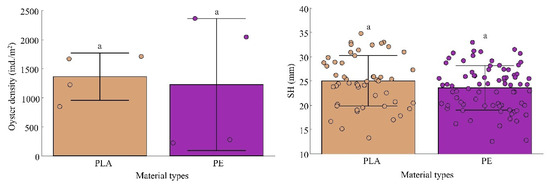
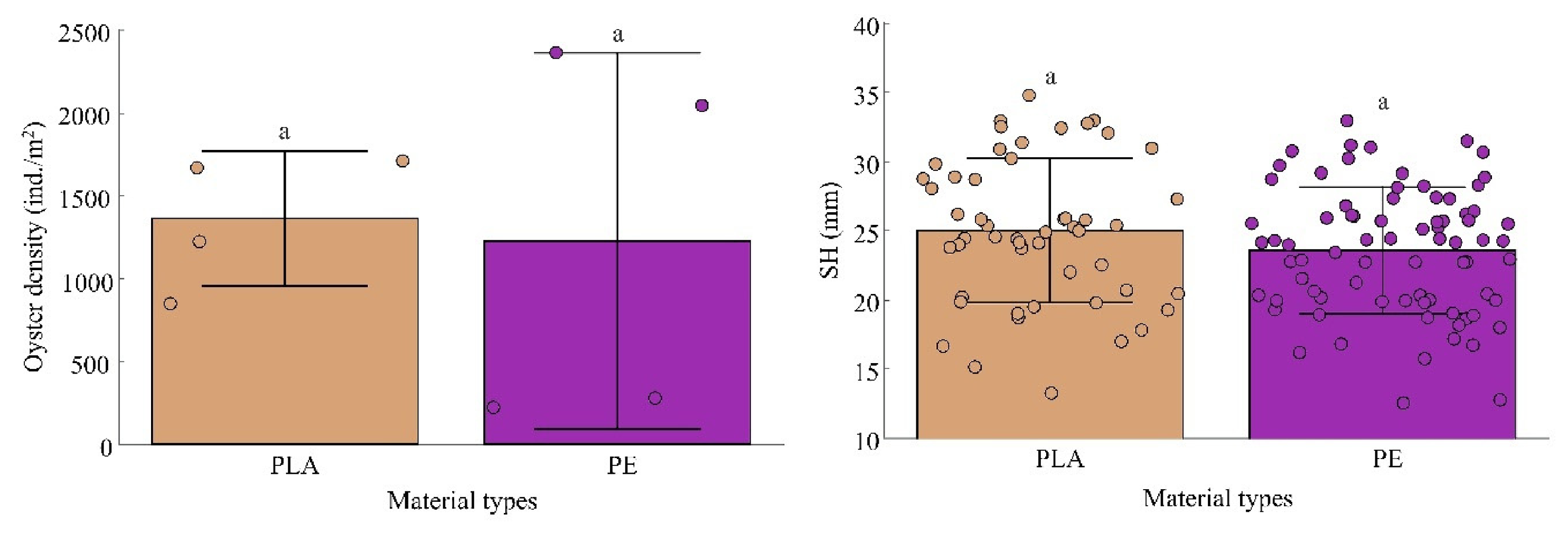
Ten months after reef deployment, no significant differences were observed between PLA and PE reefs in terms of either oyster density (t = 0.215, p = 0.422; Figure 6) or shell height (F = 0.882, p = 0.352; Figure 6).
Figure 6.
Oyster density and shell height (SH) on PLA and PE reefs after 10 months of deployment. No significant differences were observed between the two types of reefs (p > 0.05). Error bars indicate standard error. Bars with different lowercase letters indicate significant differences at p < 0.05 (one-way ANOVA, Tukey’s post-hoc test).
After ten months, nine and ten resident macroinvertebrate taxa were recorded in the PLA and PE reefs, respectively (Table 1). These included molluscs, crustaceans, annelids, and platyhelminths. Notably, the bivalve Neotrapezium sublaevigatum and the polychaete Perinereis nuntia were significantly more abundant on PLA reefs, at approximately 1.6 and 2.9 times the abundance on PE reefs, respectively.
Table 1.
Species list and abundance counts of resident macroinvertebrates colonising restored shell reefs based on PLA versus PE mesh bags.
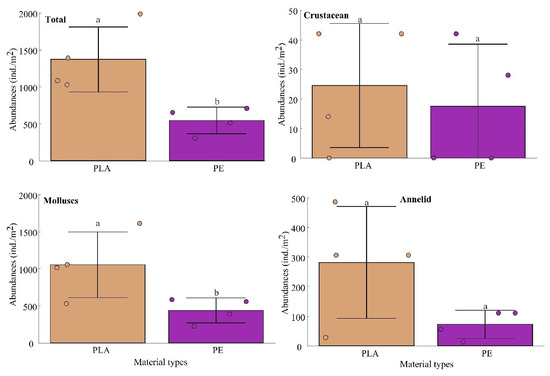
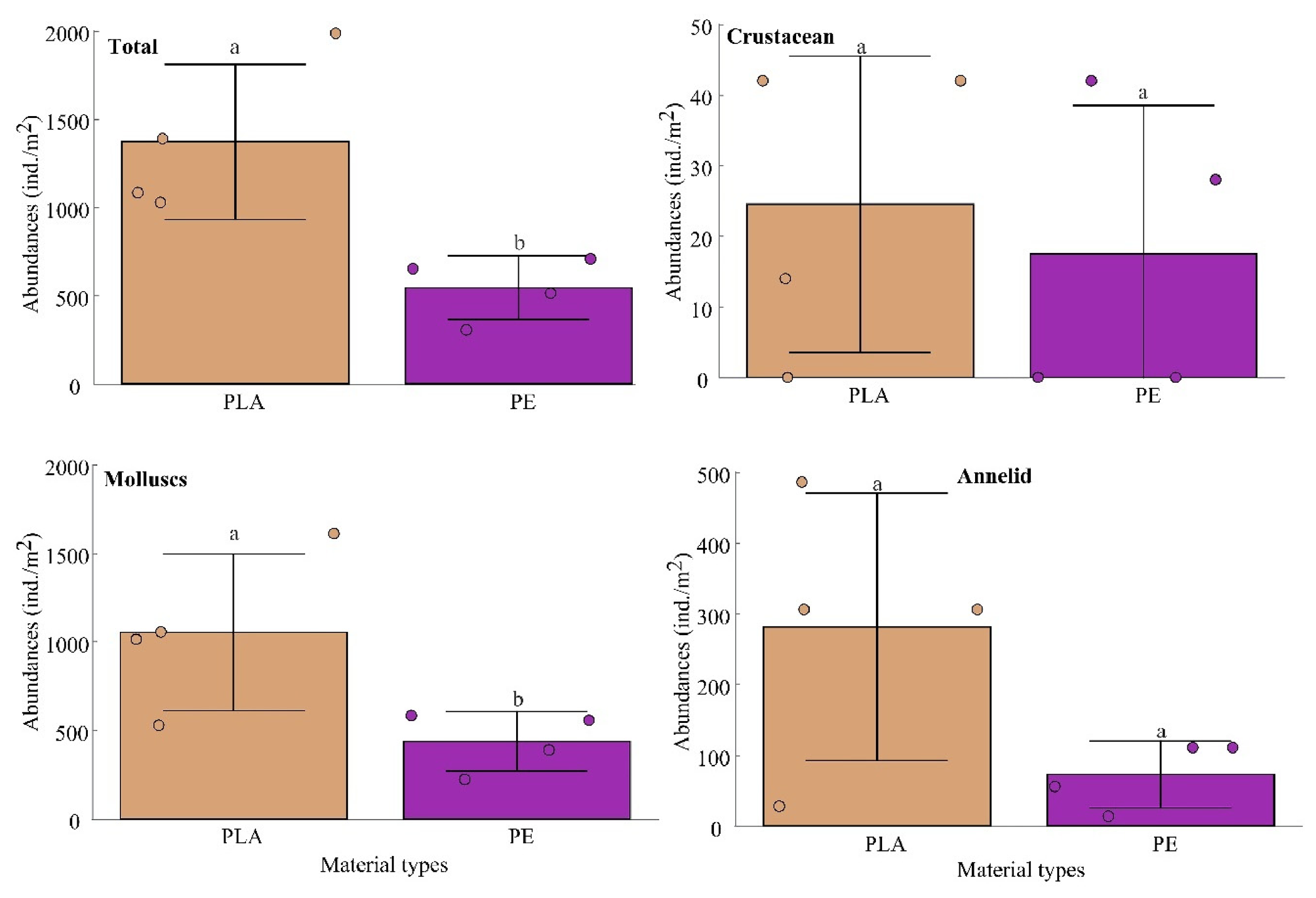
Total macroinvertebrate community density was markedly higher on PLA reefs (1372 ± 220 ind./m2) than on PE reefs (545 ± 90 ind./m2) after ten months (p < 0.05; Figure 7). While crustacean density did not differ significantly between material types, mollusks and annelids were more abundant on PLA reefs, with differences approaching statistical significance (p = 0.06; Figure 7).
Figure 7.
Densities of total macroinvertebrates and major taxonomic groups on PLA and PE reefs 10 months after deployment. Different lowercase letters indicate statistically significant differences between reef materials (p < 0.05).
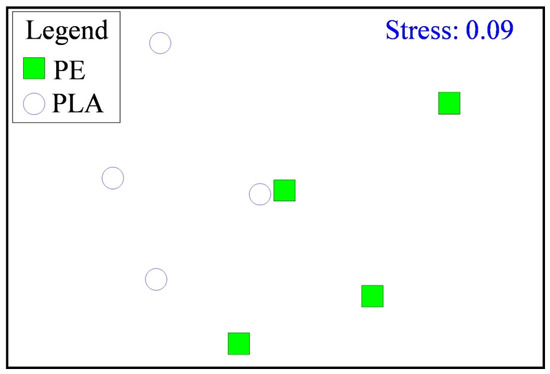
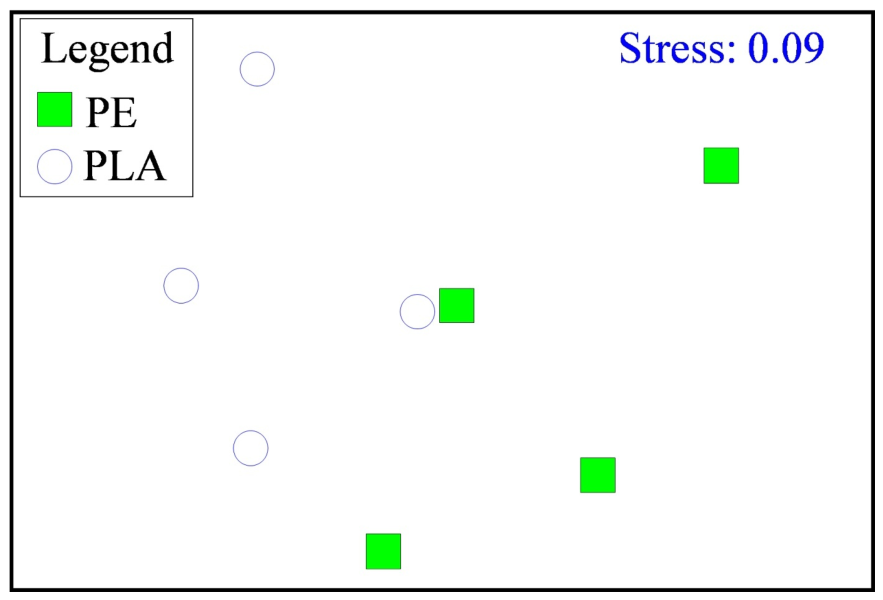
The material type had no significant effect on the species richness or the Shannon–Wiener or the Simpson diversity indices of the resident macroinvertebrate communities on the experimental reefs (p > 0.05; Table 2). Non-metric multidimensional scaling (MDS) revealed that the structure of the macroinvertebrate community was broadly similar between PLA and PE shell bag reefs, with no statistically significant distinction (global test: R = 0.271, p = 0.057; Figure 8).
Table 2.
Comparison of diversity indices of resident macroinvertebrate communities on PLA versus PE reefs after 10 months of deployment.
Figure 8.
MDS plot illustrating the macroinvertebrate community structure associated with PLA and PE shell-bag reefs.
4. Discussions
To the best of our knowledge, this study is the first study to apply PLA (polylactic acid) specifically in oyster reef restoration and to compare its performance in terms of oyster recruitment, growth, and reef development directly with that of conventional plastic materials (e.g., conventional plastic mesh bags). The results showed that substrate type did not significantly affect oyster recruitment. This aligns with previous findings that oysters primarily select substrates based on texture, colour and surface morphology rather than degradability or chemical composition [27,28]. However, the material of the substrate was found to significantly influence shell height, with oysters on PLA exhibiting notably smaller sizes than those on other plastics. This difference may be due to PLA’s relatively low toughness and surface instability of the PLA under seawater degradation [29,30], which could inhibit larval growth or cause larger, early settlers to detach. This would skew the sampled population towards recently settled juveniles. Furthermore, PLA’s relatively rapid degradation in ambient conditions of PLA may limit its suitability for long-term ecological monitoring or aquaculture infrastructure [25].
Crucially, increasing the roughness and thickness of PLA substrates significantly boosted oyster recruitment, with densities on SHP, RTP, and RHP substantially surpassing those on STP. This is partly because rough surfaces alter near-bed hydrodynamics, creating low-velocity zones that facilitate larval settlement [31]. The mineral composition of bivalve adhesive also enables effective attachment to irregular surfaces [32]. Although conventional plastics are effective in supporting recruitment and growth, the persistent risk of microplastic pollution remains a serious concern. In comparison, physically optimised PLA substrates offer comparable settlement performance alongside clear environmental benefits, highlighting their potential as sustainable alternatives in restoration applications.
Restoring oyster population is a key objective of reef rehabilitation. When biodegradable materials replace conventional plastics in restoration projects, it is important to ensure that they support the settlement, recruitment, growth, and survival of oyster larvae. However, comparative studies on the ability of biodegradable materials versus plastic materials to promote oyster population development remain limited [9]. This ten-month field experiment found that average oyster density on PLA and PE shell-bag reefs (1361 ± 204 and 1226 ± 567 oysters/m2, respectively) was comparable to that reported for the natural Lijiangtan oyster bed (1770 ± 467 oysters/m2 [33]) and a nearby restored stone reef (913 ± 147 oysters/m2 [7]). Similarly, Nitsch et al. found no significant difference in the recruitment of Crassostrea virginica on BESE-elements®(BESE B.V., Culemborg, Netherlands) compared to Vexar® mesh mats over one to two years, with an average density of 676.4 ind./m2 on BESE after two years [22]. Comba et al. reported that natural fibre bags disintegrated within two months in the Mission-Aransas Estuary, and biodegradable/loose-shell treatments experienced greater physical disturbance, which could increase oyster mortality [9]. Although oyster density on loose shell was less than half that on polyethylene bags after seven months, the settled oysters were significantly larger (mean 46 mm vs. 40 mm). Together, these findings suggest that biodegradable materials such as BESE and PLA could potentially replace conventional plastics in supporting successful reef restoration.
Oyster reef restoration involves rebuilding complex benthic habitats. The three-dimensional structure of the reef provides shelter and living space, enhancing biodiversity. Benthic diversity and density can serve as key indicators of ecological recovery in restored reefs. This study found that the total density of resident macroinvertebrates was significantly higher on PLA reefs (1372 ± 220 ind./m2) than on both PE reefs (545 ± 90 ind./m2) and stone-based reefs of a similar age (526 ± 125 ind./m2 [7]). In the same study area, factors such as the physicochemical environment, the biological background and the supply of recruits were generally consistent. Therefore, differences in the structure of the reefs themselves are likely to be the primary mechanism driving the observed patterns. In this study, PLA reefs exhibited extensive surface cracking five months after deployment. This structural damage created channels and spaces that provided shelter for mobile benthic macroinvertebrates, enabling them to enter the interior of the reefs and potentially contributing to an overall increase in the abundance of sessile fauna. In contrast, Comba et al. found that the density of mobile fauna was 2.4 times higher on PE shell bag reefs than on reefs made from biodegradable materials after seven months [9]. They attributed this to the structural complexity and predator-exclusion effect of intact polyethylene bags. However, they also found that community composition and diversity were influenced more by water depth than by bag type—a finding consistent with our observation that bag type did not significantly alter the biodiversity index or the structure of macroinvertebrate communities.
In addition to their material properties, the ecological performance of PLA substrates may be influenced by species-specific biological traits. For instance, different oyster exhibit varying different preferences regarding larval settlement, growth rates, filtration capacity, and reproductive output. These characteristics can affect recruitment success and reef development [34]. These biological characteristics may interact with the substrate surface’s chemistry, roughness, and degradation dynamics, potentially shaping the observed differences in macroinvertebrate communities. Future restoration efforts should therefore consider not only the physical and chemical properties of the material but also the life-history traits of the target oyster species. Such an approach would enhance the predictability and ecological relevance of restoration outcomes.
Cost is a key practical consideration in material selection, alongside durability and ecological effectiveness [15]. Non-plastic materials such as rock, cement-infused jute, concrete reef balls, BESE-elements, and metal gabions are generally more expensive and more difficult to install than plastic-based options. For example, a 1 m2 restoration mat made with Vexar™ mesh and oyster shells costs $9.72, whereas a BESE-based mat of the same size costs $36.72—an increase of over 370% [22]. In this study, PE, PLA, and stone reefs achieved comparable oyster and macroinvertebrate abundances, but costs per square metre differed considerably: approximately $18 for PE, $28 for PLA, and over $70 for stone. On a unit area basis, the initial material cost of PLA is approximately 56% higher than that of PE, and both are substantially lower than cotton ($9.09 per m2), jute ($14.67 per m2), cellulose ($20.95 per m2), and BESE ($36.68 per m2) [9]. However, when service life is taken into account, the cost per unit of service life becomes a more relevant metric. In this study, PLA bags showed visible fragmentation after five months, whereas PE bags remained intact throughout the experiment. Thus, for long-term restoration applications, the combination of shorter lifespan and higher initial cost could lead to substantially higher long-term expenses for PLA. This trade-off should be carefully considered, particularly for large-scale projects where longevity is a key factor.
The degradation rates of biodegradable restoration materials are influenced by various factors, including temperature, salinity, tidal exposure, wave energy, nutrient levels, and local flora and fauna [22,35]. In this study, PLA mesh bags showed extensive breakage within five months, losing their ability to retain shells. However, this did not significantly impact oyster recruitment, growth, or reef development, primarily because the restoration site was a low-energy, inner-bay area with minimal boat traffic, where shells remained stable. Although the PLA bags exhibited noticeable degradation within five months, using shell bags still offers several practical advantages. They enable rapid deployment and precise spatial arrangement, and prevent the loss of shell material during the early stages, before oyster recruitment or cluster formation occurs. Additionally, the consolidated structure formed by the shell bags provides consistent vertical relief, which is essential for standardising experimental conditions and maintaining long-term reef integrity. In high-energy open-coast environments, rapid PLA degradation could compromise long-term reef stability. By contrast, BESE materials lost only 7–12% of their mass in the first year, with an estimated half-life of 4.4–6.7 years [22].
In the present study, shell bags were used instead of loose shell piles to ensure consistent and standardised reef structures in all treatment areas. The bag enclosure provides a consolidated framework that maintains uniform vertical relief and prevents shell dispersal, which is particularly important during the initial stages before oyster recruitment and cluster formation. This standardisation is essential for isolating material-specific effects by minimising variability in the structure of replicate reefs. However, we acknowledge that the absence of a ‘no-bag’ control (e.g., loose shell piles) limits our ability to definitively distinguish between structural influences and material-specific effects. However, the primary objective of this experimental design was to create a consistent reef base that allows direct comparison between PLA and PE under controlled conditions. Despite PLA bags degrading within five months, PLA-based reefs supported higher densities of resident macroinvertebrates, particularly molluscs and annelids, than PE reefs. Nevertheless, it should be explicitly noted that incorporating a ‘no-bag’ control in future studies would further strengthen the ability to differentiate between structural and material-driven ecological responses.
This site-specific study, conducted in a low-energy environment, found that biodegradable PLA showed promise as an alternative to traditional plastics for oyster reef restoration. However, its rapid degradation limits its applicability to high-energy environments. Furthermore, as a thorough evaluation of the microplastic risks associated with PLA degradation has yet to be carried out, its large-scale use is not currently advised. These limitations highlight the need to optimise the material to ensure structural integrity under more demanding hydrodynamic conditions. Several strategies can be employed to tailor the degradation rate and mechanical properties of PLA for specific restoration contexts. For example, blending PLA with more hydrophobic biodegradable polymers, such as polycaprolactone (PCL), can slow down hydrolytic degradation. Increasing fibre diameter or surface roughness can enhance structural integrity without hindering larval settlement. Incorporating reinforcing agents, such as nano-montmorillonite (nano-MMT) or cellulose nanocrystals, has been shown to improve tensile strength and delay fragmentation [24,25]). These modifications should be guided by the expected restoration timeline: faster degradation may be acceptable for low-energy, short-term projects, whereas slower degradation and higher durability would be required for long-term or high-energy settings. A systematic evaluation of such tailored PLA formulations under field conditions would help to identify the optimal material design for different restoration scenarios. Additionally, PLA may transiently generate microparticles or fragmented residues during degradation, particularly under suboptimal environmental conditions (e.g., low temperature or limited microbial activity). The potential ecological impacts of these particles are an active area of research and should be considered in future assessments of biodegradable materials.
In addition to planar or bag-based configurations, PLA fibres can be engineered into three-dimensional reef units to further habitat complexity and restoration effectiveness further. These units can be designed with layered or lattice structures to increase the surface area available for larval settlement, as well as to mimic the interstitial spaces found in natural oyster reefs. They can also provide refuge for macroinvertebrates. Design considerations could include unit size, porosity, layering height, and surface texture. These factors can be adjusted to match local hydrodynamic conditions and the requirements of target species. Expected ecological benefits include increased oyster recruitment, greater species richness and abundance of associated fauna, and improved reef resilience. However, potential challenges may include higher material and fabrication costs, potential fragmentation over time, and the need for deployment protocols that ensure stability on the seafloor. Pilot studies involving the deployment of small-scale prototype units in protected areas would help to evaluate the feasibility of the approach and optimise designs prior to large-scale application. Monitoring strategies could include periodic visual inspection, assessment of structural integrity, and quantification of degradation behaviour, associated biogeochemical properties, and biological colonisation using standardised sampling methods.
Supplementary Materials
The following supporting information can be downloaded at: https://www.mdpi.com/article/10.3390/w18101125/s1, Figure S1: Photographs of oyster recruitment on four conventional, non-degradable plastics (polyethylene (PE), poly-vinyl chloride (PVC), polyethylene terephthalate (PET), and polyvinylidene chloride (PVDC)) and on pol-ylactic acid (PLA) substrates; Figure S2: Photographs of oyster recruitment on the four types of PLA substrate. STP: smooth thin plate; SHP: smooth thick plate; RTP: rough thin plate; RHP: rough thick plate.
Author Contributions
W.J., T.Z. (Tao Zhang) and W.Q. conceived and designed the research. T.Z. (Tianyun Zhang) and W.J. performed the experiments. T.Z. (Tianyun Zhang), W.J., T.Z. (Tao Zhang) and W.Q. analysed the data. M.M., N.W., J.F., N.L., R.F. and L.O. contributed reagents/materials/analysis tools. T.Z. (Tianyun Zhang), W.J. and W.Q. wrote and edited the manuscript. All authors have read and agreed to the published version of the manuscript.
Funding
The research was funded by the National Non-Profit Institutes Jiangsu Provincial Innovation Research Program on Carbon Peaking and Carbon Neutrality (BT2025033), (East China Sea Fisheries Research Institute) (2025TD02) and the National Key R&D Program of China (2024YFD2401700).
Data Availability Statement
The original contributions presented in the study are included in the article. Further inquiries can be directed to the corresponding authors.
Conflicts of Interest
The authors declare no competing interests.
References
- Coen, L.D.; Brumbaugh, R.D.; Bushek, D.; Grizzle, R.; Luckenbach, M.W.; Posey, M.H.; Powers, S.P.; Tolley, S.G. Ecosystem services related to oyster restoration. Mar. Ecol. Prog. Ser. 2007, 341, 303–307. [Google Scholar] [CrossRef] [Scilit]
- Coen, L.D.; Humphries, A.T. Oyster-generated marine habitats, their services, enhancement, restoration and monitoring. In Routledge Handbook of Ecological and Environmental Restoration; Routledge: New York, NY, USA, 2017; pp. 274–294. [Google Scholar] [CrossRef] [Scilit]
- Beck, M.W.; Brumbaugh, R.D.; Airoldi, L.; Carranza, A.; Coen, L.D.; Crawford, C.; Defeo, O.; Edgar, G.J.; Hancock, B.; Kay, M.C. Oyster reefs at risk and recommendations for conservation, restoration, and management. BioScience 2011, 61, 107–116. [Google Scholar] [CrossRef] [Scilit]
- Zu Ermgassen, P.S.E.; Spalding, M.D.; Grizzle, R.E.; Brumbaugh, R.D. Quantifying the loss of marine ecosystem service: Filtration by the eastern oyster in US estuaries. Estuaries Coasts 2012, 36, 36–43. [Google Scholar] [CrossRef] [Scilit]
- Bersoza Hernandez, A.H.; Brumbaugh, R.D.; Frederick, P.; Grizzle, R.; Luckenbach, M.W.; Peterson, C.H.; Angelini, C. Restoring the eastern oyster: How much progress has been made in 53 years? Front. Ecol. Environ. 2018, 16, 463–471. [Google Scholar] [CrossRef] [Scilit]
- Goelz, T.; Vogt, B.; Hartley, T. Alternative substrates used for oyster reef restoration: A review. J. Shellfish Res. 2020, 39, 1–12. [Google Scholar] [CrossRef] [Scilit]
- Quan, W.M.; Li, N.N.; Liu, Q.; Hancock, B.; Liu, Q.; Zhao, W.W.; Ma, W.J.; Jiang, W.; Fan, R.L.; Chen, L.Z.; et al. Oyster reef restoration in a subtropical bay in China: Effects of tidal elevation, reef microhabitats and size on oysters and resident macrofaunal communities. Mar. Ecol. Prog. Ser. 2025, 765, 39–52. [Google Scholar] [CrossRef] [Scilit]
- Hatchell, B.; Konchar, K.; Merrill, M.; Shea, C.; Smith, K. Use of biodegradable coir for subtidal oyster habitat restoration: Testing two reef designs in Northwest Florida. Estuaries Coasts 2022, 45, 2675–2689. [Google Scholar] [CrossRef] [Scilit]
- Comba, D.; Palmer, T.A.; Breaux, N.J.; Pollack, J.B. Evaluating biodegradable alternatives to plastic mesh for small-scale oyster reef restoration. Restor. Ecol. 2023, 31, e13762. [Google Scholar] [CrossRef] [Scilit]
- Walters, L.J.; Roddenberry, A.; Crandall, C.; Wayles, J.; Donnelly, M.; Barry, S.C.; Clark, M.W.; Escandell, O.; Hansen, J.C.; Laakkonen, K.; et al. The use of non-plastic materials for oyster reef and shoreline restoration: Understanding what is needed and where the field is headed. Sustainability 2022, 14, 8055. [Google Scholar] [CrossRef] [Scilit]
- Brumbaugh, R.D.; Coen, L.D. Contemporary approaches for small-scale oyster reef restoration to address substrate versus recruitment limitation: A review and comments relevant for the Olympia oyster, Ostrea lurida Carpenter 1864. J. Shellfish Res. 2009, 28, 147–161. [Google Scholar] [CrossRef] [Scilit]
- Hadley, N.H.; Hodges, M.; Wilber, D.H.; Coen, L.D. Evaluating intertidal oyster reef development in South Carolina using associated faunal indicators. Restor. Ecol. 2010, 18, 691–701. [Google Scholar] [CrossRef] [Scilit]
- McClenachan, G.M.; Donnelly, M.J.; Shaffer, M.N.; Sacks, P.E.; Walters, L.J. Does size matter? Quantifying the cumulative impact of small-scale living shoreline and oyster reef restoration projects on shoreline erosion. Restor. Ecol. 2020, 28, 1365–1371. [Google Scholar] [CrossRef] [Scilit]
- Gouin, T. Toward an improved understanding of the ingestion and trophic transfer of microplastic particles: Critical review and implications for future research. Environ. Toxicol. Chem. 2020, 39, 1119–1137. [Google Scholar] [CrossRef] [Scilit]
- Sussarellu, R.; Suquet, M.; Thomas, Y.; Lambert, C.; Fabioux, C.; Pernet, M.E.J.; Le Goic, N.; Quillien, V.; Mingant, C.; Epelboin, Y.; et al. Oyster reproduction is affected by exposure to polystyrene microplastics. Proc. Natl. Acad. Sci. USA 2016, 113, 2430–2435. [Google Scholar] [CrossRef] [Scilit]
- Bringer, A.; Cachot, J.; Dubillot, E.; Lalot, B.; Thomas, H. Evidence of deleterious effects of microplastics from aquaculture materials on pediveliger larva settlement and oyster spat growth of Pacific oyster, Crassostrea gigas. Sci. Total Environ. 2021, 794, 148708. [Google Scholar] [CrossRef] [Scilit] [PubMed]
- Craig, C.A.; Fox, D.W.; Zhai, L.; Walters, L.J. In-situ microplastic egestion efficiency of the eastern oyster Crassostrea virginica. Mar. Pollut. Bull. 2022, 178, 113653. [Google Scholar] [CrossRef] [Scilit] [PubMed]
- Hunsucker, K.; Melnikov, A.; Gilligan, M.; Gardner, H.; Erdogan, C.; Weaver, R.; Swain, G. Cathodically protected steel as an alternative to plastic for oyster restoration mats. Ecol. Eng. 2021, 164, 106210. [Google Scholar] [CrossRef] [Scilit]
- Grizzle, R.; Lodge, J.; Ward, K.; Mosher, K.; Jacobs, F.; Krebs, J. Successful initial restoration of oyster habitat in the lower Hudson River Estuary, United States. Restor. Ecol. 2024, 32, 14077. [Google Scholar] [CrossRef] [Scilit]
- Blanchard, T.L.; Sacks, P.E.; Donnelly, M.J.; Walters, L.J. Monitoring faunal responses to biodegradable oyster reef restoration materials with camera traps in a subtropical estuary. Restor. Ecol. 2025, 33, e70186. [Google Scholar] [CrossRef] [Scilit]
- Chambers, L.G.; Gaspar, S.A.; Pilato, C.J.; Steinmuller, H.E.; McCarthy, K.J.; Sacks, P.E.; Walters, L.J. How well do restored intertidal oyster reefs support key biogeochemical properties in a coastal lagoon? Estuaries Coasts 2018, 41, 784–799. [Google Scholar] [CrossRef] [Scilit]
- Nitsch, C.K.; Walters, L.J.; Sacks, J.S.; Sacks, P.E.; Chambers, L.G. Biodegradable material for oyster reef restoration: First-year performance and biogeochemical considerations in a coastal lagoon. Sustainability 2021, 13, 7415. [Google Scholar] [CrossRef] [Scilit]
- Zhang, W.; Chen, L.; Zhang, Y. Surprising shape memory effect of polylactide resulted from toughening by polyamide elastomer. Polymer 2009, 50, 1311–1315. [Google Scholar] [CrossRef] [Scilit]
- Min, M.H.; Chen, X.L.; Yu, W.W.; Huang, H.L.; Ma, H.Y.; Shi, J.G.; Liu, Y.L.; Wang, L.; Wang, L.M. Preparation and properties of fishery polylactic acid fiber modified by nano-montmorillonite. Mar. Fish. 2014, 36, 8. (In Chinese) [Google Scholar] [CrossRef]
- Yang, F.; Zhang, M.; Shi, J.G.; Yu, W.W.; Zhou, X.R.; Zhou, W.B. Progress on research of degradable materials for fishing. Mar. Fish. 2019, 41, 503–512. [Google Scholar] [CrossRef]
- Jiang, W.; Shi, W.J.; Li, N.N.; Zhang, W.K.; Chen, L.Z.; Liu, Q.; Ye, C.Y.; Fan, R.L.; Quan, W.M. Gonad development and recruitment pattern of the oysters Crassostrea ariakensis and Crassostrea sikamea in a subtropical bay in China. Reg. Stud. Mar. Sci. 2023, 58, 102781. (In Chinese) [Google Scholar] [CrossRef] [Scilit]
- Potet, M.; Fabien, A.; Chaudemanche, S.; Sebaibi, N.; Guillet, T.; Gachelin, S.; Cochet, H.; Boutouil, M.; Pouvreau, S. Which concrete substrate suits you? Ostrea edulis larval preferences and implications for shellfish restoration in Europe. Ecol. Eng. 2021, 162, 106159. [Google Scholar] [CrossRef] [Scilit]
- Chen, L.Z.; Jiang, W.; Shi, W.J.; Zhang, W.K.; Qi, Y.H.; Ye, C.Y.; Li, N.N.; Fan, R.L.; Quan, W.M. Effects of substrate colour and fouling organisms on the recruitment of oysters and barnacles: Results from field experiment. Mar. Fish. 2024, 46, 166–173. (In Chinese) [Google Scholar] [CrossRef]
- Wang, G.X.; Huang, D.; Zhang, W.; Ji, J.H. Degradation performance of typical biodegradable polyesters in seawater. J. Funct. Polym. 2020, 33, 492–499. (In Chinese) [Google Scholar] [CrossRef]
- Aliotta, L.; Vannozzi, A.; Canesi, I.; Cinelli, P.; Coltelli, M.B.; Lazzeri, A. Poly(lactic acid)(PLA)/poly(butylene succinate-co-adipate)(PBSA) compatibilized binary biobased blends: Melt fluidity, morphological, thermo-mechanical and micromechanical analysis. Polymers 2021, 13, 218. [Google Scholar] [CrossRef] [Scilit]
- Lanham, B.S.; Pomeroy, A.W.M.; Swearer, S.E.; Marusic, I.; Javaherchian, J.; Morris, R. Substrate-mediated alterations to hydrodynamic conditions enhances shellfish larval settlement: Implications for artificial reef restoration. Ecol. Eng. 2024, 212, 107474. [Google Scholar] [CrossRef] [Scilit]
- Metzler, R.A.; Zaborowsky, J.; Nichols, L.; Underhill, J.; Tregidga, J.; Rogers, C.; Rende, D.; Bouillon, S.; Gillikin, D.R. Exploring the mineral composition, structure, and function of a freshwater bivalve adhesive. Adv. Mater. Interfaces 2024, 11, 1. [Google Scholar] [CrossRef] [Scilit]
- Shi, W.J.; Zhang, W.K.; Chen, L.Z.; Qi, Y.H.; Ye, C.Y.; Jiang, W.; Li, N.N.; Fan, R.L.; Quan, W.M. Monitoring and assessment of species, abundances and recruitment of oysters at the Lijiangtan oyster reef in Jiantao Bay, Sanmen County, Zhejiang Province. Mar. Fish. 2023, 45, 291–301. (In Chinese) [Google Scholar] [CrossRef]
- Tamburri, M.N.; Luckenbach, M.W.; Breitburg, D.L.; Bonniwell, S.M. Settlement of Crassostrea ariakensis larvae: Effects of substrate, biofilms, sediment and adult chemical cues. J. Shellfish Res. 2008, 27, 601–608. [Google Scholar] [CrossRef] [Scilit]
- Schmidt, M.W.I.; Torn, M.S.; Abiven, S.; Dittmar, T.; Guggenberger, G.; Janssens, I.A.; Kleber, M.; Kögel-Knabner, I.; Lehmann, J.; Manning, D.A.C.; et al. Persistence of soil organic matter as an ecosystem property. Nature 2011, 478, 49–56. [Google Scholar] [CrossRef] [Scilit]

Disclaimer/Publisher’s Note: The statements, opinions and data contained in all publications are solely those of the individual author(s) and contributor(s) and not of MDPI and/or the editor(s). MDPI and/or the editor(s) disclaim responsibility for any injury to people or property resulting from any ideas, methods, instructions or products referred to in the content. |
© 2026 by the authors. Licensee MDPI, Basel, Switzerland. This article is an open access article distributed under the terms and conditions of the Creative Commons Attribution (CC BY) license.