


Abstract
Air quality management in Santiago (Chile) primarily relies on measuring atmospheric particulate matter and other criteria pollutants. This data is generated mostly by fixed-site outdoor monitoring stations, and the results are used to estimate population exposure. However, this approach may not be able to capture individual variability arising from differences in personal behaviors and microenvironmental transitions. Here we conducted an exploratory case study using residential outdoor polyurethane foam passive samplers and personal silicone wristbands to evaluate the potential polycyclic aromatic hydrocarbon exposure patterns among a limited number of residents of Santiago (Chile). Our results suggested that outdoor passive samplers and personal silicone wristbands revealed different but complementary PAH concentration patterns. Outdoor passive samplers captured regional spatial variability, whereas personal samplers revealed greater heterogeneity among individuals even when sharing the same residential environment. These findings support the value of integrating personal passive sampling into future assessment studies in urban environments of Chile.
1. Introduction
Polycyclic aromatic hydrocarbons (PAHs) are a class of persistent organic pollutants produced mostly by the incomplete combustion of organic matter. PAHs are widely distributed in atmospheric, aquatic, and terrestrial ecosystems [1]. The main sources of PAHs in urban environments of Chile and other regions of the global south include the combustion of fossil fuels (e.g., diesel, gasoline, and kerosene), woodburning for household heating or cooking, certain industrial emissions (e.g., waste treatment facilities and thermoelectric plants), and potential long-range atmospheric transport from other nearby regional sources [2,3,4]. Monitoring them and estimating the total human exposure is important because of the known carcinogenic and mutagenic properties of some congeners [1,5]. This is especially important in places where access to cleaner energy sources is limited and where national environmental policies are often less stringent [6,7,8].
PAH concentrations and related human exposure are typically estimated using active sampling methods. This involves collecting air samples by drawing air through glass fiber or polycarbonate filters over periods of 24 h or more, with a primary focus on measuring outdoor ambient air concentrations [9,10,11,12,13]. These measurements are often assumed to correlate with population-level exposure. However, it is expected that outdoor ambient concentrations may differ from indoor concentrations due to the presence of different emission sources and lower ventilation. Similarly, personal concentration levels (those captured in the personal space) will be influenced by the time spent indoors and the ability to move through various microenvironments during their daily routines.
Substantial evidence indicates that relying on ambient outdoor concentrations to estimate indoor concentrations in the global south can lead to significant misrepresentations of actual human exposure. This is primarily due to differences in indoor emission sources, ventilation, and patterns of human mobility. For example, in woodburning contexts, indoor PAH concentrations have been estimated to be up to three times higher than those outdoors [14,15]. On the other hand, in warmer months without significant indoor heating sources, outdoor concentrations may exceed indoor levels by more than four times [16].
Personal monitoring studies using either active and passive samplers are less common in the global south. Active personal sampling has demonstrated that pollutant concentrations and distributions, such as those of atmospheric fine particulate matter (PM2.5), can differ markedly from those measured at fixed sites, largely due to individual time–activity patterns and the diverse microenvironments encountered by participants [17]. Similarly, passive personal sampling has revealed a high variability in concentration profiles to pesticides and other chemicals, reflecting differences in daily routines and life trajectories [18,19,20]. Other studies in Latin America have also demonstrated the ability of personal passive samplers to explore personal concentration profiles, although not comparing them to fixed monitoring stations [21,22,23,24]. Few studies have focused on exploring the heterogeneity of personal exposure profiles in urban environments of the global south. The existing knowledge underscores the limitations of using ambient outdoor measurements as proxies for personal exposures, given the significant variability introduced by individual movement through different microenvironments [25]. However, the specific contribution of each microenvironment to overall exposure remains poorly understood.
In this exploratory case study, we compared PAH concentration profiles measured using residential outdoor passive samplers and personal silicone wristbands to evaluate their similarities. We also explored whether shared residential environments were associated with similar concentration distribution patterns in the personal sampling. This allowed us to explore how personal mobility and daily activities may contribute to variability in personal pollution profiles.
2. Materials and Methods
2.1. Study Area
Samples were collected in the Metropolitan Region of Santiago (Chile), an urban center with over 8 million people in southwest South America. Santiago experiences severe air pollution episodes regularly. The associated health impacts have been estimated to be approximately 2490 premature deaths and 5350 pediatric asthma cases in 2015 which were linked to exposure to atmospheric pollutants [26]. The primary sources of these pollutants (e.g., atmospheric particulate matter, ozone, nitrogen oxides, and other semivolatile organic chemicals) are anthropogenic emissions from transportation, energy generation, and residential combustion. The effects of these emissions are exacerbated by the city’s basin geography and winter meteorological conditions (i.e., frequent atmospheric inversions) that trap pollutants close to the surface [26,27,28].
2.2. Study Design
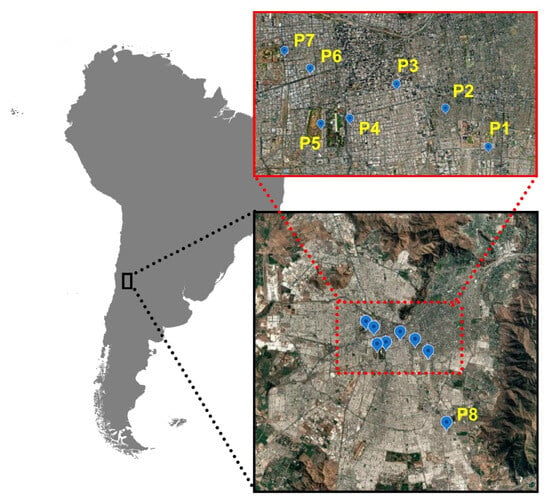
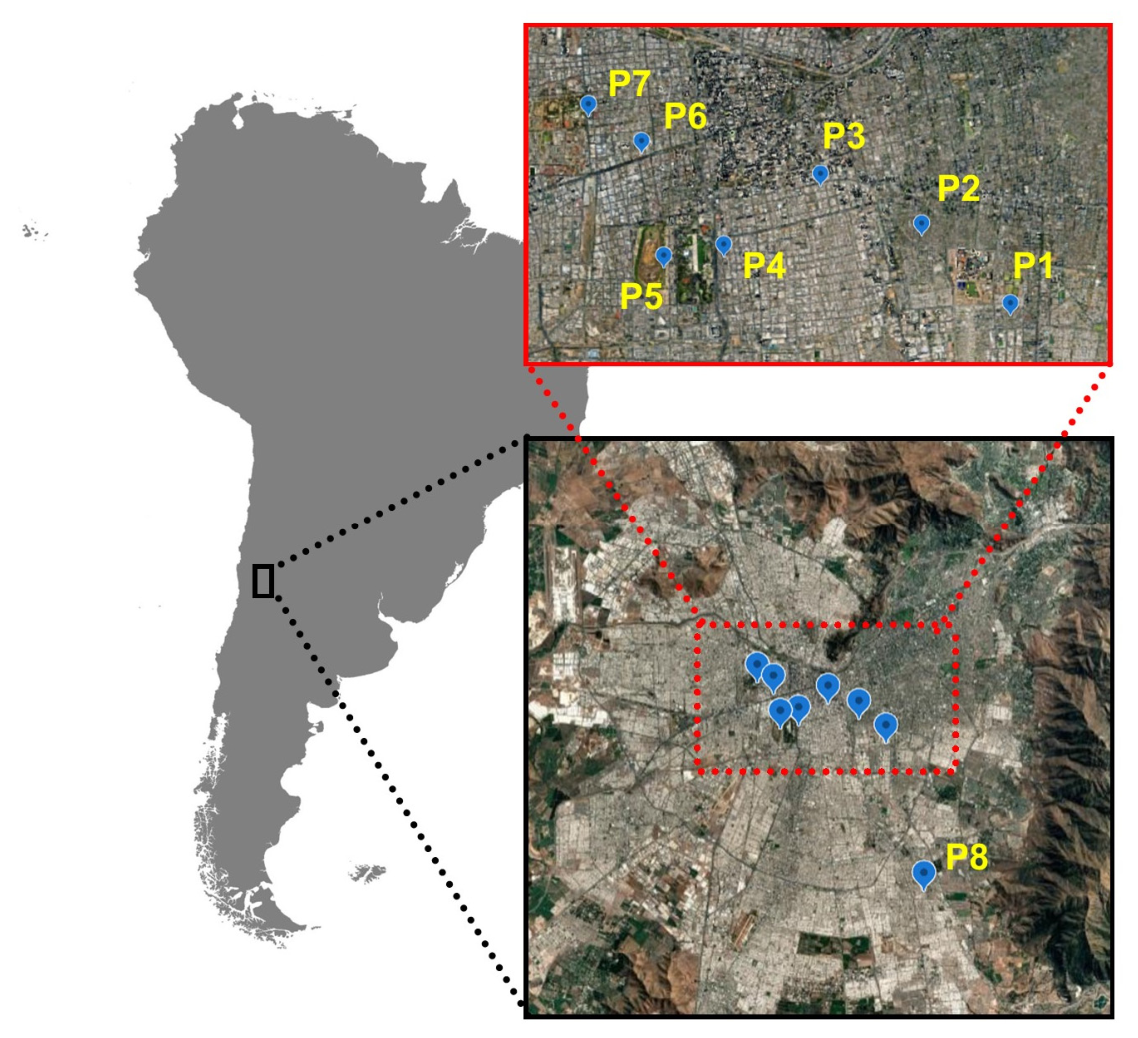
Eight sampling sites were selected in the city center (i.e., six households and two university campuses). All sampling sites were located within the representative area of official monitoring stations from the Chilean National Air Quality Information System (i.e., SINCA: “Sistema de Información Nacional de Calidad del Aire”) (Figure 1).
Figure 1.
The Metropolitan Region of Santiago in Chile showing eight sampling sites (P1 to P8) mainly distributed in the downtown area.
Sampling followed a comparative design in which one residential outdoor passive sampler and two personal silicone wristband samplers were deployed at the same residential locations. One of the silicone wristbands was worn by mostly stay-at-home adults, while the other was worn by adults who leave their household for work or study every weekday. The outdoor and personal sampling campaigns were not conducted simultaneously, but over different deployment periods and were therefore spatially, rather than temporally, comparable (Table S1). No tests were performed to determine the saturation mass of PAHs in the collecting media and the ambient concentrations or air equivalent concentrations were estimated based on the work by Wania et al. and others assuming equilibrium conditions [29].
2.3. Ambient Outdoor Samples
Polyurethane foam disks (PUF) from Tisch Environmental Inc. (Cleves, OH, USA) were used as passive sampling collecting media for the ambient outdoor samples. PUF disks had an average volume of 209.5 cm3, average thickness of 0.56 cm, average density of 0.021 g cm−3, average surface area of 373 cm2, and average mass of 4.40 g. The PUF disks were housed in direct-deposition passive air samplers (PAS-DD) from Tisch Environmental Inc. and installed above 1.5 m from the ground in each household, without facing directly toward the street. Before deployment, all PUF disks were precleaned in the laboratory by rinsing with distilled water, then rinsing with methanol. Then, they were individually cleaned by Soxhlet extraction with hexane (HPLC-grade, from HES Ltd., Santiago, Chile) for 24 h, followed by an additional 24 h with acetone (HPLC-grade, also from HES Ltd.). Each PUF disk was then dried under a hood for approximately 1 h and stored in individual, airtight glass jars at −20 °C until deployment. Further details regarding sample collection are provided in the Supporting Information (Table S2). Cleaned PUF disks were deployed in PAS-DD samplers for approximately 5 months at all locations following previous studies (PUF disks were deployed for only 75 days in sampling site P5 because the participant relocated) [30]. After retrieval, samples were stored in the same individual air-tight glass jars and stored at −20 °C until processing and analysis at the University of Chile.
2.4. Personal Samples
All procedures were performed in compliance with relevant national laws and institutional guidelines from Universidad de Chile and were approved by the appropriate institutional committee (certificate number 1871-FCS-UCH, 16 November 2018). Precleaned silicone wristbands purchased from MyExposome Inc. (Corvallis, OR, USA) were used to collect personal samples from two individuals in each household. Consent forms were signed by all participants before sample collection, which consisted of 5-day deployment periods (i.e., Monday to Friday). Participants wore the silicone wristbands for the deployment period continuously without removing them for sleeping or bathing, following the procedures used in previous studies [18]. Participant compliance was assessed through personal communication during the deployment week. After deployment, silicone wristbands were removed and stored in air-tight individual PTFE bags at −20 °C until further processing and analysis at the University of Chile. Additionally, each participant filled a short anonymous survey focused on their daily routines during the deployment week, including mode of transportation, commute times, and smoking habits (Table S1). More details on sample collection are provided in the Supporting Information (Table S2).
2.5. Sample Processing
The exposed PUF disks were extracted using a Soxhlet extraction system and 180 mL of ethyl acetate (GC-FID grade, HES Ltd.) for 16 h. On the other hand, exposed silicone wristbands were cut into 1/2-inch squares and extracted using two rounds of 20 mL of ethyl acetate in glass centrifuge tubes and a rotating shaker (model LCD MX-RL, Oni Lab, Barcelona, Spain) at 60 RPM for 2 h each. The resulting extracts were then concentrated using a TurboVap II (Biotage Inc., Uppsala, Sweden) to a volume of approximately 2 mL. The conditions used for concentration were a flow rate of 2.0 L min−1 of extra-pure nitrogen gas and a bath temperature of 55 °C. The extracts were then fractionated by solid-phase extraction (SPE) using 10 g pre-packed silica columns (Sigma Aldrich, Burlington, MA, USA) and hexane, hexane/ethyl acetate (1:1), and ethyl acetate as eluents. The aromatic fraction was recovered and further concentrated to 1 mL and stored in amber vials at 3 °C until analysis. All extracts were analyzed by standard addition in a Shimadzu gas chromatograph (GC-2014AFsc, Shumadzu, Kyoto, Japan) equipped with a flame ionization detector, utilizing an InertCap 5 column (GL Sciences, Tokyo, Japan) (30 m × 0.25 mm × 0.25 μm). The injection volume was 1.0 μL in splitless mode, and ultra-pure helium was used as the carrier gas at a flow rate of 1.1 mL min−1. The temperature program was set to 60 °C, increased to 280 °C at 5 °C min−1, and held for 10 min.
The estimated concentrations in the final vials were transformed to total mass of PAHs extracted from each PUF disk or silicone wristband. These results were transformed into ambient concentrations or air equivalent concentrations based on equivalences reported between the octanol–water partition coefficients (KOW) and the silicone–air and PUF–air partition coefficients (KSilicone-Air and KPUF-Air) for each compound [31]. The estimated air equivalent volume captured by outdoor and personal passive samplers reported previously was also used [32].
2.6. Ambient Concentrations
The ambient concentrations of chemicals sorbed onto the collecting media of passive sampling systems can be determined using their individual kinetic and thermodynamic properties. Additionally, sampling rates determined for each sampler configuration and the mass of chemicals found in the collecting media (i.e., PUF disks and silicone wristbands in this study) are also used. Thus, for the PUF disks, we followed Equations (1)–(3), assuming equilibrium uptake [29,30],
where CA is the ambient concentration of PAHs, VA is the effective air volume, which depends on the density-adjusted compound-specific PUF–air partition coefficient (K′PUF-Air), the volume of the sampling media (VPUF), the mass transfer coefficient in air (kAir), the effective thickness of the PUF disk (D), the total deployment time (t), and the sampling rate (R) which has been shown to be approximately 4 m3 day−1 for most nonpolar hydrophobic chemicals, including PAHs [32]. The PUF–air partition coefficient (KPUF-Air) was determined using its equivalence to the octanol–air partition coefficient (KOA), following previous studies [33]. The sampling rate was assumed to be 4 m3 day−1 [34]. The ambient concentration was then estimated using an available template designed to calculate air sampling volumes for a wide range of priority chemical compounds for passive air samplers using PUF and is based on references from various authors that are frequently updated as knowledge on the subject advances [34].
For the silicone wristbands, the VA was calculated following previous reports [31], using predictive models based on the boiling points (BPtest) of chemicals to derive the silicone–air partition coefficient (KSilicone-Air) as shown in Equation (4). The sampling rate (R) for the silicone wristbands was assumed to be 3.44 m3 day−1 [31]. The ambient concentration was then derived using Equation (1).
The estimated PUF–Air (KPUF-Air) and Silicone–Air (KSilicone-Air) partition coefficients, along with the sampling rates used, are shown in Table S3 of the Supporting Information File.
2.7. Quality Control
Authentic standards from ChemServices (West Chester, PA, USA) (i.e., anthracene, fluoranthene, pyrene, retene, and chrysene) were used to build individual calibration curves and to assess experimental recoveries in both PUF disks and silicone wristbands. Additionally, seven field blanks were collected (i.e., 4 PUFs and 3 silicone wristbands), consisting of 1 min exposure samples collected under the same conditions as the regular samples and treated in the same manner in the laboratory, including extraction, fractionation, and analysis. The relative standard deviations (RSD, n = 16) for the retention times and peak areas of the five standards ranged from 0.17% to 0.23% and from 4.8% to 6.2%, respectively. The individual calibration curves showed an r2 value ranging from 0.997 to 0.998. Average recoveries for the 5 PAHs ranged from 67% to 143% for the PUF disks and 49% to 83% for the silicone wristbands, which is in good agreement with previous studies. The limits of detection (LODs), estimated as the average concentration plus 3 standard deviations of the field blanks, ranged from 0.26 to 1.26 µg mL−1 for the PUF disks and from 0.34 to 2.18 µg mL−1 for the silicone wristbands. The estimated concentrations of PAHs in the PUF disks and the silicone wristbands were blank-corrected using the average of the field blanks, but not recovery corrected, and signals detected below the LODs were set to one-half the LOD for further processing as described previously [35].
During the preparation of this manuscript the authors used Elicit (January 2026 version) for the purposes of literature search. The authors have reviewed and edited the output and are fully responsible for the content of this publication.
3. Results and Discussion
3.1. Outdoor Ambient Concentrations
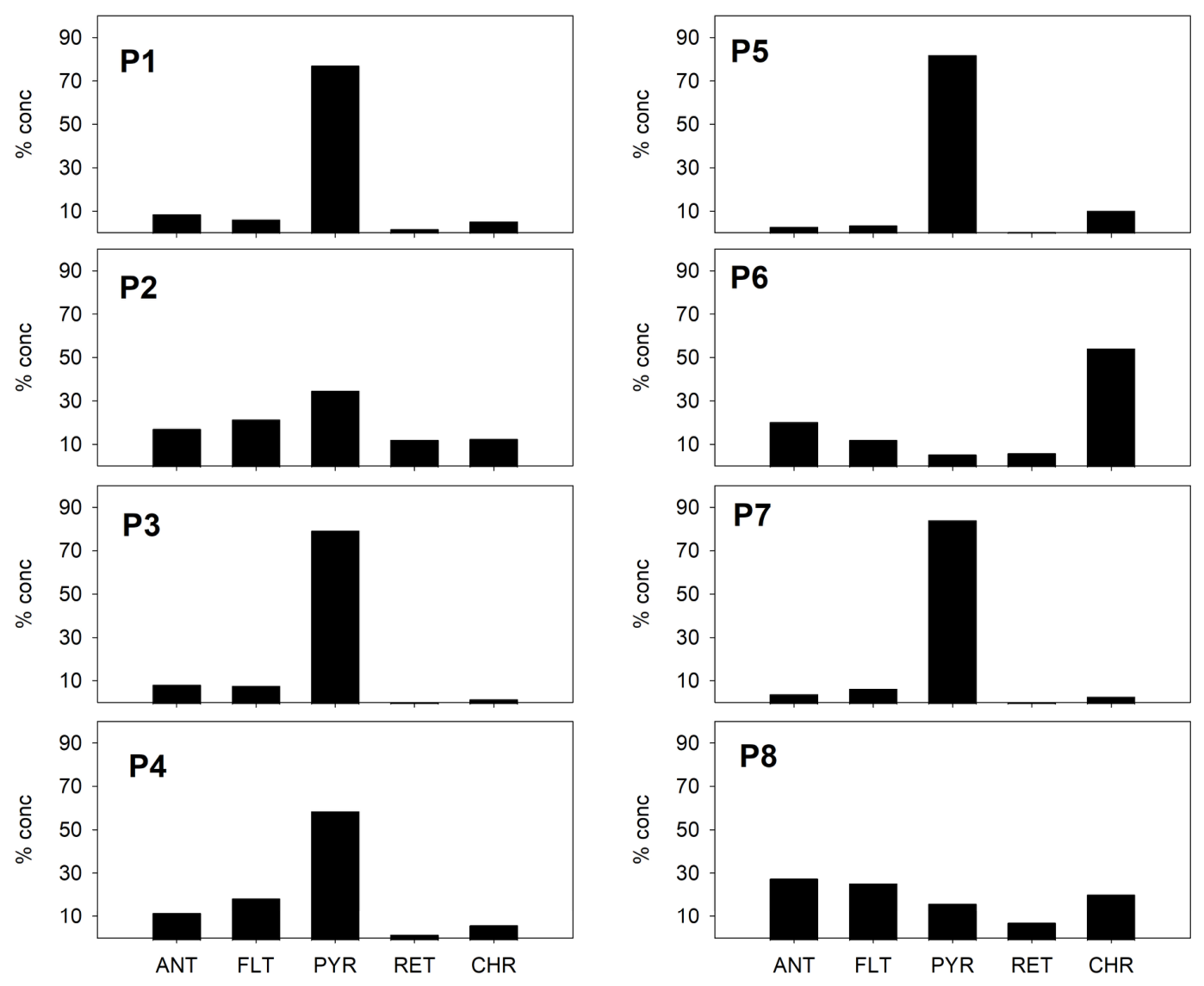
The masses of individual PAHs captured in the PUF disks ranged from 0.11 to 18.4 µg disk−1 (Table S4), with pyrene being the most abundant in nearly all samples (i.e., except for sites P6 and P8). These abundances were used to estimate ambient outdoor concentrations following Equations (1)–(3) that ranged from 0.17 to 44.21 ng m−3 (Table S5).
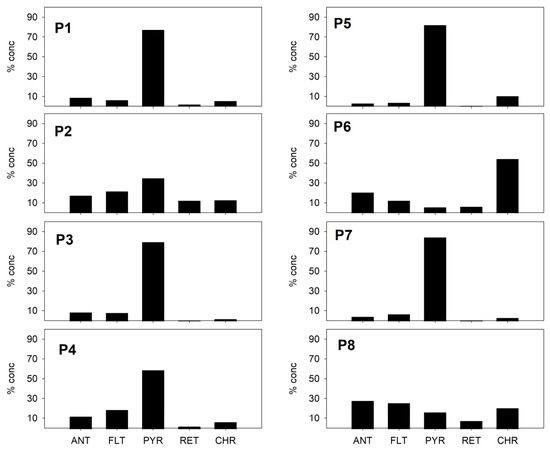
Previous studies analyzing PAHs in the atmosphere of Santiago have used a different sampling approach (e.g., high-volume and low-volume air samplers to collect atmospheric particulate matter in filters) and thus cannot be directly compared to the results obtained with passive sampler methods. However, these are the only available references in the literature and can serve as a general guide. Our results were in the upper range of previous studies focusing on PAHs sorbed to ambient outdoor particulate matter in Santiago [36,37,38]. This was expected, as according to the literature, the passive samplers used in this study (PAS-DD) have been reported to capture both gas-phase and particulate-associated PAHs, compared to high-volume filter-based systems that capture only the PM10 or PM2.5 fractions while overlooking the gaseous components [39]. Higher pyrene concentrations were evident in the distribution of PAHs in ambient outdoor samples (Figure 2), particularly at sites close to major highways such as P5 with 44.21 ng m−3. Most of the sampling sites showed similar distribution patterns of PAHs. The distinctive patterns observed at sites P6 and P8 may be consistent with combustion-related activities at home, such as barbecues and smoking, reported by residents at site P8 and students at site P6. Outdoor passive samplers revealed spatial variability in PAH distributions that may be associated with the proximity to different local emission sources (e.g., smoking, barbequing) and neighborhood-level activities. This is relevant for exposure assessment, as fixed monitoring stations may not fully capture this fine-scale spatial heterogeneity.
Figure 2.
Ambient outdoor relative concentrations for selected PAHs (ANT: anthracene, FLT: fluoranthene, PYR: pyrene, RET: retene, CHR: chrysene) for eight sampling sites in MRS in Chile.
3.2. Personal Concentration Profiles
The masses of individual PAHs captured by the silicone wristbands ranged from 0.11 to 132.28 µg wristband−1 (Table S4). This was in the same range as the only previous study in the area using silicone wristbands, although those values were reported for areas of the city far from the downtown area, with relatively different emission sources, and with participants with less mobility (i.e., high school students) [18]. Ambient concentrations estimated using silicone wristbands were in the lower range of those estimated using the outdoor samplers: 0.02 to 20.54 ng m−3 (Table S5). This difference may partially reflect reported differences in the collection behavior of silicone wristbands and PAS-DD samplers [40], and to different exposure routes, including indoor environments expected to have fewer PAH-emitting sources (e.g., office spaces with electrical heating systems). Notably, these concentrations were lower than indoor concentrations determined in previous studies in a region of Chile characterized by woodburning (up to 291 ng m−3 in PM2.5-bound PAHs from indoor samples), which may indicate the importance of the sources of energy used for house heating in Chile [15], although direct comparison, as explained earlier, may not be entirely advisable.
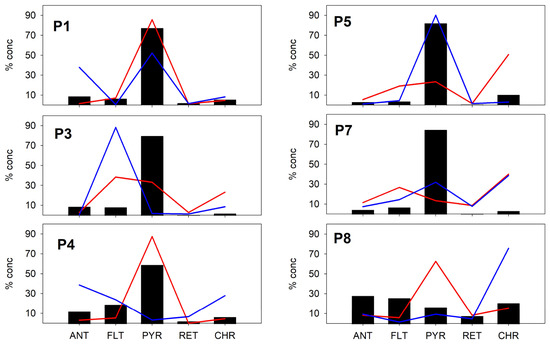
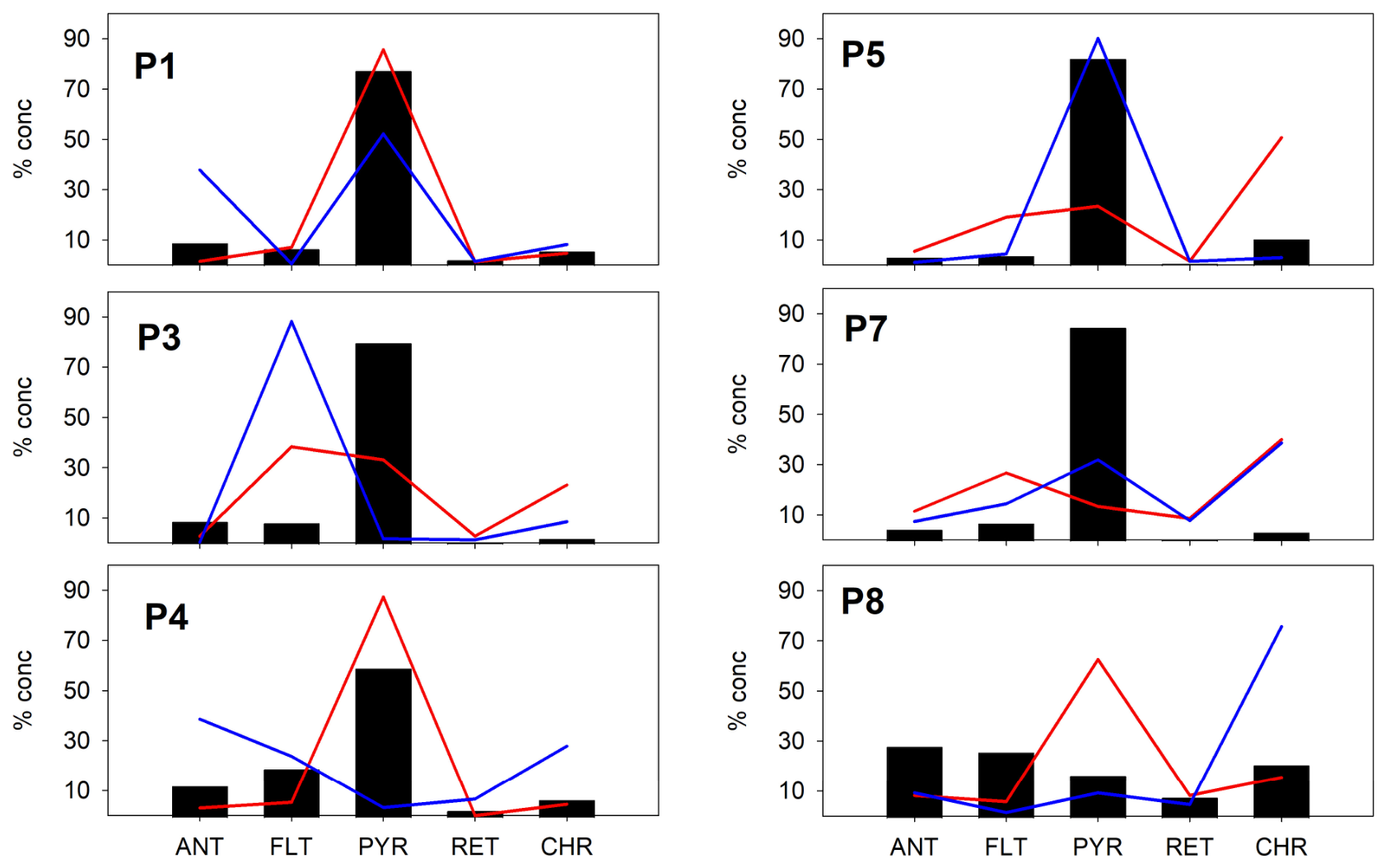
PAHs captured with silicone wristbands showed a more heterogeneous distribution than those captured with PUF disks. In some cases, the distributions were also dominated by pyrene, as in outdoor samplers, but fluoranthene, anthracene, and chrysene also showed significant concentrations (Figure 3). Other studies using silicone wristbands also showed that pyrene was detected in relative high concentration in urban pollution in Uruguay and North America [23,41]. This heterogeneity was less evident in outdoor monitoring, either in traditional high-volume samplers or passive samplers.
Figure 3.
Ambient outdoor relative concentrations and air equivalent personal concentrations for selected PAHs (ANT: anthracene, FLT: fluoranthene, PYR: pyrene, RET: retene, CHR: chrysene) for six sampling sites in MRS in Chile. The bars represent the concentrations estimated using PUF disks, while the red and blue lines represent the concentrations of PAHs estimated using silicone wristbands (red = participant No. 1, blue = participant No. 2, for each sampling site).
Different concentration profiles were observed even among people living in the same house, as evidenced by wristbands from sites P1, P3, P4, and P8 (Figure 3), which may reflect differences in daily routines and mobility patterns. In several households, participants with lower mobility showed lower relative concentrations than participants reporting greater daily mobility. Similarly, the use of public transportation or walking was a characteristic of those with higher relative concentrations (i.e., sites P1 and P3). The observed differences may be consistent with differences in daily routines and microenvironmental transitions (Table S1), but the contribution of specific microenvironments could not be quantified in this study.
3.3. Outdoor vs. Personal
There are fundamental differences between the PAS-DD and the silicone wristbands used for passive outdoor and personal sampling, respectively. Based on previous reports from urban and rural settings, the former may capture both gas-phase and particle-associated PAHs, whereas the latter may only capture gas-phase PAHs, although sweat has been demonstrated to be a contributor to the abundances found in silicone wristbands [42]. Thus, the main objective of this study was not proving equivalence between both methods but rather assessing the differences in PAH profiles and potential exposure patterns between outdoor and personal sampling. For that, air-equivalent concentrations were used because they provide a common reporting unit, but the comparison should be interpreted primarily in terms of relative PAH profiles and exposure patterns rather than strict quantitative equivalence. This distinction is fundamental to the interpretation of the present work. The study was designed to determine whether two complementary passive sampling approaches describe similar or different PAH concentration distribution patterns within the same residential context, rather than validating one passive sampler against another. Consequently, the observed differences should be interpreted as evidence that residential outdoor and personal passive sampling provide complementary information regarding potential PAH exposure patterns, irrespective of their different physicochemical uptake mechanisms.
Increasing the number of fixed outdoor samples collected relative to traditional monitoring improved the estimation of the spatial distribution of contaminants in Santiago. However, these sampling sites still reflected the ambient time-weighted concentration of PAHs at a particular point in space, which is also influenced by local atmospheric and meteorological parameters (e.g., wind speed, wind direction, rainfall, and others). However, they are not necessarily connected to personal-level contaminants.
Personal contaminant profiles are inherently more complex. Since people are constantly moving, the time-weighted average concentration estimates reflect multiple potential sources that may come into contact with each participant. Therefore, providing a better understanding of environmental pollution from a receptor perspective. Comparing residential outdoor passive samplers and personal silicone wristbands within the same residential settings revealed cases in which concentration profiles may be more influenced by personal mobility patterns, such as at sites P1 and P3. At the same time, there are others in which the outdoor distribution of contaminants seems to play a significant role in shaping personal concentration profiles, such as at sites P4, P5, and P7 (Figure 3). Although it is known that environmental abundance alone may not predict individual exposure effectively, this exploratory case study suggests that personal mobility through urban microenvironments may contribute to differences between residential outdoor and personal PAH exposure profiles.
Overall, diagnostic ratios (e.g., FLT/(FLT + PYR)) indicated that 12 out of 20 samples (60%) were associated with gasoline combustion (<0.5), as expected for a large urban area such as Santiago (Table S6) [43]. However, diagnostic ratios should be interpreted with caution given the potential transformations and mixed sources present in the area.
4. Limitations
This exploratory case study has some limitations that should be considered when interpreting the findings. Outdoor passive samplers and personal wristbands were deployed over different sampling periods and deployment durations (mainly due to the nature of each passive sampler technique used). Since PAH concentrations in urban environments exhibit significant seasonal and meteorological dependence, the direct comparison between sampler types should be avoided. However, the long deployment period for fixed outdoor samplers ensured that the measurements reflected time-weighted average concentrations rather than short-term pollution episodes.
Additionally, we cannot assess potential seasonal variation in the concentration of PAHs in the urban atmosphere of Santiago. Despite this limitation, the observed heterogeneity in personal sampling profiles contrasted with the more homogeneous distributions observed in fixed outdoor samplers. This evidence suggests that fixed-site monitoring alone may not fully capture the variability observed in personal concentration profiles.
The ambient concentrations estimated were based on literature values for sampling rates and partition coefficients, no performance reference compounds were deployed. Thus, uncertainty estimates could not be provided. Finally, our assessment is based on the interpretation of ambient concentrations. We did not collect biomarkers of exposure and therefore cannot make direct inferences about individual-level risk. Nevertheless, our findings align with evidence linking high ambient concentrations of PAHs to higher exposures. Future studies combining personal passive samplers with urinary hydroxylated PAH metabolites or other biomarkers of exposure would provide additional validation of personal exposure estimates.
5. Conclusions
This exploratory case study suggests that, while fixed-site outdoor passive samplers capture regional spatial distributions of PAHs that would not be captured by official monitoring stations in the Metropolitan Region of Santiago, they may not fully reflect the heterogeneity of the concentration profiles observed for people living in the area. Personal monitoring using silicone wristbands revealed more heterogeneous distributions, characterized by a significant variability among individuals even when sharing the same residential microenvironment. However, the direct comparison between sampler types should be avoided, given the differences in deployment time and duration.
These findings support the value of integrating personal exposure information into future exposure assessment studies, particularly in urban areas where indoor sources of pollution remain significant. Future studies involving larger populations, temporally aligned sampling strategies, and detailed participant activity information would help clarify the relationship between residential outdoor concentrations and personal exposure patterns.
Supplementary Materials
The following supporting information can be downloaded at https://www.mdpi.com/article/10.3390/atmos17070650/s1. Table S1: Participant information collected after personal sampling week. Only basic and anonymous information was collected; Table S2: Sample collection details for ambient outdoor samples and personal samples; Table S3: log-transformed Silicone-Air (Log Ksilicone-air) and PUF-Air (Log KPUF-Air) partition coefficients estimated for all PAHs analyzed. The sampling rates (R) used for both sampling methods are also shown; Table S4: Blank-corrected PAH total mass (µg) collected in ambient outdoor samples and personal samples expressed as total µg in each PUF disk or silicone wristband, respectively; Table S5: Blank-corrected PAH estimated ambient concentrations or air equivalent concentrations in ambient outdoor samples and personal samples expressed as total ng m−3 for all samples collected; Table S6: FLT/(FLT + PYR) diagnostic ratio for all samples collected. The values in bold represent those ratios greater than the threshold that distinguishes gasoline vs diesel combustion (<0.5 for gasoline relat-ed combustion).
Author Contributions
R.S.: data curation, formal analysis, investigation, methodology, writing—original draft; C.A.M.: conceptualization, formal analysis, funding acquisition, writing—review and editing. All authors have read and agreed to the published version of the manuscript.
Funding
This research was funded by the Chilean National Research and Development Agency (ANID, FONDECYT 11180151 and 1251574).
Institutional Review Board Statement
The study was conducted in accordance with ethical guidelines and approved by the Institutional Ethics Committee of the Faculty of Science of the University of Chile (approval 1871-FCS-UCH, 16 November 2018).
Informed Consent Statement
Informed consent was obtained from all subjects involved in the study.
Data Availability Statement
Data is available upon request.
Acknowledgments
During the preparation of this manuscript the authors used Elicit (January 2026 version) for the purposes of literature search. The authors have reviewed and edited the output and are fully responsible for the content of this publication.
Conflicts of Interest
The authors declare no conflicts of interest.
References
- Feng, Y.; Li, Z.; Li, W. Polycyclic Aromatic Hydrocarbons (PAHs): Environmental Persistence and Human Health Risks. Nat. Prod. Commun. 2025, 20, 1934578X241311451. [Google Scholar] [CrossRef] [Scilit]
- Adetona, O.; Sjodin, A.; Zheng, L.; Romanoff, L.C.; Aguilar-Villalobos, M.; Needham, L.L.; Hall, D.B.; Luis, A.; Cassidy, B.E.; Simpson, C.D.; et al. Personal Exposure to PM2.5 and Urinary Hydroxy-PAH Levels in Bus Drivers Exposed to Traffic Exhaust, in Trujillo, Peru. J. Occup. Environ. Hyg. 2012, 9, 217–229. [Google Scholar] [CrossRef] [Scilit] [PubMed]
- Vasconcellos, P.C.; Souza, D.Z.; Sanchez-Ccoyllo, O.; Bustillos, J.O.V.; Lee, H.; Santos, F.C.; Nascimento, K.H.; Araujo, M.P.; Saarnio, K.; Teinila, K.; et al. Determination of anthropogenic and biogenic compounds on atmospheric aerosol collected in urban, biomass burning and forest areas in Sao Paulo, Brazil. Sci. Total Environ. 2010, 408, 5836–5844. [Google Scholar] [CrossRef] [Scilit] [PubMed]
- Saa, J.; Valdivia, M.; Ruiz, J.; Manzano, C. Former landfills as environmental liabilities in central Chile: Evidence from a pilot study in Lepanto. Clean-Soil Air Water 2024, 52, 2400085. [Google Scholar] [CrossRef] [Scilit]
- Montano, L.; Baldini, G.; Piscopo, M.; Liguori, G.; Lombardi, R.; Ricciardi, M.; Esposito, G.; Pinto, G.; Fontanarosa, C.; Spinelli, M.; et al. Polycyclic Aromatic Hydrocarbons (PAHs) in the Environment: Occupational Exposure, Health Risks and Fertility Implications. Toxics 2025, 13, 151. [Google Scholar] [CrossRef] [Scilit] [PubMed]
- Reyes, R.; Schueftan, A.; Ruiz, C.; Gonzalez, A.D. Controlling air pollution in a context of high energy poverty levels in southern Chile: Clean air but colder houses? Energy Policy 2019, 124, 301–311. [Google Scholar] [CrossRef] [Scilit]
- Gonzalez-Eguino, M. Energy poverty: An overview. Renew. Sustain. Energy Rev. 2015, 47, 377–385. [Google Scholar] [CrossRef] [Scilit]
- Bruce, N.; Perez-Padilla, R.; Albalak, R. Indoor air pollution in developing countries: A major environmental and public health challenge. Bull. World Health Organ. 2000, 78, 1078–1092. [Google Scholar] [PubMed]
- Bravo-Linares, C.; Ovando-Fuentealba, L.; Orellana-Donoso, S.; Villenas-Fernandez, K.; Hernandez-Millan, M.; Mudge, S.M.; Pinaud-Mendoza, J.P.; Loyola-Sepulveda, R. Source Apportionment of PAHs in Airborne Particulates (PM2.5) in Southern Chile. Polycycl. Aromat. Compd. 2017, 37, 189–202. [Google Scholar] [CrossRef] [Scilit]
- Li, Y.; Yang, L.; Chen, X.; Gao, Y.; Jiang, P.; Zhang, J.; Yu, H.; Wang, W. PM2.5-Bound PAHs in Indoor and Outdoor of Hotels in Urban and Suburban of Jinan, China: Concentrations, Sources, and Health Risk Impacts. Aerosol Air Qual. Res. 2017, 17, 2463–2473. [Google Scholar] [CrossRef] [Scilit]
- Ouyang, R.; Yang, S.; Xu, L. Analysis and Risk Assessment of PM2.5-Bound PAHs in a Comparison of Indoor and Outdoor Environments in a Middle School: A Case Study in Beijing, China. Atmosphere 2020, 11, 904. [Google Scholar] [CrossRef] [Scilit]
- Cereceda-Balic, F.; Fadic, X.; Llanos, A.L.; Dominguez, A.M.; Guevara, J.L.; Vidal, V.; Diaz-Robles, L.A.; Schiappacasse, L.N.; Etcharren, P. Obtaining polycyclic aromatic hydrocarbon concentration ratios and molecular markers for residential wood combustion: Temuco, a case study. J. Air Waste Manag. Assoc. 2012, 62, 44–51. [Google Scholar] [CrossRef] [Scilit] [PubMed]
- Manzano, C.; Jácome, M.; Syn, T.; Molina, C.; Araya, R.; Leiva-Guzmán, M. Local Air Quality Issues and Research Priorities Through the Lenses of Chilean Experts: An Ontological Analysis. Integr. Environ. Assess. Manag. 2021, 17, 273–281. [Google Scholar] [CrossRef] [Scilit] [PubMed]
- Gil, L.; Adonis, M.; Caceres, D.; Moreno, G. Influence of Outdoor Pollution on Indoor Air-Quality—A Study in A Metropolitan-Area of Chile. Rev. Medica Chile 1995, 123, 411–425. [Google Scholar]
- Bravo-Linares, C.; Ovando-Fuentealba, L.; Orellana-Donoso, S.; Gatica, S.; Klerman, F.; Mudge, S.M.; Gallardo, W.; Pinaud, J.P.; Loyola-Sepulveda, R. Source identification, apportionment and toxicity of indoor and outdoor PM2.5 airborne particulates in a region characterised by wood burning. Environ. Sci.-Process. Impacts 2016, 18, 575–589. [Google Scholar] [CrossRef] [Scilit] [PubMed]
- Mohammed, M.; Song, W.; Ma, Y.; Liu, L.; Ma, W.; Li, W.; Li, Y.; Wang, F.; Qi, M.; Lv, N.; et al. Distribution patterns, infiltration and health risk assessment of PM2.5-bound PAHs in indoor and outdoor air in cold zone. Chemosphere 2016, 155, 70–85. [Google Scholar] [CrossRef] [Scilit] [PubMed]
- Xu, H.; Cao, J.; Gao, M.; Ho, K.F.; Niu, X.; Coons, T.L.; Ho, S.S.H.; Wang, G.; Zhao, Z. Personal exposure to fine particulates and polycyclic aromatic hydrocarbons in an office environment in Xi’an, China. Front. Environ. Sci. 2013, 2, 33–46. [Google Scholar]
- Manzano, C.A.; Dodder, N.G.; Hoh, E.; Morales, R. Patterns of Personal Exposure to Urban Pollutants Using Personal Passive Samplers and GC x GC/ToF-MS. Environ. Sci. Technol. 2019, 53, 614–624. [Google Scholar] [CrossRef] [Scilit] [PubMed]
- Aerts, R.; Joly, L.; Szternfeld, P.; Tsilikas, K.; De Cremer, K.; Castelain, P.; Aerts, J.M.; Van Orshoven, J.; Somers, B.; Hendrickx, M.; et al. Silicone Wristband Passive Samplers Yield Highly Individualized Pesticide Residue Exposure Profiles. Environ. Sci. Technol. 2018, 52, 298–307. [Google Scholar] [CrossRef] [Scilit] [PubMed]
- Donald, C.E.; Scott, R.P.; Blaustein, K.L.; Halbleib, M.L.; Sarr, M.; Jepson, P.C.; Anderson, K.A. Silicone wristbands detect individuals’ pesticide exposures in West Africa. R. Soc. Open Sci. 2016, 3, 160433. [Google Scholar] [CrossRef] [Scilit] [PubMed]
- Dixon, H.; Armstrong, G.; Barton, M.; Bergmann, A.; Bondy, M.; Halbleib, M.; Hamilton, W.; Haynes, E.; Herbstmanw, J.; Hoffman, P.; et al. Discovery of common chemical exposures across three continents using silicone wristbands. R. Soc. Open Sci. 2019, 6, 181836. [Google Scholar] [CrossRef] [Scilit] [PubMed]
- Bergmann, A.J.; North, P.E.; Vasquez, L.; Bello, H.; Ruiz, M.D.G.; Anderson, K.A. Multi-class chemical exposure in rural Peru using silicone wristbands. J. Expo. Sci. Environ. Epidemiol. 2017, 27, 560–568. [Google Scholar] [CrossRef] [Scilit] [PubMed]
- Running, L.; Olson, J.; Aga, D.; Travis, S.; Daleiro, M.; Queirolo, E.; Kordas, K. Polycyclic aromatic hydrocarbons in silicone wristbands of Uruguayan children: Measurement and exposure source exploration. Environ. Sci.-Adv. 2024, 3, 751–762. [Google Scholar] [CrossRef] [Scilit] [PubMed]
- Travis, S.; Aga, D.; Queirolo, E.; Olson, J.; Daleiro, M.; Kordas, K. Catching flame retardants and pesticides in silicone wristbands: Evidence of exposure to current and legacy pollutants in Uruguayan children. Sci. Total Environ. 2020, 740, 140136. [Google Scholar] [CrossRef] [Scilit] [PubMed]
- Guo, P.F.; Lin, E.Z.; Koelmel, J.P.; Ding, E.N.; Gao, Y.; Deng, F.C.; Dong, H.R.; Liu, Y.Y.; Cha, Y.E.; Fang, J.L.; et al. Exploring personal chemical exposures in China with wearable air pollutant monitors: A repeated-measure study in healthy older adults in Jinan, China. Environ. Int. 2021, 156, 106709. [Google Scholar] [CrossRef] [Scilit] [PubMed]
- Nawaz, M.; Henze, D.; Huneeus, N.; Osses, M.; Alamos, N.; Opazo, M.; Gallardo, L. Sources of Air Pollution Health Impacts and Co-Benefits of Carbon Neutrality in Santiago, Chile. J. Geophys. Res.-Atmos. 2023, 128, e2023JD038808. [Google Scholar] [CrossRef] [Scilit]
- Molina, C.; Toro, R.; Morales, R.G.E.; Manzano, C.; Leiva-Guzman, M.A. Particulate matter in urban areas of south-central Chile exceeds air quality standards. Air Qual. Atmos. Health 2017, 10, 653–667. [Google Scholar] [CrossRef] [Scilit]
- Toro, R.; Morales, R.G.E.; Canales, M.; Gonzalez-Rojas, C.; Leiva, M.A. Inhaled and inspired particulates in Metropolitan Santiago Chile exceed air quality standards. Build. Environ. 2014, 79, 115–123. [Google Scholar] [CrossRef] [Scilit]
- Wania, F.; Shunthirasingham, C. Passive air sampling for semi-volatile organic chemicals. Environ. Sci.-Process. Impacts 2020, 22, 1925–2002. [Google Scholar] [CrossRef] [Scilit] [PubMed]
- Eng, A.; Hsu, Y.; Harner, T.; Mastin, J.; Wheadon, S. Twenty-Five Years of Research and Monitoring Using PUF Disk Passive Air Samplers. Environ. Sci. Technol. 2026, 60, 11833–11870. [Google Scholar] [CrossRef] [Scilit] [PubMed]
- O’Connell, S.; Anderson, K.; Epstein, M. Determining chemical air equivalency using silicone personal monitors. J. Expo. Sci. Environ. Epidemiol. 2022, 32, 268–279. [Google Scholar] [CrossRef] [Scilit] [PubMed]
- Harner, T.; Su, K.; Genualdi, S.; Karpowicz, J.; Ahrens, L.; Mihele, C.; Schuster, J.; Charland, J.P.; Narayan, J. Calibration and application of PUF disk passive air samplers for tracking polycyclic aromatic compounds (PACs). Atmos. Environ. 2013, 75, 123–128. [Google Scholar] [CrossRef] [Scilit]
- Shoeib, M.; Harner, T. Characterization and comparison of three passive air samplers for persistent organic pollutants. Environ. Sci. Technol. 2002, 36, 4142–4151. [Google Scholar] [CrossRef] [Scilit] [PubMed]
- Harner, T. 2025 v5 1 Template for Calculating PUF and SIP Disk Sample Air Volumes June9. Available online: https://doi.org/10.13140/rg.2.2.28436.00643 (accessed on 2 June 2026).
- Hites, R.A. Statistical Approach for Assessing the Stockholm Convention’s Effectiveness: Great Lakes Atmospheric Data. Environ. Sci. Technol. 2019, 53, 8585–8590. [Google Scholar] [CrossRef] [Scilit] [PubMed]
- Adonis, M.I.; Riquelme, R.M.; Gil, L.; Rios, C.; Rodriguez, L.; Rodriguez, E.M. PAHs and mutagenicity of inhalable and respirable diesel particulate matter in Santiago, Chile. Polycycl. Aromat. Compd. 2003, 23, 495–514. [Google Scholar] [CrossRef] [Scilit]
- Romero, R.; Sienra, R.; Richter, P. Efficient screening method for determination of polycyclic aromatic hydrocarbons (PAHs) in airborne particles. Application in real samples of Santiago–Chile metropolitan urban area. Atmos. Environ. 2002, 36, 2375–2381. [Google Scholar] [CrossRef] [Scilit]
- Sienra, M.D.; Rosazza, N.G.; Prendez, M. Polycyclic aromatic hydrocarbons and their molecular diagnostic ratios in urban atmospheric respirable particulate matter. Atmos. Res. 2005, 75, 267–281. [Google Scholar] [CrossRef] [Scilit]
- Eng, A.; Harner, T.; Pozo, K. A Prototype Passive Air Sampler for Measuring Dry Deposition of Polycyclic Aromatic Hydrocarbons. Environ. Sci. Technol. Lett. 2014, 1, 77–81. [Google Scholar] [CrossRef] [Scilit]
- O’Connell, S.G.; Kind, L.D.; Anderson, K.A. Silicone Wristbands as Personal Passive Samplers. Environ. Sci. Technol. 2014, 48, 3327–3335. [Google Scholar] [CrossRef] [Scilit] [PubMed]
- Hendryx, M.; Wang, S.; Romanak, K.; Salamova, A.; Venier, M. Personal exposure to polycyclic aromatic hydrocarbons in Appalachian mining communities. Environ. Pollut. 2020, 257, 113501. [Google Scholar] [CrossRef] [Scilit] [PubMed]
- Hammel, S.C.; Phillips, A.L.; Hoffman, K.; Stapleton, H.M. Evaluating the Use of Silicone Wristbands To Measure Personal Exposure to Brominated Flame Retardants. Environ. Sci. Technol. 2018, 52, 11875–11885. [Google Scholar] [CrossRef] [Scilit] [PubMed]
- Nargis, A.; Habib, A.; Zhao, S.; Nigar, R.; Liu, X.; Zhang, G.; Cai, M. Monitoring of atmospheric polycyclic aromatic hydrocarbons by polyurethane foam-passive air samplers in Bangladesh: Source apportionment and health risk assessment. Atmos. Environ. 2022, 289, 119346. [Google Scholar] [CrossRef] [Scilit]
Disclaimer/Publisher’s Note: The statements, opinions and data contained in all publications are solely those of the individual author(s) and contributor(s) and not of MDPI and/or the editor(s). MDPI and/or the editor(s) disclaim responsibility for any injury to people or property resulting from any ideas, methods, instructions or products referred to in the content. |
© 2026 by the authors. Licensee MDPI, Basel, Switzerland. This article is an open access article distributed under the terms and conditions of the Creative Commons Attribution (CC BY) license.