


1. Micro- and Nanoplastics in the Atmosphere: Current Understanding and Knowledge Gaps
Micro- and nanoplastics are now recognized as emerging components of atmospheric particulate matter. Their detection in urban air, remote regions, mountain environments, clouds, snow, and human lung tissue indicates that the atmosphere is an important pathway for plastic transport, environmental redistribution, and human exposure. Nevertheless, micro- and nanoplastic research in the atmosphere remains less developed compared with studies of aquatic and terrestrial environments. Major uncertainties persist regarding sampling and analytical methods, emission sources, atmospheric transport and transformation, deposition processes, and potential effects on climate and human health.
This Special Issue, “Micro- and Nanoplastics in the Atmosphere”, brings together five studies that address several of these critical knowledge gaps. Collectively, the contributions advance the field in four closely connected areas: atmospheric occurrence and source identification, deposition and meteorological variability, analytical methodology, and inhalation toxicology.
2. Contributions to This Special Issue
Sasaki et al. [1] investigated airborne microplastics and conventional particulate-matter components simultaneously at three sites in Japan using a unified seasonal sampling protocol. Micro-Raman spectroscopy identified 106 airborne microplastic particles, with polyethylene being the dominant polymer, followed by polyethylene terephthalate and polyamide. Most particles were fragments, and their modal Feret diameter was 4–6 µm, indicating the importance of particles within the respirable size range. Correlations with particulate-matter constituents, including syringaldehyde, tungsten, cobalt, and chromium, suggested possible links with site-specific emission sources. This study demonstrates the potential value of integrating microplastic measurements with established atmospheric-chemistry observations and source tracers.
Li et al. [2] examined seasonal variability in atmospheric microplastic deposition in Oxford, Mississippi, USA, using both bulk deposition samplers and shielded gravitational deposition samplers. The markedly different deposition fluxes and polymer profiles obtained by the two sampler types illustrate that atmospheric microplastic measurements are strongly influenced by sampler design, sampling height, collection mechanism, and pretreatment procedure. Temperature was significantly associated with microplastic loading in the shielded sampler, whereas precipitation effects could not be resolved at the temporal resolution employed. These results highlight both the environmental variability of atmospheric microplastic deposition and the urgent need for harmonized sampling and reporting protocols.
Analytical uncertainty is particularly important for small airborne particles because plastic mass is extremely low relative to the surrounding inorganic and organic particulate matrix. Mattonai et al. [3] demonstrated that ammonium sulfate, a major constituent of PM2.5, can interfere with polymer quantification by pyrolysis–gas chromatography–mass spectrometry. They proposed rinsing particulate matter with water directly inside the pyrolysis crucible, thereby reducing matrix interference while minimizing particle loss and contamination. This technical contribution is important for developing reliable mass-based measurements that can be integrated with existing PM2.5 monitoring frameworks.
Niida et al. [4] addressed another major analytical challenge: quantification of atmospheric aging in microplastics smaller than 10 µm. The authors developed a high-resolution µFTIR-ATR imaging method incorporating a fourth-derivative oxidation index for polyethylene terephthalate. The method enabled simultaneous detection, polymer identification, and surface-oxidation assessment of particles down to approximately 2 µm. Its application to samples from Japan and Cambodia revealed regional differences in polyethylene terephthalate oxidation, with the highest oxidation observed in Siem Reap. Chemical-aging metrics may therefore provide information complementary to particle size, morphology, and polymer type when interpreting atmospheric processing and transport.
Understanding exposure alone is insufficient without biologically relevant methods for evaluating health effects. Okuda et al. [5] developed an air–liquid interface culture system for exposing alveolar epithelial cells directly to aerosolized nanoplastics. Conventional submerged cell-culture experiments do not accurately reproduce the deposition of inhaled particles onto the lung epithelium. The newly developed system therefore provides a methodological foundation for more realistic investigations of respiratory exposure to airborne nanoplastics and, in the future, environmentally aged particles and complex atmospheric mixtures.
Together, these studies illustrate the interdisciplinary nature of atmospheric micro- and nanoplastic research. Reliable risk assessment requires a connected framework extending from sampling and chemical identification to source characterization, atmospheric transformation, human exposure, and biological response. The contributions also demonstrate that measurement results cannot be interpreted independently of particle-size range, sampling principle, analytical detection limit, pretreatment recovery, procedural blanks, and the units used to express concentration or deposition.
3. A Priority Knowledge Gap: Operational Definitions
An additional and fundamental priority is to establish clear and internationally accepted terminology for micro- and nanoplastics in the atmosphere. At present, the terms “atmospheric microplastics”, “airborne microplastics”, and “suspended atmospheric microplastics” are used inconsistently, and it is often unclear whether they refer only to particles suspended in air or also include particles transferred from the atmosphere through deposition. Moreover, many studies report particle size without stating its operational definition. Consequently, it is often unclear whether the reported size denotes a physical dimension measured by microscopy, such as a Feret diameter or another geometric descriptor, or an equivalent diameter, defined as the diameter of a sphere having the same specified physical property as the particle, such as volume, surface area, or terminal settling velocity. Among equivalent-diameter metrics, aerodynamic diameter is widely used in aerosol science because of its relevance to atmospheric behavior and health-risk assessment. It is defined as the diameter of a sphere of unit density (1 g cm−3) that has the same terminal settling velocity as the particle under specified conditions [6]. However, only a small proportion of micro- and nanoplastic studies in the atmosphere have employed size-selective sampling based on aerodynamic diameter. Physical dimensions, geometric descriptors, and aerodynamic diameter are not interchangeable, particularly for irregular fragments and fibers, because aerodynamic diameter depends on particle density and shape as well as physical size. Without explicit definitions, comparisons among studies of atmospheric concentrations, deposition fluxes, transport, and inhalation exposure remain uncertain.
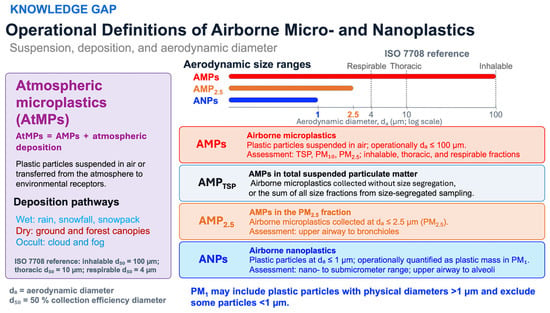
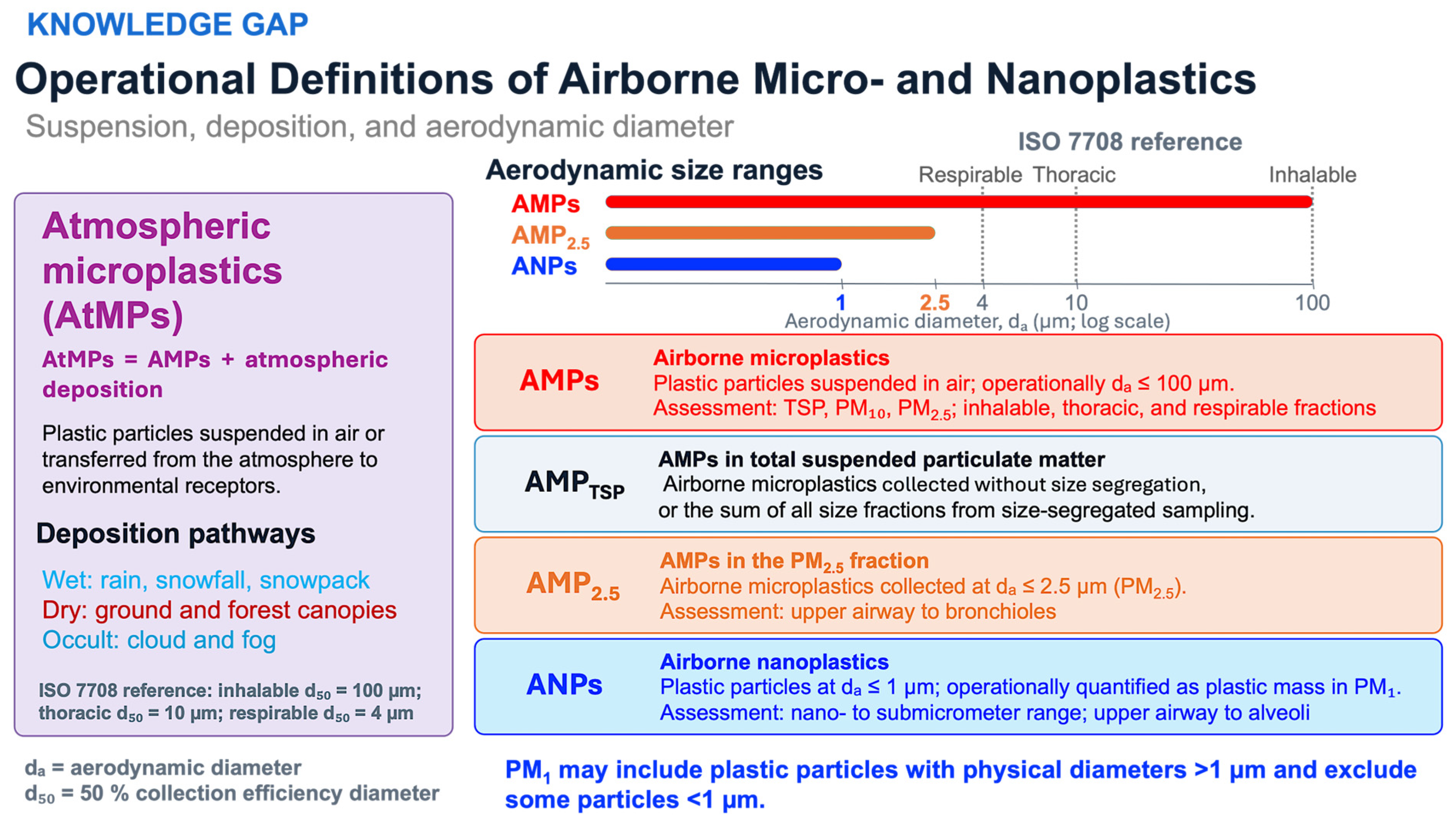
We propose the operational framework shown in Figure 1 as a basis for community discussion and validation. “Atmospheric microplastics (AtMPs)” would serve as the overarching term for plastic particles suspended in the atmosphere and those transferred from the atmosphere to environmental receptors through wet, dry, or occult deposition. “Airborne microplastics (AMPs)” would refer specifically to plastic particles suspended in air, including particles incorporated into cloud or fog droplets while they remain airborne. Within this framework, AMPs are operationally defined as plastic particles with an aerodynamic diameter (da) of ≤100 µm. This upper limit should be regarded as an operational convention for atmospheric sampling rather than as an absolute physical-size boundary.
Figure 1.
Proposed operational definitions of atmospheric microplastics (AtMPs), airborne microplastics (AMPs), AMPs in total suspended particulate matter (AMPTSP), AMPs in the PM2.5 fraction (AMP2.5), and airborne nanoplastics (ANPs). The framework distinguishes suspension from atmospheric deposition and uses aerodynamic diameter for size-fractionated atmospheric sampling. ISO 7708 reference d50 values describe sampling conventions rather than strict size boundaries. Nanoplastics are <1 µm in physical or geometric size; owing to analytical limitations, airborne nanoplastics are operationally assessed as plastic particles or plastic mass in a PM1 sampling fraction with a nominal 50% aerodynamic cut-point (d50) of 1 µm. PM1 is a sampler-defined measurement proxy, not a physical-size definition or a sharp boundary.
Within the AMP category, AMPTSP denotes AMPs collected without size segregation or, in size-segregated sampling, the sum of all collected size fractions. AMP2.5 denotes AMPs collected in the PM2.5 fraction using a size-selective sampler with a nominal 50% aerodynamic cut-point (d50) of 2.5 µm. These terms explicitly link the reported plastic fraction to the corresponding atmospheric aerosol sampling convention; they do not imply an ideal, sharp particle-size boundary.
The definition of “airborne nanoplastics (ANPs)” requires additional consideration because several related particle terms are used in adjacent research fields. In nanotechnology, a “nanoparticle” is a nano-object whose external dimensions are approximately 1–100 nm [7]. This term is based on physical dimensions and is not specific to airborne particles. “Ultrafine particles (UFPs)” are generally defined as airborne particles with diameters of 100 nm or less [8]. UFPs are commonly characterized using a measurement-dependent equivalent diameter and are often reported in terms of particle number concentration. A “submicrometer particle” belongs to the broader, composition-independent size class below 1 µm and includes both UFPs and particles between 100 nm and 1 µm. Thus, nanoparticle, UFP, and submicrometer particle are not interchangeable, although their size ranges overlap.
In environmental plastic research, particularly in marine and inland-water studies, nanoplastics are commonly defined using a different size convention. ISO/TR 21960 defines nanoplastics as plastic particles smaller than 1 µm [9]. Hartmann et al. similarly proposed a nanoplastic size range of 1 to <1000 nm [10], while Gigault et al. defined nanoplastics as unintentionally produced plastic particles exhibiting colloidal behavior within the size range of 1–1000 nm [11]. The <1 µm upper boundary used in aquatic research is therefore intentionally broader than the approximately 1–100 nm range applied to nanoparticles in general nanotechnology. Importantly, this aquatic definition is based primarily on physical or geometric particle dimensions.
A corresponding definition has not yet been established for nanoplastics in the atmosphere. In particular, adopting 100 nm as the upper boundary by analogy with nanoparticles or UFPs is not currently practical for routine atmospheric measurements. Existing polymer-specific analytical techniques generally cannot identify and quantify individual plastic particles down to 100 nm with sufficient reliability in complex atmospheric matrices. This limitation arises from analytical detection limits, the extremely low mass of plastics in this size range, and interference from coexisting inorganic and organic particulate matter. We therefore propose that ANPs be operationally assessed in atmospheric measurements as plastic particles or plastic mass collected in a PM1 sampling fraction having a nominal 50% aerodynamic cut-point (d50) of 1 µm. This PM1-based approach provides a practical connection between atmospheric size-selective sampling and currently available polymer-analysis techniques. However, PM1 should be understood as a sampler-defined operational fraction rather than as a physical-size definition or a sharp boundary at 1 µm. Its actual classification depends on the sampler’s size-dependent penetration or collection-efficiency curve and operating flow rate. Aerodynamic and geometric diameters can differ depending on particle density and shape. Consequently, plastic particles collected in the PM1 fraction are not necessarily composed exclusively of nanoplastics defined by a physical diameter of <1 µm, and some physically defined nanoplastics may not be classified within the PM1 fraction.
The 100, 10, and 4 µm values shown for the inhalable, thoracic, and respirable fractions are reference d50 values from ISO 7708 [6], rather than absolute particle-size boundaries. Similarly, PM2.5 and PM1 are sampler-defined aerodynamic fractions characterized by size-dependent penetration or collection-efficiency curves. Studies should therefore report the operational sampling fraction, sampler type, operating flow rate, nominal d50, and, where available, the complete size-selectivity curve. Whenever possible, they should also report physical dimensions, morphology, assumed particle density, analytical detection and quantification limits, and the size-detection range. Studies should specify whether a reported measurement represents a suspended-air concentration, wet or dry deposition, cloud or fog water, or another atmospheric receptor. Agreement on this terminology would substantially improve interstudy comparability, exposure assessment, model–data integration, and the development of reference materials and monitoring protocols.
4. Future Research Directions
Beyond terminology, harmonized protocols and reference materials are needed to improve comparability among studies. Quality assurance and quality control should include field and procedural blanks, recovery experiments for multiple polymers and particle sizes, explicit detection and quantification limits, and transparent reporting of sampled air volume and analyzed filter area.
Greater attention must be given to particles smaller than 10 µm and especially to nanoplastics, which are the most relevant fractions for long-range transport and deep-lung deposition but remain the most difficult to quantify. Combining particle-based spectroscopic methods with mass-based thermal and mass-spectrometric techniques will be essential. Results should be reported in both number- and mass-based metrics where analytically defensible, together with the relevant aerodynamic and physical size information.
Long-term and geographically coordinated observations should be developed to distinguish seasonal variability from methodological variability and to quantify source-specific emission factors. Simultaneous measurement of microplastics, meteorological parameters, conventional particulate-matter components, and chemical source tracers will strengthen source apportionment.
Atmospheric aging processes—including ultraviolet irradiation, reactions with atmospheric oxidants, cloud processing, and interactions with coexisting pollutants—should be incorporated into studies of transport, cloud formation, and toxicity. Finally, toxicological research requires approaches that address both biological and environmental aspects. From a biological perspective, given the current trend toward reducing animal testing, a key challenge is how to effectively model the complex respiratory system using in vitro. Meanwhile, from an environmental perspective, toxicological studies should increasingly employ environmentally relevant particle sizes, polymers, aging states, concentrations, and co-pollutant mixtures using inhalation-relevant exposure systems.
The articles collected in this Special Issue provide methodological and conceptual advances across the pathway from atmospheric emission to potential biological effects. They also show that atmospheric micro- and nanoplastics should not be treated as an isolated class of contaminants, but rather as dynamic components of atmospheric particulate matter. Continued collaboration among atmospheric scientists, analytical chemists, polymer scientists, toxicologists, exposure scientists, and modelers will be essential for moving the field from detection toward quantitative assessment of sources, environmental fate, and risks. Establishing shared operational definitions should be an early and explicit component of that collaborative effort.
Conflicts of Interest
The authors declare no conflict of interest.
References
- Sasaki, H.; Takahashi, T.; Futami, M.; Endo, T.; Hirano, M.; Kotake, Y.; Pham, K.-O. Airborne Microplastics: Source Implications from Particulate Matter Composition. Atmosphere 2025, 16, 1222. [Google Scholar] [CrossRef] [Scilit]
- Li, R.; Wontor, K.; Olubusoye, B.S.; Gregory, T.; Brewer, J.S.; Cizdziel, J.V. Seasonal Variability and Environmental Factors Influencing Deposition of Airborne Microplastics in Oxford, Mississippi, USA. Atmosphere 2026, 17, 456. [Google Scholar] [CrossRef] [Scilit]
- Mattonai, M.; Pipkin, W.; Shiono, A.; Niwa, M.; Watanabe, A. The Challenge of Matrix Interference in Quantitative Analysis of PM2.5 Microplastics Using Pyrolysis-Gas Chromatography-Mass Spectrometry. Atmosphere 2026, 17, 247. [Google Scholar] [CrossRef] [Scilit]
- Niida, Y.; Fujii, Y.; Inatsugi, Y.; Takenaka, N. Quantifying UV-Driven Aging of Sub-10 µm Airborne Microplastics with High-Resolution µFTIR-ATR Imaging. Atmosphere 2026, 17, 146. [Google Scholar] [CrossRef] [Scilit]
- Okuda, I.; Wada, Y.; Fujihara, M.; Ishihara, Y. Development of a Novel Air-Liquid Interface Culture System to Investigate the Effects of Nanoplastics on Alveolar Epithelium. Atmosphere 2025, 16, 1343. [Google Scholar] [CrossRef] [Scilit]
- ISO 7708:1995; Air Quality-Particle Size Fraction Definitions for Health-Related Sampling. International Organization for Standardization: Geneva, Switzerland, 1995.
- ISO 80004-1:2023; Nanotechnologies—Vocabulary—Part 1: Core Vocabulary. International Organization for Standardization: Geneva, Switzerland, 2023.
- World Health Organization. WHO Global Air Quality Guidelines: Particulate Matter (PM2.5 and PM10), Ozone, Nitrogen Dioxide, Sulfur Dioxide and Carbon Monoxide; WHO: Geneva, Switzerland, 2021. [Google Scholar]
- ISO/TR 21960:2020; Plastics—Environmental Aspects—State of Knowledge and Methodologies. International Organization for Standardization: Geneva, Switzerland, 2020.
- Hartmann, N.B.; Hüffer, T.; Thompson, R.C.; Hassellöv, M.; Verschoor, A.; Daugaard, A.E.; Rist, S.; Karlsson, T.; Brennholt, N.; Cole, M.; et al. Are We Speaking the Same Language? Recommendations for a Definition and Categorization Framework for Plastic Debris. Environ. Sci. Technol. 2019, 53, 1039–1047. [Google Scholar] [CrossRef] [Scilit] [PubMed]
- Gigault, J.; Ter Halle, A.; Baudrimont, M.; Pascal, P.-Y.; Gauffre, F.; Phi, T.-L.; El Hadri, H.; Grassl, B.; Reynaud, S. Current Opinion: What Is a Nanoplastic? Environ. Pollut. 2018, 235, 1030–1034. [Google Scholar] [CrossRef] [Scilit] [PubMed]
Disclaimer/Publisher’s Note: The statements, opinions and data contained in all publications are solely those of the individual author(s) and contributor(s) and not of MDPI and/or the editor(s). MDPI and/or the editor(s) disclaim responsibility for any injury to people or property resulting from any ideas, methods, instructions or products referred to in the content. |
© 2026 by the authors. Licensee MDPI, Basel, Switzerland. This article is an open access article distributed under the terms and conditions of the Creative Commons Attribution (CC BY) license.