


Abstract
Background/Objectives: Chloroplast genomes are essential for understanding the systematics and adaptive evolution of alpine plants, yet genomic data for high-altitude Delphinium species remain scarce. Delphinium densiflorum, a medicinal plant endemic to the Qinghai-Tibet Plateau, exhibits notable high-altitude adaptations, but its plastome features and evolutionary position are still unclear. This study aims to assemble and characterize its complete chloroplast genome and clarify its phylogenetic placement within Delphinium. Methods: Using Illumina NovaSeq data, we de novo assembled the D. densiflorum plastome, annotated it with CPGAVAS2, and compared it with 12 published Ranunculaceae plastomes. We analyzed IR-boundary dynamics, genome-wide sequence variation, and codon-usage bias and constructed a maximum-likelihood phylogeny based on 69 shared protein-coding genes. Results: The plastome is 154,161 bp (GC 38.24%) with a canonical quadripartite structure, encoding 131 genes (87 CDS, 8 rRNA, 37 tRNA). An IR expansion into the SSC region yields the shortest SSC reported among the compared Delphinium species and produces unique structural variants. Photosynthetic genes are extremely conserved (nucleotide diversity Pi ≤ 0.01), whereas several loci (e.g., ycf1 and psaC) are highly divergent (Pi ≥ 0.05). Codon usage shows a strong bias toward AU-ending triplets. Phylogenetically, D. densiflorum forms a 100%-bootstrap clade with other high-altitude congeners, supporting the non-monophyly of Delphinium. Conclusions: This study delineates the plastome architecture and putative adaptive signatures of D. densiflorum, identifies robust candidate loci for DNA barcoding, and provides molecular evidence for taxonomic revision and conservation strategies in Delphinium.
1. Introduction
Delphinium densiflorum is a perennial herb endemic to the Qinghai-Tibet Plateau and adjacent highlands, where it occurs in valley thickets, river terraces, or alluvial fans at elevations of 3300–4500 m. The entire plant is used in traditional Tibetan and folk medicine as an antipyretic and detoxifying agent; decoctions are applied externally to treat dermatitis, furuncles, tinea, and psoriasis or taken orally to counteract Aconitum poisoning [1].
The genus Delphinium L. (Ranunculaceae) comprises approximately 365 species distributed throughout the north-temperate alpine and sub-alpine belts, with three primary diversity centres: (i) the European Alps-Carpathians, (ii) the Rocky Mountains-Mexican Plateau, and (iii) the Himalaya-Hengduan Mountains [2,3]. China harbours the richest assemblage, with 232 species (≈64% of global diversity) recorded to date [4].
For centuries, the tubers and roots of Delphinium have been employed in traditional materia medica across continents. In Anatolian folk medicine, they are prescribed against epilepsy, rabies, and tetanus [5]; in the UK and France, the dried and powdered tubers of D. staphisagria and D. peregrinum are used as an “insecticidal powder”; in military camps it is dusted onto clothing to kill body lice, and the same formula is also applied externally for scabies and cutaneous parasitic infections [3]; in Iran they are administered for splenic disorders, jaundice, and oedema [6], whereas in China preparations are utilised to relieve toothache, rheumatic pain, oedema, and cutaneous affections such as scabies and tinea [7].
Orogenic uplift of the Qinghai-Tibet Plateau since the Late Miocene, coupled with intensified monsoon dynamics and Quaternary climatic oscillations, has triggered rapid radiation, recurrent hybridisation, and extensive polyploidisation within Delphinium, producing widespread morphological convergence and cytotype mosaics that confound both classical taxonomy and molecular phylogenetic reconstruction [8,9]. Concomitantly, the chloroplast (cp) genomes of high-alpine lineages have experienced unique molecular trajectories—ranging from gene loss and pseudogenisation to IR boundary shifts and accelerated sequence divergence—which have been hypothesized to reflect potential adaptation to hypobaric hypoxia, high UV-B flux, and thermal instability [10,11], although neutral processes such as genetic drift and mutational bias may additionally contribute. Despite these insights, the phylogenetic placement of Delphinium within Ranunculaceae remains contentious, with morphological circumscriptions often contradicting molecular topologies [8,12].
Chloroplasts retain a semi-autonomous genetic system that integrates environmental cues with organellar gene expression [13,14]. The circular cp genome of photosynthetic angiosperms (115–165 kb) is present in high copy number and exhibits strong structural conservatism, making it an ideal locus for comparative evolutionary studies [15]. Elucidating the complete cp genome of D. densiflorum will therefore (i) clarify the deep-level relationships between Delphinium and other ranunculaceous genera—especially Ranunculus, with which it shares superficial morphological similarity—and (ii) provide a robust reference for future DNA-barcode design, germplasm conservation, and marker-assisted breeding programmes within the family.
Here, we used Illumina NovaSeq paired-end sequencing to generate a high-quality, fully annotated chloroplast genome of D. densiflorum. Through comparative genomic and phylogenomic analyses that incorporate all publicly available ranunculaceous cp genomes, we aim to (i) characterise structural innovations unique to the high-alpine Delphinium lineage, (ii) test the monophyly of traditional infrageneric classifications, and (iii) refine the temporal and biogeographic framework of Ranunculaceae diversification.
2. Materials and Methods
2.1. Sample Collection and DNA Extraction
D. densiflorum samples were collected from Qunjia Forest Farm, Huangzhong District, Xining City, Qinghai Province, China (101°41′ E, 36°16′ N). Healthy fresh leaves were harvested, silica-dried, and transported back to the laboratory for subsequent use. Species identification was verified by Associate Professor Jiuli Wang from Qinghai Minzu University.
Genomic DNA was extracted using the Plant Genomic DNA Kit (Cat. No. DP305; Tiangen Biotech (Beijing) Co., Ltd., Beijing, China) strictly following the manufacturer’s protocols. The extracted DNA samples were then sent to Nanjing GSH Biotechnology Co., Ltd. (Nanjing, China) for high-throughput sequencing.
2.2. Sequencing and Data Quality Control
Following qualification of the genomic DNA samples, the DNA was fragmented by ultrasonication. The fragmented DNA was then subjected to purification, end repair, 3′-dA tailing, and sequencing adapter ligation. Fragment size selection was performed via agarose gel electrophoresis, followed by PCR amplification to construct the sequencing library. The constructed library underwent quality inspection; qualified libraries were sequenced on the Illumina NovaSeq 6000 platform with a paired-end (PE) read length of 150 bp (PE150) [16].
Raw sequencing data were filtered using fastp software (version 0.20.0, https://github.com/OpenGene/fastp, accessed on 13 January 2026): potential sequencing adapters and primer sequences were trimmed from the reads; reads with an average quality score < Q5 were discarded to avoid interference with subsequent analysis accuracy; reads containing more than 5 Ns (undetermined bases) were removed. Strict quality control was implemented to reduce uncertainties in the sequencing results [17].
2.3. Genome Assembly
The chloroplast genome of D. densiflorum was assembled using SPAdes software (v3.10.1, https://github.com/ablab/spades, accessed on 13 January 2026) with k-mer values set to 55, 87, and 121, yielding a preliminary chloroplast genome scaffold. Gap filling was performed on the assembled sequence using Gapfiller v2.1.1 (https://sourceforge.net/projects/gapfiller/, accessed on 13 January 2026) [18]. Based on the typical quadripartite structure of chloroplast genomes, the corrected pseudo-genome was subjected to coordinate rearrangement to generate a complete circular chloroplast genome sequence [19]. Finally, the final chloroplast genome sequence of D. densiflorum was obtained after manual inspection and refinement.
To assess the quality and completeness of the assembled chloroplast genome, the filtered clean reads were mapped back to the final assembly using BWA (0.7.19) (Burrows-Wheeler Aligner) [20] with default parameters. The mapping results were processed using SAMtools (v2.1) [21] to calculate genome coverage depth and breadth. The assembly achieved >500× mean coverage depth and 100% breadth (complete coverage of the chloroplast genome), with >99% of bases covered by at least 10 reads and >95% covered by at least 50 reads, confirming high completeness and reliability of the assembly.
2.4. Genome Annotation
The assembled complete chloroplast genome sequence was annotated using CPGAVAS2 (v2.1.0), a specialized tool for chloroplast genome annotation. Following manual inspection and correction, the chloroplast genome map was generated using Chloroplot (https://irscope.shinyapps.io/Chloroplot/, accessed on 13 January 2026), an organellar genome visualization tool. Finally, the annotated chloroplast genome was submitted to the GenBank database of the National Center for Biotechnology Information (NCBI) with the accession number OM022261.1.
2.5. Comparative Genomic Analysis
D. densiflorum belongs to the genus Delphinium. For comparative chloroplast genomic analysis, we selected 12 representative species with publicly available complete chloroplast genomes, including 11 Delphinium species (i.e., Delphinium anthriscifolium, D. brunonianum [22], D. caeruleum, D. candelabrum var. monanthum, D. ceratophorum, D. denudatum [23], D. grandiflorum [24], D. maackianum, D. tangkulaense, and D. yunnanense) and one Ranunculaceae outgroup species (Ranunculus tanguticus). Combined with the chloroplast genome of D. densiflorum obtained in this study, a total of 12 complete chloroplast genomes were included in the comparative analysis.
2.5.1. IR Boundary Analysis
Previous studies have shown that the chloroplast genomes of Delphinium species typically possess a circular quadripartite structure, with four junction sites between the inverted repeat (IR) regions and single-copy (SC) regions: JSA (SSC-IRa), JLA (IRa-LSC), JLB (LSC-IRb), and JSB (IRb-SSC) [7]. IRscope (https://irscope.shinyapps.io/irapp/, accessed on 13 January 2026) was used to analyze the boundary positions between IR and SC regions of D. densiflorum and 11 other Ranunculaceae species, thereby determining the expansion and contraction events of the IR regions [25].
2.5.2. Global Sequence Variation Analysis
The CPJSdraw visualization tool (http://cloud.genepioneer.com:9929, accessed on 13 January 2026) [26] was employed to compare and analyze the boundary information of the four regions (LSC, SSC, IRa, IRb) in the chloroplast genomes of 12 Ranunculaceae species, allowing observation of the contraction and expansion dynamics of the IR regions. Using the chloroplast genome of D. densiflorum as the reference, homologous sequence alignment was performed via the online mVISTA tool (https://genome.lbl.gov/vista/index.shtml, accessed on 13 January 2026) [27] under the Shuffle-LAGAN (global alignment) mode.
2.5.3. Nucleotide Diversity Analysis
Nucleotide diversity (Pi) was calculated for protein-coding sequences (CDSs) and intergenic spacers (IGSs) using DnaSP v6.0 [28]. Complete chloroplast genome sequences of 12 species were aligned with MAFFT v7.0 [29] using the G-INS-i strategy. For CDS analysis, start and stop codons were excluded, and overlapping regions between adjacent genes were trimmed to avoid redundancy. For IGS analysis, intergenic regions between protein-coding and tRNA genes were extracted and concatenated. Pi values were computed using a sliding window approach (window size: 600 bp; step size: 200 bp) implemented in DnaSP to visualize the distribution of genetic diversity across the genome. Hypervariable hotspots were operationally defined as regions with Pi ≥ 0.06 for IGSs and Pi ≥ 0.02 for CDsS, whereas conserved loci were defined as Pi ≤ 0.01. These thresholds were selected based on the overall distribution of nucleotide diversity in the dataset.
2.6. Phylogenetic Tree Construction
In this study, R. tanguticus (GenBank ID: OR625580.1) was selected as the outgroup. Shared protein-coding sequences (CDSs) were extracted from the chloroplast genomes of D. densiflorum and its related taxa (Table 1). After sequence integration and alignment using MAFFT, the best-fit nucleotide substitution model was determined using ModelTest-NG (v0.1.7), which selected the GTR + I + G model as optimal based on the Akaike Information Criterion (AIC). A phylogenetic tree was constructed via MEGA X software (v10.0) based on the maximum likelihood (ML) method [30]. The main parameters were set as follows: Model = GTR + I + G, bootstrap = 1000 replicates. Bootstrap support values ≥ 70% were considered as strong support.
Table 1.
Chloroplast genomes used for phylogenetic tree construction.
3. Results
3.1. Chloroplast Genome Characteristics
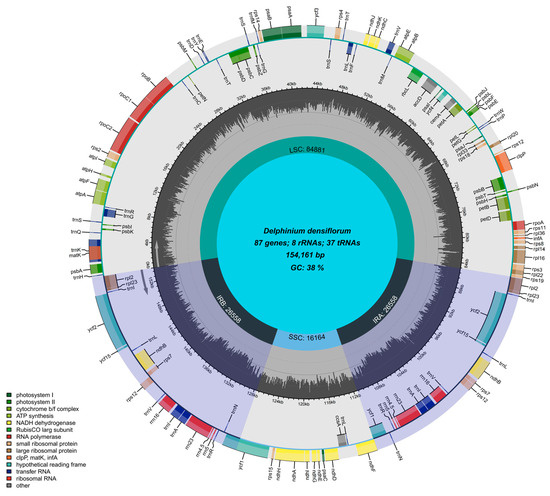
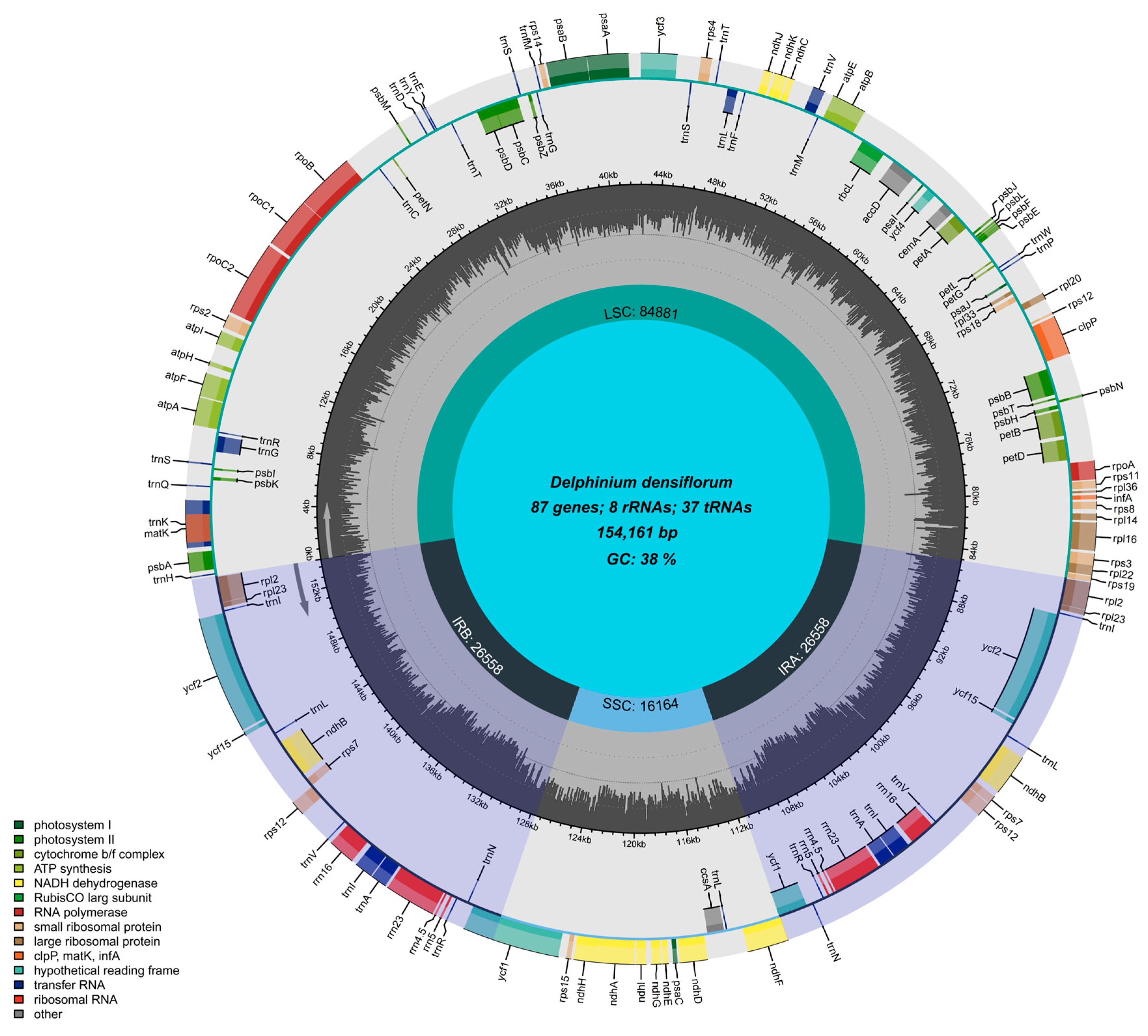
Approximately 5.01 Gb of paired-end sequencing data was generated in this study, providing an estimated coverage depth of ~507× (based on genome size of 154,161 bp) and 100% breadth, ensuring robust assembly quality. Read mapping validation showed that 99.7% of the chloroplast genome was covered by ≥10 reads and 96.2% by ≥50 reads, with an average mapping quality score of Q58, confirming high assembly accuracy and completeness. From these data, a circular chloroplast genome of D. densiflorum (Figure 1) was assembled, with a total length of 154,161 bp and a GC content of 38.24%. It exhibits a typical quadripartite structure consisting of a large single-copy (LSC) region of 84,881 bp, a small single-copy (SSC) region of 16,164 bp, and two identical inverted repeat (IR) regions (IRa and IRb) each of 26,558 bp.
Figure 1.
Chloroplast Genome Map of D. densiflorum. Genes drawn outside the circle are transcribed in the clockwise direction, whereas those inside are transcribed counter-clockwise. Different colored boxes denote distinct functional gene categories. The inner gray ring represents GC content, with darker peaks indicating regions of higher GC content. LSC, large single-copy region (green); SSC, small single-copy region (light blue); IRa and IRb, inverted repeat regions (light purple). Genome size: 154,161 bp; average GC content: 38%.
The chloroplast genome of D. densiflorum contains 131 genes, which can be functionally classified into categories such as photosynthesis and self-replication (Table 2). Among these, there are 87 protein-coding sequences (CDSs), 8 ribosomal RNA (rRNA) genes, and 37 transfer RNA (tRNA) genes, with no pseudogenes detected.
Table 2.
Gene composition of the D. densiflorum chloroplast genome.
3.2. IR Boundary Analysis Among Delphinium Species
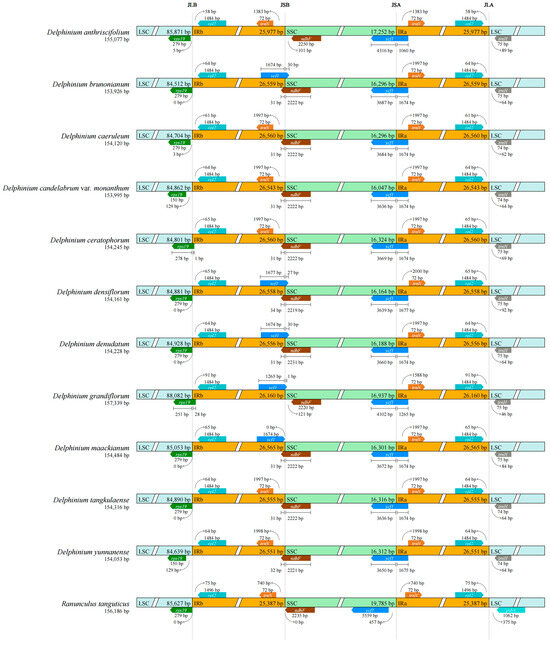
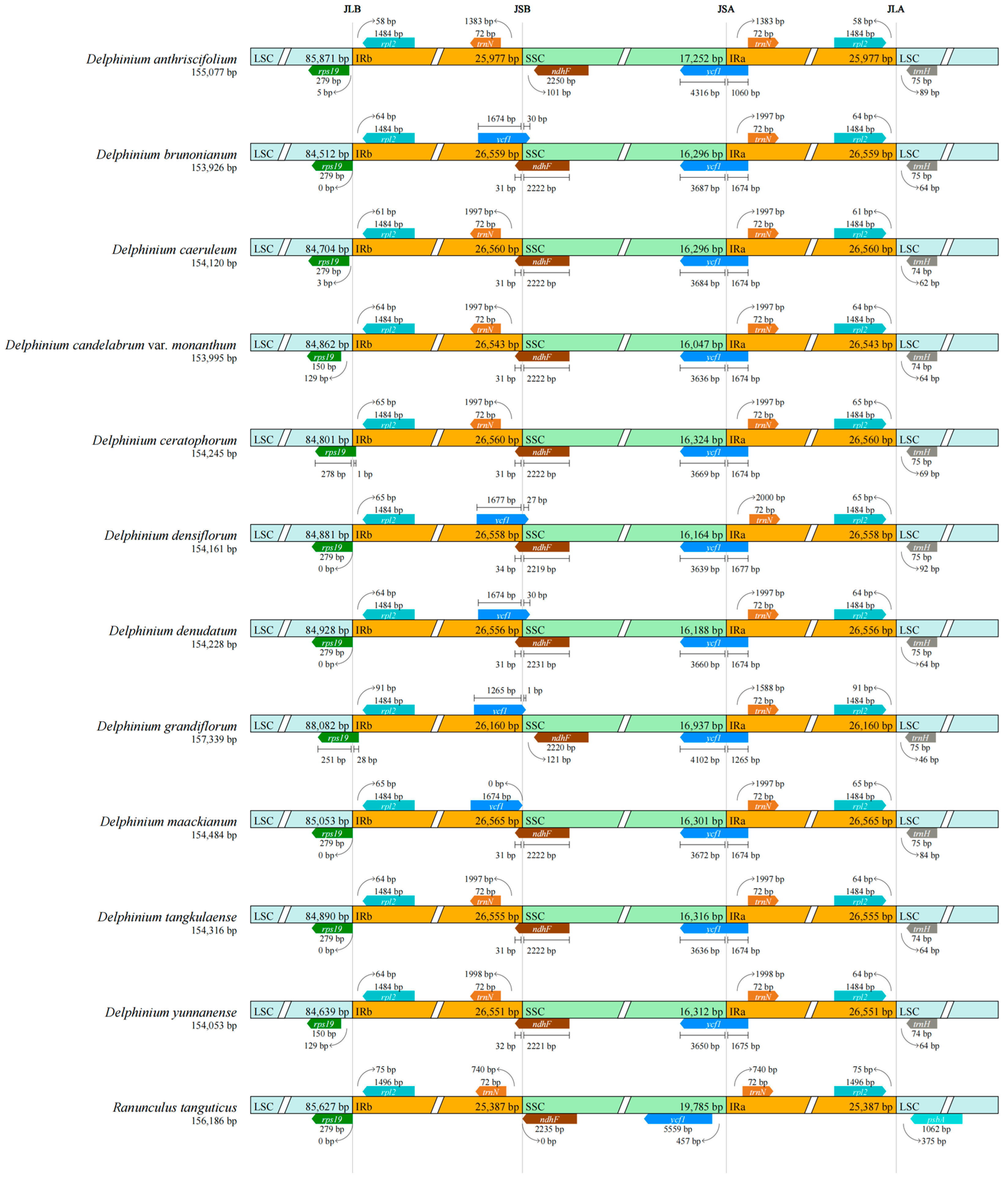
Except for D. densiflorum, the JLB boundary (the boundary between the LSC and IRb regions) of all other species is located within the rpl2 gene, approximately 1484 bp from the start site of this gene (Figure 2). The JLA boundary (the boundary between the IRa and LSC regions) of all species is situated on the same side as the trnH gene, with an interval of approximately 75 bp from the trnH gene. The JSB boundary (the boundary between the IRb and SSC regions) is near the right end of the ndhF gene in most species, at a distance of 68–72 bp, whereas this boundary has shifted in D. densiflorum due to IR region expansion. The JSA boundary (the boundary between the SSC and IRa regions) is located within the ycf1 gene; D. densiflorum exhibits a fragmented duplication of the ycf1 gene at this boundary, with sequences duplicated at positions 3639 bp and 1677 bp, and a 27 bp short sequence immediately following the second duplication.
Figure 2.
Comparative analysis of the four junction sites (JLB, JSB, JSA, and JLA) between the inverted repeat (IRa, IRb) and single-copy (LSC, SSC) regions in twelve Delphinium and one Ranunculus chloroplast genomes. Genes adjacent to the junctions are shown, with numbers indicating the distance (in base pairs) from each junction to the start or end of the neighboring gene. Different colored boxes denote distinct regions.
The length of the IR region in the chloroplast genomes of the 12 species ranges from 25,977 bp (D. anthriscifolium) to 26,565 bp (Delphinium denudatum). Among them, the IR region of D. densiflorum is 26,558 bp in length, and its SSC region is 16,164 bp, the shortest among the tested Delphinium species—further confirming that its IR boundary has undergone significant expansion toward the SSC region.
3.3. Sequence Variation Analysis of Delphinium Chloroplast Genomes
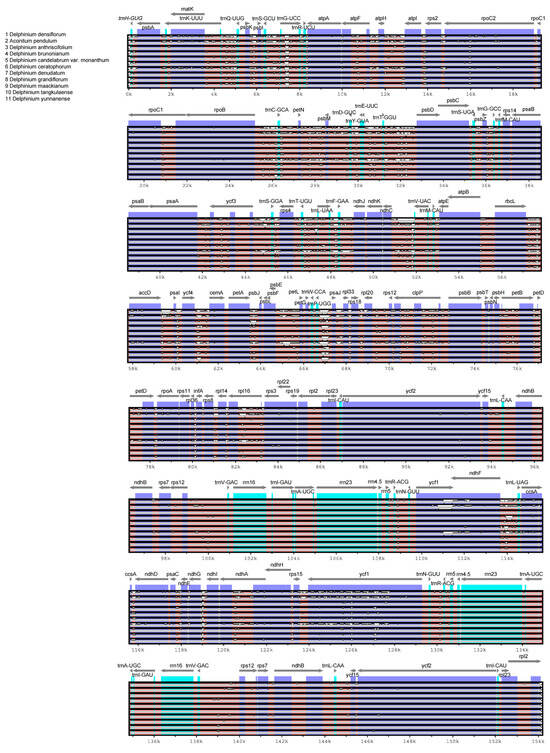
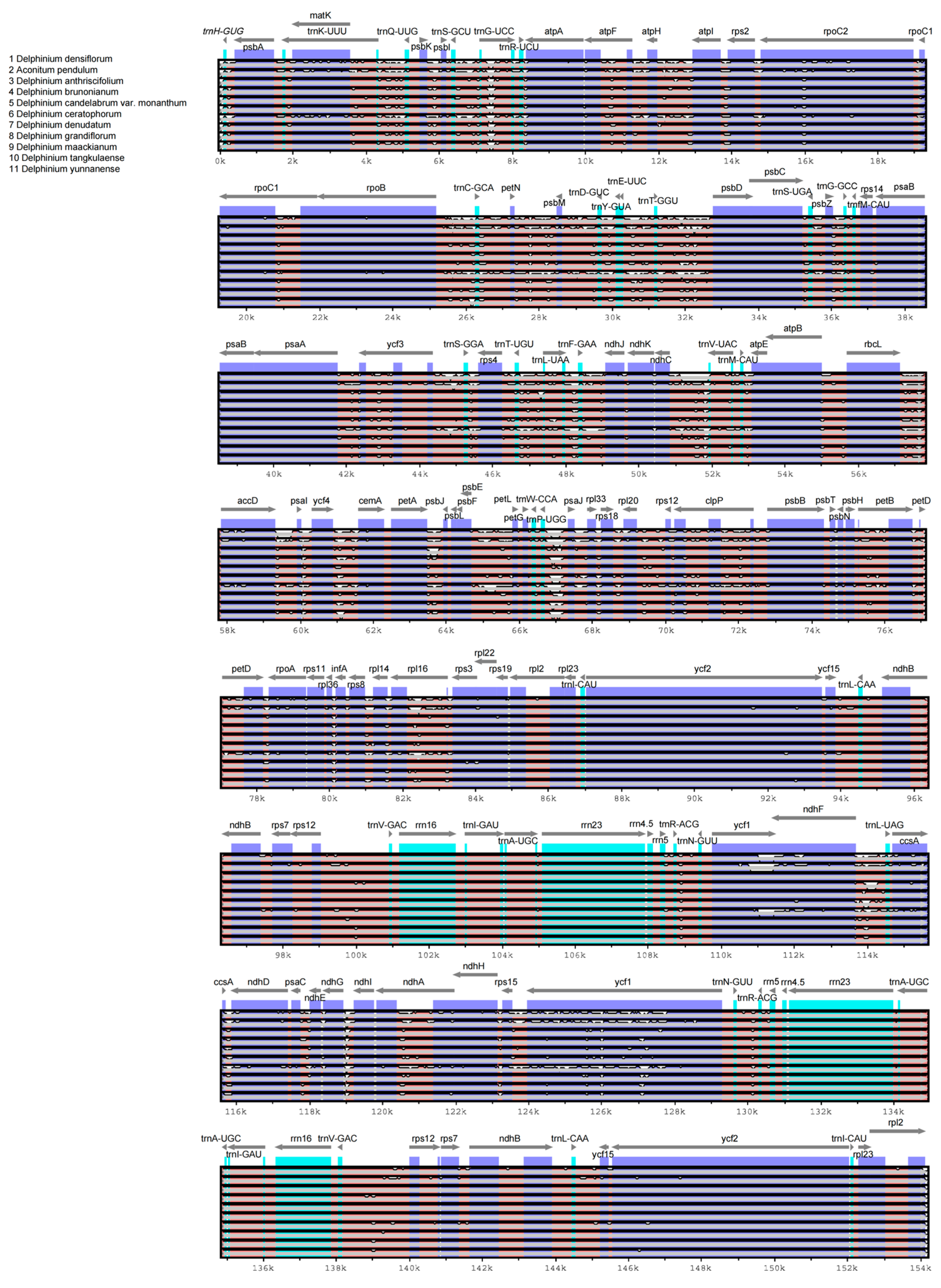
Global multiple sequence alignment of Delphinium chloroplast genomes revealed significant sequence divergence concentrated in non-coding regions. Four hypervariable regions were identified: trnK-rbcL, psbZ-psaB, rps7-ndhE, and rpl32-ycf1 (Figure 3).
Figure 3.
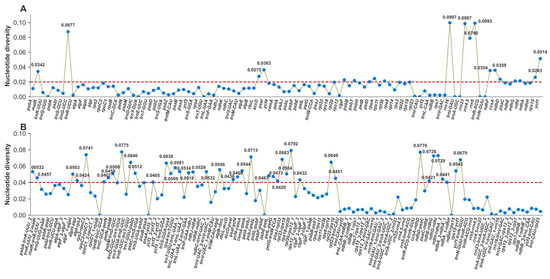
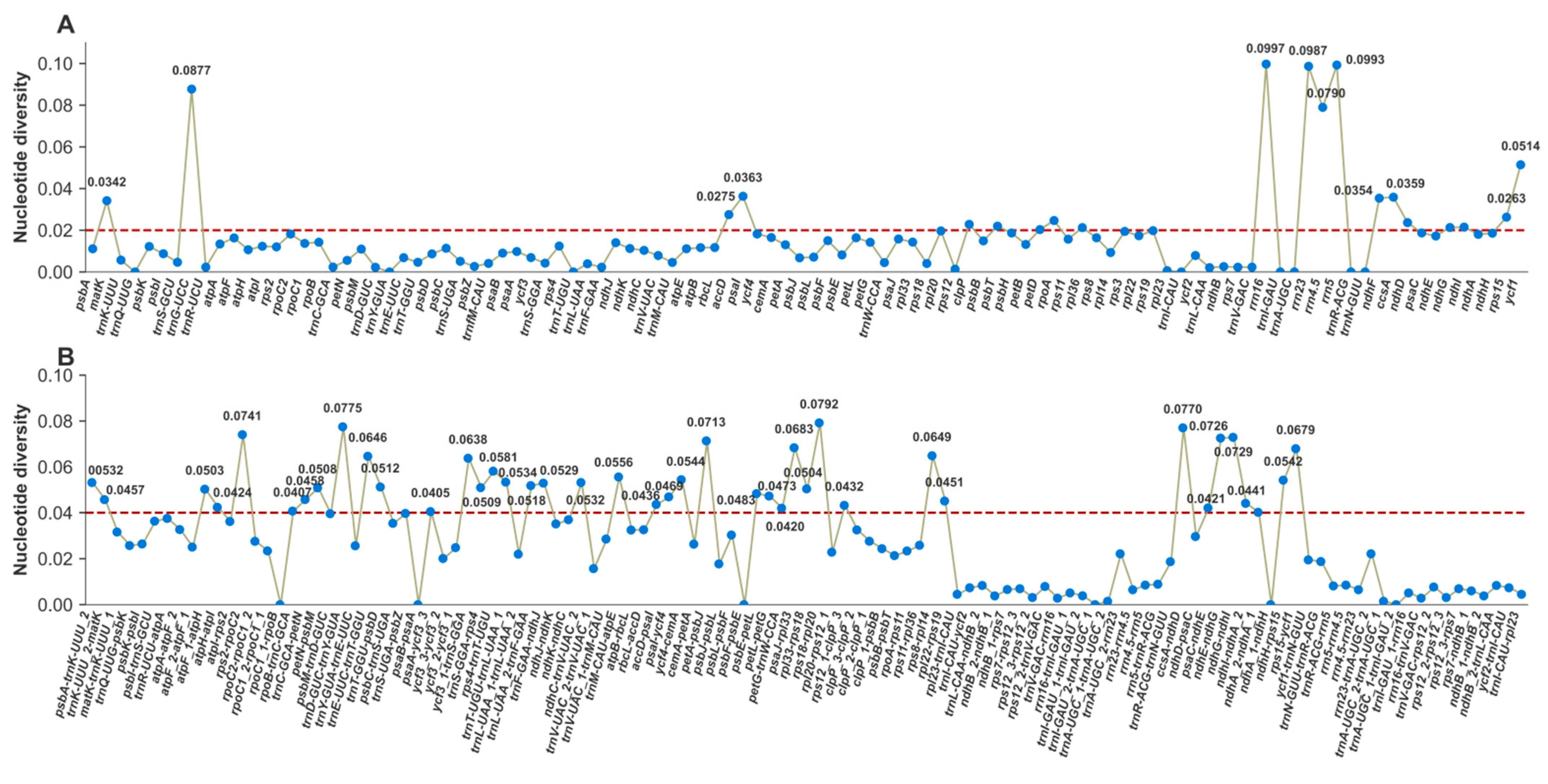
Nucleotide diversity (Pi) of chloroplast genome regions in Delphinium. (A) Protein-coding genes (CDSs). (B) Intergenic spacers (IGSs). The red dashed line indicates the threshold for conserved and hypervariable regions.
Nucleotide diversity (Pi) analysis was performed on 87 protein-coding genes (CDSs) and 114 intergenic spacers (IGSs). For protein-coding genes (Figure 3A), Pi values ranged from 0.0013 (rps12) to 0.0514 (ycf1). Four photosynthetic core genes showed extreme conservation with Pi ≤ 0.01: rps12 (Pi = 0.0013), ndhB (Pi = 0.0026), psbZ (Pi = 0.0027), and psbE (Pi = 0.0082). In contrast, six genes exhibited elevated divergence (Pi ≥ 0.02): ycf1 (Pi = 0.0514), psaI (Pi = 0.0363), ccsA (Pi = 0.0359), ndhF (Pi = 0.0354), matK (Pi = 0.0342), and rpoA (Pi = 0.0247). Notably, ribosomal RNA genes (rrn16, rrn23, and rrn5) displayed the highest diversity among all functional categories (Pi = 0.0987–0.0997).
Intergenic spacers (IGSs) showed significantly higher divergence than coding regions (Figure 3B), with Pi ranging from 0.0000 to 0.0792. Eight IGS regions qualified as hypervariable hotspots (Pi ≥ 0.06) and are suitable as DNA barcode candidates: rps18-rpl20 (Pi = 0.0792), trnD-GUC-trnY-GUA (Pi = 0.0775), ccsA-ndhD (Pi = 0.0770), ndhG-ndhI (Pi = 0.0729), psaJ-rpl33 (Pi = 0.0683), petA-psbJ (Pi = 0.0713), rps15-ycf1 (Pi = 0.0679), and trnE-UUC-trnT-GGU (Pi = 0.0646). These quantitative data confirm the hypervariable regions identified in the whole-genome alignment (Figure 4). At the whole chloroplast genome level, D. densiflorum showed higher similarity to alpine species such as D. caeruleum and D. denudatum.
Figure 4.
Sequence alignment of chloroplast genomes from D. densiflorum and related species using mVISTA. The x-axis represents the position in the reference genome (D. densiflorum). Purple bars indicate exons; gray arrows show gene orientation and transcription direction. Pink/red areas denote regions of high sequence conservation (≥70% identity), while light blue areas indicate non-coding or less conserved regions. Black vertical lines represent SNPs; green vertical lines indicate indels.
To assess the robustness of hypervariable hotspot identification, we performed sensitivity analyses by varying sliding-window parameters and taxon sampling. Using window sizes of 400, 600, and 800 bp (with proportional step sizes of 133, 200, and 267 bp), the six hypervariable CDS (ycf1, psaC, rps11, rpl22, rps18, and rps16) and eight IGS (rps18-rpl20, trnD-GUC-trnY-GUA, ccsA-ndhD, ndhG-ndhI, psaJ-rpl33, petA-psbJ, rps15-ycf1, and trnE-UUC-trnT-GGU) regions remained consistent across all parameter combinations. Similarly, jackknife resampling (iteratively excluding one of the 12 species) recovered the same hotspot regions in >90% of iterations, indicating that the results are robust to single-taxon exclusion.
3.4. Results of Codon Usage Bias (RSCU) Analysis
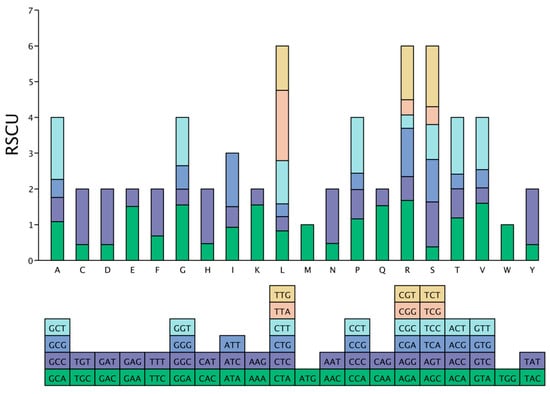
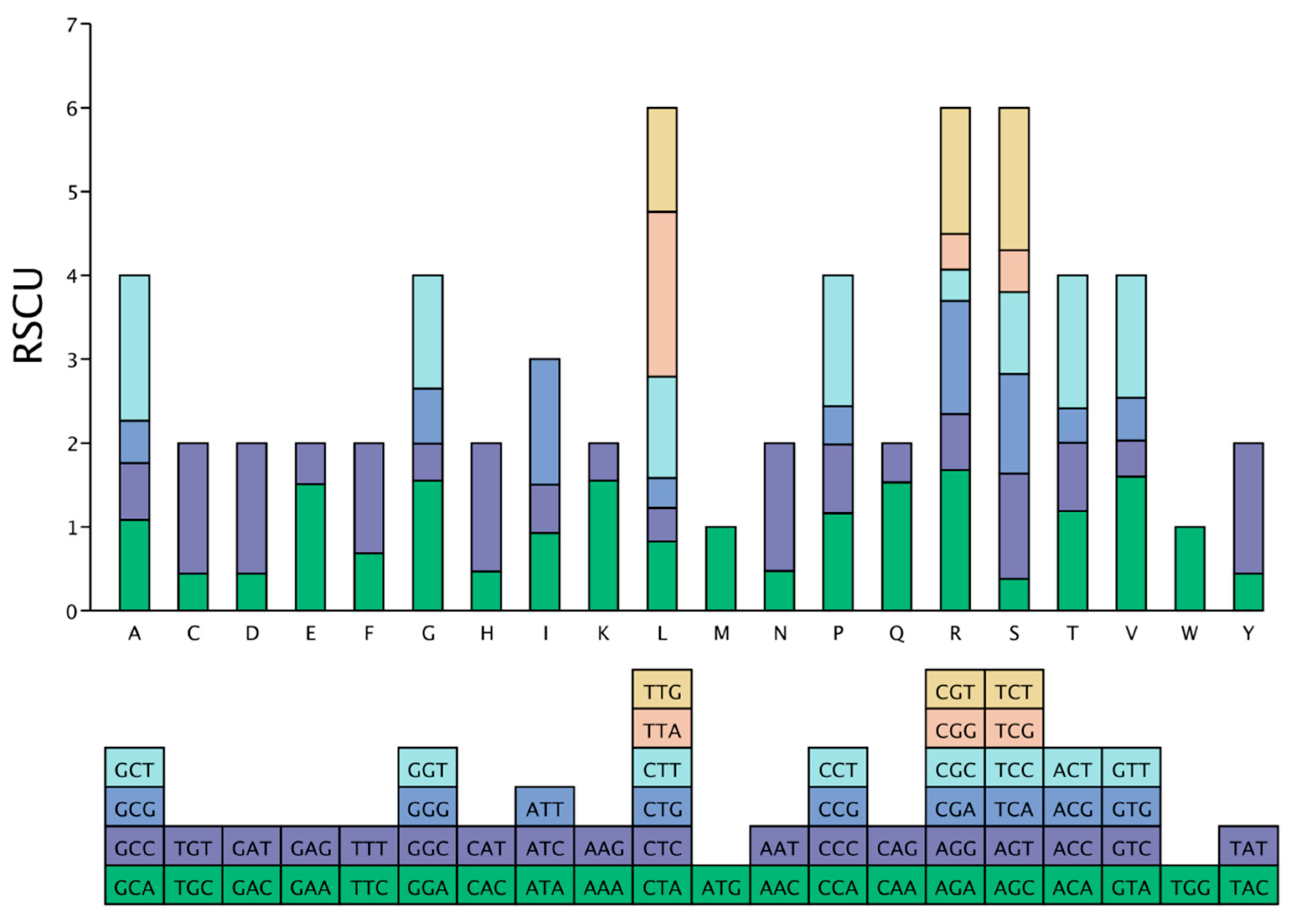
Based on RSCU (Relative Synonymous Codon Usage) profile analysis (Figure 5), the number of encodings among synonymous codons for amino acids in the chloroplast genome of D. densiflorum exhibited differences. Methionine (Met) and Tryptophan (Trp) were each encoded by a single codon; nine amino acids—Cysteine (Cys), Aspartic acid (Asp), Glutamic acid (Glu), Phenylalanine (Phe), Histidine (His), Lysine (Lys), Asparagine (Asn), Glutamine (Gln), and Tyrosine (Tyr)—were each encoded by two codons; Isoleucine (Ile) was encoded by three codons; five amino acids—Alanine (Ala), Glycine (Gly), Proline (Pro), Threonine (Thr), and Valine (Val)—were each encoded by four codons; and three amino acids—Leucine (Leu), Arginine (Arg), and Serine (Ser)—were each encoded by six codons.
Figure 5.
Relative Synonymous Codon Usage (RSCU) Analysis of Various Amino Acids in the Chloroplast Genome of D. densiflorum. Note: The upper and lower parts of the bar chart represent the total usage frequency of all synonymous codons and all synonymous codons corresponding to each amino acid, respectively.
Analysis of the 64 codons in the D. densiflorum chloroplast genome revealed that 32 synonymous codons had a high usage frequency (RSCU ≥ 1), of which 87.50% (28/32) ended with A/U bases. This indicates that the codons used in the chloroplast genome of D. densiflorum show a strong bias toward A/U-ending.
3.5. Phylogenetic Relationships
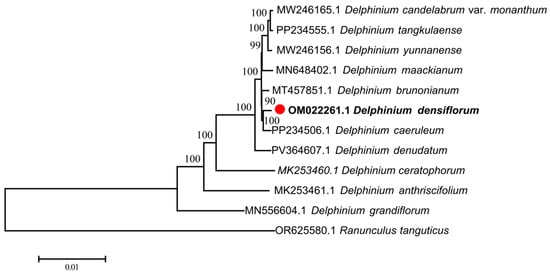
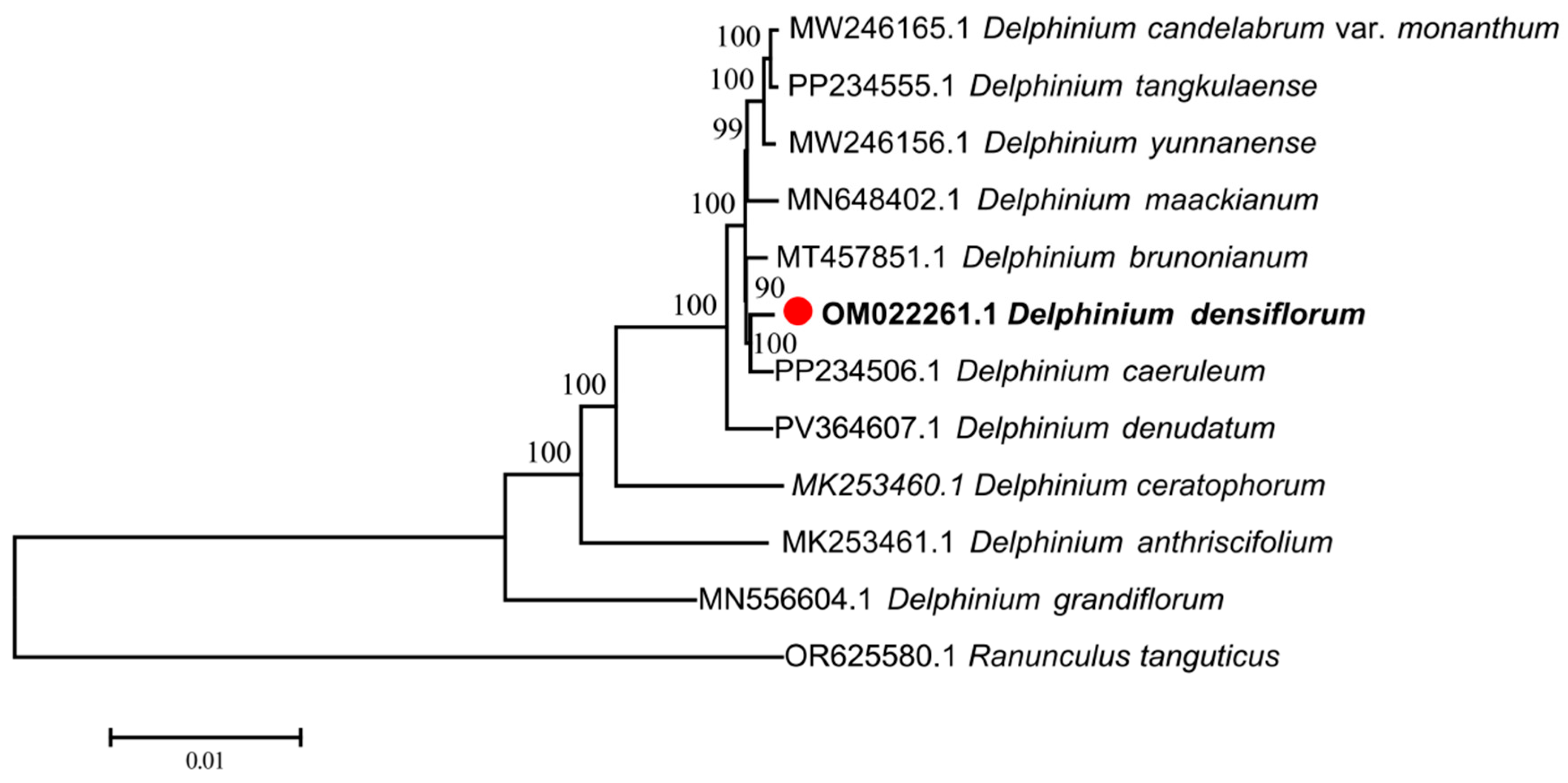
The phylogenetic tree (Figure 6) constructed using the maximum likelihood method (ML, GTR model, bootstrap = 1000) indicates that when R. tanguticus is designated as the outgroup, D. densiflorum is consistently situated within the core group of the genus Delphinium. Along with D. caeruleum and D. denudatum, it forms a monophyletic branch with robust support (BS = 100), categorized as the “Himalaya-Hengduan Rapid Radiating Branch” [31,32]. This branch encompasses six high-altitude species, including D. brunonianum and D. maackianum. In contrast, D. grandiflorum, which exhibits similar morphology, is positioned at the base of the phylogenetic tree and is more closely related to the core group (BS = 100). These findings are consistent with the hypothesis of non-monophyly of the genus Delphinium based on the maternal-inherited chloroplast genome. However, we caution that plastid phylogenies reflect only the maternal evolutionary history and may not fully represent the species tree, particularly given the documented hybridization and polyploidization events in this genus [8,9]. Nuclear ribosomal (ITS) or low-copy nuclear gene data are required to further test this phylogenetic hypothesis.
Figure 6.
Maximum-likelihood (ML) phylogenetic tree of D. densiflorum and its closely related taxa.
4. Discussion
4.1. Conservation and Distinctiveness of Chloroplast Genome Architecture
Here we present the first complete chloroplast genome of D. densiflorum. It retains the canonical quadripartite circular organization of angiosperms, with a GC content of 38.24% and 131 unique genes—both parameters lying within the range reported for other Delphinium species, thereby underscoring the macrostructural conservatism of the genus [33]. Nevertheless, D. densiflorum displays a pronounced expansion of the inverted-repeat (IR) region to 26,558 bp, concomitantly reducing the small single-copy (SSC) region to 16,164 bp—the shortest SSC recorded in Delphinium. This IR elongation is accompanied by autapomorphic structural changes, including a fragmented duplication of ycf1 and a truncated rps19. Similar IR-boundary dynamics have been documented in other alpine lineages, such as Saxifraga species from the European Alps [34] and Rhododendron species distributed across high-elevation gradients [35]. These convergent patterns are consistent with IR expansion-contraction, potentially reflecting a recurrent genomic response to high-altitude environments, though alternative explanations involving shared ancestral polymorphisms or mutational hotspots at IR-SSC junctions cannot be excluded [36]. However, whether these structural changes constitute direct adaptive mechanisms (e.g., safeguarding photosynthetic stability via gene-dosage effects) or result from neutral evolutionary processes and genetic drift remains to be functionally validated [36].
We acknowledge that IR boundary shifts may arise from neutral mutational processes rather than selection. The IR-SSC junctions are known hotspots for illegitimate recombination and slipped-strand mispairing, which can generate expansion-contraction cycles independent of environmental adaptation [34]. The observed correlation between IR expansion and high-altitude distribution in Delphinium could therefore reflect: (i) shared ancestry of alpine lineages rather than convergent adaptation; (ii) genetic drift in small, isolated populations; or (iii) linkage with selected loci elsewhere in the genome. Distinguishing among these hypotheses requires population-level sampling and functional validation.
4.2. IR-Boundary Dynamics and Phylogenetic Signal Within the Genus
Comparative mapping of IR/SC junctions across 12 chloroplast genomes reveals pronounced interspecific shifts within Delphinium, yet the movement adheres to a “micro-slide” model: the JLA (IRa/LSC) and JLB (LSC/IRb) boundaries remain effectively stationary, whereas JSB (IRb/SSC) and JSA (SSC/IRa) undergo concerted displacement in D. densiflorum and its high-elevation allies. This synchronous repositioning constitutes a molecular synapomorphy that recovers the “plateau clade” with 100% bootstrap support [7,37]. While this boundary congruence provides a useful diagnostic trait for distinguishing high-altitude species, it does not necessarily imply adaptive significance; the shared structural pattern may equally reflect shared ancestry or common mutational tendencies at the IR-SSC junctions in this lineage.
4.3. Hypervariable Hotspots and DNA-Barcoding Potential
Sliding-window analysis identified four divergence hotspots (Pi ≥ 0.05) within the intergenic spacers trnK-rbcL, psbZ-psaB and rpl32-ycf1, whereas core photosynthetic loci (psbA, rbcL, atpB, etc.) remained extremely conserved (Pi ≤ 0.01), exemplifying a “functionally conserved, sequence-diverged” genomic landscape [37,38]. The single-copy gene ycf1 exhibited the highest overall variability (Pi = 0.1987) and is increasingly advocated as a universal “super-barcode” because of its length polymorphism and strong phylogenetic resolving power [39]. We detected two tandem repeats within ycf1 (3.6 kb and 1.7 kb) that can be targeted by specific primers for rapid molecular authentication of D. densiflorum against its look-alike congeners [39,40].
4.4. Codon-Usage Bias: A Potential Correlation with High-Altitude Environment
Relative synonymous codon usage (RSCU) analysis revealed that 87.5% of preferred codons in D. densiflorum are AU-ended. This pattern primarily reflects the overall AT-richness (61.76%) of the chloroplast genome, a characteristic common to many angiosperm plastomes due to mutational biases and weak selection on synonymous sites [33,41]. The biased gene conversion and spontaneous deamination of cytosine to thymine in the single-stranded DNA state during replication contribute to the universal AT mutation bias in chloroplast genomes [42]. The plastid tRNA pool is similarly enriched for A/U anticodons, which may reinforce codon preference through translational selection efficiency [43], although the strength of this selection in plastomes is generally considered weak relative to prokaryotes [41].
In addition to these structural and mutational constraints, the observed AU bias has been hypothesized to confer physiological advantages in cold environments. Under the ‘cold-adaptation hypothesis; A/T-rich sequences may reduce DNA/RNA secondary structure stability, potentially facilitating transcription and translation at low temperatures [43,44]. Consistent with this hypothesis, D. densiflorum shows AT enrichment comparable to other Himalayan-Hengduan alpine species [10,23]. However, the low-elevation congener D. grandiflorum (distributed at <2000 m) exhibits similarly high AU bias (86.3% AU-ending codons) [24], indicating that this pattern is likely phylogenetically conserved across Delphinium rather than exclusively driven by altitude-dependent selection. Furthermore, direct experimental evidence linking codon usage to thermal performance is lacking, and the correlation may equally reflect shared ancestry or genetic drift in isolated alpine populations [45].
Distinguishing between neutral and adaptive explanations for codon usage bias requires heterologous expression experiments or comparative transcriptomics across temperature gradients [43]. We therefore interpret the AU-rich profile of D. densiflorum as a candidate pattern for functional validation rather than established evidence of adaptation.
4.5. Phylogenetic Placement and Evidence for the Non-Monophyly of Delphinium
The maximum-likelihood tree reconstructed from 69 shared CDS loci provisionally groups D. densiflorum with D. caeruleum and D. denudatum in a clade receiving 100% bootstrap support, nested within the “Himalaya-Hengduan rapid-radiation lineage.” In contrast, the morphologically similar, low-elevation D. grandiflorum is placed at the base of the tree. While this topology suggests potential paraphyly of Delphinium with respect to other genera in Delphinieae, we emphasize that chloroplast genomes represent a single, maternally inherited locus susceptible to introgression and incomplete lineage sorting. The observed conflict between morphology and plastid phylogeny—whereby D. grandiflorum is distant from high-elevation congeners despite similar floral morphology—is consistent with either (i) convergent evolution of floral traits or (ii) maternal capture of divergent plastid lineages via hybridization [8,12]. Robust inference of generic monophyly requires concordance between plastid and nuclear phylogenies; until such data are available, we interpret the non-monophyly of Delphinium as a provisional hypothesis requiring validation through phylogenomic analyses of nuclear markers [8].
5. Conclusions
Based on the research background and hypotheses, this study is the first to decode the chloroplast genome of D. densiflorum, which not only conforms to the conservative characteristics of the genus Delphinium but also exhibits unique variations adaptive to high altitudes [23]. With a length of 154,161 bp, a GC content of 38.24%, and 131 annotated genes (87 CDSs, 8 rRNAs, and 37 tRNAs), its composition is highly consistent with previously reported Delphinium species, confirming the structural stability of chloroplast genomes in this genus. Notably, the significant expansion of the IR region (26,558 bp in length) toward the SSC region results in the shortest SSC region (16,164 bp) among the tested Delphinium species, accompanied by structural variations at the IR boundaries, specifically partial duplication of ycf1 and truncation of rps19 [38]. These findings document the structural differentiation of the chloroplast genome in D. densiflorum, consistent with patterns observed in other high-altitude lineages. While we discuss potential correlations with environmental pressures, causal relationships between IR expansion and high-altitude adaptation remain hypothetical and require further functional investigation.
Sequence variation analysis reveals a pattern of “conserved photosynthetic core genes (e.g., psbA, rbcL, with Pi ≤ 0.01) and divergent auxiliary genes (e.g., ycf1, psaC, with Pi ≥ 0.05)”, while the strong preference for A/U-ending codons (87.50% of high-frequency codons end with A/U) further illustrates the balanced strategy of D. densiflorum in maintaining basic life activities and adapting to the low-temperature high-altitude environment [23,44].
Phylogenetic analysis based on maternally inherited chloroplast CDSs provisionally clarifies the evolutionary position of D. densiflorum within the context of plastid evolution. This species clusters with high-altitude species such as D. caeruleum and D. denudatum into a clade with 100% bootstrap support. However, given that chloroplast genomes track only maternal lineage history and are subject to introgression, we tentatively interpret the distant relationship with D. grandiflorum as suggestive of potential paraphyly of Delphinium sensu lato, pending validation by biparentally inherited nuclear markers. Future studies incorporating ITSs and low-copy nuclear genes are essential to distinguish between true phylogenetic divergence and maternal lineage sorting or cytoplasmic capture events [8,12]. Consistent with previous molecular systematic studies, this result reveals potential misjudgments in traditional morphological classification due to over-reliance on convergent floral traits and confirms the driving role of the Qinghai-Tibet Plateau uplift and climate fluctuations in the narrow endemic specialization and rapid differentiation of species. Additionally, highly variable genes such as ycf1 and rps11, as well as variable hotspots including trnK-rbcL and rpl32-ycf1, can be developed into efficient DNA barcodes, providing practical technical support for the accurate identification of Delphinium species and the protection and rational utilization of medicinal resources.
Author Contributions
Conceptualization, S.C. and M.M.; data curation, M.W. and X.L.; formal analysis, S.C., Y.S. and M.W.; methodology, S.C. and M.M.; project administration, M.M.; resources, X.L., Y.S. and M.W.; software, S.C. and M.W.; supervision, M.M.; writing—original draft, S.C. and M.W.; writing—review and editing, M.W. and M.M. All authors have read and agreed to the published version of the manuscript.
Funding
The funding for this study was provided by the Qinghai Provincial Science and Technology Program (Grant No. 2024-ZJ-T02).
Institutional Review Board Statement
Not applicable.
Informed Consent Statement
Not applicable.
Data Availability Statement
The data presented in this study are openly available in the GenBank of NCBI at https://www.ncbi.nlm.nih.gov (accessed on 28 October 2025) under the accession number OM022261.1.
Conflicts of Interest
All authors declare that this study was conducted in the absence of any commercial or financial relationships that could be construed as potential conflicts of interest.
References
- Sun, J.-Y.; Li, T.-C. A New Norditerpenoid Alkaloid from Delphinium densiflorum. J. Chem. Res. 2009, 2009, 306–307. [Google Scholar] [CrossRef] [Scilit]
- Delpeuch, P.; Jabbour, F.; Damerval, C.; Schönenberger, J.; Pamperl, S.; Rome, M.; Nadot, S. A Flat Petal as Ancestral State for Ranunculaceae. Front. Plant Sci. 2022, 13, 961906. [Google Scholar] [CrossRef] [Scilit]
- Yin, T.; Cai, L.; Ding, Z. An Overview of the Chemical Constituents from the Genus Delphinium Reported in the Last Four Decades. RSC Adv. 2020, 10, 13669–13686. [Google Scholar] [CrossRef] [Scilit] [PubMed]
- Huang, S.; Wang, J.-Z.; Guo, Q.-J.; Xiao, Y.; Feng, Y.-M.; Chen, L.; Xie, J.; Zhou, X.-L. Diterpenoid Alkaloids from Two Species of Delphinium. J. Asian Nat. Prod. Res. 2023, 25, 718–730. [Google Scholar] [CrossRef] [Scilit] [PubMed]
- Raza, M.; Shaheen, F.; Choudhary, M.I.; Sombati, S.; Rafiq, A.; Suria, A.; Rahman, A.-; DeLorenzo, R.J. Anticonvulsant Activities of Ethanolic Extract and Aqueous Fraction Isolated from Delphinium Denudatum. J. Ethnopharmacol. 2001, 78, 73–78. [Google Scholar] [CrossRef] [Scilit] [PubMed]
- Kiumarsi, A.; Parvinzadeh Gashti, M.; Salehi, P.; Dayeni, M. Extraction of Dyes from Delphinium zalil Flowers and Dyeing Silk Yarns. J. Text. Inst. 2017, 108, 66–70. [Google Scholar] [CrossRef] [Scilit]
- Song, C.; Zhu, J.; Li, H. Complete Chloroplast Genomes of Eight Delphinium Taxa (Ranunculaceae) Endemic to Xinjiang, China: Insights into Genome Structure, Comparative Analysis, and Phylogenetic Relationships. BMC Plant Biol. 2024, 24, 600. [Google Scholar] [CrossRef] [Scilit]
- Jabbour, F.; Renner, S.S. A Phylogeny of Delphinieae (Ranunculaceae) Shows That Aconitum Is Nested within Delphinium and That Late Miocene Transitions to Long Life Cycles in the Himalayas and Southwest China Coincide with Bursts in Diversification. Mol. Phylogenet. Evol. 2012, 62, 928–942. [Google Scholar] [CrossRef] [Scilit]
- Wang, W.; Liu, Y.; Yu, S.-X.; Gao, T.-G.; Chen, Z.-D. Gymnaconitum, a New Genus of Ranunculaceae Endemic to the Qinghai-Tibetan Plateau. TAXON 2013, 62, 713–722. [Google Scholar] [CrossRef] [Scilit]
- Chen, Z.; Yu, X.; Yang, Y.; Wei, P.; Zhang, W.; Li, X.; Liu, C.; Zhao, S.; Li, X.; Liu, X. Comparative Analysis of Chloroplast Genomes within Saxifraga (Saxifragaceae) Takes Insights into Their Genomic Evolution and Adaption to the High-Elevation Environment. Genes 2022, 13, 1673. [Google Scholar] [CrossRef] [Scilit]
- Scobeyeva, V.A.; Artyushin, I.V.; Krinitsina, A.A.; Nikitin, P.A.; Antipin, M.I.; Kuptsov, S.V.; Belenikin, M.S.; Omelchenko, D.O.; Logacheva, M.D.; Konorov, E.A.; et al. Gene Loss, Pseudogenization in Plastomes of Genus Allium (Amaryllidaceae), and Putative Selection for Adaptation to Environmental Conditions. Front. Genet. 2021, 12, 674783. [Google Scholar] [CrossRef] [Scilit]
- Jabbour, F.; Renner, S.S. Consolida and Aconitella Are an Annual Clade of Delphinium (Ranunculaceae) That Diversified in the Mediterranean Basin and the Irano-Turanian Region. TAXON 2011, 60, 1029–1040. [Google Scholar] [CrossRef] [Scilit]
- Zhang, Y.; Zhang, A.; Li, X.; Lu, C. The Role of Chloroplast Gene Expression in Plant Responses to Environmental Stress. Int. J. Mol. Sci. 2020, 21, 6082. [Google Scholar] [CrossRef] [Scilit] [PubMed]
- Lv, R.; Li, Z.; Li, M.; Dogra, V.; Lv, S.; Liu, R.; Lee, K.P.; Kim, C. Uncoupled Expression of Nuclear and Plastid Photosynthesis-Associated Genes Contributes to Cell Death in a Lesion Mimic Mutant. Plant Cell 2019, 31, 210–230. [Google Scholar] [CrossRef] [Scilit] [PubMed]
- Mehmetoğlu, E.; Kaymaz, Y.; Ateş, D.; Kahraman, A.; Tanyolaç, M.B. The Complete Chloroplast Genome of Cicer Reticulatum and Comparative Analysis against Relative Cicer Species. Sci. Rep. 2023, 13, 17871. [Google Scholar] [CrossRef] [Scilit]
- Bolger, A.M.; Lohse, M.; Usadel, B. Trimmomatic: A Flexible Trimmer for Illumina Sequence Data. Bioinformatics 2014, 30, 2114–2120. [Google Scholar] [CrossRef] [Scilit]
- Chen, S.; Zhou, Y.; Chen, Y.; Gu, J. Fastp: An Ultra-Fast All-in-One FASTQ Preprocessor. Bioinformatics 2018, 34, i884–i890. [Google Scholar] [CrossRef] [Scilit]
- Bankevich, A.; Nurk, S.; Antipov, D.; Gurevich, A.A.; Dvorkin, M.; Kulikov, A.S.; Lesin, V.M.; Nikolenko, S.I.; Pham, S.; Prjibelski, A.D.; et al. SPAdes: A New Genome Assembly Algorithm and Its Applications to Single-Cell Sequencing. J. Comput. Biol. 2012, 19, 455–477. [Google Scholar] [CrossRef] [Scilit]
- Tillich, M.; Lehwark, P.; Pellizzer, T.; Ulbricht-Jones, E.S.; Fischer, A.; Bock, R.; Greiner, S. GeSeq—Versatile and Accurate Annotation of Organelle Genomes. Nucleic Acids Res. 2017, 45, W6–W11. [Google Scholar] [CrossRef] [Scilit]
- Li, H.; Durbin, R. Fast and Accurate Short Read Alignment with Burrows-Wheeler Transform. Bioinformatics 2009, 25, 1754–1760. [Google Scholar] [CrossRef] [Scilit]
- Li, H.; Handsaker, B.; Wysoker, A.; Fennell, T.; Ruan, J.; Homer, N.; Marth, G.; Abecasis, G.; Durbin, R. 1000 Genome Project Data Processing Subgroup The Sequence Alignment/Map Format and SAMtools. Bioinformatics 2009, 25, 2078–2079. [Google Scholar] [CrossRef] [Scilit] [PubMed]
- Li, Q.; Guo, X.; Yuan, F.; Nima, C.; Dongzhi, D.; Duojie Li, X. Characterization of the Complete Chloroplast Genome of the Musk Larkspur Delphinium brunonianum (Ranunculales: Ranunculaceae). Mitochondrial DNA Part B 2020, 5, 2394–2396. [Google Scholar] [CrossRef] [Scilit] [PubMed]
- Li, H.; Jia, J.; Abdullah Sammad, A.; Shah, S.A.; Huang, Y.; Cui, Y.; Heidari, P.; Tian, X. Chloroplast Genomes Characterization of Aconitum violaceum, Caltha palustris, and Delphinium denudatum (Ranunculaceae). Ecol. Evol. 2025, 15, e72276. [Google Scholar] [CrossRef] [Scilit] [PubMed]
- Duan, H.; Zhang, Q.; Wang, C.; Li, F.; Tian, F.; Lu, Y.; Hu, Y.; Yang, H.; Cui, G. Analysis of Codon Usage Patterns of the Chloroplast Genome in Delphinium grandiflorum L. Reveals a Preference for AT-Ending Codons as a Result of Major Selection Constraints. PeerJ 2021, 9, e10787. [Google Scholar] [CrossRef] [Scilit]
- Amiryousefi, A.; Hyvönen, J.; Poczai, P. IRscope: An Online Program to Visualize the Junction Sites of Chloroplast Genomes. Bioinformatics 2018, 34, 3030–3031. [Google Scholar] [CrossRef] [Scilit]
- Li, H.; Guo, Q.; Xu, L.; Gao, H.; Liu, L.; Zhou, X. CPJSdraw: Analysis and Visualization of Junction Sites of Chloroplast Genomes. PeerJ 2023, 11, e15326. [Google Scholar] [CrossRef] [Scilit]
- Frazer, K.A.; Pachter, L.; Poliakov, A.; Rubin, E.M.; Dubchak, I. VISTA: Computational Tools for Comparative Genomics. Nucleic Acids Res. 2004, 32, W273–W279. [Google Scholar] [CrossRef] [Scilit]
- Rozas, J.; Ferrer-Mata, A.; Sánchez-DelBarrio, J.C.; Guirao-Rico, S.; Librado, P.; Ramos-Onsins, S.E.; Sánchez-Gracia, A. DnaSP 6: DNA Sequence Polymorphism Analysis of Large Data Sets. Mol. Biol. Evol. 2017, 34, 3299–3302. [Google Scholar] [CrossRef] [Scilit]
- Katoh, K.; Standley, D.M. MAFFT Multiple Sequence Alignment Software Version 7: Improvements in Performance and Usability. Mol. Biol. Evol. 2013, 30, 772–780. [Google Scholar] [CrossRef] [Scilit]
- Kumar, S.; Stecher, G.; Li, M.; Knyaz, C.; Tamura, K. MEGA X: Molecular Evolutionary Genetics Analysis across Computing Platforms. Mol. Biol. Evol. 2018, 35, 1547–1549. [Google Scholar] [CrossRef] [Scilit]
- Luo, D.; Yue, J.; Sun, W.; Xu, B.; Li, Z.; Comes, H.P.; Sun, H. Evolutionary History of the Subnival Flora of the Himalaya-Hengduan Mountains: First Insights from Comparative Phylogeography of Four Perennial Herbs. J. Biogeogr. 2016, 43, 31–43. [Google Scholar] [CrossRef] [Scilit]
- Xiang, K.-L.; Aytaç, Z.; Liu, Y.; Espinosa, F.; Jabbour, F.; Byng, J.W.; Zhang, C.-F.; Erst, A.S.; Wang, W. Recircumscription of Delphinium Subg. Delphinium (Ranunculaceae) and Implications for Its Biogeography. TAXON 2017, 66, 554–566. [Google Scholar] [CrossRef] [Scilit]
- Wicke, S.; Schneeweiss, G.M.; dePamphilis, C.W.; Müller, K.F.; Quandt, D. The Evolution of the Plastid Chromosome in Land Plants: Gene Content, Gene Order, Gene Function. Plant Mol. Biol. 2011, 76, 273–297. [Google Scholar] [CrossRef] [Scilit] [PubMed]
- Leng, Z.; Pang, Z.; He, Z.; Gao, Q. Comparative Analysis of Chloroplast Genomes of 19 Saxifraga Species, Mostly from the European Alps. Int. J. Mol. Sci. 2025, 26, 6015. [Google Scholar] [CrossRef] [Scilit]
- Zhao, S.; Gao, X.; Yu, X.; Yuan, T.; Zhang, G.; Liu, C.; Li, X.; Wei, P.; Li, X.; Liu, X. Comparative Analysis of Chloroplast Genome of Meconopsis (Papaveraceae) Provides Insights into Their Genomic Evolution and Adaptation to High Elevation. Int. J. Mol. Sci. 2024, 25, 2193. [Google Scholar] [CrossRef] [Scilit]
- Tian, Z.; Wang, J.; Zeng, Z.; Chen, J.; Zhang, T.; La, Q. Chromosome-Level Genome Assembly of the Tibetan Medicinal Plant Duyiwei (Phlomoides rotata). Sci. Data 2025, 12, 1576. [Google Scholar] [CrossRef] [Scilit]
- Xin, Y.; Yu, W.-B.; Eiadthong, W.; Cao, Z.; Li, Q.; Yang, Z.; Zhao, W.; Xin, P. Comparative Analyses of 18 Complete Chloroplast Genomes from Eleven Mangifera Species (Anacardiaceae): Sequence Characteristics and Phylogenomics. Horticulturae 2023, 9, 86. [Google Scholar] [CrossRef] [Scilit]
- Daniell, H.; Lin, C.-S.; Yu, M.; Chang, W.-J. Chloroplast Genomes: Diversity, Evolution, and Applications in Genetic Engineering. Genome Biol. 2016, 17, 134. [Google Scholar] [CrossRef] [Scilit]
- Dong, W.; Xu, C.; Li, C.; Sun, J.; Zuo, Y.; Shi, S.; Cheng, T.; Guo, J.; Zhou, S. Ycf1, the Most Promising Plastid DNA Barcode of Land Plants. Sci. Rep. 2015, 5, 8348. [Google Scholar] [CrossRef] [Scilit]
- Li, H.; Xiao, W.; Tong, T.; Li, Y.; Zhang, M.; Lin, X.; Zou, X.; Wu, Q.; Guo, X. The Specific DNA Barcodes Based on Chloroplast Genes for Species Identification of Orchidaceae Plants. Sci. Rep. 2021, 11, 1424. [Google Scholar] [CrossRef] [Scilit]
- Parvathy, S.T.; Udayasuriyan, V.; Bhadana, V. Codon Usage Bias. Mol. Biol. Rep. 2022, 49, 539–565. [Google Scholar] [CrossRef] [Scilit]
- Hershberg, R.; Petrov, D.A. Evidence That Mutation Is Universally Biased towards AT in Bacteria. PLoS Genet. 2010, 6, e1001115. [Google Scholar] [CrossRef] [Scilit]
- Yang, C.; Wang, B.; Chen, J.; Sun, Q. Codon Usage Bias Analysis of the Chloroplast Genomes in Medicinal Plants of Ampelopsis Michaux. S. Afr. J. Bot. 2025, 181, 512–522. [Google Scholar] [CrossRef] [Scilit]
- Anandan, J.; Shanmugam, R.; Alharbi, N.S.; Thiruvengadam, M. Green-Synthesized Silver Nanoparticles from Centella Asiatica and Ayapana Triplinervis: A Novel Approach to Treating Wound Infections and Reducing Antimicrobial Resistance. S. Afr. J. Bot. 2025, 177, 617–629. [Google Scholar] [CrossRef] [Scilit]
- Plotkin, J.B.; Kudla, G. Synonymous but Not the Same: The Causes and Consequences of Codon Bias. Nat. Rev. Genet. 2011, 12, 32–42. [Google Scholar] [CrossRef] [Scilit]

Disclaimer/Publisher’s Note: The statements, opinions and data contained in all publications are solely those of the individual author(s) and contributor(s) and not of MDPI and/or the editor(s). MDPI and/or the editor(s) disclaim responsibility for any injury to people or property resulting from any ideas, methods, instructions or products referred to in the content. |
© 2026 by the authors. Licensee MDPI, Basel, Switzerland. This article is an open access article distributed under the terms and conditions of the Creative Commons Attribution (CC BY) license.