


Abstract
Background/Objectives: The A1/A2 polymorphism of the bovine CSN2 gene, encoding β-casein, is relevant to milk composition and breeding strategies for A2 milk production. This study aimed to compare the frequencies of A1 and A2 variants in three cattle breeds maintained in Poland: Simmental, Polish Red, and Polish Black-and-White. Methods: A total of 898 cows (568 Simmental, 273 Polish Red, and 57 Polish Black-and-White) were analyzed. DNA was isolated from hair follicles previously collected for routine parentage verification, independently of this study. The CSN2 polymorphism (rs43703011) was genotyped using a TaqMan allelic discrimination assay, with selected genotypes validated by Sanger sequencing. Results: Genotype and allele frequencies differed among the sampled populations. In Simmental cattle, A1A1, A1A2, and A2A2 genotype frequencies were 17.8%, 52.6%, and 29.6%, respectively, with an A2 allele frequency of 55.9%. Corresponding frequencies in Polish Red cattle were 30.4%, 49.5%, and 20.1%, with an A2 allele frequency of 44.9%. Polish Black-and-White cattle showed frequencies of 47.4%, 47.4%, and 5.2%, respectively, with an A2 allele frequency of 28.9%. Significant differences in genotype distributions were observed between the sampled populations (p < 0.001 and p = 0.007). Conclusions: The results demonstrate variation in CSN2 A1/A2 polymorphism frequencies among the studied cattle populations, with the highest A2 allele frequency observed in Simmental cattle. These findings suggest that CSN2 genotyping could support breeding strategies aimed at increasing the frequency of the A2 allele, particularly through the selection of A2A2 breeding animals.
Keywords:
CSN2; β-casein; A1/A2 polymorphism; A2 milk; cattle; Simmental; Polish Red; Polish Black-and-White; genetic selection 1. Introduction
Cow’s milk proteins, particularly casein fractions, play key roles in both human nutrition and the technological suitability of milk for processing. Caseins influence, among other factors, the rate of coagulation, curd structure, and cheese-making efficiency. One of the key proteins in the casein fraction is β-casein—a protein composed of 209 amino acid residues and characterized by a high degree of genetic polymorphism [1]. To date, 12 genetic variants of β-casein have been identified (A1, A2, A3, B, C, D, E, F, H1, H2, I, and G), of which seven (A1, A2, A3, B, C, I, and E) occur in European cattle breeds [2]. The most common variants are A1 and A2, whereas variant B occurs less frequently, and variants A3 and C are considered marginal [1,3].
Particular interest among both the scientific community and consumers has been focused on the A2 variant of β-casein, which differs from the A1 variant by a single point mutation in codon 67 of exon 7 of the CSN2 gene, involving the substitution of proline in the A2 variant with histidine in the A1 variant [4]. This change is biologically significant because it affects the susceptibility of the β-casein molecule to enzymatic hydrolysis in the digestive tract. The A1 variant of β-casein may release β-casomorphin-7 (BCM-7) during digestion, a bioactive peptide with opioid activity. Previous studies have suggested possible associations between BCM-7 exposure and several health conditions, including gastrointestinal disorders and neurological conditions such as autism spectrum disorder. In contrast, milk containing only A2 β-casein has been associated with improved gastrointestinal tolerance in some human studies. However, the potential relationship between β-casein variants and neurological disorders remains unclear and requires further investigation [5,6]. Some studies have also suggested possible associations between BCM-7 and neurological disorders such as autism and schizophrenia, although the available evidence is insufficient to establish a causal relationship [7,8]. Furthermore, the consumption of milk containing A1 β-casein has been associated in some studies with symptoms resembling lactose intolerance, including gastrointestinal discomfort and cognitive dysfunction [9]. Such effects have not been consistently observed following the consumption of milk containing only A2 β-casein; however, the clinical significance of β-casein polymorphism remains a subject of debate and requires further investigation [3]. Importantly, the present study evaluates CSN2 polymorphism rather than milk composition, digestion, or human health outcomes.
Although the CSN2 polymorphism has been investigated in several cattle breeds, additional population-specific data are needed to better characterize variation in A1 and A2 allele frequencies. The aim of this study was to determine and compare the frequencies of CSN2 A1 and A2 alleles and genotypes in Simmental (SM), Polish Red (PR), and Polish Black-and-White (ZB) cattle maintained in Poland. We hypothesized that genotype and allele distributions would differ among the studied populations. The results provide additional information on CSN2 genetic variation and may support future studies on breeding strategies for A2 milk production.
2. Materials and Methods
2.1. Materials
The genetic identification study was conducted at the Experimental Station of the National Research Institute of Animal Production in Odrzechowa, maintaining Simmental cattle; at the Experimental Station of the National Research Institute of Animal Production in Chorzelów, maintaining Polish Black-and-White cattle; and in 12 individual farms maintaining Polish Red cattle located in the Limanowa district. Hair samples with follicles were collected during routine diagnostic DNA testing for pedigree verification and used for DNA isolation; thus, the samples were not collected through a population-wide random sampling procedure. The Simmental and Polish Black-and-White cattle originated from separate experimental stations, whereas the Polish Red cattle were sampled from 12 individual farms, reflecting the fragmented farming structure and herd management characteristics of this breed. Consequently, the study populations differed in sample size and herd origin, which should be considered when interpreting the results. In total, biological material was collected and identified from 898 dairy cows, including 568 Simmental, 273 Polish Red, and 57 Polish Black-and-White cows.
2.2. DNA Extraction, Genotyping, and Sequencing
Genetic analyses aimed at determining the β-casein gene were performed using the collected biological material (hair follicles), from which DNA was isolated using the commercial Kit for DNA Purification Sherlock AX (A&A Biotechnology, Gdańsk, Poland). The genotyping was performed on StepOne Plus Real-time PCR System Applied Biosystems, Life Technology, Carlsbad, CA, USA, using the Allelic Discrimination method according to the manufacturer’s protocol. The primers and TaqMan MGB probes for the CSN2 polymorphism (ENSBTAT00000003409.7:c.350A>C; rs43703011) were designed based on the ENSBTAG00000002632 reference using the Custom TaqMan® Assay Design Tool (online tool; Life Technologies). The Custom TaqMan SNP Genotyping Assay Service contains CSN2 F:TCTTTCCAGGATGAACTCCAGGAT and CSN2 R:GGTTTGAGTAAGAGGAGGGATGTTT primers and fluorescently labelled probes: CSN2 VIC—CCCATCCATAACAGCC and CSN2 FAM—CCATCCCTAACAGCC.
The genotyping reactions were performed using TaqManTM Genotyping Master Mix (Applied Biosystems, Foster City, CA, USA) according to the manufacturer’s protocol in the presence of positive (samples representing each variant genotype and confirmed by Sanger sequencing) and negative (sterile water) controls in each run. The validation of the obtained results was performed by Sanger sequencing. The randomly selected DNA samples (5% of all samples) were amplified using primers CSN2_F:TCCAGGATGAACTCCAGGAT and CSN2_R:GCAGAGGAAGGTGCAGATTT designed using Primer3 Input (version 0.4.0) [10]. The CSN2 gene fragments were amplified using 2x Phanta Max Master Mix (Vazyme, Nanjing, China) polymerase. PCR amplification was performed under the following cycling conditions: initial denaturation at 95 °C for 3 min, followed by 35 cycles of denaturation at 95 °C for 15 s, annealing at 57 °C for 15 s, and extension at 72 °C for 30 s. A final extension step was performed at 72 °C for 5 min. Next, purification was performed using the EPPIC enzymatic purification kit (A & A Biotechnology, Gdańsk, Poland), and sequencing PCR was performed using BigDye Terminator v3.1 (Applied Biosystems) according to the manufacturer’s protocol. After BigDye XTerminatorTM purification (Applied Biosystems), the amplicons were sequenced on the 3500 Series Genetic Analyzer platform (Applied Biosystems), based on the manufacturer’s instructions. The raw results were analyzed using BioEdit 7.2 [11].
A total of 45 samples, representing 5.01% of the analyzed animals, were selected for validation by Sanger sequencing. The validation set included 15 samples for each genotype (A1A1, A1A2, and A2A2), distributed across the three studied cattle populations. For each genotype, three samples were selected from Polish Red cattle and three from Polish Black-and-White cattle, while the remaining nine samples were selected from Simmental cattle. Thus, the validation set comprised 27 Simmental, nine Polish Red, and nine Polish Black-and-White samples. Complete concordance (100%) was observed between the genotypes determined using the TaqMan allelic discrimination assay and those confirmed by Sanger sequencing. The overall genotype call rate was 100%.
2.3. Statistical Analysis
Genotype frequencies were calculated as the proportion of animals carrying each CSN2 genotype within each breed. Allele frequencies were calculated directly from genotype counts using the following formulas: f(A1) = (2nA1A1 + nA1A2)/(2N) and f(A2) = (2nA2A2 + nA1A2)/(2N), where N represents the total number of successfully genotyped animals.
Expected genotype counts under Hardy–Weinberg equilibrium were calculated as N × f(A1)2, 2N × f(A1) × f(A2), and N × f(A2)2 for A1A1, A1A2, and A2A2, respectively. The expected genotype frequencies are these expected counts divided by N. Approximate 95% confidence intervals for genotype proportions were calculated using the Wilson score method (n = number of animals). Allele-frequency intervals were calculated using the normal approximation with the animal-level sample variance of A2 dosage (0, 0.5 or 1), so both alleles from the same animal were not treated as independent observations.
Differences in genotype distributions between the sampled cattle populations were assessed using Pearson’s chi-square test of independence. For each pairwise comparison, all expected cell counts exceeded five; therefore, exact tests were not required. The resulting p-values were adjusted for multiple comparisons using the Holm method. Hardy–Weinberg equilibrium was evaluated separately within each population using an exact test implemented in the Hardy–Weinberg package in R. Statistical significance was set at p < 0.05.
3. Results
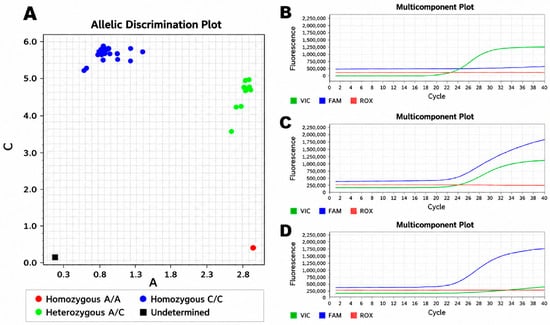
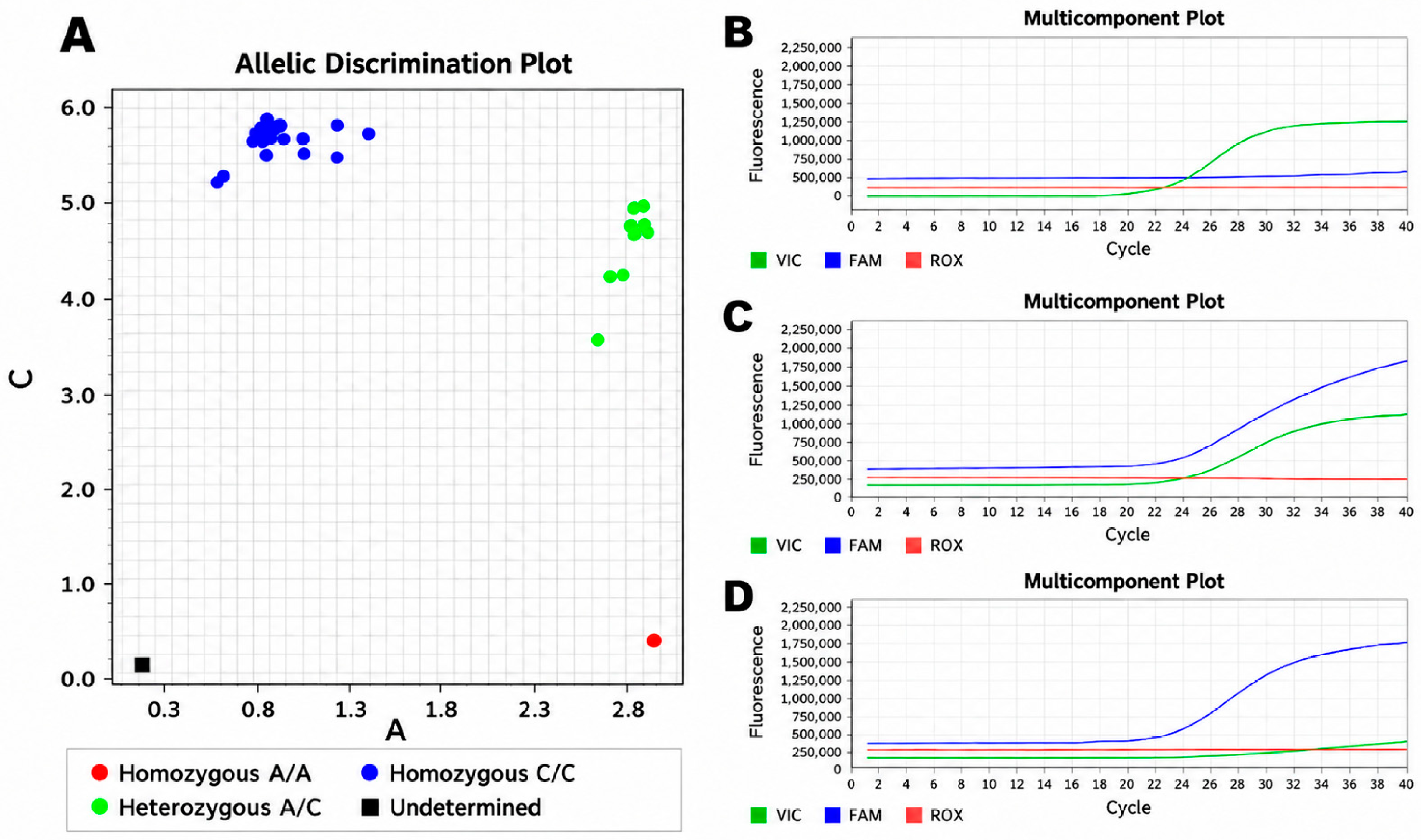
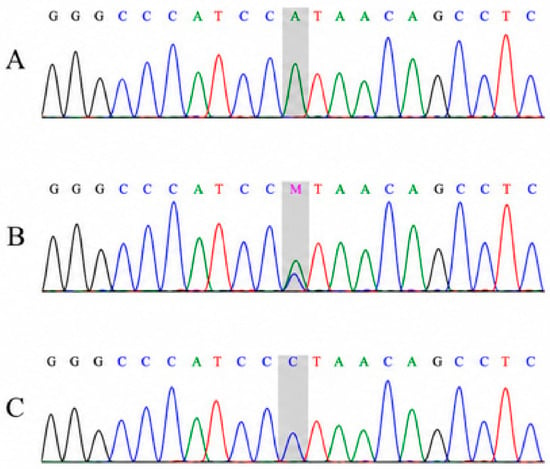
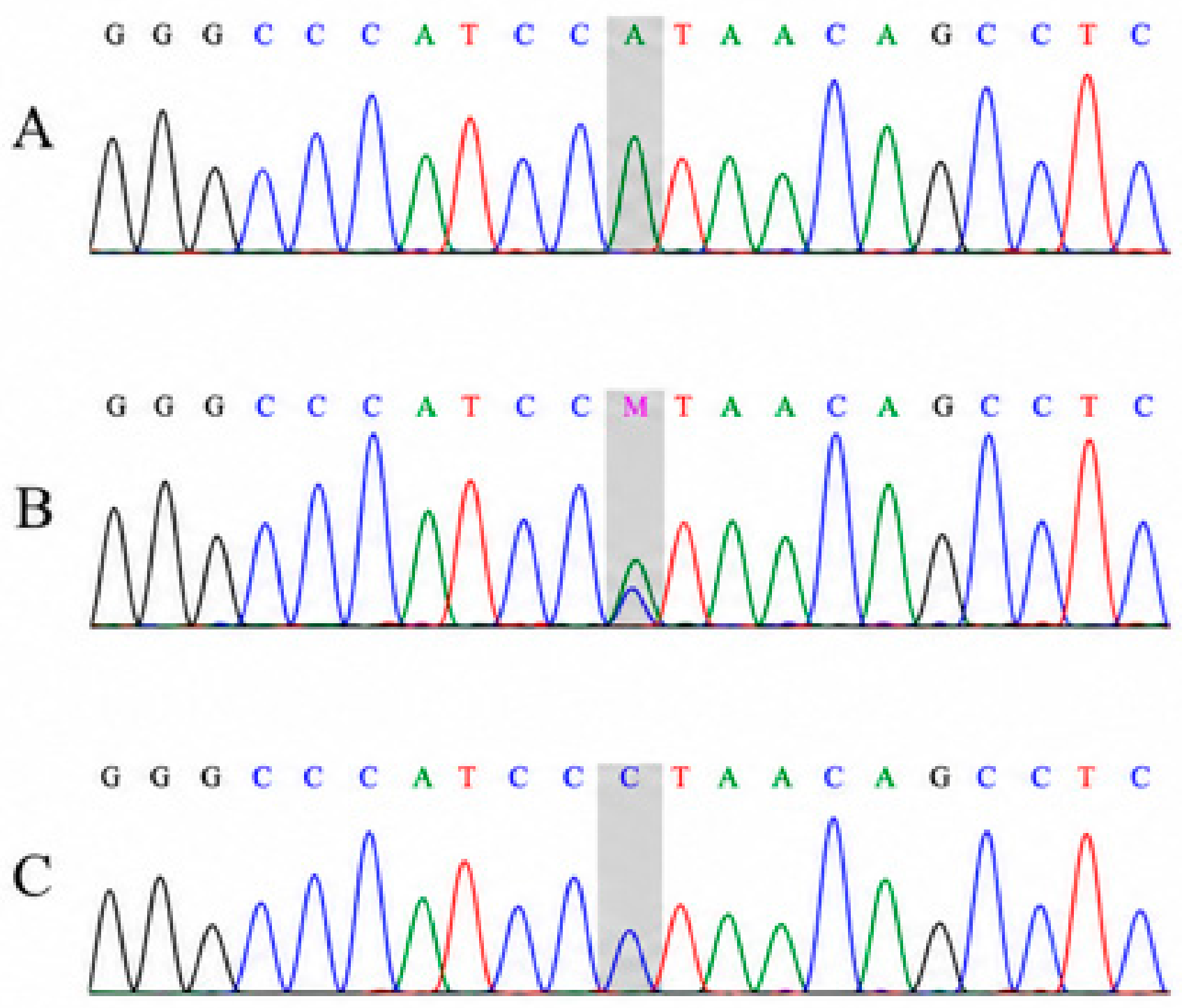
The optimized TaqMan allelic discrimination assay enabled the identification of the CSN2 A1 and A2 alleles and the classification of animals into three genotypes: A1A1, A1A2, and A2A2. All three genotypes were identified (Figure 1) and then confirmed by Sanger sequencing (Figure 2).
Figure 1.
Genotype distribution for samples determined by the allelic discrimination method (A); amplification curves—multicomponent plots for samples A1A1, A1A2, and A2A2, respectively (B–D); the black square represents the negative control.
Figure 2.
Sequencing chromatograms of a fragment of the bovine CSN2 gene from 3 individuals carrying different genetic variants of the gene: (A)—A1A1; (B)—A1A2; and (C)—A2A2. The analyzed mutation site is highlighted in gray, while individual nucleotides are indicated by different colors.
Analysis of the CSN2 genotype frequency revealed clear differences among the sampled populations of the studied cattle breeds: Simmental, Polish Red, and Polish Black-and-White. In Simmental dairy cows, a favourable genetic structure was observed in the studied population. The most frequently represented genotype was the A1A2 heterozygote, accounting for 52.6% of the population. A high frequency was also recorded for the A2A2 homozygote (29.6%), whereas the A1A1 genotype occurred least frequently, representing 17.8% of the population. This distribution of genotypes indicates a clear predominance of the A2 allele, considered desirable from the perspective of A2 milk production (Table 1).
Table 1.
Distribution of genotype and allele frequencies with 95% confidence intervals and Hardy–Weinberg equilibrium analysis in three cattle breeds.
The frequency of β-casein alleles in the studied Simmental population was estimated based on genotype frequencies. The frequency of the A1 allele was 44.1%, whereas the frequency of the A2 allele was 55.9% (Table 1). The predominance of the A2 allele over the A1 allele indicates the high breeding potential of this breed for the production of milk containing exclusively A2 β-casein. At the same time, the considerable proportion of A1A2 heterozygotes suggests substantial genetic potential within the population and the possibility of further increasing the A2 allele frequency through targeted breeding selection. Preference for bulls with the A2A2 genotype could, increase the proportion of A2A2 homozygotes in the herd while simultaneously reducing the occurrence of the A1A1 genotype.
The identification of β-casein genotypes in 273 Polish Red cows revealed a diverse genetic structure of the population. The largest group consisted of A1A2 heterozygotes (49.5%), whereas the proportion of A1A1 homozygotes was approximately 30%, and that of A2A2 homozygotes was approximately 20.1%. This genotype distribution indicates the predominance of the heterozygous genotype and a moderate proportion of the A2A2 genotype. In the studied population, the frequency of the A1 allele was 55.1%, while the frequency of the A2 allele was 44.9% (Table 1). This means that despite the predominance of the A1 allele, the A2 allele occurs in the population relatively frequently, providing a basis for breeding selection aimed at increasing the proportion of the A2A2 genotype. The substantial percentage of A1A2 heterozygotes indicates a high genetic potential of the population for modifying the allele structure of the CSN2 gene. Appropriate selection of bulls with the A2A2 genotype could, within a relatively short time, lead to an increase in the frequency of the A2 allele and a reduction in the occurrence of the A1A1 genotype.
In contrast, the frequency of the β-casein gene in the studied population of Polish Black-and-White cows at the Experimental Station in Chorzelów indicates a clear predominance of the A1 allele. The proportions of genotypes were as follows: A1A2—47.4%, A1A1—47.4%, and A2A2—5.2%. These values allowed for the calculation of allele frequencies within the population, amounting to 71.1% for the A1 allele and 28.9% for the A2 allele. The obtained results confirm the predominance of the A1 allele and the relatively low frequency of the A2 allele, although the latter is not entirely marginal in the studied group of animals.
The proportion of A1A2 heterozygotes was higher than theoretically expected, whereas the frequencies of both homozygous forms—A1A1 and A2A2—were lower than expected. Such variation could potentially be associated with non-random mating; the influence of breeding selection; or population structure effects, including the use of specific bulls in reproduction. The increased proportion of heterozygotes could theoretically be associated with the use of A1A2 bulls, leading to a higher frequency of this genotype in subsequent generations. However, no statistically significant deviation from Hardy–Weinberg equilibrium was detected (Table 1); therefore, these potential explanations remain speculative.
Analysis of the individual genotype distributions indicates that the current breeding potential associated with the production of milk containing exclusively A2 β-casein is limited. The low proportion of the A2A2 genotype (5.2%) means a low possibility of obtaining A2 milk in the studied population. At the same time, the A2 allele frequency of 28.9% suggests a realistic opportunity to increase its prevalence through appropriately targeted breeding selection. The use of bulls with the A2A2 genotype and could, over the course of several generations, lead to an increase in the frequency of the A2A2 genotype.
Pairwise comparisons of genotype distributions among the sampled populations are presented in Table 2; all three comparisons remained statistically significant after Holm adjustment. The genotype considered most favourable from the perspective of A2 milk production, A2A2, occurred most frequently in Simmental cattle (29.6%), somewhat less frequently in Polish Red cows (20.1%), and quite infrequently in the Polish Black-and-White cattle population (only 5.2%). In the context of the growing interest in A2 milk and its potentially more beneficial effects on the human digestive system, the obtained results indicate the need for further breeding efforts aimed at increasing the frequency of the A2 allele in dairy cattle herds. The current genotypic structure of the sampled populations provides information on the distribution of CSN2 variants; however, it simultaneously confirms the existence of genetic resources enabling the development of A2 milk production through the implementation of appropriate selection programmes.
Table 2.
Pairwise comparisons of genotype distributions among the three cattle breeds using Pearson’s chi-square test.
Hardy–Weinberg equilibrium was evaluated separately for each breed. The observed and expected genotype frequencies, together with the results of the exact tests, are presented in Table 1. The analysis showed no statistically significant deviation from HWE in any of the three sampled populations (Table 1).
4. Discussion
The obtained results show significant differences among the sampled populations in the frequency of β-casein gene (CSN2) genotypes and alleles, which is consistent with literature reports indicating a strong genetic determination of this polymorphism [1,2]. In the studied populations of Simmental, Polish Red, and Polish Black-and-White cattle, clear differences were observed in A2 allele proportion, a relevant parameter for potential A2 milk production. The highest A2 allele frequency was found in the sampled Simmental population. These results are consistent with those obtained by Miluchova et al. (2014), who demonstrated the predominance of the A2 allele and a high proportion of the A2A2 genotype in populations of this breed [12]. In their study, the genotype frequencies were as follows: A1A1—7.92%, A1A2—43.19%, and A2A2—as high as 48.89%. Consequently, the allele frequencies were 0.295 (29.5%) for A1 and 0.705 (70.5%) for A2. Similar results were also obtained by Ladyka et al. (2021) [13]. Genotyping of Simmental cattle for the β-casein gene demonstrated that the A2 allele occurred at a higher frequency, 64.5% (0.645), with the genotype frequencies as follows: A1A1—13%, A1A2—45%, and A2A2—42% [13]. Studies conducted in Austria also indicated a predominance of the A2 allele, with a frequency of 0.618 [14]. Although the frequency of A2A2 homozygotes in the present study was lower than that reported by the cited authors, the A2 allele proportion still indicates favourable breeding potential of this dairy cow breed for A2 milk production. The observed differences may result from the different origins of the studied populations, production type, and breeding selection history.
The Polish Red breed exhibited a moderately favourable genetic structure. Similar results were obtained in studies conducted by Cieślińska et al. (2019) on 177 Polish Red cows [15]. They found that the frequency of the A2 β-casein allele in the Polish Red cattle population was 47%, and highlighted the significantly higher frequency of the A2 β-casein allele (0.58; 58%) among bulls of this breed compared with cows. Due to the health-promoting properties of milk from native and conservation breeds, it is therefore advisable to genotype these breeding bulls for the occurrence of both β-casein variants, since a high frequency of the A2 allele may increase its prevalence within the entire population [15]. The results obtained by Barłowska et al. (2022) indicate an even higher proportion of the A2 allele, amounting to 0.539, with the genotype frequencies as follows: A1A1—0.198, A1A2—0.526, and A2A2—0.276 (19.8%, 52.6%, and 27.6%, respectively) [16].
The lowest A2 allele frequency was observed in the sampled Polish Black-and-White population. These findings are consistent with reports concerning highly productive breeds, including Holstein Friesian cattle, in which the frequency of the A1 allele may range from 31% to 66% (0.31 to 0.66) [3]. Similar tendencies were also observed in studies by Sebastiani et al. (2022) and Massella et al. (2017), who demonstrated the predominance of heterozygous A1A2 genotypes and a clear effect of intensive production-oriented selection on the allelic structure of the CSN2 gene [2,17]. At the same time, numerous studies indicate that local and primitive breeds are characterized by a much higher frequency of the A2 allele. In Zebu, Gir, and Guzerá cattle, the A2 allele occurs almost exclusively, and the A2A2 genotype predominates within the population [18,19]. This suggests that the A2 allele represents the original evolutionary form, whereas the high frequency of the A1 allele in European breeds is most likely a consequence of long-term selection focused on milk yield, without consideration of milk protein polymorphism. As observed in this study, the CSN2 genotype distributions may provide useful information for breeding strategies aimed at increasing A2 allele frequency. However, the present study did not assess milk yield, fertility, or other production traits. Therefore, possible consequences of A2A2 genotype selection require further investigation. In native and conservation breeds, such a selection should also consider the maintenance of genetic diversity and broader breeding objectives.
Although some studies have suggested differences in gastrointestinal responses following the consumption of milk containing A1 or A2 β-casein, the clinical relevance of these findings remains under investigation [5,6]. Studies by Jianqin et al. (2016) indicate that consumption of milk containing exclusively A2 β-casein does not induce symptoms resembling lactose intolerance, which further emphasizes the validity of breeding selection aimed at increasing the frequency of the A2 allele in dairy cattle populations [9]. The present study did not evaluate milk composition or human health outcomes. However, it provides valuable information on the distribution of CSN2 A1 and A2 alleles and genotypes in the studied cattle populations, identifying breeds with a higher frequency of the A2 allele that may be of interest for future breeding programmes aimed at A2 milk production.
5. Conclusions
This study identified differences in the CSN2 A1 and A2 genotype and allele frequencies among the sampled Simmental, Polish Red, and Polish Black-and-White cattle populations. The A2 allele was found most frequently in Simmental cattle and least frequently in Polish Black-and-White cattle. These findings provide additional information on CSN2 genetic variation in cattle maintained in Poland and may be useful for future breeding studies. However, further research involving larger and more representative populations, together with production and milk composition data, is needed to evaluate the practical implications of these results.
An important limitation of this study is the unequal sample size and sampling structure among the three cattle populations. In particular, the relatively small Polish Black-and-White group may result in less precise frequency estimates. Differences in herd origin, possible relatedness, and breeding history may also contribute to the observed variation. Therefore, the results should be interpreted as estimates for the sampled populations rather than as representative frequencies for the entire breeds.
Author Contributions
Conceptualization, I.R. and K.R.-M.; methodology, K.R.-M., D.R., and A.S.; software, K.R.-M.; validation, D.R. and A.S.; formal analysis, D.R. and A.S.; investigation, K.R.-M., D.R. and A.S.; resources, I.R.; data curation, I.R.; writing—original draft preparation, I.R.; writing—review and editing, K.R.-M., D.R., and A.S.; visualization, K.R.-M.; supervision, I.R. and K.R.-M.; project administration, I.R.; funding acquisition, I.R. All authors have read and agreed to the published version of the manuscript.
Funding
This research was funded by the National Research Institute of Animal Production, grant 01-10-05-11 and 501-100-711.
Institutional Review Board Statement
Ethical review and approval were not required for this study in accordance with Article 1(2)(1) of the Polish Act of 15 January 2015 on the Protection of Animals Used for Scientific or Educational Purposes, which excludes certain non-experimental veterinary and animal breeding activities from its scope. The study was conducted exclusively using hair samples with follicles previously collected by licensed veterinarians and submitted to a diagnostic laboratory for routine parentage verification, independently of the present research. No animals were sampled specifically for this study, and no additional procedures involving live animals were performed. Consequently, no approval or formal waiver from an animal ethics committee was required or obtained.
Informed Consent Statement
Not applicable.
Data Availability Statement
The data supporting the findings of this study are available from the corresponding author upon reasonable request. The datasets are not publicly available due to confidentiality agreements and the commercial interests of the private farm owners whose animals were included in this study. Public disclosure of the complete datasets is restricted to protect farm-specific information and the interests of the participating livestock owners. Data may be provided by the corresponding author upon reasonable request, subject to consent of the relevant farm owners and applicable confidentiality restrictions.
Conflicts of Interest
The authors declare no conflicts of interest.
Abbreviations
The following abbreviations are used in this manuscript:
| SM | Simmental cattle |
| ZB | Polish Black-and-White cattle |
| PR | Polish Red cattle |
| CSN2 | β-casein gene |
References
- Farrell, H.M., Jr.; Jimenez-Flores, R.; Bleck, G.T.; Brown, E.M.; Butler, J.E.; Creamer, L.K.; Hicks, C.L.; Hollar, C.M.; Ng-Kwai-Hang, K.F.; Swaisgood, H.E. Nomenclature of the proteins of cows’ milk—Sixth revision. J. Dairy Sci. 2004, 87, 1641–1674. [Google Scholar] [CrossRef] [Scilit] [PubMed]
- Massella, E.; Piva, S.; Giacometti, F.; Liuzzo, G.; Zambrini, A.V.; Serraino, A. Evaluation of bovine beta casein polymorphism in two dairy farms located in northern Italy. Ital. J. Food Saf. 2017, 6, 6904. [Google Scholar] [CrossRef] [Scilit] [PubMed]
- Kamiński, S.; Cieślińska, A.; Kostyra, E. Polymorphism of bovine beta-casein and its potential effect on human health. J. Appl. Genet. 2007, 48, 189–198. [Google Scholar] [CrossRef] [Scilit] [PubMed]
- Jinsmaa, Y.; Yoshikawa, M. Enzymatic release of neocasomorphin and beta-casomorphin from bovine beta-casein. Peptides 1999, 20, 957–962. [Google Scholar] [CrossRef] [Scilit] [PubMed]
- Kay, S.S.; Delgado, S.; Mittal, J.; Eshraghi, R.S.; Mittal, R.; Eshraghi, A.A. Beneficial Effects of Milk Having A2 β-Casein Protein: Myth or Reality? J. Nutr. 2021, 151, 1061–1072. [Google Scholar] [CrossRef] [Scilit] [PubMed]
- Cieślińska, A.; Fiedorowicz, E.; Rozmus, D.; Sienkiewicz-Szłapka, E.; Jarmołowska, B.; Kamiński, S. Does a Little Differ-ence Make a Big Difference? Bovine β-Casein A1 and A2 Variants and Human Health—An Update. Int. J. Mol. Sci. 2022, 23, 15637. [Google Scholar] [CrossRef] [Scilit] [PubMed]
- Severance, E.G.; Lin, J.; Sampson, H.A.; Gimenez, G.; Dickerson, F.B.; Halling, M.; Gressitt, K.; Haile, L.; Stallings, C.R.; Origoni, A.E.; et al. Dietary antigens, epitope recognition, and immune complex formation in recent onset psychosis and long-term schizophrenia. Schizophr. Res. 2011, 126, 43–50. [Google Scholar] [CrossRef] [Scilit] [PubMed]
- Jarmołowska, B.; Bukało, M.; Fiedorowicz, E.; Cieślińska, A.; Kordulewska, N.K.; Moszyńska, M.; Świątecki, A.; Kostyra, E. Role of milk-derived opioid peptides and proline dipeptidyl peptidase-4 in autism spectrum disorders. Nutrients 2019, 11, 87. [Google Scholar] [CrossRef] [Scilit] [PubMed]
- Jianqin, S.; Leiming, X.; Lu, X.; Yelland, G.W.; Ni, J.; Clarke, A.J. Effects of milk containing only A2 beta casein versus milk containing both A1 and A2 beta casein proteins on gastrointestinal physiology, symptoms of discomfort, and cognitive behavior of people with self-reported intolerance to traditional cows’ milk. Nutr. J. 2016, 15, 35. [Google Scholar] [CrossRef] [Scilit] [PubMed]
- Untergasser, A.; Cutcutache, I.; Koressaar, T.; Ye, J.; Faircloth, B.C.; Remm, M.; Rozen, S.G. Primer3—New capabilities and interfaces. Nucleic Acids Res. 2012, 40, e115. [Google Scholar] [CrossRef] [Scilit] [PubMed]
- Hall, T.A. BioEdit: A user-friendly biological sequence alignment editor and analysis program for Windows 95/98/NT. Nucleic Acids Symp. Ser. 1999, 41, 95–98. [Google Scholar]
- Miluchová, M.; Gábor, M.; Trakovická, A. Analysis of beta-casein gene (CSN2) polymorphism in different breeds of cattle. Sci. Pap. Anim. Sci. Biotechnol. 2014, 47, 56–59. [Google Scholar]
- Ladyka, V.I.; Pavlenko, Y.M.; Drevytska, T.I.; Dosenko, V.Y.; Skliarenko, Y.I.; Bartienieva, L.S. Study of beta-casein gene polymorphism and its relationship with milk composition in Simmental cows. Anim. Breed. Genet. 2021, 62, 106–113. [Google Scholar] [CrossRef] [Scilit]
- Mayer, H.K.; Lenz, K.; Halbauer, E.M. “A2 milk” authentication using isoelectric focusing and different PCR techniques. Food Res. Int. 2021, 147, 110523. [Google Scholar] [CrossRef] [Scilit] [PubMed]
- Cieślińska, A.; Fiedorowicz, E.; Zwierzchowski, G.; Kordulewska, N.; Jarmołowska, B.; Kostyra, E. Genetic polymorphism of β-casein gene in Polish Red cattle—Preliminary study of A1 and A2 frequency in genetic conservation herd. Animals 2019, 9, 377. [Google Scholar] [CrossRef] [Scilit] [PubMed]
- Barłowska, J.; Sawicka-Zugaj, W.; Ślaska, B.; Król, J.; Brodziak, A.; Teter, A.; Chabuz, W. Genetic analysis of CSN2 in local and international cattle breeds raised in Poland. Anim. Sci. Pap. Rep. 2022, 40, 411–422. [Google Scholar]
- Sebastiani, C.; Arcangeli, C.; Torricelli, M.; Ciullo, M.; D’Avino, N.; Cinti, G.; Fisichella, S.; Biagetti, M. Marker-assisted selection of dairy cows for β-casein gene A2 variant. Ital. J. Food Sci. 2022, 34, 21–27. [Google Scholar] [CrossRef] [Scilit]
- Jawane, V.B.; Ali, S.S.; Kuralkar, S.V.; Bankar, P.S. Genetic polymorphism of β-casein (CSN2) in Indian Zebu and HF crossbreds. Indian J. Dairy Sci. 2018, 71, 530–533. [Google Scholar]
- Rangel, A.H.N.; Zaros, L.G.; Lima, T.C.; Borba, L.H.F.; Novaes, L.P.; Mota, L.F.M.; Silva, M.S. Polymorphism in the beta casein gene and analysis of milk characteristics in Gir and Guzerá dairy cattle. Genet. Mol. Res. 2017, 16, gmr16029592. [Google Scholar] [CrossRef] [Scilit] [PubMed]

Disclaimer/Publisher’s Note: The statements, opinions and data contained in all publications are solely those of the individual author(s) and contributor(s) and not of MDPI and/or the editor(s). MDPI and/or the editor(s) disclaim responsibility for any injury to people or property resulting from any ideas, methods, instructions or products referred to in the content. |
© 2026 by the authors. Licensee MDPI, Basel, Switzerland. This article is an open access article distributed under the terms and conditions of the Creative Commons Attribution (CC BY) license.