


Abstract
Background/Objectives: The Hetian Rose (Rosa ‘Hetian’) is a locally important oil-bearing rose cultivar grown in Hetian, Xinjiang, China, but its genetic origin remains unclear. Methods: To clarify its genetic background, we sampled R. ‘Hetian’ together with 35 related Rosa species and cultivars and performed phylogenetic and genetic-structure analyses using 7478 SNPs in 1851 single-copy nuclear loci. We also reconstructed a plastid genome phylogeny to assess its maternal-lineage affinity. Results: In the nuclear SNP phylogeny, R. ‘Hetian’ was associated with European rose lineages rather than Chinese Hybrid Rugosa roses. Genetic-structure analyses indicated that R. ‘Hetian’ showed its strongest nuclear genomic affinity to Gallica roses, with weaker affinities to several other Eurasian lineages. In the plastid phylogeny, R. ‘Hetian’ clustered with Gallica and Alba roses, sect. Caninae, and European sect. Synstylae accessions. Conclusions: Together, these results indicate that the genetic background of R. ‘Hetian’ is closely related to European Old Garden Roses. A Gallica-related lineage may have made a major contribution to its genomic background. Historical genetic exchange with other Eurasian Rosa lineages may also have contributed to its present genomic composition.
1. Introduction
China is one of the major rose-producing regions, and the Hetian Rose (Rosa ‘Hetian’ is an important commercial oil-bearing rose cultivar in China. The Hetian Rose, also known as “Xiaozhi Meigui”, is mainly cultivated in Hetian (Hotan) Prefecture, Xinjiang Uygur Autonomous Region. It is cultivated over approximately 5700 ha and yields about 15,000 tons of fresh flowers annually [1]. Moreover, the Hetian Rose is widely used as drought-tolerant vegetation for desertification control on the south edge of the Taklamakan Desert. Despite its economic and ecological importance, the origin and genetic background of this cultivar remain poorly understood, mainly because detailed historical records are lacking. This constrains standardized production, germplasm conservation, and further utilization of this cultivar.
Over the past two decades, parentage testing, phylogenetic reconstruction and population genetic analysis based on molecular markers have been used to investigate the evolution and domestication history of several rose groups, such as Damask roses [2], Noisette roses [3], Bourbon roses [4], China roses [5], an ancient Chinese hybrid Rugosa called Rosa ‘Kushui’ [6], and many edible roses in China [7]. However, hybridization and polyploidization are extremely prevalent in the genus Rosa. Therefore, analyses based on plastid genes or a few nuclear loci may not adequately reflect the complex evolutionary and domestication histories of roses [8].
Whole-genome sequencing (WGS) and genome-scale analyses now provide greater power to resolve these complex relationships. The hybrid origins of ten rose species, including economically important R. gallica and R. × damascena, were investigated using 92 single-copy nuclear loci and 4 plastid genes [8]. Phylogenetic analysis based on haplotype-resolved genomic data resolved the evolutionary origin of pentaploid Canine rose, which was a mystery for more than 100 years [9]. Likewise, the allotetraploid R. gallica was inferred to have originated from ancient hybridization between Cinnamomeae lineage and European Synstylae lineage using similar methods [10]. Moreover, the haplotype-resolved chromosome-scale genome assembly of R. ‘Samantha’, a tetraploid Hybrid Tea, revealed the genomic composition of a modern rose [11].
The cultivation history of the Hetian Rose can be traced back approximately 300 years, although detailed historical records are lacking, and this cultivar has not been documented outside China. A double-flowered rose depicted in a mural from the ancient Milan site, dating to approximately 1600 years ago, resembles the Hetian Rose. Because of its economic importance and unique distribution, several studies have partially investigated the genomic background of R. ‘Hetian’ [1,12,13,14]. Phylogenetic analyses based on several nuclear and plastid loci suggested that R. ‘Hetian’ is related to R. × damascena, and subsequently underwent geographical isolation, thereby forming an independent, endemic cultivar. More evidence is needed to test this interpretation.
In this study, we broadly sampled Rosa species and cultivars potentially related to R. ‘Hetian’. Whole-genome resequencing data were used to analyze SNP variation in single-copy nuclear loci for phylogenetic and genetic-structure analyses. In addition, we reconstructed a plastid genome phylogeny to assess the maternal-lineage affinity of R. ‘Hetian’. By integrating nuclear and plastid genomic evidence, this study aims to clarify the genetic background of R. ‘Hetian’ and provide a genomic basis for its identification, conservation, and utilization.
2. Materials and Methods
2.1. Sample Collection
Rosa ‘Hetian’ and 35 related Rosa species and cultivars were included in this study, comprising five Gallica roses (R. gallica and its cultivars), eight Damask roses (R. × damascena), two Alba roses (R. × alba), two Centifolia roses (R. × centifolia), six Hybrid Rugosa roses (R. rugosa and its cultivars or hybrids), and twelve wild Rosa species (six from sect. Cinnamomeae, four from sect. Synstylae, and two from sect. Caninae). Most accessions are cultivated and maintained in the research nursery of Shanghai Botanical Garden. Young leaves were collected and dried in silica gel prior to DNA extraction. Detailed sample information is provided in Table 1.
Table 1.
Plant materials from Genus Rosa included in the research.
2.2. DNA Extraction and Sequencing
Genomic DNA was extracted from dried leaves using the cetyltrimethylammonium bromide (CTAB) method [15]. Sequencing libraries with an average insert size of approximately 350 bp were prepared using the Nextera XT DNA Library Preparation Kit (Illumina, San Diego, CA, USA). After quality control, paired-end 150 bp sequencing was performed on an Illumina NovaSeq 6000 platform by Shenzhen Huitong Biotechnology Co., Ltd. (Shenzhen, China). Sequencing was targeted at approximately 30× coverage relative to the estimated haploid genome size (~0.5 Gb).
2.3. Plastid Genome Assembly and Phylogenetic Analysis
Raw reads were quality-filtered using fastp v0.19.7 [16]. Clean reads were de novo assembled using SPAdes v3.14.1 with k-mer sizes of 21, 45, 65, 85, and 105 [17]. Bandage v0.8.1 was used to inspect the assembly graph, remove residual contigs, and circularize the plastid genome [18]. To assess assembly quality, clean reads were mapped back to the assembled plastid sequence using BWA-MEM, and sequencing depth and coverage were calculated using SAMtools depth [19,20]. The resulting plastid genome sequences were annotated using PGA, with GenBank accession OR381389 as the reference [21].
Plastid genome sequences were aligned using MAFFT v7.525, and poorly aligned regions were removed using Gblocks v0.91b [22,23]. A maximum-likelihood phylogeny was reconstructed using IQ-TREE v3.0.1 under the TVM + F + R5 model with 1000 bootstrap replicates [24]. Rosa hugonis and Fragaria × ananassa were used as outgroups.
2.4. SNP Calling and Filtering
Given the complex history of polyploidization and hybridization in Rosa, we focused on SNPs located within previously identified single-copy orthologous (SCO) nuclear loci rather than genome-wide SNPs to reduce potential biases associated with paralogous mapping. A set of 1856 SCOs from Rosa chinensis ’Old Blush’ was used as a reference [8]. The loci ranged from 300 to 550 bp in length, with a total length of 663,805 bp. BWA-MEM v.2.2.1 [19] was used to build the index from the reference sequence and align the cleaned reads from each sample to the reference sequences. GATK was used for SNP calling and preliminary filtering (QD < 2, MQ < 40, FS > 60, SOR > 3, QUAL < 30, MQRankSum < −12.5, ReadPosRankSum < −8) [25]. The variants were filtered using VCFtools (minQ 30, min-meanDP 5, max-missing 0.7, maf 0.05; only SNPs with two alleles were preserved), then linked sites were removed using PLINK (indep-pairwise 50 10 0.2) to avoid linkage disequilibrium [26,27]. Ploidy of each species or variety followed Cheng et al. (2025), Zhang et al. (2024) and helpmefind.com [11,28].
2.5. Phylogenetic and Genetic-Structure Analyses
A maximum-likelihood tree including 36 Rosa accessions and the outgroup was inferred from the SNP dataset using FastTree v2.1.11 under the generalized time-reversible (GTR) model [29]. The nuclear SNP tree was rooted according to relationships inferred from the plastid phylogeny and previous phylogenomic studies [8,28].
Principal component analysis (PCA) was performed using GCTA v1.94.0 with default settings [30]. Genetic structure was estimated using ADMIXTURE based on the binary PLINK dataset [31]. Analyses were performed for K = 2–12. The K value with the lowest cross-validation (CV) error was identified, and higher K values were additionally examined to evaluate finer-scale genetic structure in relation to the taxonomic groups represented in the sampling.
3. Results
3.1. Read Assembly and SNP Calling
The mean sequencing depth among samples ranged from 11.441× to 40.625×, depending on ploidy, and approximately 78–100% of the reference sequence was covered (Table S1). A total of 19,638 SNP sites were identified across the 36 Rosa accessions, of which 92.93% were biallelic. After linkage-disequilibrium pruning, 7478 SNPs distributed across 1851 loci were retained for downstream analyses. The mean sequencing depth at retained SNPs was 20.01×, and the overall missing-genotype rate was 8.04%. Missing-genotype rates ranged from 3.41% to 24.31% among accessions and from 0% to 27.78% among SNP sites.
3.2. Phylogenetic Analysis
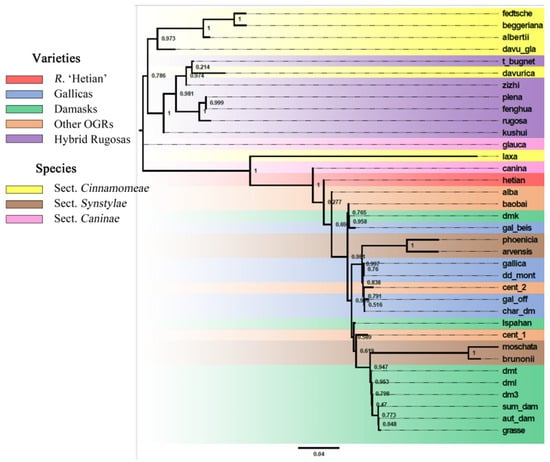
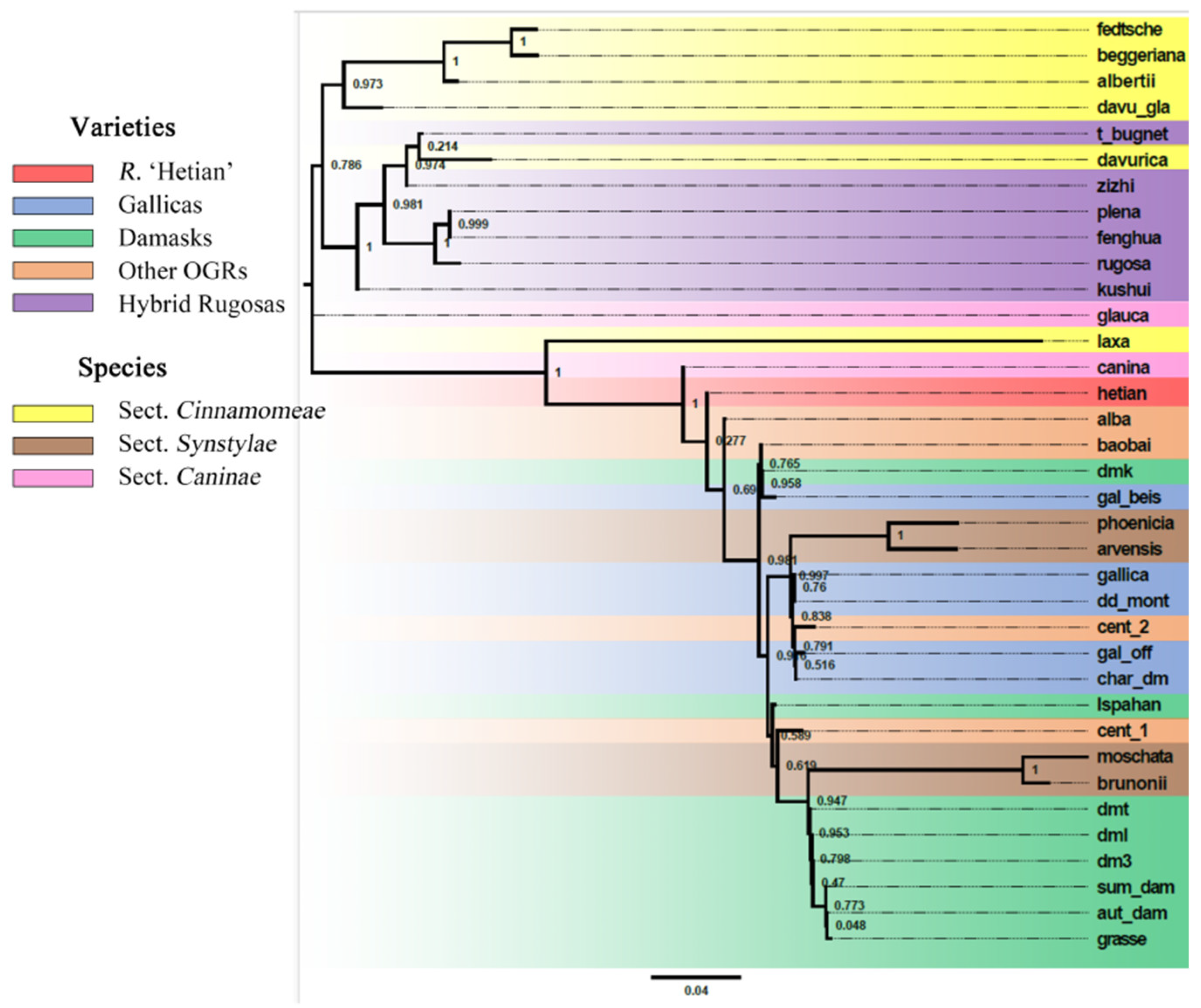
The maximum-likelihood phylogenetic tree based on 7478 SNPs is shown in Figure 1. Species from section Cinnamomeae, except for R. laxa, formed a monophyletic clade comprising two subclades: one containing R. rugosa, R. davurica and their varieties or hybrids (namely Hybrid Rugosa roses), and the other containing species distributed in northwestern China and Central Asia. All Gallica roses except for R. ‘Bella Isis’ formed a monophyletic group, with European Synstylae species (R. arvensis and R. phoenicia) as its sister group. Likewise, most Damask roses formed a monophyletic clade, whereas R. ‘Ispahan’ and dmk were excluded. The R. brunonii–R. moschata clade was the sister group of the principal Damask clade. Rosa ‘Hetian’, as well as R. ‘Bella Isis’ (Gallica), R. ‘Ispahan’, dmk (Damask), cent_1 (Centifolia), Alba roses (R. × alba and Baobai) and section Canine species (R. canina and R. glauca) fell outside the major Gallica and Damask clades and did not form a monophyletic group.
Figure 1.
Maximum-likelihood phylogenetic tree of Rosa ‘Hetian’ and related roses based on genomic SNPs from 7478 single-copied nuclear loci.
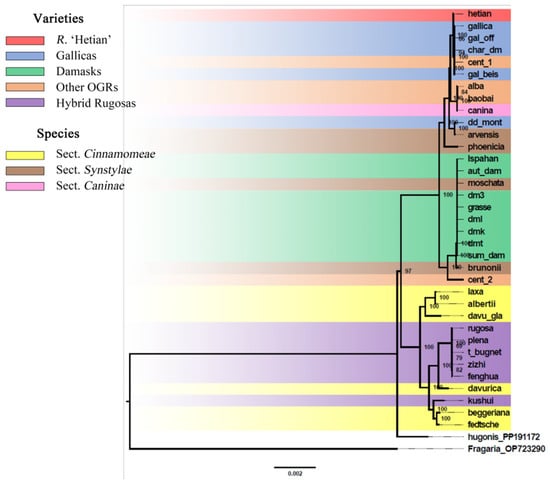
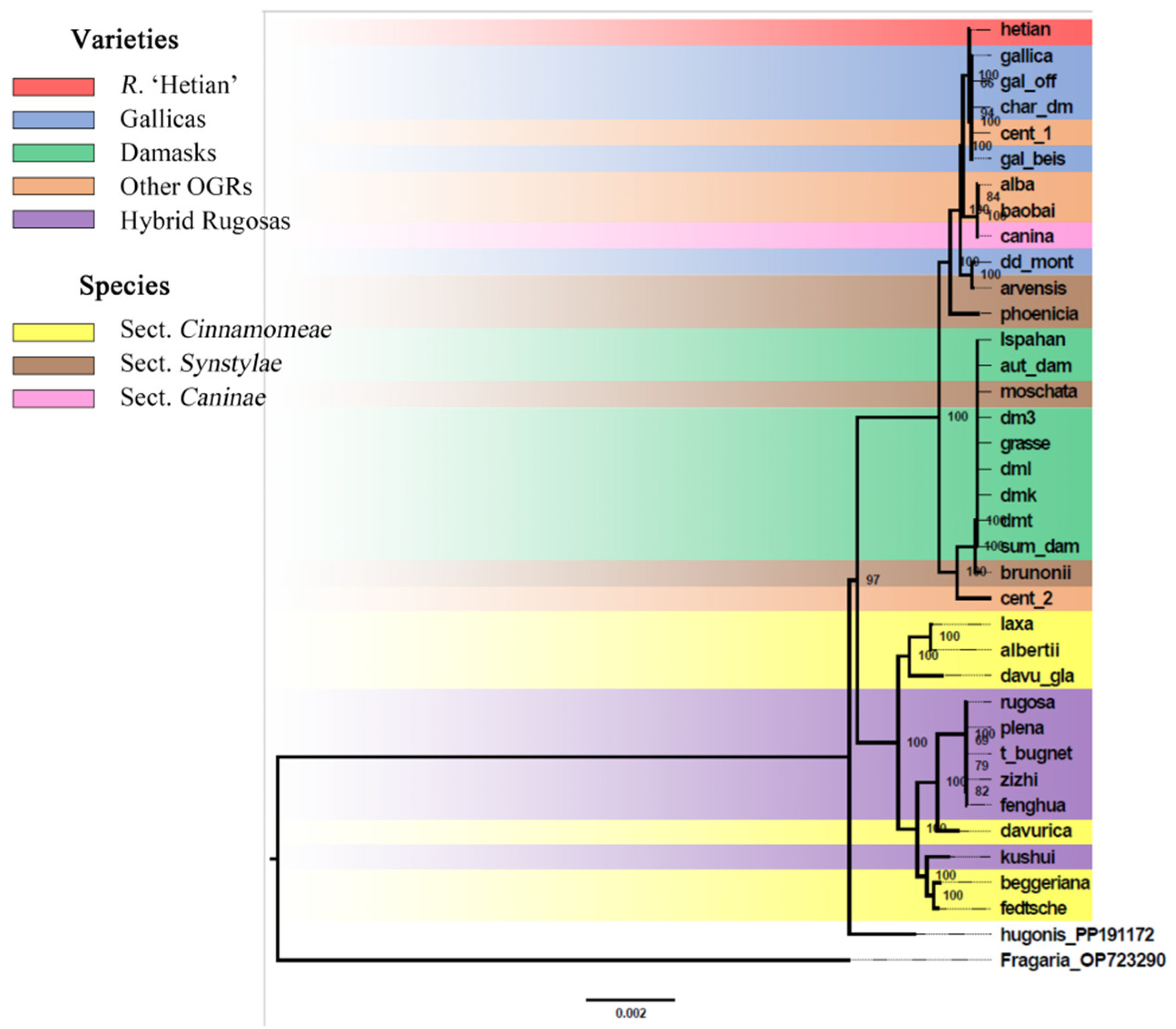
In the plastid genome phylogeny (Figure 2), Rosa ‘Hetian’, cent_1, the sampled Gallica and Alba roses, sect. Caninae species, and European sect. Synstylae species formed a clade. The sister group comprised all sampled Damask roses, cent_2, R. brunonii, and R. moschata. Species and cultivars of sect. Cinnamomeae formed a separate clade.
Figure 2.
Maximum-likelihood phylogenetic tree of Rosa ’Hetian’ and related roses based on plastid genomes.
3.3. Genetic Structure
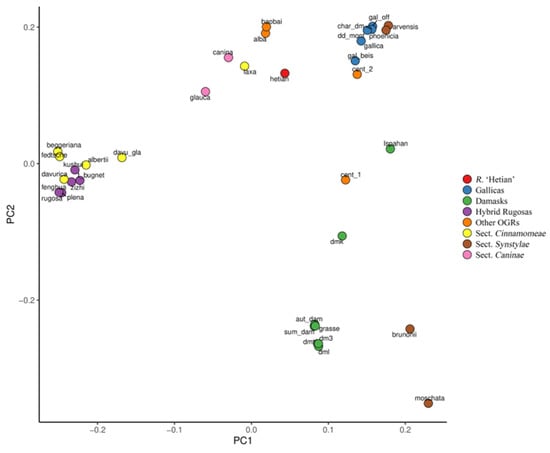
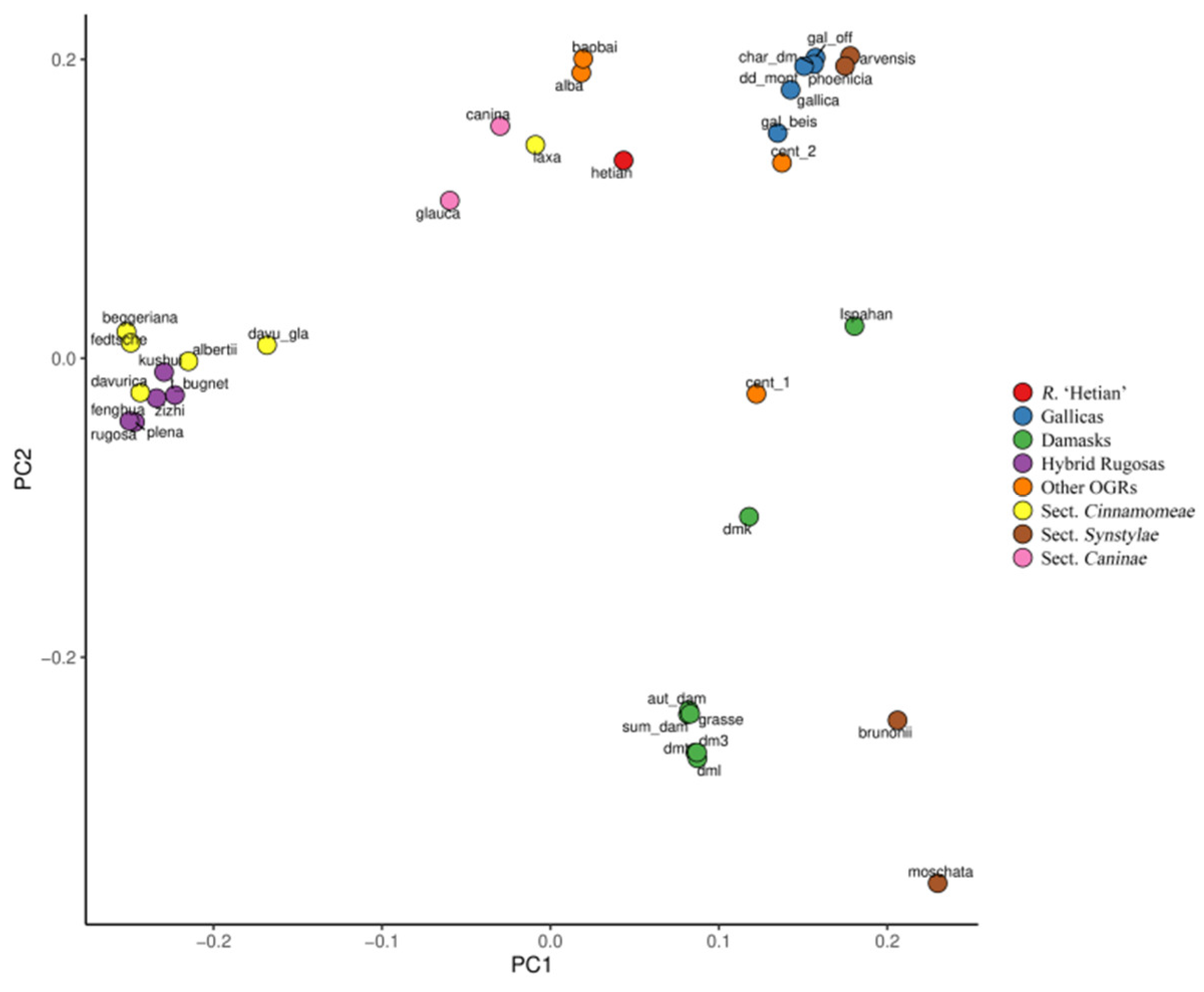
The PCA results are shown in Figure 3. The sampled Gallica roses, Damask roses (except R. ’Ispahan’ and dmk), and Cinnamomeae species formed three distinct clusters. R. arvensis–R. phoenicia and R. brunonii–R. moschata were positioned near the Gallica and Damask groups, respectively. R.’Hetian’ occupied an intermediate position among these clusters but was positioned closest to the Gallica accessions. Cent1, dmk, and R. ‘Ispahan’ were positioned between the Gallica and Damask groups, whereas the Alba roses, sect. Caninae species, and R. laxa were positioned between the Gallica and Cinnamomeae groups.
Figure 3.
The PCA plot of 36 Rosa accessions, including R. ‘Hetian’. The classification of each sample is represented by color. OGRs = Old Garden Roses.
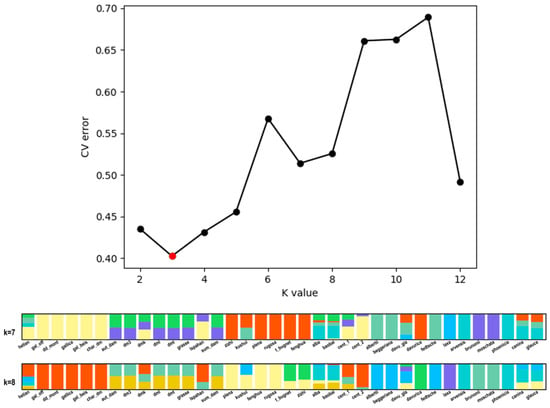
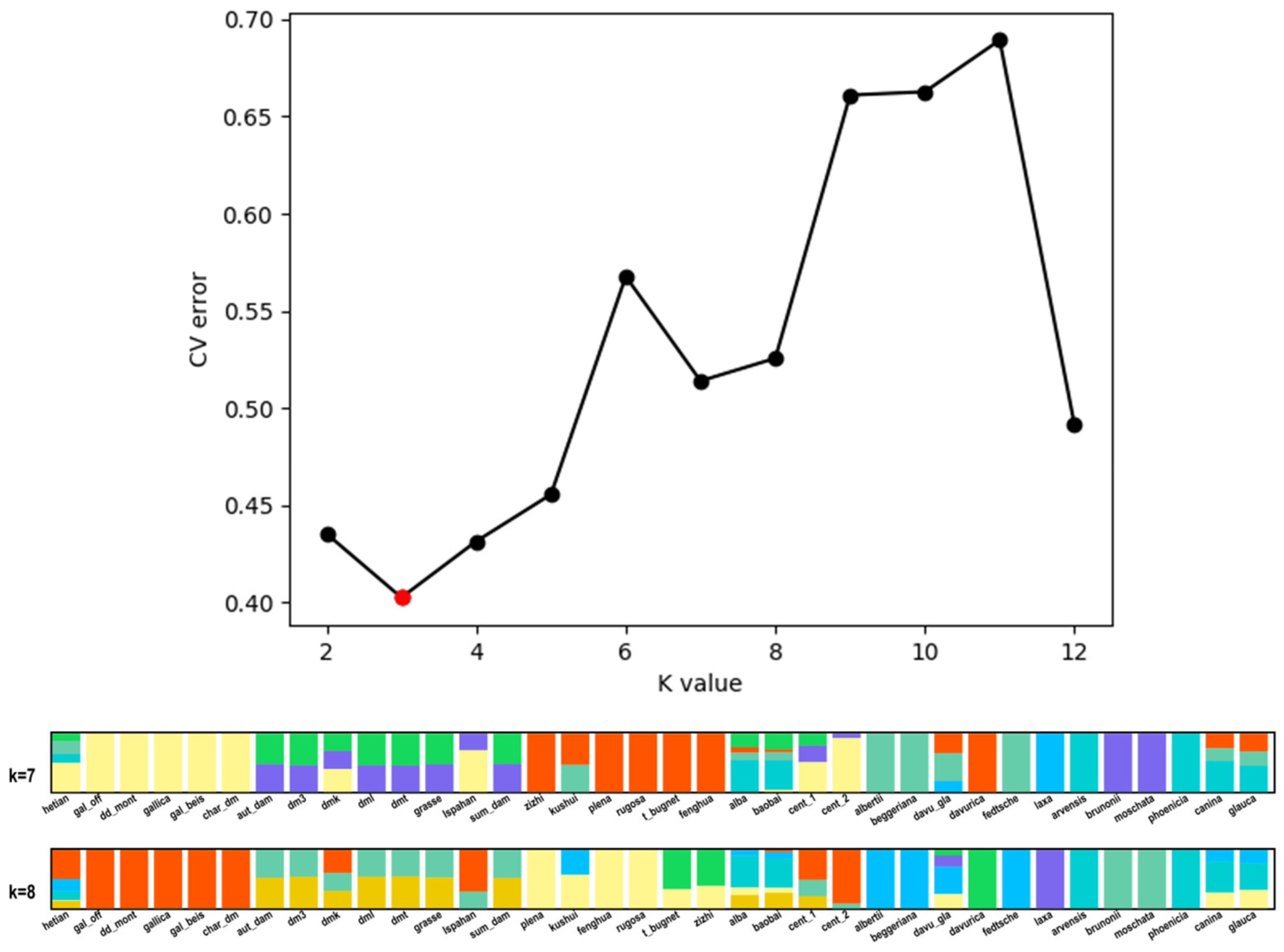
In the ADMIXTURE analysis, the lowest CV error occurred at K = 3, with additional decreases at K = 7, 8, and 12 (Figure 4). We additionally examined K = 8 because it provided finer differentiation among several major taxonomic groups represented in our sampling; K = 8 should therefore be regarded as a biologically informative higher-resolution representation rather than the statistically optimal model based solely on CV error. The bar plot is shown in Figure 4 and Figure S2. At K = 8, most wild species were dominated by a single ancestry component. Exceptions included R. canina, R. glauca, and R. davurica var. glabra. The genetic components of each type were named Gal (R. gallica), Rug (R. rugosa), Dar (R. davurica), CinW (R. beggeriana, R. albertii and R. fedtschenkoana), SynA (R. arvensis, R. phoenicia) and SynB (R. brunonii, R. moschata) in this article. Six of the eight Damask rose varieties shared very similar genetic components, comprising the unique component of Damasks (Dam) and SynB. For the two exceptions, Dmk contained additional Gal, while R. ‘Ispahan’ contained only Gal and SynB components. The genetic component of R. ‘Hetian’ was mainly Gal, but Dam, CinW and SynA were also included. For Hybrid Rugosa roses, the genetic component of R. rugosa ‘Plena’ and R. rugosa ‘Fenghua’ contained the only Rug component, while R. ‘Zizhi’ and R. ‘Thérèse Bugnet’ contained both Rug and Dar, whereas R. ‘Kushui’ contained Rug and CinW components.
Figure 4.
Population structure of Rosa ‘Hetian’ and related rose species or varieties: Above: the CV-error curve. The CV-error is lowest at k value = 3 (red dot). Below: The ADMIXTURE bar plot with k value = 7, 8.
4. Discussion
Oil-bearing roses are fragrant Rosa species and cultivars grown primarily for essential-oil production. Such roses have been cultivated in both China and other regions (e.g., Europe and Western Asia) for centuries, but different species were selected in each region. In China, most oil-bearing roses are derived from Rosa rugosa, a species native to east Asia. In other regions, European Old Garden Roses were cultivated for oil production. European Old Garden Roses include four main types: Gallicas (varieties of R. gallica), Damasks (R. × damascena), Centifolias (R. × centifolia) and Albas (R. × alba). Unlike modern roses, which have largely been developed through deliberate hybridization, these old rose varieties largely arose through spontaneous mutation and natural hybridization. Moreover, historical records concerning the discovery, cultivation, and dispersal of old roses are usually scarce. Therefore, the origin of many old roses remains unsolved. Here, we applied whole-genome resequencing combined with phylogenetic and population genetic analysis to investigate the origin of Rosa ’Hetian’.
4.1. Genomic Affinity of Rosa ‘Hetian’ with European Old Garden Roses
To clarify the genetic background of the Hetian Rose, we broadly sampled rose species and cultivars that might be genetically related to R. ‘Hetian’. The sampling included (1) Chinese Rugosa roses, which were traditional oil-bearing roses cultivated in other regions of China; (2) representative varieties of all four types of European Old Garden Roses; and (3) wild Rosa species previously suggested as ancestors of oil-bearing roses, or occurring in Xinjiang.
Complex ploidy level is a main difficulty in phylogenetic and population genetic analysis of genus Rosa. Our samples included species and cultivars with different ploidy levels (Table S1). Therefore, we use a set of single-copy orthologous (SCO) nuclear loci as the reference sequence, which would avoid misidentifying paralogues as orthologues in polyploid species. Additionally, only biallelic SNPs were retained to simplify downstream analysis, so multiallelic loci and allelic frequency were not considered. However, over 90% of the SNPs were biallelic in our results, indicating that loss of informative sites was reduced.
In the phylogenetic tree based on SNP data, the other three major Chinese oil-bearing roses, R. rugosa ‘Fenghua’, R. rugosa ‘Plena’ and R. ‘Kushui, clustered with their ancestors, R. rugosa and other members of section Cinnamomeae. However, R. Hetian was not included in this group. Instead, it was placed within the clade comprising European Old Garden Roses and related species, such as Gallicas, Damasks, Albas, R. canina, R. moschata and R. phoenicia. Similarly, in the plastid genome tree, R. ‘Hetian’ clustered with Gallicas, Albas, Caninae and European Synstylae species. Previous studies revealed that allotetraploid R.gallica and allopentaploid Caninae species originated from ancient hybridization between European Synstylae species and other lineages, consistent with our results [2,8,9,10]. Therefore, R. ‘Hetian’ was not derived from R. rugosa like other Chinese oil-bearing roses. Otherwise, it shows greater genetic affinity to European old roses like Gallica roses and Damask roses. These results are consistent with previous phylogenetic analyses based on several nuclear and plastid loci [1,12,13,14].
Notably, the phylogenetic position of R. ‘Hetian’ differed between the nuclear SNP and plastid genome trees. Because plastid genomes in Rosa are generally maternally inherited, whereas nuclear genomes are inherited biparentally, such cytonuclear discordance may reflect historical hybridization or genetic exchange between divergent rose lineages. However, incomplete lineage sorting and differences in phylogenetic resolution cannot be excluded.
4.2. Genomic Affinity of Rosa ‘Hetian’ to Gallica Roses
In the PCA plot, the three major groups of oil-bearing roses—Gallicas, Damasks, and Hybrid Rugosa roses—formed distinct clusters. The Gallica and Damask groups were relatively close along PC1 but separated along PC2, whereas Hybrid Rugosa roses were distinct along both dimensions and grouped with other Cinnamomeae species. Rosa ‘Hetian’ occupied an intermediate position but was closest to the Gallica accessions. This pattern supports a stronger genome-wide affinity of R. ‘Hetian’ to the sampled Gallica roses, with weaker affinities to other lineages; however, PCA proximity alone does not demonstrate direct ancestry.
In the ADMIXTURE result with k value set as 8, Hybrid Rugosas, Gallicas and Damasks formed three distinct groups, although several varieties contained components from other groups. The ancestry profile of R. ‘Hetian’ was dominated by the Gal component, with smaller contributions from components associated with Damask roses, some Cinnamomeae species (native to Central Asia—Xinjiang) and European Synstylae species. No component related to R. rugosa was detected. Therefore, we infer that a Gallica-related lineage may have contributed substantially to the ancestry of R. ‘Hetian’, but other species and varieties from Europe to western China may also have contributed to its ancestry. Additionally, The ADMIXTURE patterns observed for Damask roses, R. canina, R. ‘Kushui’, R. ‘Zizhi’ and R. ‘Thérèse Bugnet’ are consistent with previous studies based on genome data or molecular markers, as well as recorded pedigrees [2,6,7,8,9,10,32]. These consistencies provide additional support for our interpretation.
Most cultivated rose varieties are clonally propagated; therefore, a single accession may adequately represent a named cultivar. However, a single accession cannot capture intraspecific variation in wild species. Accordingly, the PCA and ADMIXTURE results presented here should be interpreted primarily as comparisons among sampled accessions rather than as formal population-level estimates. Broader sampling of wild populations and additional cultivars will be necessary to resolve the ancestry of R. ‘Hetian’ more precisely.
4.3. Morphological Similarities and a Possible Historical Scenario for Rosa ‘Hetian’
Based on our observations, the morphological characteristics of R. ‘Hetian’ resemble those of European old roses rather than hybrid Rugosa roses. Rosa ‘Hetian’ has relatively smooth leaflets, fringed sepals, ovate hypanthium and erect hips. By contrast, R. rugosa and its cultivars have rugose leaflets, entire sepals, depressed-globose hypanthium and drooping hips. Among European old garden roses, the morphology of R. ‘Hetian’ is most consistent with that of Gallica roses. Shared traits include short, slender, dense growth; sparse prickles on the upper part of branchlets; deep purple flowers borne in small clusters; and short styles. Rosa gallica is native to central and southern Europe to the Caucasus region, and it has been regarded as one of the earliest roses cultivated in Europe. A selected variety, R. gallica ‘Officialis’, was widely cultivated in Europe for culinary and medical use in ancient times [33]. Therefore, we hypothesize that cultivated Gallica roses reached Hetian along the ancient trade routes, such as the Silk Road, and hybridization may have occurred during its dispersal. More comprehensive sampling for local oil-bearing rose cultivars and wild roses along the region related to the Silk Road, as well as archeological information, would produce more evidence for this hypothesis. A comparable pattern has been reported for China roses. As reblooming China roses originated in Ya’an, Sichuan, China, genetic contributions from R. multiflora var. cathayensis, R. kwangtungensis and R. gigantea were incorporated into many cultivars, contributing to the diversification of China Roses and Tea Roses [5].
5. Conclusions
Our nuclear genomic analyses indicate that Rosa ‘Hetian’ is genetically more closely associated with European Old Garden Roses than with Chinese Hybrid Rugosa roses. Among the sampled accessions, R. ‘Hetian’ showed the strongest genomic affinity to Gallica roses, with weaker affinities to other Eurasian rose species or cultivars. Our results suggest that a Gallica-related lineage may have substantially shaped the genetic background of R. ‘Hetian’, with additional affinity to other Eurasian rose species and cultivars. We hypothesize that its introduction into Xinjiang occurred through historical dispersal along trans-Eurasian trade routes, possibly including the Silk Road; however, this scenario remains plausible but untested. These findings provide a genomic framework for further investigation of the origin, conservation, and utilization of this distinctive local rose germplasm.
Supplementary Materials
The following supporting information can be downloaded at: https://www.mdpi.com/article/10.3390/genes17101234/s1, Figure S1: Plastid genome of Rosa ‘Hetian’; Figure S2: ADMIXTURE results for the Rosa accessions included in this study; Table S1: Detailed information on the Rosa accessions, including source, ploidy, plastid genome length, and coverage of the reference sequence.
Author Contributions
Conceptualization, H.W. and Y.X.; methodology, M.Z. and H.W.; software, M.Z.; validation, H.W. and M.Z.; formal analysis, M.Z. and H.W.; investigation, H.W. and M.Z.; resources, Y.X. and H.W.; data curation, H.W. and M.Z.; writing—original draft preparation, H.W. and M.Z.; writing—review and editing, H.W., M.Z., and Y.X.; visualization, H.W. and M.Z.; supervision, Y.X.; project administration, Y.X.; funding acquisition, Y.X. and H.W. All authors have read and agreed to the published version of the manuscript.
Funding
This study was funded by the Key Technology Research Project of the Shanghai Municipal Administration of Landscaping and City Appearance titled “Selection and Application Demonstration of Ancient Tea-scented Roses Adapted to East China”.
Institutional Review Board Statement
Not Applicable.
Informed Consent Statement
Not Applicable.
Data Availability Statement
The accession links of resequencing data and aligned plastid genomes are presented in Table S1.
Acknowledgments
We thank Liu Tianzhi, General Manager of Xinjiang Hetian Sunshine Desert Rose Co., Ltd. for providing the plant materials of the Hetian Rose, and Jiang Zhengzhi, General Manager of Suzhou Huaguan Yuanchuang Horticulture Co., Ltd., for providing several wild Rosa species resources.
Conflicts of Interest
The authors declare no conflicts of interest.
References
- Xu, R.; Wang, Y.; Yuan, X.; Wang, H.; Ma, S.; Liu, T.; Ma, C. Habitat-driven high-value specialty resource: A review of quality formation mechanisms, functional properties, and industrial development of Hetian rose. J. Beijing For. Univ. 2026, 48, 1–14. [Google Scholar]
- Iwata, H.; Kato, T.; Ohno, S. Triparental origin of Damask roses. Gene 2000, 259, 53–59. [Google Scholar] [CrossRef] [Scilit]
- Manners, M.M.; Morvillo, N.; Frederick, C.; Wagner, A. RAPD-PCR answers some long-standing questions about rose identification. In XXVI International Horticultural Congress: IV International Symposium on Taxonomy of Cultivated Plants; International Society for Horticultural Science: Korbeek-Lo, Belgium, 2004. [Google Scholar]
- Alioua, A.; Heitzler, P. On the Origin of Cultivated Roses: DNA Authentication of the Bourbon Rose Founding Pedigree. Int. J. Plant Biol. 2023, 14, 1117–1130. [Google Scholar] [CrossRef] [Scilit]
- Zhang, C.; Jiang, Z.-Z.; Yang, S.-Z.; Li, S.-Q.; Liang, Z.-L.; Gao, X.-F. Molecular investigation of the progenitors, origin and domestication patterns of diploid Chinese old garden roses. Ann. Bot. 2026, 137, 655–672. [Google Scholar] [CrossRef] [Scilit]
- Zhao, F.; Wang, Y.; Zhang, Y.-J.; Sun, K.; Da, L.-L.; Zhang, H. Molecular and morphological evidences for the hybrid origin of Kushui Rose. Genet. Resour. Crop Evol. 2024, 71, 1257–1269. [Google Scholar] [CrossRef] [Scilit]
- Cui, W.-H.; Du, X.-Y.; Zhong, M.-C.; Fang, W.; Suo, Z.-Q.; Wang, D.; Dong, X.; Jiang, X.-D.; Hu, J.-Y. Complex and reticulate origin of edible roses (Rosa, Rosaceae) in China. Hortic. Res. 2022, 9, uhab051. [Google Scholar] [CrossRef] [Scilit]
- Debray, K.; Marie-Magdelaine, J.; Ruttink, T.; Clotault, J.; Foucher, F.; Malécot, V. Identification and assessment of variable single-copy orthologous (SCO) nuclear loci for low-level phylogenomics: A case study in the genus Rosa (Rosaceae). BMC Evol. Biol. 2019, 19, 152. [Google Scholar] [CrossRef] [Scilit]
- Herklotz, V.; Zhang, M.; Nascimento, T.; Kalfusová, R.; Lunerová, J.; Fuchs, J.; Harpke, D.; Huettel, B.; Pfordt, U.; Wissemann, V.; et al. Bimodal centromeres in pentaploid dogroses shed light on their unique meiosis. Nature 2025, 643, 148–157. [Google Scholar] [CrossRef] [Scilit]
- Zhang, X.; Lan, L.; Yang, Y.; Guan, H.; Peng, D.; Jiang, H.; Wu, Q.; Huang, R.; Liao, X.; Lin, S.; et al. Pangenomic analyses of rose uncover widespread structure variation and empower genomics-directed breeding. Nat. Genet. 2026, 58, 1164–1175. [Google Scholar] [CrossRef] [Scilit]
- Zhang, Z.; Yang, T.; Liu, Y.; Wu, S.; Sun, H.; Wu, J.; Li, Y.; Zheng, Y.; Ren, H.; Yang, Y.; et al. Haplotype-resolved genome assembly and resequencing provide insights into the origin and breeding of modern rose. Nat. Plants 2024, 10, 1659–1671. [Google Scholar] [CrossRef] [Scilit]
- Song, Y.; Wang, H. Genetic background analysis of ‘Hetian’ rose based on DNA sequence. Chin. Agric. Sci. Bull. 2022, 38, 36–40. [Google Scholar]
- Wang, H. Germplasm Resources Classification and Evaluation of Oil-Bearing Rose in China Based on Genetic Diversity. Ph.D. Thesis, Shanghai Jiao Tong University, Shanghai, China, 2013. [Google Scholar]
- Ning, H.; Lu, J.; Lu, C.; Wen, H.; Nurpolati, A.; Haibier, H.; Liu, G. ITS2-based phylogenetic analysis of Rosa damascena ‘Hetian’. Mod. Chin. Med. 2022, 24, 1225–1233. [Google Scholar] [CrossRef]
- Allen, G.C.; Flores-Vergara, M.A.; Krasynanski, S.; Kumar, S.; Thompson, W.F. A modified protocol for rapid DNA isolation from plant tissues using cetyltrimethylammonium bromide. Nat. Protoc. 2006, 1, 2320–2325. [Google Scholar] [CrossRef] [Scilit]
- Chen, S.; Zhou, Y.; Chen, Y.; Gu, J. fastp: An ultra-fast all-in-one FASTQ preprocessor. Bioinformatics 2018, 34, i884–i890. [Google Scholar] [CrossRef] [Scilit]
- Prjibelski, A.; Antipov, D.; Meleshko, D.; Lapidus, A.; Korobeynikov, A. Using SPAdes De Novo Assembler. Curr. Protoc. Bioinform. 2020, 70, e102. [Google Scholar] [CrossRef] [Scilit]
- Wick, R.R.; Schultz, M.B.; Zobel, J.; Holt, K.E. Bandage: Interactive visualization of de novo genome assemblies. Bioinformatics 2015, 31, 3350–3352. [Google Scholar] [CrossRef] [Scilit]
- Li, H. Fast and Accurate Short Read Alignment with Burrows-Wheeler Transform. Bioinformatics 2009, 25, 1754–1760. [Google Scholar] [CrossRef] [Scilit]
- Li, H.; Handsaker, B.; Wysoker, A.; Fennell, T.; Ruan, J.; Homer, N.; Marth, G.; Abecasis, G.; Durbin, R.; Subgroup, G.P.D.P. The Sequence Alignment/Map format and SAMtools. Bioinformatics 2009, 25, 2078–2079. [Google Scholar] [CrossRef] [Scilit]
- Qu, X.-J.; Moore, M.J.; Li, D.-Z.; Yi, T.-S. PGA: A software package for rapid, accurate, and flexible batch annotation of plastomes. Plant Methods 2019, 15, 50. [Google Scholar] [CrossRef] [Scilit]
- Katoh, K.; Standley, D.M. MAFFT Multiple Sequence Alignment Software Version 7: Improvements in Performance and Usability. Mol. Biol. Evol. 2013, 30, 772–780. [Google Scholar] [CrossRef] [Scilit]
- Castresana, J. Selection of Conserved Blocks from Multiple Alignments for Their Use in Phylogenetic Analysis. Mol. Biol. Evol. 2000, 17, 540–552. [Google Scholar] [CrossRef] [Scilit]
- Wong, T.K.F.; Ly-Trong, N.; Ren, H.; Demotte, P.; Baños, H.; Roger, A.J.; Susko, E.; Bielow, C.; De Maio, N.; Goldman, N.; et al. IQ-TREE 3: Phylogenomic inference software using complex evolutionary models. Mol. Biol. Evol. 2026, 43. [Google Scholar] [CrossRef] [Scilit]
- McKenna, A.; Hanna, M.; Banks, E.; Sivachenko, A.; Cibulskis, K.; Kernytsky, A.; Garimella, K.; Altshuler, D.; Gabriel, S.; Daly, M.; et al. The Genome Analysis Toolkit: A MapReduce framework for analyzing next-generation DNA sequencing data. Genome Res. 2010, 20, 1297–1303. [Google Scholar] [CrossRef] [Scilit]
- Chang, C.C.; Chow, C.C.; Tellier, L.C.A.M.; Vattikuti, S.; Purcell, S.M.; Lee, J.J. Second-generation PLINK: Rising to the challenge of larger and richer datasets. GigaScience 2015, 4, s13742-015-0047-8. [Google Scholar] [CrossRef] [Scilit]
- Danecek, P.; Auton, A.; Abecasis, G.; Albers, C.A.; Banks, E.; DePristo, M.A.; Handsaker, R.E.; Lunter, G.; Marth, G.T.; Sherry, S.T.; et al. The variant call format and VCFtools. Bioinformatics 2011, 27, 2156–2158. [Google Scholar] [CrossRef] [Scilit]
- Cheng, B.; Zhao, K.; Zhou, M.; Bourke, P.M.; Zhou, L.; Wu, S.; Sun, Y.; Geng, L.; Du, W.; Yang, C.; et al. Phenotypic and genomic signatures across wild Rosa species open new horizons for modern rose breeding. Nat. Plants 2025, 11, 775–789. [Google Scholar] [CrossRef] [Scilit]
- Price, M.N.; Dehal, P.S.; Arkin, A.P. FastTree 2—Approximately maximum-likelihood trees for large alignments. PLoS ONE 2010, 5, e9490. [Google Scholar] [CrossRef] [Scilit]
- Yang, J.; Lee, S.H.; Goddard, M.E.; Visscher, P.M. GCTA: A tool for genome-wide complex trait analysis. AM J. Hum. Genet. 2011, 88, 76–82. [Google Scholar] [CrossRef] [Scilit]
- Alexander, D.H.; Novembre, J.; Lange, K. Fast model-based estimation of ancestry in unrelated individuals. Genome Res. 2009, 19, 1655–1664. [Google Scholar] [CrossRef] [Scilit]
- Bai, M.; Liu, J.; Fan, C.; Chen, Y.; Chen, H.; Lu, J.; Sun, J.; Ning, G.; Wang, C. KSN heterozygosity is associated with continuous flowering of Rosa rugosa Purple branch. Hortic. Res. 2021, 8, 26. [Google Scholar] [CrossRef] [Scilit]
- Clovis, P. Rosa gallica L. and Other Gallic Roses: Origin(s) and Role in the Genesis of Cultivated Roses. Ph.D. Thesis, Université d’Angers, Angers, France, 2023. [Google Scholar]

Disclaimer/Publisher’s Note: The statements, opinions and data contained in all publications are solely those of the individual author(s) and contributor(s) and not of MDPI and/or the editor(s). MDPI and/or the editor(s) disclaim responsibility for any injury to people or property resulting from any ideas, methods, instructions or products referred to in the content. |
© 2026 by the authors. Licensee MDPI, Basel, Switzerland. This article is an open access article distributed under the terms and conditions of the Creative Commons Attribution (CC BY) license.