


Abstract
Background: The phylogenetic resolution within the Gloydius halys-intermedius Complex remains debatable due to the following reasons: loci selection in previous studies varied between authors; limited dataset (1−5 mitochondrial or nuclear gene fragments); lack of sampling density; and nodal supports at specific nodes remain weak, specifically within Gloydius cognatus, G. halys, and G. stejnegeri. Objectives: To revise the taxonomic and phylogenetic relationships within the G. halys-intermedius Complex, we reconstructed the molecular phylogeny and performed species delimitation based on the complete mitochondrial genomes. Methods: In this study, twelve nomenclatural groups of Gloydius species were involved in the computation of Bayesian phylogenomic inference, five of the twelve nomenclature groups were newly sequenced, while the rest were acquired from the National Center for Biotechnology Information (NCBI). The Bayesian phylogenomic inference was constructed based on 13 mitochondrial protein-coding genes. Species delimitation was performed by two distance-based methods (ABGD and ASAP) and two tree-based methods (GMYC and bPTP). Results: This research resolved the systematic relationship within the G. intermedius Complex with the support of mitogenome-based phylogenomics, while indicating cryptic diversity within the Gloydius halys-intermedius Complex: G. intermedius samples from South Korea show as paraphyletic to the cluster of the samples from northeastern China. Species delimitation results based on four models resemble each other, supporting Gloydius caucasicus, G. cognatus, G. halys, and G. stejnegeri, each representing full species. The species delimitation results of this research also resemble the nomenclatural species based on previous morphometrical results. This research indicates that species delimitation efforts based on the phylogenomic approach would likely resolve complex evolutionary relationships.
1. Introduction
The Asian pit vipers, genus Gloydius Hoge & Ramano-Hoge, 1978, a group of small-bodied anterior-fanged snakes, widely distributed from northeastern to central Asia. This genus contains more than 23 specific-leveled clades spread throughout diverse habitats from temperate forests at lower elevations to alpine meadows at higher elevations, such as the Qinghai–Tibetan Plateau [1,2,3,4]. Morphometrics and previous molecular phylogenetics conducted in this genus indicate three intragenic lineages: the G. blomhoffii Complex, G. intermedius-halys Complex, and G. strauchi Complex [5,6].
The current molecular phylogenetics inference has resolved the systematic relationship at specific levels under both the G. blomhoffii Complex and G. strauchi Complex with strong nodal support [2,3,4,7,8,9,10]. However, due to complex overlapping distributions, possible interspecific gene flows, and less genomic data involvement within the G. intermedius-halys Complex, the evolutionary relationships and the species delimitation under this species complex remain debatable [5,11,12,13]. In the molecular phylogeny of Sino-distributed Gloydius species constructed by Xu et al. [14], the two taxa labeled as “G. intermedius” did not display monophyletic topology [14], and were subsequently clarified as misidentifications of specimens of the two different subspecies under G. halys. Shi et al. [13] initially reconstructed the molecular phylogenetics of the G. intermedius-halys Complex with combined mtDNA ND4 and Cyt b [13], indicating G. halys and G. stejnegeri each represents a valid taxon at specific level. This taxonomic conception has been accepted by most studies [1,2,3,11,15,16]. However, in several recent publications, the diversity of the G. intermedius-halys Complex is still underestimated, these species are still conflated as G. halys without illustrations or reliable data support [12,17,18].
In previous studies, little genomic data were used to construct molecular phylogeny compared to the accumulating sampling and sequencing strength in recent years. Previous data usually contains 2–5 mtDNA gene sequences or a combination of both mtDNA and nucDNA [1,2,3,4,13,14,16,19]. As a result, some nodal supports remain at questionable levels.
Recent studies on molecular species delimitation in reptiles and insects [20,21,22] have provided new approaches for resolving taxonomic problems at specific level. However, these efforts have not been applicated to Asian pit vipers yet. To provide higher-resolution molecular phylogenomic inference within the G. intermedius-halys Complex, with the support of accumulated genomic data and strong sequencing strength, multiple mtDNA genomes of the Sino-distributed Gloydius species were acquired. Hence, to further investigate the inter-specific evolutionary relationship within the G. intermedius-halys Complex, an initial phylogenomic inference and molecular species delimitation of Gloydius species were performed in this study.
2. Materials and Methods
2.1. Samples and DNA Extraction
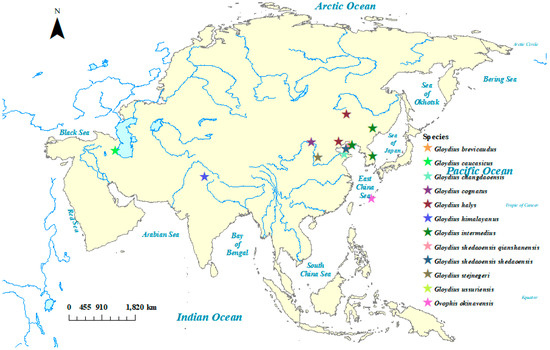
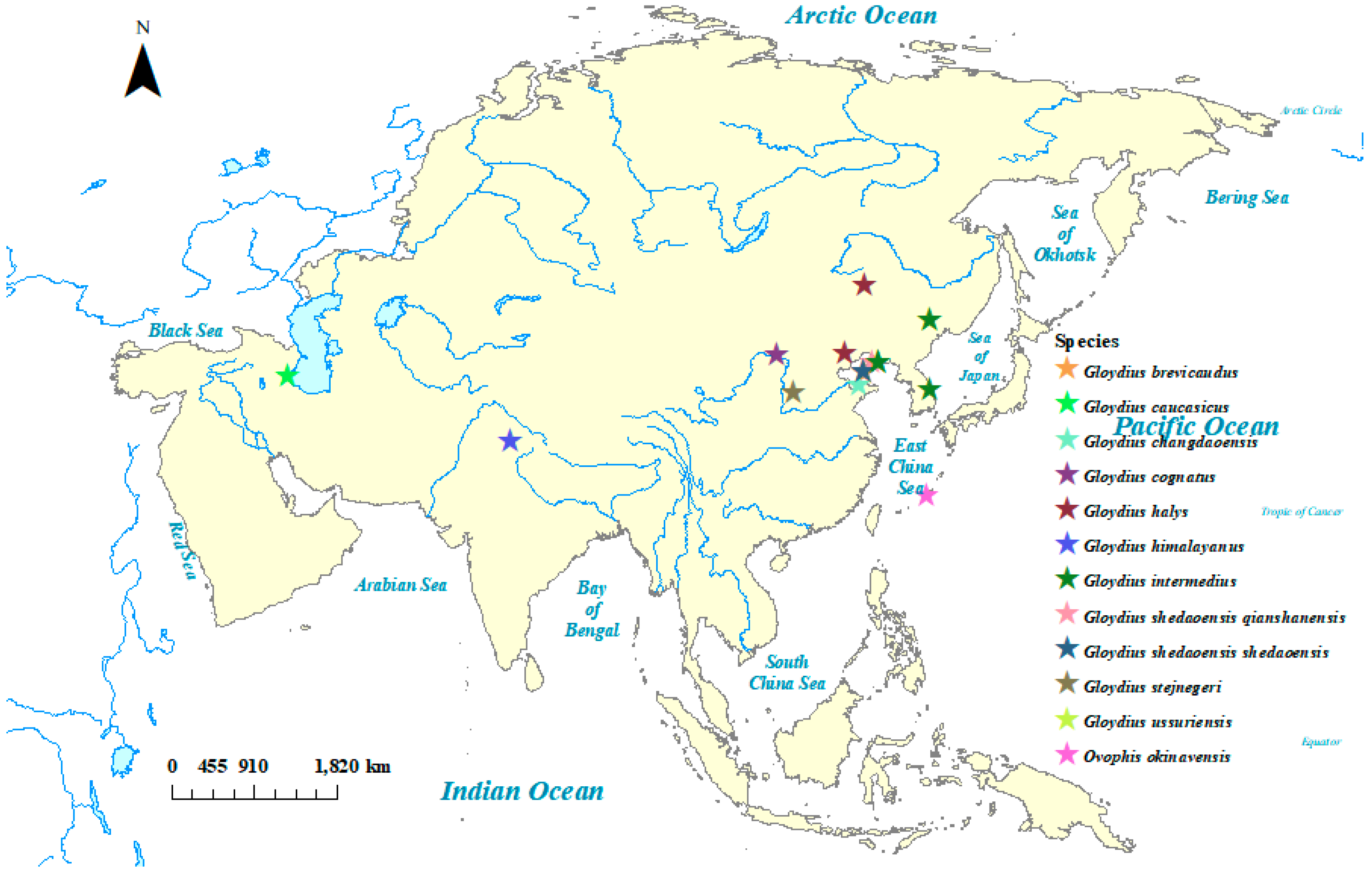
In this study, five taxa of Gloydius were sampled. The detailed specimen information is listed in Table 1. In addition, the mitochondrial genome of seven Gloydius species were downloaded from GenBank for phylogenomic analysis. The distribution map of Gloydius in this study was drawn with ArcGis (Figure 1). Ophis okinavensis, a close relative of Gloydius, was selected to be the outgroup. Liver tissues were dissected to extract the whole genome using a TGuide Smart Universal DNA Kit (TIANGEN, Beijing, China) with the TGuide S16 Nucleic Acid Extractor. And the whole genome sample was deposited in a refrigerator at −20 °C at the Institute of Zoology, Chinese Academy of Sciences (IOZ, CAS).
Table 1.
Samples used in this study.
Figure 1.
Distribution of molecular samples in this study. Each star represents a species of Gloydius.
2.2. Genome Sequencing, Assembly, and Annotation
The genomes were sequenced by the Illumina HiSeq 6000 platform at BerryGenomics (Beijing, China) with a 400 bp insert size and a pair-end 150 bp sequencing strategy. The sequence reads were first filtered with MitoZ 3.6 [23] at default parameters. Then, the remaining clean paired reads were assembled using GetOrganelle-1.7.7.1 [24]. The annotation of genes was performed by MitoZ and manually double-checked with Geneious 8.0.5 [25]. The composition of the mitochondrial genome was calculated with MEGA7 [26].
2.3. Phylogenetic Tree Construction and Pairwise Distance Estimation
The phylogenetic tree was constructed based on 13 mitochondrial protein-coding genes (PCGs, Appendix A). All the PCG sequences were extracted by the script, extract_genes.py (https://github.com/tjcreedy/biotools, accessed on 8 July 2024). After aligning each gene sequence with MAFFT v7.526 [26], all alignments were concatenated with PhyloSuite v1.2.2 [27]. Model determination for MrBayes (Bayesian inference, BI) was generated with ModelFinder [28]. The phylogenetic tree was reconstructed using MrBayes version 3.2.7a [1]. Two Markov chains in the Bayes phylogenetic tree ran simultaneously, totaling 600,000 generations. Samples were collected every 5000 generations, and the first 25% was discarded as burn-in. The phylogenetic trees were visualized with iDOL (https://itol.embl.de/, accessed on 15 July 2024). Pairwise distances of each two species were computed using the bootstrap method of 1000 replications, calculating the p-distance with MEGA7 [26], other detailed parameters and the results can be seen in Appendix B.
2.4. Molecular Species Delimitation
This research focused on the molecular species delimitation for the genus Gloydius (Appendix C). To conduct a molecular species delimitation, two distance-based methods (ABGD [20] and ASAP [27]) and two tree-based methods (GMYC [28] and bPTP [22]) were performed. The ABGD (Automatic Barcode Gap Discovery) is a convenient method for alignment-based species delimitation, it enables rapid classification of species, performing under the JC69 Jukes-Cantor model with relative gap width (X = 0.015). ASAP (Assemble Species by Automatic Partitioning) can automatically delineate species, reducing intervention and enhancing the objectivity and accuracy of species delimitation, performed at default settings. GMYC (Generalized Mixed Yule Coalescent) takes into account evolutionary processes, such as speciation and gene flow, to provide more precise species delimitation, with an ultrametric tree generated from MrBayes using multiple sequences per species. bPTP (Bayesian Poisson Tree Processes) delineate species by identifying temporal shifts between interspecific and intraspecific branches, offering high accuracy and resolution, executing 100,000 Markov chain Monte Carlo generations with a thinning of 100 and with 20% discarded as burn-in.
3. Results
3.1. The Composition of the Mitochondrial Genome
In this study, all Gloydius species contained a typical 37 genes (22 tRNA and 2 rRNA genes, and 13 PCGs, Appendix A). The five newly sequenced mitogenomes resembled the order in previous sequenced samples [1,2,3,4,13,16]. The gene rearrangement phenomenon is not present in this genus. The nucleotide compositions of these mitogenomes are shown in Table 2. These Gloydius species exhibited the same AT nucleotide bias: 58%. Moreover, these mitogenomes had both a positive AT skew (0.10–0.11) and a CG skew (0.37 to–0.38).
Table 2.
Nucleotide compositions of the whole mitogenomes of five newly sequenced Gloydius species. Both the AT skew and GC skew values from five species were positive, and the GC skew amplitude was greater than that of AT skew.
3.2. Phylogenetic Relationships
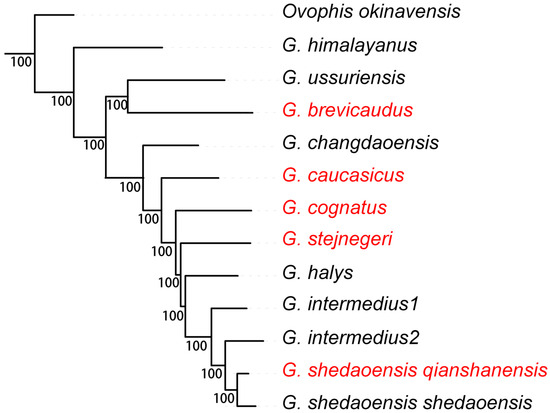
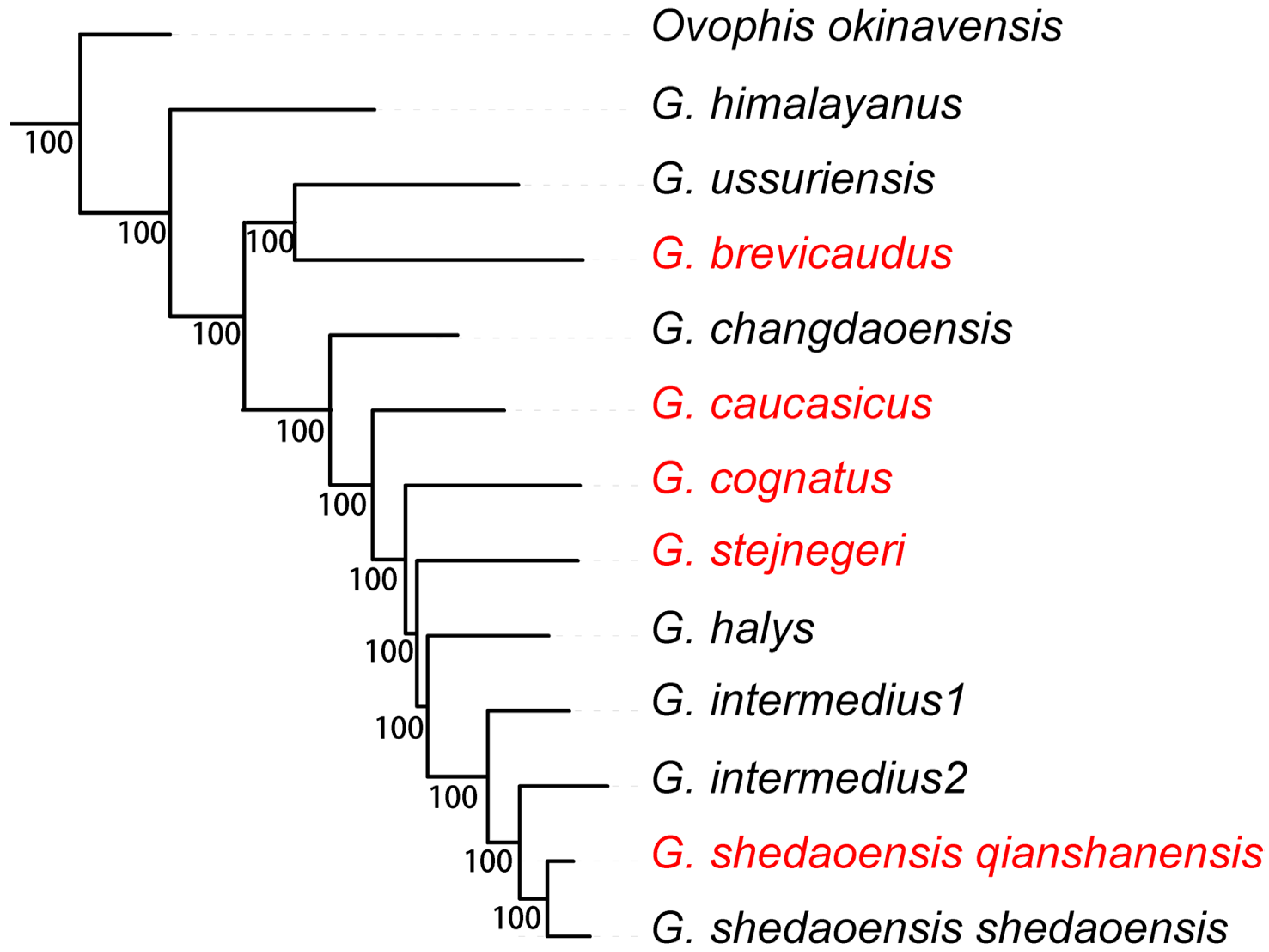
The topology of the Bayesian inference (BI) tree displayed an identical cladogram with those in previous studies [1,2,3,4,7]. Gloydius species were clustered in a strongly supported monophyletic group with 100/100 posterior probabilities on all of the nodes (Figure 2). Figure 2 illustrates the Bayesian phylogenetic inference based on 13 mitochondrial protein-coding genes. The topology reveals a well-supported monophyletic lineage for the Gloydius halys-intermedius Complex, with strong Bayesian posterior probabilities at essential nodes. Notably, G. caucasicus and G. stejnegeri form distinct branches, supporting their divergence at specific level.
Figure 2.
A MrBayes tree of Gloydius based on 13 mitochondrial PCGs. O. okinavensis was used as the outgroup. The numbers under branches indicate posterior probabilities, respectively. The red ones are newly added in this study.
The phylogenetic position of Gloydius himalayanus from the southern slopes of the Himalayan ranges, is basal to, and considerably distant from, other species of Gloydius (p-distance: 11.7−13.2%). Nine samples that represent G. halys-intermedius are clustered in a monophyletic group sister to another monophyletic group comprising G. brevicaudus and G. ussuriensis (G. blomhoffii Complex). However, the samples of G. intermedius from South Korea did not form a monophyletic group with the samples from northeast China, as is mentioned by Lee et al. (2022) [19]. The four samples of four species, G. caucasicus, G. cognatus, G. halys, and G. stejnegeri, display paraphyly even though they were treated as subspecies of G. halys [5] or one single species in previous studies [10,12,18]. The taxonomic relationship between those clades will be discussed in the species delimitation section.
3.3. Species Delimitation
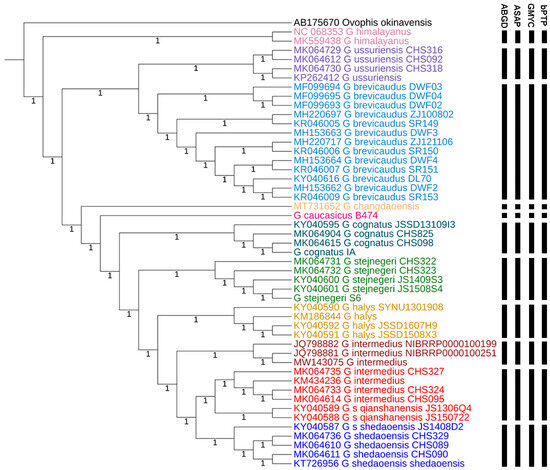
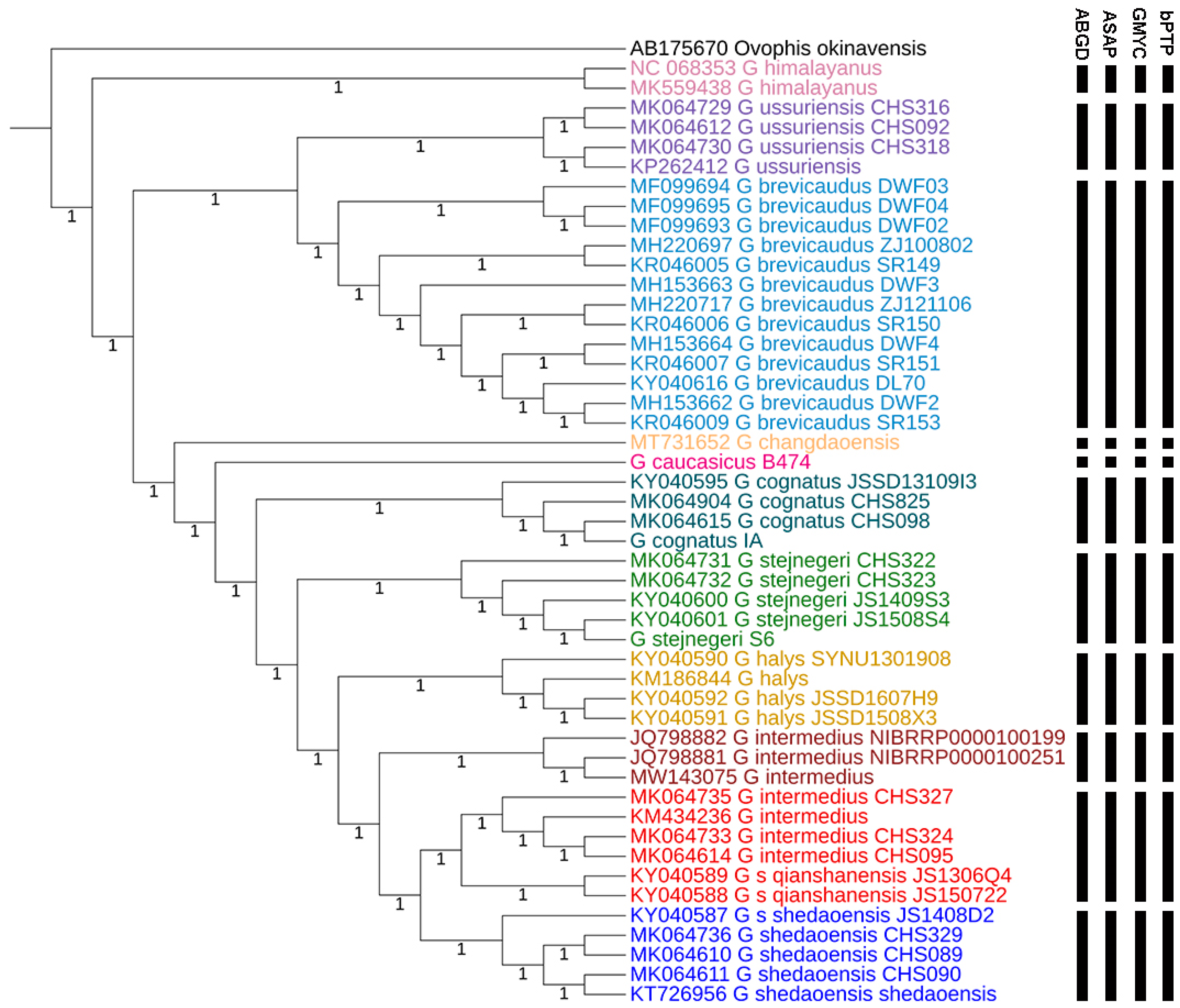
The results of specific delimitation by two distance-based methods (ABGD [20] and ASAP [27]) and two tree-based methods (GMYC [28] and bPTP [22]) are shown as vertical black bars (Figure 3). The summary of molecularly delimited species of all four approaches was identical: all four approaches revealed 11 molecular clades of Gloydius within the samples included in this study, and resemble the morphological species delimitation opinion [5,13].
Figure 3.
The molecular species delimitation of Gloydius based on COI gene with four methods (ABGD, ASAP, GMYC and bPTP). The samples delimitated as a single species are represented by a black bar. Every intermittent vertical black bar on the right side of the taxon name represents a single species determined by species delimitation (from left to right: ABCD, ASAP, GMYC, and bPTP). The numbers under branches indicate 100% posterior probabilities. Each color of the tips represents a species.
The G. halys-intermedius Complex, G. cognatus, G. caraganus, G. caucasicus, G. halys, and G. stejnegeri each represent a valid specific taxon based on the species delimitation techniques. Note that the two populations of G. intermedius from northeast China and South Korea are determined as two distinct species (p-distance 2.1%), indicating cryptic diversity that requires further investigation.
4. Discussion
This study provides a higher-resolution molecular phylogenomic inference within the G. intermedius-halys Complex, based on the complete mtDNA genomes of the Sino-distributed species of genus Gloydius which face prolonged debate from different scientific publications. The specific-level taxonomic relationships within the Gloydius halys-intermedius Complex are clarified by both molecular phylogeny and specific delimitation models. The results correspond with previous morphological studies [5,13]. The complex situation of the taxonomy and phylogeny of the G. halys-intermedius Complex may be caused by the interspecific or intraspecies gene flows between different adjacent habitats. A further phylogenomic inference of Gloydius species with more samples included is required in order to investigate the origin, evolution, and migration of Asian pit vipers. The results indicate the specific-leveled genetic differentiation between the populations of G. intermedius from South Korea and northeast China. Further advanced species delimitation is encouraged to investigate this cryptic diversity.
Increasing the sample density and sequencing strength have provided a solid platform for species delimitation reviews, and phylogenomic inference construction. n globally widespread and complex species systems, the use of nuclear loci in phylogenomics is gaining increasing popularity. At the same time, sequencing known regions, combinations, and newly developed regions has become a trend in advanced species delimitation projects. The utility of mtDNA loci in molecular phylogenetics remains advantageous when it comes to accessibility, and many studies combine nucDNA and mtDNA when performing computations. Although nucDNA loci have been actively used in recent projects, mtDNA phylogenetic analysis remains essential for assessing systematics in complex biogeographical regions. While the trend encourages the combined use of mtDNA and nucDNA in constructing molecular phylogenomics, inferences based on mitochondrial genomes still provide a reference topology for subsequent topology comparisons.
Author Contributions
Conceptualization, J.S. and M.B.; methodology, J.S. and L.J.; software, L.J.; validation, C.L., L.T. and S.F.; formal analysis, L.J., Z.X. and N.L.; investigation, C.L., L.T. and S.F.; data curation, J.S., S.H. and Z.X.; writing and original draft preparation, L.J., J.S. and Z.X.; writing—review and editing, Z.X. and N.L.; supervision, J.S.; project administration, M.B.; funding acquisition, J.S. All authors have read and agreed to the published version of the manuscript.
Funding
This work was supported by the National Natural Science Foundation of China (NSFC No. 42202014, Jingsong Shi); the National Key R&D Program of China (No. 2022YFC2601200); and the project of the Northeast Asia Biodiversity Research Center (NABRI202203).
Institutional Review Board Statement
All experimental procedures were approved by the Animal Care and Ethics Committee at the Institute of Zoology, Chinese Academy of Sciences (IOZ-IACUC-2023-153, 1 January 2025).
Informed Consent Statement
Not applicable.
Data Availability Statement
All mitogenome sequences generated in this study were deposited in GenBank under accession numbers: PQ858434-PQ858438.
Acknowledgments
We are grateful to Qiu Xianchun, Wang Jinze, Zhou Shengbo, Yu Guoxu, Wu Zhongxun, Bao Yan, and Sun Baiyue for helping with the field work and molecular laboratory work. We thank Nikolai Orlov and Ananjeva Natalia for providing important samples for our study, and Seunghyun Lee for professional advice on data analysis. We are grateful to Jonathan Eisen for his assistance with language improvement.
Conflicts of Interest
The authors declare no conflicts of interest.
Appendix A
Table A1.
The abbreviations and full names of 13 mitochondrial Protein-Coding Genes.
Appendix B
Appendix B.1
Table A2.
The number of each species used for pairwise distances calculation.
Appendix B.2
Table A3.
The pairwise distances of each two species of Golydius.
Appendix C
Table A4.
The samples used in this study for molecular species delimitation of Golydius.
References
- Shi, J.; Wang, G.; Chen, X.; Fang, Y.; Ding, L.; Huang, S.; Hou, M.; Liu, J.; Li, P. A new moth-preying alpine pit viper species from Qinghai-Tibetan Plateau (Viperidae, Crotalinae). Amphib. Reptil. 2017, 38, 517–532. [Google Scholar] [CrossRef] [Scilit]
- Shi, J.S.; Liu, J.C.; Giri, R.; Owens, J.B.; Santra, V.; Kuttalam, S.; Selvan, M.; Guo, K.J.; Malhotra, A. Molecular phylogenetic analysis of the genus Gloydius (Squamata, Viperidae, Crotalinae), with description of two new alpine species from Qinghai-Tibet Plateau, China. Zookeys 2021, 1061, 87–108. [Google Scholar] [CrossRef] [Scilit] [PubMed]
- Shi, J.; Yang, D.; Zhang, W.; Peng, L.-F.; Orlov, N.L.; Jiang, F.; Ding, L.; Hou, M.; Huang, X.; Huang, S.; et al. A New Species of the Gloydius strauchi Complex (Crotalinae: Viperidae: Serpentes) from Qinghai, Sichuan, and Gansu, China. Russ. J. Herpetol. 2018, 25, 126–138. [Google Scholar] [CrossRef] [Scilit]
- Zhang, M.H.; Shi, S.C.; Li, C.; Yan, P.; Wang, P.; Ding, L.; Du, J.; Plenkovic-Moraj, A.; Jiang, J.P.; Shi, J.S. Exploring cryptic biodiversity in a world heritage site: A new pitviper (Squamata, Viperidae, Crotalinae) from Jiuzhaigou, Aba, Sichuan, China. Zookeys 2022, 1114, 59–76. [Google Scholar] [CrossRef] [Scilit] [PubMed]
- Nikolai, L.O.; Barabanov, A. Analysis of Nomenclature, Classification, and Distribution of the Agkistrodon halys—Agkistrodon intermedius Complexes: A Critical Review. Russ. J. Herpetol. 1999, 6, 167–192. [Google Scholar]
- Gloyd, H.K.; Conant, R. Snakes of the Agkistrodon complex: A monographic review. In Contribution to Herpetology; Society for the Study of Amphibians and Reptiles: Oxford, UK, 1990; Volume 6. [Google Scholar]
- Wu, Y.; Li, K.; Liu, Q.; Chen, S.; Cai, B. The complete mitochondrial genome of the Asian pitviper Gloydius changdaoensis (Squamata, Viperidae). Mitochondrial DNA B Resour. 2020, 5, 3276–3277. [Google Scholar] [CrossRef] [Scilit] [PubMed]
- Chaudhuri, A.; Mukherjee, S.; Chowdhury, S.; Purkayastha, J. Geographic Distribution: Gloydius himalayanus (Himalayan Pitviper). Herpetol. Rev. 2018, 49, 505. [Google Scholar]
- Xu, C.; Xie, F.; Liu, Y.; Zhao, S.; Wang, Y.; Ma, T.; Zhao, T. Sequencing and analysis of the complete mitochondrial genome of Gloydius saxatilis (Squamata: Viperidae: Crotalinae). Mitochondrial DNA Part A 2015, 27, 2361–2362. [Google Scholar] [CrossRef] [Scilit] [PubMed]
- Xu, C.; Zhao, S.; Dou, H. The complete mitochondrial genome of Gloydius intermedius (Squamata: Viperidae: Crotalinae) from China. Mitochondrial DNA A DNA Mapp. Seq. Anal. 2016, 27, 2373–2374. [Google Scholar] [CrossRef] [Scilit]
- Xu, R.; Dujsebayeva, T.N.; Chen, D.; Mijidsuren, B.; Xu, F.; Guo, X. Phylogeography and Ecological Niche Modeling of the Alashan Pit Viper (Gloydius cognatus; Reptilia, Viperidae) in Northwest China and Adjacent Areas. Animals 2023, 13, 3726. [Google Scholar] [CrossRef] [Scilit]
- Guo, P.; Liu, Q.; Wu, Y.; Zhu, F.; Zhong, G. Pitvipers of China; Science Press: Beijing, China, 2021. [Google Scholar]
- Shi, J.; Yang, D.; Zhang, W.; Qi, S.; Li, P.; Ding, L. Distribution and Infraspecies Taxonomy of Gloydius halys-Gloydius intermedius Complex in China (Serpentes: Crotalinae). Chin. J. Zool. 2016, 51, 777–798. [Google Scholar]
- Xu, Y.; Liu, Q.; Myers, E.A.; Wang, L.; Huang, S.; He, Y.; Peng, P. Molecular Phylogeny of the Genus Gloydius (Serpentes: Crotalinae). Asian Herpetol. Res. 2012, 3, 127–132. [Google Scholar] [CrossRef] [Scilit]
- Wu, Y.-H.; Hou, S.-B.; Yuan, Z.-Y.; Jiang, K.; Huang, R.-Y.; Wang, K.; Liu, Q.; Yu, Z.-B.; Zhao, H.-P.; Zhang, B.-L.; et al. DNA barcoding of Chinese snakes reveals hidden diversity and conservation needs. Mol. Ecol. Resour. 2023, 23, 1124–1141. [Google Scholar] [CrossRef] [Scilit] [PubMed]
- Kuttalam, S.; Santra, V.; Owens, J.B.; Selvan, M.; Mukherjee, N.; Graham, S.; Togridou, A.; Bharti, O.K.; Shi, J.; Shanker, K.; et al. Phylogenetic and morphological analysis of Gloydius himalayanus (Serpentes, Viperidae, Crotalinae), with the description of a new species. Eur. J. Taxon. 2022, 852, 1–30. [Google Scholar] [CrossRef] [Scilit]
- Zeng, Y.; Wu, Y.; Liu, Q.; Yu, M.; Li, K.; Wang, J.; Guo, P.; Shu, G. A Report on Reproduction of Gloydius halys. Chin. J. Zool. 2024, 59, 639. [Google Scholar]
- Guo, P.; Che, J. Snakes in Qinghai-Xizang Plateau; Science Press: Beijing, China, 2024. [Google Scholar]
- Lee, Y.S.; Do, M.S.; Kim, W.; Jeon, H.S.; Lee, S.-C.; Jung, J.-H.; An, J. Phylogenetic relationships between three Korean pit viper Gloydius (Serpentes: Crotalinae) species using mitochondrial DNA genes. Genes Genom. 2022, 44, 517–526. [Google Scholar] [CrossRef] [Scilit]
- Puillandre, N.; Lambert, A.; Brouillet, S.; Achaz, G. ABGD, Automatic barcode gap discovery for primary species delimitation. Mol. Ecol. 2012, 21, 1864–1877. [Google Scholar] [CrossRef] [Scilit] [PubMed]
- Chen, X.; Jiang, K.; Guo, P.; Huang, S.; Rao, D.; Ding, L.; Takeuchi, H.; Che, J.; Zhang, Y.-p.; Myers, E.A.; et al. Assessing species boundaries and the phylogenetic position of the rare Szechwan ratsnake, Euprepiophis perlaceus (Serpentes: Colubridae), using coalescent-based methods. Mol. Phylogen. Evol. 2014, 70, 130–136. [Google Scholar] [CrossRef] [Scilit] [PubMed]
- Zhang, J.; Kapli, P.; Pavlidis, P.; Stamatakis, A. A general species delimitation method with applications to phylogenetic placements. Bioinformatics 2013, 29, 2869–2876. [Google Scholar] [CrossRef] [Scilit] [PubMed]
- Meng, G.; Li, Y.; Yang, C.; Liu, S. MitoZ: A toolkit for animal mitochondrial genome assembly, annotation and visualization. Nucleic Acids Res. 2019, 47, e63. [Google Scholar] [CrossRef] [Scilit]
- Jin, J.-J.; Yu, W.-B.; Yang, J.-B.; Song, Y.; DePamphilis, C.W.; Yi, T.-S.; Li, D.-Z. GetOrganelle: A fast and versatile toolkit for accurate de novo assembly of organelle genomes. Genome Biol. 2020, 21, 241. [Google Scholar] [CrossRef] [Scilit]
- Kearse, M.; Moir, R.; Wilson, A.; Stones-Havas, S.; Cheung, M.; Sturrock, S.; Buxton, S.; Cooper, A.; Markowitz, S.; Duran, C.; et al. Geneious Basic: An integrated and extendable desktop software platform for the organization and analysis of sequence data. Bioinformatics 2012, 28, 1647–1649. [Google Scholar] [CrossRef] [Scilit] [PubMed]
- Kumar, S.; Stecher, G.; Tamura, K. MEGA7: Molecular Evolutionary Genetics Analysis Version 7.0 for Bigger Datasets. Mol. Biol. Evol. 2016, 33, 1870–1874. [Google Scholar] [CrossRef] [Scilit] [PubMed]
- Puillandre, N.; Brouillet, S.; Achaz, G. ASAP: Assemble species by automatic partitioning. Mol. Ecol. Resour. 2021, 21, 609–620. [Google Scholar] [CrossRef] [Scilit] [PubMed]
- Fujisawa, T.; Barraclough, T.G. Delimiting species using single-locus data and the generalized mixed Yule coalescent approach: A revised method and evaluation on simulated data sets. Syst. Biol. 2013, 62, 707–724. [Google Scholar] [CrossRef] [Scilit] [PubMed]

Disclaimer/Publisher’s Note: The statements, opinions and data contained in all publications are solely those of the individual author(s) and contributor(s) and not of MDPI and/or the editor(s). MDPI and/or the editor(s) disclaim responsibility for any injury to people or property resulting from any ideas, methods, instructions or products referred to in the content. |
© 2025 by the authors. Licensee MDPI, Basel, Switzerland. This article is an open access article distributed under the terms and conditions of the Creative Commons Attribution (CC BY) license (https://creativecommons.org/licenses/by/4.0/).