


Highlights
What are the main findings?
- Bet v 1-sensitization governs the prevalence and severity of respiratory and pollen-related food allergy symptoms in birch and mixed pollen-allergic patients, with particularly more severe plant-related food allergy in birch pollen-allergic patients with asthma. It influences the prevalence of pollen-related food allergy in grass pollen-allergic patients to a lower extent and independently of symptom severity.
- IgE co-sensitization to Bet v 1 and to at least two profilins tends to increase the prevalence of plant-related food allergy, together with the duration of rhinitis and food allergy compared to non-co-sensitized grass pollen-allergic patients, although there is no correlation with the severity of food and respiratory symptoms.
What are the implications of the main findings?
- It is important to distinguish between pollen sensitization and pollen allergy.
- Our study did not prove that profilin IgE sensitization is associated with more severe symptoms of respiratory and pollen-related food allergy in grass pollen-allergic patients.
Abstract
Birch pollen-sensitized patients co-sensitized to Bet v 1 and Bet v 2 allergens present more frequent and severe respiratory or plant-related food allergy symptoms (PFASs). This study analyzed the relevance of Bet v 1 and profilin sensitization in the clinical phenotype of pollen-allergic patients in Belgium. Ten patients allergic to birch pollen (BPA), 31 to grass pollen (GPA) and 33 to both pollens (MPA), with rhino-conjunctivitis with/without asthma (ARRC), were evaluated by means of questionnaire, skin-prick tests and specific IgE assays. Half of GPA were co-sensitized to birch pollen, and no BPA were sensitized to profilin. The prevalence of asthma and pollen-related food allergy syndrome (PFAS) was higher in BPA than in MPA or GPA, with a higher severity of PFAS in asthmatic BPA. GPA with PFAS were more frequently sensitized to Bet v 1, with higher levels of rBet v 1-IgE. The prevalence of PFAS, together with the duration of rhinitis and PFAS tended to increase in profilin-polysensitized vs. mono- and un-sensitized GPA, regardless of Bet v 1-IgE and the severity of symptoms.
1. Introduction
In Europe, the Poaceae and Betulaceae families are the most common causes of allergic rhino-conjunctivitis in Central and Northern Europe, including in Belgium [1,2,3,4,5,6,7]. Climatic and geographical factors influence the respiratory phenotype of pollen allergy in relation to the IgE sensitization to pollen allergens and allergenic components [1,8,9,10,11]. These are also linked to symptoms of pollen-related food allergy syndrome (PFAS), frequently observed in pollen-allergic patients [12,13,14,15,16,17]. Belgium is located midway along a North–South axis in Europe, with a warming temperate maritime climate.
The PR-10 protein Bet v 1 is largely responsible for PFAS in birch pollen-allergic patients (BPA), while cross-reactive profilins (Bet v 2, Phl p 12) are more associated with PFAS in grass pollen-allergic patients (GPA), particularly in Southern Europe [4,15,17,18,19]. In a recent study in Germany, patients sensitized to birch pollen (BP), with co-sensitization to Bet v 1 and Bet v 2, were more often affected by oral allergy syndrome (OAS) and intestinal symptoms (but no anaphylaxis) than those without profilin sensitization [20]. They also suffered more frequently and severely from rhinitis, with a tendency to develop asthma. Other studies performed in Southern Europe showed that sensitization to profilins was a marker for the severity of pollen-allergic asthma and rhino-conjunctivitis, with more severe food allergy during an intense grass pollen (GP) season [15,21,22].
Based on the type of clinical allergy (and not only sensitization), our study focused on two objectives, namely (a) to analyze the respiratory phenotype of patients allergic to BP and/or GP in relation to their IgE sensitization profile (allergens and components), and (b) to correlate the symptoms of PFAS with the IgE sensitization profile, particularly taking into account the role of profilins. The study was conducted approximatively 10 years after the first respiratory and food allergy phenotype modifications observed in Europe at the end of the 20th century [2,4,8,12,13]. This timeframe presupposed that the general population had had time to be exposed to the first climatic changes.
2. Materials and Methods
2.1. Study Design and Selection of Participants
Between 10 May 2010 and 26 January 2011, patients were consecutively recruited from outpatient clinics (chest and ENT departments) at two Belgian academic centers. Inclusion criteria were: well-defined rhinitis and/or conjunctivitis with/without asthma (AARC), consistent with confirmed IgE sensitization to Betulaceae and/or Poaceae pollens, and present for more than one year over the period from March to July. Patients described the chronology of the symptoms in relation to personal and social events, allowing their timing and reproducibility to be accurately determined. The timing of symptoms and daily pollen concentrations [provided each year by the Mycology and Aerobioloy Department (https://airallergy.sciensano.be/ accessed on 8 March 2013) of the Belgian Scientific Institute of Public Health (WIV-ISP)], confirmed by the skin and laboratory tests, helped define the type of pollinosis. Age, gender, ethnicity and severe symptoms were not exclusion criteria. All patients were administered a standardized questionnaire, skin-prick tests (SPTs) for aeroallergens and skin prick-prick tests (SPPTs) to 7 preselected fresh foods (and any additional clinically relevant foods). The severity of AARC was evaluated based on the ARIA and GINA classifications [23,24]. A blood sample was collected for IgE assays. All participants (or the legal guardians for children) gave their written informed consent before the start of the study.
2.2. Skin Testing
Sensitization to aeroallergens was assessed by SPT performed on the forearms with the Stallerpoint® and the commercial extracts (Stallergènes®, Antony, France) Dermatophagoides pteronyssinus, Dermatophagoides farinae, cat and dog dander, pollens of alder, birch, hazel, ash, and mugwort, 5 GP mix, latex, Alternaria and Cladosporium sp., including glycerinated serum and 9% codeine phosphate as negative and positive controls, respectively. SPPTs were performed in all patients for hazelnut, peanut, Golden Delicious apple, peach, green kiwi, Alpro® soy milk, and raw carrot; other foods were skin tested as clinically relevant. The tests were performed at distance of any antihistamine intake (>10 days), dermal corticosteroid or calcineurin inhibitor use (>1 month) with a reading after 20 min. A positive response was defined by a mean wheal diameter of ≥3 mm larger than the mean diameter of the negative control (and a positive reaction to codeine phosphate).
2.3. Serum IgE Assays
The patient’s serum was collected at the time of enrollment, frozen at −20 °C, and the samples were analyzed simultaneously for all patients at the end of 2011. The determination of total (totIgE) and specific (sIgE) IgE was performed by ImmunoCAPTM assay (Thermo Fisher Scientific-Phadia AB, Uppsala, Sweden) for the following allergens: Phleum pratense (Phl p) or Timothy grass pollen (TGP), Betula verrucosa or birch pollen (BP), allergen components of Phl p: rPhl p 1, rPhl p 2, nPhl p 4, rPhl p 5b, rPhl p 6, rPhl p 7, rPhl p 11, rPhl p 12, components of BP rBet v 1, rBet v 2, rBet v 4, rBet v 6, and MUXF3 (for CCD or cross-reactive carbohydrate determinant), and expressed in kUA/L with a cut-off at 0.35 kUA/L). These components corresponded to the major and minor allergens of the pollens studied, available for IgE assay and referenced in the 2011 product catalog of Thermo Fisher Scientific-Phadia AB. In addition, ImmunoCAPTM ISAC103 (Thermo Fisher Scientific-Phadia AB, Uppsala, Sweden, catalog 2011, Ref.81-10005-01) was used as a semi-quantitative multiplex testing method for 103 allergen components, expressed in ISAC standardized units (ISU; positive > 0.3 ISU).
2.4. Statistical Analysis
The non-parametric Mann–Whitney U and Kruskal–Wallis tests were used for the comparison of median values between independent groups, and the parametric Student’s t test for the comparison of 2 independent serial data with normal distribution. Comparison of the distribution of qualitative criteria in 2 or more populations was performed by the Chi-squared test (Chi2) or Fisher’s exact test (for small groups). The effect size on the mean value ± SD of 2 groups was evaluated using the Cohen’s d test and Hedges’ g test (for small populations). The Cramer’s V (or adjusted Cramer’s V) test was used on categorial data in 2 (or 3) populations. The evaluation of the effect size measured by a Kruskal–Wallis rank sum test on 3 populations was expressed by the epsilon-squared (ε2). The adjusted comparisons were performed using multiple linear regression (continuous variables) and logistic regression for categorial outcomes (odds ratio calculation (OR) with [95% CI] and p-value). The significance limit was defined as p = 0.05. Correlations were established between profilin IgE values with Spearman’s rho rank test. Comparison of correlations was performed using Fisher’s transformation, followed by the Z-test. All statistical analyses were performed using “R++, l’essentiel” for Windows, version 1.7.04 to 1.9.07 (Toulouse, France) and Microsoft Excel® 2021, version 2608/MSO, Microsoft Corporation, (Redmond, WA, USA).
GenAI was not used for this publication.
3. Results
3.1. Demographic Data
During the limited inclusion period, 87 patients signed an informed consent form; 13 were excluded due to inconsistencies between the symptom period and the nature of pollen IgE sensitization. Seventy-four patients with well-defined respiratory symptoms were included and divided into three groups according to the following criteria:
Birch pollen-allergic patients (BPA), with allergic airway disease from March to April, and positive SPT for ≥two of the three Betulaceae pollen extracts, including BP (n = 10).
Grass pollen-allergic patients (GPA), with symptoms from May to July, and a positive SPT for the five GP extracts (n = 31).
Mixed pollen-allergic patients (MPA), with symptoms from March to July, and a positive SPT for Betulaceae pollens (≥two extracts including BP) and five GP extracts (n = 33).
The demographic data of the population with pollen-induced AARC and patient clinical characteristics are shown in Table 1, and the sub-populations with AARC and PFAS, in Table 2. Gender distribution was similar in the three groups. Although GPA patients were significantly younger than patients in the other two groups (median effect size measured by the Krukal–Wallis p = 0.004; ε2 = 0.09, [0.02, 1.00]), median age was similar for the three groups of patients with asthma, PFAS, or both. Seasonal allergic rhino-conjunctivitis was the dominant respiratory disease observed among the three groups, mostly moderate to severe persistent rhinitis. The prevalence of asthma (Chi2 p = 0.019; Adjusted Cramer’s v = 0.42, [0.17, 1.00]) and PFAS (Adjusted Cramer’s v = 0.28, [0.0, 1.00]) was significantly higher in BP and MPA than in GPA.
Table 1.
Demographic data and clinical characteristics of pollen-allergic populations with allergic rhinitis and/or conjunctivitis and/or asthma (AARC).
Table 2.
Demographic data and clinical characteristics of pollen-allergic patients (birch, grass, and mixed pollen) with allergic rhinitis, and/or conjunctivitis, and/or asthma, and plant-related food allergy.
3.2. Skin-Prick Sensitization Profile
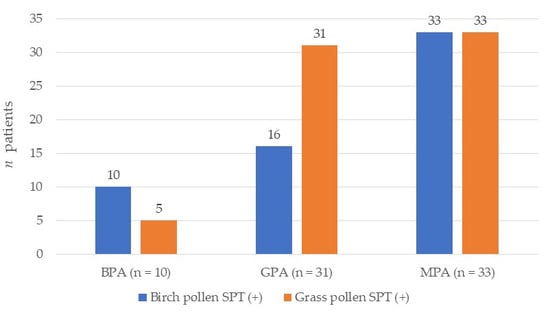
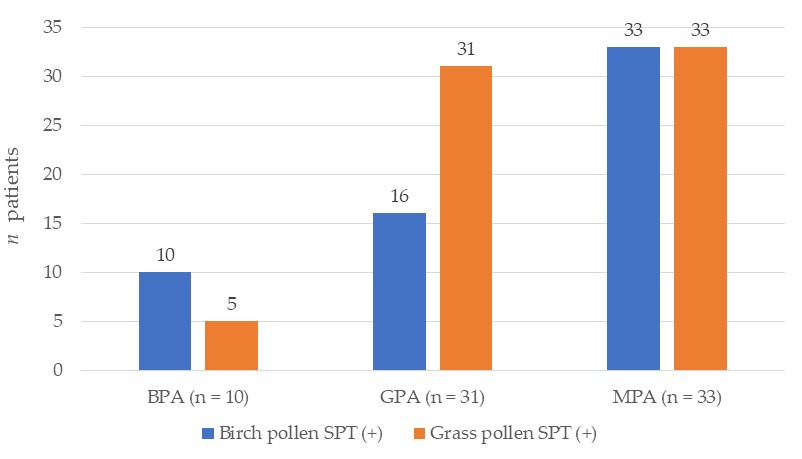
Based on the SPT for aeroallergens, monosensitized patients represented one out of 10 BPAs and three out of 31 GPAs. In the BPA and GPA groups, five out of 10 and 16 out of 31 were respectively co-sensitized to the other pollen, but without related symptoms (Figure 1).
Figure 1.
Prevalence of IgE sensitization to birch and grass pollen extracts, evaluated by skin-prick tests in the 3 groups of pollen-allergic patients (n = 74). Abbreviations: BPA, birch pollen-allergic patients; GPA, grass pollen-allergic patients; MPA, mixed pollen-allergic patients, SPTs, skin prick tests. Based on SPT, half of BPA are sensitized to grass pollen and half of GPA are sensitized to pollen of Betulaceae.
3.3. Serum IgE Sensitization Profile
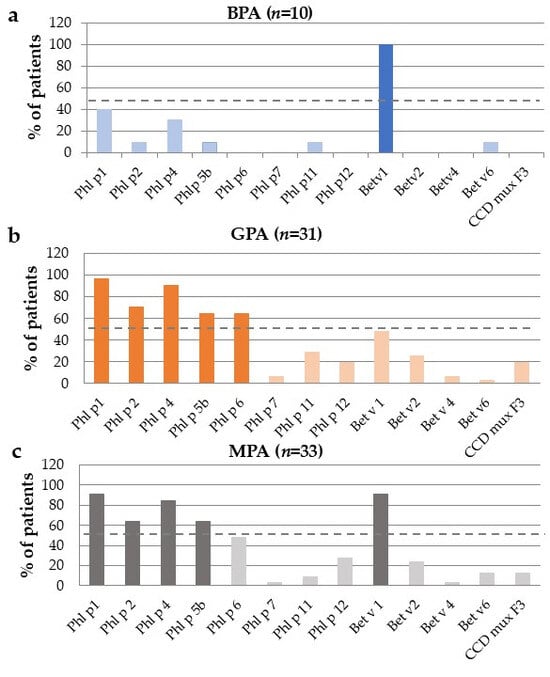
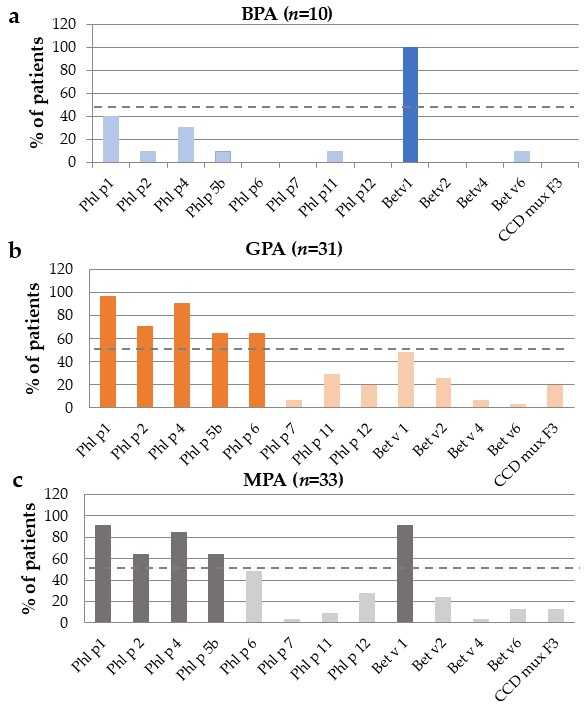
All BPA and GPA patients had positive sIgE for BP and TGP respectively, but 30% of BPA were sensitized to TGP and 54.8% of GPA had positive BP-IgE. In BPA, rBet v 1 was the only major allergen (100%), 40% were sensitized to rPhl p 1. In GPA, rPhl p 1, nPhl p 4, rPhl p 2, rPhl p 5b, and rPhl p 6 were major allergens and 48.4% of the patients were co-sensitized to rBet v 1. In MPA, rPhl p 1, rBet v 1, nPhl p 4, rPhl p 5b, and rPhl p 2 were major allergens while the prevalence of sensitization to rPhl p 6 was ~50% (Figure 2a–c).
Figure 2.
Prevalence of serum IgE sensitization to pollen allergen components in the 3 groups of pollen-allergic patients (n = 74): (a) birch pollen-allergic patients (BPA); (b) grass pollen-allergic patients (GPA); (c) mixed pollen-allergic patients (MPA). Abbreviation: CCD mux F3: cross-reactive carbohydrate determinant. The major allergens in each group appear darker. The dotted line represents 50% sensitization. The IgE assay was performed using ImmunoCAPTM.
Median BP-IgE and rBet v 1-IgE levels were significantly higher in BPA vs. GPA (p < 0.0005) without difference between the BPA and MPA groups. There was no sensitization to profilins (rBet v 2, rPhl p 12), or to CCD in BPA, whereas non-significant sensitization to isoflavone reductase (rBet v 6) was observed in 10% of BPA with low rBet v6-IgE levels. In GPA, sIgE levels for TGP, rPhl p 1, nPhl p 4, and rPhl p 6 were significantly higher than those of MPA and BPA, and those for rPhl p 2 and rPhl p 5b were higher than those of BPA, but similar to those of MPA. In GPA and MPA, the prevalence of sensitization to profilins based on the ImmunoCAPTM assay (rBet v 2, rPhl p 12) was ~24%, ~5% to polcalcins (rBet v 4, rPhl p 7), and 12 to 19% for CCD (in MPA and GPA, respectively) (Table 3 and Table S1).
Table 3.
sIgE levels and prevalence of serum IgE sensitization to pollens and allergen components (ImmunoCAPTM assay) in the 3 groups of pollen-allergic patients.
3.4. Food Allergy in Pollen-Allergic Patients
Pollen-allergic patients with PFAS, accounting for 43 out of 74 patients, were significantly older (Cohen’s d of −0.98, 95% CI [−1.5, 0.45], large effect size) with later onset of respiratory disease compared to patients without PFAS (p < 0.005 with a Cohen’s d −0.77, [−1.25, 0.29], medium to large effect size) (Table 4). The presence of active asthma was significantly higher in the population with PFAS (OR: 3.2, 95 CI [1.2, 8.3], p < 0.05]). The logistic regression analysis revealed the significant association between the development of PFAS with the presence of asthma (OR: 3.2, [1.1, 9.3], p < 0.05) and the age at inclusion (OR 1.1, [1, 1.1], p < 0.005). The presence of PFAS was independent of sex.
Table 4.
Respiratory phenotype and key results of biological tests of pollen-allergic patients with and without plant-related food allergy syndrome (PFAS).
In BPA, the most frequent allergenic foods were raw apple, hazelnut, and cherry, compared with hazelnut, Rosaceae, and kiwi in GPA (Table S2). Oral allergy syndrome was the dominant symptom of PFAS in the three groups (Table 2). In the groups with PFAS and subgroups with PFAS and asthma, respiratory symptoms (rhino-conjunctivitis, asthma, wheezing, dyspnea, and laryngeal edema) associated with food ingestion or peeling were significantly more prevalent among BPA (≥50%, p < 0.05). These were reported with apple, potato, carrot, soy milk and kiwi. All BPA and three of the four MPA with these symptoms were also asthmatic. More severe digestive symptoms (mainly epigastric discomfort, diarrhea, vomiting, and oropharyngeal edema) were rare, observed in only one asthmatic BPA and three asthmatic MPA, irrespective of the IgE sensitization to profilins. There were no reports of anaphylaxis for any of these patients.
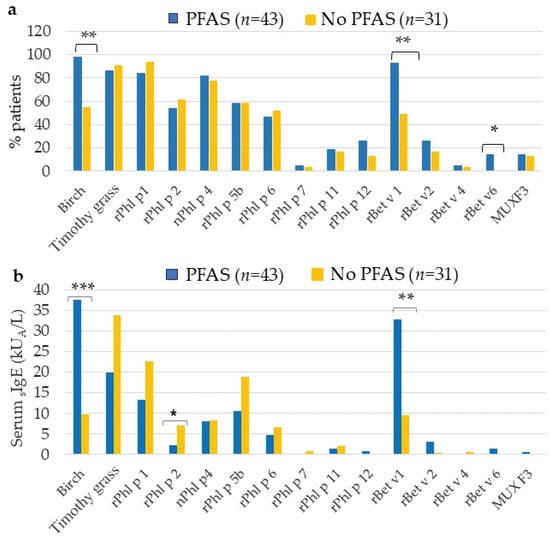
Pollen-allergic patients with PFAS had a significantly higher prevalence of positive BP-, rBet v 1-, rBet v 6-IgE (respective OR with [95% CI] and p-value—OR 34.6, [4.21–284], p = 0.001; OR 14.2 [3.62–55.9], p = 0.0001; and OR 10.9 [0.59–201.5], p = 0.10)—and significantly higher BP- and rBet v 1-, and lower rPhl p 2-IgE mean levels than patients without PFAS. A large effect size is observed for BP- and rBet v 1-IgE levels with Cohen’s d values of 0.99 and 0.91, respectively, and a medium effect size is observed for rPhl p2 (d, 0.60) (Table 4, Figure 3a,b). The prevalence of IgE sensitization to the thaumatin-like protein nAct d2, lipid transfer proteins and different classes of storage proteins—7S globulin, 11S globulin and 2S albumin—was not significantly different between patients with or without PFAS, and the levels remained low and not significantly different (Table S3).
Figure 3.
IgE sensitization to pollens and allergen components in pollen-allergic patients with or without pollen-related food allergy syndrome (n = 74). (a) prevalence; (b) mean levels of sIgE. The sIgE assay was performed by ImmunoCAPTM. Abbreviations: MUXF3, CCD cross-reactive carbohydrate determinant; PFAS, patients with pollen-related food allergy syndrome; No PFAS, patients without pollen-related food allergy syndrome. Statistical analysis: Student’s t test and Chi2; * p < 0.05; ** p < 0.0001; *** p < 0.00005.
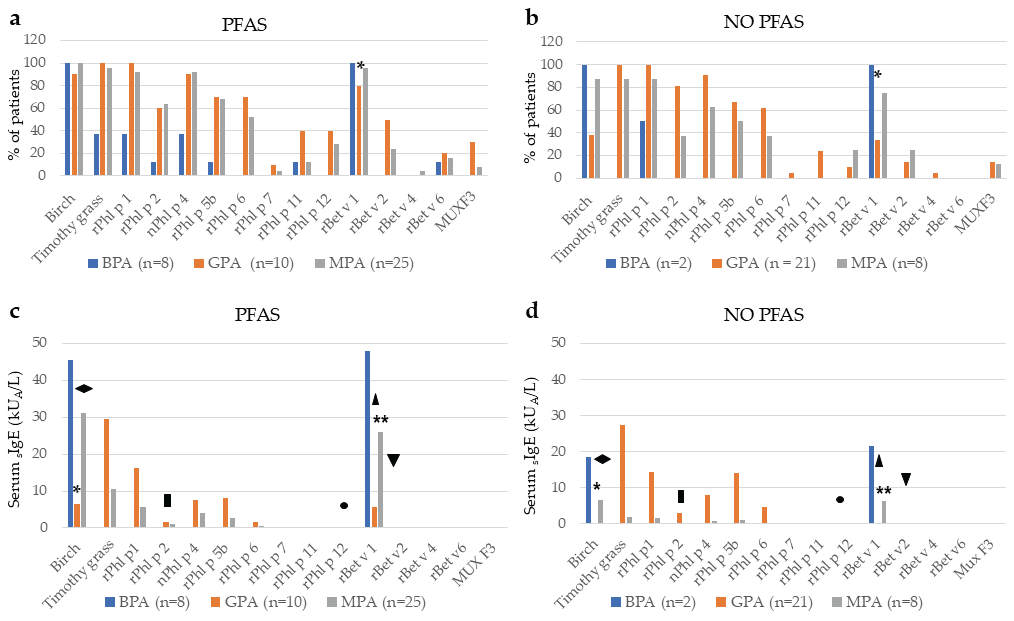
The BPA, GPA, and MPA groups were analyzed (Figure 4a–d) according to the presence or absence of PFAS, with comparison performed between subgroups. A larger prevalence of sensitization to rBet v 1 (OR 6.5, [1.09–38.6], p < 0.05), a higher level of BP and rBet v 1-IgE (Hedges’ g 0.61 and 0.60 respectively), and a discreetly but significantly higher level of rPhl p 12- and rBet v 2-IgE (Hedges’ g of 0.64 and 0.62, respectively) were observed in the GPA with PFAS compared to those without PFAS. The BP-IgE and rBet v 1-IgE levels were higher in MPA with PFAS vs. without PFAS (Hedges’s g of 0.80 and 0.68 respectively). In GPA, nine out of 10 patients with PFAS were sensitized to BP, including eight sensitized to rBet v 1 and four co-sensitized to profilins. GPA without PFAS had higher rPhl p 2-IgE levels than GPA with PFAS (Hedges’s g of 0.62).
3.5. Influence of the IgE Sensitization to Profilins With or Without Co-Sensitization to Bet v 1
In pollen-allergic patients sensitized to rBet v 1 without any sensitization to profilin (n = 43), the prevalence of asthma and the severity of rhinitis were significantly higher in BPA and MPA compared with GPA (Adjusted Cramer’s v for asthma: 0.37, [0.0–1] corresponding to a medium effect size). BPA and MPA had also higher levels of rBet v 1-IgE (Table S4). Although the prevalence of PFAS was statistically similar between the three groups, the respiratory symptoms due to plant food ingestion or peeling were more frequent in BPA (Adjusted Cramer’s v: 0.36,95 [0.0–1.0], medium effect size). The phenotype was similar between GPA and MPA co-sensitized to rBet v 1, rPhl p 12, and/or rBet v 2 (n = 13), In GPA sensitized to rBet v 1, there was no documented evidence that the co-sensitization to at least one profilin was associated with a higher risk of severe rhinitis, severe asthma, or PFAS compared with GPA not co-sensitized to profilin(s). The relatively high prevalence (80%) of PFAS in GPA co-sensitized to profilin(s) was also associated with a high rBet v 1-IgE level equivalent to the levels in MPA.
Figure 4.
IgE sensitization to pollens and allergen components in the 3 populations of pollen-allergic patients with or without pollen-related food allergy syndrome. (a) Prevalence in patients with PFAS; (b) prevalence in patients without PFAS; (c) median sIgE in patients with PFAS; (d) median sIgE levels in patients without PFAS. The sIgE assay was carried out by ImmunoCAPTM. Statistical analysis: Fisher’s exact and Mann–Whitney U tests; p-values *,  : <0.05; **: p = 0.05. Student’s t-test;
 : p-value < 0.05. Abbreviations: BPA, birch pollen-allergic patients; GPA, grass pollen-allergic patients; MPA, mixed pollen-allergic patients; MUXF3, CCD cross-reactive carbohydrate determinant; PFAS, patients with pollen-related food allergy syndrome; no PFAS, patients without pollen-related food allergy syndrome.
: <0.05; **: p = 0.05. Student’s t-test; : p-value < 0.05. Abbreviations: BPA, birch pollen-allergic patients; GPA, grass pollen-allergic patients; MPA, mixed pollen-allergic patients; MUXF3, CCD cross-reactive carbohydrate determinant; PFAS, patients with pollen-related food allergy syndrome; no PFAS, patients without pollen-related food allergy syndrome.
In GPA (Table 5), the co-sensitization to rBet v1 and two profilins [column A] significantly increased the prevalence of PFAS and OAS compared with that of GPA not sensitized to rBet v 1 and profilins [column E]. Respiratory disease severity was identical and rPhl p 1, nPhl p 4, rPhl p 5, and rPhl p 2 IgE levels were similar. GPA sensitized to rBet v 1 without co-sensitization to profilins [column B] had the same respiratory and food allergy phenotypes as GPA not sensitized to Bet v 1 [column E].
Table 5.
Respiratory and food allergy phenotypes of grass pollen-allergic patients according to the combination of IgE sensitization to rBet v 1 and profilin(s) (rBet v 2, rPhl p 12).
The phenotype and biological data for profilin(s) un- vs. mono- vs. polysensitized GPA patients are shown in Table 6. Polysensitized GPA tended to have a larger prevalence of PFAS (66.7%, p = 0.057), and a longer duration of PFAS and rhinitis; however, respiratory disease and PFAS severity was similar in the three groups. The prevalence of sensitization to rBet v 1 and rBet v 1-IgE levels were not significantly different. Profilin-polysensitized GPA did not have higher rPhl p 12- or rBet v 2 IgE levels compared with monosensitized GPA (n = 2, both sensitized to rBet v 2), but showed widely distributed values) (Table S5).
Table 6.
Comparison of the clinical and biological phenotypes of profilin(s) un-, mono- and poly-sensitized grass pollen-allergic patients (GPA).
3.6. Correlation Between Levels with Profilins IgE (rBet v 2 and rPhl p 12) in and Between Grass Pollen-Allergic Patients (GPA) and Mixed Pollen-Allergic Patients (MPA)
In GPA, Spearman’s rho rank correlation between rPhl p 12 and rBet v 2 was positive, statistically significant, and very large (rho = 0.99, S = 74.33, p < 0.001). In MPA, there was a positive correlation (Spearman’s rho rank correletaion) between rPhl p 12 and rBet v2, which was statistically significant and very large (rho = 0.85, S = 918.62, p < 0.001). To compare the two correlations, after Fisher’s transformation (z1 = 2.6467 and z2 = 1.2562, SE 0.2582), statistical analysis yielded a Z value of = 5.39 (considerably above 1.96, corresponding to a 5% error risk), p < 0.0001. There is a good correlation between rPhl p 2- and rBet v 2 IgE in each group, but the correlation is stronger in GPA compared to MPA.
4. Discussion
Our study explored the IgE sensitization profile of patients allergic to birch, grass, or mixed pollens, and the relevance of the molecular sensitization (to allergen components) to respiratory and pollen-related food allergy phenotypes.
In the Belgian population of patients strictly allergic to Betulaceae or to Poaceae with AARC, approximatively 50% of patients allergic to one pollen family had a positive SPT to the other pollen family. In BPA, no sensitization to profilins was detected. A major role of the IgE sensitization to Bet v 1 was observed to play a major role in the severity of respiratory allergic disease and cross-reactive PFAS, particularly in BPA and MPA. The prevalence of PFAS among GPA also seemed to be driven by sensitization to Bet v 1, but with less severe symptoms. Co-sensitization to profilins and Bet v 1 increased the prevalence of PFAS in GPA, but only when compared to patients not sensitized to either type of allergen. Profilin-polysensitized GPA patients tended to have a higher prevalence of PFAS, together with a longer duration of PFAS and rhinitis compared with profilin mono- and un-sensitized GPA but with similar rBet v 1 sensitization and symptom severity. We studied populations with real clinical pollen allergy, not solely based upon pollen sensitization, in line with the rationale for outpatient clinic assessments.
Among patients living in Belgium suffering from pollen-induced AARC, GPA and MPA were the main groups, as seen in other countries. As observed in other studies, seasonal rhinitis was the most frequent respiratory symptom in the three groups of pollen-allergic patients [4,5,6,7,25]. Patient distribution in the three groups was consistent with that of European studies [1,2,5,6,26,27,28]. During our consecutive recruitment process over a limited period, a small number of strictly BP-allergic patients were included. This was due to the growing trend of overlapping pollen seasons associated with a high prevalence of co-sensitization and co-allergy to the other pollen studied.
Our BPA and GPA were rarely (10%) monosensitized to aeroallergens. Different factors influenced this result, including age (mainly adults), geographical distribution of patients, and the number of skin-tested allergens in particular [6,29]. In vitro, we observed that sensitization to the other studied pollen was independent of cross-reactivity to profilins. Similar results were observed by others in Belgium [30]. This justified the important distinction in the study between pollen sensitization or allergy.
Analysis of the prevalence of IgE sensitization to BP and TGP allergens showed that our Belgian GPA population seemed closer to Southern populations for minor allergens (rPhl p 7, rPhlp 12, rBet v 2, and rBet v 4) [3,12,19,31,32,33,34]. It was different for the major grass pollen allergens. The rPhl p 2 and rPhl p 6 components were major allergens resulting from geographical distribution and the level of exposure to the variety of the grass species [3,25,32,34]. The prevalence of sensitization to rPhl p 1 and nPhl p 4 was comparable to that of populations in Central and Northern Europe [33,35]. The coexistence of several major allergens in GPA was consistent with a clinical allergy to TGP in a predominantly adult population [36]. The prevalence of sensitization to rBet v 1 in our GPA (48%) corresponded to intermediate European BP exposure [1,2,25,32,33]. As seen in Northern populations, all of our BPA had significant levels of BP-IgE and rBet v 1-IgE [4,34,37]. None were sensitized to profilins, CCD and polcalcins, as observed in other reports [4,25,32]. Another Belgian study, published in 2004 and performed on 33 BPA (same diagnostic criteria), documented the absence of sensitization to Bet v 2 and CCD [32]. The same authors reported another study in 2010, performed on 37 BPA, and observed a low prevalence of sensitization to polcalcin (5–10%) but the mono-allergy diagnosis to BP was not clear [38]. The lack of sensitization to profilins in our BPA does not appear to be due to the size of the population. Moreover, the clinical relevance of polcalcin remains controversial [19].
Studies have established a correlation between aeroallergen sIgE level and the probability of clinical relevance [36,39]. In our study, and as reported in others, this was observed for rBet v 1 in BPA and MPA. This link was suggested for rPhl p 1, rPhl p 5b, nPhl p 4 and rPhl p 6 in GPA while the median level of rBet v 1-IgE remained low [3,11,25,31,34]. In MPA, rBet v 1 was the first major allergen with the highest median IgE level followed by rPhl p 1, nPhl p 4 and rPhl p 5b at levels nonetheless lower than in GPA [25].
The rhinitis was significantly more severe, and asthma more prevalent in BPA and MPA compared to GPA patients sensitized to rBet v 1 with no co-sensitization to profilins according to significantly higher levels of rBet v 1-IgE in BPA and MPA. This could result from the increased pollination of birch trees, length of pollination of cross-reactive Betulaceae and larger amounts of breathable fine particles containing the highly inflammatory Bet v 1 allergen [4,7,9,10,34].
In our study, 58% of the pollen-allergic population with respiratory symptoms had PFAS (80% of BAP, 76% of MAP and only 32% of GPA). Our PFAS population (largely represented by BPA and MPA) was also older, with later onset of respiratory disease compared to those without PFAS. These findings were not due to effect size (large and medium to large, respectively). These results were not observed in Southern Europe where plant food allergies were more often linked to profilin(s) or nsLTP sensitization [17]. Logistic regression analyses documented the increased and significant risk of developing PFAS among older and asthmatic patients with a pollen allergy (and vice versa). As reported by other authors, our study did not correlate this finding with the severity or a longer duration of respiratory symptoms [13,17,40]. That could result from the absence of association with other allergic respiratory diseases in our population. The OAS was the most frequent clinical symptom of PFAS in the three groups (>90%). PFAS patients also displayed higher IgE levels for BP and rBet v1 than patients without PFAS, in relation to the higher proportion of patients sensitized and allergic to BP and rBet v 1, corroborating previous reports [4,40]. Although the rBet v 1-IgE levels remained fairly low in GPA, the prevalence of sensitization to rBet v 1 was significantly higher in GPA with PFAS (with a significantly higher level of BP-IgE) compared to those without PFAS. Profilin IgE levels in GPA were lower compared to rBet v 1, and no other relevant allergens (e.g., LTP, TLP, storage proteins, isoflavone reductase) were identified using the ImmunoCAPTM ISAC assay. No systemic reactions were reported, in contrast to Southern populations with more frequent reports of sensitization to nsLTP [17]. Food anaphyactic reactions due to Bet v 1-IgE sensitization in BPA have been progressively recorded since the beginning of the 21st century in our country [41]; the shortened recruitment period and the small size of our population were probably limiting factors. A few cases of angioedema and asthma symptoms have also been further observed in MPA and BPA patients ingesting or peeling cherries, carrots, and apples, or consuming soy milk, in line with previous reports [41,42,43]. The implicated foods (apple, other Rosaceae, kiwi) identified by our GPA with PFAS were not typically those reported by GPA with cross-reactive food allergy in relation to IgE sensitization to profilins, i.e., tomato, paprika, orange, melon, banana, and watermelon [15,17,44]. This later finding further reinforces the relevance of PR-10 proteins in GPA patients with PFAS.
Respiratory symptom severity in pollen-allergic patients was not influenced by the sensitization to profilins, in contrast to previous studies [15,20,21]. This was specifically documented for profilin-polysensitized GPA even though they tended to have a longer duration of rhinitis. However, GPA co-sensitized to rBet v 1 and at least two profilins had PFAS more often than those who were not co-sensitized, and symptoms were not more severe. There was no evidence linking the development of profilin sensitization to GP allergy severity. However, our co-sensitized rBet v 1-profilin GPA population was too small to confirm any relationship with higher rBet v 1-IgE values. The latter could have then also explained the increased prevalence of PFAS.
In the profilin-sensitized GAP, the number of patients was insufficient to perform statistical analysis. There was no argument to suspect a higher level of rBet v2-rPhl p 12-IgE in profilin-polysensitized patients. We noted that the profilin monosensitization in GAP was linked to the presence of rBet v 2 IgE in two patients highly sensitized to rBet v 1 too. It would be interesting to observe on larger GAP populations if the rBet v 2 monosensitization is observed only in patients with high rBet v 1 and/or BP IgE levels, and if Bet v 2, in the absence of cross-reactivity to other profilin(s), is clinically more relevant. We cannot rule out the possibility that this was due to chance. The correlation between the values of rBet v 2-IgE and rPhl p12-IgE in GPA was excellent and better than in MPA. The significant correlations reflect cross-reactivity between profilins, but the comparison of the two correlations revealed a significant difference suggesting a higher power of sensitization from Bet v 2 in GPA. The rBet v2-IgE level was higher in GPA than in MPA while the BP-IgE levels were largely higher in MPA than GPA.
The level of rPhl p 2 IgE was lower in pollen-allergic patients with PFAS including GPA, even though rPhl p2 was a major allergen in GPA. However, our population was insufficient (medium effect size) to document significant features associated with the combination low rPhl p 2-IgE and the presence of PFAS. All of these findings need to be confirmed by larger studies in the future.
Limitations of the study:
- -
- The short inclusion period with reduced populations may have limited the identification of sensitization to minor allergens, particularly in BPA, together with the number of severe clinical reactions in patients with PFAS. The small sample size of the populations limited the power of statistical analyses (1-β below 0.8), reducing the ability to detect a real effect. The non-statistically significant differences observed in these populations could become significant in larger groups. For the statistically different results with medium-large to large effect sizes, the observed differences were scientifically significant.
- -
- The clinical implications of the IgE sensitization to profilins may have been underestimated due to the limited populations and non-significant results.
- -
- The study results offer a snapshot of the situation in 2010–2011 period. A contemporary study with the same design on larger populations could potentially lead to different results (particularly in terms of profilins sensitization, severity of symptoms, and identification of other major allergens). Our changing times and the increasing effects of climate change could be associated with modifications in sensitization profiles.
5. Conclusions
This study showed that the severity of rhinitis, together with the prevalence of asthma and respiratory symptoms associated with food ingestion/peeling all increased in birch- or mixed pollen-allergic patients sensitized to Bet v 1. Conversely, profilin sensitization, observed at low levels, was only associated with a higher prevalence of food allergy in GPA patients co-sensitized to Bet v1, but there was no correlation with symptom severity.
Supplementary Materials
The following supporting information can be downloaded at: https://www.mdpi.com/article/10.3390/cells15201907/s1, Table S1. Statistical analysis performed on the sIgE levels to pollen allergens and their allergen components (ImmunoCAPTM assay) between the 3 groups of pollen-allergic patients. Abbreviations: BPA, birch pollen-allergic patients; CCD, cross-reactive carbohydrate determinant; GPA, grass pollen-allergic patients; MPA, mixed (birch/grass) pollen-allergic patients; NS, not significant. Statistical tests used: Kruskall-Wallis and Mann-Whitney U tests. Significant p-values (p ≤ 0.05) are shown in bold font. Near-significant p-value are underlined. The median values of sIgE levels are expressed in Table 3. Table S2. Manifestations of plant food allergy spontaneously reported by the patients according to the nature of the pollen allergy and food. Abbreviations: AARC: Allergic asthma and/or rhino-conjunctivitis; BPA, birch pollen-allergic patients; D, other digestive symptoms; GPA, grass pollen-allergic patients; MPA, birch and grass pollen-allergic patients; OAS, oral allergy syndrome; R, respiratory symptoms; U, contact urticaria. Exposure to raw food occured via the oral, respiratory or percutaneous route. Results are expressed in % for each group of pollen-allergic patients. Nuts include walnuts and hazelnuts. The other Rosaceae include pear, plum, apricot. The other digestive symptoms are oropharyngeal edema, epigastralgia, diarrhea, nausea and vomiting or abdominal cramp. The respiratory symptoms are cough, dyspnea, wheezing, chest tightness or laryngeal edema. Table S3. Prevalence and level of sIgE to allergen components for Thaumatin-Like, Cupin and Prolamin superfamilies (ImmunoCAP® ISAC 103) in pollen-allergic patients with or without plant-related food allergy syndrome. Abbreviations: NS, not significant; PFAS, plant-related food allergy syndrome. The statistical analysis is performed with parametric tests: Chi2 and Student′s t tests. The IgE sensitization is defined by a level of sIgE > 0.3 ISU. Table S4. Influence of the IgE sensitization to rBet v 1 and at least 1 profilin (rBet v 2 and/or rPhl p 12) on the phenotype of the 3 groups of pollen-allergic patients. Abbreviation: BPA, birch pollen-allergic population; GPA, grass pollen-allergic population; MPA, mixed (birch/grass) pollen-allergic population; OAS, oral allergy syndrome, PFAS, Pollen-related food allergy syndrome. Positive sensitization was defined by a level of sIgE > 0.35 kUA/L (ImmunoCAPTM assay). Age and sIgE results are expressed by median [25–75 interquartile range] values. Significant p-value (p ≤ 0.05) are presented in bold font. Statistical analysis was performed with Fisher’s exact and Kruskal-Wallis or Mann-Whitney U tests.
Author Contributions
Conceptualization, F.P. and C.P.; methodology, F.P. and C.P.; software, F.P.; validation, F.P. and C.P.; formal analysis, F.P. and E.F.L.; investigation, F.P., C.H., C.S., B.B., M.L. and C.P.; resources, F.P., C.H., C.S., B.B., M.L. and C.P.; data curation, F.P.; writing—original draft preparation, F.P.; writing—review and editing, F.P. and C.P., visualization, F.P., supervision, C.P.; project administration, F.P., funding acquisition, F.P. and C.P. All authors have read and agreed to the published version of the manuscript.
Funding
This research received no external funding.
Institutional Review Board Statement
The study was approved by the Ethical Committees of the two Belgian academic centers (Ref. 2010/02MAR/071 for the Comité d’Ethique Hospitalo-facultaire des Cliniques Universitaires Saint Luc et UCLouvain as the central board and Ref. 30/2010 for the Comité d’Ethique hospital-facultaire central, Site of Godinne-UNamur).
Informed Consent Statement
Written informed consent was obtained from all subjects (or their legal representant) involved in the study.
Data Availability Statement
Data are available on request from the corresponding author due to the language used for the construction of the database.
Acknowledgments
This study was supported by the Centre de l’Allergie, Cliniques Universitaires Saint-Luc, 1200 Brussels (limited to the financial charge of ImmunoCAPTM and ImmunoCAPTM Isac analyses). The authors thank Thermo Fisher Diagnostics Phadia Belgium, NV BE-1702 Groot-Bijgaarden, for the technical support, as well as JL Gala, PhD (Experimental and Clinical Research Institute (IREC), Center for Applied Molecular Technologies UCLouvain, 1200 Brussels, Belgium) for the technical facility provided for the ImmunoCAP® ISAC assay.
Conflicts of Interest
The authors declare no conflicts of interest.
Abbreviations
The following abbreviations are used in this manuscript:
| AARC | allergic rhinitis and/or conjunctivitis with/without asthma |
| BP | birch pollen |
| BPA | birch pollen-allergic patient(s) |
| CCD or CCD mux F3 | cross-reactive carbohydrate determinant |
| GP | grass pollen |
| GPA | grass pollen-allergic patient(s) |
| MPA | mixed pollen-allergic patient(s) |
| OAS | oral allergy syndrome |
| PFAS | pollen-related food allergy syndrome |
| PFASs | pollen-related food allergy symptoms |
| Phl p | Phleum pratense |
| SPT | skin-prick test |
| SPPT | skin prick-prick test |
| TGP | Timothy grass pollen |
References
- D’Amato, G.; Cecchi, L.; Bonini, S.; Nunes, C.; Annesi-Maesano, I.; Behrendt, H.; Liccardi, G.; Popov, T.; van Cauwenberge, P. Allergenic pollen and pollen allergy in Europe. Allergy 2007, 62, 976–990. [Google Scholar] [CrossRef] [Scilit]
- Smith, M.; Jäger, S.; Berger, U.; Sikoparija, B.; Hallsdottir, M.; Sauliene, I.; Bergmann, K.-C.; Pashley, C.H.; de Weger, L.; Majkowska-Wojciechowska, B.; et al. Geographical and temporal variations in pollen exposure across Europe. Allergy 2014, 69, 913–923. [Google Scholar] [CrossRef] [Scilit]
- García-Mozo, H. Poaceae pollen as the leading aeroallergen worldwide: A review. Allergy 2017, 72, 1849–1858. [Google Scholar] [CrossRef] [Scilit]
- Biedermann, T.; Winther, L.; Till, S.J.; Panzner, P.; Knulst, A.; Valovirta, E. Birch pollen allergy in Europe. Allergy 2019, 74, 1237–1248. [Google Scholar] [CrossRef] [Scilit]
- Burbach, G.J.; Heinzerling, L.M.; Edenharter, G.; Bachert, C.; Bindslev-Jensen, C.; Bonini, S.; Bousquet, J.; Bousquet-Rouanet, L.; Bousquet, P.J.; Bresciani, M.; et al. GA(2)LEN skin test study II: Clinical relevance of inhalant allergen sensitizations in Europe. Allergy 2009, 64, 1507–1515. [Google Scholar] [CrossRef] [Scilit]
- Blomme, K.; Tomassen, P.; Lapeere, H.; Huvenne, W.; Bonny, M.; Acke, F.; Bachert, C.; Gevaert, P. Prevalence of Allergic Sensitization versus Allergic Rhinitis Symptoms in an unselected Population. Int. Arch. Allergy Immunol. 2013, 160, 200–207. [Google Scholar] [CrossRef] [Scilit]
- Guilbert, A.; Simons, K.; Hoebeke, L.; Packeu, A.; Hendrickx, M.; De Cremer, K.; Buyl, R.; Coomans, D.; Van Nieuwenhuyzen, A. Short-Term Effect of Pollen and Spore Exposure on Allergy Morbidity in the Brussels-Capital Region. EcoHealth 2016, 13, 303–315. [Google Scholar] [CrossRef] [Scilit]
- Shea, K.M.; Truckner, R.T.; Weber, R.W.; Peden, D.B. Climate change and allergic diseases. J. Allergy Clin. Immunol. 2008, 122, 443–453. [Google Scholar] [CrossRef] [Scilit]
- D’Amato, G.; Cecchi, L.; D’Amato, M.; Liccardi, G. Urban air pollution and climate change as environmental risk factors of respiratory allergy. J. Investig. Allergol. Clin. Immunol. 2010, 20, 95–102. [Google Scholar]
- Venkatesan, S.; Zare, A.; Stevanovic, S. Pollen and sub-pollen particles: External interaction shaping the allergic potential of pollen. Sci. Total Environ. 2024, 926, 171593. [Google Scholar] [CrossRef] [Scilit]
- Twardosz-Kropfmüller, A.; Singh, M.B.; Niederberger, V.; Horak, F.; Kraft, D.; Spitzauer, S.; Valenta, R.; Swoboda, I. Association of allergic patients’ phenotypes with IgE reactivity to recombinant pollen marker allergens. Allergy 2010, 65, 296–303. [Google Scholar] [CrossRef] [Scilit]
- Asero, R.; Antonicelli, L.; Arena, A.; Bommarito, L.; Caruso, B.; Crivellaro, M.; De Carli, M.; Della Torre, F.; Heffler, E.; Lodi Rizzini, F.; et al. EpidemAAITO: Features of food allergy in Italian adults attending allergy clinics: A multi-centre study. Clin. Exp. Allergy 2009, 39, 547–555. [Google Scholar] [CrossRef] [Scilit]
- Cuesta-Herranz, J.; Barber, D.; Blanco, C.; Cistero-Bahima, A.; Crespo, J.F.; Fernández-Rivas, M.; Fernández-Sánchez, J.; Florido, J.F.; Ibáñez, M.D.; Rodriguez, R.; et al. Differences among Pollen-Allergic Patients with and without Plant Food Allergy. Int. Arch. Allergy Immunol. 2010, 153, 182–192. [Google Scholar] [CrossRef] [Scilit]
- Burney, P.G.J.; Potts, J.; Kummeling, I.; Mills, E.N.C.; Clausen, M.; Dubakiene, R.; Barreales, L.; Fernandez-Perez, C.; Fernández-Rivas, M.; Le, T.M.; et al. The prevalence and distribution of food sensitization in European adults. Allergy 2014, 69, 365–371. [Google Scholar] [CrossRef] [Scilit]
- Alvarado, M.I.; Jimeno, L.; De La Torre, F.; Boissy, P.; Rivas, B.; Lázaro, M.J.; Barber, D. Profilin as a severe food allergen in allergic patients overexposed to grass pollen. Allergy 2014, 69, 1610–1616. [Google Scholar] [CrossRef] [Scilit]
- Kondo, Y.; Urisu, A. Oral allergy syndrome. Allergol. Int. 2009, 58, 485–491. [Google Scholar] [CrossRef] [Scilit]
- Lipp, T.; Acar Sahin, A.; Aggelidis, X.; Arasi, S.; Barbalace, A.; Bourgoin, A.; Bregu, B.; Brighetti, A.A.; Caeiro, E.; Sozmen, S.C.; et al. Heterogeneity of pollen food allergy syndrome in seven Southern European countries. The @IT.2020 multicenter study. Allergy 2021, 76, 3041–3052. [Google Scholar] [CrossRef] [Scilit]
- Barber, D.; De la Torre, F.; Feo, F.; Florido, F.; Guardia, P.; Moreno, C.; Quiralte, J.; Lombardero, M.; Villalba, M.; Salcedo, G.; et al. Understanding patient sensitization profiles in complex pollen areas: A molecular epidemiological study. Allergy 2008, 63, 1550–1558. [Google Scholar] [CrossRef] [Scilit]
- Asero, R.; Monsalve, R.; Barber, D. Profilin sensitization detected in the office by skin prick test: A study of prevalence and clinical relevance of profilin as a plant food allergen. Clin. Exp. Allergy 2008, 38, 1033–1037. [Google Scholar] [CrossRef] [Scilit]
- Högerle, C.; San Nicolo, M.; Gellrich, D.; Eder, K.; Gröger, M. Clinical Relevance of Profilin Sensitization Concerning Oral Allergy Syndrome in Birch Pollen Sensitized Patients. J. Asthma Allergy 2022, 15, 249–255. [Google Scholar] [CrossRef] [Scilit]
- Ruiz-Hornillos, J.; López-Matas, M.A.; Berges Jimeno, P.; Henriquez, A.; Blanco, S.; Seoane-Rodriguez, M.; Mahillo, I.; Carnés, J. Profilin is a marker of severity in allergic respiratory disesases. Allergy 2020, 75, 853–861. [Google Scholar] [CrossRef] [Scilit]
- Rodriguez del Rio, P.; Diaz-Perales, A.; Sánchez-Garcia, S.; Escudero, C.; Ibáñez, M.D.; Méndez-Brea, P. Profilin, a Change in the Paradigm. J. Investig. Allergol. Clin. Immunol. 2018, 28, 1–12. [Google Scholar] [CrossRef] [Scilit]
- Bousquet, J.; Khaltaev, N.; Cruz, A.A.; Denburg, J.; Fokkens, W.J.; Togias, A.; Zuberbier, T.; Baena-Cagnani, C.E.; Canonica, G.W.; van Weel, C.; et al. Allergic Rhinitis and its Impact on Asthma (ARIA) 2008 update (in collaboration with the World Health Organization, GA(2)LEN and AllerGen). Allergy 2008, 63, 8–160. [Google Scholar] [CrossRef] [Scilit]
- Global Initiative for Asthma (GINA). Global Strategy for Asthma Management and Prevention; Global Initiative for Asthma (GINA): Bethesda, MD, USA, 2010; Available online: https://fr.scribd.com/document/86655898/Asthma-Guideline-GINA-2010 (accessed on 9 December 2010).
- Ghunaim, N.; Grönlund, H.; Kronqvist, M.; Grönneberg, R.; Söderström, L.; Ahlstedt, S.; van Hage-Hamsten, M. Antibody Profiles and self-reported symptoms to pollen-related food allergens in grass pollen-allergic patients from northern Europe. Allergy 2005, 60, 185–191. [Google Scholar] [CrossRef] [Scilit]
- Bruffaerts, N.; De Smedt, T.; Delcloo, A.; Simons, K.; Hoebeke, L.; Verstraeten, C.; Van Nieuwenhuyse, A.; Packeu, A.; Hendrickx, M. Comparative long-term trend analysis of daily weather conditions with daily pollen concentrations in Brussels, Belgium. Int. J. Biometeorol. 2018, 62, 483–491. [Google Scholar] [CrossRef] [Scilit]
- Bousquet, P.-J.; Chinn, S.; Janson, C.; Kogevinas, M.; Burney, P.; Jarvis, D. Geographical variation in the prevalence of positive skin tests to environmental aeroallergens in the European Community Respiratory Health Survey I. Allergy 2007, 62, 301–309. [Google Scholar] [CrossRef] [Scilit]
- Newson, R.B.; van Ree, R.; Forsberg, B.; Janson, C.; Lötvall, J.; Dahlén, S.-E.; Toskala, E.M.; Baelum, J.; Brozek, G.M.; Kasper, L.; et al. Geographical variation in the prevalence of sensitization to common aeroallergens in adults: The GA2LEN survey. Allergy 2014, 69, 643–651. [Google Scholar] [CrossRef] [Scilit]
- Charpin, D.; Ramadour, M.; Lavaud, F.; Raherison, C.; Caillaud, D.; de Blay, F.; Pauli, G.; Annesi-Maesano, I. Climate and Allergic Sensitization to Airborne Allergens in the General Population: Data from the French Six Cities Study. Int. Arch. Allergy Immunol. 2017, 172, 236–241. [Google Scholar] [CrossRef] [Scilit]
- Ebo, D.G.; Hagendorens, M.M.; Bridts, C.H.; De Clerck, L.S.; Stevens, W.J. Sensitization to cross-reactive carbohydrate determinants and the ubiquitous protein profilin: Mimickers of allergy. Clin. Exp. Allergy 2004, 34, 137–144. [Google Scholar] [CrossRef] [Scilit]
- Tripodi, S.; Frediani, T.; Lucarelli, S.; Macri, F.; Pingitore, G.; Di Rienzo Businco, A.; Dondi, A.; Pansa, P.; Ragusa, G.; Asero, R.; et al. Molecular profiles of IgE to Phleum pratense in children, with grass pollen allergy: Implications for specific immunotherapy. J. Allergy Clin. Immunol. 2012, 129, 834–839. [Google Scholar] [CrossRef] [Scilit]
- Rossi, R.E.; Monasterolo, G.; Monasterolo, S. Measurement of IgE antibodies against purified grass-pollen allergens (Phl p 1, 2, 3, 4, 5, 6, 7, 11 and 12) in sera of patients allergic to grass pollen. Allergy 2001, 56, 1180–1185. [Google Scholar] [CrossRef] [Scilit]
- Panzner, P.; Vachová, M.; Vitovcová, P.; Brodská, P.; Vlas, T. A Comprehensive Analysis of Middle European Molecular Sensitization Profiles to Pollen Allergens. Int. Arch. Allergy. Immunol. 2014, 164, 74–82. [Google Scholar] [CrossRef] [Scilit]
- Movérare, R.; Kosunen, T.U.; Haahtela, T. Change in the Pattern of IgE Reactivity to Timothy Grass and Birch Pollen Allergens Over a 20-Year Period. J. Investig. Allergol. Clin. Immunol. 2006, 16, 274–278. [Google Scholar]
- Niederberger, V.; Laffer, S.; Fröshl, R.; Kraft, D.; Rumpold, H.; Kapiotis, S.; Valenta, R.; Spitzauer, S. IgE antibodies to recombinant pollen allergens (Phl p 1, Phl p 2, Phl p 5, and Bet v 2) account for a high percentage of grass pollen-specific IgE. J. Allergy Clin. Immunol. 1998, 101, 258–264. [Google Scholar] [CrossRef] [Scilit]
- Schäfer, T.; Hoelscher, B.; Adam, H.; Ring, J.; Wichmann, H.E.; Heinrich, J. Hay fever and predictive value of prick test and specific IgE antibodies: A prospective study in children. Pediatr. Allergy Immunol. 2003, 14, 120–129. [Google Scholar] [CrossRef] [Scilit]
- Movérare, R.; Westritschnig, K.; Svensson, M.; Hayek, B.; Bende, M.; Sorva, R.; Haahtela, T.; Valenta, R.; Elfman, L. Different IgE Reactivity Profiles in Birch Pollen-Sensitive Patients from Six European Populations Revealed by Recombinant Allergens: An Imprint of Local Sensitization. Int. Arch. Allergy Immunol. 2002, 128, 325–335. [Google Scholar] [CrossRef] [Scilit]
- Ebo, D.G.; Bridts, C.H.; Verweij, M.M.; De Knop, K.J.; Hagendorens, M.M.; De Clerck, L.S.; Stevens, W.L. Sensitization profiles in birch pollen-allergic patients with and without oral allergy syndrome to apple: Lessons from multiplexed component-resolved allergy diagnosis. Clin. Exp. Allergy 2010, 40, 339–347. [Google Scholar] [CrossRef] [Scilit]
- Hatzler, L.; Panetta, V.; Lau, S.; Wagner, P.; Bergmann, R.L.; Illi, S.; Bergmann, K.E.; Keil, T.; Hofmaier, S.; Rohrbach, A.; et al. Molecular spreading and predictive value of preclinical IgE response to Phleum pratense in children with hay fever. J. Allergy Clin. Immunol. 2012, 130, 894–901. [Google Scholar] [CrossRef] [Scilit]
- Asero, R.; Massironi, F.; Velati, C. Detection of prognostic factors for oral allergy syndrome in patients with birch pollen hypersensitivity. J. Allergy Clin. Immunol. 1996, 97, 611–616. [Google Scholar] [CrossRef] [Scilit]
- Van der Brempt, X.; Sabouraud-Leclerc, D. Le syndrome oral (SO) est-il toujours bénin? Rev. Fr. Allergol. 2019, 59, 177–179. [Google Scholar] [CrossRef] [Scilit]
- Kleine-Tebbe, J.; Wangorsch, A.; Vogel, L.; Crowell, D.; Haustein, U.-F.; Vieths, S. Severe oral allergy syndrome and anaphylactic reactions caused by a Bet v 1 related PR-10 protein in soybean, SAM22. J. Allergy Clin. Immunol. 2002, 110, 797–804. [Google Scholar] [CrossRef] [Scilit]
- Senders, A.S.; Ruiz Oropeza, A.; Kristensen, B.; Eller, E.; Kjaer, H.F.; Bindslev-Jensen, C.; Mortz, C.G. Food-dependant exercise-induced anaphylaxis due to almond in a PR-10-sensitized patient. J. Allergy Clin. Immunol. Pract. 2018, 6, 683–684. [Google Scholar] [CrossRef] [Scilit]
- Asero, R.; Mistrello, G.; Roncarolo, D.; Amato, S.; Zanoni, D.; Barocci, F.; Caldironi, G. Detection of clinical markers of sensitization to profilin in patients allergic to plant-derived-foods. J. Allergy Clin. Immunol. 2003, 112, 427–432. [Google Scholar] [CrossRef] [Scilit]

Disclaimer/Publisher’s Note: The statements, opinions and data contained in all publications are solely those of the individual author(s) and contributor(s) and not of MDPI and/or the editor(s). MDPI and/or the editor(s) disclaim responsibility for any injury to people or property resulting from any ideas, methods, instructions or products referred to in the content. |
© 2026 by the authors. Licensee MDPI, Basel, Switzerland. This article is an open access article distributed under the terms and conditions of the Creative Commons Attribution (CC BY) license.